A Daily History of Holes, Dots, Lines, Science, History, Math, Physics, Art, the Unintentional Absurd, Architecture, Maps, Data Visualization, Blank and Missing Things, and so on. |1.6 million words, 7500 images, 4.9 million hits| Press & appearances in The Times, Le Figaro, Mensa, The Economist, The Guardian, Discovery News, Slate, Le Monde, Sci American Blogs, Le Pont, and many other places… 5000+ total posts since 2008.

Category: Technology, History of

  • Automation and Robots: Iron Man, an Automated Bowery Hotel, and a Fortune Teller (1932)

    JF Ptak Science Books   2771

    “All things are leading to Man’s Machine Made Millenium”–maxim by Hudson Maxim
    Pop Mech 1932 robot mechanized iron man _3_There are a number of posts to this blog on the coming of the “robotic” and the modern automatic age(s), though they are mostly concerned with the period from anthropomorphic steam preachers of 1840 to the 1930s. Admittedly there’s not a lot of “robots” in the 19th c lit but there are some; and of course there’s a fair amount of basic automation that takes place in the 19th c as well—but things really start to heat up in the 20th c. (It should be remember that just after the turn of the 19th c that “Ned Ludd’s” followers weren’t what they are confused with being today—they weren’t resistant to technology and innovation, so long as those new machines didn’t take away their means of supporting themselves, which was their real bone of contention. After all, there have been automated machines that have taken jobs from folks going back thousands of years. All of that is a huge story, and today all I’m concerned with in the present entry is robotics (such as they were) and automation (ditto) for an article and a couple of picture-posts from Popular Mechanics for 1932.

    And by “robots” I’m not talking about the the sophistication of AI and the Singularity; mainly they are posts about the first or early ventures in replacing some aspect of human activity with a machine. The Pop Mech article that addresses this in very simple terms: “The Automatic Age, Millions in Pennies” appearing in the October issue, does come close to using the term and concept of “automation” here, though that word does not make an official appearance in this context for another 16 years. The discussion in the article is on curious applications for machines, like penny fortune teller dolls, automated public hair dryers, and “drink dialers” (after the deposit of a nickel you would use a telephone dialer to order your favorite beverage). There’s also some recognition of an automatic grocery which was “devoid of time-wasting conversation” with store clerks, the machine also being equipped with a “mechanical brain” to make change as your dropped in your dime for some 5-cent canned corn. Also among the moderns here were “pin” (pinball machines of a sort) games, automatic scales, and a very odd phrenological device. Plus: there’s a short note on the first coin-operated hotel, this one being opened on the Bowery…The Bowery, the home of America’s “Forgotten Men”. If you dropped two bits into the automated room opener you were allowed into a “tiny room” where the renter was allowed a “cot, hooks, hangers, a chair, a mirror, wash basin, soap, a towel, and privacy for the night”.
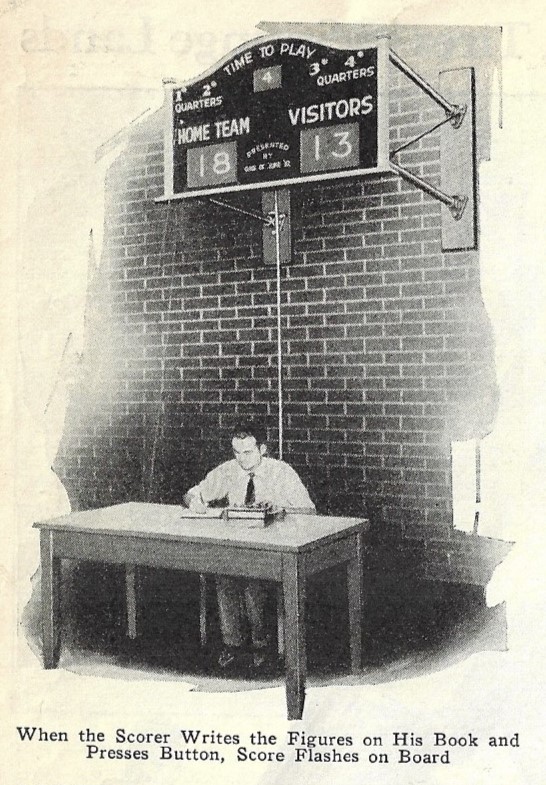
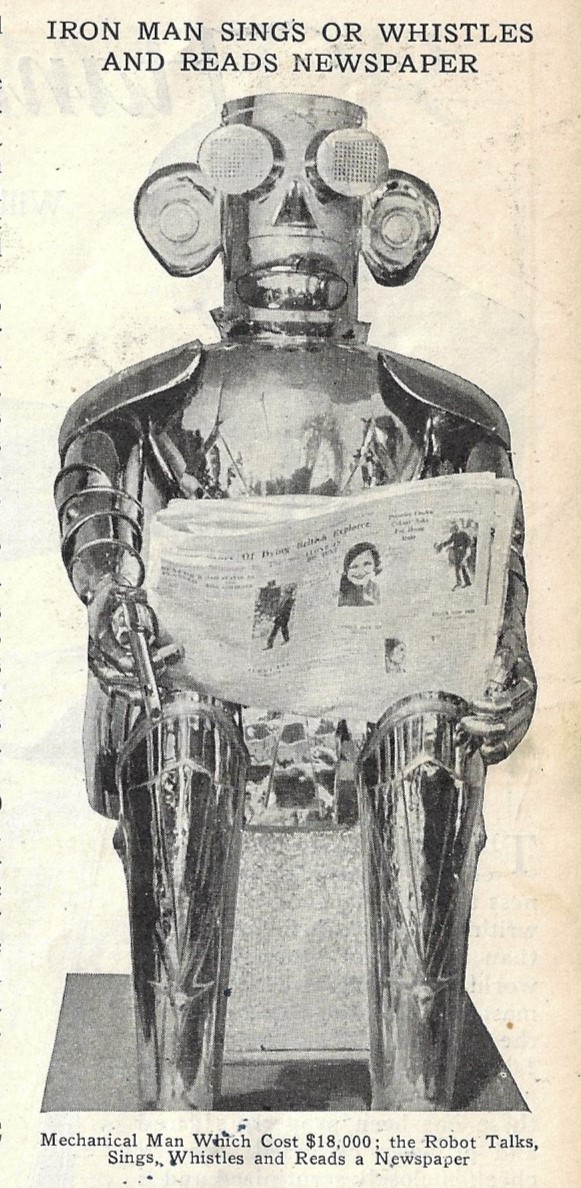
    Pop Mech 1932 Robot mechanized basketball _2_Following on the heels of this article was a short notice on “reading and whistling” “Iron Man”, which just looks sad. And then, but to a lesser extent, there was another automated man, of a sort. A machine that eliminated the need for a person to run a scoreboard at a basketball game. A small wink towards the future, though at the time this was a lovely and wonderful small innovation.

    In any event I was a little surprised to see the attention paid I this half year volume of Popular Mechanics to “the automatic present”.

    Notes:

    Here’s a few definitions of “automation” from the Oxford English Dictionary:

    1948: American Machinist 21 Oct. in McGraw-Hill Encyclopedia of Science and Technology.  I. 676/2. “Automation, the art of applying mechanical devices to manipulate work pieces into and out of equipment, turn parts between operations, [etc.].”

    1953: Manchester Guardian Weekly 3 Dec. 15/2  “ Many factories are spending large sums on ‘automation’, that is, the adoption of automatic machines working together with little labour.”

    1660:  H. More Explan. Grand Myst. Godliness ii. iii. 37   “God will not let the great Automaton of the Universe be so imperfect. (first appearance 1616 though this.”

    Also this, assigning a more definite place for the word to originate:

    1948: ”in the manufacturing sense, coined by Ford Motor Co. Vice President Delmar S. Harder, from automatic+ ion. Earlier (1838) was automatism , which meant “quality of being automatic” in the classical sense.: Online Etymology Dictionary, by Douglas Harper

  • Rolling Thunder: a 12,000-Pound London-to-Birmingham Steam-Driven Land Coach (1833)

    JF Ptak Science Books   Quick Post  [And yes! Four hyphens in the title!]

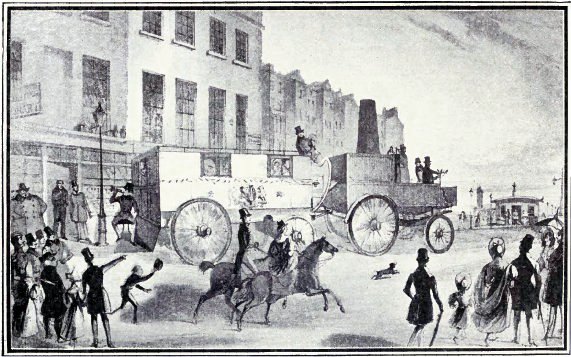
    Here’s a found bit from the Journal of the Franklin Institute, 1833, on a rumbling beast that would have been seen as the great technological achievement it was: a 12,000-lb land carriage connector between London and Birmingham. The report1 was made by the great Thomas Telford, engineer and builder of roads/bridges/canals as president of the Society of Civil Engineers, and a host of others, on the possibility of  Sir Charles Dance’s steam carriage being capable of implementing a transport service using existing roads. Charles_Dance's_carriage_-_1833

    [Sir Charles Dance’s vehicle, ca. 1833. Source: wikipedia entry for Sir Charles Dance, motorist.]

    ·Posted by :

    ·in:


  • The Skies of the “Electrical Experimenter”

    JF Ptak Science Books   Quick Post

    The Electrical Experimenter is my new favorite magazine, and here’s why:

    Electrical Experimenter Skies MONTAGE _2_

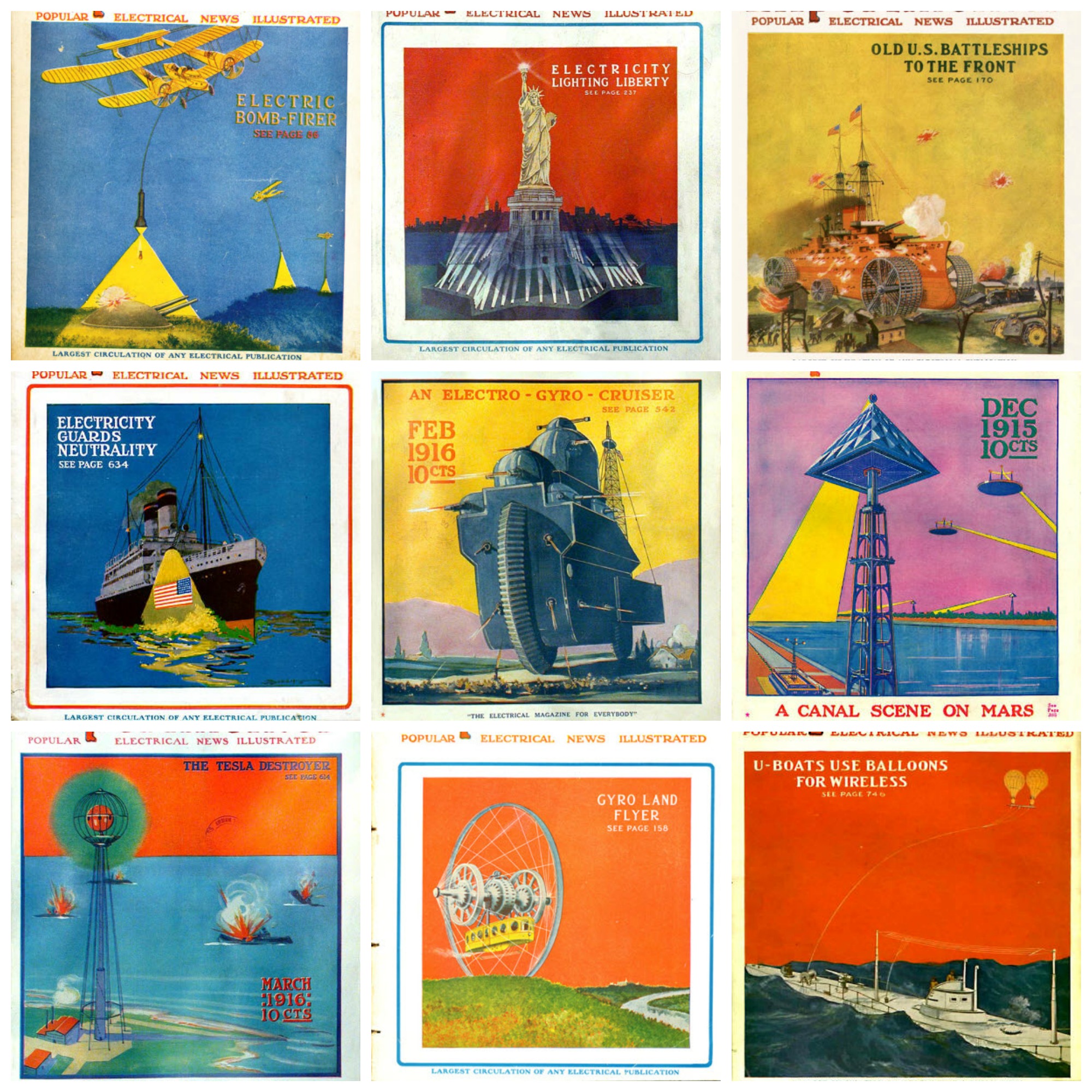
    In addition to being thick and full of real electrical necessities and scientific bric-a-brac, it also held a fair amount of speculative thinking and just plain old science fiction (when sci fi wasn’t “plain” or “old”).  The EE was created and edited by the very busily creative Hugo Gernsback (1884-1967), a pioneer in science fiction, who held the magazine together from 1913 until 1929 (as the Electrical Experimenter from 1913-1920 and then as Science and Invention from then until the finale in 1931). There was evidently no holding back on cover design–at least from September 1915 until the end, when glorious ideas were display with flat design dominated by unusual and contrasting colors. For example, in the montage above, I was able to find glassy unadorned background skies that were red, yellow, purple, blue, and orange, with variation on each. Not only were the skies unusual, so were the surface colors: unusual blues, deep blacks, n=unnatural greens, purples, and so on. All of this framed some occasionally Highly Unusual and Not Expected Ideas. For example, in these WWI-era images–working right to left on the montage–there was an aerial bombing assistant of a light that illuminated the target through which a bomb could be deployed; a land battleship; an enormous motorcycle-like land megaship; a Martian canal-governing apparatus; a Tesla death weapon; an overland trolley housed in a gigantic spoked wheel; and a relatively tame portrayal of a communication system for a submarine. These are terrifically entertaining, and of course all they are are the covers. So, The Electrical Experimenter: terrific. 


  • Alphabet Tubes (1895)

    JF Ptak Science Books  Quick Post

    I’ve written a couple of times on this blog on “tubes”, including tubular cars and ships, and of course pulp sci-fi adventures in tubular rocket ships, person intra-space tube propulsion systems, x-ray tubes, vacuum tubes, “tubes of uranium, and that sort, tubes as tubes. Plus there was the “extended tube”, like telescopes, canons, boilers, vacuum tubular whatzis of the future, plus the extended idea of the tube as an open-ended shaft and tunnel (there must be an opening on both ends otherwise you have a “hole”, which has its own category).  In these side tube researches I’ve never encountered the idea or phrase “alphabet tube”, until today. 

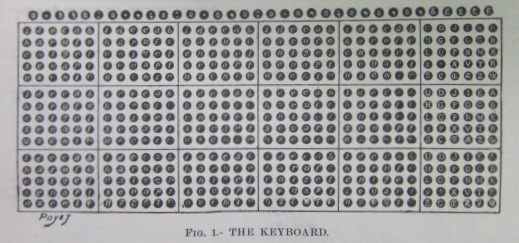
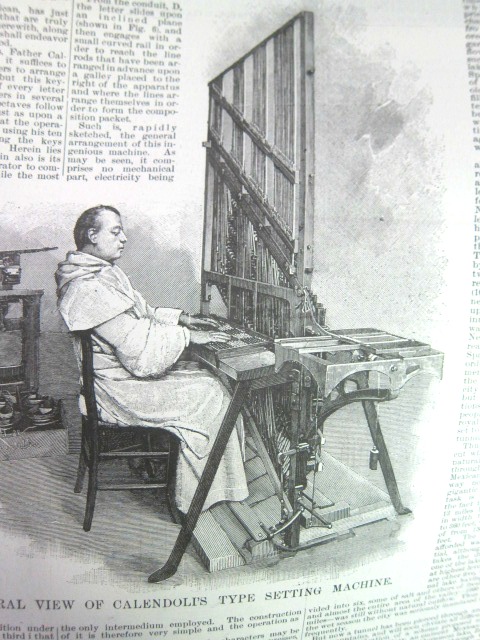
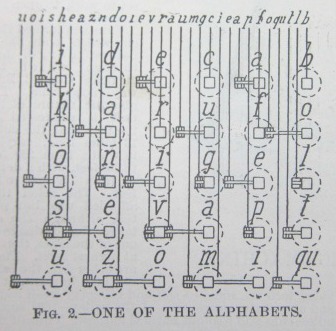
    The Domincan priest Father Vincenzo Calendoli invented (between 1893 to 1895) an unusual and seemingly-simple-but-hardly-so linotype machine that was seen by some as “the typsetting machine of the future…”(–C. Cochrane, American Printer and Lithographer, vols 21-23, 1896). The image below shows Calendoli in serene concentration seated at his machine which looks like a cross between a small Jacquard loom and an odd harpsichord (emphasis on the harp). And what Calendoli is concentrating on is this, his keyboard:


    Sci AM Mega typesetter _2_

    Sci AM Mega typesetter _3_

    The Scientific American Supplement  (1895, pp 16055-16057) illustration is reproduced exactly in an uncommon publication called the Rosary Magazine, (1895)–exact, with the exception of the additional caption: the writer annotates it by identifying the “checker board”, “inclined wire and galleys”, and the indescribably beautifully-named “alphabet tubes”! The explanation of what this tube is is far less interesting than its title–tubes filled with type–though the machine overall was extraordinary.


  • Finding Anthropomorphism in an Electric Chair Patent (1897)

    JF Ptak Science Books  Quick Post

    This image of among the first electric/electrocution chairs is based on the designs of Dr. Alfred P. Southwick (1826-1898, MDS, DDS, SUNY Buffalo), who came up with the idea and started experimenting with it beginning in 1881. His was a mission of mercy, looking to find a quick if not instant salient to carry out the death penalty of a convicted murderer. NY Governor David B. Hill (1843-1910) looked to Southwick for a solution to a more humane way of executing people, establishing a distinguished panel of advisers to help him with this task. (In the small-world department, Hill succeeded Grover Cleveland as governor in 1885 following Cleveland’s election as president of the U.S.–he also acted as executioner in at least two cases while he was the Sheriff of Erie county in the mid 1870s.)

    Southwick’s design/chair was first used on the condemned criminal William Kemmler in August 1890. Most everyone who witnessed this first attempt were aghast at the spectacle; George Westinghouse is reported to have uttered that the executions “would have been better off using an axe”. Theoretically the first application of electricity kills the brain in less time than it takes the body to respond to pain. This seems not to have been the case in many instances.

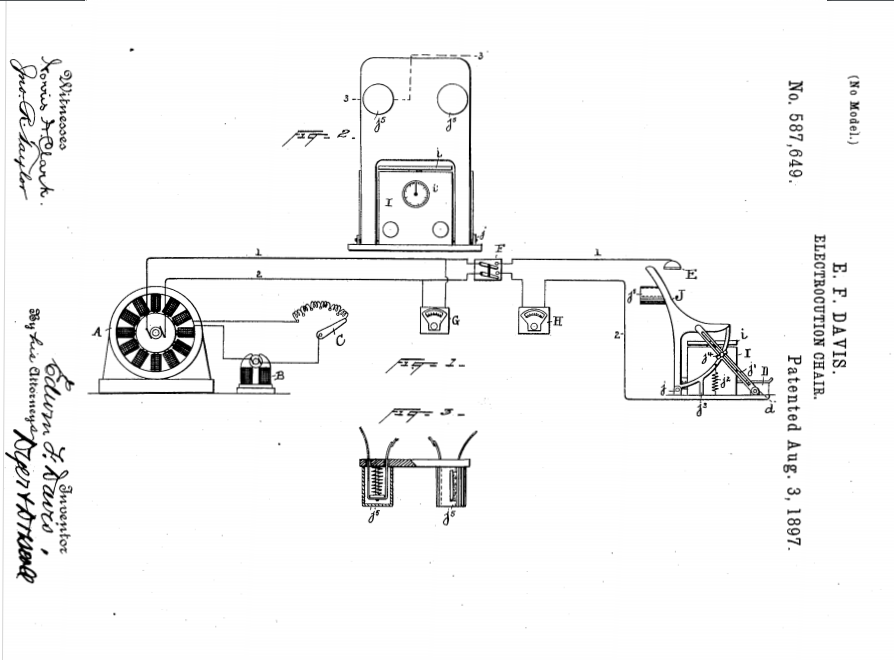
    No tong afterwards Edwin F. Davis (1846-1923) conducted his own research on an effective and humane way to execute people and was awarded a patent in August 1897 for his “electrocution chair”. Davis would serve as NY state’s “electrician”/electrocutionist from 1890-1914, delivering the final blow to 240 of the condemned during that time.

    It was strange to me how anthropomorphic the design was, including the obvious head and less so for arms and feet. Overall, I think the relationship to a human form is unmistakable. 

    Electric chair patent

    Excerpt from the article illustrating the 1888 electric chair:

    “Execution by Electricity. The State of New York may pride herself in the fact that the gallows is to be banished and a more humane and scientific method of executing criminals is to be instituted. On June 4 Governor [David B.] Hill signed the bill authorizing that criminals should be put to death by an electric shock. The bill is to go into effect on January 1 1889 and new method of execution be applied in the punishment of crimes committed after date.”

    SciAm writes that “instant death” occurs with the electric chair—it doesn’t. The condemned would be lucky to have their brains damaged enough to not register pain, as it takes 45 seconds to several minutes for death to occur.

    “…the criminal is seated bound to a chair having a metal seat connected with one pole of the current. At the back of the chair there is an adjustable head rest having a metal plate on its face and a metal band which passes around the forehead of criminal. The wires may be connected with dynamo which according to the bill may be of any approved type or the current may be supplied from electric light plant or there may be a private plant arranged especially for that purpose at the place of execution. Sponges or dampened cloths should be at the points of contact with the convict to render connection more perfect. At the proper moment switch is turned by the officer and instant death ensues. The current passes along the spinal column and the brain and nerve centers. The current may be few moments to bring about complete exhaustion.”

    Scientific American, 30 June 1888, vol 58.

    ·Posted by :

    ·in:

    —

  • Bubbles, Anti-Bubbles, and Reflections (and Not)

    JF Ptak Science Books   Post 2758     

    [For Jeff Donlan, Extreme Answer Lad of Answers!]

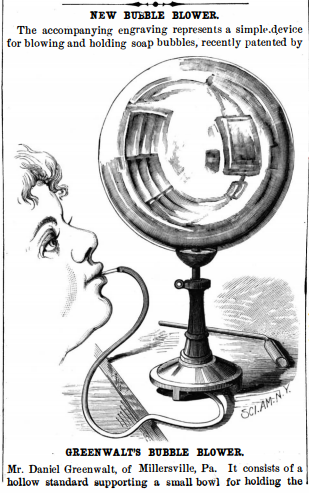
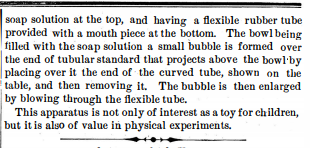
    This article was just a small 4″ or so notice  in the Scientific American on 2 August 1879, written for a new sort of apparatus to make bubble-blowing easier, or more effective, or “rounder”, or less anti-bubbly. (Actually that last would be a trick though I guess you could rig something like this up in an anti-air-breathing way, to create a bubble of liquid encapsulated by a layer of gas surrounded by a liquid. This is actually pretty easy to do standing around and would probably be a much harder thing to accomplish if you needed an apparatus for it. By the way “anti-bubble” should not be associated with the “Dirty Bubble”, which is a character from SpongeBob SquarePants.) 

    Back to the illustration: it is only about 2″ tall and a bit of a “filler”, but enough care is given it that it displays something which you never really see on bubbles in artwork: a reflection of an image! 


    Sci Am 1879 bubble blower _1_

    Sci Am 1879 bubble blower _2_

    If you go to Google and search out Renaissance/Bubble/painting or some such, you will find a number of examples of fine-looking bubbles: Gerrit Dou’s young boy blowing bubbles has life to the boy but not so much to the bubbles he’s blowing; J.E. Mallais bubble boy also has some somber fun but little exclusivity is paid to the bubble, same to for Naiveau, and de Gheyn; David Bailly’s self portrait has three happy bubbles with flair and color, and Desjardin’s allegory’s bubble maker is standing on a bubble with a fair amount of color and light to it. Even  the much-reproduced “Soap Bubbles” (ca. 1733-4) painting  by Jean Siméon Chardin (1699–1779)–which is perhaps one of the most famous antiquarian paintings involving bubbles–finds us with a bubble that is not very bubbly, without much reflection and optical interest…a too-subtle bubble. Not so in this image above, the anonymous artist collecting the 25-cent fee and giving the bubble some of the greatest bubble-life that I’ve noticed. 

    One thing those older artists do have a feel for more so than this piece above is the thinness of the wall of a bubble–here it looks pretty defined whereas with the others you get a real sense of lightness and fragility (though hardly knowing the thickness in terms of ^…as a matter of fact some of the artists mentioned were active before Newton, others before Huygens, and all before Young.) Anyway even though the business of bubbles seems to be kids’ stuff, with children playing at making bubbles in the artwork mentioned above, bubbles are worthy of some real thinking–if you understand bubbles (and anti-bubbles), you can address a fair amount more than that. 

    [I can’t really tell what the bubble-blower is seeing, what is being reflected, though one of the objects definitely seems to be a painting…]

    ·Posted by :

    ·in:


  • A Short but Good Report on a Major Paper by Tesla, 1892

    JF Ptak Science Books  Quick Post

    Tesla 5121

    In January 1892, the 34-year-old Nikola Tesla gave an interesting and significant lecture on (“alternate currents of high potential and frequency”) in London, first to the Royal Institution and second to the Institution of Electrical Engineers, which was summarized in this short paper in Nature (volume 45, #1163, 1892) reproduced below. This is a continuation it seems of his famous July 1891 lecture in which he first addressed his experiments with alternating current, and which gained him international attention. The full lecture may be seen at the Internet Archive: https://archive.org/details/ExperimentsWithAlternateCurTeslaNikola5098/page/n0

    ·Posted by :

    ·in:


  • Thayer’s “New Navigable War Balloon” and Mutually Assured Destruction, (1885)

    JF Ptak Science Books  Quick Post

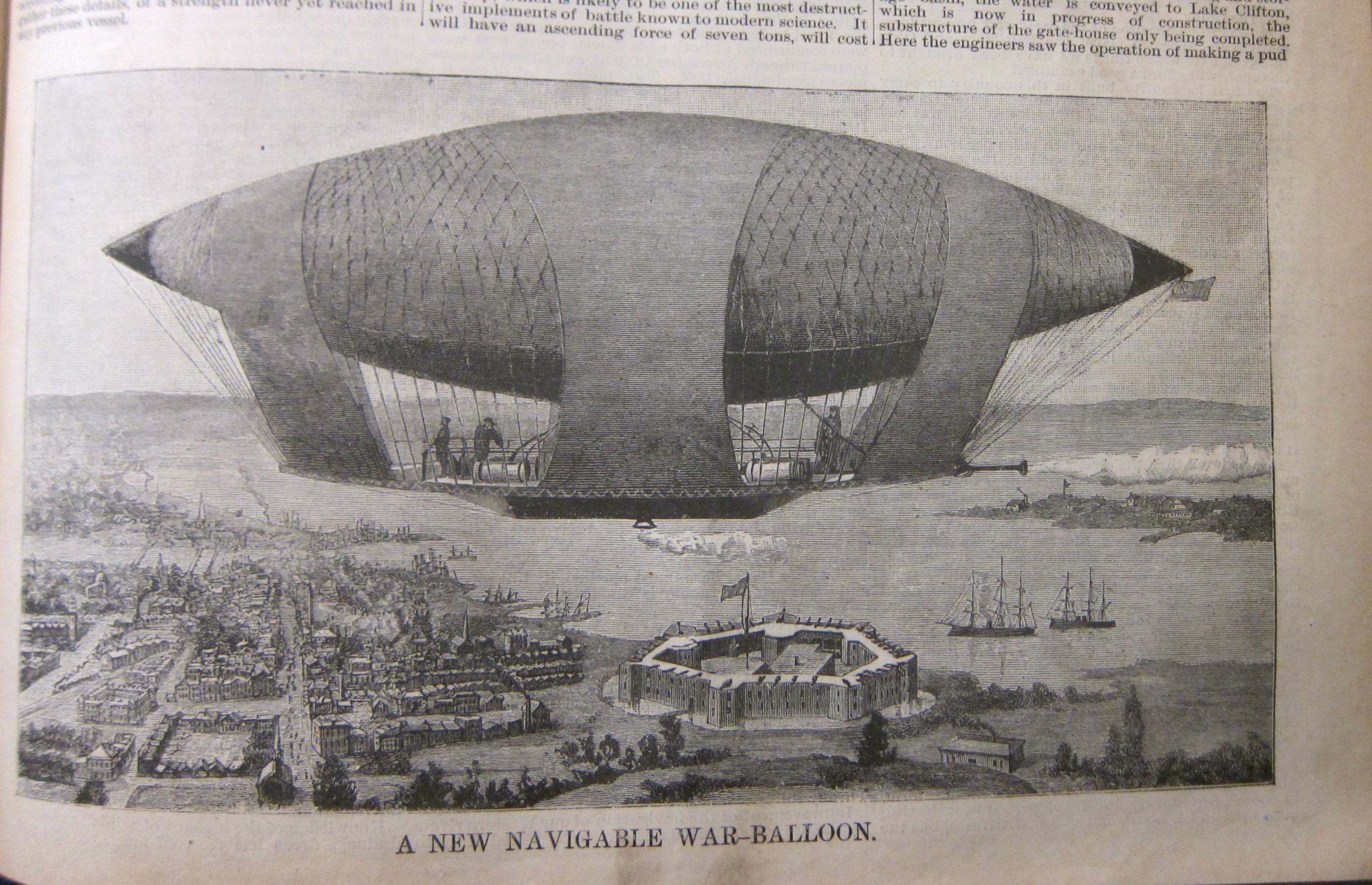
    Here’s a rather Jules Verne-y concept for a military balloon, presented to by General Russell Thayer, and published in the Scientific American Supplement in 1885.  In this iteration the aircraft is labeled a “war-balloon” but looks benign and observational; in the second image, see a month later in Harper’s Weekly, the balloon is definitely a war machine, having just bombed something with what looks like an enormous explosive. The scene here illustrates an airship in flight over a very industrialized section of a city, perhaps to drive home a propaganda point that bombing was accurate enough to be strategic and also that targets were industries and not general populations. 

    (The first aerial bombing seems to have been during the first Italian War of Independence and used by the Austrians from a  balloon against Venice in 1849; while this 1916 bombing occurred a few years after the first bomb was dropped from a heavier-than-air aircraft during the Italo-Turkish War on 1 November 1911, the Italians this time delivering the blow in Tripoli.)  

    The idea of aerial bombardment was an enormous threat, imagining death coming from above,  huge airships dropping untold numbers of bombs upon a city–I imagine that the idea came as much a blow to someone at the end of the 19th c as the threat of nuclear devastation came to those in the mid-20th c.  As a matter of fact S.L. Koter and J.E. Gessler quote an unnamed “distinguished officer in the U.S. Navy” implying much the same thinking as would be later heard as nuclear-weapons-inspired Mutually Assured Destruction (MAD): “War will become impossible because it will signify not merely great loss of life and property, but annihilation”. (Ballooning, a History; 1782-1900, p. 268.)

    It is particularly interesting to note here that Thayer, proposes to use a propulsion system that is not dependent on a propeller but rather “compressed air”.  “In the independent balloon the motor is a high pressure air compressor coupled directly to a newly devised carbonic acid gas engine and a reservoir for storing the air until sufficient pressure is obtained. The construction of the dependent balloon is similar to that of the independent ship except as regards the motive power which is here electricity…”

    Sci Am 1885 war balloon


  • A Bridge for Carrying a Ferry Over Water (1869)

    JF Ptak Science Books  Post 2755   

    I don’t mean to appropriate the past from my seat here in the future, raising my eyebrows over what definitely seems to be an Ig Nobel engineering effort, but, well, there are times when you distill a bad idea over a low flame that the bad idea distilled is still a bad idea. 

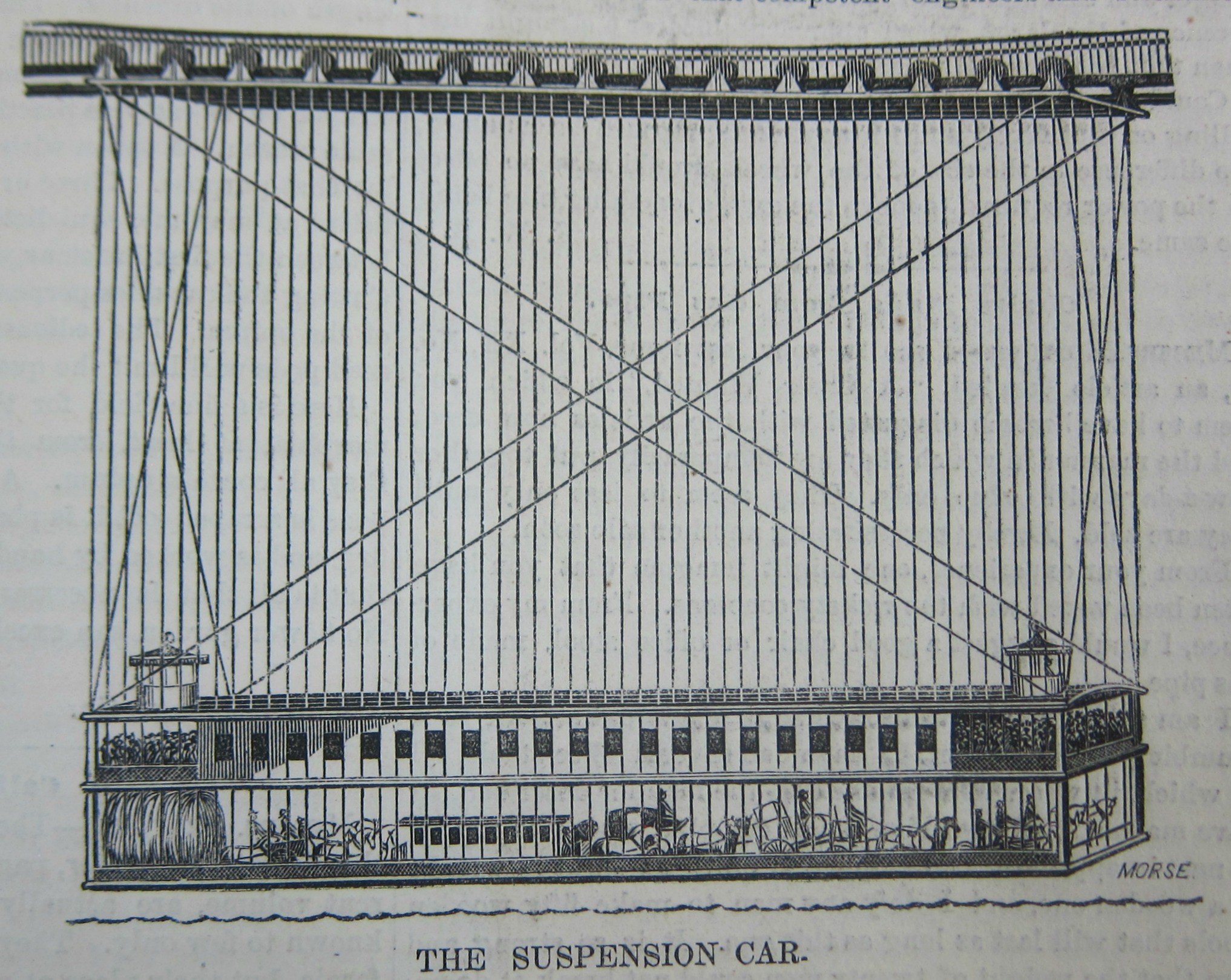
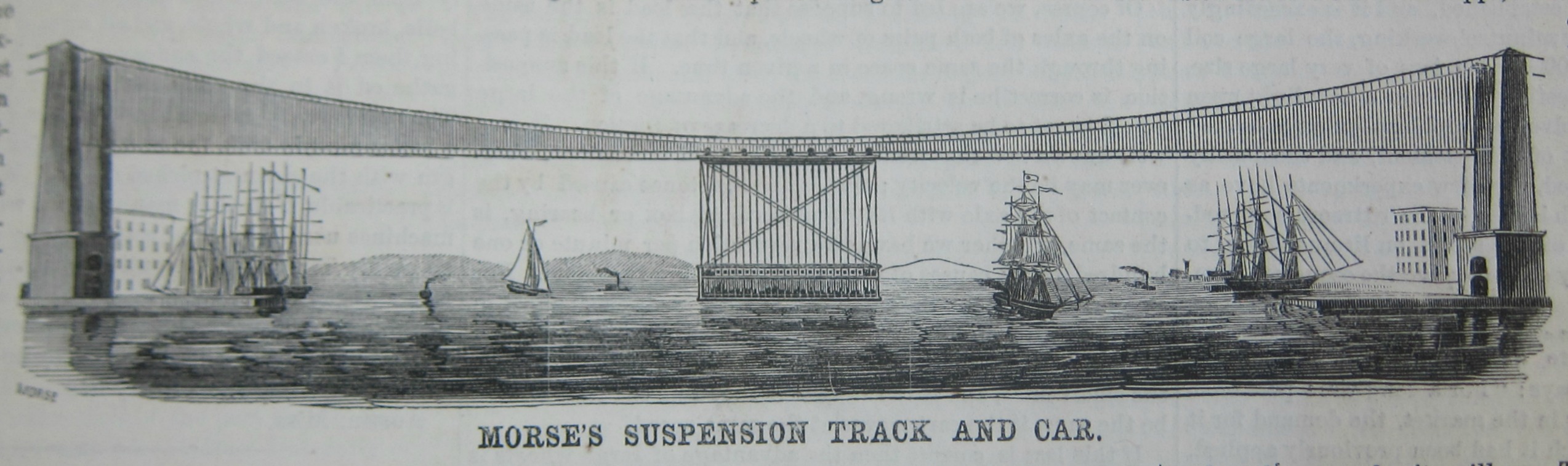
    I’ve tried to imagine the circumstance in which this bridge would make sense, particularly in light of the fact that it was a proposal by J.W. Morse to counter the Roebling plan to erect the East River (later “Brooklyn”) Bridge in about the same location. This is how this bridge plays itself out in my mind: a suspension bridge of some substantial size is constructed to carry a ferry from Manhattan to Brooklyn, even though it seems that a ferry would be able to get from one place to the other with not terrible fuss, except in the old style of using a boat it would be moving on/in the river rather than over it. The ferry wouldn’t need a bridge to cross the river if it didn’t wholly depend on one from completing its task, which ferries almost never do, being watercraft and all.

    Sci Am 1869 suspension ferry

    The details of the plan are a little shocking: that “car” hanging from the bridge cables measured 160’x40′ (6400 square feet) and two storeys high, and was meant to carry 5,000 people at one time (75,000 over a 12-hour period) along with another 500 horses and carts on the lower level. It was to make the trip in a minute or two, and would be moved from one point to the other at a few feet above the river.

    This might make sense if the river was choppy, or ice-bound, at which point it would be nice to use HyrdoplanePunk to get across the river. A bridge-as-bridge would accomplish this task without turning itself basically upside down and inside-out. 

    As I said it is not so good to judge application of technology by a modern standard; though in this case it seems as though if you were to look just slightly into the future from 1869 that you’d realize a continuous flow across the river would be highly preferable to a car shuttling a limited number back and forth. In addition to numerous other issues, I’m not sure how the engineer was dealing with the traffic and congestion caused by the fits and starts of 1,000 or 2,500 (let alone 5,000) people plus freight leaving the car/boat all at once, joining a crowd of people and horses and so on waiting to board, dozens of times a day.

    Sci Am 1869 suspension ferry profile

    At the end of it all, this bridge is also just not very attractive, and not made for the ages—it seems temporary, a short range solution to a long range issue, something soon to be dismantled, used elsewhere, and then scrapped.

    I should point out that there is a variety of bridge dedicated to this sort of transportation—it is evidently of French origin, and referred to as a pont a transbordeur, and seems to have some utility here and there, though that “here” and “there” did not include “Manhattan” and “Brooklyn”.

    • From the article:  “While plans have now been divulged to connect the island of Manhattan in New York with Brooklyn by means of a giant suspension bridge over the East River, Mr. J. W. Morse has devised a bridge which permits of a much lighter construction than a normal suspension bridge and is, consequently, much cheaper to build. Mr Morse’s project provides for transportation across the river in a giant platform, suspended by means of cables from a trolley running upon a gantry across the river. Measuring 40 X 160 feet, the platform has two stories: the top floor is for pedestrians while the bottom deck is intended for horses and carriages. While a normal suspension bridge requires extensive abutments and ramps to enable the road traffic to reach the bridge-deck level of almost 120 feet, Mr. Morse’s transporter bridge obviates the need for such provisions. The fact that the traveller [sic] hangs only 3 feet above the water-and hence is almost at street-level-makes it easy for heavily loaded wagons to cross the river, and will also be appreciated by the workman returning home on foot after a hard day’s toil in the factory or warehouse.” —Scientific American,  24 May, 1869

  • A Very Large Barrel (1888)

    JF Ptak Science Books  Quick Post

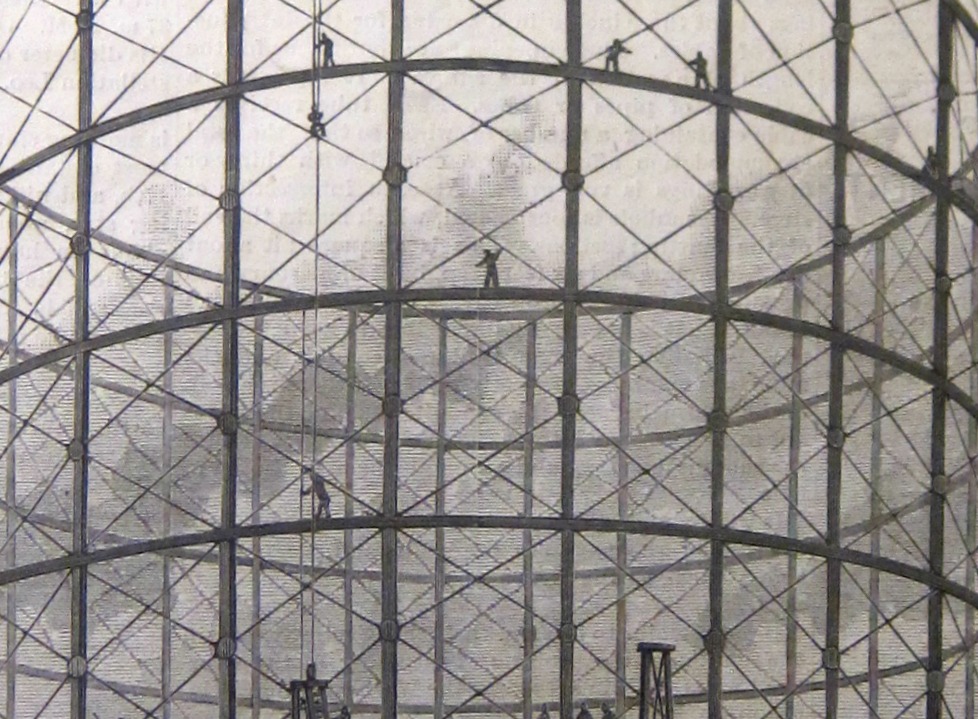
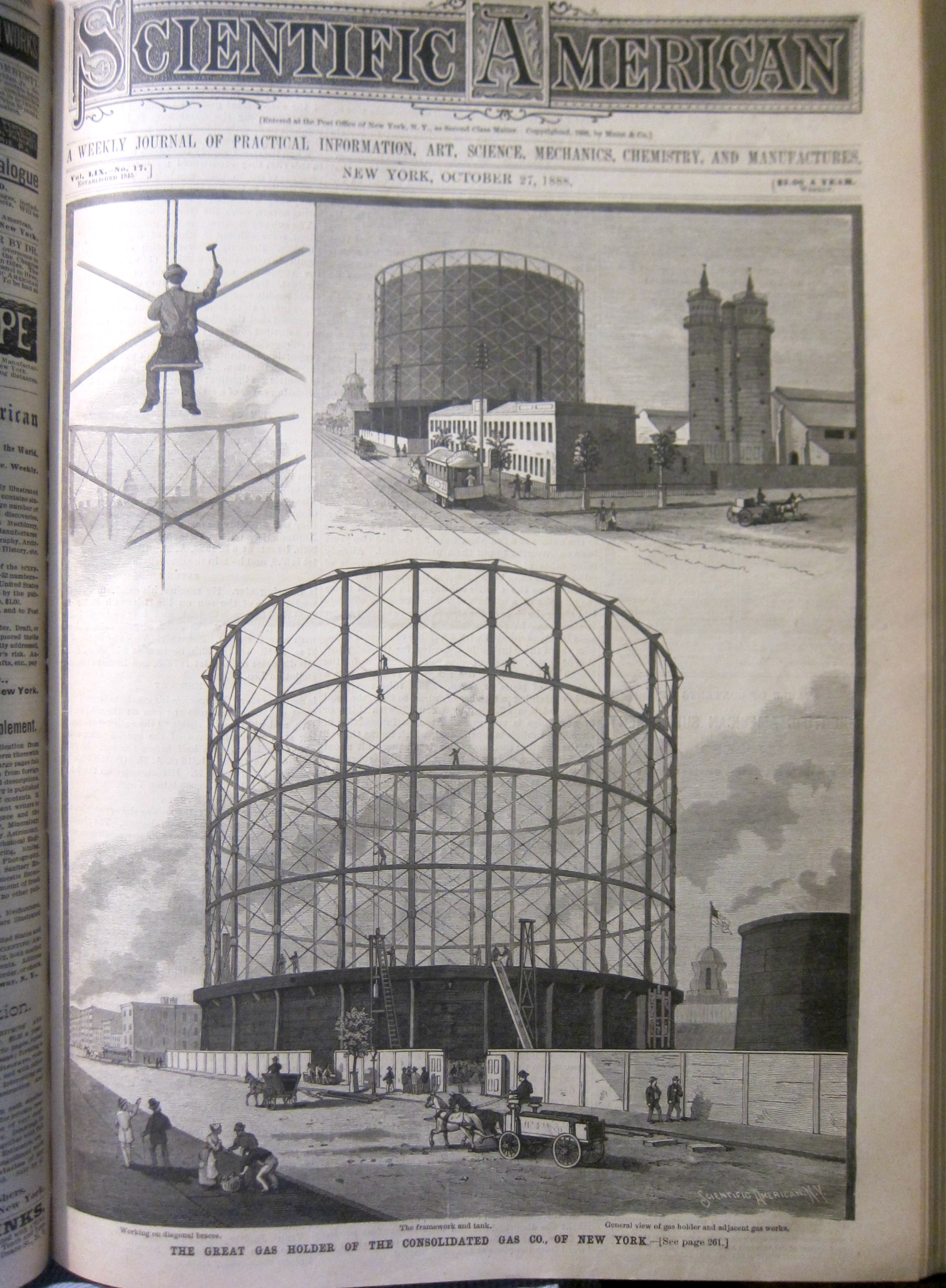
    Consolidated Gas Company storage facility being constructed in Manhattan, on Ave C between 15th+16th, as it appeared in Scientific American, 27 October 1888. It is a striking structure. Consolidated Gas (formed from six companies in 1884 and which would become Con Ed in 1936) built this mega bruiser: the facility was 192′ in diameter  and 150′ tall, the “barrel” made of double applications of 7/8″ wrought iron plate which would accommodate 3.2 million cubic feet of gas. Big.

    I don’t see any harnesses:

    Brooklyn Gas detail

    Brooklyn Gas 1888 Sci Am

    ·Posted by :

    ·in: