A Daily History of Holes, Dots, Lines, Science, History, Math, Physics, Art, the Unintentional Absurd, Architecture, Maps, Data Visualization, Blank and Missing Things, and so on. |1.6 million words, 7500 images, 4.9 million hits| Press & appearances in The Times, Le Figaro, Mensa, The Economist, The Guardian, Discovery News, Slate, Le Monde, Sci American Blogs, Le Pont, and many other places… 5000+ total posts since 2008.

Category: Technology, History of

  • On Doing and Done: the Differences in describing the Difference Engine of Charles Babbage, 1832.

    JF Ptak Science Books  Post 2792
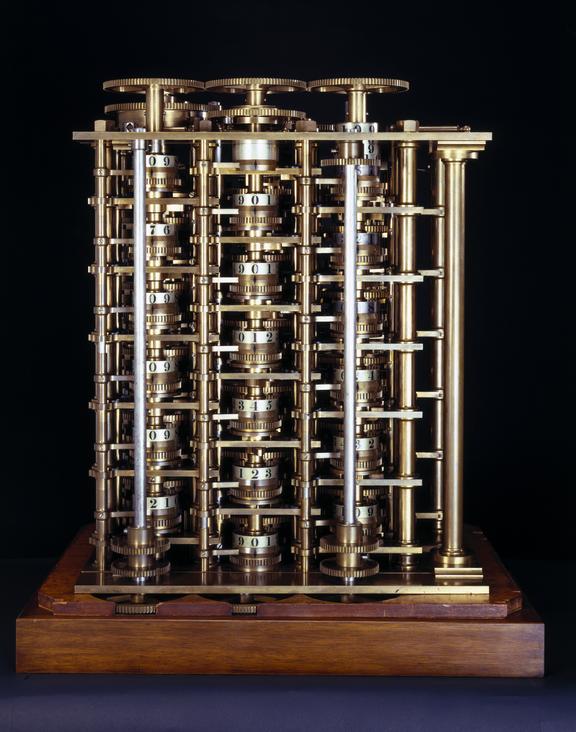
    Babbage difference engineThere’s a big difference being “inventing” and “invented”. You virtually never hear or read of someone declaring “I am inventing thus-and-so” imply that they’re working on something; “I invented the letter number seven” implies that you’ve completed the act of invention and the number seven exists. 

    In cataloging a book for my bookstore I came upon this difference in reference to Charles Babbage and his early calculating machine, and proceeded to make a mountain of a molehill, and then the reverse. 

    The “incident” was sparked by a volume of the Journal of the Franklin Institute1 with the appearance of a very early mention of Babbage having built his Difference Engine  (No. 1) found in a one-paragraph mention in the article “The Results of Machinery”:

    [Image at left of Babbage’s machine in 1832, from the Science Museum http://collection.sciencemuseum.org.uk/objects/co62243/difference-engine-no-1-difference-engine-portion-only]

    “Mr. Babbage…has invented a calculating machine…” referring to the newly (1832) “completed” 1/7th  of the machine. (The Difference Engine No. 0 announcement came June 14, 1822; the Difference Engine No. 1 appeared in this year, 1832, though work was suspended on it in 1833 (with government funding removed);’work soon to begin on Difference Engine No.2 (1846-9), (and with A. Lovelace’s famous “Notes” appearing on the Analytical Engine in 1843.)

    The article is a review/abstract of the book by Charles Knight, The results of machinery : namely, cheap production and increased employment exhibited : being an address to the working-men of the United Kingdom, which appeared in a second edition in London in 1831 (and a fifth in 1832) with a first American appearing in 1831. The Babbage calculating machine bit from the JFI is taken very nearly verbatim from these editions, where in the original the mention of the machine is referred to as “almost perfected”–here in the JFI it shows up as “invented”, which as they say is something quite different, the world of “almost-perfecteds” being much wider broader deeper than that of “the perfecteds”.

    Leaving out the fact that the machine was yet really built is of course a minor thing compared to the overall message of the paper and the book in general, but I just got my scarf wrapped around the axle on it. 

    The full note on Babbage reads:

    “The inventions for saving mental labour, in calculations of arithmetic, have been carried so far, that Mr. Babbage, a gentleman whose name we have twice before mentioned, has invented a calculating machine, which not only does its work of calculation without the possibility of error, but absolutely arranges printing types of figures, in a frame, so that no error can be produced in copying the calculations, before they are printed. We mention this curious machine, to show how far science may go in diminishing mental labour, and ensuring accuracy.”

    This was part and parcel the principle thrust of this article: investigating the application of machinery in a positive way to production and labor and showing its “…effects of saving unprofitable labor”.

    The few paragraphs of background leading to the Babbage reads as follows:

    “The foot-rule of the carpenter not only gives him the standard of a foot measure, which he could not exactly ascertain by any experience or any mental process; but it is also a scale of the proportions of an inch or several inches, to a foot, and of the parts of an inch to an inch. What a quantity of calculations, and of dividing by compasses does this little instrument save the carpenter, besides ensuring a much greater degree of accuracy in all his operations! The common rules of arithmetic, which almost every boy in England now learns, are parts of a great invention for saving mental labour. The higher branches of mathematics, of which science arithmetic is a portion, are also inventions for saving labour, and for doing what could never be done without these inventions.

    There are instruments, and very curious ones, for lessening the labour of all arithmetical calculations; and tables—that is, the results of certain calculations, which are of practical use, are constructed for the same purpose. When you buy a joint of meat, you often see the butcher turn to a little book, before he tells you how much a certain number of pounds and ounces amounts to, at a certain price per pound. This book is his “Ready Reckoner,” and a very useful book it is to him; for it enables him to despatch his customers in half the time that it would otherwise require, and thus to save himself a great deal of labour, and a great deal of inaccuracy.

    The inventions for saving mental labour, in calculations of arithmetic, have been carried so far, that Mr. Babbage, a gentleman whose name we have twice before mentioned, has invented a calculating machine, which not only does its work of calculation without the possibility of error, but absolutely arranges printing types of figures, in a frame, so that no error can be produced in copying the calculations, before they are printed. We mention this curious machine, to show how far science may go in diminishing mental labour, and ensuring accuracy.”

    So in this message of insight and hope I got stuck on one word, which ultimately really doesn’t mean anything. The message was significant and an interesting and insightful way of phrasing the possibilities for the application of more advanced machines in the future, and was much bigger whatever the state of completion of the Babbage machine was.
  • Scientific Instrument Display (1711, with Key)

    JF Ptak Science Books  Quick Post

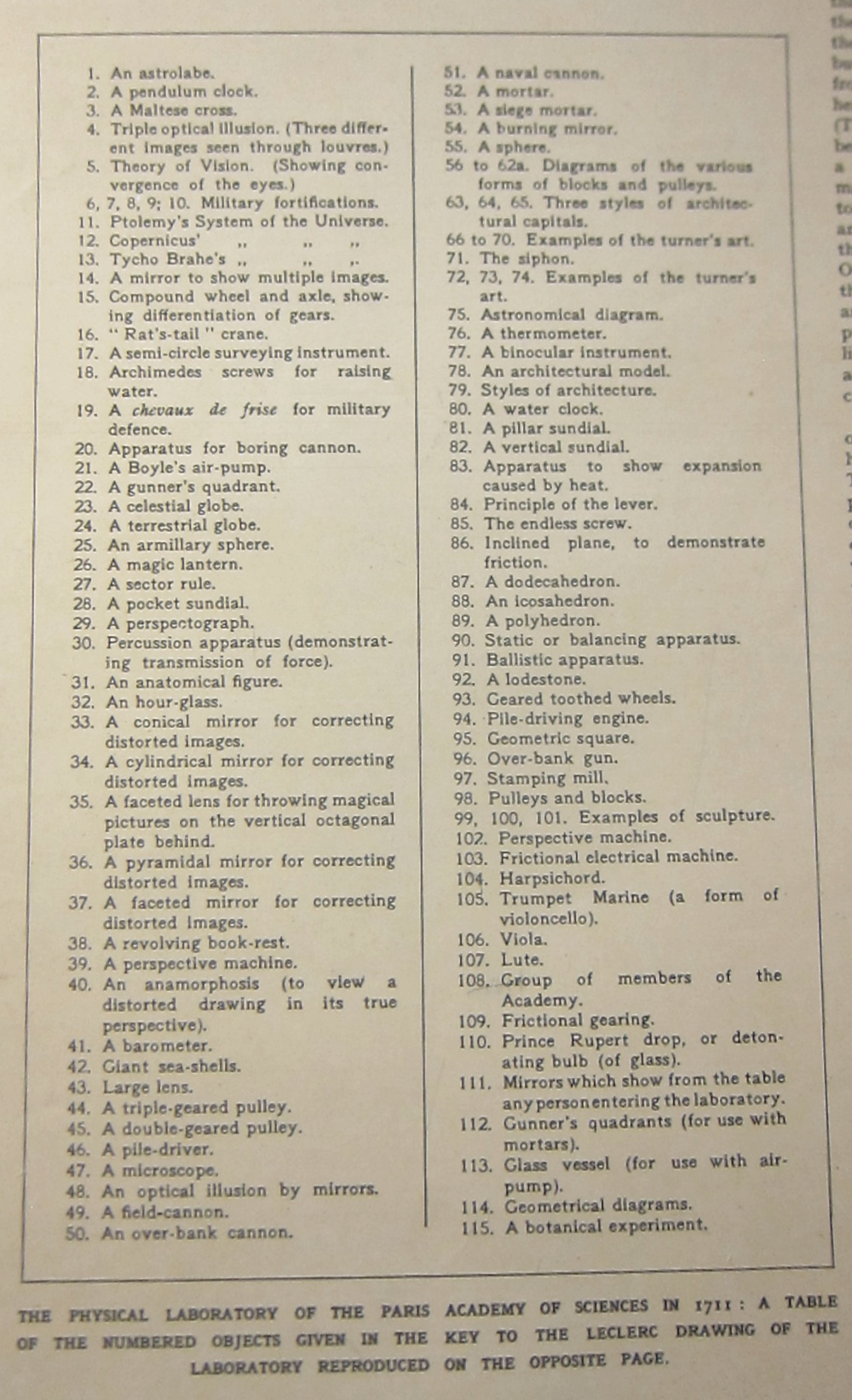
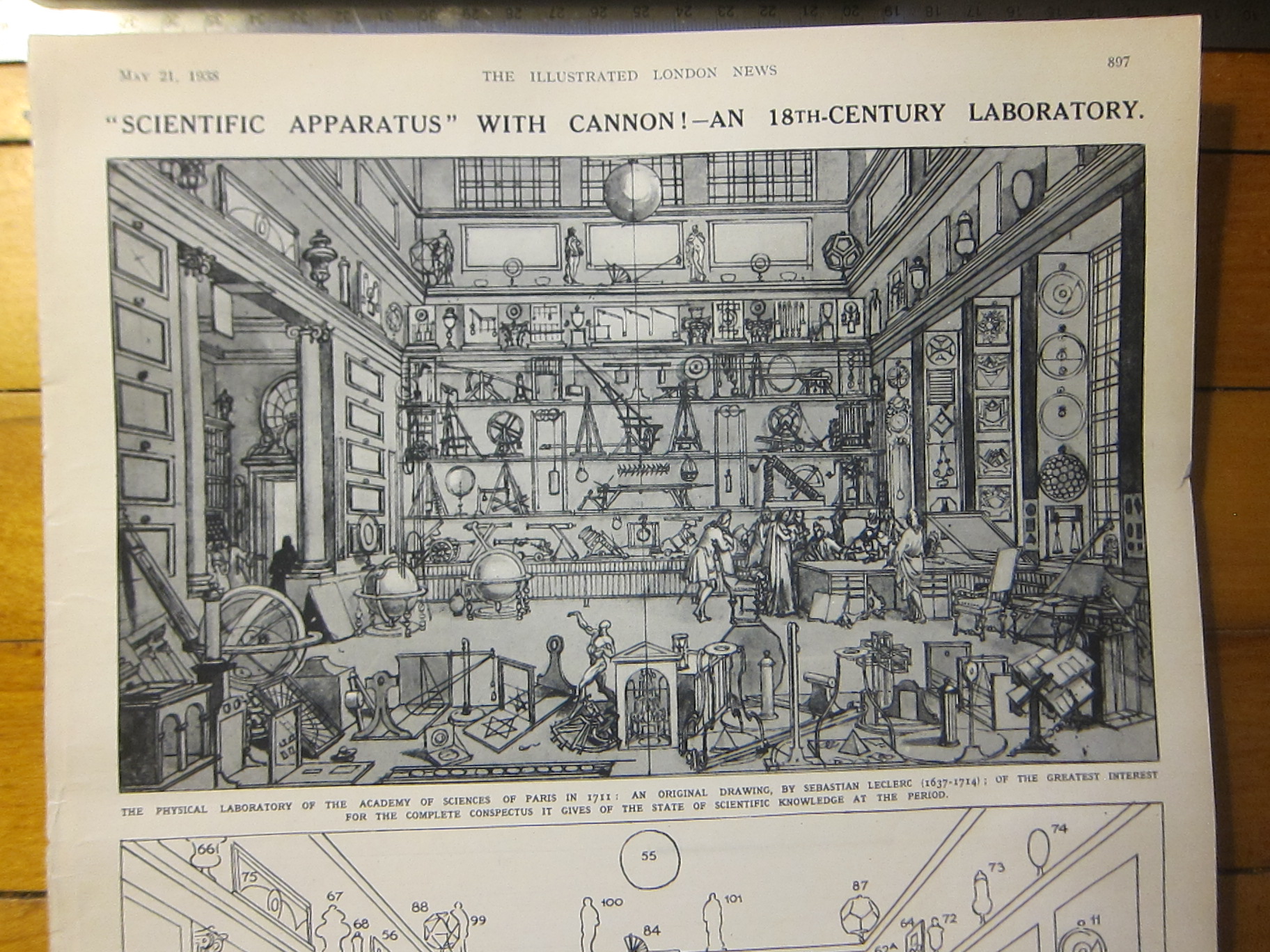
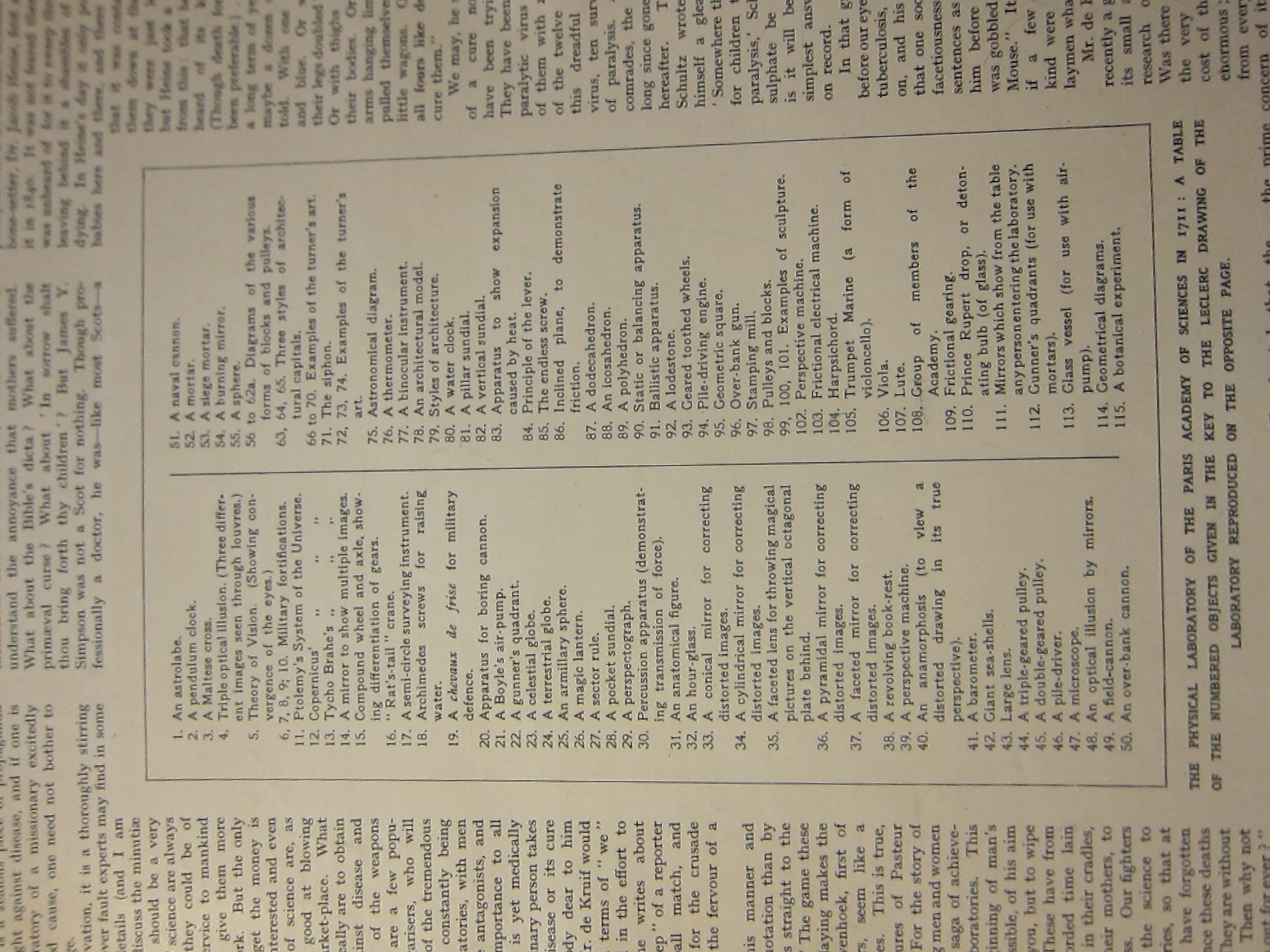
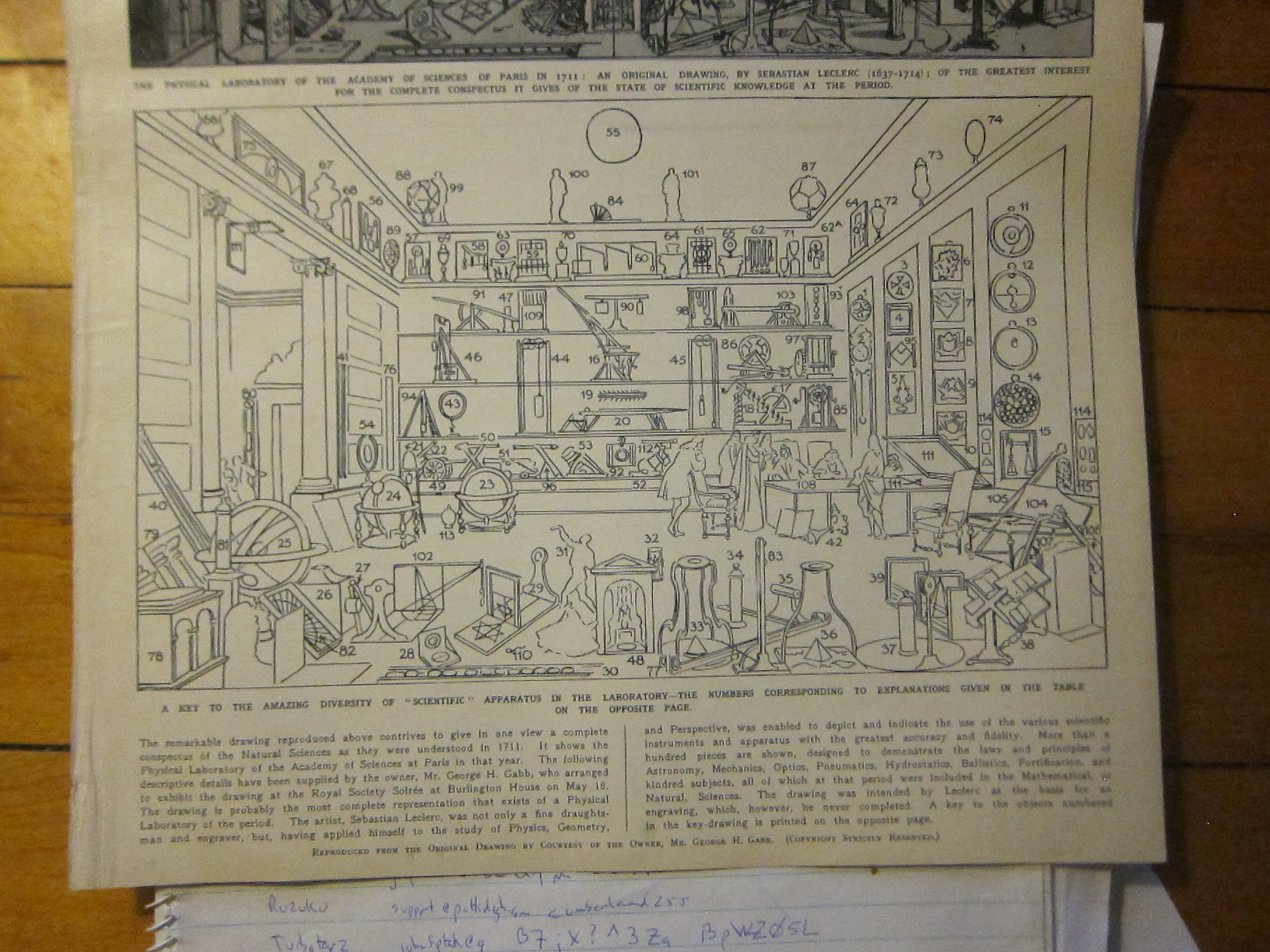
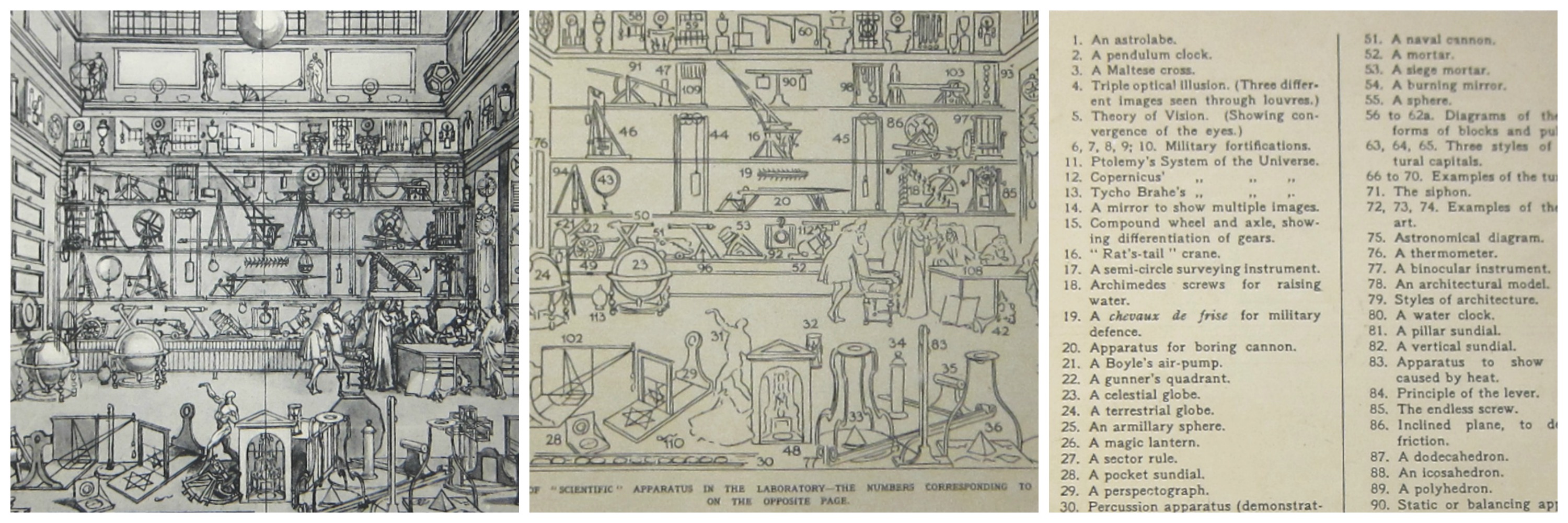
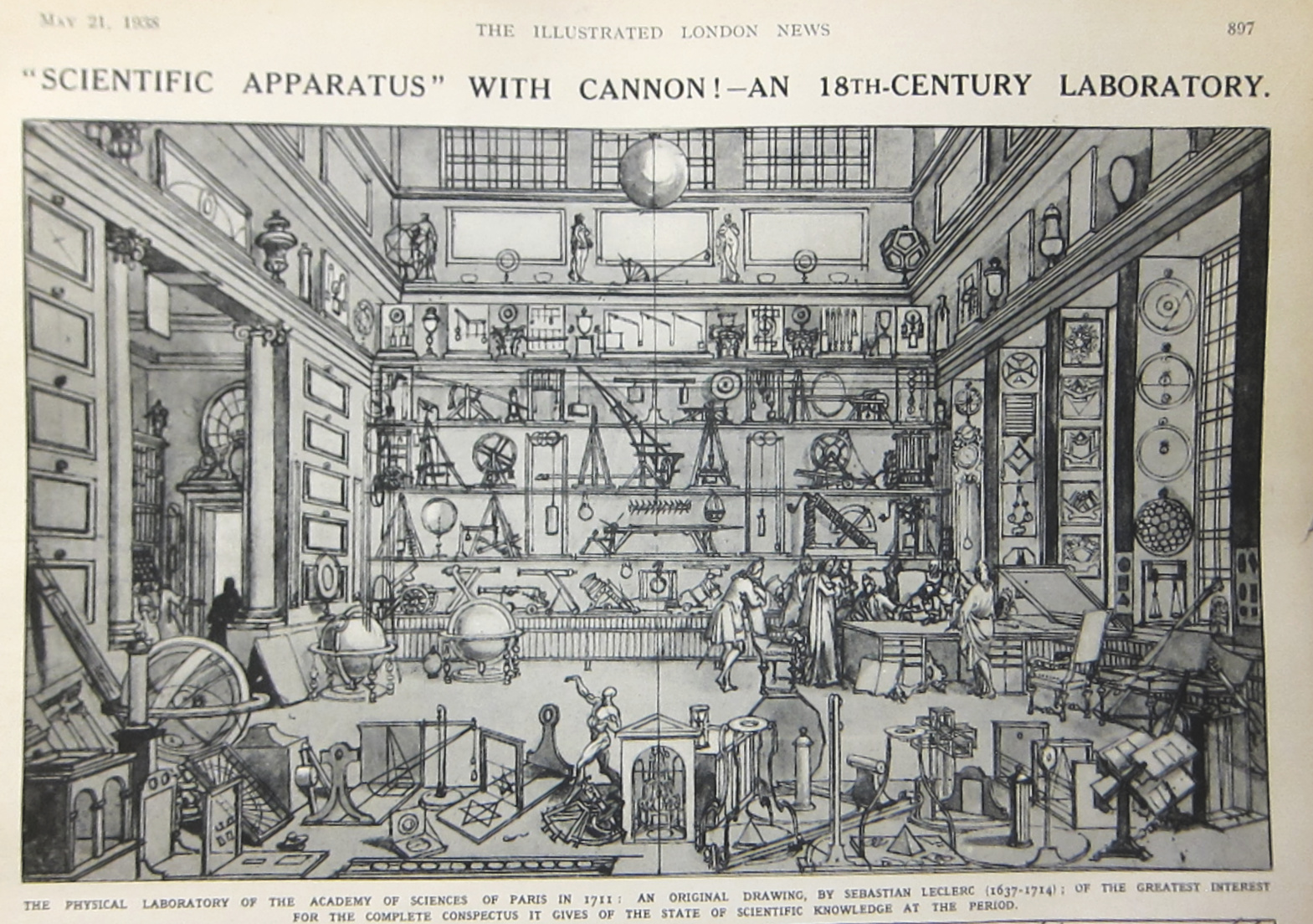
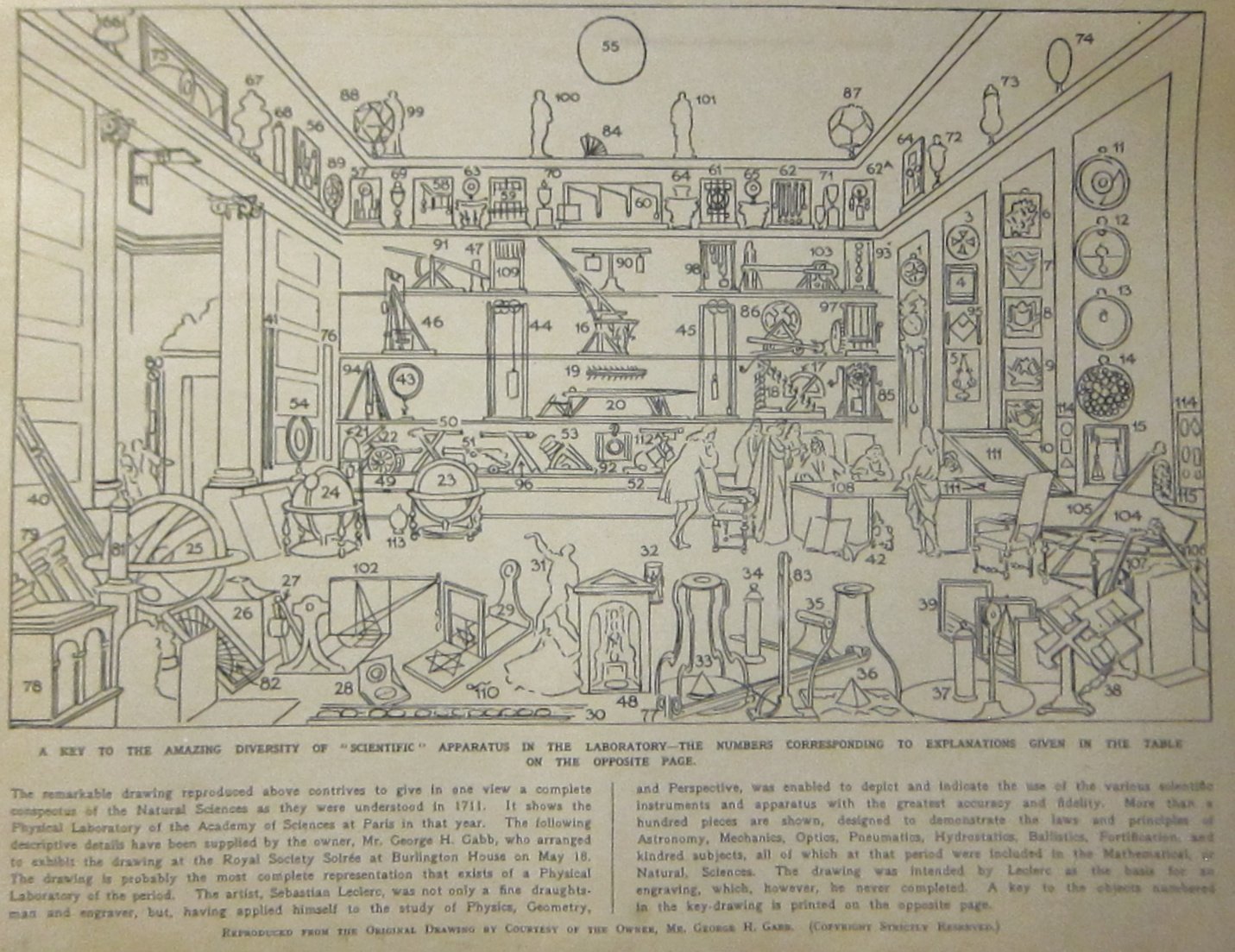
    This interesting image appeared in the Illustrated London News for 21 May 1938 (p 897) and it shows “the Physical Laboratory of the Academy of Sciences in Paris” in 1711, rendered by Sebastian Leclerc (1637-1714).  The nice thing here is that is comes with a key and explanation for the 115 (!) displayed instruments. For some reason the editor decided to put scientific instruments in quotation marks, as if to differentiate those instruments from 1711 from the modern standard of 1938 as not being worthy of the title when compared to modern instrumentation. Its an unfortunate display of evaluating and judging the achievements of one period in relation to those of a particular present without regard to context and the capacity of what came before.  Apart from the unfortunate title, these are useful images:

    Physical Lab collage


    Physical lab view 1938
    Physical lab view 1938

    Physical Lab legend


    ·Posted by :

    ·in:


  • One of the Earliest Appearances in Print of One of the World’s Most Famous Series of Dots (1838)

    JF Ptak Science Books  Post 2790   Part of the “History of Dots” series

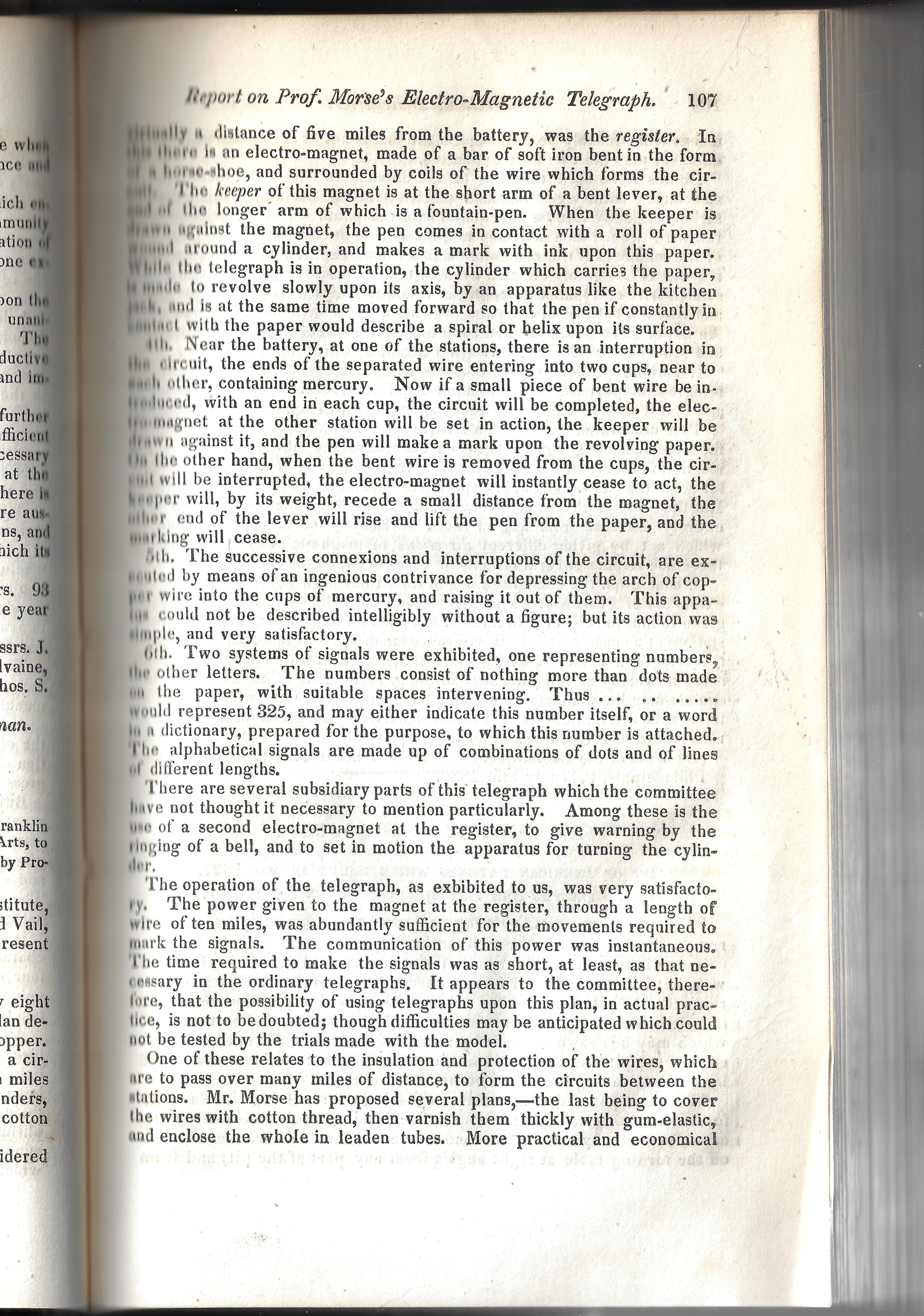
    I was looking in Journal of the Franklin Institute (1838) for what I thought was an important report by Charles Goodyear on his “vulcanization” process, where he is finally able to present the results of his experiments on saving rubber from itself for commercial use. But I was wrong–the report was a step in the correct direct, the finalization occurring the next year (and not a moment too soon for the very highly economically challenged Goodyear). Anyway, I poked around the index (which is a half-miserable affair) grazing for something else interesting when I saw the entries for “telegraph”, with subdivisions for “electric” and “electromagnetic”. Now, both of these types of telegraphs had been around for a score or three of years, but just for the play of it I checked out the “electromagnetic telegraph” on page 106.  And there he was: Samuel Morse. And Alfred Vail. And their electromagnetic recording telegraph–all of which appeared in the paper called “Report on Prof. Morse’s Electro-Magnetic Telegraph“.1

    This was a significant report. As it turns out Morse makes the first public demonstration of his and Alfred Vail’s recording electromagentic telegraph on January 6 1838 at Speedwell Ironworks near Morristown, New Jersey, just weeks before this JFI appearance.  On this success, Morse went south to Philadelphia and demonstrated his invention to the Franklin Institute on February 8, 1838 (summarized in the present report), appearing two weeks later on February 21 1838 midway between Phila and home in Washington D.C., demonstrating the apparatus to President Van Buren and members of the Congressional Committee on Commerce2,3.

    This may well be the one of the two earliest journal appearances of the successful demonstration of the Morse/Vail electromagnetic recording telegraph, and is perhaps the very first appearance of the “dot” end of the Morse Code.

    Morse dots _2_

    The demonstration in January and February 1838 used the Vail register (accentuated in italics in the JFI report) and did away with the Morse pendulum apparatus for recording the message–this was evidently a great improvement.

    The narrative identifies two systems of signals (“…one representing numbers, the other letters”) that were displayed in the demonstration. The first “representing numbers” were a series of dots. This is perhaps the first publication in a journal of the dot method of transcribed signals of a recording electromagnetic telegraph. The dots are pictured “…   ..   …..” on page 107, representing the number “325” or as explained could also mean the word represented by the number “325” in Morse’s code book (“indicate…a word in a dictionary, prepared for this purpose…”). The second, “alphabetical signals are made up by a combination of dots and lines of different lengths”), an example of which is not shown. 

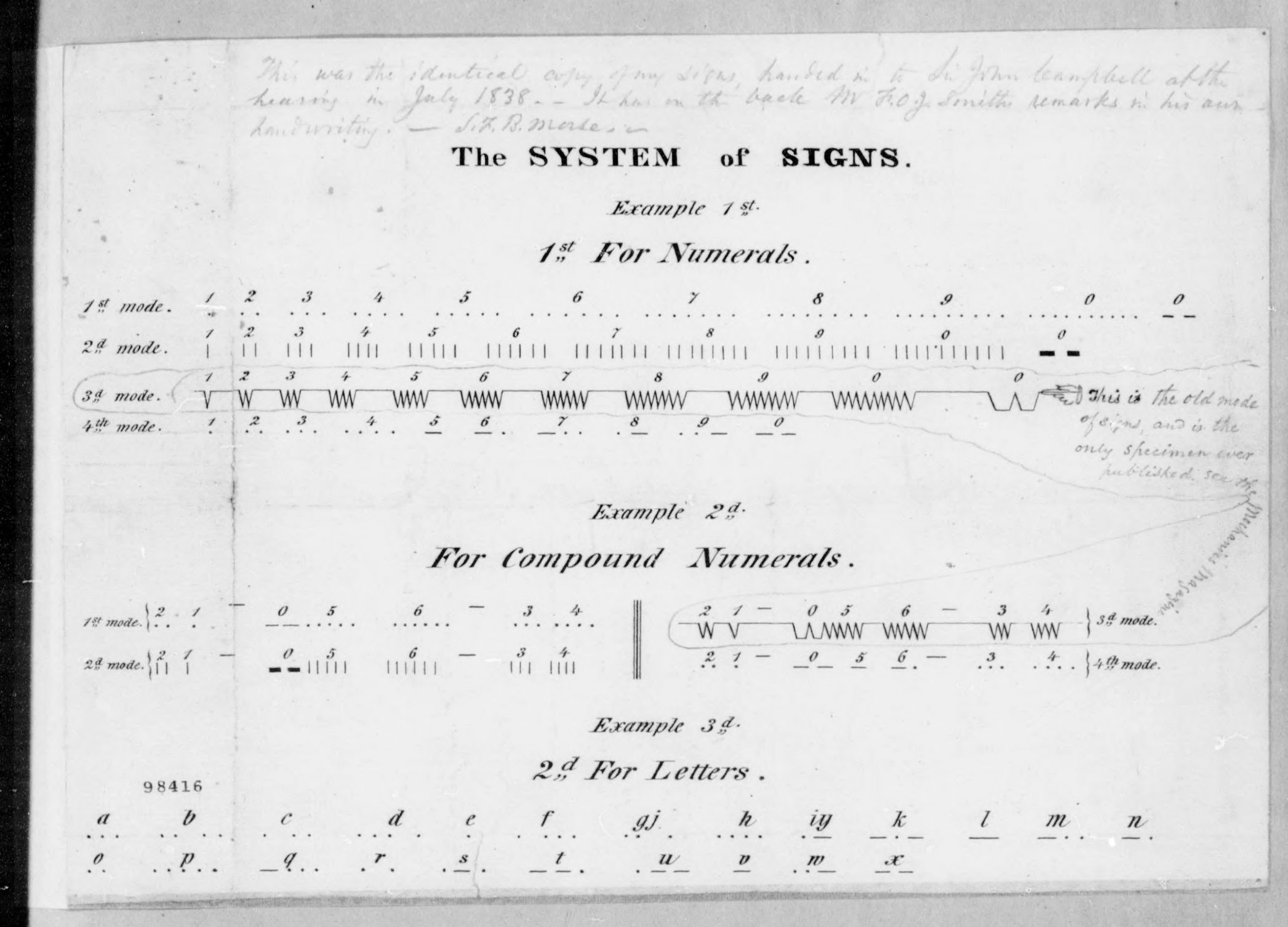
    Morse dots _1_I have only been able top locate a symbolic system of the code in published journal reports (and a newspaper article) showing a “V” system, as in the American Journal of Science and the Arts (vol 33 #1, 1838), which prints an image of the register, and shows a “specimen of telegraphic writing” using this “V”: so, “V   VV   VVV” governed by spaces of long and short intervals,  would stand for 1,2,3 or 123, or to some word designated “123” in a code book. (I should point out that this article is about half the length of the JFI article.) 

    What is surprising is to see what Morse himself had to say on this issue. Here are his notes on the system of notation, from the SFB Morse papers at the Library of Congress, Manuscripts Division, bound volume 28 November 1835-18 April 1838, page 154 (“Drawings to Accompany Copy of Caveat of Oct 6 1837”). The penciled note states “this is old mode of sign and is the only specimen ever published. See the Mechanics Magazine”.  It was also evidently published in the American Journal of Science and Arts at about the same time. There is no reference to the JFI report or the “dots” (or “1st Mode”).  It may simply be the case that at the time of his writing this that Morse was simply unaware of the JFI report, as the three appearances were all published at about the same time (within weeks of one another). 

    Morse system signs _2_

    The famous “first” telegraph “What Hath…”1  transmission (at least seven years after the true “first”) was made of a series of raised symbols corresponding to Morse’s dictionary. 

    I’m no expert in this field, but I haven’t been able to turn out any earlier use of the dots than this report. 

    Notes:

    1. The full quote, suggested by a young girl, was from Numbers xxiii, 23:

    “22…Surely there is no enchantment against Jacob, neither is there any divination against Israel: according to this time it shall be said of Jacob and of Israel, What hath God wrought!

    24 Behold, the people shall rise up as a great lion, and lift up himself as a young lion: he shall not lie down until he eat of the prey, and drink the blood of the slain.”

           2.  Reports of the Capitol demonstration were published in the American Journal of Science and Arts, vol 33, pg. 168, and then in the Mechanics’ Magazine (London) for 10 February 1838.

           3.  There was also an earlier attempt made at Morse’s New York (City) University on 2 September 1837, though this appears to have been unsuccessful. 


  • A Sign Visible in the Dark, 1834

    JF Ptak Science Books   Quick Post

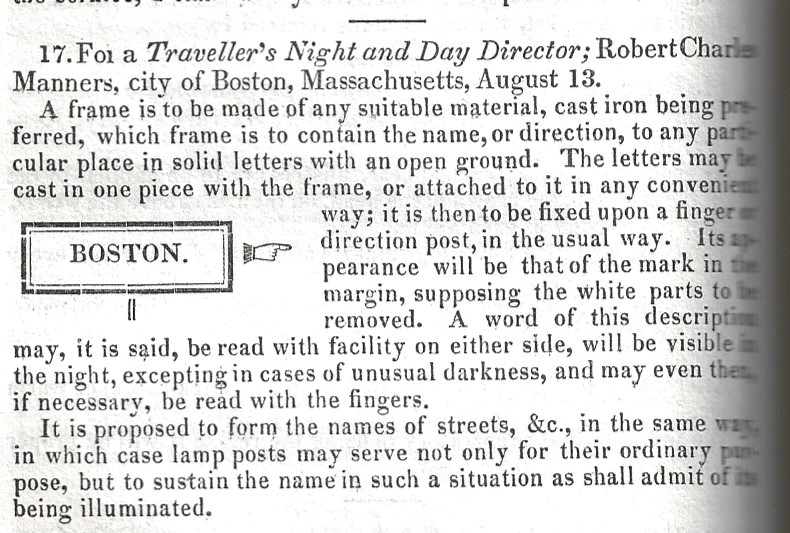
    JFI 1834 Sign I found this fine little notice buried in the patent reports for the 1834 volume of Journal of the Franklin Institute. The turn in the road on road signs here was to paint the destination in black on a field of white, accompanied by a pointing hand. The sign then would “be visible at night, excepting in cases of unusual darkness, and may even then, if necessary,  be read with the fingers”.  My word. Interesting that this attempt is made so early in the game for coach roads–the same cannot be said for roads for automobiles, where it took into the 1920s and 1930s to invent the dividing lines in the center of the road to define lanes and put in shoulder lines (respectively). 


    ·Posted by :

    ·in:


  • On the Speeds of Things (1883)

    JF Ptak Science Books  Quick Post

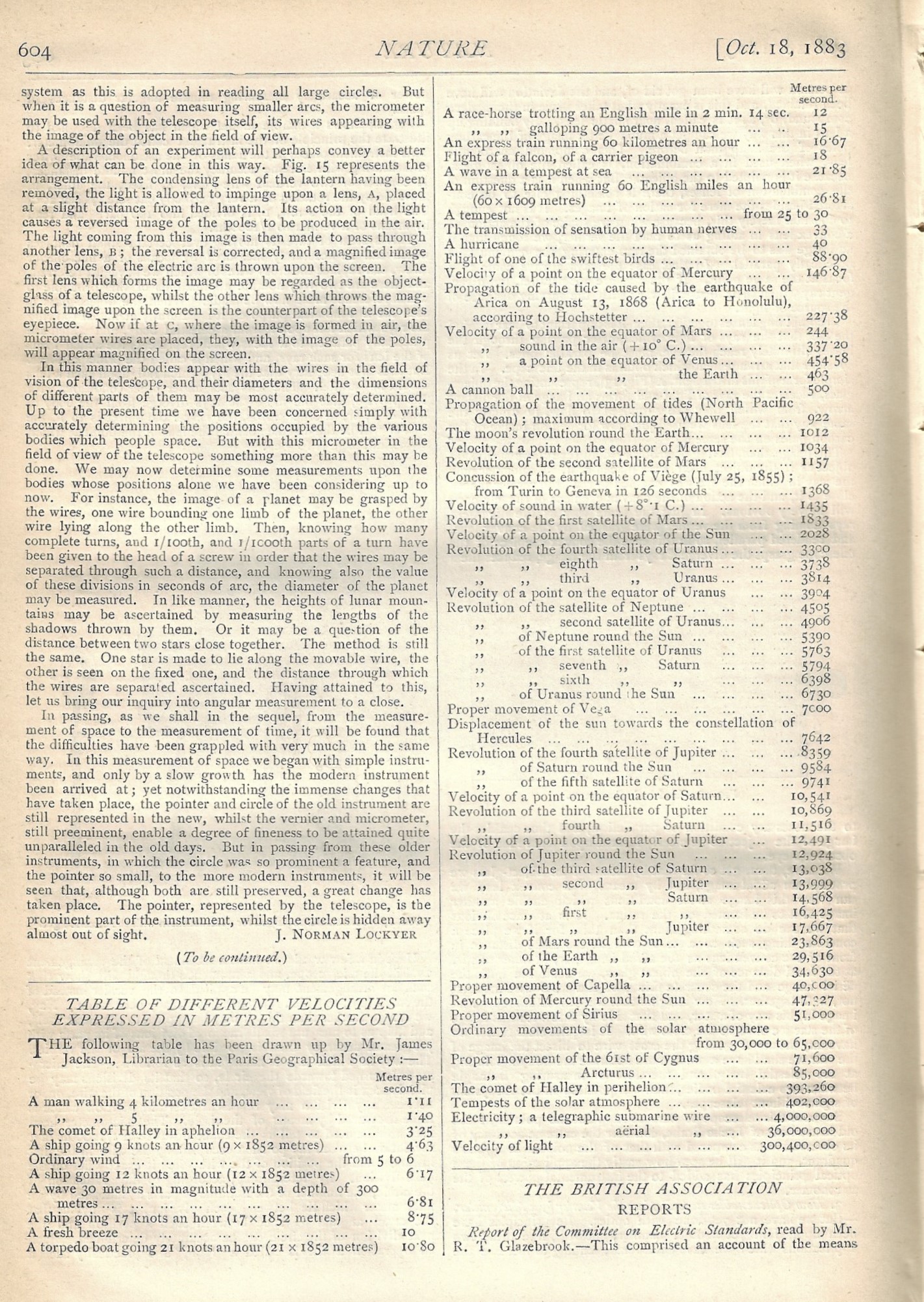
    Here’s an interesting collection of bits that I just came across in the October 18, 1883 issue of Nature, showing the speed of things.  Some of the examples are quite charming, showing the velocities for an “ordinary wind”, a “fresh breeze”, “a race horse trotting an English mile”, “flight of a falcon”, “flight of one of the swiftest birds”,  and “a tempest”; others show the speeds of things that are quite antique, like the velocity of “a cannon ball”, and “an express train travelling at 60 kph”. Then of course we get into the high velocity astronomical examples, all brought to a close by the speed of light. I like the list, and so I share it here:

    Nature 1883 veocity of stuff


  • A Small World of Rubber Bands and Erasers (1903)

    JF Ptak Science Books   Quick Post

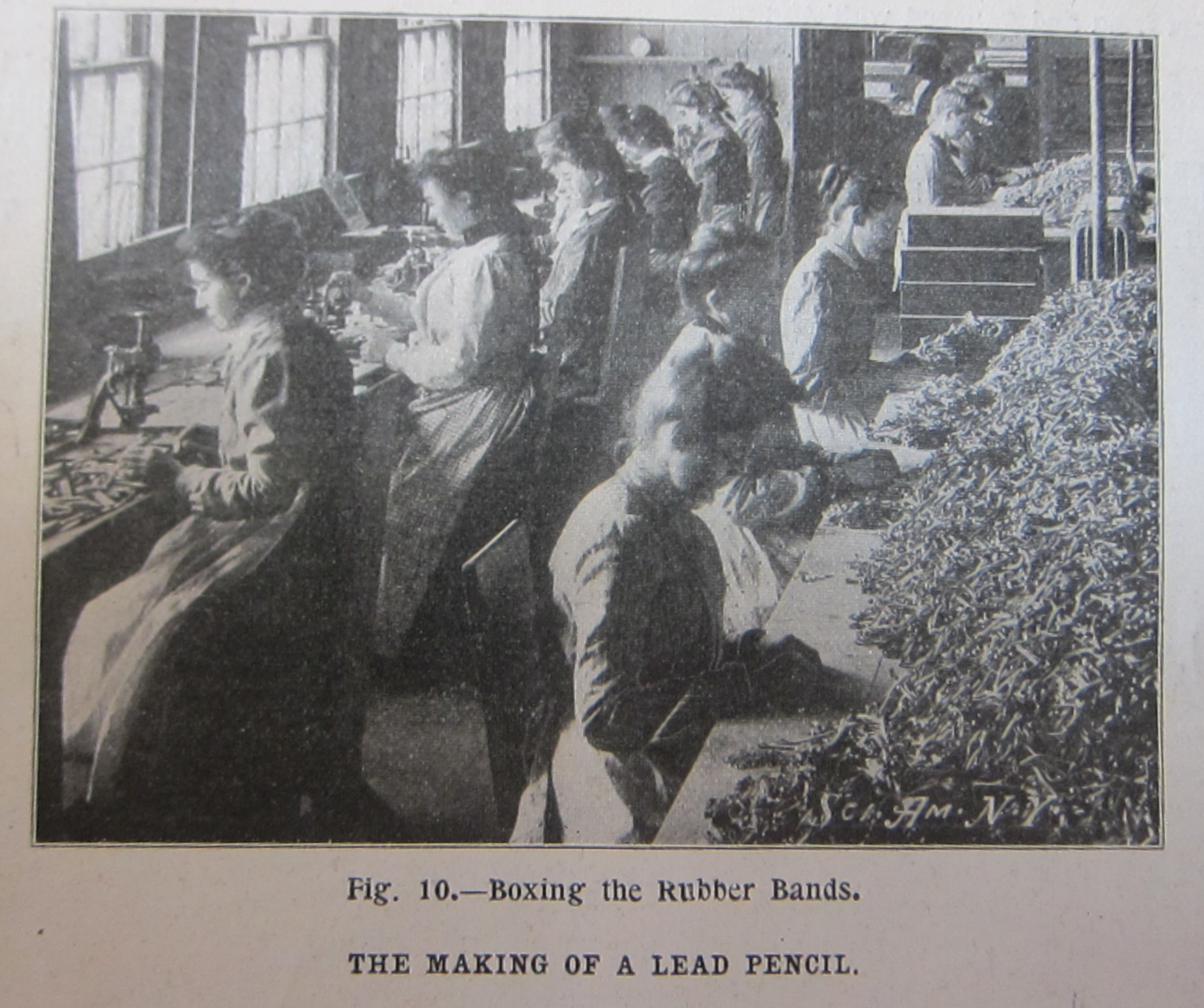
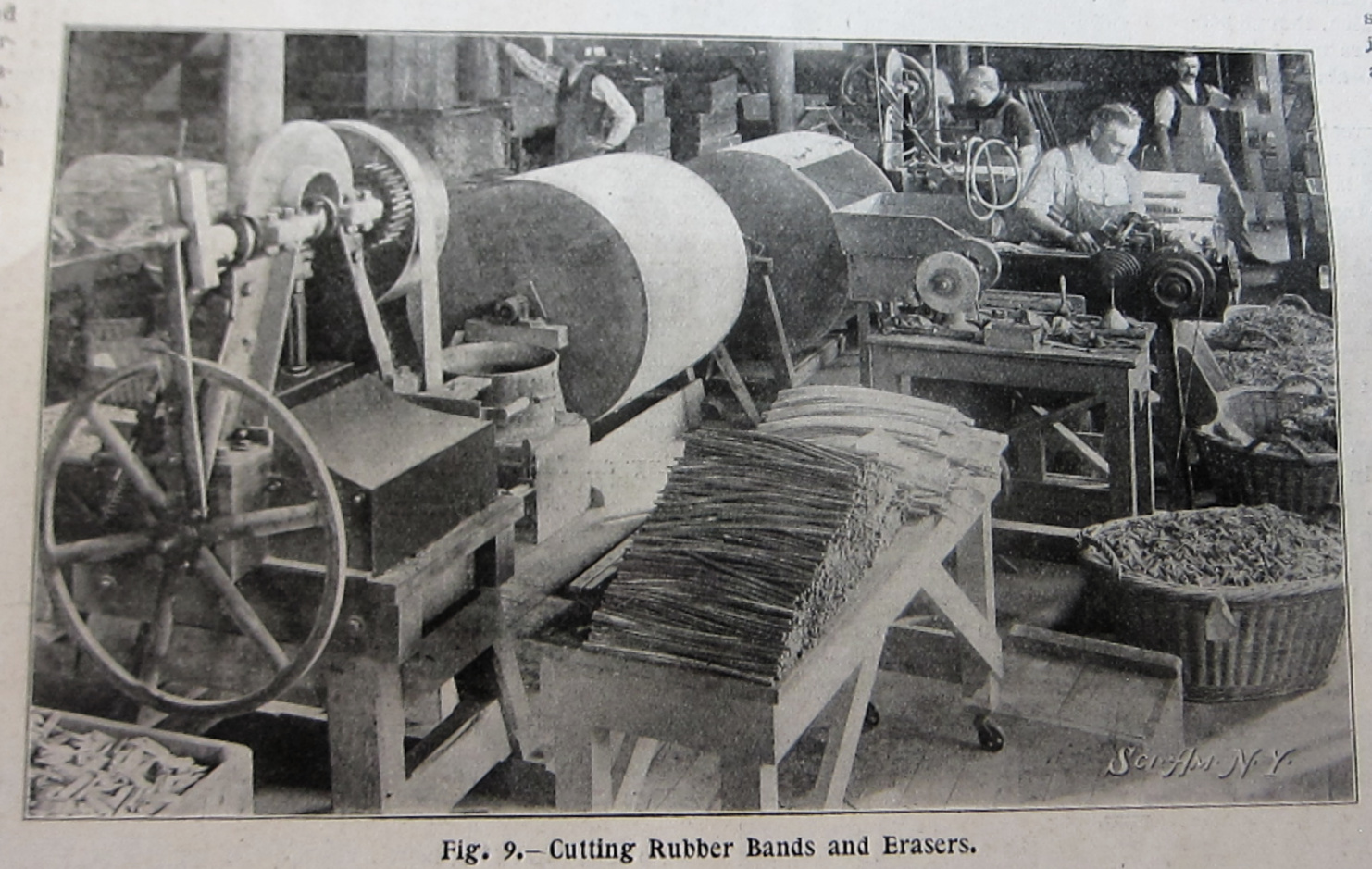
    Back in the days of burgeoning human-machine interfaces there were many industries employing some automation and independent machine operating assembly lines, though there were many more in 1903 that were not. This pictures struck me for the number of people working on what looks like an endless mountain of little tasks combined to make a little product, though there was nothing “little” about the labor that went into it all. In this case, it is a “lead” pencil and rubber band manufacturing establishment, and appears in a rather lengthy article in Scientific American for August 22, 1903. The machines seem to be run by hand, though there were a number of steps int eh process that were hand-done, including gluing the graphite into the pencil, polishing the wood, stamping the pencil, and applying the metal tips for the eraser (called “ferrules” which I hadn’t known about before) and the erasers themselves. An offshoot of the eraser here was the production of rubber bands, and as we can see below the work of sorting and boxing them was dauntingly accomplished by hand.  I wonder what the working conditions were like, and if any precautions were taken with the graphite dust that must’ve been misty here and there in the factory…

    Sci AM 1903 rubber bands _2_

    Here’s the rubber being prepared for both pencil and rubber bands:

    Sci Am 1903 Pencil rubber bands


  • Mozart and NYC: the Hudson River Tunnel und die Zauberflote’s Königin der Nacht

    JF Ptak Science Books   Quick Post

    Sci Am 1903 Hudson River tunnel

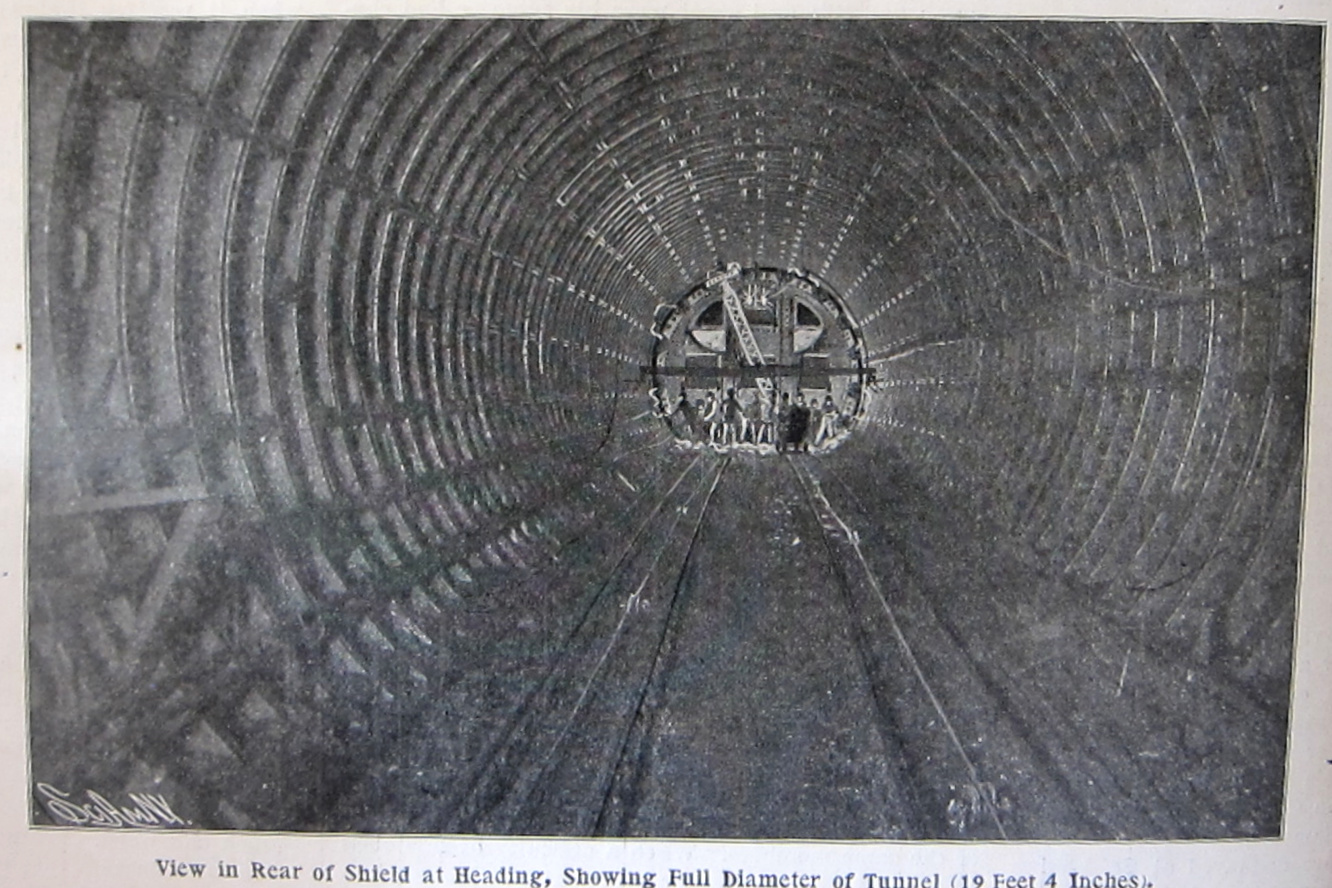
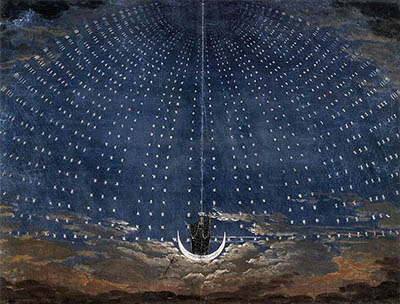
    This photographic view of the 19′ tunnel section of the Hudson River tunnel reminds me a little bit—I mean, it reminds me in a sparkly sense—of the 1815 stage set by Karl Friedrich Schinkel (1781-1841) for Mozart’s Magic Flute (from the original gouache, measuring 463 x 616 mm, and part of the collection of the Staatliche Museen, Berlin). Again, its just the initial reaction to the perspective pulled up the Schinkel more than anything else, except maybe for a non-existent underground image from Jan Vredeman de Vries’ book on perspective. That said, the set design I’m thinking of features the arrival of the Queen of the Night/Königin der Nacht, so perhaps this association isn’t too meshuga…excepting the ripped-to-shreds lust for revenge that the Queen of the Night sings about, which hasn’t much to do with digging a tunnel. 

    (And just in case you’ve never seen Amadeus by Milos Forman, you should, if for nothing more than watching M conduct the Queen of the Night aria.) Also, I’m writing this note at the tail end of the day of Beethoven’s 248nd birthday, and Mozart (although he would conduct the premier of the opera) wouldn’t live out the year of his opera. I don’t know what that has to do with anything, though it almost does. 

    Mozart_magic_flute

    Source for the Friedrich Schinkel image: https://www.wga.hu/support/viewer_m/z.html

    ·Posted by :

    ·in:


  • A World Going on, Underground: Tugger Boys, Trench Blasters, George Orwell, & Tom Waits

    JF Ptak Science Books   [An earlier post from 2008, expanded]

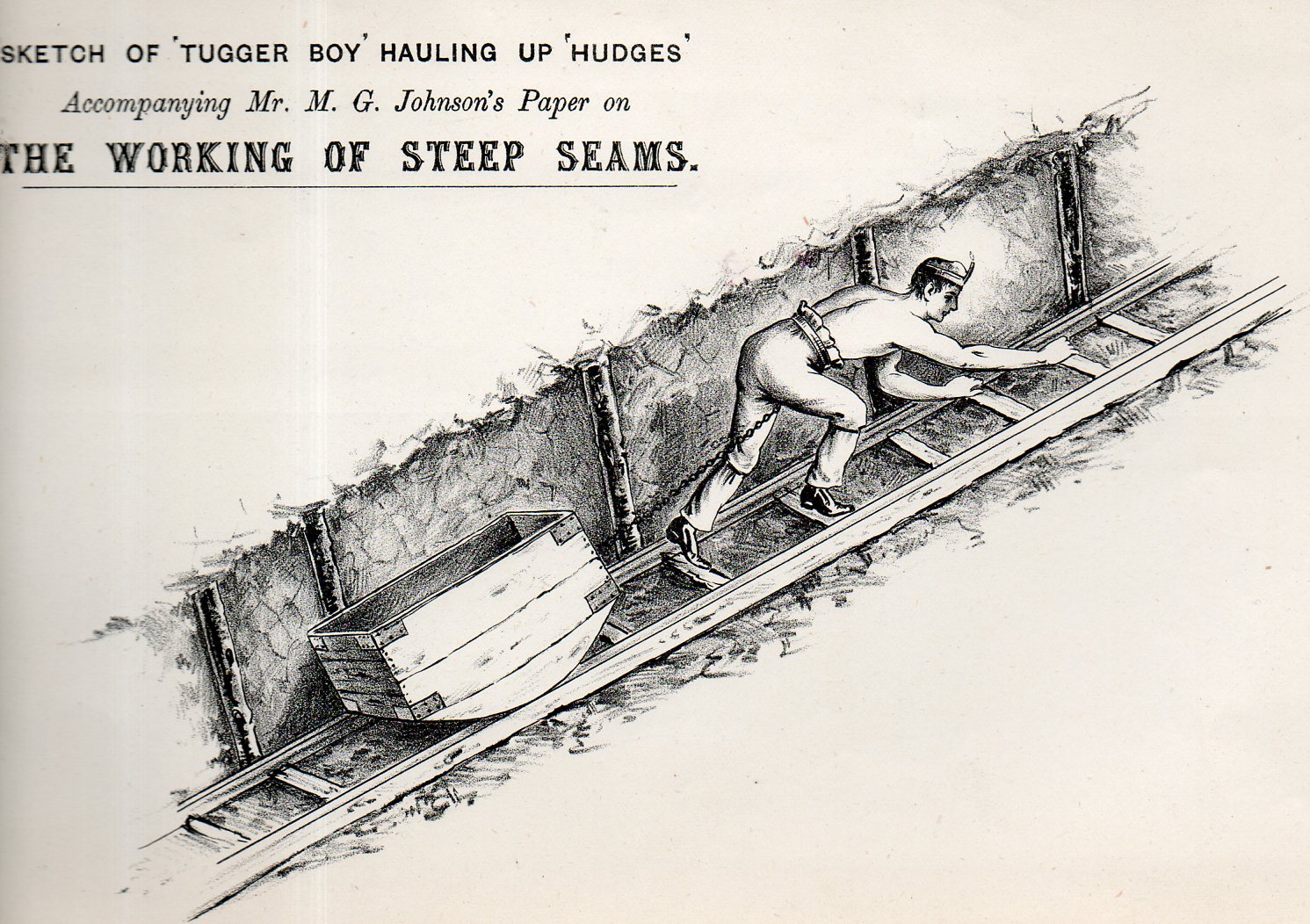
    Underground working steep102


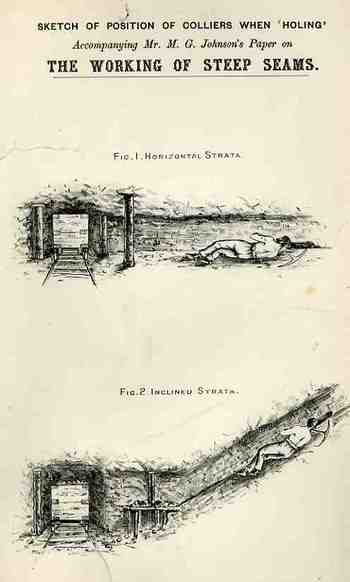
    Looking at these two images of the shirtless miner laying down and working on his side in the semi-dark way underground in what looks to be a tunnel about twice the width of his shoulders makes you wonder about how in the name of great bog could people have done this, day in and day out.  The fact that the appearance of these images were both essential and mundane further tells us—as we sit here in a comfortable chair in the print’s future—that this is, simply, what people did, and what they had to do.

    Blogjuly_17_work334

    This was “holing”, as in working in a hole, and served to illustrate a point in Mr. M.G. Johnson’s paper “The Working of Steep Seams”, which I think appeared in a West Australian mining journal around 1900.  It seems that the miner in the picture would spend his day chunking coal from a hard vein, laying down, scrapping (I think) away at the coal in a too-tight tunnel.  Did he do this for hours?  Days?  Weeks?  I guess the bad answer is that he did this as long as the coal could be followed, though I suspect that the miners must’ve traded out positions to prevent any one man from doing this sort of extremely difficult work for too long, sharing the responsibility of The Bad Job.  (Also, it looks as though that the major tunnel in which the coal car is located may be 4 or 5 shoulders high—certainly not tall enough to walk in, which means that this guy could’ve crab-walked to this position for a half mile or more, just to get to work.  The tenacity of this worker to do his work and collect his pay to feed his family was just incredible. 

    The first image really doesn’t need much commentary, though calling the worker a “tugger boy” pulling up a “hudge” was probably a bit of sardonic camaraderie–except that the doing of the job would distance you from its folksy name.

    • “Tugger boy (Brist). One who draws small tubs or sleds underground by means of a tugger. Called Tugger-work. (Gresley), 1883. 

    The depiction of what seems to be a mature man in the image might be a piece of propaganda. In any event,  the Tugger Boy carries his own flame on the top of his headgear, and the chain that attaches him to the heavy coal bucket runs from his waste down the front of his body and through his legs.  

    George Orwell wrote perhaps one of the most brilliant descriptions of the mining environment in his superb The Road to Wigan Pier. (It is well worth reading all of Orwell’s books at this point—his insights almost never looked so fresh.)

    He  describes the crab-walk from the elevator to the place of work, telling how difficult and exhausting the process was of just getting to the place where you would then begin your difficult workday.  Of the miners he says at one point:  “Watching coal-miners at work, you realize momentarily what different universes people inhabit. Down there where coal is dug is a sort of world apart which one can quite easily go through life without ever hearing about. Probably majority of people would even prefer not to hear about it. Yet it is the absolutely necessary counterpart of our world above.” 

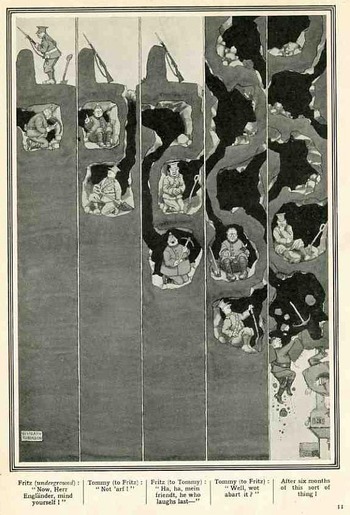
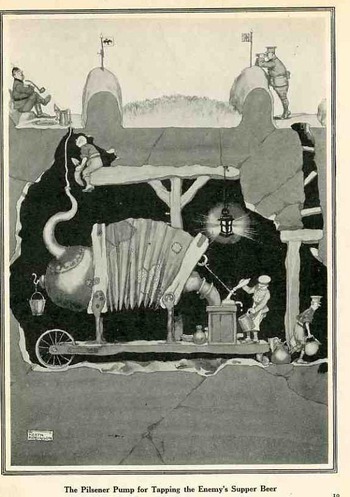
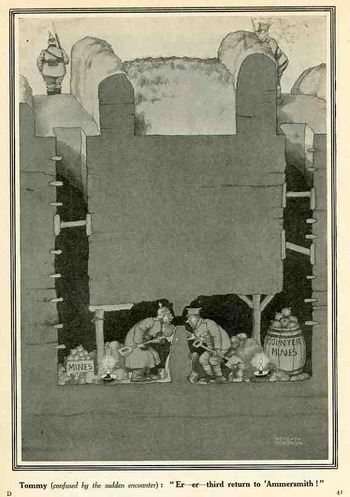
    The next series of images come from the pen of W. Heath Robinson (1872-1944) who was a lovely, quirky, charming, skewed, dark, stiff-bouncing and creative illustrator capable of considerable whimsy (light and complex) and deep skepticism.  The images I’ve selected are from one of his three WWI books, Hunlikely, published in 1916 (Some “Frightful” War Pictures (1915), and Flypapers (1919), were the other two) and depict scenes from the intra-trench tunnel wars, which were battles fought in the midst (or, actually, beneath) other battles.  This was a savage, grueling, post-adjectival affair—exceedingly dangerous, difficult, awful.  And it happened a lot during the war, given the experience of stalemates between vast armies sunk into mole city trenches, with no one going anywhere for long periods because there was nothing in between the two impervious lines but a death vacuum. 

    Blogjuly_18_mining_robinson338

    So one of the solutions was to try and tunnel underneath the opposing army’s defenses, fill the far end with high explosives, and blow them up.  The other side was doing it too, and in the middle of it all was the incorporation of newer/better listening devices to detect forces rummaging around underneath your position dozens of feet into the ground.  It was a bad business. (One of the other means of breaching the trench lines was aerial combat, but bombers carrying tons of HE were still yet to be invented; poison gas was another.  Most of the time the armies would just meet in the middle  in wide plains of nothingness in a sea of hot, expanding metal,  where to this day in many of those places nothing can live).

    Robinson’s illustrations are odd, and oddly funny, the dark humor coming at the expense of both sides of the conflict, piercing each.   

    Blogjuly_18_tunnel_2_robinson340

    This all puts me in mind of Tom Waits’ concrete-toothed “There’s A world Going On Underground” song from the Swordfishtrombones album: 

    Rattle big black bones in the danger zone
    There’s a rumblin’ groan down below
    There’s a big dark town, it’s a place I’ve found
    There’s a world going on underground
                
    They’re alive, they’re awake
    While the rest of the world is asleep
    Below the mine shaft roads, it will all unfold
    There’s a world going on underground
                
    All the roots hang down, swing from town to town
    They are marching around down under your boots
    All the trucks unload beyond the gopher holes
    There’s a world going on underground

    Blogjuly_18_tunnel_3_2_robinson341


  • The Sun in Type (1909)

    JF Ptak Science Books   Quick Post

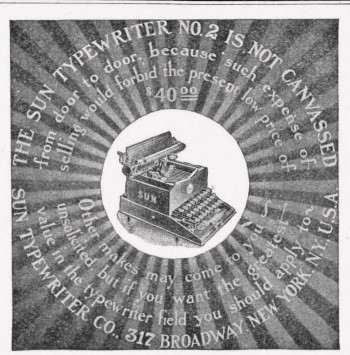
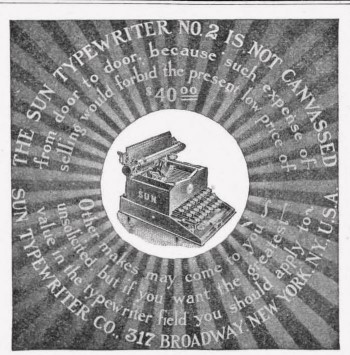
    Typewriter Sun 1909This is a small 1.5″ ad that appeared in a premier issue of Scientific American, June 11, 1909. It is tiny and attractive, a sunburst design for a Sun typewriter, the text claiming that it wasn’t sold door-to-door but via paper advertising to save costs in production and delivery, offering it for what was then a discounted price of $40. That 40 bucks is equal to about $1000 now according to the inflation calculator at the Bureau of Labor Statistics site–better though perhaps to think of it in terms of monthly/yearly income: laborers earned about $300-$600 a year in 1910, whereas an engineer or accountant would make between $2000 and $5000 a year; that would make the machine somewhat expensive at about a week’s salary or less, but affordable.

    The address says to apply at 317 Broadway–the building is still there and a fine structure it is; presently the address is broken up on the ground floor and shared by a booze shop and pizza place, sandwiched by a 7-Eleven and a McDonald.

    (I say “premier” issue of the SA because the cover is dedicated to the Wright Brothers, the first such honor paid them by the magazine in over five years of mounting successes following their huge accomplishment at Kill Devil in December 1903. A fine acknowledging article appeared in 1908, but there’s precious little in the way of support to the brothers in the magazine between 1904 and 1908. This issue ended that drought.)


    ·Posted by :

    ·in:


  • The Wright Stuff in Alabama, 1910

    JF Ptak Science Books   Post 2772

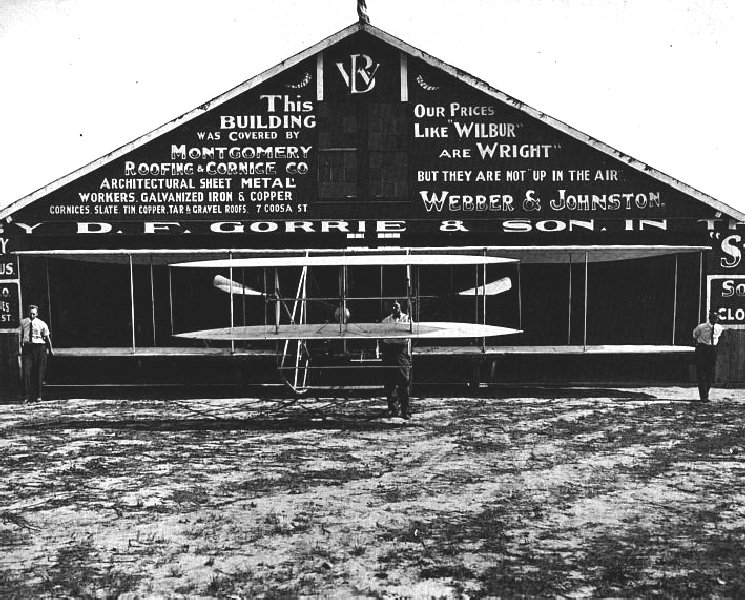
    In the times that I’ve had to research the Wright Brothers (they do deserve that capital “B” if they are not named separately) I’ve never seen a reference for their 1910 flight school in Montgomery, Alabama. The school came to be as part of an effort to educate a team of fliers who could then go out and educate the general public in the art of flying.

    This was a solidly-grounded idea much in the same tradition as any of the concerted and considered efforts by the Wright Brothers. (It is remarkable how competent and exploratory they were in their pursuit of flight. Right from the time that Wilbur was laid up in bed recovering from typhoid fever in 1896, he was doing some clear and excellent thinking on the matter, beautifully concluding that getting into the air in an aeroplane was not so much the case as it was staying in the air; and that depended upon control of the aircraft, and for that he gave very considerable time to the study of how birds control their flight. This realized, flight was not long to follow—five years from sickbed and near-death to 1000 glides, seven to powered flight, all paid for by the brothers, and mostly funded by their bike shop. And by the way, according to David McCullough in his biography of the Wrights the whole flying exercise–including materials, books, machinery, travel, food, and so on–from 1900 to 1903, cost the brothers under $1000. )

    Seven years after Kill Devil Hills and the great success, the Wrights came to establish their first flight instruction school in a parcel of land that had been a cotton field, a wide piece of flat land outside of Montgomery, Alabama. There was nothing there except for the flatness, and so to attract the school local businesses worked to clear the land and construct a building that would serve many purposes, which explains the advertisements for those who contributed to the project:

    Wright flying school 1910

    [Photo source: Alabama Pioneers,  https://www.alabamapioneers.com/airplane-montgomery/]

    Wilbur had made the first flight in Alabama in March 1910, and the school followed soon after. After a relatively short period of instruction, the first graduate of the place, Walter Brookins (1889-1953), would become one of the celebrated Wright Exhibition Team, and set records that same year for highest and longest flights in the U.S. Another early graduate was Henry Arnold, “Hap” Army, General of the Army and only USAF five-star general, who was among other things a barnstormer before his military career.

    In any event, I just wanted to share this picture, as I like it so much.

    With a fair dose of poetry sprinkled on it, that cotton field is now covered by Maxwell Air Force Base.

    Notes:

    1. There’s a ton of other stuff, too, that I’ve not seen concerning them, but in this instance the photo of the hangar/school is so charming and the story so compelling that I think I just missed something that is probably a piece of highly visible popular culture.