A Daily History of Holes, Dots, Lines, Science, History, Math, Physics, Art, the Unintentional Absurd, Architecture, Maps, Data Visualization, Blank and Missing Things, and so on. |1.6 million words, 7500 images, 4.9 million hits| Press & appearances in The Times, Le Figaro, Mensa, The Economist, The Guardian, Discovery News, Slate, Le Monde, Sci American Blogs, Le Pont, and many other places… 5000+ total posts since 2008.

Category: Technology, History of

  • The Fossil Record of Duchampian Motion–an Early Image in Spatial Time (1884)

    JF Ptak Science Books   Post 2747

    MArey May 1884_2_

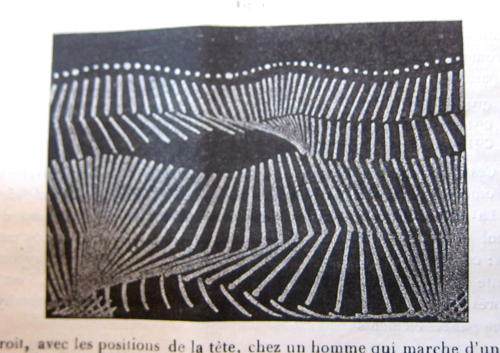
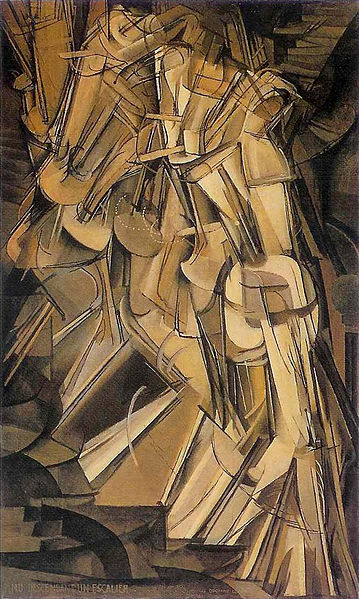
    This is one of those times where science precedes art–that’s the least significant aspect of this image, as the folks seeing it in 1884 couldn’t see into the future didn’t know that they were looking at what may pass for prehistoric fossil record of Duchamp’s 1912 Nude Descending.  The Duchamp would cause trial and occasional outrage in much of the artworld due no doubt to it challenging aesthetic–I don’t know what the readers of the Compte Rendus thought when they saw this image, but I suspect it did not involve evaluating its artistic impact.

    This is the work of Etienne Marey (who has made a number of appearances on this blog), a very smart and versatile guy who would go from physiology to cinematography to aerodynamics in the course of his life and be a leader/pioneer in each field.  Marey published this “strobophotograph” in his article “Analyse cinematique de la marche” in the Comptes Rendus on 19 May 1884–this was a brilliant effort in the analysis of human locomotion by making a dozen or two exposures on a single photo sheets of a reflective-outlined walking figure. This was different from Marey’s birthyear and deathyear buddy, the other motion picture pioneer, Eadweard Muytbridge (1830-1904 for both). Marey introduced his “chronophotography” and studied aspects of movement and motion that had been dispersed to human history because of the inability to observe and record them–with Marey, that issue necessary for the beginning of real scientific discourse was to a large extent solved. 

    Duchamp_-_Nude_Descending_a_Staircase

    Marcel Duchamp’s Nude Descending a Staircase, 1912, via Wikicommons

     There are more applicable Marey images for the Duchamp–for example his series on a single sheet of a naked woman descending a short set of stairs–but the image above has more aggregated motion in a confined space sense to it, so I’ll stay with the sense-impressions than the more-visual ones. 

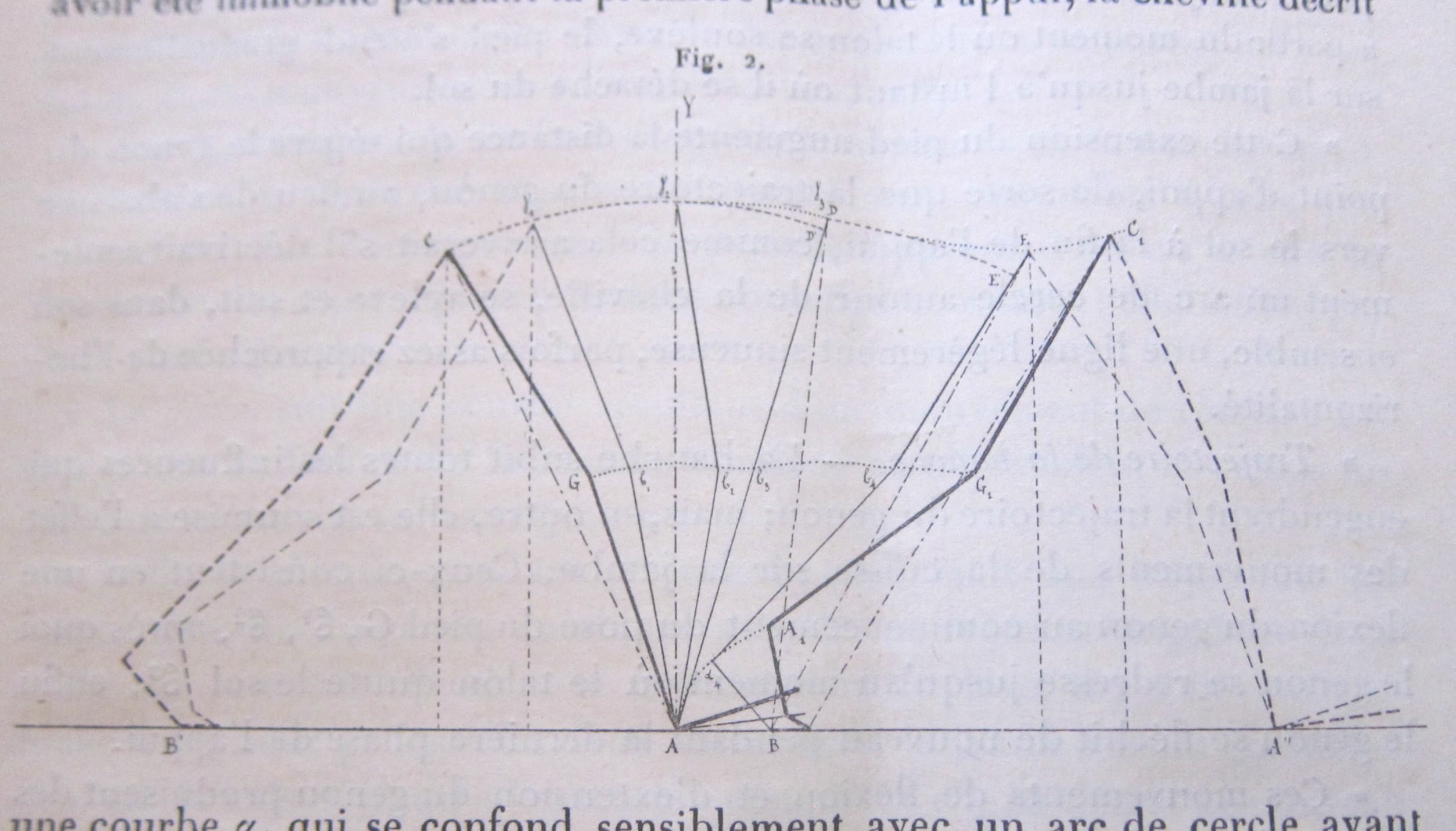
    And here’s Marey’s  modeling of the action:

    Marey May 1884

    In any event, I just wanted to pass on this quick note on some seldom-seen Marey images…


  • Aeroplane Roulette, 1912

    JF Ptak Science Books   Quick Post

    It took a few years for the Wright Brother’s iconic and monumental flights of 1903 to be thoroughly and popularly deemed not-crackpot, but once that was the case, the Wrights, and their flying machine, and aeroplanes in general, were heralded as the future-arriving. (It seems to me that their fame was mounting over a few years, but still, their reception was limited–it wasn’t like Einstein becoming instantly immortalized following the eclipse confirmation of 1919, being obscure one day and immortalized soon after, but they did go from relative quiet to international renown in a couple of years.) 

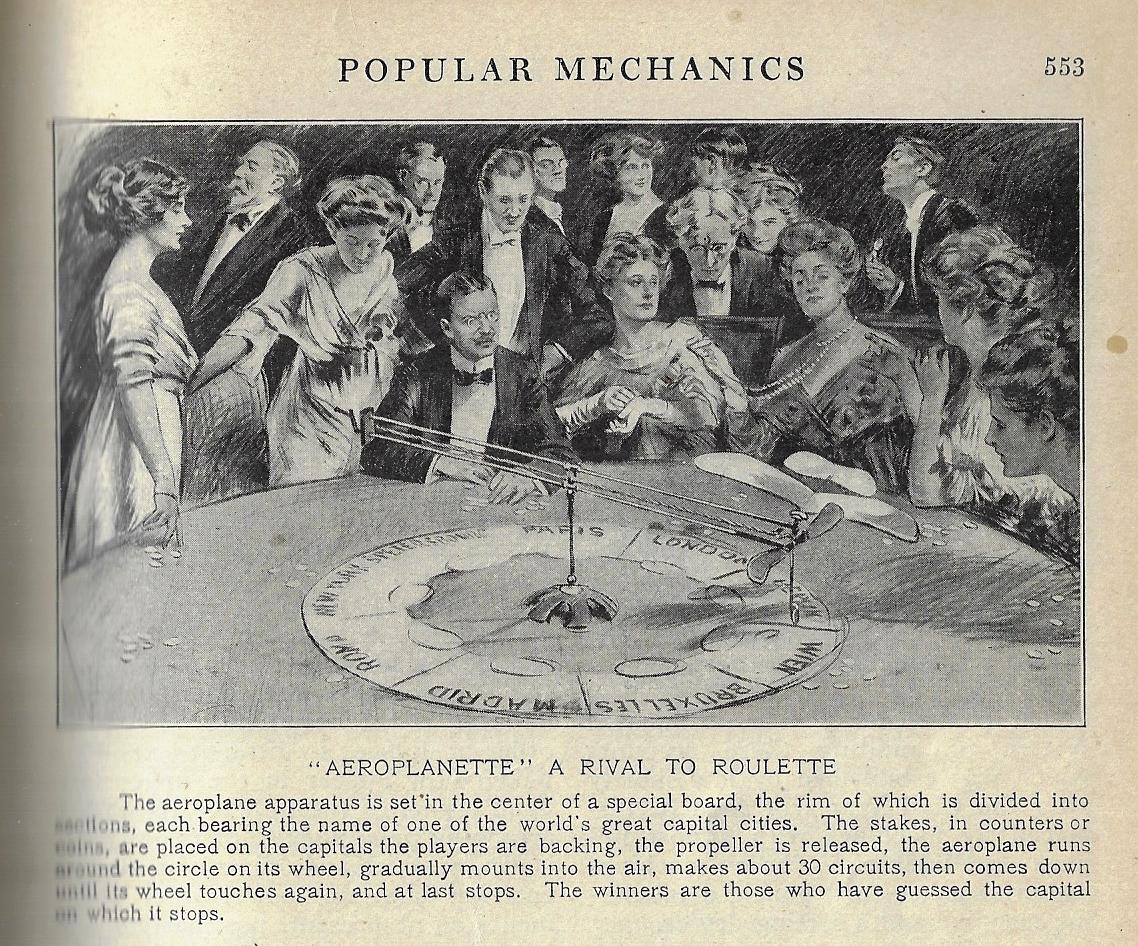
    In any event, by 1912 there were aeroplane toys, and games, and popularly sold sheet music for songs, and also, evidently, a version of roulette made to accommodate the cascading interest in the new technology. I had never seen this toy/game/gaming apparatus before tonight, and I was happy to see it:

    Pop Mech 1912 aeroplane roulette

    Source: Popular Mechanics, p 553. 


  • A Very Large and Very Early X-Ray Photo, February 1896

    JF Ptak Science Books  Quick Post

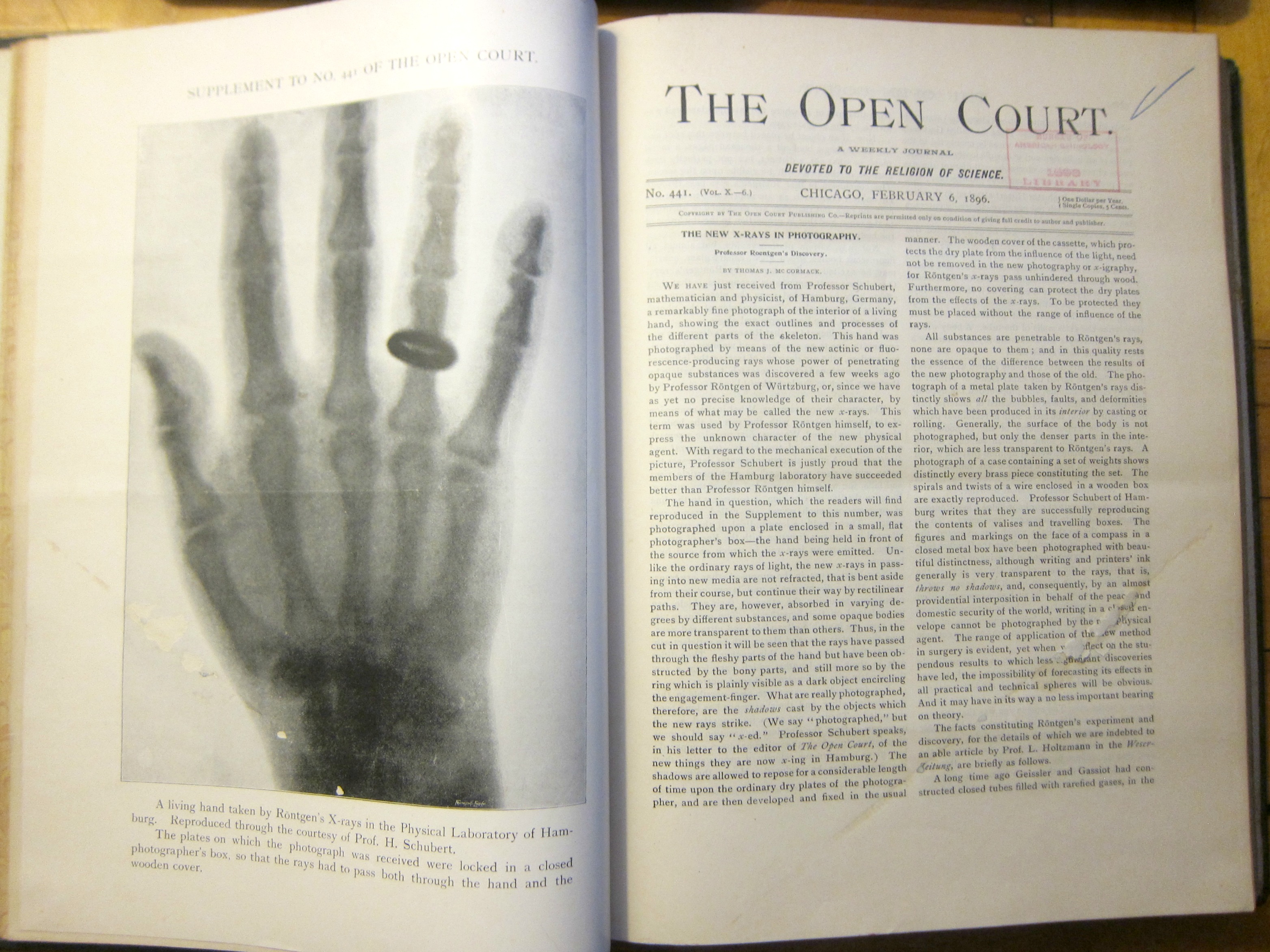
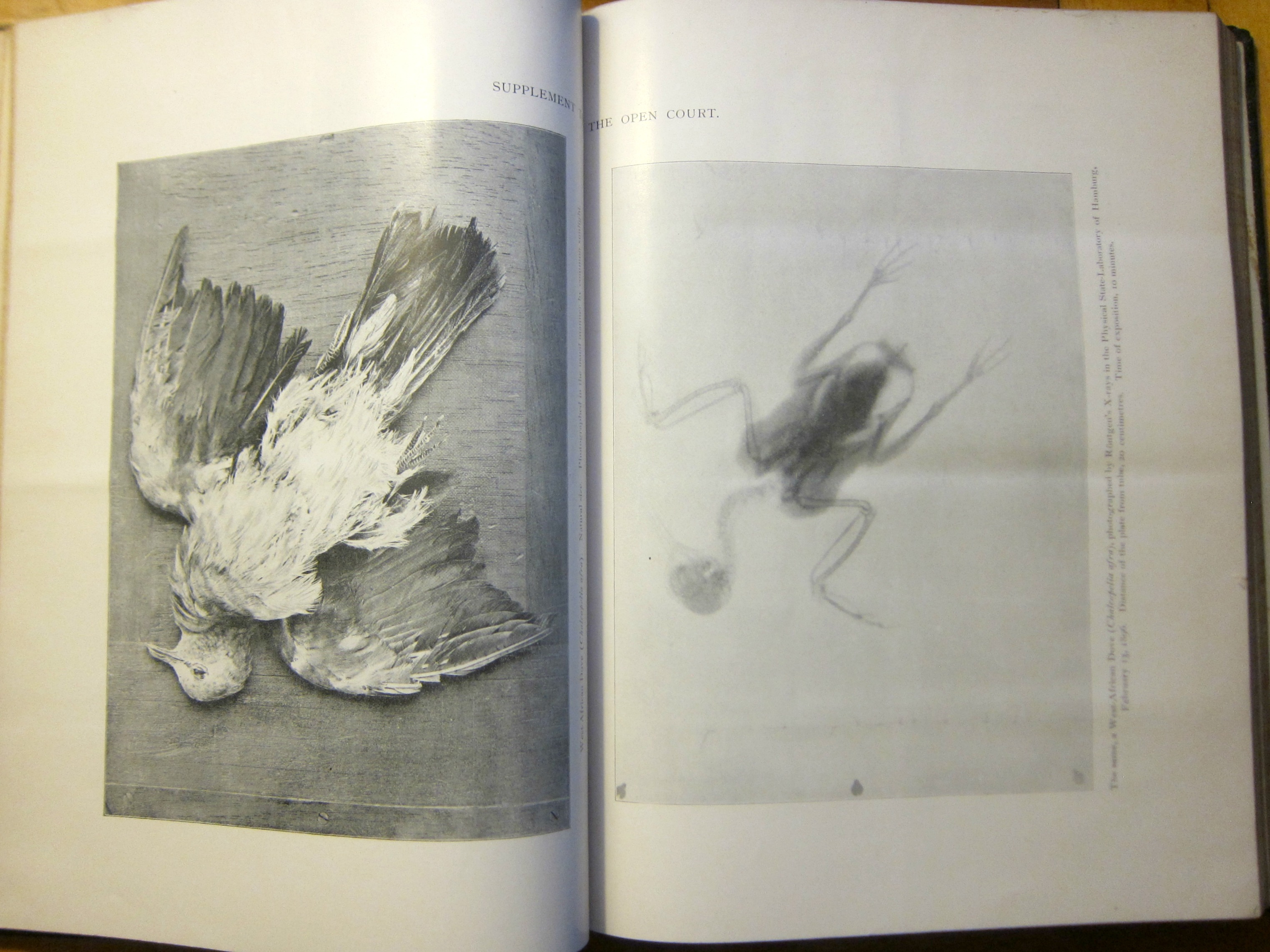
    I made an unexpected find today, poking around in a February 18961 volume of the probing, somewhat classically-radical and Easternist journal, The Open Court, a Weekly Journal Devoted to the Religion of Science.  The photo and article form a very early appearance in the U.S. of the weeks-old Roentgen discovery of the x-ray. The first journal edition in English appears to be 23 January 1896 in Nature (vol 53), and the first in a U.S. journal in Science on 31 January, though that is not illustrated.  (The Science article, written by Hugo Muinsterberg of Harvard, notes that this was a good thing for the reassurance of German stature in physics as they had in the last year lost Kundt, Hertz, and von Helmholtz, and now they had Wilhelm Roentgenfor a new placeholder of living greatness.) 

    X-ray _3_


    X-ray _2_

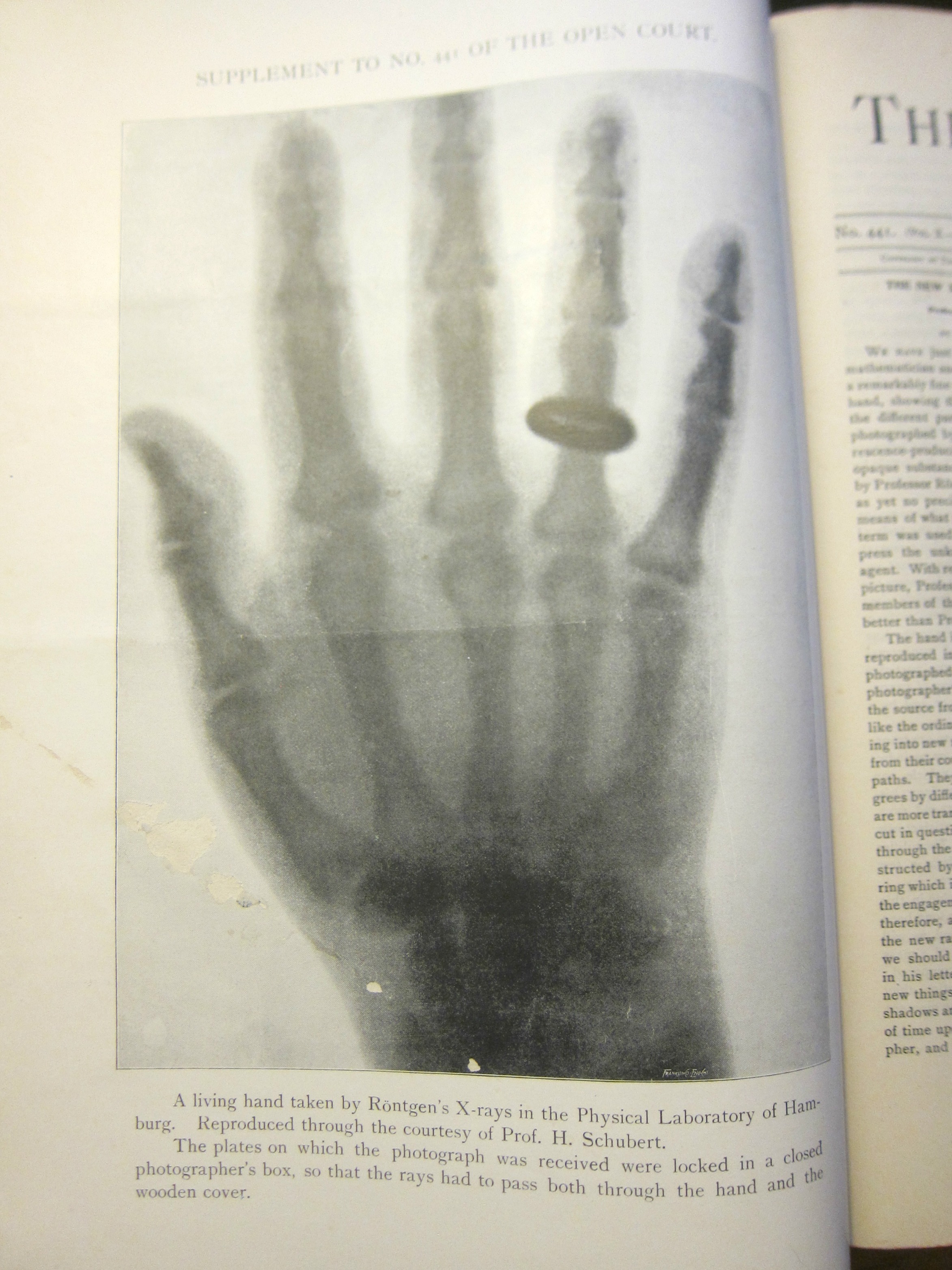
    A close-up of the 12″ tall image

    The illustrated article by McCormack, in the Taoist-historico-scientific journal Open Court, shares an example of x-ray photography by H(ermann). Schubert (1848-1911, and who would have his paper on the Rontgen rays translated for the Monist in April) ) of the Physical Laboratory in Hamburg which is very large, more than 12″ tall, and by far the largest of these famous photos that I have seen. There is a short discussion on what exactly to call the “photograph”, since it really wasn’t a photo by general standards, and the term “x-ed” is suggested…I’m not sure when the “X-Ray” as a term for the product of being exposed to x-rays and photographic film was, but it wasn’t long after this.)  There is a bit of history of the discovery of the x-ray, and a discussion on the idea of chance and discovery in scientific progress. 

    There would be an enormous wave of publications on the x-ray over the course of the next year–in fact, the Bibliography of X-ray Literature and Research (1896-1897) by Charles Phillips (published in 1906) is 68pp long and finds more than 1500 books and articles published over just two years. Oddly, the Open Court papers are not to be found in the Phillips bibliography, and I’m not sure why.  

    It seems to me that Open Court publishes on the of the first photographs of an x-ray in a U.S. journal. 

    McCormack (1865-1932) had an interesting career, translating Lagrange, Weismann, Mach, as well as the photographer and mathematician  Hermann Schubert’s books on recreational mathematics), and wrote several books in disparate disciplines.  

    X-ray _1_

    Notes:

    1. Thomas J. McCormack, “The New X-Rays in Photography”, in a bound volume of The Open Court, a Weekly Journal Devoted to the Religion of Science, February 6, 1896, no. 441, volume x-6, pp 4799-4801.  With a very large photographic image (12×9.25″ 31x24cm).
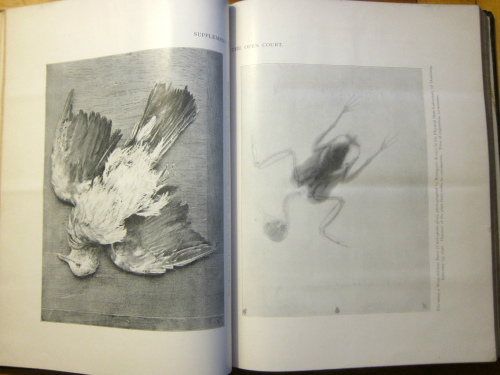
    Also appearing in this volume, again by McCormack,  “Roentgen’s Rays Again”, no. 446 vol X-11, March 12, 1896, pp 4483-4844, illustrated with a double-page photographic image. 

    ·Posted by :

    ·in:

    —

  • Radio and Television, a Peep into the Future of 1930 from 1929

     JF Ptak Science Books   Post 2740

    Pop Mech 1929 radio of the future

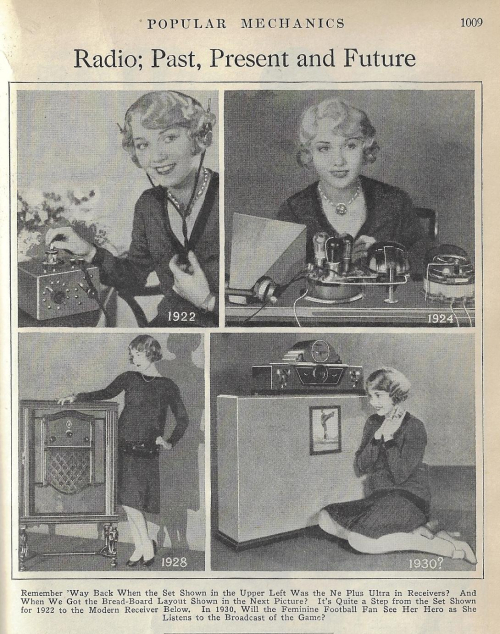
    The odd thing about this odd speculation for an odd look advancing a single odd year into the future is that it is so, well, odd. Here on page 1009 of the January-June volume of Popular Mechanics the editors speculated on what the approaching year might bring in the evolution/revolution of the radio. Radio as a popular medium was relatively new-ish in 1922 and the in six quick years very much developed for wide use, and so it must have appeared not too long a leap to jump into a radio for 1930 that offered images to accompany the broadcast. The idea of “seeing by wireless” was already upon folks back then, or at least the technology was.

    Since the vision of the future of 1930 was that of the radio, I’m assuming that the image that “the feminine football fan” was seeing in 1930 was a static image of someone punting–the capacity for that already existed, so I suppose that what Popular Mechanics was expressing was the general distribution of this new wireless set.  Perhaps “television” wasn’t mentioned because this was a speculation on radio.

    As a matter of fact, television as an invention was already established by 1929–deeply so. There was already a television station  (established in 1928, WRGB), which already was several years after John L. Baird’s1 first public demo of his mechanical tv at Selfrdige’s department Store in London on March 25, 1925. And by 1926 Baird had made a successful demonstration of a moving image, which was well documented in a 62-page book months later by Alfred Dinsdale, Seeing by Wireless, in which “television”  is elegantly described as an invention where “we see what is happening at a distance while it is happening”. (There is a famous and relatively creepy image that is described as the first photo of a moving image transmitted via television, a death-mask-like portrait of Baird’s business part, Oliver Hutchinson, and which first appeared in The Times on January 28, 1926.)

    In the same period a D.C. man, Charles Francis Jenkins, was having success with his electronic television, where by 1925 he had already publicly demonstrated a transmission of silhouetted images (and this following a dozen years after his first publication on the subject, “Motion Pictures by Wireless” in 1913).  Two years later (April 7, 1927) yet another very successful demo was made by Herbert E. Ives and Frank Gray (both of Bell Labs). A year later, on September 3, 1928, the beautifully-named Philo Farnsworth was far enough along with his invention that its public demonstration on that date is recognized as the first electronic television demonstration.

    In any event, I wanted to note some of the events in the development of television that occurred around the time of the publication of this issue of Popular Mechanics to show how much work and how far along the new medium had come to give  a little background into the question of why this photo essay would stand by a static-image radio while a moving image electronic television was being shown to be so successful. I’m a little stumped.

    Notes:

    1. I don’t know where else to hang this tidbit, so here it goes: it is just interesting to note that two Scots–Alexander Graham Bell and John Logie Baird–gave ears and eyes to human communication, one with the telephone and the other with the television.  There are many others who made very significant contributions to both developments, but I thought that this was worth a mention.

    Also, Frankenstein’s “monster” may not have been flesh and blood, but a moving picture of it. Here’s the work of one Frankenstein with a patent relating to the development of the media monster, television: “VON JAWORSKI, W. und FRANKENSTEIN, A., “Verfahren und Vorrichtung zur Fernsichtbarmachung von Bildung und GegenstÄnden mittels Selenzellen, Dreifarbenfilter und Zerlegung des Bilden in Punktgruppen durch Spiegel”, Brevet allemand, 172 376, 20 August 1904.”

    ·Posted by :

    ·in:

    —

  • Spaghetti & Subways: an Ordered Anxiety of 1929

    JF Ptak Science Books  Quick Post

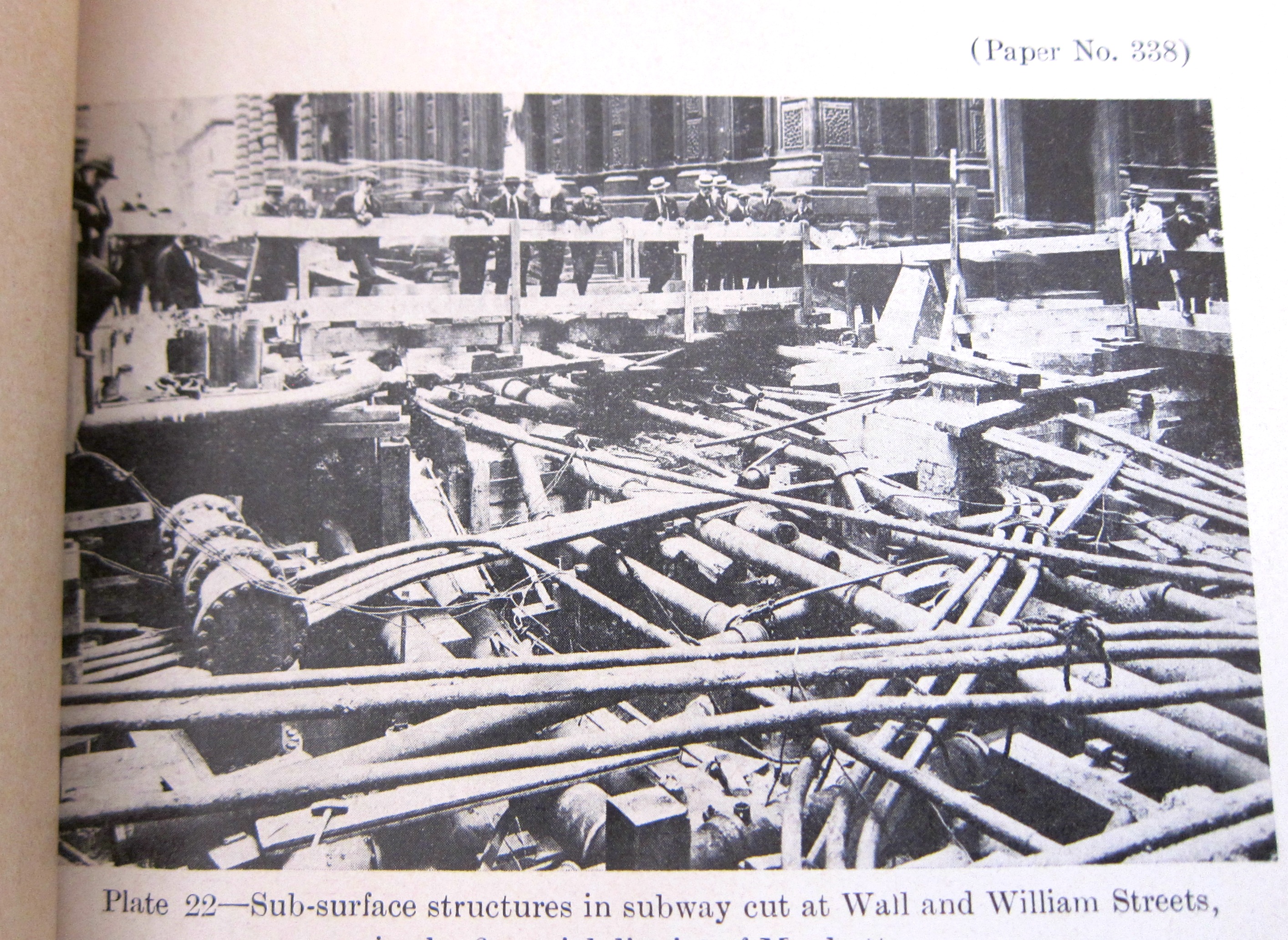
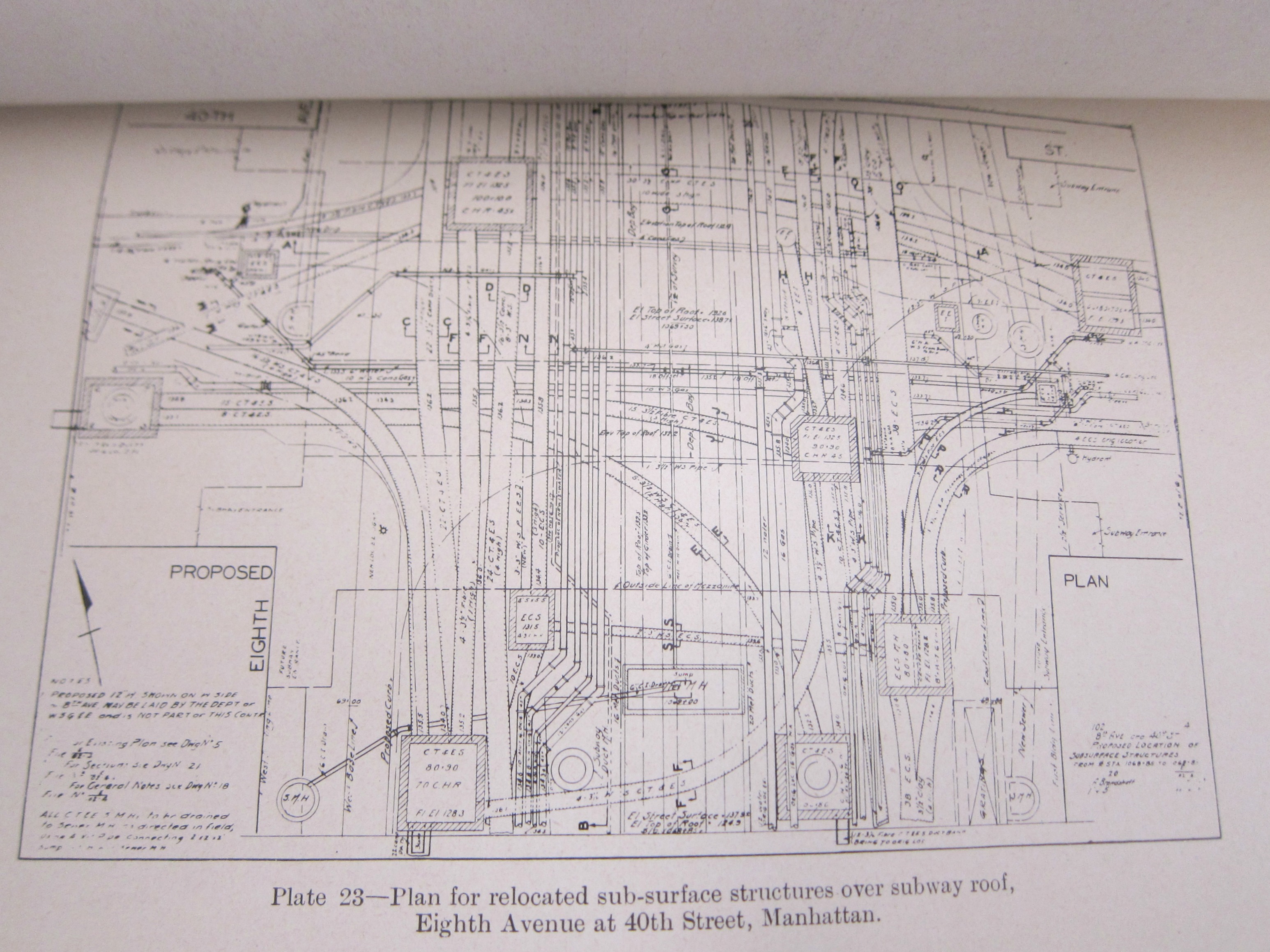
    spaghetti (or is it linguine?) and subways is not a common topic on this blog, but that was all I could think about (and eating some eggplant parm) when looking at some of the illustrations in Robert Ridway’s1 “The Rapid transit Subways of New York City”2. This was a pamphlet published in 1929 for a World Engineering Congress in Tokyo, and Ridway (67 years old at this point) was a very old hand in public works/building/transport in NYC, and gave a pretty masterful review of the subway situation in the city. In any event, this is the image that stopped me:

    Ridgway subway cut wall st

    Holy moley.

    Here’s another, this one a plan, and for a different location, but, still…:

    Ridgway subsurface 40th st

    I don’t have that much to say about the ordered anxiety of these images except “oh, my”.  

    Notes:

    1. “Robert Ridgway, sometimes spelt Robert Ridgeway, (born Oct. 19, 1862)  was an American civil engineer. He did not study engineering at any school, but worked 49 years for New York City in the construction of major projects, and became Chief Engineer of the Transit Commission in 1921. He became president of the American Society of Civil Engineers (ASCE) Metropolitan section. Further he became president of the national ASCE in 1925. The Ridgway Awards are an annual award of the ASCE Met section named for him.”–Wikipedia

    2.  9×7″, 32pp, plus 17 plates (two folding). This is an offprint, or at least a separately-printed paper, presented by Ridgway at the World Engineering Congress in Tokyo, 1929, and presumably printed there. It is a SIGNED copy to another engineer of high order, Maj. General W.L.Siebert. There are NO copies located in WorldCat/OCLC.


    ·Posted by :

    ·in:


  • Revolutionary Lines (1811)

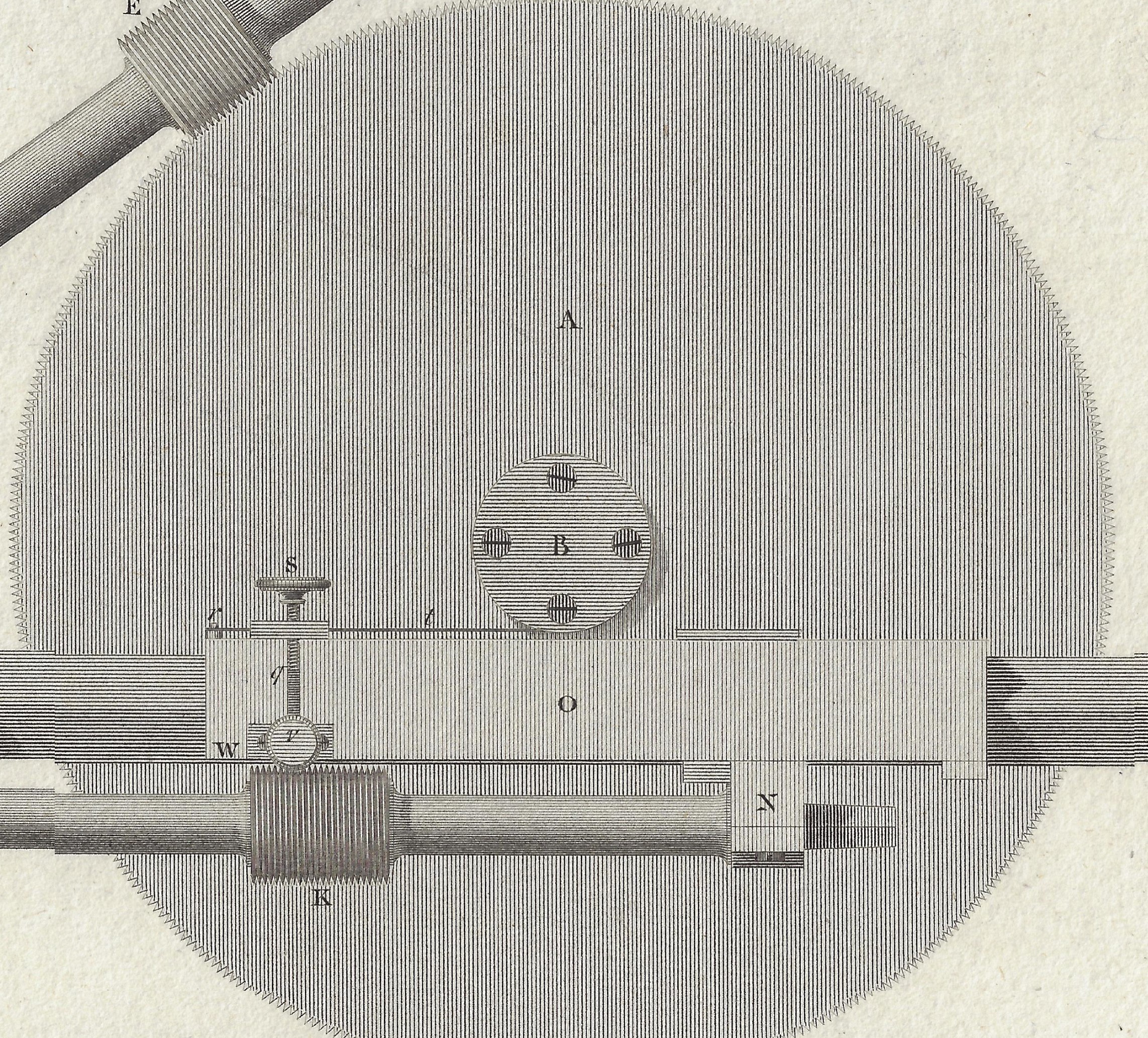
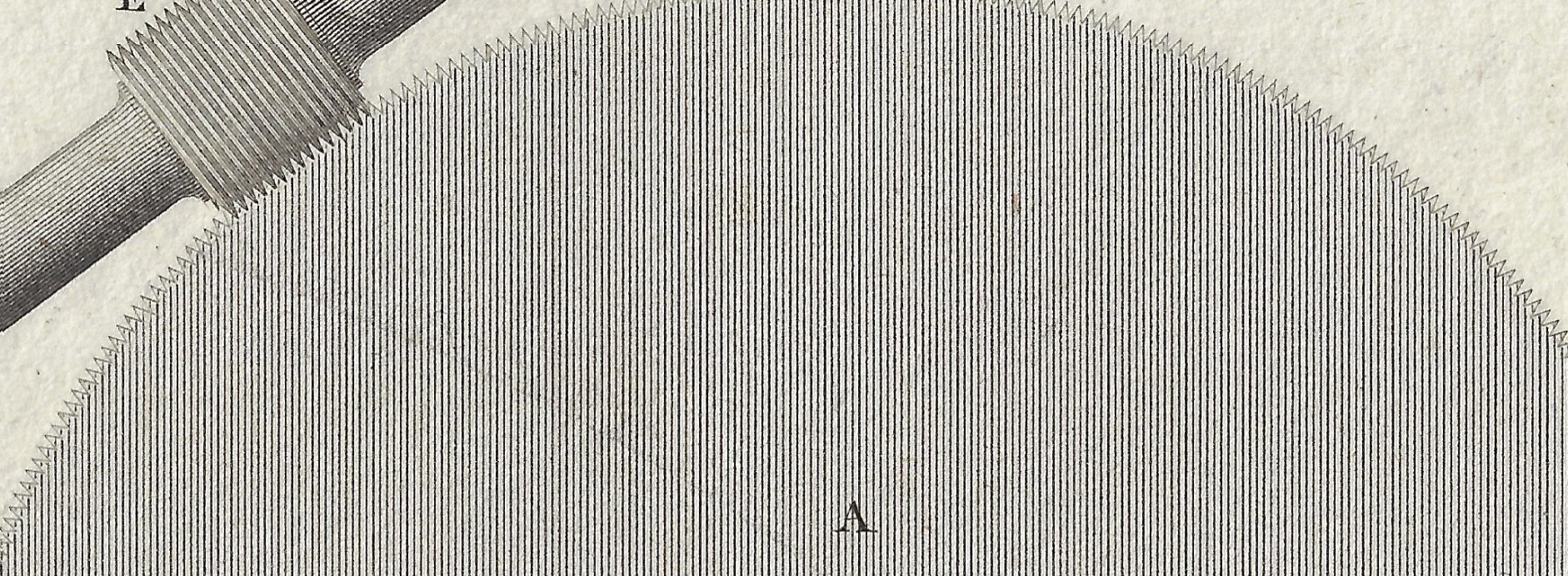
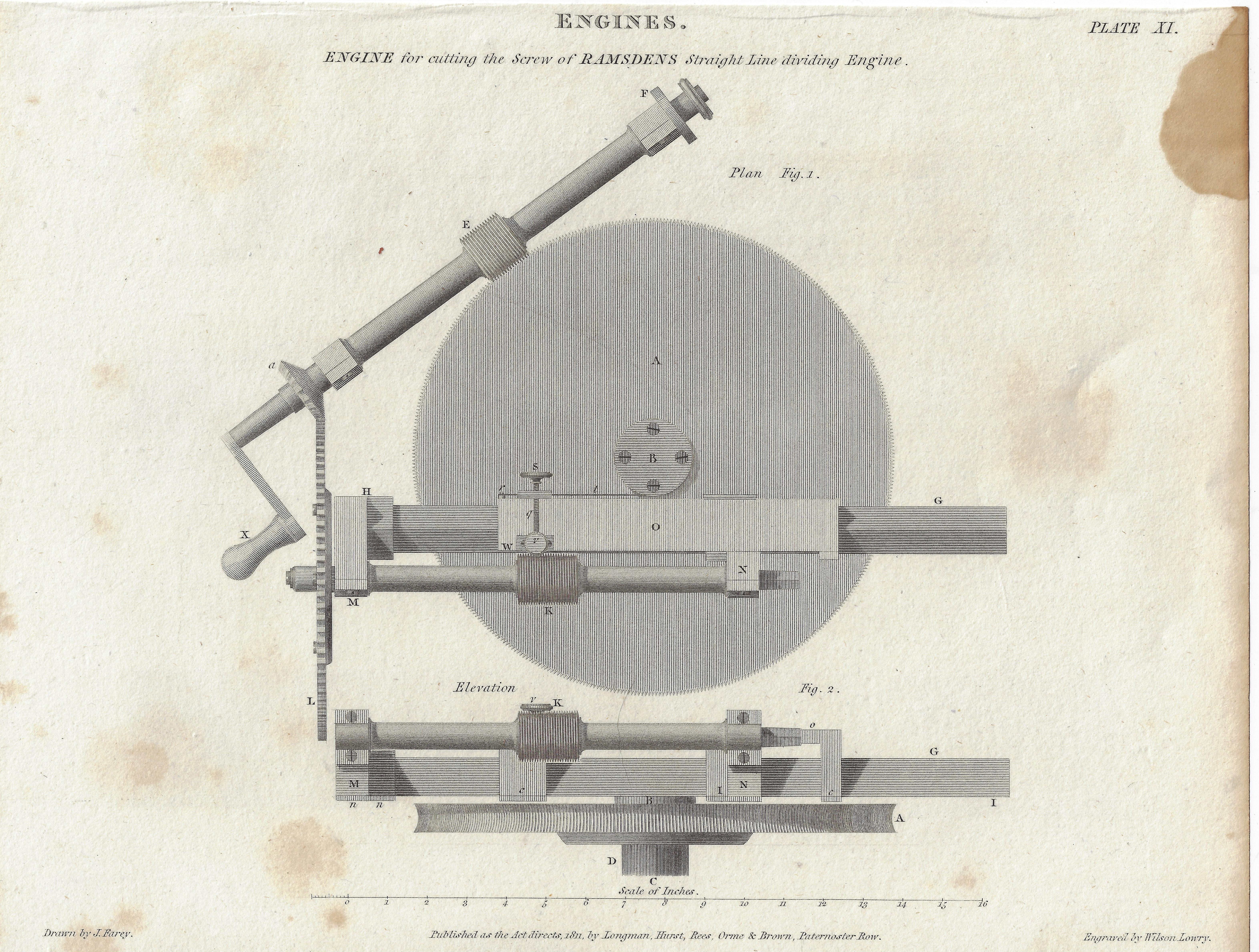
    Here’s a very fine example of a beautiful piece of engineering and a lovely rendition of it. The artwork is an engraving found in Abraham Rees’ monumental Encyclopedic Dictionary…,and was published in London in 1811. It shows in exquisite detail the straight line dividing engine of Jesse Ramsden (1735-1800), which here is being used as “an engine for cutting screws”.  A person could crawl all over this image in varying degrees of microscopic inspection and find  beautiful internal images nestled within the larger drawing in a Ken Burns/fractal-y way. 

    [Click on each image for a better resolution–seems as though this is restricted in a general view by my host]

    Ramsden _2_

    This and other similar inventions by  Ramsden’s were key additions to the developing scientific technologies of the Industrial Revolution, integral improvements necessary for integral improvements. (And as we see below in the Wiki quote on this subject, one of the very first things that Ramsden fabricated with his new and accurate lathe was to construct and even more accurate lathe before getting to work–that is an essential and brilliant idea.) Simply put, to make something more precise you need a more precise instrument, and this is exactly what Ramsden made. 

    Ramsden _3_

    And the full engraving:

    Ramsden _1_

    Notes:

    From Wikipedia–“The first truly modern screw-cutting lathe was likely constructed by Jesse Ramsden in 1775. He appears to have been the first person to put a leadscrew into actual use (although, as Leonardo’s drawings show, he was not the first person ever to think of the idea), and he was the first to use diamond-tipped cutting tools.  His device also included a slide rest and change gear mechanism. These form the elements of a modern (non-CNC) lathe and are in use to this day. Ramsden was able to use his first screw-cutting lathe to make even more accurate lathes. With these, he was able to make an exceptionally accurate dividing engine and in turn, some of the finest astronomical, surveying, and navigational instruments of the 18th century.”

    ·Posted by :

    ·in:


  • Tech Quiz: an Elevation of an Elevation (1880)

    JF Ptak Science Books   Quick Post

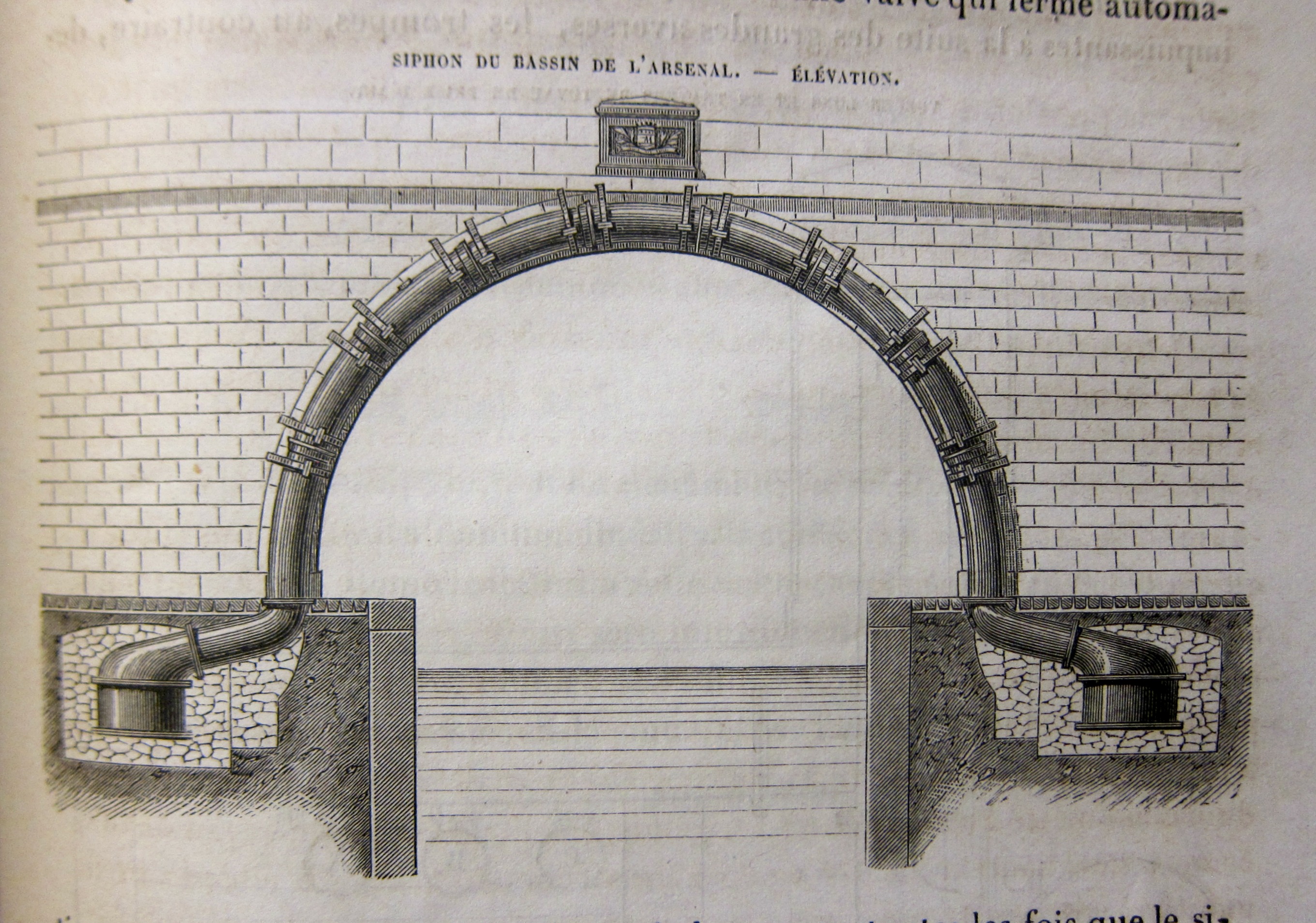
    This is just a lovely little mechanical drawing that I found in the pages of the 5 May 1880 issue of the Comptes Rendus de l’Academie des Sciences and I decided to share it. The Comptes Rendus is a very old workaday maintstay in my job, and I have become very familiar with it over the years, and in its great heyday in the 19th c it published all manner of scientific events over many disciplines, and at the highest level for each field. I’ve never really paid too much attention though to the illustrations in the journal as general “art” as I have done with other journals (like the Annalen der Physik)…why, I don’t know. In any event I was working on a two-part Pasteur paper in this volume and noticed this elevation of a “siphon” for Napoleon’s canal Saint-Martin, which is just about at the center of old Paris. 

    SciArt CR 1880 Siphon

    The structure does look a little like a headphone, and as pretty as this is, it subject matter wasn’t. This is a sewer line that would allow the sewage and etc. to flow over the canal along the arch of a bridge…which makes this an interesting problem. I mean, it is a necessary and important thing, dealing with waste, and that is exactly what this pipe was all about. 


  • Proving that Heavier-than-Air Powered Flight was Possible–Samuel Langley, 1896

    JF Ptak Science Books   Post 2743 

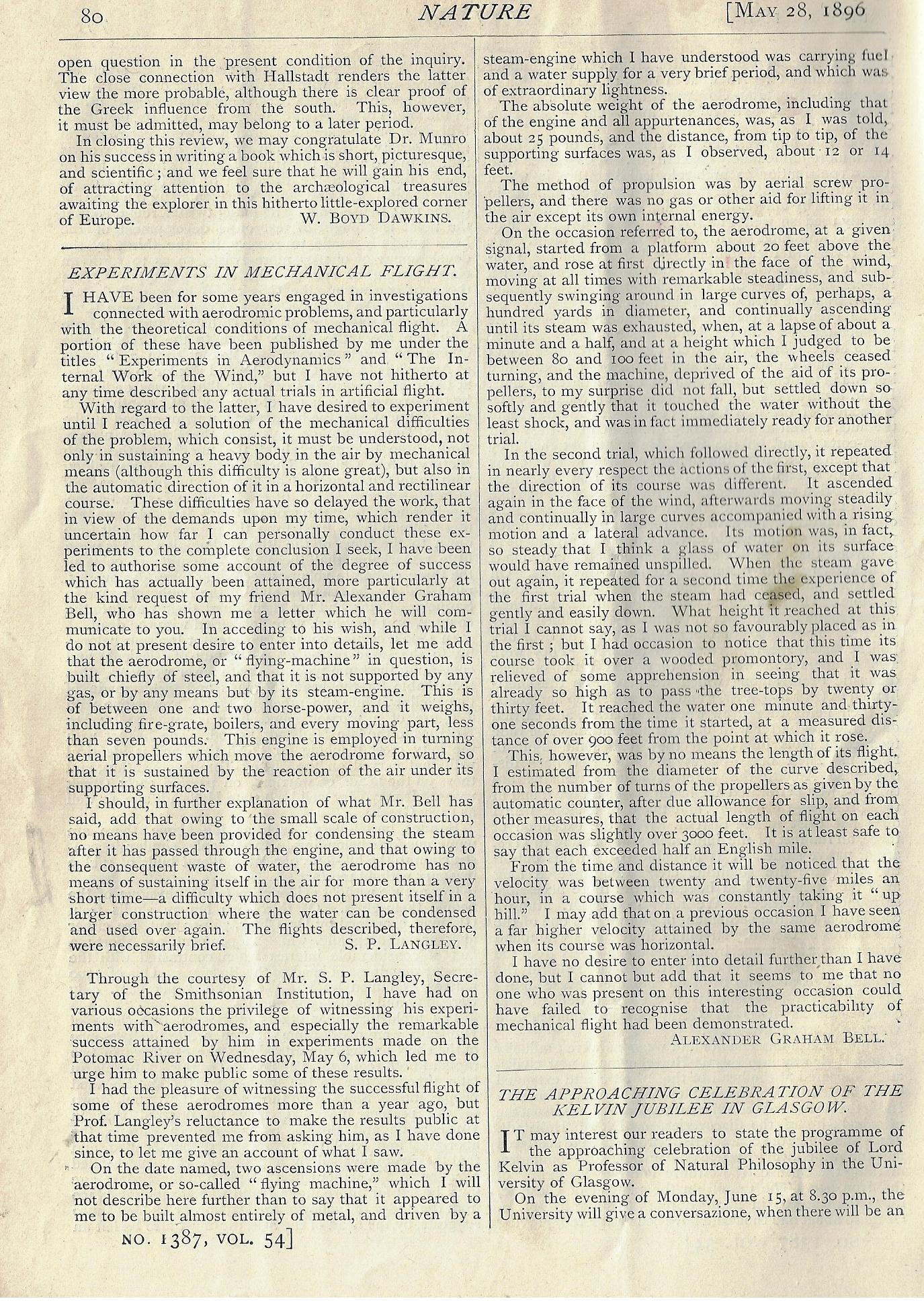
    I came upon this article last night in the pages of Nature–it doesn’t look like much, but it turns out to contain a first-person account of an historic moment in the history of aviation. The article, “Experiments in Mechanical Flight”, is by Samuel Pierpont Langley (1834-1906) and Alexander Graham Bell (1847-1922). and appears in volume 54, May 28, 1896, page 80 in the issue of pp 73-96. It contains the first account printed in England of heavier-than-air non-piloted sustained powered flight–and proof that mechanical heavier-than-air flight with existing technology was real. (This article appeared on 28 May; a somewhat shortened account appeared in Comptes Rendus… two days earlier, on the 26th. The first printed announcement of the event  seems to have been in Science, May 22, 1896, according to Brockett’s Bibliography of Aeronautics, #7160.)

    I think most people remember Langley as the (Third) Secretary of the Smithsonian Institution and for his work in astrophysics and observational astronomy, but he was a significant figure in the history of aviation, publishing his first extended work in the field in Experiments in Aerodynamics in 1891, and became one of the first if not the first aerodynamics experimenter in the U.S. He was also the first government-sponsored in-house researcher in this field.
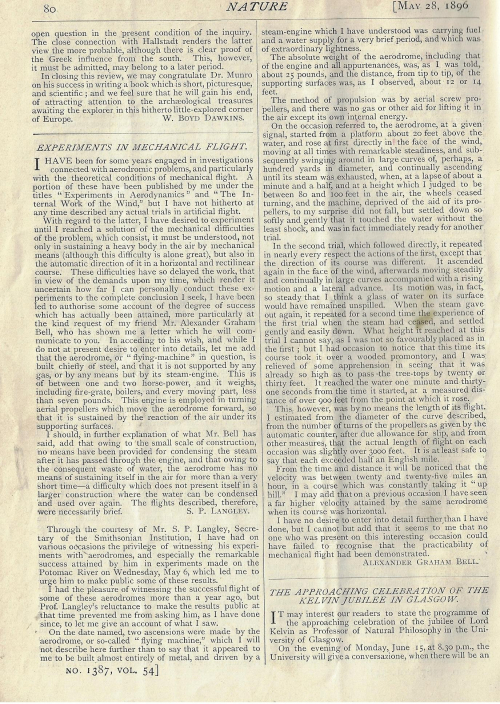
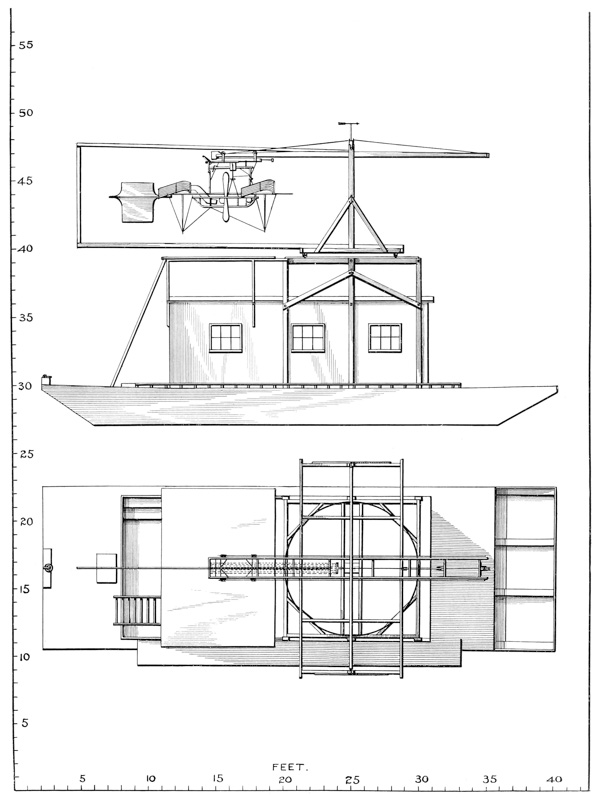
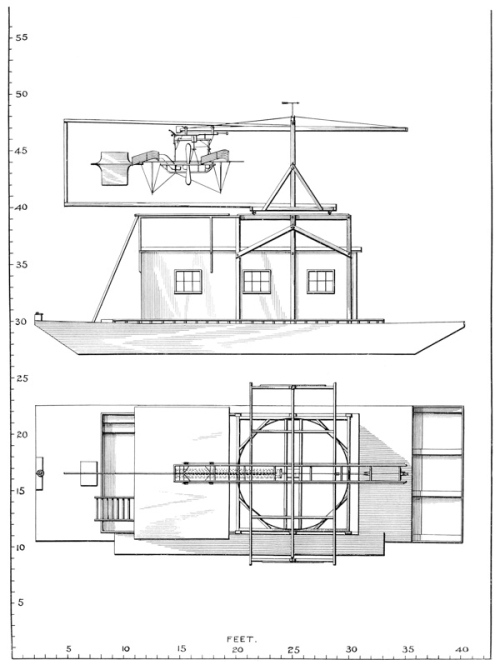
    Langley textThis article (or notice, really) covers Langley’s  historic experiments of 6 May 1896 with his 13′-wide Aerodrome 5–the fifth iteration of his mechanical flying machine–which was launched from a makeshift “houseboat” (“…nothing more than a scow about 30 feet long by 12 feet wide, upon which a small house was erected, to be used for the occasional storing of the aerodromes…”)1 moored in the Potomac River a few miles south of D.C. near Quanitco, Virginia. There was one witness to this affair, Langley being very concerned for privacy, particularly not wanting news of failures to reach a general audience. His guest observer was his old friend, Alexander Graham Bell, who had already witnessed some of Langley’s earlier attempts with models and made monetary contributions to help fund the larger enterprises. Langley had no interest in making the report—though he did invite Bell to do so. And it is the second part of this short, two-part paper in which Bell’s observations appear.

    Langley’s own description of the aircraft appeared in his Mechanical Flight2 : “The aerodrome was built chiefly of steel, though lighter material entered into the construction, so that its density as a whole was a little below unity. No gas whatever entered into the construction of the machine, and the absolute weight, independent of fuel and water, was about 11 kilos (24 pounds). The width of the supporting surfaces was about 4 metres (13 feet), and the power was furnished by an extremely light engine of approximately one horse-power. There was no one to direct it on board, and the means for keeping it automatically in horizontal flight were not complete. It is important to remark that the small dimensions of the machine did not allow it to include any apparatus for condensing the steam, so that it could only carry water enough for a very brief course—a drawback which would not be encountered in one of a larger construction.”

    Bell’s description of the aircraft: “On the date named two ascensions were made by the aerodrome, or so-called “flying machine,” which I will not describe here further than to say that it appeared to me to be built almost entirely of metal, and driven by a steam engine which I have understood was carrying fuel and a water supply for a very brief period, and which was of an extraordinary lightness.” And “The method of propulsion was by aerial screw propellers, and there was no gas or other aid for lifting it in the air except its own internal energy…The absolute weight of the aerodrome, including that of the engine and all appurtenances, was, as I was told, about twenty-five pounds, and the distance from tip to tip of the supporting surfaces was, as I observed, about twelve or fourteen feet3.”

    The flying experiment began, and much to the delight of Langley, Bell, and the men who fished previous flying efforts from the Potomac, the two Aerodrome 5 flights for the day were successful. The first flight brought the steam-driven, one-quarter-scale model made a half mile at altitudes of up to 100 feet, marking it the world’s first flight of its type. The second flew longer, and faster (3300′ and 9 seconds aloft), and Bell was much impressed by the serenity of the plane’s descent once the engine exhausted its fuel, turning the plane into a glider that touched lightly down onto the Potomac.

    Bell was thrilled with the display, and recorded what he felt:

    • The flying machine “resembled an enormous bird, swooping steadily upward in a spiral path until it reached a height of about 100 feet in the air.”

    And then, Bell famously observed:

    • “It seems to me that no one who was present on this interesting occasion could have failed to recognize that the practicability of mechanical flight had been demonstrated.”

    The once-reticent Langley himself writes an account of the event in “The Flying Machine” in the June 1897 issue of McClure’s (vol IX/2)–this was a very public article in a very popular magazine that also featured a drawing of the aerodrome right on the front cover.  The article also includes the Bell observations as well as the first printing of the photograph that Bell made of the second flight, the first of its kind, though it is really a drawing after the photograph, the photo itself used as proof of the event and the drawing done to enhance that. The coverage of the event and the Bell statement also appears in the Smithsonian Reports for 1896 (published in 1897). Later, Scientific American Supplement #1404 , Nov 29, 1902, reprints the Bell observations and other historical statements in “The Langley Aerodrome”.  
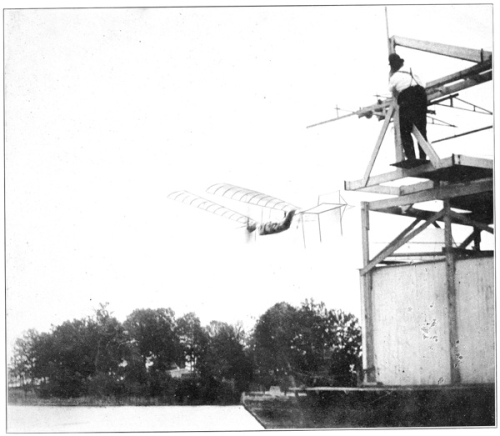
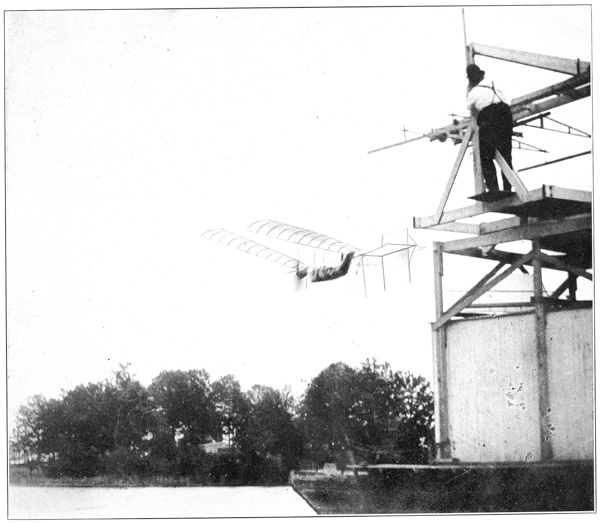
    Langley flightThe Aerodrome 5 in flight. Image via Langley’s 1911 Experiments…(see below; the image is not in the Nature article)

    Even in the face of support of U.S. presidents and stipends from the military, and with a history of mounting successes, the public failure in two attempted flights of his expanded, full-size Aerodrome A (a refitted and larger #5 and #6, this time designed for a pilot, and powered by a state-of-the-art 52hp engine designed by Charles Manly) on October 7, 1903 proved to be too much for Langley and his supporters, resulting in a withdrawal of funding, and the relatively quick retirement of Langley from this field. Just weeks later (December 17) the Wrights made their historic flight at Kitty Hawk–they were successful in many of the ways that Langley was not and made the first manned, powered, controlled, and sustained flight. Early aviation expert Tom Crouch of the National Air and Space Museum remarked that “The problem was the machine itself and Langley’s approach…he did just about everything wrong that the Wright brothers did right. “4

    That said, John D. Anderson Jr in the AIAA Journal states that it must not be overlooked that “[Langley] made extensive use of aerodynamic coeffcients and legitimately shares with Lilienthal the credit for introducing the concept of lift, drag, and resultant force coeffcients to the applied aerodynamics community. His data are the first substantive proof of the aerodynamic superiority of high-aspect-ratio wings over those with low aspect ratio; it is curious that Langley is not widely recognized for this important contribution.”  And significantly, “the work did serve a very useful purpose. The fact that a man of Langley’s stature believed in the possibility of the flying machine was enough to convince most laymen that aeronautics was no longer the pastime of fools.”5

    NOTES

    1. Samuel P. Langley and Charles Manly (editor), Langley Memoir in Mechanical Flight, Smithsonian Contributions to Knowledge, Washington, D.C., 1911. Part I (Langley), 1887-1896; Part II (Manly), 1897-1903. 
    2. _____. Langley, p. 123.
    3. From the Nature article, quoted above.
    4. Lee Wolff, “First in Flight (Almost)”, http://www.chopawamsic.com/First%20Flight.htm
    5. John D. Anderson Jr., “ Langley’s Aeronautical Research: A Modern Critique and Reassessment”, AIAA JOURNAL Vol. 35, No. 3, March 1997 Historical Review Paper.

    The extended  quote by Bell in the last three paragraphs from the Comptes Rendus:

    “La durée du vol, dans le second essai, fut d’une minute et trente-une secondes et la vitesse moyenne entre vingt et vingt-cinq milles à l’heure (soit dix mètres par seconde) sur un trajet qui fut constamment en pente ascendante.”

     “Je fus extrêmement frappé du vol aisé et régulier de la machine dans les deux essais, et du fait que lorsque l’appareil, privé de la force motrice de la vapeur au plus haut point de sa course, fut abandonné à lui-même, il descendit chaque fois avec une égalité d’allure qui rendrait tout choc ou tout danger impossibles.”

    “Il me semble que personne n’aurait pu assister à cet intéressant spectacle sans être convaincu que la possibilité de voler dans l’air à l’aide de moyens mécaniques venait d’être démontrée. “ 

    The “hosueboat”, with launching apparatus and with the aerodrome in place (from Langley, 1911):   Langley hosueboat

  • From the Department of Vast Understatement (1958): a Half-Visible Wernher von Braun

    JF Ptak Science Books   Post 2742

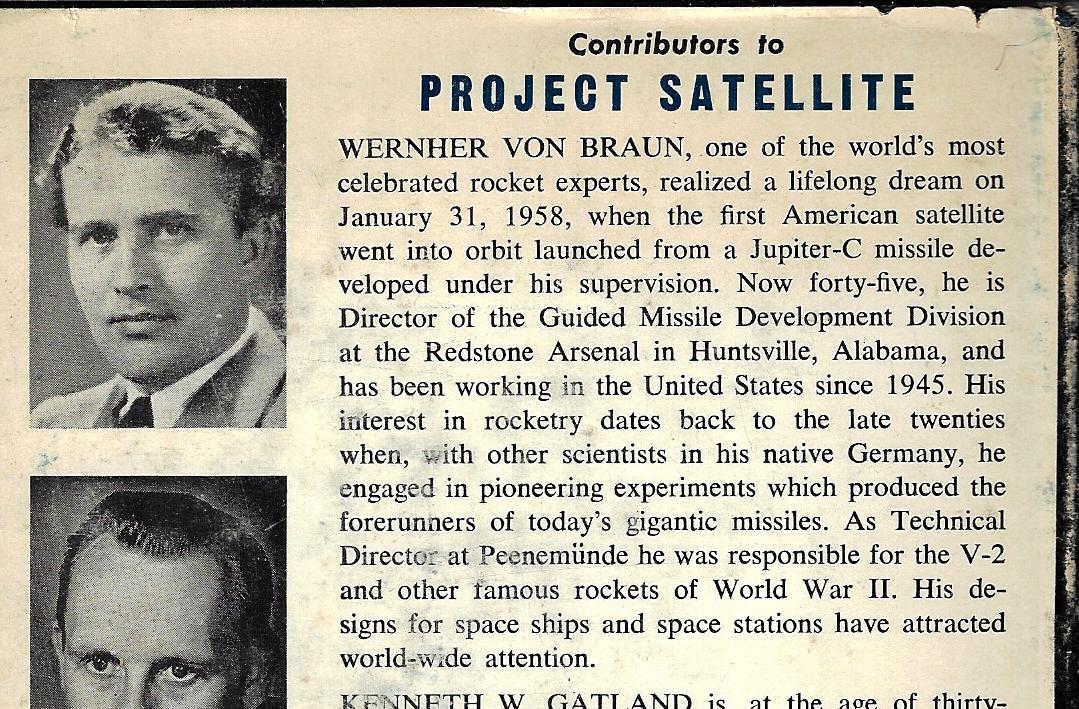
    Von Braun_2_What does one do about Wernher von Braun? For a long time it was difficult to find his name at the National Air and Space Museum, though I don’t know what that status is, nowadays. In 1958 I know what was up with him, at least according to the dust jacket of this book he co-authored, one of the first books on satellite communication, Project Satellite.  (I can almost here the echo of the title repeating, a la 1958…)

    It is there that we are told that Dr. von Braun “has been working in the United States since 1945”. Indeed he was, thanks to having been swept up by U.S. forces at the end of the war just 40 days or so after the last V-2 was launched. There were many others taken by the U.S. in this way, though von Braun was hardly alone as a Nazi working as a rocketeer for Adolf Hitler, but he may have been one of the few members of the Nazi Party who were collected and worked  at the Army Ballistic Missile Agency in Huntsville, Alabama, there in 1958.

    “…(H)e engaged in pioneering experiments which produced the forerunners of today’s gigantic missiles”. So true–and just when I thought that the blurb writer would skip mentioning the V-2, they do:

    “As Technical Director at Peenemude he was responsible for the V-2 and other famous rockets of World War II.”

    And there it is. 

    Let’s remember that von Braun was a Nazi, worked hard for Hitler’s ear to keep his projects rolling, and used slave labor (12,000+ of whom were worked to death at Peenemunde and related sites) to build his “famous rocket”, the great forerunner of “today’s gigantic missiles”. The V-2 began its life ending lives soon after D-Day, with more than 5,000 of them launched primarily against British and Belgian targets, killing 2,754 and wounding 6,523 in London, alone, and terrifying everyone. His pioneering spirit can be seen in the following extraordinary map, which begins to show the V-2 action on London:

    V-2 map

    map via The Londonist https://londonist.com/2013/06/v2

    The map makes quite an impression, no? 

    And he helped create the U.S. space program. 

    Back to the book jacket–what else could they say, I wonder, back in the thick and near-disastrous days of the Cold War?


  • Clouds, Paddle W-Patterns, Hot Ice, and other Attractions: “Nature” magazine, 1881

    JF Ptak Science Books  Quick Post

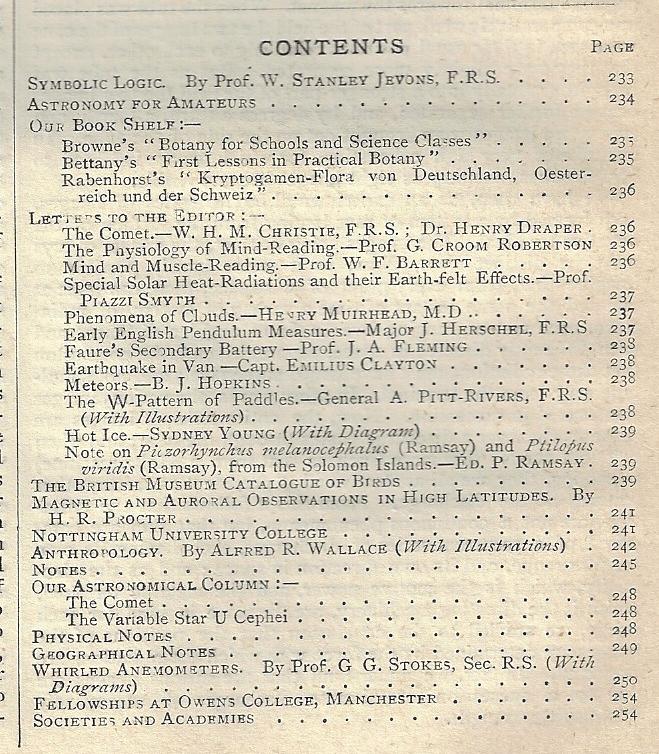
    I just finished a short post about the wide-ranging W. Stanley Jevons  review of John Venn’s classic book, Symbolic Logic, when I had another look at the contents of the slim issue of Nature in which the article appeared. This Nature is our present-day mega-Nature, but here in 1871 it was only in its 12th year. And even though the issue was only 17 pages long, it was filled with an astonishing range of succinct papers, and heavily seasoned with bits for the generally curious of the high Victorian era. After you read the gentleman’s gentleman high-end astronomer Henry Draper’s paper, you could read “the Physiology of Mind reading” and follow that up with “Mind and Muscle-Reading”. Piazzi Smith followed that with “Special Solar Heat-Radiations and their Earth-felt effects”, with “Phenomena of Clouds”, “early English Pendulum Measures”, and J.A. Fleming’s “Faure’s Secondary Battery”. Papers on earthquakes and meteors, and then the wonderfully enticing “The W-Pattern in Paddles” and of course “Hot Ice”. It all ends up with an extended article by G.G. Stokes’  (a remarkable physicist and mathematician who spent his entire career at Cambridge, the vast majority of that as Lucasian Professor of Mathematics from 1849 until he died in 1903) “Whirled Anemometers”, which occupies about a third of the issue. 

    Nature 1881 Contents_0002