A Daily History of Holes, Dots, Lines, Science, History, Math, Physics, Art, the Unintentional Absurd, Architecture, Maps, Data Visualization, Blank and Missing Things, and so on. |1.6 million words, 7500 images, 4.9 million hits| Press & appearances in The Times, Le Figaro, Mensa, The Economist, The Guardian, Discovery News, Slate, Le Monde, Sci American Blogs, Le Pont, and many other places… 5000+ total posts since 2008.

Category: Prints–looking HARD/deeply at

  • “Why is England in the Pyramid?”– A Question That Has Never Been Asked Before (?); or, FInding Pi in the Pyramid

    JF Ptak Science Books  Post 272
    Blog1sept_16_england_in_egypt_tp559“The lunatic , the lover and the poet,
    are of imagination  all compact…”
        Midsummer-Night’s Dream act v sc 1

    “Great ideas sure to madness near allied
    and thin partitions do their bounds divide”
        Dyden, Absolom and Achtiophel, part i, line 163.

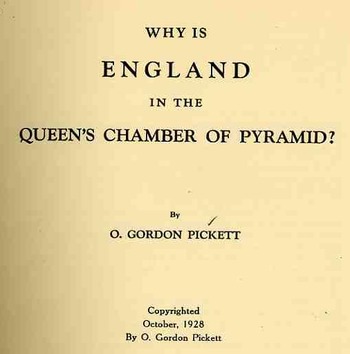
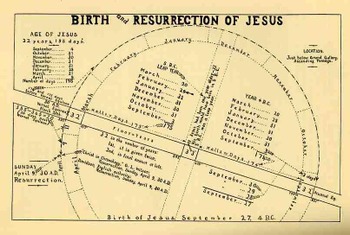
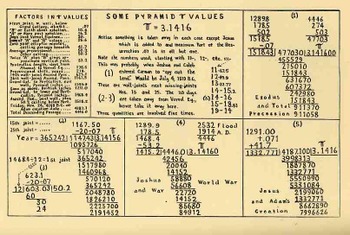
    I am pretty sure that O. Gordon Pickett, the very dedicated and serious author of this work, may well have been the only person to put the question forward of “why is England in the Queen’s Chamber of [sic] Pyramid?”  Isn’t the ability to ask an uncommon question one of the sources of innovation and genius?  Mr. Pickett, of Los Angeles (of course (?)), tried mightily in this 1928 publication to make his case for predetermination of the Anglo Saxon race by assembling and interpreting lost angles (sorry), implied geometry, found numbers, ratios, perspectives, and the like, endlessly, to find the outline of the England in the Queen’s Chamber of the Great Pyramid.  Almost all of this was invisible, a kind of outsider-logic-x-ray brought to bear on pyramid architecture–and when the picture clears, what the x-ray reveals,somehow and incredibly, is England.  And Christ.  And Pi. And although he was dedicated, and insightful, and capable of long sitting time, he probably was not a genius as we would recognize today, testing perhaps what Charles Lamb called the “radical sanity of genius” (“Sanity of True Genius” in Last Essays of Ella). Sometimes, having the ability to ask an unrecognized and first-time question doesn’t mean that the there is an ability to discern a place for the thing in a shining logical kingdom.  I do appreciate though that Mr. Pickett was a considered and discerning thinker, though to what non-personal end it all came to, I don’t know.
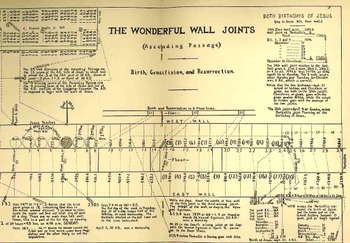
    Blog1sept_16_england_in_egypt558_3 But Mr. Pickett did evidently assemble ALLOT of data and drawings and plans and renderings of the pyramids in the course of looking for the secret strings  which would alter the known into the secret and unknown.

    I think what is most revealing about the way that he is going with his hard-thunk hard data is particularly revealing, and may also be, in their own way, some of the most uncommonly-titled visual displays of “quantitative” data that I’ve encountered:   “The Wonderful Wall of Joints, Ascending Passage, North, Crucifixion and Resurrection”, “(Pyramid) Passages and Planetary Rotation”, “Birth of Jesus at Entrance” and “Some Pyramid Pi Values” are all unexpected constructions.   Well, hard work does not necessarily make for good thinking, and though Mr. Pickett did allot of thinking on this…
    Blog1sept_16_england_in_egypt_jesus


    Blog1sept_16_england_in_egypt_pi561


  • Towards a History of Horses in Flight in the 19th Century.

    JF Ptak Science Books  Post 270

    Balloon

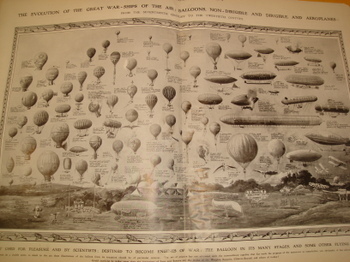
    Here’s a great opening sentence:  “Images of 19th century flying horses have always been difficult to find”.  And, since this is a serious issue, it really is a true statement, until today, when I noticed them in a little project I was dong.  I found a lovely history of balloon and aeroplane flight published in The Illustrated London News for 3 July 1909, called “The Evolution of the Great War-ships of the Air:  Balloons, Non-Dirigible and Dirigible, and Aeroplanes, from the Seventeenth Century to the Twentieth Century.  Its a big, double-page spread of a picture, featuring 60 or so of these flying machines–its so wonderful that I decided to reproduce the thing in a large format (35 x 45 inches), and it was then that I noticed something quite strange, at least to my experience.

    Blogsept19_horses_in_flight607
    .
    There were flying horses.  And one flying stag.
    Men on horseback in balloons.

    Actually, 8% or so of the images in the display involved horses. 
    Now perhaps men on horseback in balloons in the 19th century is a well know bit of aviation history; however, not being an historian in this area I’ve got to admit that I was very surprised (!!) when I first noticed these horses.
                                                                                                  
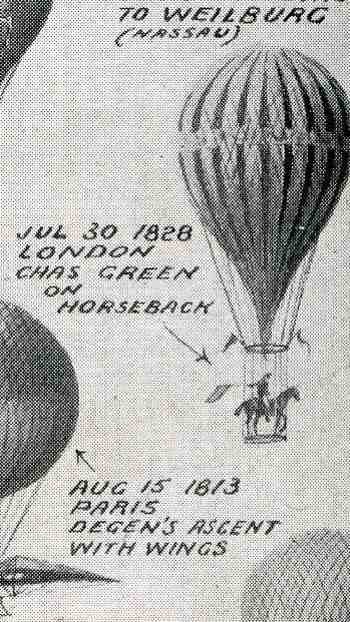
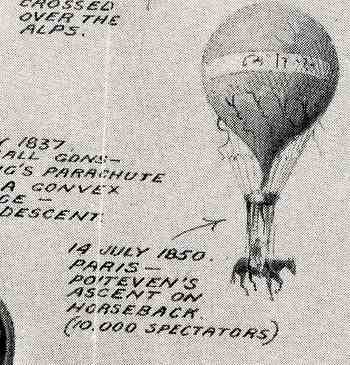
    Blogsept19_horses_in_flight609Missing them is understandable if you weren’t looking closely at the image’s little bits and pieces, what with the horses occupying something like 1/1,000 of the print’s surface.  But there they are, clear and bright as day:  “1798, Ascent by Testu-Brissey”, and “1828 London Chas Green on horseback”, and “1850 Paris Poiteven’s ascent on horseback (10,000 spectators)”. 
    In what is certainly a very uncommon notice there is also “Sep 1850 English Aeronaut Gale on horseback suffocated Bordeaux”.  Is this the first man-on-horseback-in-flight death? And death by suffocation? (?)  I’m not so sure that the ascent records for 1850 would’ve made allowance for running out of oxygen at high altitudes–if not, then how did this man suffocate? According to the Dictionary of National Biography, which, somehow, admitted (George) Gale (1797-1850) to its pages, reported that he died as a result of a misunderstanding of language, sent back into the heavens after landing with his pony, his balloon mistakenly released with none of its ballast remaining, with him attached to it still.  It was his 114th flight, which was quite allot, but not evidently enough.   Gale was a very colorful character, being an actor, then finding his way out to the American west and returning with several of the Indians he encountered and “exhibiting” them at the Victoria Theatre, and then becoming an Irish blockade defender before turning to ballooning. 

    Then there is the utterly fantastic “1804 Paris Margat on a stag”.  Somehow I guess M. Margat thought that being on a horse just wasn’t quite enough, and elected to ride a stag.  I’m not sure what to say, exactly, except that all of this renders “1836 Surrey Gardens–monkey “Jacopo” & parachute (with a little monkey dropped/thrown from the balloon in an experimental parachute device) somewhat anti-climactic. 

    What I was really after in this print and which I’ll get to in another post–sidetracked as I am by the horse issue–is found in the subtitle: “first used for pleasure and by scientists, destined to become engines of war…the balloon”, about the short but furious transformation of the aeroplane into a machine of war, all of which takes place in about a five-year period.  But that’s for another day. 


  • Visual Display of Information: Ships on the Pyramid and in Trafalgar Square

    JF Ptak Science Books Post 264

    Blog1sept_17_ship_city_btm_det572
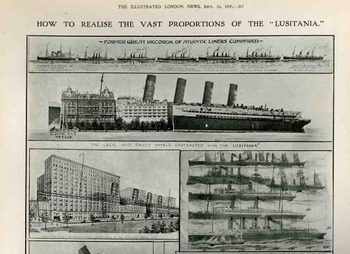
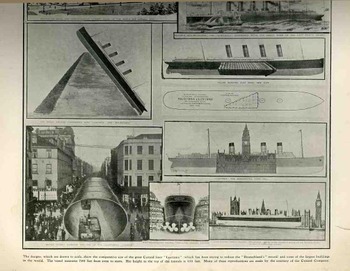
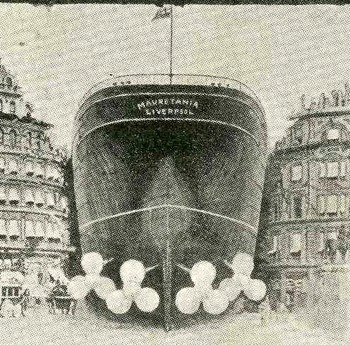
    Just yesterday I made a post about Ships-in-the-Skyline as part of a series on the Visual Display of Information, saying that I recalled seeing another ship as part of a skyline but couldn’t recall the reference.  Luckily just now I stumbled upon it, and it is better than memory served–it is also the sister ship of yesterday’s Mauretania, the even-more-famous Lusitania.  This ten-part full-page illustration in The Illustrated London News for 14 September 1907 seems to cover all of the cityscape bases for ship comparison, and then some, from the Lusitania dwarfing the Cecil/Savoy Hotels, or behind the Manchester Town Hall, to being printed in outline against the enormous Auditorium Hotel in Chicago.  I think that for most people, numbers don’t quite “do” for comparative discussions on unrelated objects–illustrations like this, though, form a perfect understanding almost instantly.

    Blog1sept_17_ship_city570

    There are four other outstanding comparative views, though, that are just simply remarkable, using points of view that I’ve not noticed before. 

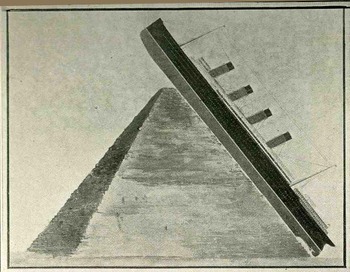
    1.  The first is the spectacular image of the Lusitania on the side of the Great Pyramid–taken alone, discretely and removed from context this image would be a prime example of the Found Dadaist division of my imaginary museum of Found Art..

    2.  This next image, below, is one of the rare times that buildings are displayed on a horizontal axis next to a ship–in this case, its the (Stieglitz) Flat Iron Building (NYC).  A bonus with the Flat Iron Building was placing the plan of the structure on the superstructure of the Lusitania!  This was a superb idea. 

    Blog1sept_17_ship_city_btm571

    3.  I’m certain that this bit of early 20th century pre-photoshopism must’ve stopped the casual view in their tracks–seeing the stern of the Lusitania completely filling up Northumberland Avenue at Trafalgar Square must’ve been a true surprise to the visual system.

    Blog1sept_17_ship_city_btm_det_traf

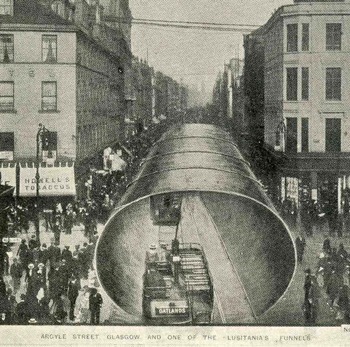
    4.  The last of the four shows one of the four great funnels of the Lusitania on its side allowing traffic to go through it for two blocks or so, resting on its side on the great Argyle Street in Glasgow.  If all four stacks had been placed end-to-end, traffic could’ve continued through it for 7 blocks or more.

    Blog1sept_17_ship_city_btm_det_gl_2


  • Graphical Display of Data: the R.A.F. and Luftwaffe Present Their Cases, 1938-1940

    JF Ptak Science Books LLC  Post 262


    Blog1sept_15raf_range_1939551

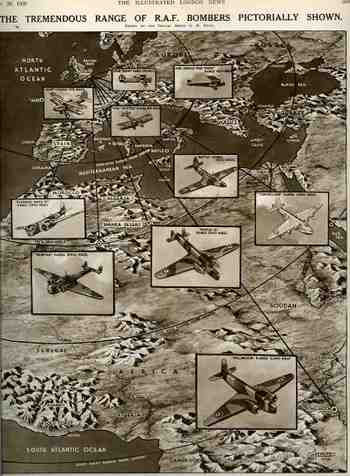
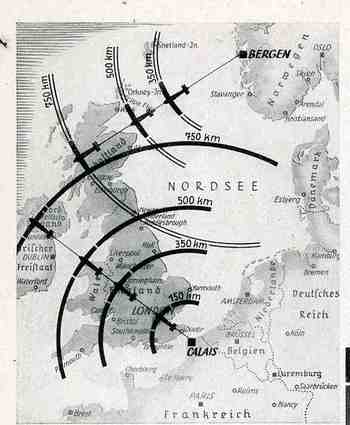
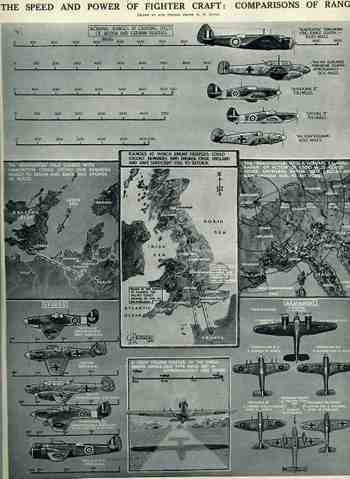
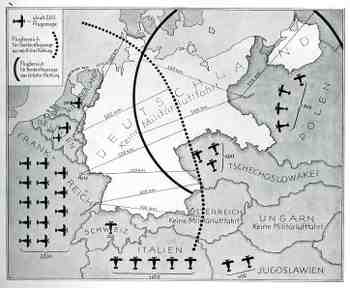
    These four images represent some common, popular distribution of
    information to the general population, the sets of two working at cross
    purposes.  (I’ve written several posts here about the Nazi use of maps as a propaganda tool; if you search this blog under those terms you’ll find several entries.)  The British images  were issued just after the start of WWII
    (30 September 1939) and then again just after the end of the Battle of
    Britain (November 1, 1941), respectively.  The first (“The Tremendous
    Range of RAF Bombers Pictorially Shown”), illustrates the range
    capacity of its long range bombers for WWI and for 1939, showing how
    far they could strike into the heart of Africa.  I’m not so sure why
    Africa was chosen as the target, as nothing at all was happening there,
    militarily speaking, at this early stage of the war; why this didn’t
    show the planes screaming their way to the east is a mystery to me.   
    The Home Office was busy showing how far the Wellington bomber could
    reach (3,240 mles), as well as the long shadows cast by the Hampden,
    Sunderland and Wellesley.  The second British image, “The Speed and
    Power of Fighter Craft, Comparisons of Range”  displays aircraft of the
    principle RAF and Luftwaffe fighters and bombers. 

    Blog1sept_16_aviation_maps_germany5

    The first German image, printed as a small inset map in a general propaganda piece in the Illustrirte Zeitung (Leipzg), for November 1940, depicted the capacity of the Luftwaffe to reach, threaten and bomb any region in the British Isles from bases in Calais (France) and Norway, having secured the positions in their attacks against the two countries in Fall Gelb and Operation Weserubung respectively. Britain was effectively half-surrounded from these positions from the Brittany to the Norwegian coasts.

    The second German map (and the fourth presented here) is another interesting fiction coming from the propaganda offices in 1938, showing how Germany was threatened by attack from the air forces of its neighbors.  Particularly pungent in this portrayal was the threat from Checoslovakia, Yugoslavia and Poland.
      

    Blog1sept_15raf_range_1941552

    Blog1sept_16_aviation_maps_german_2


  • Comparative Display of Quantitative Data: Ships in the Skyline

    JF Ptak Science Books LLC  Post 261

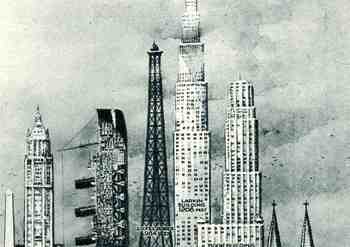
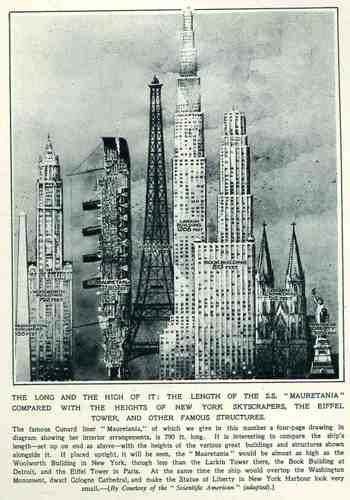
    This wonderful display (appearing in The Illustrated London News for 26 March 1927, page 518) of quantitative data isn’t quite as whimsical as it appears in detail, though I can think of onlyBlog1sept_16_ship_skyline_detail5_2
    a few (antiquarian) times that I have seen a ship made part of a cosmopolitan vertical cityscape.  It is a great way of comparing two disparate, out-of-place equals, and certainly can get the idea of the size of something as stand-alone and solitary as a great ship to children (and adults, too) by comparing it to something as obvious as a tall building.,  This time its really just comparing the length of the SS Mauretania with the heights of some famous and notable buildings. (The Mauretania, 1906-1935, was a fabled, luxurious and fast ocean liner of the Cunard line; it was refitted for a resurgent oceanic service at about this time.)   In the larger, expanded second image we see the Mauretania stacked up against (from left to right) the Washington Monument (555′), the Woolworth Building (792′), the Mauretania  (790′), the Eiffel Tower (984′), the Larkin Building (proposed at 1208′), the Book Building (873′), the Koln Cathedral (512′) and the Statue of Liberty (305′).  The Larkin Building (not the F.L. Wright structure of the same name) was a proposed super-tall of 110 floors for 330 W. 42nd Street that was proposed in 1926 and not canceled until 1930, and which would’ve been the tallest building in the world. (For an interesting site on the cancellation of tall buildings, see HERE.)   In any event, this was a big ship–the largest in the world when it was launched as a matter of fact–and the drawing is wonderful.   Upon closer inspection, there is a terrific amount of detail in the cross section of teh ship.)                                                   

    Blog1sept_16_ship_skyline564


  • Unexpected Uses of Musical Instruments: War Headdress

    JF Ptak Science Books LLC Post 259

    Blog1sept_13_german544

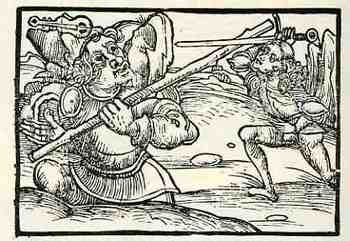
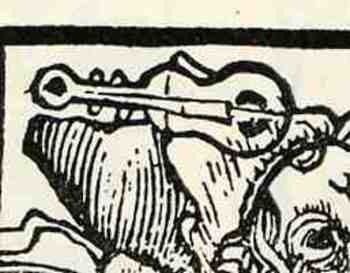
    I don’t mean this seriously, and I’m probably mucking around with a national treasure/iconic figure by even suggesting my flippant title, but I really would like to know what in the world this violin-cello or whatever it is is doing on the head of this figure? Probably ir is just artistic license, meaning that the large-staffed giant (?) would ultimately use music as a weapon (Amphion?); maybe, probably  not.  If anyone knows, I’d love to hear the answer.

    The source of this woodcut is the Heldenbuch, das Heldenbuch mit synen Figuren…, a towering work in the history of German ltierature (or at least early German literature)  printed by Heinrich Gran in Hagenau in 1509.  It is a collection of German epic poetry from the period of the Barbarian Invasions (more sweetly
    Blog1sept_13_german_det545_3
    referred to as the “Migration Period”, or Volkwanderung) ca. 300-700 ACE, and collected in the 13th century.  It is evidently a luxurious ride through German folklore and legend, with dragons, supernatural beasts, giants, scampering and clever warrior dwarfs, spectacular voyages to the East, shining moments of chivalry, and wide fairy lore.  So, if anyone knows the answer, would they please let me know about the very curious use of this musical instrument?


  • Mondo Bizarro: Image of the Earth with a Background Earth Floating in Space

    JF Ptak Science Books LLC Post 253

    Well, one doesn’t get the chance to write a title like that every day, or, for that matter, write about dual/multiple earths, with the earth both in the foreground *and* floating in outer space in the background.  I wrote about a spectacular pamphlet in February in Post 11 that did exhibit just such a thing– I thought that it was a pretty singular event, writing:

    “This is the only known example of the depiction of an extra-terrestrial New York City pictured with the earth in the background.  Huh?  Yes, this is the Big Apple in space—not its OWN space but THE space,  outer space—somehow, impossibly, removed to some something-or-other (actually in this case, a “bubble”) that, while not being the Moon, was something like it, though not actually a solid and without gravity, floating on a base of floating effluvia…”

    Blog1sept_10_floating_earthclean

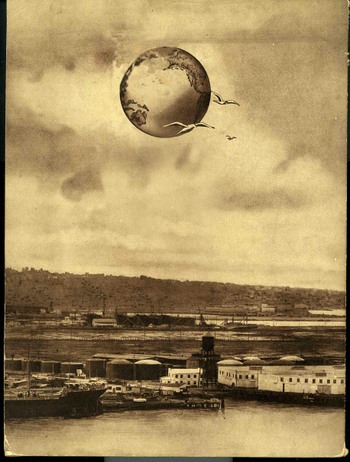
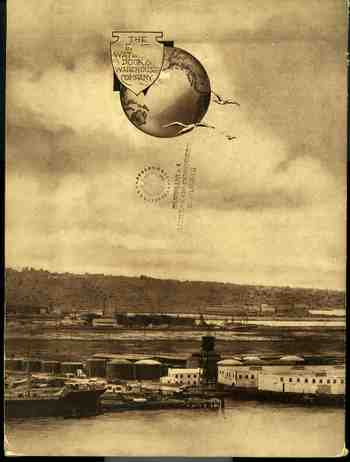
    Listen:  I found another such oddity.  Well, almost.  This is the back cover for a pamphlet called The East Waterway Dock & Warehouse Company:  Harbor Island Terminal”, of Seattle, printed in 1920.  The pamphlet and contents is real enough–what caught my attention was the back cover, which very nearly places the earth in the sky above the earth, albeit innocently.  IT just so happens that this was a design/logo for the company, and it was placed in the sky, raising my hopes at first blush that this was another improbable example of Post #11. It is sort of close, visually speaking, especially when I took out ten minutes to manipulate the logo away from the earth so that the image is more, well, incredible.  But the fact of the matter is that the earlier New York City in Space pamphlet may well be a one-item category, particularly when you consider the content and the rest of its illustration, which are (generously) outre. But I’ll post new image anyway because it is just such a rare visual  idea and almost-feast.

    Blog1sept_10_floating_earth533


  • The Beauty of Drill Bits in the Dark Days of 1918

    JF Ptak Science Books  Post 287

    1ebay_sept_30drill_bit697

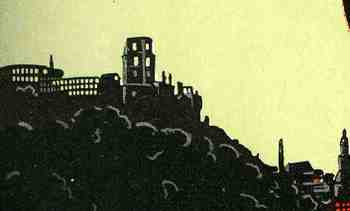
     This striking ad for Emil Steinrurck’s drill bit manufacturing company (Verlangen Sie Spiralbohrer-Katalog und Lagerlisten) appeared in the magazine Motor for July/.August 1918, just a few months away from the German defeat in WWI.  Steinruck’s Heidelberg business was making some massive, industrial  drill bits is all I can say, and they had a designer and artist who figured out exactly how to relate this to the motorheads reading this magazine–all care being taken and monies spent just as the guns of August turned into the corrupted plougshares of November.  What self-respecting machinist wouldn’t, or couldn’t, appreciate the beauty and depth of this thing even if a rusty old railway car was waiting just minutes in the future to spirit away the immediate future of Europe?  The small detail (of the factories and whatever weirdly empty buildings there were in the background) were miniature works in themselves.1ebay_sept_30drill_bit_detail698


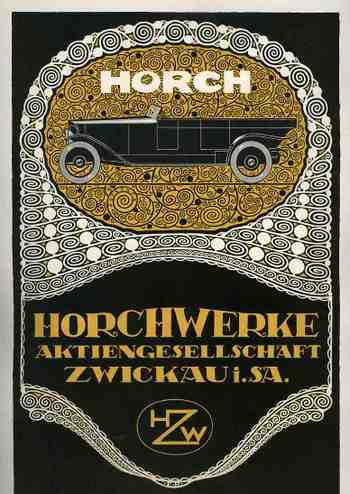
    On the other hand, on the back of this full page ad appears another–a frilly, high-nouveau-y grillwork ad for the Horch automobile, forming the other representative book end to the manufacturing process.  Horch began producing 4.5 hp automobiles as early as 1901, and by 1918 had improve and upgraded to produce high-end luxury automobiles. I can’t determine what exact model of Horch this is in the ad, but I can tell that it is massive, with a tremendous wheelbase.  (Horch would merge/found Audi in 1932 and meet its fate in Allied bombing raids during the war.  It survived but in the hands of the Soviets who used the machinery to produce the Yugo-like Trabant (Trabbi”) sub-compact “car”. I guess that the artwork is sorta beautiful in its way. 
    1ebay_sept_30drill_bit_detail699

    1ebay_sept_30drill_bit_detail700


  • Found Images: Carrying Baby Coffins at London Stone?

    JF Ptak Science Books Post 286

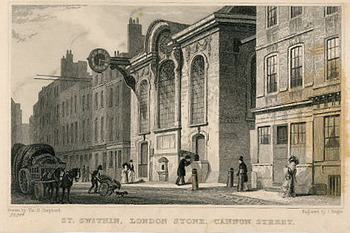
      This image has always been a little troubling to me, and one that I’ve never figured out.  Unfortunately I cannot now find the original to get a better, deeper scan of the curious object being carried by the oldish man in the center of the picture. This is another in a series of generic topographic prints of famous churches/buildings/streets and so on, decorated with figures some of whom are just going about their daily days as well as others who are quirkily adventurous–but those quirky actions are most often buried in the smallness of their representation. sometimes almost to small to see, especially considering that they are just there for scale.

    File0760saved

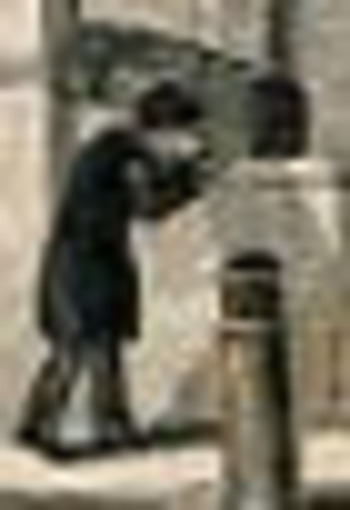
    File0760saved_detailLooking at this image of St. Swithin’s* and the London Stone, even a quick, noncommittal  look at the people filling up the foreground reveals this most unusual character with an uncommon box, right there at stage-center.
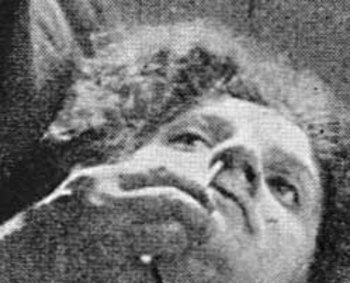
    I make this out to be a child’s coffin, largely because I want it to be for the sake of the print and also because there aren’t many other easy, logical choices.  I remember it looking even more so in the original under 20X magnification, with the figure carrying it buckling slightly from more than just the weight of the box he was bearing.  What else could be in there?  A big set of engineer’s scales?  A precision pantograph?  Legs?  I don’t know–its kind of too big and bulky to be a carrier for everyday work material, as tools filing the box would make it too hard to hoist to the shoulder. The figure seems sad somehow rather than burden, and the question, again, as in the other posts dealing with this subject matter, is why the artist bothered with some a complicated figure to simply people-up the street at St. Swithin.  Did the artist  or engraver just suffer the loss of a child and is displaying their grief, or is it a reminder of the dance of grim death just outside the doors of the church door?  Or is it just some guy carrying a heavy box filled with table scraps? 

    * The famous “London Stone”, a solid block of oolite such as used by the Romans in their buildings, is set in a large stone case,     protected by an iron grille, and let into the wall on Cannon Street. It originally stood on the south side of the street opposite St Swithin’s Church until it was moved and set  into the wall of the church itself (in 1798). According to Camden, it was a Milliarium or  Milestone from which the British high roads radiated, and from which the distance on them was reckoned, similar to the one in the forum at Rome (16th Street in Washington D.C., once upon a time named Meridian Strete, was also supposed to perform this chore.  Meridian Hill Park, now renamed Malcolm X  Park, is about all that is left of that idea. And it seems like a good notion lost  now that the rest of the world isn’t setting their timepieces to an imaginary line running right through a big desk in an oval office at 1600 Pennsylvania Ave.)


  • Women’s Rights and the Fight for Equality: Force-Fed Torture of Imprisoned Women, 1912

    JF Ptak Science Books  Post 284

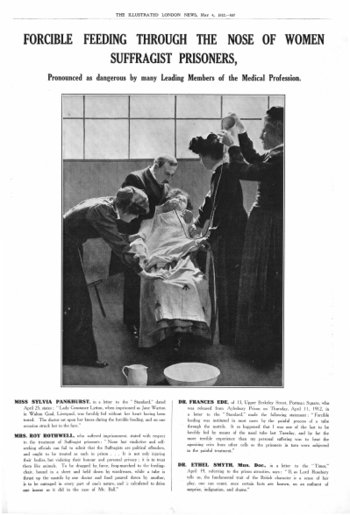
    Reprosuffragist_forced_fed_detail

    Lady Lytton was an upper-class Englishwoman who became interested in the ideas of equality and in suffrage for women at the very early part of the 20th century. Her interest in suffrage (which was lost, taken away, from women there in 1832 and to be regained in 1918) led her to join the Women’s Social and Political Union (WSPU), and she became an avid, vocal, participating and socially visible member of the organization. She was arrested in 1909 following a demonstration at the House of Commons and was imprisoned, only to be released shortly thereafter after it was uncovered that she was the daughter of the former Viceroy of India–one cannot have the upper class in a common prison with the common people, so her imprisonment just wouldn’t do. Enraged by this treatment, Lady Lytton became an advocate for changing the penal code relating to the treatment of working class prisoners. After disguising herself as a working class woman with the name of Jane Wharton, Lady Lytton was again arrested and imprisoned following a suffrage rally and protest in 1910. In the prison’s effort to break her hunger strike, Jane Wharton endured the particularly heinous remedy of being fed through the nose. What happened is that a tube was forced into her nose and down into her stomach, with an assistant quickly forcing gruelly liquids through the tube via gravity into her stomach. She described the feeding as follows:

    Reprosuffragist_forced_fed

    “[The doctor] put down my throat a tube which seemed to me much too wide and was something like four feet in length. The irritation of the tube was excessive. I choked the moment it touched my throat until it had got down. Then the food was poured in quickly; it made me sick a few seconds after it was down and the action of the sickness made my body and legs double up, but the wardresses instantly pressed back my head and the doctor leant on my knees. 

    “The horror of it was more than I can describe. I was sick over the doctor and wardresses, and it seemed a long time before they took the tube out. As the doctor left me he gave me a slap on the cheek, not violently, but as it were, to express his contemptuous disapproval.”

    Another suffragette, Mary Leigh, describes the forced feeding spectacle as follows, following her own episode in September 1912:

     “The Wardresses forced me on to the bed and the two doctors came in with them, and while I was held down a nasal tube was inserted. It is two yards long with a funnel at the end – there is a glass junction in the middle to see if the liquid is passing.  The end is put up the nostril, one one day, and the other nostril, the other. Great pain is experienced during the process … the drums of the ear seem to be bursting, a horrible pain in the throat and the breast. The tube is pushed down 20 inches.  I have to lie on the bed, pinned down by Wardresses, one doctor stands up on a chair holding the funnel at arms length, so as to have the funnel end above the level, and then the other doctor, who is behind, forces the other end up the nostrils.”

    “The one holding the funnel end pours the liquid down; about a pint of milk, sometimes egg and milk are used…. Before and after use, they test my heart and make a lot of examination. The after-effects are a feeling of faintness, a sense of great pain in the chest, in the nose and the ears….”

    “I was very sick on the first occasion after the tube was withdrawn.”

    In any event, I had heard of such treatment, but I had never seen a contemporary image of the process; and I was very surprised to find this in the pages of the Illustrated London News for 1912. It was, after all, a pretty sniffy magazine not much given to social reporting of this sort; but this was a pretty strong condemnation of the practice, considering the source.