A Daily History of Holes, Dots, Lines, Science, History, Math, Physics, Art, the Unintentional Absurd, Architecture, Maps, Data Visualization, Blank and Missing Things, and so on. |1.6 million words, 7500 images, 4.9 million hits| Press & appearances in The Times, Le Figaro, Mensa, The Economist, The Guardian, Discovery News, Slate, Le Monde, Sci American Blogs, Le Pont, and many other places… 5000+ total posts since 2008.

Category: Prints–looking HARD/deeply at

  • The Poetics of STDs and the Mountain of Truth; a Rollicking Good Time in 1545

    JF Ptak Science Books  Post 348

    Mountain of truth

    The progress of man/humankind has, in our dim antiquarian past, been represented in art in stages of ascending a mountain.  The fine arts and sciences have been shown, in their various intellectual pedigrees, at various points on the mountain of the mind, usually with Philosophia sitting supremely at the top (with Astronomia and Mathematica generally not far underneath). This is mind, I came across another sort of progression to the Olympian heights, though it has no people in it, just the mountain, and a curious idea, ascending to faith, or truth. 

    The image is on the title page of a curious, little, early work by the pseudonymous  “Grappa” (well-named for the drink), Cicalamenti de Grapps intorno  al Sonetto…though its real nature is revealed in the subtitle,“dove si’ Cliarala allungo delle lodi delle donne et del mal francioso”, or “where one chats at length about women with The French [venereal] Disease”.  It is also dedicated to a non-existent courtesan who was heralded as being lovely, generous, and deep in the seat of this same disease.  Indeedy! This ribald, blustery, frank, coarse innuendo-laced tract (28 leaves long) was not terribly unusual when it was printed in 1545, celebrating as it does the low- and high-cultural private life of Renaissance Italy.  Doctors, poets, gluttons, cheats and of course lots of beautiful women romp around ostensibly in an attempt to prove the usefulness of their sinful vices, relating it all somehow to the disease-improved poetic capacities of the STD-bestowed Petrarch, master of forlorn and unrequited love poetry and the father of Humanism  (It relates in a way that I can’t explain to Petrarch’s Canzoniere, sonnet #88, mostly written, I think, about a  girl/woman that he fell in love with in church, which is why we can see he needed to invent Humanism. He seems to say that the needs of love are strong, stronger than he could stand, evidently, and that one should flee, renounce it; he seems to for himself, the girl across the pew or across the great open space in the cathedral never weakening to him a bit.  He pines over her, and announces his own amoroso intoppo, or “amorous fumblings”, and would take flight from himself as well. Evidently the people in this work by Grappa do not take his warnings to heart, though they do seem to renounce the “love” part but not the “sex” part. I could be really wrong on this god knows; all I wanted to do was look at the pretty picture on the cover!)

    Stumbling into things like this  makes you remember that the Renaissance wasn’t all stuffy and main-springy; perspective-this and techno-that; they had their fun, too, even in 1545, and put it into print.

    Back to the woodcut on the title page: it features a small, winding route up a mountain, the top of which is sanctified “fide”.  Now considering what these folks were doing in this work I wouldn’t necessarily christen the end of the adventure with this word, particularly if it meant (as it does) the name of the World Chess Federation (FIDE).  Seriously though fide means “faith”, as in bona fide (on good faith, by good authority), as opposed to mal fide (bad faith).  I cannot determine what in the world the structure is on the top of the mountain, or what is in it. 

  • A River of Men: French Prisoners in Laon, May, 1918

    JF Ptak Science Books  LLC  Post 292

    1ebay_oct_2_prisoners_det_3731
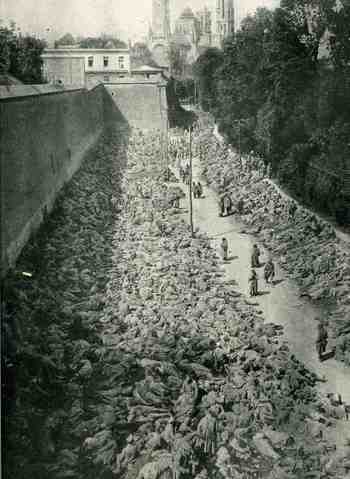
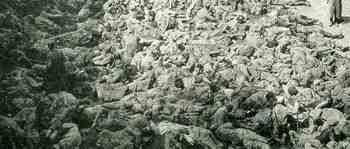
    I came across this impossible  image in the 6 June 1918 issue of Illustrierte Zeitung (Leipzig)  It is almost unbelievable that the bumps and twists and angles of this mass were humans, though at least they were alive. The original was taken on 21 March and shows part of the  210,000  prisoners that were being held in Laon–they seem, at least by their helmets, to be French soldiers.  (The 210,000 figure is German and wartime and intended for German readership; it seems that the real figure was 85,000–still massive.)

    1ebay_oct_2_prisoners728

    Laon is a French Medieval city of magnificent architecture–its cathedral can be seen in the background, in stark contrast to this human blanket. Looking at this image with a magnifying glass, I can see virtually no open ground space in the mass of men.  I estimate that in this photo are 7500 men:  I also figure that the area that we see here (to the left of the open path)  is approximately 400 feet long and 40 feet wide, or roughly a third of an acre.  I’m not sure what was going on here, though it looks like they might be on the move, with the men in the right-hand part of the image stretching off into the distance.  What is also troubling is that so many of these men seem to be asleep, and judging from the way the shadows have fallen it seems to be mid-morning (not early).  Perhaps they’ve just been marched in from battle and are totally exhausted.  I just don’t know–they just don’t look like people.


  • The Famous Painting of the Tulip Who Stopped Rembrandt’s Bones from Turning Into Jelly

    JF Ptak Science Books LLC  Post 345

    Blog--tulp rembrandt
    This ungainly title is actually a true statement–even the Tulip “who” rather than “which” part. Rembrandt did suffer from some sort of mental suggestion/annoyance which convinced him that his bones were turning into jelly. (Weird happens: Kurt Goedel thought that he was being poisoned through his food and finally through water.) His symptoms were addressed, and treated (I guess), by the Amsterdam physician Nicolaas Tulp (1593-1674), who saved Rembrandt from himself.

    Tulp, which means “tulip” in Dutch, was born Claes Pieterzoon, and was a Leyden-education physician who established a very respected and large practice in Amsterdam.
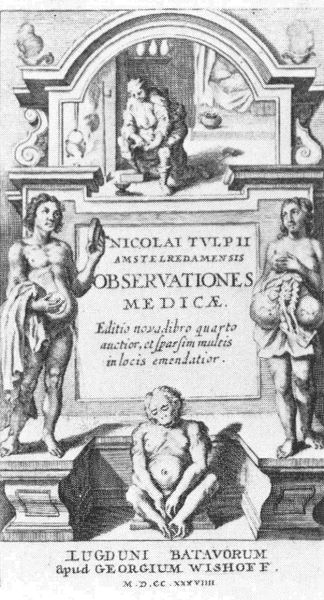
    He was additionally very interested in pathological anatomy, and in an early-CSI vein he frequently corresponded his diagnoses through postmortem dissection. In addition to his several published works is his magnum opus, Nicolai Tulpii Amstelredamensis Observationum medicarum libri tres.Cum aeneis figuris (Amsterdam, apud Ludovicum Elzevirium Elzevier, 1641), which contains much of medical interest (including what seems to be a description of diphtheria, a description of a bronchial cast, the description and illustration of the ileocecal valve and kidney stones, and a tapeworm, and the earliest European description of berberi  (see Major’s  Classic Description of Disease)). Additionally he takes on the ideas of monsters, describes a narwhal, and makes the first illustration of a chimpanzee (called an “ouirang atong”) in Europe.

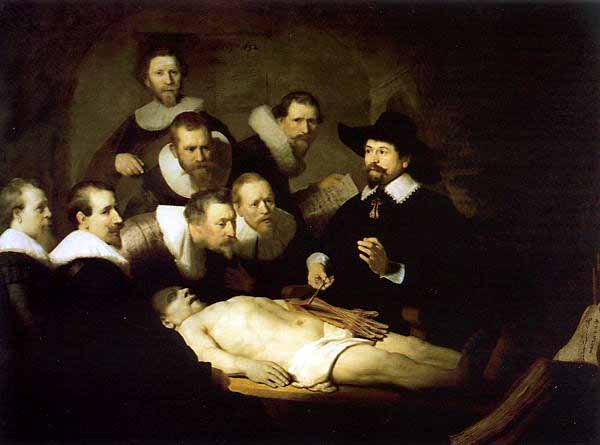
    But he most famously survives all this by being the focus, the central figure, the catcher of light, in Rembrandt’s painting “The Anatomy Lesson”, which is really called “The Anatomy Lesson of Dr. Tulp”, which was painted in 1632. (I wonder how Dr. Tulp lived with this painting in his life for 42 years? ) In any event, it was he who evidently rescued Rembrandt from his dark place, or migraine, or depression—or at least he suggested how he could live his life with whatever he had in his head. 
    Tulp’s portrait appears in the frontis to each of his works, but certainly there would be almost no shock of recognition in them; on the other hand, with the Rembrandt, almost everyone recognizes the scene,  though very few would now who Dr. Tulp was and what service he performed to the art world.Rembrandt_anatomy_lesson_dr_tulp

    NOTE:
    In one of his very many remarkable letters, Vincent Van Gogh writes to his brother Theo in October 1885 about this painting, offering an insight on color: “Rembrandt’s “Lesson in Anatomy,” yes, I was absolutely staggered by that too. Do you remember those flesh colors – it is – de la terre – especially the feet….You know, Frans Hals’s flesh colours are also earthy, used here in the sense that you know…”

    Check out the website that annotates and includes illustrations of all of the works that Vincent references in his letters—his breadth was really astonishing, as is his memory, and of course his immense appreciation of color—and light– in general.


  • Ships in the Skyline Part III

    JF Ptak Science Books LLC   Post 291

    1ebay_sept_30cunard_skyline_detail6
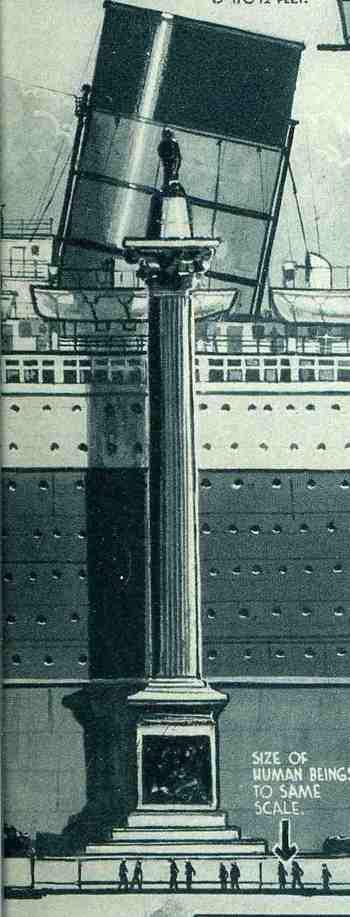
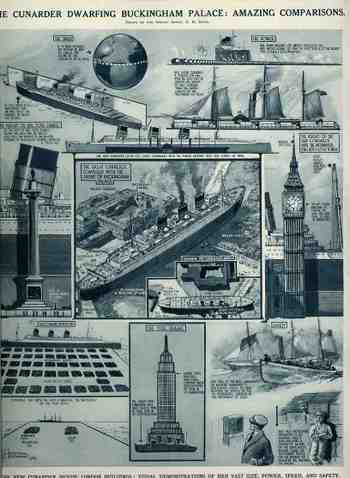
    In another unlikely-to-be-added-to category, Ships in the Skyline, I’ve found, surprisingly, a third installment. (I guess that there are many more as I’ve found these guys without actually looking for them, though perhaps that is the trick to finding things (that you don’t need).)  The comparisons that we see here for the ship The Cunarder, appeared in The Illustrated London News for 29 September 1934, and the skyline that it  is favored against is  London’s Big Ben.  Interestingly, the graphic goes on to compare the powertrain of the ship to 100 “Cock o’ the North type locomotives” to generate its 200,000 horsepower; also, the amount of steel frame found in the ship  (32,000 tons) is comparable to the steel framing of the brand-new Empire State Building (58,000 tons in the steel framework).  Of further interest is the relief of a human set against the Nelson Column in Trafalgar Square and the top of the ship’s fore funnel (reaching 170′).  This is just fantastic design and some good thinking about how to make the dimensions of the ship more understandable in everyday terms, and thus compares it in size and capacity to stuff that people see most every day, or at least know.

    1ebay_sept_30cunard_skyline_detai_3
       

    1ebay_sept_30cunard_skyline690


  • 100,000 People at the Dempsey-Carpentier Fight, 1921: a Remarkable Photograph

    JF Ptak Science Books LLC  Post 344

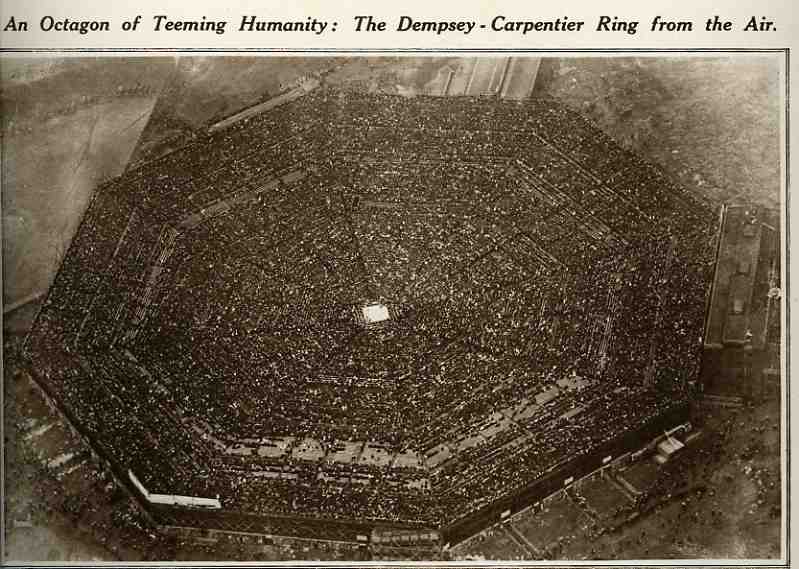
    This was a remarkable photograph for the information it presented when it was published in The Illustrated London News on 30 July 1921. That’s a real sea of humanity surrounding the canvas ring, and probably the largest crowd ever assembled in Jersey City.

    00-blog--Oct 28 dempsey fight949

    The image was made by a photographer for The New York Times from an airplane about 2,000 feet over the arena.

    00-blog--Oct 28 dempsey fight948 The fight between the two men was billed as “The Fight of the Century”, and it was, up until that time.  It was probably the event that was most-listened to than any other event in history, the early radio broadcast of the fight reaching at least 300,000.  But since there were so many mass venues listening to the fight–or watching its progress via displayed messages transcribed from the radio broadcast–it is really pretty impossible to say how many followed the event on that day. 

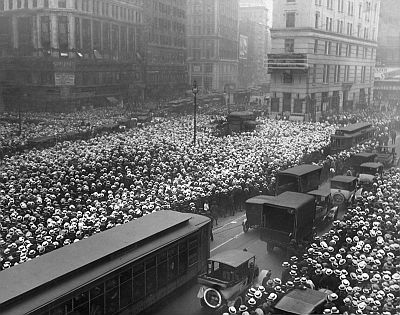
    (The image below shows a very large crowd of approximately 10,000 in Times Square waiting for the returns f the fight.)  

    1921-dempsey-carp-5-50


  • Electric Surf and the First Touch of the Ocean by Blind Children; Coney Island, 1878

    JF Ptak Science Books LLC   Post 290

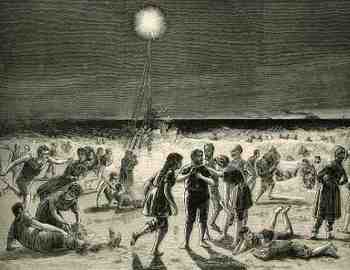
    1ebay_oct_1coney_island_electric711 This woodcut is from the Leipzig equivalent of LIFE or The Illustrated London News:  Illustrirte Zeitung, and was published in August 1878.  It appeared in the same issue as the very first image of Edison’s phonograph in a European publication (just two pages away)  It was a big issue for Edison in Germany, as he was of course principally responsible for not only integrating minor discoveries of others into a revolutionary discovery of his own (the electric light and light bulb), but was also reasonable in the largest part for the physical distribution of energy to those light bulbs.  And so it came to be that the beach at Coney Island–one of metropolitan New York’s greatest recreational sites–was lighted by a  portable electric “floodlight”  (though I don’t know what the illuminating part was–perhaps it was a carbon-arc something or other, as I’m pretty sure it wasn’t a light bulb” as we would think of it…nevertheless the source was electrical).  It had never in human history happened before that people could frolic in the surf under an artificial source of illumination–it had to have been an extraordinary sensation.  The light appeared in the same year that the The Camera Obscura
    Observatory was established (borrowed from 1876 Philadelphia
    Exposition) and just nine short years after the “great” Charles Feltman
    invented the Coney Island hot dog (though my favorites of the boardwalk
    was Nathan’s big crinkly french fries in a paper cone).

    1ebay_oct_2_blind_beach721

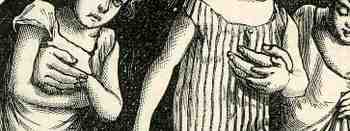
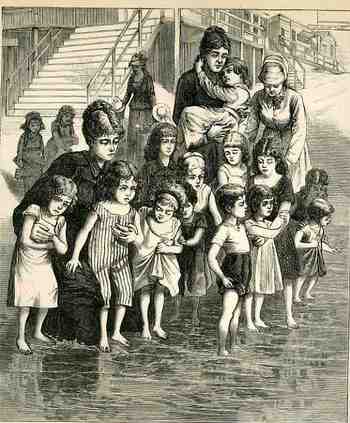
    Right above this image was this extremely emotional wood engraving of blind children being taken to the beach for the first time (at Sheepshead Bay)–my German is pretty rough, but it seems as though they were on a field trip from their  institutional home, which was something like a  “waif” school for the “deaf, dumb and blind” or something 19th-centuryish like that. 

    1ebay_oct_1coney_island_blind712_3
    It is a deeply touching image to me, showing tremendous touch and care…these children, drawn tightly together, feeling and smelling the vastness of the ocean, feeling the full sun on their faces, experiencing it together and separately, overwhelmed, gentle–thirteen children and three matrons and not a smile, all deep  in a private world flooded with feeling.


  • Trans-Atlantic Crossing by Air, 1910 (?) The Voyage of the “America”

    JF Ptak Science Books LLC  Post 343

    00-blog--Oct 28 airship atlantic946
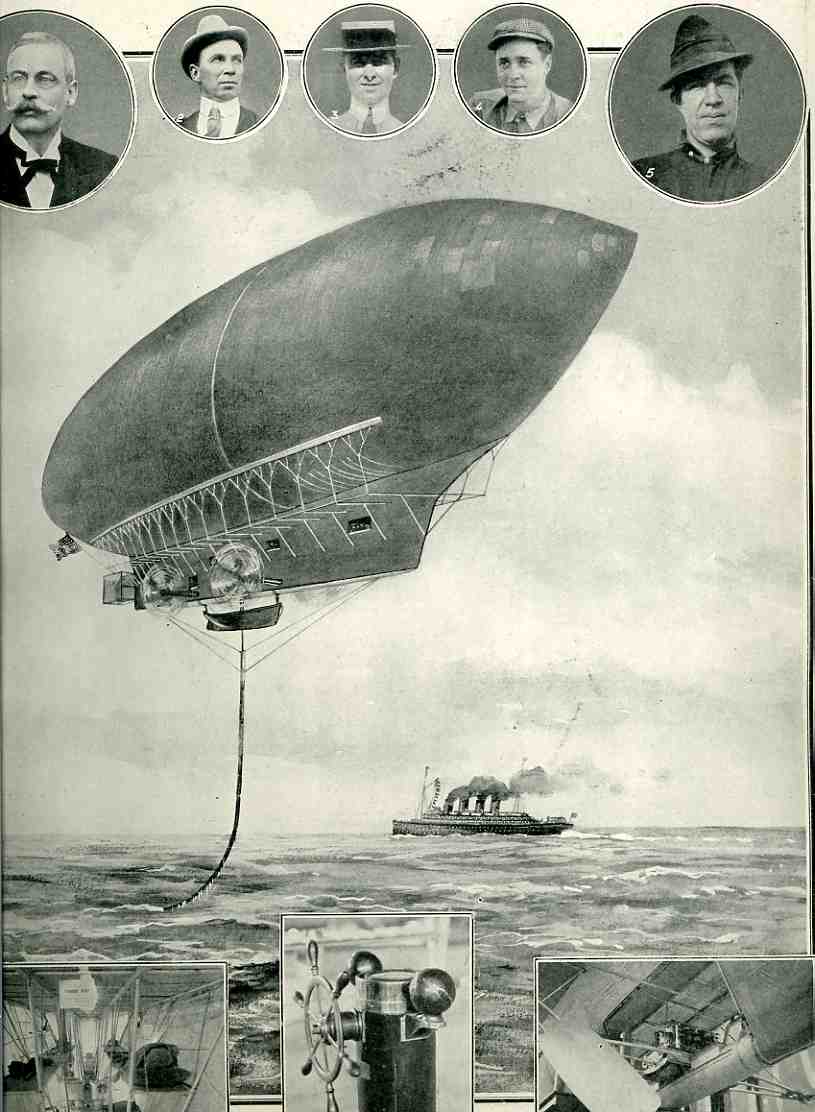
    The airship “America”, under the command of Captain Murray Simon and Walter Wellman (the arctic explorer, set out to cross the Atlantic Ocean on 15 October 1910. The dirigible was 228 feet long with a diameter of 58 feet, had a crew of eight, and was filled with hydrogen gas.  The airship’s four-tons worth of petroleum (to run the four engines on either side of the ship) was carried in the base of the car compartment of the dirigible, with another ton or so of fuel carried in the “equilibraor”, which served to keep the height of the dirigible “equalized” at about 200′.  They set off from New Jersey and flew in a very wide arc for about 1300 miles until engine trouble forced them down near Bermuda.  Although never coming close to crossing the ocean the “America” did set a record for the longest flight of any sort of flying machine.

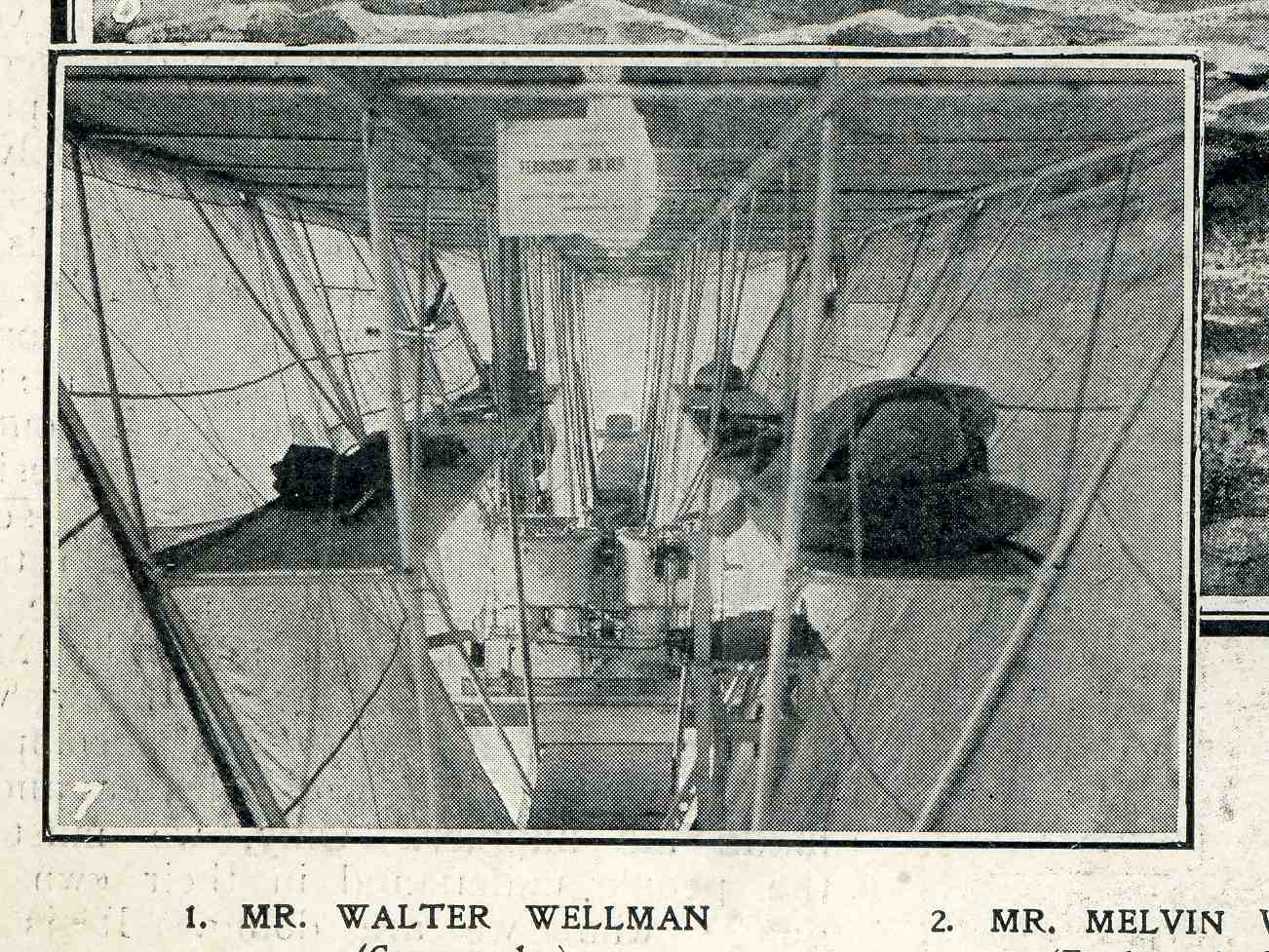
    What drew me to this image though was something far less important: the small inset picture at bottom left, which shows the “sleeping shelves” for the crew. The accommodations, shall we say, are barely so; they looked very narrow, very metal-y, very cold and pretty dangerous, with basically no room for a roll-over.  Then again, no one was there for comfort, but these racks look defiantly un-comfortable.  

    This was the last flight for Wellman, and the crossing of the Atlantic by air would have to wait for the ethically-challenged Lindbergh sixteen years later.

    00-blog--Oct 28 airship atlantic947


  • A 117×1 Mile Blanket of Planes: What 185,000 Planes Looks Like

    JF Ptak Science Books  Post 289

    1ebay_sept_30185000_planes695

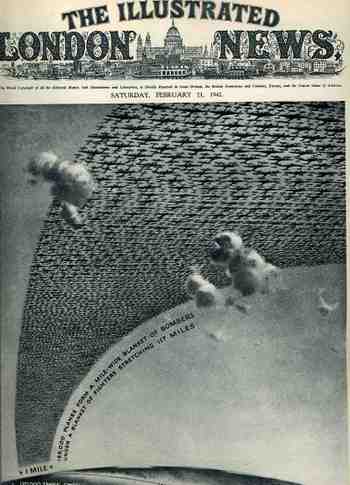
    This arresting cover image for The Illustrated London News of 21 February 1942 illustrates the (new) American production program for planes and tanks for 1942 and 1943 (It reminds me too of an earlier post I did with a similar cover for LIFE magazine here.) The caption reads: “185,000 planes form a mile-wide blanket of bombers under a blanket of fighters stretching 117 miles” which is actually a double blanket of planes–if they were thinned out to form one layer it would stretch one mile wide from Washington D.C. to New York City, which is quite an unimaginable ribbon.

    1ebay_sept_30185000_planes_detail69

    The reality of the situation was greater than this:  by 1945 over 300,000 planes were produced, 275,000 of them after Pearl Harbor.  And this from a combined aviation industry which before 1939 had produced fewer than 6,000 planes a year.  The war effort increased this by orders of magnitude, and by war’s end there were 81 production facilities with a combined area of 175 million feet, all bumped up within four years.   I’ve never read about it, but I have no doubt that one of the key ingredients to this sort of hyper-successful undertaking was organization–the oversight and control for this process must’ve been fast and decisive, with little room for mid-level anything.  I think that this is the only way the whole thing could’ve worked so well. 


  • Vegetius and the 4th Century Underwater Attack

    JF Ptak Science Books LLC  Post 342

    Blog--vegetius
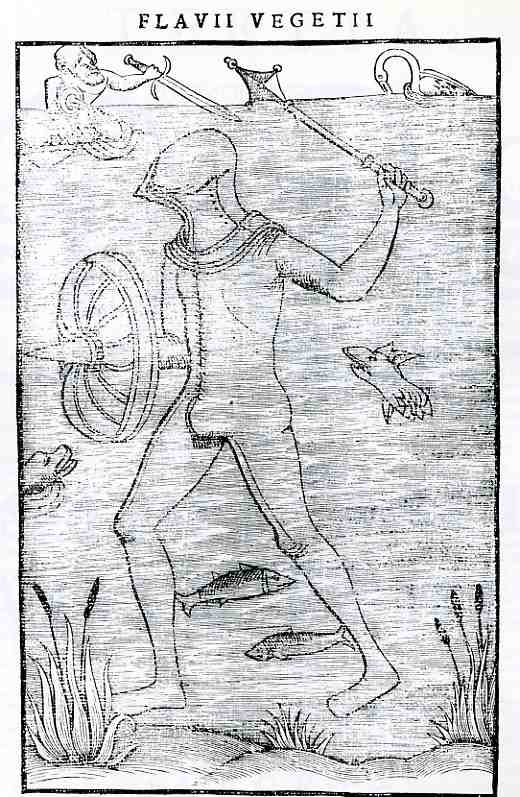
    The name of Flavius Vegetius is not so much popularly known today, though his influence is felt through the hands of other, more famous, writers and thinkers.  He was seen as the most adept writer on the Roman mind in warfare, and his De re militari libri quator… was his masterpiece.  It was reprinted in 1532 by Christian Wechel from sources reaching back to the original, which was written around 390 ACE, and found a wide readership not only for its authority on all things military/Roman but also for his iconic insights and aphorisms on warfare in general.  It was Machiavelli who came under his spell and who adopted some of Vegetius, who became further disseminated through the military followers of Machiavelli, and so on.

    I came to this work much more simply than all of this – I liked this image of the underwater warrior, who was somehow able to breathe while submerged.  I get the importance of this sort of undercover, guerilla maneuver, but what I really like was the rarity of seeing a Renaissance illustration of human submarine life, which is pretty uncommon.  Also, the use of the lines to represent the underwater quality of the image—giving the woodcut an overall grey tone—is also very scarce in the history of illustration, at least before 1600.  And very neat!  One of the hallmarks of this printing of Vegetius was the liberal use of white space in many of the (119) woodcut illustrations, though it is clearly not on display in the woodcut that I’m sharing here.
    00-blog-Oct 28 vegetius939

    Of further interest are the following excerpts of Vegetius from the 1767 English translation found at the Digital Attic website. I’ve selected four interesting bits on the selection of recruits, their initial training, the size of recruits and the need of the new soldiers to learn how to swim.  I find them a fascinating insight into the appreciation of the raw military recruit from 1600 years ago. 

    The Military Institutions of the Romans (De Re Militari)

    By Flavius Vegetius Renatus

    INITIAL TRAINING

    The first thing the soldiers are to be taught is the military step, which can only be acquired by constant practice of marching quick and together. Nor is anything of more consequence either on the march or in the line than that they should keep their ranks with the greatest exactness. For troops who march in an irregular and disorderly manner are always in great danger of being defeated. They should march with the common military step twenty miles in five summer-hours, and with the full step, which is quicker, twenty-four miles in the same number of hours. If they exceed this pace, they no longer march but run, and no certain rate can be assigned.
    But the young recruits in particular must be exercised in running, in order to charge the enemy with great vigor; occupy, on occasion, an advantageous post with greater expedition, and prevent the enemy in their designs upon the same; that they may, when sent to reconnoiter, advance with speed, return with greater celerity and more easily come up with the enemy in a pursuit.


  • Found Images: Carrying Baby Coffins at London Stone?

    JF Ptak Science Books Post 286

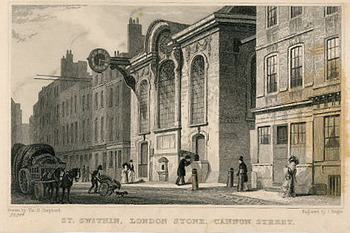
      This image has always been a little troubling to me, and one that I’ve never figured out.  Unfortunately I cannot now find the original to get a better, deeper scan of the curious object being carried by the oldish man in the center of the picture. This is another in a series of generic topographic prints of famous churches/buildings/streets and so on, decorated with figures some of whom are just going about their daily days as well as others who are quirkily adventurous–but those quirky actions are most often buried in the smallness of their representation. sometimes almost to small to see, especially considering that they are just there for scale.

    File0760saved

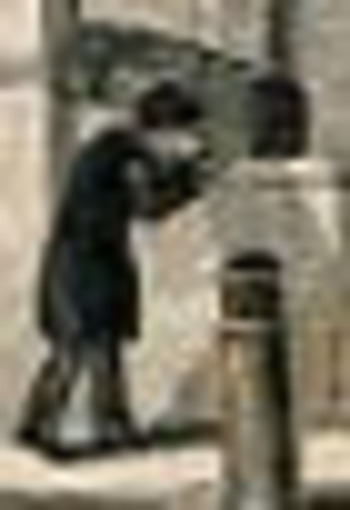
    File0760saved_detailLooking at this image of St. Swithin’s* and the London Stone, even a quick, noncommittal  look at the people filling up the foreground reveals this most unusual character with an uncommon box, right there at stage-center.

    I make this out to be a child’s coffin, largely because I want it to be for the sake of the print and also because there aren’t many other easy, logical choices.  I remember it looking even more so in the original under 20X magnification, with the figure carrying it buckling slightly from more than just the weight of the box he was bearing.  What else could be in there?  A big set of engineer’s scales?  A precision pantograph?  Legs?  I don’t know–its kind of too big and bulky to be a carrier for everyday work material, as tools filing the box would make it too hard to hoist to the shoulder. The figure seems sad somehow rather than burden, and the question, again, as in the other posts dealing with this subject matter, is why the artist bothered with some a complicated figure to simply people-up the street at St. Swithin.  Did the artist  or engraver just suffer the loss of a child and is displaying their grief, or is it a reminder of the dance of grim death just outside the doors of the church door?  Or is it just some guy carrying a heavy box filled with table scraps? 

    * The famous “London Stone”, a solid block of oolite such as used by the Romans in their buildings, is set in a large stone case,     protected by an iron grille, and let into the wall on Cannon Street. It originally stood on the south side of the street opposite St Swithin’s Church until it was moved and set  into the wall of the church itself (in 1798). According to Camden, it was a Milliarium or  Milestone from which the British high roads radiated, and from which the distance on them was reckoned, similar to the one in the forum at Rome (16th Street in Washington D.C., once upon a time named Meridian Strete, was also supposed to perform this chore.  Meridian Hill Park, now renamed Malcolm X  Park, is about all that is left of that idea. And it seems like a good notion lost  now that the rest of the world isn’t setting their timepieces to an imaginary line running right through a big desk in an oval office at 1600 Pennsylvania Ave.)