A Daily History of Holes, Dots, Lines, Science, History, Math, Physics, Art, the Unintentional Absurd, Architecture, Maps, Data Visualization, Blank and Missing Things, and so on. |1.6 million words, 7500 images, 4.9 million hits| Press & appearances in The Times, Le Figaro, Mensa, The Economist, The Guardian, Discovery News, Slate, Le Monde, Sci American Blogs, Le Pont, and many other places… 5000+ total posts since 2008.

Category: Photography, history

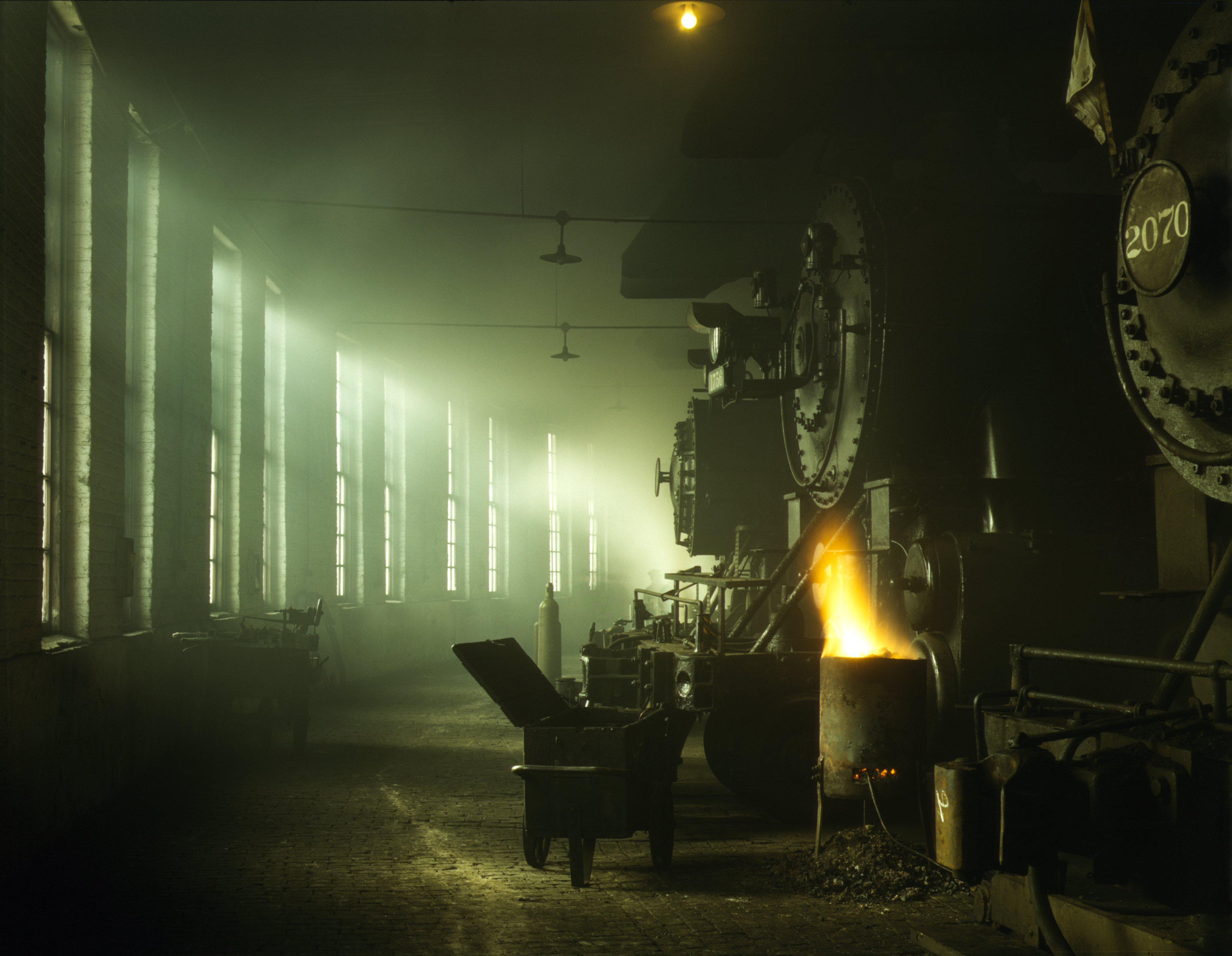
  • Jack Delano Photographs, 1939-1972

    JF Ptak Science Books   Quick Post

    I found Jack Delano as a photographer for the Farm Security administration where he worked for Ray Stryker making photographs of the vastly changing America during the mid/late 1930’s. He worked with a relatively small group of photographers
    including Esther Bubley, Marjory Collins, Mary Post Wolcott, Arthur
    Rothstein, Walker Evans, Russell Lee, Gordon Parks,
    Charlotte Brooks, John Vachon, Carl Mydans, Dorothea Lange and Ben
    Shahn–as a collective they produced perhaps the greatest body of documentary work this country has ever seen.  Delano was in his mid-20’s when he started with the FSA, a little more than a decade in the U.S. after arriving here from the Ukraine (born Jack Ovcharov in 1914).  Besides his life in photography, Delano was a gifted and versatile composer.  He died in 1997. 

    Here’s an interview with Delano at the Archives of American Art (here).

    Most images below are from the FSA collection at the Library of Congress (here). Another nice selection is found at the Museum of Contemporary Photography (here)


    Delano2003_126

    File:Locomotives-Roundhouse2.jpg


    DelanoEL2003_150


    ·Posted by :

    ·in:

    —

  • Walker Evans’ Indelible Images of The Great Depression

    JF Ptak Science Books   Post 1892

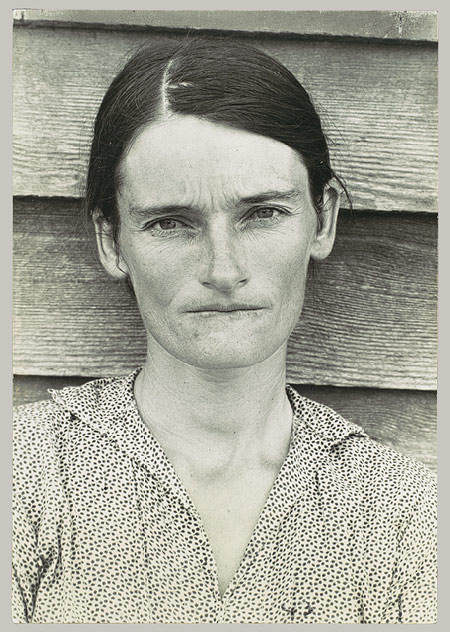
    Evans, walker  farmer tenemnt wife det


    Evans--alabamna tenant farmer wife The photographer Walker Evans (1903-1975) was an ultra-light and lyrical traveler, who didn’t leave a footprint in the country he moved through, though the impact of his work–the result of the travel–fastened a famously indelible image on American history–indelible, and fast, being recognized for his work with a commanding exhibition at the new Museum of Modern Art in 1938.  

    Evans possessed a crystaline lens which yielded both spectacular detail and subtle quietnesses. He could turn a tenement farmer’s rough-hewn wooden kitchen drawer filled with roustabout cutlery into a photographic masterpiece, and then photograph the face of that farmer or that farmer’s family and have it stand as an absolute testimonal to the expereince of the Great Depression in the American life. Evans made some of the core memories of that visual experience. He (along with some of the greatest photographers America has produced) worked for the government for a time during the Depression, answering to Roy Stryker at the Resettlement Administration and the Farm Security Administration, with the mission of taking photographs of America–which he did, establishing himself as one of the early and preeminent masters of documentary photography. 

    I was thinking of him earlier today, adn thought that I’m make a selection Walker’s photographs from the magnificent collection of Farm Security Administration images at the Library of Congress. (Also, see the Museum of Modern Art for a nice appraisal, here).

    Shoeshine stand detail, Southeastern U.S.  1936

    [Shoeshine stand detail, Southeastern U.S.]


  • Daily Dose from Dr. Odd: Superbly Unusual and Beautiful Baseball Portraits

    JF Ptak Science Books   Post 1831

    (Please also see this blog’s post on Women in Sports, from about the same era, here as well as here)

    Strolling through the New York Public Library Digital Collection (here), I came across many hundreds of images of baseball players.  What struck me with some of them were their stubborn, unabashed pride, images made of the ballplayers standing squarely in front of the camera, mostly looking directly into the lens, shoulders set squarely under that, a straight, dead-on shot.  Its not just in cartoons where the full frontal is rare–my experience shows it to be uncommon almost across the board. 

    [Unidentified baseball player in pitching form.]

  • Images of the Quick and the “Still”: Trouvelot’s Sparks and Stars, ca. 1890

    JF Ptak Science Books     Post 1827

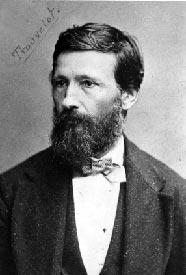
    Etienne Leopold Trouvelot. Trouvelot Figure. Photographic print, c. 1888.

    Etienne Leopold Trouvelot (1823-1895) was an ex-pat Frenchmen who settled in Medford (“Don’t Pronounce the First D”) Massachusetts, and who became a very highly accomplished and deeply skilled astronomical observer and astro-illustrator.  (I’ve included a suite of fifteen of his most accomplished works below, all found in greater detail via their links from their source at  the NY Public Library Digital Collections.)

    Trouvelot covered the spectrum in his art and photography–in addition to making photographs of the deeply settled but still open-to-mystery astronomical objects, he also was the photographer of extremely intransient things.  Among the later are some fantastic images that he made of high-voltage electrical discharges (images of which I found initially at the blog  Translinguisitic Order). 

    The image above is an example of that work, despite it looking like something rather deep-space-y, it is decidedly terrestrial–it is an image that he made of a discharge from either a Ruhmkorff coil or Wimshurst machine, and was produced ca, 1888/9.  It was a signature accomplishment, like photographing lightning or making an atlas of clouds, a watermark of sorts in a decade of photographic highpoint contributions in the sciences. (Some of these accomplishments were found in the work of Etienne Marey, who was able to isolate action in a continuous series of photographic still images, which for its time revealed shocking results.  Not only did the Marey work display the magnificence of motion, it also provided just about the first opportunity in the history of people to show the action in reverse.)

    File:Trouvelot.jpg

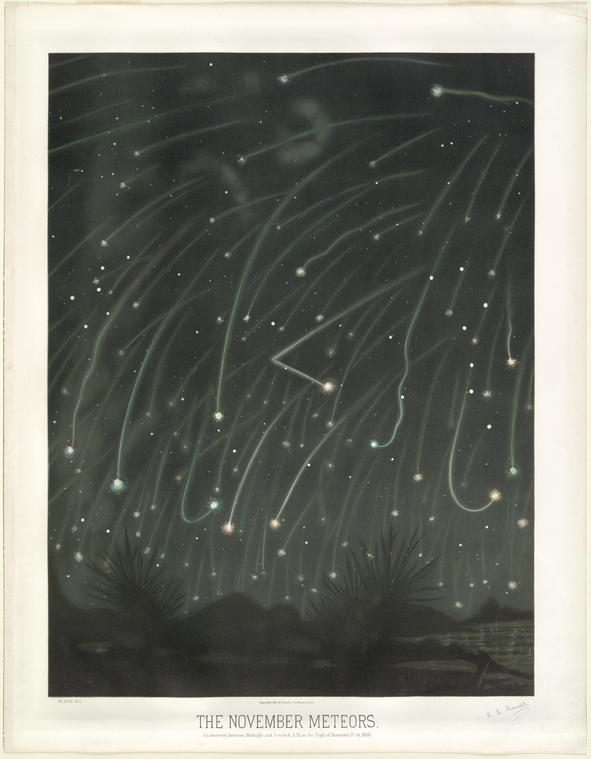
    Trouvelot’s drawing of a meteor shower, which I know has a very certain biological feel to it:

    The November meteors. As observed between midnight and 5 o'clock A.M. on the night of November 13-14 1868.

    Caption from NYPL: “Image ID: trouvelot_012. The November meteors. As observed between midnight and 5 o’clock A.M. on the night of November 13-14 1868. (1881-1882)

    And this spectacular image of the “Great Nebula in Orion” as it used to be called in some textbooks, now better known as Messier 42 or M42 or NCG 1976, which was and probably still may be one of the closest scrutinized things in the sky. It was recognized first perhaps by Niclas Claude F de Peirsec in 1610, with the first published account following in 1618 by Cysatus of Lucerne, though it didn’t get any real traction until it fell into the hands of Christian Huygens (1656) who also published the first image of the big bright spot in the middle of the sword of Orion in 1659.  (This is a little off-target but I like the historical end of the story.)

    The great nebula in Orion. From a study made in the years 1875-76.
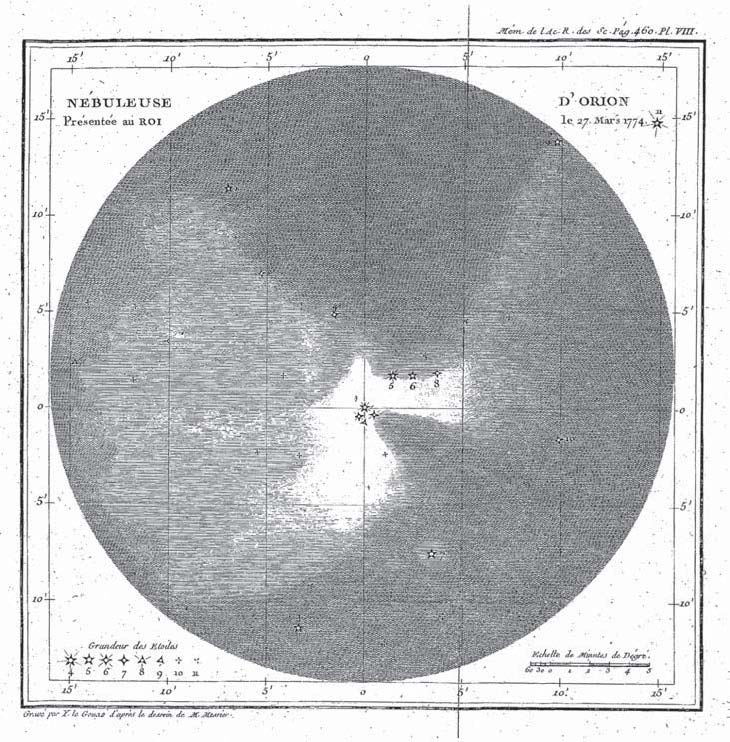
    And just for the sake of it, the Messier drawing:
    File:M42m.jpg
    And Andrew Commons’ photograph of the nebula in 1883 was a great improvement over our old friend Henry Draper’s 1880 groundbreaking attempt:

    File:Orion-Nebula A A Common.jpg

    It is still a little bit of a mystery to me that it took another two decades or so for people to consider that first photo (above) as “art”–perhaps it was the classification of the work as “scientific” and therefore not-necessarily-art, but folks surely made use of this and the Marey and other scientific photography of the 1880’s in their art of the 19-teens.  Trouvelot never lived to see it, though; and perhaps it wouldn’t’ve made sense to him.  I just don’t know. 
    It is also amusing that for this great “finder” the root of the first half of his name in French is “find”.
    The full suite of fifteen images by Trouvelot, below, all thumbnails from NYPL:

  • Dorothea Lange–FSA Photographs at the Library of Congress Site

    JF Ptak Science Books    Post 1806  

    Found below is a selection of photographic images from the Farm Security Administration collection at the Library of Congress.  Today’s photographer:  Dorothea Lange.

    On of the great innovations in a sea of great things accomplished during the Franklin Roosevelt administrations was the formation of the Farm Security Administration, a division of the government established to help farmers through the devastating Dust Bowl and Great Depression.  A subset of the FSA was a photographic unit which was set up to document the progress made by the FSA (and provide, I am sure, for some much-needed good news, a hearts-and-minds campaign).  This division was headed by Roy Emerson Stryker, who wound up hiring a collection of dream-team photographers unlike any ever assembled for a single purpose.  Esther Bubley, Marjory Collins, Mary Post Wolcott, Arthur Rothstein, Walker Evans, Russell Lee, Jack Delano, Gordon Parks, Charlotte Brooks, John Vachon, Carl Mydans, Dorothea Lange and Ben Shahn were sent out all across the country and wound up with the greatest and most beautiful photographic history ever assembled in the United States.  There were about 77,000 images made, and I recall reading (somewhere) that the total budget for the Stryker group for the years 1936-1942 was about $100,000, meaning that each completed image cost just over a dollar apiece. So far as art funding by the government is concerned, that about the best it has done.

    [Listed below are some samples of Lange’s work at the LC–there are more than 3,000 images by her in the collection, found here.  All images below are also expandable.]

    Note:  occassionally found among these images are those with a black dot in the center.  That was the editorial work of Mr. Stryker, who for some reason hole-punched images that he thought weren’t quite up to snuff, or unacceptable for some reason.  In this ruination he also decided to archive them, which means if he was keeping them anyway he might as well have not plugged them, keeping them whole and intact and in their own pile. Anyway, that is what the black dot is all about.

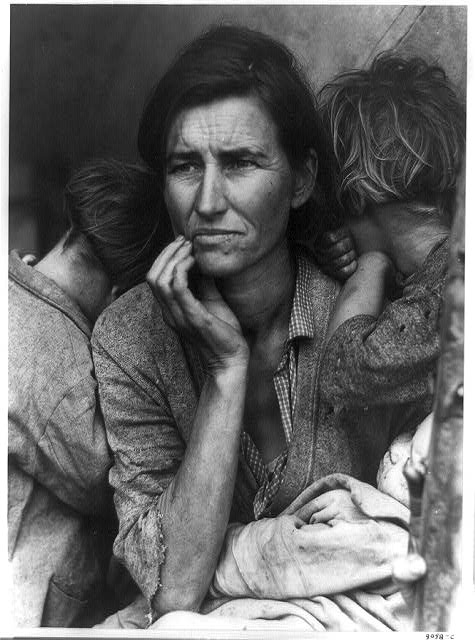
    Lange--migrant

    digitized item thumbnail digitized item thumbnail digitized item thumbnail digitized item thumbnail digitized item thumbnail digitized item thumbnail digitized item thumbnail digitized item thumbnail digitized item thumbnail digitized item thumbnail
    digitized item thumbnail digitized item thumbnail digitized item thumbnail digitized item thumbnail digitized item thumbnail digitized item thumbnail digitized item thumbnail digitized item thumbnail digitized item thumbnail digitized item thumbnail
    digitized item thumbnail digitized item thumbnail digitized item thumbnail digitized item thumbnail digitized item thumbnail digitized item thumbnail digitized item thumbnail digitized item thumbnail digitized item thumbnail digitized item thumbnail
    digitized item thumbnail digitized item thumbnail digitized item thumbnail digitized item thumbnail digitized item thumbnail digitized item thumbnail digitized item thumbnail digitized item thumbnail digitized item thumbnail digitized item thumbnail
    digitized item thumbnail digitized item thumbnail digitized item thumbnail digitized item thumbnail digitized item thumbnail digitized item thumbnail digitized item thumbnail digitized item thumbnail digitized item thumbnail digitized item thumbnail
    digitized item thumbnail digitized item thumbnail digitized item thumbnail digitized item thumbnail digitized item thumbnail digitized item thumbnail item not digitized thumbnail digitized item thumbnail digitized item thumbnail digitized item thumbnail
    digitized item thumbnail digitized item thumbnail digitized item thumbnail digitized item thumbnail digitized item thumbnail digitized item thumbnail digitized item thumbnail item not digitized thumbnail digitized item thumbnail digitized item thumbnail
    digitized item thumbnail digitized item thumbnail item not digitized thumbnail digitized item thumbnail digitized item thumbnail digitized item thumbnail digitized item thumbnail digitized item thumbnail digitized item thumbnail digitized item thumbnail
    digitized item thumbnail digitized item thumbnail digitized item thumbnail digitized item thumbnail digitized item thumbnail digitized item thumbnail digitized item thumbnail digitized item thumbnail digitized item thumbnail digitized item thumbnail
    digitized item thumbnail digitized item thumbnail digitized item thumbnail digitized item thumbnail digitized item thumbnail digitized item thumbnail digitized item thumbnail digitized item thumbnail digitized item thumbnail digitized item thumbnail

    ·Posted by :

    ·in:

    —

  • The Topography of Antiquarian Sisters

    JF Ptak Science Books    Quick Post

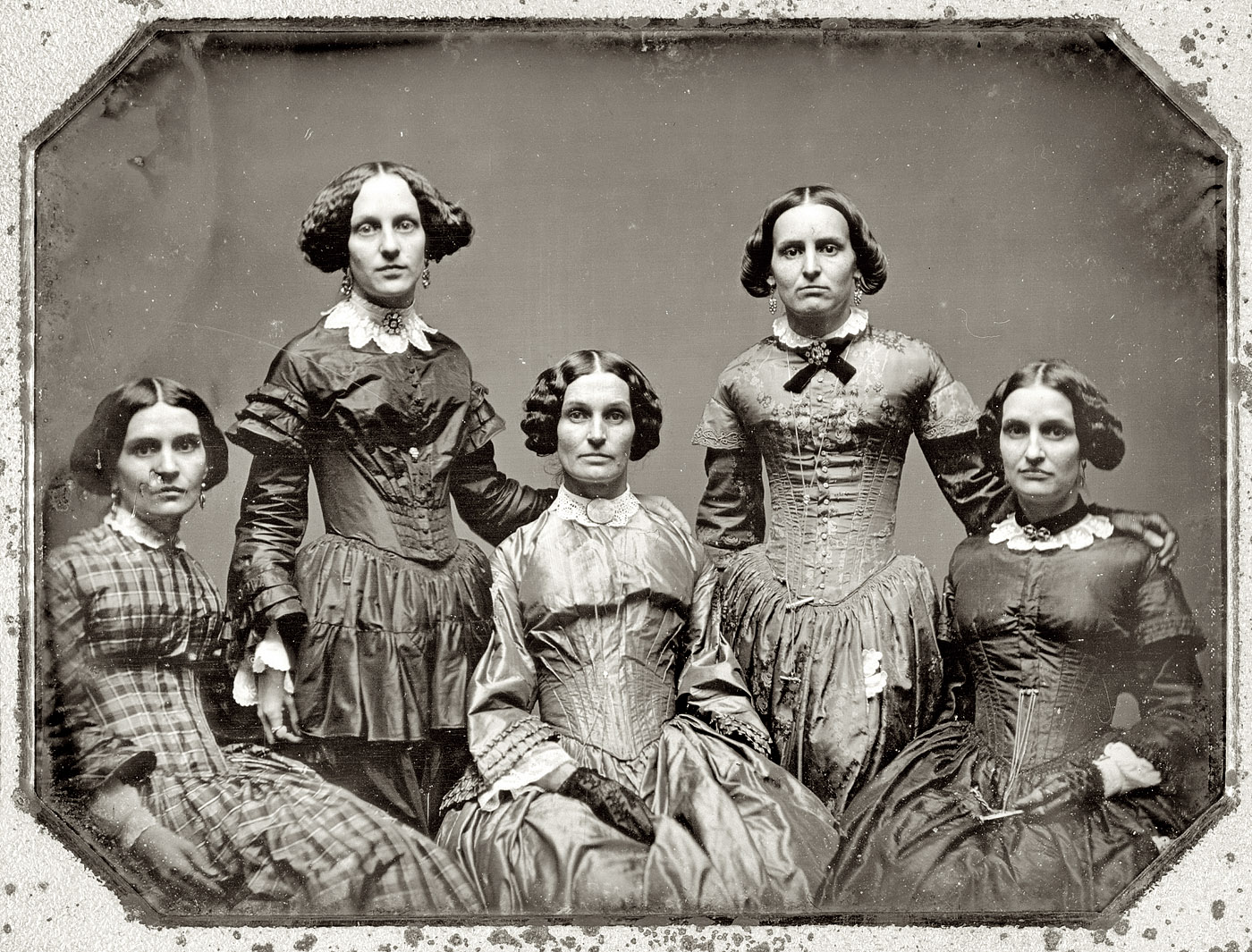
    Sisters

    Photo source: Library of Congress, via Vintage Photography, at retro-vintage-photography.blogspot.com

    This photograph–a daguerreotype, really–is both extraordinary and terribly common, at the same time, and is so in a way that is difficult to define, just that it is so.  It is the work of Frances Benjamin Johnston (whose collection resides at the Library of Congress) and was completed between 1845-1860, and shows the photographer’s aunts.  They make a formidable group.  I’d like to be able to find the data that the outline of their portraits form, because to me they look lik a graph.

    The photographer, Frances Johnston (1864-1952),  was one of America’s first successful female workers in the field of photography and photo-journalism.  She opened a studio around 1890, and went into business, no doubt helped along by her wealthy family’s social clipboard.  That it took 50 years or so and the application of a family’s small fortune to firmly establish a woman at this rank in photography, so close to the year 1900, so far into the advance of photography, is remarkable. The self-portrait, below, shows her mind:

    File:Frances Benjamin Johnston, full-length portrait, seated in front of fireplace, 1896 (altered).jpg

    she reveals herself a woman of the modern age, with her petticoats flaring and obvious, a cigarette in one hand, and a beer stein in the other, secrets no longer.

    Sisters 1


  • The First Published Image of a Photograph, April 20, 1839

    JF Ptak Science Books,  Post 1701 

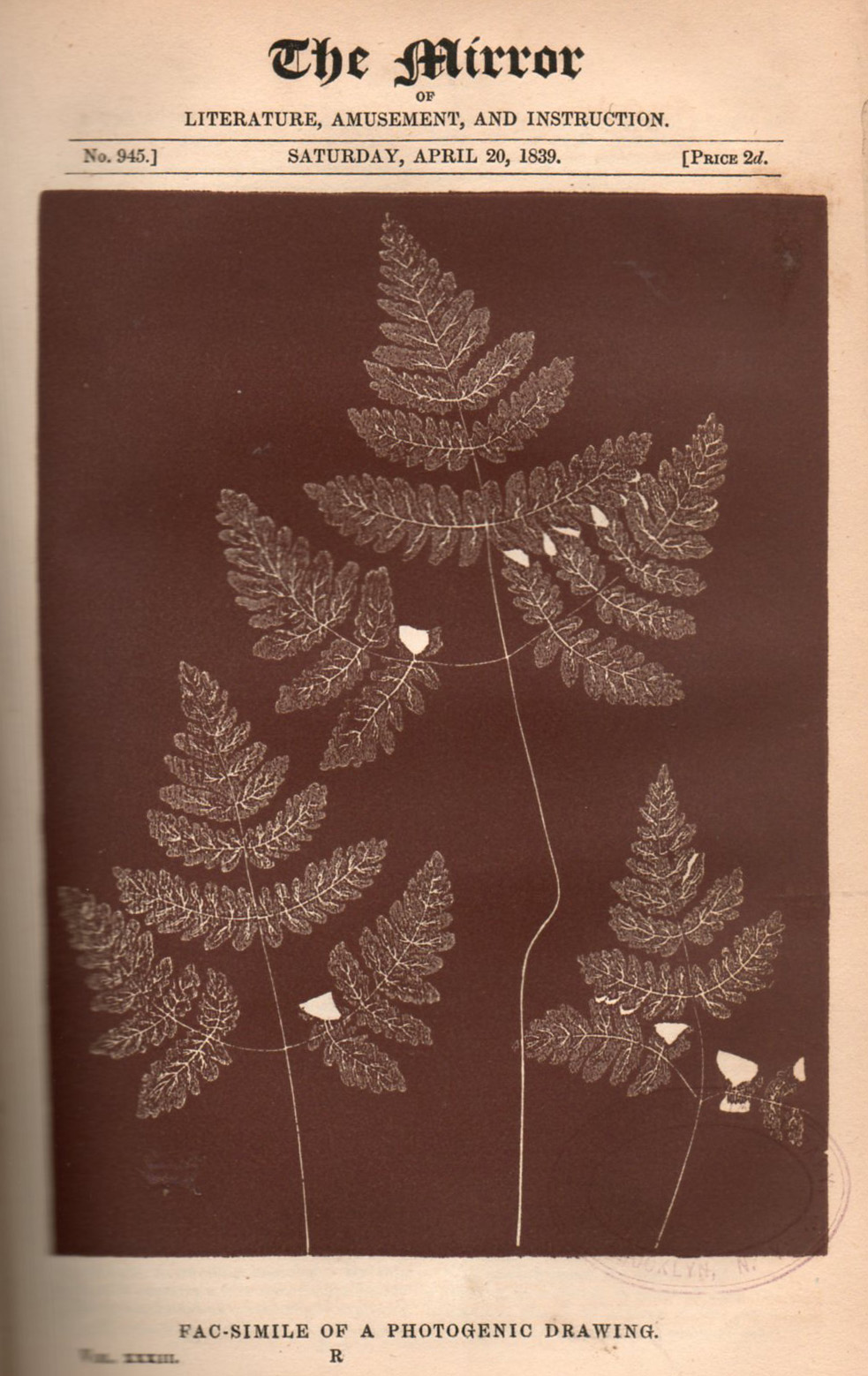
    The first published photographic image,  or “sunpicture”, illustrating an excellent collection of extremely early papers on photography, 1839.
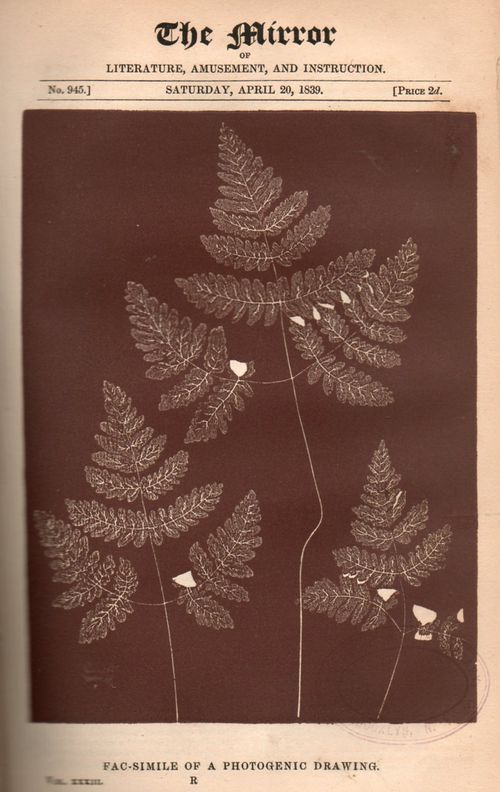
    Bird photograph148
    Bird, Golding.  “A Treatise on Photogenic Drawing.”  Five papers in a series found and bound in the London-published journal, The Mirror.  These five issues comprise a very early work on the new science of photography by Dr. Golding Bird, appearing in issues from April 20-May 25, 1839:  this includes “A treatise on photogenic drawing”,  (pp. 241-44);  and also  “The new art – photography”,  (pp. 261-2, 281-3, 317-18, 333-335.)

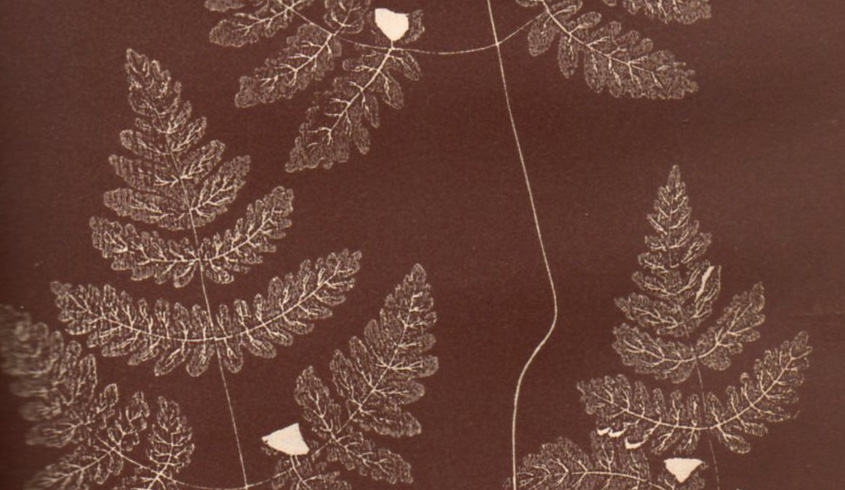
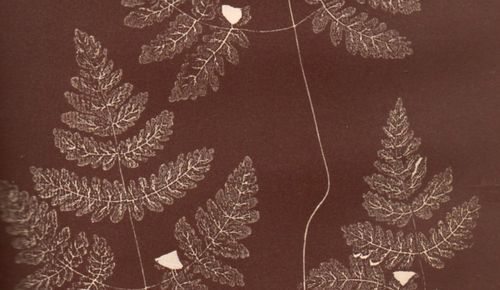
    It is page 241 (issue no. 945, Saturday April 20) that particularly peaked my interest–it contains the First Image of a Photogenic Drawing. This is essentially the first publication of an image produced by any sort of photographic process.  The process here is the ‘sun picture”, a photographic process, making this the first published “photographic” image, but really it is more like the first publication of a photographic image that was produced via woodcut.  It predates the first mass-published photograph by four years and the first (entirely) photographically illustrated book (The Pencil of Nature) by six years.  The sun picture, or heliotype, was first described in print in 1801 by both Thomas Wedgewood and Humphrey Davy, and although the process was at least 39 years old at this time there are no recorded *published* images produced by that process. (The woodcut is much larger than usual for The Mirror, and is also of a unique brown/red color, and of a different hue than any other woodcut that we have seen in any of the issues of the first 45 years of this publication.)
    Bird photograph148_edited-1

    The image is described in David A. Hanson Collection of the History of Photomechanical Reproduction, located in
     the Sterling and Francine Clark Art Institute (Williamstown, Massachusetts), so:

    “…facsimile of a photogenic drawing of ferns (done on the block) as a plate [to illustrate an article serialized by Dr. Golding Bird “A Treatise on Photogenic Drawing” and reprinted in the Magazine of Natural History, p. 234-44]…printed in rust to imitate the photogenic drawing… The facsimile of the photogenic drawing done directly from an exposure on the block is the first photographic image published. The finished example is printed directly from the block in a reddish brown to match the color of Talbot’s first salt print photograms.”–Hanson Collection catalog, p. 6 [Source, here.]

    Under the title, “the First Reproduction of a Photograph”,the George Eastman House of Photography’s journal, the Image (volume 11/2, 1962)  notes:

    “On April 20, 1839, the London magazine The Mirror of Literature, Amusement, and Instruction, featured as its cover a “Facsimile of a Photogenic Drawing.” There is a copy in the George Eastman House collection. It is a picture —in negative—of three stalks of leaves. The original was made by Golding Bird, “a distinguished botanist” by following William Henry Fox Talbot’s newly invented process, the details of which were made public at the Royal Society on February 21. Paper was made light sensitive by bathing it first in sodium chloride solution, then, after sponging the surface, in a solution of silver nitrate. The material could be used in two ways: to make, as Golding Bird did, a contact print, pressing flat objects to the surface during exposure to light, or in a camera. Both techniques produced negative images, which were fixed in a strong solution of sodium chloride. Talbot named his invention “photogenic drawing.” His friend, Sir John Herschel, proposed for it the word “photography.”

    “Thus to The Mirror falls the honor of having first published a reproduction of a photograph. The facsimile which was presented to its readers was the work of a draftsman, who made a drawing of the photograph, and a wood engraver, who cut the block..”

    The Image continues:

    “Only a week later, on April 27, The Magazine of Science and School of Arts, another London magazine, featured three “Fac-similes of Photogenic Drawings” on its cover: two botanical specimens; (Fool’s Parsley and Grass of Parnassus), and a piece of lace. Although wood engravings created by skill of hand, they approach photography more closely. For the very wooden block used for the printing plate was itself sensitized, just as Bird’s paper had been sensitized, and the engraver followed with his burin the photographic image itself, rather than the artist’s drawing.”

    “The photogenic drawings were contributed to the magazine by a reader who signed himself “G.F.” He commented, in his covering letter published in the same issue: “I send you three drawings of this new art, which were impressed at once on box-wood, and therefore are fit for the graver, without any other preparation. I flatter myself that this process may be useful to carvers and wood engravers, not only to those who cut the fine objects of artistical design, but still more to those who cut patterns and blocks for lace, muslin, calico-printing, paper-hanging, &c., as by this simple means the errors, expense, and time of the draughtsman may be wholly saved, and in a minute or two the most elaborate picture or design, or the most complicated machinery, be delineated with the utmost truth and clearness.”

    Gernsheim states in his History of Photography that  the first photographic camera ever made for sale to the public was advertised by Francis West, an optician of 83 Fleet Street, London, and published in this issue.   

    Bird later reworked these sections of the Mirror into elements of and a chapter in his Elements of Natural Philosophy; (being an experimental introduction to the study of the physical sciences; revised and enlarged third London edition, Philadelphia: Lea & Blanchard, 1848). This article was reproduced in the Journal of the Franklin Institute in September 1839 as “Observations on the Application of Heliographic or Photogenic Drawing to Botanical Purposes; with an account of an economic mode of preparing the Paper: “in a Letter to the Editor of the magazine of Natural History”.

    [Offered for sale in our books for sale section, here.]

  • A Note on Tricycles in the History of Nothing

    JF Ptak Science Books   Post 1576

    Lbikes--tryke645
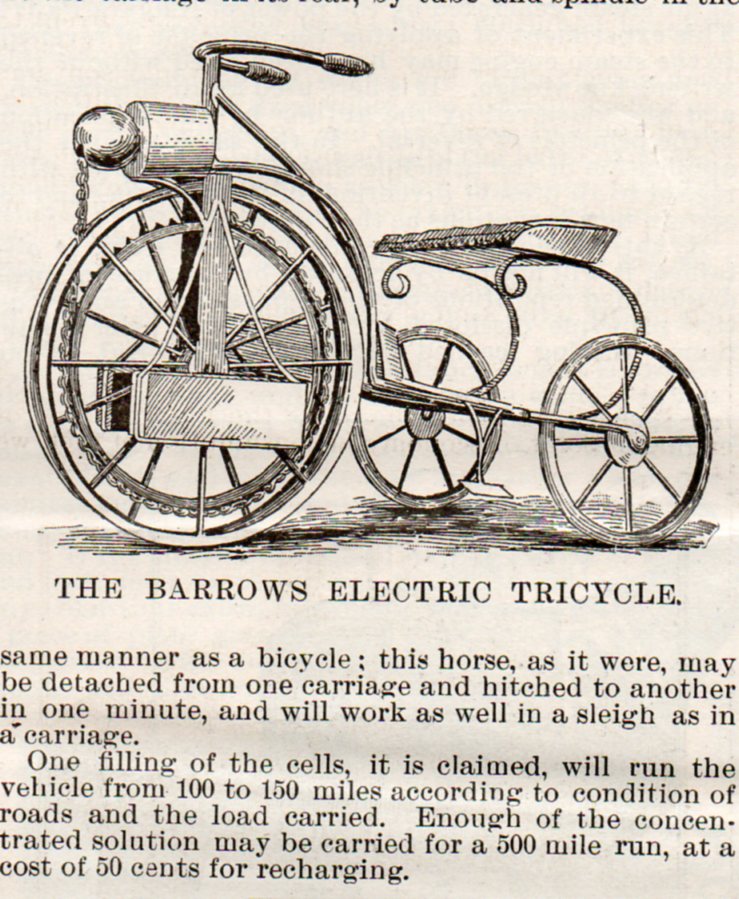
    This image–from the Scientific American Supplement for 25 September 1895–triggered an immediate reaction, though not for the electrification of what looks like a child’s toy. Charles H. Barrows of Willimantic, Connecticut patented this bike, which turns out to be a considerable object–it has a two hp engine which is powered by a hundred-pound battery that is “stored in the two cabinets” (measuring 24x8x8) on either side of the hub, making the wheel I guess somewhere around 34-36″ in diameter. After everything was said and done, the trike was a big, heavy, thing, in spite of a fairly spartan design in the rest of the bike.

    What the woodcut remind me of was William Eggleston’s quiet, odd, iconic and enigmatic portrait of a tricycle, which  I think launched a new photographic experience for the suburbs–a kind of Robert Frank for people doing “okay”.

    Tricycle

    Eggleston’s work, including this s image above (Untitled, Tricycle and Memphis, 1970), was a subject at a MoMA show in 1976, William Eggleston’s Guide.  It was received with long glances down long noses–seen as a banal exercise in the portrayal of everyday stuff in everyday settings, critics saw the semi-nothingness in the photos as simple all-nothingness, with one critic asking “a guide to what?”  But the Eggleston show was far more than that, showing the bits–in color–of American cultural life in middle class seclusion, a splendor of small Americana. 

    Bill Owens, working at about the same time as Eggleston, also shared his vision on the restricted glory of the suburbs in his Suburbia, spreading his discoveries of new-found cultural diversity.

    http://adventurepatches.files.wordpress.com/2010/05/suburbia-boy-with-gun.jpg

    The critics saw basically nothing in these works when they were first shown, though they had a lot more going on for them than the electrified tricycle, which was far too big and heavy to have done any good for anyone (though the design of the sprocket/wheel was pretty interesting).  The only nothingness that are in the photos of Eggleston and Ownes was the nothing that the critics chose to see.  Sometimes new, different ways of looking at things as in the cases of these two photogrpaher makes it seem as though it is a newness of nothing, but only for a short time, until everybody else showed up. 


  • Ancient Motion Pictures, London, 1896/1903

    JF Ptak Science Books   Post 1413

    I just wanted to share these films that I found at the British Film Institute’s youtube account.  They are remarkable, clear, fluid images of London in 1903/1913 or thereabouts, offering a slice of relatively unrehearsed life from 100 years ago that is so unexpected. They are visual time capsules, beautifully restored by the BFI–they are like moving picture versions of sumptuous platinum prints, with gorgeous detail in each frame, so lovely that they look as though they could withstand micro inspection. 

    The first: London, 1903:


    Blackfriar’s Bridge, 1896–very short, but again, another remarkable piece of moving history…if only there was sound.

    Trafalgar Square Riot for Mrs. Pankhurst, 1913:

    Petticoat Lane, a semi-ancient marketplace east of Central London, showing a common look to common folk buying and selling common stuff, 1903:

    ·Posted by :

    ·in:


  • Picturing the Unseen World #`1–the Discovery of the Complex World of Splashes, 1877.

    JF Ptak Science Books   Post 1350

      Drops 456
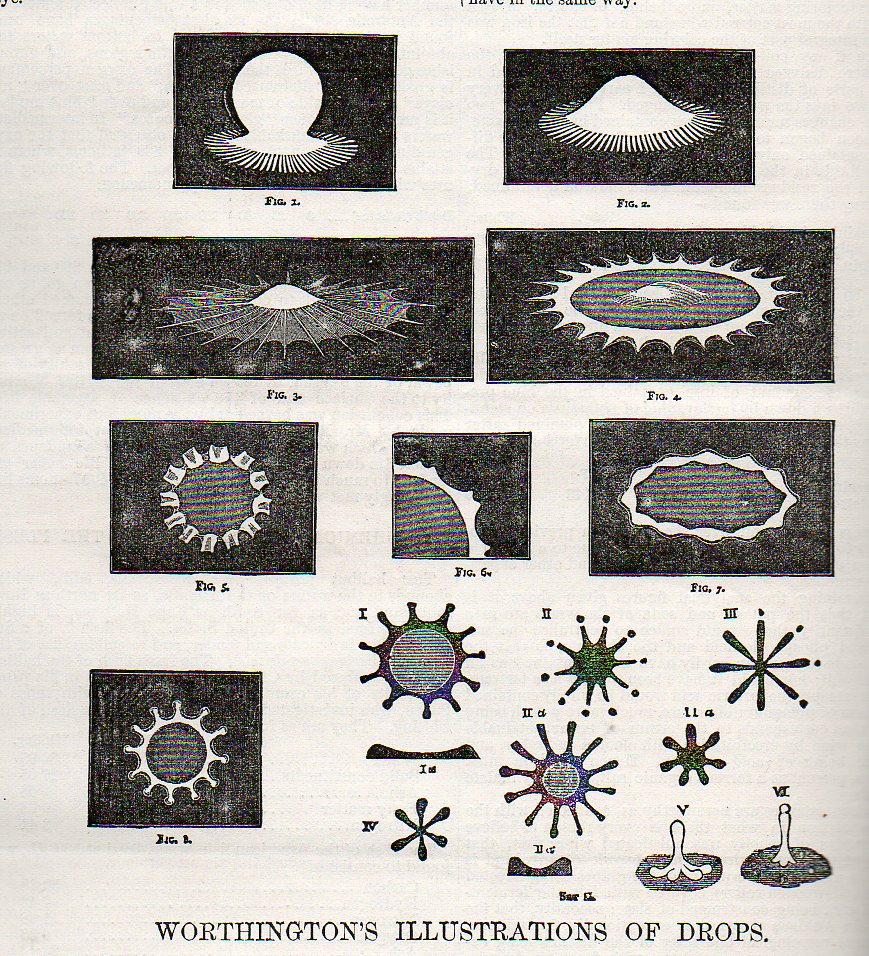
    A.M. Worthington published his extraordinary researches in capturing drops and splashes  just a year after the invention of the telephone–seeing his very quietly magnificent work would’ve been worth the phone call, even at those heady rates at the beginning of the new medium. Worthington was the first in his field, and for a short while, before he told anyone, he was the only person on the planet who had ever seen the fantastic complexity of this very common and previously-simple event.   In its own way these photographs showing the deformation of a drop of milk (and mercury) were as much a revolution as the images shown by Robert Hooke in his epochal Micrographia in which he (just about the next-best-thing to Newton) introduced the fabulous complexities of the previously microscopical world(s). 

    Worthington and Hooke are two in a long line of people who brought  unseen worlds into the visible sphere.  Isaac Newton’s (1642-1727) reflecting telescope (1672) gave a brighter vision to the observable universe; Galileo Galilei created an observable universe an order of magnitude larger than ahead ever been seen before in just one action, in one evening.  Christoph Scheiner put a face on the sun in 1611, Henry Mosely gave geometrical growth patterns to the nautilus shell in 1838, James Fraunhoefer found out the chemical constituents of the sun in 1814, Watson/Crick (and Rosalind Franklin, really) emerged the helix of DNA in 1953, Wilhelm Roentgen presented pictures of the internal structure of living humans without a single drop of blood in 1895,  and on and on, all providing us with spectacular images of what these people saw.

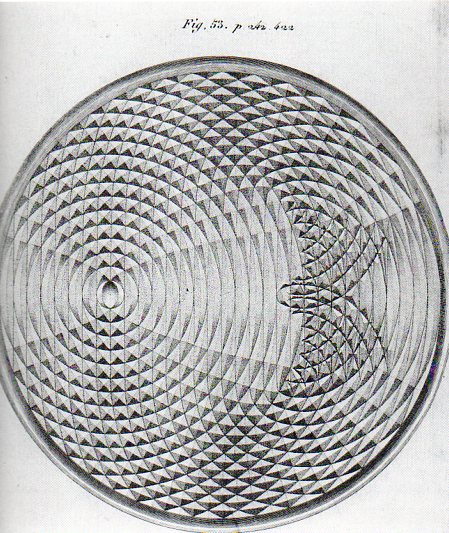
    Chladni’s images of the vibrations made from a bow on a violin string caught on sand-topped metal plates:

    ernst chladni cimatica onde modali
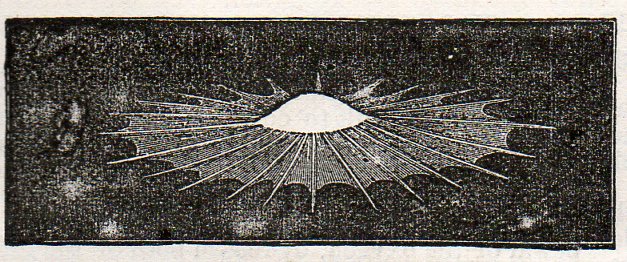
    Adding mercury to mercury: the sensational drawings by the Weber brothers as they observed the changing wave frontsmade by a drop of mercury into a pool of mercury:
     
    Weber acoustics461

    Worthington’s visions into the small, oblique world of ephemeral occurrences gave these things a wider world to themselves; seeing their structure, their complexities, and getting the viewer into their tiny worlds made everyone who could think about such things a better person for doing so.

    The series of semi-photographic images that Worthington was able to make of the drops and splashes could not be readily reproduced in his short article (“On Drops”) published in the Scientific American  (25 August 1877, and available for purchase at our blog bookstore) at this time–the half-tone was still a few years away, and the only way outside of making a drawing after the photograph in 1877 would’ve been a process (like, say, the Woodburytype) that would have been much too expensive to use in a mass-market publication like SciAm. Also, the photographic plates in 1876/7 weren’t quite up to the task of fixing an image exposed so quickly.  Even when Worthington’s book is published on this subject–a popular effort in 1895–it reproduces the photographs as halftones but there are still many interpretative drawings of those images. (The belief in the Civil War images reproduced as woodcuts in places like Harper’s Weekly and Frank Leslie’s was very high–it was enough to know the woodcut was being executed after a photograph and not from drawings made on the spot by the magazines’ field artists.)

    This was some pretty sophisticated stuff, being able to freeze the action of a drop of milk as it exploded in slow stages on a flat surface–especially, again, when you consider that photography wasn’t yet 40 years old and was really only a half-decade or so into its first major revolution since the early 1850’s. 

    Perhaps though the most spectacular thing of all about seeing this dedicated series of images of an exploding drop of milk was that you could look at the series and imagine it all taking place in reverse . 

    The drawings and photos below are taken from his 1895 work, The Splash of a Drop:

    Drops 455