A Daily History of Holes, Dots, Lines, Science, History, Math, Physics, Art, the Unintentional Absurd, Architecture, Maps, Data Visualization, Blank and Missing Things, and so on. |1.6 million words, 7500 images, 4.9 million hits| Press & appearances in The Times, Le Figaro, Mensa, The Economist, The Guardian, Discovery News, Slate, Le Monde, Sci American Blogs, Le Pont, and many other places… 5000+ total posts since 2008.

Category: Photography, history

  • Portraits Within Portraits: Images of Exhaustion, Defeat and Old Youth

    JF Ptak Science Books LLC  Post 806  Blog Bookstore

    + blog 10.24

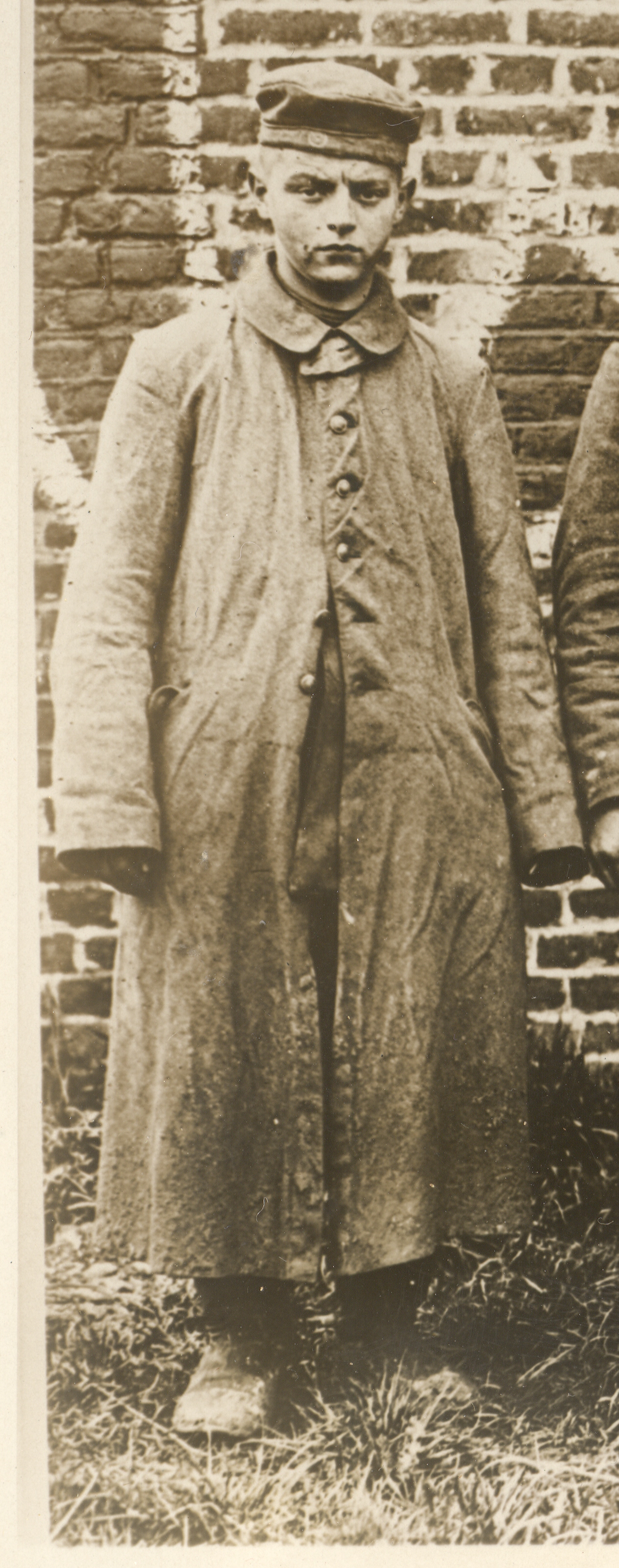
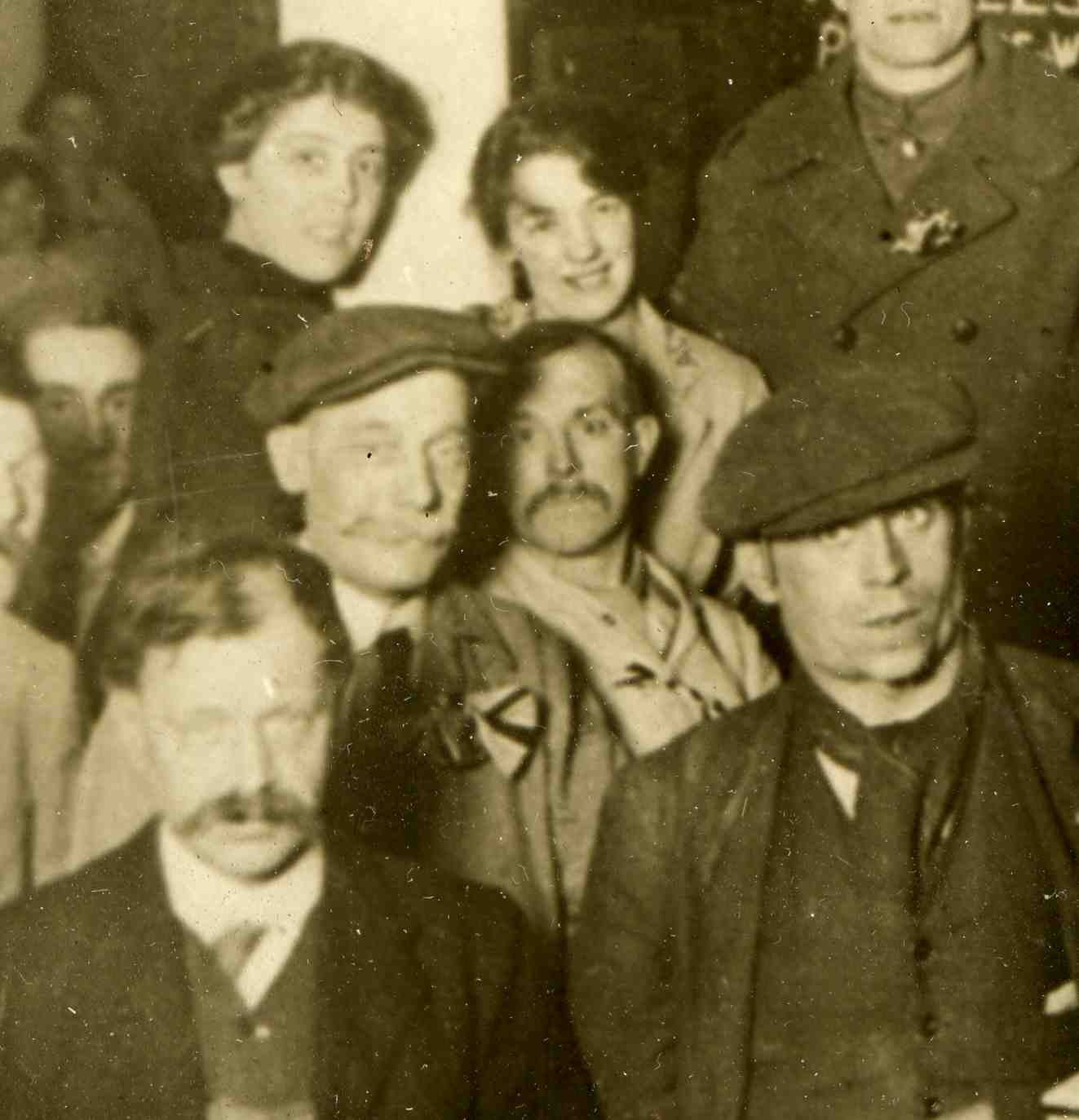
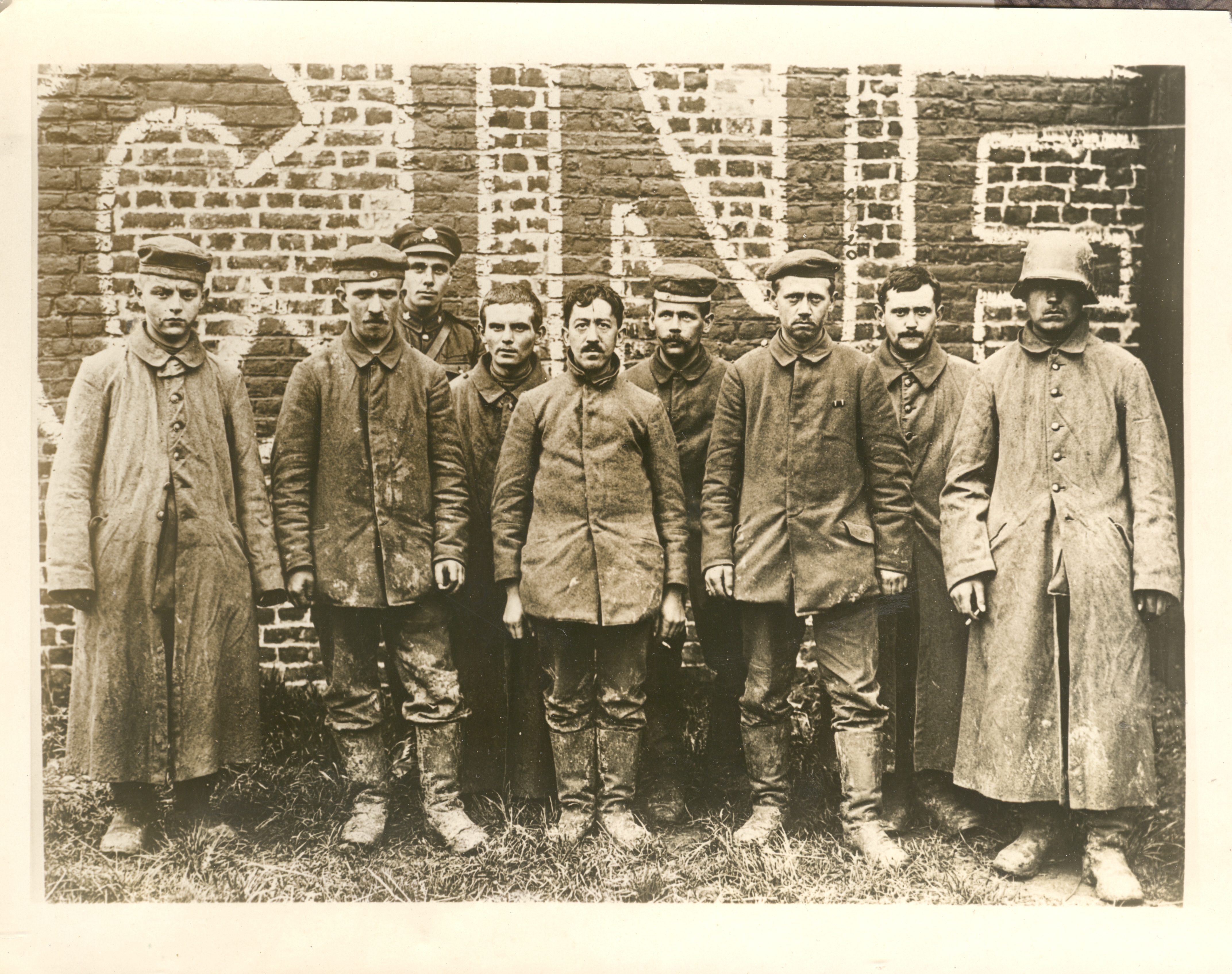
    Earlier today I made a post on some of the images in my collection of WWI News Service Photographs. (These were photos that were sold by an image agency to newspapers and journals which looked for stock photos of, well, whatever, and after paying a use fee would include the photo in the story they were reporting.)  This photo is one of three in a series that show German POWs being marched around a town in France and stopped here and there for a photo.  The picture was taken deep into 1918, within a month or two of the end of the war,.when the Germans were already defeated.  From the look of things, these soldiers were done: tired, mostly beaten, dirty. They at least had most of their buttons on their coats (which is actually a very big deal, keeping your overcoat closed in cold weather to keep warm and alive), their boots looked warn but intact, and they looked not terrible undernourished (though I doubt anyone in the group weighed more than 150 pounds).  

    + blog 10.24 boy left

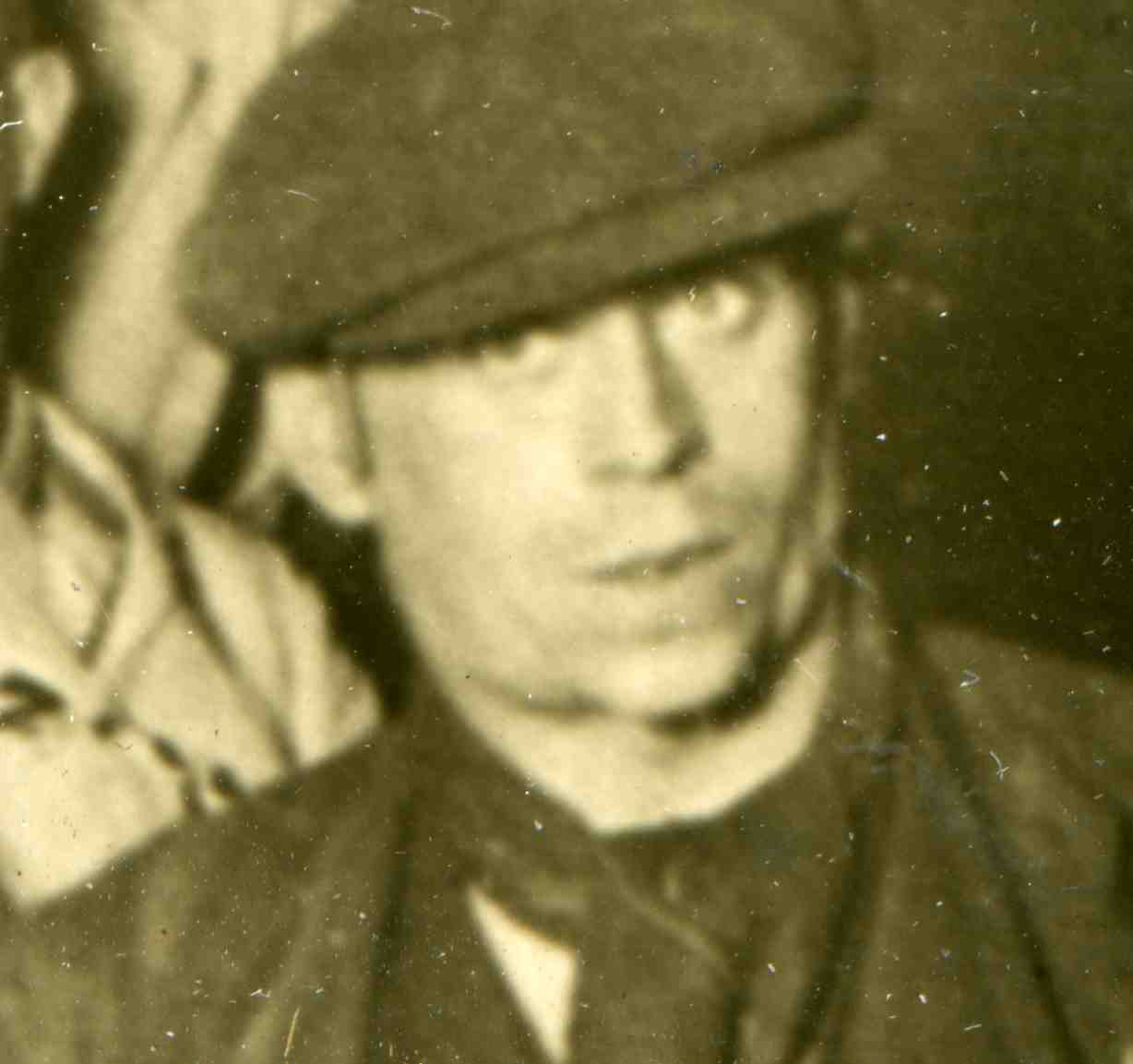
    The group is bookended by two remarkable figures:  the soldier on the left looks not 16 or so, but with a not-new ground in toughness.  He’s all smooth face and baby fat, though he has at least survived the grueling fighting.  The soldier on the right could be the prototype for any number of propaganda posters that popped up in Berlin in the early 1930’s advocating the sold-out but not defeated German soldier of the Great War whose fate must be avenged. 

    + blog 10.24 eyes

     Almost everyone was cupping a ciggy.

    Lastly, the guy third from the left seems to be a Canadian guard, not that this group was going to try to escape.


  • Portraits Within Portraits: Found Images in WWI Photographs

    JF Ptak Science Books LLC  Post 805  Blog Bookstore

    0 blog jan 12baker374

    In
    my collection of WWI News Photo Service Agency photographs I would say
    that half or so of them show  scenes like this–semi-informal group
    portraits of military support groups.  500 portraits like this seem to
    be a lot, and I’m not sure why these images are so well represented.
    Except of course that there weren’t that many images (overall) of
    active-battle scenes. 

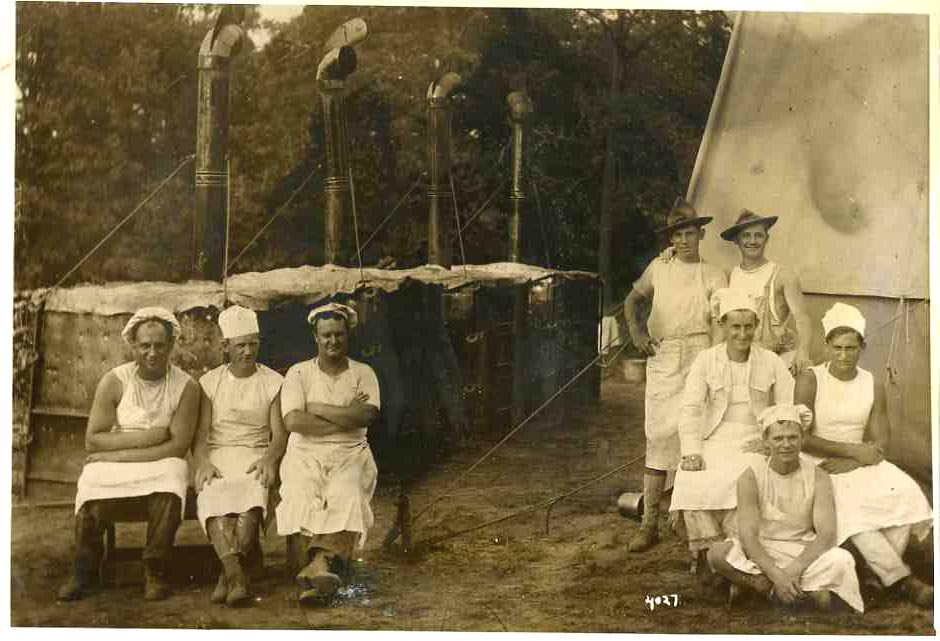
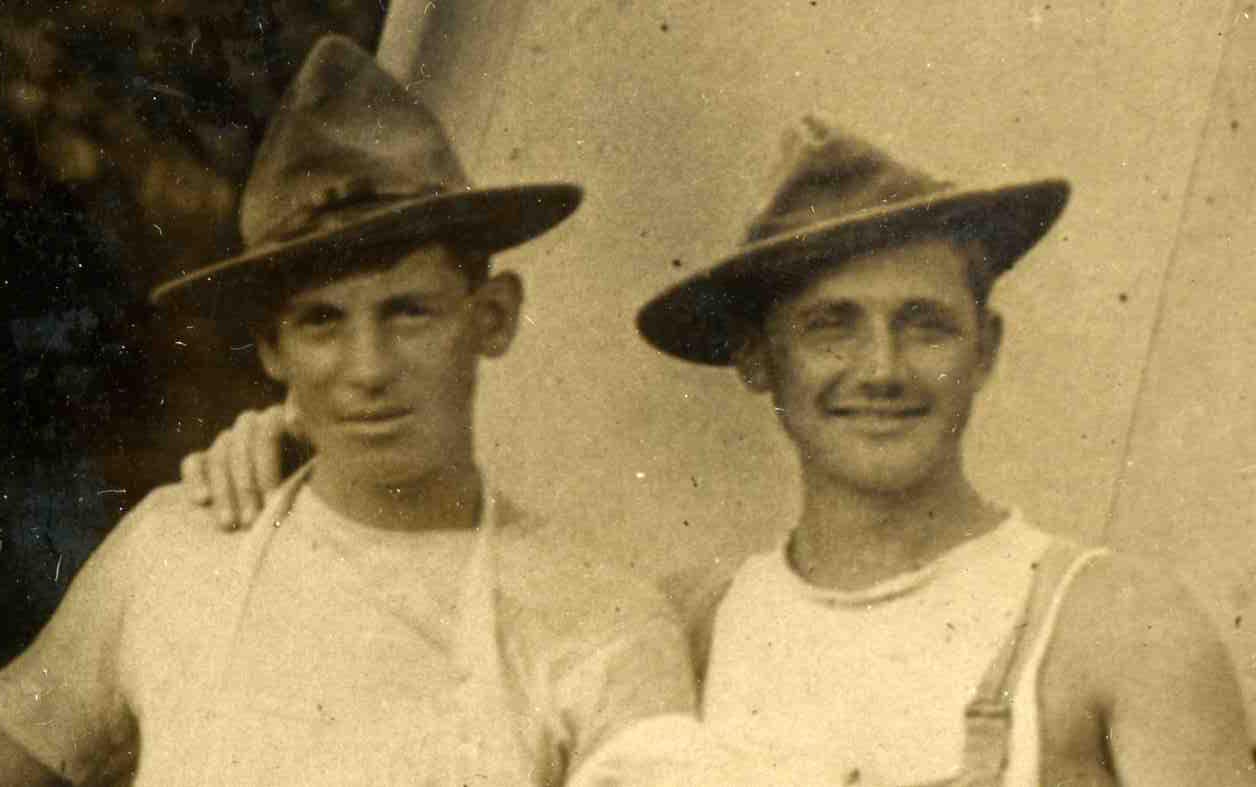
    These bakers, working at a front-line
    support station, from my read were probably taking a break, and the
    photographer took the opportunity to draw them together for the
    portrait.  I don’t know why they’re separated so, but they do look as
    though they have a real camaraderie–it is just a wonderful picture,
    full of friendship and loyalty, and I’m sure it has never been
    published before.  

    0 blog jan 12baker375


  • Very Early Films of NYC, 1903

    JF Ptak Science Books LLC  Post 738 Blog Bookstore

    I came across another fantastic part of the Library of Congress site:  The Life of the City, Early Films of NewYork, 1896-1906. I’ve quoted liberally from the descriptions of the films, and also provided a chronological listig of many of the films that are found at the site.  They are spectacular things, like pieces of eidetic memories, offering wide swaths of minuate detail in corners of pockets of life from a hundred years ago. 

    NOTE:  To view the films just follow the link and click on the MPEG format for best viewing.

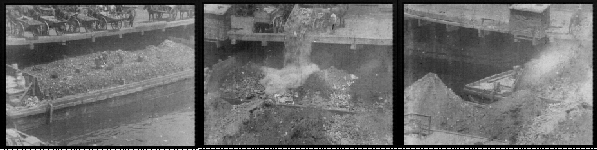
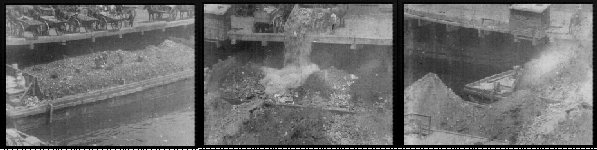
    NYC Garbage Dumping Scene 1903
    Nyc dumping wharf

    Yes, this is what people did when they worked, not so long ago, when thousands and thousands of people worked at making The City go–in the streets picking pulling pushing prying pumping preening polishing purging.  What grabs me are the three workers working beneath the horse-drawn carriages, working on the barges, spreading around the waste.  The topsiders dump their cargo, letting it fall twenty feet or so, landing very closely to the men below.  It seems like an unending process

    From the LC site:
    “The film shows a wharf where a barge is being loaded with trash from
    two-wheeled, horse-drawn wagons. The trash is dumped off the edge of the pier
    onto the barge, where men with shovels are spreading the piles of debris. The
    camera pans left to the next barge, where four-wheeled carts are shown dumping
    excavation rubble. Probably filmed on the East River,
    this is one of several New York City Sanitation Department dumping wharves in
    operation at the time.”

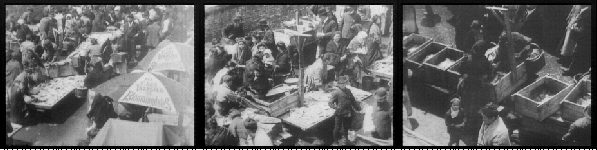
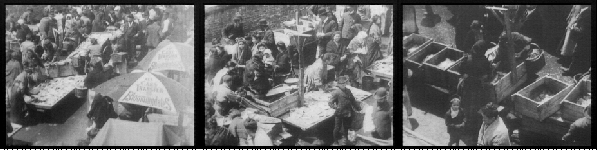
    “Ghetto” Fish Market
    Nyc--fish market

    I love what the kids do when they see this camera–they pretty much uniformly stand still, their fingertips pressed together in wonder and worry, and stare at the strange goings-on fifteen feet above the crowd.  At one point three officials stroll through the crowds, coming in at top right; they are very sharp eyed, and the one guy at the end of these three looks like every other guy who has played a corrupt NYC official in every other movie made before WWII. 
    “The view, photographed from an elevated camera position, looks down on
    a very crowded New York City street market. Rows of pushcarts and
    street vendors’ vehicles can be seen. The precise location is difficult
    to ascertain, but it is certainly on the Lower East Side, probably on
    or near Hester Street, which at the turn of the century was the center
    of commerce for New York’s Jewish ghetto. Located south of Houston
    Street and east of the Bowery, the ghetto population was predominantly
    Russian, but included immigrants from Austria, Germany, Rumania and
    Turkey. According to a description in a 1901 newspaper, an estimated
    1,500 pushcart peddlers were licensed to sell wares (primarily fish) in
    the vicinity of Hester Street. At one point the film seems to follow
    three official looking men (one in a uniform) as they walk among the
    crowd. They may be New York City health inspectors, who apparently
    monitored the fish vendors closely.”

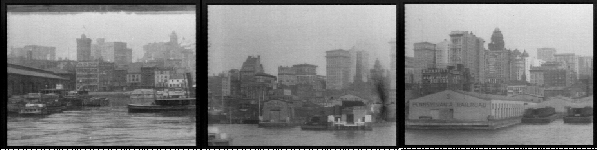
    NYC Waterfront
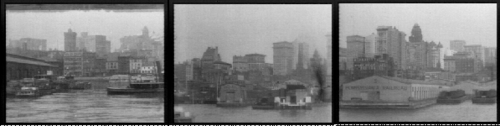
    Nyc-ncy skyli


    From the LOC site:
    “Filmed from a moving boat, the film depicts the
    Hudson River (i.e., North River) shoreline and the piers of lower
    Manhattan beginning around Fulton Street and extending to Castle Garden
    and Battery Park. It begins at one of the American Line piers (Pier 14
    or 15, opposite Fulton Street) where an American Line steamer, either
    the “New York” or “Paris,” is seen docked [Frame: 0120]. The camera
    passes one of the Manhattan-to-New Jersey commuter ferries to Jersey
    City or Communipaw [0860]. Proceeding south, the distinct double towers
    of the Park Row, or Syndicate Building, erected in 1897-98, can be seen
    in the background [0866]. A coastal freighter is next [1560], then
    Trinity Church appears, to the left of which can be seen the Surety
    Building, as a tug with a “C” on the stack passes in foreground [2032].
    Several small steamboats come into view [2136], and the B.T. Babbitt
    Soap factory at Pier 6 is seen [2300], followed by the Pennsylvania
    Railroad piers (#5 & #4), with a group of docked railroad car
    floats [2556], and the Lehigh Valley Railroad piers (#3 & #2), also
    with car floats [3030]. Next are the Bowling Green Building
    (rectangular, with facade to camera) [3208], the Whitehall Building
    (vertical, thin side to camera) [3388], followed by Pennsylvania
    Railroad Pier #1 [3630]. Pier A (with a clock tower) is seen with the
    New York Harbor Police steam boat “Patrol” at its end [4654]. The
    Bowling Green Offices and the Produce Exchange at Bowling Green are
    visible in the background. The breakwater (sheltered landing) and the
    New York City Fireboat House appears [5270] and the distinctive round
    structure, Castle Garden, once a fort and immigrant station, but at the
    time of filming the City Aquarium, comes into view [5438]. The camera
    then pans east along the Battery Park promenade: the Barge Office (with
    tower) is visible in the distance [5804], and further out the Brooklyn
    shoreline with the grain elevators at Atlantic Avenue can be seen
    [6088]. This view is continued, with only a minor break in continuity,
    in the film Panorama of Sky Scrapers and Brooklyn Bridge From the East
    River. Together they comprise a sweep around the southern tip of
    Manhattan, from Fulton Street on the Hudson to the Brooklyn Bridge.”

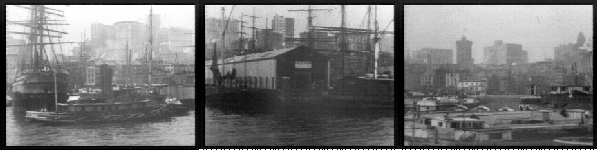
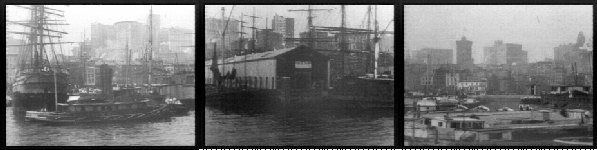
    Brooklyn Bridge to the Battery, waterfront
    Nyc--brooklyn

    Another beautiful water-side continuous panorama, from just above the Brooklyn Bridge to the battery.

    From the LOC site:  “This film depicts the East River shoreline and the piers of lower
    Manhattan starting at about Pier 5 (the New York Central Pier) opposite
    Broad Street, and extending to the Mallory Line steamship piers just
    south of Fulton Street and the Brooklyn Bridge. The film begins with
    shots of canal boats or barges (from the Erie Canal via the Hudson
    River) docked at and around Coenties Slip [Frame: 0106]. As the film
    progresses, the New York Produce Exchange located at Bowling Green,
    Manhattan, with its distinct tower, comes into view in the background
    [0346]. Between here and the Wall Street ferry, there follows in order
    of appearance: steam tugs [0308 and 0422], a wooden hull barkentine
    [1032] with box barges alongside, a docked iron hull sailing ship,
    probably British [1448], an ocean steamer with yards on the foremast
    [1748], a derrick lighter laden with barrels docked at the end of a
    pier [2134], and a fruit steamer [2612]. In the Wall Street Ferry slip
    (between Piers 15 and 16) there is a Wall St., Manhattan-to-Montague
    St., Brooklyn, double-ended steam commuter boat [2896]. The ferry is
    visible immediately before a shot of the large advertising billboards
    on Pier 16. The film next shows the Ward Line piers (J.E. Ward &
    Co., New York and Cuba Steamship Co.) [3040], a Pennsylvania Railroad
    tug [3190], a derrick lighter [3320], and the Mallory Line piers
    [3692]. A Mallory Line steamer can be seen on the south side of one of
    the Mallory Piers [3736]. The camera begins panning out into the East
    River after passing pier 20, catching the fog bell at the end of pier
    21 [3922]. A car float is visible passing under the Brooklyn Bridge
    [4202]. The pan follows the line of the Brooklyn Bridge eastward to
    Brooklyn Heights, where the Hotel Margaret (tall building in
    background) is visible just before the end of the film [4464]. This
    film continues the view begun in the film Sky Scrapers of New York City
    From the North River. Together they comprise a sweep around the
    southern tip of Manhattan, from Fulton Street on the Hudson to the
    Brooklyn Bridge.”

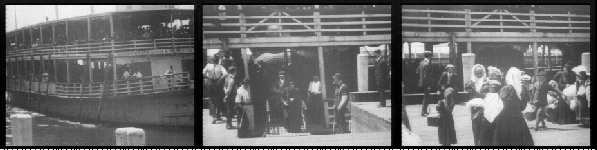
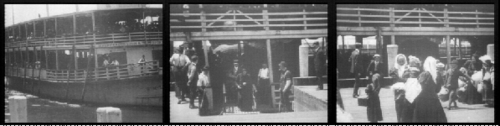
    Immigrants Arriving at Ellis Island 1903
    Nyc--ellis

    Here comes everyone, from everywhere, emerging from a ferry, delivering immigrants from Manhattan to Ellis Island, where the process of the beginning of the rest of the lives of all these people began.  Between 1892 and 1954 some 12.5 million people were processed into the U.S. through Ellis, and in the early days, say 1892-1920, most of them looked just like these folks–the grandparents and great-grandparents of a quarter of the country.

    From the LOC site:  “The film opens with a view of the steam ferryboat “William Myers,”
    laden with passengers, approaching a dock at the Ellis Island
    Immigration Station. The vessel is docked, the gangway is placed, and
    the immigrant passengers are seen coming up the gangway and onto the
    dock, where they cross in front of the camera.”
    ·Posted by :

    ·in:


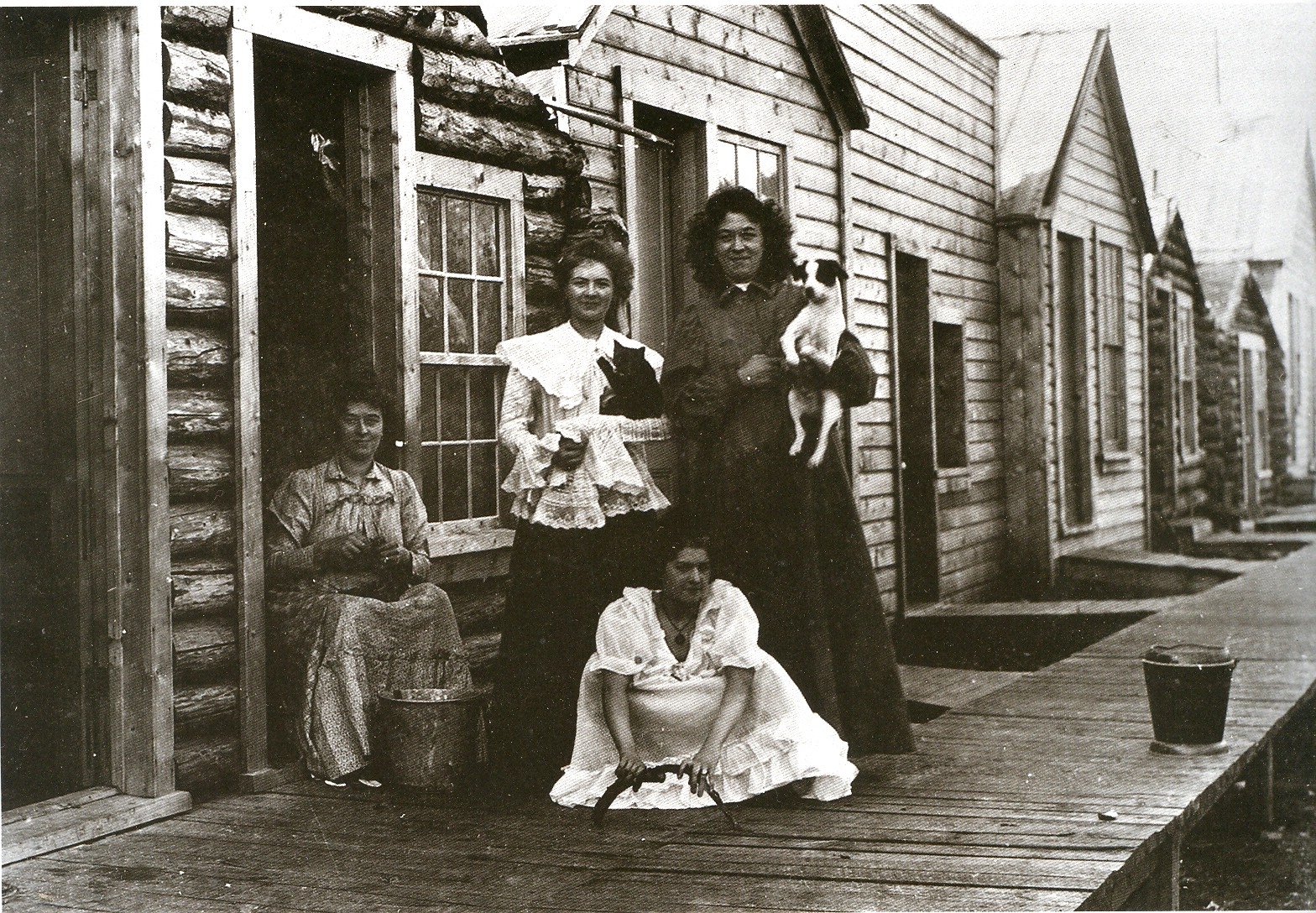
  • Paradise Alley: Slavery in Alaska, 1899

    JF Ptak Science Books LLC   Post 714   Blog Bookstore

    The Klondike Gold Rush, or the great Alaskan Gold Rush, took place at the very tail end of the 19th century (starting 1896/7) along the Klondike River near Dawson, Alaska.  It was a wild, woolly (literally) time, with communities of thousands springing up in just a few days–Klondike itself grew almost immediately to 40,000, stretching all human services, food being the scarcest commodity.

    One service to humans that was ably met was sexual, filled by legions of prostitutes, some of whom arrived in the Klondike of their own free will, and others, not.  This photo, made near Dawson, shows “Paradise Alley” (behind front street) an almost-overnight series of rough-hewn log bungalows sweatily constructed for lonely needs. There were evidently 70 of these little huts, all in a row, each with the woman’s name above the door, presumably rendered in chalk.  (It seems that the photos I’ve seen of women in the Klondike show many smiles, but no toothy ones.)

    ==blog==aug14==paradise alley

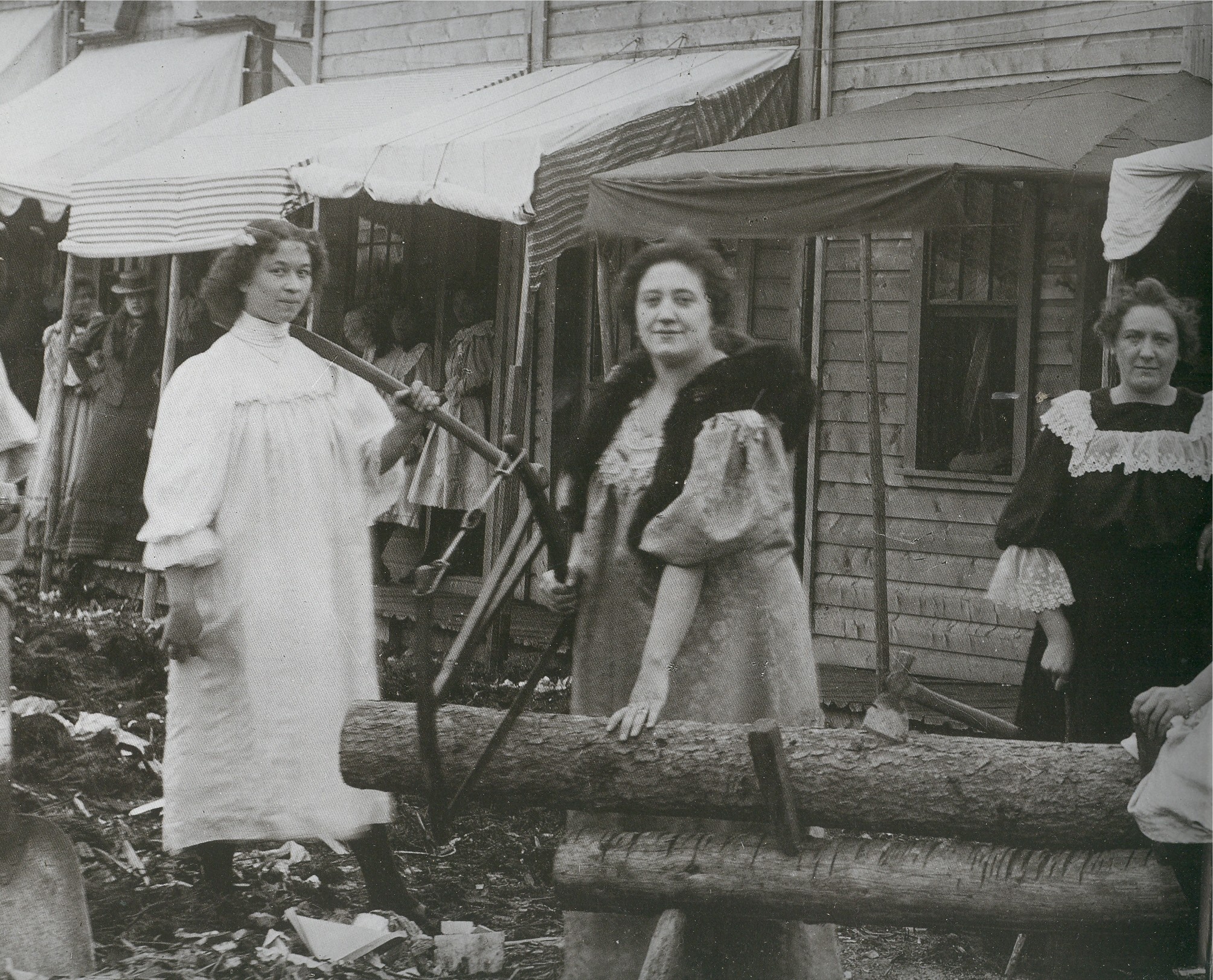
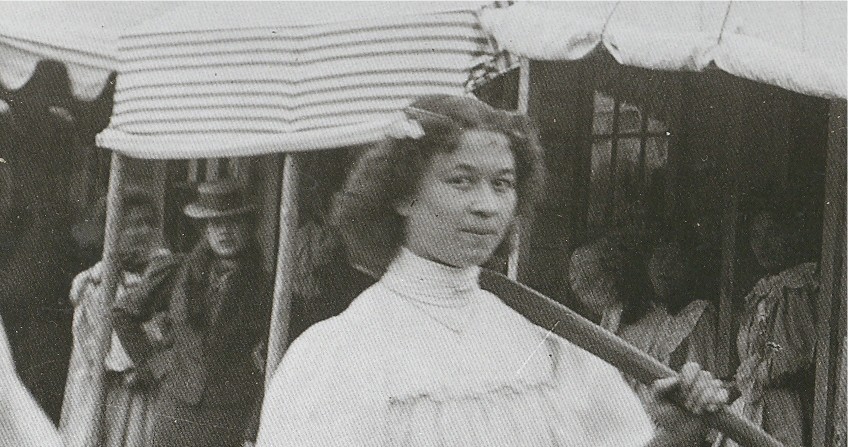
    This is a detail from a photo seen in Pierre Berton’s The Klondike Quest (a big, beautiful book of high rank for a popular history, interestingly published with a more shouty title in America as Klondike Fever) showing the working women of Dawson working at other trades.  I particularly like the picture of the high-collared white-dressed angel-woman witht he axe on her shoulder…and the woman behind her, under the make-shift cloth awning, her hat tiled forward and her hand jauntily on her relaxed hip.

    ==blog==aug14==paradise alley2

    Prostitution wasn’t legal, nor was gambling or the encyclopedia of con games that evolved here–but all certainly flourished, with many fortunes made outside the gold fields. Mr. Pantanges started his movie house empire here, and Donald Duck’s Uncle Scrooge started his pile of money bags, as did many other people.  But the 12.5 million ounces of gold wasn’t exxactly distributed with equality to the dozens of thousnds, and probably hundreds of thousnads of people who came to the Klondike looking for their fortunes.  I’m certain that in this vast game of winners and losers, there was moreof the later and less of the former. 

    ==blog==aug14==paradise alley3


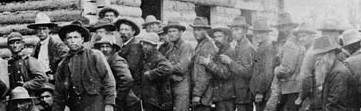
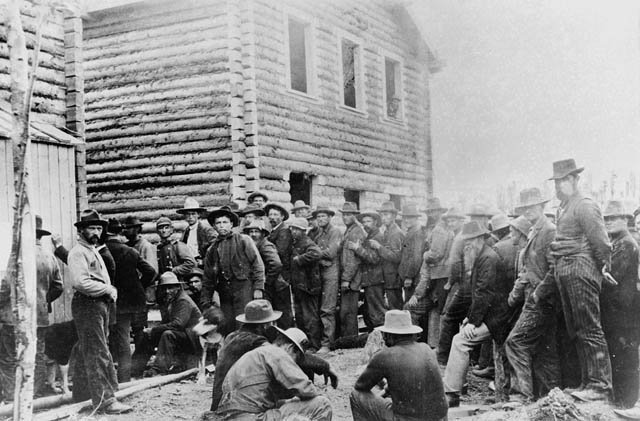
    This image of miners waiting to register their claims gives us a pretty decent idea of the clientelle available to these women.  Oy.  Seems to me an impossible way to live–for the women, that is.

    ==blog aug 14=miners waiting2

    ==blog aug 14=miners waiting                                                                                                                                                         


  • San Francisco, 1906: Pictures within Pictures. The Great Earthquake and Fire.

    JF Ptak Science Books Post 623  Blog Bookstore

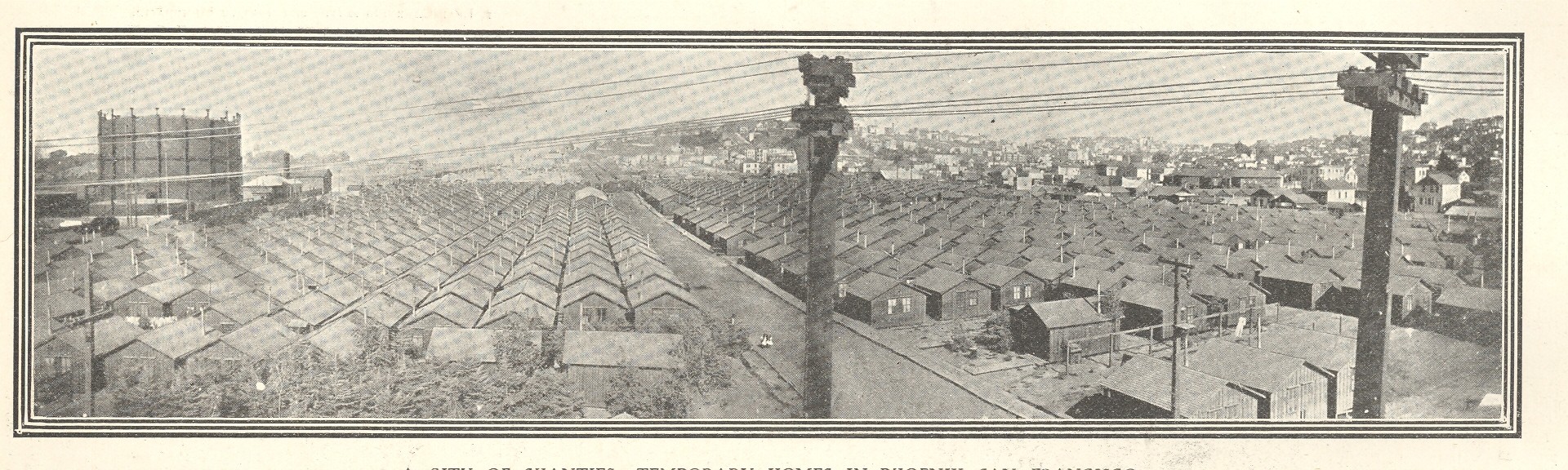
    The following two images were found in the Illustrated London News for 30 April 1906, and shows the “shanty town” built near the site of the major destruction in San Francisco following the earthquake of 18 April 1906.  Actually the tragedy is more appropriately called the “San Francisco Fire” of 1906, as the major destruction was caused by the raging fires set off by the earthquake.  The end result was 485 or so blocks of the city were destroyed leaving a quarter-million people homeless.  That this orderly development was referred to as a “shanty town” by a sniffy Brit reporter is appalling–unless of course the offending word meant something different 103 years ago.  It looks orderly and well-developed to me.  I also happened to notice two small girls in the detail–just about the only people in the picture.  They could still be alive….

    Blog--May 22--san fran

    Blog--May 22--san fran2

    Blog--May 22--san fran3


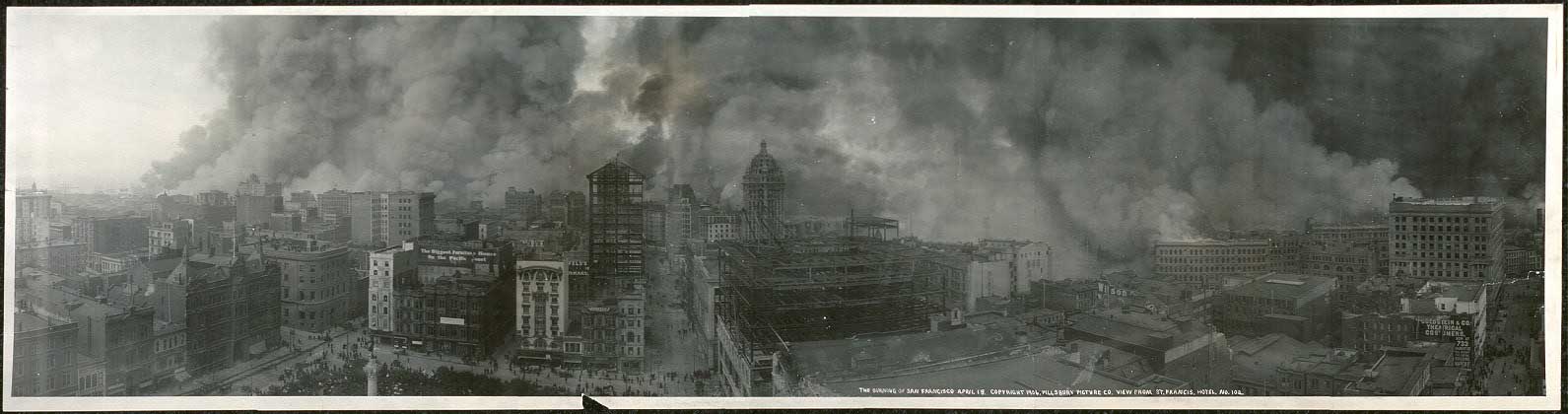
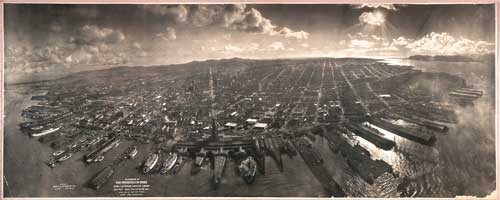
    The bottom two pictures were taken during the conflagration:  the first was the fire still raged, and the second was made days after the fire  from a  tethered balloon observation point. 

    I made myself 6-foot-long prints of these images; nearly every 2×2 inch area of the enlargement is a picture in itself.  These images are clickable and will expand if you click in the expanded version.  


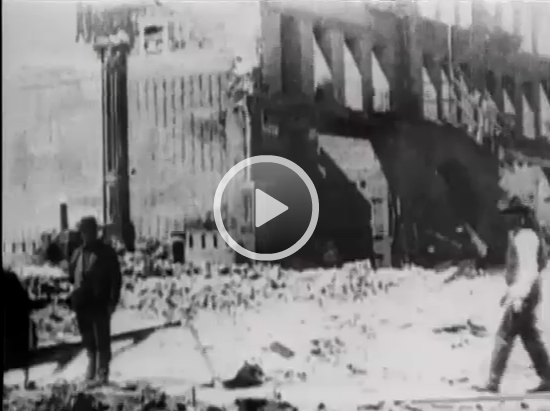
    For a contemporary film of the event via the Library of Congress, see here: http://loc.gov/item/00694425

    San Francisco film 1906 still

    SanfranciscoiburningT1

    SanFRansmallT2


    Panoramic images via the Library of Congress Prints and Photographs Division, see the following link for these and a number of others:  http://loc.gov/search/?in=&q=panorama+san+francisco+fire&new=true&st=

    A few eyewitness reports, from the Eyewitnesstohistory.com website: 

    “Of a sudden we had found ourselves staggering and reeling. It was as if the earth was slipping gently from under our feet. Then came the sickening swaying of the earth that threw us flat upon our faces. We struggled in the street. We could not get on our feet. Then it seemed as though my head were split with the roar that crashed into my ears. Big buildings were crumbling as one might crush a biscuit in one’s hand. Ahead of me a great cornice crushed a man as if he were a maggot – a laborer in overalls on his way to the Union Iron Works with a dinner pail on his arm.” (P. Barrett).

    “When the fire caught the Windsor Hotel at Fifth and Market Streets there were three men on the roof, and it was impossible to get them down. Rather than see the crazed men fall in with the roof and be roasted alive the military officer directed his men to shoot them, which they did in the presence of 5,000 people.” (Max Fast).

    “The most terrible thing I saw was the futile struggle of a policeman and others to rescue a man who was pinned down in burning wreckage. The helpless man watched it in silence till the fire began burning his feet. Then he screamed and begged to be killed. The policeman took his name and address and shot him through the head.” (Adolphus Busch).


  • Common Views of the Uncommon–Non-Combatant Photography in WWI

    JF Ptak Science Books LLC   Post 600    Blog Bookstore

    There are many histories of photography in wartime:  early images show cavalry standing at the
    ready, troops marching, piles of munitions, heaps of food; later on (as late as
    WWI) come actual scenes during the course of battle.  War photography changes forever beginning in
    the Spanish Civil War, and then of course WWII. 

    Korea, Vietnam,
    and then into the more recent past elevates the camera to being a third-person
    and fifth column.

    Blog april 29 trench Looking through the WWI years in the Illustrated
    London News
    I experienced a creeping realization of a different sort of
    perspective in war photography:  turning
    the camera to look behind the battle. 

    Turning the camera exactly around, away from the action, hasn’t a good
    history in itself.  There are some great
    examples:  when the Golden Spike was
    driven at Promontory Point in 1869 someone had the foresight to look the other
    way and make a photo—it shows a vast plain, a long double ribbon of rail, a
    long series of telephone poles receding into the horizon, and one man. It is
    also a scene that looks pretty much the same today, if you took away the small
    dedication center that is there.  That
    was the reality of the day, not all of those RR workers gathered around the two
    hot locomotives, the cleanest of them toasting each other and the camera. (If
    you look closely you can find some Chinese laborers in among the crowd and also
    occasional bits of Confederate uniforms.)  
    Elsewhere in this blog I told the story of Ed Clark, the LIFE
    magazine photographer who wheeled his camera away from where the hundreds of
    other cameras were recording the removal of Franklin Roosevelt’s casket from Hot Springs and made
    perhaps the greatest photograph of the FDR years. 

    But it is a different sort of turn-around that struck me for WWI.  These are the photographs of the liminal
    spaces after the fight, the clean up, the gathering of spent ammo, the cleaning
    of the clothing, the care of the soldiers, the rehabilitation. And I’m not talking
    about the Matthew Brady after-battle battlefield photograph style.  What I’m referring to is all of the “little”
    things that happen when the battles aren’t being fought and the troops weren’t
    on the move. There some images for thing that appeared in Harper’s Weekly and
    Frank Leslie and so on during the U.S. Civil War, but so far as I can tell the
    vast majority of them are drawings. 
    Having looked through popular illustrated magazines that covered the
    Franco-Prussian War, the Spanish American War and all of the conflicts
    in-between, I just don’t have much of a sense at all that this life was
    recorded very well photographically.

    I can understand this—there’s not that mBlog april 29 trench 2uch glory in sandbagging Red Cross
    stations, or hauling away dead horses by the thousands, or cooking thousands of
    loaves of bread in primitive conditions; they certainly aren’t a good case for
    a hearts-and-minds campaign.  The camera
    has enough power to go ‘round, giving and taking, usually at the same
    time. 

    But to my brain these photographs really come into being in the second half
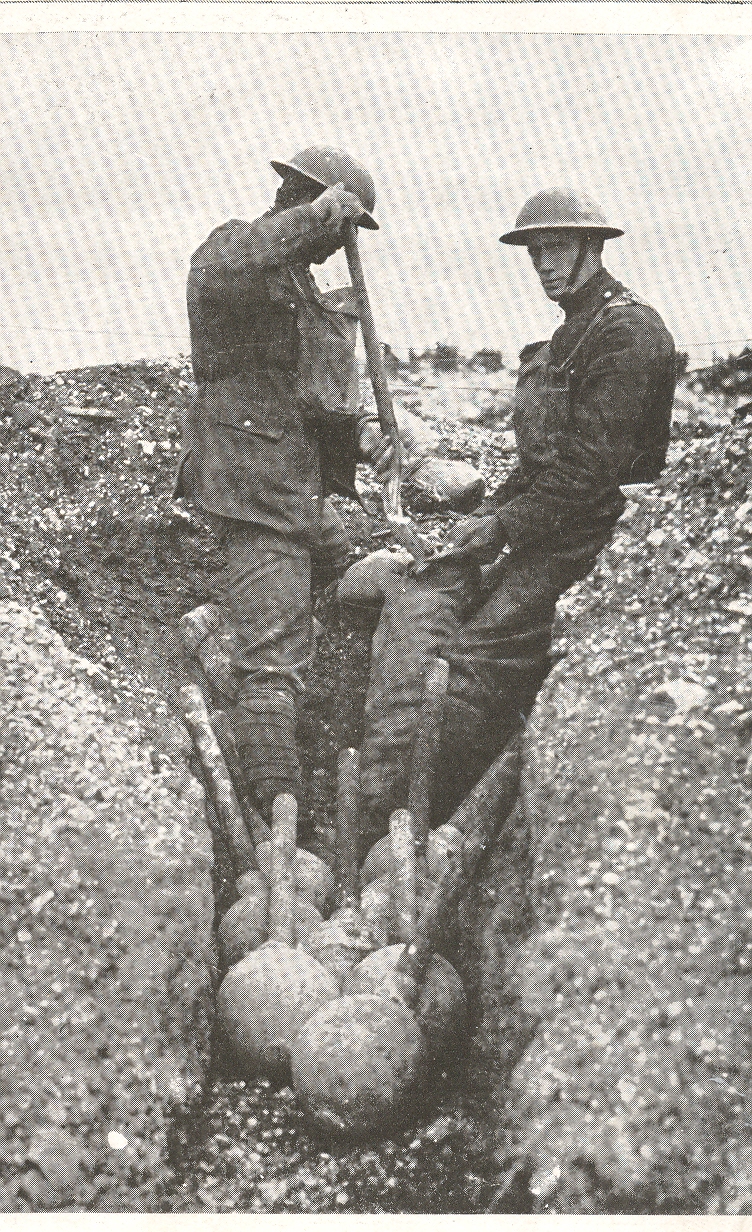
    of WWI., and they tell an other, integral, more human story of that same war.  The first image (above) shows two soldiers
    cleaning up cartridge cases after a fight—when you look closely at the photo
    you see that the place is littered with those cases.  I suspect that there were hundreds of
    millions of these cases ejected from rifles. 
    Billions, probably.  I wonder how
    long it would take a thousand soldiers to shovel a billion shells into canvas
    bags?  The picture reveals a very deep
    image of the ways of war at the most basic level. Blog april 29 trench 3

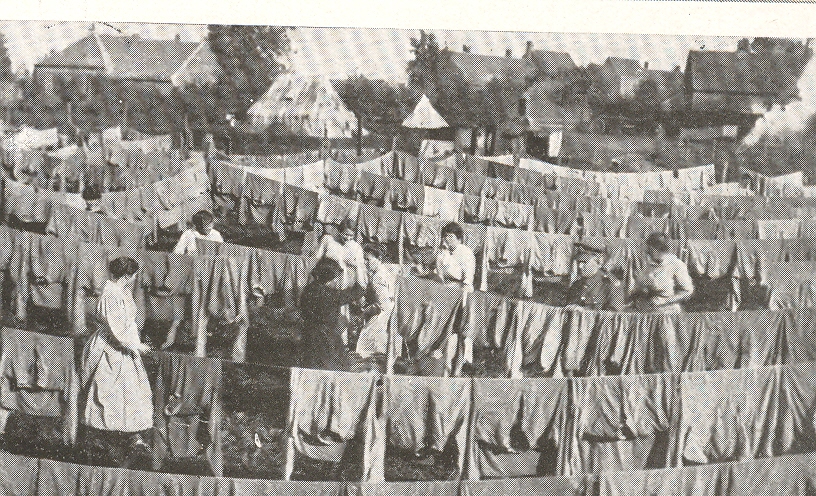
    The next photo is a “simple” image of clothing out for a dry—except of
    course that the clothing lines go on and on, railroad tracks into the sun,
    tended by hundreds of women, getting the shirts ready for the “men in the trenches”,  many of whom won’t need those shirts by the
    end of the month. 

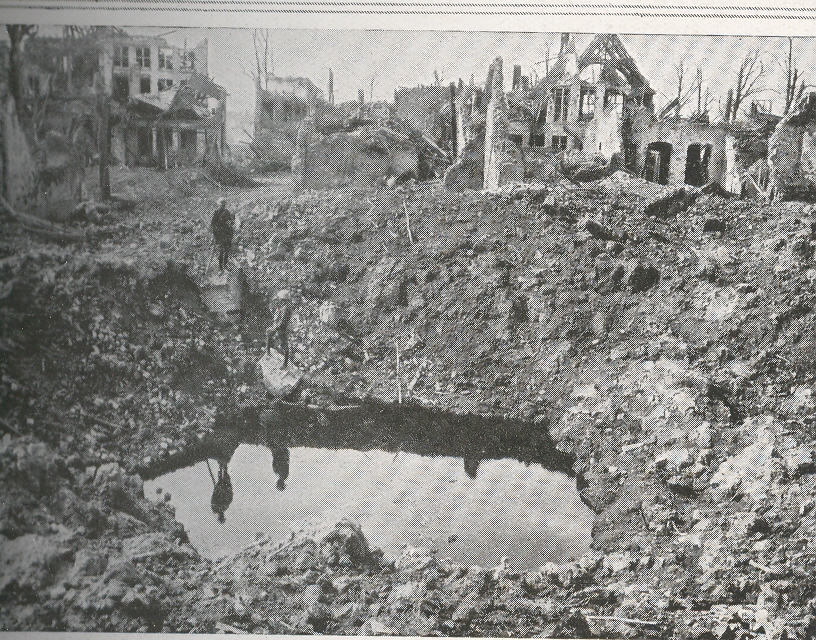
    Many of these men and women wound up being consumed–this photo at right shows one of the ways how that happened. It is an extraordinary crater some 75 yards in circumference created by a massive shell.  It is a massive image–brutal, lonely, and speaking the quiet of the end.  And it was a different sort of image that people were used to seeing in war reporting. 

    These three photos appeared on only three successive pages of the 15 October 1917 issue of the Illustrated London News.

    ·Posted by :

    ·in:

    —

  • History of Dots 7: Dots versus Lines, Engravings versus Half-tones

    JF Ptak Science Books LLC  Post 558

    Engraving_example
    The history of illustration has some distinct phases:  from woodcut to wood engraving to engravings on metal to lithography to printing in colors to chromolithography…and then on to a process that would begin to do away with all of those processes, the half-tone.  This was a process whose foundation was laid in the 1850’s by William Fox Talbot and brought to life in 1873 by Stephen Henry Horgan, though  it really wasn’t commercially viable until  Frederick Ives  further deepened the process in 1881, finally becoming a staple in the printing industry in the mid 1890’s.  The half-tone process would basically due away with the line-centric engraving process, as it was much quicker and easier to use, making images much more readily available to daily-printed media like newspapers.  Images that were drawn could be rendered without being engraved; also, one of its greatest advantages was being able to reproduce photographs, which was an enormous breakthrough, as a photograph automatically increased the veracity of the image. (During the U.S. Civil War, reader’s of the illustrated

    Stieglitz-gossip-1905

    weekly journal Harper’s Weekly trusted battlefield images more if the wood engraving appearing in the magazine was copied from a photograph rather than being from the sketchbook of the

    correspondent on the scene.  The photograph would capture a particular point in time (nearly) instantaneously, whereas the war correspondent artist captured bits and pieces of an instant flavored with memory and subsequent action.  The phrase in the credit line. “Drawn from a photograph”, had real value.)

    MorseCodeForever
    And so it came to pass that the happy lives of dots and lines–so important and intertwined in such things as the Morse Code–made a particular and dramatic break with the triumph of the half-tone over the engraving in illustrating popular publications (from the 1890’s to the 1980’s). 

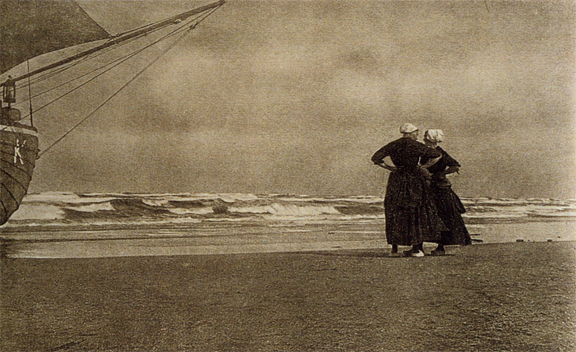
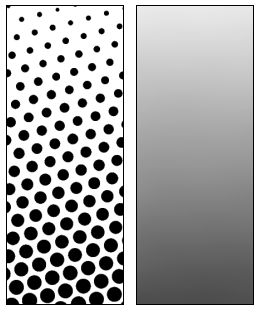
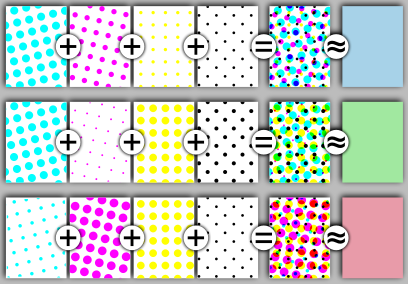
    The image above at left is a magnification of an engraving from 1760;above right is a half-tone image of a 1905 Alfred Stieglitz photo; below left is a magnified sample of what the Stieglitz was composed of; and bottom right finds an illustration of the different combinations in size and color that would effect the composed final image in the final column. 

    Halftoning_introduction

    408px-Halftoningcolor.svg


  • Portraits within Portraits: Found sub-Images in WWI Photography

    JF Ptak Science Books LLC

    0 blog jan 12baker374

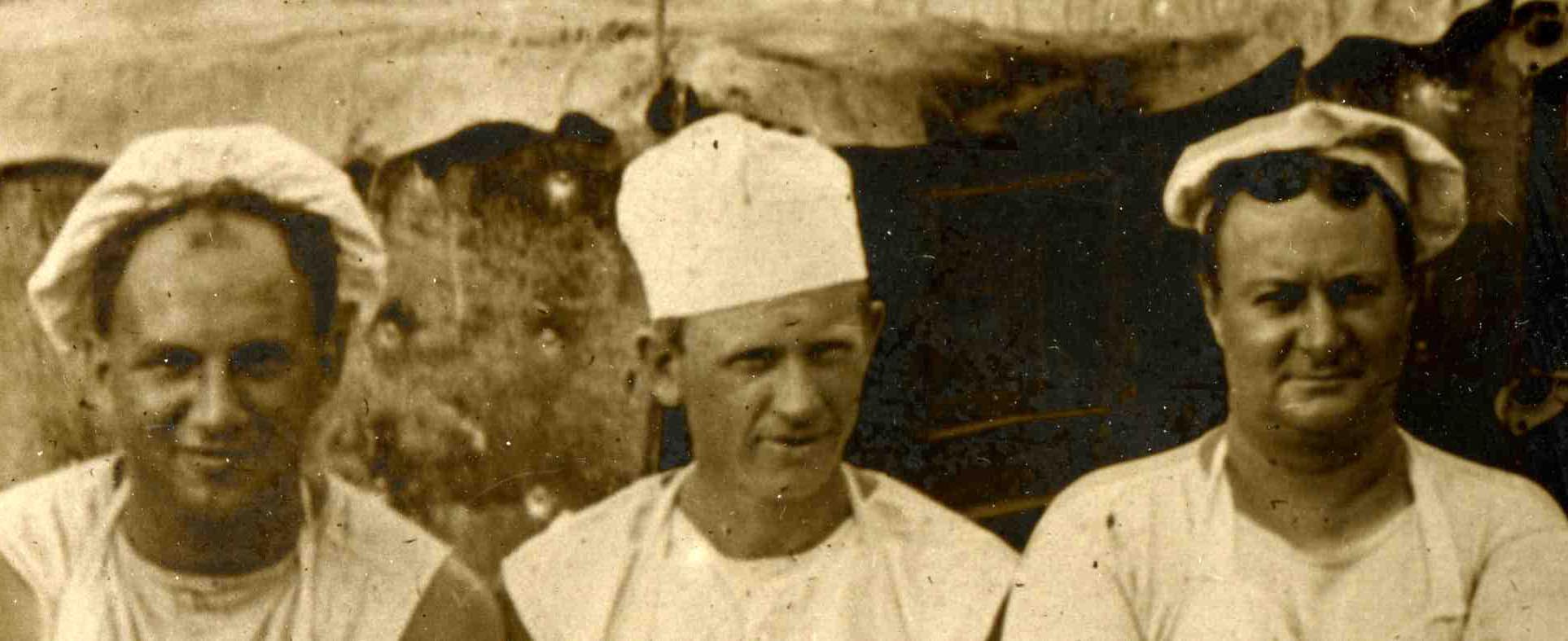
    In my collection of WWI News Photo Service Agency photographs I would say that half or so of them show  scenes like this–semi-informal group portraits of military support groups.  500 portraits like this seem to be a lot, and I’m not sure why these images are so well represented. Except of course that there weren’t that many images (overall) of active-battle scenes. 

    These bakers, working at a front-line support station, from my read were probably taking a break, and the photographer took the opportunity to draw them together for the portrait.  I don’t know why they’re separated so, but they do look as though they have a real camaraderie–it is just a wonderful picture, full of friendship and loyalty, and I’m sure it has never been published before.  

    0 blog jan 12baker375

    0 blog jan 12baker376


  • Looking Deeply at Group Portraits from World War I

    JF Ptak Science Books LLC Post 467

    0 blog jan 12baker377

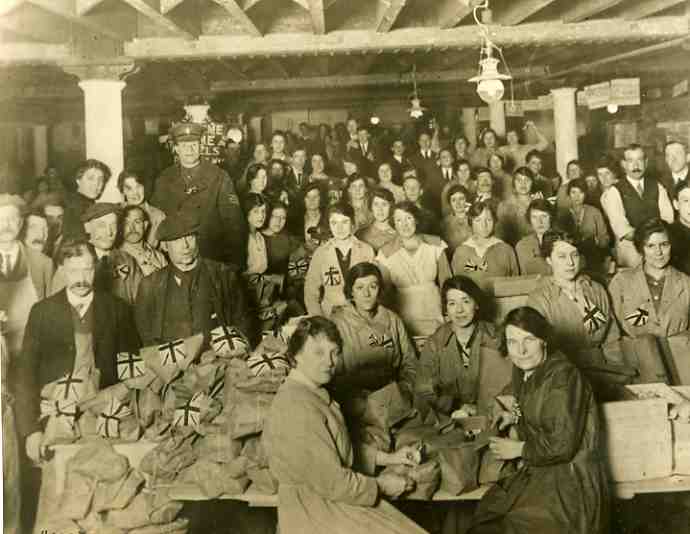
    This is another magnificent group portrait from my collection of News Service Photographs from World War I.  This is image is from mid-1918 and depicts nurses, wounded and recovering soldiers and an assortment of volunteers preparing relief packages for other wounded soldiers in filed hospitals.  My experience with these images is that are many levels of portraits within the larger group portrait–looking at them under magnification is an addictive process, and quite often there are some lovely surprises. 
    0 blog jan 12baker379

    0 blog jan 12baker378


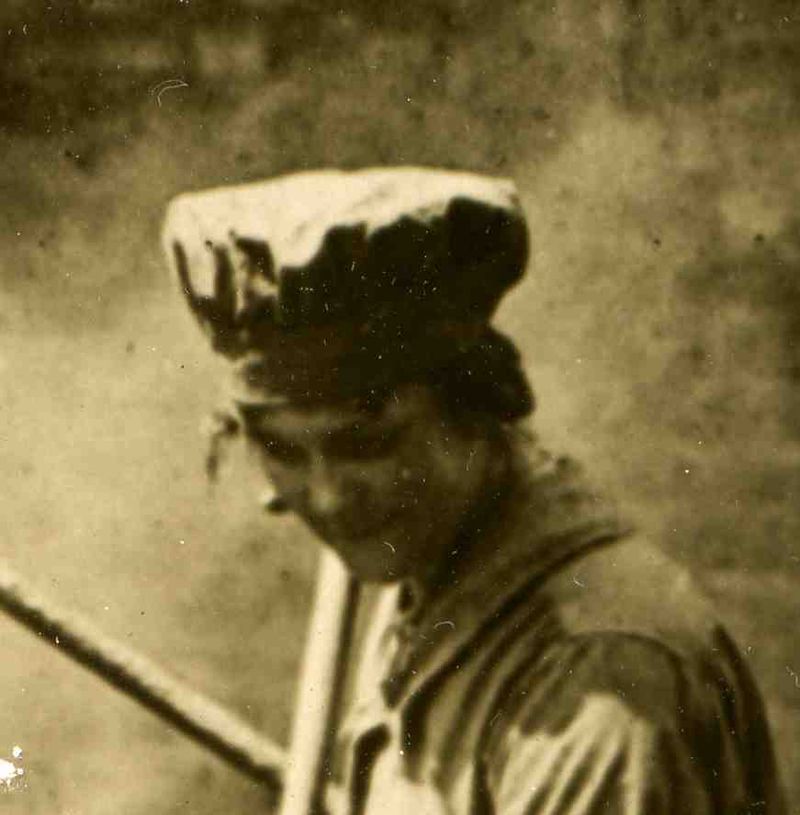
  • Women in the War Effort: London, 1918

    JF Ptak Science Books LLC  Post 465
    0 blog jan 10 brit women strt371

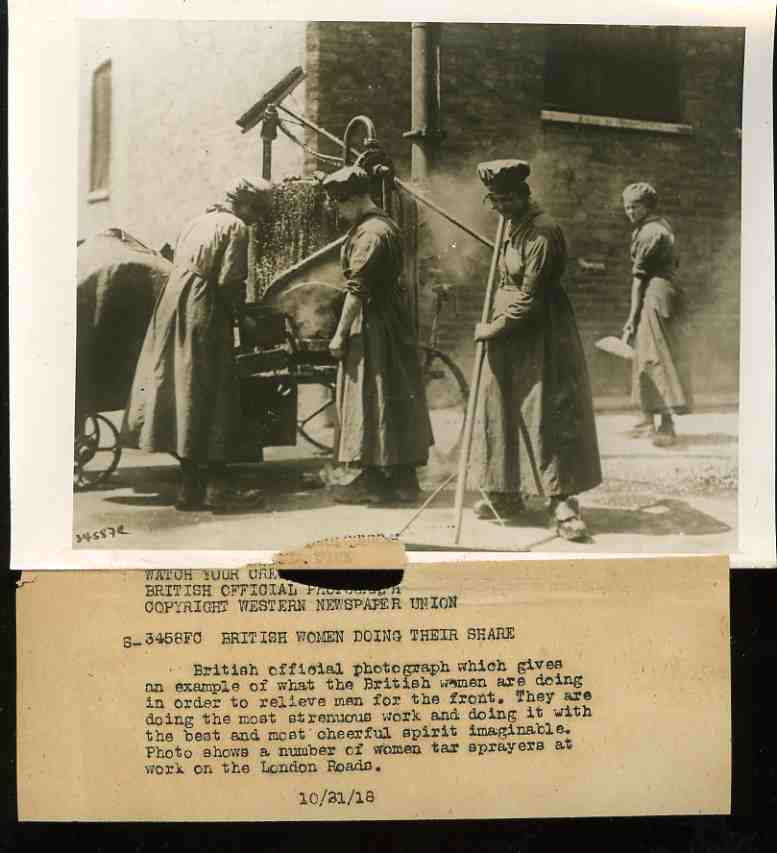
    In England,
    women were welcomed to the (paid) workforce during the years of the First World
    War (1914-1918)—their employment in traditionally male positions enabled those
    they replaced to go out to the front and die for their country.  Thus the women seen here in the News Photo
    Service Agency photograph (taken in 1918), working at spraying tar in the
    streets of London,
    were appreciated, and tolerated.  For
    women in England the War
    blasted away the contrivances of formally scheduled employment:  something like 12% of fall women in England were
    working as servants and house cleaners.  
    Come the War, women were offered jobs of revolutionary stature in a wide
    range and variety of work.  The Civil
    Service employment for women went from 33,000 in 1911 to 102,000 in 1921, and trade
    union membership rose 160% (357,000 in 1914 to 1,000,000 in 1918 (with men
    showing a 44% increase at the same time); for the most part, though, employers
    took advantage of the situation, and the women still generally earned less than
    half of the salary as comparable male workers did (or the men they
    replaced). 

    0 blog jan 10 brit women strt372

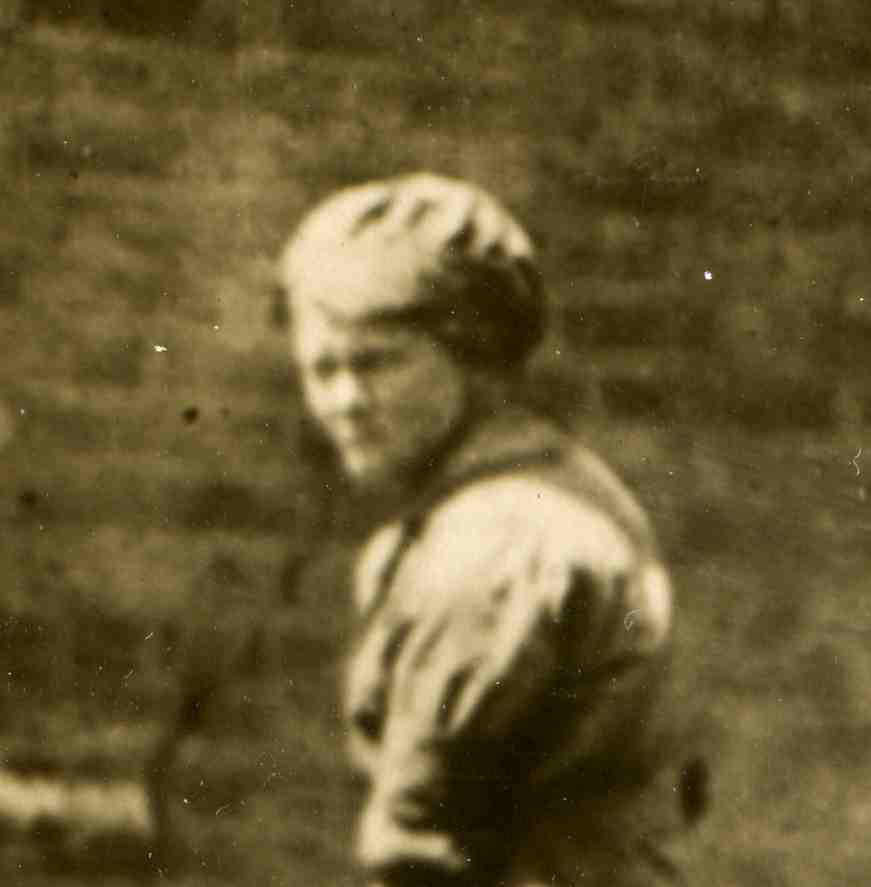
    When the end of the War came,
    so did the appreciation for the women replacement workers—there was bitter feelings
    in the post-war period because of the weak British economy and a scarcity of
    jobs.  So the women who took the jobs of men
    to help the country’s war effort and free up hundreds of thousands of men for
    war service became an atavistic action, “taking” the jobs of men who had gone
    out to fight for their country. This of course cost many women their jobs, but
    the damage had already been deeply done to the pre-1914 British world of the
    sexual politics of business-being-done, though it would take World war Ii to
    really ingrain the appearance of women in the workforce into the national
    psyche.

    (Madonna of the tars, right)

    0 blog jan 10 brit women strt373