A Daily History of Holes, Dots, Lines, Science, History, Math, Physics, Art, the Unintentional Absurd, Architecture, Maps, Data Visualization, Blank and Missing Things, and so on. |1.6 million words, 7500 images, 4.9 million hits| Press & appearances in The Times, Le Figaro, Mensa, The Economist, The Guardian, Discovery News, Slate, Le Monde, Sci American Blogs, Le Pont, and many other places… 5000+ total posts since 2008.

Category: Militaria

  • A Shadow for a Mask–the Pivot Person in the Execuiton of the Lincoln Conspirators

    JF Ptak Science Books   Post 1166

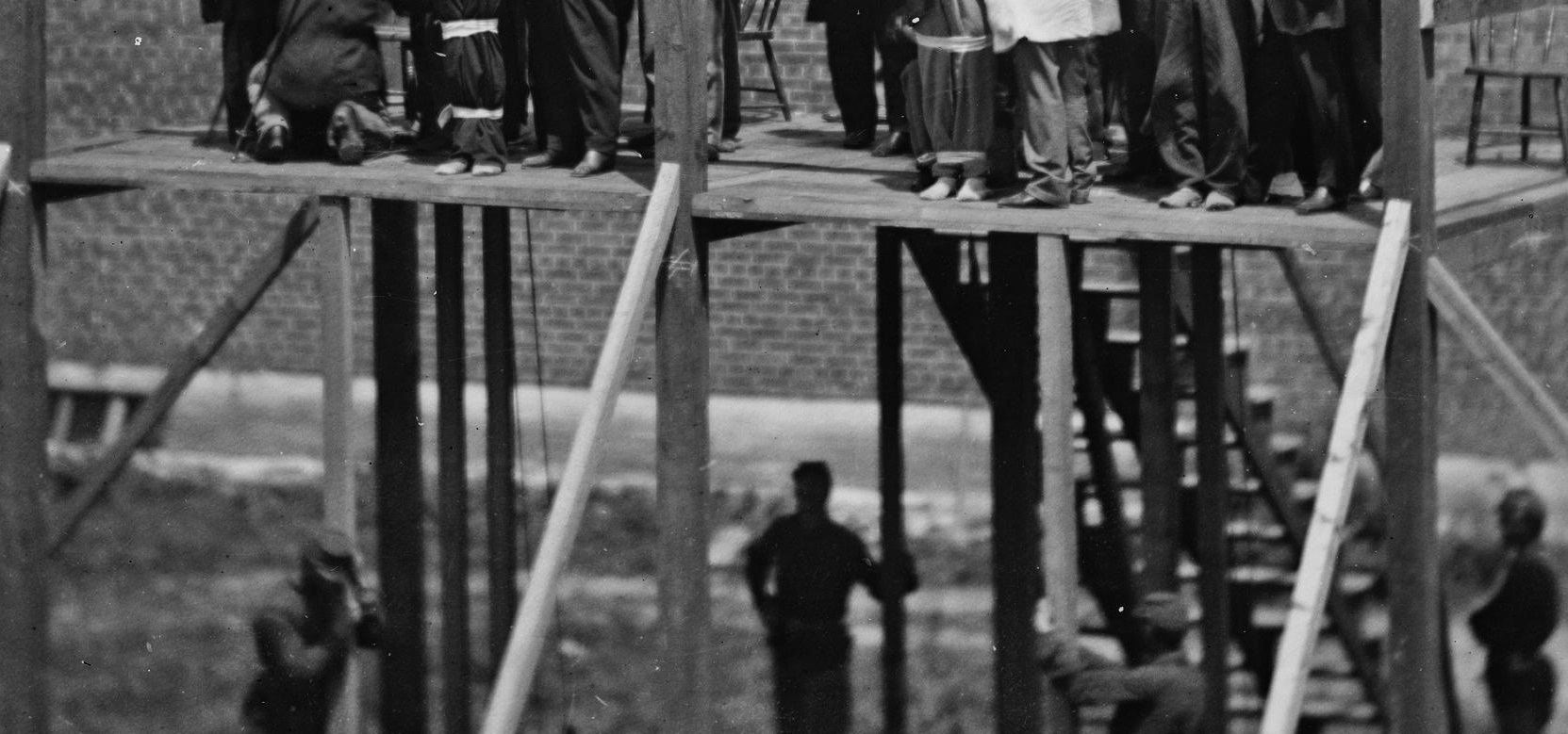
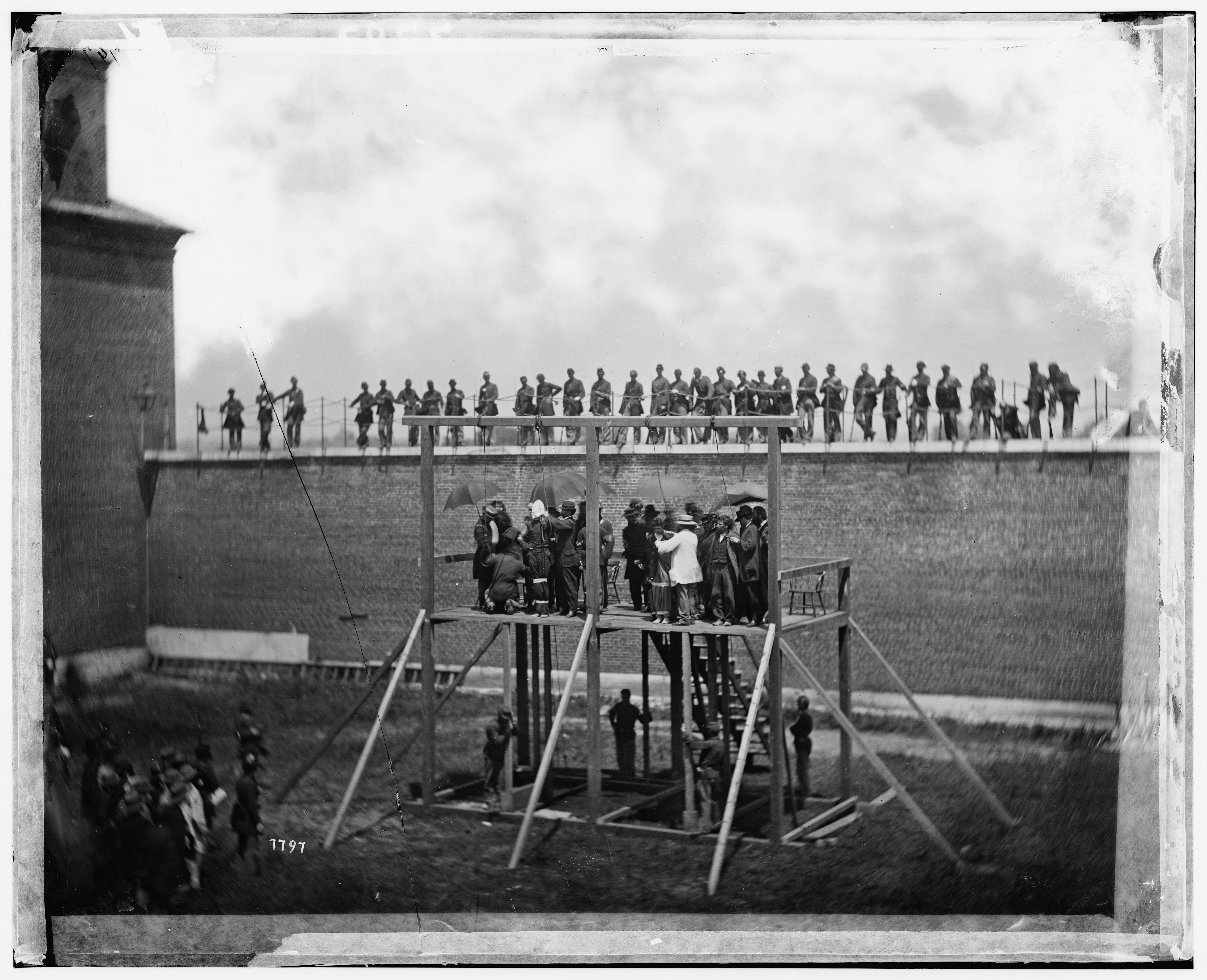
    On a hot 7 July, 1865, photographer Matthew Brady was the only photographer present at the old Washington Penitentiary to make images of the execution of the Lincoln assassination conspirators  Mary Surratt, Lewis Powell, George Atzerodt and  David Herold.  All of these stories of the assassination are best told elsewhere–in many other elsewheres, a story that is legion–but I can’t seem to find anything about one special, particular  person captured in two of the series of these photos.

    Lincoln conspirators

    If you look closely at the first photograph, there is a man leaning against a pole that is directly under the first condemned conspirator, Mary Surratt.  That pole, a substantial 6x6x10′ or something like that, is the only thing that is holding the trapdoor closed on which Surratt stands.  Actually, I think that two conspirators occupy one trapdoor–there is a second pole just to the right, another man standing nearby.

    Lincoln conspirators detail

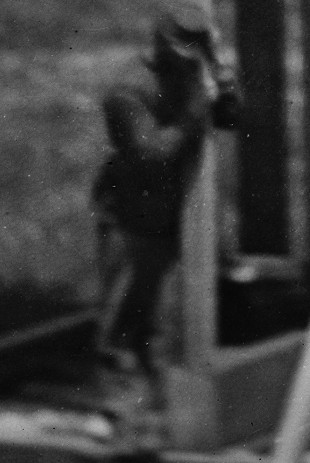
    I guess the execution was at high noon.  The shadows seem to be falling straight down, our man–standing just out of the reach of the shadow of the gallows–has his face obscured by the shadow of the brim of his cap. Like a mask.

    Gardner execution detail man pole jpg 

    What was that first man doing, exactly?  He seems to be in a  nonchalant attitude, given his position and circumstance, as well as the crowds and significance of the event. Why was he leaning on the pole?  Was this just the last part of a long morning?  Was the pole not terribly secure? Was he bored?  Was he overcome?

     He was surrounded on all sides, and he was hearing the boots-on-wood above him, the conversations in the preparations of the nooses, the shuffling of the shackled feet of the condemned, and perhaps the last words of the people waiting now for the last noose to be fitted over the last man.  At that point, an order would be given, and our man–who was now positioned behind the gibbet–would simply push another long pole against the bottom of the supporting pole, dislodging it, and allowing the trapdoor to open, the conspirators dropping to their deaths with broken necks. Or I hope for their sake that their necks were broken–by the looks of the position of one of the nooses, its in a bad spot so far as assuring a quick death is concerned.  Maybe the noose’s position was changed after this picture was made  Maybe not.  What did our man do after pushing the beam out of position?  He would’ve been very close to the action, within a few feet.

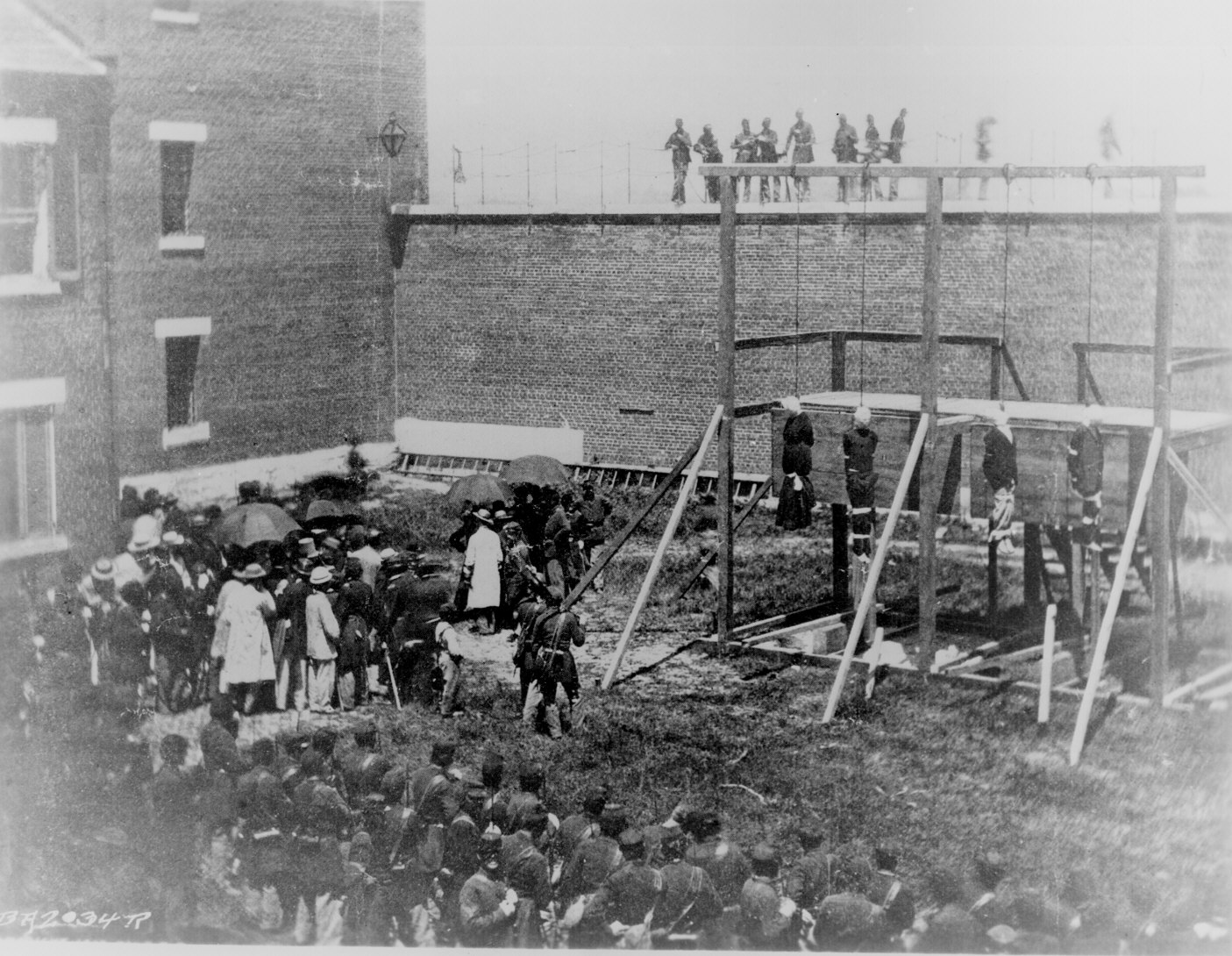
    I wonder what the trapdoor pole pushers do afterwards?  What were their jobs?  From the looks of the last picture, someone put the beams in order, placing them alongside the execution structured, tidied up. 

    Where did the man go?  Since they were the few folks right at the base of the scaffold, right there where the mandrake were supposed to grow, did these men wind up with th job of cutting the bodies free from their ropes and burying them?  Someone did it. I wonder what that someone thought as they returned home, or to the barracks, and st down to dinner.  What did they see in their dinner plate?

    Civil-war-201

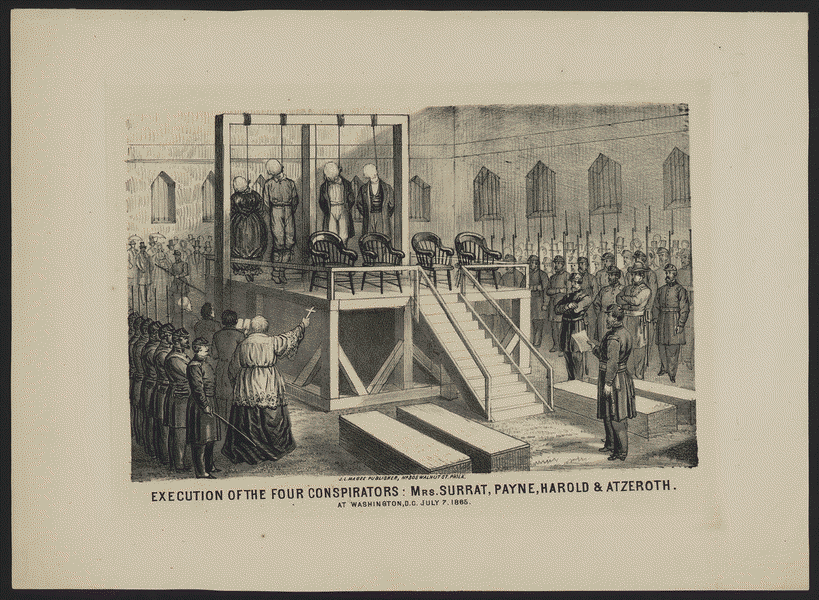
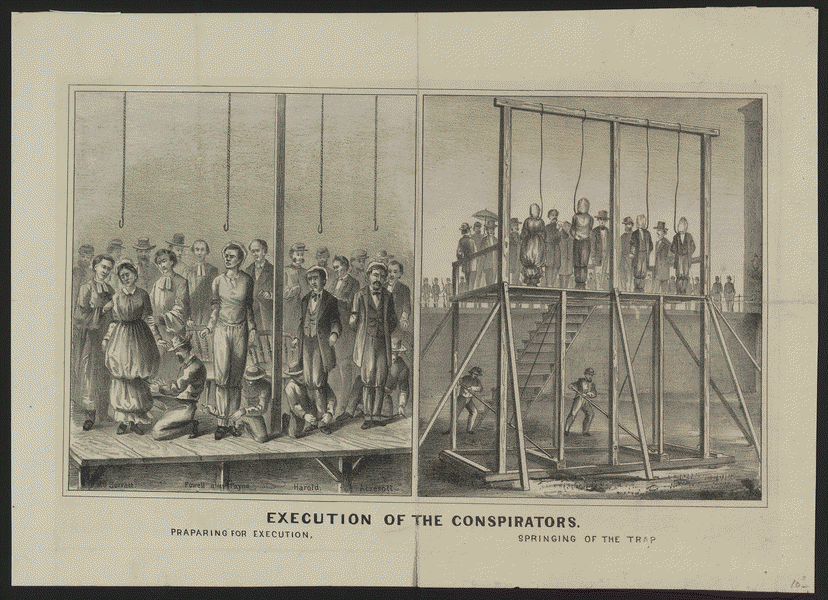
     This contemporary print of the scene gets little correct, though the chairs for the conspirators are about right.  The scaffolding is much nicer than in the original, and the place looks certainly far less austere than the penitentiary. The awful thing here is the actual, physical manner of the hanging–the attitudes depicted here  would have been even more bestial,  the lack of a trapdoor suggesting that the were all dropped or raised a few inches and basically strangled to death.  Also in the real scene of the execution there were four coffins for the condemned nearby–except that three of them were piled one on top of the other.  I’m not sure why they were stacked. It seems to me that they were within the visual range of the conspirators.

    Lincoln conspirators

    The next contemporary print gets a little more of the reality of the scene correct, both mechanically and emotionally, and shows how our own character of interest did his job. The actual hanging part–the ropes and the nooses–is again wrong, suggesting strangling more than hanging.

    Lincoln execution 2

    The pictures raise far more questions to me than anything else, as witnessed by my personal record use of the question mark in this post. . 

    [Sources: photographs courtesy of the U.S. National Archives; prints, courtesy of the Stern Collection, U.S. Library of Congress.]


    ·Posted by :

    ·in:

    —

  • WWII Aircraft Cross Sections–Spitfire, Hurricane, Beaufighter, Lancaster (!) and Stirling.

    JF Ptak Science Books    Post 1165

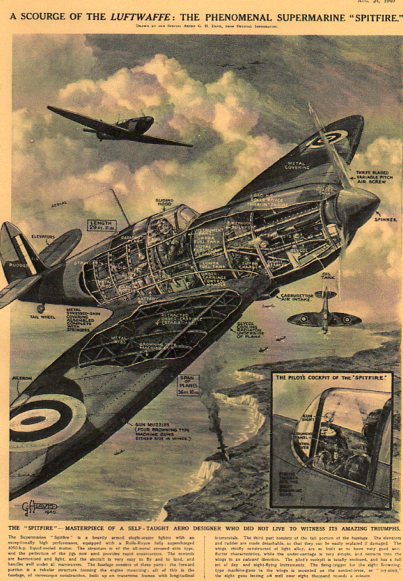
    Here are some fabulous examples of technological cross sections from the collection here–this part concenrtrating on some of the British WWII aricraft.  The drawings are just superb, and you can easily get lost in them, following the geogrpahy of engineering detail from one logical place to the next. All of these images were published in The Illustrated London News and appeared 1940-1943.

    X-Sect  SPitfire507

    And the detail (sorry for that–the originals are much larger than the scanning bed would allow…)


  • Food and Not Having It: Visual Displays of Data, Britain and Germany, 1918

    JF Ptak Science Books    Post 1157

    00-blog--Oct 29 starvation germany953
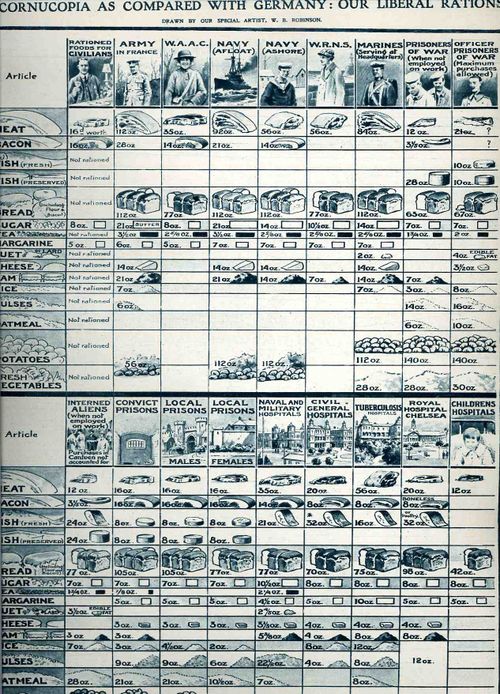
    The idea behind these three images was part of a hearts-and-minds home-front propaganda campaign by the British government to instill fortitude and a feeling of general good in the population, trying to get the message across that British citizens were far better off (in regards to food and staples at least) than their German counterparts.  Even though the situation wasn’t exactly standard in Great Britain in the last year of the First World War, the situation was far more dire in Germany–there was after all an embargo against ships going into Germany or its allies, making it a very difficult to receive food, whereas that problem did not exist in Britain, which pretty much controlled the seas at that point, and could therefore receive food and other material from the Colonies and allies.

    The first graphical display, appearing in The Illustrated London News on June 12, 1918 (and just four months from the end of the War), showed the “ample weekly rations for various classes of the population”.  18 classes, actually, that were enjoying more food than the Germans, the “U-Boat having failed to starve” them. In all of this what comes to my attention first are the allowances for male/female prisoners in England; each getting similar amounts of meat, bacon fish, margarine and fresh vegetables, though for some reason the women are given lesser shares of bread, rice and oatmeal.  The other bit is that the food allotted to the “childrens hospital” is less by far in all categories than everything else.  I’m hoping that this is due to size and consumption differences more than anything else.  I also notice that the officer prisoners of war are given more rations than the enlisted POWs.  Interned aliens are also given short rations, except for fish (Fresh and preserved)  and potatoes, when they get substantially more than anyone else. 

    Unfortunately we do not see what the Germans had to eat, though in the next graphic (same source, though 23 March 1918) we see the “ingenious” ways in which the German people got around not having certain foodstuffs.  The means look more desperate than anything else: meat/sausage for example is replaced by “War Sausage”, which was coagulated ox blood bleached with peroxide, and also by a “vegetable” meat, which was dyed glucose.                                                                                                                          

    00-blog-Oct 27 foes food part II937

    00-blog-Oct 27 ill fed foes 1918935


  • On the End of WWII, 14 August 1945

    JF Ptak Science Books  Post 1102

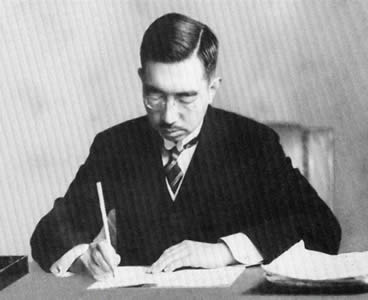
    One thing that 14 August means is that millions of people weren’t killed in any extension of WWII in 1946.  That’s probably what the Devil’s bill would’ve been had operations Olympic and Coronet (the Allied invasion plans for the outer Japanese islands and then the main island of Honshu) been carried out.  The 14th of August was just a few months after the horrendous battles at Okinawa (where the inevitable Japanese loss resulted in the surrender of only 7,000 of the 77,000 Japanese troops there) and Iwo Jima (a part of the Japanese home islands, 65 0 miles from Tokyo, where only 218 of 18,000 soldiers were taken prisoner). It was two months out from the no-holds-barred firebombing of Tokyo and just a week after Hiroshima, which managed to still not secure a surrender message from the Japanese government.  It still took a few days after the Nagasaki bombing for the Emperor to step in and finally insist on the unthinkable, and surrender. 
    Hirohito
    Defeating your enemy doesn’t mean that they’ve stopped fighting, or surrendered. On 10 August there were still 2 million soldiers stationed in Japan, plus another 4 million “reservists”, as well as a general population which was being told how to resist to the last.  

    14 August 1945 was the end of the war in the Pacific and the end of World War II, and not just another day in the beginning of a potentially long and very deadly endgame to conclude a won war. 

    Notes:
                                   
    The Emperor’s Statement of Surrender

    (I’m still not sure what he meant when equating the surrender of Japan with saving humanity:
    Moreover, the enemy has begun to employ a new and most cruel bomb, the power of which to damage is indeed incalculable, taking the toll of many innocent lives. Should We continue to fight, it would not only result in an ultimate collapse and obliteration of the Japanese nation, but also it would lead to the total extinction of human civilization.)

    “To Our good and loyal subjects: After pondering deeply the general trends of the world and the actual conditions obtaining to Our Empire today, We have decided to effect a settlement of the present situation by resorting to an extraordinary measure.

    “We have ordered Our Government to communicate to the Governments of the United States, Great Britain, China and the Soviet Union that Our Empire accepts the provisions of their Joint Declaration.

    “To strive for the common prosperity and happiness of all nations as well as the security and well-being of Our Subjects is the solemn obligation which has been handed down by Our Imperial Ancestors, and which we lay close to heart. Indeed, We declared war on America and Britain out of Our sincere desire to ensure Japan’s self-preservation and the stabilization of East Asia, it being far from Our thought either to infringe upon the sovereignty of other nations or to embark upon territorial aggrandisement. But now the war has lasted for nearly four years. Despite the best that has been done by everyone — the gallant fighting of the military and naval forces, the diligence and assiduity of Our servants of the State and the devoted service of Our one hundred million people, the war situation has developed not necessarily to Japan’s advantage, while the general trends of the world have all turned against her interest. Moreover, the enemy has begun to employ a new and most cruel bomb, the power of which to damage is indeed incalculable, taking the toll of many innocent lives. Should We continue to fight, it would not only result in an ultimate collapse and obliteration of the Japanese nation, but also it would lead to the total extinction of human civilization. Such being the case, how are We to save the millions of Our subjects; or to atone Ourselves before the hallowed spirits of Our Imperial Ancestors? This is the reason why We have ordered the Acceptance of the provisions of the Joint Declaration of the Powers.

    “We cannot but express the deepest sense of regret to our Allied nations of East Asia, who have consistently co-operated with the Empire towards the emancipation of East Asia. The thought of those officers and men as well as others who have fallen in the fields of battle, those who died at their posts of duty, or those who met with untimely death and all their bereaved families, pains Our heart day and night. The welfare of the wounded and the war sufferers, and of those who have lost their homes and livelihood, are the objects of Our profound solicitude. The hardships and sufferings to which Our nation is to be subjected hereafter will certainly be great. We are keenly aware of the inmost feelings of all ye, Our subjects. However, it is according to the dictate of time and fate that We have resolved to pave the way for a grand peace for all the generations to come by enduring the unendurable and suffering what is insufferable.

    “Having been able to safeguard and maintain the structure of the Imperial State, We are always with ye, Our good and loyal subjects, relying upon your sincerity and integrity. Beware most strictly of any outbursts of emotion which may engender needless complications, or any fraternal contention and strife which may create confusion, lead ye astray and cause ye to lose the confidence of the world. Let the entire nation continue as one family from generation to generation, ever firm in its faith of the imperishableness of its divine land, and mindful of its heavy responsibilities, and the long road before it. Unite your total strength to be devoted to the construction for the future. Cultivate the ways of rectitude; foster nobility of spirit; and work with resolution so as ye may enhance the innate glory of the Imperial State and keep pace with the progress of the world.”

    ·Posted by :

    ·in:


  • Soldier’s Graves for Nurses Killed in Action, 1918

    JF Ptak Science Books   Post 1100

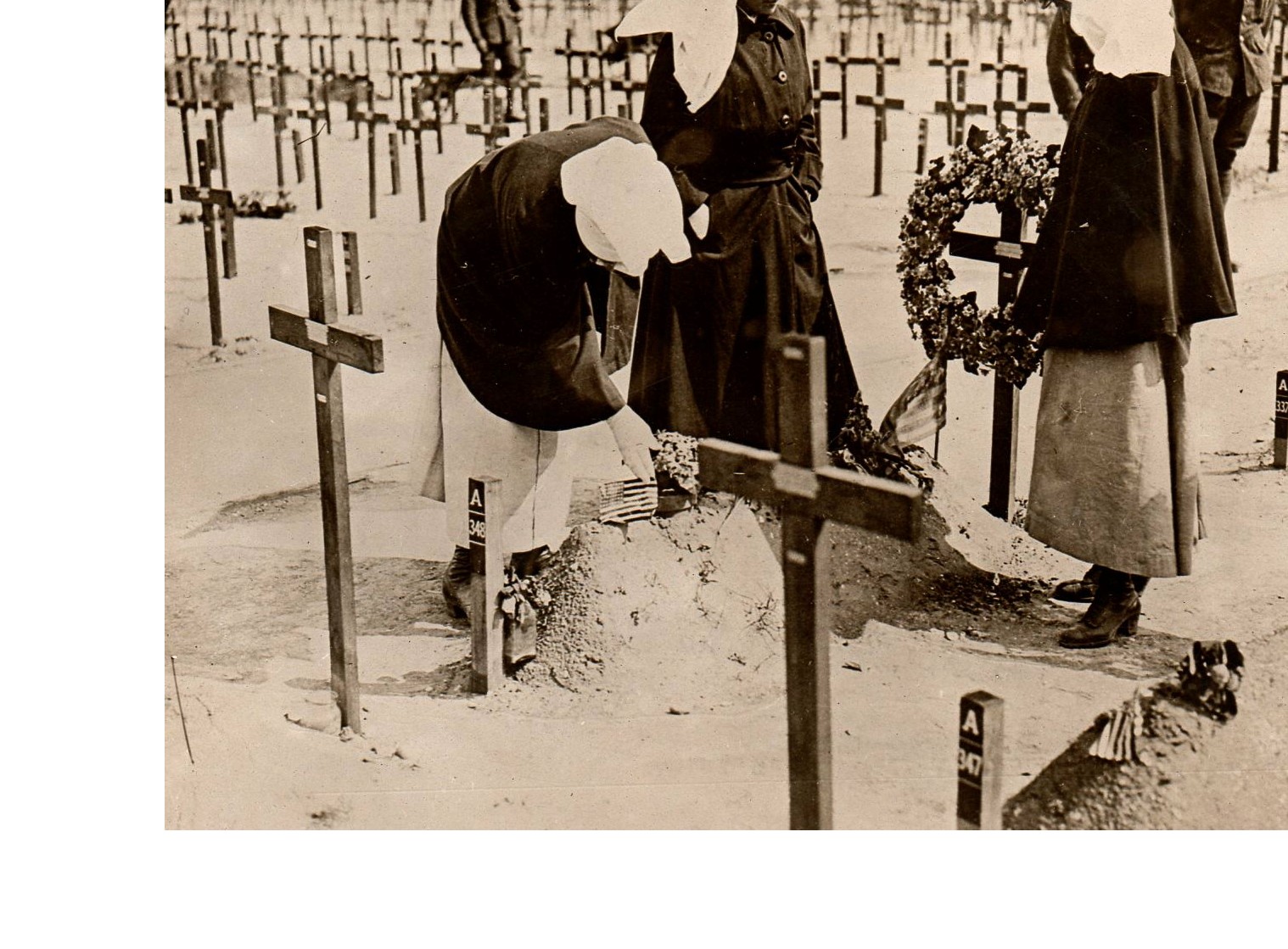
    I was very taken by this image, a photograph made of three Sisters on their way back from attending a funeral service for their compatriot, Sister Lowe, a fellow Canadian nurse killed by a German bomb dropped from an airplane in 1918.  It is from my collection of photo news service images, this one owned and distributed by Underwood & Underwood.  More often than not the photographs were accompanied by a sheet of brief text describing the image.  This photo text was dated 8 July 1918 and reads:


    Women--WWI sister 2259

    Women--WWI sister 4261
    “Another German victory manifested itself several weeks ago when Boche air flyers bombed a defenceless Canadian general hospital in France.  This Canadian Official picture shows Canadian Sisters preparing to return to their hospital after attending the funeral of Sister Lowe who died of wounds received during the raid. Note the grave of an American nurse who was killed during a previous air raid.”

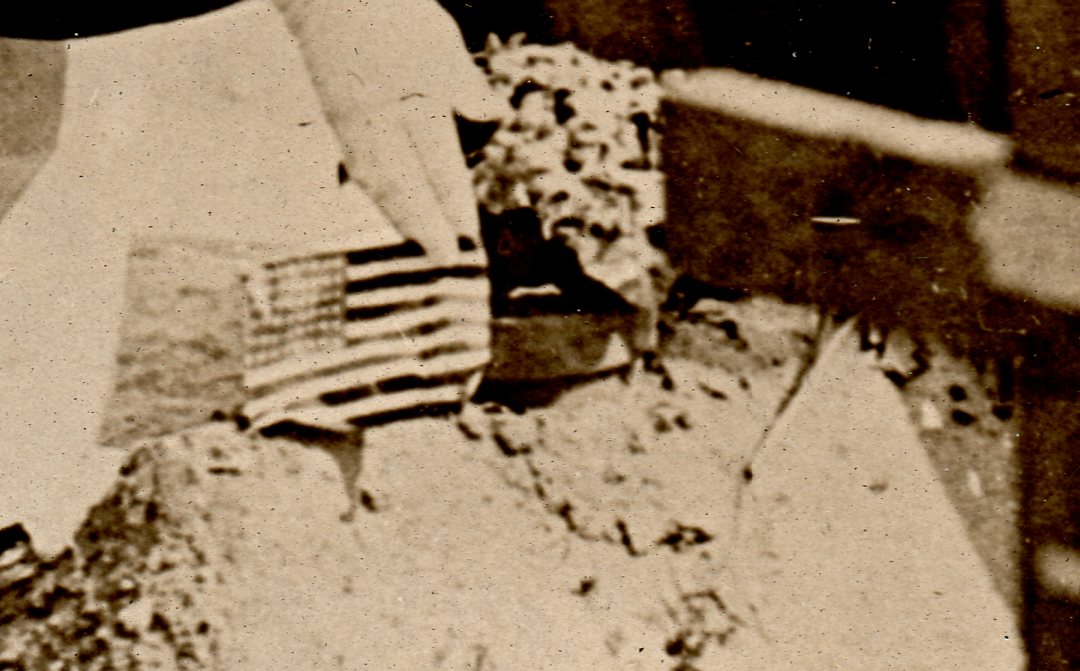
    They evidently stopped to pay their respects.  Its the tiny flags that got to me–I think they’re homemade.


  • Custer and the Extermination of…Southerners

    JF Ptak Science Books  Post 1109       

    Here’s a bit of Custer legend that is true and seldom heard—if
    left to his own devices in a Custer-filled world,  the general would have “exterminated” everyone
    in the South, every one (“men, women or children”) , “with an ounce of rebel
    blood”, hanged dead.  At that point the South
    would be free, and would be repopulated with the “loyal and patriotic”.

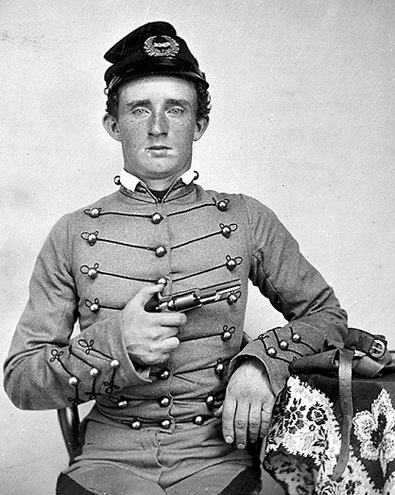
    Custer This was part of  a
    long letter (transcript below) to U.S. Senator Jacob Howard, written on 19th January 1864, in the
    field.  Custer was feeling on the ropes
    at the time, needing to defend his loyalty to Lincoln and his policies,
    and needing to distance himself from Lincoln’s
    election contender and inferior general, George McClellan. (Richard Slotkin, in
    his fabulous The Fatal Environment, the Myth of the Frontier in the Age of
    Industrialization, 1800-1890
    notes that Custer needed “to justify himself…(and)
    disabled his previous affiliations and the nature of his relationship with
    McClellan…’)

    Custer’s relationship–real and imagined–with McClellan was putting him in a stench void, creating the possibility of distance between himself and the powers that be–particularly with Senators like Howard and Zachariah Chandler, “who controlled army promotions” (Slotkin, page 384), which meant distancing himself from the higher rank he thought he was destined for. Custer had been on McClellan’s staff, and had aligned himself with his
    war policies, though not necessarily so his presidential ambitions. 
    Howard, a Republican from Michigan and member of the Military Affairs Committee, believed that Custer was a “McClellan Man” and set against Lincoln, and for that was set to block
    his promotion to brigadier general.  Custer’s  salvaging letter1 to Howard left no doubt about his supposed non-political feelings and where he stood on Lincoln, the Emancipation, and the treatment of the Confederates:

    “If  I could decide
    the questions, I would offer no compromise except that which is offense at the
    front of a bayonet, and rather than that we should accept peace, except on our
    own terms, I would, and do, favor a war of extermination. I would hang every
    human being who possesses a drop of rebel blood in their veins whether they be
    men, women or children. Then after having freed the country from the presence
    of every rebel, I would settle the whole Southern country with a population
    loyal and patriotic who would not soon forget their obligations to their
    country and to themselves.”

    Slotkin points out that the letter to Howard  was so well received that he wrote an update letter to the public-at-large, finding itself published in he Detroit Free Press in May 1865 (“and which was widely reprinted” (Slotkin, 384)) It read in part: “Extermination is the only true policy we can adopt towards the political leaders of the rebellion…Then, and not till then, may the avenging angel sheathe his sword, and our country will emerge from the struggle regenerated”.  

    Custer left out the women and children part of his Southern bloodbath, but left the “extermination” part in.

    Custer was a man of short bursts with little imagination or capacity for extended action or thought–a difficult character, a limited man with no limits.  This would come up again and again, more horribly so at Washita massacre2, and then, finally, the strength to endure his impulsive recklessness gone, at the Little Big Horn.

    The entire letter (and notes)  are  included below:


  • Take the July 1945 “How do we Use the Atomic Bomb?” Poll

    JF Ptak Science Books  Post 1094      

    Note:  our poll site crashed I think under the weight of unexpectedly high traffic.  At last count there were over 12,000 responses, 10,000 of them coming in the last few days.  I will update the analysis section on 7 August.  My apologies for the disappearance of the poll.
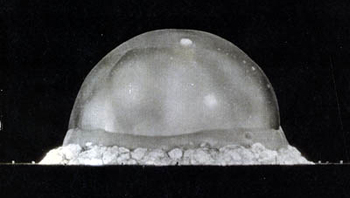
    Trinity

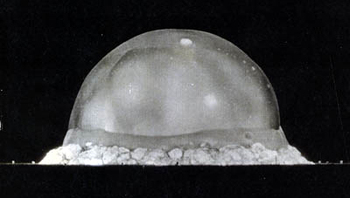
    This is a continuation of my post/thread “Deciding to Use the Atomic Bomb: The Chicago Metallurgical Lab Poll, July, 1945″ which is part of a 50-post thread on the history of atomic and nuclear weapons.  Thus far more than 2400 people have responded to this poll on whether/how to use the atomic bomb that was first taken by the Manhattan Project metallurgical lab physicists at Chicago.  (Image: the 600-foot wide fireball of the first detonation of an atomic weapon at .016 seconds. The event, codenamed “Trinity”, detonated an implosion design plutonium device code at Alamogordo, New Mexico (near Socorro), 16 July 1945.)
     

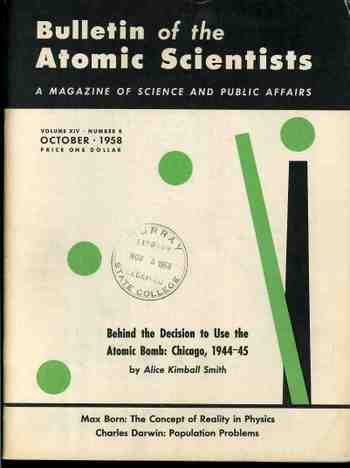
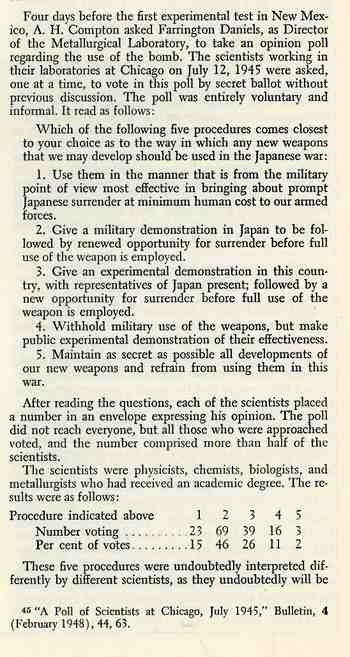
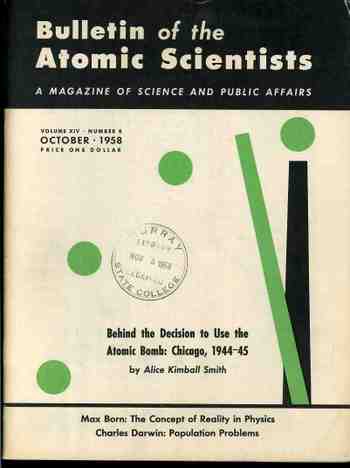
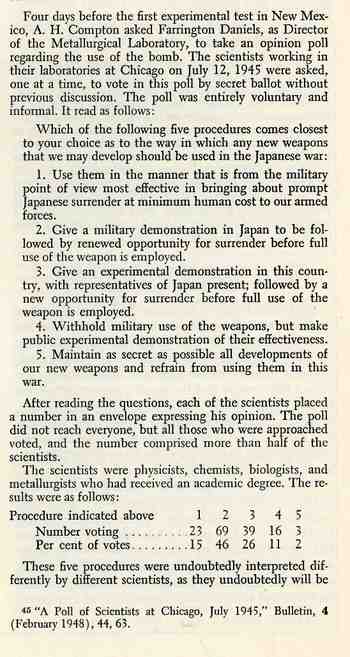
    In July 1945 (but before Trinity), Arthur H. Compton asked  Farrington Daniels (Director of the Metallurgical Lab section (at Chicago) of the Manhattan Project) to poll the 250 or so scientists at work under Farrington on the coming immediate use of the atomic bombs.  (The results of the poll, answered by 150 of the 250 people, were originally published as “A Poll of Scientists at Chicago, July 1945,”  Bulletin of the Atomic Decision to drop--BAS coverScientists, February 1948, 44, page 63. and again published in Compton’s own book,  Atomic Quest, in 1956. You can follow the images of the Bulletin of Atomic Scientists for October 1958, p 304 here.
    The results of the five-option poll were interesting.  Of the 250 asked to take the poll, 150 responded, with 15% (as you will be able to see in the Results section below) of the scientists thinking that the bomb should be immediately employed against a military target.  46% thought that there should be a demonstration of the weapon in Japan in a show of strength, while another 26% thought that the bomb should be demonstrated here in the U.S. and witnessed by members of the Japanese government.  Rounding out the poll was the 11% who thought that the bomb should be demonstrated but not in front of the Japanese, and the final 2% holding the option for keeping the weapons secret and unused. 
      
    Decision to drop--poll outline

    The 2010 results thus far are displayed below, though if readers were  interested in taking the poll they should do so now and then return to read the results. 

    To take the poll, go HERE.  You can be a part of this poll anonymously. Please try and keep in mind the time
    and place of the events unfolding: the Japanese resistance to the
    unconditional surrender ultimatum developing at Potsdam; the resistance
    to massive air raids which in the year or so previous to 6 August saw the destruction of 66 major cities (destroying half of all the combined major centers, killing about 900,000, wounding over a million and making another 9 million homeless); the tenacious fighting in the islands at the
    outreaches of the Empire; the thousands of American POWs; the
    circulating estimates of the coming Japanese invasion casualties
    (hundreds of thousands of Americans, far more so Japanese), and so on.

    Caveat: this is a curiosity-poll more than anything–it is hardly scientific.  Admittedly the original poll was taken by a very distinct population which represents only itself and could hardly be thought of as representing any wide section of the American population.  Still it is interesting to see how folks today respond to the poll even in this environment (where the writer has already discussed the results of the original poll, for example) where the history of the decision to use the bomb and its results are so iconic and well known. 

    The story goes so (this from my original 2008 post):  “In late June 1945, the Interim Committee (a secret, blue chip group established by Secretary of War Stimson with the approval of President Harry S. Truman to examine the problems that could result from the creation of the atomic bomb). decided what exactly to do with the weapons.  The group (also including James F. Byrnes, former US Senator soon to be Secretary of State, as President Truman’s personal representative; Ralph A. Bard, Under Secretary of the Navy; William L. Clayton, Assistant Secretary of State; Vannevar Bush, Director of the Office of Scientific Research and Development and president of the Carnegie Institution; Karl T. Compton, Chief of the Office of Field Service in the Office of Scientific Research and Development and president of Massachusetts Institute of Technology; James B. Conant, Chairman of the National Defense Research Committee and president of Harvard University; and George L. Harrison, an assistant to Stimson and president of New York Life Insurance Company) found the following:

    The opinions of our scientific colleagues on the initial use of these weapons are not unanimous: they range from the proposal of a purely technical demonstration to that of the military application best designed to induce surrender. Those who advocate a purely technical demonstration would wish to outlaw the use of atomic weapons, and have feared that if we use the weapons now our position in future negotiations will be prejudiced. Others emphasize the opportunity of saving American lives by immediate military use, and believe that such use will improve the international prospects, in that they are more concerned with the prevention of war than with the elimination of this specific weapon. We find ourselves closer to these latter views; we can propose no technical demonstration likely to bring an end to the war; we see no acceptable alternative to direct military use.
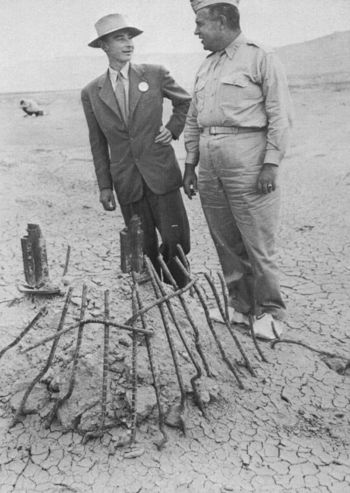
    Oppenheimer_groves_090945 The Manhattan Project Poll on the Use of Atomic Weapons, July 1945.

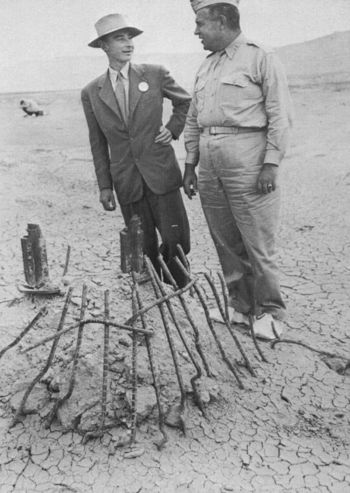
    Overall the results are fairly similar—of course there were no controls in the 2008-2010 poll, and it was taken by more than just the scientists at Chicago who helped build the bomb in 1945, and of course people were asked to try and place themselves with some judiciousness back into 1945.  So the results are necessarily problematic.  Even so, I’m not sure right now how to interpret them. (Image:  Oppenheimer and Groves at what was left of the tower that suspended “the Gadget” at Alamogordo.)

    The results thus far for Option 1—drop the bomb, drop it now, and drop it on a military target–show that roughly twice the number of people were willing to go straight away to military application than among the Chicago scientists in 1945, 27% in 2010 said to use the bomb “now” compared to only 15% in 1945.

     I’m not sure if I’m surprised by this or not—people today certainly know and probably could not put out f their mind that the Japanese didn’t surrender until days after the dropping of the Nagasaki bomb.  Wouldn’t this mean that more people would think to drop it?

    The second option, which frankly I thought would be the overwhelming choice in ’08-’10 (the demonstration of the effectiveness of the bomb) fell from 46% to 36%, which is just about the percentage of folks who were more willing to drop the bomb more-or-less immediately. 
     I was thinking that this number would increase dramatically. On the other hand  I would guess, though, that if the general public was given this poll (somehow) in 1945, that the overwhelming response would be option #1. After all there were millions of Americans in uniform who would’ve been put at risk in an invasion of Japan.   There were also dozens of thousands of American GIs who were in POW camps whose well-being would not have been a primary concern if the Japanese homeland was invaded.  Also it must be remembered that just a few weeks before this poll was
    given and before the American public could have imaginarily taken it,
    there was a massive firebombing of Tokyo–334 of  Curtis LeMay B-29’s were
    loaded to utmost capacity with the newly-conceived M-69s bomb, an incendiary
    so vicious  that the fires it produced were all but inextinguishable.  The B29’s bombed
    Tokyo for hours, killing 100,000 people and making over a million
    homeless.  In spite of this overwhelming display, the Japanese movement
    towards surrender was still secretive and extraordinarily slow1.

    My suspicion is that this number would be overwhelming on the order of  90% or something like that, because by this point the U.S. was swimming in reports of terror and blood and death with nothing but the promise of more, the invasion of Japan leading to the possibility of hundreds of thousands of soldiers being killed.  The chance of ending it all in one or two steps was irresistible to the decision makers; had the use of the bombs been publicly debated I feel that there would have been no debate.  Remember:  no major decision-maker in the U.S. government had any reservations about the military use of the bomb.  There were private reservations on the use of the bomb among America’s top military men (Eisenhower, for one), but these men would not make the ultimate decision. (This is a  shallow description of a complex situation, but for our purposes here I think it will do.)
    . 
    Results thus far (as of 26 July 2010):

    2008 poll takers=  2418 people.
    1945 poll takers=    150 people

    Option 1. “Use them in the manner that is from the military point of view most effective in bringing about prompt Japanese surrender at minimum human cost to our armed forces.” 
    2010= 27%
    (1945=15%)

    Option 2. “Give a military demonstration in Japan to be followed by renewed opportunity for surrender before full use of the weapon is employed.”
    2010= 36% 
    1945=46%)

    Option 3: “Give an experimental demonstration in this country, with representatives of Japan present; followed by a new opportunity for surrender before full use of the weapon is employed.” 
    2010= 22% 
    (1945=26%)

    Option 4. “Withhold military use of the weapons, but make public experimental demonstration of their effectiveness.”
    2010=10% 
    (1945=11%)

    Option 5. “Maintain as secret as possible all developments of our new weapons and refrain from using them in this war.”
    2010=5% 
    (1945=2%)

    Notes:

    1. The business of whether the Japanese were ready to negotiate a peace in the weeks before 6 August is complicated and far from conclusive.  It does seem though that no negotiating team could’ve spoken with a unified voice for the Japanese government, and that the issue of an  unconditional surrender further complicated the situation. 

  • Quantitative Display of Information: What was Left of the Japanese Navy, 1945

    JF Ptak Science Books  Post 1082

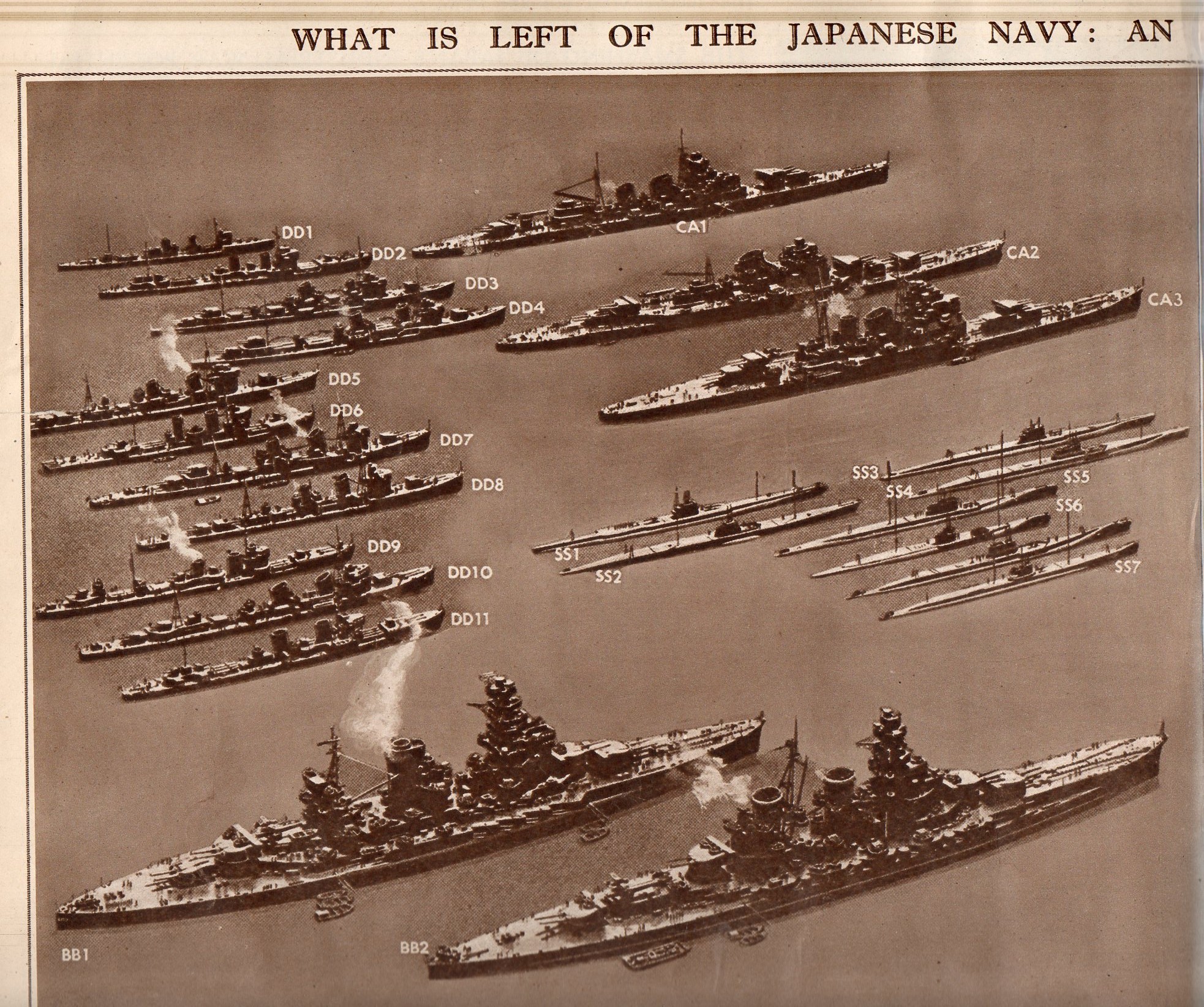
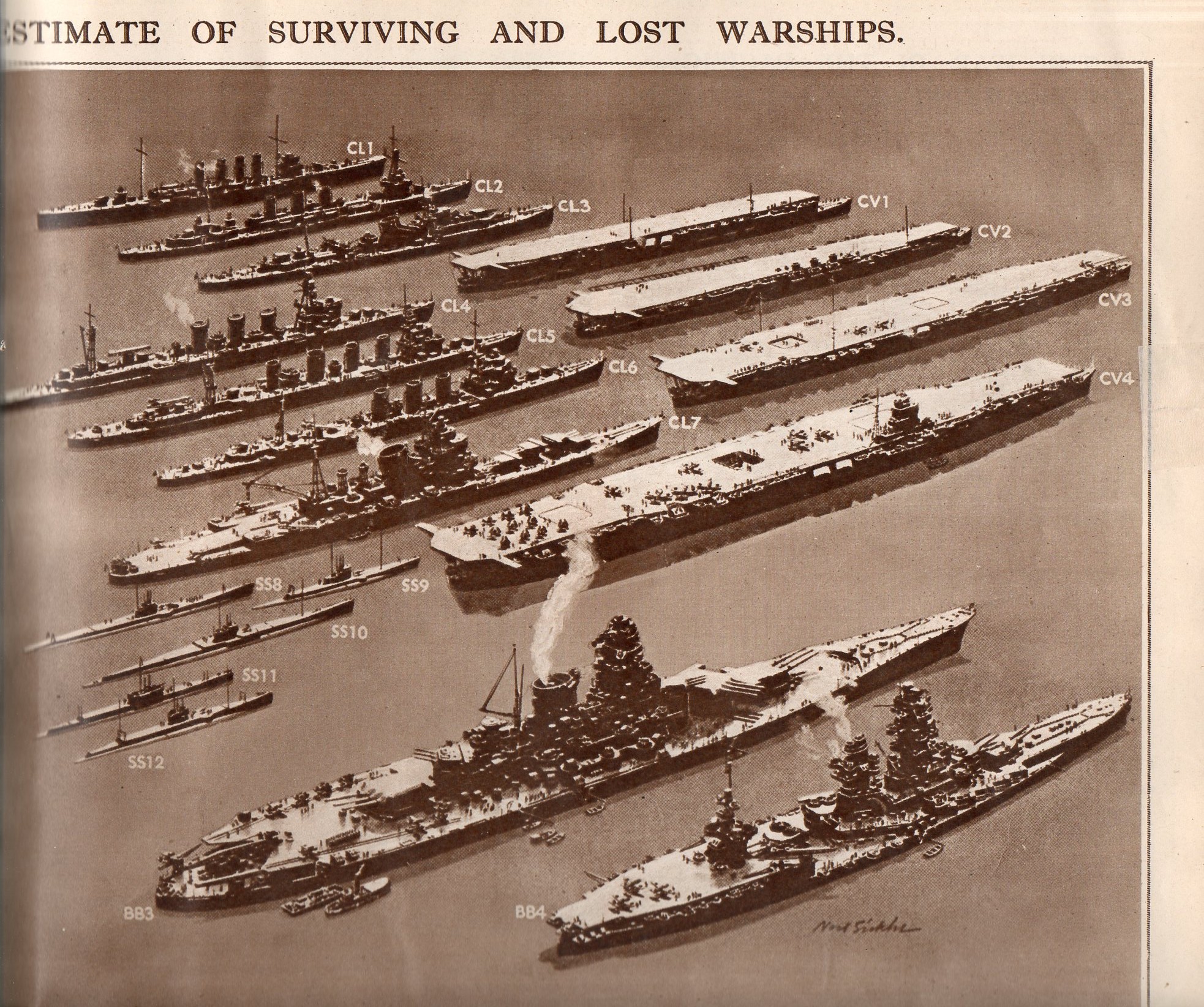
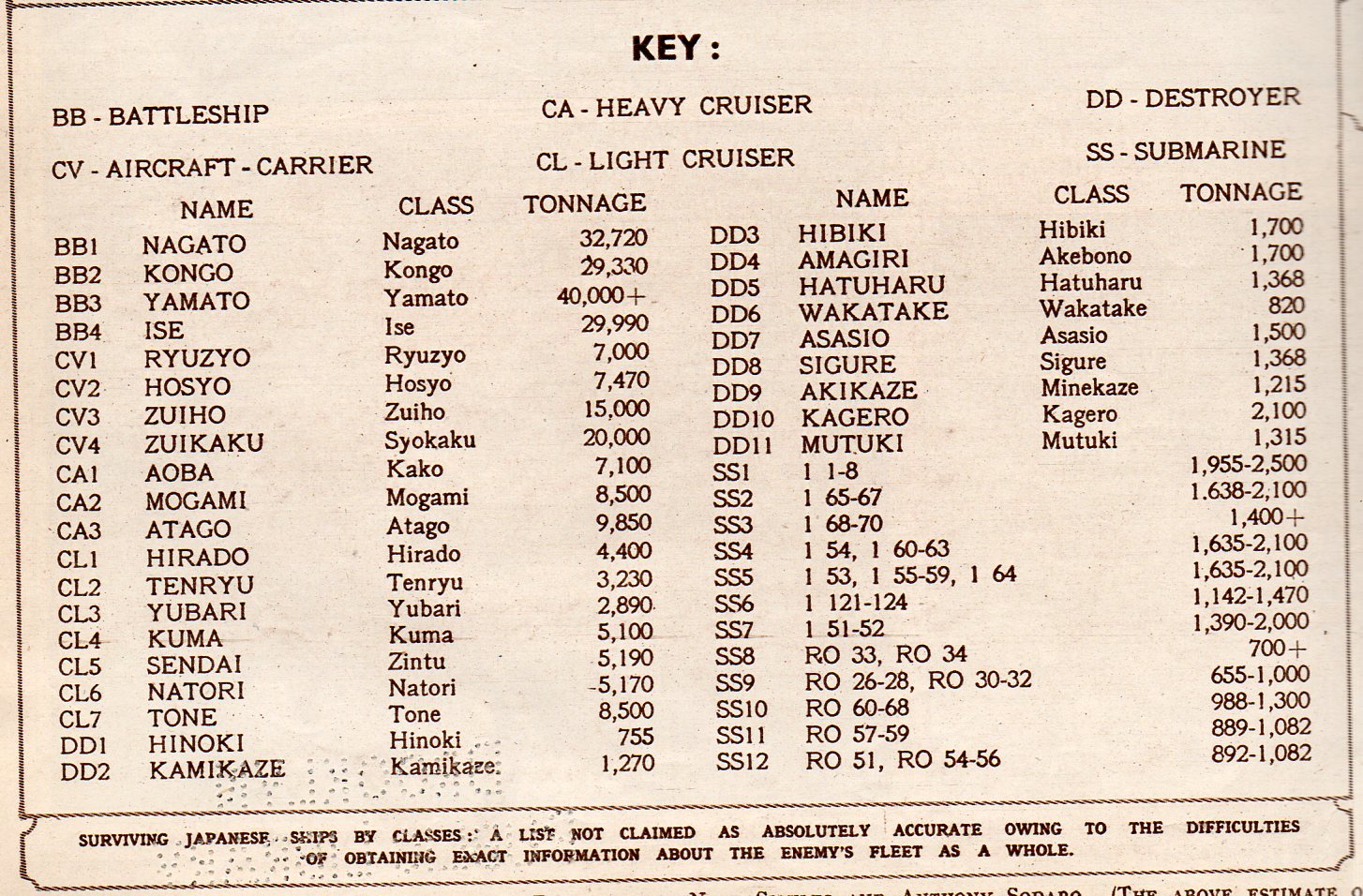
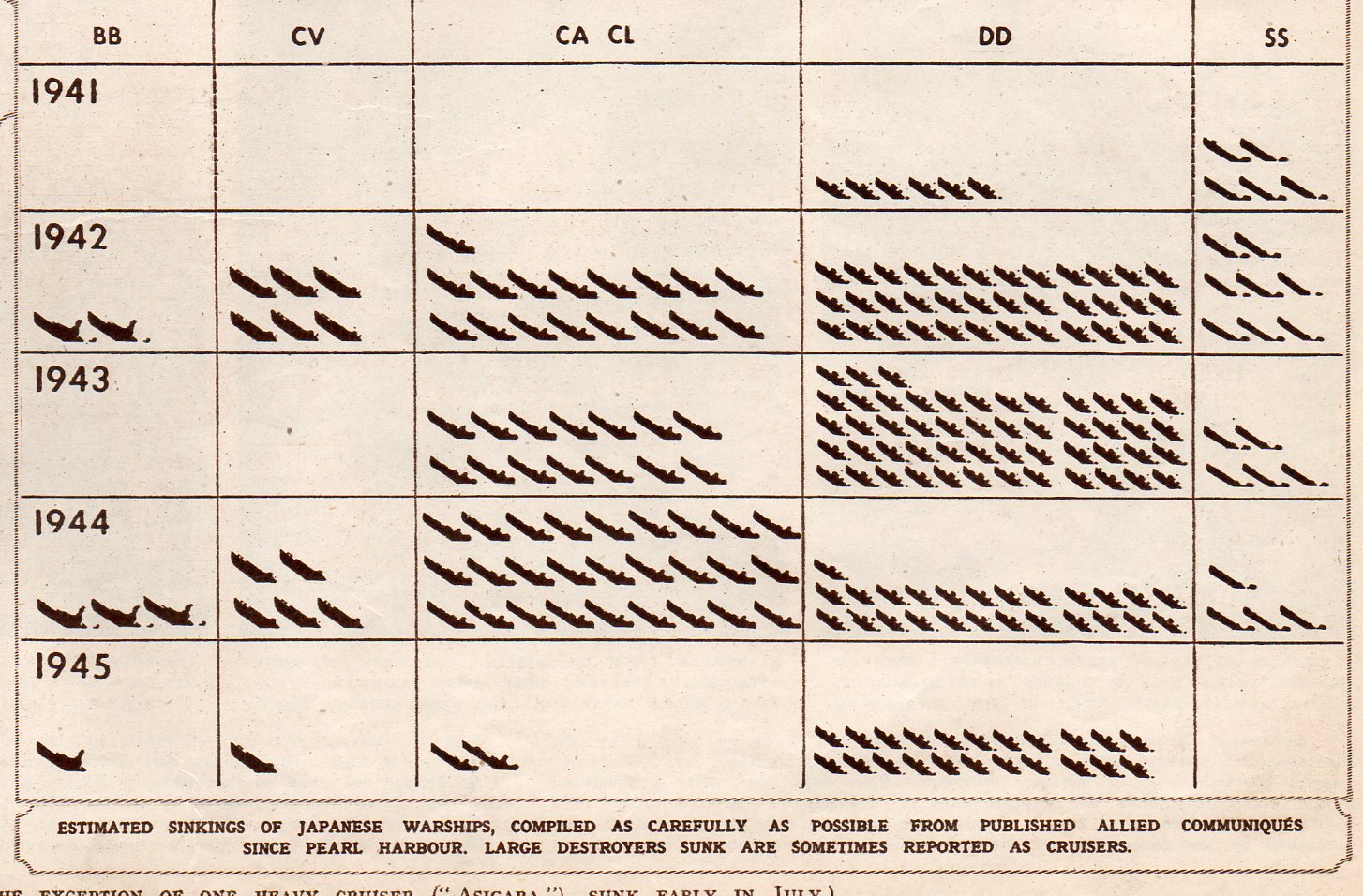
    This double-page spread in the Illustrated London News for 28 July 1945 displays what was left of the Japanese Navy.  Originally appearing in LIFE magazine a few weeks earlier, the image represents classes of Japanese naval ship, multiplied by the estimated number of ships in that class.  Even after all of the great  losses of 1942/3, the Japanese Navy was still the third largest afloat. 

    The navy consisted of an estimated 10 battleships, 6 carriers, 15-30 cruisers, 60-80 destroyers,and an not-estimated number of subs (though there were at this point use din patrol and to accompany the fleet.  

    This is an excellent display of a significant amount of historical data, made quickly understandable to even a quick reader, or even to a non-reader.  Two weeks from this date would find this information moot.

     Japanese Navy 1205 

    Japanese Navy 2206

    Japanese Navy 3207

    This chart shows the numbers of each class of vessel sunk by year:

    Japanese Navy 4208


  • Human Bombs, part II: the Ohka and Jinrai Butai, 1944/5

    JF Ptak Science Books   Post 1080

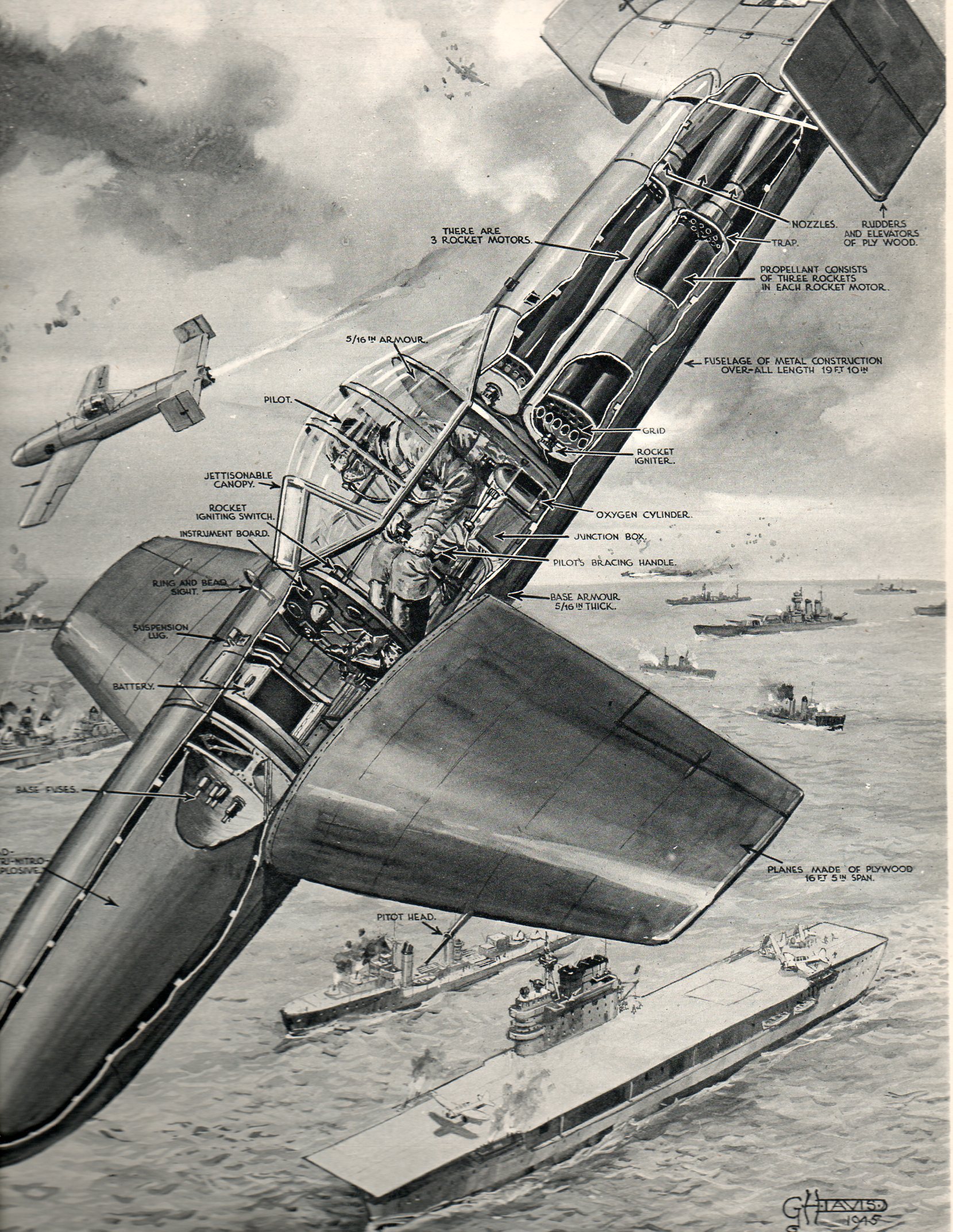
    My favorite mid-century illustrator–G.H. Davis of the Illustrated London News–has provided yet another remarkably clear and well-designed series of images on a difficult topic for a main-line popular audience.  This time (appearing as a two-page spread on 28 July 1945 in the ILN) showed the structure, strategy and deployment of one of the late war’s

    Human bomb japan202

    most feared weapons–the jet-powered human bomb of the Japanese naval air force. (In practice though the weapon didn’t produce that must damage though it did produce the fear: “the operational record  includes three ships sunk or damaged beyond repair and three other ships with significant damage; seven US ships were damaged or sunk by Ohkas throughout the war”1).  The Yokosuka MXY-7 Ohka was a purposefully designed and built rocket powered suicide rocket whose sole purpose was to attack and destroy ships. They were first produced in 1944 as unpowered glider aircraft, and then later in November 1944 the rocket propulsion system was added.  All tolled, the Yokosuka and the Kasumigaura Naval Air Arsenal together built about 850 of them–fewer than 3 dozen survived.

    It was a relatively simple construction and was easily deployed: dropped from a bomber it would glide until near it target and then the rockets would be ignited, powering the thing to a near-unstoppable 500+mph, sending it, its pilot and the 2,300 lb ammonal warhead (an explosive made up of ammonium nitrate, trinitrotoluene (TNT), and aluminum  powder) into its target, detonating on impact.
                                       

    ·Posted by :

    ·in:

    — —

  • Human Weapons: Torpedo-Driven Torpedoes, 1944/45

    JF Ptak Science Books   Post 1076

    Torpedo bomb 3182

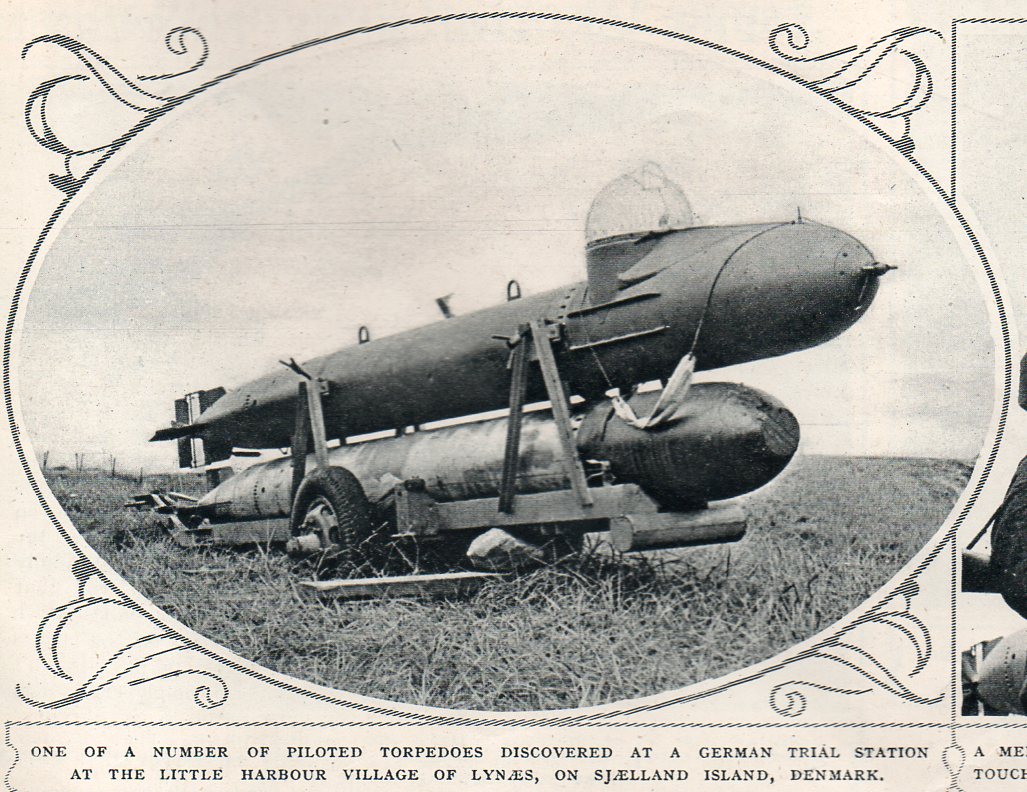
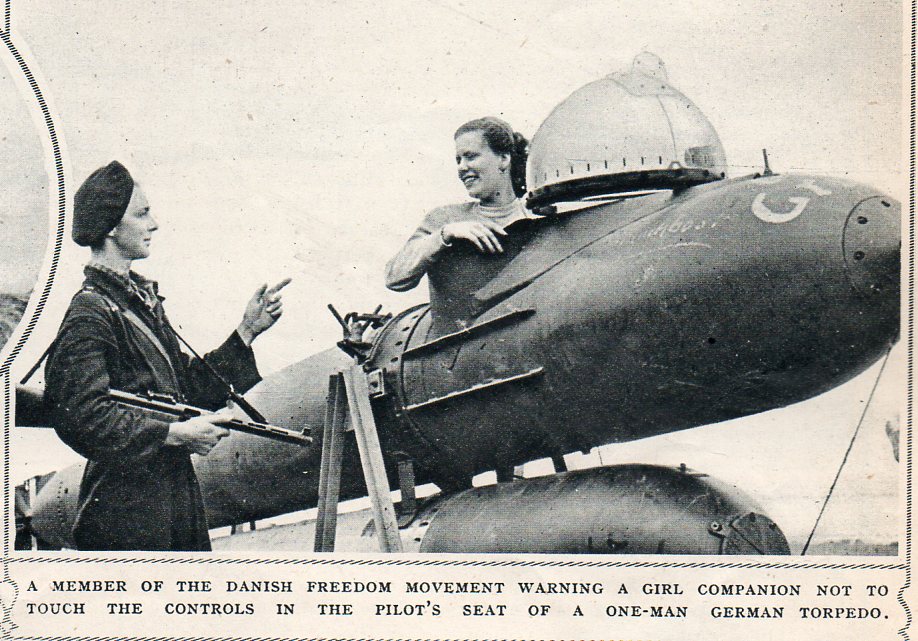
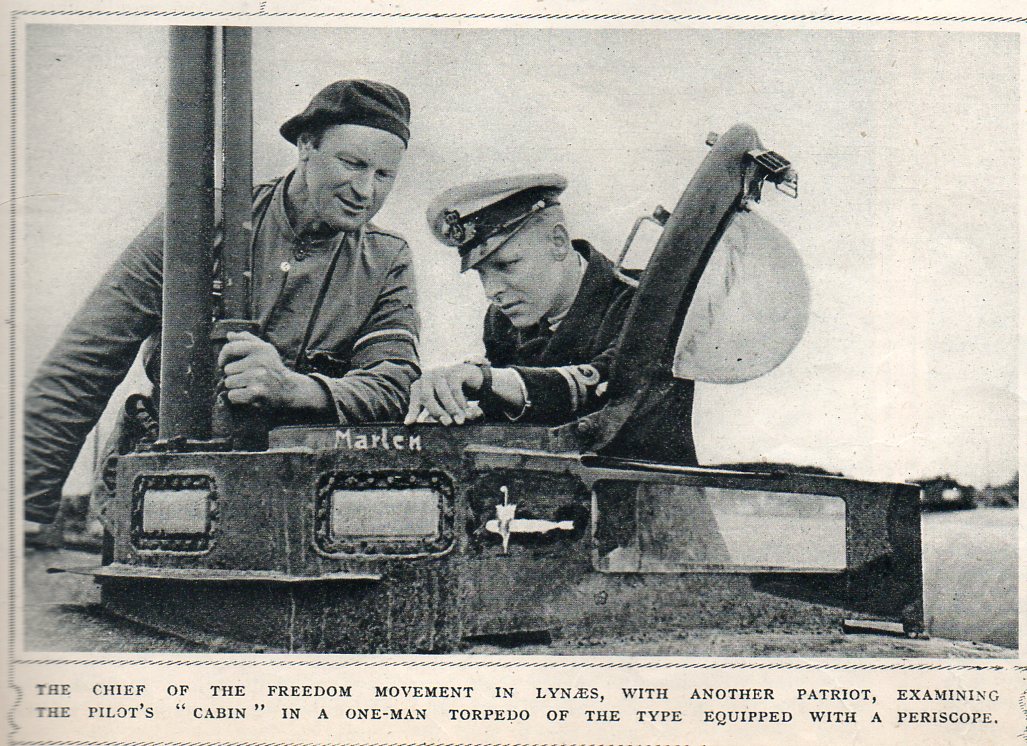
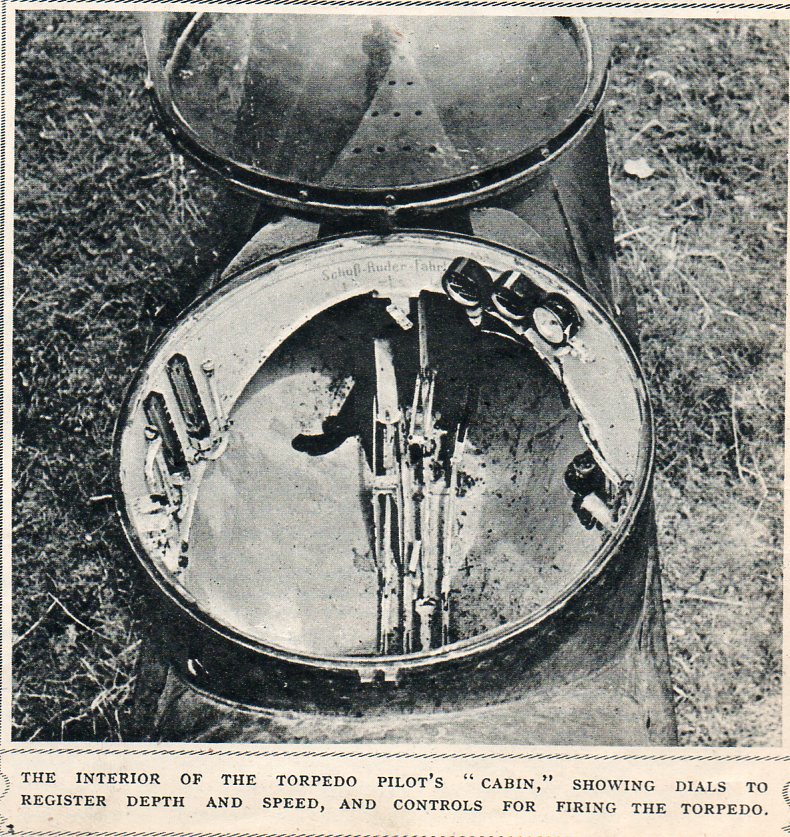
    These are some interesting images of a German 1944/5 human-guided torpedo known as the Marten.  It was an interesting idea, built on hundreds of  years of previous thinking along these lines–a one- or two-person submersible boat.  The Marten took this another step, attaching a 21-inch torpedo to the body of the boat.  The idea could’ve been a tide-turner had these things been anywhere near functional, but the fact of the matter was that they were poor sea craft and ineffectual at delivery their weapon.  

    Torpedo bomb 1180

    The Marten was an improved version of a slightly earlier boat called the Neger.  It made 3 knots on a good day and had a range of 30 nautical miles.  It was difficult to maneuver, evidently took the pilot’s full attention, and when submerged could stay underwater for 30 minutes and did not have a periscope. So after all of this, the captain would release the torpedo, and then steam away at low speed.  Evidently of the 300 produced only a relatively few found targets*   

    Torpedo bomb 2181

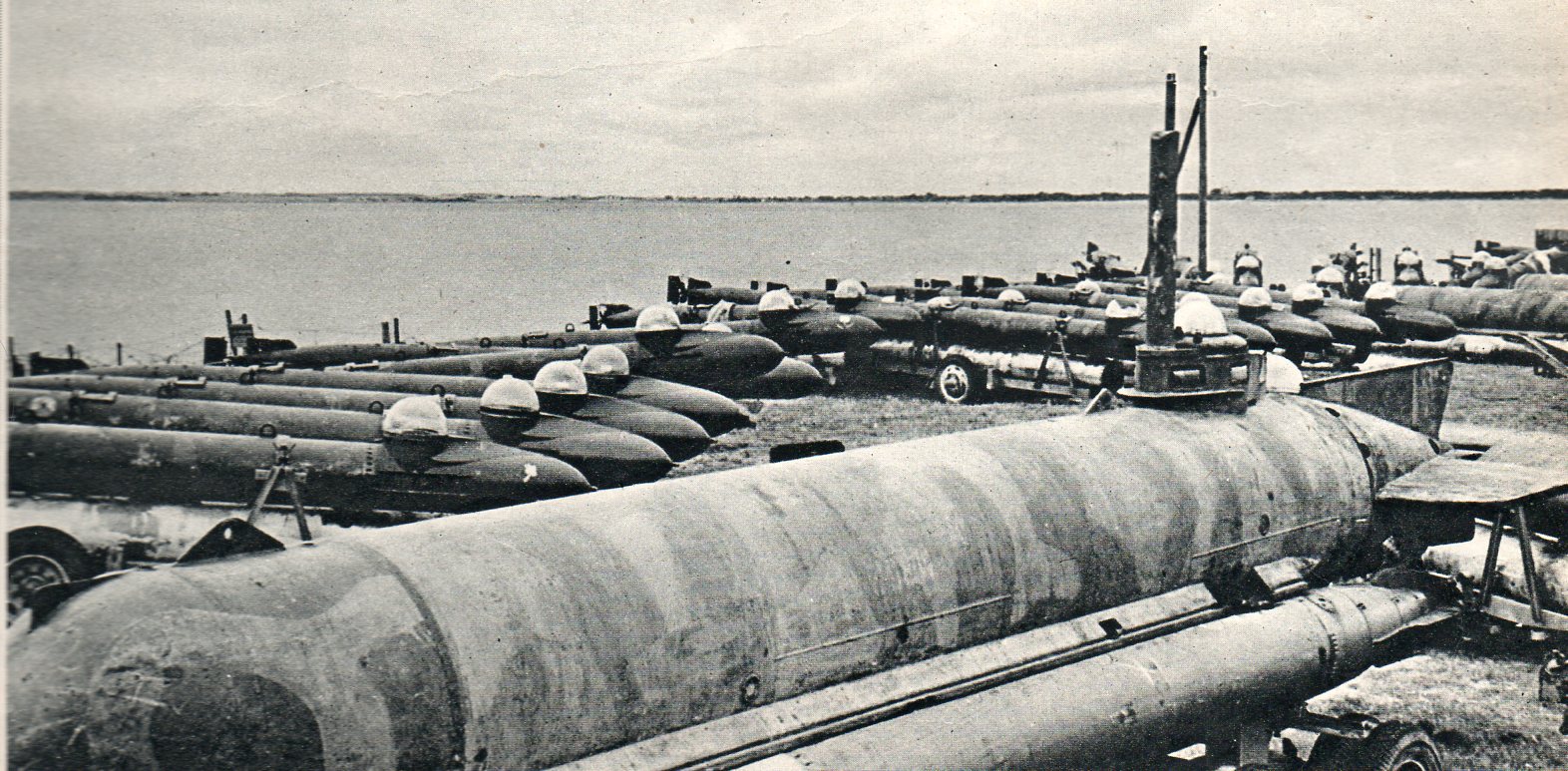
    This photo spread from The Illustrated London News of 11 August 1945 shows the disposition of about 10% of that force, on dry land on the small village of Lynes, Denmark.

    These aren’t on the order of my next post–on the human weapon–but it is getting close.  The German Navy did, after all, expect the pilot of the craft to survive. 

    Torpedo bomb 4183

    *There were many missions by these boats–most famous among them launched against British ships during the D-Day invasion on 5/6 June 1944–but overall they were rarely effective in a strategic sense.  I in no way mean to lessen the sacrifice of the sailors who were killed by the torpedo-launched torpedoes.

    Torpedo bomb 5184


    ·Posted by :

    ·in: