A Daily History of Holes, Dots, Lines, Science, History, Math, Physics, Art, the Unintentional Absurd, Architecture, Maps, Data Visualization, Blank and Missing Things, and so on. |1.6 million words, 7500 images, 4.9 million hits| Press & appearances in The Times, Le Figaro, Mensa, The Economist, The Guardian, Discovery News, Slate, Le Monde, Sci American Blogs, Le Pont, and many other places… 5000+ total posts since 2008.

Category: Industrial & Technological art

  • Strange Things in the Sky Department: Aircraft, 1919

    JF Ptak Science Books   Post 1222
    Blog--May 20--minerveA

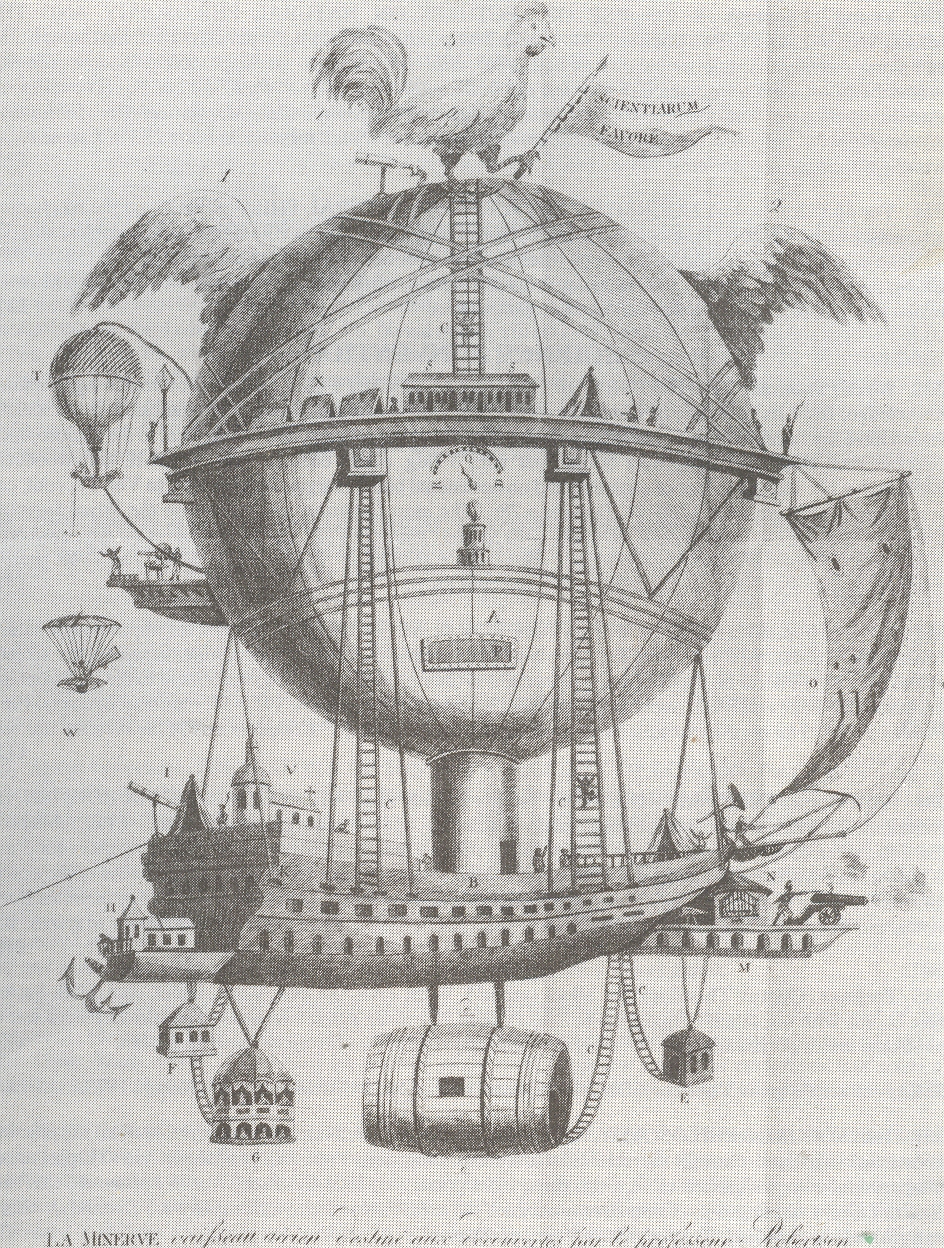
    I’ve written earlier in this blog about odd things found in the sky, some of which is imagined  (holes, extra Earths, blank Heavens, disembodied hands/feet/eyes/ears,proto-human empty aliens,  rat) and some of which were/are possibily real (like this fabulous aircraft with an escape pod for women, located here). [Both of these images are available from our blog bookstore, here.]

    These images present incredible, indelible ideas to us here in 2010, images of creations that look more like created steampunk for a retro-futurist novel than something real.  But they were actually state-of-the-art techno advances for their times, decent ideas, solutions for knotty problems that had no better answers than those presented. 
    Strange sky--launch plane839

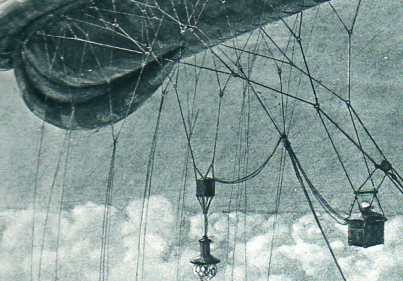
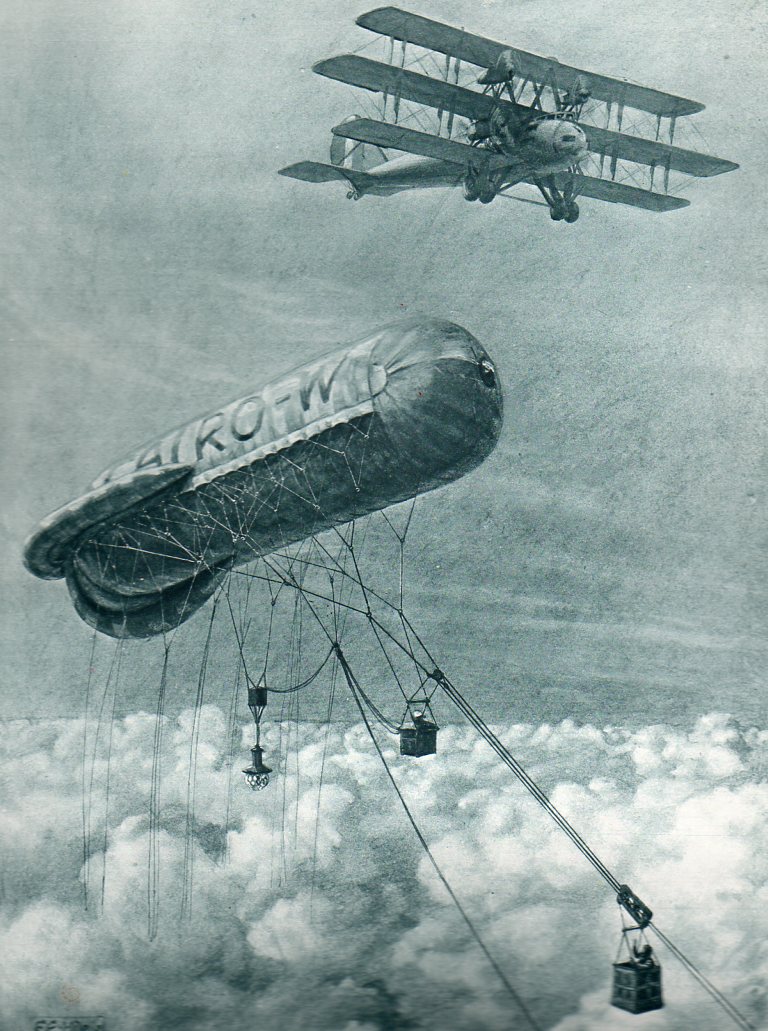
    The first is “The Clapham Junction of the Air, a Cloudland Signal-box”, seen in The Illustrated London News for 15 March 1919.  The idea was simple–cloud cover prevented aircraft from seeing their objective (lacking RADAR, which wouldn’t appear for another 23 years) and so something needed to be done to communicate with them above the clouds to relay data on ground conditions.  And so we have the tethered kite balloon with a mobile travelling car, the man in which would relate the necressary info to the waiting aricraft above.  (The description of the image notes that the aircraft is “one of a coming type”.)
    Strange sky--launch plane crowd det840

    Strange sky--launch plane det841

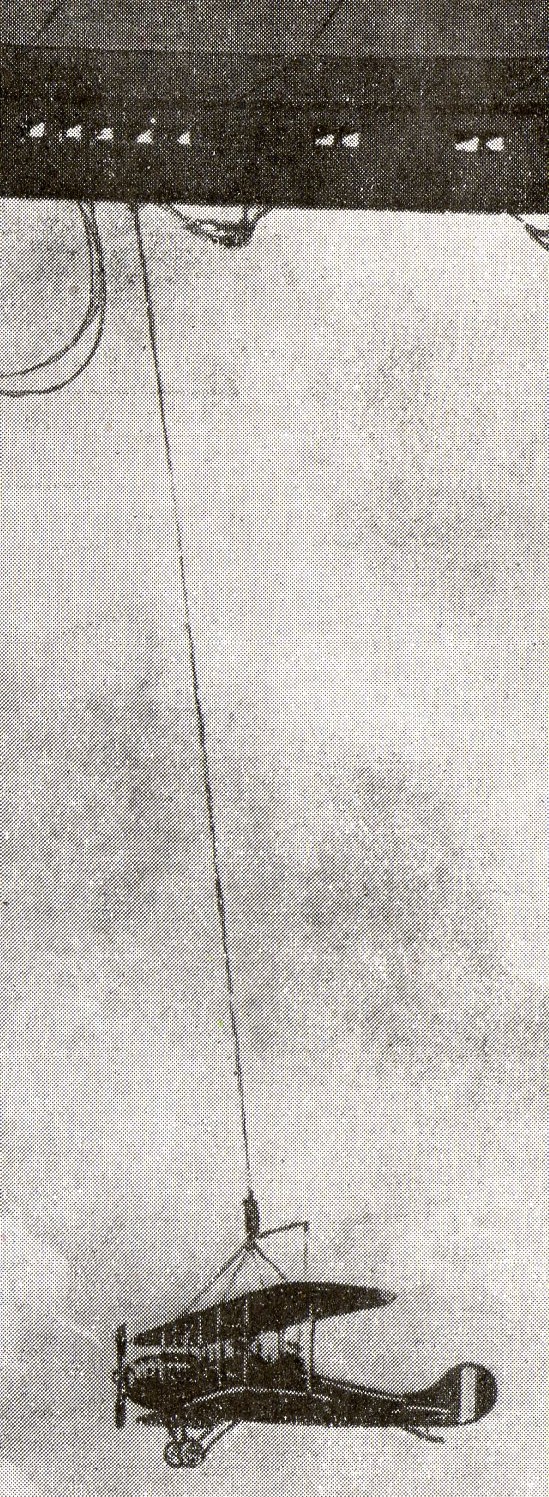
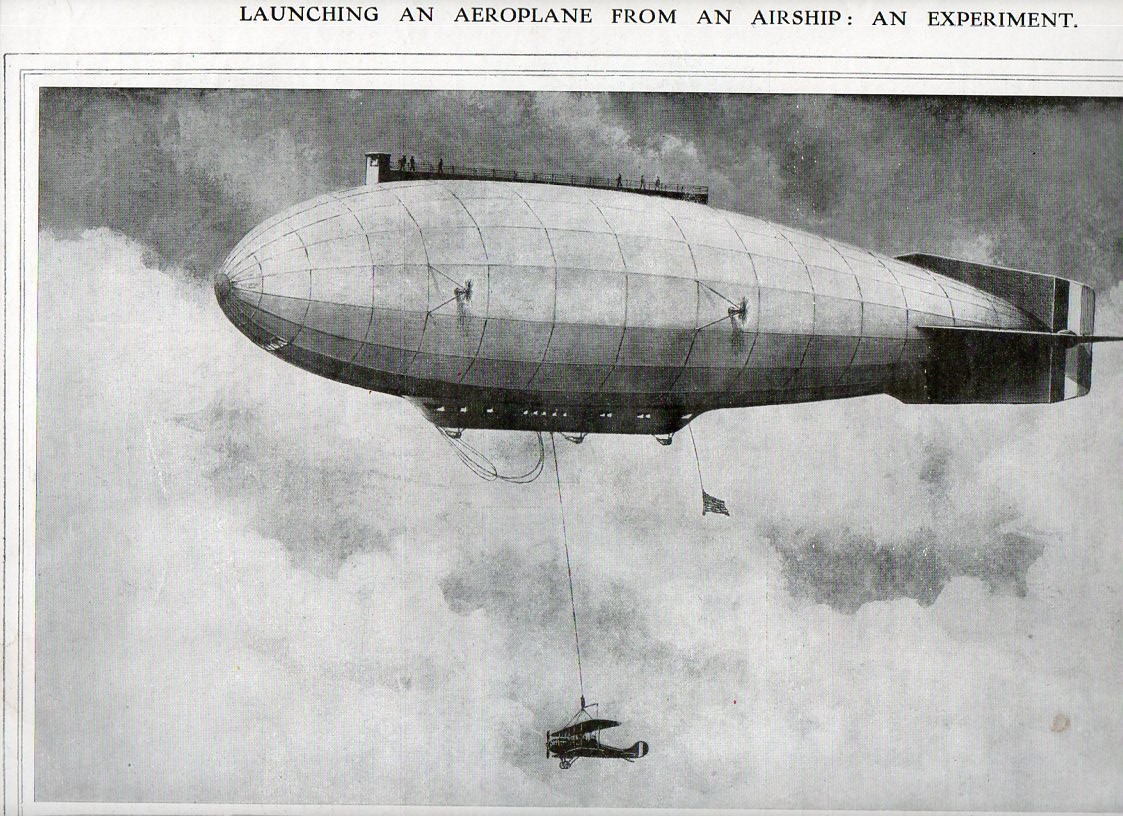
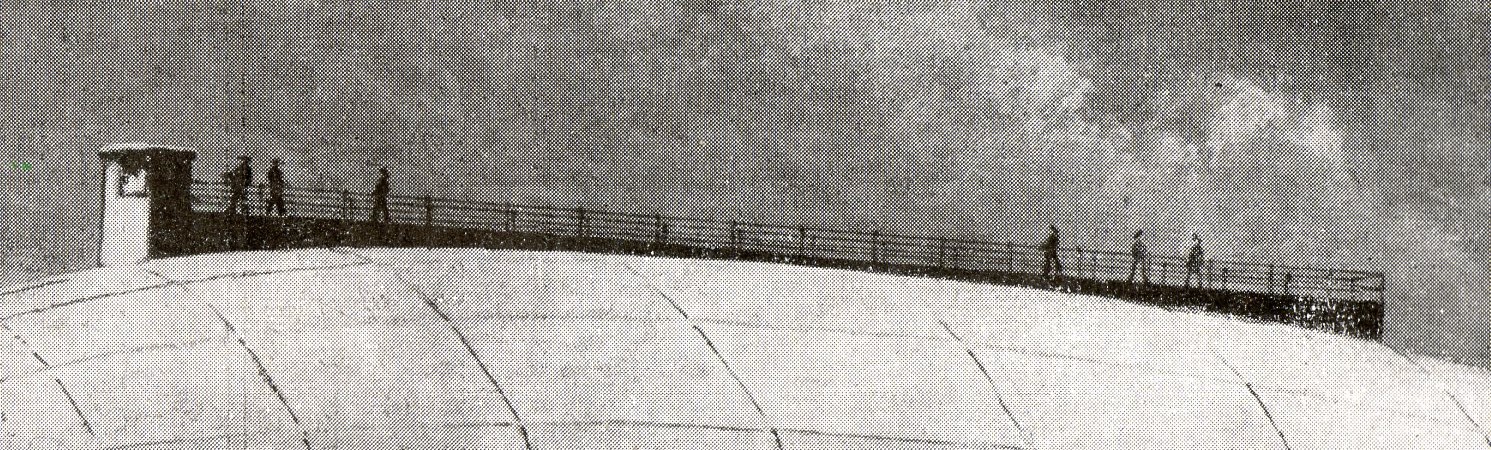
    The second image appears in The Illustrated London News for 1 March 1919 and is entitled “Launching an Aeroplane from an Airship, an Experiment”, and shows a helium-filled airship (“of the near future”) about to drop an aircraft.  The airship would have risen to some height with the aircraft already at tether, travelled a distance far beyond the normal range of the airplane-in-tow, and then release it–after a fall of a thousnad feet or so, the engines would start, and the plane would be operational.  that was one way of advancing air cover far beyond what woul dhave normally been feasible. 

    The set of problems encountered here woul de remedied in relatively short order, say with a few years of the publication of these pictures–but for teh time being, in 1919, this was the best that could be offered. 
    Strange sky--lmessages842
    Strange sky--lmessages det843


  • Display of Quantitative Data: What was Left of the Japanese Navy, 1945 [Short Post]

    JF Ptak Science Books    Post 1220

    Japanese sinking detail

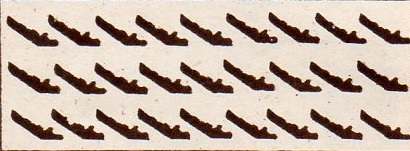
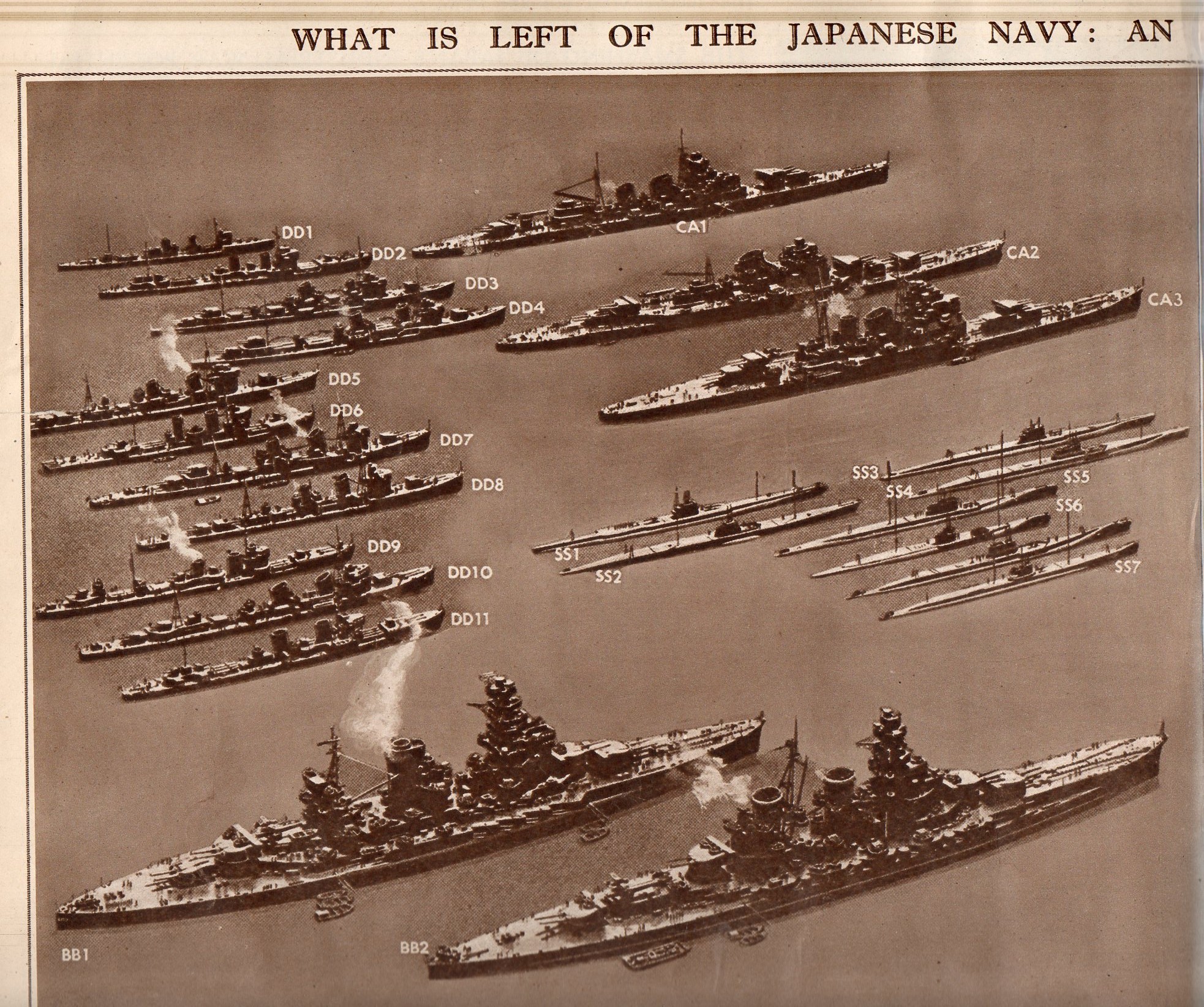
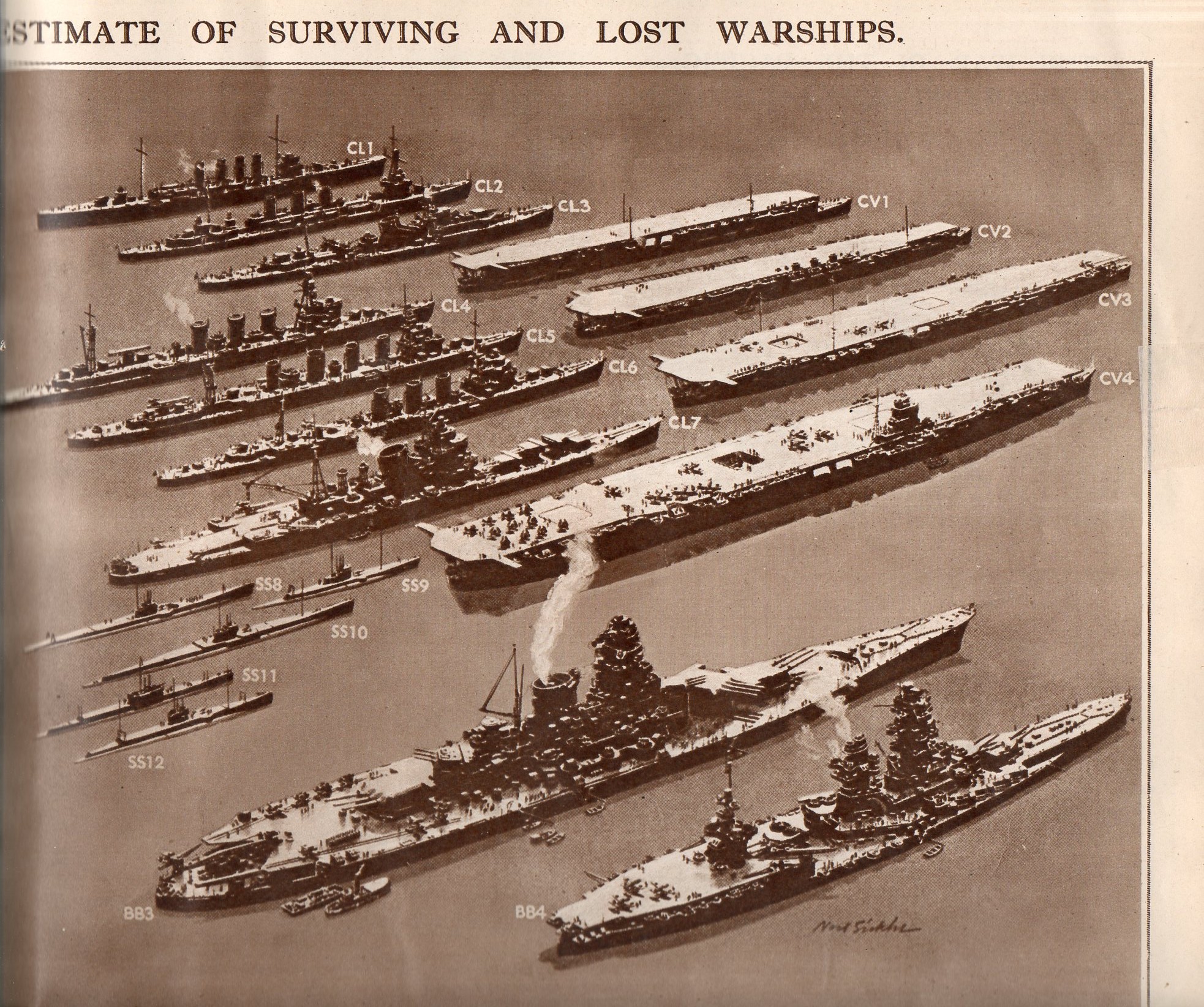
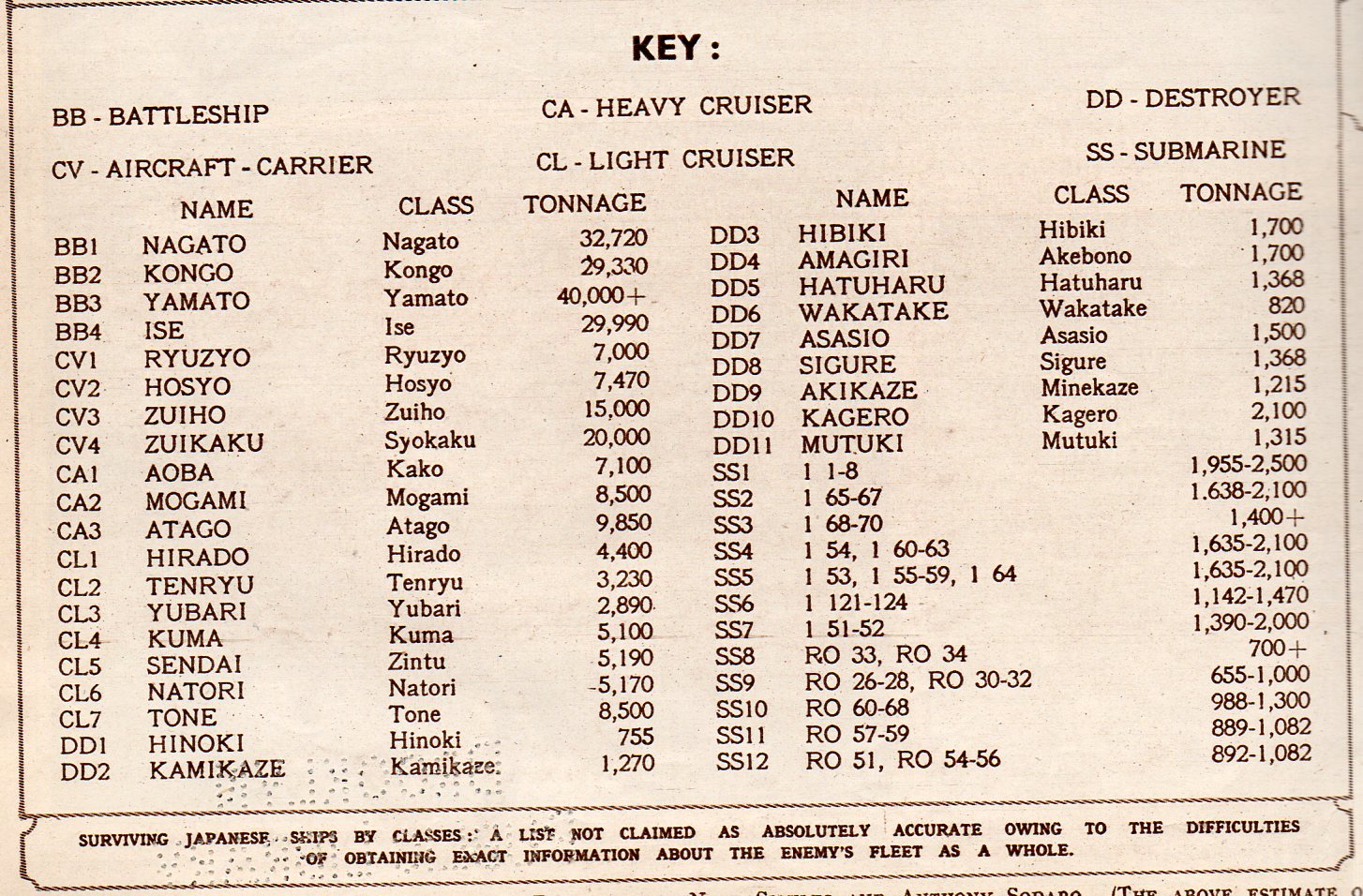
    This double-page spread in the Illustrated London News for 28 July 1945 displays what was left of the Japanese Navy.  Originally appearing in LIFE magazine a few weeks earlier, the image represents classes of Japanese naval ship, multiplied by the estimated number of ships in that class.  Even after all of the great  losses of 1942/3, the Japanese Navy was still the third largest afloat. 

    The navy consisted of an estimated 10 battleships, 6 carriers, 15-30 cruisers, 60-80 destroyers,and an not-estimated number of subs–or at least that is what was being published as the case in LIFE/ILN.

    This is an excellent display of a significant amount of historical data, made quickly understandable to even a quick reader, or even to a non-reader.  Two weeks from this date would find this information about the remaining Japanese Navy to be beside the point.

     Japanese Navy 1205 

    Japanese Navy 2206

    Japanese Navy 3207

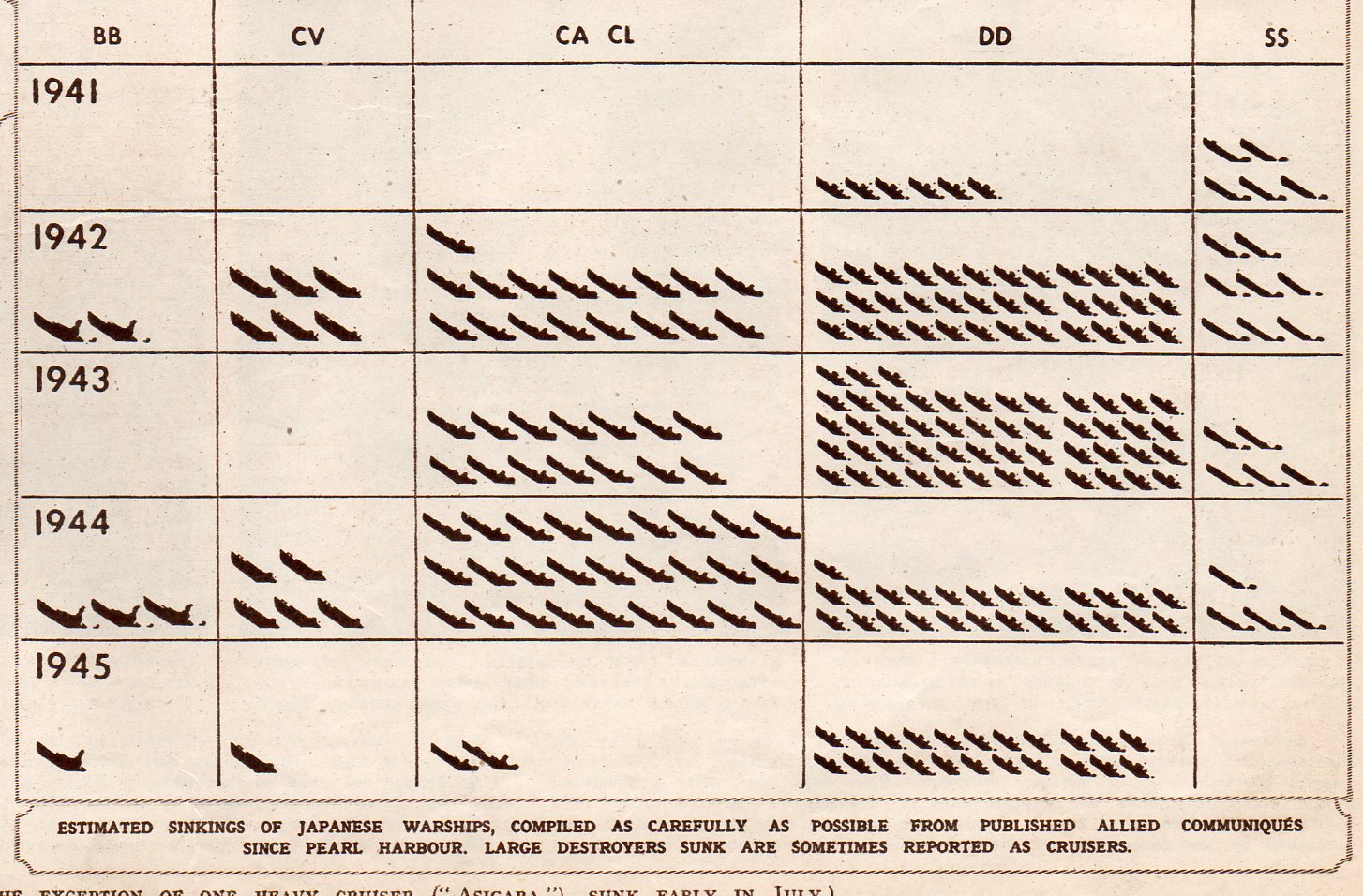
    This chart shows the numbers of each class of vessel sunk by year:

    Japanese Navy 4208


  • Quiet Images of Great Loss and Heroism–British Navy Losses, 1945

    JF Ptak Science Books  Post 1216

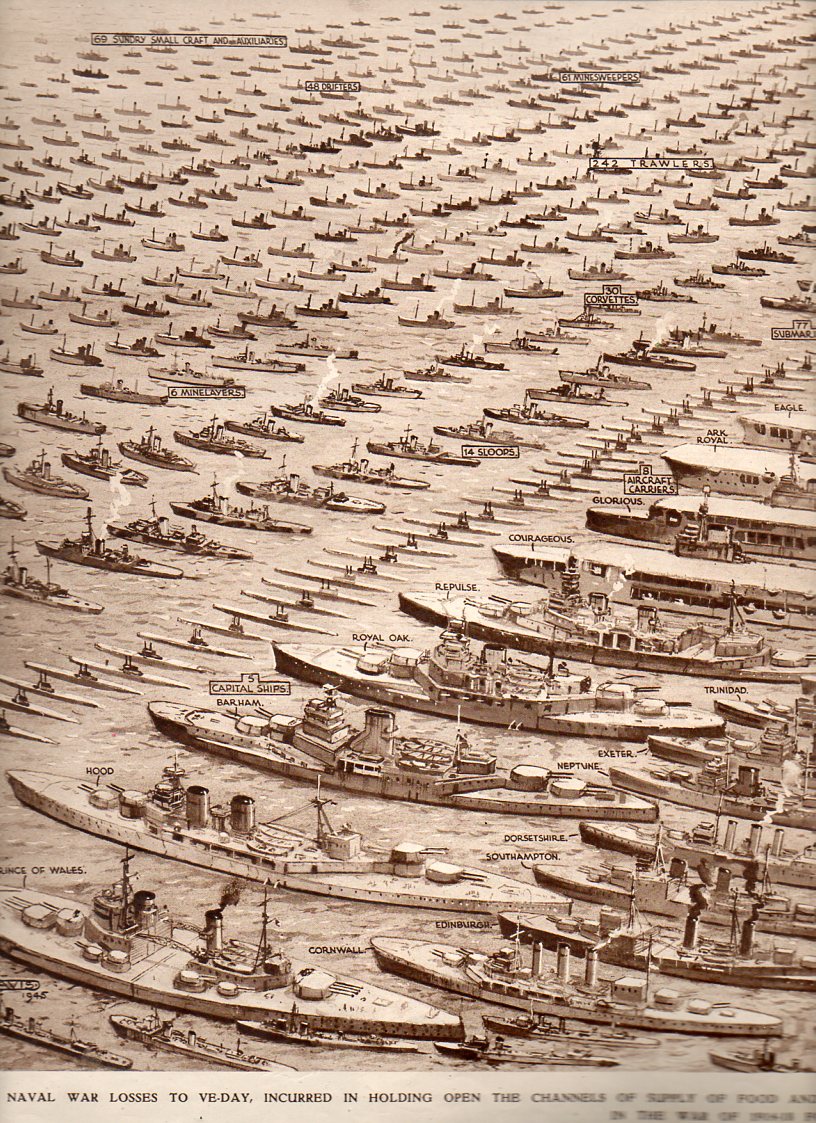
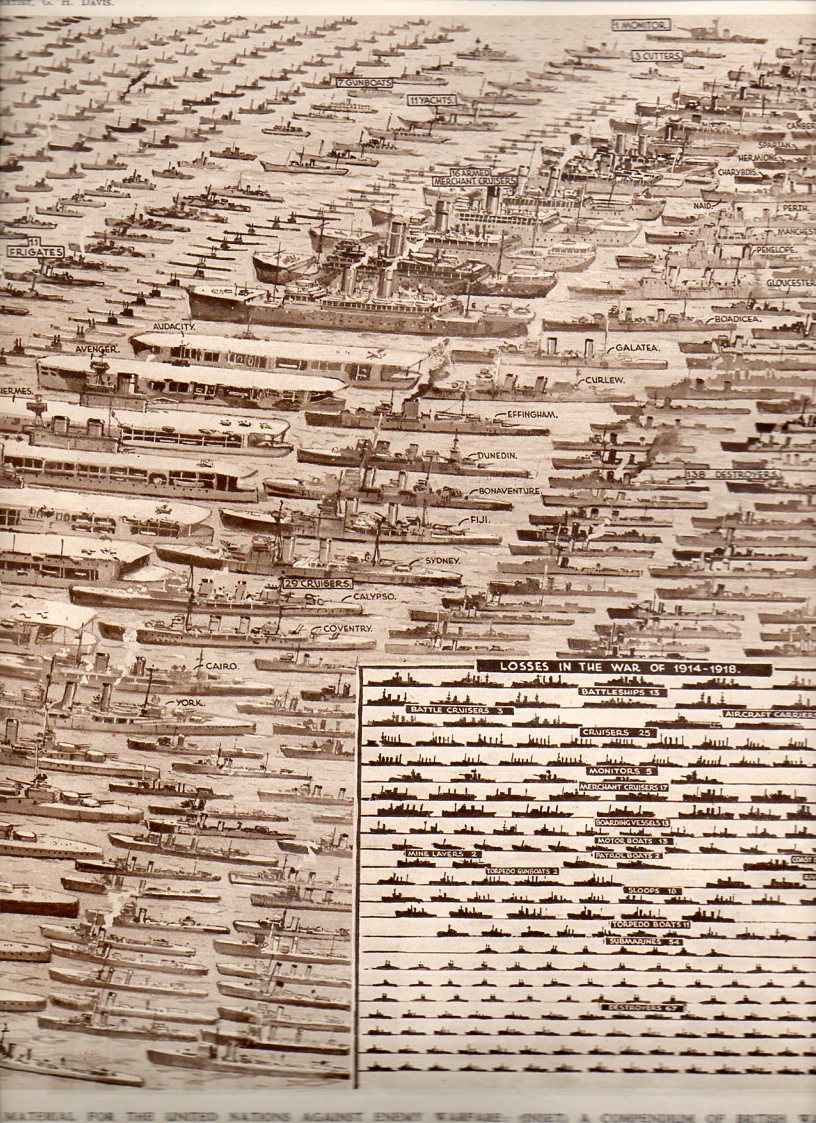
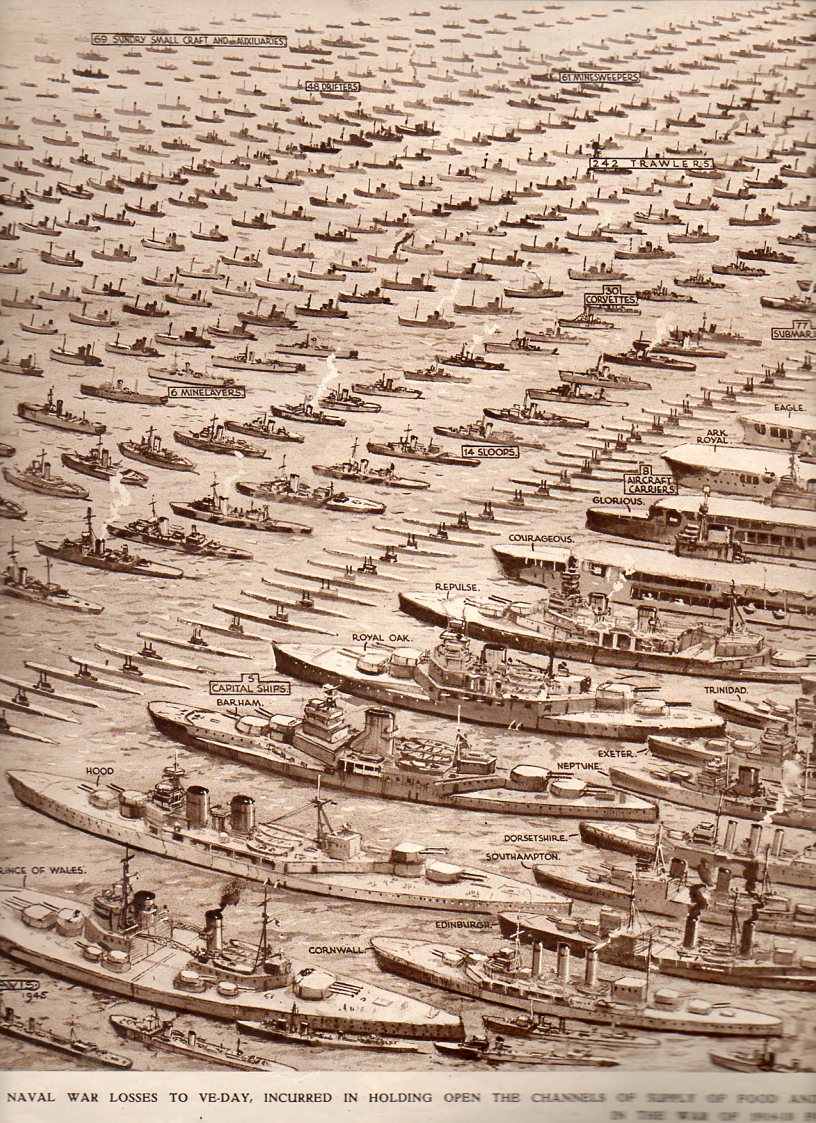
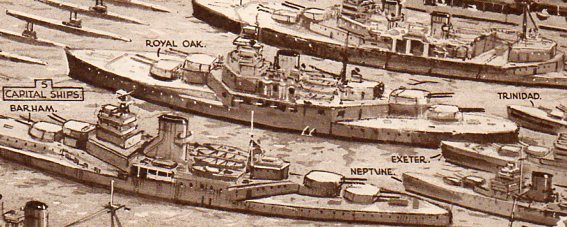
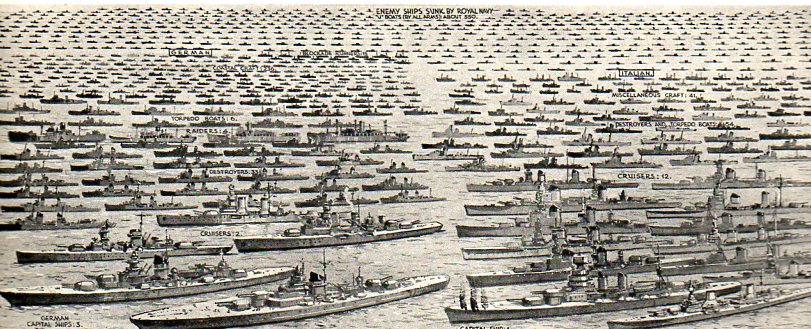
    This enormous, quiet image appeared in The Illustrated London News on 23 June 1945, just weeks after the termination of WWII in Europe.
    Navy Losses--left796 Navy Losses--right795

    It graphically presents every ship lost by Great Britain in the defense of “holding the seas against the Axis Powers…holding open the channels of supply and food and war material” from the outbreak of the war to VE day. The inset narrative states that there were on average nearly 3000 British and Allied ships at sea at any given moment, with the Royal Navy patrolling an aggregate  of 80,000 miles of trading routes, day in and day out
    Navy Losses--left796
    [This image is available for purchase–in the original and in a 30×40″ poster–at our blog bookstore.]

    It is a symbol of loss, of heroism, of lives not lived, of lives saved, of valor, of greatness, of will, of the cold black sea, of burning oil, of red waves, and above all, of sacrifice. Of splendid behavior.

    It is a terrible picture of what victory demanded of bravery.       

    It is as much an image of a military graveyard as anything else, a Remembrancer, especially for  those who were never recovered.  It is a grid, a finding aid, a visualizer, for all of those sailors lost in a sea that is indifferent to particular memory.
    Navy Losses--right795
    I can’t imagine how this image was received by the Illustrated London News reader on that day.  Did they suck their breath in at the scope of it, of the gigantic reminder of what all of those ships represented?  Was it the sort of image-reading that was forced, a white-knuckle, vacant-chested feeling of sweeping loss?  Of loss and gratitude?  Of gratitude and finding purpose for all of those sacrifices to the island nation?  I suspect that all of those words were in the minds of those readers in 1945–and also for emotions that have no words. 
    Navy Losses--left detail797

    Notes:
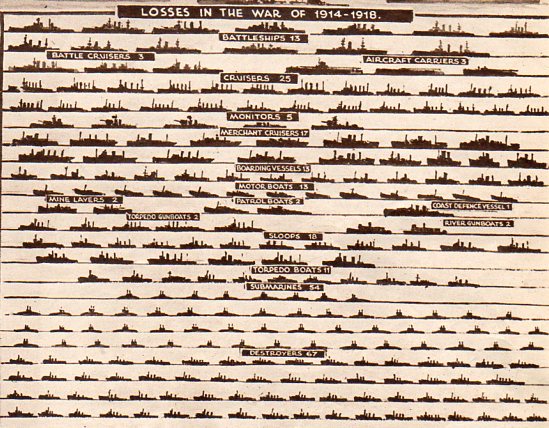
    There is also a small inset that shows in comparison the Royal Navy losses for WWI, 1914-1918. 

    Navy Losses--wwi798

    There is also this, an incredible single-page display of British merchant-marine war losses of 2570 ships.
                Navy Losses--merchant marine799

    Both images are the work of the incredible G.H. Davis, who provided cut-aways, cross-sections, maps, diagrams an all manner of information to the ILN readers throughout the war.  HE was an inexhaustible man of excellent design sense.


  • Thinking Deep about St. Paul’s and the Eiffel Tower–Presenting the Depths of the Oceans in Plaster and Steel,1910

    JF Ptak Science Books   Post 1173

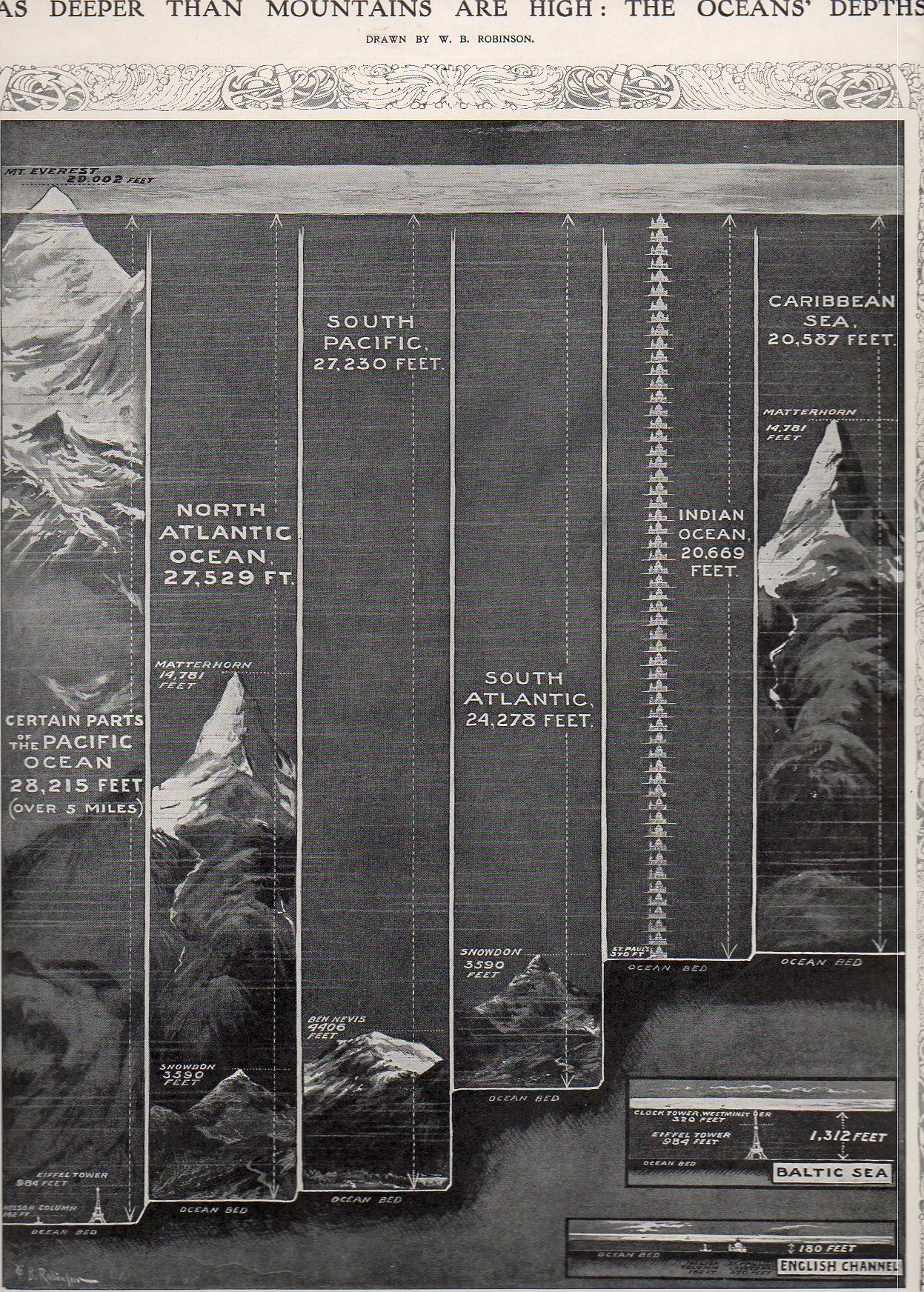
    Although maps showing the depths of the oceans existed from about the mid-19th century (through the pioneering work of the American father of oceanography, Virginia’s Matthew Fontaine Maury1) few casual readers would have ever seen a more approachable representation of information than what appeared in the Illustrated London News for 8 October 1910. Although Maury’s maps are elegant, they didn’t receive nearly as wide a distribution as this ILN image–also they weren’t nearly quite as relational as the 1910 version.

    Sea depths533

    Granted, the 1910 comparison chart only displays one statistic–the supposed greatest dept of five oceans, two seas and the English channel–it does so in such a way as to make those numbers immediately approachable to any reader, which is always an issue in relating scientific information to the general reader.

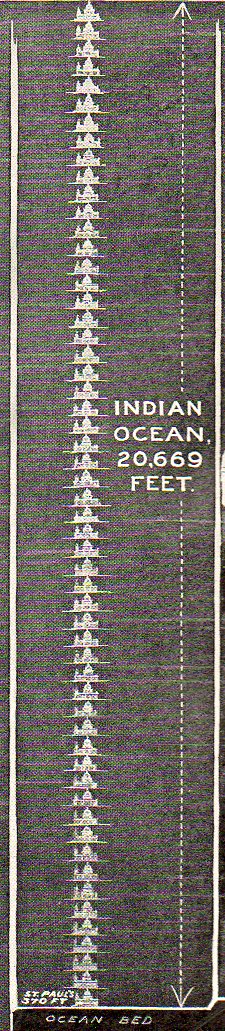
    Sea depths ist pauls537 {One of the standard unit of measurement for the purpose of this display was St. Paul’s Cathedral.]


     What W.B. Robinson presented was a way of looking at an invisible entity through very visible means–comparing depth to the heights of things that everybody in 1910 knew: the Eiffel Tower (relatively newly constructed out of 18,000 prefabricated highly-engineered pieces) and St. Paul’s Cathedral. So rather than stating that the Pacific Ocean is 28,000 feet deep, Robinson chose to replace feet with Nelson’s Column–174 of them. Or 29 Eiffel Towers. The 20,000-foot deep Indian Ocean was actually 56 St. Paul’s deep, while the Baltic Sea was deep enough to not quite cover one Eiffel Tower with one Westminster Bell Tower on top (ha!); and the English Channel at its deepest wouldn’t quite cover St. Paul’s.

    This is really the way to display data in my book, especially to kids.  This is one of the few ways of making the information accessible and understandable across almost all age ranges. 

    Notes:
    1.  Actually the work goes back a century before Maury with Buache, who produced this map of the English Channel in 1737–the data points are veyr numerous, but this is the very first time that such information was available on a map.

    Sea depths idouth pacific536 Sea depths indian535


    NOAA Photo Library Image - map00004

    And Maury again with this first map of an oceanic basin, published in 1853:

    NOAA Photo Library Image - map00001

     And in 1752, Philippe Buache produced this fantastic and first-of-its-kind map for the depths of the English Channel:

    NOAA Photo Library Image - map00186

    Here’s an extraordinary cross sectrion of a part of the ocean floor produced in 1857 by the HMS Cyclops in preparation for laying the Atlantic Cable:

    NOAA Photo Library Image - map00010


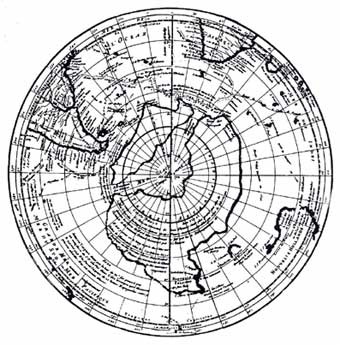
    Its also interesting to note here Buache’s work on this map of Antarctica, published in 1737.  Buache put together all of the known (to him) information about the mass in the South, bits taken from other maps, and accumulated them into what was the best-possible guess on what was down there in the Antiopode.  Pretty good detective work given the amount of material that he could work with.


  • The Kryha Cipher Machine. 1929 [Quick Post]

    JF Ptak Science Books  Post 1169

    [I wrote an earlier post on this blog on ciphers here: Books of Shadows—”Trithemius, Bacon, Porta, & Falconer vs. a Make-Believe Derrida on How to Make Something Unintelligible. Secret Writing and Ciphers”.]

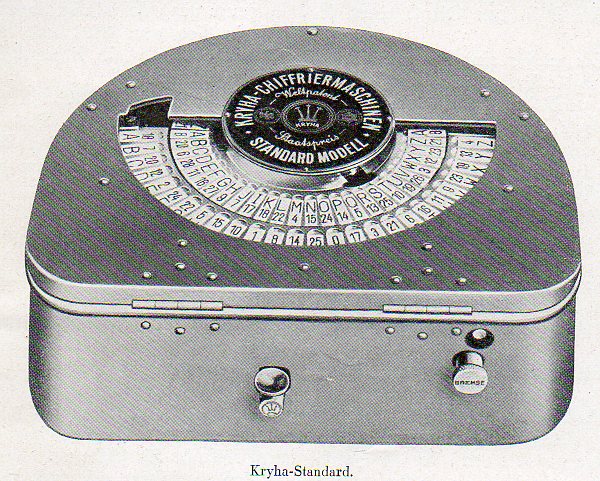
    The Kryha ciphering/enciphering machine was invented by Ukranian Alexander Kryha (d. 1955) and was capable of coding about 350 characters a minute.  It was used to enforce secrecy in business transactions, and was used in conjunction with (at least) Siemens telegraphic equipment.  I found these images (except for the patent drawings) of the Kryha machines in several issues of the Illustrirte Zeitung (Leipzig) for 1929, all of which are unusual and evidently not findable as good copies online–and so I’m simply reposting them here.

    Kryha big527

    Kryha  529


  • Food and Not Having It: Visual Displays of Data, Britain and Germany, 1918

    JF Ptak Science Books    Post 1157

    00-blog--Oct 29 starvation germany953
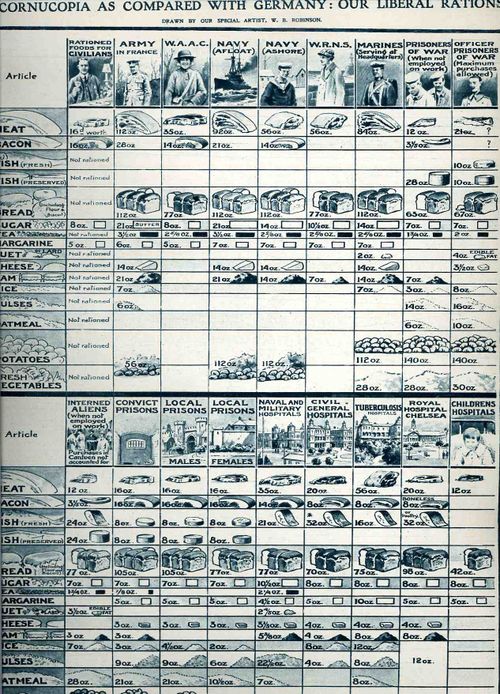
    The idea behind these three images was part of a hearts-and-minds home-front propaganda campaign by the British government to instill fortitude and a feeling of general good in the population, trying to get the message across that British citizens were far better off (in regards to food and staples at least) than their German counterparts.  Even though the situation wasn’t exactly standard in Great Britain in the last year of the First World War, the situation was far more dire in Germany–there was after all an embargo against ships going into Germany or its allies, making it a very difficult to receive food, whereas that problem did not exist in Britain, which pretty much controlled the seas at that point, and could therefore receive food and other material from the Colonies and allies.

    The first graphical display, appearing in The Illustrated London News on June 12, 1918 (and just four months from the end of the War), showed the “ample weekly rations for various classes of the population”.  18 classes, actually, that were enjoying more food than the Germans, the “U-Boat having failed to starve” them. In all of this what comes to my attention first are the allowances for male/female prisoners in England; each getting similar amounts of meat, bacon fish, margarine and fresh vegetables, though for some reason the women are given lesser shares of bread, rice and oatmeal.  The other bit is that the food allotted to the “childrens hospital” is less by far in all categories than everything else.  I’m hoping that this is due to size and consumption differences more than anything else.  I also notice that the officer prisoners of war are given more rations than the enlisted POWs.  Interned aliens are also given short rations, except for fish (Fresh and preserved)  and potatoes, when they get substantially more than anyone else. 

    Unfortunately we do not see what the Germans had to eat, though in the next graphic (same source, though 23 March 1918) we see the “ingenious” ways in which the German people got around not having certain foodstuffs.  The means look more desperate than anything else: meat/sausage for example is replaced by “War Sausage”, which was coagulated ox blood bleached with peroxide, and also by a “vegetable” meat, which was dyed glucose.                                                                                                                          

    00-blog-Oct 27 foes food part II937

    00-blog-Oct 27 ill fed foes 1918935


  • Nazi Propaganda to the French–Leave France Behind and Join Us

    JF Ptak Science Books   Post 1156
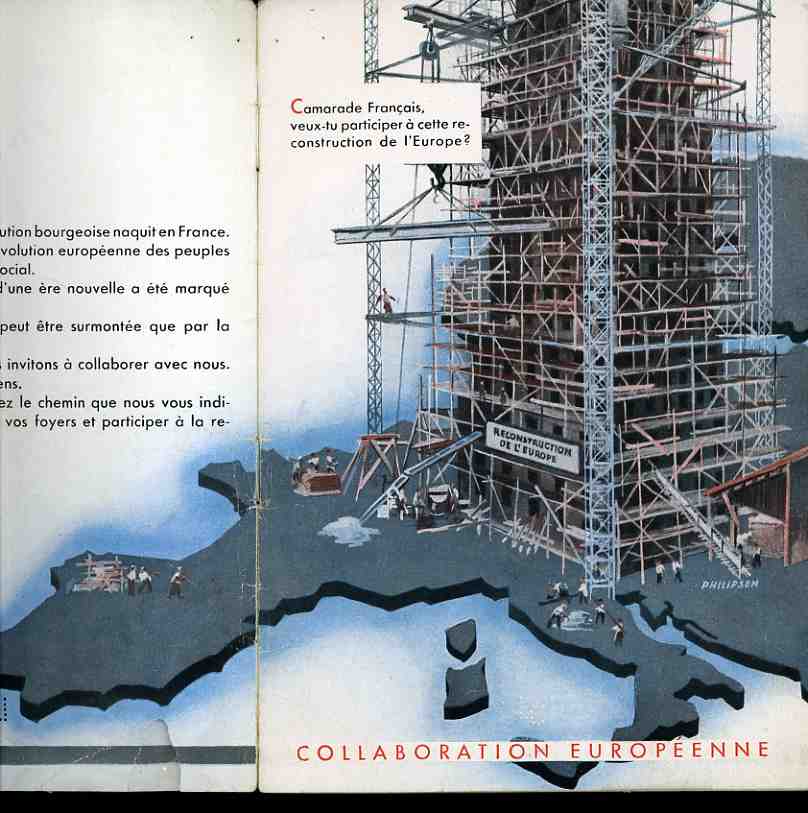
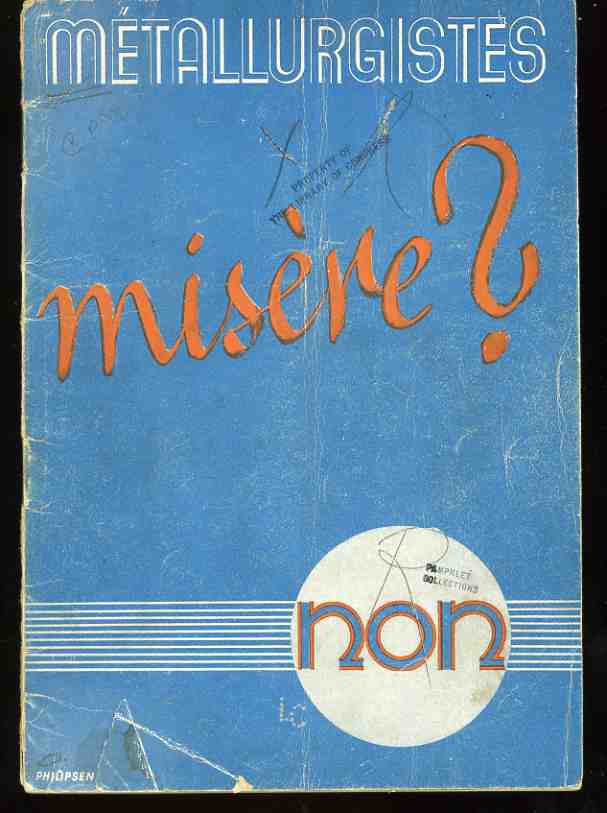
    0--blog-dec 9 vichy cvr220This appeal to practicing French metallurgists by the Nazi occupying force (Metallurgistes misere? Non 1943.) promised good wages, a clean place to sleep, and a livable future.  This included a life for professional metallurgists with a family, as well.  The Nazis were (blood) thirsty for practically-trained “help”, desperate for people with an expertise in occupied France to help contribute to their war effort, and this pamphlet was one means of trying to persuade (via propaganda) or purchase the tacit approval of these professionals.  The Nazis were promising a place to all of those who followed the call, a place in the resurrection of Europe, in the rebuilding of the European community under German/Nazi rule. 

    There was one very odd problem in this pamphlet.  The map shows the creation of this very large allegorical structure, which naturally centers on Germany;

    0--blog-dec 9 vichy cvr219

    but strangely enough, none of the structure seems to touch French
    soil–so much for the “New Europe”.  As a matter of fact it looks as though there is a table with
    three men standing around it at just about the exact place that Paris
    would be.  I’m not convinced that this was intentionally represented
    this way, showing the French reader that France was not going to be
    part of the rebirth–not having France as a part of this new empire
    would seem to be unthinkable–perhaps.  Maybe the issue was to show the inductees that should they decide to stay at home they and their family and the rest of the country will be part of a destitute agrarian Medieval future, that France would not be part of the New Europe, rather than someone screwing up in the Nazi propaganda offices. The screwup is possible though–they were, after all, only Nazis.

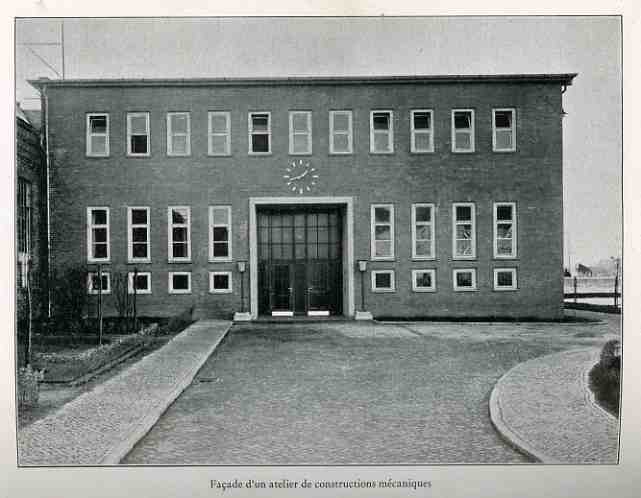
    Photos of the promised facilities:

    0--blog-dec 9 vichy clock222


  • Zippers, Part Two: a Big Lesson from the Humble Zipper

    JF Ptak Science Books   Post 1154

    Blogaugust_28zipper469_2

    Earlier in this blog I made a post about the Ulysses of zipper repair.  How to Repair a Zipper was one of those great, unknown classics of American technolit that stands the test of time, a great manual on how to approach n-problems with a faulty zipper–if only there were zippers worth repairing.  There are different grades of zippers, just as there are different grades of any other fastening device or automobile or wine.  Of course the zipper seems a ridiculous subject unless the lives of people–say the lives of soldiers–are dependent on their zippers working when the going got tough, 
    when soldiers’ jackets really needed to stay closed, tight, protecting them from the rain or cold.  Just ask the soldiers in 
    Zipper trouble465

    the Napoleonic army when their coats refused to stay closed because the threads that held on their  buttons that held their jackets closed failed, leading to the death of many due to exposure and cold.  Suddenly, fasteners are a big deal.  Just try it the next time you’re out on the frigid trail–unzip your jacket and try to keep the thing closed and you warm.  Its a bad story. 

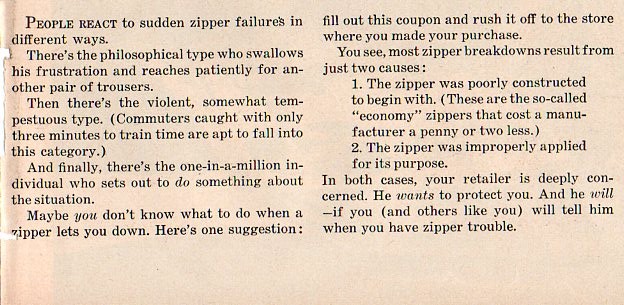
    So the initial reaction to this ad that appeared in Life magazine in 1953 is some laughter to a non-sequitor, but once you gave it a little thought, it can be appreciated just like any other piece of good craftsmanship.  In this ad, the manufacturer of Conmar Zippers (located in the once-mighty, once-leading American city of Newark, in New Jersey) plead with the reader of the full-page ad to pay attention to the zippers on their apparel.  If the zippers fail , they should use the blank form to send to their appropriate retail in complaint, and to replace the zipper with a high-quality, unconditionally guaranteed Conmar zipper, made to never fail. 

    This is attention to the small detail that would do us a world of good today. I love the idea of the Conmar Zipper.

    Zipper trouble 2466


  • Department of Strange Steampunk: Oddest Place to Find a Locomotive?

    JF Ptak Science Books      Post 1096

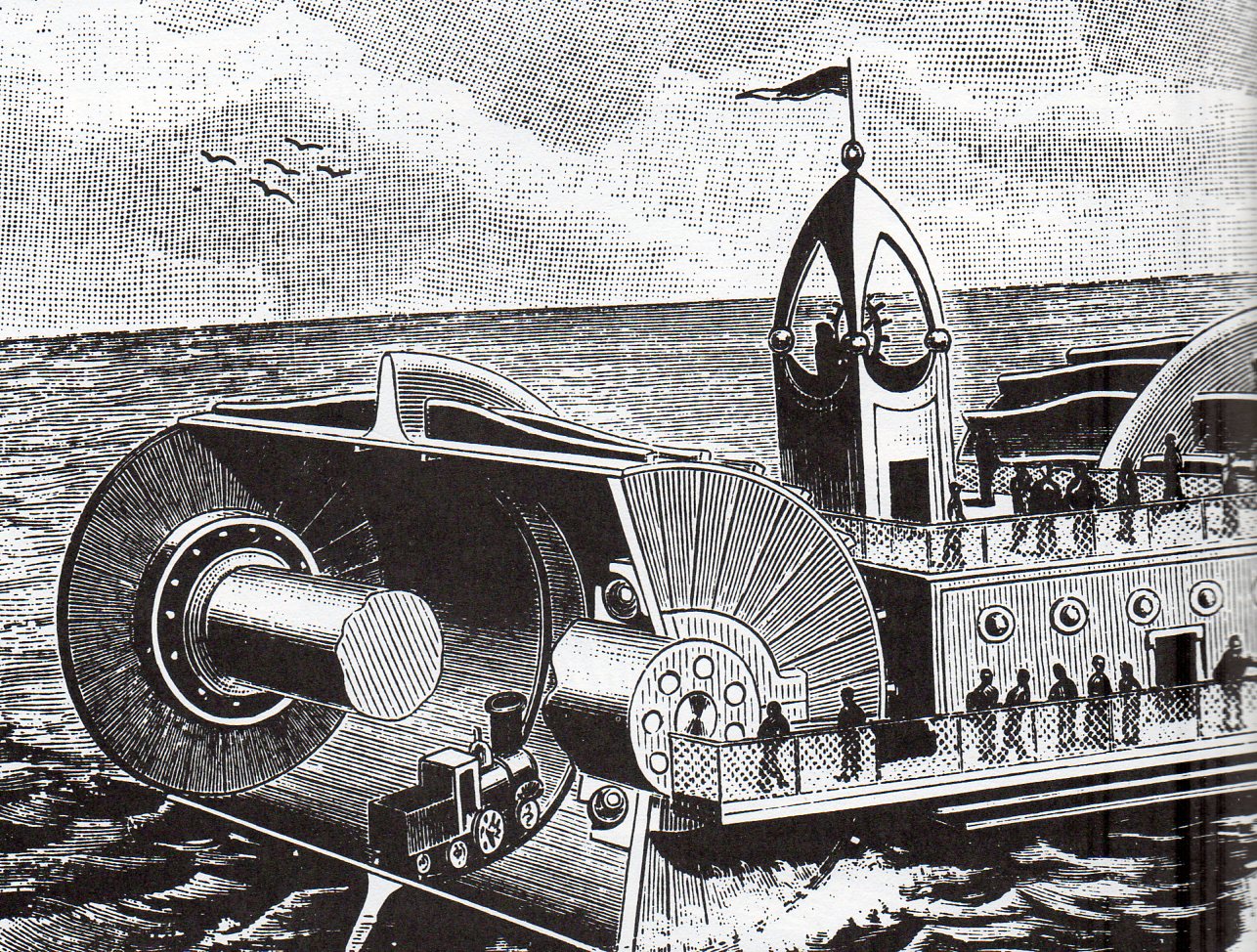
    I think perhaps one of the oddest places to find a locomotive is in the inside of a propeller of a ship on the high seas. 

    What is it--loco in ship227

    This image really belongs to the sub-category “Out of Place Department”, along with the unexpectedly-found restaurant at the top of a punked-out 19th c Eiffel Tower, a swimming pool in the bottom of a mine shaft, a steamboat along the side of a mountain in Amazonia, and so on.  Seeing this strange sea craft and the cutaway schematic showing the man-sized locomotive (and tender) was very exciting and unexpected as well, perhaps more so than most of the unexpected steam/electro punky thingsa that I come across.

    It appeared as a real-life suggestion as “Chapman’s Roller Vessel” in (ca.) 1897 and looks o be a squarish, blocky ship of questionable seaworthiness, fitted out with two hollow cylindrical props powered by two small small-gauge locomotives running infinitely on  small-gauge tracks inside of them, push-pulling the ferry  through the water.  (I wonder about access to the engine and how to control its stopping and starting; I would only hope that there wasn’t someone at the locos’ controls.)

    It seems to me to be a bad idea of a high order.


  • Wings Taking over Prayers: Human Flight in 1714

    JF Ptak Science Books  Post 1090

    Valentini216

    The esteemed Michael Bernhard Valentini (1657 – 1729), professor of  medicine and of physics at Giessen, Germany and natural history collector, produced one of the century’s   most important works on the state of museums and natural history collections.  Actually, his Museum Museorum1 was much  more than that, its three volumes presenting more descriptions and illustrations of all manner of scientific things than just about anything else of the pre-encyclopedist 17th century. There are many “firsts” to be found in this work, including numerous first-time description of fossils, tropical plants, American botanical specimens, techno items, shells, and on and on, not to mention sections on monsters, dragons and mythical creatures. 

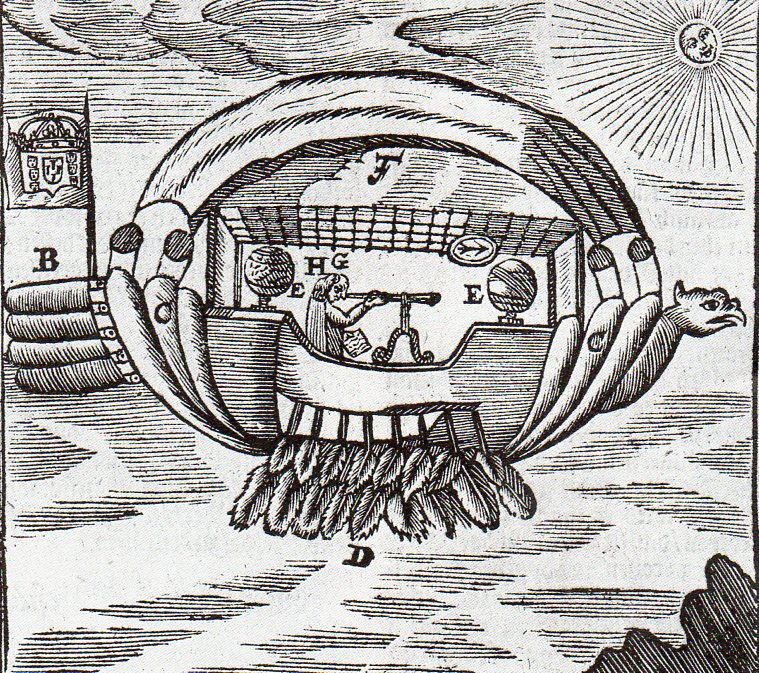
    One image that caught my attention appears in volume two, and seems to me to be a flying machine, though I can’t recover how it is being kept aloft, or what is providing its power.  The pilot is keeping a sharp eye on things with a  telescope, and is reckoning position with a compass2 and two globes.  The canopy of the aircraft seems to be just that, some sort of cloth held in place by pulleys and ropes, though I don;’t know what is providing lift, if anything.  Perhaps the whole thing finds its lift and propulsion with the many feathers on the craft’s keel.  I’m not sure.  But I can say that I don’t recall any other earlier image of a pilot using a telescope and compass.   

    Valentini also assembled an enormous natural history collection of his own, and in addition to his spectacular collection of the state of scientific and technical knowledge at the begininng of the 18th century, he also included in his book a  list of 100+ museums/collections of natural history objects–an extraordinary document for the time and unfortunately one that can’t be reproduced here.