A Daily History of Holes, Dots, Lines, Science, History, Math, Physics, Art, the Unintentional Absurd, Architecture, Maps, Data Visualization, Blank and Missing Things, and so on. |1.6 million words, 7500 images, 4.9 million hits| Press & appearances in The Times, Le Figaro, Mensa, The Economist, The Guardian, Discovery News, Slate, Le Monde, Sci American Blogs, Le Pont, and many other places… 5000+ total posts since 2008.

Category: Books–title pages, beautiful

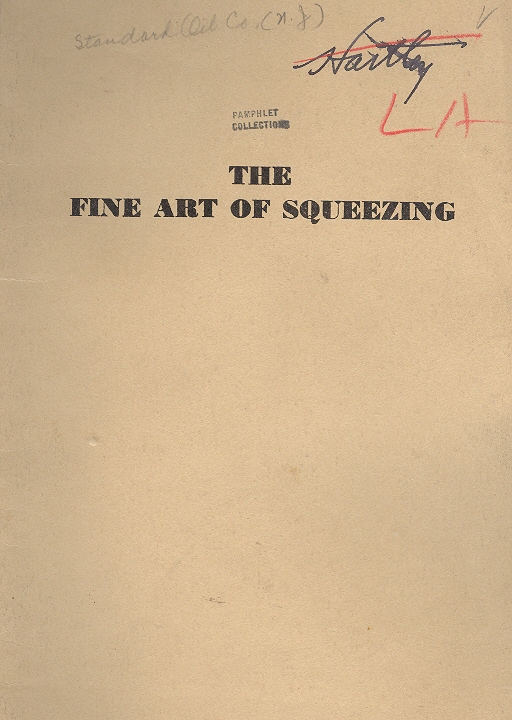
  • Bizarre Titles with Real Content: the Fine Art of Squeezing

    JF Ptak Science Books LLC  Post 612   Blog Bookstore

    The Heart is a Lonely Hunter, This Side of Paradise, Revolutions of the Heavenly Spheres, In Praise of Folly, the Divine Comedy,  Pride and Prejudice.

    Sometimes magnificent titles of books deliver magnificent things.

    Blog--may 11--odd 001

    Then there are the uneven, unruly titles hiding great works like Aristtotle’s On Youth and Old Age, On Life and Death, On Breathing; Das Kaptial, On the Origin of Species, Paradise Lost, Brothers Karamazov,  Tractatus Logico-Philosohicus.

    There are badly-titled books that are just bad–we don’t need to get into that right now, wounding the wounded.

    And then sometimes a book title promises a lot and delivers it–but not the “a lot” that you expected.  The Fine Art of Squeezing, god knows, is a title that demands attention.  I thought, well, I’m not sure what I was expecting–possibly it would actually be on squeezing things. (I’ve seen many examples of this sort of bizarre title/content continuity, so I thought it a possibility.)  But  the story here is delivered by the Standard Oil Company of New Jersey and details their properties being nationalized–squeezed–by the government of Mexico in 1938.  It is one of a series of pamphlets, and it evidently sucked up every bit of creativity at Standard Oil:  The Question of Subsoil Rights in Mexico and The Accustomed Practices in Cases of Expropriation and Confiscation are two titles that deliver the contents’ good accurately and dryly.  This singluarly-titled work also has chapter headings that equally lovely and bizarre:  “The Revolutionary Squeeze”, “The Constitutional Squeeze:, “The Concession Squeeze”, “Strangling the Goose “and other fortifies the reader with the possibility of a surreal experience.  It is not, of course–it is a competent and direct summation of Standard’s deal with Mexico. 

    Blog--may 11--odd 003


    Soap…in Everyday Life is another one of those lovely naive titles, though it only hides a very accurate and authoritative display of Soap Knowledge, published by the Colgate-Palmolive-Peet Co. The draw to this pamphlet for me stops as soon as you open it.  (It is a happy little soap-making theme on the cover, though.)

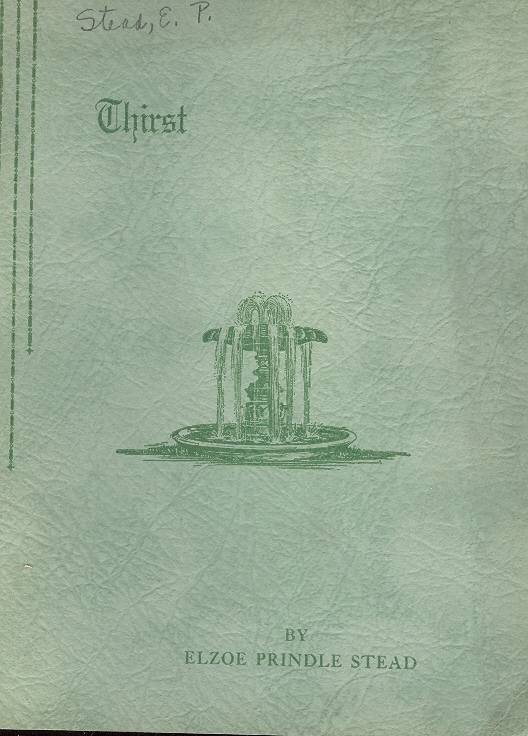
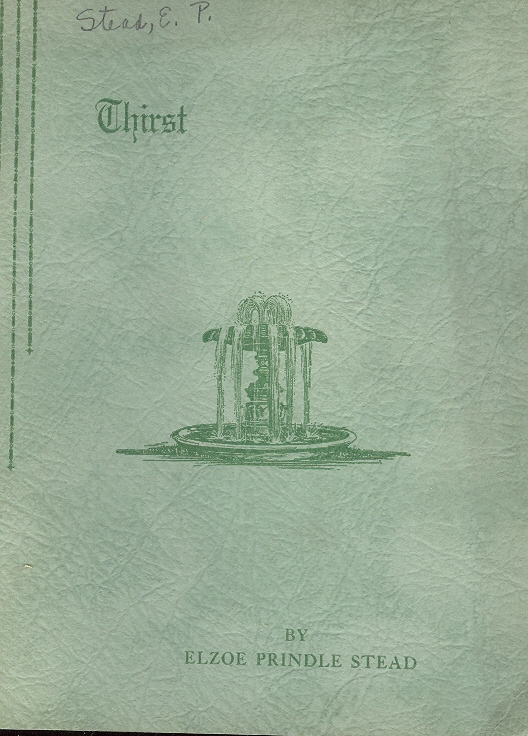
    Thirst is another disappointment–weird title and design, and was written in 1937 (and self-published) by Elzoe Prindle Stead.  The joy of the title is quickly dissolved by the content, with chapter headings such as “Born Once”, “Once to Die”, “Going to Hell”, “For Him of the Second Death”, “Forgotten or rejected Savior”, and “Jesus goes to the Cross.  Its a major proselytizing vehicle which defines itself with the last chapter title, “Why Not”. 
    Blog--may 11--odd 


  • The Most Important Menu in the History of Computing–the NORC, John von Neumann, & the Weather

    JF Ptak Science Books LLC  Post 576

    “There is no mystery about these machines[computers]. The mystery is how the human brain has been able to develop them. These devices are merely small tools which men have devised to help them do a better job.”–Thomas J. Watson, chairman of the board of IBM, 1954

    [I need to thank my friend P.J. Mode for pointing this connection out to me years ago!]
    Norc--von n group
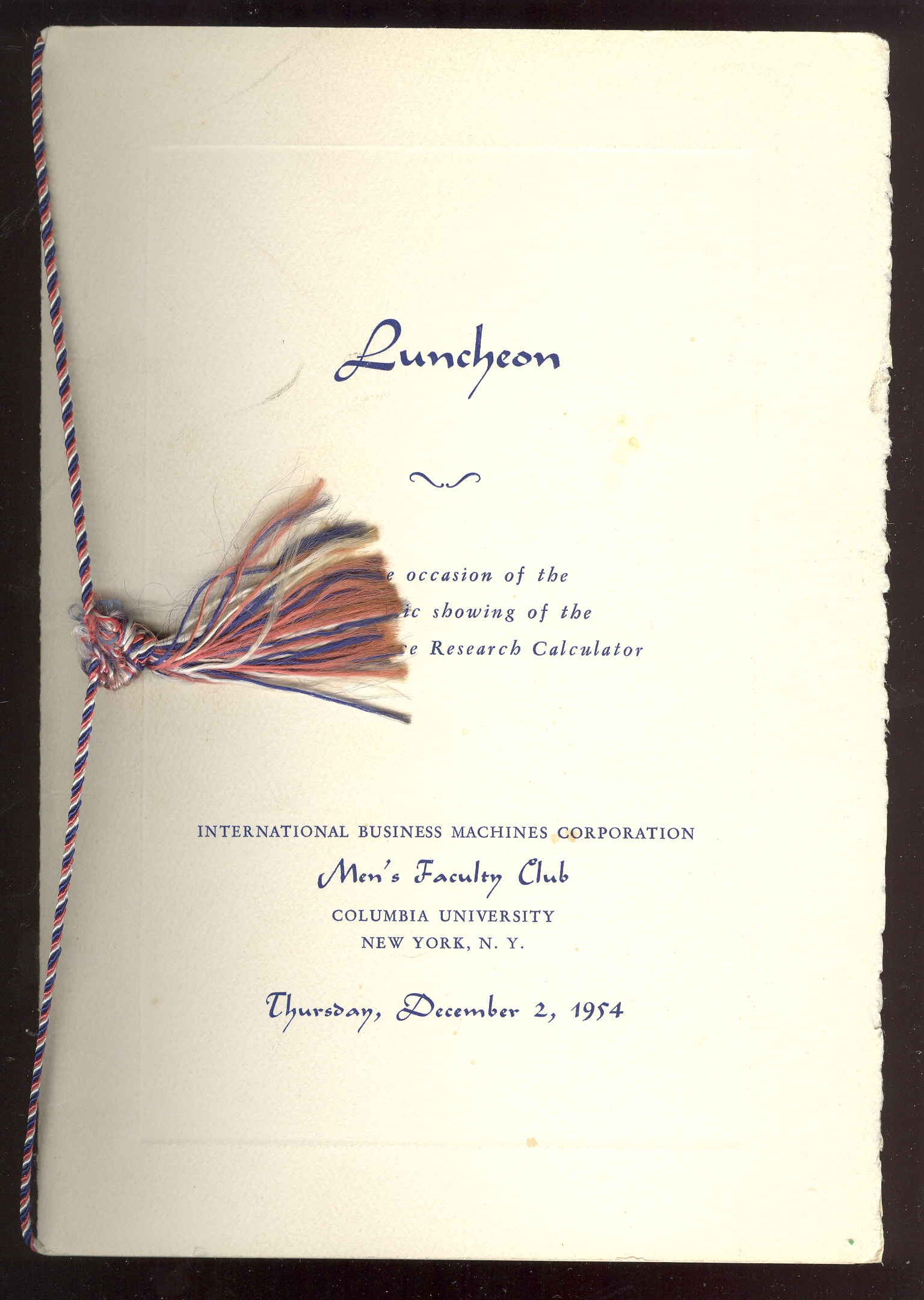
    Here is something that one doesn’t get to say very often:  this is perhaps the most important memory in the history of computing. 

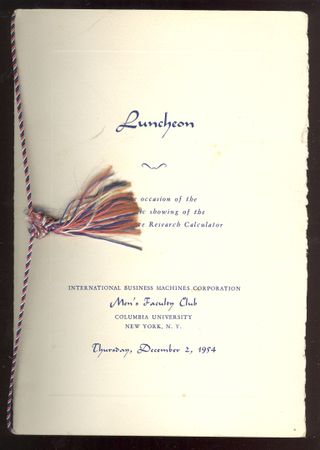
    This is the luncheon menu for the dedication of the NORC “Calculator” (the Naval Ordnance Research Calculator) a computer which was constructed principally with IBM parts and built at the Watson Scientific Computing Laboratory at Columbia.  The NORC was the world’s first supercomputer, and the most powerful computer on the planet for about ten years (from 1954 to 1963, until it was surpassed by Seymour Cray’s CDC 6600 in 1964). 

    The NORC was an astonishing accomplishment, difficult to summarize simply, really, though a very good example is that provided by Dr. Paul Herget, the director of the Cincinnati Observatory.  Dr,. Herget used the NORC in 1956 to make precise calculations of the earths orbit for the 1920-2000 period.  Dr. Herget said: “We used nine hours of running time and completed more computations than had ever before been done at one time in the history of astronomy.’”

    Outside of celebrating the accomplishment of the NORC, the luncheon was also  important for the remarks of the principal speaker, John von Neumann.  Von Neumann of course was perhaps the most expansive mind of the century–a thinker of phenomenal proportions and the father of the modern computer.  His brain was impossibly big.  Impossible. 

    During the luncheon von Neumann made prescient and extraordinarily wide remarks on the future utility of the computer.  Some of the highlights (from the entire address, included below):

    –it is now “practical and feasible” to forecast, with the NORC, the weather for an entire hemisphere thirty or sixty days ahead

    –calculation of the tidal motions of all the oceans, the marginal movements near the continents as well as the main motions of the oceans

    –the hydrodynamics of the earth’s fluid core

    –“In the statistical field, dealing with matters which are not wholly mechanical, such as troop operations and logistic operations which involve purely accidental factors like the prevailing weather during the operation, command decisions which have not yet been officially made can be stipulated and various solutions for various alternatives calculated. This has been done before on a minor scale but it takes too long to do on a large scale. “In this field the importance of NORC is enormous…”

    –in the first four hours of operations the NORC  performed more work than any calculator of ten years ago has performed in its entire lifetime. He termed this performance “completely fantastic; I doubt if it has ever been done before.”

    Norc--von n group menu

    The last section of von Neumann’s comments:

    “The last thing, which is very important, is said in fewer words, but I think that it is none the less important. And it is this: In planning new computing machines, in fact, in planning anything new, in trying to enlarge the domain of parameters with which one can work, it is of course customary and very proper that one should consider what the demand is, what the price is, whether it will be more profitable to do it in a bold way than in a cautious way, and so on. This type of consideration is necessary — the world would very quickly go to pieces if these rules were not observed in 99 cases out of a hundred.

    “It is terribly important that there should however be one piece in a hundred where it is done differently.

    “And that one uses the definition which Dr. Haven (?) pointed out 20 minutes ago, namely to occasionally do what the U. S. Navy did in this case and what IBM accepted in this case: to write a specification essentially to build the most powerful machine that is possible in this day with the present state of the art. I just hope that this will be repeated very soon and will never be forgotten.    http://ftp.arl.mil/~mike/comphist/54nord/

    It may be the last statement that is the most important–pressing those of the present and future to perform
    Norcd

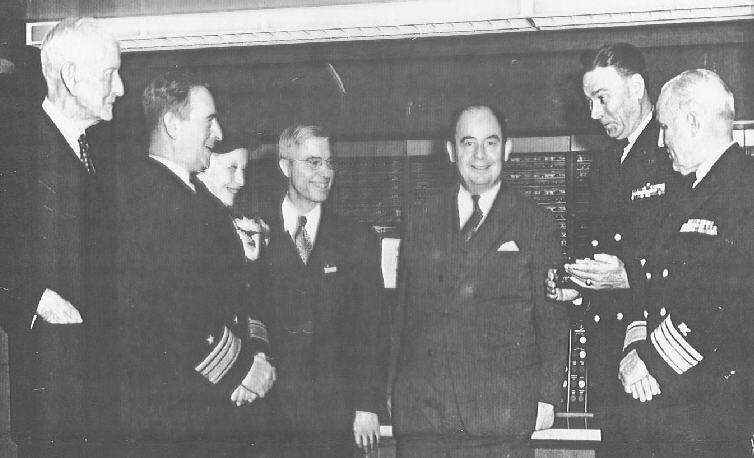
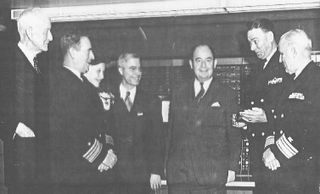
    The NORC group caption from the IBM Archive website:
    “At the NORC dedication in Watson Lab, 2 December 1954: IBM Chairman Thomas J. Watson, Rear Admiral E.A. Solomons (Executive Office, Secretary of the Navy), Jeannette Watson (Mrs. Watson Senior), Columbia Professor Wallace Eckert, John von Neumann, Captain C.K. Bergin (Director, R&D, Bureau of Ordnance, Dept of the Navy), Rear Admiral C.G. Warfield (Executive Office, Secretary of the Navy).”  The Navy is happy here because they wound up with the computer at Dahlgren.  Von Neumann was happy because he got to play von Neumann his whole life long. 

    The IBM press release for the NORC included the following summary of the event and the von Neumann address:

    NORC Press release//The following is the text of a December 2, 1954 IBM press release regarding the first public demonstration of NORC and its official “delivery” to the U.S. Navy.

    The first public demonstration of NORC (Naval Ordnance Research Calculator), fastest and largest capacity electronic calculator in existence, which has been built by International Business Machines Corporation for the Bureau of Ordnance, U.S. Navy, was conducted today at the Watson Scientific Computing Laboratory at Columbia University in the presence of approximately 150 representatives of the U.S. Navy and other Government departments, education and scientific research institutions and industrial companies. The machine was accepted on behalf of the Bureau of Ordnance by Captain C. K. Bergin, USN, Assistant Chief of research and development of the Bureau, from Thomas J. Watson, Jr., president of IBM.

    At a luncheon following the demonstration, Professor John Von Neumann, of the Institute for Advanced Study, Princeton University, and an appointee to the Atomic Energy Commission, discussed possible uses for the NORC other than for the immediate problems of the Bureau of Ordnance, instancing the field of geophysics as having great possibilities.

    It is now “practical and feasible” to forecast, with the NORC, the weather for an entire hemisphere thirty or sixty days ahead, by calculations occupying perhaps 24 hours, with results about as good as those obtained by an experienced subjective weather forecaster, “which are very good.” Calculations similar to those now made, forecasting weather over the area of the United States for 24 hours in advance, could be made on the NORC in perhaps half a minute, he stated.

    Complete calculation of the tidal motions of all the oceans, the marginal movements near the continents as well as the main motions of the oceans, is now, with the NORC, a matter of days and therefore feasible. He also declared that calculation of the hydrodynamics of the earth’s fluid core, the movements of which are responsible for the main phenomena of terrestrial magnetism, “becomes probably accessible for the first time.”

    In the statistical field, dealing with matters which are not wholly mechanical, such as troop operations and logistic operations which involve purely accidental factors like the prevailing weather during the operation, command decisions which have not yet been officially made can be stipulated and various solutions for various alternatives calculated. This has been done before on a minor scale but it takes too long to do on a large scale. “In this field the importance of NORC is enormous,” Dr. Von Neumann said.

    He concluded by pointing out that the NORC was assembled less than two months ago and put on test less than two weeks ago, yet in a test yesterday (Wednesday. Dec. 1) it ran for four hours without an error, doing in this period more work than any calculator of ten years ago has performed in its entire lifetime. He termed this performance “completely fantastic; I doubt if it has ever been done before.”

    Dr. Grayson L. Kirk, president of Columbia University, stated that during the test period the NORC will be available to the University for important research projects, particularly in the field of nuclear physics, before it is shipped to the Naval Proving Ground, Dahlgren, Va. to be installed in the Computation Laboratory already established there.

  • On the Under- , Partial and Full Discoveries of Oxygen

    JF Ptak Science Books LLC  Post 574

    Oxygen
    Our sea of air is composed of atoms, and the atoms are
    mostly nitrogen (78%) and oxygen (21%), and the atoms are of course all around us; though
    as obvious as it is, as present as it is, the most active component of air, oxygen,
    remained under-discovered until relatively late in human history.  Oxygen is present in all major classes of
    structural molecules in living organisms and in all manner of inorganic
    compounds, and is   When it was
    discovered, it really wasn’t; or it wasn’t discovered and recognized until the
    second time around.  But the stuff that
    was whirling around its near discoveries were important in themselves for their
    constituent parts. 

    Johann Joachim Becher (born in 1635 and dead at 47 in 1682)
    got part of the way there, though he didn’t discover oxygen—he discovered the
    thing that oxygen wasn’t: 
    phlogiston.  But the phlogiston
    theory worked a little, but not a lot. 
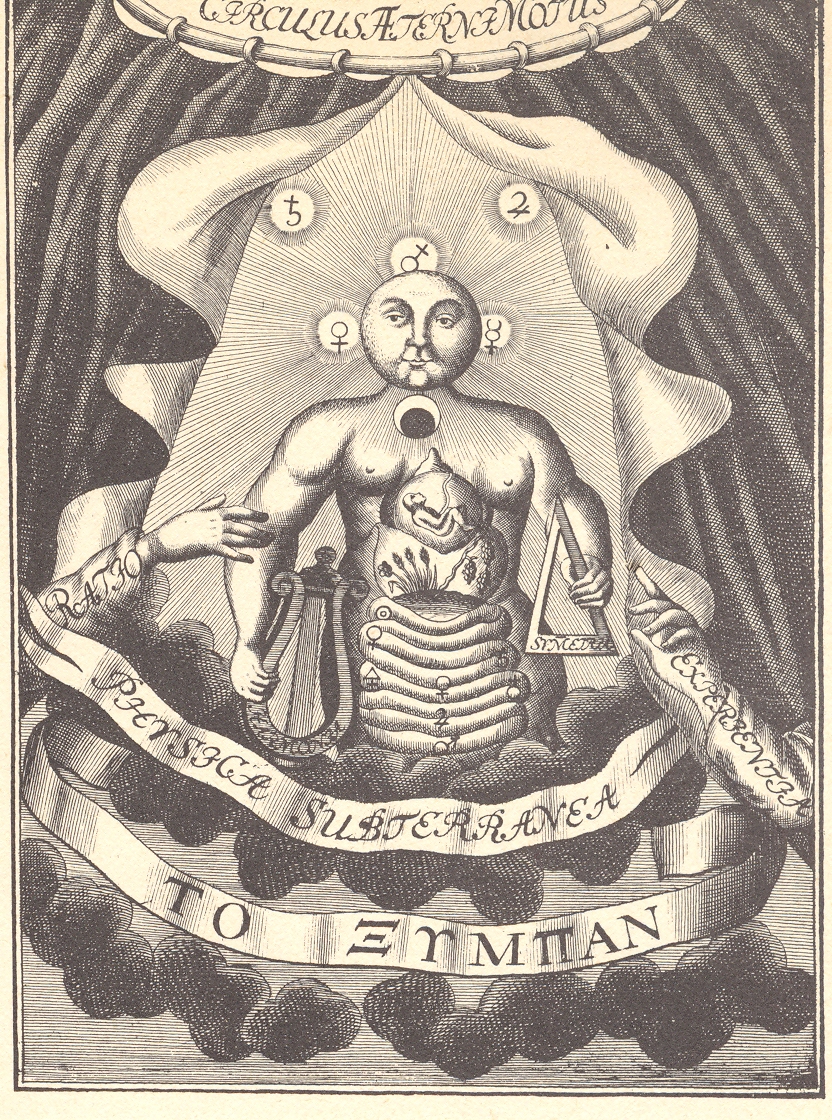
    The theory appeared in his book Physica
    subterranean profundam subterraneorum genesin e principiis bucusque ignotis…
    and
    was published in 1669. (Actually, his Subterranean book was published just a
    few years after our old friend Athanasius Kircher’s masterpiece Mundus Subterreaneus. Just a tired note
    from the small-world category.)  Actually
    what the phlogiston theory “did” was explain the process of fire and
    oxidation—phlogiston was the colorless/odorless/undetectable stuff that was released
    from the combustibles of the four elements of the Greeks when they rusted or
    caught on fire. Once the phlogiston was released, the true nature of the
    material that once held it was then revealed. 
    As James Conant wrote in. The Overthrow of Phlogiston Theory: The
    Chemical Revolution of 1775–1789
    . Cambridge :
    Harvard University Press (1950, page 14):

    “…in general, substances that burned in air were said to be
    rich in phlogiston; the fact that combustion soon ceased in an enclosed space
    was taken as clear-cut evidence that air had the capacity to absorb only a
    definite amount of phlogiston. When air had become completely phlogisticated it
    would no longer serve to support combustion of any material, nor would a metal
    heated in it yield a calx; nor could phlogisticated air support life, for the
    role of air in respiration was to remove the phlogiston from the body.”

    The other thing that happened was that the phlogiston
    released into the air could not on its own support life.  That meant it wasn’t not oxygen, it was the
    opposite of oxygen:  anti-oxygen.  Anti-oxygen is an interesting, very science
    fiction-y topic, a very cool brick for 
    the edifice of contracting imaginary worlds.  But in the world of the late 17th
    century and for another hundred years, it as the material of theory. 

    Becber’s
    Physica was actually not that at all,
    either:  it was a work on chemistry, and
    alchemy, and addressed itself too to the positive possibilities of
    transmutation.  On the other hand, Becher
    was the very first to attempt to construct a theory of chemistry.  As stated by Thompson in his history of
    chemistry:  “(Becher) was the first
    person who can with propriety be said to have attempted to construct a theory
    of chemistry; Boyle, who was responsible for hastening the downfall of
    alchemical and other onions, did not attempt to set out (such a theory)…”

    Joseph
    Priestly on the other hand did actually discover oxygen in 1774—or at the very
    least was the first to get into print about the discovery, establishing priority
    over 
    Carl Wilhelm Scheele who seems to have
    discovered oxygen first in 1773 but was second in print on the matter–but he couldn’t believe
    his own results enough to dislodge phlogiston, and went to his grave an
    unredeemed phlogistonist. ((I admit to being pretty flippant here, as Priestly
    was an enormously talented man, at high rank in part of the great panoply of
    scientists; he was also a great political observer and pamphleteer who paid dearly
     for his morality.)  It took Antoine Lavoisier’s beautiful
    experiment in 1777 that established the work of Priestly and Boyle beyond
    question, killing phlogiston once and for all. 
    As a matter of fact Lavoisier also published his account along with a
    general treatise on chemistry in his
    Traité élémentaire de chemie—a book that looks remarkably fresh for being
    printed in 1789—completely it at age 47, just four years before he was
    guillotined for being seen as an enemy to the people of France.  But that (along with the exceptional Mme.
    Lavoisier, is another story).
     

    _____

    The illustration above is actually from the 1738 edition of Becher.


  • Locating Chaos: Giovanni Della Porta’s Natural Magic and Chaos in the Sky

    JF Ptak Science Books LLC  Post 571

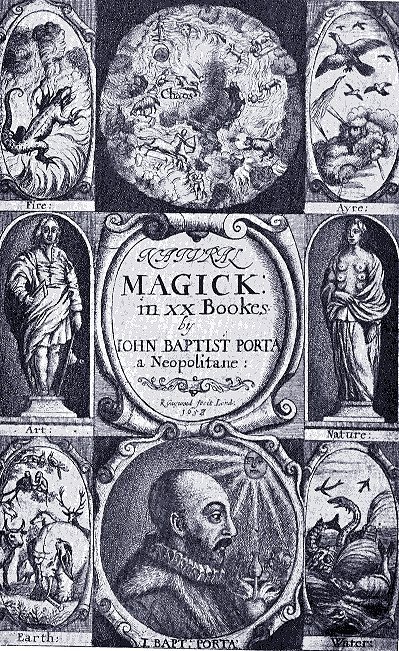
    Porta title page
    Giovani Baptista della Porta was a magus, or a natural
    magician*, who searched nature for similarities that would serve to build a
    broad template of forced  understanding of seeming likenesses, looking for the great connector
    in the exceptional and the unusual, the stuff outside of the formerly
    Aristotlean world.   Natural Magic is his magnum opus, an expansion of  its earlier
    version (Magna naturalis)  published in Latin in 1558, which Porta expanded to twenty sections in 1589. It was an encyclopedic work of vast proportions, a
    gold-mine of information and clever wishfulness, and very accessible due to
    Porta’s  wide inter-personal travel**,
    very wide reading and critical abilities, clear reasoning and deep vision:  the book was hugely successful, going into at
    least twelve Latin, four Italian, seven French, two German, and two English
    editions in the early modern era. Natural
    Magic
    , which first appeared in English in 1658, concerned itself with
    magic, alchemy, optics, geometry, cryptography, magnetism, agriculture, the art
    of memory, munitions, and many other topics, all grouped together and refined,
    distilled, into a cloudy assemblage of natural knowledge—it would end up that the magical
    whole was worth far less than the sum of its parts. 

    But the parts were pretty considerable, and much of the
    information was spot-on for the time, not the least of which was a very capable
    demonstration and explanation of a lensed camera obscura. 

    What I’m interested in right now though is the title page of
    the book.

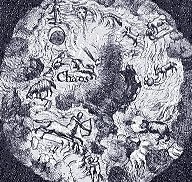
    Porta title page detailIt turns out and as we can see in the top image of the
    title page, Chaos is not some subspace trajectory of cellular automata, or in
    Dr. Brown’s/Einstein’s dancing dust—it is right above us.  This recognition of its regular, localizable structure
    probably does not support parameterization, or anything else for that matter,
    except to say that it is definitely “pretty”. 
    The title page has nine illustrated compartments:  the four corners depict the four elements,
    the two opposing middles show art and nature; the bottom shows the author,
    illuminated by the knowing sun.  The top
    center image is the element showing “chaos”, which I’ve chosen to use a map,
    identifying where exactly chaos might be. 
    I’ve not seen an antiquarian map identifying chaos, though I have seen a
    number showing lots of other non-existent places, like heaven and hell and
    purgatory and Eden and the Kingdom of Prester John, to name a few.  But not chaos.

    Porta sky

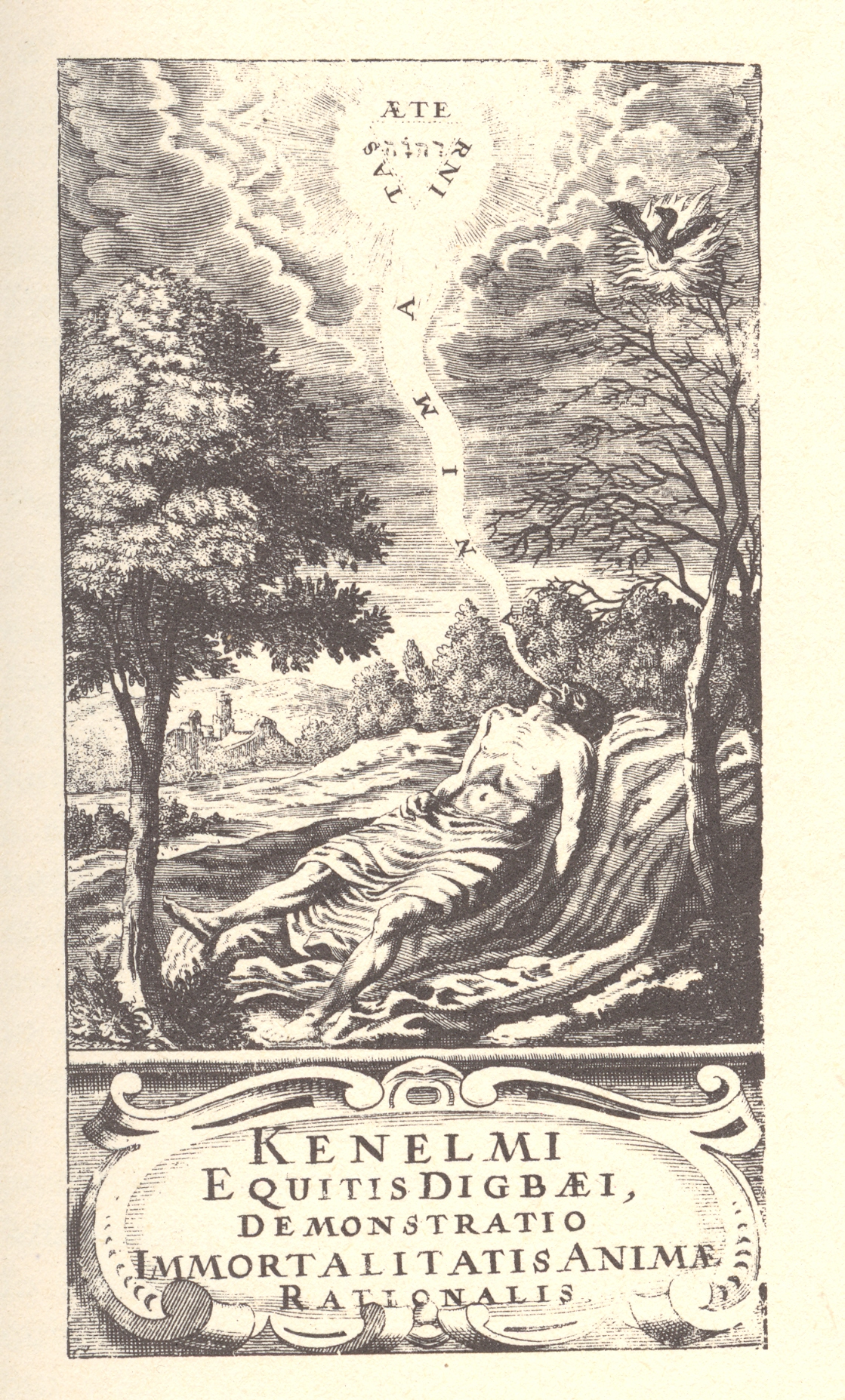
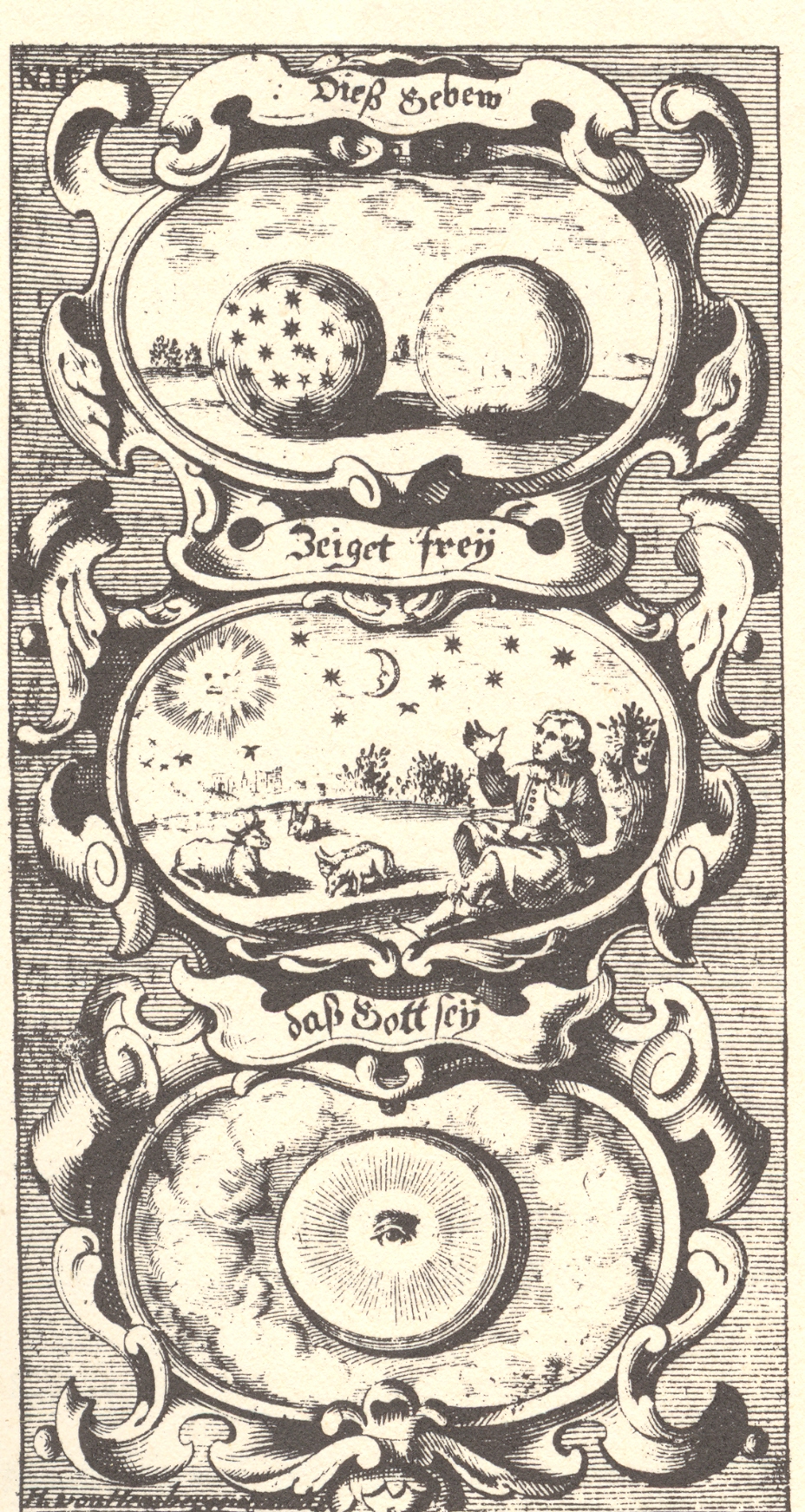
    On the other hand there are many different, substantiated, anthropomorphic objects that wind up in the sky in antiquarian images: there haven’t yet been anything spelling out chaos,  though there are many Hebrew names for the g*d incised and cut into plates of wood and metal.   There are all manners of hands-of-the-creator, gearworks for the Primum Mobile, eyes, doves, geometric shapes, blazing fires, blazing iconic people, multiple worlds, flying people, and so on. But no chaos.

    These are just two examples of the alternative-to-the-sun-in-the-sky category, a wonderful image from Kenelem Digby’s Demonstratio immortabiliitatis animae rationalis, printed in 1664.  The other is a very striking example from J.B.von Helmont’s surviving and prodigal (and prodigiously brilliant) son Franciscus Mercurius’  Das Geheimnuess der Schoepflung.  Printed in 1701, two years after FM’s death (and years after his other brothers succumbed to the Plague), the book was a bit of an amalgamation of the author’s vast and undisciplined interests, which sloshed over into the areas of magic, conjuring, Kaballa and astrology. 
    He had more success editing and translating his father’s works. 

    Porta sky 2
    I admit I’m taking a wide liberty with “chaos”, and that the the first image could simply be the creator stepping in to rid the heavens of chaos, but I liked the idea of chaos being located on a map better.  Mea culpa. 

    * Porta writes in the first chapter, defining the word “magic”:  Magic took her name and original [sic] from

    Persia.
    . . . In the Persian language, a Magician is nothing else but one that expounds
    and studies divine things; and it is the general name of wise-men in that
    country. . . . Magic was begun in Persia by Zoroastres.”

    ** A fair amount of information in this book was derived
    from his own house-bound Academia de
    Secret
    i—a name I now love!—a society of friends and scholars who discussed
    topics ranging from physiognomy to optics to cosmology to conjuring. 

    The Chapters/books of Natural
    Magick
    are shown here below to give an idea of what the book is about:

    The First Book of Natural
    Magick
     “Of the Causes of Wonderful Things.”
     “Wherein are searched out the
    causes of things which produce wonderful effects”

    The Second Book of Natural Magick  “Of the Generation of Animals.”
     “Showing how living creatures of
    diverse kinds, may be mingled and coupled together, that from them, new and yet
    profitable kinds of living creatures may be generated.”

    The Third Book Of Natural Magick  “Of the Production of New Plants.”
     Which delivers certain precepts of
    Husbandry, and shows how to intermingle sundry kinds of Plants and how to
    produce new kinds.

    The Fourth Book Of Natural Magick  “Of Increasing Household-Stuff.”
     Which teaches things belonging to
    house-keeping; How to prepare domestic necessities with a small cost; And how
    to keep them when they are procured.

    The Fifth Book Of Natural Magick  “Of Changing Metals.”  “Which treateth of Alchemy, showing how
    metals may be altered and transformed, one into another”

    The Sixth Book Of Natural
    Magick
     “Of Counterfeiting
    Glorious Stones.
    “

    The Seventh Book Of
    Natural Magick
     “Of the Wonders of
    the Load-Stone.
    “

    The Eighth Book Of Natural
    Magick
     “Of Physical
    Experiments”

    The Ninth Book Of Natural
    Magick
     “Of Beautifiying
    Women.”

    The Tenth Book Of Natural
    Magick
     “Of Distillation.“

    The Eleventh Book Of
    Natural Magick
     “Of Perfuming.
    “

    The Twelveth Book Of
    Natural Magick
    “Of Artificial
    Fires.
    “

    The Thirteenth Book Of
    Natural Magick
    “Of Tempering Steel.
    “

    The Fourteenth Book Of
    Natural Magick
    “Of Cookery.“

    The Fifteenth Book Of Natural Magick “Of Fishing, Fowling, Hunting, etc. ”
    (Complete)

    The Sixteenth Book Of
    Natural Magick
     “Of Invisible Writing.“

    The Seventeenth Book Of
    Natural Magick
    “Of Strange Glasses.“

    The Eighteenth Book Of
    Natural Magick
     “Of Static Experiments.“

    The Nineteenth Book Of
    Natural Magick
     “Of Pneumatic
    Experiments.
    “

    The Twentyth Book Of
    Natural Magick
     “Of the Chaos. “


  • The First Book about Books about Books

    JF Ptak Science Books LLC  Post 498

    0 blog jan 29 books488
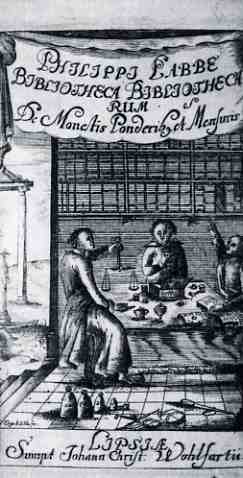
    Phillippe Labbe (1607-1677), a contemporary of the savant’s savant, Athanasius Kircher, and was himself a prodigious polymath, produced this fantastic piece of scholarship, the Bibliotheca Bibliothecarum…accedit bibliotheca nummaria.  He was a member of the Society of Jesus, like Kircher (which whom he also shared similar birth and aeath dates, Kircher’s being 1601-1680); and was born in the town of Borges, France, which gives him an almost invisible connection to one of the 20th century’s most imaginative/flexible writers in the great blind librarian of Argentina.  This book, published in Leipzig in 1682 as the second edition of the 1662 first,  is the earliest extant work of bibliography of bibliographies (it also has a very useful work on numismatics, as we can see from the last part of the title.)  Gathering the data necessary to produce this work was a prodigious undertaking–Labbe needed to have had access to fine libraries to assemble the data, then of course he needed the brain to handle all of the disparate and erudite areas of learning, and then be smart enough to organize it all.  This was an enormous accomplishment in 1682–with the stuff that Labbe had floating around in his brain and the reasonable aspect of disseminating it, Labbe would’ve been a National Treasure to whichever country he would call “home”. 

    I haven’t seen the title page of this book for many years, and my memory of it had these three bibliophiles holding drinks in the air–but I’m wrong, unfortunately.  The scholar on the left is weighing something, the scholar o the right is pointing to a book, and I not exactly sure what scholar-middle is doing.  One thing for certain though is that these men are not drinking.  Somehow I’d’ve preferred a few rounds with all of that scholarly/scientific bric-a-brac strewn on the table, but it was not to be. 

    Some of Labbe’s selected works include:

    • Trirocinium Linguæ Græcæ etc. (1648)
    • La Géographie royale (1646)
    • De Byzantinæ historiæ scriptoribus, etc. (1648)
    • Concordia sacræ et profanæ chronologiæ annorum 5691 ab orbe condito ad hunc Christi annum 1638 (1638)
    • Bibliotheca antijanseniana (1654)
    • Bibliotheca bibliothecarum (1664)
    • Sancrosancti Oecumenici Tridentini Concilii . . . canones et decreta (1667)
    • Sacrosancta concilia ad regiam editionem exacta

  • Ultimate Legal Hoax: Pilate’s Death Sentence of Christ and the Salamander Letter

    JF Ptak Science Books LLC  Post 419

    0--blog-dec 9 pilate224
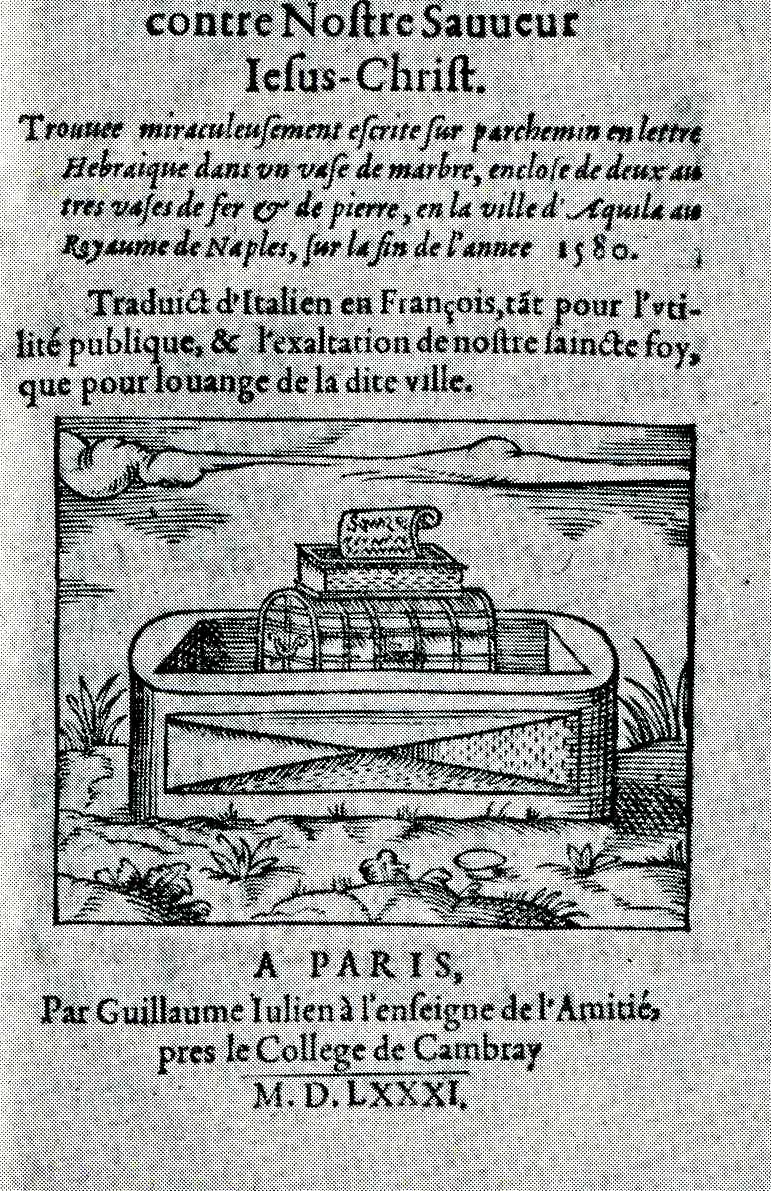
    One of the most remarkable literary frauds testing the published boundaries of religious merit was this remarkable publication, the death sentence for Jesus Christ by Pontius Pilate. Printed in Paris by Guillaume Juliene for Jean Stratius at Lyon, the Thresor admmorable, de la senstence prononceepar Ponce Pilate, contre notre Sauveur Jesus-Christ, (translated from Italian into French), was a work of great audacity if for nothing else than in its reach. (I’d like to restrict these comments on religious-mythological writings to the more-obvious and modern forgeries and hoaxes, and leave the question on the “authenticity” of other religious works like “divinely-inspired word-of-god transcriptions” for another time.) The book is about a parchment that was supposed to contain a rather touching, and naive   account (in Hebrew) of Pilate’s death sentence of Christ, a document found in a successive, nesting marble containers which protected it from time’s enemies.  As a matter of fact, the vignette illustration on the title page shows the parchment and the open containers as “proof” of the hoax’s merit.  Another very nice, light touch was the remark that this work was translated from the Italian (and that from the Hebrew) edition; it is most likely that this is the original edition, beginning its fictional life as a third-generation translation, a claim adding to the document’s possible authenticity. 

    It is not possible to leave remarks on religious forgeries/hoaxes without mentioning the talented and odious murdering forger Mark William Hofmann, the man who lead the most productive life of any American forger, and who late in his career was said to be attempting to fabricate the missing first 118 pages of the Book of Mormon. In addition to his very accomplished literary and political forgeries, Hofmann came upon an evil and brilliant idea–the devout Mormon would forge unseemly documents from the earliest periods of Mormon history and sell them to the Mormon Church, which was evidently very interested in obtaining such documents for its not-public archive.  Hofmann’s plan was remarkable–at first blush the offending documents that he “tracked down” were donated to the Church.  As the troublesome finds became more interesting (read “damaging”) he needed money (and lots of it) from Church officials to secure the documents from their “enemies”.  Having established goodwill and a sort of loyalty, and being terribly gifted and of course deeply knowledgeable about early Mormon history, Hofmann (a sixth-generation Mormon) created his own market, his own clientele, and his own product. (The “product” being very well researched and radiocarbon dating-proof documents for which he also forged their own provenance (!); even though fairly elementary stuff it was very well constructed, and Hofmann’s forging ability was exceptionally high.)  Outside the messing around with people’s belief system and committing major frauds all over the place and stealing millions of dollars, the biggest problem with Hofmann (perhaps some of you will remember his from the “Salamander Letter” of the mid 1984) was that in the course of doing business and protecting himself he bombed and killed two people in cold blood.  He didn’t answer his own religion’s hushed call for “blood atonement” and was sentenced in his cowardly way to life imprisonment in the state of Utah, where he lives to this day.


  • Revelations and Beautifully-Illustrated Prophesies: Methodius, 1504

    JF Ptak Science Books LLC  Post 445

    0 blog dec 23 revelation314

    “For the uneducated the pictures are necessary for reading” (Imperitis pro lectione pictura est.)
    –from the dedication to Revelationes

    So we read in the dedication of this early illustrated work on prophesy. I love that:  “pictures are necessary for reading”.

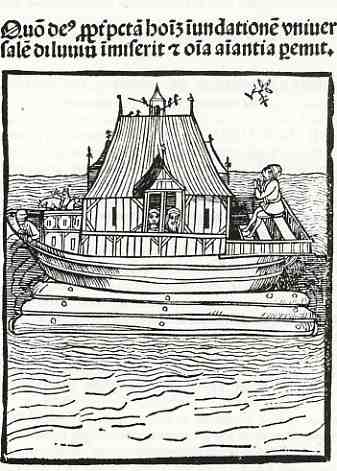
    This magnificent woodcut is one of 61 illustrations appearing in Saint Methodius, the Bishop of Tyre,  (Sebastian Brant) [Revelationes] (Methodius primum Olimpiade et postea Tyri ciuitatum episcopus, sub diocleciano Imperatore, in Calcide civitate (que nigropontuz appelatur ut diuus scribit hieronimus martyrio)) and  printed in Basel just past the turn of the sixteenth century 1504. It was the second edition of this work (the first appearing in 1496), replacing the un-illustrated first edition, making its appeal to the lesser- or unread among its readers. the author had been asked to include illustrations for the benefit of all those who could read only pictures–and for many that’s all they would need, the 61 images were easily understood and consumed.

    Neither edition though was actually written by Methodius, both being, probably, the work of Wolfgang Aitinger, a monk in Ausberg.


    Some Samples of Ancient Literature in Prophesy and Prophetic Revelations:

    Old Testament Apocalypse  Literature:

    Canonical: Isaiah xxiv.-xxvii.; xxxiii.; xxxiv.-xxxv; (Jeremiah xxxiii. 14-26?); Ezekiel ii. 8; xxxviii.-xxxix.; Joel iii. 9-17; Zech. xii—xiv; Daniel.

    Extra-canonical:– Palestinian. 200-100 B.C., Book of Noah, 1 Enoch vi.-xxxvi.; lxxii.-xi, Testaments of the Twelve Patriarchs. 100 B.C. to 1 B.C.:1 Enoch i.-v.; xxxvii.-lxxi.; xci.-civ; Testaments of the Twelve Patriarchs, i.e. T. Lev. x., xiv.-xvi., T. Jud. xxi. 6-xxiii, T. Zeb. ix., T. Dan. v. 6, 7; Psalms of Solomon. A.D. 1-100 and later:Assumption of Moses, Apocalypse of Baruch., 4 Ezra, Greek Apocalypse of Baruch, Apocalypse of Zephaniah, Apocalypse of Abraham, Prayer of Joseph, Book of Eldad and Modad, Apocalypse of Elijah. Hellenistic: 2 Enoch, Oracles of Hystaspes. Testament of Job, Testaments of the III. Patriarchs,Sibylline Oracles (excluding Christian portions).

    New Testament Apocalypse Literature:

    Canonical: Apocalypse in Mark xiii. (Matthew xxiv., Luke xxi.).2 Thessalonians ii,Revelation.

    Apocryphal: Apocalypse of Peter, Testament of Hezekiah, Testament of Abraham, Oracles of Hystaspes, Vision of Isaiah, Shepherd of Hermas. 5 Ezra 6 Ezra, Christian Sibyllines, Apocalypses of Paul, Thomas and Stephen, Apocalypses of Esdras, Paul, John, Peter, The Virgin, Sedrach, Daniel, Revelations of Bartholomew, Questions of Bartholomew.


  • Suggesting Freud’s Suggested Suggestion, 1893

    JF Ptak Science Books LLC  Post 429

    0 ebay 13 freud265

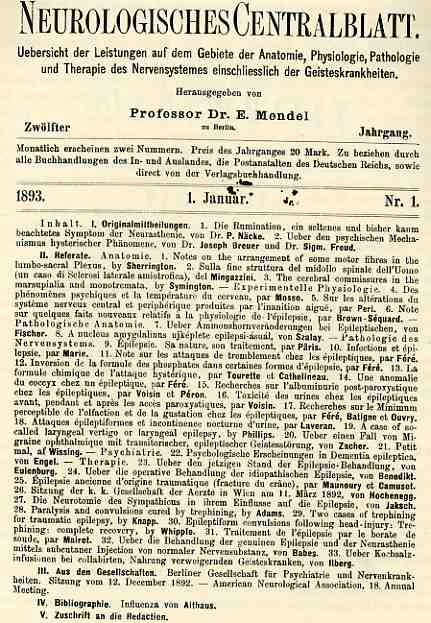
    Hidden in plain but complex view of this title page for the Neurologisches Centralblatt is  an early and important work by Sigmund Freud and Josef Breuer, “Ueber den psychischen Mechanismus hysterischer Phaenomen”.  Its a paper that establishes a Freudian dictum–based in the well-boiled ideas and work of Charcot–stating that it is not  mental trauma that leads to the cause of hysterical symptoms, but the memory of it. “Hysterical patients suffer mainly from reminiscences.” Ernst Jones explains:  “The trauma is not an evoking or precipitating factor, but rather, in its memory trace…resembles a foreign body that continues to irritate the mind”.

    Honestly I don’t know why people think about Freud.

    If for no other reason, this paper was important as it lead to a much more significant paper in Freud’s development of himself, Studien ueber Hysteria (1895). 

    The attraction for me was the complex presentation of the contents of this monthly journal–there’s a lot of data presented, it is not terribly reader-friendly, but it is still, well, pretty.  To me, its art.  Freud just  kinda mucks it up. 


  • Hero’s Stairs to Nowhere: an Intolerably Small Look at a Great and Important Book

    JF Ptak Science Books LLC  Post 356

    000-ebay--Nov 1 heron978
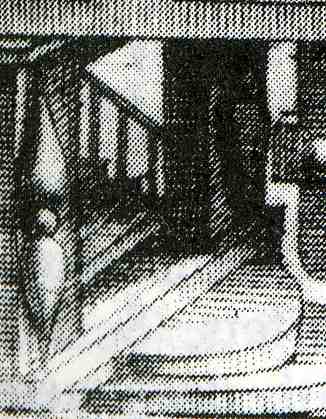
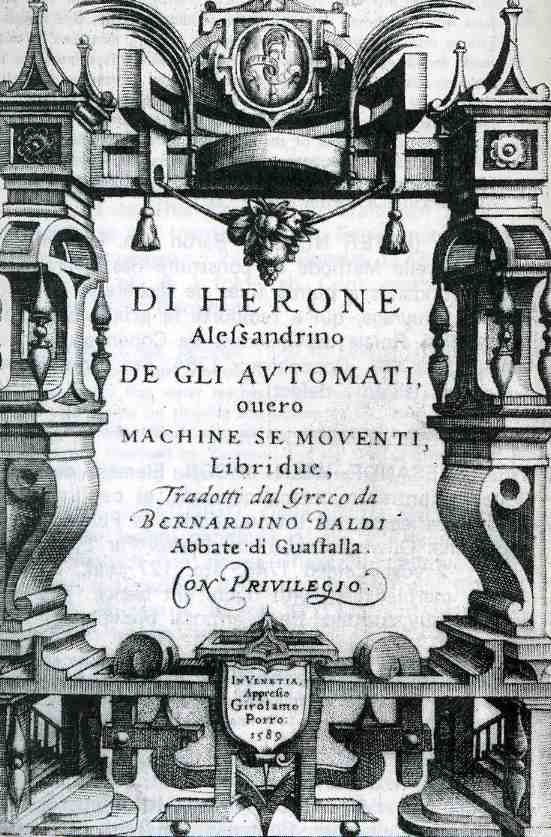
    And so here we have a gorgeous title page for the very first treatise on automata, and the thing I’m focusing on are the stairs in the bottom corners of the design, the stairs that go nowhere.  Maybe its just because of the seemingly flat effect of the perspective that they became so obvious to me, or the  subtle sense of a twisted two-and-a-half dimensions feel to it, the very Escher-y feel of complex, impossible and improbable dimensionality.  For example, the very pre-Baroque ornamentation of this very heavy title page construction seem to bounce between convex and concave, like the background and foreground change place somehow, as it the case of Escher’s trying to find a place between planes of two- and three-dimensional representation.  Although here I’m pretty sure the effect is unintentional; whereas in Escher, the effect is the aim of the art. 

    000-ebay--Nov 1 heron977

    The design and the printing of this large book was the work of the firm of Bernardino Baldi, of Venice, who published De gli avtomati oueri machine se moventi...in Venice in 1589, the original by Her/Heron of Alexandria, who lived ca. 10-70 ACE.   Hero was one of the most exalted of Greeks in the pantheon of ancient experimenters and scientists, an unparalleled inventor and producer of the earliest automatic and robotic devices. Have a look at  the illustrated link to Hero’s fabulous work called Penumatics (below).


  • Allegory and Symbolism: the New Botany and a New Way of Classifying, 1737

    JF Ptak Science Books   Post 318

    Carl Linnaeus (1707-1787) was the father of modern botany–he was a Swedish zoologist, physician, and above all, way above all else, he was a botanist. He was also widely recognized  as an accomplished, applied polymath:  Rousseau said of him “Tell him I know no greater man on earth”, and Goethe, one of the greatest of all polymaths and an expert on recognizing another one,  wrote: “With the exception of Shakespeare and Spinoza, I know no one among the no longer living who has influenced me more strongly”.  Pretty strong stuff from giants.

    1blog_oc_t11_linnaus814

    In addition to much else, Linnaeus contributed a template, a grid for identification and discussion,  establishing conventions for the naming of living organisms that became universally accepted in the scientific world—the  the starting point of binomial nomenclature. 

    And perhaps it is small of me, but I concentrated a bit on the frontispiece to his greatest books (rather than on the writing)–it is truly a capstone of the botanical canon.  The book is Hortus Cliffortianus plantas exhibens quas in Hortus tam vivis quam siccis… and it was published in Amsterdam in 1737, and it was as beautiful as it was important. The book was basically the product of the desire of the entrepreneur and multiply-rich East India Company investor and Anglo-Dutch banker George Clifford, whose desire to catalog his massive and extraordinary gardens brought him to Linnaeus.  The partnership, or at least the bringing of Linnaeus on-board for this unique and monumental opportunity, was one of the most fortuitous in the history of 18th century science. 

    The fine, baroque frontispiece allegorical engraving by Jan Wandelaar pretty well drips symbolism and allegory–which is a good thing since that is what is was supposed to do.  The main figure in all of this is a crowned Europa, seated before the very gates of the Clifford garden, holding a set of keys (to the botanical kingdom).  She is surrounded by activity, including three people representing the continents (Africa, Asia and America) offering  her gifts of plants.  Europa is bathed in light, perhaps because the figure to her right, Apollo, is just now removing a drape or cloak from her (which I guess is the pre-Linnaean coverlet of incomplete  and incorrect botanical knowledge), and providing her with his own source of light (with the torch in his left hand).  Between Apollo’s legs we can see the arm/tentacle of some sort of beast/hydra/dragon, no doubt another representation of incomplete knowledge, or worse. 

    Around the edges of the print , beginning in the foregorund, we see a map (represnerting Clifford’s gardens, probably, or the general sense of planning an approrpiate way of growing and displaying plants); to the right of the map are two cherubs/imps sitting before a roaring brazier, one holding a staff of some sort and the other pointing to a (celsius) thermometerm which Linnaeus had a hand in invneting.  Moving up the side of the print we come to my favorite part, the producing banana tree (you can see the bananas if you look closely), which I imagine must’ve been a great rarity in Eruope in the 18th century).  All in all I’d say that the artist accomplished the task of allegorically depicting the importance of the pages that followed.