A Daily History of Holes, Dots, Lines, Science, History, Math, Physics, Art, the Unintentional Absurd, Architecture, Maps, Data Visualization, Blank and Missing Things, and so on. |1.6 million words, 7500 images, 4.9 million hits| Press & appearances in The Times, Le Figaro, Mensa, The Economist, The Guardian, Discovery News, Slate, Le Monde, Sci American Blogs, Le Pont, and many other places… 5000+ total posts since 2008.

Category: Bad Ideas

  • Towering Classics of Lost Logic: the Japanese War Lords, Kaiser Wilhelm, U.S. State and Justice Depts as the “True Kidnappers” of the Lindbergh Baby

    JF Ptak Science Books  Post 1204  [Part of our Bad Ideas series.]

    Sometimes things aren’t what they seem, and then sometimes they’re not what they seem not to be, and then there are these things, below.  These small pamphlets are very reaching examples of finding gold or silver or muffins or whatever in a sow’s ear, finding a hope for belief where there wasn’t room for any, logically speaking.  But there’s always room for belief and faith, which takes on myraids of appearances, from believing in paper money to believing in heaven–in these cases, our writers believed in the unbelievable, creating and then believing in “innermost secrets” where there were no secrets and were no insides. 
    Lindbergh771

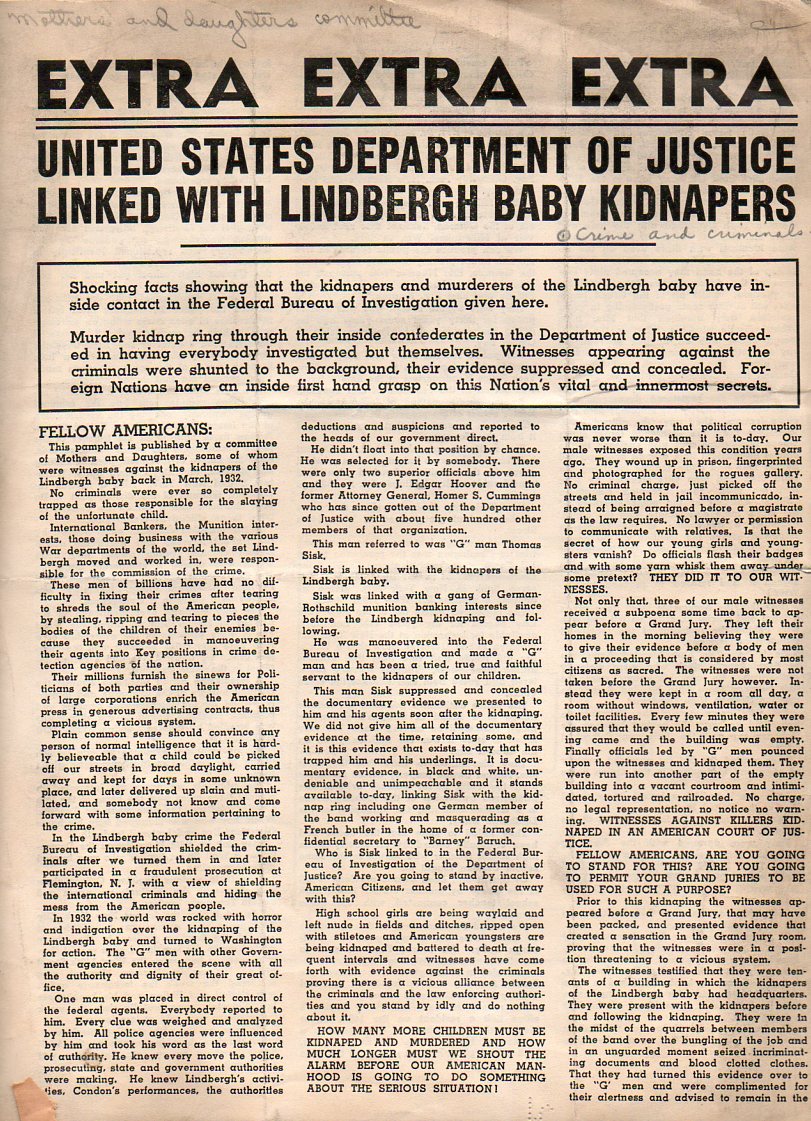
    Both of the examples below relate to the kidnapping of the 20-month-old son of Charles Lindburgh in 1932.  The crime was an extraordinarily national event, with seemingly everyone in the country following the case  During the two-month hunt for the baby and the subsequent trial and execution of the man who was seen as responsible for the child’s kidnapping and murder, there were fantastic numbers of claims from people who had solutions to the mystery, or had been in contact with the kidnappers, or some other sad, imaginary relationship to the event.  The examples below [both of which are available for purchase at our blog bookstore] claim to have incredible insight into the real nature of the crime, which of course goes blindingly beyond the simple matters of the case and on to include massive colusions between the U.S. State and Justice Departments, “international bankers”, F.D.R., Kaiser Wilhelm, and “the Japanese government”.  And more.

    The first example was published in 1942 by something called “The Mothers and Daughters Committee”.  This group used the address of  280 E. 21St Street, Brooklyn, New York, which today is a six storey building with 96 apartments, and I suspect that the MADC back there in ’42 was nothing more than a crank in apartment inthis building. The thinking is too confusing and the references too many amnd too busy to actually do this thing justice by de-threading it, but suffice to say it claims that the F.B.I. was shielding “the international criminals”who were truly responsible for the crime–I’m not sure how F.D.R. works his way in there but it has something to do with “international bankers”, communist conspirators, traitors in the State Department, and “needy” lawyers, all brought together in a choking confluence to do harm somehow to American society and morality.
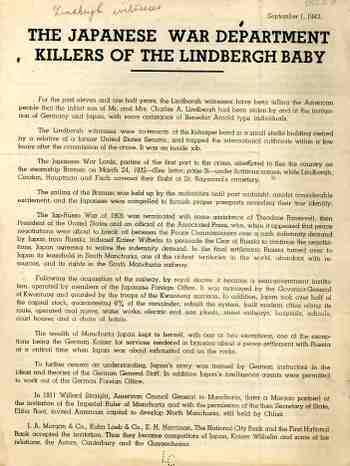
    Lindberh_japanese168 Now our second towering example is this four page pamphlet, received by the Library of Congress (and probably nobody else) on 1 October 1943, which divines the origins of World War Two and the kidnapping of the Charles Lindbergh baby to a complex and impossible cabal of Japanese “War Lords”, Kaiser Wilhelm of Germany, the assassination of Leon Trotsky, the League of Nations, Elihu Root,  “3 cent gallon kerosene”, the South Manchurian Railway, and some sort of “historical documents of posterity countersigned by Tokyo and Berlin” in the possession of Mrs. Renee Valentine (“Secretary”) of Staten Island, New York. 

    The entire affair began with “co-tenants of the kidnappers band in small studio building owned by a relative of a former U.S. Senator” under the instigation of “Germany, Japan and certain Arnold Benedicts types” brought about by the end of the “Jap-Russo” War of 1905.

    We are told it was an “inside job”.

    Somehow Teddy Roosevelt gets involved with Kaiser Wilhelm in arranging for the Russians to pay indemnity to the Japanese in terms of a land agreement of Southern Manchuria, opening the way to exploitation of China by the Japanese.  Something else happens, the South Manchuria Railroad gets thrown in as well as four competing U.S. banks and Elihu Root and a failed League of Nations agreement which upsets a balance of power and brings “the Astors, Canterbury and the Guggenheims” into competition with the Japanese and Kaiser Wilhelm, doing something to the Treaty of Washington.

    After this incredible and unconnected and partially non-existent series of events is both untangled and entangled before our eyes, the writer reaches the lonely and very solitary conclusion that “the necessary documents to prove these charges (??) could be secured through the kidnapping of the Lindbergh baby”.  I was waiting for the  author to make a case for Lindbergh’s real-life (and long held) Nazi sympathies, but that just didn’t happen. 

    I really have no idea of what the writer is talking about, but the failure of making any connection whatsoever with any of the “facts and circumstances” is magnificently appalling, and has moved itself from the realm of being so bad that it isn’t even “bad” anymore.  It is that singular sort of “badness” that makes the printed words seep into the paper and disappear before your very eyes, and the only thing that you can say is “wow”. 

  • The Sense and Nonsense of Success–the Pulitzer Prize, A Saturday Mornng Quiz

    JF Ptak Sdcience Books   Post 1198

    Can you spot what the similarity is in these books–besides being published works?  It is a list of Pulitzer Prize winners, but what else?  One work got the prize, the other didn’t.  Can you tell the winner from the loser? 

    Here’s the hint–its not the title whose writer almost everyone can identify.         

    That’s correct–it is a list of famous losers.  All of the winners of the Pulitzer for that year are listed first; the losers (well, those not selected) are second. (Yes I’ve mixed drama in with the fiction–this is a very quick study.)

    1919.  The Magnificent Amerbersons and  My Antonia

    1921.  Age of Innocence and  This Side of Paradise.
                       
    1923   Icebound and The Hairy Ape.   

    1924  Hell-Bent Fer Heaven (by Hatcher Hughes) and No! No! Nanette.

    1926.  Arrowsmith and The Great Gatsby

    1927.  Early Autumn and The Sun Also Rises.

    1929.  Street Scene and Strange Interlude

    1930.  Laughing Boy and The Sound and the Fury and A Farewell to Arms and Sartoris

    1931. Years of Grace and As I Lay Dying

    1932.  Of Thee I Sing and Mourning Becomes Electra

    1933.  The Store and Light in August

    1935. Now in November and Tender is the Night

    1936. Honey in the Horn and Of Time and the River

    1938. The Late George Apley and Of Mice and Men

    1939.  Abe Lincoln in Illinois and Our Town

    1943.  Dragons Teeth and The Moon is Down

    1944. Journey in the Dark and A Tree Grows in Brooklyn

    1946. State of the Union and The Glass Menagerie.

    1952. The Shrike and Requiem for a Nun and Darkness at Noon and The Rose Tatoo and The King and I.

    1959 The Travels of James McPheeters and Lolita.       

    1965. The Keepers of the House and Herzog.

    And so on. 

    I’m not saying that the winners of the Pulitzer for that year are bad works–I’m just pointing out that they just might not be good.  In any case I think that if you were given the chance to be the writer of one or the other, my guess is that 99.9% of folks would chose the work in column #2.

    “The nature of winning and losing is not a win-win situation…” the opening line for one of these winners might have read.  The vagueries of success is a disorganized system but a system nonetheless, and sometimes it just makes no sense; and sometimes when it actually does make sense the sense it is is nonsense.  

    So it goes.

    ·Posted by :

    ·in:

    —

  • War Ads, 1915–Gallipoli and Soap, Tires and Zeppelins, 1915

    JF Ptak Science Books

    [These items are available for purchase on our Blog Bookstore, here.]

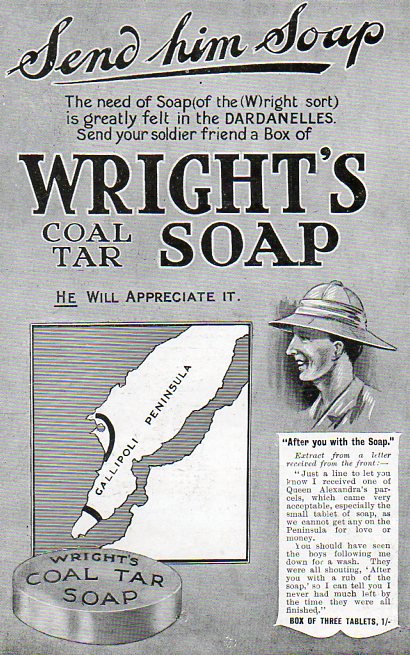
    These ads are interesting and take a bite, both ways.  For example, the first–for Wright’s Coal Tar Soap–uses the background of the enormous struggle in Gallipoli to sell itself.  The ad appears in the 9 October 1915 issue of The Illustrated London News, and stresses the fact that the troops were badly in need of, well, soap, among other things,

    WWI--e---galipolli640

    not the least of which was forward motion, or victory.  But the fact of the matter is that this relatively cheery image of the actions at Gallipoli looks entirely misplaced, especially at this point in the campaign when things were going badly.  The battle took place at Gallipoli peninsula in Turkey from 25 April 1915 to 9 January 1916, and the conditions were deplorable: massive heat, rotting corpses, poor sanitation, dysentery, flooding and then frostbite and bitter cold in the winter–that, plus the killing part, with 392,338 killed and wounded on both sides of this one campaign.  There’s much more to this campaign, of course–especially for my New Zealand and Australian friends– but this is not the place for it.   I was just taken by the spectacularly mundaneness of this ad for selling soap on the back of a terrible campaign.
    WWI--e- german dirigible639

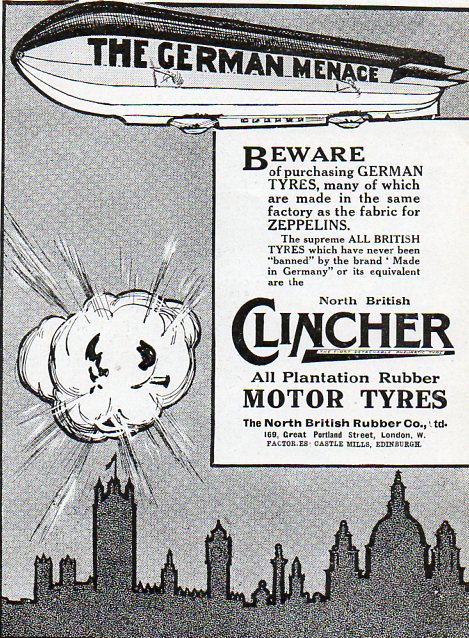
    The second ad sells British nationalism, of course, screaming to its readers to avoid purchasing German rubber tires, “made in the same factory as the fabric for Zeppelins”.   This appeared in The Illustrated London News for 23 October 1915.  The Zeps had definitely appeared over London by this point, and the ad drives the point home by showing an exploding shell over Westminster Clock Tower (from 9 October 1915 issue).

    WWI--e---zeppelin london641


  • Nazi Propaganda–the Big Lie and Germany Surrounded, 1933

    JF Ptak Science Books  1174

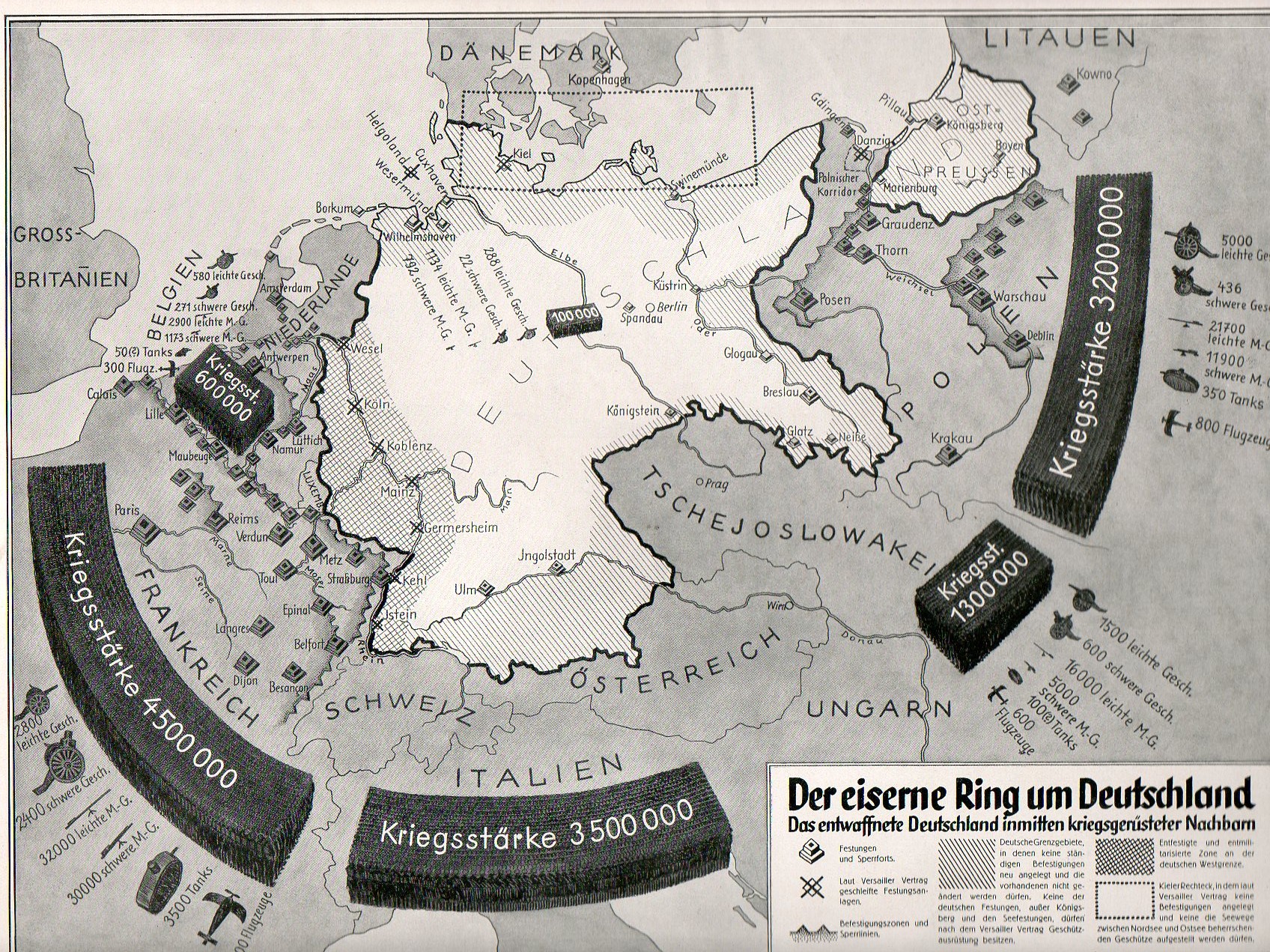
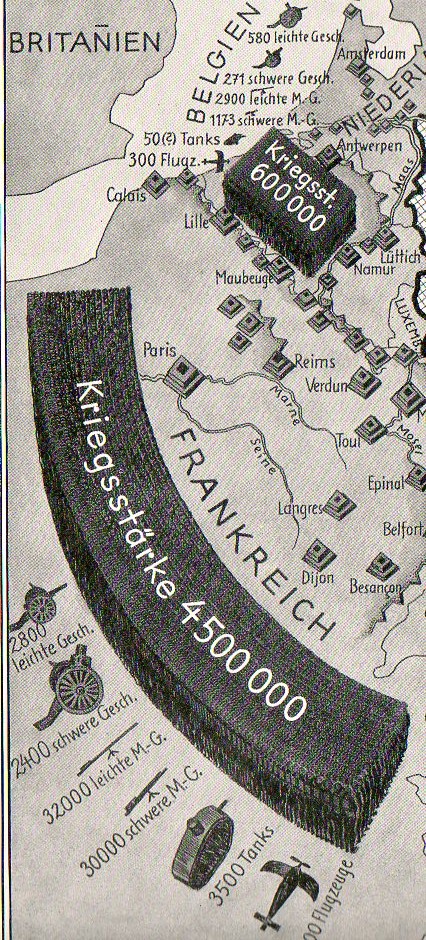
    The newly-elected NSDAP government lost little time in putting forward a case to the German people that the Treaty of Versailles left Germany in a defenceless postion, surrounded by forboding armies and air foprces of its neighbors, the forces of France, Italy, Czecholovakia, Belgium and Poland forging a tight and formidible strangelhold on the weakened Germany.  This image comes from the late November 1933 issue of the Illustrite Zeitung1 (Leipzig), and its relates to the casual and general reader the de-militarized and tenuous situation of the country–its design is effective enough so that the voice of he illustrations is well heard even if no on actually bothered to stop and read its legend–it was all about threat and impending doom, and the words for those emoptions weren’t necessary in this artwork.

    Nazi Prop surrounded538

    Campaigns like this were a first step in the Nazi consolidation of the public spirit, attempting to unify the population under Hitler and the NSDAP by presenting a threat so common that it could not help but to draw everyone into the big tent.  This was a simple message of natural survival, a wide threat to the German state, a threat that was so simple and so devastating and so opaque that there would be virtually no resistence to unifying against it. (J.W. WHeeler-Bennet wrote about this in his superb and still-classic book The Nemesis of Power, the Germany Army in Politics, 1918-1945, published in 1954.)

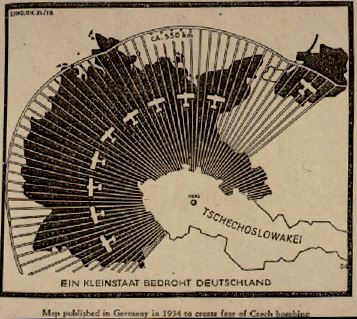
    Here’s another example from about the same time, again showing the devastating effects of imagery–this displays the non-existent threat from Czechoslovakia:

    Blog jan 3 czech air


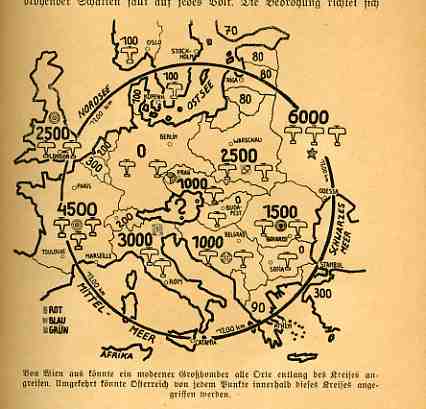
    And another, showing the encircling imagery again:

    https://historyofideasblog.com/a/6a00d83542d51e69e20120a7a04f7a970b-pi

    Getting back to the first image–curiously Great Britain and Russia don’t make the Enelmies Liest here, though in 1933 they certainly loomed as an enemy as much as any other.  (Well, perhaps not neessarily so for the Soivet Union, but close.)

    Someone who actually read the article and looked closer at the full-page ilustration would see the details of t he European threat, like this for France (and Belgium), with bloated figures for WWI-era ordnance and an extremely effectively articiulated represntation of what was seen as the standing army:

    Nazi Prop surrounded france539

    And this for Poland:

    Nazi Prop surrounded poland542

    And of course, Czechoslovakia: Nazi Prop surrounded czech541

    Among other things the signing of the Treaty of Versailles in 1919 limited the German armed forces to less than 100,000; limited the Navy to 15,000; prohibited the manufacture of submarines, armed aircraft, tanks, armored cars, Maxim guns and of course poison gas. There was assignment of guilt, heavy reparations (in what today would translate into something like a half-trillion dollars, without though translating buying power), and much more that was aimed at keeping Germany vanquished if not somewhat pastoral.  Many have seen the Treaty as being the bridge and greatest impetus to WWII, an opportunity lost and squandered by the Allies–maybe so. A year after the end of the incredibly violent and ripping four-year onslaught in which millions were killed and so much destroyed it would’ve been difficult for all parties to the Treaty to have a great forward vision in how to best deal with Germany.

    The Treay did provide a unifying front for Hitler; the Nazi Party using choice aspects of it in hearts-and-minds propagandizing methods like the one above:  the military restrictions were true, but the portrayed threat of attack from Poland and Czechoslovkia and Belgium and Italy and even France were part of the building of the Big Lie.  The “Big Lie” was something that Hitler identified in his 1925 Mein Kampf, and then used in his own terror campaigns–it is a lie so colossal and so impudent, so fantastic, that it is perceived as being true because no one would lie so gigantically.  As  George Orwell put it in his 1948 novel 1984, the Big Lie was “…to tell deliberate lies while genuinely believing in them, to forget any fact that has become inconvenient, and then when it becomes necessary again, to draw it back from oblivion for just so long as it is needed….”  The perception of imminent threat was one of the starting points for the Big Lie; the mechanics and people behind the manufacture of the invasion, of the Treaty of Versailles, of the German economic meltdown, and so on was already laid down in Hitler’s ridciulous book, and much of that lay at the feet of the Jewish people. 

    But first the Nazis needed to address the issue of their entirely weak and vulnerable military position by proposing the threat from much of the rest of Europe, this in order to rail against Versailles and break the German obligations to non-militarism.  The foundations for rebuilding the German war machine started in earnest in 1933; by 1935 most of the restrictions of Versailles had been broken, and Germany (which in 1933/4 had bene secretive about it) had gone public with its new obligations to itself (introducing the Luftwaffe to the rest of the world in March1935).  Reactions from the Allies to generating the new war machine were weak, and Germany rolled right into WWII. 

    Notes:

    1. I’ve written many times here about the Illustrirte Zeitung–it was basically the German equivalent of the Illustrated London News, Paris Match, and LIFE magazine, a better, mid-level weekly magazine that was well-written, very-well illustrated, approachable and affordable to folks of nearly all classes.  It was an expedient way of sending across the government’s message from te beginning of the Nazi ouccpation of German politics.


  • A Note on the History of Bad Chairs

    JF Ptak Science Books   Post 1161

    There are all sorts of famous seats:  seats of wisdom, of power, of lameness, of government, of discontent, of honor, of learning, of war; there’s the hot seat, the best and worst seats, a seat on the board, a seat on the bench, a seat at the bar; there are captain’s chairs, endowed chairs, and famous chairs (like architectural gems/mules of Mackintosh, Wright, Saarinen, van der Rohe, Eames, Gehry, LeCorbu) and famous seats (at the original Yankee stadium or a Roman coliseum). 

    The Rush Chair / Restraining Chair

    There’s another side to this–the History of Bad Chairs.  It is certainly easy to spot the grossly offensive examples–chairs for torture, the working chair of Adolf Hitler, the chairs Bluto used to clobber Popeye with, the terrible captain’s chair that belonged to Capt. Kirk, the offensive seating in Anthony Burgess’ Korova Milkbar in A Clockwork Orange, the final aspect of the condemned as they witnessed the bad aspect of St. Peter’s judgment chair, (and for the Red Sox fan, the chair into which Bucky Dent’s home run fell), and so on.   Then of course there’s the electric chair, the battleground of not only the philosophically opposed sides for its use, but its earlier fight as well when it was used as field fodder for the war between Thomas Edison and Nikolai Tesla for the adoption of their opposing electricity delivery systems. 

    But there’s a subcategory for the subcategory of the History of Chairs and the History of Bad Chairs– the unintentionally bad chair.  Benjamin Rush–for all of his good work, for all of his American Founding Fathers heritage and background, for all of his wide humanitarian work–has committed an ignoble applicant to this category.  Actually, his ranks among the leaders for unintended gruesomeness, a consequence of his attempt  to do good, but just gone wrong.

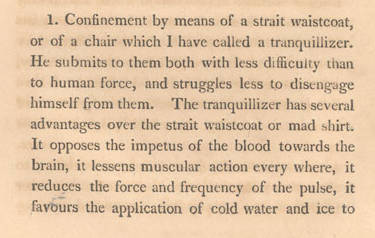
    Rush’s (1745-1813) name is on the Declaration of Independence, and he is also one of the founding fathers of American psychiatry.  A medical doctor, his background is very deep in care and ethical treatment, a social liberal who was against slavery and capital punishment, and who was determined to improve the condition and treatment of the mentally ill.  Unfortunately, in using the tools at hand and operating with a deep understanding of the contemporary knowledge of neurology and mental disorders, Rush sought to treat the severely deranged (or most institutionally uncorrectable) with his own creation–the tranquilizer chair.  Once certain calming measures had been exhausted, Rush described how to retrain combative patients reeking in misbehavior and keep them from ruining their clothing, or harming the handlers, or ruining the furniture of their cell, introducing the use of his immobilizing chair.  (There was an associated “mad shirt”, similar to what we know as a straight jacket, that was also invented and employed by Rush.)
    His invention, ironically,  was very high corporal punishment, what wound up being a torture device for what good it did and the cost it extracted from the person who was to sit in it. 

    + blog 10.25 rush 1

    As we can see Rush also commented that the application of cold water and ice would be facilitated with the tranquilizing chair.

    A practice that continued at least into the deep 19th century was the dunking chair, whose intent was to “shock” the misbehaving “patient” into docility or normalness.  Here we see

    Hydrotherapy

    some poor sot being drenched from above and also being hosed from the side prior to being dunked into a vat of cold water.  No telling how long one might be submerged or how calm the waters must be from bubbly interruptions before being hauled out. 

    Circulating Swing

    On par with these other instruments was the rotating chair, which was supposed in some way to confuse madness into something not-mad–that, or subdue an unruly patient, whichever came first.  

    Then there is the dentist-like chair used in Terry Gilliam’s Brazil, where the subject–Sam Lowry, accused of crimes against a mega-dystopic state–is tortured into a catatonic state, and in that thin wall between being conscious an dnot so lives in a utopian existence in his mind far from the reach of his captors. 

    brazil-torture-cell-1.jpg

    There are of course all sorts of obvious, different chairs in which torture was committed upon people, but I really don’t need to picture them here, everyone knowing what they were, or are:  spiked chairs, garroting chairs, spine compressors…you get the picture.  Nasty, terrible chairs. Intentionally bad.

    Notes:

    In addition to the tranquilizing chair, Rush recommended a host of other approaches to controlling the “raving lunatic”.  The founder of American psychiatry made the following suggestions:

    –Place “noisy” patients into total darkness, (keeping “madmen” for 24 hours or more as required)

    –Cold shower baths, slowly, for 20 minutes to four hours

    –Solitude; keeping the patient alone, in teh dark, with no visits, no speech, nothing; an “indispensible necessary” to securing correct behavior.

    –Bloodletting, with “the quantity of drained blood should be greater than any other organic disease” (page 189), and should “draw 20-40 ounces of blood unless fainting is induced”.

    –“Low diet”, which was actually starvation, having the patient fast for one to three days, and then feeding “just” vegetables, “of the least nutrious value”.

    –Freezing, in addition to cold shower baths, as in placing the patient in the middle of the night outside in freezing cold.  Ice could also be used on the head, but not before the head is completely shaved, as the effect of hair on the brain and madness “we know not”.

    –Blistering, which is not a known process to me, except that blisters be induced on the ankles rather than on the head or neck.

    There was also treatment via purging, emetics, and the employment of small amounts of opium “to waste the excitability” and reduce fatigue to keep the patient awake.


  • Equal Rights for Women–NOT a Good Idea. Redefining “Equality”, 1863

    JF Ptak Science Books LLC   Post  1158

    Womensrights_1

    “Can a woman be said to have a right to life, if all means of self-protection are denied her….Can she be said to have a right to liberty, when another citizen may have the legal custody of her person ….Can any citizen be said to have the right to the pursuit of happiness, whose inalienable rights are denied; who is disenfranchised from all the privileges of citizenship…?” –Elizabeth Cady Stanton, speaking to the Tenth National Woman’s Rights Convention, The Cooper Union, New York, N.Y., May 10 and 11, 1860

    A Good Woman is “not an equal of man” or so we are told in this peon to the status quo of 1863.  This  semi-sugary attack upon the “Womans Rights Conventions” found the appeal of equal rights to be almost mostly unappealing–no

    t that women should not have “rights”, just not “equal” rights.  Jut rights enough–some of which for 1863, as it turns out, were pretty liberal. [The song was probably addressed in general to the series of ten conventions for women’s rights that had been held in this country beginning with the first–at Seneca Falls, New York–in 1848. Between then and 1860 there were ten conventions, plus one in 1863 that was called the First Woman’s National Loyal League Convention.] 

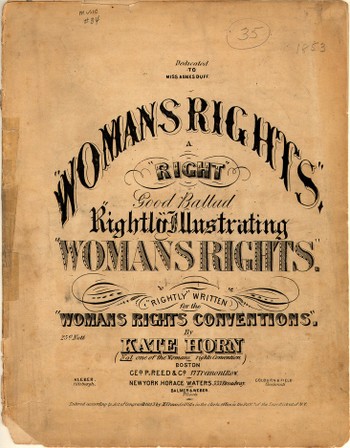
    The song–Woman’s Rights, a “Right” Good Ballad, Right of Illustrating Woman’s
    Rights, Rightly Written for the Womans Rights Convention…
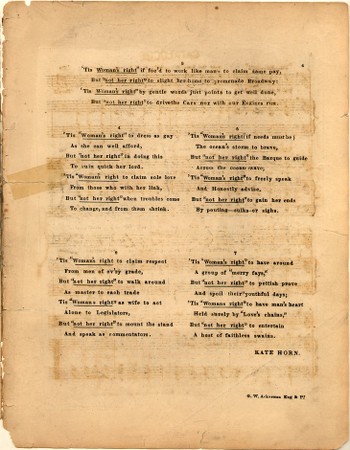
    –and published in Boston in 1863 was written by composer Kate Horn (emphatically self-stating to be “NOT of the woman’s rights convention”).  She was annoyed with the prospect of overall equality impinging upon traditional womanhood, or at least the current tradition of the feminine, and convinced the publisher Geo. P. Reed to publish her complaint in song. 

    She had many supporters, evidently–the equal rights part not really coming partially true, until, well, not even now.  I guess that this is certainly a debate platform, and I could probably argue a good but wrong response from the republican point of view, but I won’t–differences in pay scales, access to corporate power, under- and mis-representation in government and so on is not evidently enough of a scare to entice the necessary number of state to endorse the ERA.   In any event, women didn’t get a big push towards equal rights until they got the vote in the USA  in 1920 (the legislation which became the 19th Amendment was introduced in 1878; a majority of women didn’t exercise that right until, I think, after WWII), and really didn’t enjoy much power until the 1960’s.  

    As it turns out, Ms. Horn was lyrically resolved to demand some equality–but definitely not the brand of people like Elizabeth Cady Stanton.  The greatest surprise from Horn (at least to me) makes the demand for equal pay for equal work, though women should not be allowed to operate machinery and such.  There are a number of calls to decency and modesty which sound like basic ethics, but they’re also peppered with subservient overtone rejoinders.  Its hard for her to recover from the call to household “pretty trouble(s) brave”, but there are elements of forward thinking in the song.  Horn doesn’t absolutely  reject the ideas of “equality” of the rights conventions, but by taking her stance against universal equality she makes her’s less so and those of Stanton more.

    Woemnsrights2

    ·Posted by :

    ·in:

    —

  • Bad Ideas Department: Pool Vodka and Cigarette Wallpaper 1947-1953

    JF Ptak Science Books   Post 1153

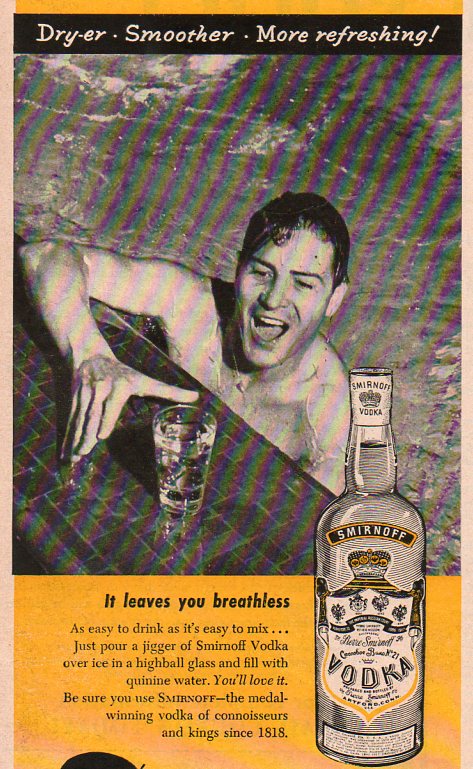
    Things we dont need vodka swim464 I just can’t leave this week’s string of five posts on stuff that I found in Life magazine without adding a little to the Bad Ideas category.  Generally this is the place  to collect the really odd, little material that I stumble upon that is noteworthy but not necessarily a good  fit for a general, stand-alone post.  So comes this installment to Bad Ideas–Things We Don’t Need.

    For example I just couldn’t wrap any sort of integrating or creative bow around this image (left) to present it as anything more than what it is.

    I could think of almost no other thing that I’d rather drink after a swimming workout than a glass of vodka with no ice. 
    I mean, really–it gives me a headache to just think about popping out of a cold pool, a little out-of-breath, and grabbing four fingers of room-temperature Smirnoff. I get that it is a “dry” juxtaposition, but all this looks like to me is a man with a pretty big problem.

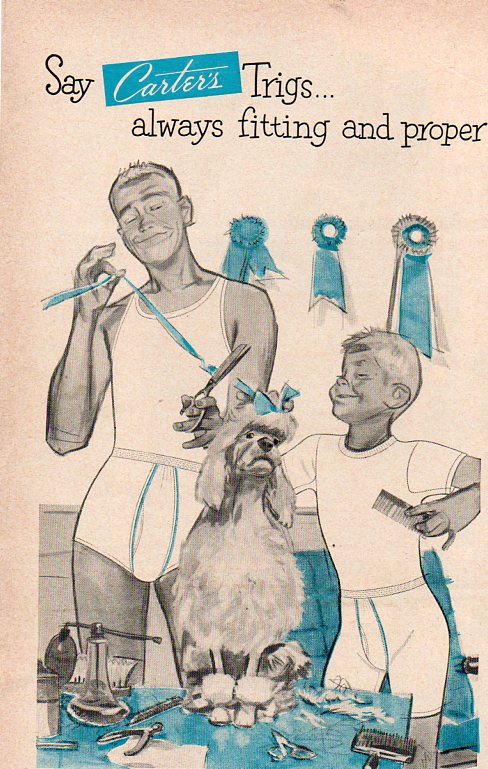
    Things we dont need underwear dog463

    And then the next picture–there’s simply  no good need to be posing in your underwear with a small boy in his underwear while grooming a French poodle.  There’s just no conceivable need to do it, period, especially with such oddly satisfied smiles.

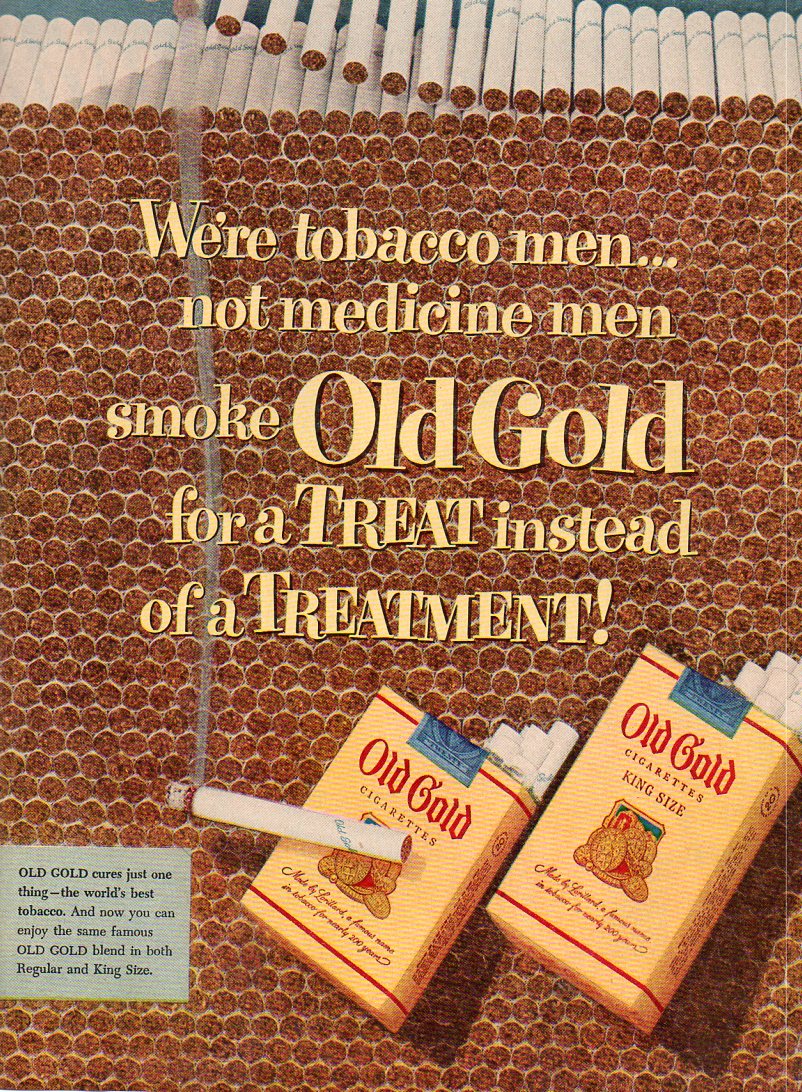
    And then  there’s this ad that is utterly demeaning to almost everyone–a wall of Old Gold unfiltered ciggies that are about life-sized with a vague suggestion that you smoke them for fun rather than some sort of medical benefit (?)  With a little editing you could construct a wallpaper out of this photo–and I mean a wallpaper for a room rather than a computer, a wallpaper composed of cigarette butt ends..  Just for the record, I figure that a 1.5 pack a day smoker would smoke the equivalent of this image spread over the four walls of an average-size bedroom in about four years.  Its conceivable that you could paper a decent-sized house with the wallpapered equivalent of every cigarette smoked by the smoker in a lifetime, or for as long as the cancer could be tricked to stay away.

    And so this is the beginning of this category–I hope it will be entertaining.

    Things we dont need cigs462

    ·Posted by :

    ·in:

    —

  • Christmas Gift Porn: Reagan, Santa, Cigarettes and (Lots) of Booze. Giving Ideas, 1954

    JF Ptak Science Books  Post 1135

    Tv 1954 Some time ago I wrote a post here on the images displayed in tvs in television ads from the 1950’s as small windows into societal attractions and expectations.  My thinking was that the exploding television industry would try to lure buyers with the seductive promises of these pictures, that seeing them displayed would entice  people to buy the televisions so that they could see them at home.  Or perhaps not–perhaps they were only placeholders so that the screen wouldn’t be dark and blank, though I feel otherwise.  The selection of these images tells us a tiny bit of something about the working person’s dreams–I admit it’s a slippery slope and not a blunt diagnostic tool, but it is interesting.

    So too with Christmas advertising.  Looking for something else in a volume of LIFE magazine for 1954 (an article on workers using irradiated paint to apply highlights to glow-in-the-dark wristwatches) I was struck by the goods being advertised for Christmas gift-giving. Pro-phyl-Ac-Tic Brush Company was selling brushes, and Santa was pushing Playtex pillows and Hoover vacuums and irons and MEAT and waffle makers.         Christmas lited cig b370

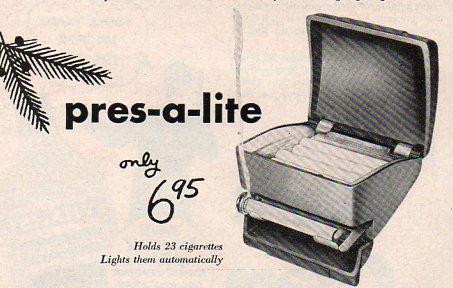
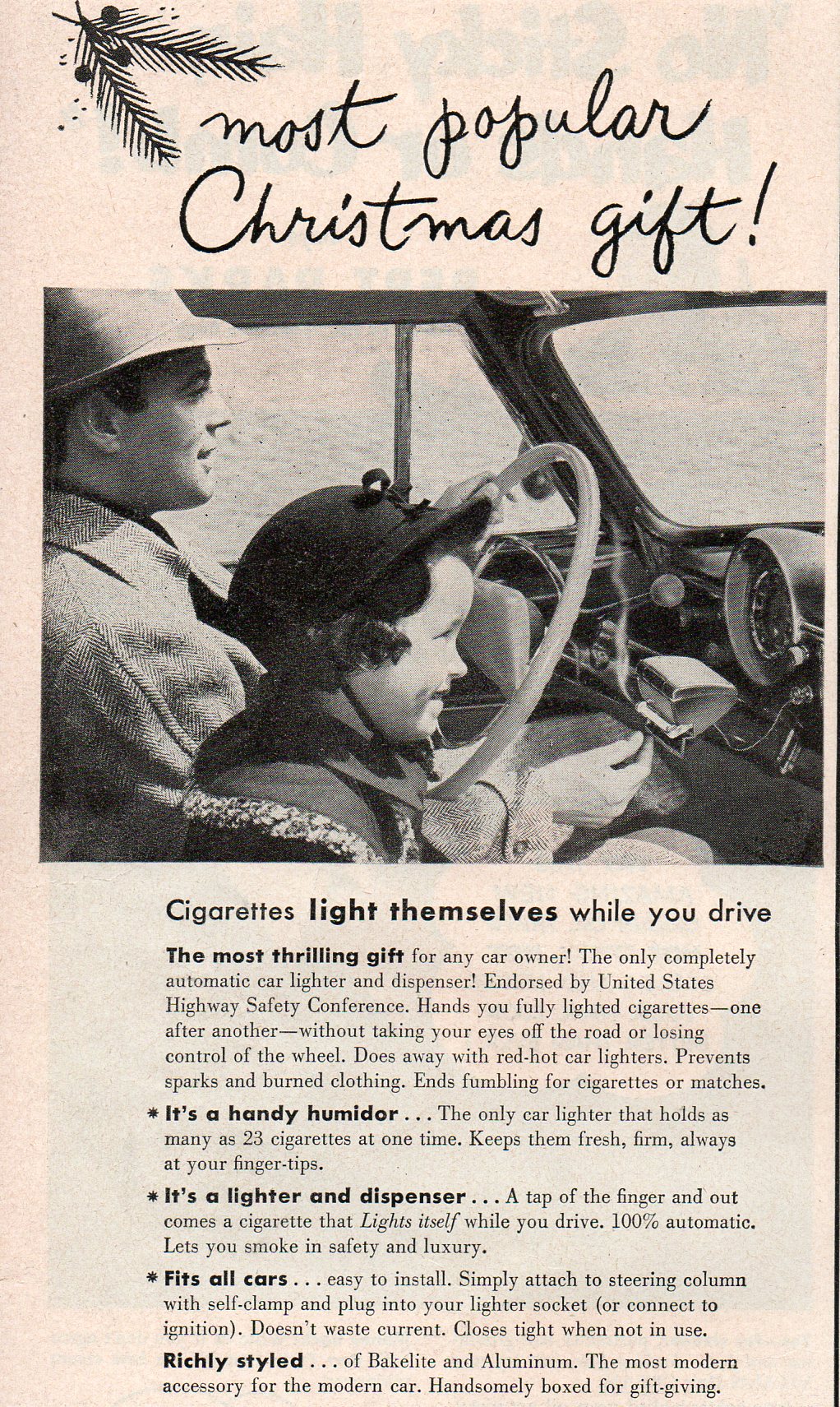
    And then there was the automatic lit-cigarette dispenser for the automobile.  Push a button–out rolls a burning ciggie.  The heated air and the rolled-up windows must’ve made for an extra-pleasurable experience for the girl sitting next to daddy.
     

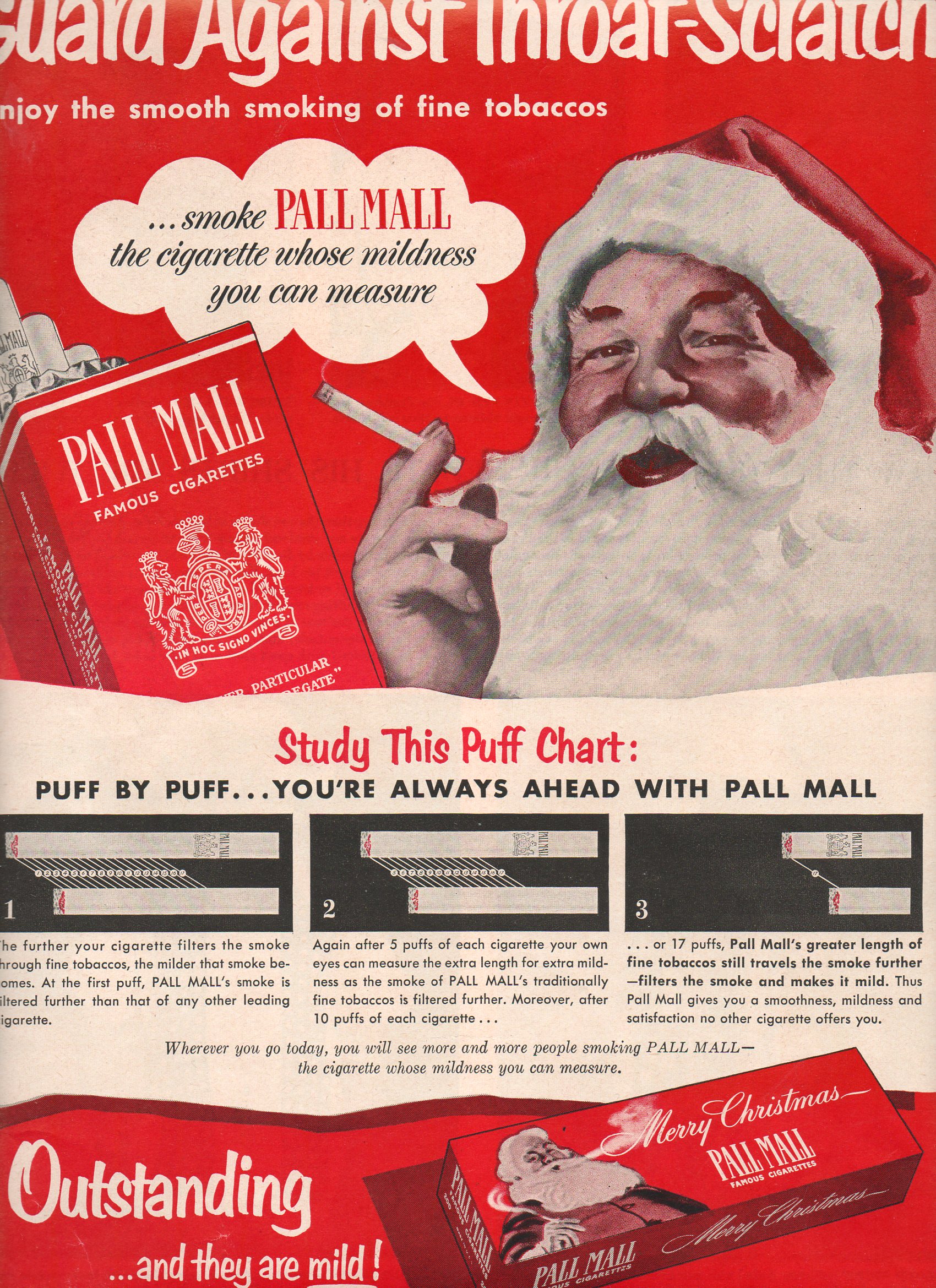
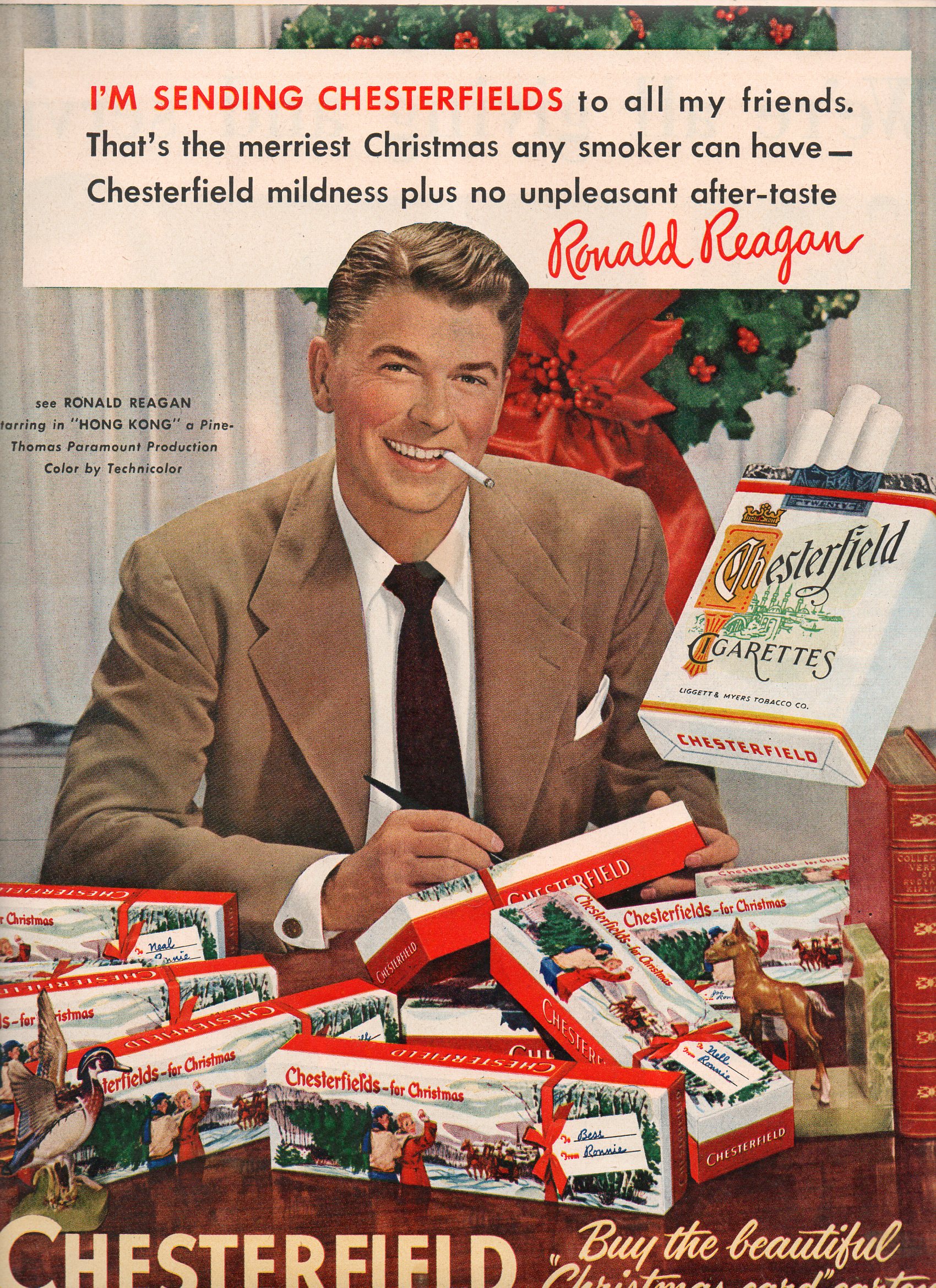
    Christmas Santa ciggies367 But it was the pictures of Santa selling cigarettes as Christmas gifts that got me–again (this story on the worst Christmas advertisements appeared earlier in this blog).  There were bunches of Santas selling smokes, including one de-bearded impostor selling Fatima cigarettes.  There were bunches of other folks, too, trading in on the smoking bit–they were excitedly opening wrapped/ribboned gifts of boxes of smokes, or hanging packs on the tree, or kissers kissing with boxes of newly-gifted smokes in their hands behind their lover’s neck.  And of course there was Ronald Reagan, who 26 years later would sell his flat forehead and broad grin to the American people as presidential lumber. (He seems to be writing on the carton in this picture.)

    Christmas RR366  

    And we’re not just talking Camels here.  In four issues of LIFE prior to Christmas 1954, the following cigarettes were advertised in full-page placements, looming suggestions for expressions of a “smokey” (which would later read “coughy/spitting/deady” for many of the buyers and receivers) love: Old Gold, Lucky Strikes, Fatima, Camel, Pall Mall and Chesterfields; also included were Robert Burns and White Owl cigars, plus Keywood pipes.  More often than not, each one of these products was featured in each of these four issues of LIFE. 

    Booze was featured very prominently as well, more so, really, than the cigs.  The ads included: Schlitz, Seagrams, Arrow Brady, Fleischman’s Gin, Haig and Haig, Old Forester, Paul Jones Whiskey, Sunny Brook Whiskey, Heublein Whisky, Seagrams Whiskey, Gilbey, Calvert, Medly, Black and White, Old Grand Dad, Pabst, Schenley, Four Roses, and Coronet.    

    LIFE was running about 175 pages per weekly issue at the time, so the full page ads for cigarettes and alcohol were actually eating up a bit of total display space per issue.

    What about the “regular” stuff?  There were surprisingly few toys, and so far as I can tell only two big ads for Schwinn bicycles. The 3/4-page/full page ads featured Whtiman Chocolates, toasters, light bulbs, cologne, televisions, Samsonite luggage, NUCOR oleomargarine, fountain pens, Zipo lighters, razors, meat, Van Heusen shirt, socks, lingerie, Green Giant peas, Coke, A & P coffee, refrigerators, pillows, Kodak cameras, cedar chests, washing machines, irons (“to show her you love her”), waffle irons, Hoover vacuums (“to show her you care”), and a couple of ads for Plymouths and Fords.

    So. Pretty utilitarian stuff, overall: buy mother chocolate, margarine, a lady razor, green peas, meat, coffee, pillows, lingerie, washing machine, and an iron; maybe a refrigerator if you had the extra cash, and an assortment of oils and perfumes for later on, when she was not working.  Dad gets cologne, a tv, fountain pens, a shirt, a tie, a high-beam spotlight for the Ford, simonize, some socks, and maybe a car for the family.  There was a two-page, double-page spread for kids’ toys, all o fit wrapped up in to display, showing 40 or so things from Santa, but in general the images for goods for children was very slim. Maybe everyone just knew to go to the toy store, or Macy’s toy department, or Gimbel’s, or Wanamaker’s. But at least for this year, in this magazine, the ads for children were very slim.

    Christmas Sunny Brook368What does all of this say?  Was there little money for working class fancies for Christmas in 1954?   I guess this all depends upon what you compare it to–slated against ads from the 1902’s, the selection looks pretty good; against the turn-of-the-century, better yet.  I’m not sure how early “Christmas advertising” gets,. But I have a feeling that it doesn’t precede Thomas Nast’s Santa by very much at all–seems to me that by 1954, real advertising for Christmas was only a couple of decades old; overall, it seems that advertising Christmas purchases is a definite 20th century invention.
    Christmas lited cig369
    That said, all of this looks like a nearly-null set compared to now, when seemingly everything and anything can be purchased at any time, especially around the Holiday season.  I wonder how this sort of consumerism can be maintained?  There’s always a fallout in super-saturated solutions, and it seems that we must be near that point.  Then again, the folks in 1954 might’ve been saying the same exact thing. 


    ·Posted by :

    ·in:

    —

  • The First X-Ray of an Atomic Explosion Inside of a Person (1964)

    JF Ptak Science Books  Post 1140

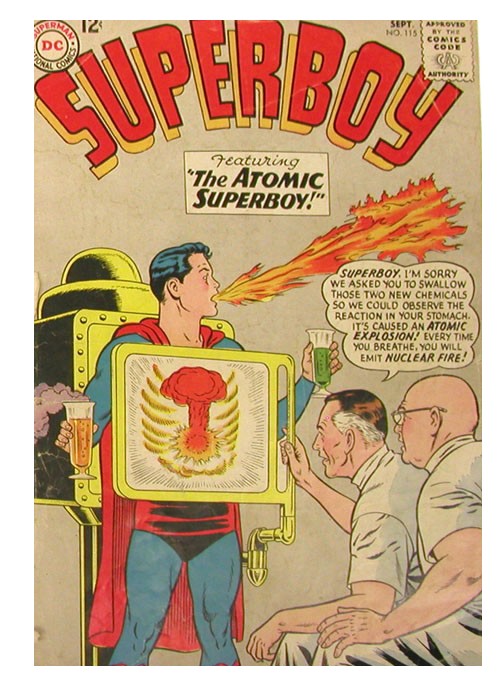
    I don’t know why, but I cannot remember ever having seen an x-ray of an atomic explosion taking place inside of a person, before today.  I guess that Superboy’s body is susceptible to x-rays but is also at the same exact time capable of preventing a nuclear explosion from escaping his body–all except for the “nuclear fire” coming from his mouth.Now that’s some sort of body control! The men in white seem pretty confident, being so close to the Trinity-like action and all.

    Atomic explos superboy
    Superboy evidently needs fewer ribs than humans, and it looks like the detonation point is right on the transpyloric plane, taking out kidney, liver, gall bladder and just about everything else.  And his spine doesn’t show up, either–along with a lot of other innards.

    Atomic explos superb deta 

    The original (published in September 1964) comes from the Oak Ridge Associated Universities, and they point out that this issue comes right after the signing of in-air nuclear weapons testing ban (after a speech by JFK in June 1963, marked by a memorial that was about 10 feet away from where I used to practice the shot put in D.C.)


  • Radioactive Suppository Sex Aids & Radium Toothpaste: Shining Lethal Nonsense

    JF Ptak Science Books  Post 1139

    Radium chemical co385

    “Radium was what was bad and worse
    a shiney and shining curse,
    till we stuck uranium in there,
    to make me have my ‘splodin’ hair…”–Lyrics to the nonexistent song “Satan’s Tooth in Me”, (1946),  by Blending “Loose Tooth” Bender

    If this was 15 May 1915, we could all be attending the Illinois State Medical Society’s annual meeting at the Masonic Temple in Springfield, Illinois.And if we went to booth 18, we could’ve bought some fine, newish radium-based products that would be enjoyed drinking or bathing in.  And all for the cause of human progress, the radium-based nonsense promised cures for all sorts of ills:  rheumatism, dandruff, dull teeth, gout, sexual problems, general malaise, and on and on. 


    The exceptionally important discovery by the Curies was made 17 years before this event, with the medically-unknown problems of radium waiting in the wings for another decade or so after this.  In the meantime, there were many companies that took advantage of the unknown qualities of radium (as happened with the use of X-Rays for all sorts of quack applications) using it as a shining addition to dozens of products.

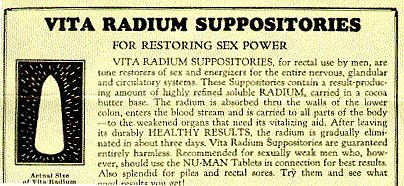
    Many of these companies employed the real stuff, affecting thousands of people, radium-based cure-alls being ingested, injected, applied and bathed-in. For example, there were numerous companies distributing ‘radium water” (such as “Radithor” by William J.A. Bailey’s company), radium suppositories (“in a cocoa butter base”), toothpaste (“Doramad”, distributed by Doramad Radioaktive Zohncreme during WWII, to Germans), cosmetics (“Tho-Radia”), and many different varieties of radium-enriched healing belts (to be worn or slept on).  There were plenty of other products that used the “radium” name but didn’t actually use the substance itself, further selling the idea of its usefulness on the individual level.  There was radium beer, nail clippers, starch, cigars, polish, headache tablets, razor blades, butter and of course, condoms.

    Radium--suppositories

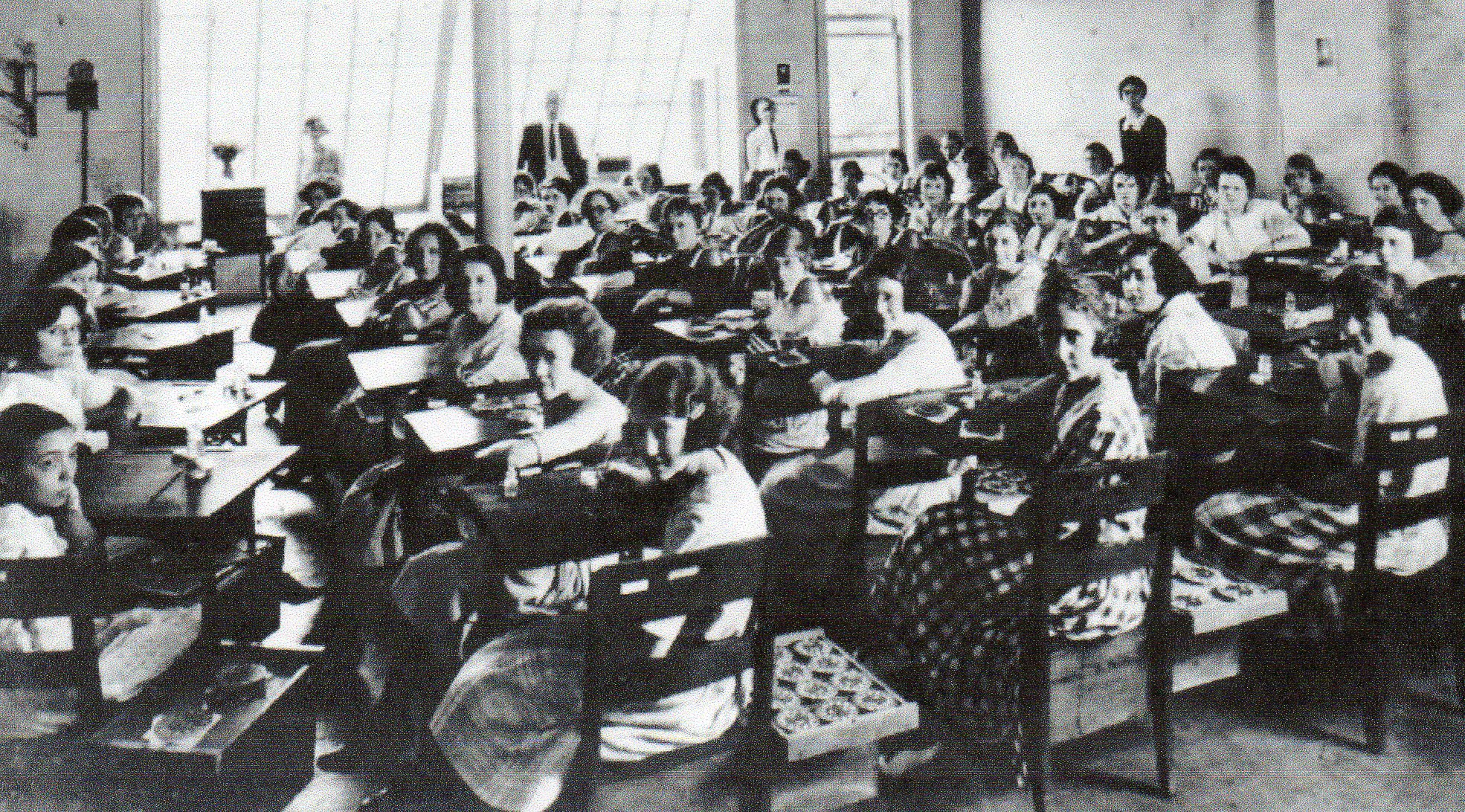
     Perhaps the most famous case of misguided application of radium was in the case of the radium dial painting women, more than 1200 employed by four companies1 during the ‘teens and ‘twenties (and some later) to apply radium-laced paint to make watch face/dials luminous in the dark.  It wasn’t necessarily the radium in the paint that got to so many of these women and killed them–it was the fact that they would generally put their paint brushes on the tips of their tongues to get a better painting point with the camel hairs.  Ingesting the radium paint like that was

    Radium women 2384
    [Image: Oak Ridge Associated Universities, radium dial painters, ca. 1920.]

    the killer.  The manufacturers said, basically, that they “tried” to discourage this behavior, but there was nothing that they could do about it, and so the brush-to-mouth to cancer/necrosis continued until people started dying.  It was then that the whole connection between radium and cancer was discovered.  Of course some of this continued into the ‘forties and ‘fifties, with “safeguards” in place, but, well, something else just needed to be done.  

    I guess that the point of telling this story is that we can shake our heads at this sort of behavior now, but it is assured that entire populations will be shaking their quizzed-up collective noggins with what we practice now (that is deemed to be “safe” or “appropriate”), and all in just a few short decades.  This is always the case.  Its just hard, sometimes, to identify what these practices are while they’re happening, and then have the willingness to do something about it. 

    Notes

    1. The four main companies included Radium Dial Company (with 213 such workers), Waterbury Clock (with 404), US Radium Company (with 73), and Luminous Processes (with 608).