A Daily History of Holes, Dots, Lines, Science, History, Math, Physics, Art, the Unintentional Absurd, Architecture, Maps, Data Visualization, Blank and Missing Things, and so on. |1.6 million words, 7500 images, 4.9 million hits| Press & appearances in The Times, Le Figaro, Mensa, The Economist, The Guardian, Discovery News, Slate, Le Monde, Sci American Blogs, Le Pont, and many other places… 5000+ total posts since 2008.

Category: Anticipation, History of

  • How Old are (Some) Scientific Words? Many Not Very.

    JF Ptak Science Books    Quick Post  Follow Me on Pinterest

    Wood-type
    It is interesting to think about the newness of old things, particularly English words that we have in use every day.  In this case I’m referring to words in the sciences–and not necessarily the words coming in the 20th century following the explosion of modernity beginning in 1895.  It is surprising sometimes to realize the relative newness of some terms, like, for example, “scientist”. The word “science” is very old and very old in English, but the word “scientist” is coined only in 1833. It is surprising to think of the modernity of some of the words when by their constant use they seem as though they must be ancient, but of course are not so.

    Here’s a quick lising of some interesting candidates, everyday words with a not-very-old lineage, their dates taken from first-usages identified by the Oxford English Dictionary:

    Altimeter, 1847; Ampere, 1861; Aphasia, 1867; Bacterium, 1847; Biology, 1802; Cambrian , 1836; Centigrade, 1812; Chlorophyll, 1810; Chromosome, 1890; Claustrophobia, 1879; Cosmology, 1730; Cretacious, 1832; Diatom, 1854; Electron, 1891; Embryology; 1859; Ethnology, 1842; Gastritis, 1806; Gynaecology, 1847; Histology, 1847; Joule, 1882; Jurassic, 1833; Kleptomania, 1830; Morphology, 1830; Ohm, 1861; Palaeobotany, 1872; Palaeography, 1822; Palaeolithic, 1865; Palaeontology, 1838; Petrology, 1811; Pilocene, 1833; Scientist, 1833; Symbiosis, 1877; Synthesis, 1804; Taxonomy, 1828; Triassic , 1841; Voltmeter, 1882; Watt, 1882.

    ·Posted by :

    ·in:


  • The Astronomy of the Great Flood

    JF Ptak Science Books  Quick Post

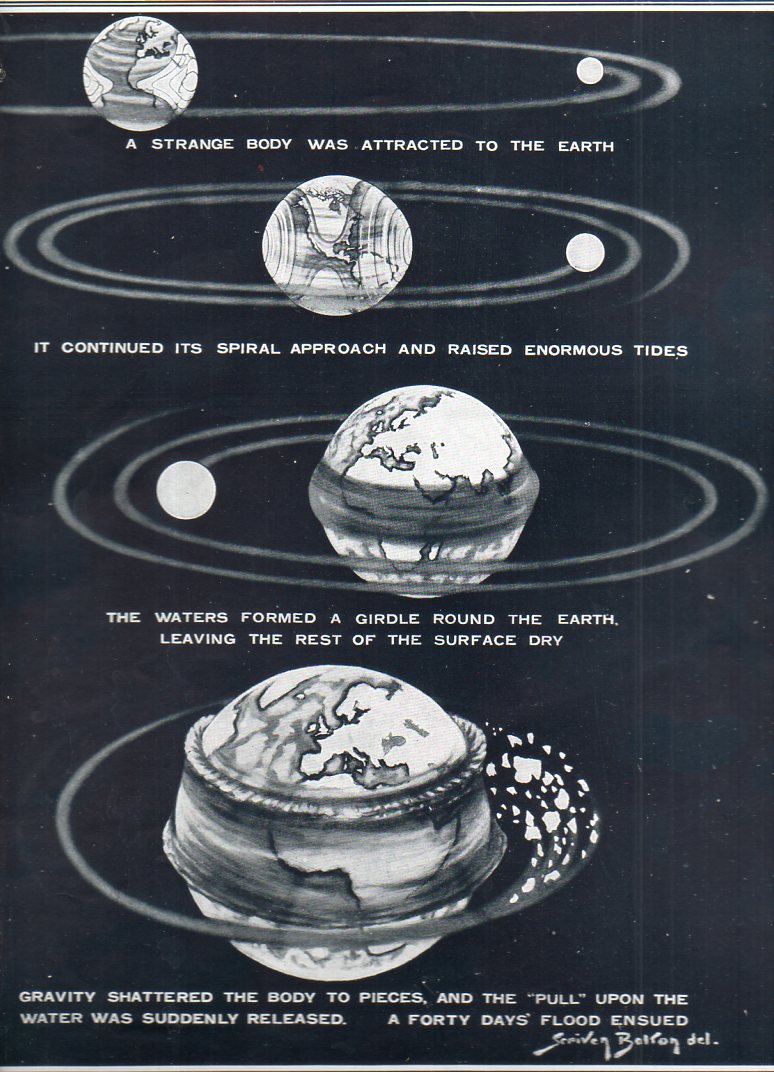
    This lovely if not very convincing argument was produced and directed by “a German engineer, Herr” (Enrst) Horgiger, of Munich.  He attempted to wed belief and mythology and astronomy, providing a worlds-in-collision explanation for the Flood.  From the caption to the drawing I do not know if it is The Flood of Noah, as it occurs in the book of Genesis in the Bible, or the flood of Apollodorus, or Hygenius, or of the Eridu Genesis (some 2000 years or so before Genesis) or the flood of Atrachasis (of about 1650 bce) or the flood of Gilgamesh (of about 1100 bce), or if it is the flood of Emhil, or Zeus, or Allah, or Yahweh, or the other 150+ great floods of mythology categorized by James Frazer in his astounding but unreadable books. But it is a flood, and his reason is that a wandering body in space came into temporary orbit around the Earth with a resulting gravitational soup that caused the waters to rise up after which the flood occurred and the orbiting sphere to break apart.

    The flood 1925057
    As I said, it is a pretty picture, with a nice deep blue background that my scanner won’t capture.

    Source:  The Illustrated London News, 21 January 1925, “A New Theory of the Flood: How it Might Repeat Itself”.


  • Proust’s Mother’s Hands

    JF Ptak Science Books   Quick Post   


    Follow Me on Pinterest

    “None of us has time to live the true dramas of the life that we are
    destined for. This is what ages us – this and nothing else. The wrinkles
    and creases on our faces are the registration of the great passions,
    vices, insights that called on us; but we, the masters, were not at
    home”.–Walter Benjamin on experiencing M. Proust

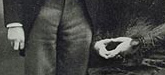
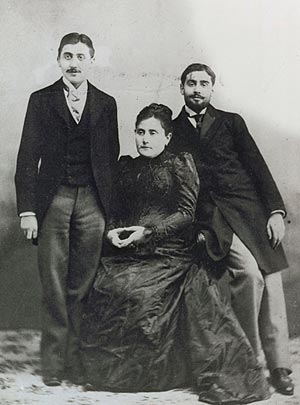
    In sliding my way through found pieces of Proust this morning I bumped quite a bit into aging in general and mothers and the “very painful sense of things” [“une impression fort pénible1“] .  And then in Marcel Proust on Art and Literature 1896-1919 I found Proust quoting Hugo, “I fancy that old age invades us trough the eyes, and that they age too soon who dwell among grey heads”2.  This can go on for quite a while, and it is a little too much before the first coffee.  I did want to post this picture of Jeanne Proust with her two boys because of her hands: not only because their attitude is very very uncommon for late-19th/early-2oth century portraits, but because they see strong and assured, which is I think just what his mother was, not creaking off to the grave covered in moss and age.


    Proust hands

    A detail from:

    Proust

    [Source: the Morgan Library http://www.themorgan.org/exhibitions/exhibition.asp?id=71]

    Notes:

    1.  Mme Proust in a letter to her son Marcel, from Michael Wood, “Proust and his Mother”, in the London Review of Books, http://www.lrb.co.uk/v34/n06/michael-wood/proust-and-his-mother  22 March 2012

    2.  Sylvia Townsend Warner (translator), Marcel Proust on Art and Literature, 1896-1919, Carroll & Graff, 1954, page 105.

    ·Posted by :

    ·in:


  • On a Census of Senses in Oz-Land: Adventures in the Land of Silence and Light

    JF Ptak Science Books  Post 1980    Follow Me on Pinterest

    With the endless images of the Land of Oz in our minds from the book and movie it is easy for the other lands generated by their creator L. Frank Baum to escape our attention   Oz isn’t the only place that Dorothy traveled to–far from it.  She went very far and wide in the mind of Baum, who was extraordinarily prolific both inside and outside of the Oz series.

    From 1900-1919, Baum (1856-1919) wrote 17 Oz books, as well as another 18 books in the non-Oz realm, plus 17 books in a juvenile series for girls under the pseudonym of Edith Van Dyne, plus six more books under the name of Floyd Akers, plus another seven other books under five other names, plus a pretty wide assortment (200+) of short stories, plus plays. Plus all of the stuff he wrote before 1900.  That’s a LOT of writing in 19 years.


  • Imaginary History: 2-D and 3-D Shadows

    JF Ptak Science Books    Post 1975 

    Follow Me on Pinterest


    In preparing an alphabetic sampler atlas of imaginary places (a thing which looks much finer capitalized, so An Alphabetic Sampler Atlas of Imaginary Places), I wondered about the non-existent relationships between these nonexistent places, and thought that this too might make an interesting alphabetization project. So an Alphabetic Sampler of Non-Existent Relationships Between Non-Existent Places came to be, and since it has such an oddly appealing ring to it, with a certain amount of surrealist qualities (really more affectations) it might be appropriate to start with Alfred Jarry, and here with his wonderful creation, Laceland1. and its relationship to Edwin Abbott’s Flatland2.. Their’s could be a war in the relationship of their light–or more exactly, their relationship of shadows.

    I can see across the vast and extremely limited sea that separates these two places a commonality in at least one dimension–and maybe only one, though being light, it is a rather large one. Light plays a big part in Flatland. The slender book Flatland is perhaps one of the best books ever written on perception and dimensions, a beautifully insightful book that was quick and sharp, and in spite of all that was also a best-seller. Written in 1884 when Abbott was 46 (Abbott would live another 46 years and enjoy the book’s popular reception), it introduces the reader to a two dimensional world with a social structure in which the more sides of your object equals power and esteem. Thus a lower class would be a triangle (three sides) while the highest (priestly) class would be mega-polygons, whose shape would then become a circle. On the lowest but complex strata is woman, who is represented as a line, but which is also the most contentious and unpredictable of all of the Flatland shapes. That is, until they all encounter a sphere, and the introduction of the third dimension, where Abbott’s magistry comes in explaining to the three-dimensional reader what it was like to be in a two-dimensional world.

    Jarry’s Laceland–along with Amorphous Island, Fragrant Island, Bran Isle and what is almost the pluralization of my surname, Ptyx–was an island kingdom that was surrounded by shadow and semi dark, but upon approaching it there would appear absolutely brilliant and blinding light the power outmatching that of the sun, glorious and fantastic, the light greater than that of the light of creation. The light is beautifully described by Alberto Manguel and Gianni Guadalupi in their excellent The Dictionary of Imaginary Places (1980):

    “The King of Lace spins this bright light, weaving pictures of madonnas, jewels, peacocks and human figures which intertwine like the dances of the Rhine-maidens. Clear patterns apper against the pitch-black darkness of the surrounding air, like shapes painted on windows by the first, and then disappear again into the shadows” (Page 204)

    Now in Flatland, light is a different sort of thing, coming as it does in only two dimensions, which means that two-dimensional light in a two dimensional world makes for a different sort of shadow, one that is rather flat and uninspired, especially compared to those of Laceland, which must be magnificent. Perhaps the shadow relationship between Laceland and Flatland is one of opposites. Polar opposites. Impossibles.

    This all seems to come together a little when considering that the Dr. Faustroll of the Laceland adventures, is the inventor of “pataphysics”, which is “the science of imaginary solutions”.

    Notes:

    1. Alfred Jarry. Ptyx, Laceland, Amorphous Island, Fragrant Island and Bran Isle, Exploits and Opinions of Dr. Faustroll, pataphysician, 1911.

    2, Edwin Abbott. Flatland: A Romance of Many Dimensions (1884).
    ·Posted by :

    ·in:

    —

  • On Inferred Narratives of the Last Word in Novels

    JF Ptak Science Books  Post 1968  Follow Me on Pinterest

    I was reading the ending of Vladimir Nabokov’s Lolita and found it a highly unusual occurrence that the novel ended on its single-word title.  It doesn’t seem to happen very often at all (though it also occurs in Toni Morrison’s Beloved).  And so I set to check out the last words of some significant works of fiction that are on the shelves here at home and see what these books ended on, and to give this project an hour of search.  Nothing comes very close to Nabokov, though Dalton Trumbo’s Johnny Got His Gun ends with “gun”, and Italo Calvino’s  If on a Winter’s Night ends with the entire title, along with the author’s name: “Just a moment, I’ve almost finished If on a winter’s night a traveler by Italo Calvino.” (Thomas Pynchon’s The Crying of Lot 49” ends with the title of the book, as well). But on my hour’s journey into ending, that was about it.  It all seems a little useless, except that there were a few nice bits that broke away from this time-hole.

    First, when you read the words and their books, they sorta/maybe suggest the essence of what came before–I think if you squint your eyes a little and connect the last word to the title, the word occasionally feels like a micro-summation.  Second, I found that when taken together and in order, the last word of each of the short stories in the beautiful Jorge Luis Borges’ Ficciones (edited by Kerrigan for Grove Press in 1962 with a number of different translators) presents themselves as not-bad found poetry/musical word arrangement. Third, it might be a fun idea to set up a chess set of pieces composed on the one side by Last Words in Great Fiction and on the other the Last Words in Famous Scientific Papers. 

    Another interesting bit is a challenge to write a paragraph using the following last word from the accompanying list of novels (you can have your choice of punctuation and prepositions and whatever else is necessary).  Dr. Seuss managed to create a great classic with a 236-word allowance from his publisher and somehow managed to write The Cat in the Hat, so there is a precedence for such things.  Taken as a random group, the words aren’t necessarily a collection of momento mori, but could make a nice beginning for something. 

            Found Poetry in the Last Word of the Short Stories in Borges’ Ficciones:

    Burial memempschosis

    counsel him,

    chance ruins, hope, heart

    congestion me foreseen,

    fired morning evil,

    man

    infastructure

    plain.

                          –I added punctuation and the spacing.


  • On Stability and Observation in the Earliest Microscopical Worlds

    JF Ptak Science Books  Post 1967  


    Follow Me on Pinterest

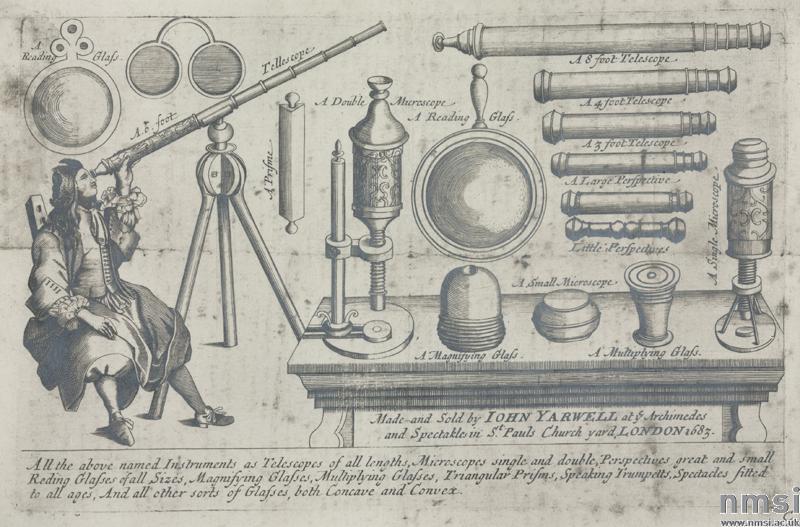
    Instrument seller Yarwell[Image source: Science Museum Group http://collectionsonline.nmsi.ac.uk/detail.php?type=related&kv=8015861&t=objects]

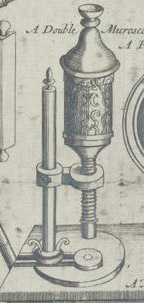
    Instrument seller Yarwell detailI was looking at this trade card for the optical instrumentalist John Yarwell (“Traded at Ye Archimedes & Spectacles in St. Paul’s Church Yard
    (1671-92), North Side of St. Paul’s (1672), St. Paul’s Churchyard
    (1676-96) & Archimedes in Ludgate St.(1697) & Archimedes &
    Crown (1698-1712), all London, England”) and was struck by something a little bit “odd”. For as many times that I have seen early images of compound microscopes I don’t think I’ve ever looked at how the instrument was attached to its stand.  Now that I am seeing it, it is remarkable how efficient and careful the early users were. Basically, the microscope was attached bya hair to its stand–well, not really, but just about. 

    Yarwell features spectacles, looking glasses, microscopes and a variety of telescopes.  Here’s a detail of a compound microscope from the Yarwell image (left), and it is remarkable how potentially unstable the attachment makes the instrument. Just a slight bit of turmoil, or a bump near a table leg could upset the image. 

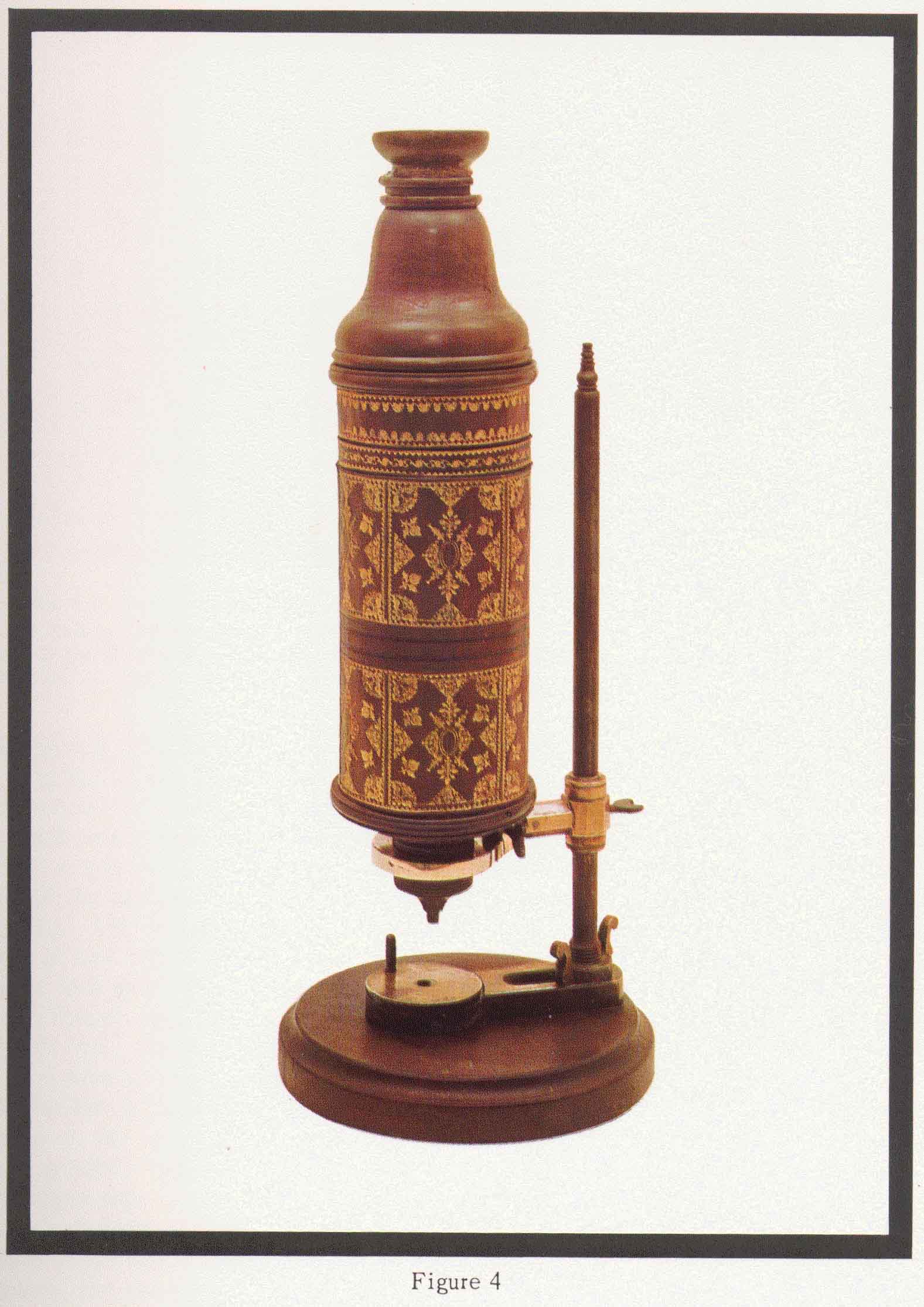
    Take for another example this very famous compound microscope made by Christopher Cock  for the great Robert Hooke (1635-1703):

    Hooke microscope

    [Image of the Hooke microscope via the Billings Collection at the National Museum of Health and Medicine, Armed Forces Institute of Pathology]

    This famous instrument was evidently the one with which Hooke first observed living cells (25 March 1663, nearly 350 years ago) and which he used for the first investigation and of cork and the naming of the “cell” (13 April 1663), and which was the basis for the images gathered for his masterpiece of investigation and exploration, the Micrographia (1665).

    It seems even less stable than the Yarwell instrument.  The astonishing thing about this fish-skin-covered instrument, this gateway to a completely undiscovered miniature world, is that so much of it depended upon such a little bit of engineering…it just seems as though taking the next little step could have been taken for a more basic base, a heavier mount, a more stout connection from stand-to-microscope, just to make the instrument more stable.  But it didn’t happen just then for Hooke, and it evidently didn’t matter. 


  • History of Hard Right Angles in Human Workers–Prehistoric Illustrations of the Technical Singularity, Part I

    JF Ptak Science Books    Post 1966  


    Follow Me on Pinterest 


    See also Cyborgs and Robots Man as Machine and Machine as Man

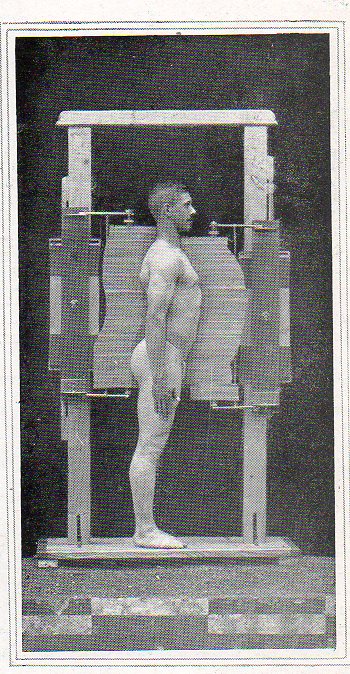
    Some images are sleepily iconic, instantly recognizable, symbols of something bigger than themselves. This is the case with the photographs below–this image of athletic posture makes me think of the development of human-robot (and then robot-human) interaction.

    Dr odd out of context042This series of images–which seem to be a celebration of straightness, of flatness in the human body, breathing at right angles–were actually (simply but not-so-simply) displays of physical tests given athletes in France to determine whether they had a higher physical capacity for their sport, identifying (they hoped) those with indelible gifdts that could be squeezed out via medical/physical instrumentation.

    ·Posted by :

    ·in:


  • Alice Disappeared

    JF Ptak Science Books    Quick Post

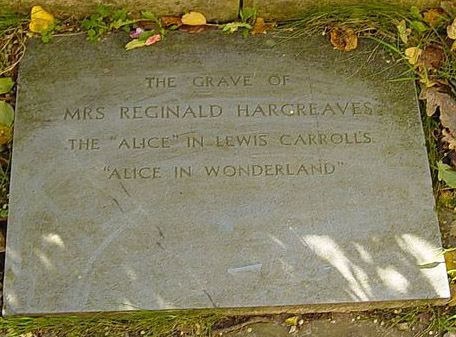
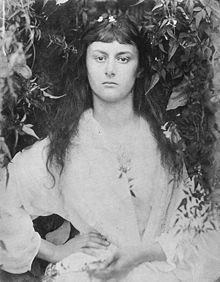
    Having just read a notice from Brainpickings on the 181st anniversary of Lewis Carroll’s/Charles Dodgson’s (1832-1898)  birth, I thought a little about the Alice who excited his interest in telling the story that became the 1865 book, Alice’s Adventures in Wonderland.  Alice (1852-1934) was born Alice Pleasance Liddell, but the epitaph for her ashes in the graveyard of the church of St. Michael & All Angels, Lyndhurst doesn’t bear her name, per se, leaving her last mortal footprint as Mrs. Reginald Hargreaves.  I know that this is a production of the times and a long-practiced practice, but for a person who may be one of the most famously-known people by their given names in the West should have had it in their name on their marker, instead of the Cheshire-like one that she wound up with:

    ALice's grave

    A better epitaph at least in the imagination could be something like the acrostic from Through the Looking Glass:

    A boat beneath a sunny sky,
    Lingering onward dreamily
    In an evening of July–

    Children three that nestle near,
    Eager eye and willing ear,
    Pleased a simple tale to hear–

    Long has paled that sunny sky:
    Echoes fade and memories die.
    Autumn frosts have slain July.

    Still she haunts me, phantomwise,
    Alice moving under skies
    Never seen by waking eyes.

    Children yet, the tale to hear,
    Eager eye and willing ear,
    Lovingly shall nestle near.

    In a Wonderland they lie,
    Dreaming as the days go by,
    Dreaming as the summers die:

    Ever drifting down the stream–
    Lingering in the golden gleam–
    Life, what is it but a dream?

    My favorite picture of Alice:

    Alice

    ·Posted by :

    ·in:


  • Pale Horse and the Lake of Fire: a Map of End Times

    JF Ptak Science Books

    Blog--jun 13 end of the world


    There are, in my experience, very few antiquarian images
    depicting the end of the world in which we see the entire globe exploding or in
    pieces or in flames. This sort of image gets more play in the 20th
    century, especially after 8 August 1945, but prior to that it is really very
    scarce.  I own a few images that appear
    in the 17th and 19th centuries, and another from 1929 (Das Weltbild which show a “giant ice
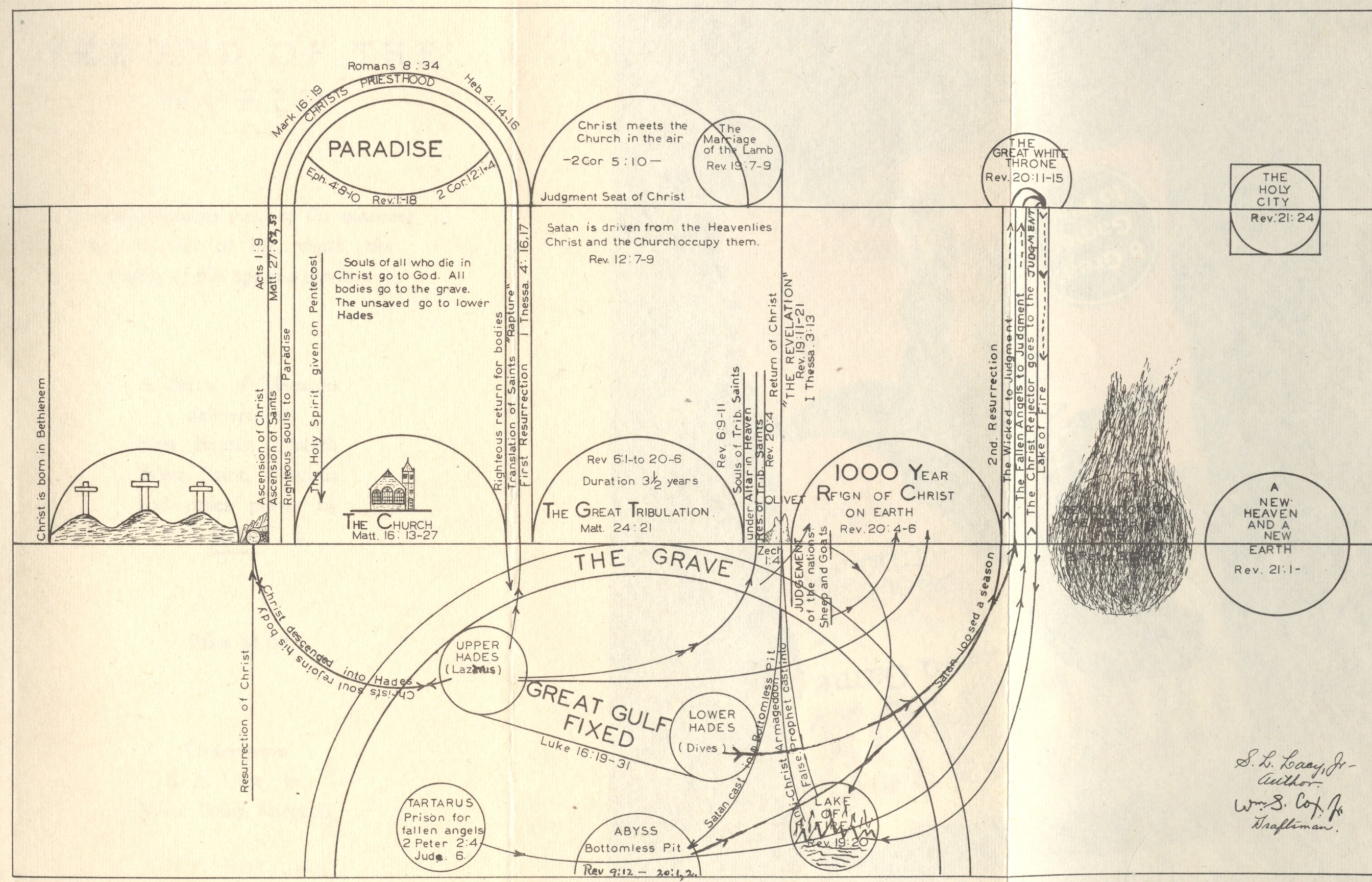
    ball” colliding into and completely destroying the earth). .  Then there is this new find, S.L. Lacy’s The End of the World, (necessarily) self-published
    in West Point, Virginia, in 1941.  It is a short and stocky, and bound in orange
    wrappers—its spine title (The End of the
    World
    ) begs the casual reader to pull it from the shelf. It’s a simple
    book—studying the Bible prophecies and revelations on the end of all things—and
    it annoys and is insulting but doesn’t disappoint.

     I started to breeze through the book (back-to-front as always) and opened the
    book to Chapter XIII, finding this delicious chapter heading:  “The Chronological Order of Final Things”,
    this being a full page pre-PowerPoint summation of the time-shrinking fireball
    that is rolling inexorably towards us all. 
    To say that one is able to put a period at the end of the world’s flow
    of time, that someone is able to identify the point in the future where the
    future is no more, is “presumptive”–this in the most understated
    fashion as to offend even the highest of high-Victorians’ sense of restrained
    propriety.  Wrapped in a comfortable
    Christian chrysalis of pre- and post-apocalyptic religious certitude, Mr. Lacy
    delivers his interpretation of biblical prophecy for the coming of the end,
    hustling it to the front of the religious line of things to come.

    It seems that in 1941 the end was beginning, and Lacy saw
    all of the images implied by prophecy that were necessary to announce the
    glorious final days of broad retribution. This includes the list if the ten
    things indicating “the sign of The Times”, one of which (Number 5)
    was “The Automobile” and another (Number 7) was “Increased
    Knowledge and Travel” (announced by Nathum 2: 3,4 and old dependable
    Daniel. 12:4, respectively.  There’s
    nothing that doesn’t fit into Daniel’s visions or revelations, though Mr. Cash
    has certainly made a lovely song of them.) 
    When everything fits perfectly into a predictive model with no possibility
    of falsification (or of proof or disproof), then the model has no validity
    outside of a belief system in itself. Very tidy.

    Blog--jun 13 end of the world det

    It is an annoying, cloying minor treatise, promising little
    more than The Lake of Fire awaiting almost all of us, even the sleeping dead,
    who would be scraped from their graves to be spit into this burning
    tragedy. 

    Lacy does a lot of inspired interpretation and
    philosophizing, much of which he doesn’t seem to bother separating from
    biblical quotations—I don’t think it is intentional, just bad writing.  A random
    find in Lacy’s thinking dislodges the following  nugget:

    “Satan is in the atmosphere above the earth, with access to
    heaven and earth with a circumscribed power over the atmospheric elements and
    the earth including the inhabitants”. 

     Oh dear.

    But enough of this nonsense. What brought me to this work is
    the folding schematic map at the front of the book.  It is a slightly complex jumble of
    semi-circles and circular reasoning, and I have no interest in straightening
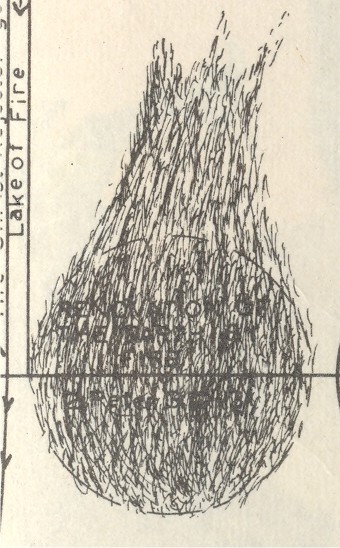
    out this jumbled linguine. What has my interest is the dissolving Earth part of
    the diagram, a part of the dead earth that comes between Calvary 
    and Heaven-on-Earth.  What makes this
    image different from the others though is that the Earth reappears—different from
    its former self having been vanquished and cleansed by all consuming fire, but
    the Earth nevertheless.  Or something
    like it.  Or nothing like it.