A Daily History of Holes, Dots, Lines, Science, History, Math, Physics, Art, the Unintentional Absurd, Architecture, Maps, Data Visualization, Blank and Missing Things, and so on. |1.6 million words, 7500 images, 4.9 million hits| Press & appearances in The Times, Le Figaro, Mensa, The Economist, The Guardian, Discovery News, Slate, Le Monde, Sci American Blogs, Le Pont, and many other places… 5000+ total posts since 2008.

Category: Anticipation, History of

  • A Telephone Book for the Dead and a Telephone to Deadville Redux (1912)

    JF Ptak Science Books     Daily Dose from Dr. Odd  

    Follow Me on Pinterest


    Dead club334
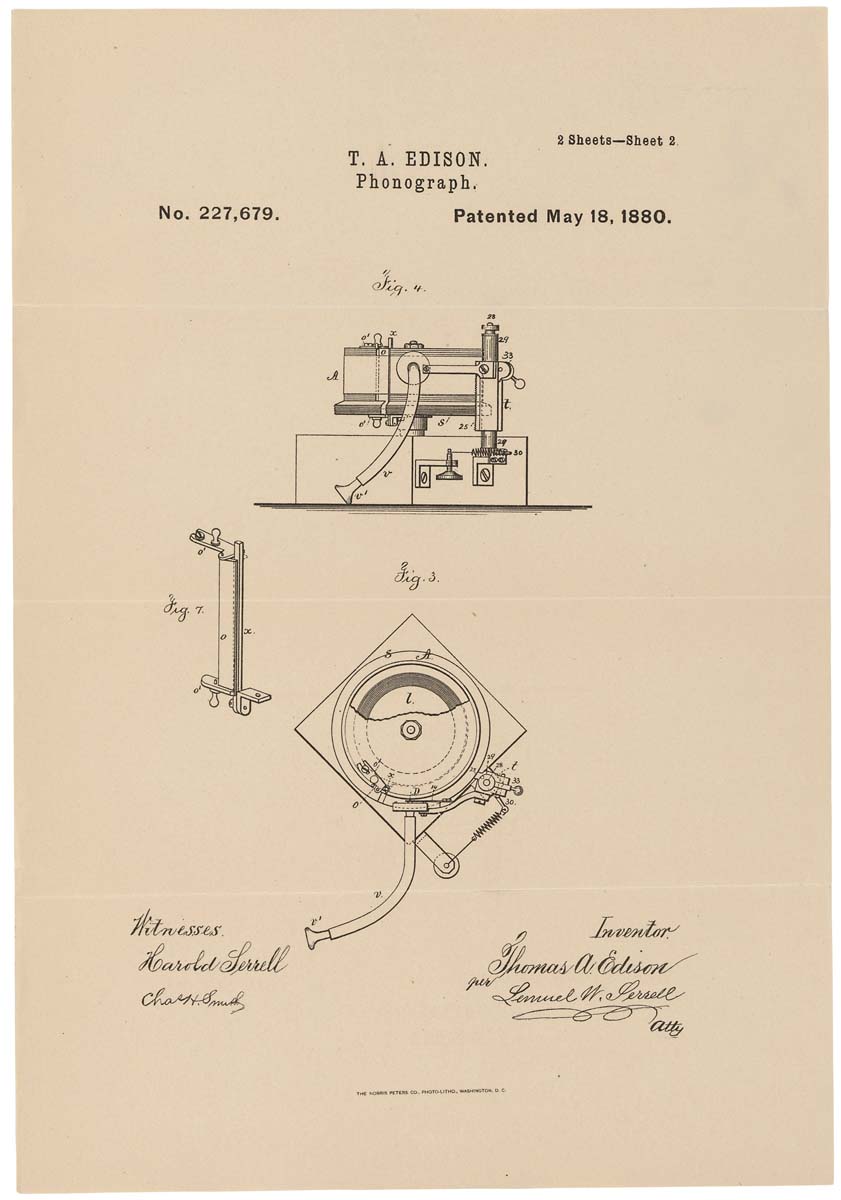
    Two years ago I posted “My Zombie ‘Phone to Deadville” and Tales of the Infinite Boneyard, by Tom Edison which addressed a prickly mock-interview that the great inventor gave in 1910 about the possibility of communicating/telephoning with/to the dead.  On the other hand, his recording phonograph did accomplish this, in a one-way way–for the first time in human history it allowed a person to listen to the sounds of something that couldn’t make sounds anymore.  Dead People Talking must have been an enormous idea to those of the first few years of Edison’s 1877 recordable/playable device–it still its own enormity if you stop to think about it for a moment. 

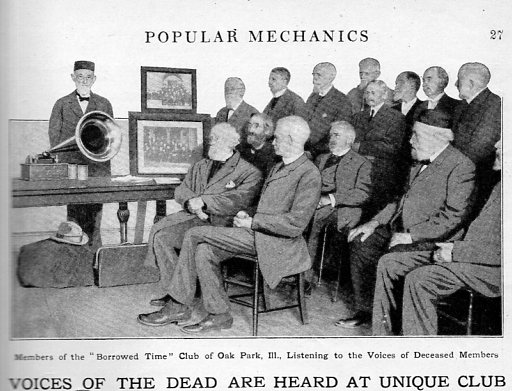
    This is to some degree what was in the minds of the members of the Talking-with-the-Dead Club in Chicago’s Oak Park as seen in an article in the endlessly interesting Popular Mechanics (for 1912). The members of the “Borrowed Time” club really weren’t so much interested in talking with the dead but rather were more consumed with the dead talking to them. On waxed cylinders.  Perhaps it was a new modern miracle and a possible comfort to their own soon-to-be demise that it would be possible to reach out from the grave to have your voice heard.  The club was founded in 1902, and of its 25 charter members only 10  survived in 1912. It would have been an odd conceit to join a club to sit with fellow members to listen to the voices of dead members, a strange if new insistence on corporeal attention to dead stuff. But it is a very recognizable wish–“need’, even–to have your the memory of your dead self improved or at least substantiated with a recording of your years-dead voice available to the curious. 

    This makes me think about a telephone book for the dead–there’s certainly enough material out there for one, or to at least think about organizing one. Certainly in the near future there will be millions of new dead people, and given the extent of cell phone communication and etc. this will be one of the fastest-expanding communities of potential communicants. Probably the idea of a “telephone book” for the Dearly Departed is old fashioned, especially when we can have an entire internet (the world wide dead web) devoted to them, the them that are us. This may sound trivial and snarky, but it isn’t and I’m not trying to be–I’m dead serious.
    PhonographPatentEdison1880


  • Negative Space Images: the Dark Imaging of an Absent Halo?

    JF Ptak Science Books   Post 2033  

    Follow Me on Pinterest


    Part of a series on the History of Blank, Empty and Missing Things

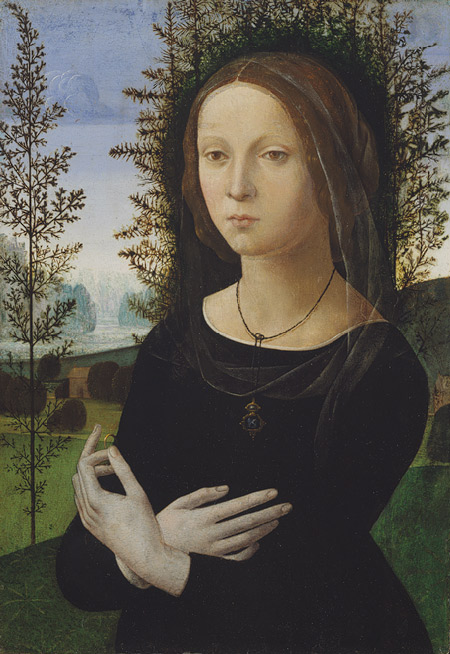
    Negative space di Credi[Image source: Metropolitan Museum of Art.]

    The idea of negative imaging–of forming an image “backwards”, or by using a surrounding space to define the image’s properties–came into play for me while looking at this beautiful portrait in the collection of the Metropolitan Museum of Art in NYC.  Lorenzo di Credi (Florentine, ca. 1456-1536) painted Portrait of a Woman (an oil on panel) in the last decade of the 15th century, a beautiful work presenting the portrait of a woman who was possibly in mourning, modestly dressed in very dark clothing and holding a ring.  What strikes me is the “dark halo” around her head, a black space outlining her head and neck and shoulders, giving all of those features a further powerful light by the very wide border between them and the juniper in the background.  I imagine that this technique was used to establish a deep luminosity, but for me it also creates the presence of a halo by painting its absence–this is admittedly tenuous, but that is the way it seems, to me. 

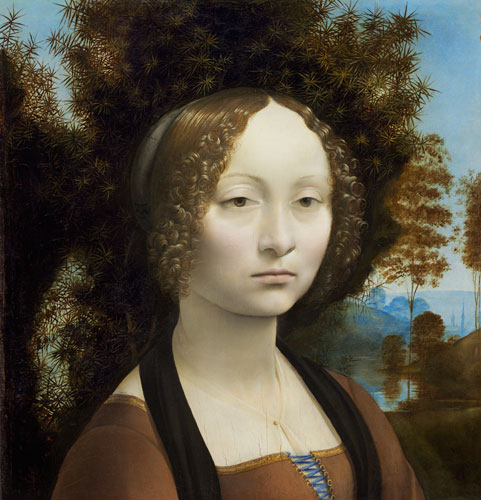
    It also reminds me in a way of Leonardo da Vinci’s  Ginevra de’ Benci, (c. 1474/1478, oil on panel), though there is much more detail in Leonardo’s non-halo. 


    Negative leonardo

    [Image source: National Gallery of Art, Washington D.C.]

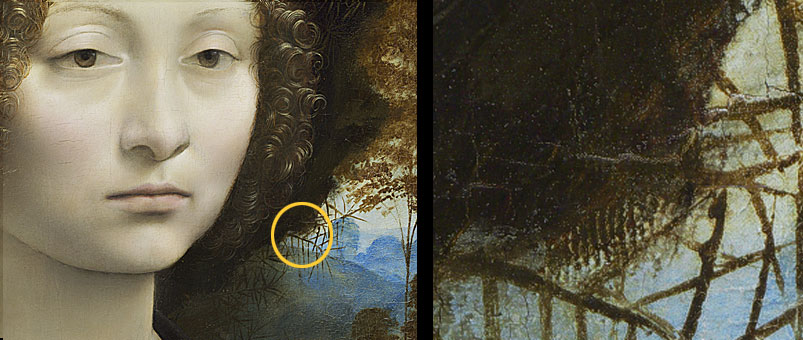
    Even
    though there does not seem to be a “halo” in the Leonardo, there does
    seem to be a fingerprint where the non-halo isn’t–evidently Leonardo
    did not limit himself to just the brush in his painting technique, but
    used his fingers as well.

    Negative space leonardo fingerprint


  • Subjugation, Surrender, Food, and the North American Indian

    JF Ptak Science Books  

    Follow Me on Pinterest


    Blogindian_ration194

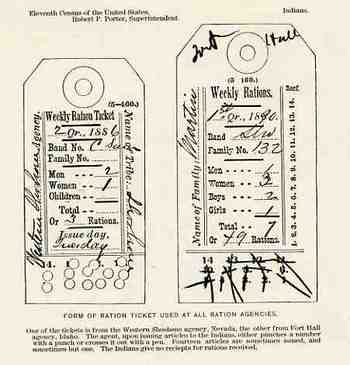
    These images of the Indian ration card and the Indian Police button were found opposite page 76 in the monumental Report on Indians Taxed and Indians Not Taxed in the United States (except Alaska) at the Eleventh Census 1890 (published in Washington DC in 1891, and perhaps the best single-volume statement on the conditions of the Indian tribes in the U.S. in the 19th century). 

    Generally tribe members would wear the white ration card on a string and attached to a button.  When you see old photographs of the Indians queued up to receive their food and provisions, the little white cards stand in sharp contrast to everything else, when they are in focus,.  When not (as the lens weren’t necessarily fast enough to capture things in motion) they look semi-invisible, like a puff of smoke on the chests of so many people.  I can imagine then these people standing in line, waiting for food, having entered reservation life with enforced “sale” of their lands, still except for the fluttering of their ration cards, small white flags of surrender that they would fly for generations.  Certainly no other element of our society would be forced to surrender so often for the need of food.  And considering too the number of Indians who would die of starvation over decades’ time at the hands of this system and in the care of the federal government, it was a surrender that didn’t necessarily entitle them to the sort of treatment that a POW would receive.  (The following photo is of a queue for ration distribution at camp Supply, Oklahoma Territory, 1871.)
    Rationscamp_supply

    The amount of the ration was mysteriously worded, at least to me; I couldn’t really tell how much food people were allowed.  The explanation reads as follows:  “the table of quantity allowed to 100 rations is:  bacon, 10 pounds; beans, 3 pounds; beef (net) 150 pounds; baking powder, 1 pound; coffee, 4 pounds; ham, 50 pounds; salt, 2 pounds; soap, 2 pounds; sugar, 7 pounds; tobacco, ½ pound.”  (The salt part is curious; salt was very important, and ion relation to everything else, 2 pounds wasn’t really very much salt at all.  I am reminded of the very last part of the negotiations between John Ross, who was the principal chief representing the Cherokees, and the flatulent Gen.Winfield Scott, the head liaison between the Cherokees and the U.S. government, in the terrible last phases of the preparation for the Cherokee removal.  Ross pleaded, and in effect offered to buy, more provisions of salt for the walking winter journey for his 12,000 charges (children included).  That this was a point of negotiation is cruel and sickening.  Scott “gave in” and allowed the extra salt…his other practices in this enforced emigration though resulted in the deaths of about a third of the Cherokee people.  And Scott was about the best, most “Indian-friendly” general that the government had to offer.)

    It continues, badly written:  “Still, it frequently happens that issue same day finds the agency short of supplies and frequently rations are issued, and of limited quantity. 

    And closes:  “The Indian, however, arrives promptly on the appointed day, no matter whether he receives or not”. 

    Blogindian_ration_button195

    The button pictured here belonged to the uniform of the Indian Police. 
    It shows an Indian guiding a plow, with the legend written around the figure that reads:  “God helpeth those who help themselves”.  Or not. 


  • A First and a Fifth of Firsts, And So On, in the History of Cinematography

    JF Ptak Science Books  Post 2031

    The story of the history of the story of firsts, of the first time something was noticed or acknowledged or invented or composed, is a problematic one.  It isn’t so easy as it might seem to establish priorities–and once the major first of a particular field or interest is established, there may be a long line of minor firsts following the major one. 

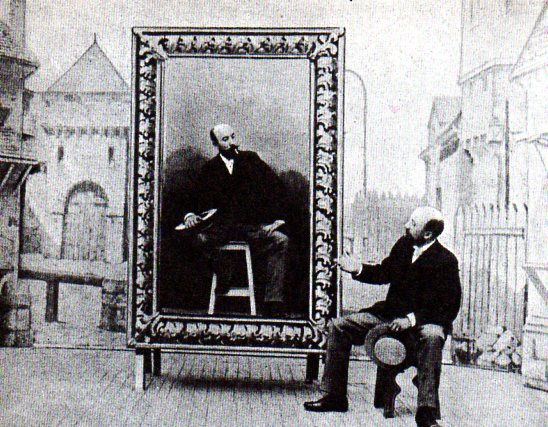
    Meiles329
    This is definitely true in photography and cinematography–even the first photograph is an item for discussion depending on how you define “photograph”.  Absent this, there is a long line of other firsts that come into play–the first photograph of a human, the first portrait, the first night-time photograph, and so on, and the same sort of issue is applicable in the history of the cinema–and they fall into a long list of Wittgenstein/Tractatus1 enumeration. 

    The subject of this post is an interesting “first” in the history of the cinema is this very interesting still of (the great) Georges Melies (1861-1938), who in 1888 opened his cinema in the Theatre Robert Houdin.  He was extraordinary, and highly gifted, a man of vast creativity (see for example his early A Trip to the Moon, 1902, here) and energy.  And it was here that in the long line of his own firsts that he produced the first cinematic experience of an a person appearing in a moving picture with themselves.  There had been inventive photography that accomplished this minor miracle decades earlier, but this was indeed the first instance of this magic being worked in film. This must have been an enormous moment for the viewer, being able to see a person having a conversation with their duplicate–my guess is that it would have seemed other-worldy, brought to earth by (according to Louis Lumiere) a great cinematician. 


  • Found Art: Re-Purposed Book, 1848

    JF Ptak Science Books  Quick Post

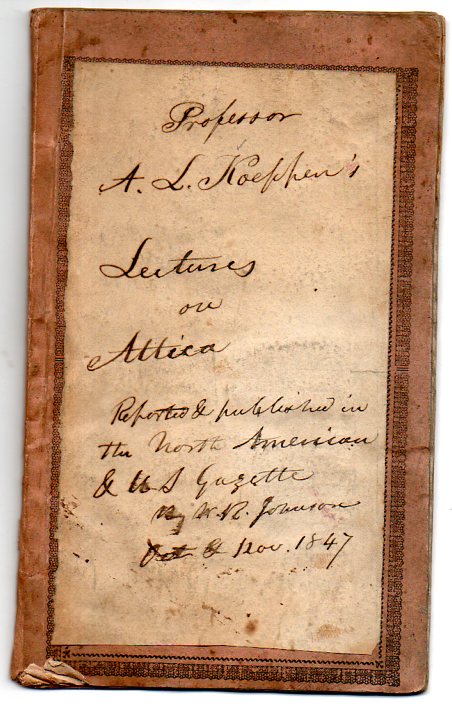
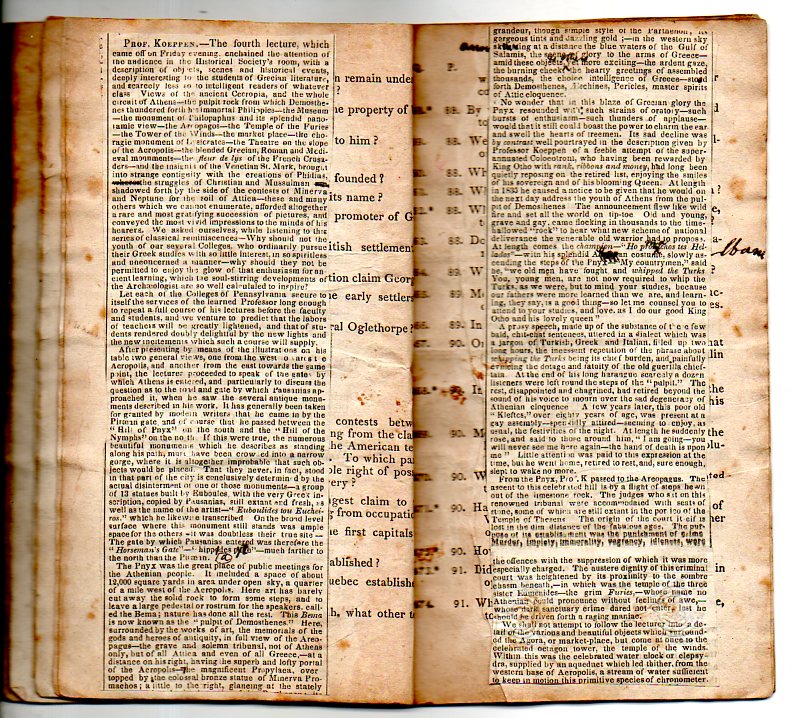
    This beautiful, home-made pamphlet was pieced together in 1847 or thereabouts, bits of an article on Attica by Professor A.L. Koeppen, cut from the North American and U.S. Gazetteer, and then pasted onto and covering the pages and cover of a chapbook. Everything about this little (5″-tall) book is stiff–the flexible paper wrappers of the pamphlet and its pages had been soaked with glue to such a degree that they’re all like boards, but with the feel and sound of paper.  All in all the feel of the book is very satisfying, and very comforting, somehow.

    Found art288
    Found art289
    Found art291

    ·Posted by :

    ·in:

    —

  • Dr. Johnson’s Definition of Letters, A-Z

    JF Ptak Science Books   Quick Post  #426

    I hear Jeremy Brett–as the ultimate Sherlock Holmes–reading this in my head.

    The energy of Dr. Johnson must have been heroic–had to have been.  In addition to all of his other work, he sat down and wrote a dictionary–the first of its kind for the English language: A Dictionary of the English Language, which was printed in 1755.

    Samuel johnson2
    I’ve collected what he had to say about the letters of the alphabet, which is in itself a small and remarkable thing of sweep and brevity.  He sites the “labial” P, the “canine “R”, the unhappy hissing of S, the “note of aspiration” in H, and so on, in a forceful march to recording the language.  His book is a work of high beauty. 

    All of the material below comes from the JohnsonDictionaryOnline site, here.

    ~ A ~

    A, The first letter of the European alphabets, has, in the English language, three different sounds, which may be termed the broad, open, and slender.

    The broad sound resembling that of the German a is found, in many of our monosyllables, as all, wall, malt, falt; in which a is pronounced as au in cause, or aw in law. Many of these words were anciently written with au, as sault, waulk; which happens to be still retained in fault. This
    was probably the ancient sound of the Saxons, since it is almost uniformly preserved in the rustic pronunciation, and the Northern dialects, as maun for man, haund for hand.


  • An Underground Tornado of Coal

    JF Ptak Science Books   Quick Post  #427 

    Follow Me on Pinterest


    Coal tornado220

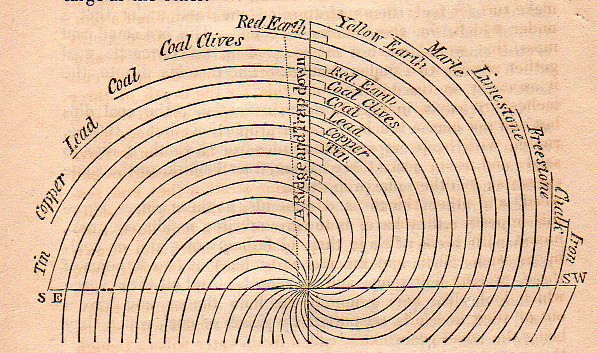
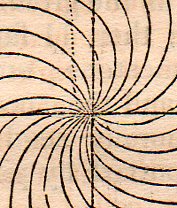
    This simple theoretical map is an invented scheme of John Strachey (1671-1743), an early geologist who with this thinking introduced the very big geological idea of strata. The original appeared in the Philosophical Transactions in 1725 (full text here, and another, with a more-realized version of representing strata, is here), and was reprinted I believe in Popular Science Monthly in 1869 with the above illustration (somewhat changed from the original).   My interest in the image is tinged with design, as it reminds me of an enromous subterranean tornado of coal, even though what Strachey is doing here is establishing the idea of strata.  

    Coal tornado221

    These lines then are the strata of these geological elements as they fan themselves out like pages from a book from the center of the Earth outward.  Its all very vague at this point, but the kernel of a great idea is present.

    The phrase “underground tornado” appears very few times in the intertubes with the world “shelter” accompanying it.  It is nonsensical, mostly, to think of underground weather and particularly extreme weather, but it has certainy playud itself out many times in literature in the pre-science-fiction fiction days. In some stories there are multiple suns, amd waterfalls, and vast canyons many times the size of the Grand Canyon, and so on–there just doesn’t seem to be much bad weather, down there.

    [Note: Strachey, a country squire and gentleman of science, published his theories and findings in two papers in 1719 and 1725, and then in a small pamphlet in 1727.]


  • Suprematist Planetary Images of Very High Contrast 1837

    JF Ptak Science Books   Post 1993    Follow Me on Pinterest

    There are times when the future turns up in unexpected places–and sometimes that imagery is quite unintentional, and belongs only to the viewer in that future, looking back.  It seems to me that many of these examples belong in the history of scientific illustration

    Thomas Dick’s Celestial Scenery, or, The wonders of the planetary system displayed
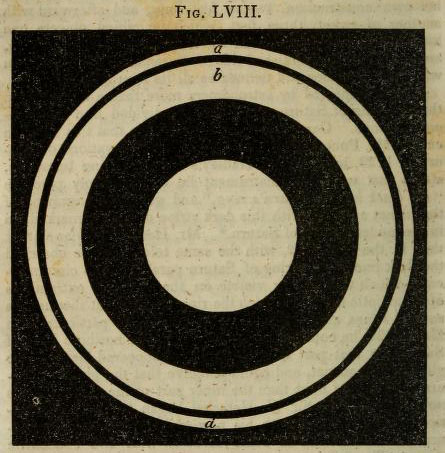
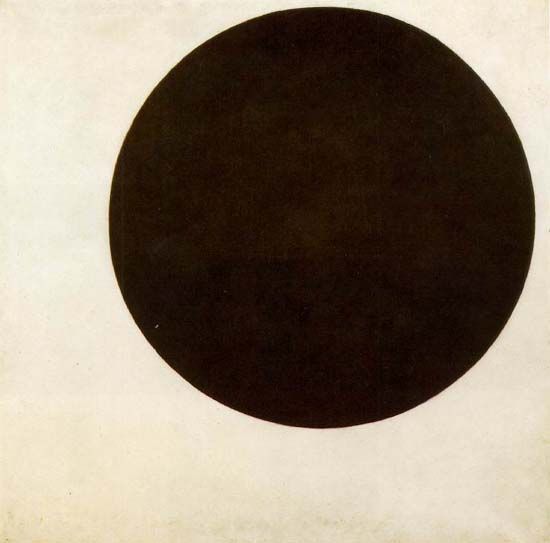
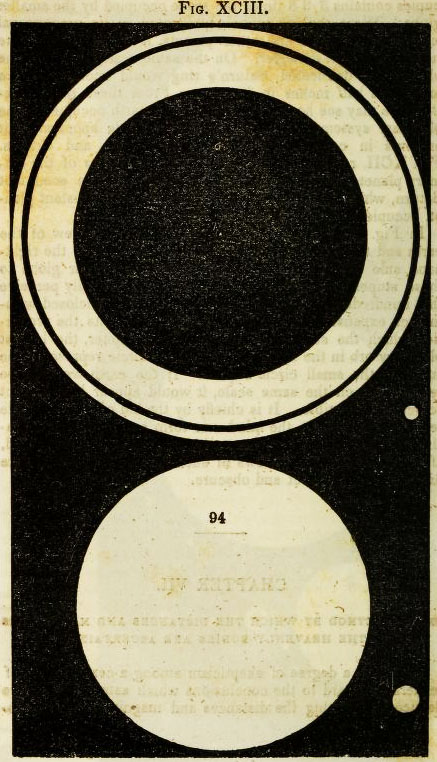
    was published by Harper & Brothers in New York in 1838 is a good example for a home of some of these flashes of future brilliance.  What we’re seeing in the pages of this chunky book–which was an influential object in the early reading of a number of people who were to become influential astronomers, one including E.E.. Barnard–are lovely, simple, and include some relatively simple images of size comparisons. The result seems to my eye to suggest Suprematist art, geometrical art that would come into being another 75 years hence or so.  (This movement was founded by the great Kazimir Malevich in the 19-teens, who said of it: “Under Suprematism I understand the primacy of pure feeling in creative art. To the Suprematist, the visual phenomena of the objective world are, in themselves, meaningless; the significant thing is feeling, as such, quite apart from the environment in which it is called forth.“) Of course the Dick images were simple comparatives and not-yet-art–but they certainly do suggests themselves as something more than what they are. The full text of the book is located at the Internet Archive, here.  (Thanks to Trevor Owens and his interesting Pinterest collection here who brought my attention to the Dick book via images of the Martian canals.)

    A plan of the rings of Saturn relating their size and some of their imagined composition:

    Astronomy dick saturn
    Kazimir Malevich, Black Circle, 1915:

    Black_circle

    Comparative of the Earth to Saturn’s rings; image bottom, depicts the Sun and Jupiter

    Astronomy dick earth saturn


  • On a Census of Senses in Oz-Land: Adventures in the Land of Silence and Light

    JF Ptak Science Books  Post 1980    Follow Me on Pinterest

    With the endless images of the Land of Oz in our minds from the book and movie it is easy for the other lands generated by their creator L. Frank Baum to escape our attention   Oz isn’t the only place that Dorothy traveled to–far from it.  She went very far and wide in the mind of Baum, who was extraordinarily prolific both inside and outside of the Oz series.

    From 1900-1919, Baum (1856-1919) wrote 17 Oz books, as well as another 18 books in the non-Oz realm, plus 17 books in a juvenile series for girls under the pseudonym of Edith Van Dyne, plus six more books under the name of Floyd Akers, plus another seven other books under five other names, plus a pretty wide assortment (200+) of short stories, plus plays. Plus all of the stuff he wrote before 1900.  That’s a LOT of writing in 19 years.


  • Imaginary History: 2-D and 3-D Shadows

    JF Ptak Science Books    Post 1975 

    Follow Me on Pinterest


    In preparing an alphabetic sampler atlas of imaginary places (a thing which looks much finer capitalized, so An Alphabetic Sampler Atlas of Imaginary Places), I wondered about the non-existent relationships between these nonexistent places, and thought that this too might make an interesting alphabetization project. So an Alphabetic Sampler of Non-Existent Relationships Between Non-Existent Places came to be, and since it has such an oddly appealing ring to it, with a certain amount of surrealist qualities (really more affectations) it might be appropriate to start with Alfred Jarry, and here with his wonderful creation, Laceland1. and its relationship to Edwin Abbott’s Flatland2.. Their’s could be a war in the relationship of their light–or more exactly, their relationship of shadows.

    I can see across the vast and extremely limited sea that separates these two places a commonality in at least one dimension–and maybe only one, though being light, it is a rather large one. Light plays a big part in Flatland. The slender book Flatland is perhaps one of the best books ever written on perception and dimensions, a beautifully insightful book that was quick and sharp, and in spite of all that was also a best-seller. Written in 1884 when Abbott was 46 (Abbott would live another 46 years and enjoy the book’s popular reception), it introduces the reader to a two dimensional world with a social structure in which the more sides of your object equals power and esteem. Thus a lower class would be a triangle (three sides) while the highest (priestly) class would be mega-polygons, whose shape would then become a circle. On the lowest but complex strata is woman, who is represented as a line, but which is also the most contentious and unpredictable of all of the Flatland shapes. That is, until they all encounter a sphere, and the introduction of the third dimension, where Abbott’s magistry comes in explaining to the three-dimensional reader what it was like to be in a two-dimensional world.

    Jarry’s Laceland–along with Amorphous Island, Fragrant Island, Bran Isle and what is almost the pluralization of my surname, Ptyx–was an island kingdom that was surrounded by shadow and semi dark, but upon approaching it there would appear absolutely brilliant and blinding light the power outmatching that of the sun, glorious and fantastic, the light greater than that of the light of creation. The light is beautifully described by Alberto Manguel and Gianni Guadalupi in their excellent The Dictionary of Imaginary Places (1980):

    “The King of Lace spins this bright light, weaving pictures of madonnas, jewels, peacocks and human figures which intertwine like the dances of the Rhine-maidens. Clear patterns apper against the pitch-black darkness of the surrounding air, like shapes painted on windows by the first, and then disappear again into the shadows” (Page 204)

    Now in Flatland, light is a different sort of thing, coming as it does in only two dimensions, which means that two-dimensional light in a two dimensional world makes for a different sort of shadow, one that is rather flat and uninspired, especially compared to those of Laceland, which must be magnificent. Perhaps the shadow relationship between Laceland and Flatland is one of opposites. Polar opposites. Impossibles.

    This all seems to come together a little when considering that the Dr. Faustroll of the Laceland adventures, is the inventor of “pataphysics”, which is “the science of imaginary solutions”.

    Notes:

    1. Alfred Jarry. Ptyx, Laceland, Amorphous Island, Fragrant Island and Bran Isle, Exploits and Opinions of Dr. Faustroll, pataphysician, 1911.

    2, Edwin Abbott. Flatland: A Romance of Many Dimensions (1884).

    ·Posted by :

    ·in:

    —