JF Ptak Science Books LLC Post 848 Blog Bookstore
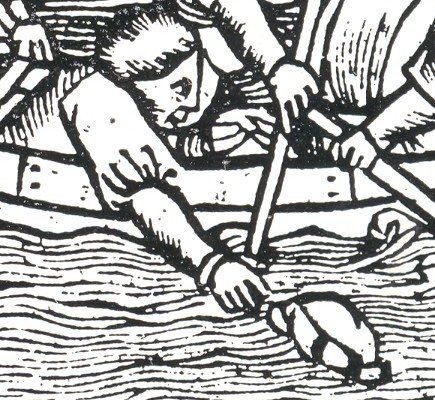
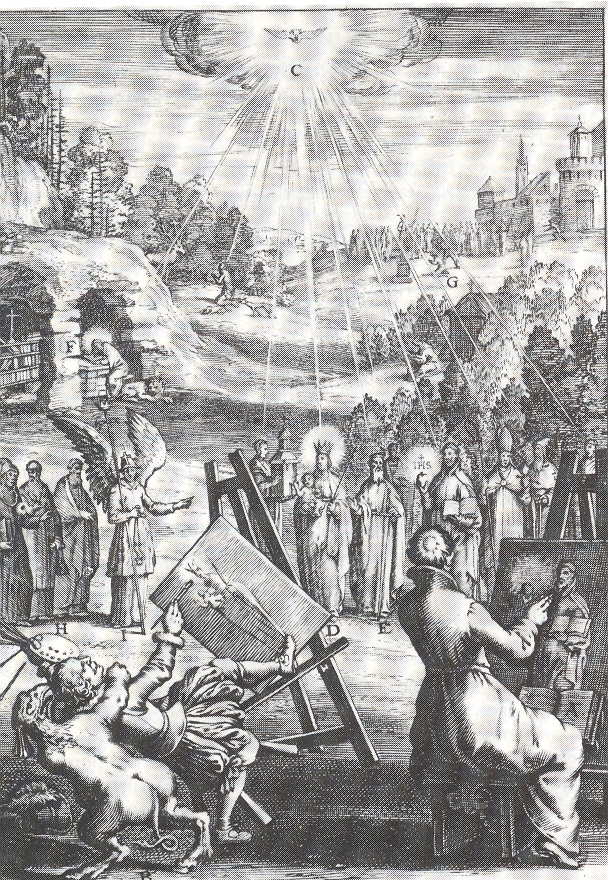
Mark Twain said that Adam only took the apple not because it was delicious or attractive but because it was forbidden. I wonder why this operative of Satan was so interested in this artist (pictured below), who was seemingly and boringly making his way through a standard portrait of an imagined vision of the Holy Mother. She and the other holies (some of whom appear to be “simply” human and clerical compared to the rest of the iconic foundations of Christianity) are being bathed in pure holy light; an angel at left, seemingly with nothing else to do, unnecessarily points to the main attraction, making sure that the artists knew that it was the folks with the halos who were to be painted. . [It would be surreal and interesting to imagine a short sequence in which we see these two artists working busily on their unseen canvases, sweating as the oils fly, recording the celestial scene before them, golden and glowing people illuminated by the light of the creator; finished, the artists reveal their work, one painting the holy congress, while the other turns his godless landscape canvas featuring the odd tower at right-rear. “I could never paints hands” he might’ve said.]
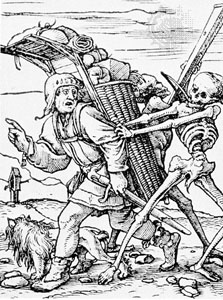
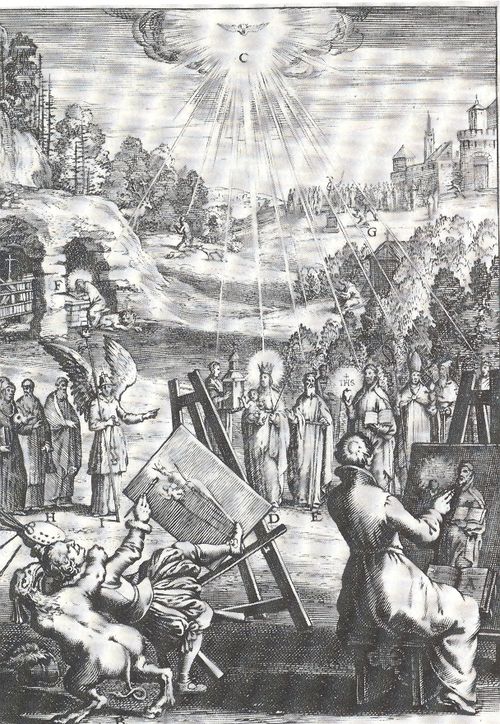 The engraving is the work of Bortius a Bolwert (1580-1643 and a pupil of the much better-known Abraham Bloemaert) for A. Suquet’s morality and Heaven/Hell peepbook, Den wech des eeuwich levens…which was printed in 1620. I don’t know what the original message was for this image, unless it was something simple, some punishment for a less-than-pure artist painting purity; perhaps the devil took the artist at death, showing the reader that not only is death available to call at any time, but that the devil was right there, too, to whisk you away to the lake of fire even while your oily hommage to the creator was wet on your easel. It might well simply be in the dance of death tradition–so beautifully and haltingly executed by people like Albrecht Durer–showing Death visiting people of all ranks and professions, the moment of extinction coming at the time most perfectly illustrating the deathee’s station of life.
Also appearing under such titles as Ars moriendi, Memento mori, Vanitas, Dancs Macabre, the Skeleton Dance, la Danza de la Muerte, Totentanz, and the Chorea Machabæorum, among others, the idea of the Dance of Death existed as morality plays and in literature for many centuries. In the years before printing in Europe, there were many versions of time’s massacre in frescoes in churches and chapels all across Europe (see here for an interesting chronological listing) as well (of course)as in myriads of manuscripts. In addition to Durer, some of the early post-Gutenberg masters of this genre included Konrad Witz, (1460); Bernt Notke, (1463); Hans Holbein the Younger (1538), Daniel Nikolaus Chodowiecki,r Johann Elias Ridinger. (See here for an introduction to and explanation fo the Holbein cycle.) 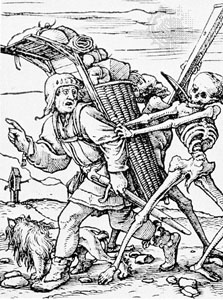
In music too the Dance of Death scenario is seen many times: the Danse Macabre (by Camille Saint-Saëns, 1874); Songs and Dances of Death, (by Modest Mussorgsky, 1875); Dance of Death in Symphony No. 4, 2nd Movement (by Gustav Mahler, 1901); Mattasin oder Toden Tanz, (by August Nörmiger, 1598); (Dance of Death), in Ballad of Heroes, (by Benjamin Britten, 1939); Dance of Death, in Trio in E Minor, op. 67 (by Dmitri Shostakovich, 1944); Totentanz ( by Franz Liszt, 1849 AND Felix Woyrsch in 1905 AND Arnold Schoemnber in 1914 AND Wilhelm Kempff in 1931, and on and on. I didn’t mean to go on about this, but just wanted to make the point that the Looming Nature of Death really was so in Medieval and Renaissance Europe–and where death as waiting at virtually every turn, the Devil wasn;t too far behind.
(Also, see Bibliodyssey for a wonderful woodblock book of the dance of death.)