A Daily History of Holes, Dots, Lines, Science, History, Math, Physics, Art, the Unintentional Absurd, Architecture, Maps, Data Visualization, Blank and Missing Things, and so on. |1.6 million words, 7500 images, 4.9 million hits| Press & appearances in The Times, Le Figaro, Mensa, The Economist, The Guardian, Discovery News, Slate, Le Monde, Sci American Blogs, Le Pont, and many other places… 5000+ total posts since 2008.

Author: JF Ptak

  • U.S. Wartime Production, Control, and Patriotic Propaganda, 1942

    JF Ptak Science Books  Post 1416

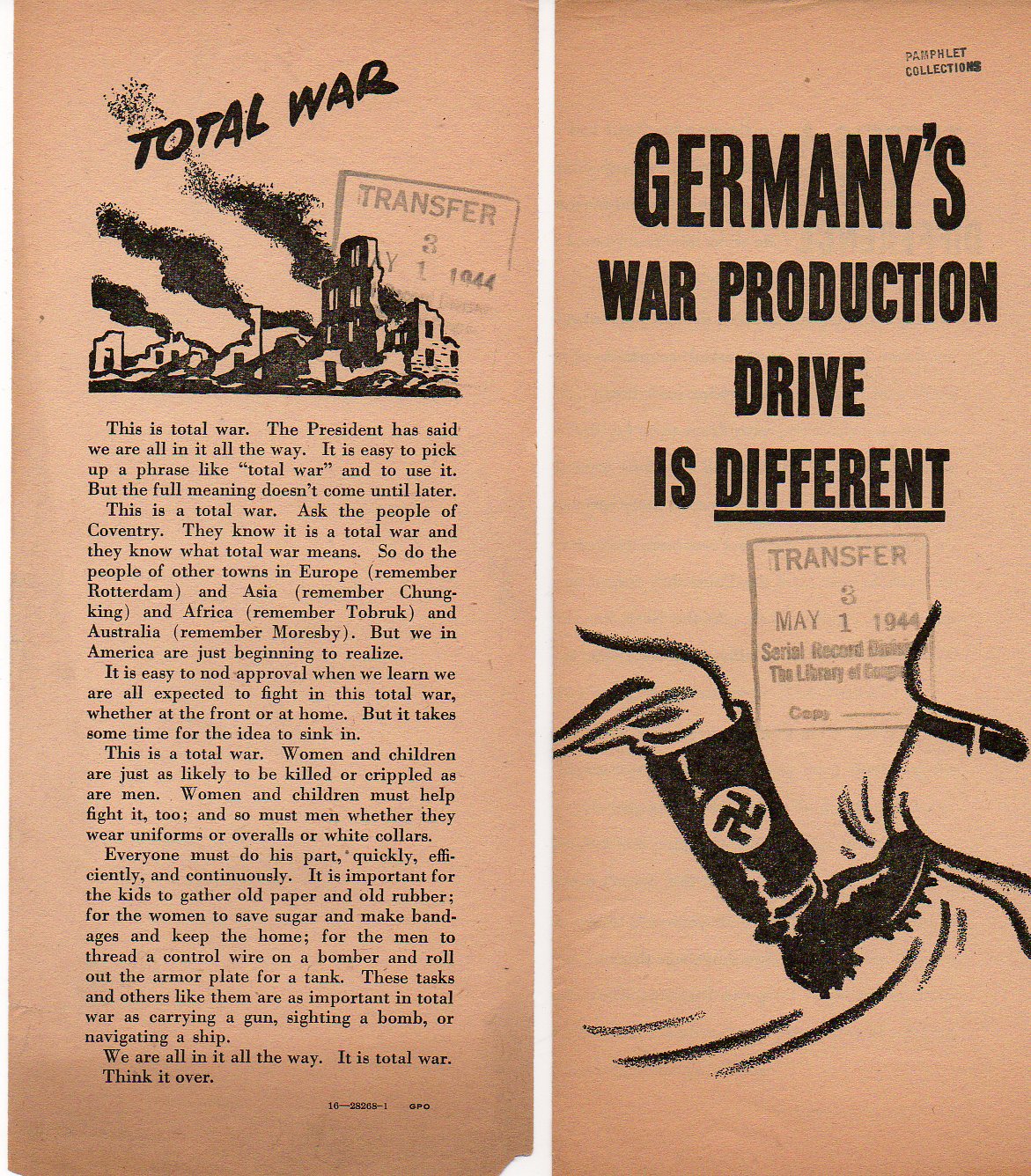
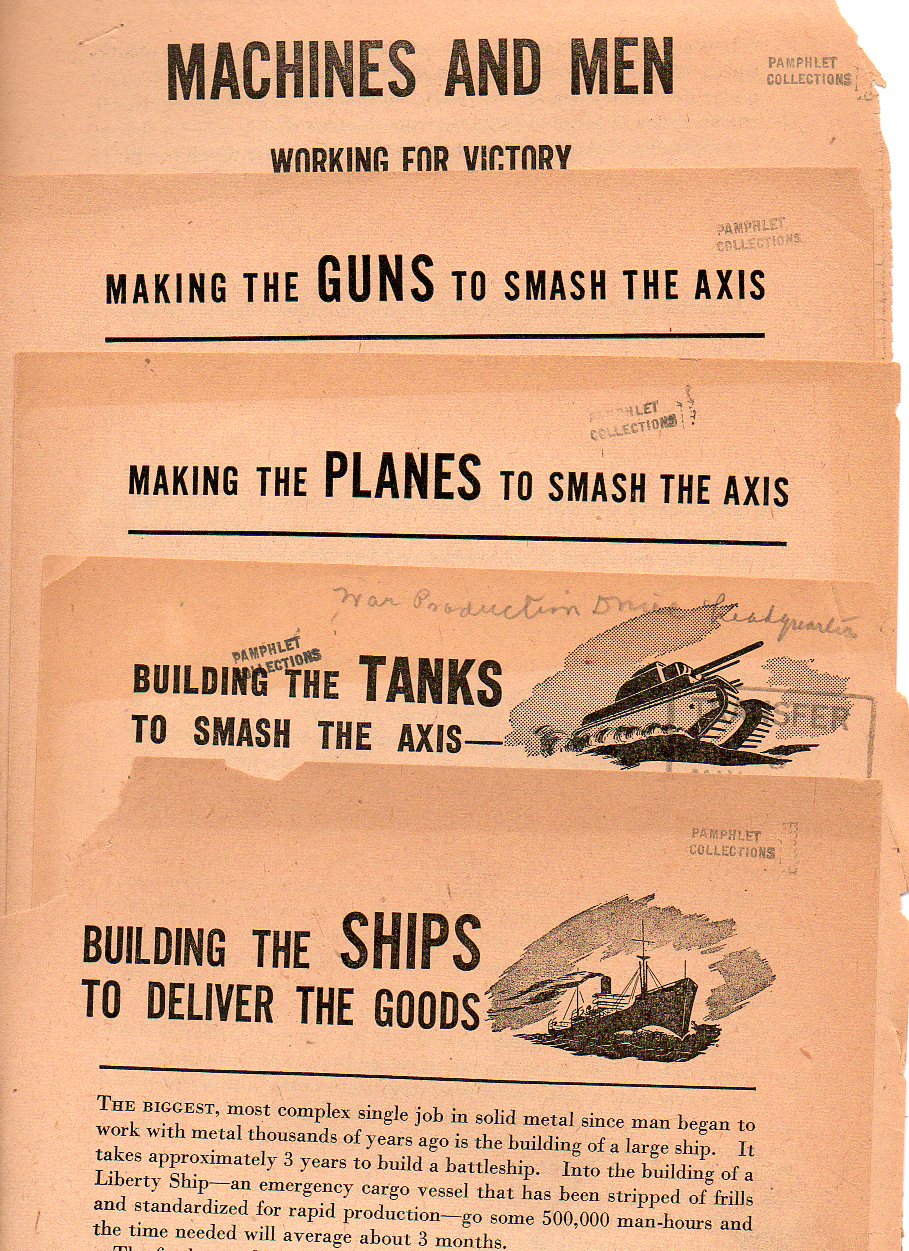
    The War Production Board (WPB)–the entity responsible for printing the leaflets below–was instituted 16 January 1942 as a federal effort to direct U.S. wartime production and allocation of essential commodities.  And time. The WPB centralized the effort to convert some peacetime industry to wartime production, as well as direct the production of existing wartime industries in the manufacture of critical goods, and rationed or prohibited the manufacture of other material that could possibly hinder the war effort.  Thus the WPB rationed things like sugar, heating oil, plastic, gasoline, paper, rubber, nylon and metals of all descriptions; it also controlled large swaths of the workforce, restricting wages and benefits as well as prices.   It was an essential element of fighting the war, and brought necessary control to an economy and industrial base that needed organization for what would become a total war.        (We offer a small collection of 16 of these items at our blog bookstore.)
    War Production Board265
    Instituting a war-production base for American industry allowed production to ratchet way up, producing (for example) multiples more aircraft more in 1943 than in 1941:   1940, 6k aircraft; 1941, 19k; 1942, 47k; 1943 85k; 1944, 56k; 1945, 46k.  Also there were enormous production advancements for total shipping tonnage (reaching a wartime production total of 33 million tons), across-the-board huge increases in coal and iron ore (and especially in crude oil), and on and on.  The U.S. was able to mobilize itself and take advantage of its enormous natural resources, industrial base and civilian workforce in what was essentially an unreachable island economy, forming what was actually an unbeatable combination of war goods production. (Plus of course there was the atomic bomb, which is another story, but which also only could have been produced in the U.S., given the enormous quantities of energy and material needed to begin its production.)     

    War Production Board264 The WPB also was responsible for hearts-and-minds campaigns at home, too, because so many people, such a huge proportion of the population, needed to be involved in the war effort, not only from the production standpoint but also for strategic conservation.  For example, in one massive effort to collect the very necessary scrap metal (that would be collected and reformed into war materiel) the WPB organized a nation-wide drive that in one day collected 82 pounds for every person in the country.  Singular efforts like this, or seemingly singular, needed to happen at regular and short intervals for the war economy to be successful.  And so pamphlets like the story of Joe, below, needed to be told:

    The “it” that Joe needed to have was ammunition, and grenades, and anything else that would kill the enemy.  With it, Joe was successful; without it, and thereby without the “it” being produced by the folks at home to whom this flyer was being distributed, was helping to kill Joe by not giving him enough of the deadly stuff.

    “Don’t let Joe down” says the flyer, “its our job to give him everything he needs and wants”.  It turns out that Joe had 26 notches in the comb of his rifle, “from the Japs (who would never) get back to report after they met Joe”.   Joe “spread the lead around with a free and easy hand and alot of Japs wished he hadn’t been so generous.  Trouble was, he never had quite enough of it…”

    And so went the rest of it, and them–resonant pleas, demands, for people at home to be vigilant in whatever it was they were doing to push the war effort forward.  Slacking meant death and possible destruction, and the hosts of these flyers that I have here gave very little pre-text for this not to be the case. 
    War Production Board266


  • The Almost-Tomorrow Department: Radio-Vision, 1928.

    JF Ptak Science Books  Post 1415

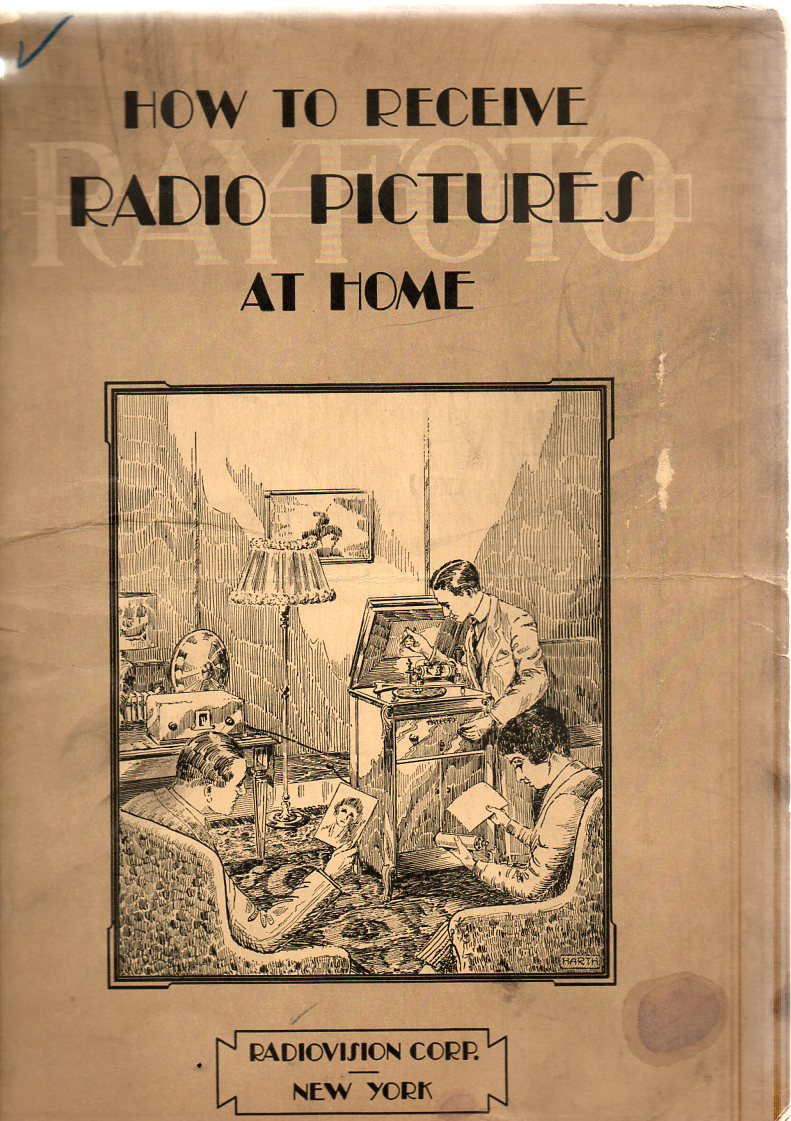
    Radio vision258 Tomorrow seemed to be almost there to readers of this pamphlet, what with the idea of looking at pictures relating to the radio broadcast you were listening to looming before a slightly disbelieving mind.  The fact of the matter though is that this breakthrough by Mr. Austin G. Cooley1–basically attaching what we would know today as a fax machine to a radio cabinet which would receive and print images relating to the show being heard–was rubbing up mightily against the real wave of the future, the television. (The original is available here at our blog bookstore.)

    Mr. Cooley’s invention of the Rayfoto just didn’t quite fit the demands that would soon be established and met by television.  The idea of practical television goes back a fair way2, at least to Arthur Korn in the late 1890’s, which much work being done on both broadcast television and facsimile transmissions.  But tv was definitely a high scent in the air when Cooley published his Rayfoto pamphlet in 1928–as a matter of fact, this was the same year in which the first television license was granted (to Charles Jenkins, W3XK).  And just two years later the BBC would begin regular television broadcasts, while also in 1930 Mr. Jenkins initiated another television-first, the t.v.commercial. 

    Radio vision259

    “No greater thrill awaits the radio experimenter than receiving his first picture through the ether…Not many months will pass before picture broadcasts will be a part of every radio broadcast”–A. Cooley, 1928

    So the time was definitely note ripe for Cooley’s idea as an image supplement to radio, though it did have other possible applications–like the “fax” delivering newspapers to your home–though they are not listed in the pamphlet. 

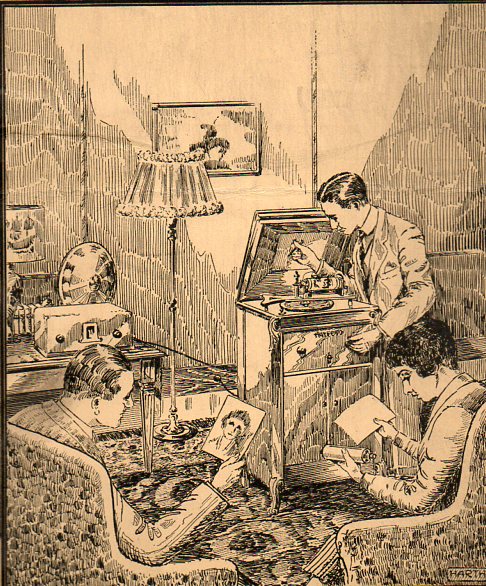
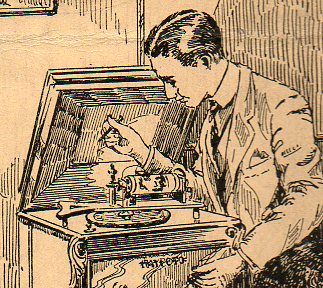
    What we see here the drum of the apparatus (we don’t see the three-tray developer/fixer wet set-up inside the apparatus), one of the listeners retrieving an  incoming vision-image, something that evidently took quite some time, depending on the image and the ways in which the developing trays have been set.  Dark images might’ve taken the entire length of a 15-minute broadcast to transmit and print; other, simpler efforts took less time.

    Radio vision260
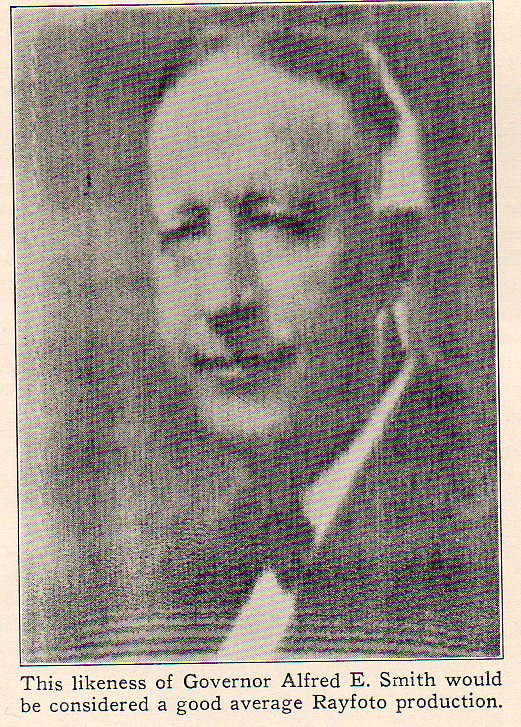
    Here’s an example of a successful, medium-quality image that one could expect using Cooley’s Rayfoto system:

    Radio vision261
    It doesn’t look like much now, and maybe it wouldn’t’ve looked like much to people familiar with the new television.  But even a grainy, static image accompanying a voice performance is a fabulous thing when compared with never having seen anything like it before, never having had such an experience, if even only as a novelty.

    _______

    Notes:

    1. Cooley,  Austin G.  How to Receive Radio Pictures at Home.  New York:  Radiovision Corp,  1928.  1st edition.  26pp, 2 folding blueprints  4to.   This unusual publication describes the construction and use of an apparatus which would receive broadcast (facsimile) images that would be used to illustrate radio transmissions/shows.  The idea (in this form of illustrating radio shows) at this date would be reduced to almost-nothingness once television entered the picture in the next year or so.  Still, it was an elegant idea to illustrate the spoken word.

    This system was offered by Austin G. Cooley (1900-1993), inventor of the Rayfoto system, “the first authentic radio picture apparatus”. This was a very early attempt at mass entertainment via a mechanical medium that proved ineffective by 1929/1931 against the advances of television. (The radiovision method was something like a facsimile device, offering a static image every now and again, and was completely outclassed by the moving image).

    2. Followed by Paul Nipkow’s rotating discs in the earliest part of the 20th c, then by Vladimir Zworkin’s iconoscope (1923), Charles Jenkins and John Baird’s television of 1924, and then of course by Philo Farnsworth’s 1928 image dissector.


  • Ancient Motion Pictures, London, 1896/1903

    JF Ptak Science Books   Post 1413

    I just wanted to share these films that I found at the British Film Institute’s youtube account.  They are remarkable, clear, fluid images of London in 1903/1913 or thereabouts, offering a slice of relatively unrehearsed life from 100 years ago that is so unexpected. They are visual time capsules, beautifully restored by the BFI–they are like moving picture versions of sumptuous platinum prints, with gorgeous detail in each frame, so lovely that they look as though they could withstand micro inspection. 

    The first: London, 1903:


    Blackfriar’s Bridge, 1896–very short, but again, another remarkable piece of moving history…if only there was sound.

    Trafalgar Square Riot for Mrs. Pankhurst, 1913:

    Petticoat Lane, a semi-ancient marketplace east of Central London, showing a common look to common folk buying and selling common stuff, 1903:

    ·Posted by :

    ·in:


  • Films from U.K. National Archives, 1940. Winning the War for Hearts and Minds at Home.

    JF Ptak Science Books   Post 1412

    Interesting films produced by the Office of Information, mostly 1940 and 1941, and found at the (U.K) National Archives. 

    London Can Take It!  (Battle of Britain, 1941)

    “This film, in which the American journalist, Quentin Reynolds pays tribute to London and its people under fire, conveys the spirit and atmosphere of the 1940 blitz on the capital. Its impact at the time, especially in U.S.A., makes it historically one of the most important of the war films.”

    “The production file in the National Archives – TNA: INF6/328 states that the film was to be ‘distributed throughout U.S.A, Canada and Latin-America by Warner Bros’ and was to be shown in ‘at least 15,000 American cinemas’.”  Relseased 1941.

    Hitler Takes Command

    “Cleverly edited montage footage taken from German propaganda films, including Leni Riefenstahl’s Triumph Des Willens, which shows Hitler and his marching Soldiers of the Reich, synchronised to the tune of ‘The Lambeth Walk’.”  Relseased 1941.

    Dig for Victory

    “An appeal to everyone during wartime to ‘Dig for victory’ by cultivating vegetables for the good of the country and their own better health.

    Words for Battle.

    “The production file held at the National Archives – TNA: INF 6 / 507 states that ‘a re-edited version was made by Spectator for inclusion in the fortnightly reels for Russia’ and that material was used from other Ministry of Information Films including ‘How to dig’, ‘Sowing and planting’ and ‘Cultivation’.”

    “Words for Battle evocatively sets to film passages of quotation from poetry and prose including works by: Milton, Blake, Browning and Kipling. The famous “we shall never surrender” speech by Winston Churchill and Abraham Lincoln’s Gettysburg Address are also quoted in the Film. It powerfully associates these passages and music by Handel and Beethoven with images of everyday life in Britain at war.

    The Crown Film Unit file held in the National Archives: TNA: INF 6/338 synopsis reads: ….“A call to arms through images and words of Britain’s countryside, people and poets”.

    Released 1941, and read by Lawrence Olivier.

    Workers’ Weekend (A Tribute to the Workers of the British Aircraft Industry)

    ‘A tribute to the workers of the British Aircraft Industry’. Men and women in a factory in the North-West of England set themselves the task of building a Wellington bomber in the record time of 30 hours. Constructing in their own time, the workers donate the bonus they got to the Red Cross ‘Aid to Russia Fund’.

    The cameras capture the whole process of the construction in record time through to the test pilot taking off in the plane, ahead of schedule.”

    ·Posted by :

    ·in:

    —

  • A Graphical Representation of Journal Articles on Relativity Theory, 1896-1923

    JF Ptak Science Books     Quick Post

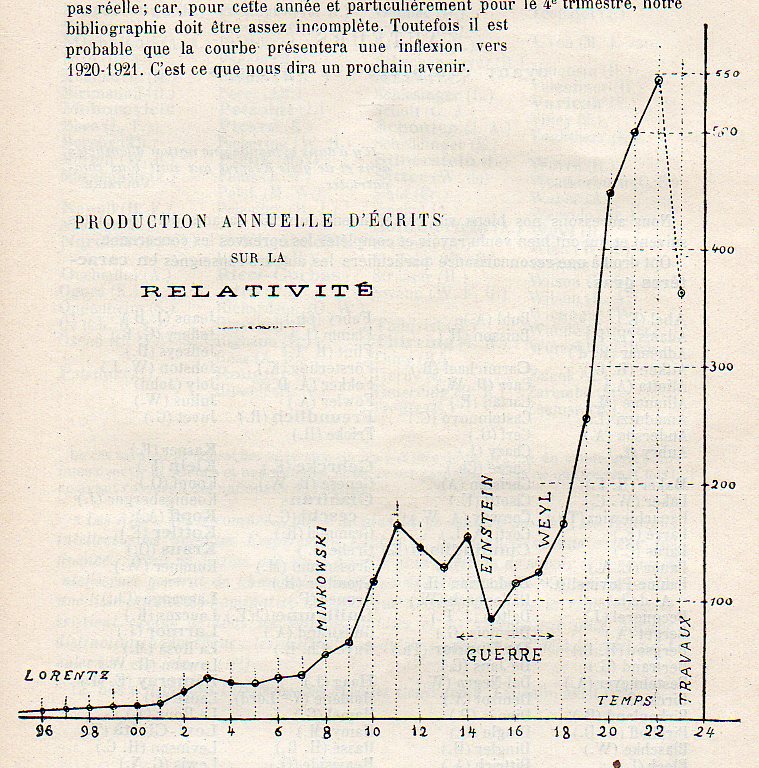
    I haven’t often seen graphical representations showing the relative publishing interests in a particular discipline of the sciences, or the maths either for that matter.  But that’s exactly what is found in the deep pages of Maurice Lecat‘s Bibliographie de la Relativité, suivie d’un appendice sur les déterminants à deux dimensions, le calcul des variations, les séries trigonométriques, et l’azéotropisme, published in Bruxelles by Lamertin in 1924. [The original text is offered for sale at our blog bookstore.]  The graph is called “Production Annuelle d’Ecrit sur la Relativite”, and shows the total number of articles published in that area–or at least those identified by the verifiable Lecat, who finds more than 4,000 of them for the 1896-1922 1/2 period.

    Relativity graph252

    We track the year of publication on the X and the number of publications on the Y, and we can see that before the great 1905 special theory was published by Einstein that Lecat considered some dozens of other papers (actually more than 200)  to fall into that (pre-Einsteinian relativity) category. It is interesting to note that “On the Electrodynamics of Moving Bodies” paper (30 June 1905) is not indicated with a vertical “Einstein” for that year (like the for indicator for 1915/16), though Lecat does indicate the general decline in relativity papers in the 1914-1916 period  was probably caused by WWI.  The number of papers does triple and then quadruples in year one and two of the peace.

    ·Posted by :

    ·in:


  • Making Things Disappear–German POWs, 1918

    JF Ptak Science Books    Post 1410

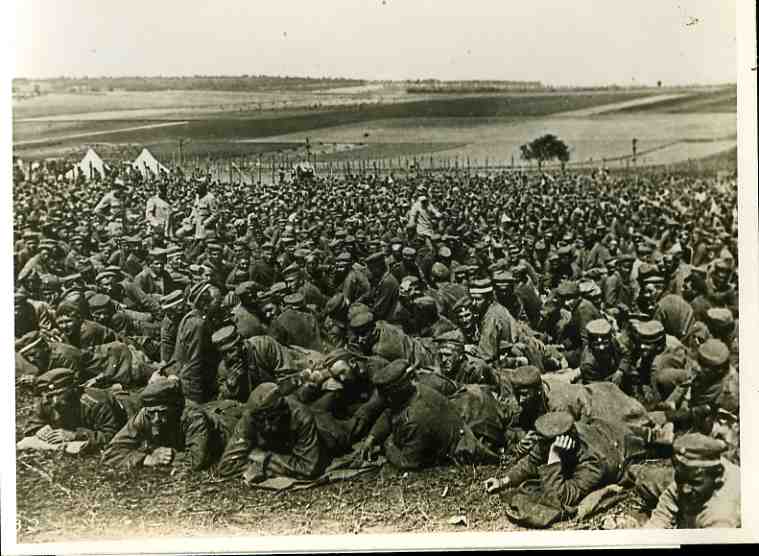
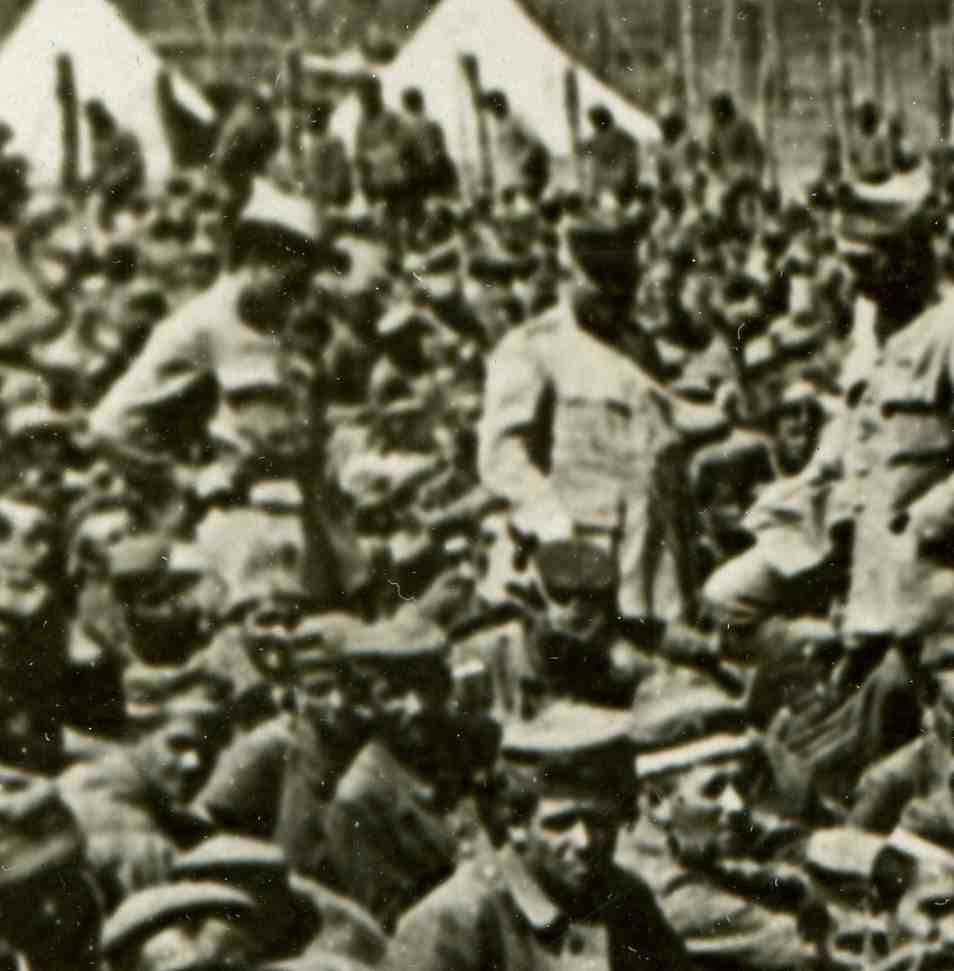
    In continuing series of posts on Blank and Empty Things is this image on fading, disappearing German prisoners of war.  The French had been pounding them in western France in the summer of 1918, and Germans were surrendering and being captured by the thousands.  This news service photograph shows one of the assembly camps with about 10,000 POWs–I made a heavy scan of the group of soldiers in the distance and was  a little taken aback to see that the men had lost their human forms,  looking like bacteria, fading into their future.  (The original photo is available for purchase through our blog bookstore.)

    000-ebay--Nov 8 pows018

    000-ebay--Nov 8 pows017

    The full image is impressive, and shows just a small fraction of the men taken prisoner during 1918; and it shows even a lesser percentage of those killed.

    000-ebay--Nov 8 pows019

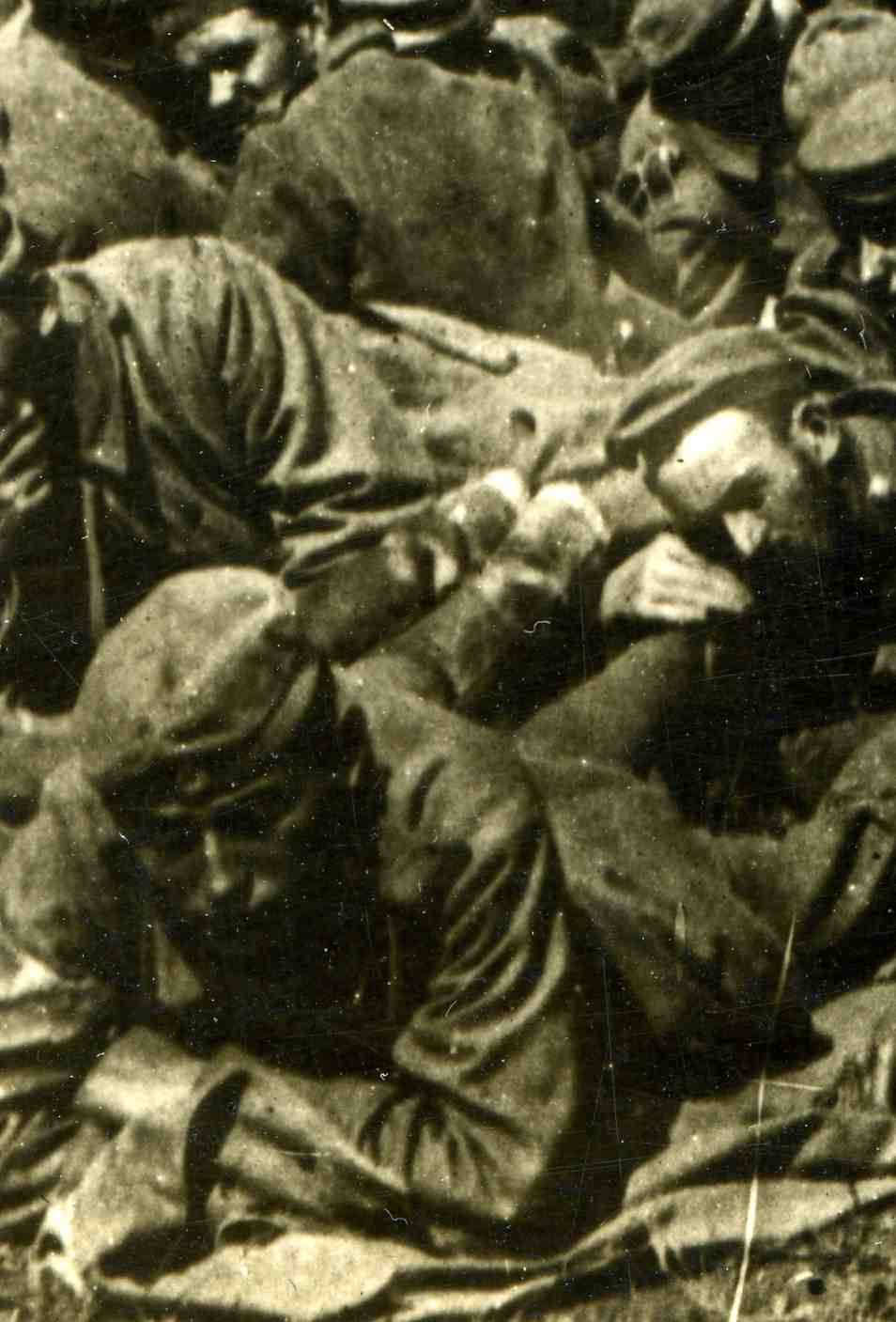
    This detail of the foreground shows the familiarity necessitated by the men being pressed so closely together–there was little free ground.

    Also, I thought that the French soldiers in the midst of the prisoner might’ve been feeding them, but it seems as though they were just walking in their midst.

    000-ebay--Nov 8 pows022


  • World War I in Ivory–Pianos and Recovery

    JF Ptak Science Books   Post 1409

    WWI  piano246

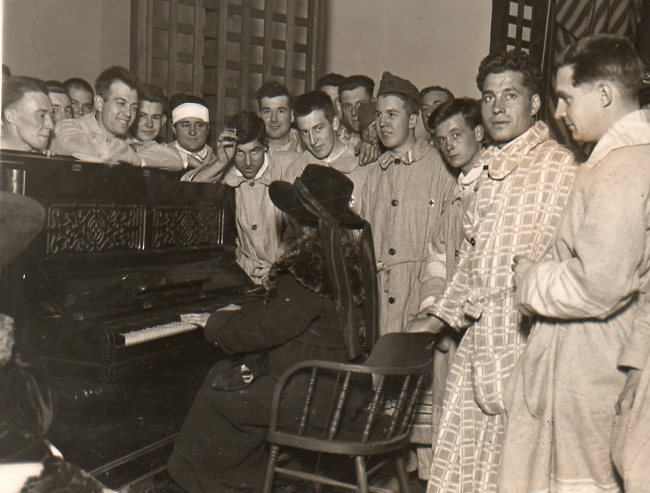
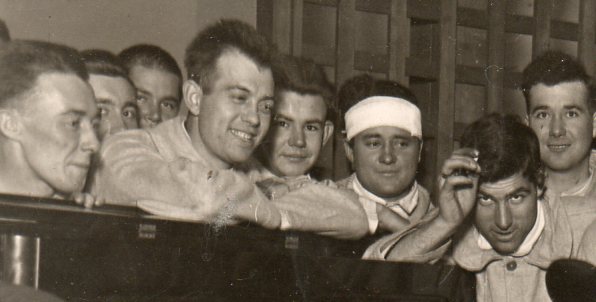
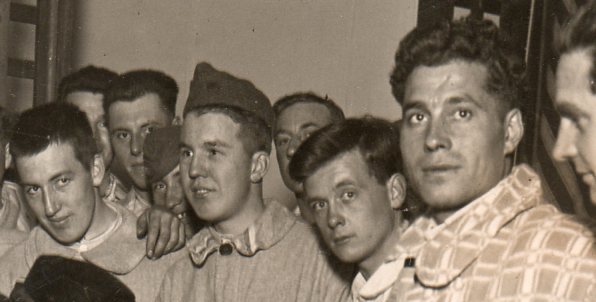
    These images come from my collection of World War I news photo service photographs, and are among the minority that show even momentary happiness.  In both of these cases, the emotion resolves itself in song and in the piano.  The first image takes place in a U.S. overseas hospitals for wounded soldiers, and they seem genuinely relieved to have the attention and the entertainment. (Both images are available at our blog bookstore.)

    WWI  piano247
    WWI  piano248

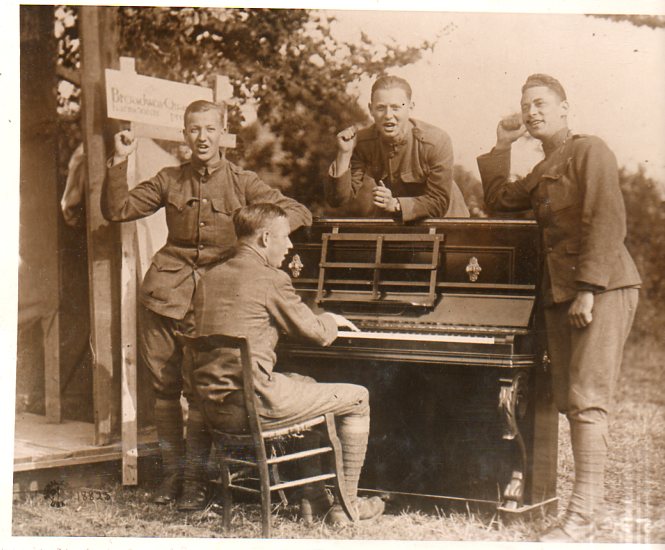
    The second image is dated 2 November 1918–just nine days before the armistice–and shows the “Broadway Quartet” as they rehearse “I’m Only a Buck Private” for a behind-the-lines show for U.S. servicemen, somewhere in France.  The note with the image (from the Western Newspaper Union) says that the staging used for their shows came from found wood, bits of flooring, and camouflage netting torn into pieces.  

    WWI  piano250
    WWI  piano251

    ·Posted by :

    ·in:

    —

  • Display of Information: What a Dreadnougth was Worth in Airplanes, 1911

    JF Ptak Science Books  Post 1408   [Display of Quantitative Information series]

    Info display dreadnought237

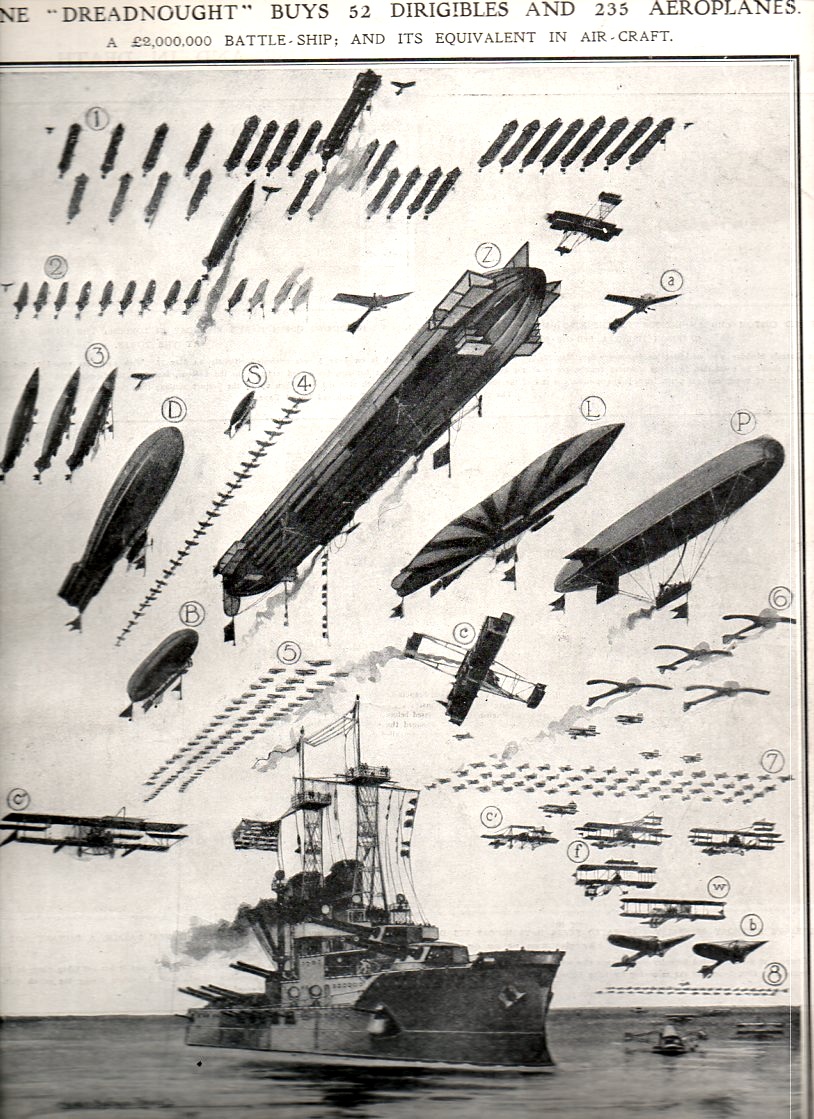
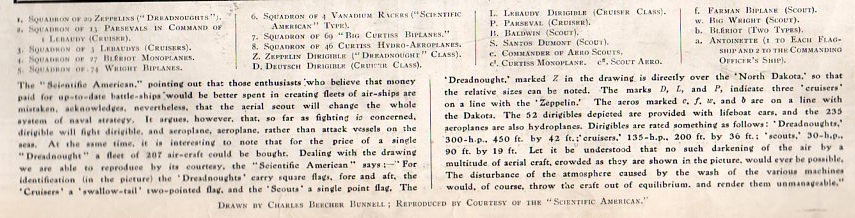
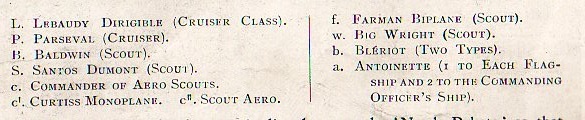
    There’s nothing quite so satisfying as seeing a representation of quantitative data like this where the graphical displays are flying.  “One Dreadnought Buys 52 Dirigibles and 235 Aeroplanes” is a full-page diagram appearing in the 3 June 1911 , making a very strong point that in the new air-age 2 million pounds for one battleship buys a lot of aircraft.  Of course this is a British journal and the ship is flying an American flag–the image originally appeared in the Scientific American just a short while before this publication, and so it also enumerates American and international aircraft, making for a lovely representation of a broad range of airplanes filling up the same sky.  (This image is available for purchase from our blog bookstore, here.)

    Info display dreadnought238
    Info display dreadnought239
    Info display dreadnought240


  • Elegant, Lightweight Steam-Powered Vehicle, 1877

    JF Ptak Science Books  Post 1407

    Steam car232

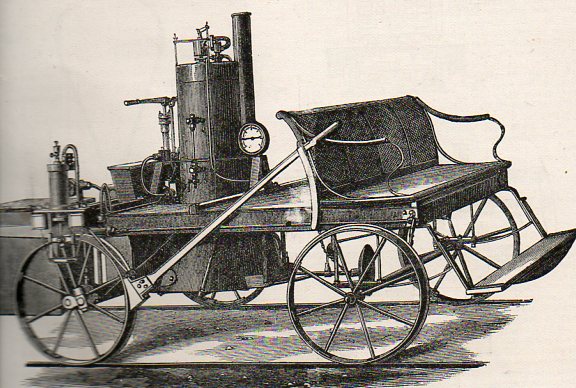
    This lovely steam-powered trolley looks as though it was just <this> close to being lifted off of its tracks and placed on the street for tooling around town.  Of course part of the reason why Joseph Green Cooke’s trolley was so lightweight1 is because it was traveling on rails, which meant the surface over which it would be propelled was smooth and predictable, unlike the streets that it would have to use to makes its way through a town.  Uneven, choppy, bumpy roadways would mean that the vehicle would have to be more sturdy; more sturdy means more weight, more weight means bigger engine, and so on.  So instead of this relatively light 1,200 pound vehicle you might wind up with something at 5,000 pounds, or more–at least in 1877’s mindset. (The issue of Scientific American is available here.)

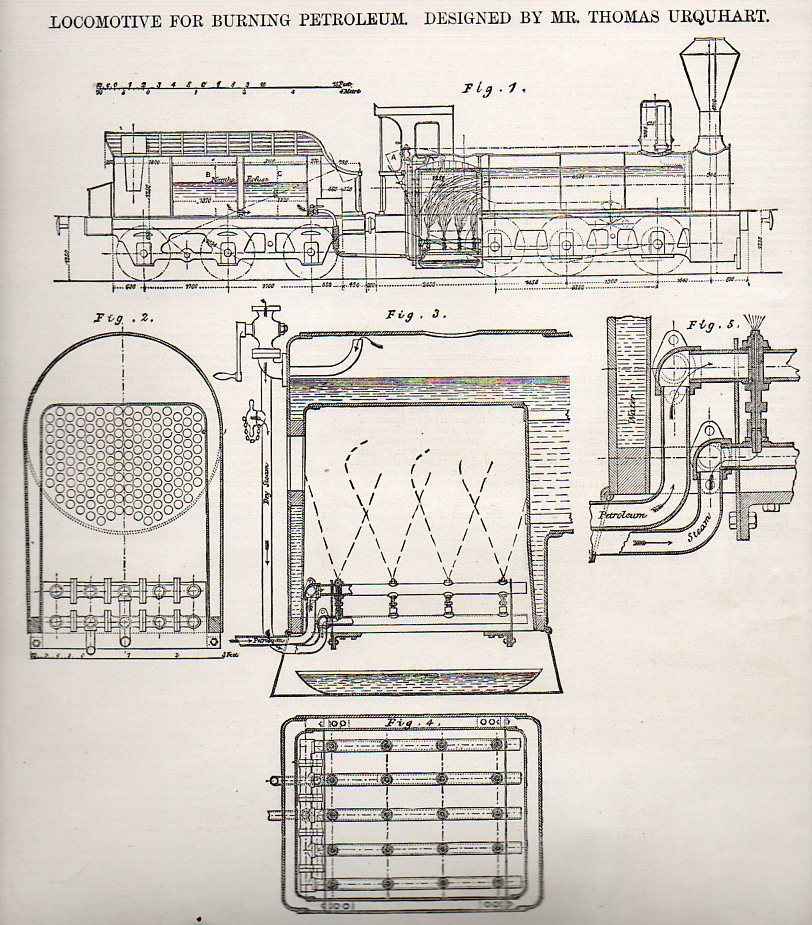
    The lighter vehicle would come before the end of the decade, but it had mostly to do with getting away from the steam engine to the lighter gasoline engine2.  It is serendipitous and perhaps ironic that the illustration facing the steam trolley is for the gasoline-burning train locomotive engine of Thomas Urquhart, who developed it for the Grazi-Tsaritsin Railway (Russia), which converted all of its 143 engines to this method by 1885.  When the pages of the magazine are closed, the two images lay one on top of the other. 

    Steam car234

    Notes:

    1. Earlier efforts at putting mobile steam-powered vehicles on the road stretches back into the very dim pre-automobile with the behemoth of Nicolas Joseph Cugnot, which strained its way along French streets as early as 1869….it also in the first recorded automobile accident, which caused enough trouble and damage and injury to scare away development money.  There were engines that were considered “portable” traction devices in the earliest part of the 19th century (by Trevithick and Tuxford, among others) , though they were not mobile–the “portable” part was that they could be moved (at all).  The movable, working traction machine (“tractor”) would begin to make its appearances in the 1860’s, though these were generally major pieces of machinery, locomotives on wheels. 

    2. Thanks to Gottlieb Daimler’s 1885 prototype, and Karl Benz’s 1886 patent for the gas-fuled car, and of course to the Charter Gasoline Engine Company of Illinois, whose work in the mid/late 1880’s brought about the production of several gas-powered traction engines in 1889.

    From the Western Review of Science and Industry, 21 December 1876: STEAM TROLLY. “Mr. Joseph Green Cooke, the locomotive and car superintendent of the  Oude and Kohilkunde Railway, has constructed a steam troll}” or carriage, the object of which is to enable resident engineers to inspect their tracks,  bridges and works with rapidity


  • The Architecture of 13,000,000 Pounds of Opium Production

    JF Ptak Science Books   Post 1407

    These images present an excellent invitation to understanding the size and scope of one section of the opium industry in India.  I found these pictures in the 29 July 1882 issue of the Scientific American, which in turn had reproduced them from the Bengal Commissioner Lt. Col. Walter S. Sherwill, who published them as color lithographs in 1850 and which (again) found their way into print in The Truth about Opium Smoking by Benjamin Broomhill1(1882).  They are iconic images of a devastating trade and were frequently reproduced over many decades–mostly not for the “devastating” part of what I just wrote, but more for the industrial/business appreciation end, as was the case with this article in SciAmerican.   The British interest in the trade stretched back two cneturies earlier, and of course the use of opium bends far back into Neolithic times.

    Sherill’s scenes are all from the opium receiving/production/distribution center in Patna, India, which claimed to produce some 13,000,000 pounds of opium juice annually, shipping the stuff out to Bengal and then on to China. 

    There is a hint of abrasion about this trade in the article, noting that there was nothing that could be done to stem the tide of Chinese demand for the product, and that “if the government monopoly of opium were abandoned, India would not only lose a revenue which would have to be made up by some tax, but the extent of the poppy cultivation would almost certainly be largely increased  in the hands of private growers.”  Also, if the British government gave up the trade altogether, the article notes that the Chinese demand would be supplied “by inferior quantities of Persian and native Chinese growth”. 

    The first image shows a cavernous hall for examining the incoming opium, “brought in in earthen pans…tested…by touch, or by thrusting a scoop into the mass”, after which a sample is sent to “the chemical test room”.  As it turns out, the text in the Scientific American article describing the various halls quotes the London Graphic  which was  reproduced almost verbatim from The Truth About Opium Smoking, but without quotations and without attribution. 


    MIT Visualizing Cultures

    Next, in image #2, is the mixing room, where, yes, the opium is mixed.  According to the Opium/Sci American: “In the Mixing Room the contents of the earthen pans are thrown into vats and stirred with blind rakes until the whole mass becomes a homogeneous paste.”
     
         
    MIT Visualizing Cultures
      Image #3 is the Balling Room: “From the mixing room the crude opium is conveyed to the Balling Room, where it is made into balls. Each ball-maker is furnished with a small table, a stool, and a brass cup to shape the ball in a certain quantity of opium and water called ‘Lewa,’ and an allowance of poppy petals, in which the opium balls are rolled. Every man is required to make a certain number of balls, all weighing alike. An expert workman will turn out upwards of a hundred balls a day.”  

    MIT Visualizing Cultures


    Image #4 is the drying room,  where “the balls are placed to dry before being stacked. Each ball is placed in a small earthenware cup. Men examine the balls, and puncture with a sharp style those in which gas, arising from fermentation, may be forming.”


    MIT Visualizing Cultures
     
    The stacking room is image #5, where “the balls are stacked before being packed in boxes for Calcutta en route to China. A number of boys are constantly engaged in stacking, turning, airing, and examining the balls. To clear them of mildew, moths or insects, they are rubbed with dried and crushed poppy petal dust.”
     

    MIT Visualizing Cultures


    The Chinese really weren’t able to resist this trade (which they had fought over a period of hundreds of years, not to mention in two opium wars in the 19th century) until about 1916. 

    Notes:

    1.  As it turns out, Broomhill was writing against the opium trade in his book.  See also this MIT page on the First Opium War.

    ·Posted by :

    ·in: