A Daily History of Holes, Dots, Lines, Science, History, Math, Physics, Art, the Unintentional Absurd, Architecture, Maps, Data Visualization, Blank and Missing Things, and so on. |1.6 million words, 7500 images, 4.9 million hits| Press & appearances in The Times, Le Figaro, Mensa, The Economist, The Guardian, Discovery News, Slate, Le Monde, Sci American Blogs, Le Pont, and many other places… 5000+ total posts since 2008.

Author: JF Ptak

  • On Finding Pictures of 18th Century Everyday Common Life (1726)

    JF Ptak Science Books     Post 2356

    I’ve written earlier in this blog about the magnificent-ish and often described book by John Comenius called The Visible World…1, which also happens to be the first illustrated children’s book. It was also a book about virtually anything, and everything, and certainly not a book about nothing, because sooner of later Comenius would get to the topic and deal with it, right or wrong.

    The book was originally written in 1676, and translated into English in 1726; in that edition the translator states the purpose of the work:   

    To entice witty children to it, that they may not conceit a torment to be in the school, but dainty/are., For it is apparent, that children (even from their infancy almost) are delighted with Pictures, and willingly please their eyes with these fights: And it will be very well worth the pains to have once brought it to pafs, that fcare-crows may be taken away out of Wifdom’s Gardens…”

    Though much is said of other illustrations in that book (I was drawn to it for the illustration of the human soul) I don’t often see very much at all on the subject of his display of trades–for example, the barber, illustrated below. The trusting bit about these cuts is that it shows a relatively simple image of common working life, which frankly is not terribly common, or at least so with the commentary on the tools of the trade, which are listed in the text and annotated in the image.  It is interesting to see the reference to the comb used to sometimes “curl” the customer; and also the “crisping iron” which is a tong-like device that would be used to further curl the hair.  In the background we see the remnant from an older time, a barber using a “pen-knife” to “sometimes…cutteth a vein”, a practice of balancing the humours, of curing maladies from major aliments to gunshots to dandruff and ingrown toenails–anatomy and the understanding of the body may have progressed a little more quickly than figuring out disease.  This practice lasted in places until deep into the 19th century, and is still used today in  are cases where Dr. House might find something absolutely suited for this procedure, or for the application of leeches, which did much the same thing. (The Brits imported millions of these buggers from France for this purpose, even into the 19th century.) 


     There’s much much more to come in this book–just follow the link to the original at Project Gutenberg. 

    Notes:

    1.  The work itself: John Amos Comenius, Orbis Senfualium Piélus: Omnium Principalium in Mundo Rerun/ &f m Vita АШопит,  translated as Pictura et Nomenclatur, the Visible World, or A Nomenclature, and Pictures of all Chief Things that are int he World, translated into English by Charles Hoof…1726.

     

    ·Posted by :

    ·in:


  • A Remarkable Chronology of Elusive Definition

    JF Ptak Science Books  Quick Post

     The source for this is a lovely article “Colonial School Books” by Clifton Johnson in the New England Magazine, volume 30, 1904, who sifted and read his way through a number of primers and turned out this work by “Fenning”, which urns out to be Daniel Fenning of the Universal Spelling Book, first printed in 1762.   This turns out to have been a best seller and kin to another British speller, Thomas Dilworth’s New Guide to the English Tongue (70+ editions in American before 1800!), both of which dominated the market until the first American-born speller was written by Daniel Webster in 1783.  In any event Fenning for whatever reason listed historical tidbits, one of which is this chronology, which is slight and charming and, well, a little elusive:


    [I cannot locate the reference for this–it obviously was re-set by someone in a more modern typeface; I’m sorry to say I cannot locate who. It wasn’t me. See HERE for a lexisnexis document on American Primers.]


    ·Posted by :

    ·in:


  • Help (1946)

    JF Ptak Science Books   Quick Post

    Cover--Help431

    This pamphlet was written in 1946 and is indeed a plea for help–mostly for food, and medical aid, for the displaced persons and survivors of WWII. It is a striking thing, blunt, necessary. The cover of the work does its job.  

    ·Posted by :

    ·in:


  • On Death and Mayhem in Children’s Alphabets–the New England Primer

    JF Ptak Science Books   Post 2355

    Now I lay me down to sleep, I  pray thee Lord, my soul to keep;If I should die before I wake, I pray thee, Lord, my soul to take.–New England Primer, 1784 edition

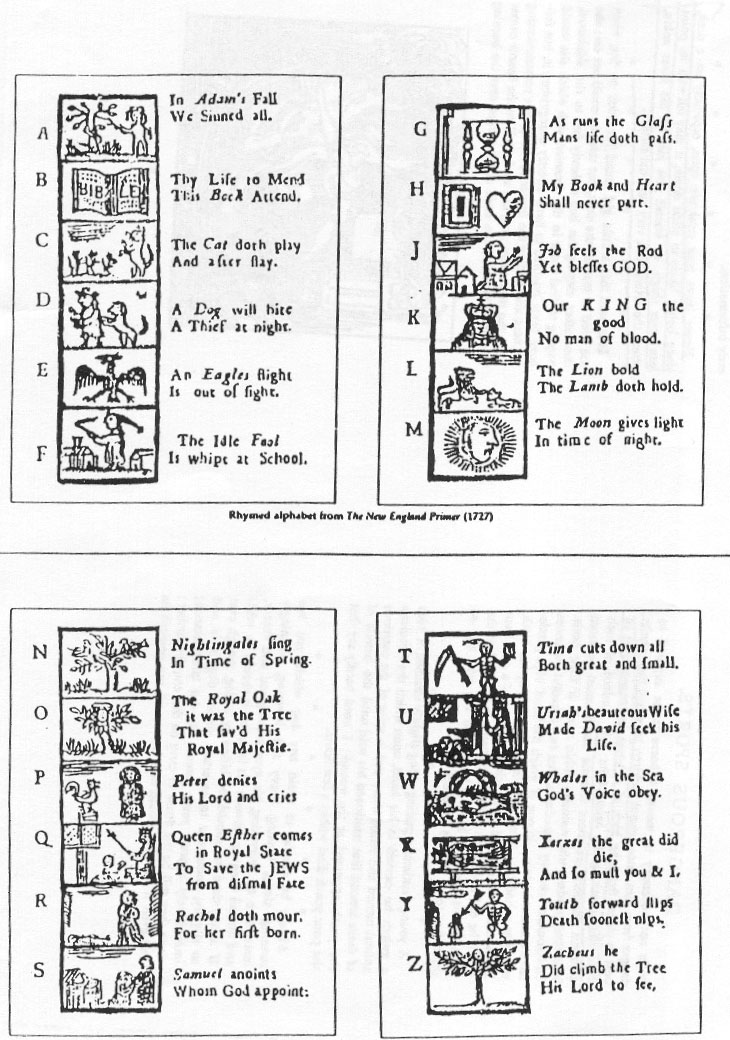
    There’s nothing scary in that is there?  The nightmare-maker may have its first introduction in the New England Primer, a book which was the backbone of North American education for many decades. as popular as it was and as much as it was used, print runs were not enormous, and most children would never actually own a copy of the book. It would be read to them for lessons, and that being the case much info was presented by vivid short rhymes , some of which are hard to forget because of the mental imagery they present.

    NEPrimer

    [Image source: Wikipedia, here.]

    For example the mnemonic devices used to help learn the alphabet is riddled with murder, mayhem, vice, death, and not all that much hope….except if you include stuff like “Job feels the rod, and praises God” as a Puritanical form of hope/salvation. Perhaps the writers were after the indelible impression as well as searing the cerebellum with the moral code. In fact, in the 24-letter alphabet presented in the   edition (“i” and “v” are not included), 12 of the letters are death- or violence-related, including the statements that we are all sinners, that cats kill things, dogs bite, fools are whipped at school, life runs out like sand in an hourglass, punishment deserves prayer, offensive things as big as armies can be swallowed up whole, a teary Rachel cries over her tiny dead child, time will kill you (again), kings will do and so will so, and youthful bits can of course kill you.  It is part-and-parcel I guess of the rearing of kids in the not-necessarily-glorious history of childhood.  Death and the possibilities of it or some close relative of it was a lot closer to reality than it is today, especially when the average life span at the time was well under 50 and infant mortality easily an order of magnitude more prevalent than it is today1.  And of course outside of the plague-of-death culture and the subjugation of kids for a better behavior there was also the screaming Calvinist theology that beat up/taught readers the abandonment of the self to the creator available to young and old.  

    This sort of indoctrination was hardly limited to the New England Primer, printed in this country as the first of its type beginning in the late 17th century (and with some familiarity several printings can be remember for famously having the “printed by B. Franklin” imprint in the 1760’s). It would be easier to name the child’s instructional that did not have this leaning (at least before 1880) though I am presently hard-pressed to think of an example off-hand).

    And lest we forget, the Grimm brothers wrote stuff for kid the vast majority of which we wouldn’t think of reading to our kids today–I didn’t.  

    Notes:

    1. Good national statistics for the U.S. before 1870 begin to get sketchy in this area, though from 1900 onward the numbers look pretty good.  Suffice to say that historians of medicine and Medieivalists and so on make pretty good educated estimates for these rates, and they’re not so good.  For example, in 1900 in America the average life span was 47 and the infant mortality at 16% (compared to about 80 or so and .7% today), though I cannot offhand find the stats for childhood survivability by age 10.  Looking back in time the numbers get really big, with some people  saying that childbirth mortality in the Medieval and Renaissance times were in the 30-50% range, and the survivability rate passed 10 was about the same.  I don’t have these rates for American colonial times, but I assume that they are closer to the Renaissance than they are to 1900 numbers.  And of course this does not apply to slaves, whose rates of survivability were smaller still.  

    ·Posted by :

    ·in:

    —

  • An Outstanding Issue on Relativity in NATURE, 1921

    JF Ptak Science Books  Quick Post

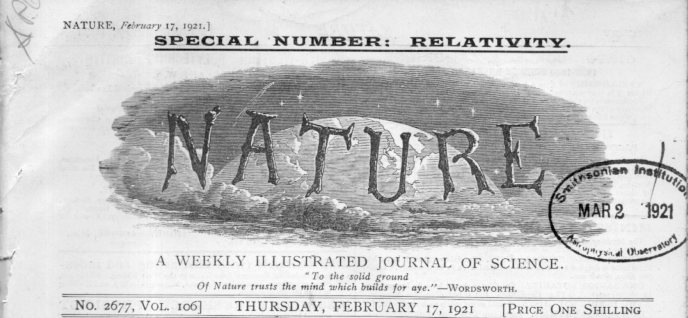
    I bumped in this issue of Nature  (volume 106, pp782–784) this evening, and as it turns out it is the “Special Number: Relativity” and published February 17, 1921–and it is packed. Somehow when I first looked at this weekly I mega-missed the Einstein entry–as is customary I work back-to-front, bottom-to-top (don’t ask) and was so taken by the collection of Big Names that Einstein’s escaped me. Einstein’s article is longish for this journal and concise, with numerous references in the influencing forces in his development of the theory of relativity (which he capitalizes).  Einstein nature 1921429

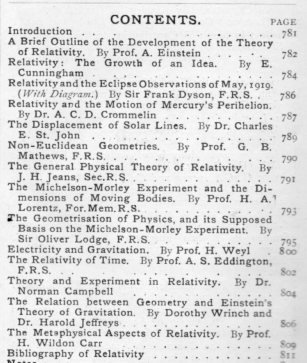
    The table of contents for this single week–though it is (roughly) a double issue of thirty pages or so–incoudes work by Cunningham, Frank Dyson, James Jeans, H.A. Lorentz, Oliver Lodge, Herman Weyl, A.S. Eddington, Norman Campbell, and Harold Jeffreys, plus a few pages of tight bibliography.  

    Einstein nature 1921430

    Here’s the beginning of the Einstein article, courtesy of Nature, with the rest of it available from their website, here. My copy (formerly in the Smithsonian Institution) is too tender to open fully for the scanner, but the cover’s masthead is certainly available, and pretty. Abraham Pais notes in his Subtle is the Lord : The Science and the Life of Albert Einstein, that Einstein delayed the publication of the issue somewhat in his attempts to make a complicated issue fit in the space allot (as in the old Mark Twain adage, “If I had more time I would have written a shorter letter”).  So, the Einstein:

    A Brief Outline of the Development of the Theory of Relativity, by Prof. A. Einstein

    [Translated by Dr. Robert W. Lawson] 

    There is something attractive in presenting the evolution of a sequence of ideas in as brief a form as possible, and yet with a completeness sufficient to preserve throughout the continuity of development. We shall endeavour to do this for the Theory of Relativity, and to show that the whole ascent is composed of small, almost self-evident steps of thought.

    The entire development starts off from, and is dominated by, the idea of Faraday and Maxwell, according to which all physical processes involve a continuity of action (as opposed to action at a distance), or, in the language of mathematics, they are expressed by partial differential equations. Maxwell succeeded in doing this for electro-magnetic processes in bodies at rest by means of the conception of the magnetic effect of the vacuum-displacement-current, together with the postulate of the identity of the nature of electro-dynamic fields produced by induction, and the electro-static field.

    ·Posted by :

    ·in:


  • Poland and WWIV

    JF Ptak Science Books   Post 2354

    Fourth WOrld War428

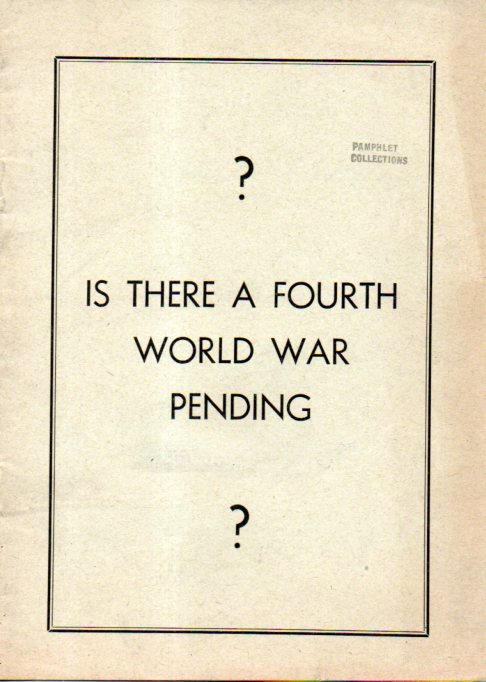
    This pamphlet certainty has entry to the evocative Fantastic and Improbable Pamphlet Covers Collection, though I was a little stumped by not being able to make it reveal itself to me with a short effort.  It was written by J. Kmicic and from what I can see was probably published during WWII, though there is no publishing information and nothing in the text to hang a firm date on. (There is a periodicals reception stamp in it from November 1946 fro the periodicals division of the Library of Congress, but that doesn’t mean it was accessed right after publication, though it does put a limit to how old it isn’t.)  As it turns out the keys to WWIV is Poland. That a very strong and heavily armed Poland would be the cornerstone of a defense of the West in the East, that the further the extent of a strong Polish eastern border reached the greater the play “of our Western culture will extend”.  Kmicic makes the case that it if Poland were stronger then it could have resisted Napoleon (evidently WWI), and the Kaiser (making WWI into WWII) and Hitler (WWII=WWIII).  The WWIV part is murkier because there isn’t a clue so far as I can tell that the author knew what happened to Poland when the Nazis fell and the Soviets moved in.  Had that been the case, the call for having a strong and unified Poland would probably not have been played so heavily.  A “Mighty Poland”, Kmicic writes, means “freedom for all smaller nations of Europe” and therefore “the impossibility of world war”. There are a few things that I’ve missed no doubt in my speed-read, but I was just after the cover, anyway.

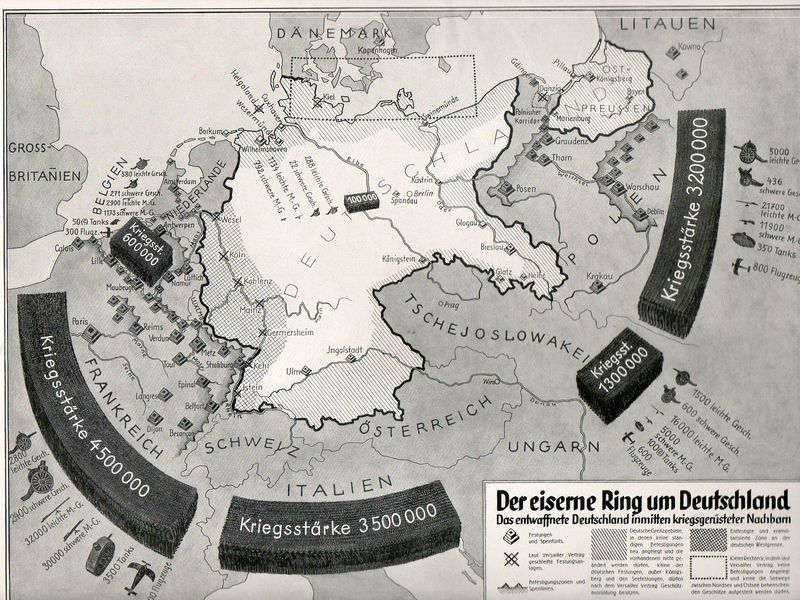
    Hitler and Company tied to sell the idea of an aggressive Polish nation, that the attack launched on 3 September 1939 was a preventative  measure to stop the advance and attack of Poland against Germany.  Not too many people believed it–at least outside of Germany–but Hitler tried it out, anyway. And why not? When most of everything he said was grounded in The Big Lie, why not pile it on?  The great the untruth, the more impossible it is, and the ore you say that you believe it to be the case, the more of a possibility exists for others to believe it, too–because who in their right mind would say something so insane about something else that is equally unbelievable? Therefore, the insane statement much be so.  That’s part of The Big Lie.

    See Polish Designs on Germany, here 

    Blogsept_1_poland476

    And another attempt at winning hearts and minds, this from 1933 (here):

    Nazi Prop surrounded538

    ·Posted by :

    ·in:

    — —

  • The Fabulously Thorough Instructional on Using a Telephone, 1946

    JF Ptak Science Books   Quick Post

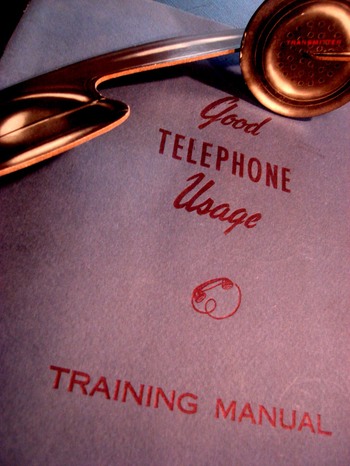
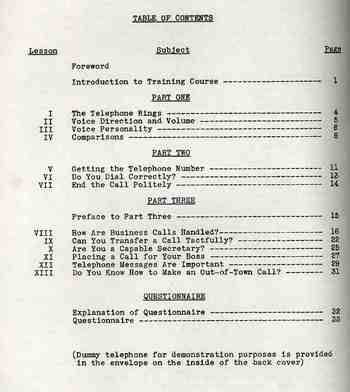
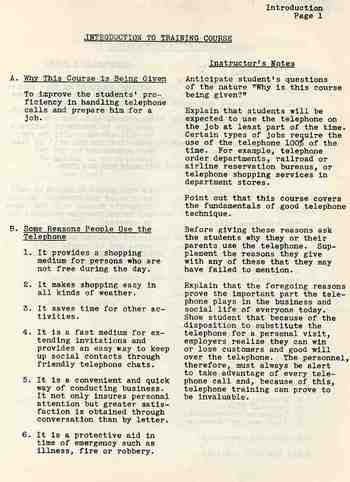
    Yes, this elegant, oversized, well written 1946 pamphlet explains in fabulous and excruciating detail how to use the telephone–and it does indeed come with a two-part heavy paper telephone receiver for the reader’s practice. It is packaged in an envelope in the back of the pamphlet with a large drawing explaining how to put the two pieces together.   The work is just so fulsome, wholesome, forthright, exacting and thorough that it just makes the casual reader stop in their tracks to applaud the effort of explanaion.  For example, it isn’t until page 13 that we get to pick up the receiver (and listen for the dial tone). I’ve reproduced some of the table of contents to give an idea of the extent of the telephone usage. 

    Ballistics_049

    What brings this so close to being from out of the science fiction past is that the booklet is ten years older than your narrator.  Atanasoff’s ABC, Bell Labs Mark II, Bletchley’s  Colossus, and Harvard’s Mark I machines existed, television was begnning to explode and half-doom radio for all time, and telephones were on their semi-last-leg of exploding their way into more American homes and businesses.  But somehow, here on the verge of the greatest electrical revolution in history, we were getting instructions on how to pick up the telephone.  But I’m really not complaining here, not at all–its just the nexus of the “how to listen for a dial tone” and the coming of the ENIAC one year after this pamphlet is published that is so startling.

    Even so, this instructional is more complete and (of course) better written than any of the computer manuals that came with any of the machines that I’ve purchase in the last 30 years. It is a thing of great and supra-obvious beauty.

    This is another example of a small job done Very Correctly.

    Blogsept3_tele489  

    Blogsept3_tele490


    ·Posted by :

    ·in:


  • The “Where, When, and How” of Attacking Berlin (1943)

    JF Ptak

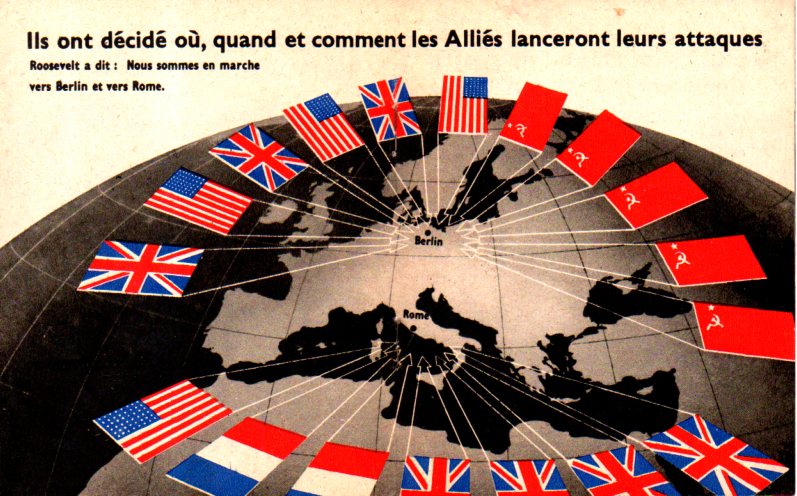
    I found this arresting map in a tiny publication called …Sans Condition, which was published in the first half of 1943. The publication is only 12 pages long but has a number of evocative images of Germany being bombed and lines of German POWs, in general a propaganda piece for French-speaking folk (which was printed god-knows-where) produced deep in the war and at a time when the tide has about turned on the Nazi regime.  

    The title of this post is the title of the map,  “Ils ont decide ou, quand et comment les Allies lanceront leurs attacques”–and you don’t need to know French to know what it says.  

    Map Berlin attacked426

    And the cover, which is basically “Surrender Without Condition”:


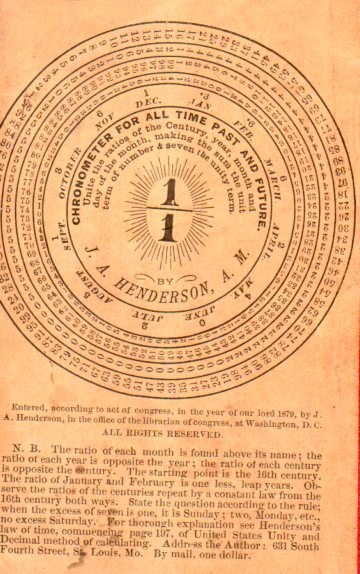
  • 1 Over 1 & the “Rule for All Time Past and Future”

    JF Ptak Science Books  Post 2353

    That is a provocative title, or chapter heading, but that’s how it appears in a pamphlet I’m reading right now, a juicy thing that can lead to a memory palace of ideas…until you start reading the para below the head, when things get both more crystalline and fuzzy.

    John Alexander Henderson, a lightning calculator and professor of math at Delaware College in New York, produced this sprightly pamphlet eponymously titled Henderson’s United States Intellectual and Practical Lightning Calculator, the Unity and Decimal Method, which he published in St. Louis in 1879. (It is followed a few years later in another edition with a hundred new pages.) 

    What Mr. Henderson is getting at is a calculator for reducing a date to find out the day of the week a particular date falls on, from the 1st century to the 99th.  On the back cover of this pamphlet he provides a tickler for this enumerating device, which is explained in another publication (Henderson’s United States Unity and Decimal Method of Calculating). 

    Calculatort mental425

    And so in order to calculate the day of the week on which, say, November 26, 2014, occurs you would you the dial above as follows, but first an explanation of what is on the dial face:


  • Explosives as a Civilizing Force (1930)

    JF Ptak Science Books   Quick Post

    This is the very striking cover design for a pamphlet written by Dr. Julius Klein (the assistant secretary of commerce) produced by the Institute of Makers of Explosives (103 Park Avenue, NYC, who of course made a large play for blowing stuff up as a positive driving force in the history of civilization.  And they are right in many cases, obviously, but the images and title taken out of context are very provocative. 

    Explosives civilizing423

     Dr. Klein starts off by disabusing the reader of the “bad press” of explosives:  “a good many of us, I imagine, labor under a misapprehension about the explosives industry…we conceive of explosives as an instrumentality of havoc.  But that conception is utterly wrong.”  Utterly?  The man does have a point of course,  which he explains in subject headings like “Dynamite the Liberator”, “Many Unusual Uses”and “Explosives Release Raw Materials”  But “utterly”?  Its a real piece of heavily worked propaganda that makes the case for the economics goodnesses and misunderstood destructive values of TNT. 

    ·Posted by :

    ·in: