A Daily History of Holes, Dots, Lines, Science, History, Math, Physics, Art, the Unintentional Absurd, Architecture, Maps, Data Visualization, Blank and Missing Things, and so on. |1.6 million words, 7500 images, 4.9 million hits| Press & appearances in The Times, Le Figaro, Mensa, The Economist, The Guardian, Discovery News, Slate, Le Monde, Sci American Blogs, Le Pont, and many other places… 5000+ total posts since 2008.

Author: JF Ptak

  • The Cold War and Spider Webs (1947)

    JF Ptak Science Books  Quick Post

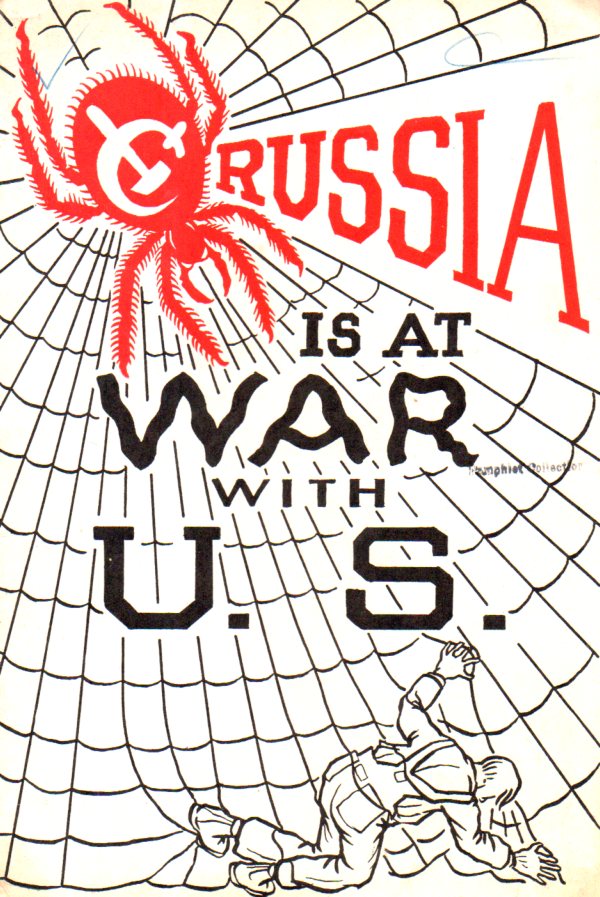
    Blanche Murray wrote this short pamphlet in 1947, the designer completing the cover in the Russian-spider/American-fly motif. Ms. Murray was trying to warn the U.S. that World War III was “happening now” and that Russia had crept into the U.S. on “cushioned paws”.

    Russia War US479


    The author was more or less correct in the WWIII part, though not so much in the creeping Commie part–my quick-browse didn’t find any “Cold War” reference exactly, but that is what she was talking about there in 1947, two years before the Soviets had their own nuclear weapons (with the so-called Joe-1 shot) and three years before the Korean War began. Mr. Orwell called it in October 1945:

    “For forty or fifty years past, Mr. H. G. Wells and others have been warning us that man is in danger of destroying himself with his own weapons, leaving the ants or some other gregarious species to take over. Anyone who has seen the ruined cities of Germany will find this notion at least thinkable. Nevertheless, looking at the world as a whole, the drift for many decades has been not towards anarchy but towards the reimposition of slavery. We may be heading not for general breakdown but for an epoch as horribly stable as the slave empires of antiquity. James Burnham’s theory has been much discussed, but few people have yet considered its ideological implications — that is, the kind of world-view, the kind of beliefs, and the social structure that would probably prevail in a state which was at once unconquerable and in a permanent state of ‘cold war’ with its neighbors.”–George Orwell, Tribune 19 October 1945 (“You and the Atomic Bomb”) Here, via Project Gutenberg. 

    In any event I like the cover design, which is probably the best part of the pamphlet. Sometimes that is all you really need.  

    ·Posted by :

    ·in:


  • Bubble Aeronautics

    JF Ptak Science Books  Quick Post

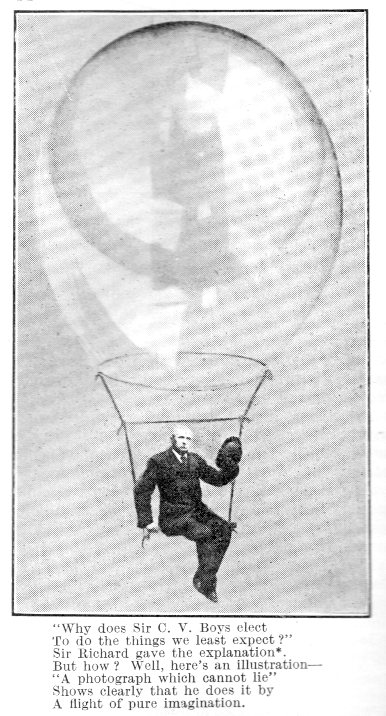
    CV Boys (1855-1944), the great experimentalist and all-around physicist/mechanic, wrote a classic book on bubbles in 1889 that found success and went through several editions—the bubble book not surprisingly was called Soap Bubbles and it was a fascinating journey through the world of bubbles and was they were indeed so fascinating and better called “bubbles” to the popular mind rather than “rotating films”. Late in life (and 53 years after the publication of the book) in the October 17, 1942 edition of the journal Nature Boys writes a funny little note called “A Flight of Pure Imagination” which is illustrated by a photograph Boys’ made in 1912 showing an aeronaut in a gondola of a big bubble balloon. It is a wonderful picture and accompanied by a nice verse about Boys, who for some reason, 30 years later, decided to republish his “permissible diversion”.   

    Boys478

    ·Posted by :

    ·in:


  • The Crumbling Media is the Crumbling Message, 1939: a Decomposition of American Communism

    JF Ptak Science Books     Post 2363

    Commie pamphlet decomposition476


    Commie pamphlet decomposition475 
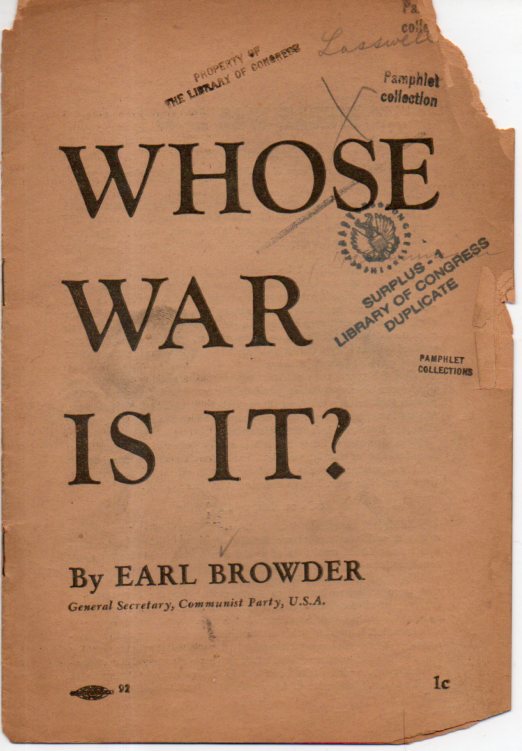
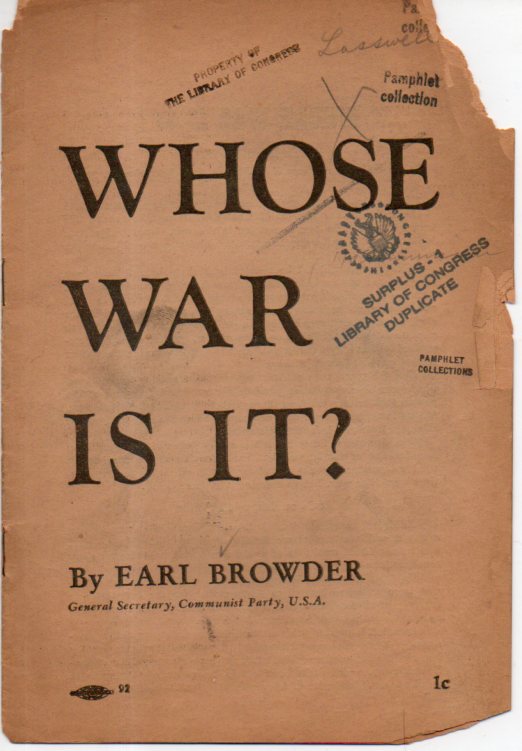
    Earl Browder was the General Secretary  of the Communist Party of the United States, this penny pamphlet (brown and brittle and crumbling today and smelling like a brown and crumbling and brittle Communist penny-pamphlet) is the text of a speech he delivered on the party’s anti-war stance on September 29, 1939–just a few weeks after the otubreak of WWII.  He called it an imperialist’s war, imperialists on both sides, both sides equally at fault.  The Soviet Union of course wants the war to stop-but-not-really, for both sides to cease and desist, sort of–the outcome would be the “brilliant Leninist doctrine” that would have both sides fighting each other to doom, so that the Soviet Union could succeed and replace the two vanquished imperialists. 

    Browder thought that the Communist Party in the USA wouls save the country, so long as the party wasn’t extinguished.

    In the dreamtime of Browder’s plans and hopes Joseph Stalin had this to say to Adolph Hitler in August 1939:

    “To the chancellor of the German Reich, Herr A. Hitler.

    I thank you for your letter. I hope that the German-Soviet Nonaggression Pact will mark a decisive turn for the better in the political relations between our two countries.

    J. Stalin”

    He had signed a Non-Aggression pact with the Nazis, as well as a Economic Agreement and a Secret Protocol, the last allowing the Soviets to gobble up much of Eastern Europe.  This all changed of course on June 22, 1941, the launch of the Nazi Barbarossa plan, a massive and bloody attack on the Soviet Union.  That is when the Communist plan of anti-intervention in the Imperialist war turned instantly into an all-out war of intervention against the formerly brother Fascists in an effort to save Mother Russia.  On June 21 the USSR was friendly with the Nazis and allowed a semi-passive Imperialist hand to swipe up and ruin countries in Eastern Europe; on June 22 the federation is forgotten and the ill-gained graces destroyed as if they had never existed, and the Communist Party stands for something else.  It all feels that way handling this pamphlet, a not-so-slow disintegration of words and deeds.  

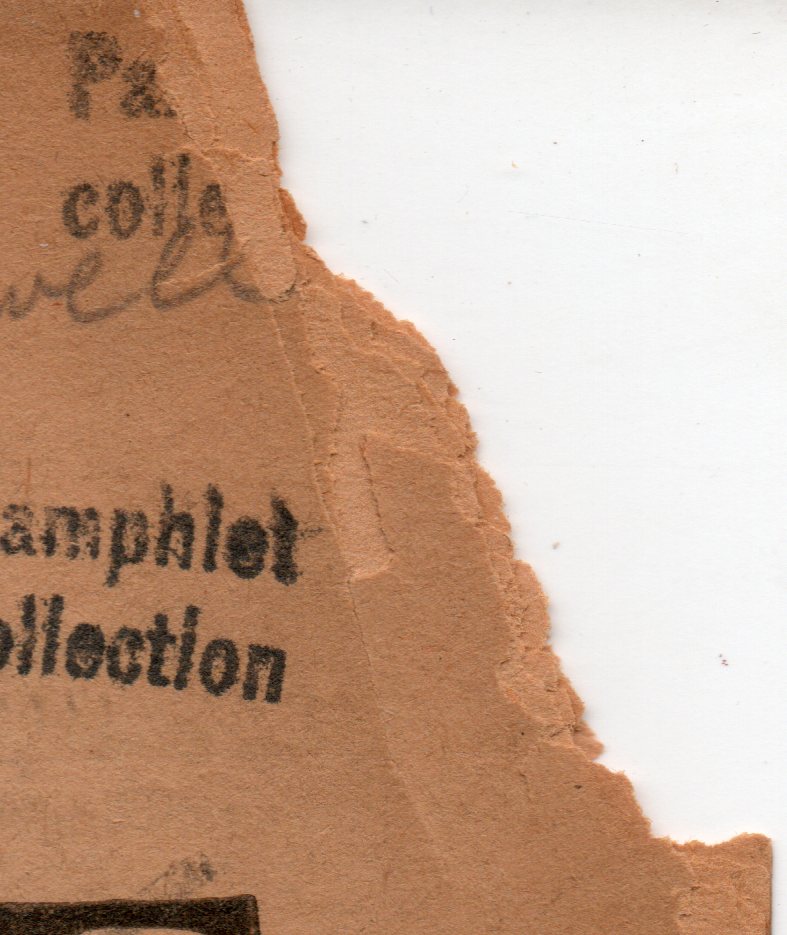
    Advanced decomposition:

    Commie pamphlet decomposition477

    ·Posted by :

    ·in:


  • A Child’s History of Writing and Books Writ Small, 1726

    JF Ptak Science Books  Quick Post

    On Writing

    Children--writing

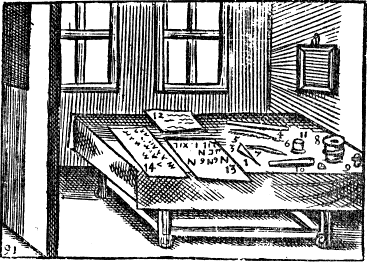
    [Images from John Comenius,  Orbis Senfualium Piélus: Omnium Principalium in Mundo Rerun/ &f m Vita Alопит,  translated as Pictura et Nomenclatur, the Visible World, or A Nomenclature, and Pictures of all Chief Things that are int he World, translated into English by Charles Hoof…1726.  See an earlier post here for more on Comenius. Image Source:  PROJECT GUTENBERG.]

    The Ancients writ
    in Tables done over with wax
    with a brazen Poitrel, 1.
    with the sharp end, 2. whereof
    letters were engraven
    and rubbed out again
    with the broad end, 3.

    Afterwards
    they writ Letters
    with a small Reed, 4.

    We use a Goose-quill, 5.
    the Stem, 6. of which
    we make
    with a Pen-knife, 7.
    then we dip the Neb
    in an Ink-horn, 8.
    which is stopped
    with a Stopple, 9.
    and we put our Pens,
    into a Pennar, 10.

    We dry a Writing
    13with Blotting-paper,
    or Calis-sand
    out of a Sand-box, 11.

    And we indeed
    write from the left hand
    towards the right, 12.
    the Hebrews
    from the right hand
    towards the left, 13.
    the Chinese and other Indians,
    from the top
    downwards, 14.


  • The Reverse Children’s Crusade, 1940. A note, with Videos.

    JF Ptak Science Books    Post 2362

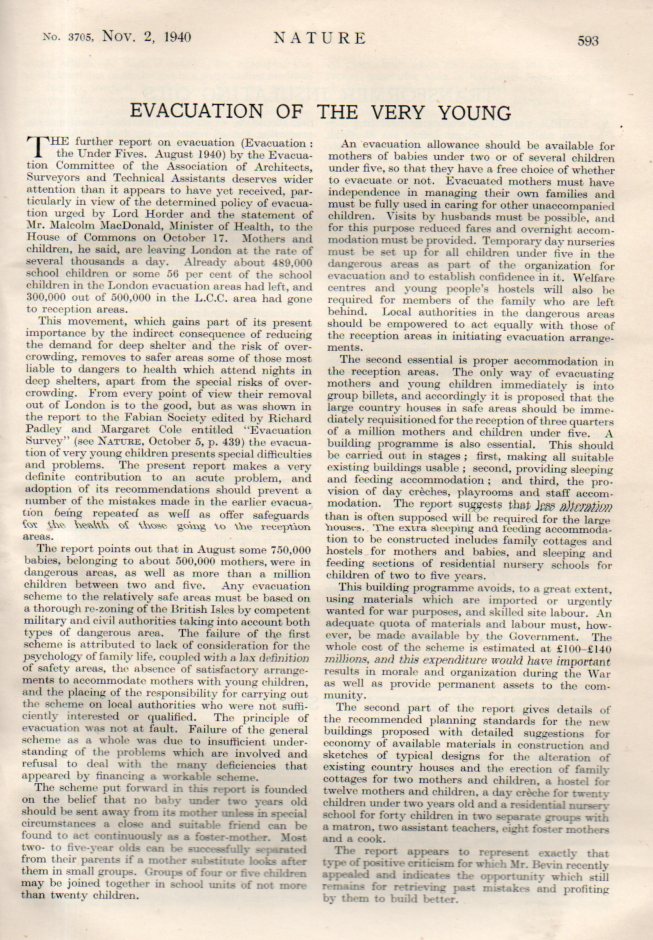
    It is good to remember the early part of the war and the efforts made by the people of Great Britain, and their sacrifices,  This notice appeared in the November 2, 1940 issue of Nature which recounts the evacuation measures of children during the Battle of Britain.  By this point more than half of the school children in the London evacuation areas had been been evacuated, with nearly a million leaving altogether in a total evacuated population of some 3.5 million people.  (At the very beginning of the war there was also an evacuation program for Jewish children from Germany to England–this was the  Kindertransport which brought some 10,000 children to safety.) It was a sort of reverse/anti “Children’s Crusade” (as in the subtitle for Kurt Vonnegut’s Slaughterhouse Five), where rather than an army of children sent to expel or convert Muslims from Jerusalem/Holy Land in the 13th century, the children were sent to safety away from a crusade against their homeland. The major difference besides the existence of their opposition is that this evacuation was real, and the so-called “Children’s Crusade” was not.

    Evacuation474


    The Battle of Britain was fought primarily from 10 July to 31 October 1940, so by the time this report was published the Brits had been able to turn the tide of Hitler’s plan.  (The air strikes wouldn’t really end until the Nazis turned their attention to the Soviet Union in Operation Barbarossa in May 1941.)  And that plan, named Luftschlacht um England, was to overtake and destroy the British capacity in the air, for as long as the English had command of the airspace there would be no way that the Nazis could force an invasion by land/sea (at least in the minds of the Oberkommando der Wehrmacht  and Hitler).  And so the Nazis failed–it was their first major defeat, and, especially, with the turning of attention east, it was a pivotal point of the war

    The numbers of loses: England: 1,023 fighters: 376 bombers, 148 coastal command aircraft  for a total of 1,547 aircraft and  544 pilots and aircrew killed.  There were also 27,450
    civilians killed and 32,138 wounded.  The Germans lost 873 fighters and 1,014
    bombers for a total of 1,887 aircraft and  2,500 pilots


    ·Posted by :

    ·in:


  • A (Possibly) Famous Chair

    JF Ptak Science Books   Quick Post

    Chair detail

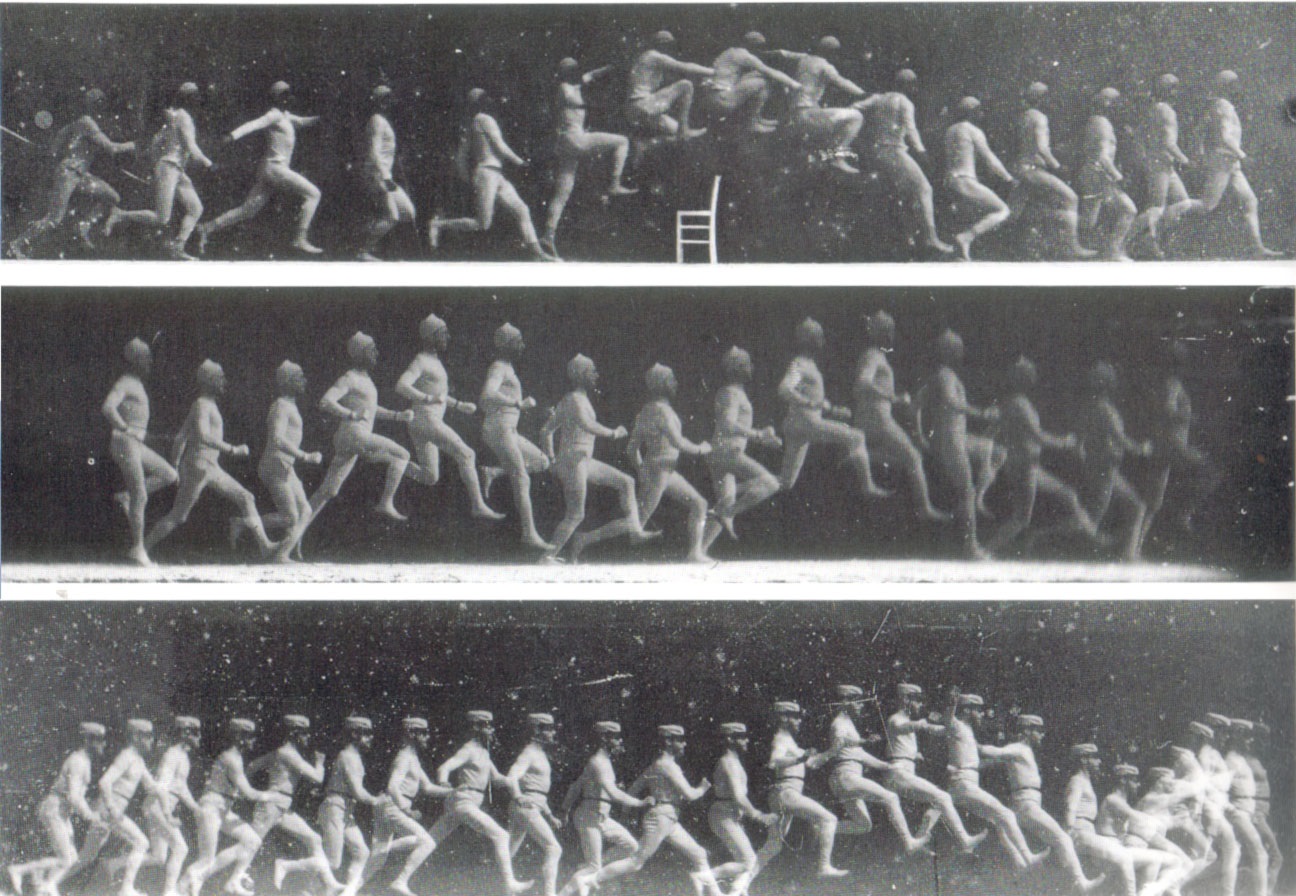
    This is actually part of the Tech Quiz series on this blog, though it should probably be in a Why-is-it-Famous series (if there was one) better yet.  It is a hard chair to identify byt itself, but as soon as you see it in context you’ll know what it is.

    And so:

    Chair Muybridge

    Prior to the invention of photography, printed works on how humans should move in a given way and for a given task are uncommon and, generally, somewhat complex. The image I have in my head is the epochal work of the somewhat forgotten Etienne Marey who in the 1870’s created what was essentially the world’s first “slow motion” device. One iteration of Marey’s apparatus was basically a long series of ganged cameras recording a motion for a simple task at a given time frame and presented on a continuous strip of photographic paper, sort of like a motion picture with the camera speed set at three frames per second. The resulting images were phenomenal and showed people for the first time the exactness of all manners of simple motions–motions that no longer looked so “simple” once all of its aspects could be studied from captured photographic evidence.  Even the act of hopping over a small chair or bending to pick up a bucket of water were enormously revealing in a way like Robert Hooke’s Micrographia displayed the great detail and complexity of the seemingly simple fly.  Perhaps the most famous of Marey’s series of images was that of a galloping horse, which also for the first time revealed what exactly the horse’s legs were doing and proving that almost every painter in the history of art represented the galloping horse incorrectly. But Marey doesn’t actually fit the mold of directing the motions of people for a particular instructional purposes, though he does of course photographically reveal hundreds of actions that led to a revolutionary understanding of the body-in-motion.  

    Perhaps one of the most famous series of photographs was of the man jumping over a chair, and action so seemingly common that people wouldn’t pay too much attention to it.  But when there are 15 connected photographs of a 1.5 second event, there are entirely new worlds of motion revealed.  And the chair, that white chair, was at the heart of it, and may be one of the most iconoclastic props in Marey’s full cabinet.  Anyway in my mind it is a famous chair.  

    ·Posted by :

    ·in:


  • Magic in NATURE, 1896

    JF Ptak Science Books  Quick Post    

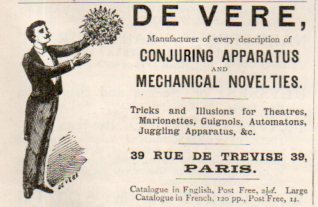
    Here’s a very unusual bit that I found deep in the a volume of the great Nature magazine, for July 9, 1896.  There were only 23 pages of text for the standard issue, with this one carrying eight very full pages of advertisements.  The issue is full of the expected–and then there was this, a great unexpected ad:

    Nature--ads471

    Nature was a semi-popular magazine for the general sciences in the great Victorian age, so it is quite possible that a generalist/not-necessarily-science type woud place an ad in it. The “magic” part is odd, though the “mechanical novelties” part of it makes a lot of sense.  The other ads are lovely and engrossing and cover a wide spectrum of what teh active scientific mind in 1896 might want: x-ray tubes (for the earth-shatteringly new discovery of just months earlier), rock and mineral specimens, live specimens for dissection, galvanometers, descriptions of courses for science schools, mathematical instruments, and so on.  It would be a high privilege to see teh store associated with any one of these advertisements.  

    Nature--ads463


    ·Posted by :

    ·in:


  • A Picture of Light: Finite & Infinite in All Directions

    JF Ptak Science Books

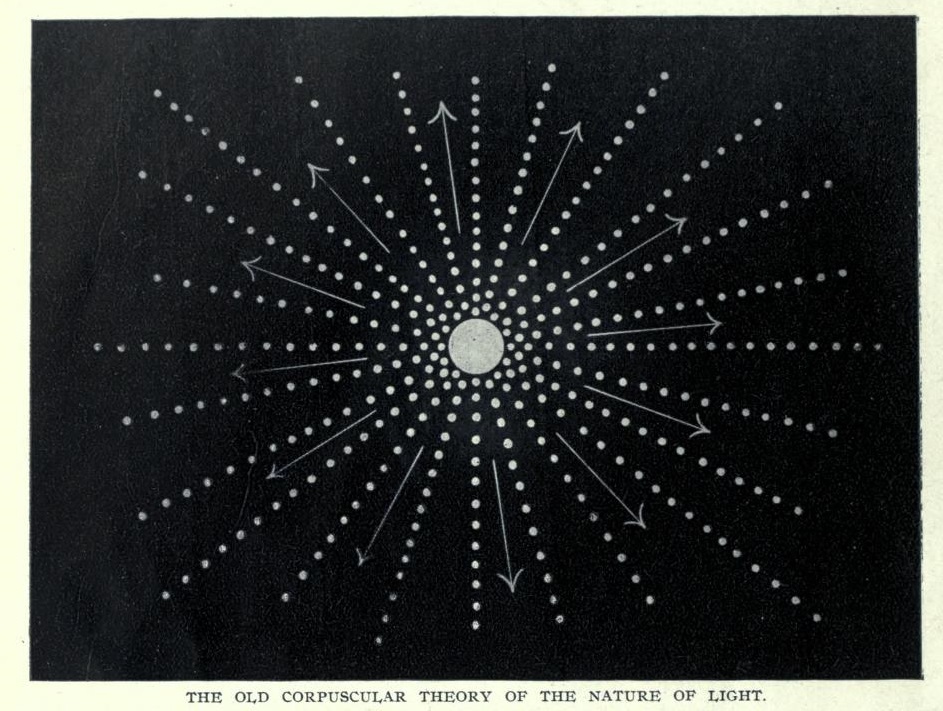
    I found this very interesting image in the early pages of T.E.R. Phillip’s astronomical review and history, Hutchinson’s Splendour of the Heavens, issued by the publishing house whose name is in the title, and printed in London in 1923.  What we see here is a representation of light, or at least the corpuscular theory of light and the movement of the corpuscles. The theory is partially the work of the Christian atomist Pierre Gassendi (1592-1655) and Thomas Hobbes (1588-1679), who argued that light was composed of infinitesimally small particles traveling at finite speeds and in a straight line in all directions.

    Corpuscular theory b

    The corpuscular theory preceded the wave theory which preceded the EM theory which preceded the quantum theory of light, and it is interesting to note that even though this work was published 18 years after the Einstein paper of 1905 and four years following the Eddington/Dyson et al eclipse confirmation of relativity  after which Einstein became a mega-star, that there is scant mention of this paper in this book in spite of his 14 other mentions.’

    Still, this is a pretty cool rendering of the “shape” and constituents of light. 

    ·Posted by :

    ·in:


  • Very Deep Racism–on the Vocabularies of “children, negroes [sic], parrots and schizophrenics” (1942)

    JF Ptak Science Books   Post 2361

    I am constantly surprised-and-then-unsurprised, having the “surprise” part ripped away like a bandage to leave a vacuum of missing surprise, when I bump into deep, inherent, part-of-the-language and part-of-the-social-landscape racism.  I’ve mentioned before in this blog that some years ago I bought a very large collection of pamphlets from the Library of Congress–it was a collection in name only (even though almost every item was stamped “the Pamphlet Collection”) though their storage and relationship was basically unassociated and uncategorized even though they were supposed to be so, housed in 3,000 document boxes that supposedly put everything into order, though the classifications were extremely loose and could refer to author/title/subject/publisher and so indexed almost nothing. The great majority of the time The Finding of Things was almost random, and there was really no telling what might slip out of each box.  
    Racist found455I looked at quite a few of these documents, and one thing that I found over and over, in varied subject areas and content, in obvious and odd places, was periodic deep-seated racist remarks. The vast majority was directed at African Americans, though there has been a showing for the Japanese and Chinese, as well as Mexicans, and Eastern Europeans, and of course Jews. The surprising thing to me has been how this racism emerges from the pamphlets–usually it seems so, well, “out of context”, even if you were racist, the way that suddenly something bizarre and racist would appear, as though dropping unexpectedly from the sky.  For example, in the middle of an introduction to carnival barking, the caller was supposed to occasionally “slap his hands like a n-word” when accepting money. I mean, right there in the middle of a nothing sentence, this awful stuff would just appear.  After many exposures to this I took it to represent very deeply rooted systemic racism, where light banter and semi-meaningless explanations would be peppered seemingly from nowhere with racist statements.  I remember feeling so outraged opening a pamphlet on Purina sheep feed and catching a phrase where the farmer is supposed to feel some part of a sheep’s wool and that it should feel something like “n-word hair but softer”.  It is an incredible disgrace to read it in 2014 and to think that in 1940 (when the Purina sales catalog was written) that it would be so much part of the verbal landscape that it would seem like nothing at all.

    And this happened many times, and all by chance, a weird turgidity of racist serendipity.

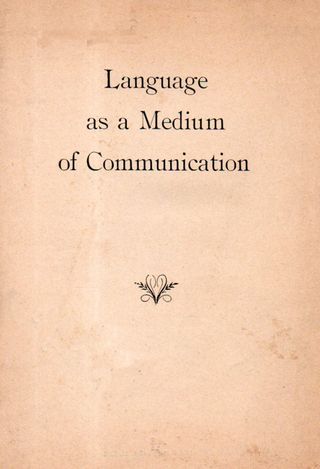
    Which brings me to tonight.  I selected the pamphlet (above) called Language as a Medium of Communication to be part of my book cover Found-Surreal collection–I mean, what else is language for, and what would Wittgenstein say in his quietest moments about this? I opened the pamphlet, and there it was, the found-offending bit, on page 9.

    The question the author asked in text was “Does the increase in vocabulary facilitate ease in thought?” Which is kind of an interesting question if it wasn’t so filled with the demand for explanation and definition.

    The rejoinder was this:

    “Do remarkable vocabularies of many hotel porters, couriers, precocious children, negroes, parrots, and schizophrenics “facilitate” their “ease in thought”?

    Now, the irony here of course is that this problematic and overwritten pamphlet was on language and communication, and what happens here is that (a) the author does not capitalize “Negro” even though it had been a long-fought battle that was basically decided in favor of the capital “N” a few decades earlier, which communicates something in a corruption of language, and (b) that the inclusion of “Negro” speech alongside that of parrots, children, and schizophrenics communicates a racist view of African American speech. None of this makes a dent in the consciousness of the author because these completely unexpected racist bombs that seem so incredibly pernicious and disgusting to us now were really evidently nothing when this pamphlet was written in 1942. That they appear without any real call for them is a damnable thing, that the racist aspect was so deep that one could include a racist reference even in an innocuous statement–that made bitter and repugnant with the expression of stupidity, fear, and loathsomeness. And this is only 72 years ago. 
    ·Posted by :

    ·in:


  • Some Good Thinking, 1945

    JF Ptak Science Books   Post 2360

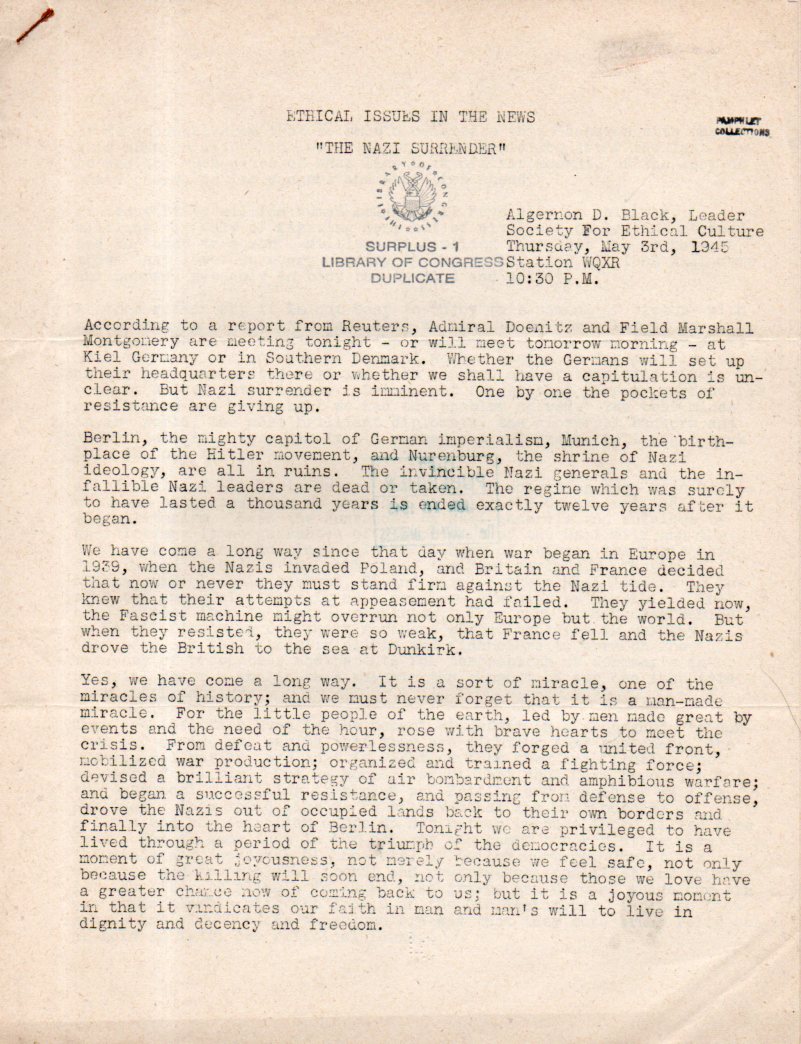
    Algernon D. Black, the leader of the Society for Ethical Culture, wrote a pretty good appeal to America in his radio broadcast of May 3, 1945 on WQXR (NYC). His topic on his “Ethical Issues in the News” series was The Nazi Surrender.  WWII in Europe was nearly over, Hitler had been dead for four days, nearly every major German city was in ruins, and surrender was in the air– and on the ground, and in the rivers, German troops surrendering in the tens of thousands in the west, and more so in the east, with many also being killed at the hands of the Soviets. Surrender was everywhere but on paper.

    May 7 would be the official day, four days in Mr. Black’s future. 

    Black, Algernon459And what Mr. Black warned against in the coming of surrender was this–that even though Germany was defeated, we must make sure that Nazism is defeated too.  He warned that the Nazis claimed to be fighting a common enemy in the Soviets, and at the end tried to align themselves with the West against the rising East. “Even the surrender of Nazi generals and suicides by Nazi leaders in no guarantee if a surrender of the Nazi will and the defeat of the Nazi ideology.

    He went on:  “In the moment of defeat, the Nazis have done things to assure the rebirth of the Nazi movement” pointing out hidden money, transfer of major funds to neutral countries, setting the stage for retrieving patents and industries, and so on. 

    Black points out that the Nazis started a war that killed at least 50 million people, and who in their quest to defeat “Russian bolseheviks” killed hundreds of thousands of British, French, and American soldiers, and civilians, caused the deaths of millions more, imprisoned millions and ran concentration camps. 

    “When we have accepted the Nazi surrender, our real difficulties will begin” Black writes, telling his audience that the Nazis must be separated from the non-Nazis, and that Germans who were “victim of false indoctrination will have to be subjected to intensive re-education”, and that “those who are anti-Nazis must be encouraged to take leadership and to aid in the rebuilding of German life and of German democracy…”

    Black was advocating a sensible, thoughtful approach to a longer-termed peace in discussing the termination not of the German state, but of the Nazi ideology.  

    ·Posted by :

    ·in: