A Daily History of Holes, Dots, Lines, Science, History, Math, Physics, Art, the Unintentional Absurd, Architecture, Maps, Data Visualization, Blank and Missing Things, and so on. |1.6 million words, 7500 images, 4.9 million hits| Press & appearances in The Times, Le Figaro, Mensa, The Economist, The Guardian, Discovery News, Slate, Le Monde, Sci American Blogs, Le Pont, and many other places… 5000+ total posts since 2008.

Author: JF Ptak

  • History of Lines series: the Geometry of Cannon-Fire (1812)

    JF Ptak Science Books   Post 2369

    Cannons ha003
    There were many integral components to firing a cannon on a ship, not the least of which were the Powder Boys, the small, young, semi-strong kids who would run the gunpowder from a below-decks armory to whatever gun deck was needed.  It was a relatively simple procedure, filling up a longish tube (cannon  derived from the Italian  cannone–or large tube–which came from the Latin canna from the Greek  kannē , meaning something like a reed or any similar hollow thing) with gunpowder and then cannonball/shot and then wad, then causing the gunpowder/propellant to ignite and throw the ball.  Basically, that was it, though you needed to maintain the cannon, aim it, and so on (don’t forget to first swab the bore from unexploded gunpowder so you don’t blow things up!).

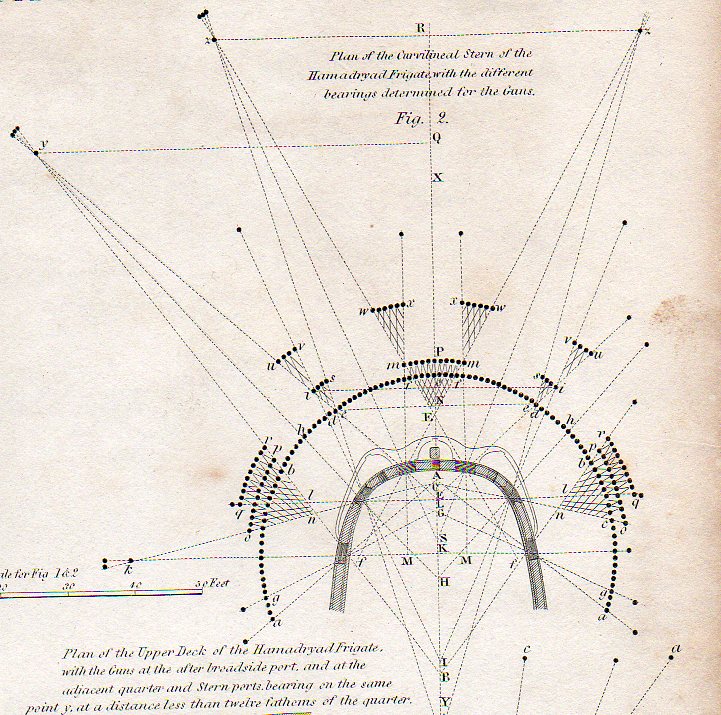
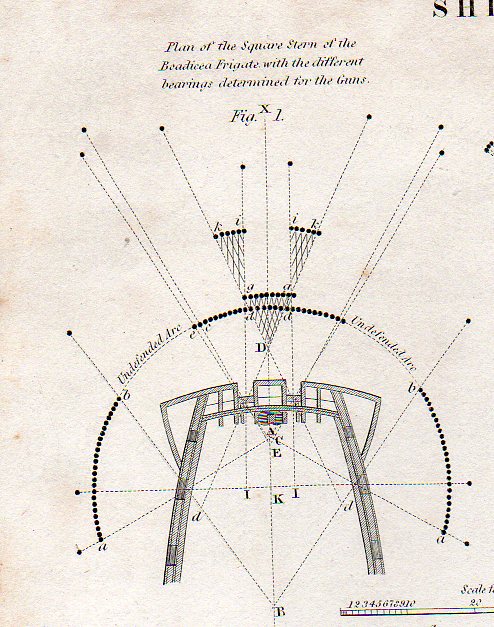
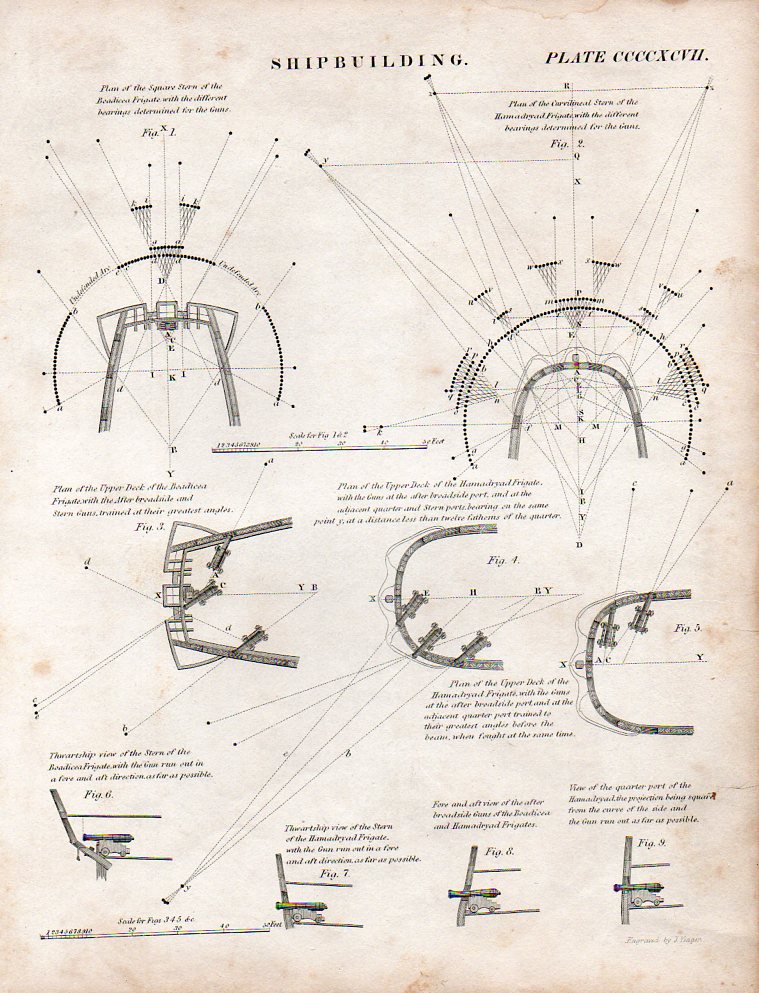
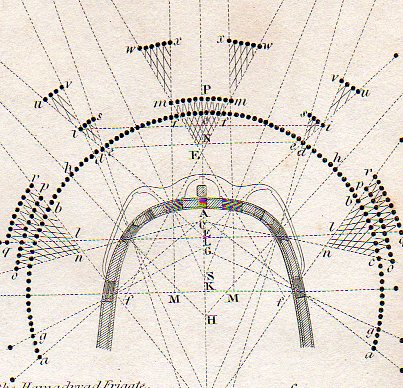
    The (first)  image above of found modernist/semi-dadaist artwork comes form 1812 and was found in Rees’ Encyclopedic Dictionary from the article on “Shipbuilidng”   and illustrates the ways in which the stern of a ship can be outfitted with cannons–actually, the sterns of the HMS Bodiceae (28 18-pounders)  and HMS Hamadryad  (36 guns). Also by this time cannons had been carried on naval ships for nearly four hundred years, while the first cannons appeared on the ground in Europe another few hundred years before that. 

    Cannons ha002


    In the third detail (below) we see the coverage of the four cannons placed in the stern of the Bodicae, mainly pointing out its weaknesses, showing the undefended arc, which comprises about 1/3, or about 60 degrees of the defensive posture.  The Hamadryad on the other hand shows 100% coverage of the 180+ degrees of attack possibilities shown, along with secondary and teriary areas of fire coverage covered by more than one gun.

    Cannons b004 

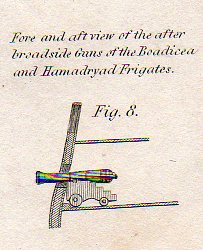
    A fine,tiny detail from the full engraved sheet:

    Cannons little005And the full sheet:

      Cannons001

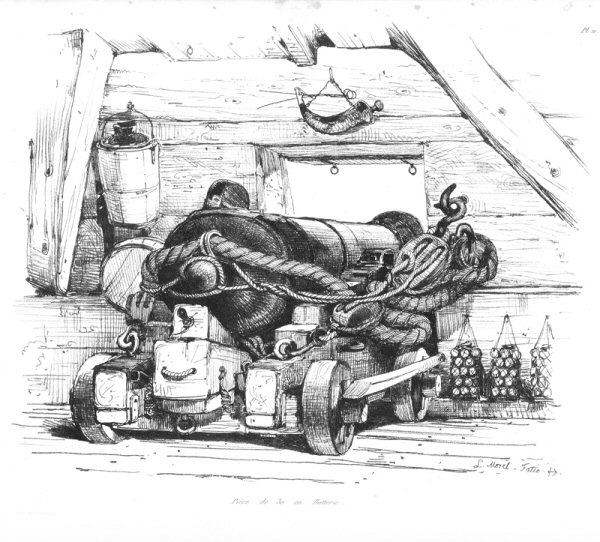
    This is pretty much all that was needed to fire a cannon, except the men of course.

    File:Antoine Morel-Fatio pl10.jpg


  • Notes on Two Great Early Computer Science Textbooks (1950-1953)

    JF Ptak Science Books       Post 2368

    It is worth reporting on these two perhaps-forgotten (outside of the specialty area) classics in the early history of computation. The first was written by a powerhouse married team of Andrew and Kathleen (Britten) Booth—Andrew was the inventor of the magnetic drum memory and the Booth multiplication algorithm, and Kathleen was the creator of the first assembly language, for starters).

    The book was a superior effort and was a survey of the state of computation via digital computer for the Post WWII-1953 era.  The 17 chapters are geared mainly as an instructional–an advanced “how to”, if you will, with plenty of diagrams and illustrations.  After a few historical chapters, we have:  the overall design of a computing system; the control; the arithmetic unit; miscellaneous operations; input-output; gates; single digit storage; miscellaneous components, storage devices.  From this point on, from p136-196, the book deals primarily with programming issues:  definitions of a code and discussion of its form and controls (!), pp 136-151; the techniques of coding; the use of subroutines in coding; program design; some applications of computing machinery. 


    ·Posted by :

    ·in:


  • Mr. Mencken, Unterrified Jeffersonism, and the Anarchist

    JF Ptak Science Books   Quick Post

    Tucker mencken605

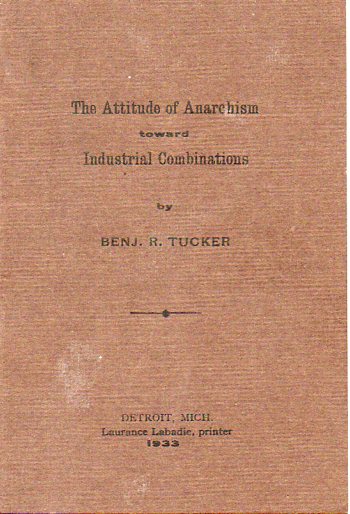
    The long-spirit anarchist (and “Unterrified Jeffersonian”) Benjamin R. Tucker (1854-1939) wrote  “The Attitude of Anarchism toward Industrial Combination” in 1926, but the one I have at  hand here was printed in Detroit (by Lawrence Labadie) in 1933–hardly a hotbead of anarchism in the the front yard of Henry Ford. 

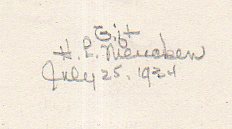
    It is interesting to see on the inside of this tiny pamphlet that the anarchist Tucker’s work was sent to H.L. Mencken, as a gift from the printer.  It wouldn’t stay long in Mr. Mencken’s possession, as he sent it (along with a number of other works by Tucker that I can’t lay my hands on at the moment) to the Library of Congress in July 1934 (and coming into my possession as part of a purchase of “the Pamphlet Collection” 65 years later.).  I’m  not so sure about what Mr. Mencken would have thought of most of it, only that he didn’t keep it for long, I think, despite what might seem to be his “Tory Anarchism” and general oppositionist stances. left and right, whatever they might have meant at the time.

    The full text of the pamphlet is found here.

    Tucker mencken607

    ·Posted by :

    ·in:


  • A Picture of a Dream, 1869

    JF Ptak Science Books   Quick Post

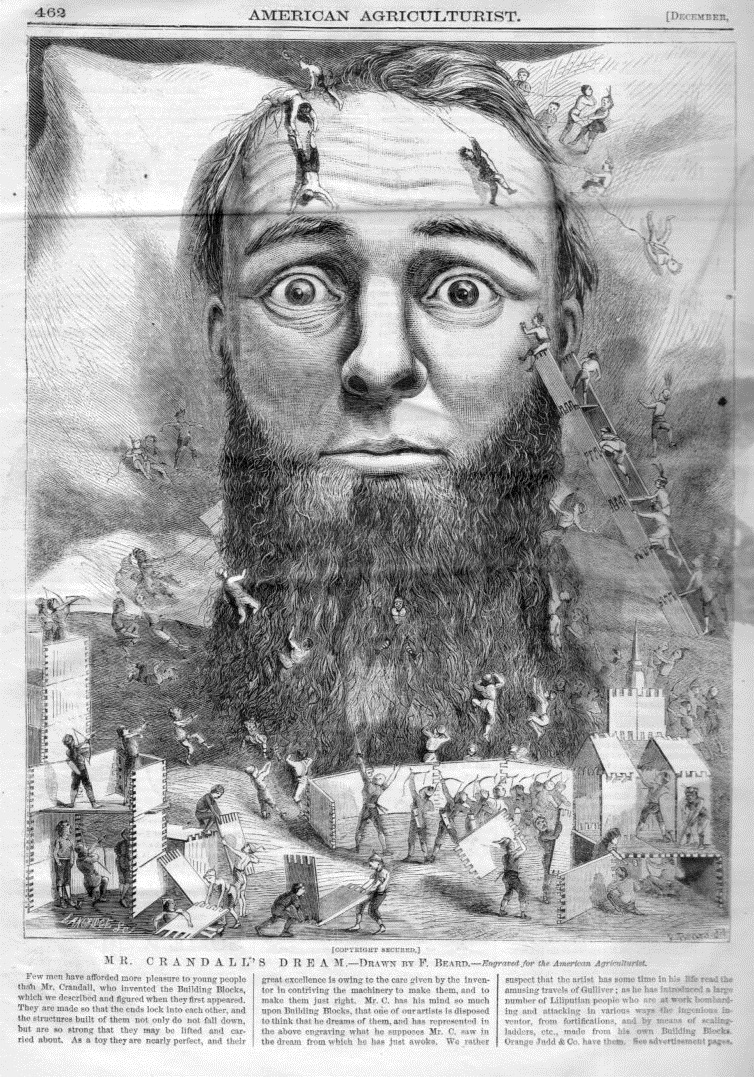
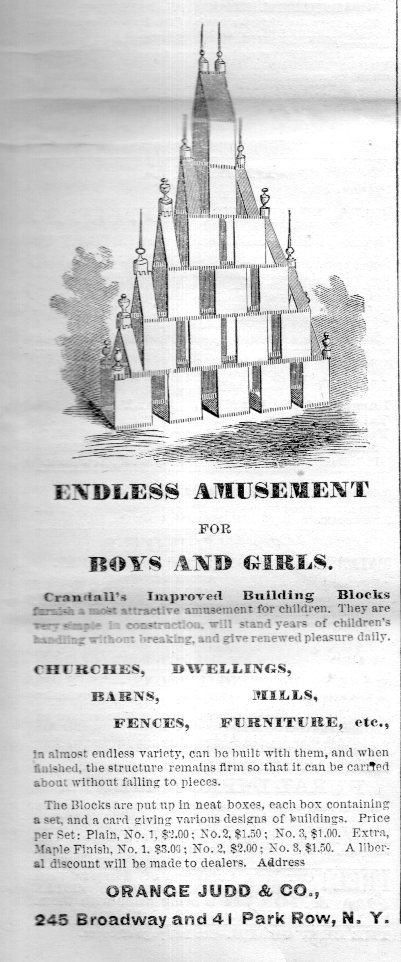
    I’ve been looking at antique images for thirty-five years and in that experience it is easier to recall things that I do not often see–the missing-bits absences seem to be easier to recall than the many categories of images that I do see regularly.  And one of those “missing” categories that was excited tonight by a serendipitous find is “dreaming”, or the representation of a dream, as found in The American Agriculturalist for the Farm, Garden, and Household for December, 1869.  It was an interesting appearance, being a good illustration wrapped around a product-placement ad, as the subject was a children’s block manufacturer, and that’s pretty much what the text was about. But the drawing was good and the imagination behind it was pretty nice, especially for 1869.

    Crandal dream502

    And here’s an ad for the blocks (from the April 1869 issue):

    Crandal dream503

    ·Posted by :

    ·in:


  • The Circle of Words Both Broken and Unbroken–Outsider Political Rants, 1912

    JF Ptak Science Books   Quick Post    Part of the Uninentional Absurdist series

    I’ve catalogued a number of pamphlets on this blog that  are on the Outsider/Found-Surreal/Uninentional-Absurdist spectrum, people who reveal their insights into the un-insightable, or their outsights into the great Outside world that is unseeable because it is unseen, or unknowable, or non-existent. Sometimes it is all-existent, though the insights bearing upon the issue are the unknowable, non-retrievable, self-referential, private-logic and private-language communications. Sometimes there is insight in that, but usually not.  

    This day’s installment has the feel and look of something from the 19th century, but is it comes from 1912, and the rants and razor-vision is localized on Teddy Roosevelt and Woodrow Wilson.  I’m not sure what the author’s point was, because it is all fairly circular, a circle of words filled with a another circle of words, and who knows really where they go. 

    Outsider Political497

    and

    Outsider Political498

    and

    Outsider Political499

    And the full front page of one of the pamphlets:

    ·Posted by :

    ·in:


  • Photographic Composite of Criminality (1883)

    JF Ptak Science Books  Quick Post

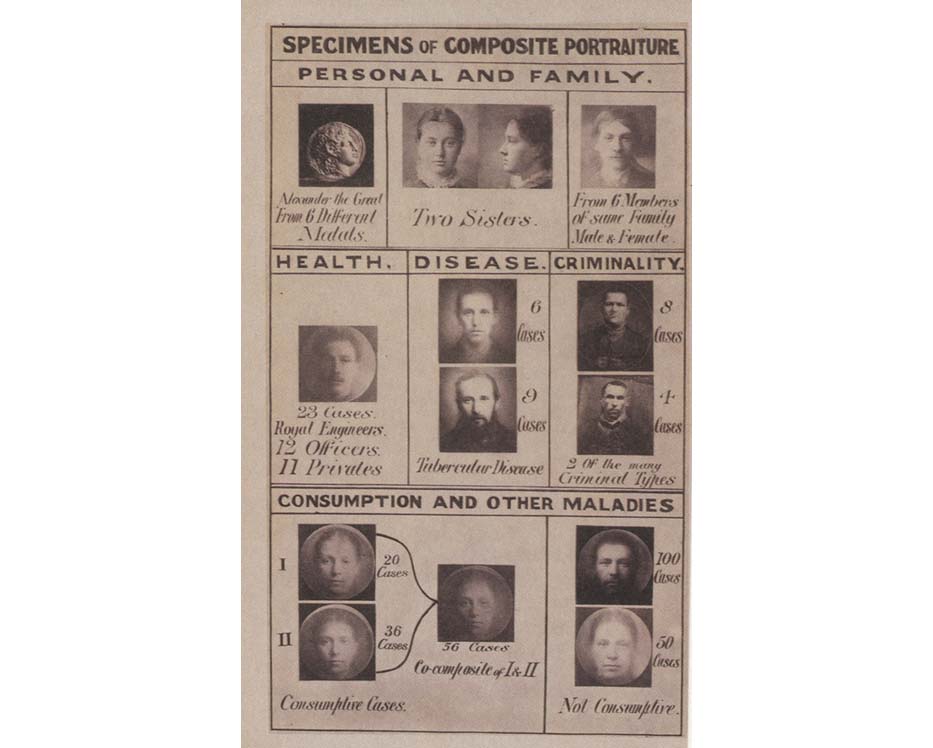
    This is a comparison between two different types of photographic vision–one on seeing instantaneous and direct responses, a photograph recording a true and unguarded reaction; the other, though it was the achieving the same but used a series of photographs laid one on top of the other for a complex amalgam.  Charles Darwin used the first, particularly in the Expression of Emotions, and Francis Galton the second, in his Inquiries into the Human Faculty (1883). This is Galton’s version, the famous frontispiece to his 1883 work:

    Galton faculty

    Living within a self-defined truth function, and its own language, setting its own parameters, finding what it wanted to find. Galton’s work is more like ambient music with a touch of Steve Reich, multiple layers of the same piece of music textured at intervals one piece on top of the other, seeing what came out the other end.  Darwin’s approach was a simple score.  


    ·Posted by :

    ·in:


  • How to Make Yourself Hated by Your Children (1814)

    JF Ptak Science Books   Quick Post

    I was digging through a volume of The Emporium of Arts, and Sciences (Philadelphia, 1813-14), extracting the references for a long and fine article on the still-relatively-new steam engine (it runs 222 pages through several sections of the 448-page volume II) I stumbled upon this collection of pearls on how to raise children. Some of it is pretty good, some not, and some just compeltely and necessarily outdated and dusty and shrivelled and gone. But the first part, the very first bit, the very first sentence, is pretty much the whole enchilada. It was written by Christian Gotthilf Salzmann, who was the founder of the Schnepfenthal Institution, a new approach to education and a certainly-atypical school for the late 18th century.  


    [I own this volume though I’ve used the scans from the Internet Archive rather than spread the big-but-not-undelicate volume on the scanner.]

    ·Posted by :

    ·in:


  • A Big Dark Spot in the History of Spots

    JF Ptak Science Books   Quick Post    

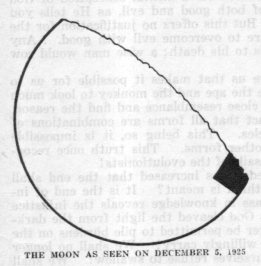
    Spots.  Being in a tight spot, Spot the dog, SPOT satellite, spot-on, spot price, spotlight, Data’s (STNG) Spot the cat, the Great Red Spot, and on and on, most of the remained of “spots” seemingly having to do with animal and largely bird names (spot-billed, -necked, -legged, -breasted, -tailed, etc.). There are certainly “spots” in the history of art, though I have a hard time referring to Malevich’s circles as spots; I have no problem calling Damien Hirst’s spots “spots” though I would not call them “art”. There were spots on the Moon for some time under they were revealed to be Mare, and in the world history of spots I think that was the only spot relating to the Moon, outside of the spot picked for the Apollo spacecraft to land. That is until today, when I bumped into this not-remarkable remarkable outsider-y pamphlet that was ostensibly a screed against the International Court of Justice and the League of Nations…except that the broadside opens with a mighty salvo proclaiming a miracle of a black geometric spot that appeared on the Moon’s surface on December 5, 1925.

    If there was any proof necessary beyond a drawing of the spot, there is none.  Why throughout the world of telescopes and observatories that no one anywhere thought to make a photograph of an irregular quadrilateral shape occupying 5% of the surface of a half-Moon is a secret mysterious outer space mystery secret.  Mystery.

    But there is a drawing of it. And here it is.  

    Moon spot494


    [Source of the mystery:  “The Great Miracle of Yesterday! As Thou Sawest it, so ws it!” , by “A Humanist”, one-page, two-sided broadsheet, printed 1925. I have a number of other bits by the author, all of which are as slippery with commonly-acknowledged reality as this one.]

    ·Posted by :

    ·in:


  • Memory-Inducing Advertisements—Wartime “Nature”, 1942

    JF Ptak Science Books    Post 2365

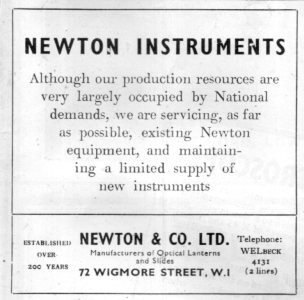
    Yes, it is 1942; yes, Great Britain had been fighting the Nazis for nearly three years at this point, the Americans joining the fight just 10 months prior; yes there were bombings; yes there were hardships. And with great stiff-upper-lippedness, this becomes somewhat seen in advertisements that I noticed in reading through Nature magazine for the last quarter or so of 1942. Scientific instruments and the components that went into their constructions were scarce or non-existent, conscripted to the war effort. For example Newton Instruments (72 Wigmore Str., Lond), announced on the front page of Nature that “our production resources are very largely occupied by National demands”, but that even though their inventory was far down, they were still servicing existing equipment.

    Wwii ads492

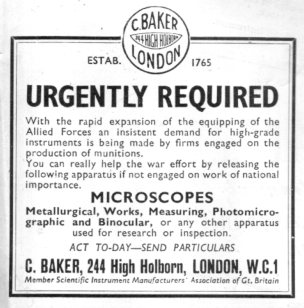
    Baker of High Holburn made a similar announcement, and went a step farther, asking clients in their URGENTLY REQUIRED ad to release scientific equipment to the national war effort.

    Wwii ads493

    On the back back of the October 10, 1942 issue of nature we see the ad for William A. Webb (Skinner Str., London) apologising for being “unable to meet…requirements at the present time, but feel sure you appreciate we are sending out precision balances where the need is greatest.” Then: “later, you will once again be able to get balances…”

    This does give a sense of pause, stopping the reader, finding the outside world, and war, showing itself of a giant scale in small scale in the pages of a scientific journal.

    And what a good show these companies made in their support of the united national effort.   


  • The Deceive-o-Scope–the Motion Picture in 1848

    JF Ptak Science Books    Post 2364

    The moving picture is at base a deception, a series of still shots shown/projected/viewed in order at 16 or 24 or 48 or 60 frames per second (although a new and incredible slow-motion device records at a billion fps) which is enough to allow the brain to fill in the connections in-between the frame with the latent image (persistence of vision) so that our mind perceives that the display is continuous.  The first mechanical approximations of what we think of as the motion picture came into being at about the same time (as these things do happen) and mostly independent of one another.
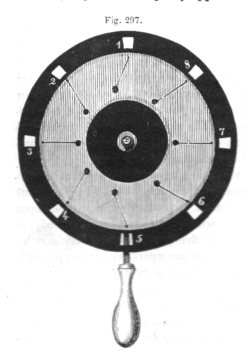
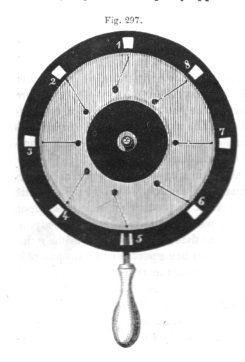
    Plateau491

    [Image:  J. Mueller, Principles of Physics and Meteorology, published in Philadelphia, 1848, image on page 311.]

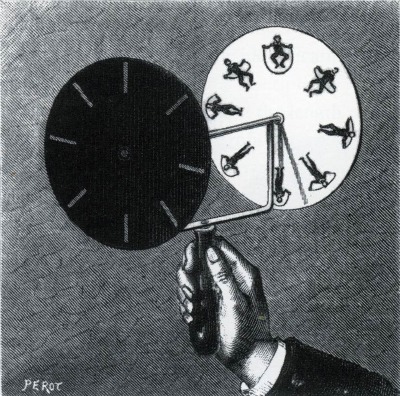
    The biggest name in this small group is Joseph Plateau (1801-1883), who constructed a two-disk slotted device in 1832, just at the same time as Simon Ritter von Stampfer (1792-1864, working in Vienna) constructed his own version.  Plateau called his the Phenakisticope; von Ritter, the Stroboscope–Plateau’s invention is Greek for what is essentially the title of this post.

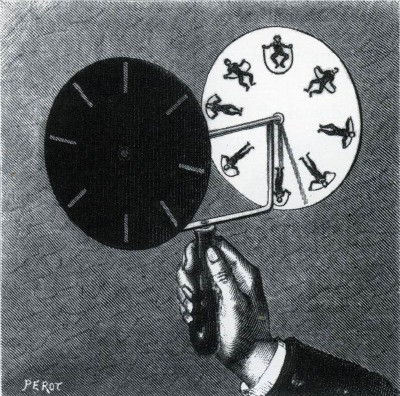
    The device was relatively simple for the effect it produced and future that it held–in one iteration it was a slotted disk on which 12 or 16 images of successive motion appeared; when spun and observed through one of the slots in front of a mirror, the images seem to come alive, moving in one fluid-ish motion.  There are other models (as shown below) though the principle and effect are the same.
     Plateau

    This was not the earliest attempt at animated motion, though it is the first that comes to resemble what would appear about 60 years later and what we could recognize as a “motion picture” but without the film.  For centuries before this there was entertainment via moving shadows cast by paper/wooden puppets in Shadow Shows (actors using figurines positioned between a light source and a white cloth/screen on which the shadows were projected.  Of course there was also this effect using the hands, with instructionals appearing in book to appeal to the Victorian parlor adult and child (like “Frank Fireside’s” Lights and Shadows on the Wall, a Handy Amusement for Winter Evenings, which actually appeared a little after the Plateau invention but which was cheaper). In the field of applied optics there was the magic lantern, a 17th century invention (though it shows up i the Leonardo notebooks) and appearing in the remarkable Athanasius Kircher’s (S.J>!) Ars MAgna Lucis et Umbrae in 1646. A bit later in the hands of Joahannes Zahn came the Kircher idea but with a sliding disk with several images on it that when projected and moved from left to right suggested movement.  The magic lantern was usually used within or behind an audience and projected forward–Robertson raised the ante on this by being one of those in the 1840’s who projected the images from behind a scree that was in front of the audience, so that the appearance of the images was unforeseen, with shocking results (and thus the naming of his apparatus quite appropriately The Phantasmagoria). 

    Permanent capture of these images would come several years later with the invention of Daguerre in 1839 though that would not come into effect for moving pictures for another 50 years or so. A stop-action photograph of a continuous event would come slightly before that, naturally, with the work of Eadward Mybridge and Etienne Marey whose results were produced in the early 1880’s. Edison’s kinetoscope would come in the early 1890’s and produce the first projected moving images, though there are many other names besides Edison who could lay claim for bring the inventor of cinema, and who are all at least pioneers of the genre, including Le Prince, Varley, Friese-Greene, Dickson, and Sklandanowsky. And most of that pre-history occurred here, with Plateau and Cie. 

    It is interesting that in the short span between Plateau and the publication of the first image in Muller’s work in 1848 that so many other events in the history of science occurred that, in effect, segmented and expanded understanding of previously quick and discrete events.  Like Morse’s telegraph (1837), Theodor Schwann’s cell division (1838), Murchison’s silurian system/stratigraphy, Meyer’s conservation of energy (1842), Doppler’s effect (1842), Joule’s conservation of energy (1847), and of course, Daguerre’s invention of photography. 
    ·Posted by :

    ·in: