A Daily History of Holes, Dots, Lines, Science, History, Math, Physics, Art, the Unintentional Absurd, Architecture, Maps, Data Visualization, Blank and Missing Things, and so on. |1.6 million words, 7500 images, 4.9 million hits| Press & appearances in The Times, Le Figaro, Mensa, The Economist, The Guardian, Discovery News, Slate, Le Monde, Sci American Blogs, Le Pont, and many other places… 5000+ total posts since 2008.

Author: JF Ptak

  • Super Hero High Voltage Mask, 1941

    JF Ptak Science Books   Quick Post

    Mask878

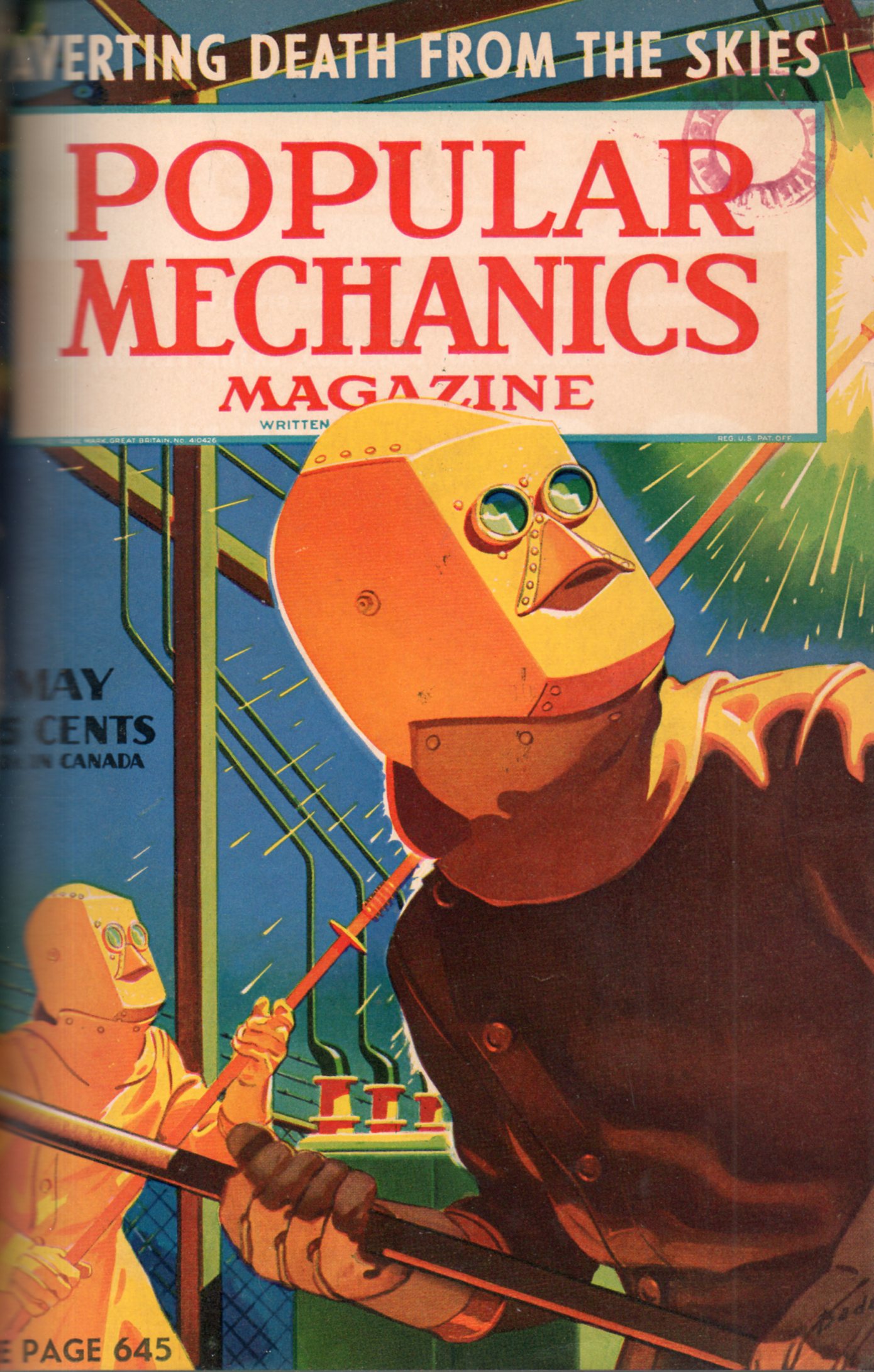
    I just couldn’t resist this.  And I don’t have much to say about it, either, except that it is a killer cover from Popular Mechanics for May 1941. Unfortunately it has nothing to do with my title for this Quick Post or the sub-head of the magazine–the men are dressed in protective gear to deal with high voltage electrical works,  though I have every expectation for these guys to take off with their rocket packs and punch-out Nazi dive bombers.  

    Mask877

    ·Posted by :

    ·in:


  • Alphabetical Apocalypse(s): Apocalypse Now and Then

    JF Ptak Science Books   Post 2431

    “Just as psychoanalysis reconstructs the original traumatic situation in order to release the repressed material, so we are now being plunged back into the archaeopsychic past, uncovering the ancient taboos and drives that have been dormant for epochs… Each one of us is as old as the entire biological kingdom, and our bloodstreams are tributaries of the great sea of its total memory.”–The Drowned World, J.G. Ballard, Millennium 1999, p. 41.

    Is there a plural of apocalypse? Is there even a need for one (plural)? There is, of course, even if it is a word that is supposed to spell out the end of times–there can be more than one apocalypse, and they can happen at the same time, although given my very limited knowledge of the scifi genre I don’t know of any books addressing dual/multi-combative apocalypses. (And here I’m not talking about one apocalypse generating all manner of associated badness, but a second, completely unrelated, apocalypse.) 

    So in trying to understand the nature of apocalypse storytelling I decided to make a very abbreviated  overview of a vast literature of the end of times/apocalypse/technocaust/end of the world themes.  This is just a short working list, really, and includes only short stories or novels, and to keep it relatively crisp I’ve chosen the artificial delimiter of an alphabet of apocalypse types.  In many cases there is just one example (where there could be hundreds, so please don’t fault the list for completeness because that would take years of assembly and understanding). The same goes for the categories of apocalypse–I’m certain I not included the majority of them, though I think that this is a good start (There are no movies or television shows listed independent of a text, so Soylent Green will show up but under Harrison’s Make room! Make Room!. I think that tv shows/movies etc  must be enormously outnumbered and the scale of orders of magnitude by the print media.) 

    Evidently this list can be reproduced in the same spirit but with iterations–for example, Juvie Apocalyptic Lit (see here).

    Also–the list is a little heavy with Wells, Chrisopher, Aldiss, Heinlein, and Ballard; this simply because I’m a little familiar with these writers.  So, the list:

    Alien Invasion:  the great initiator, The War of the Worlds 1898, H. G. Wells; The Moon Men 1926, Edgar Rice Burroughs; The Puppet Masters, 1951, Robert A. Heinlein. There were other earlier incarnations of extra-terrestrial visits, especially if you considered religious/mythological aspects, though in literature it was far less common–like Swift’s mathematicians of Laputa and Voltaire’s titans in his Micromegas. For the modern era though it is Wells who seems to create this idea. 


    Apoca war of the worlds Apoca--heinlein puppet
    [Of course this could not possibly be complete by the genre-bender/creator H.G. Wells’ War of the Worlds–Flavorwire has a selection of 15 different covers for this classic best-seller, here.  ]

    Botanical endgame virus destroying all plant life: The Death of Grass by John Christopher.  On the opposite end is  1962 novel Hothouse by Brian Aldiss where the plants take over everything.

    Apoca--aldiss hothouse

    Climate Change: apart from the state of globa;l warming as we know it now, The Drowned World by J.G. Ballard 1962 is perhaps the best and most well-known adventure in this field.. In this book in 2145 solar radiation has shrunk and mostly melted the polar ice caps, which is a lot of water, and has turned most cities into architectural swamplands of vertical mangrove. Conversely Ballard wrote the novel The Drought  in 1964 about all of the water on earth drying up.

    Apoca--ballard drowned world


    ·Posted by :

    ·in:

    — —

  • Cigarette Women of the Second Dimension, 1940

    JF Ptak Science Books   Quick Post

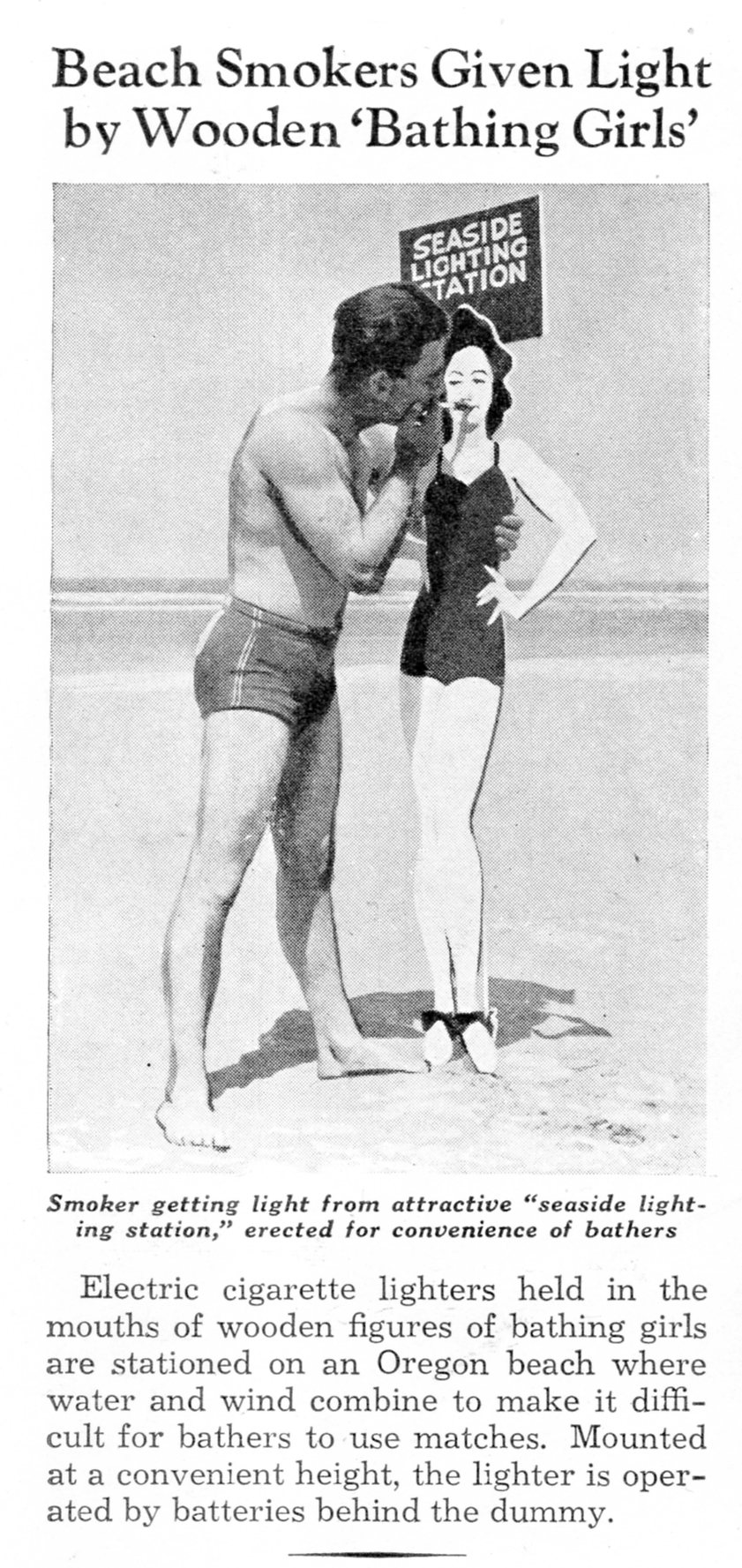
    Nothing quite spells out the duties of subjugation as being a one-dimensional-purposed two-dimensional object.  And in the world of these things few seem to come as close to becoming-a-real-girl in the Pinocchioiana sense than this item.


    Woman ciggie lighter corrected875

    It is a cigarette-lighting girl for beachgoers, found sleeping lightly on page 556 of the October 1940 issue of Popular Mechanics.  It seems that it is an issue for people being able to light their cigarettes on the beach, so cigarette manufacturers or their agents or agents of agents manufactured this device to make sure that no ill wind would come between the cigarette consumer and the uninterrupted consumption of cigarettes.  And so this device was created–the lightless ciggie smoker would come up to the cut-out and place their cigarette tip into the recesses of the lighting element in the cutout’s mouth.

    Weird, filled with dread, and true.  

    ·Posted by :

    ·in:

    —

  • Looking at Things: an Iconic Photograph of the U.S.A., April 12, 1945

    JF Ptak Science Books   Post 425 (from 2008) expanded

    0 ebay clark


    [Image made from a private, original photograph; the picture first appeared in Life Magazine, April 23, 1945.]

    Many years ago I went to the house of a man with books to sell.  The house was terrific, with a view of the Potomac and just outside the district line–a hard thing to accomplish in housing in Washington.  The elderly gent’s house was open, airy and basically wallpapered with large format, very big photographs.  Many of the photographs I recognized–and of those, many were iconic images.  I said something simpy/obvious like, “so I see that you collect historic photographs.”  “No, I don’t” he said.  In that moment I thought he was just being a wiseacre with me.

    He quickly said, “I took them”. 

    “Oh my God”, I thought.

    I honestly didn’t know what to say–I had seen so many of them in my life, and so often, that like a lot of things, these images were just there, part of the cultural landscape.  And here was the man who took them.  After I got over my shock and came to a sense or two, I interview hi a little.  The man behind the camera’s name was Ed Clark.

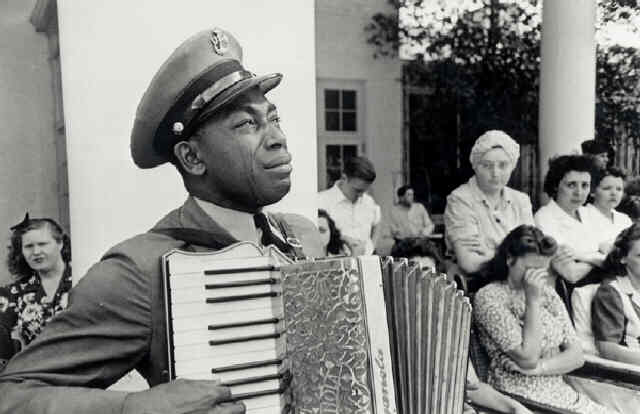
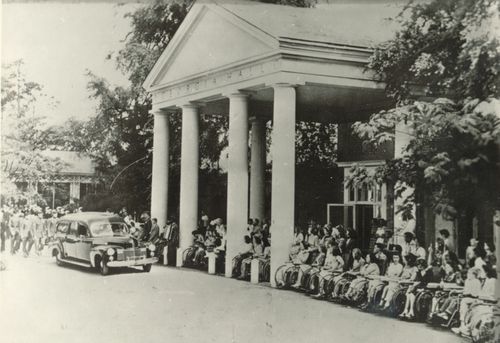
    Ed (1912-2000) was about 80 when I met him, and he was selling some books because he was getting ready to leave DC and head back home to Nashville.  He was very quick with strong recall.  I asked him about his ultra-famous photo of CPO Graham Jackson (1903-1983), preserved forever, who on the morning after Franklin Roosevelt’s death on 12 April 1945 in Warm Springs, Georgia, was playing Going Home  at the portico of Georgia Hall as the president’s casket was being taken to the train for a last ride to D.C.  Jackson was at Warm Springs to perform for Roosevelt as he had many times before when the President died on the 12th, on his 42nd visit there.

    I wondered about where the rest of the crowd was, and particularly, where the rest of the photographers were, at that moment  After all, FDR was about the most famous man in the world, and perhaps the most important, when he died in the last stretch of WWII.  Surely there must’ve been tons more photojournalist there to record the scene of FDR’s body being removed. 

    “There were” Ed said.  I asked him where they were.  He explained that they behind him, which would’ve been in front of him, actually–he was at the rear of the crowd, with every other photographer pointing their cameras forwards, recording the movement of FDR’s body.   Ed said that he turned around (“because that picture was already being made”) and found the rest of the crowd, the people who were already there at Warm Springs, watching from a respectful distance.  And it was at that point that CPO Jackson started to play his accordion, the music being one of FDR’s favorite pieces.  “They weren’t looking the wrong way”, Ed Clark said, “just not the right way”.  And Mr. Clark made the photo that everyone else missed, because they’re faced the obvious.

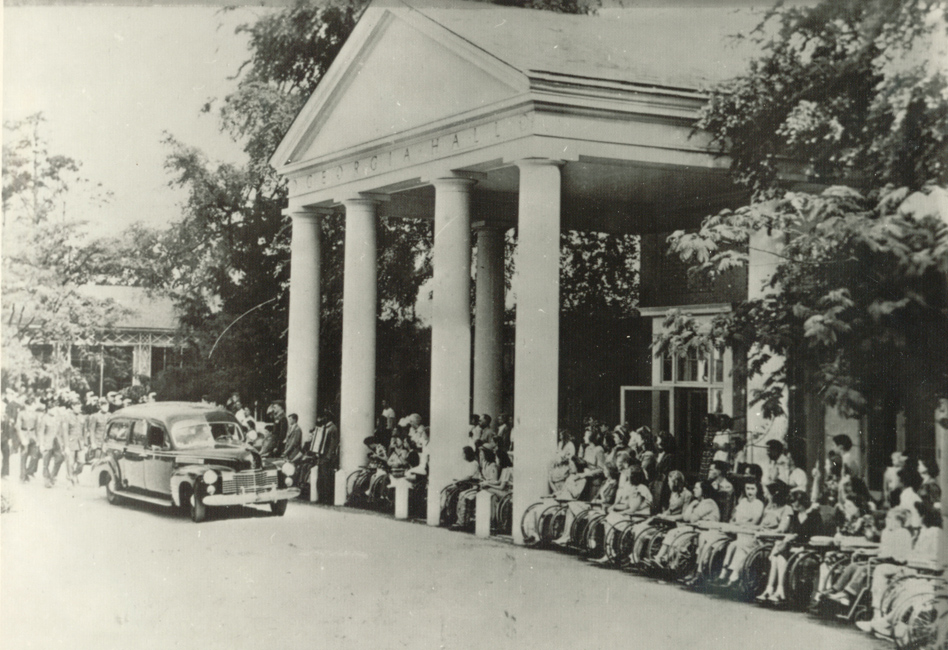
    Another view of Roosevelt’s casket being driven by Georgia Hall in Warm Springs. If you look closely you can see CPO Jackson standing just to the left of the hearse’s front left fender: [Source]:
    FDR Warm Springs


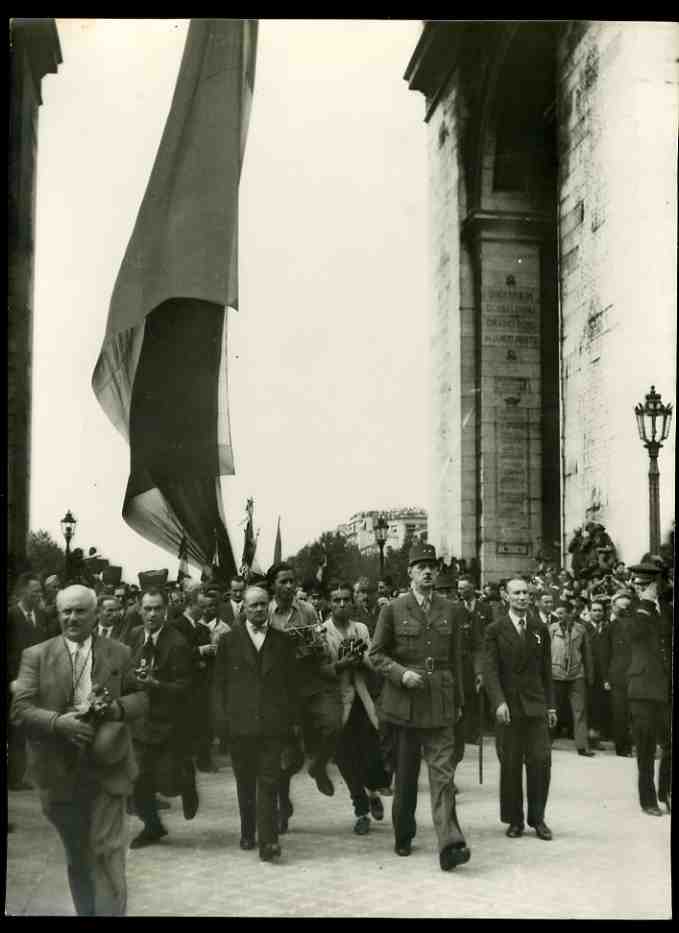
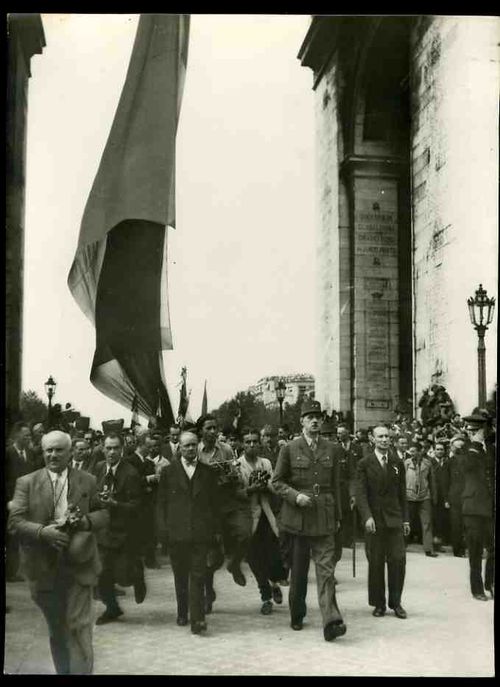
    This second picture captures both the moment and the photographers whop were missing it.  The scene is of course General De Gaulle making his triumphant return to the liberated city of Paris, walking back into the city through the Arc de Triomphe on 25 August 1944.  I am also completely certain that the picture was taken by another LIFE photographer (Ed Clark having worked their for years contributing many photo-stories and covers), Ralph Morse (my original doesn’t have any identification on the back, though it certainly looks like the others Morse made at that moment).  Morse caught De Gaulle in mid stride at the half-way point through the Arc.  And you can see the look of pain in the faces of the other scrambling photographers who must’ve been just coming to the realization that they were in the shot they had been desperately wanting to make since 1940. Their sinking feeling is pretty visceral.
    0 ebay 12 where not to belia260

    Perhaps being in the “wrong” place is just someone else’s perception until you prove them wrong.  After all, there must be some right place right time, wrong place right time, right place wrong time, wrong place wrong time hierarchy, no?–that is, until you’re smart enough to realize that there’s no such thing as “wrong”. 

    0 ebay 12 where not to belia261


  • Multiple-Maginot and the “Floating Wall of Fire” (Romania, 1940)

    JF Ptak Science Books    Post 2430

      Fire wall872Fire wall871

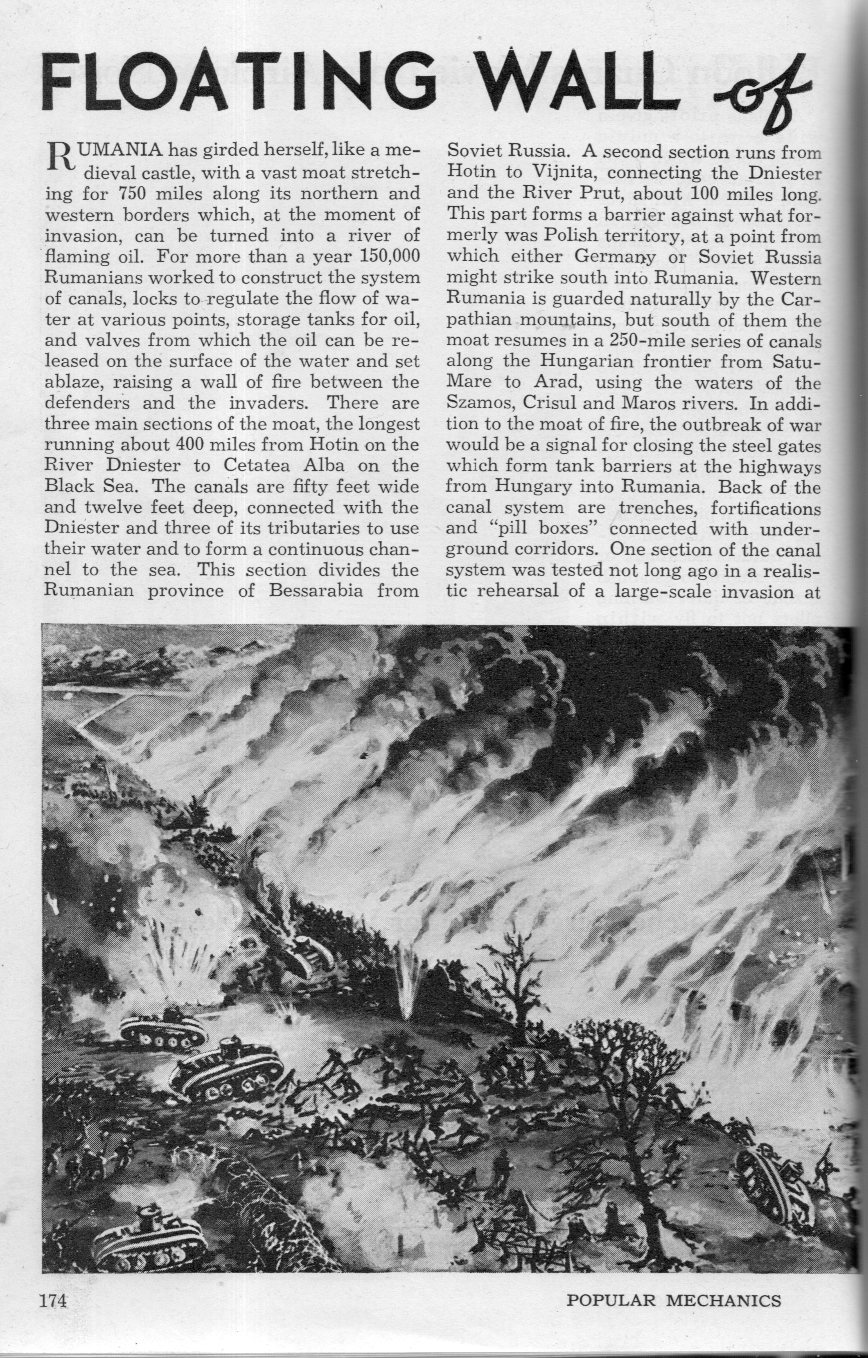
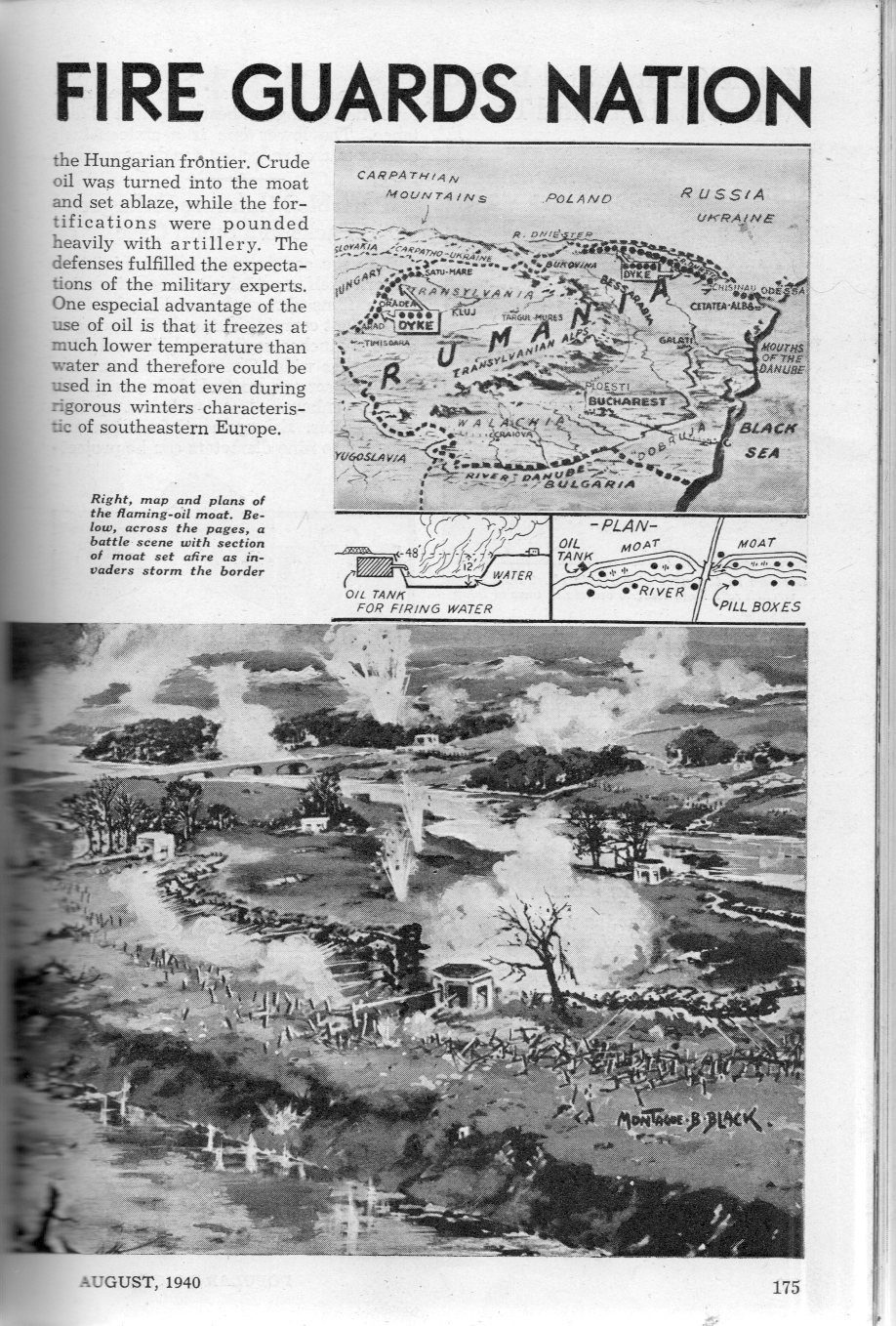
    In August 1940 Popular Mechanics reported on another example of cloudy thinking on the coming world of warfare–the “Floating Wall of Fire” of Romanian defensive consideration.  The article tells the story of how Romania “girdled itself, like a medieval castle, with avast moat stretching for 750 miles….which, at the moment of invasion, can be turned into a river of flaming oil”.  The canals which make up this open-pit Maginot line were 50′ wide and 12′ deep, the longest of them running some 400 miles, the combined efforts of the big dig meant top protect the country from invasion from Hungary, Poland, the Soviet Union, Yuoslavia, and Bulgaria–and of course from Germany which at the time could advance from a number of different positions.  There were also hundreds of gun emplacements facing the pit, I guess to fire on whomever if they decided to try and break through/over the moat, which would have been flooded with crude oil and set ablaze when invasion occurred.

    The problem of course was that even a year after the Blitzkrieg in Poland with the combined assault by land/air forces the lesson had not been learned here–unless of course the flames were 20,000′ high.  And obviously the river of fire would last only so long–depending on available amounts of crude oil I wonder how long they determined the wall of fire could be maintained?  A day?  A week?  (I know that from controlled burns of oil spills that in one case some 16,000 barrels of floating oil was burned off in a controlled burn in about four hours–it seems to me that if there was an invasion front that was miles wide and striking at numerous point along a 100-mile front that…well, the problems are obvious.)

    Could anyone have expected an invasion force to arrive and then once confronted by a burning moat turn back and retreat?  

    In spite of fulfilling expectations during a “rehearsal of a large-scale invasion”, it seems very highly dubious that anyone could really have been comfortable with the first line of national defense being fire in a long hole.  

    [It should be mentioned that after the once-neutral-ish Romania settled into its relationship with the Axis that the worst single-mission air losses for the U.S. Army Air Force occurred in the bombing of petroleum facilities in the area of Ploiesti, Romania, on 1 August 1943. In an unsuccessful attempt to damage the flow of petroleum to Axis forces, Operation Tidal Wave targeted this location but with devastatingly bad consequences, with 53 aircraft and 660 servicemen lost in the action.]  


  • On the Origins of Ripples (1883)

    JF Ptak Science Books     Part of the series on the History of Lines

    Seems like an easy topic–it isn’t.  

    Perhaps there are no more “basic” a collection of lines than those made in sand, either at the beach, in water, or in the desert, created by water or wind, changes to the surface of a mass at the intefave of the fluid.  They seem to be about as basic as things can be, line-wise, or at least in lines that can be found in nature and not made by humans.   These lines are called “ripples”, and ripples have numerous names and classifications.  Not  many, though, in 1883, where I found this lovely article in Nature by Charles Darwin’s son, George.  (This is a shorter version of a 25-page earlier paper “On the Formation of Ripple-mark in Sand,”  In the Proceedings of the Royal Society, November 22, 1883, vol. 36.)

    It  is a wonderful thing this thinking on the movement of sand, and dirt, these wave-formed ripples, created in forms straight, sinuous, cantenary, lingoid.  It also is followed closely in by George Darwin’s article on the formation of mudballs (volume 27, page 507). Who could not but read an article like that? 

    Also it brought to mind his father’s Power and the Movement in Plants, and specifically a letter to the editor of Nature in the April 28, 1881 issue of Nature, “The Movements of Leaves” in response to bright light…)

    ·Posted by :

    ·in:


  • The Old Bridge’s Future Bridge

    JF Ptak Science Books  Quick Post

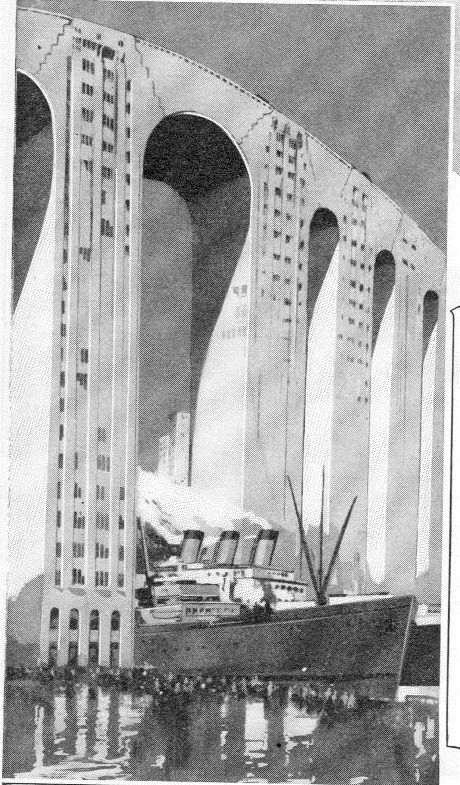
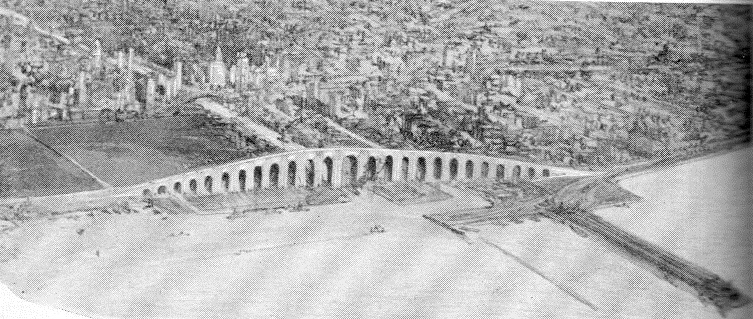
    This view of a future “skyscraper bridge” appeared in the May 1928 volume of Popular Mechanics (volume 48). It is an interesting idea , though very much on the high side, what with the structures being hundreds (500?) of feet high, towering over the shipping lanes. It is an old idea, the new bridge, and it reminds me of a lovely example in the Ponte Vecchio (literally, the “Old Bridge”) of Florence, the recognizable image of it rebuilt in the 14th century. (It was probably designed by the great Taddeo Gaddi (remembered so well in narrative by Vasari and in portraiture by Paolo Uccello.)  There was no Gaddi at work on this bridge, which was set to unite Chicago.  

    Future bridge558

    And the bird’s-eye view of the enormous structure:

    Future bridge559


  • The Future in Blocks and Chunks (1928)

    JF Ptak Science Books   Quick Post

    There have been a few dozen posts on this blog concerning the history of the future, and the present addition

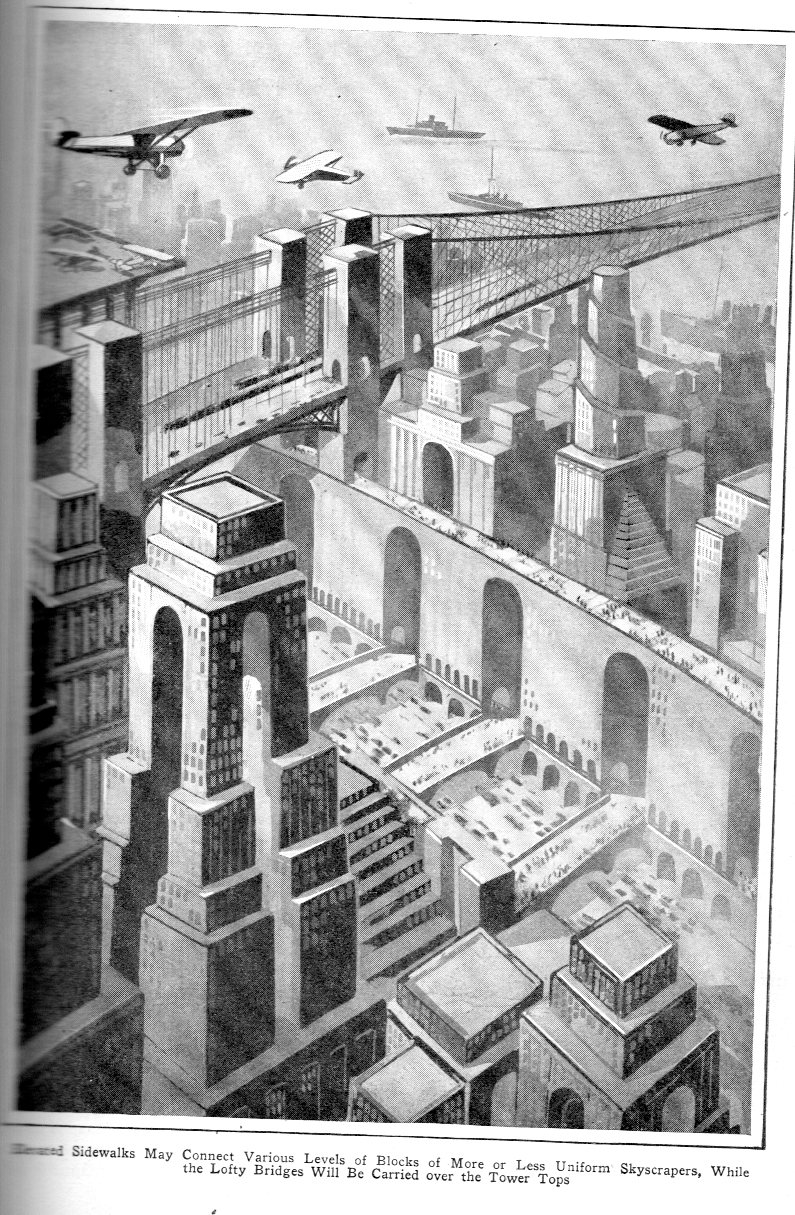
    The near-future of urban living evidently includes a lot of walking space for pedestrians, because in spite of the enormous increase in airplanes and cars and trains and so on, there is still a need for massive construction for folks to walk on.  For example, take a look at this Babylonia-International style cityscape–it is a sort of concretized Craddle of Italo-Fascist Civilization, with lots of space pancaked one on the other, including skyscraper pedestrian bridges:

    Future 1922533

    [Source: Popular Mechanics, January, 1928]

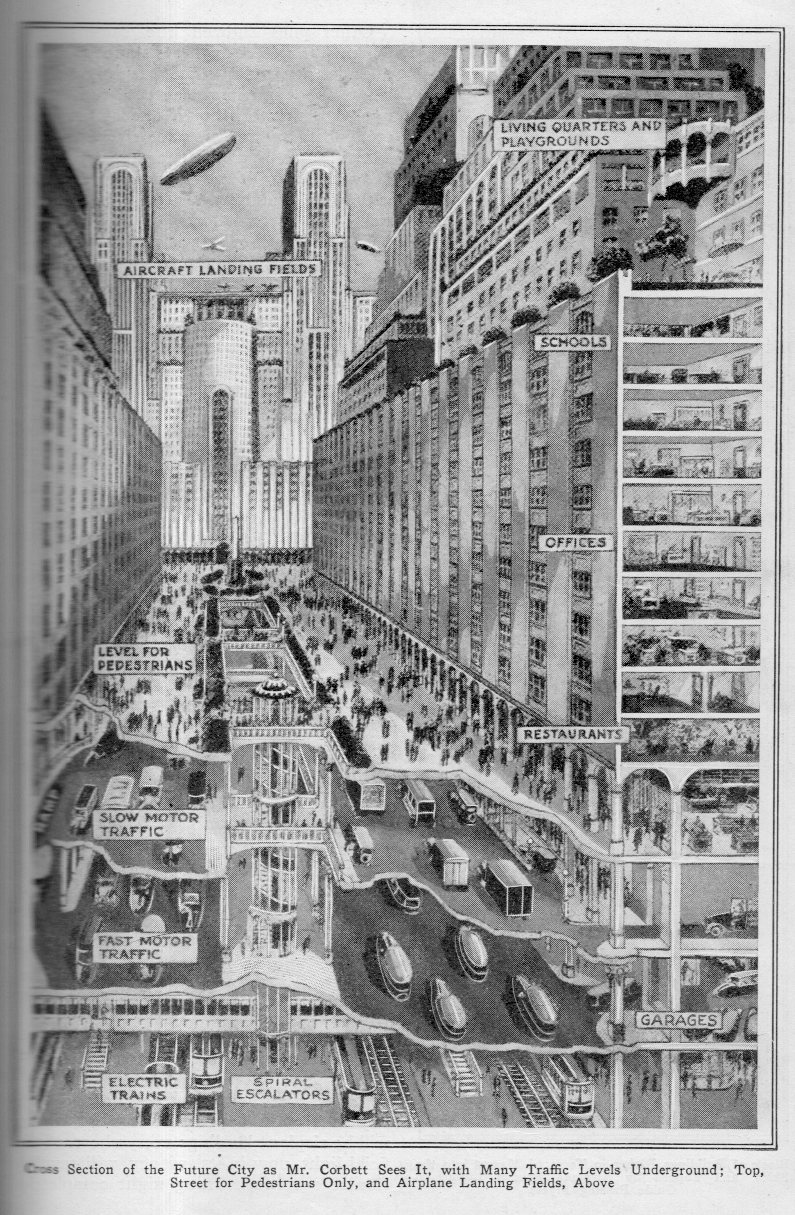
    And further on we see another example of very segmented spaces for the comings-and-goings of urban progress, with people able to mill about on vast rooftop-like structures while the mechanized conveyances take place on three different levels.  One of these levels is above-ground, and two are below: the slow traffic of commerce and delivery is still above ground, though beneath that and segmented again are the fast/slow traffic and buses and trains:

    Future 1922532

    In the massive blocks of buildings is where the other living-of-life things occur–shops and restaurants at bottom, followed by offices , and the above them are the schools, and then finally above all else are apartments and playground. Oh: and atop it all are dirigible airfields.  

    Looks like it would all be pretty dark, to me.  


  • 1931 M.I.T. Integraph Calculator

    JF Ptak Science Books   Quick Post

    I’ve looked around quite a bit now and without success about this calculator designed by Thomas Gray–except for this small notice in Popular Mechanics.  “Electric Brain Solves the Hardest Problems” pops up in the September 1931 issue of Popular Mechanics, and is a nice description of the machine:  

    Thomas gray869

    Bush, V. (October 1931). “The differential analyzer. A new machine for solving differential equations”. Journal of the Franklin Institute 212 (4): 447–488

    Notes:

    Thomas S. Gray (1906-1992) “was professor emeritus of engineering electronics at M.I.T… best known for the development in 1931 of the Photo-Electric Integraph, a calculating machine that solved complex mathematical problems in minutes by turning them into rays of light…out of this work came his book “Applied Electronics,” an authoritative text, published by M.I.T. Press in 1954.–New York Times 1992 obituary

    ·Posted by :

    ·in:


  • U.S./Allied Propaganda Newspaper for German Soldiers, April 1945.

    JF Ptak Science Books   Quick Post

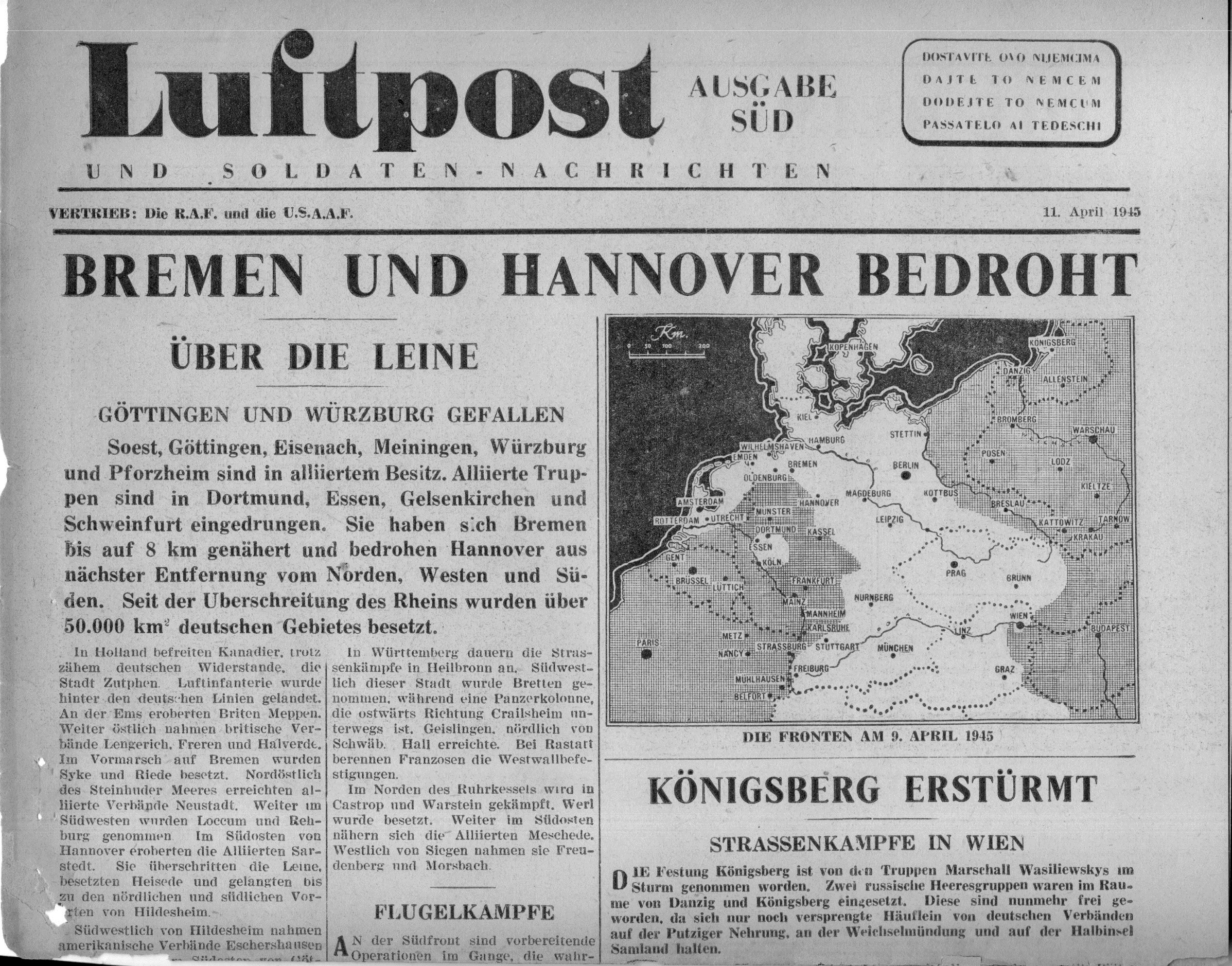
    The Luftpost was an Allied propaganda newspaper delivered as we see by the RAF and USAAF–and this one, “delivered” in the closing days of the war on April 11, 1945, is loaded with information that was meant to undermine any German resistance with news of the collapse of the Wehrmacht.  “Bremen and Hannover are Threatened” and “Across the Leine, Goettingen and Wuerzburg have fallen”; its was reported that the Luftwaffe “reappeared” and 101 of them duly destroyed; fighting in Yugoslavia going well, in Italy there was “a new massive onslaught”, and “endless columns” of newly-surrendered German troops have added themselves to the million+ existing German POWs. And on and on in a litany of destruction and demise and death of Germany.  On the reverse are several photos showing American rations going to German families, milk going to children, and the people of Munchen-Gladbach receiving their first instructions from the occupying military government.  In short–the delivery of food and health and structure from the Allies, offering a safe and real alternative to fighting. 

    WWII Propaganda newspaper866

    ·Posted by :

    ·in: