A Daily History of Holes, Dots, Lines, Science, History, Math, Physics, Art, the Unintentional Absurd, Architecture, Maps, Data Visualization, Blank and Missing Things, and so on. |1.6 million words, 7500 images, 4.9 million hits| Press & appearances in The Times, Le Figaro, Mensa, The Economist, The Guardian, Discovery News, Slate, Le Monde, Sci American Blogs, Le Pont, and many other places… 5000+ total posts since 2008.

Author: JF Ptak

  • In the Golden Age of Bicycles–a 25-cent Bike

    JF Ptak Science Books   Quick Post

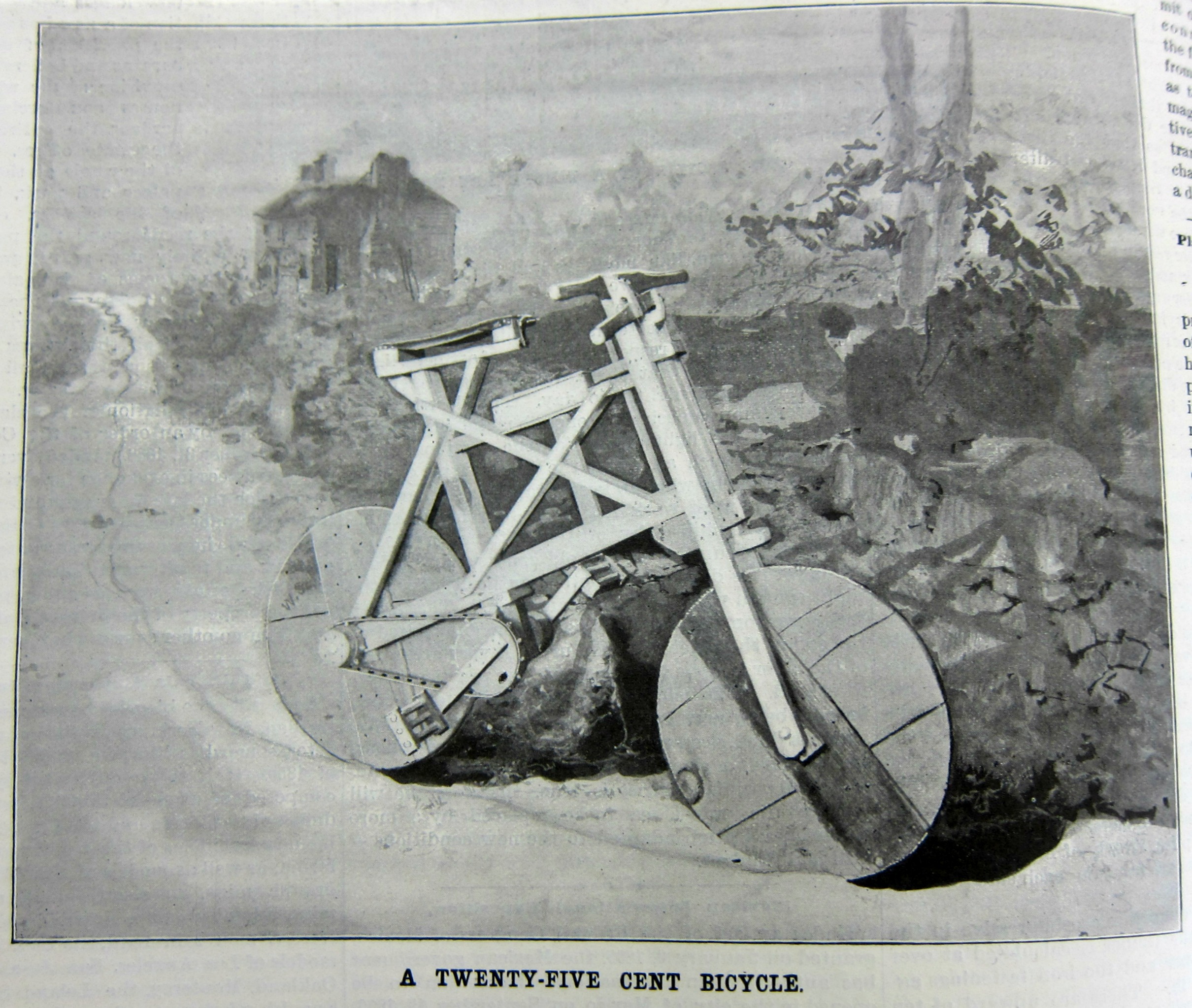
    Today I joked with a neighbor that my car was so old that it has wooden seat belts.  At least it has seat belts, no thanks to the early (pre-1989) efforts of people like Lee Ioccoca to prevent having them automatically installed, and unlike the Flintstones and Jimmy Rockford and others who had no seat belts at all–it is more like Granny’s rope-belt in the Beverly Hillbillies. Be that as it may, this bicycle is a much better creation than my seat belts.  The image appeared in the Scientific American for February 1, 1896, a half tongue-in-check proposal at a time of a great bicycle craze. Even though millions of bicycles were being made, a decent one could cost you $25, which would (according to the Bureau of Labor Statistics inflation calculator) would be about $750-$1000 today–not nothing.  So this Modest Proposal on making a bike from bits, found wood, and a quarter.  

    Bicycle 25 cents


  • Over and Under Stories: an Underwater Lighthouse and a Piggy-Back Bomber (1916)

    JF Ptak Science Books   Post 2593

    Airplane piggyback

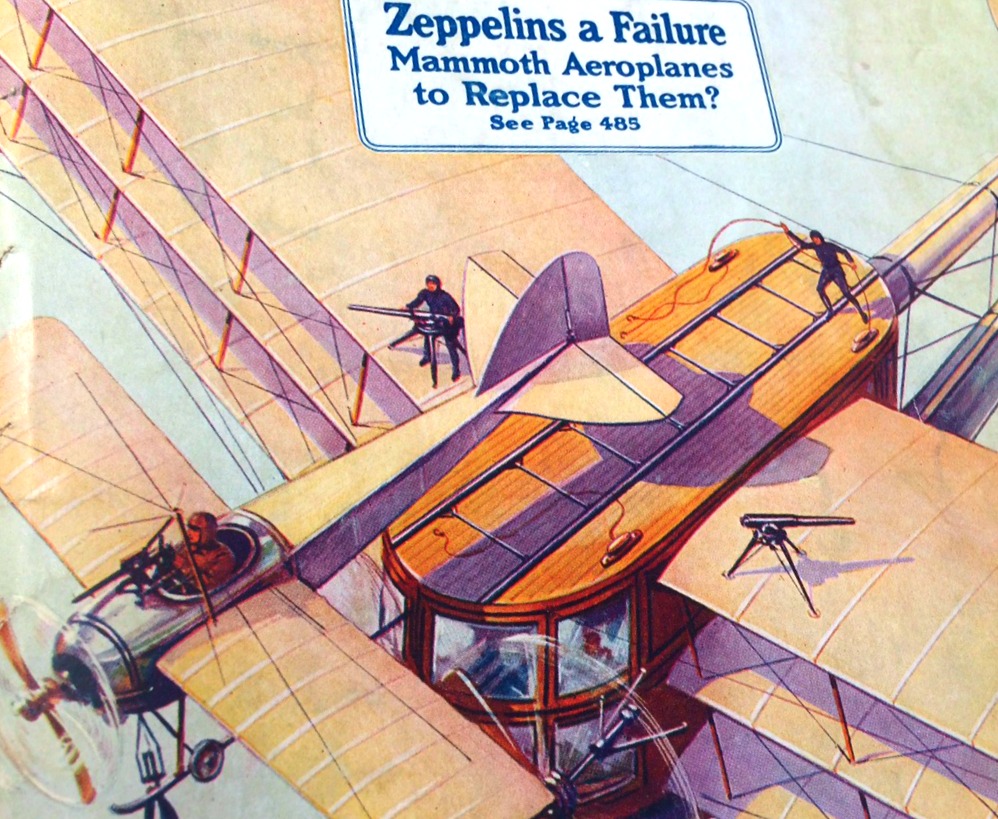
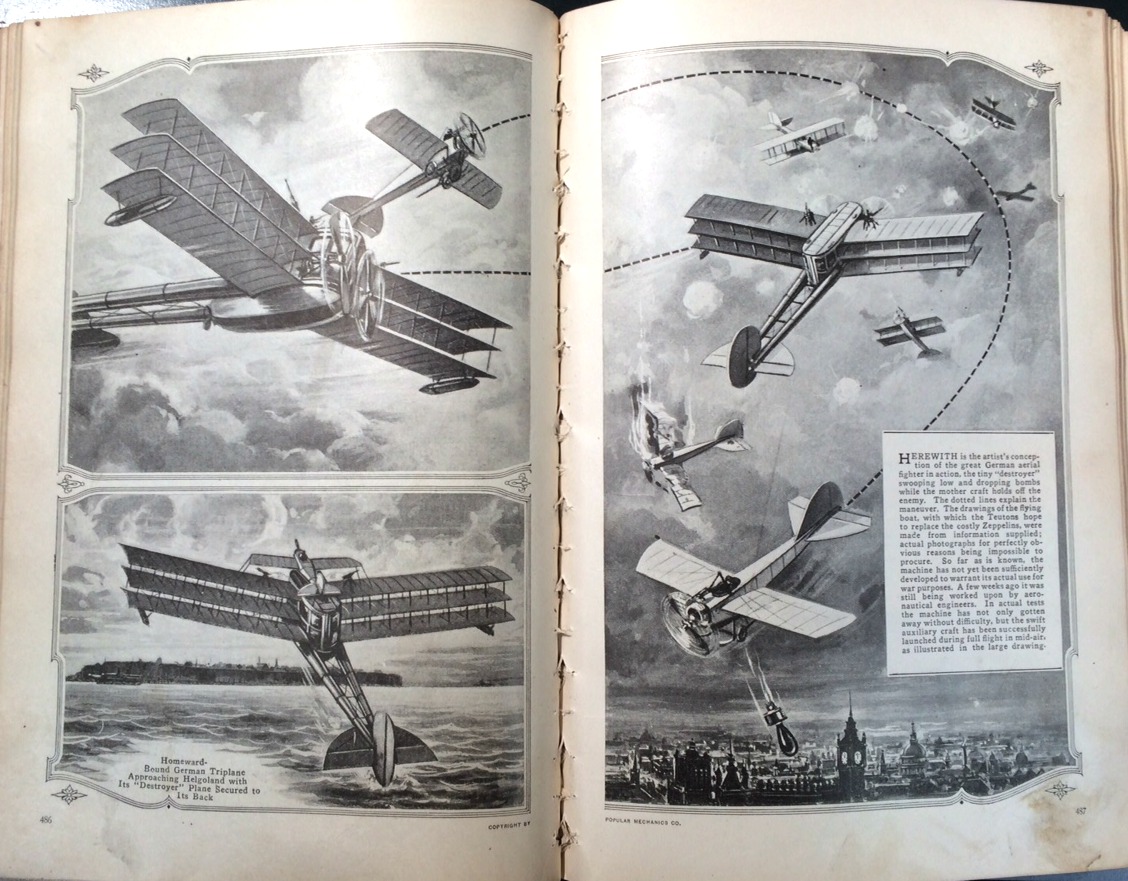
    There are two interesting and remarkable techno-military suggests in this October, 1916 issue of Popular Mechanics.  First is the cover story, a (“destroyer”) aircraft bomber is to be launched from a “battleship” aircraft for a one-two punch of carpet and strategic bombing. The large “mother ship” was to have a 143′ wingspan, making it a monster of a plane for the time. It would enough fuel and oil to keep it aloft for 48 hours, and also have a 1000-pound payload “of bombs”, and a crew of five, two of whom would be wingwalkers firing machine guns. And another plane. The smaller aircraft was “equipped with bomb-dropping devices” and was to be launched for a special raid and/or to ward off enemy attack planes. But the fly in the ointment, says the article, was getting the smaller aircraft back to the larger one–launching was no problem; landing was.  And I can see why.  

    Airplane piggyback 2

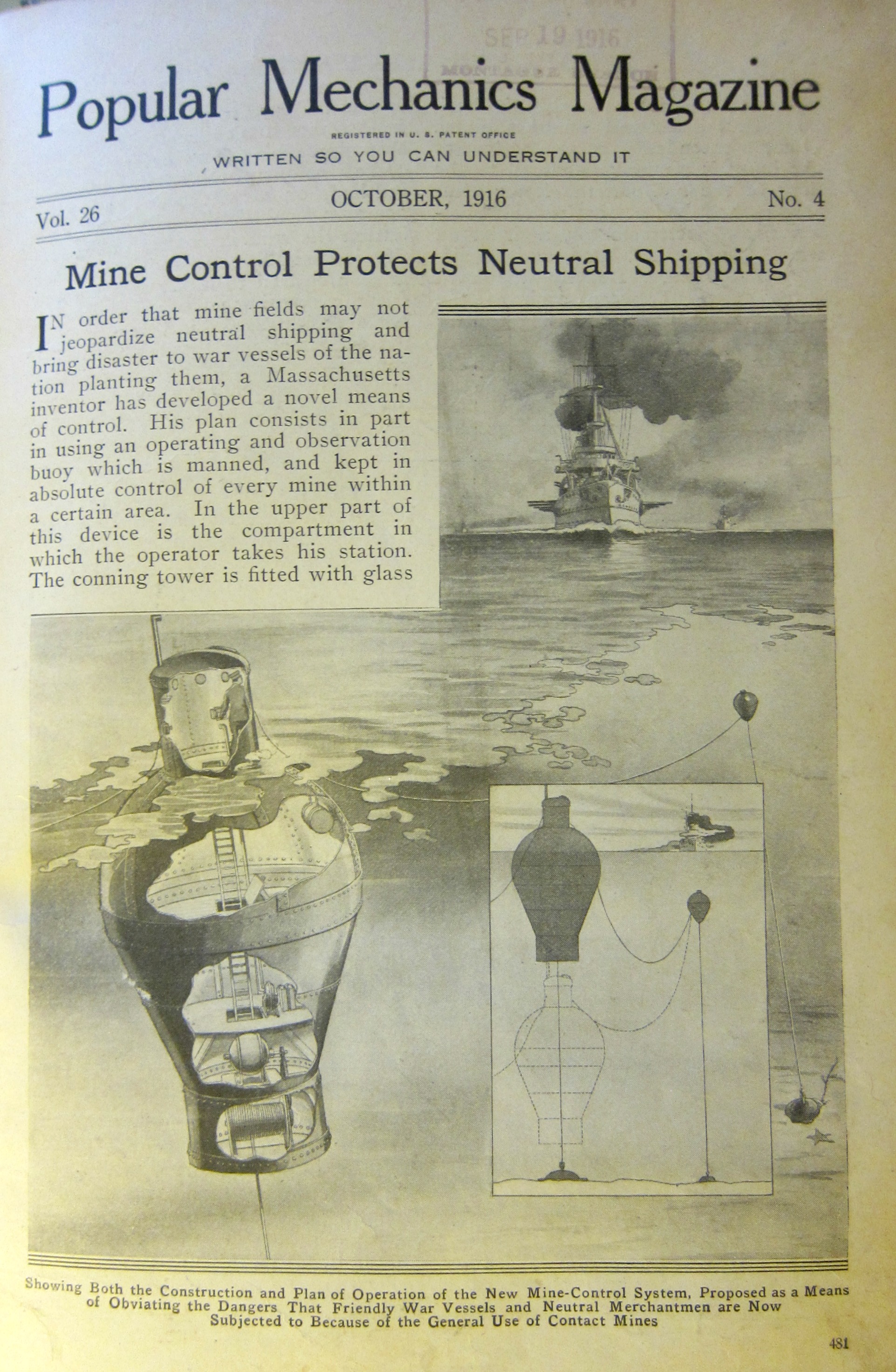
    The second article in the issue–the so-called underwater lighthouse (appearing under the far less amusing but much more informative title of “Mine Control Protects Neutral Shipping”)–was a defensive and offensive buoy-structure that would provide a very claustrophobically-unwantable job for someone. The buoy was made to control an undisclosed-number field of mines in/near shipping lanes and differentiate friendly from unfriendly ships.

    Popular MEchanics--buoy mine

    The buoy would have an observation area  from which our unlucky guardian would scan the seas; once a ship was spotted, the buoy would submerge to periscope depth, and after some time the nationality of the ship would be identified; at that point if an enemy ship is recognized the operator could submerge the buoy further (being anchored to the sea floor) via a winch to 50 or 60 feet beneath the surface, and then when the mine made contact (proximity or otherwise?) the buoy operator could detonate the mine. It was thought in this way that you could mine an area of sea and not have to worry about ships being damaged by friendly fire. The whole thing seems highly problematic to me–not the least of which would probably be a very jostling ride to the buoy operator. 

    And so two adventures in speculative military technology in one single war-time issue of Popular Mechanics.


  • Trees and Telephones, 1918

    JF Ptak Science Books  Quick Post

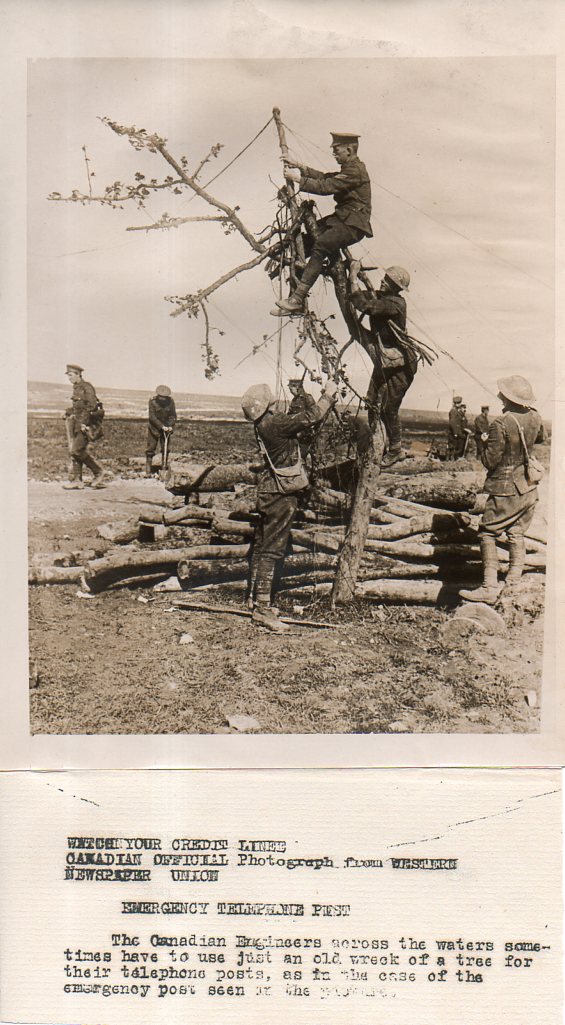
    During World War I battlefields that began as forests ended as plains.  And since telephonic communications depended upon wires, and since the wires needed to go somewhere, anything that survived that was head-and-shoulders above the ground was of particular use, especially to the telephone corps and especially for the use of telephone wires.  This news service photo (provided by the Western Newspaper Union) shows a rather desolate scene, with Canadian engineers working the wreck of a lone tree for all it was worth…as is plainly visible, there is nothing else like it in the near or remote vicinity.  

    WWI Photo Telegraph176

    It was the practice of the agencies providing these images for worldwide distribution to also include typed captions for the photographs.  

    The original of this photograph is available at the blog’s bookstore, here. 

    ·Posted by :

    ·in:


  • On The Flood, Comets, and a Recantation (1823-1831)

    JF Ptak Science Books   Post 2592

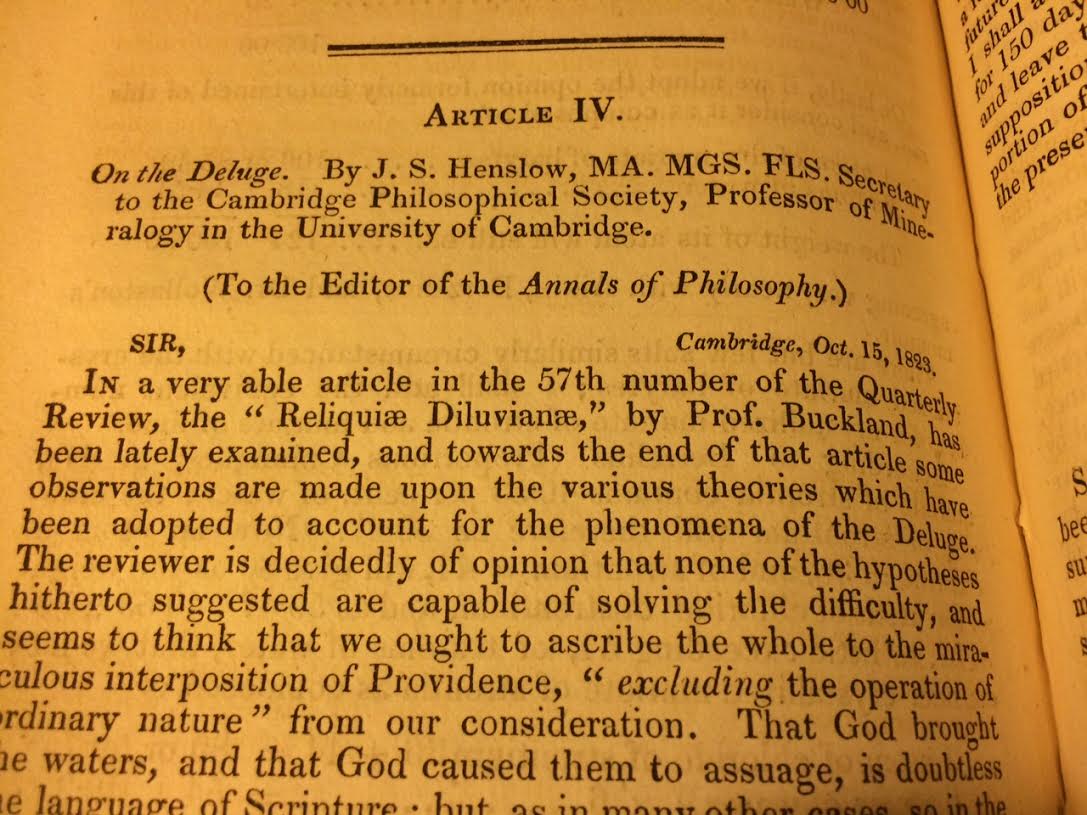
    I pulled a volume at random of the Annals of Philosophy from the shelves–it was volume VI (new series) from 1823. Trying to think of what might be a hot-button issue (in English) for that year, I started flipping through the pages, reading the page headers: Humboldt on volcanoes, Beaufoy’s astronomical observations, Mr. Moyle on the temperature of mines, Prevost on the blood, Pond on some astronomical topic, Ramond on the barometer, book reviews, scientific society announcements, and so on. Nothing really drew me in–until in the back, at page 344, this running header: “Prof. Henslow on the Deluge”. That was a “something” that I was looking-but-not-looking-for.  

    Flood

    This was a late-ish contribution to the history of the geology of the Great Flood, and in it, John Henslow (a great naturalist and botanist, 1796-1861) postulates that the flood was caused by the near-passing of a comet that disintegrated and contributed its enormous aequeous “nebulae” to the Earth’s atmosphere producing the Noachic flood.  He quickly sites a contemporary (one of many), William Buckland1, in this, who was one of the late leaders in the geological response to the flood, and who theorized a natural history of the flood and a production of an Ice Age.  The belief that there was some scientific basis in the divinely-induced flood was buoyed by the general flavor of the mythology of the flood, which turns up in more than 100 cultures–so part of the Noahic flood argument as being true is the broad cultural base for it. Commonality across cultures like this doesn’t necessarily make something real–there are many many parallels between the Bible and other sacred books besides this, like for example the savior descending into Hell for three days before resurrection, and that in stories that precede the New Testament. So common story bases make them popular, though not necessarily correct.

    So Henslow thinks about the comet in a long tradition of Genesis geology, like Buffon and his comet. But what is more interesting to me in this issue is another contemporary, Reverend Adam Sedgwick, Woodwardian Professor of Geology at Cambridge University, who at the end of several decades in theorizing on catastrophic flood geology decided that he had taken a wrong turn.  What happened then, in 1831, was a remarkable refutation of his earlier work. It was an enormous thing, a statement of real courage and conviction to the scientific process.  


  • Striking Anti-Nazi Work on the Subjugation of Women, 1931

    JF Ptak Science Books  Quick Post

    German design frau in reich031

    Wilhelm Hoegner was an early and influential opponent of Adolf Hitler and the NSDAP–a very early opponent, having been involved in the investigation of Hitler’s Beer Hall Putsch in 1923.  He maintained his strong opposition as a member of the Reichstag from 1930-1933; after the elections and after Hitler consolidated his power in 1933, Hoegner’s position became “untenable” in Germany and he left for Austria, and by 1934 he was situated as a journalist in Switzerland.  He played a prominent role in German postwar politics, and died in 1980. 

    Hoegner wrote Die Frau im Dritten Reich  in 1931 as a warning to all about the totalitarian possibilities of the Nazis, and in particular of the tyranny against women–the result is pretty much evident on the very striking cover of his pamphlet.


  • A Beautiful Instrument Displaying Sound on Paper

    JF Ptak Science Books   Quick Post

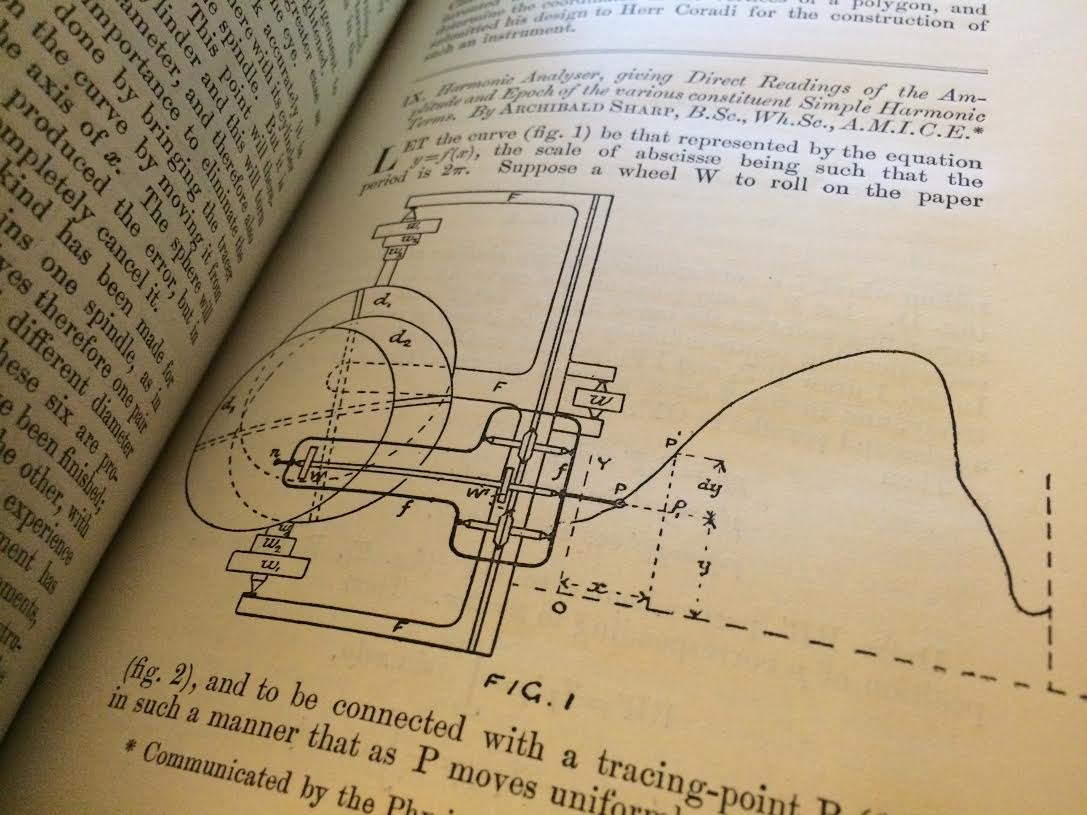
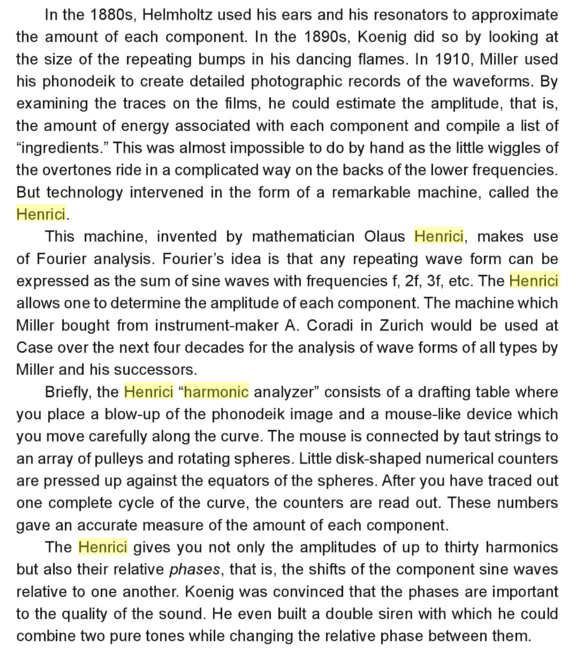
    Olaus Henrici (1840-1918) constructed a beautiful and tidy analog computer to analyze musical sound, publishing his efforts in The Philosophical Magazine in 1894.  It was a mechanical fourier analyzer, in the heritage of the harmonic analyzer/tide predicting computer of James Thomson and his brother Lord Kelvin, analyzing a traced sound waveform.  It was built upon in turn by Dayton Miller and much expanded.  

    Henrici b

    William Fickinger has this solid description in his book, [Dayton] Miller’s Waves: An Informal Scientific Biography, (2011) found on page 69: 

    Henrici

    A little more background on the harmonic analyzer and Henrici as follows:

    • Robert K. Otnes in The Oughtred Society, “Notes on Mechanical Fourier Analyzers” http://www.oughtred.org/jos/articles/V17.1_OtnesPaper.pdf  
    • Full text of the Henrici paper  from the Biodiversity Heritage Library http://biodiversitylibrary.org/item/122066#page/124/mode/1up
    • On Olaus Henrici https://en.wikipedia.org/wiki/Olaus_Henrici
    • http://www.phys.cwru.edu/ccpi/Harmonic_analyzer.html

    ·Posted by :

    ·in:


  • The Swastika as a Rising Sun–Linz, ca. 1935

    JF Ptak Science Books   Quick Post

    Judging from the cover art it is not necessarily clear what is going on with that swastika. But given the question in the title (“Can Austria Still Be Saved?”) and the publisher, the NSDAP’s Volkstimme (Linz) leaves little doubt that the swastika is a rising sun rather than setting.  I can’t find another title in the OCLC/WorldCat–which makes this piece of propaganda rare–and which means that I can’t date it precisely, though I would say it was printed prior to the annexation in 1938 (though the design definitely has an earlier touch to it…)  There is a mention of the Gauleitung der N.S.D.A.P. and the Hitlerbewegung located at Goethestrasse 7 in Linz–and since the Nazis were suppressed under Dollfuss from 1932-1934, which means this document may have been printed in the mid/late 1930’s.  

    German design salvation Austria032


  • A Bit on the History of the Future of Sucking–Vacuum Trains (1945)

     JF Ptak Science Books   Post 2590

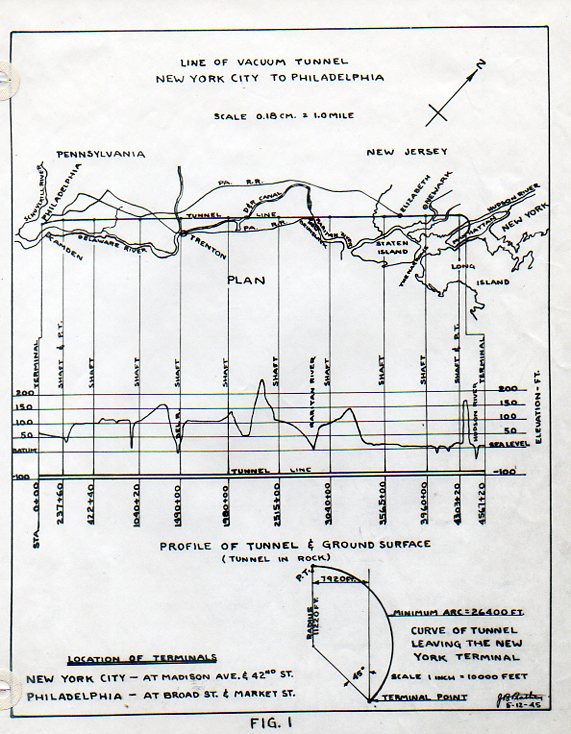
    John B. Prather launched an idea in 1945 for building a high-speed pneumatic passenger/freight train connecting New York City to Philadelphia.  His New York-Philadelphia Vacuum Tunnel, Preliminary Design Features and Economic Analysis was exceptionally hearty. The idea is interesting in a removed, lets-not-do-it-for real-way because, well, it just doesn’t seem to make sense in the long run, at least beyond the building of the thing to show that it could be done.  And I don’t doubt that could be the case–and I just don’t know why it was necessary. 
    Vacuum tunnel318

    [If you’d like to own the original report I’m offering for sale on my blog–there seems to be no others available, with no listings in WorldCat. If you’re interested see the listing follow this link or go to the general catalog and look up [TRAINS]  The Future of Sucking: Vacuum Express Train, NYC to Philly, 1945.]

    Mr. Prather’s approach seems to be the work of an engineer, or at least he had some help.  I doubt though that he had any help from a structural engineer or site geologist–his proposal was to build this tunnel 100′ down through bedrock when it could be found, a level hundred-feet  below the surface, from NYC to Philadelphia.   The tube would accommodate an aluminum-shelled  400′-long train that would be hauling 350 people and 175 tons of freight at speeds of 400-600+ mph, making the run between the two cities in about 20 minutes.  Not bad.  He figures too that all of the freight could be offloaded in 7.5 minutes.  This would make for  a very busy train, though Prather doesn’t tell us how many runs a day it would be making. This was all preliminary.

    The 16.2′-wide  tunnel would be 456,720 feet long, and would cost $173 million to excavate and $41 million to line with cement–according to the author.  The total cost for the ordeal would be about $334 million and would take 6 years, start to finish–that includes all of the tunneling, which would swallow/excavate/face 300′ per day. 

    I don’t see, really, how this could be so narrow a tunnel–I’m not an engineer but it would seem that wear, heat and the abuse and so on that a massive and dense 400′-long missile going 400+mph would require something that was more than 125% of the width of its trains. 

    There is however  precedence for a massive tunnel of something like this size being built in something like this time–the Delaware Aqueduct is 82 miles long and 13 feet wide, and was built during the Second World War (1939-1945) , so, perhaps if enough people and money were thrown at a project like the vacuum tunnel could actually be built (barring geological problems). 

    But it would all be worth it:  Prather suggests that the overall revenue from the operation of the train to be $196 million/year with $32 million in yearly operating expenses.  Which means that the whole thing could be paid for in three years or thereabouts.  So if the things was started in 1946, it would all be finished and paid for by 1956.

    I’ve looked at a number of proposals like this over the course of this blog–like almost filling up the Narrows between Staten Island and Manhattan with an airport and seaport, and making a series of transoceanic airports for flights between the continents, and dropping a gigantic shell filled with people from the top/interior of the Eiffel into a narrow hole filled with water, and covering Midtown Manhattan with a rooftop airport, and covering Midtown Manhattan with a glass-ish dome, and so on–and I know that it is good for at least one thing:  superb classroom discussion fodder of why something like this does or doesn’t make good physical/economic etc. sense.
  • “When Will We Have Television?”, 1937

    JF Ptak Science Books   Quick Post

    This is the delightful ABC of Television, published in 1937 by the sci-fi and early modern tech guru and visioneer Hugo Gernsback’s Short Wave & Television magazine–it is a separate publication in it own printed wrappers. The pamphlet includes technical basics (“fundamentals of scanning”, “mechanical systems”, “Cathode ray emission”, transmitter operation”) as well as some popular and necessary information, like “when will we have television” and a list of television stations.  (Just for the record, this publication lists 25 active stations, including low wattage stations like W2XAX, the Atlantic Broadcasting Company, in NYC at 50 Watts–there were 9 broadcasters with 150 Watts or less of the 25 listed. There’s also a list of nine other “discontinued” television stations (“experimental visual licenses and permits discontinued or expired”). The “Experimental Visual License: is a very nice turn-of-phrase.)

    Television abc477

     [If you’d like to own the original, see our books for sale section, here: https://historyofideasblog.com/books/]

    ·Posted by :

    ·in:


  • A Transatlantic Flying Wing/Boat, 1927

    JF Ptak Science Books  Quick Post

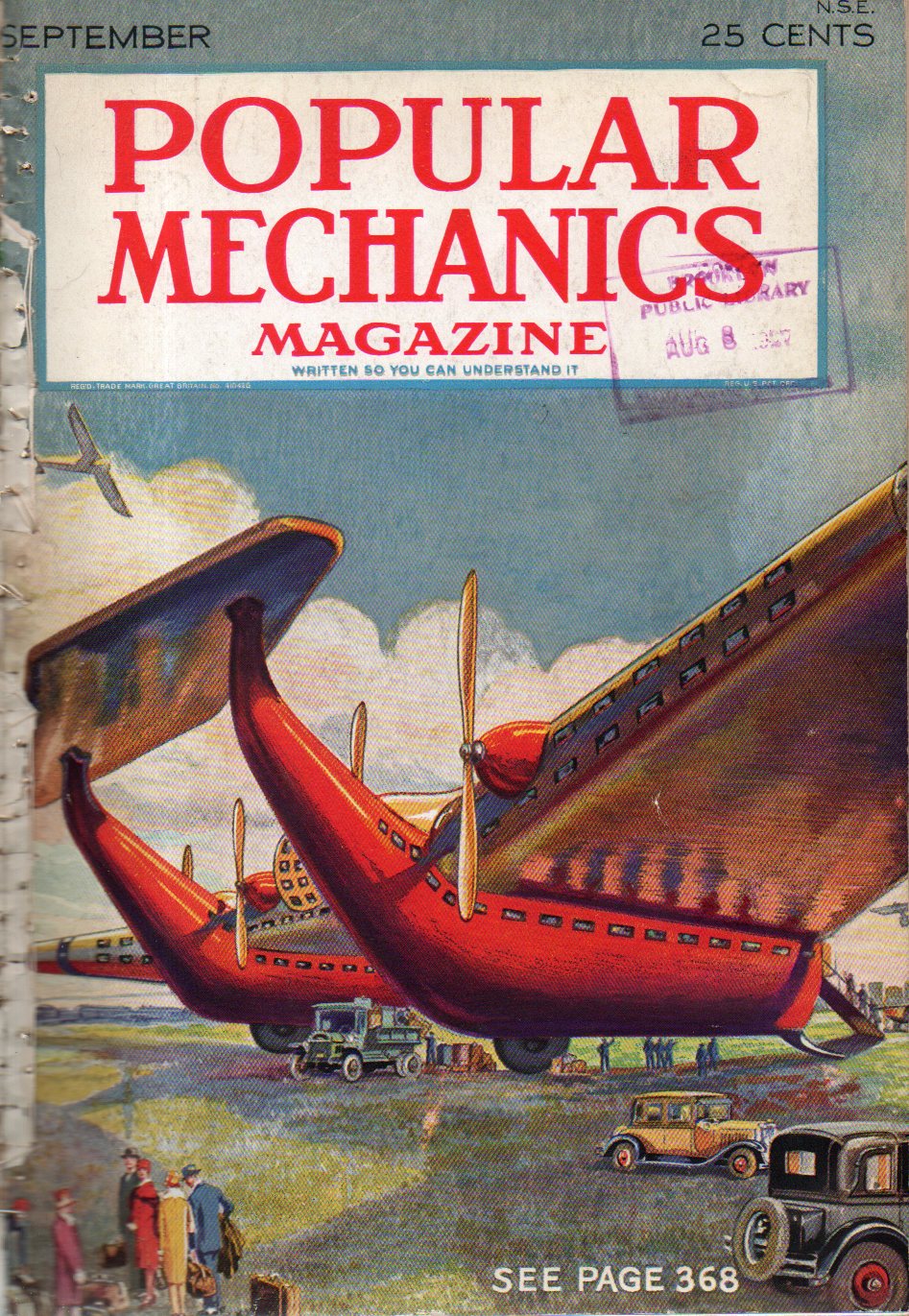
    The beautiful aircraft was being built primarily on high hopes and a sleepless night, but that’s okay. This was a vision for a transatlantic aircraft, and appeared int he September 1927 issue of Popular Mechanics, and was an interesting and in some ways remarkable insight to the coming prospects of long-distance passenger flight. The Wright flight was only 24 years before this, and the Lindbergh solo crossing of the Atlantic occurred just a few months prior to this publication, an event which no doubt added fire to the speculation of future transatlantic flights. The artist imagines a massive aircraft with a 400′ wingspan, the wings offering room enough for sleeping quarters for the passengers.  The Transatlatic flight was technically difficult, and outside of crossings by the Graf Zeppelin and the Hindenburg in the late 1920’s, passenger service really wasn’t instituted on any large scale until after WWII.  There were crossings by aircraft in the early 1930’s, but there (as with the famous flight by Dornier in the DO-X seaplane in 1931) the majority of those flights were over the ocean to South America, and then continued to North America. A notable exception is the Yankee Clipper. which was a luxury flight (carrying 74 and sleeping 36) and which was a massive aircraft, though the real plane’s wingspan was less than half (at 150′) of the visioneered aircraft below.  In any event, recognition is in order to the designer who thought about flight in this manner just 10 weeks1 after Charles Lindbergh made his NYC-Paris flight.

    Airplane flying wing029


    A newsreel of the parade held in Lindbergh’s honor in NYC on June 13, 1927 showing the enormous reception of the new world-wide hero:

    Notes:

    1. The September issue of Popular Mechanics would have been issued in early August (as we can see in the stamp on the cover, this issue being received by the Brooklyn Public Library August 8.