A Daily History of Holes, Dots, Lines, Science, History, Math, Physics, Art, the Unintentional Absurd, Architecture, Maps, Data Visualization, Blank and Missing Things, and so on. |1.6 million words, 7500 images, 4.9 million hits| Press & appearances in The Times, Le Figaro, Mensa, The Economist, The Guardian, Discovery News, Slate, Le Monde, Sci American Blogs, Le Pont, and many other places… 5000+ total posts since 2008.

Author: JF Ptak

  • A Transatlantic Flying Wing/Boat, 1927

    JF Ptak Science Books  Quick Post

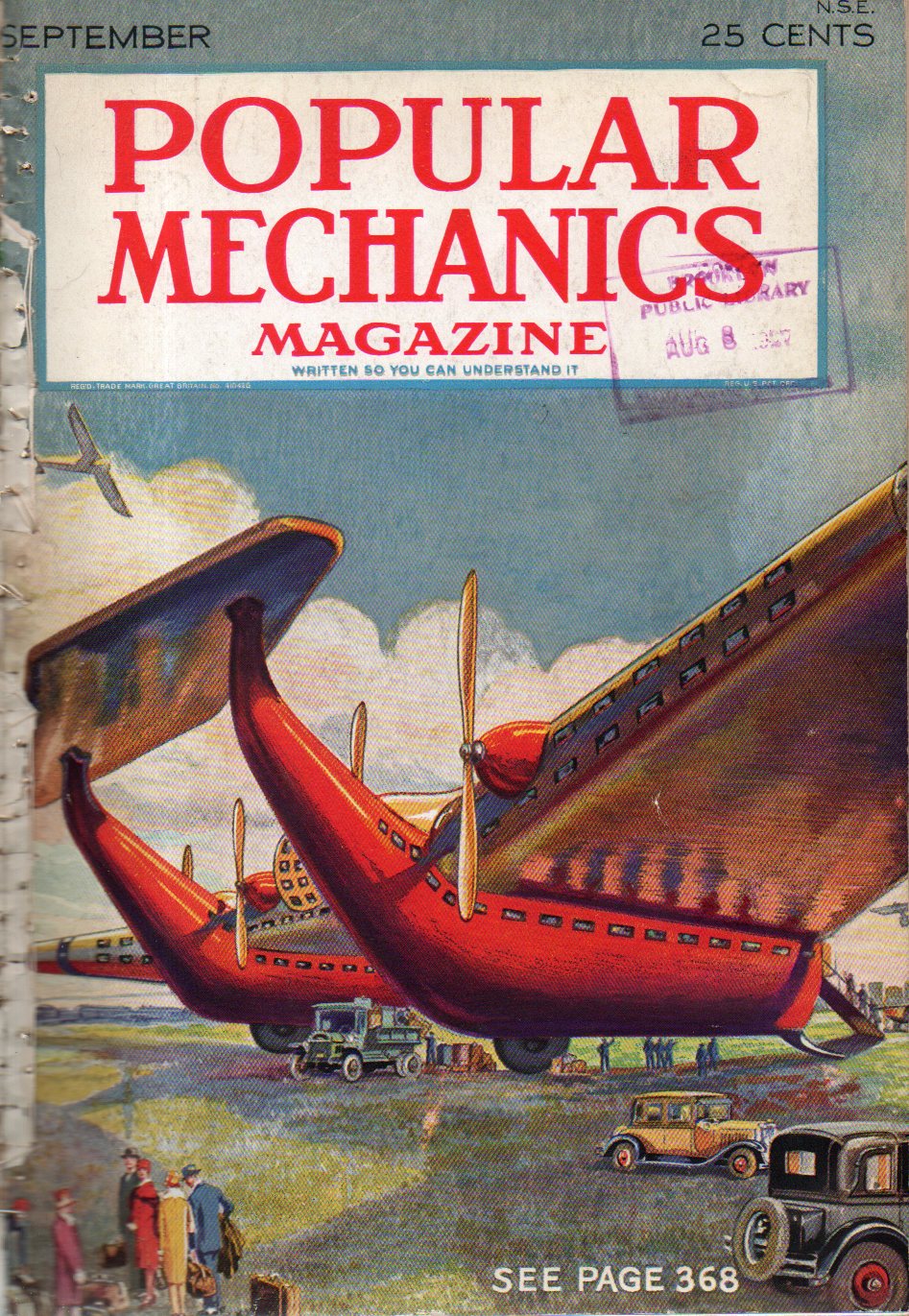
    The beautiful aircraft was being built primarily on high hopes and a sleepless night, but that’s okay. This was a vision for a transatlantic aircraft, and appeared int he September 1927 issue of Popular Mechanics, and was an interesting and in some ways remarkable insight to the coming prospects of long-distance passenger flight. The Wright flight was only 24 years before this, and the Lindbergh solo crossing of the Atlantic occurred just a few months prior to this publication, an event which no doubt added fire to the speculation of future transatlantic flights. The artist imagines a massive aircraft with a 400′ wingspan, the wings offering room enough for sleeping quarters for the passengers.  The Transatlatic flight was technically difficult, and outside of crossings by the Graf Zeppelin and the Hindenburg in the late 1920’s, passenger service really wasn’t instituted on any large scale until after WWII.  There were crossings by aircraft in the early 1930’s, but there (as with the famous flight by Dornier in the DO-X seaplane in 1931) the majority of those flights were over the ocean to South America, and then continued to North America. A notable exception is the Yankee Clipper. which was a luxury flight (carrying 74 and sleeping 36) and which was a massive aircraft, though the real plane’s wingspan was less than half (at 150′) of the visioneered aircraft below.  In any event, recognition is in order to the designer who thought about flight in this manner just 10 weeks1 after Charles Lindbergh made his NYC-Paris flight.

    Airplane flying wing029


    A newsreel of the parade held in Lindbergh’s honor in NYC on June 13, 1927 showing the enormous reception of the new world-wide hero:

    Notes:

    1. The September issue of Popular Mechanics would have been issued in early August (as we can see in the stamp on the cover, this issue being received by the Brooklyn Public Library August 8.


  • A Grisly Visit With a Contemporary Account of Jack the Ripper, October 1888

    JF Ptak Science Books  Quick Post

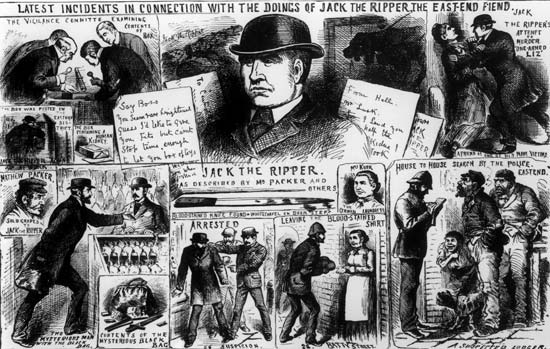
    “LATEST INCIDENTS IN CONNECTION WITH THE DOINGS OF JACK THE RIPPER THE EAST-END FIEND.”

    Ripper online

    [Image source via Victorian Contexts: http://victoriancontexts.pbworks.com/w/page/47425374/The%20Whitechapel%20murders]

    I am pretty certain that I haven’t made a single post (of 4,500 or so) on an odious/horrendous matter for the sake of it odiousness–excepting, I think, this post on Jack the Ripper. I won’t bother with the history of the madman as I am sure everyone is well acquainted with pieces of it.  I bumped into it using a new online find, a paywall site, which is very useful for on-the-spot usage though not so when it comes to reproducing one of its images–so, I needed to find a friendly place to share the image from and found one in Victorian Contexts (see link above). The first magazine to pop up in this new browse was The Illustrated Police News  (London, England), and the first thing I searched for was The Ripper, and so came this issue for Saturday, October 27, 1888; Issue 1289. It just so happens that this issue dealt mainly with the infamous Lusk Kidney, which was a human kidney evidently sent by Jack to the home of  George Akin Lusk, (“a builder who resided at 1 Alderney Road, Mile End. Since his appointment as head of the Whitechapel (or Mile End) Vigilance Committee”1), and which was a cause of enormous excitement. In the fine tradition of other illustrated newspapers/journals, The Police News told much of hte highlights of the story in pictures, right on the front page. Perhaps this was to entice people into buying the paper, and perhaps it was a very elementary entry point for part of the readership that had limited reading ability–I don’t know. But the front page is certainly sensational, whatever the  motivation. 

    The contents of the letter accompanying the mailed box of the human kidney:

    ·Posted by :

    ·in:


  • The Pistol in Air-to-Air Combat (1914)

    JF Ptak Science Books  Post 2588

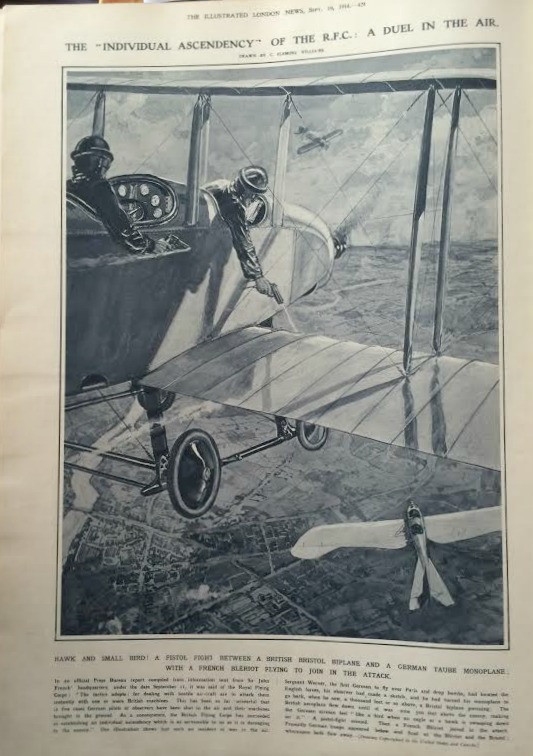
    Air combat 1914The news of the Wright Brothers and their historic powered flight in December 1903 was a monumental deal, though the report of the success was buried in middle of the Scientific American issue that first covered it.  Eleven years later heavier-than-air powered aircraft went from being from non-existent but with potential/possibility to machines used in war.  It took eight years from the Wright plane for an aircraft to be used in combat dropping bombs on people, a role that would of course be exploded beyond all recognition just a few years later. During the first few months of WWI aircraft were used but mostly for surveillance and mapping–aerial combat existed, sort of, though without any firepower. The first air victories were results of aircraft ramming one another (the first seems to have been August 25, 1914), while the first instance of one plane shooting down another didn’t occur until the war was in its second month, a French plane shooting down a German aircraft with a machine gun and a rifle.1

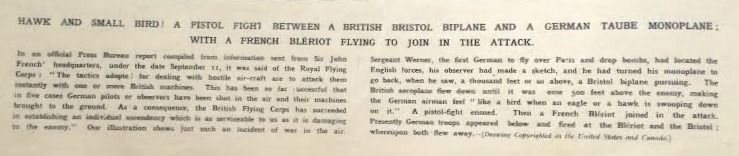
    These notes are simple background for the image that I found in The Illustrated London News (September 19, 1914)  showing aerial combat between a British Bristol and a German Taube.  What is striking of course is that the Royal Flying Corps aircraft was attacking with the co-pilot firing a pistol at the German plane–a little unexpected. The description of the image identifies the pilot of the German aircraft (“Sergeant Werner, the first German to fly over Paris and drop bombs”) and that he had been on a reconnaissance flight mapping allied positions–how that information was known I do not know.  In any event the British aircraft pursued the German and nearly had it within rights–that is until German soldiers on the ground returned fire on the British aircraft, forcing it to retire.  

    Air combat 1914 b

    Luckily I own the war years for the ILN and I do believe that this was the first image in that journal showing air-to-air combat. The ILN does have earlier images showing the first bombing raids from aircraft and also of air-to-ground machine gun attacks, but at this point this may be the first of its kind. It all seems very removed–quaint,even–given how quickly things developed over the next year.  

    Notes

    1. “On October 5, 1914, Sergeant Joseph Frantz and Corporal Louis Quénault of Escadrille VB24 scored the first air-to-air kill (not involving ramming – see Pyotr Nesterov) of the war, shooting down a German Aviatik B.II with machine gun fire. Quénault fired two 48-round magazines at the Germans. The Germans returned fire with rifles. When the Frenchman’s 8 mm Hotchkiss M1909 machine gun jammed, he successfully returned fire with his rifle. Oberleutnant Fritz von Zangen and Sergeant Wilhelm Schlichting of FFA 18 fell to their deaths. This is believed to be the first air-to-air kill in any war.”–a good Wikipedia contribution on the Voisin III, here: https://en.wikipedia.org/wiki/Voisin_III

  • An “Air Garage” Airport Skyscraper, 1927

    JF Ptak Science Books  Quick Post

    Air garage028


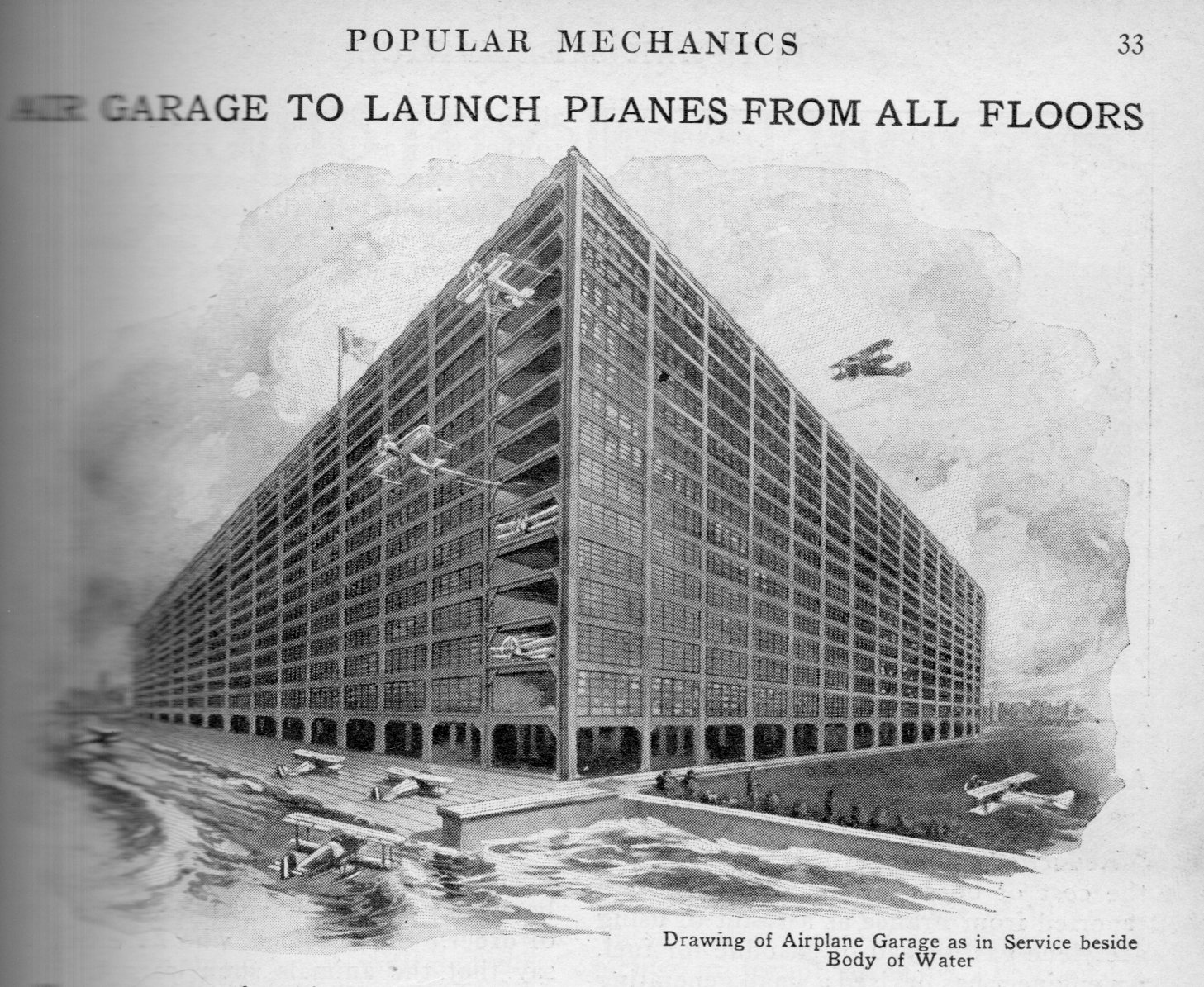
    There were a number of interesting/unusual/bizarro ideas for air travel int he heady aeroplane decade of the 1920’s (search for “airport” in the google search box at right to find some of this blog’s posts on the subject). This one appeared in Popular Mechanics for July, 1927–a 14-story “Air Garage” that would serve to launch 14 planes from its 14 floors, times four, I guess.  I reckon that the interior of each floor would function like a garage/taxi/pre-flight area, and the planes would use the areas closest to the exterior of the structure as a runway. No doubt the writer was envisioning the need for this as the popularity of the airplane was, well, soaring, and the vision may have inched the airplane close to the ubiquity of the Model A.  I commend the writer for thinking Big.  


  • An Interesting Design for an Optics Advertisement, 1918

    JF Ptak Science Books   Quick Post

    Josef Rodenstock (1846-1932) started his company, “G. Rodenstock” in 1879, manufacturing and selling mathematical, physical, and optical instruments–it survives to this day. This advertisement for the optics branch of the company appeared in the July 1, 1918 issue of Illustrirte Zeitung (Leipzig)–it is rather small in the original, but very effective; I couldn’t pass it  by without sharing. 

    German eyeglasses


  • Jane Austen and the Evasion of Submarines

    JF Ptak Science Books  Quick Post

     “The little zigzags of embarrassment.”– J. Austen Emma I. xv. 282, 1816

    Zig zag027

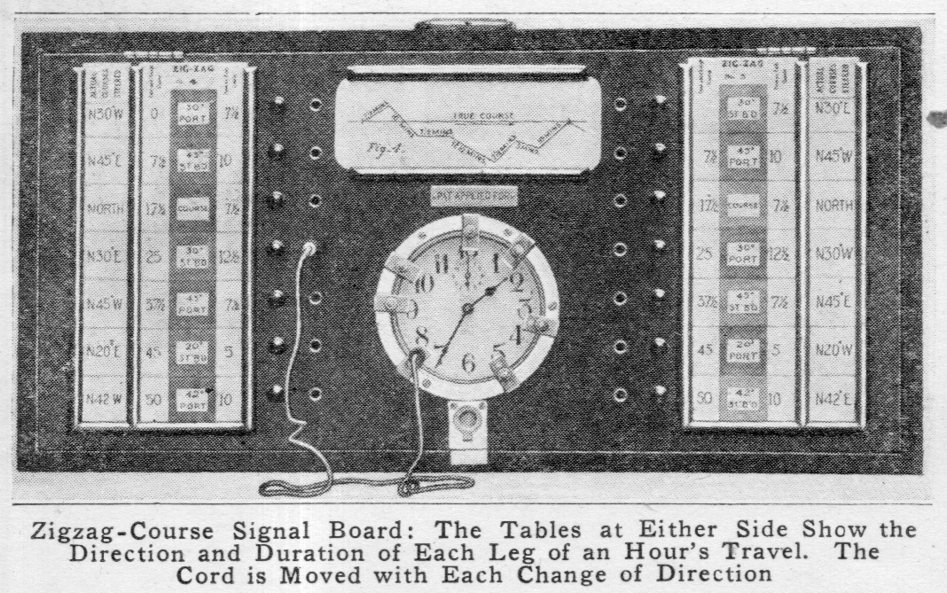
    Well, these be not zigzags of embarrassment, but zigzags of necessity, and the means for keeping track of them.  And too there’s nothing in Jane Austen to relate to submarines and their evasion except for an appearance of the word “zigzag”, which is actually a fairly old word in English (coming from the French “sigsak”), reaching down into the very early 18th century.  It is older than the word “submarine” as it is used to describe an underwater vessel, and curiously in light of Ms. Austen it appears in print very close to the date of Emma, in 18281. And so the course of a ship could be documented for those in control of her, keeping track of the true destination in spite of all the zigs and zgas made to confuse and elude a German sub.  This is another example of an empire controlled with string, as we have previously seen here in the use of long collections of string that kept track of the British rail. String isn’t as simple as it seems.  

    • This short article appeared in Popular Mechanics, March, 1918, page 484. 

  • Neo-Proto-Absurdist Art (?) in “Nature”, 1874

    JF Ptak Science Books   Quick Post

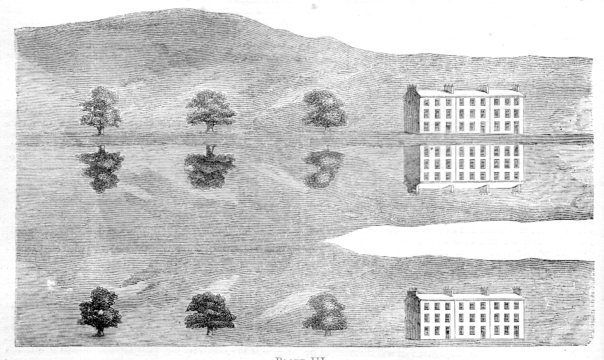
    Mirage025

    I found this delightful article while browsing volume 11 of Nature (1874)–J.D. Everett’s On Mirage. It actually appears in parts over two issues (November 19 and 26) and I’ve got to admit that I was attracted to it from the illustrations–the wood engraving appearing in the concluding part having neo-proto-Absurdist qualities six decades before that would become recognized as an art form.  I’ve included the image below from my copy as it is very sharp and crisp–I’ve also included links for the texts from the University of Wisconsin (though their scans of the images are not quite so fresh as the one below).  

    [Everett (1831-1904) was a distinguished physicist and is perhaps best remembered for his translation of a wonderful textbook by Augustin Privat-Deschanel, Elementary Treatise on Natural Philosophy: Physics (1882), a book I’ve found useful over time (along with Ganot’s Physics) for identifying period scientific instruments as both books are absolutely filled with images.]


  • A Rare Document on the Jinan Massacre, May 1928

    JF Ptak Science Books   Quick Post

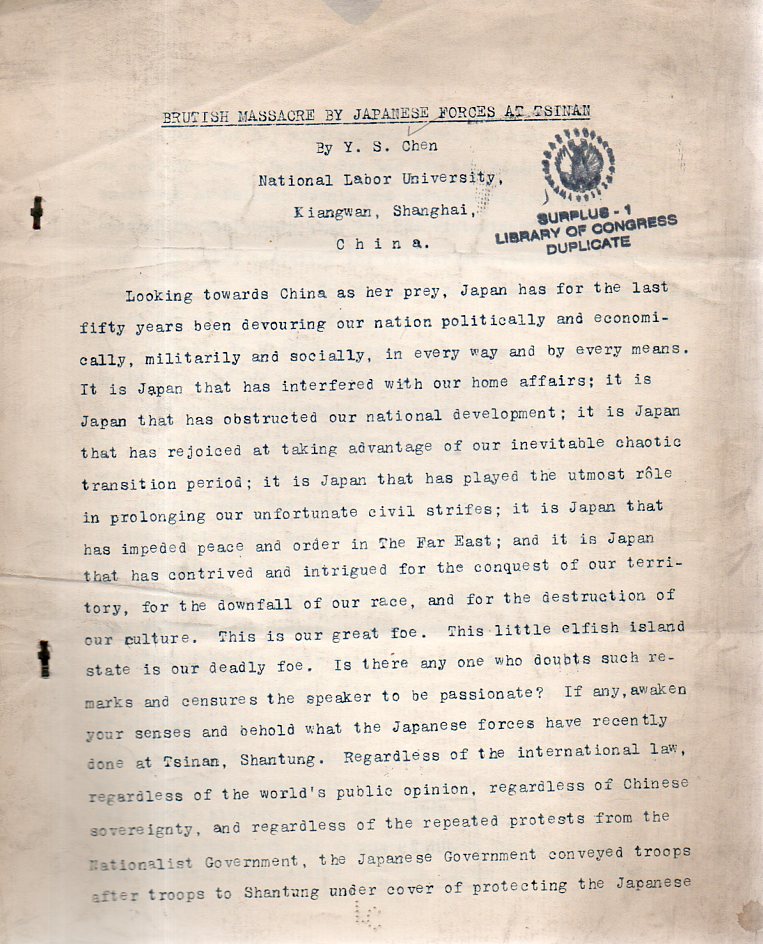
    I just located a rare and emotional document on the Japanese massacre of Chinese soldiers and civilians at Jinan (“Tsinan”), Shandong (“Shantung”), China. It forms part of the long pre-Sino-Japanese War (of 1937-1945), and though it is often described as an “incident” it was far more than that, as more than 6,000 soldiers of the National Revolutionary Army of China and civilians were killed, with many thousands more wounded, done in by the Imperial Army of Japan, which suffered only 200 casualties (most of these being wounded).

    I’ve scanned as much of this document as I could without damaging the pamphlet and reproduced those three pages below–it isn’t quite half of the document, but it does give the main thrust of it, and certainly displays the writer’s outrage and frustration.  Brutish Massacre by Japanese Forces at Tsinan was written by Y.S. Chen of the National Labor University, Kiangwan, Shanghai, China, and was printed from typed sheets via an offset process of some sort and published not later than June 28, 1928.  My copy is deaccessioned from the Library of Congress, where the documents division received it on June 28, 1928, which means it was probably printed within weeks of the massacre. There is only one copy of this document located in WorldCat (at Northwestern University), and there are no hits on the title in various online searches.  

    CHina Jinan Massacre022

    ·Posted by :

    ·in:


  • In the Fool’s Cap, a Map

    JF Ptak Science Books  Quick Post

    Jester020

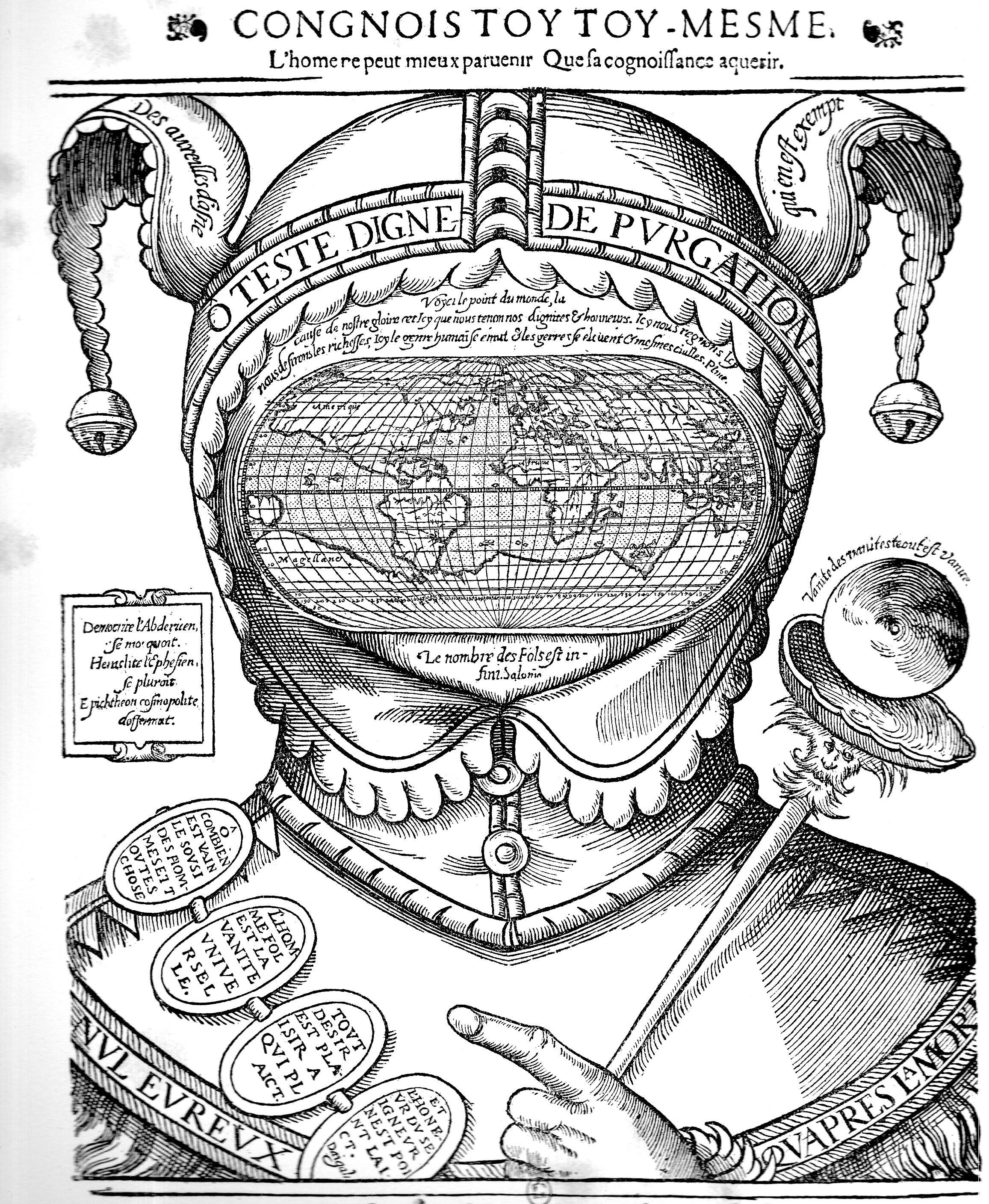
    I’ve known about this famous map/curiosity by Jean de Gourmont (ca. 1570) for some time, though I never seem to meet it out there in the world very often. Yesterday though I discovered that there was a fine 19th century reproduction of it in the studio, and so I thought I had a closer look now that I had a good copy in my hands.  

    And then when I looked the map up I found a number of good descriptions of it that pretty much took care of its description and interpretation. The baseline description is that it is mostly an allegory on the pursuit of knowledge, and of knowing, and thinking about the nature of knowledge–my read is that in the end, only a fool would think that the more they knew the less there was to know.  The famous Ortelius map (“Typus Orbis Terrarum”) in the face of the jester could represent a gridwork of what we think we know, though across the top of the image is the dictum from Socrates, “Know Thyself” (“Congnois toy [‘toi’] toy-meme”), which prepares us for what might be the dry hole in our soul if we spend too much time in the pursuit of knowledge of the world.

    One of the most interesting reads on this image can be found in  Literature, Mapping, and the Politics of Space in Early Modern Britain, by Andrew Gordon, Bernhard Klein, where the authors discus the mind-as-a-map, and bring into play a great passage from the immortal great-book-that-is-semi-unreadable Anatomy of Melancholy, by Robert Burton. They refer to the great map set in the motley, order set against “the spirit of disorder” and “the enemy of boundaries”, with Burton declaring on the essence of folly.


  • Seeing Mathematics as it “Happens”

    JF Ptak Science Books  (an earlier post from 2008 expanded and corrected  somewhat) 

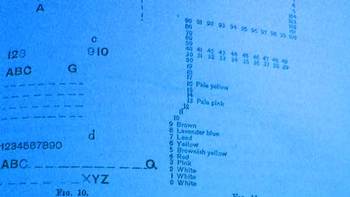
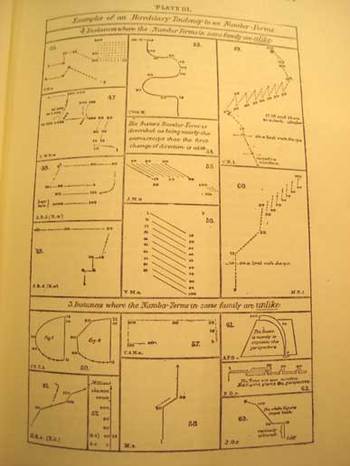
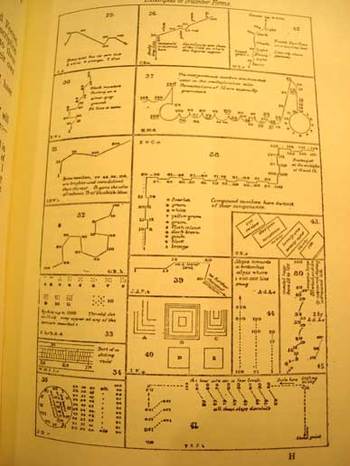
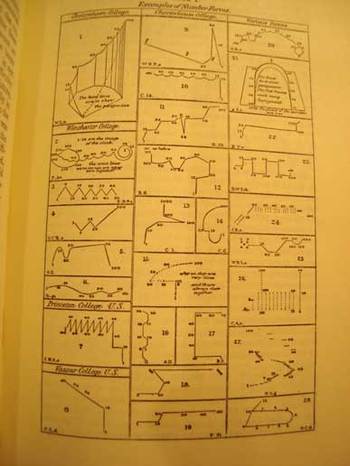
    I wanted to return and add a bit to an earlier notice concerning a series of drawings that I found utterly fascinating—what seems to be among the earliest illustrations of the active formation representing visualized human thought.  (I know that this titling is ungainly, but it seems to be the least inelegant solutions to stating the idea of what the images represent.)  In 1873 Miss H. R. Hudson wrote an article1 on her visualization of numbers–and later and more famously Sir Francis Galton approached this same issue first in an article in Nature2 that included a number of fascinating presentations of the “suspended” numbers.  Working further through this thesis he greatly expanded it, resulting  in a 26-page chapter called “Number-Forms” in his book Inquiries into Human Faculties and its Development 3(1883, with a second edition appearing in 1909).  Galton includes another 71 images of visualizing arithmetic, plus others on general images of mental images of numbers and letters—there is also a small but beautiful section on associations between colors and numbers and letters.  (These are all depicted in the first four images on this page.)
    Bloggalton1

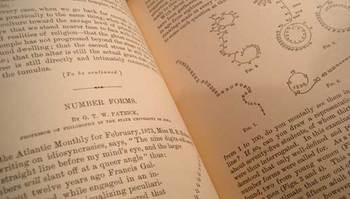
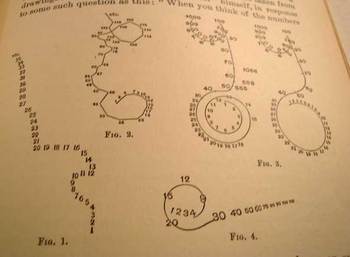
    G.T.W. Patrick (a professor of philosophy at the state university of Iowa) published one of the earliest papers in response to Galton’s work.  In “Number-forms”4, published in the Popular Science Monthly in 1893, Patrick addresses and expands Galton’s work somewhat, including another eighteen wonderful illustrations of similar images.

    But the path back to Galton is not quite a straight one.  Galton was initially concerned with imaging of numbers and numbers forms while people were performing mental calculations.  Patrick on the other hand asked his subjects if they had associative images in their mind of numbers—formally, he asked them if the number series of 1-9 presented itself in a visual, representative way in their minds.  In the second and third parts of his three-part inquiry, he asked the same question about letters and the alphabet, and then, thirdly, if they perceived any sense of color from letters and numbers, and what then what those exact relationships were.
    Bloggalton2_4

    It is interesting that in the studies of Galton and Patrick that over time in each of the subjects tested that (in Galton’s words) the images were “absolutely unchangeable except for a gradual development of complexity”.  Since I (like Galton, which is probably the only time I will ever be able to associate myself with this man
    in terms of familiar traits) have no such images in my head when I think about mathematics or numbers or letter or words in general, it is remarkable to me on the human scale that people who have these associations would have the same ones time after time.  A movable feast, as it were.  Of course it would make sense that this reference system would be constant—but for someone that doesn’t ‘see” these images at all, the fact that they are so flowing and lucid and unchanging is simply difficult for me to imagine. (In a few weeks I’ll return to this issue, looking at how some prodigiously gifted people “see” with their special attributes.)
    Bloggalton3_2

    Images below are from the Patrick paper:
    Bloggalton5

    Bloggalton6


    Bloggalton4blue

    Notes:

    1. “The nine digits will ascend in a straight line before my mind’s eye, and the larger numbers will slant off at a queer angle”, Atlantic Monthly for February, 1873.
    2. Nature, January 15, 1880. Follow the first link to a full reprint of the paper and a short article on it that appeared in this blog. 
    3.  Full text of Galton’s work appears at Gutenberg: http://www.gutenberg.org/files/11562/11562-h/11562-h.htm#1noshow
    4.  Popular Science Monthly,  February 1893 (pp 504-515). Full text of the article by Patrick  here: https://en.wikisource.org/wiki/Popular_Science_Monthly/Volume_42/February_1893/Number_Forms  I should also note that Patrick wrote a very early paper on the psychology of football in 1903, full article here: https://archive.org/stream/jstor-1412309/1412309_djvu.txt