A Daily History of Holes, Dots, Lines, Science, History, Math, Physics, Art, the Unintentional Absurd, Architecture, Maps, Data Visualization, Blank and Missing Things, and so on. |1.6 million words, 7500 images, 4.9 million hits| Press & appearances in The Times, Le Figaro, Mensa, The Economist, The Guardian, Discovery News, Slate, Le Monde, Sci American Blogs, Le Pont, and many other places… 5000+ total posts since 2008.

Author: JF Ptak

  • Unbuilt New York City, 1935–Almost-Closing the NYC Harbor


    JF Ptak Science Books 

    Liberty Landing _1_602

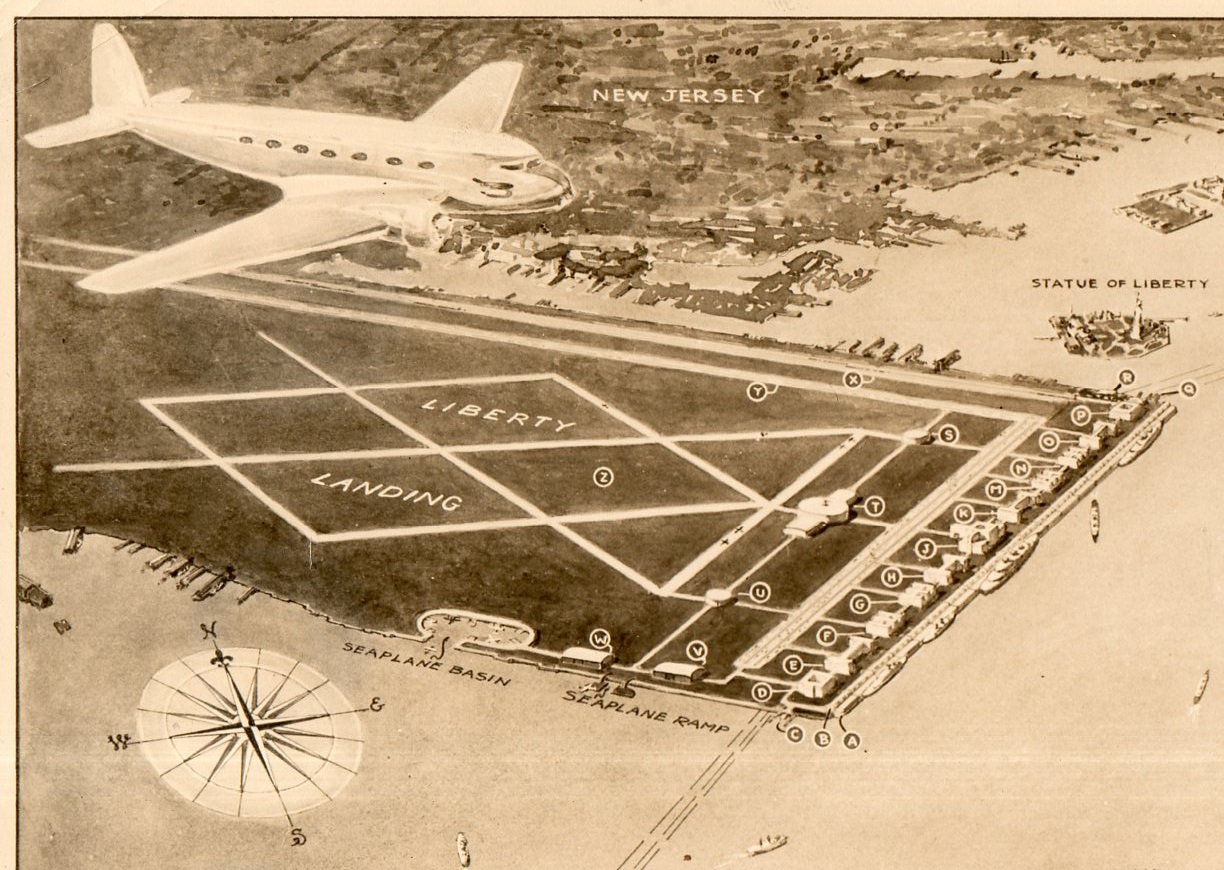
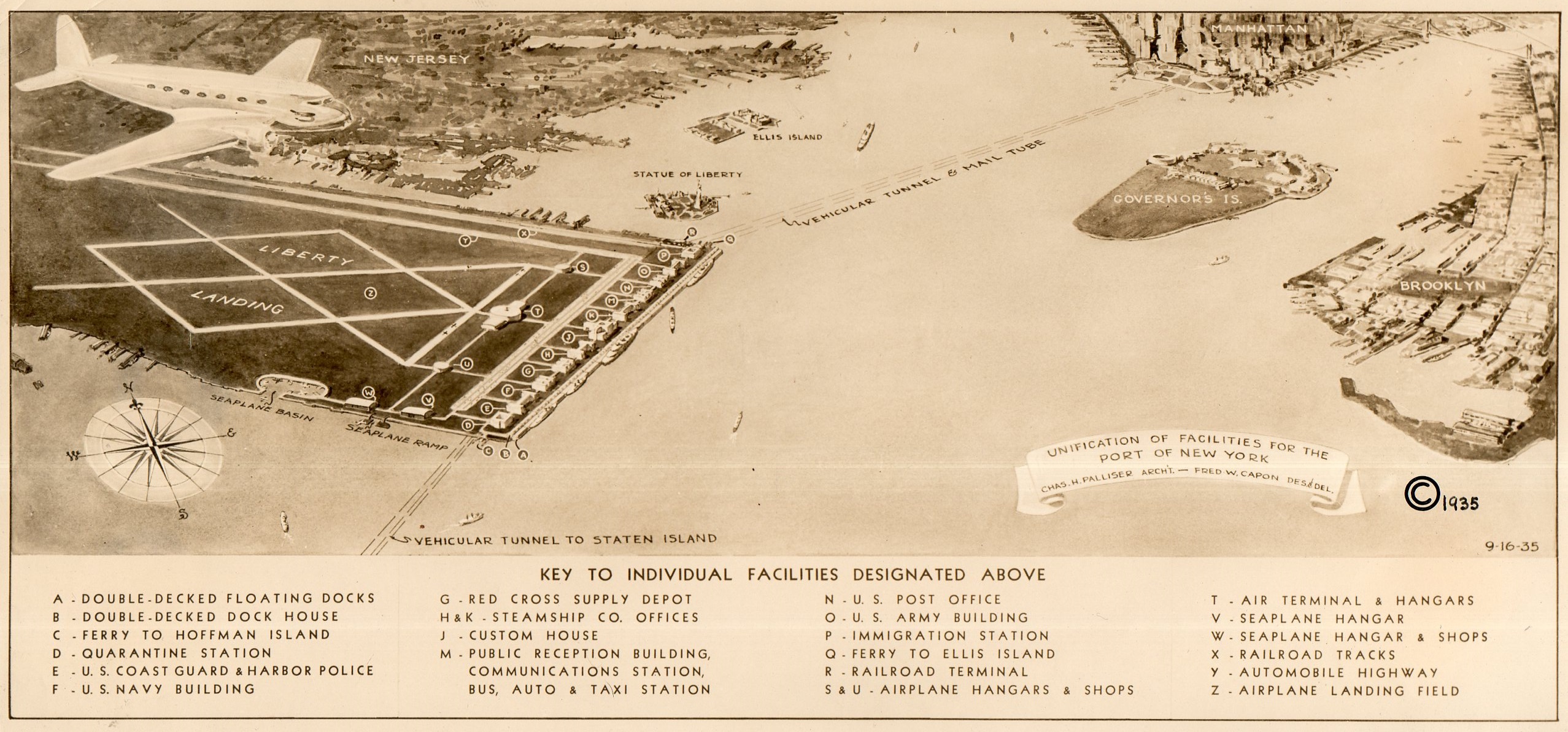
    I recently uncovered an interesting, unpublished and probably not-acceptable engineering report to extend the ports capacity in the Hudson River at New York City–the ports of the  area being famously over-busy for a long period of time, especially right before World War II.  Charles Palliser and Frederick W. Capon presented a proposal in 1935 for a unification of the port and airport facilities to take care of the overcrowding and overworked problem.


    Liberty Landing _2_603

    What they came up with was Liberty Landing, a mile-long and half-mile-wide facility that nearly bumped into the Statue of Liberty (and hence its name).  The plan called for backfilling the “flats” that were just south of Jersey City, as “the natural formation of these were very favorable”, which meant that the airport-port combo would extend all the way into the harbor to the edge of the channel, which would put it further out than the Statue of Liberty, which would also be just hundreds of feet away from the end of the north runway.

    Also attached to the backfill and new land would be a one-mile-long floating dock.  Oh my!

    The floating island would also have vehicular tunnels that connected it to Staten Island and the Battery.  There were facilities for seaplanes, airplanes, railroads, dirrigbles, and trucks, plus a military installation, a custom’s house and the US Mail Service, so that all commerce would converge at this one point, which sounds interesting (for about 20 seconds). 

    Dsc04773

    This is a good candidate for the “Better Left Undone” award for 1935.

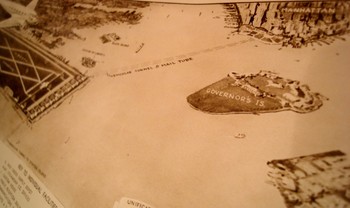
    As I look at the photograph of the aerial view of the plan it strikes me that if the designers increased the surface area by only 125% or so they could’ve connected the new facility with Governor’s Island AND Brooklyn, building a land bridge from Jersey City to Coney Island—a superbly bad idea to cap an already strongly bad idea. 

    The report is called, simply, Liberty Landing, and published by the architect in Jackson Heights, NYC, 16 Septmeber 1935.  This is also the U.S. Copyright Deposit copy (accepted 10 October 1935), which is where the history of this project ends.

    ·Posted by :

    ·in:


  • A Map of Television to Come, with a Price Tag (1946)

    JF Ptak Science Books  Quick Post

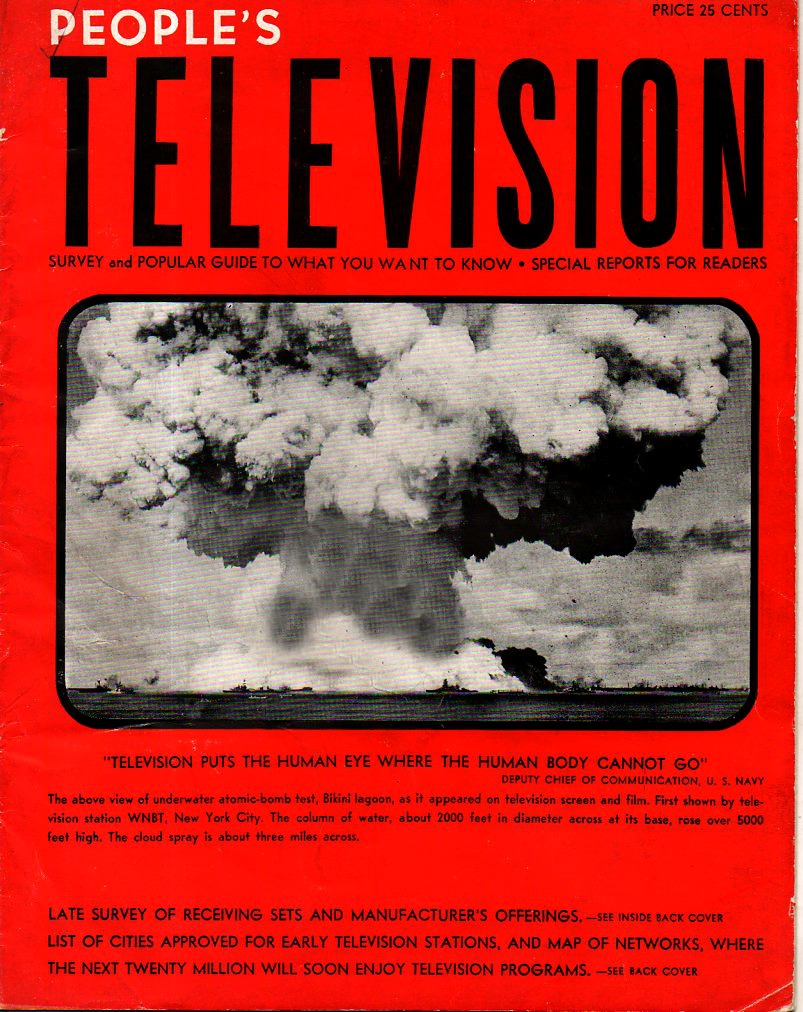
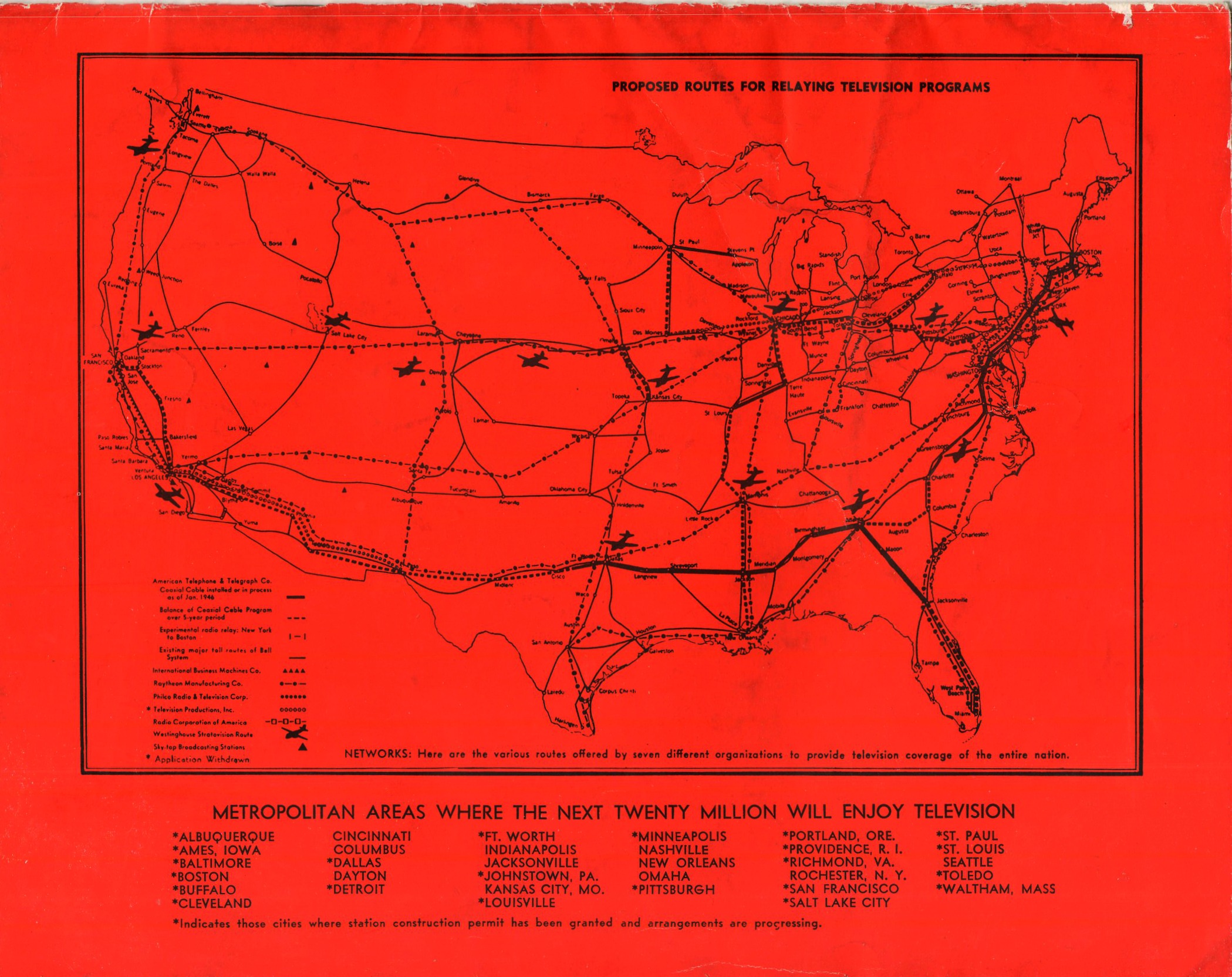
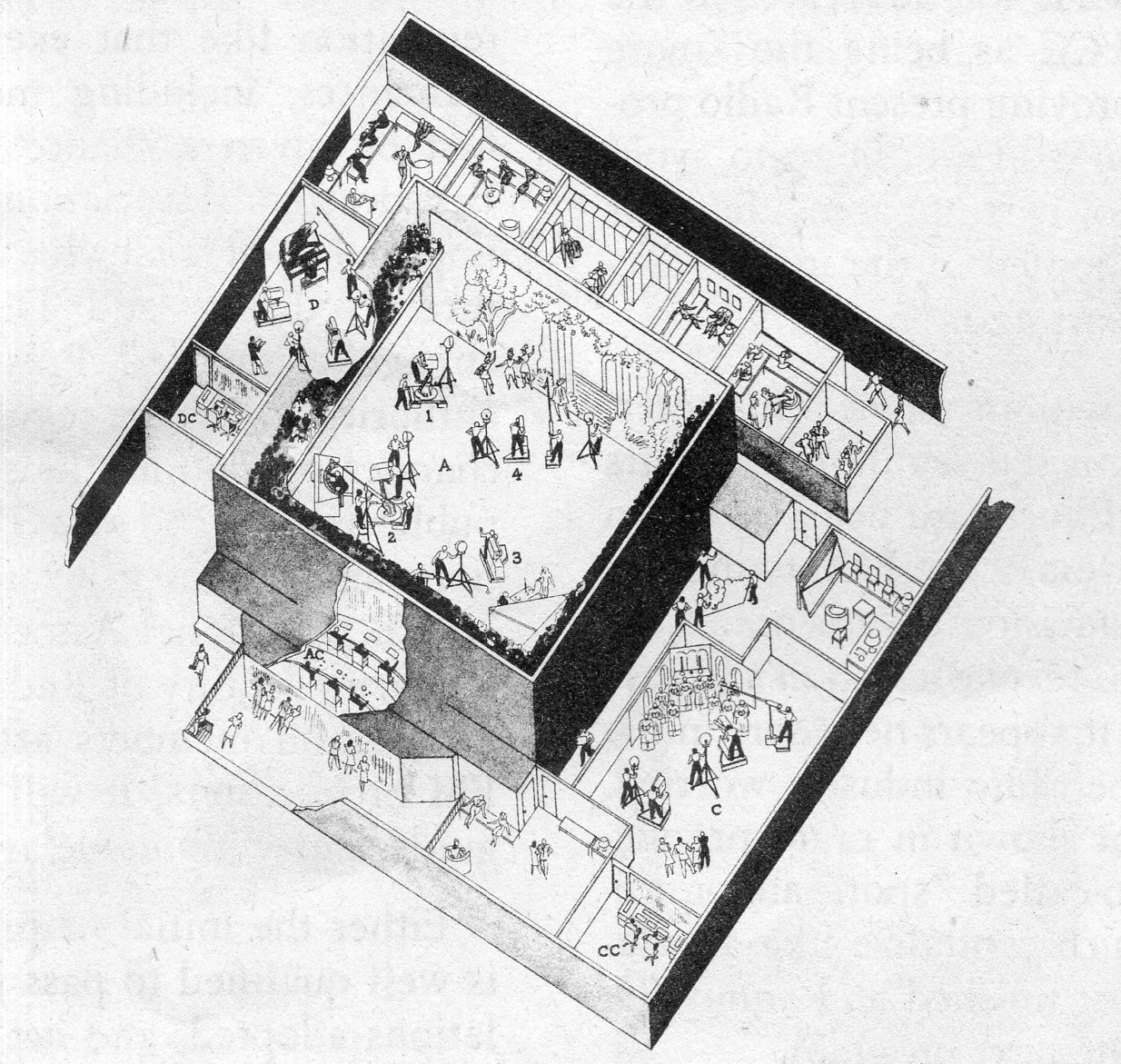
    On the anniversary of the Nagasaki bombing (today being August 9) I found this old friend down in the studio:  People’s Television, Survey and Popular Guide to What You Want to Know…” (possibly) by Walter J. Greene, which was published about a year after the bomb was dropped, received by the Library of Congress in December 1946. In a full twenty-four pages the author laid out the future of the young (“virile youth returned from war”) television and how signals could be transferred across the country for transcontinental broadcast, setting up the reader for the appreciation of the coming boom in the new medium. It includes a small section on how television programs are made (I’ve included a scan of a small diagram of the Du Mont-John Wannamaker Television Studios located at the Wannamaker store in NYC), a chapter on how the public will determine the content of television programming (“The Public is the Final Judge, Television can “Grow Up” More Quickly than Radio”), a bit on the future of television reception, color television (“A Cause for Some Speculation”), all followed by a reader quiz and a list of televisions and their prices.

    Of course the major draw for me in this pamphlet is its cover–one of many efforts using imagery of nuclear explosions to sell an idea or a product. The image is a famous one, being the second airburst test shot at Bikini, Marshall Islands, on July 1, 1946. The image has been cropped a bit, the full versions showing a beach and palm trees in the foreground.  Although it seems as though this was a mass-produced item, it just doesn’t seem to show up anywhere, nothing substantive in the intertubewebs, and the trusty WorldCat/OCLC finding hardly anything–surprising. 

    Peoples television _1_591

    And a map of the coming transmission scheme:

    Peoples television _map_592

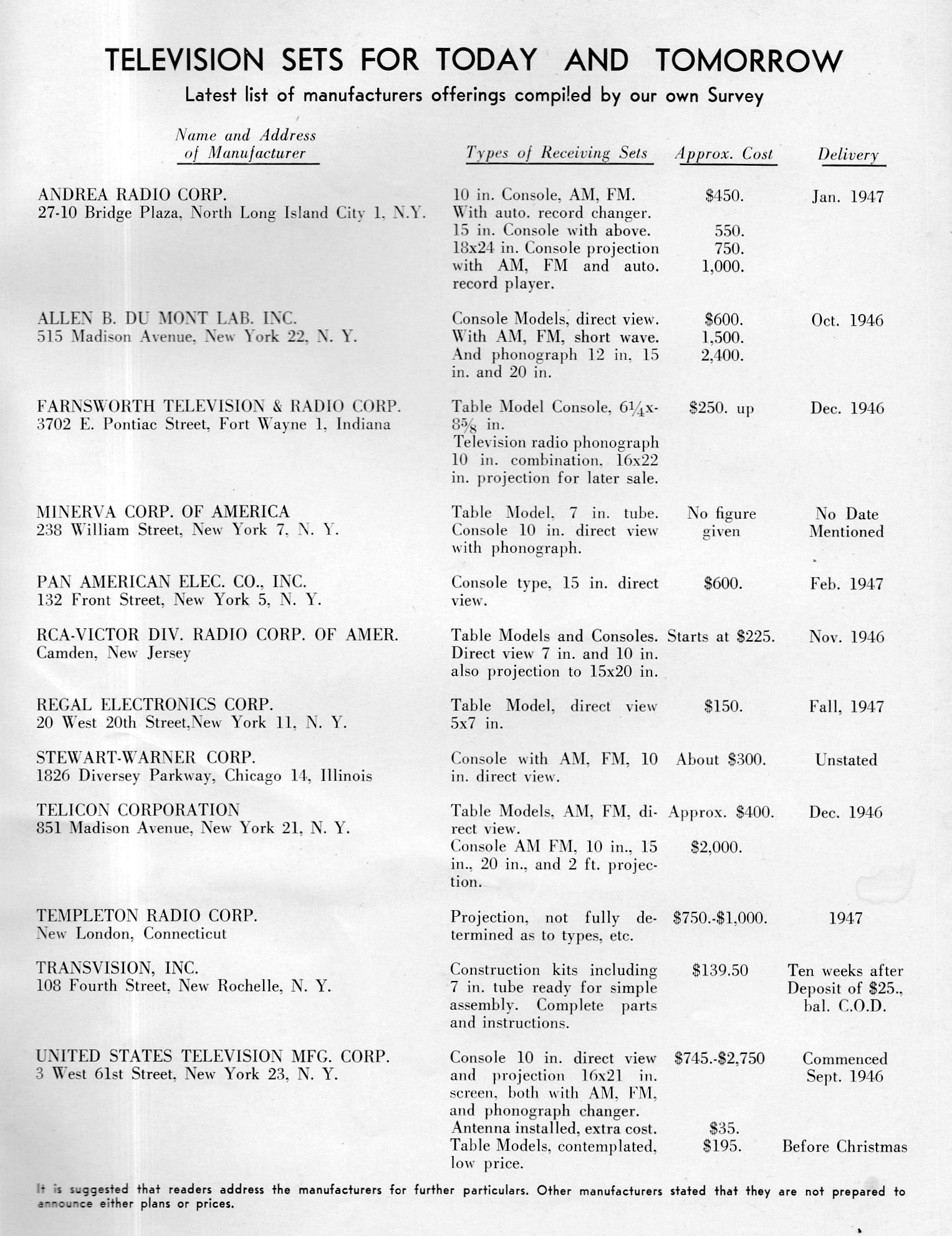
    And a list of televisions available–remember that $1 in 1946 is about the equivalent of $12 today, so, $1000 for an upper end model would have been about $12k today, which is considerable:

    Peoples television _tv prices_595

    And of course the television studio of 1946:

    Peoples television _studio_593


    ·Posted by :

    ·in:


  • Blade Runner Retinal ID, 1936

    JF Ptak Science Books   Quick Post

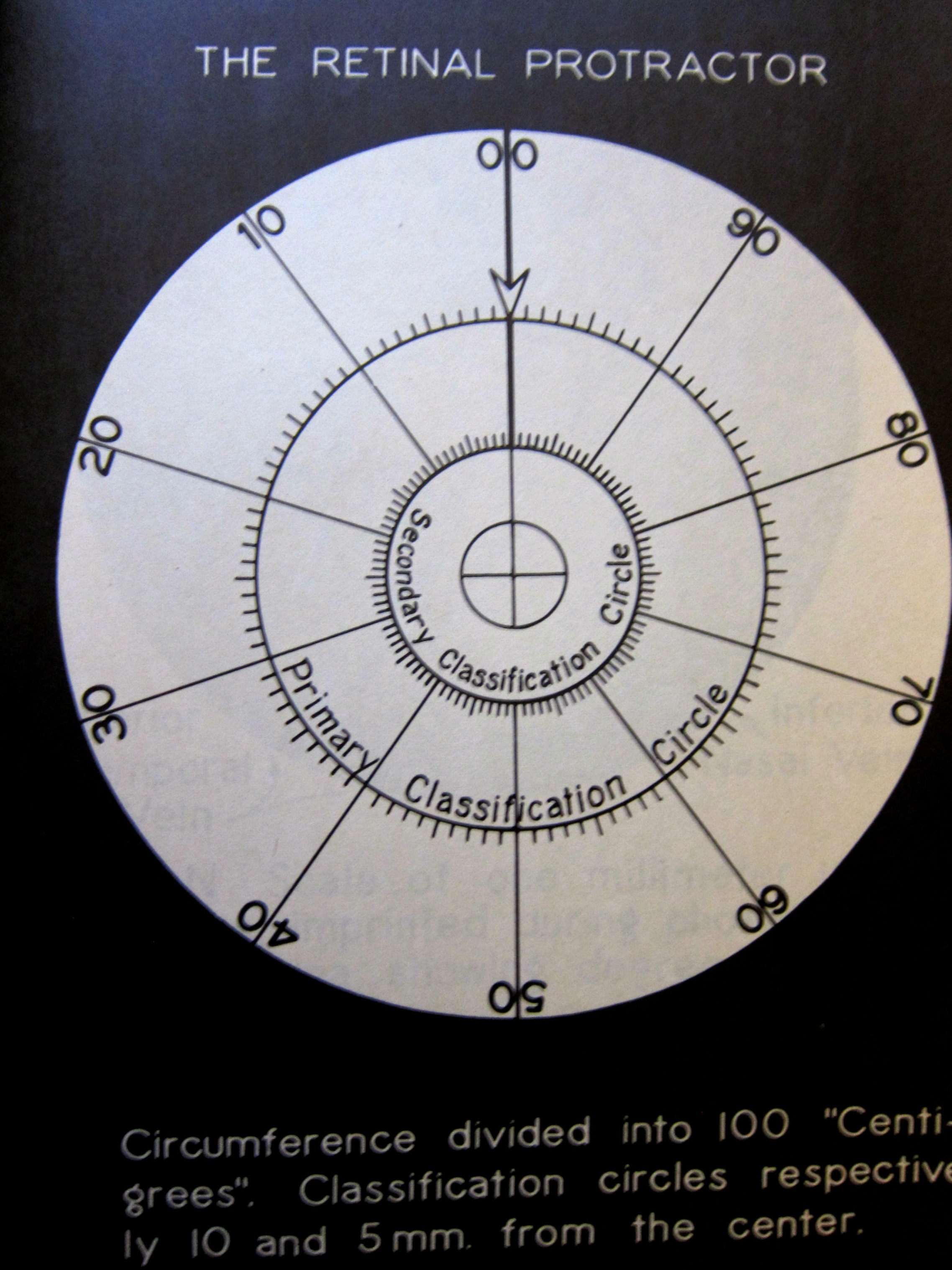
    Retinal identification is here, and it is in the future; it was in the past’s version of the future in the P.K. Dick Do Androids Dream of Electric Sheep? in 1968 which was turned into the film Blade Runner in 1982. But long before any of this was Carleton Simon and Isidore Goldstein, who figured out that everyone has a unique display of veins in their retina. Of course this is not exactly as obvious as fingerprints, but evidently it was a whole new thing in 1936–highly interesting. ANd what struck me was the “retinal protractor” which was like a grid placed on the photograph of the retina onto which the veins would be plotted, from there it went to another step to assign numerical values. 

    Retina id protractor

    Source:  Carleton Simon. The retinal method of identification; a new system of classifying retinal patterns. Presented at the annual convention of the International Association of Chiefs of Police at Kansas City,Mo.,September 21st to 24th, 1936.  11×8.5″ cover/title, followed by 4 leaves of photographs showing the sections of the retina, examples of the veinous patterns, and a retina protractor explaining the sections of the retina in a common language for placement.  
     
    Dr. Simon–“Criminologist of the International Association of Chiefs of Police, New York Association of Chiefs of Police…” is the Simon of Simon & (Dr. Isidore) Goldstein, whose groundbreaking paper1 introducing the uniqueness of the patterns of retinal blood vessels and their use in identification, was published on September 15, just a week before this address.  This publication may have been a handout for the address–it consists of one page of cover text and a separate four leaves of retinal pattern photographs with a cover sheet.  
     
    Notes:
    1. “One of the most accurate techniques for human identification is based on the uniqueness of the retina blood vessels pattern. The unique structure of the blood vessels in the retina pattern was first introduced in 1936 by Simon and Goldestein” . Simon C,,  Goldstein, I., “Retinal Method of Identification”, New York State J Med. 1936 Sep; 15– noted in “Retinal Identification System using Fourier-Mellin Transform and Fuzzy Clustering” Hadi Jafariani and Hamid Tabatabaee, Indian Journal of Science and Technology, Vol 7(9), 1289–1296, September 2014.

    ·Posted by :

    ·in:


  • A Steampunk Clown Robot, Generational Robots, and a Vision of the Future, 1866

    JF Ptak Science Books  (Expanding an earlier post, not having previously noticed the robot baby)

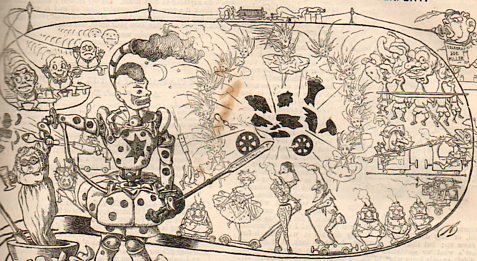
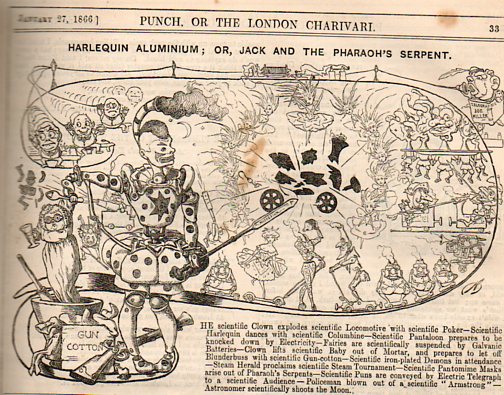
    Punch, or the London Charivari published this delightful and somewhat prescient illustration  (“Harlequin Aluminum; or, Jack and the Pharaoh’s Serpent”) in its 27 January 1866 issue.  It is for me an excellent, sort-of early depiction of a steam-man, a steampunk man, a steam-driven clown robot person, that is very deeply and frequently hinged, with smoke belching from a curved smokestack coming from the back of its head, and controlling its own destiny enough so that it is actually attacking and blowing up a steam locomotive.

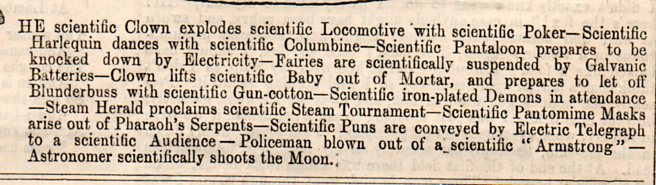
    And that’s what this image is all about–in the age of steam, the future looks more so; that, and given its extraordinarily frequent use (16 times) in the very short text, things in the future are going to get very “scientific1“.  

    Sci clown694
    And what the (aluminum2) robot seems to be doing with its scientific poker is exploding a scientific locomotive, for reasons unknown, except that the application of the poker was very successful, if that is the proper word to describe this action–it does act to control its steam technology is busting the new technologies of the era, a rub and at the same time a statement of hope or expectation in a high-Victorian manner, a rationalism of all things via technological means.  And at this time, in the mid-1860’s, the new wellspring of hope was being found in electricity-based solutions–moving away from the pervasive steam-driven technologies–though as the cartoon suggests those expectations might be too soon, too fast and too deeply placed.  After all, these things are being exploded by a “scientific clown” with a “scientific poker”–and that clown is being driven by steam. 

    Further, the steamrobot clown is pulling a scientific baby from a mortar–this is something that is unique to my experience, a robot generating a newer, younger, baby-robot in some undescribed manner. This is a generational moment among robots and something that is certainly not common in the history of early robots.  

    Sci clown695

    In the background-right we see a string of “scientific fairies” suspended by electricity, and beyond them, center-rear, is a comedian reading from Joe Miller’s joke book (of “scientific puns”)  into a telephone-like device, with an audience to his mirth sitting and listening on the other end of the line–and this still 11 years away from the invention of the telephone. And so on.  It is a marvelous piece of work, especially considering what was probably an ephemeral status.  

    Sci clown692

    (Also, the “Pharaoh’s Serpent” part of the title of the illustration refers to a three-year-old phrase: “1863   W. Allingham Jrnl. 3 Oct. in H. Tennyson Mem. Tennyson (1897) I. 513   Mrs Cameron showed a small firework toy called ‘Pharaoh’s Serpents’, a kind of pastille which when lighted twists about in a wormlike shape”–from the OED.)

    Notes:
     
    1. It is well-known that William Whewell created the word “scientist” relatively recently, in 1834 (see below). “Scientific” goes back quite a bit further, deep into the 18th c in some uses; farther back in others. 
    “Scientist” in the OED: 1834   W. Whewell in Q. Rev. 51 59   Science..loses all traces of unity. A curious illustration of this result may be observed in the want of any name by which we can designate the students of the knowledge of the material world collectively. We are informed that this difficulty was felt very oppressively by the members of the British Association for the Advancement of Science, at their meetings..in the last three summers… Philosophers was felt to be too wide and too lofty a term,..; savans was rather assuming,..; some ingenious gentleman proposed that, by analogy with artist, they might form scientist, and added that there could be no scruple in making free with this termination when we have such words as sciolist, economist, and atheist—but this was not generally palatable.
    1840   W. Whewell Philos. Inductive Sci. I. Introd. p. cxiii,   We need very much a name to describe a cultivator of science in general. I should incline to call him a Scientist. Thus we might say, that as an Artist is a Musician, Painter, or Poet, a Scientist is a Mathematician, Physicist, or Naturalist.”
     
    2. “Aluminim” is a word created by Humphrey Davy in 1812. 

  • A Great National Moment Hidden in a Single-Sentence Description (1814)

    JF Ptak Science Books    Post 2624

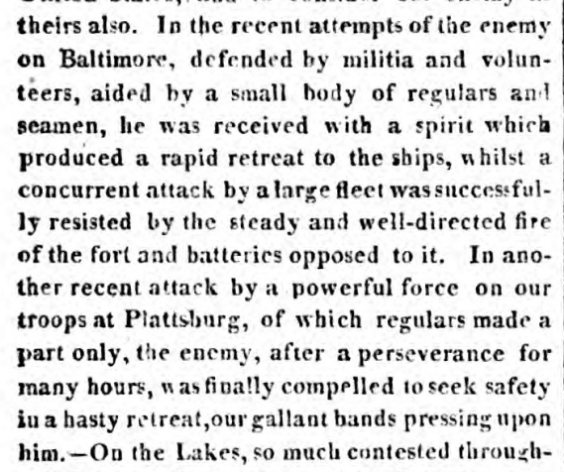
    I was working my way through a stack of volumes of  William Cobbett’s Political Register containing reporting for the war years for the War of 1812–this magazine/newspaper was  a weekly journal of news and interpretation by an American-sympathizing radical journalist reformer Brit.  Looking for one event in particular, I came across it in an official report of September 19, 1814, dated from Washington City, in the November 14, 1814 issue of the  Register, Nestled in the “official reports” section is this summation of the action of September 13, 1814, in the city of Baltimore, which was under siege by a large British fleet, which was “successfully resisted by the steady and well-directed fire of the fort and batteries opposed to it”.

    Here’s the snippet:

    Cobbett Ft McHenry

    • Source: William Cobbett, Cobbett’s Political Register, London, printed for the author and sold by Richard Bagshaw in Covent Garden, volume 26, November 5, 1814.  

    Much of the critical bombardment of the fort occurred at night, and for one observer–an official U.S. representative then being held in custody by the British on board a ship in the harbor–the outcome of the battle would not be known until the first light of day.  What he saw that morning by dawn’s early light was what he had seen in the evening, hailed at the twilight’s last gleaming,–a U.S. flag (a “star-spangled banner”) flown above the fort, meaning that the fort had survived, the defense maintained, with a victory in hand. 

    The fort was Fort McHenry, and the U.S. representative here of course was Francis Scott Key, who turned his experience into a national witnessing, presenting it in a poem later to to music that would become the national anthem.  

    There was no mistaking the victory described here at Baltimore (and also the mention of the major victory at Plattsburg), though there was not much flavor to the reporting. But here it is, a great national moment, appearing as a single sentence with four commas. Given the scanty capabilities of overseas reporting perhaps these were the scant public facts that were presented to the British people buying Cobbett’s two-penny weekly (much scorned by the wealthy/well-do-do and much read by the actual working class), so the emotive significance of the event was lost to detail and translation. The impact of the victory was certainly felt very quickly in the U.S. 

    This is one reason why it is so interesting to read the original reports and publications of historical social and scientific events.


  • An Extraterrestrial Society Views the Earth, 1896

    JF Ptak Science Books   Quick Post

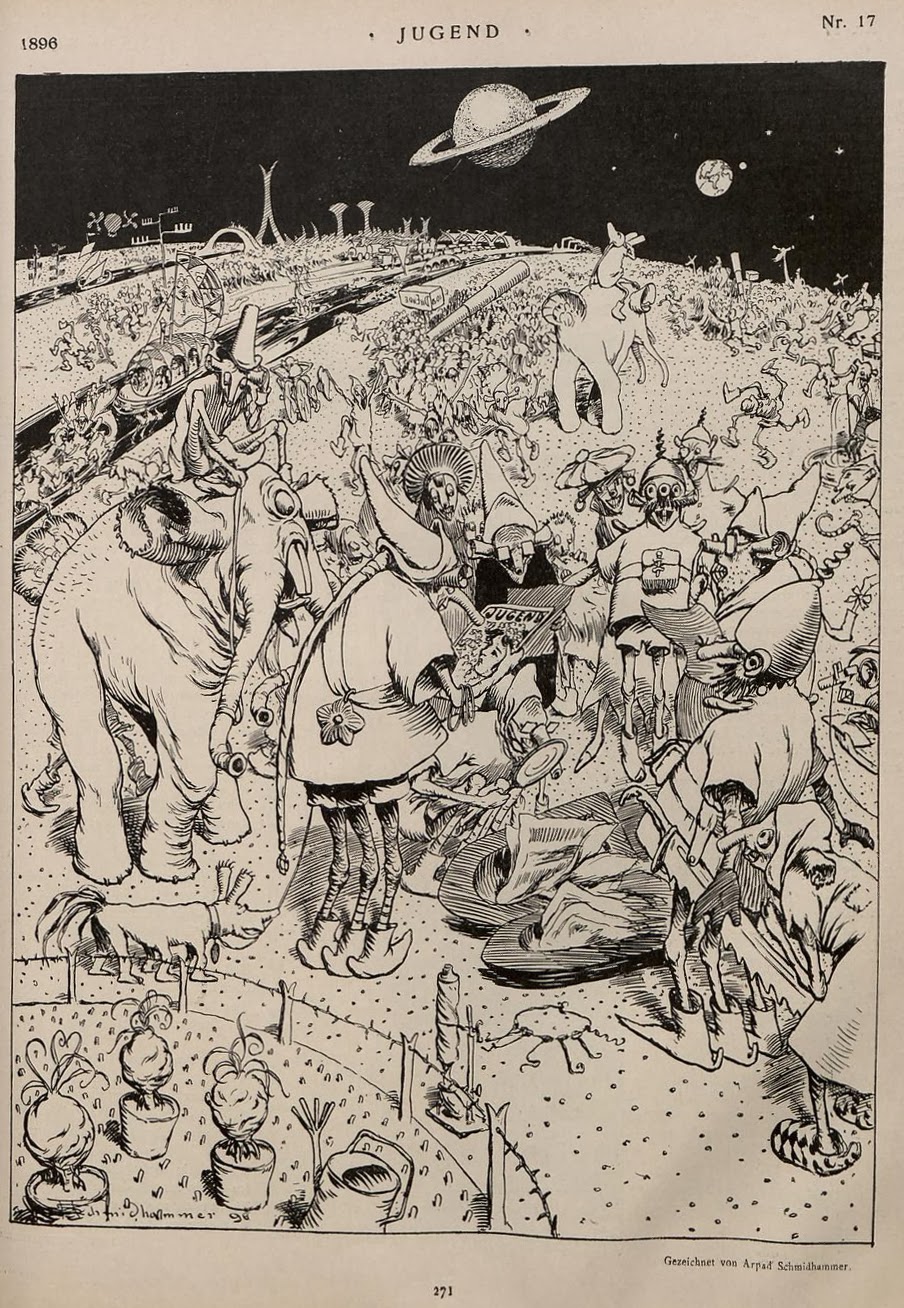
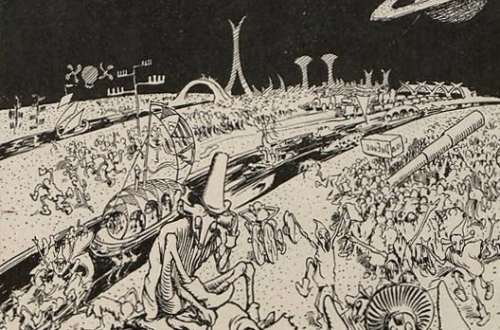
    The Munich-based Jugend magazine (1896-1940), founded by Georg Hirth, was host to an entire generation of art nouveau artists, lending its name (“Jugendstihl”) to a movement of expression of German Art Nouveau.  In the April 25, 1896 issue we find an unusual image of extraterrestrial life within our own solar system, drawn by the artist and illustrator Arpad Schmidhammer. It depicts life on a  planet beyond Saturn–complex life, complete with what we’d imagine automobiles of the future from 1935 to look like, as well as cities, and large crowds very engaged in receiving an object from a world alien to their’s.  The commotion seems to be a space-shell of some sort, and of course it carries issues of Jugend magazine.  There is all manner of action around the magazine in the foreground, and slightly beyond that we see another large group of people crowding around a telescope, hoping for a view of the Earth, while another dense crowd farther in the background swells around another Earth-intent telescope.  It is intended as a humorous scene, no doubt, but the fact is that there weren’t all that many scenes of alien life forms taking an interest in a floating Earth in the background.  Perhaps Wilhelm Roentgen’s newly-discovered X-rays helped an image like this along with the idea of entirely unseen worlds made visible…

    Alien art Jugend 1896

    [This image found thanks to an image-share by the Ephemera Society USA. Image Source: University of Missouri libraries, http://muspeccoll.tumblr.com/post/144371190257/jugend-1896-no-17-katya-s-jugend-mu-nchen utm_content=buffera68da&utm_medium=social&utm_source=twitter.com&utm_campaign=buffer]

    And just for the record, “extraterrestrial” finds life in English as far back as 1868: 

    1868   W. Lockyer & J. N. Lockyer tr. A. Guillemin Heavens (ed. 3) 188   Bodies situated in the extra-terrestrial regions.
    1882   Nature 21 Dec. 173/2   The oblique direction of the meteor..is another evidence of its extra-terrestrial origin.
    [Oxford English Dictionary]
     
    The detail from the busy upper-left corner:

    Alien art Jugend 1896 detail


  • Moving Product by Embracing the War–Making Memory Dents in 1914

    JF Ptak Science Books  Quick Post

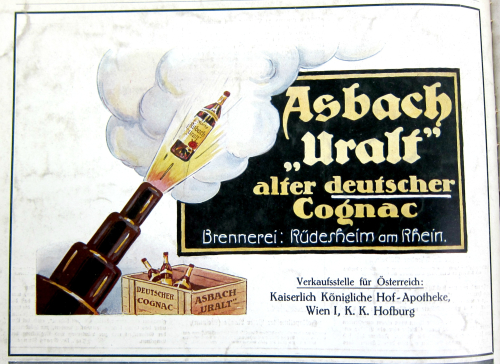
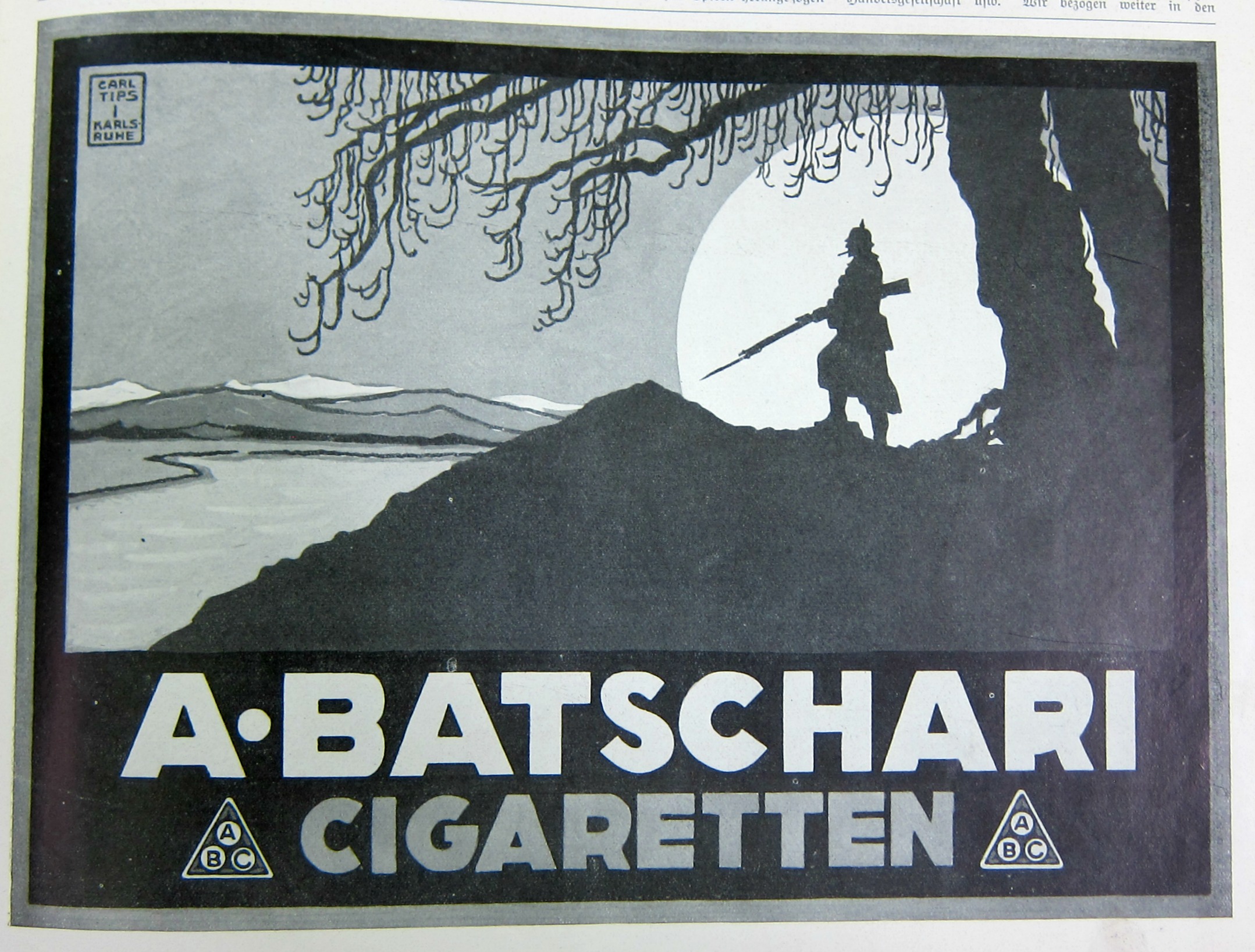
    There is some inexplicable something about advertising in popular magazines and newspapers during war time, and how inappropriate it seems to used the circumstance of conflict to sell a product.  Of course, everything doesn’t come to a standstill in war time, not even in World War, as economies still run and society still functions (at least to the very end).  So, even though there could be millions of soldiers in uniform, and millions dead, and tens of millions (hundreds of millions peripherally) involved in the conflict, the daily life of living and the stuff of society keep on.  This is what strikes me about these ads, all seen in two consecutive weekly issues of the Leipzig-based Illustrirte Zeitung in November 1914: chocolate, cigarettes, cognac, and of course a Benz automobile, though it was the cognac that seems to me to have the most noise about it–I don’t know how you relate cognac to a war effort (let alone having it being fired from a howitzer) but they did manage to wrap themselves up in a patriotic-something and associative themselves with the national war effort. Over time manufacturers and ad folks would manage to see connections between the war effort and whatever it was they were producing–scissors, laxatives, buttons, razors, toys, pool tables, and so on.  Then again, in a presidential cycle such as what we are witnessing in the U.S., people can relate anything to anything else in spite of the nonsensical and mythological nature of it, like the impossible Donald Trump stating he can relate to racism because “the system” has been “stacked against” him. You can say anything you want in these circumstance, evidently–the point is not making sense, it is about making a vague memory dent, and how that dent got there is immaterial to the lingering notion of the association.  

    WWI Project Ads _7_

    WWI Ads _7_


  • Beef Fat, Bones, and the Flu (1918)

    JF Ptak Science Books
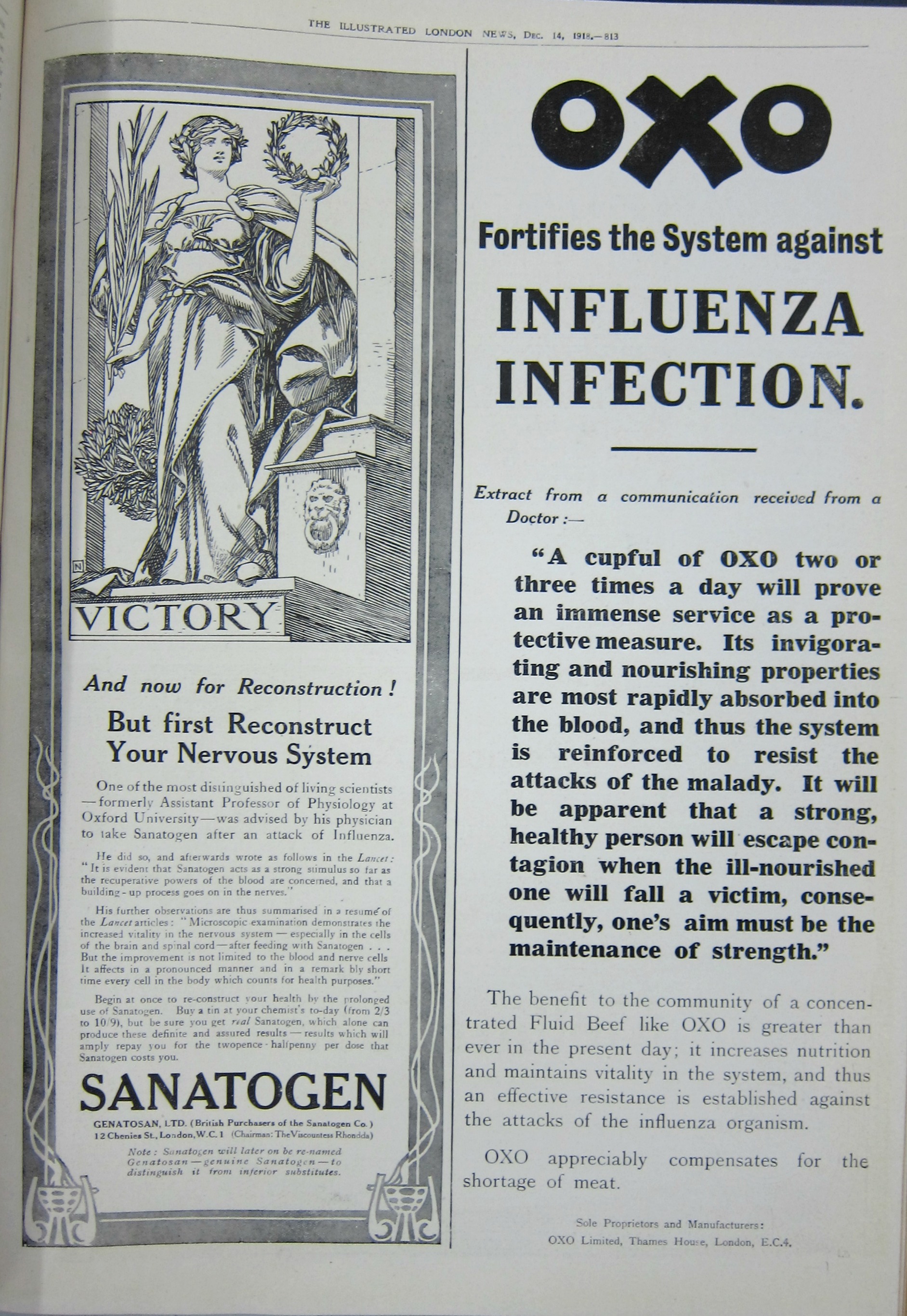
    Riding the last waves of wear into the public conscience and pocketbook come these two ads, published in a very large full-page format in the Illustrated London News in August 1918, just a few months before the end of WWI.  Yes, no doubt there was a public “nervousness” about the affairs of the self/state/world in general, and yes there was a problem at this point with the beginning of flu season (which would soon develop into a world-wide pandemic that killed millions), and I guess the makers of Sanatogen and Oxo thought that they could make a positive impact on these things.  Considering that Sanatogen was a tonic and both a relaxing and a vitalizing agent, and made of 95% milk protein, probably would not make much of an impact in anyone’s nervous system. Same deal too to Oxo–apart from water the major ingredients were flour, beef fat, and dried beef bone, and probably whatever beefy thin might have fallen to the floor at the slaughterhouse.  Certainly there was no good to come of treating a deadly influenza with beef fat–except of course that the manufacturer would do well distributing dietary supplement made of the stuff that has almost no value of any sort. 

    So, I guess I’ll need to check out Oxo for the winter of 1918/19 and see how often this ad appears–it wouldn’t be until the fall of 1918 that the pandemic would begin, killing about as many people who were killed in the just-ended war. Combating infectious disease with left-over stuff from a beef killing floor was probably not a hope-filled thing.  

    WWI Project Influenza Cured with Meat


  • H.L. Mencken and Beer

    JF Ptak Science Books  Quick Post

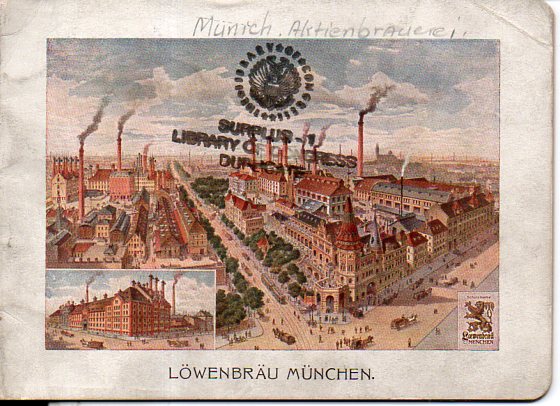
    Lowenbrau _1_523

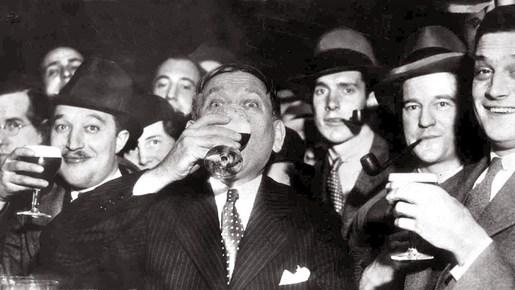
    I found this nice association copy of an unusual pamphlet1–the work is on the Lowenbrau brewery in Munchen (with a nice bird’s-eye view of the massive works), and it was given once upon a time to the Library of Congress by none other than the Bard of Baltimore, H.L. Mencken (1880-1956), who was known to enjoy his suds.  As a matter of fact, here’s a sort of quietly iconic picture of the man from the Baltimore Sun, legally enjoying his drink in Baltimore in 1933, right after the repeal of prohibition (1920-1933).

    Mencken drinking beer

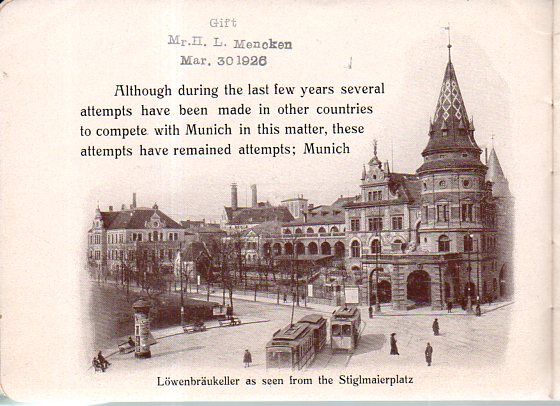
    And this, gifting the pamphlet seven years earlier:

    Lowenbrau _2_524

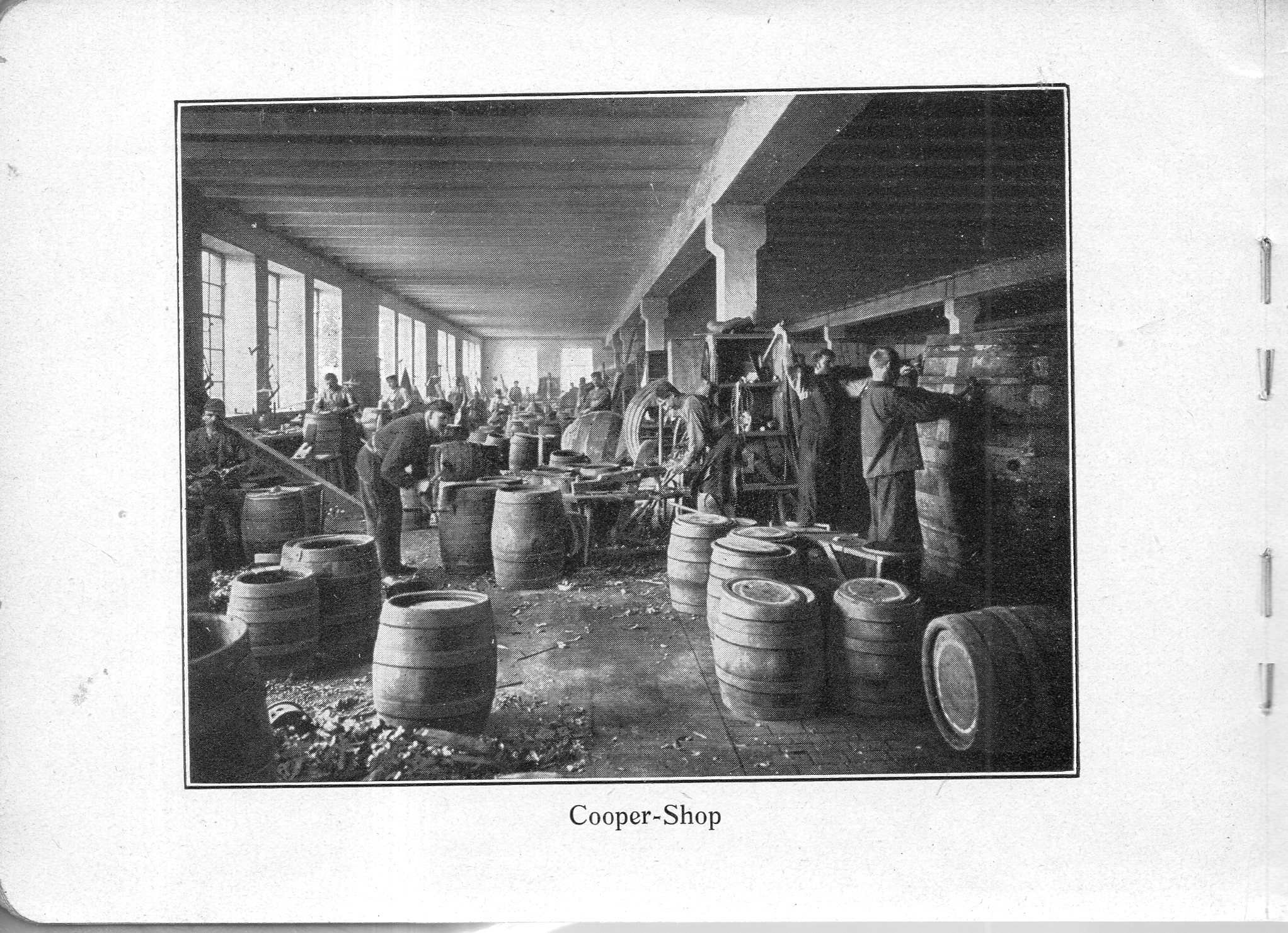
    But what I really liked was this photo of the cooper works, dozens of folks working on the barrels to be filled with beer, an entire industry dedicated to packaging liquid and grain, all gone now:

    Lowenbrau _2_525


    Notes:

    1. Aktienbrauerei zum Lowenbrau in Munchen,  which was probably published by the brewery, and printed pre-WWI, ca. 1910 or so.  

    ·Posted by :

    ·in:


  • Sandbags, Helmets, and the End of WWI

    JF Ptak Science Books  Quick Post

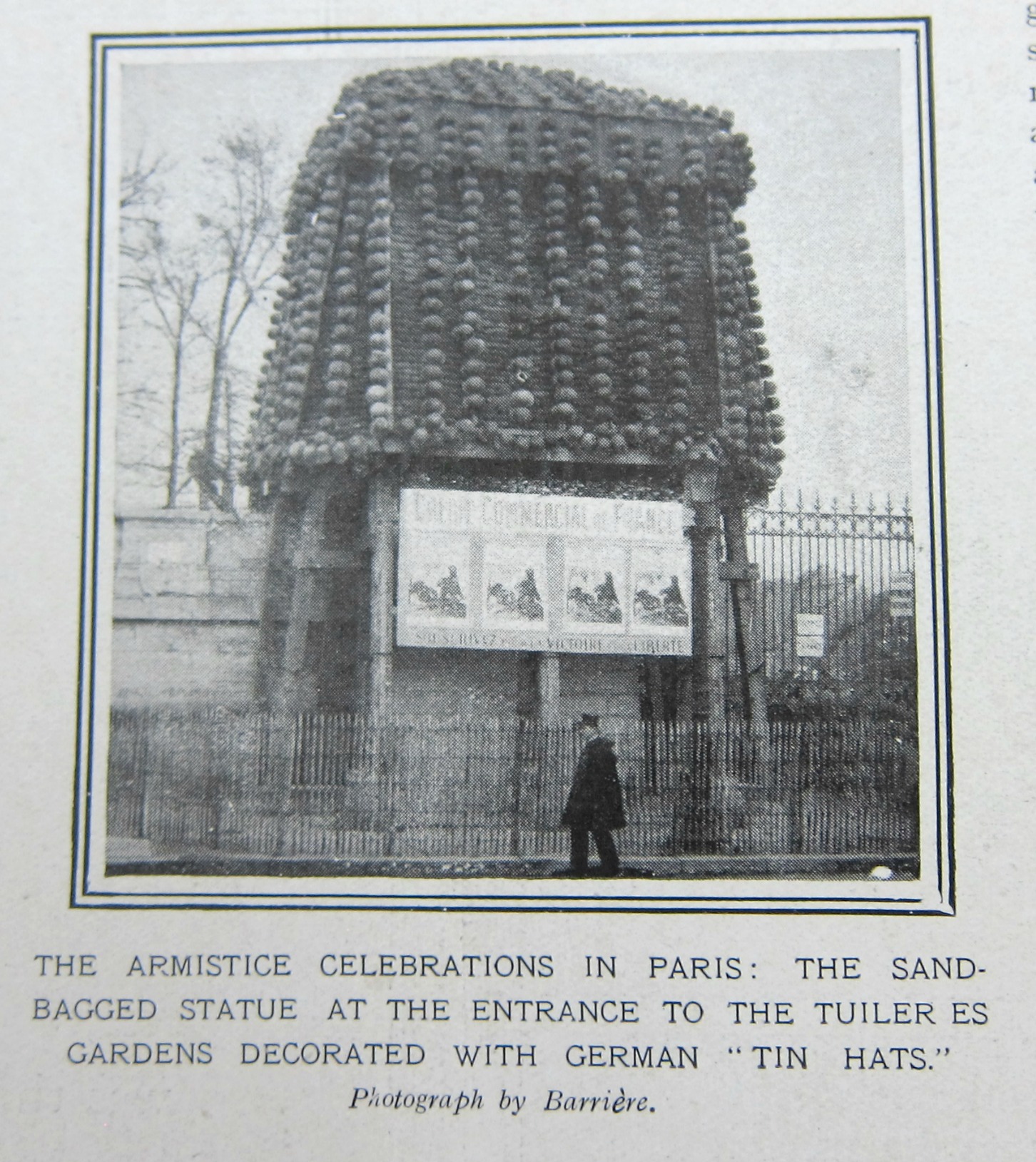
    This extraordinary image was found in the November 21, 1918 issue of Illustrated London News–a strong vision celebrating the newly-signed armistice ten days earlier ending WWI.  It shows one of the statues at Tulieres–this at the entrance to the garden. Like many statues and buildings and churches, this structure was protected by sandbags–and in this case, the sandbags were decorated with war trophies of German helmets.  

    WWI Project Armistice Paris Helmets Statue


    ·Posted by :

    ·in:

    —