A Daily History of Holes, Dots, Lines, Science, History, Math, Physics, Art, the Unintentional Absurd, Architecture, Maps, Data Visualization, Blank and Missing Things, and so on. |1.6 million words, 7500 images, 4.9 million hits| Press & appearances in The Times, Le Figaro, Mensa, The Economist, The Guardian, Discovery News, Slate, Le Monde, Sci American Blogs, Le Pont, and many other places… 5000+ total posts since 2008.

Category: Technology, History of

  • L O S T at Sea and Waiting to be Saved (1877)

    JF Ptak Science Books  Quick Post

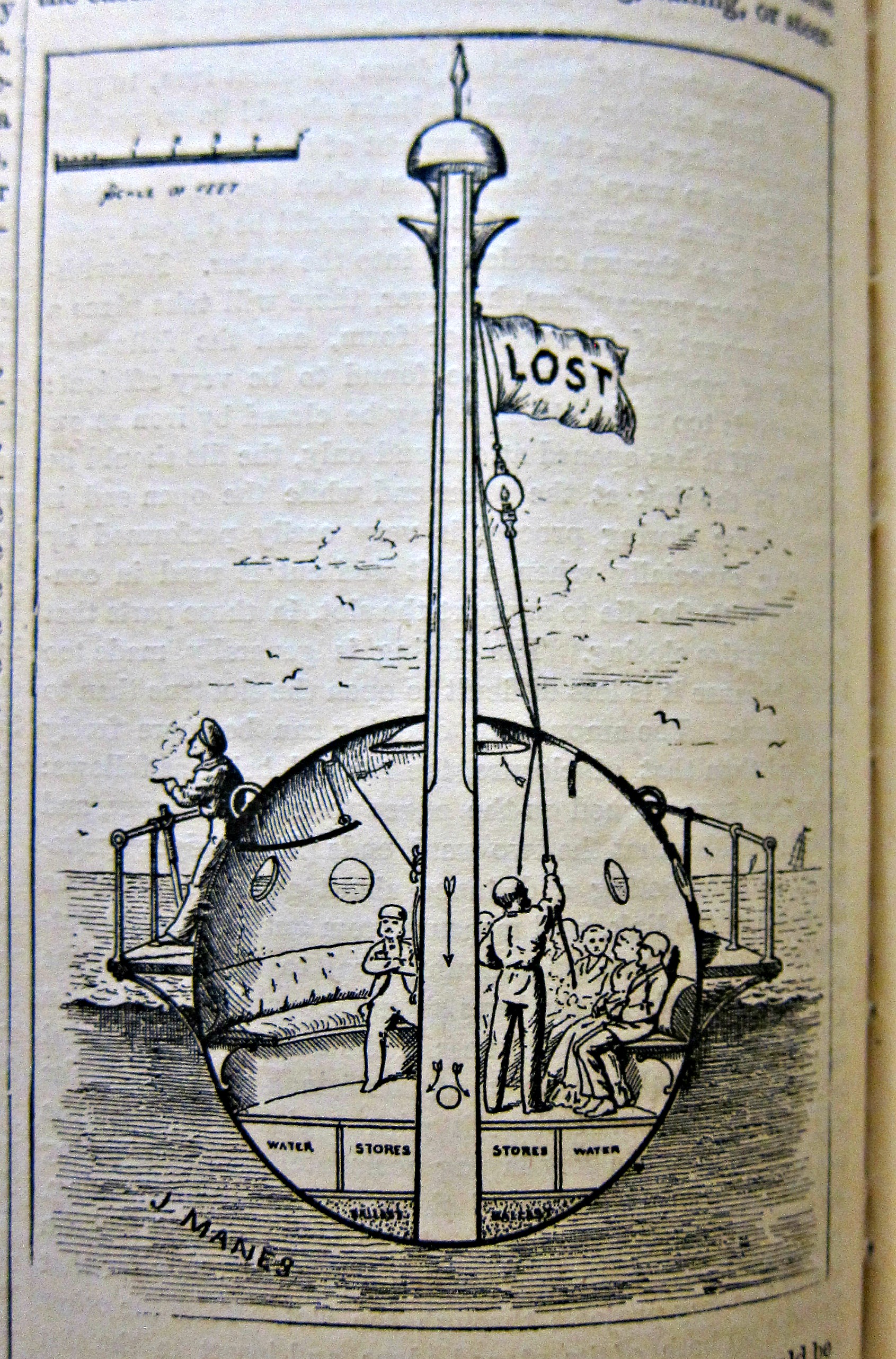
    I’ve seen a number of novel life boat/vehicles in my travels through patent office records but never really made note of them, which is too bad.  They can be pretty interesting in an oddly shared way with 19th century coffin designs and other mortuary patents–specifically the ones having to do with the dead should they find themselves fortunately/unfortunately resuscitated in their sleeping chamber underground. As a matter of fact some of the coffins were equipped with a small belled spire with a wire that went down into the coffin and wrapped around the hands of the dearly departed.  So, in the event of premature burial, the undead dead would simply need to move their hands and sound a bell or raise a flag. In any event, that is what came to mind when I saw this image in the Scientific American for August, 1877:

    Sci Am life boat lost

    This floating sphere was ballasted so that it would remain upright even in a heavy sea, and looks as though it could carry 10 or 15 people. It came complete with mast and flag, and a wrap-around walkway, and as you can see it is being used in the image by a man having a smoke.  

    The “Lost” sign seems to be a little redundant. 


  • Disk-Dirigible Star Trek “Enterprise”, 1932

    JF Ptak Science Books  Quick Post

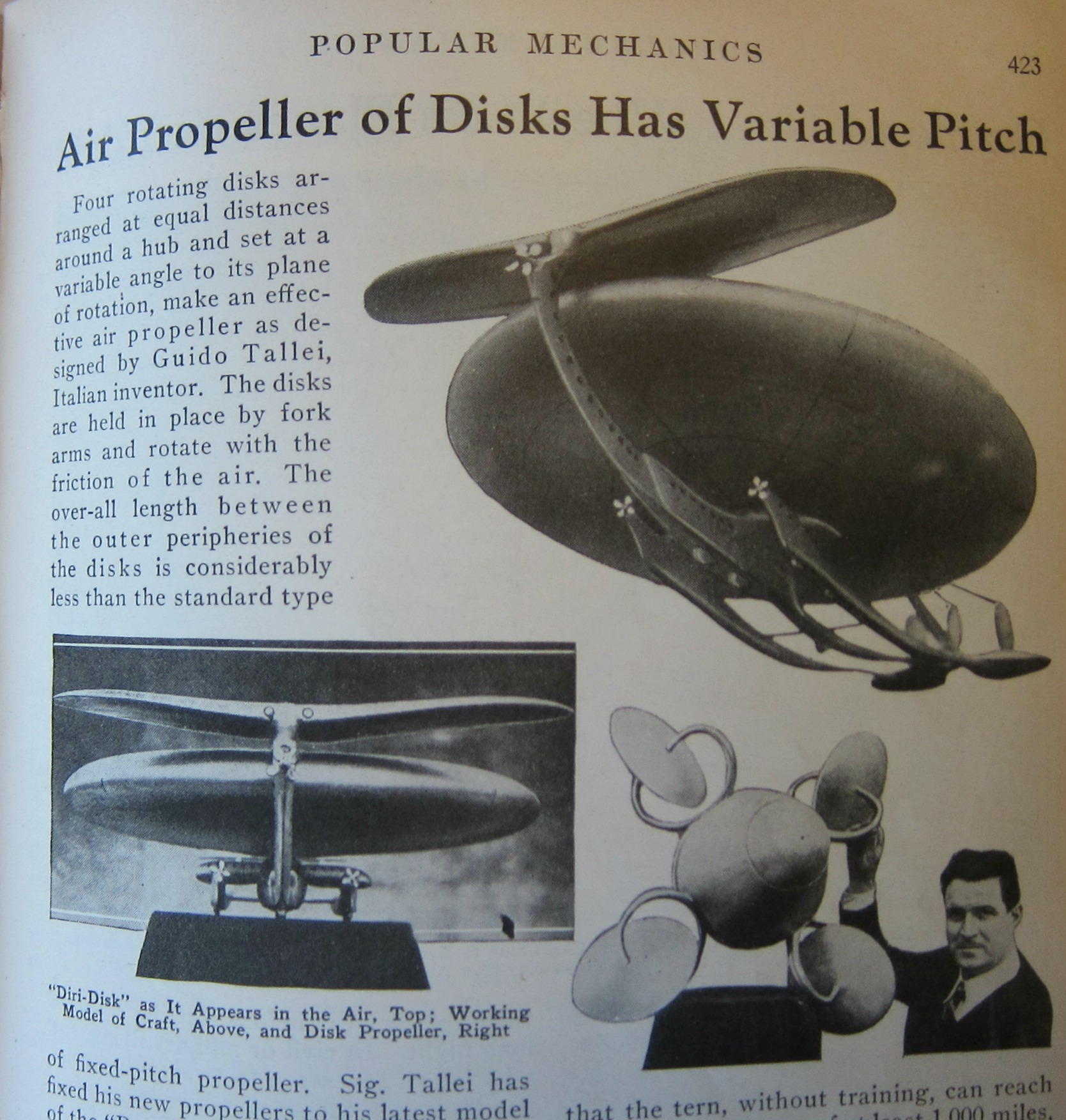
    An indulgence: I’ve posted a few things on this site of old and/or found tech that reminds me of the USS Enterprise (NCC-1701-D). Here is one that popped up in the pages of Popular Mechanics for May 1932–an airship designed by Guido Tallei that was effectively a flying saucer, a dirigible-disk. There was another design from him from 1931 that was similar to this except that it looked a LOT like a sleek underwater-swimming penguin.  


    Enterprise flying disk 1932April, 1932, Popular Mechanics


  • Reverse Catapult Landing System for Airplanes, 1932

    JF Ptak Science Books   Quick Post

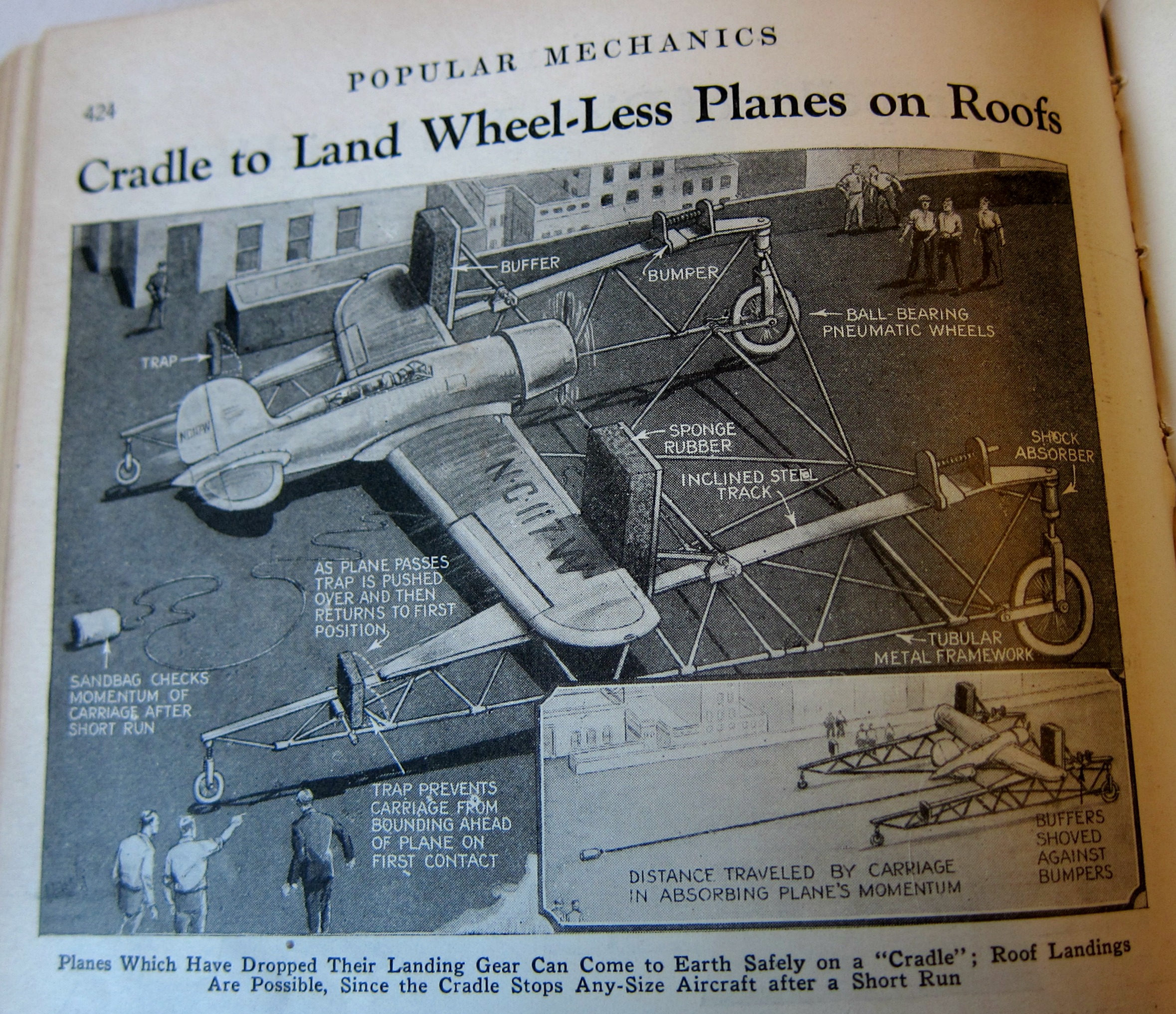
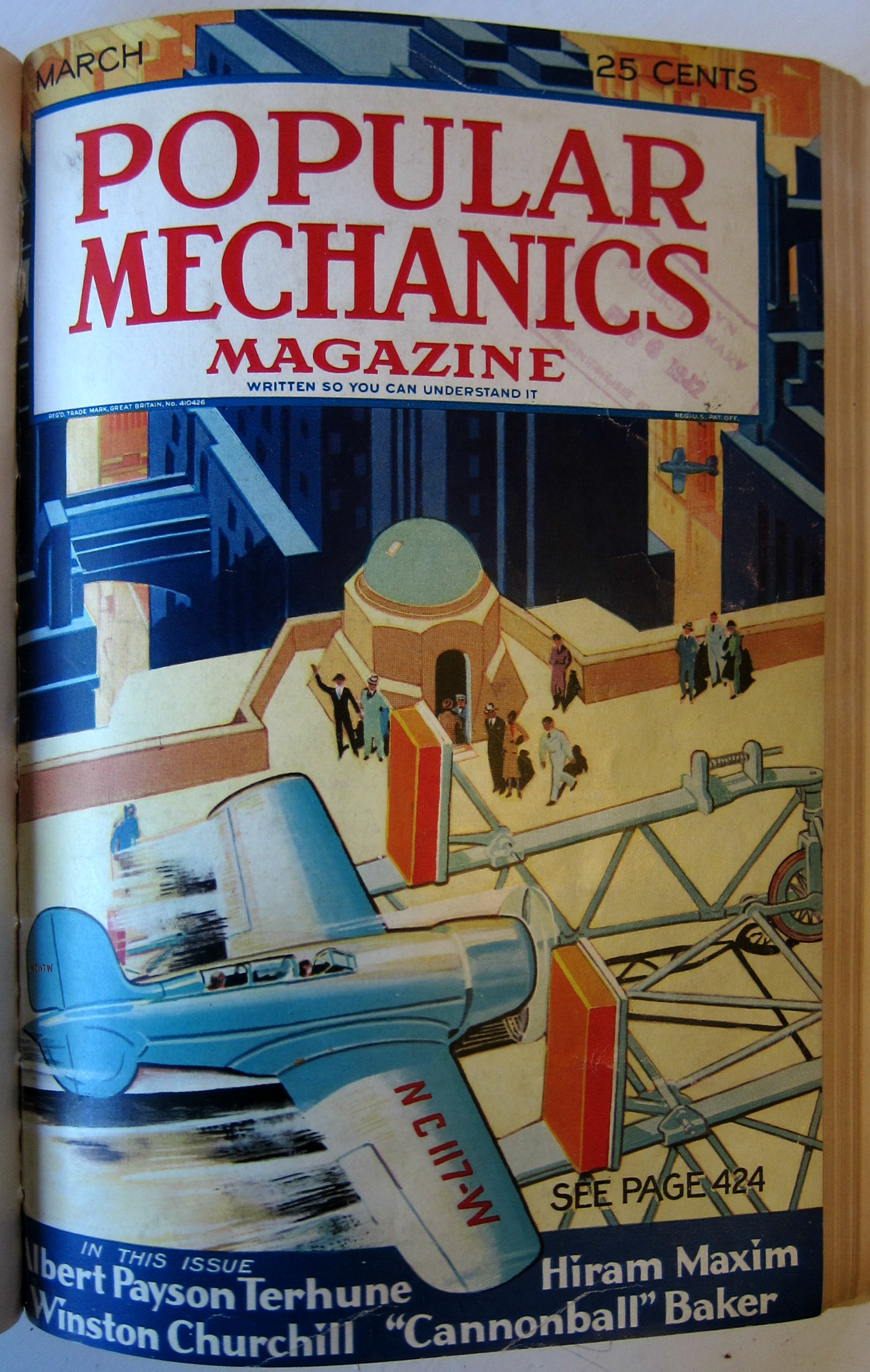
    There’s a certain attraction to relieving an aircraft of the weight and drag of landing gear–except for the actual “landing” part of the aircraft, which becomes more, well, difficult, without wheels. Except of course when you have an apparatus like that below, something to basically catch the aircraft. For the sake of fuel economy the idea of getting rid of wheels and other landing gear made the cover of this Popular Mechanics issue for March 1932. The apparatus was supposed to be able to (safely) stop an airplane in the space of 40′, which no doubt would have interested the U.S. Navy if such a thing worked with damaging the airplane or the pilot. I really don’t see how the thing could have possibly worked, even with the helpful image in the text of the thing being a “reverse catapult”. Still, publishing such stuff may have given someone an idea for something else–some bit or insight in this apparatus may have come in handy for someone else working on something entirely different, as is sometimes the case with Outsider ideas.

    Reverse catapault b


    Airplane reverse catapault


  • A Paper Internet of 1932

    JF Ptak Science Books   Post 2605 

    Paper interrnet145Before the internet the idea to the idea of the internet existed to some extent in the head of a great unsung hero of the U.S. WWII figure, Vannevar Bush, a person who may well have invented the notion of hypertext.  Vannevar (pronounced “van ee var”) was a flinty no-nonsense New Englander who was an organizational and mechanical genius who as a professor at MIT developed a remarkable analog computer that greatly advance computation capacities for solving differential equations.  This was in the 1930’s, and even after creating an improved electromechanical version of the machine still chose the wrong way to go in the soon-to-materialize digital computer revolution. During WWII Bush was one of the most important Americans in the war effort, overseeing the entire scientific effort of the U.S.—an enormous effort dispatched beautifully (and successfully).  His importance in this regard is difficult to overstate. He also published a short paper on the hypertext idea in an article in The Atlantic in 1945.

     The article, “As We May Think”, outlined his idea for a device he called the MEMEX (“memory” and  “index”), which compressed and organized all that its user could remember and whatever information would be obtained in the future via electromechanical apparatuses, and available with associative tracking between the microtext frames.  So all manner of book and papers and reports and newspapers and images would be microphotographed and stored in a beautifully-indexed mechanical retrieval system where it would live with the information of others.  There was also the possibility of real-time textual additions to whatever it was that was retrieved, the genetic precursor of hypertext.  Bush’s thinking has been deeply recognized (and also by the creators of the internet) as the intellectual grandparent of the modern internet. 

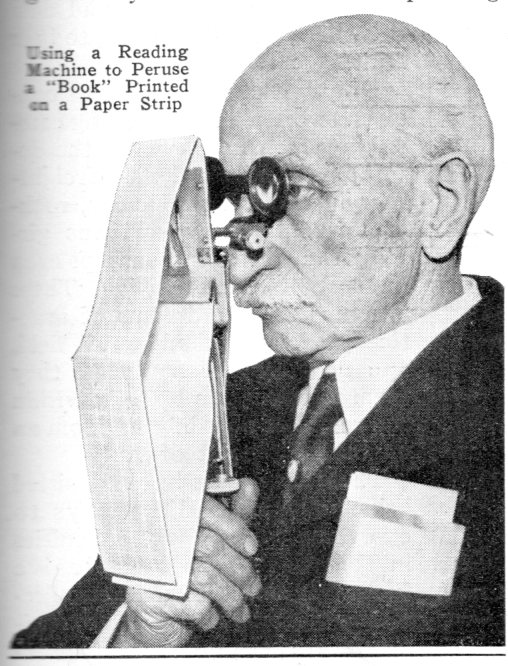
    And so I had a mostly-comical response to the image that I found (left) in the pages of the March 1932 issue of Popular Mechanics–it was actually on the back of the page that I was looking for (on passenger rocket travel across the Atlantic).  With Bush in mind, this image of a man reading a miniaturized book using the system of Rear Admiral Bradley A. Fiske (1854-1942), and the photo shows the reader with the equivalent of a 100,000-word novel.  The article only mentions this one book, and doesn’t venture out into imagining anyone carrying a library with them, nor does it mention searches of organizing systems, but it does bring to bear the possible power of having access to a vast amount of info held on a strip of paper about the size of a newspaper column.  And for 1932, that was a strong idea.  


  • “Finally the Head Flies Through Space”–the Berlin Rocket Field, 1932

    JF Ptak Science Books   Post 2605

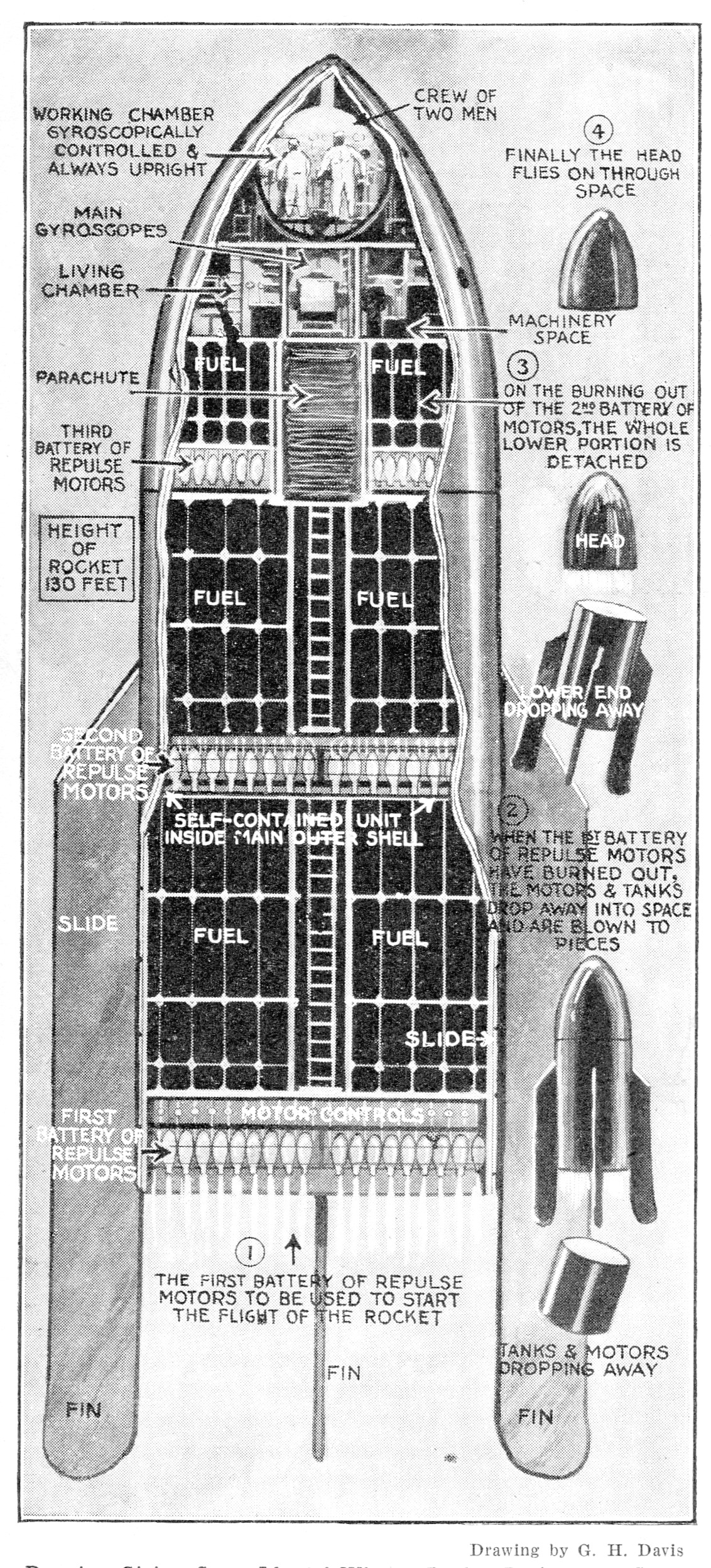
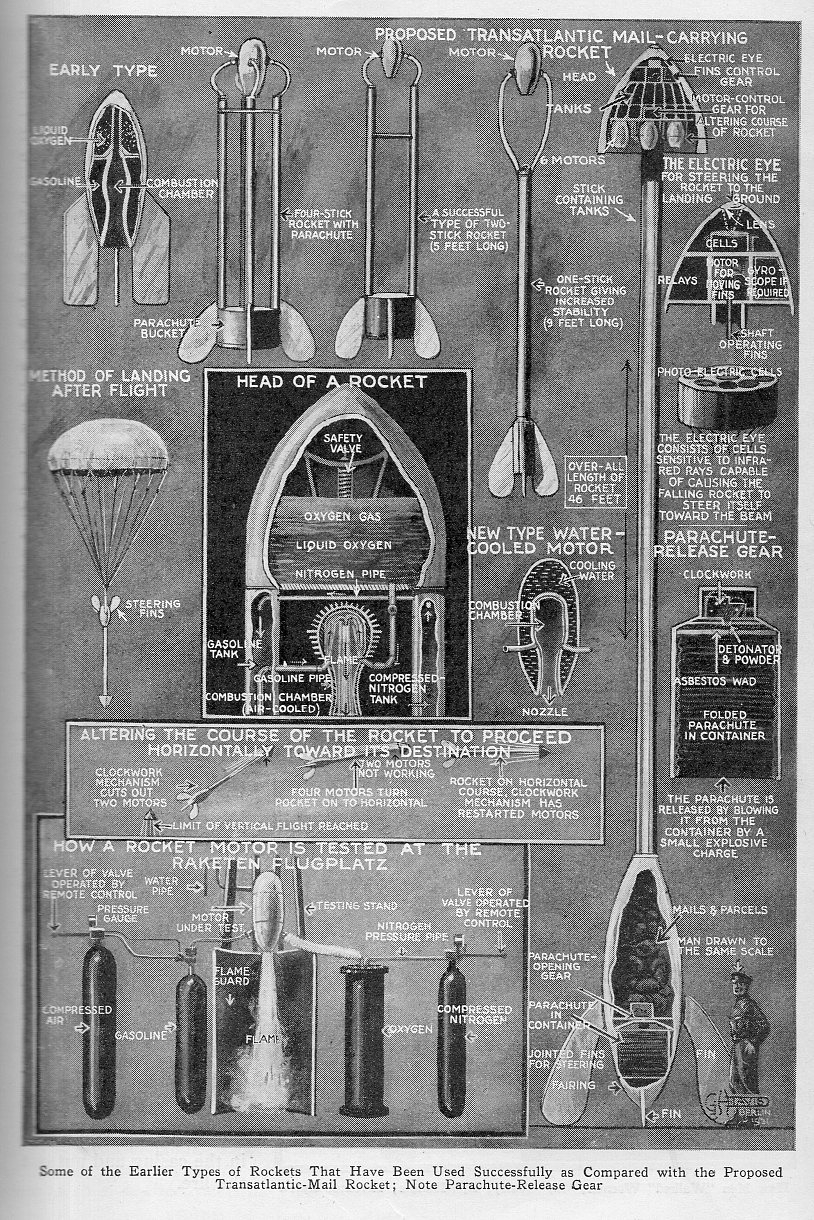
    This interesting schematic was drawn by one of my favorite technical artists, G.H. Davis, who generally worked for the Illustrated London News, though he appears in this article in the March 1932 issue of Popular Mechanics.  Davis was exceptional and prolific and produced (I guess) hundreds of drawings like this one, below.  “From Europe to New York by Rocket?” is mostly about delivering trans-Atlantic mail in twenty-five minutes rather than people, though that is mentioned somewhat, along with a scant reference to the possibility of interplanetary travel.  Mostly the article is based on Davis’ trip to the Raketen Flugplatz–the Rocket Airfield–a 300 acre former munitions/weapons site pockmarked with highly-useful bunkers in the Reinickendorf suburb in northeast Berlin, which is today very nearby the Berlin airport.  This was the world’s first such aerodrome, and it was staffed by the amateur rocket club of Germany which composed of such names as Nebel (who named the Raketen Flugplatz), Ritter, von Braun, Riedel, Heinish, and Oberth, among many others.  The place was opened in 1931 and saw the development of the liquid fueled rocket in Germany.  The place was short-lived though its influence was long-felt, the facility closed down over an unpaid water bill in 1933–it was at that time, anyway, where the Wehrmacht assumed control of rocket development in Germany and amateur exploits/testing was forbidden.  Six years later the Nazis went to war, and shortly after that appeared the V-weapons that so terrorized Europe and Great Britain, killing tens of thousands and leaving hundreds of thousands homeless, not to mention the thousands of slave workers who were killed in the process of production. 

    Rocket 1932 147

    But for 1932, when this article appeared and when Davis happily toured this facility, liquid-fueled rockets (introduced by Robert Goddard in 1929) seemed to hold the key to the future of rocket/space travel.

    Here’s Davis’ cutaway of a proposed rocket–it is not named nor is its purpose described, though it is not a rocket built for mail delivery, which was the discussion on this page of the  article–this is clearly far too massive (seemingly 100+ feet tall) for that, and also has sleeping quarters for the (standing) crew in the nose.  

    There are a few photographs of the team at the team at the Raketen Flugplatz, though no one is actually named–there is this photo which I’ve seen before and recognize, and I’d like to point out that aside from depicting Kurt Heinish (1910-1991) and Klaus Riedel (1909-1944) it also shows Heinish handling what I think is liquid nitrogen with basically no protective gear at all, save for some gloves.  

    Rocket 1932 148


  • In the Golden Age of Bicycles–a 25-cent Bike

    JF Ptak Science Books   Quick Post

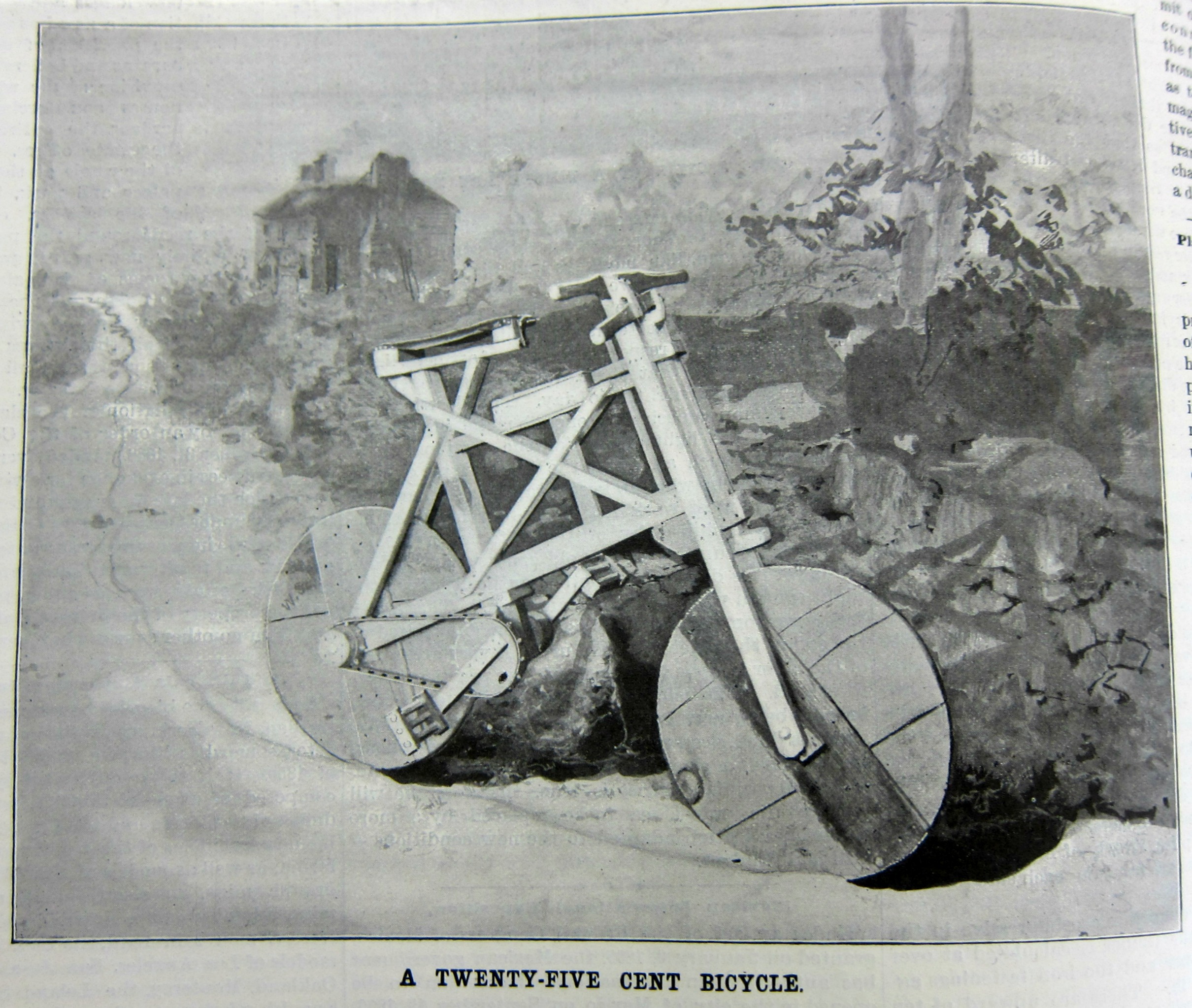
    Today I joked with a neighbor that my car was so old that it has wooden seat belts.  At least it has seat belts, no thanks to the early (pre-1989) efforts of people like Lee Ioccoca to prevent having them automatically installed, and unlike the Flintstones and Jimmy Rockford and others who had no seat belts at all–it is more like Granny’s rope-belt in the Beverly Hillbillies. Be that as it may, this bicycle is a much better creation than my seat belts.  The image appeared in the Scientific American for February 1, 1896, a half tongue-in-check proposal at a time of a great bicycle craze. Even though millions of bicycles were being made, a decent one could cost you $25, which would (according to the Bureau of Labor Statistics inflation calculator) would be about $750-$1000 today–not nothing.  So this Modest Proposal on making a bike from bits, found wood, and a quarter.  

    Bicycle 25 cents


  • Over and Under Stories: an Underwater Lighthouse and a Piggy-Back Bomber (1916)

    JF Ptak Science Books   Post 2593

    Airplane piggyback

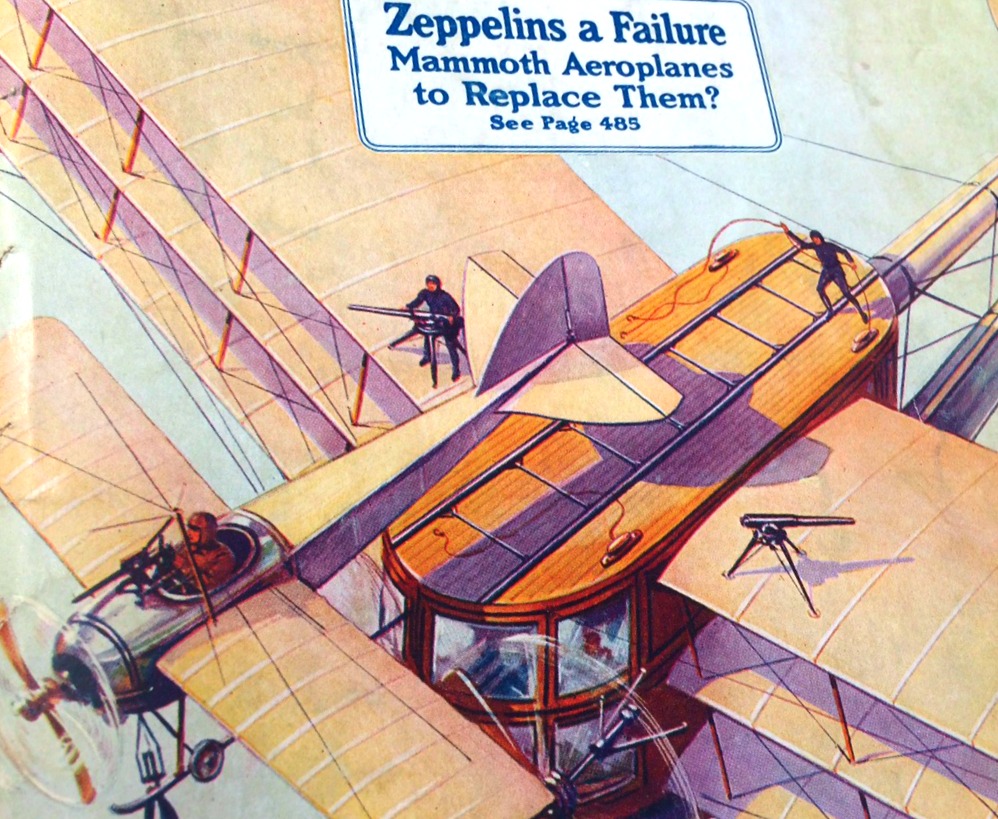
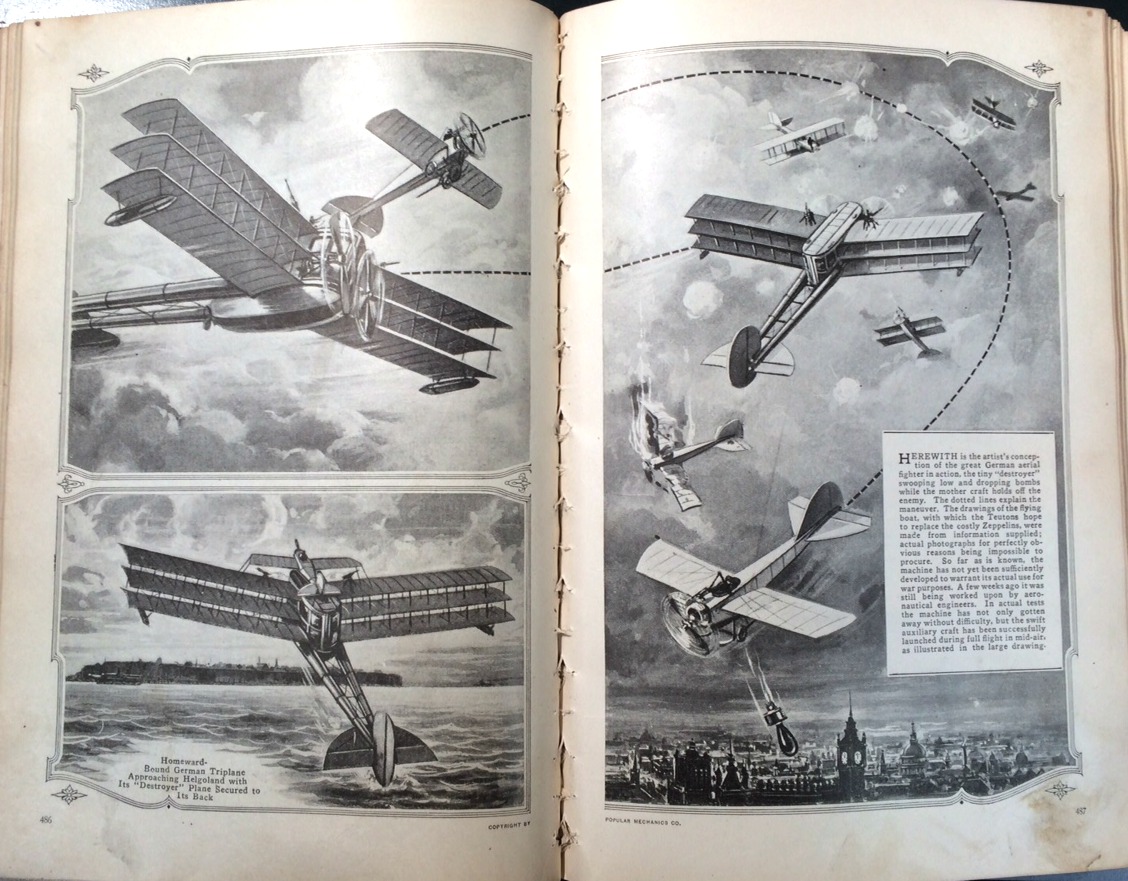
    There are two interesting and remarkable techno-military suggests in this October, 1916 issue of Popular Mechanics.  First is the cover story, a (“destroyer”) aircraft bomber is to be launched from a “battleship” aircraft for a one-two punch of carpet and strategic bombing. The large “mother ship” was to have a 143′ wingspan, making it a monster of a plane for the time. It would enough fuel and oil to keep it aloft for 48 hours, and also have a 1000-pound payload “of bombs”, and a crew of five, two of whom would be wingwalkers firing machine guns. And another plane. The smaller aircraft was “equipped with bomb-dropping devices” and was to be launched for a special raid and/or to ward off enemy attack planes. But the fly in the ointment, says the article, was getting the smaller aircraft back to the larger one–launching was no problem; landing was.  And I can see why.  

    Airplane piggyback 2

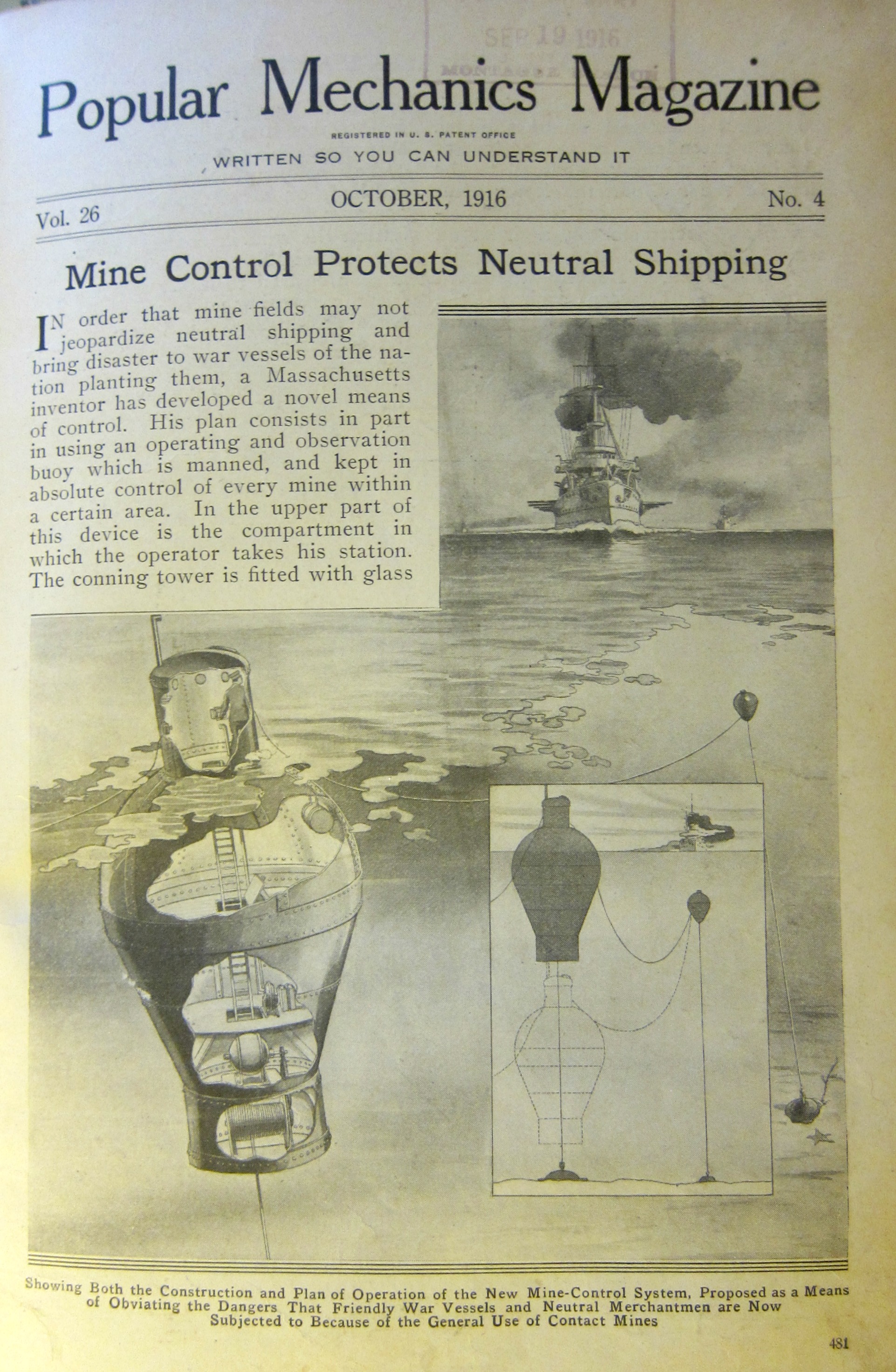
    The second article in the issue–the so-called underwater lighthouse (appearing under the far less amusing but much more informative title of “Mine Control Protects Neutral Shipping”)–was a defensive and offensive buoy-structure that would provide a very claustrophobically-unwantable job for someone. The buoy was made to control an undisclosed-number field of mines in/near shipping lanes and differentiate friendly from unfriendly ships.

    Popular MEchanics--buoy mine

    The buoy would have an observation area  from which our unlucky guardian would scan the seas; once a ship was spotted, the buoy would submerge to periscope depth, and after some time the nationality of the ship would be identified; at that point if an enemy ship is recognized the operator could submerge the buoy further (being anchored to the sea floor) via a winch to 50 or 60 feet beneath the surface, and then when the mine made contact (proximity or otherwise?) the buoy operator could detonate the mine. It was thought in this way that you could mine an area of sea and not have to worry about ships being damaged by friendly fire. The whole thing seems highly problematic to me–not the least of which would probably be a very jostling ride to the buoy operator. 

    And so two adventures in speculative military technology in one single war-time issue of Popular Mechanics.


  • A Beautiful Instrument Displaying Sound on Paper

    JF Ptak Science Books   Quick Post

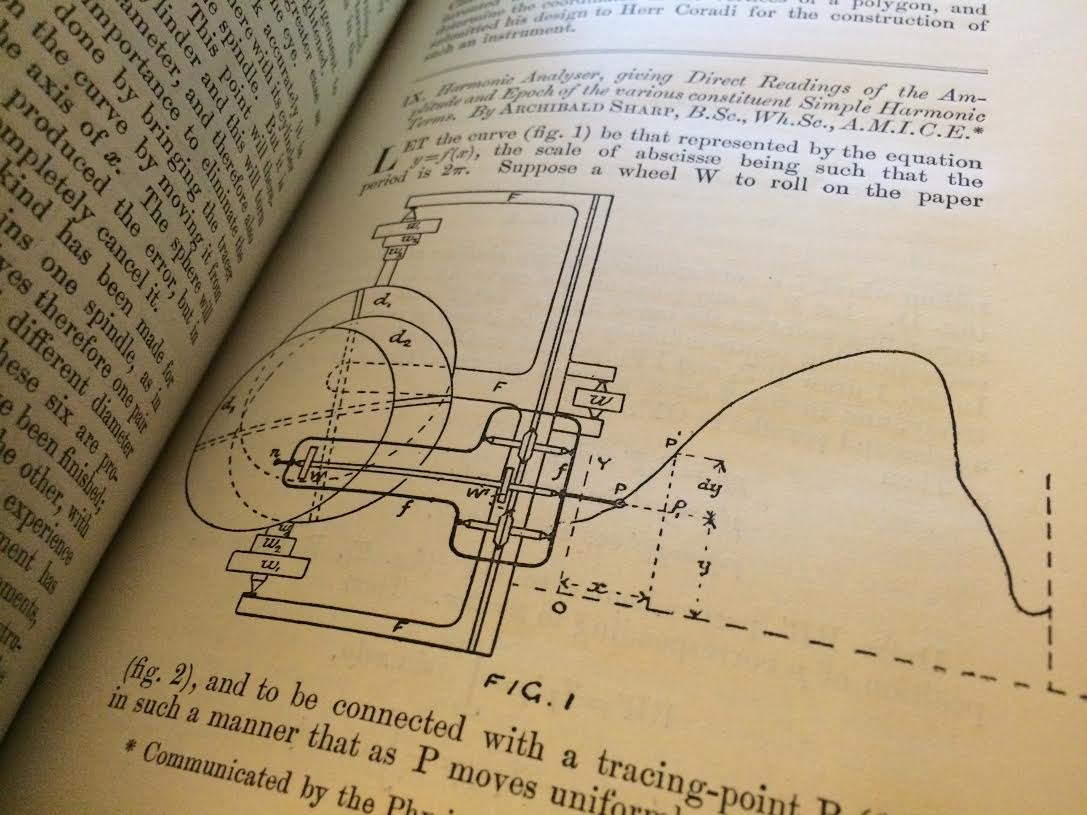
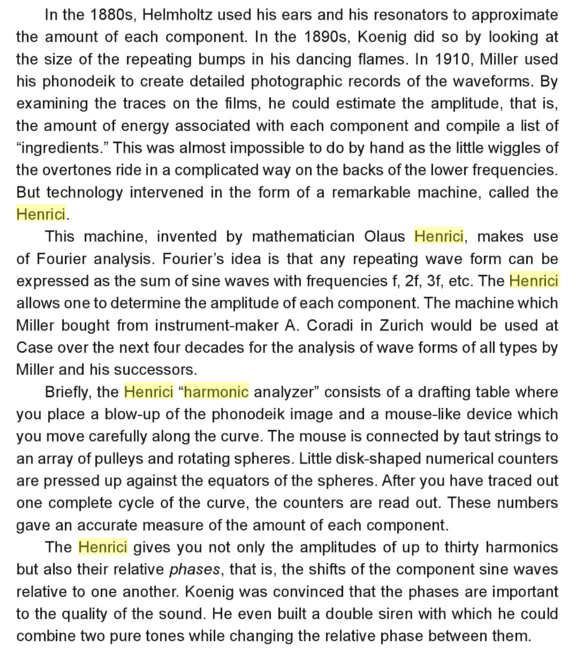
    Olaus Henrici (1840-1918) constructed a beautiful and tidy analog computer to analyze musical sound, publishing his efforts in The Philosophical Magazine in 1894.  It was a mechanical fourier analyzer, in the heritage of the harmonic analyzer/tide predicting computer of James Thomson and his brother Lord Kelvin, analyzing a traced sound waveform.  It was built upon in turn by Dayton Miller and much expanded.  

    Henrici b

    William Fickinger has this solid description in his book, [Dayton] Miller’s Waves: An Informal Scientific Biography, (2011) found on page 69: 

    Henrici

    A little more background on the harmonic analyzer and Henrici as follows:

    • Robert K. Otnes in The Oughtred Society, “Notes on Mechanical Fourier Analyzers” http://www.oughtred.org/jos/articles/V17.1_OtnesPaper.pdf  
    • Full text of the Henrici paper  from the Biodiversity Heritage Library http://biodiversitylibrary.org/item/122066#page/124/mode/1up
    • On Olaus Henrici https://en.wikipedia.org/wiki/Olaus_Henrici
    • http://www.phys.cwru.edu/ccpi/Harmonic_analyzer.html

    ·Posted by :

    ·in:


  • A Bit on the History of the Future of Sucking–Vacuum Trains (1945)

     JF Ptak Science Books   Post 2590

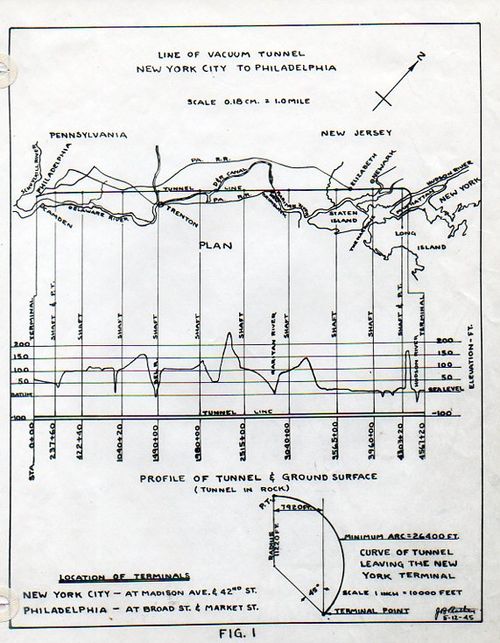
    John B. Prather launched an idea in 1945 for building a high-speed pneumatic passenger/freight train connecting New York City to Philadelphia.  His New York-Philadelphia Vacuum Tunnel, Preliminary Design Features and Economic Analysis was exceptionally hearty. The idea is interesting in a removed, lets-not-do-it-for real-way because, well, it just doesn’t seem to make sense in the long run, at least beyond the building of the thing to show that it could be done.  And I don’t doubt that could be the case–and I just don’t know why it was necessary. 
    Vacuum tunnel318

    [If you’d like to own the original report I’m offering for sale on my blog–there seems to be no others available, with no listings in WorldCat. If you’re interested see the listing follow this link or go to the general catalog and look up [TRAINS]  The Future of Sucking: Vacuum Express Train, NYC to Philly, 1945.]

    Mr. Prather’s approach seems to be the work of an engineer, or at least he had some help.  I doubt though that he had any help from a structural engineer or site geologist–his proposal was to build this tunnel 100′ down through bedrock when it could be found, a level hundred-feet  below the surface, from NYC to Philadelphia.   The tube would accommodate an aluminum-shelled  400′-long train that would be hauling 350 people and 175 tons of freight at speeds of 400-600+ mph, making the run between the two cities in about 20 minutes.  Not bad.  He figures too that all of the freight could be offloaded in 7.5 minutes.  This would make for  a very busy train, though Prather doesn’t tell us how many runs a day it would be making. This was all preliminary.

    The 16.2′-wide  tunnel would be 456,720 feet long, and would cost $173 million to excavate and $41 million to line with cement–according to the author.  The total cost for the ordeal would be about $334 million and would take 6 years, start to finish–that includes all of the tunneling, which would swallow/excavate/face 300′ per day. 

    I don’t see, really, how this could be so narrow a tunnel–I’m not an engineer but it would seem that wear, heat and the abuse and so on that a massive and dense 400′-long missile going 400+mph would require something that was more than 125% of the width of its trains. 

    There is however  precedence for a massive tunnel of something like this size being built in something like this time–the Delaware Aqueduct is 82 miles long and 13 feet wide, and was built during the Second World War (1939-1945) , so, perhaps if enough people and money were thrown at a project like the vacuum tunnel could actually be built (barring geological problems). 

    But it would all be worth it:  Prather suggests that the overall revenue from the operation of the train to be $196 million/year with $32 million in yearly operating expenses.  Which means that the whole thing could be paid for in three years or thereabouts.  So if the things was started in 1946, it would all be finished and paid for by 1956.

    I’ve looked at a number of proposals like this over the course of this blog–like almost filling up the Narrows between Staten Island and Manhattan with an airport and seaport, and making a series of transoceanic airports for flights between the continents, and dropping a gigantic shell filled with people from the top/interior of the Eiffel into a narrow hole filled with water, and covering Midtown Manhattan with a rooftop airport, and covering Midtown Manhattan with a glass-ish dome, and so on–and I know that it is good for at least one thing:  superb classroom discussion fodder of why something like this does or doesn’t make good physical/economic etc. sense.
  • “When Will We Have Television?”, 1937

    JF Ptak Science Books   Quick Post

    This is the delightful ABC of Television, published in 1937 by the sci-fi and early modern tech guru and visioneer Hugo Gernsback’s Short Wave & Television magazine–it is a separate publication in it own printed wrappers. The pamphlet includes technical basics (“fundamentals of scanning”, “mechanical systems”, “Cathode ray emission”, transmitter operation”) as well as some popular and necessary information, like “when will we have television” and a list of television stations.  (Just for the record, this publication lists 25 active stations, including low wattage stations like W2XAX, the Atlantic Broadcasting Company, in NYC at 50 Watts–there were 9 broadcasters with 150 Watts or less of the 25 listed. There’s also a list of nine other “discontinued” television stations (“experimental visual licenses and permits discontinued or expired”). The “Experimental Visual License: is a very nice turn-of-phrase.)

    Television abc477

     [If you’d like to own the original, see our books for sale section, here: https://historyofideasblog.com/books/]

    ·Posted by :

    ·in: