A Daily History of Holes, Dots, Lines, Science, History, Math, Physics, Art, the Unintentional Absurd, Architecture, Maps, Data Visualization, Blank and Missing Things, and so on. |1.6 million words, 7500 images, 4.9 million hits| Press & appearances in The Times, Le Figaro, Mensa, The Economist, The Guardian, Discovery News, Slate, Le Monde, Sci American Blogs, Le Pont, and many other places… 5000+ total posts since 2008.

Category: Technology, History of

  • The Appearance of the Landship in WWI–Welcome the “Tank”, May 1917

    JF Ptak Science Books  Post 2623

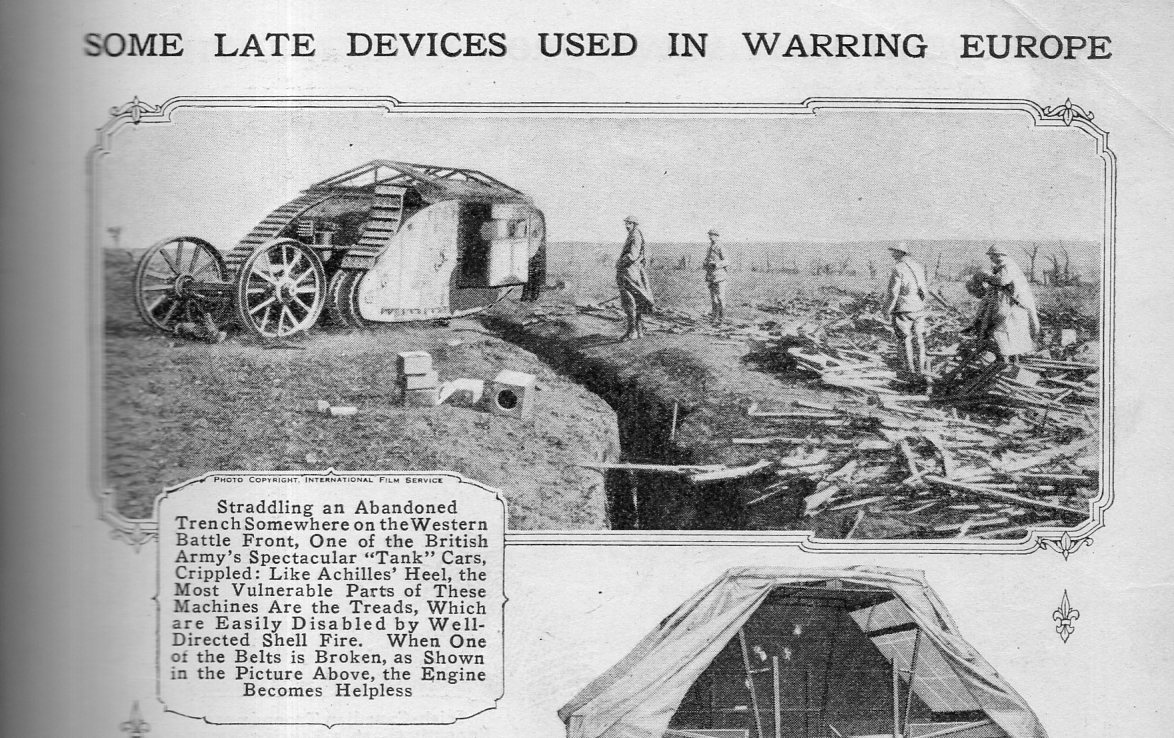
    I wasn’t looking for this–or anything else in particular–while browsing the year 1917 in Popular Mechanics, though when I came across it  and noticed that tank was in parenthesis, it occurred to me that there was good reason for that. The “tank” was brand new on the battlefield when this issue of the magazine came out in May, 1917.  The tank had made its first showing just weeks earlier in April, and had really only just come into its abbreviated name.  The committee formed in February 1915 to spearhead the development of a new armored fighting vehicle was called the Landships Committee, and as one story goes, the vehicle was called a “tank” because of its resemblance to a water tank–also, it was intended to misdirect any information going the wrong way by not referring to it as a “landship”, which would give away some of the secrecy. It should be noted too that it was the First Lord of the Admiralty, Winston Churchill, who established the committee.  So what we see here on page 683 of the May 1917 issue of Popular Mechanics is a very early photograph of the tank in a mass distribution magazine.
     

    Wwi project  tanks may 1917434

    The tank hit the battlefield pretty hard, and it evidently took the Germans by surprise–they certainly captured many more tanks than they produced, by far. During the war, from 1916-18, Germany produced only 20 tanks.  In that same period, the U.S. produced 84, while the French constructed nearly 5,000 and Great Britain 3,800 or so.  Germany was completely unprepared for heavy armored mobile combat–that would be a completely different story by 1939.  

    I’ve attached a photo of German soldiers with captured British tanks being hauled away on railroad flatbeds–no doubt these were photographic postcards.  Seems to me highly plausible that Germany would employ more captured British tanks on the battlefield than they would German-made tanks. 
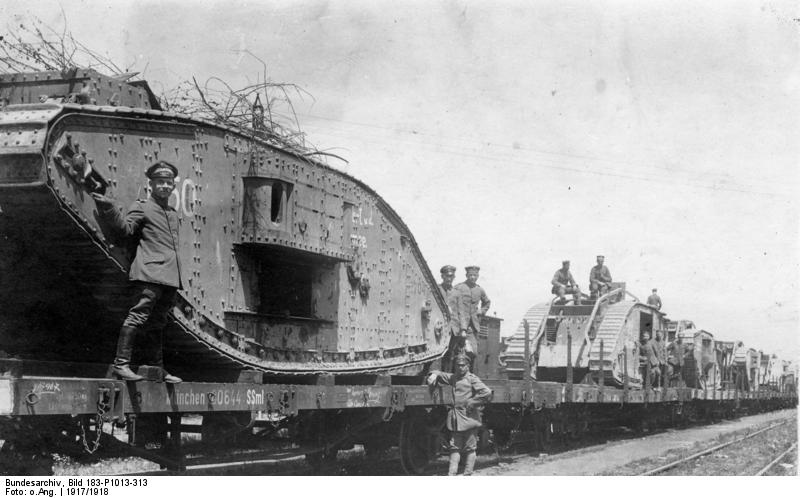
    Wwi project tanks captured
    [Source: wiki source– https://en.wikipedia.org/wiki/Tanks_in_World_War_I#/media/File:Bundesarchiv_Bild_183-P1013-313,_Westfront,_erbeutete_englische_Tanks.jpg]
     
    Notes
     
    See this interesting table on tank production for WWI: http://landships.activeboard.com/t35439129/total-number-of-tanks-usedproduced-per-nation-1916-1918/

    ·Posted by :

    ·in:

    —

  • Finger-tip Lights for Theater Ushers, 1917

    JF Ptak Science Books  Quick Post

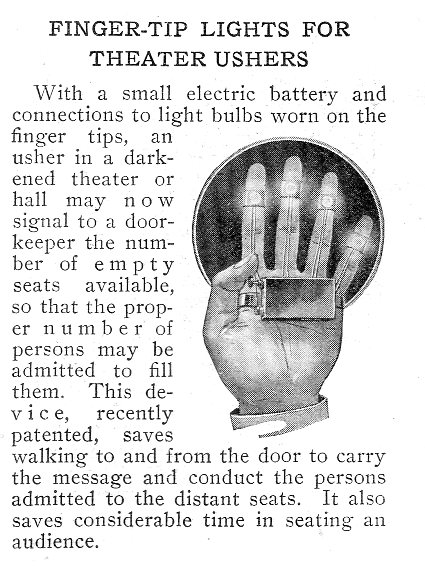
    This invention/innovation looks coy and sweet today, but it actually addressed an issue in 1917.  This was the year that “Hollywood production” in movies really begins, though there was already an explosion of movie houses in the U.S., “Hollywood” or not. Cinemas were plentiful and packed, and from the numbers I’ve seen already in 1917 50% of Americans were going to the movies several times a month–this number would top out in the 30’s when it approach nearly 70%.  So ushers standing at points throughout a movie house finding stray seats for people being held back by the doorman could have signaled the number of available seats with his lighted fingers, and moved the waiting line along more quickly than a lot of whispered back-and-forth strolls around the house. 

    Inventions finger tip431

    Popular Mechanics, April, 1917, p. 525, 

    ·Posted by :

    ·in:

    —

  • Cars of the Future (1942)

    JF Ptak Science Books   Quick Post

    Your victory car389

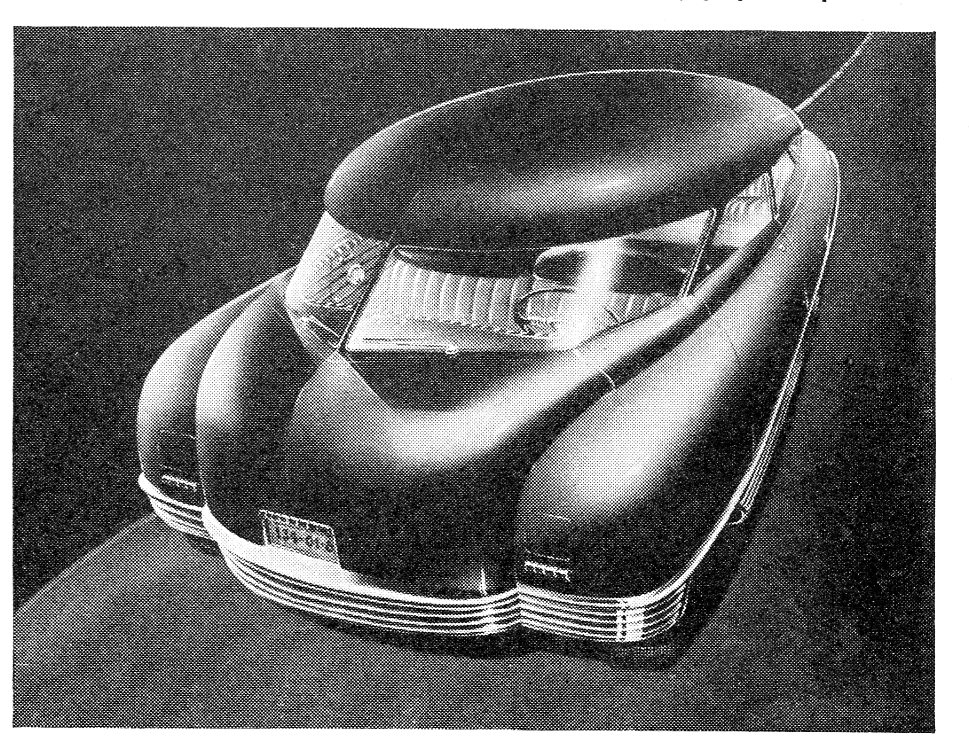
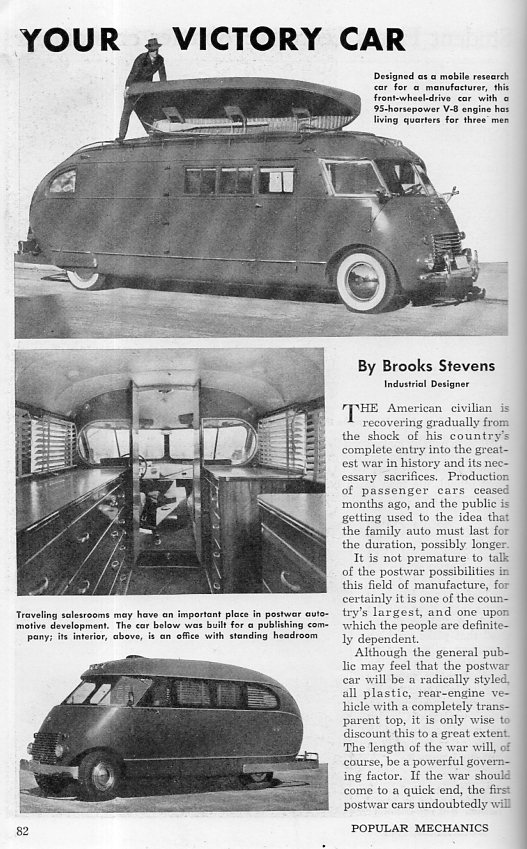
    This article comes from a volume of Popular Mechanics that I have been enjoying for a few days now.  “Your Victory Car”, written by Brooks Stevens for the December 1942 issue, discusses a vision for the future, a nod to “normalcy” at a supremely difficult time in the world history of the 20th century. Car design went off in another direction, of course–a lot of what we see in these pages looks like offshoots of the Fuller Dymaxion car from a decade or so earlier–though some of the ideas present here (more streamlining, lighter design, smaller engines) wound up in cars in the future…it is just that the cars didn’t quite look like these cars.  

    Your victory car385


  • Cross-sections: U.S.-Built R.A.F Fighter Aircraft, 1942

    JF Ptak Science Books   Quick Post

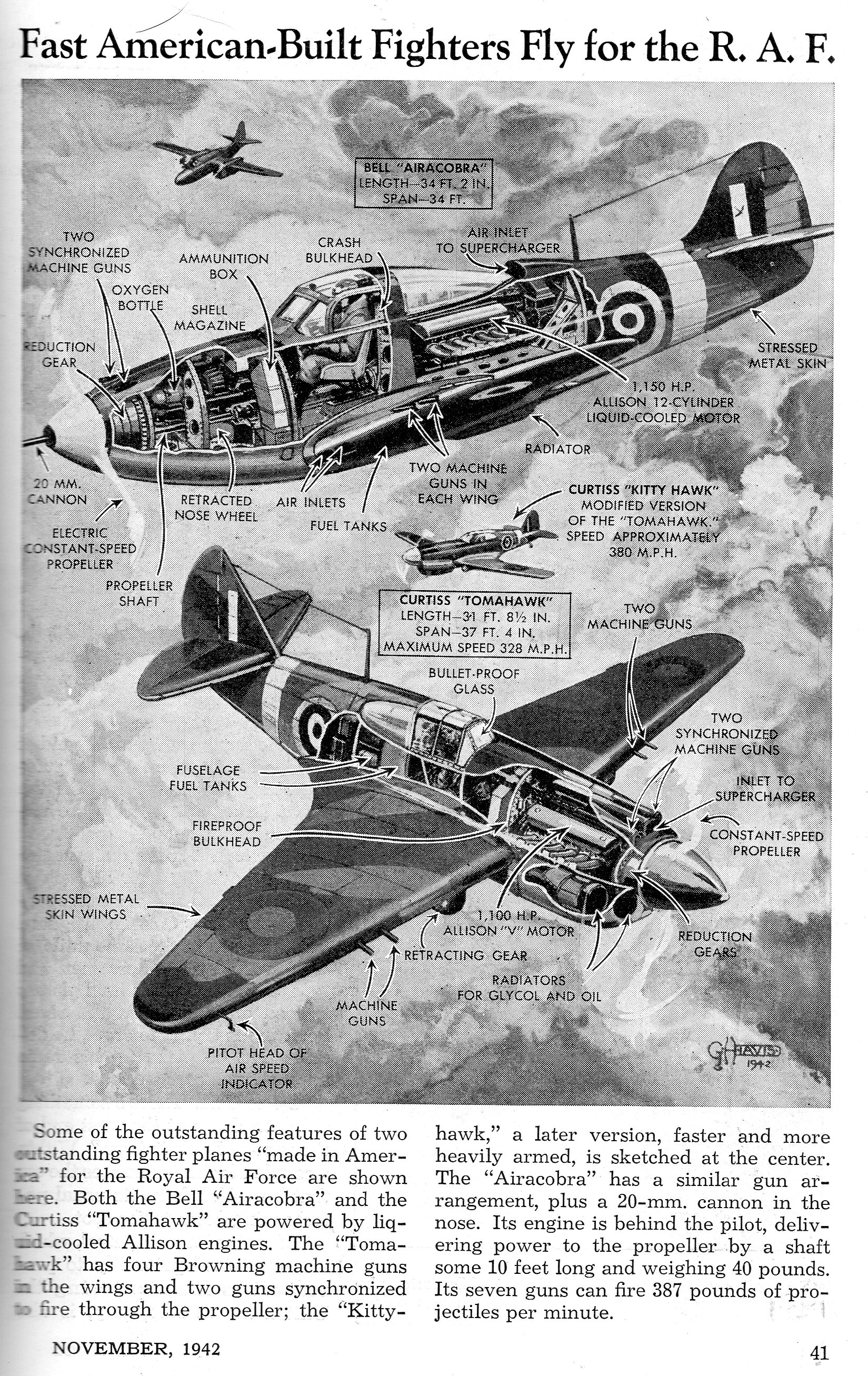
    Here’s an interesting cross section by the great and invaluable George Horace Davis, appearing in the November 1942 issue of Popular Mechanics, page 41.  I’ve noted elsewhere that Davis reminds me of Thomas Nast, in a way–his output was enormous and workmanship wonderful, seemingly publishing drawings like this every few weeks, if not more frequently, reminiscent of the fantastic production of Nast. I can only imagine that Davis was seeing most of the detail in his memory rather than referring endlessly back-and-forth to references–I don’t know that this is so, but it does make good sense.  (For other work by Davis, just enter his name in the google box for his blog appearances.)

    WWII american built fighters384


  • Industrial Depth: Unexpected Industrial Photographs (ca. 1910)

    JF Ptak Science Books  Quick Post

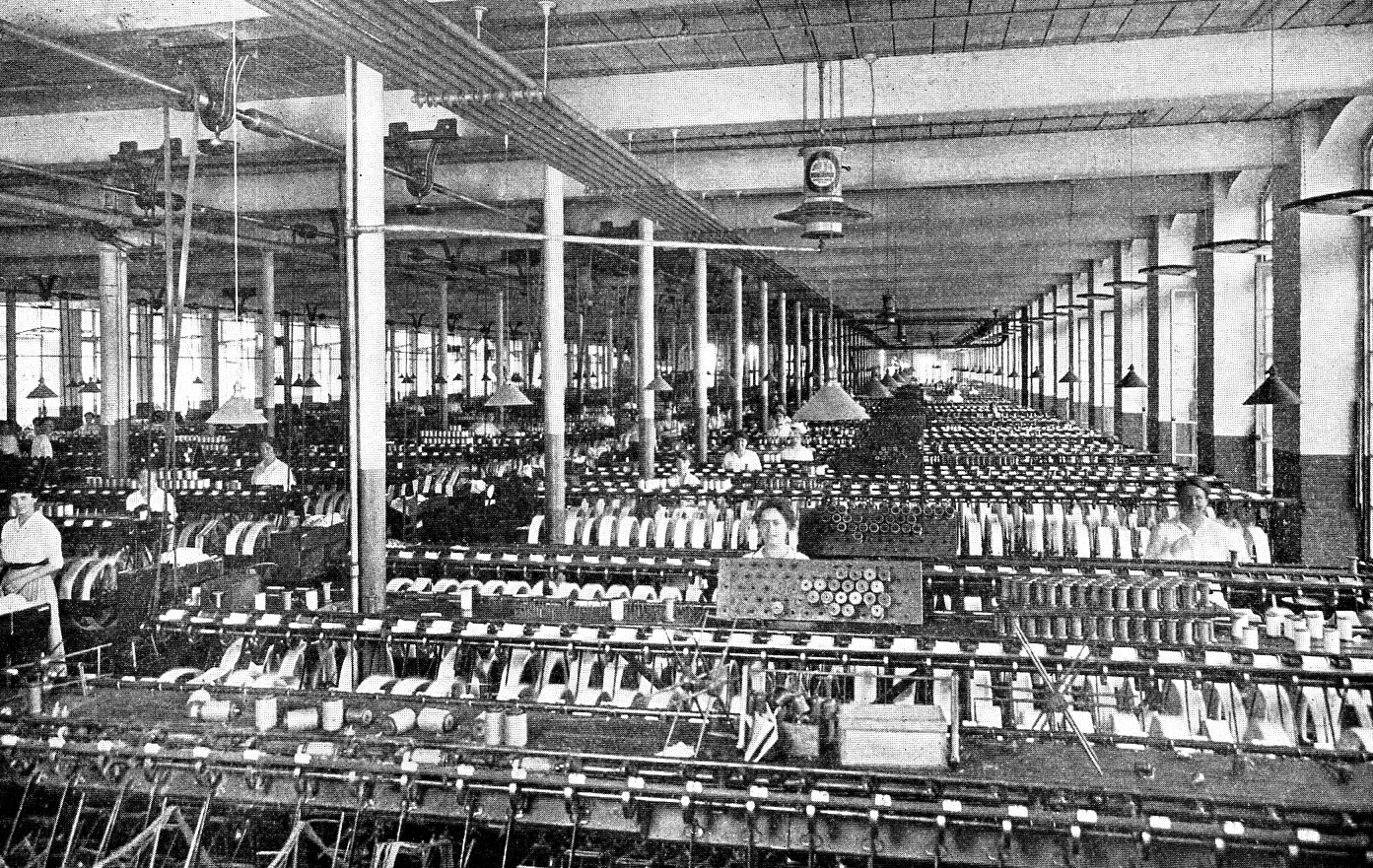
    The following photos are from a pamphlet entitled The Miracle Workers, a product of the Cheney Silk Company, extolling more the virtues of the considerable workforce and their living conditions more so than the product. My guess is that the pamphlet (with no publishing info) was printed around 1910, evidently when the company was coming towards its zenith after having been in business for 40+ years.  I thought it would be worthwhile to share industrial/production images from uncommon sources like this one–especially since the “wrapper” holding the text wouldn’t necessarily invite a reader inside.  In any event, here are the few photos dealing with the interior of the factory, though there are others (like the one showing a worker’s lunch room) that show the school, and church , and other such social buildings that were constructed for the workers by the company.  It seems that the company had an unusual trajectory–getting a boost during the Civil War by producing the famous Spencer Rifle, then concentrating on the silk business, and then after suffering through the Depression and the failure of the silk market selling itself off to a company in teh 1950’s that switched gears from silk to velvet


    Siilk factory364


  • Cover Design and Industrial Art (1941)

    JF Ptak Science Books   Quick Post

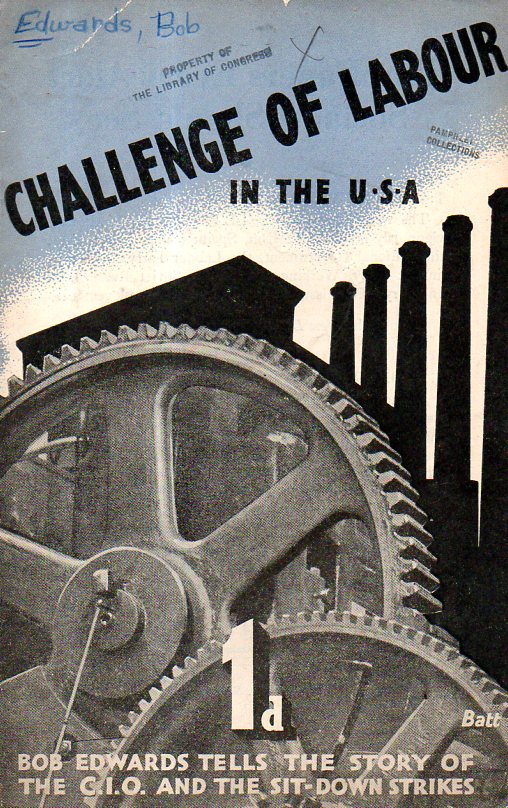
    I don’t mean to trivialize the contents of this pamphlet by focusing solely on its cover design, but I guess that is what I am doing, not having any real interest in the content. That said, the work is by Bob Edwards (1905-1990) who led a long and very interesting life as a union person, labor organizer, Socialist, MP, and a fighter against the Fascists in the Spanish Civil War. (He was also the author of another interesting pamphlet that appears elsewhere on this blog on the British chemical industry in 1944 and its “Nazi associates” https://historyofideasblog.com/thesciencebookstore/2014/09/superior-cover-design-chem-industry-nazism-and-race-suicide-1944.html).  In this present pamphlet Edwards looks at the history of the CIO “and the sit-down strikes” while concentrating on its role in the U.S. during WWII. This is pretty dicey stuff (as John Lewis would discover when his vehement pro-Union and non-interventionist/Isolationist policy proposals was defeated by his membership) and rubbed up the wrong way against U.S. defense and war policies. But Edwards was looking for something different, writing in this pamphlet well deep into (the U.K.’s) WWII about the need to change capitalist industry in the U.S. and a “REVOLUTIONARY OCCUPATION OF INDUSTRY” (caps in the original) to be achieved through “Workers Power and Socialism”, all of which would probably not play all that well int eh U.S. at this point. (It is unclear exactly when in 1941 this pamphlet was published, but I assume it is probably after the Nazis ended their cordial entente with the Soviet Union.) 

    Anyway, there is an interesting history of sit-downs in the pamphlet–I still like it more for its cover, though. 

    Challenge of labor273


  • L O S T at Sea and Waiting to be Saved (1877)

    JF Ptak Science Books  Quick Post

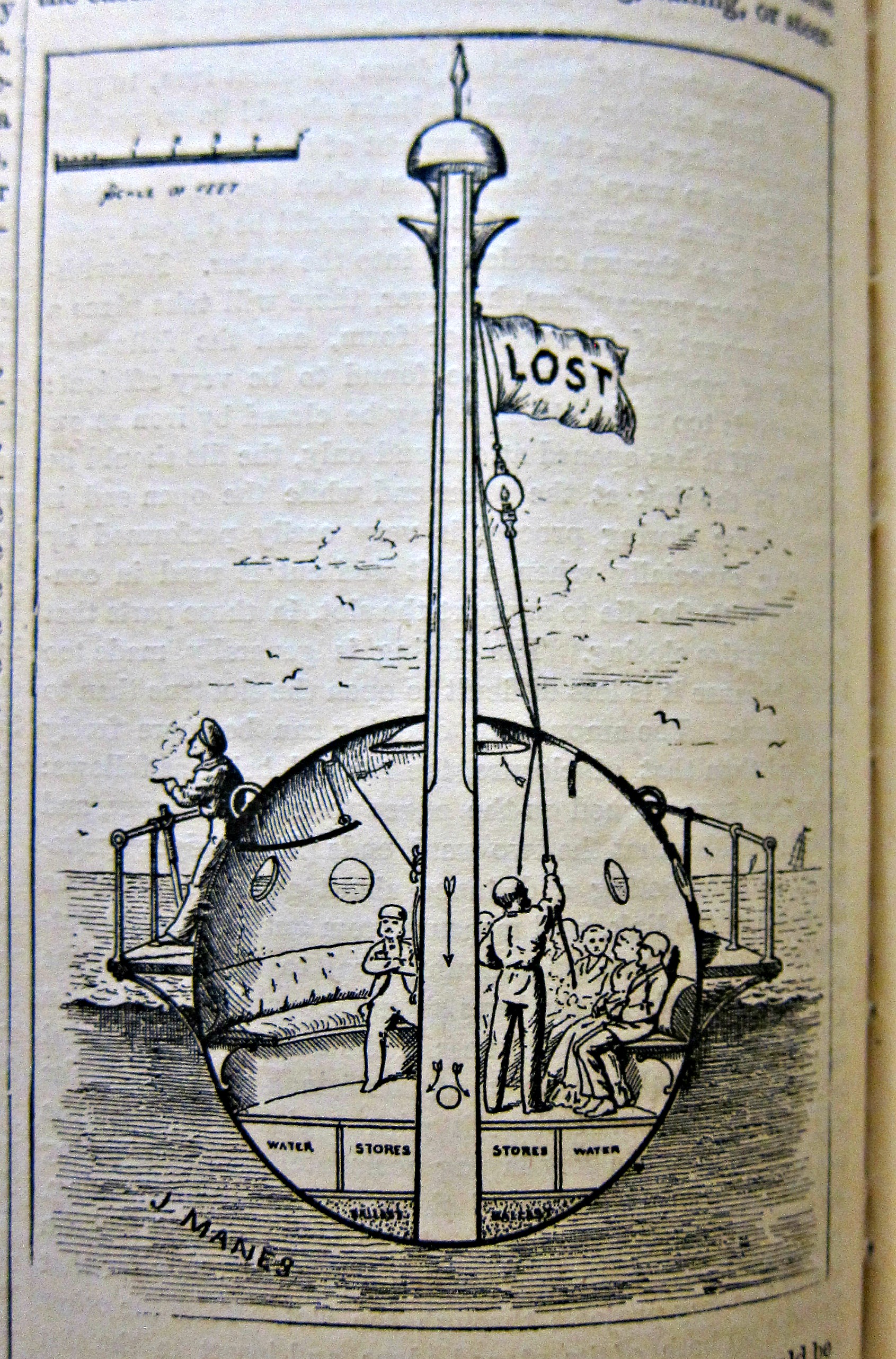
    I’ve seen a number of novel life boat/vehicles in my travels through patent office records but never really made note of them, which is too bad.  They can be pretty interesting in an oddly shared way with 19th century coffin designs and other mortuary patents–specifically the ones having to do with the dead should they find themselves fortunately/unfortunately resuscitated in their sleeping chamber underground. As a matter of fact some of the coffins were equipped with a small belled spire with a wire that went down into the coffin and wrapped around the hands of the dearly departed.  So, in the event of premature burial, the undead dead would simply need to move their hands and sound a bell or raise a flag. In any event, that is what came to mind when I saw this image in the Scientific American for August, 1877:

    Sci Am life boat lost

    This floating sphere was ballasted so that it would remain upright even in a heavy sea, and looks as though it could carry 10 or 15 people. It came complete with mast and flag, and a wrap-around walkway, and as you can see it is being used in the image by a man having a smoke.  

    The “Lost” sign seems to be a little redundant. 


  • Disk-Dirigible Star Trek “Enterprise”, 1932

    JF Ptak Science Books  Quick Post

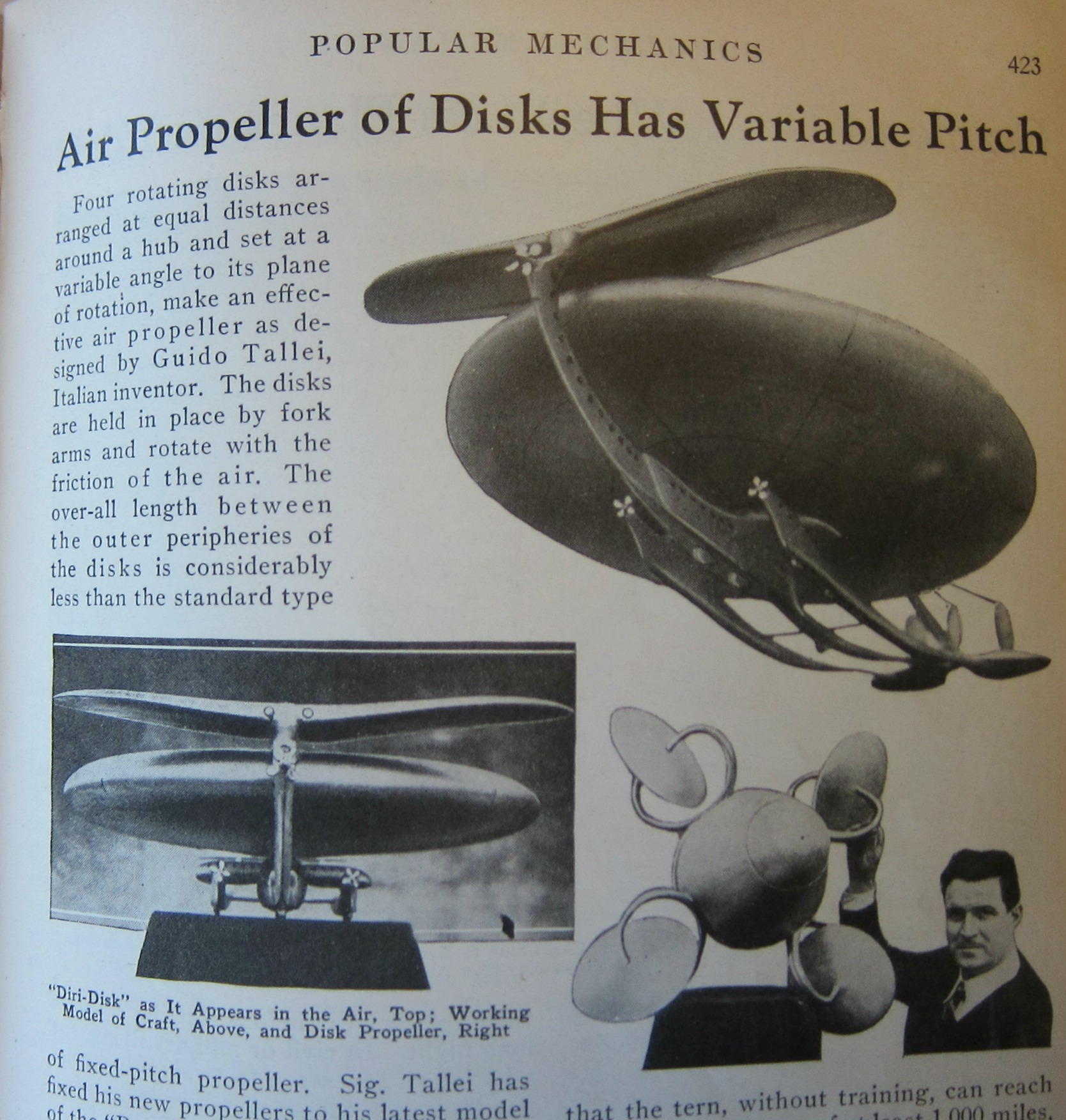
    An indulgence: I’ve posted a few things on this site of old and/or found tech that reminds me of the USS Enterprise (NCC-1701-D). Here is one that popped up in the pages of Popular Mechanics for May 1932–an airship designed by Guido Tallei that was effectively a flying saucer, a dirigible-disk. There was another design from him from 1931 that was similar to this except that it looked a LOT like a sleek underwater-swimming penguin.  


    Enterprise flying disk 1932April, 1932, Popular Mechanics


  • Reverse Catapult Landing System for Airplanes, 1932

    JF Ptak Science Books   Quick Post

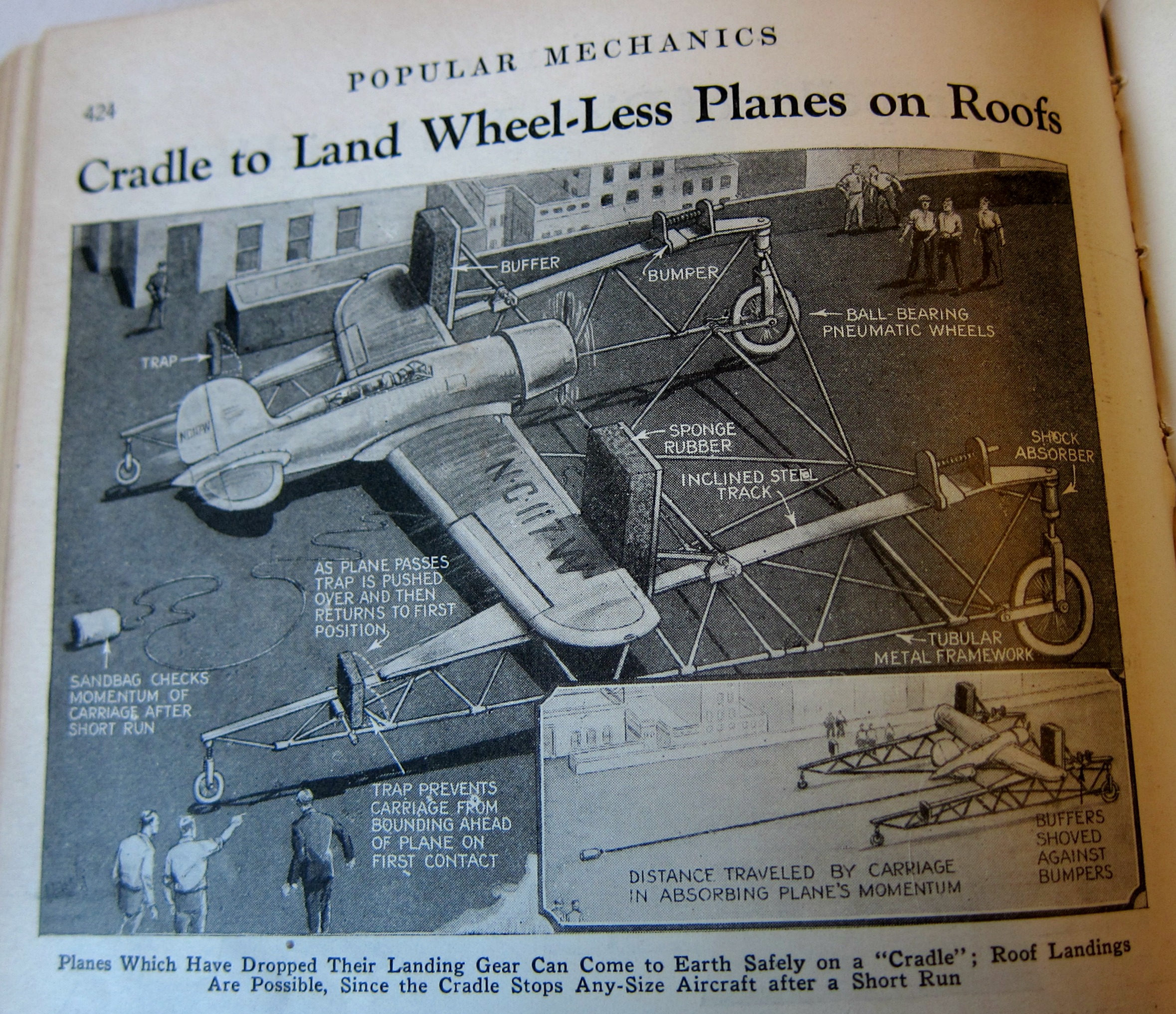
    There’s a certain attraction to relieving an aircraft of the weight and drag of landing gear–except for the actual “landing” part of the aircraft, which becomes more, well, difficult, without wheels. Except of course when you have an apparatus like that below, something to basically catch the aircraft. For the sake of fuel economy the idea of getting rid of wheels and other landing gear made the cover of this Popular Mechanics issue for March 1932. The apparatus was supposed to be able to (safely) stop an airplane in the space of 40′, which no doubt would have interested the U.S. Navy if such a thing worked with damaging the airplane or the pilot. I really don’t see how the thing could have possibly worked, even with the helpful image in the text of the thing being a “reverse catapult”. Still, publishing such stuff may have given someone an idea for something else–some bit or insight in this apparatus may have come in handy for someone else working on something entirely different, as is sometimes the case with Outsider ideas.

    Reverse catapault b


    Airplane reverse catapault


  • A Paper Internet of 1932

    JF Ptak Science Books   Post 2605 

    Paper interrnet145Before the internet the idea to the idea of the internet existed to some extent in the head of a great unsung hero of the U.S. WWII figure, Vannevar Bush, a person who may well have invented the notion of hypertext.  Vannevar (pronounced “van ee var”) was a flinty no-nonsense New Englander who was an organizational and mechanical genius who as a professor at MIT developed a remarkable analog computer that greatly advance computation capacities for solving differential equations.  This was in the 1930’s, and even after creating an improved electromechanical version of the machine still chose the wrong way to go in the soon-to-materialize digital computer revolution. During WWII Bush was one of the most important Americans in the war effort, overseeing the entire scientific effort of the U.S.—an enormous effort dispatched beautifully (and successfully).  His importance in this regard is difficult to overstate. He also published a short paper on the hypertext idea in an article in The Atlantic in 1945.

     The article, “As We May Think”, outlined his idea for a device he called the MEMEX (“memory” and  “index”), which compressed and organized all that its user could remember and whatever information would be obtained in the future via electromechanical apparatuses, and available with associative tracking between the microtext frames.  So all manner of book and papers and reports and newspapers and images would be microphotographed and stored in a beautifully-indexed mechanical retrieval system where it would live with the information of others.  There was also the possibility of real-time textual additions to whatever it was that was retrieved, the genetic precursor of hypertext.  Bush’s thinking has been deeply recognized (and also by the creators of the internet) as the intellectual grandparent of the modern internet. 

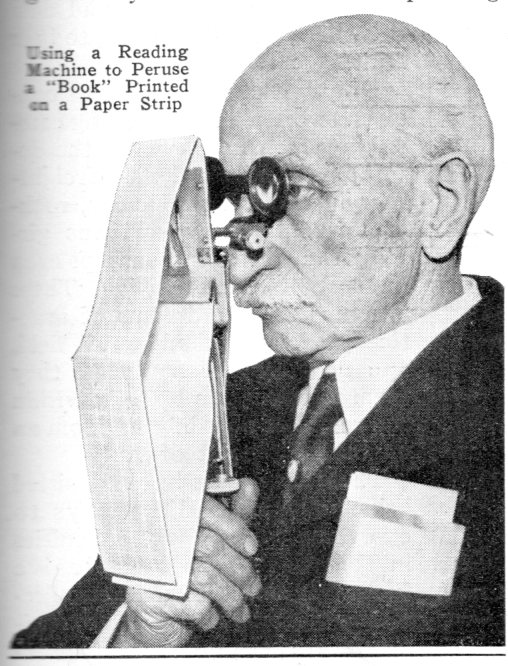
    And so I had a mostly-comical response to the image that I found (left) in the pages of the March 1932 issue of Popular Mechanics–it was actually on the back of the page that I was looking for (on passenger rocket travel across the Atlantic).  With Bush in mind, this image of a man reading a miniaturized book using the system of Rear Admiral Bradley A. Fiske (1854-1942), and the photo shows the reader with the equivalent of a 100,000-word novel.  The article only mentions this one book, and doesn’t venture out into imagining anyone carrying a library with them, nor does it mention searches of organizing systems, but it does bring to bear the possible power of having access to a vast amount of info held on a strip of paper about the size of a newspaper column.  And for 1932, that was a strong idea.