A Daily History of Holes, Dots, Lines, Science, History, Math, Physics, Art, the Unintentional Absurd, Architecture, Maps, Data Visualization, Blank and Missing Things, and so on. |1.6 million words, 7500 images, 4.9 million hits| Press & appearances in The Times, Le Figaro, Mensa, The Economist, The Guardian, Discovery News, Slate, Le Monde, Sci American Blogs, Le Pont, and many other places… 5000+ total posts since 2008.

Category: Technology, History of

  • A Flying Aircraft Carrier, 1942

    JF Ptak Science Books   Quick Post

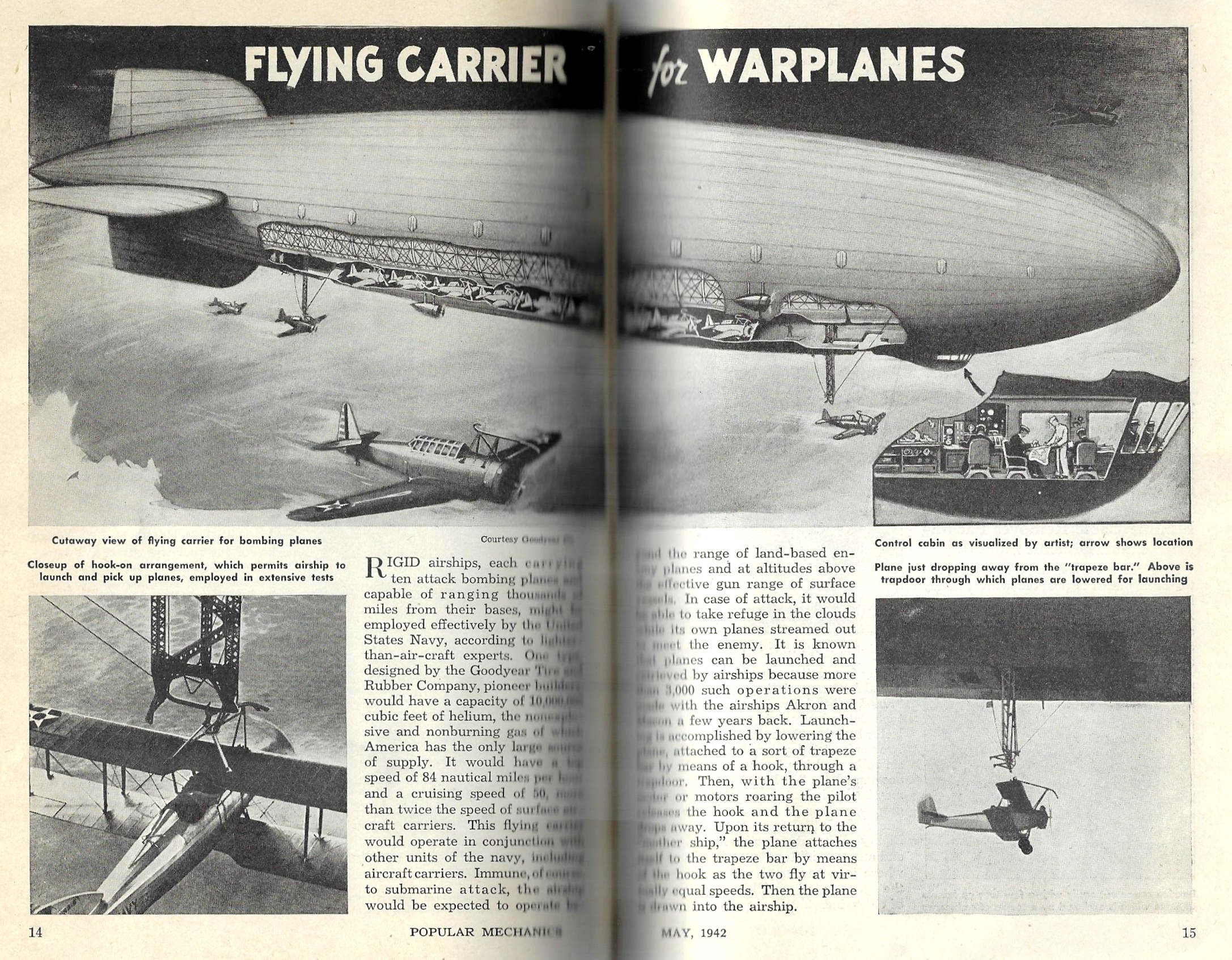
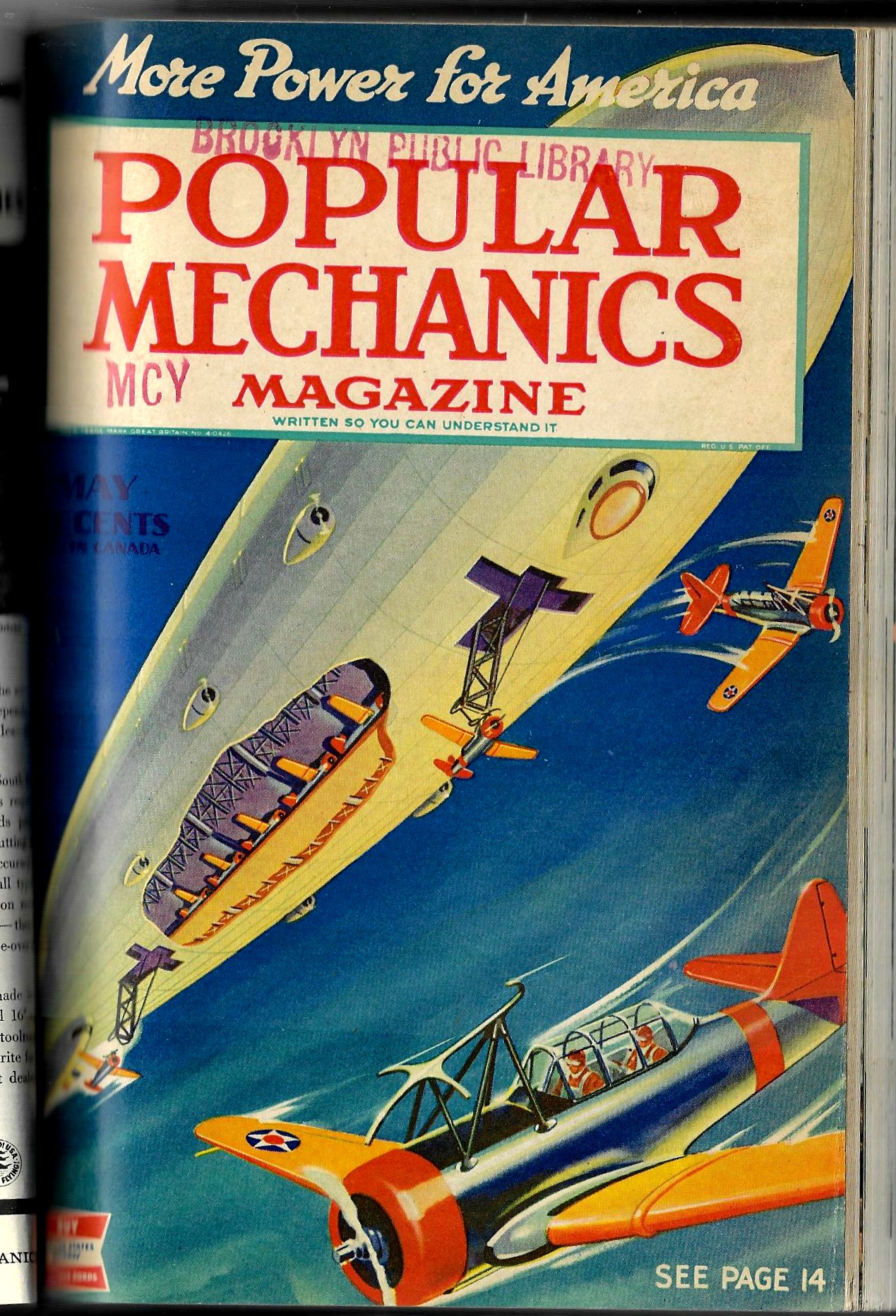
    Here’s an interesting idea: the flying, floating, helium-filled rigid-airship to serve as a flying aircraft carrier, and it appeared in the May 1942 issue of Popular Mechanics Magazine.  That places the idea in print six months after Pearl Harbor, when the U.S. was gearing up for its own direct involvement in WWII.  At the time of the attack at Pearl, the U.S. had 7 carriers; from this point out (from May 1942) to the end of the war there would be 16 more aircraft carriers constructed, plus another 33 escort carriers and light aircraft carriers, and of course those were all seaborne–and in addition to everything else that was being manufactured, that was a huge achievement.

    One thing the article points out that is an unimpeachable positive for the rigid airship carrier–they were not threatened by submarines. 

    Pop Mech 1942 May dirigible airplanes

    And the cross section giving a clearer idea of what is going on in the airship: 

    Pop Mech 1942 May diribible cross section

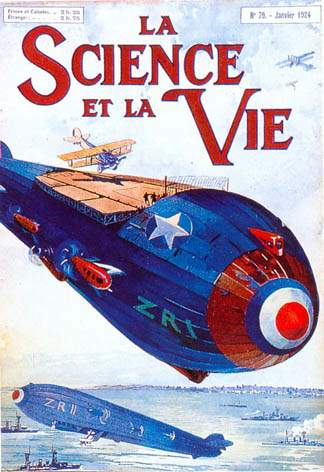
    And another, far more awkward variation, from 1924–this has little to do with the idea above though it is somewhat related:

    https://historyofideasblog.com/a/6a00d83542d51e69e2012875ea3636970c-pi


  • A Peek at the Future in Which Jobs Are Not Threatened by Machines (1940)

    JF Ptak Science Books  Quick Post

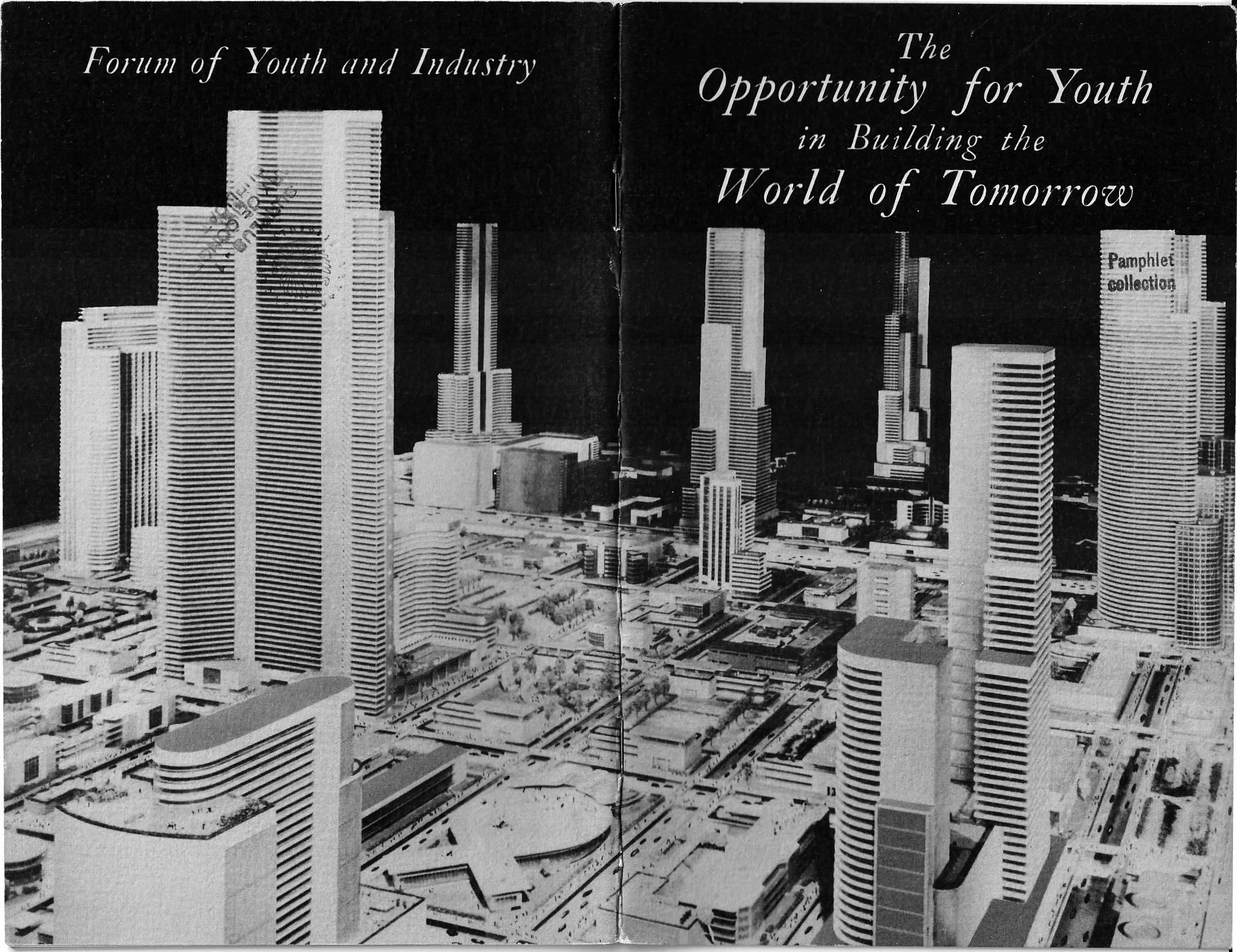
    Book covers world future architecture opportunity youth

    This is the front and back cover of a little work directed at upper-aged kids in 1940 about how they might be employed and what life might be like in the future.  The Opportunity for Youth in Building the World of Tomorrow, published by General Motors in 1940, is a lot more sanguine and less interesting than its cover, sorry to say–but the cover is enough to reprint here, all on its own.  

    There is one odd thing, one missed peep into the future, and it is made by a great figure in the history of 20th century science, Karl T. Compton, who at the time was president of MIT. He responded to a question about the impact of mechanization in a short section labeled “Man vs. Machine”. Dr. Compton got a lot right in his life and saw a lot of things that other people didn’t or couldn’t, but in 1940, he couldn’t see very far into the future of the machine.  Of course there’s a particular irony with this vision and what would happen with humans v. robots at GM.  So it goes. 


  • The Greatest Traffic Machine Ever Built (to 1936)

    JF Ptak Science Books  Quick Post

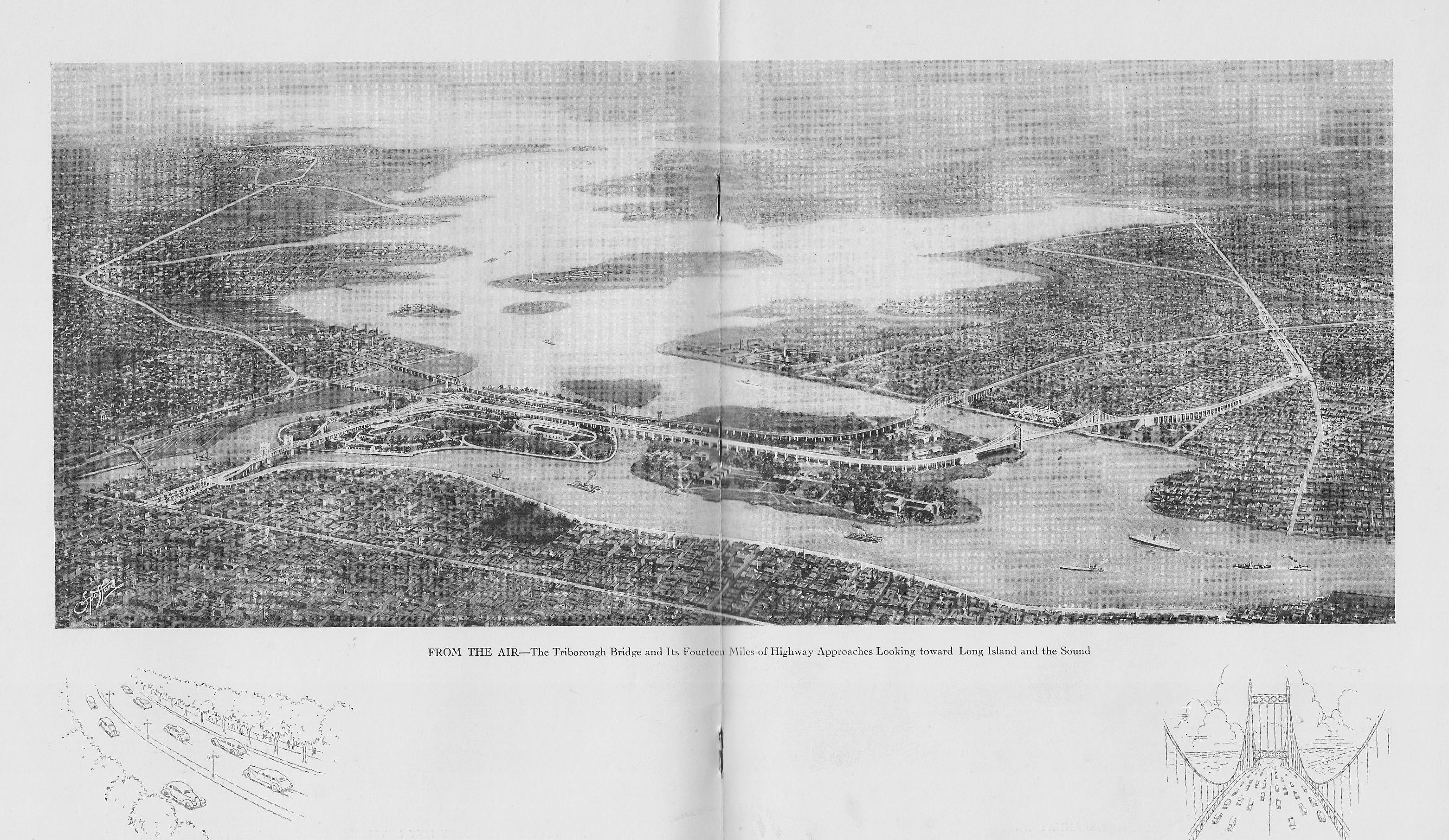
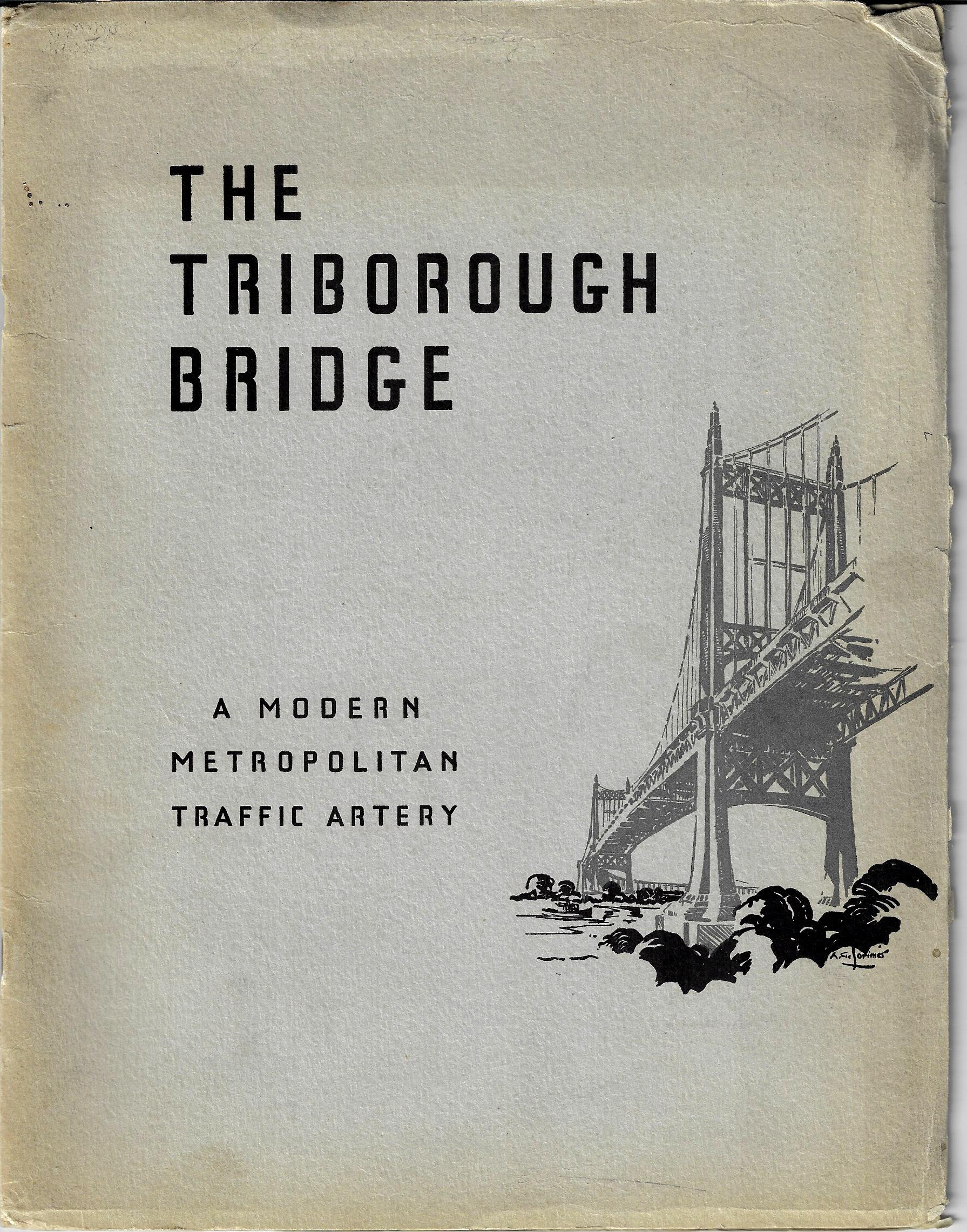
    This is a bird’s-eye view of part of NYC illustrating a pamphlet on the construction of the Triborough Bridge1, and published in the month of its opening in 1936. The view shows its 14 miles of approaches plus the bridges themselves, all stretching out to the southeast. The perspective here shows the Queens approach at the bottom right, the East River spreading out before us, with Flushing Bay at right; the middle island is Riker’s, and the two smaller island with the bridge and connections in the foreground are Randall’s and Ward’s, and the land receding into the distance is part of the Bronx and then on to Long Island. Overall, it is a pretty interesting map. 


    Triborough bridge

    .The Virginia Commonwealth University Social Library site quotes two paragraphs from Robert A. Caro’s The Power Broker which provides a good insight into the breadth and depth of the bridge project: 

    “Here was a project to kindle the imagination. In size, its proportions were heroic. For all Moses’ previous construction feats, it dwarfed any other single enterprise he had undertaken. Its approach ramps would be so huge that houses – not only single-family homes but also sizable apartment buildings – would have to be demolished by the hundreds to give them footing. Its approaches, the masses of concrete in which its cables would be embedded, would be as big as any pyramid built by an Egyptian Pharaoh, its roadways wider than the widest roadways built by the Caesars of Rome. To construct those anchorages and to pave those roadways (just the roadways of the bridge proper itself, not the approach roads) would require enough concrete to pave a four-lane highway from New York to Philadelphia, enough to reopen Depression-shuttered cement factories from Maine to the Mississippi. To make the girders on which that concrete would be laid, Depression-banked furnaces would have to be fired up at no fewer than fifty separate Pennsylvania steel mills. To provide enough lumber for the forms into which that concrete would be poured, an entire forest would have to crash on the Pacific Coast on the opposite side of the American continent.  Triborough was not really a bridge at all, but four bridges which, together with 13,500 feet of broad viaducts, would link together three boroughs and two islands.”

    “Triborough was not a bridge so much as a traffic machine, the largest ever built. The amount of human energy that would be expended in its construction gives some idea of its immensity: more than five thousand men would be working at the site, and these men would be putting into place the materials furnished by the labor of many times five thousand men; before the Triborough Bridge was completed, its construction would have generated more than 31,000,000 man-hours of work in 134 cities in twenty states. And the size of the bridge is also shown by the amount of money involved. With $5,400,000 already contributed by the city and $44,200,000 promised by the PWA (Public Works Administration), the amount promised for its construction was almost equal to the combined cost of all the projects Robert Moses had built on Long Island during the previous ten years.”  Quote source:  http://socialwelfare.library.vcu.edu/eras/great-depression/triborough-bridge-dedication-1936/

    Triborough bridge pamphlet

    Notes:

    1. “The Triborough Bridge, known officially as the Robert F. Kennedy Bridge since 2008…is a complex of three separate bridges in New York City. The bridges connect the boroughs of Manhattan, Queens, and the Bronx via Randalls and Wards Islands… The bridge complex … connects with the FDR Drive and the Harlem River Drive in Manhattan, the Bruckner Expressway and the Major Deegan Expressway in the Bronx, and the Grand Central Parkway and Astoria Boulevard in Queens…”–Wiki https://en.wikipedia.org/wiki/Triborough_Bridge


  • The Highways of Tomorrow 1937 (and 1938)

    JF Ptak Science Books    Post 2701

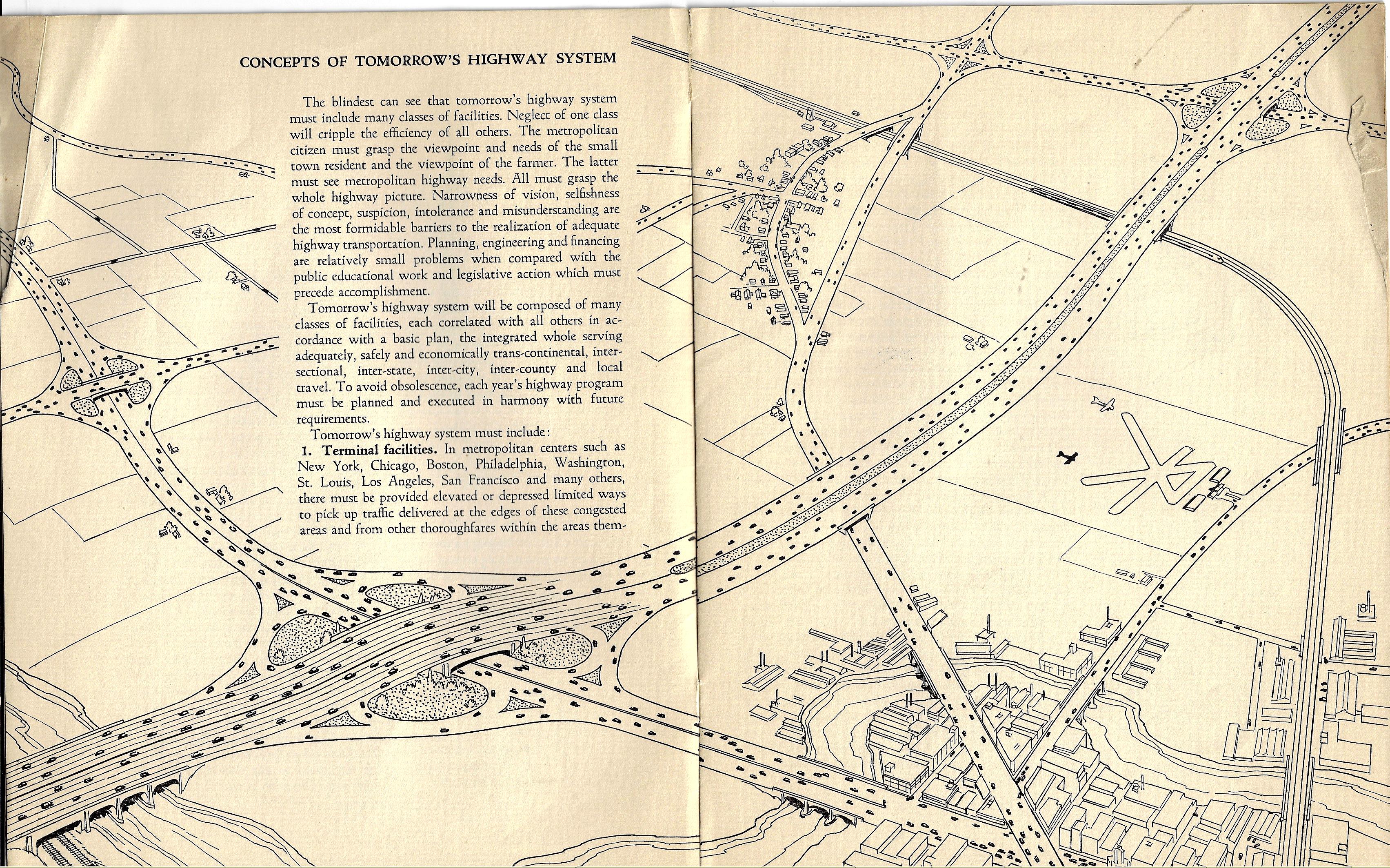
    The future–as presented in the following two pamphlets–was coming, and it was guided on a 100′-wide flat ribbon of cement, with a life-blood moving along it at 45 mph.  It is presented by Frank Sheets (president of the American Association of State Highway Officials), and the world looked like the cement that would be produced and purchased from the publisher of this pamphlet, the Portland Cement Company. And they’d be right, there would need to be something for the exploding auto market to get to and fro on the expanding horizon of city- and suburb-spread. To that end there exists in this work a proposal for 3 million miles of highways at a cost of $57,000,000,000, which was equal to about 75% of the entire budget of the U.S. government. It was a big plan–the proposal itself can’t be found in the pamphlet.
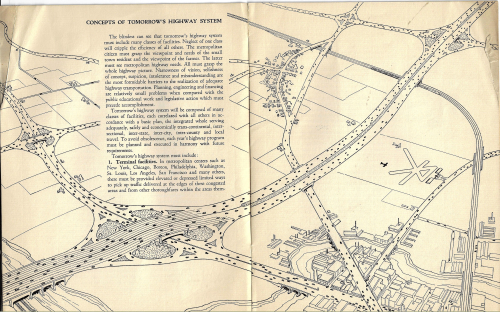
    Highway of the future

    [Source: Frank T. Sheets, The Highway of Tomorrow, Delivered at the Annual Meeting of the Greater New York Safety Council at Hotel Astor in New York City, April 14, 1937.] 

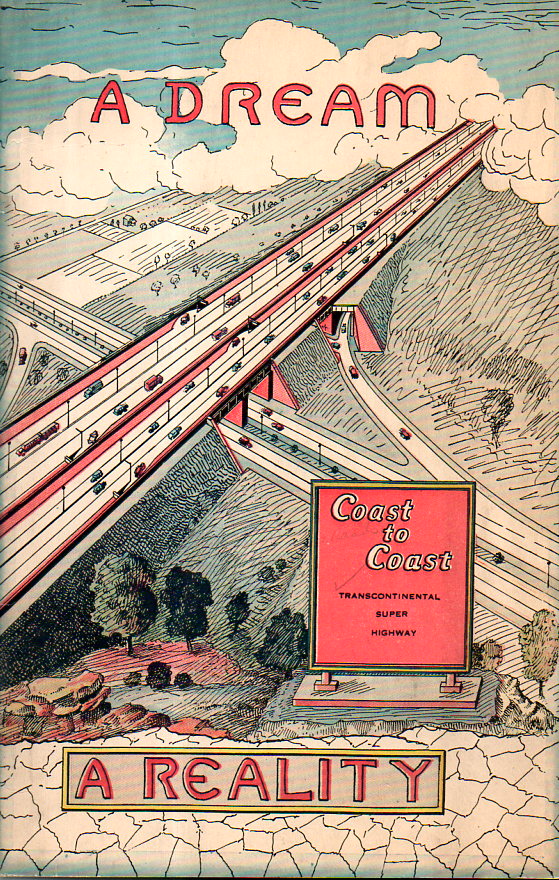
    Another vision of the future A Dream, a Reality” and/or “Coast to Coast Transcontinental Super Highway isn’t actually the title of this work even though they are on the cover; it is mostly a caption for an interior image though it somehow percolated topside.  The real title is The Highway of Tomorrow made Possible by the Ideal of Today, which gets to the subject of the work even though it is slightly unwieldy. It is difficult to say who wrote this though Mr. T.E. Steiner (“Sponsor”, of Wooster, Ohio) and which somehow found its way to a fourth edition in its two years of existence, published and promoted in undoubtedly small numbers by the “Transcontinental Stream-Lined Super Highway of the United States of America” in 1938.
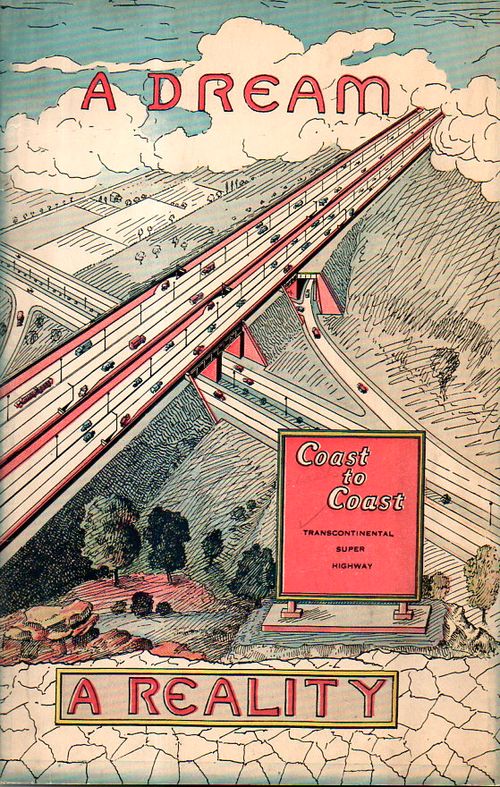
    Highway visionary120

    This is all about super-highways, and mainly replacing the old roads with four new roads that are as straight as straight could be. A map of the proposals features one line of the highway is straight from San Francisco to Boston; another from Laredo, Texas (!) direct to International Falls, Minnesota (!);  a third not-straight shot from Boston-Allentown-near-Valdosta Ga-Miami; and another from near-Valdosta to Cleveland. A schematic of this map though drops near-Valdosta for Jacksonville, and has the Boston-Miami route further east to include NYC and D.C., which are omitted from the map.  Ah, well.

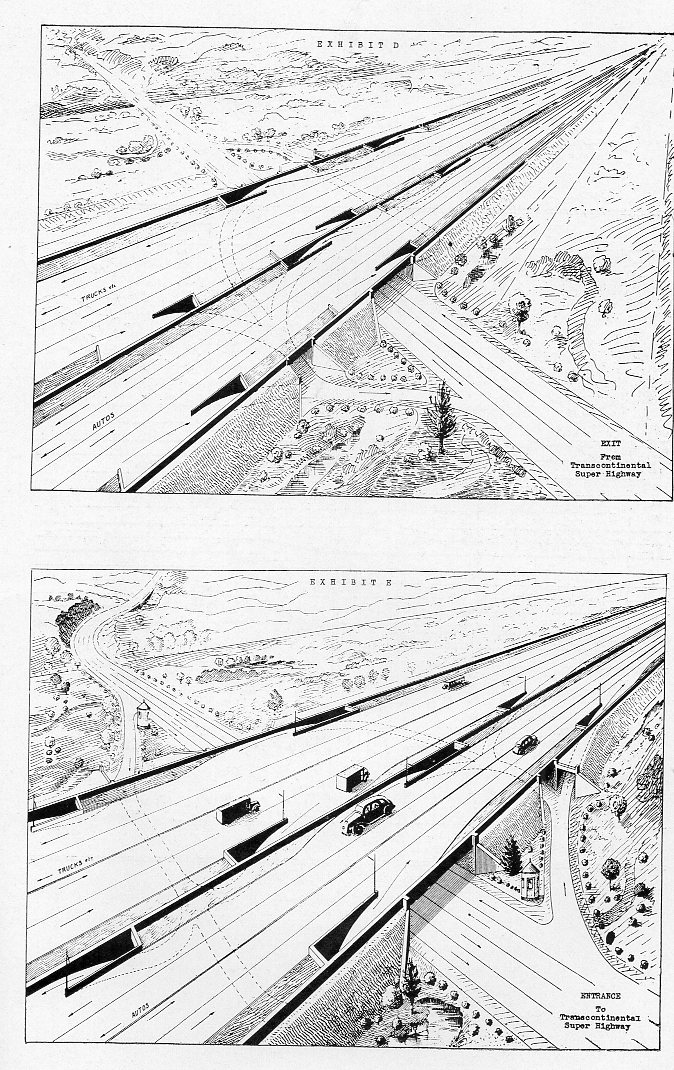
    I think that the author–an accomplished “business man” was was the head of a “manufacturing company” in Ohio and a coal company in West Virginia (and “employer of labor”) –was not much of an engineer, because the plan ignores topography and the highway design itself is pretty bad, especially the parts on exit/entrance (which the author takes particular care to note are separately copyrighted (?)) bits, which are killers. 
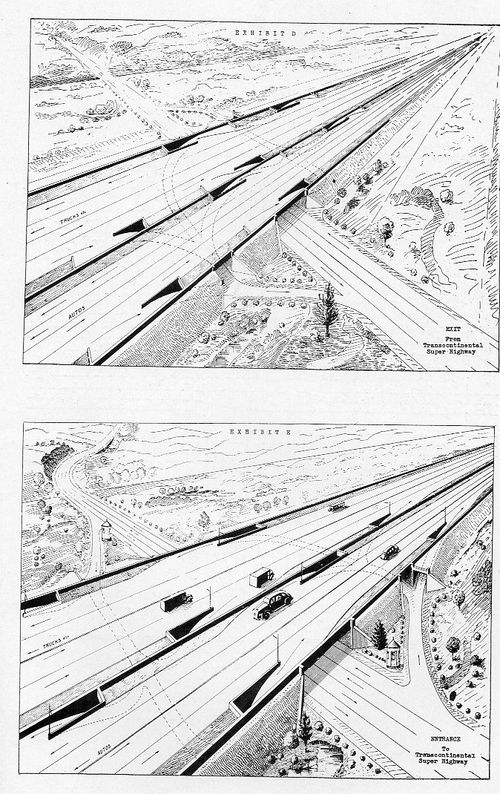
    Highway visionary121

    In any event, the super highway extending into the clouds on the cover is all I’m here for.  Mr. Steiner no doubt attracted some attention for the project because of the enormous pork and public works potential, what with the building of 6,000 miles or whatever of an 8-lane highway, which is billions of square feet of paving times some multiplier.  So a lot of money would be spent, which means, well, a lot of possible interest–after all, it did get so far as a hearing before the Committee on Roads, U.S. House of Representatives, on May 18, 1937.

    This no doubt was a “visionary”proposal of some sort, though the engineering aspects of it were more imaginary than anything else. 


  • A Lovely Printer’s Device Honoring the Sciences (1724)

    JF Ptak Science Books  Quick Post

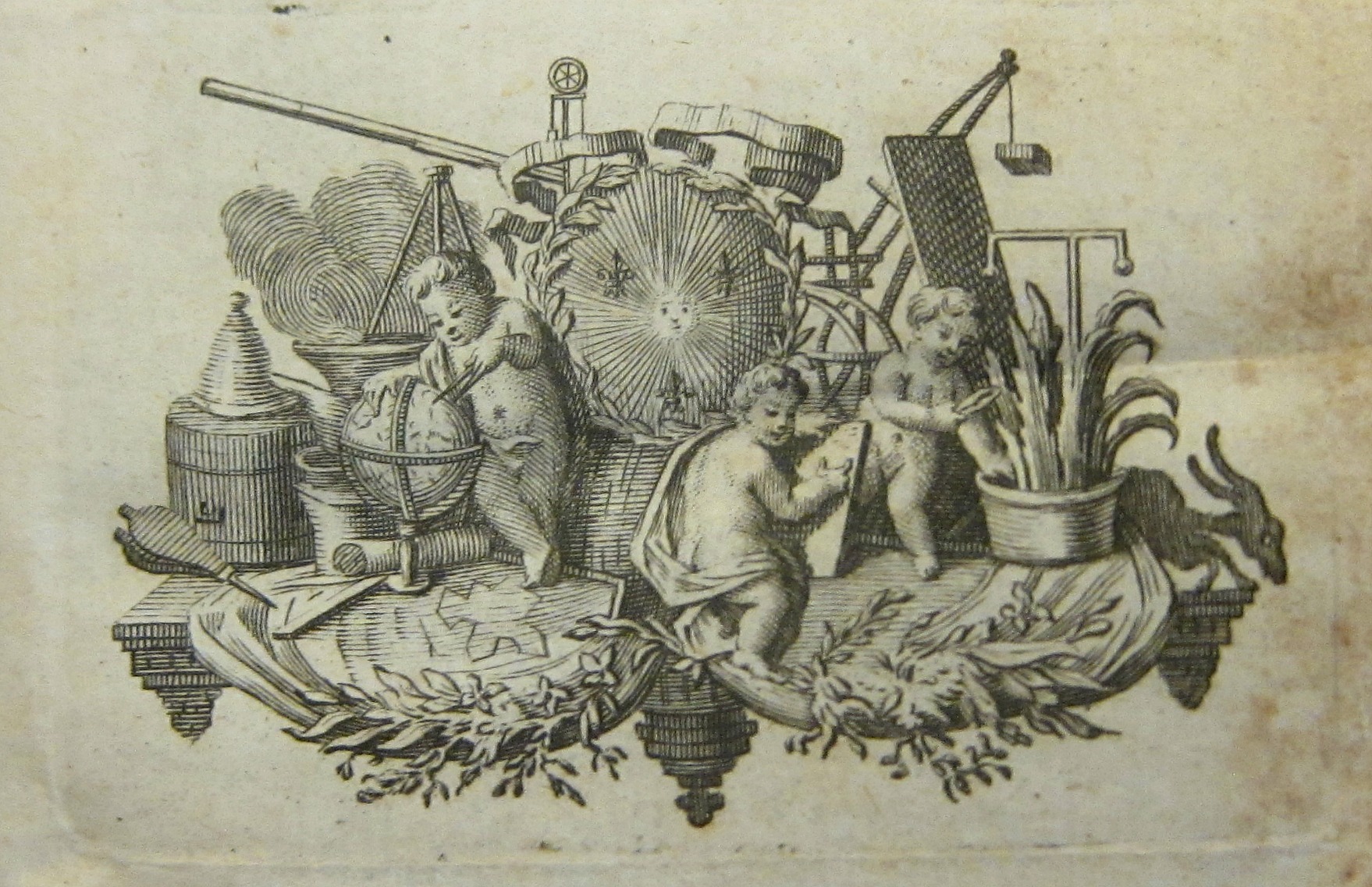
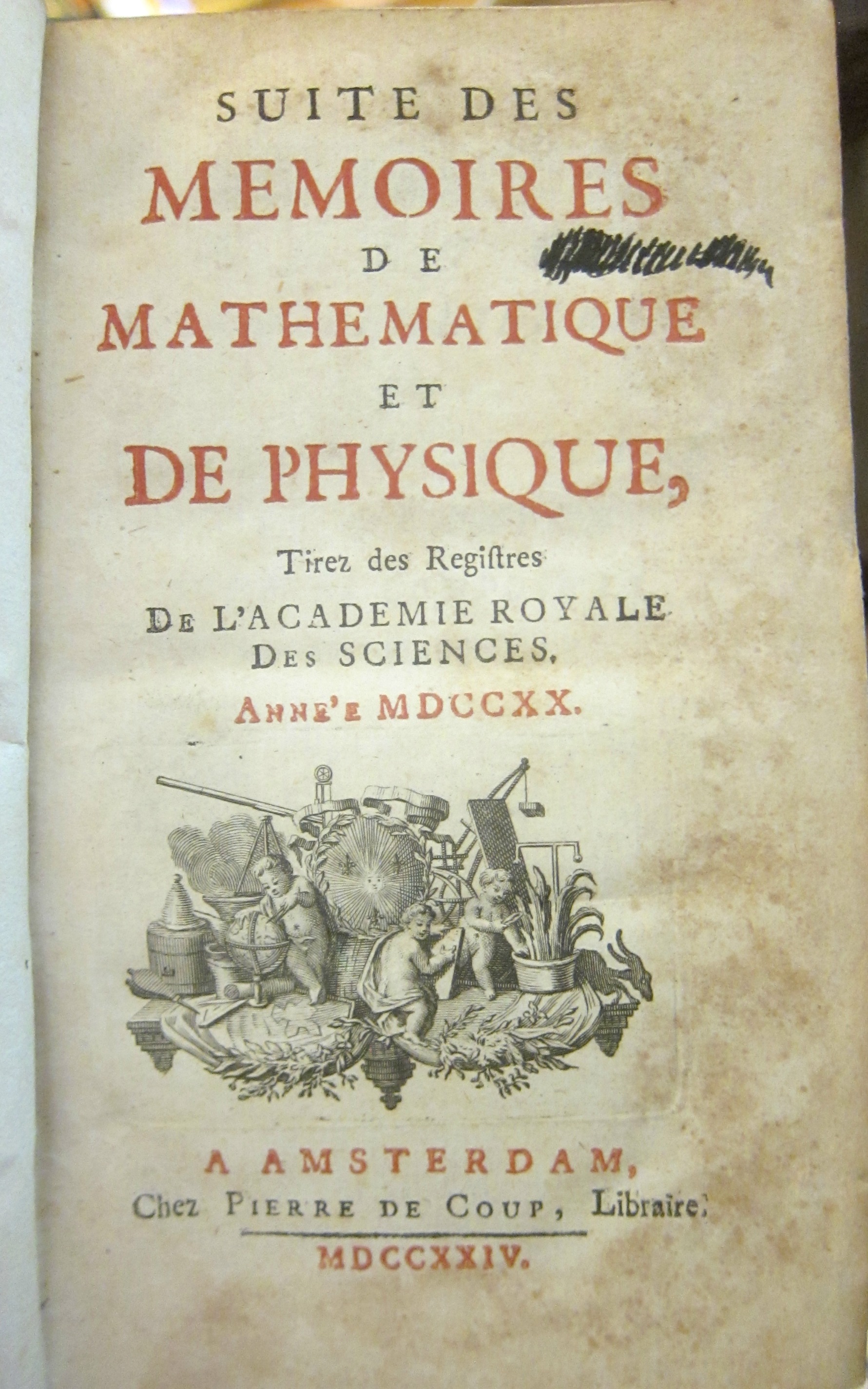
    Newly arrived here and new to my experience are some volumes of the journal Suite des Memoires de Mathematique et de Physique tirez des Registers d e l’Academie Royale des Sciences, a significant and beautifully-designed series of books which are small (only about 16cm) and very light, and their fine binding makes the book feel “correct” in your hands. I’ll be writing quite a bit about what I find in them over the next weeks and months, but the very first thing that stopped me was the scientific instrument-laden printer’s device on the title page–this the work of Pierre de Coup, of Amsterdam. The original is only about 3″ square (35x60mm), but it presents an abundant allegorical punch in a tiny space:

    Memoire de le Math


    And the full page:

     Memoire de le Math detail


    I can identify most of the instruments around the putti: right in the middle of it all is a crest with a blazing sun, no doubt indicating the reign of holy light on the impact of science and mathematics; to its rear and left is a telescope and to the right is a drawing table with a considerable balancing weight. One of the putti cuts a bit of the potted plant on the right, while another on the left works on a globe with a set of dividers (and may actually be standing on the plans of a fort).  The putto in the center (with an armillary sphere just behind him?) works on some sort of drawing, and looks down and away to the right. Additionally there are some bits an pieces: a right angle, a cauldron, perhaps an alembic, though I don’t know what that T-shaped instrument (on the right) is, or the clock-like-looking clock-like device at top-central…and I’m not sure why the bellows is figured so prominently (except for symbolic reasons). 

    For a full run of the journal see the Gallica site, here: http://gallica.bnf.fr/ark:/12148/cb32786820s/date


  • TubePunk–Electronics Returns from War (1946)

    Book covers electronics reutn from the war 1946JF Ptak Science Books  Quick Post

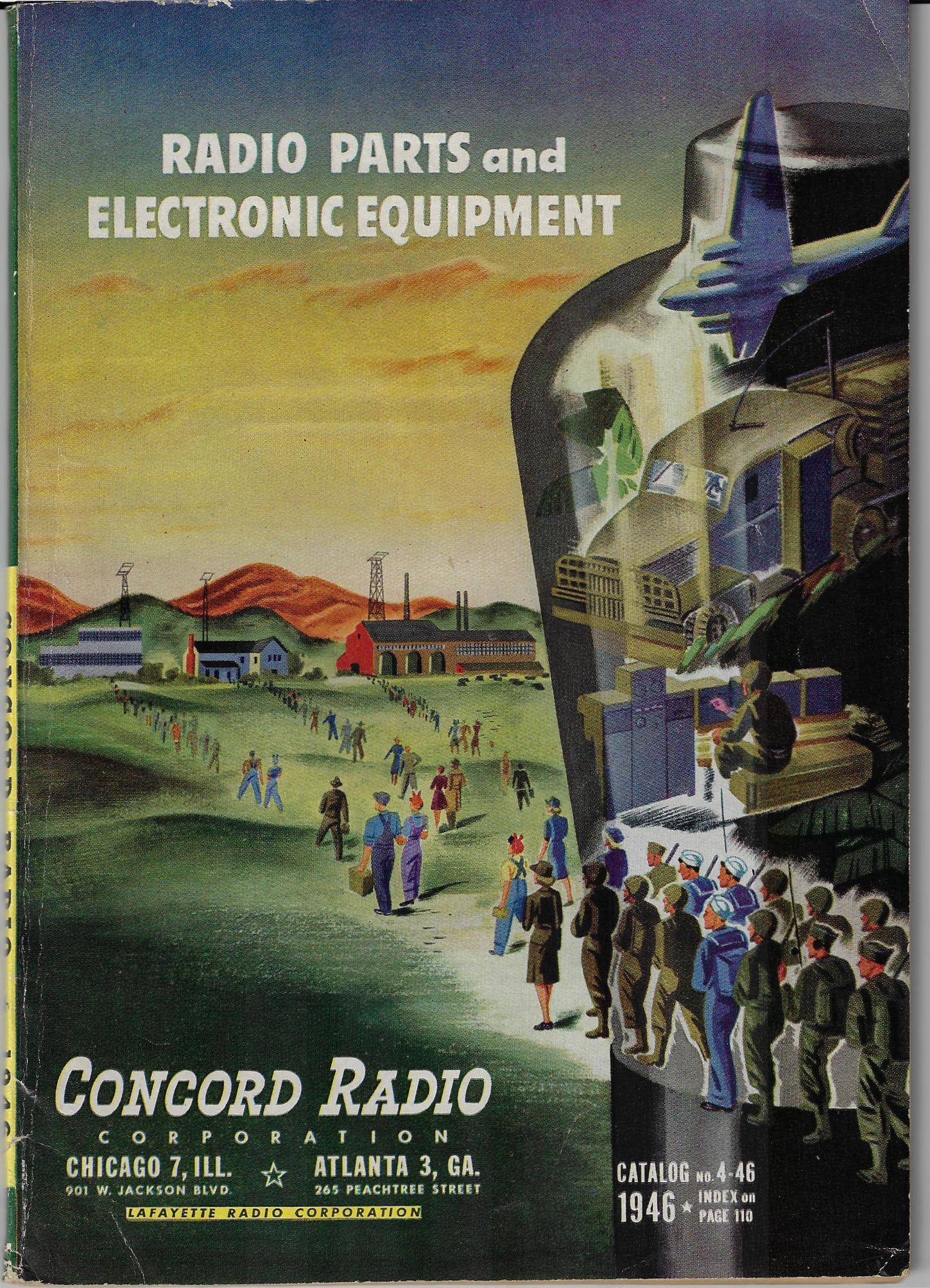
    Of the numerous things that “won the war” for the Allied forces–besides Churchill, and Roosevelt, and millions of Soviet soldiers, and Eisenhower, and V Bush, and cracking Enigma and MAGIC, and the enormous production capacity of the U.S., and so on–there was “also” the warm electrical/dusty scent of active vacuum tubes, which somehow always remind me of “precision”. The importance of RADAR I think cannot be overstated, plus SHORAN, and the Harvard Mark I, directional finders, and etc., all combined into a massive electronic war-winning effort that certainly helped define victory in WWII.  

    This is sorta what I was thinking about when I saw this lovely Concord Radio catalog for 1946–the enormous vacuum tube in which various military ops were happening, and then the troops marching out of it on the bottom, back into civilian life, carrying the promise of the new electronic world with them to home, industry, and business, and that electronics was here to stay.  Another “here to stay” thing here was the female worker–if you look closely at the crowds returning to their lives-left-behind there is no shortage of women, which I think was pretty progressive for 1946.  


  • The Barrels of Brooklyn, 1873

    JF Ptak Science Books   Quick Post 

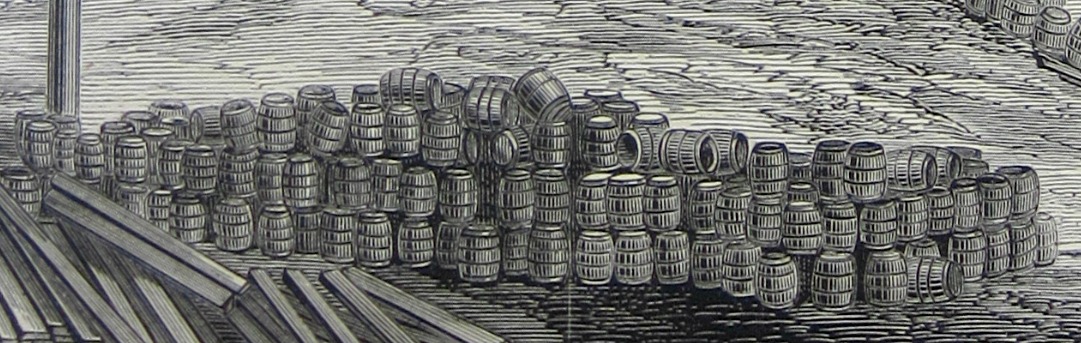
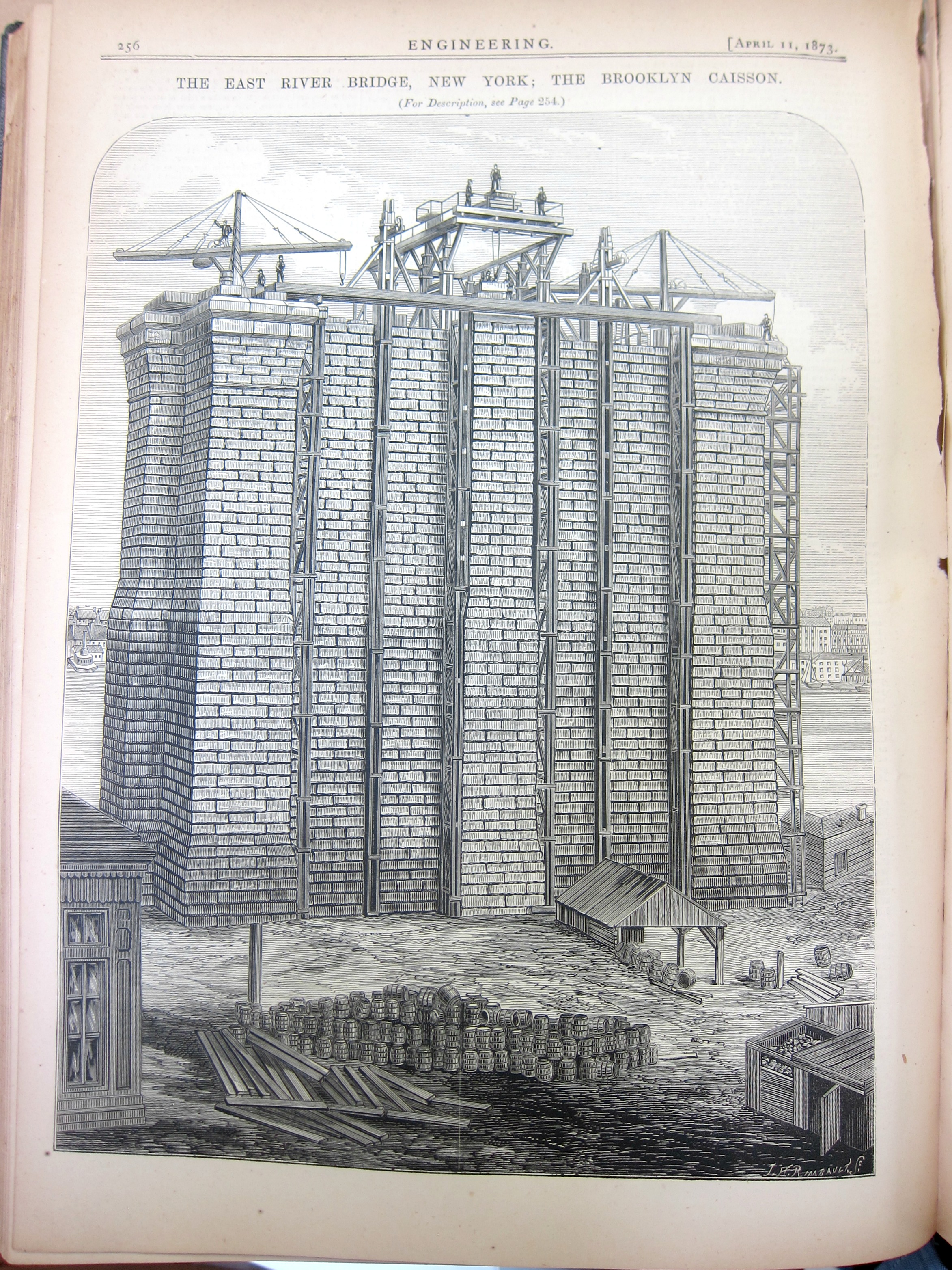
    This dramatic image of the foundations of the New York and Brooklyn Bridge (and then the East River Bridge, and then in 1915 the Brooklyn Bridge) appears in the journal Engineering for April 11, 1873. It is a massive structure, and like a tree there is as much going on for it underground as there is above; and in all of that, one of the most interesting elements is the pile of barrels in the foreground, a detail of which is below: 

    Engineering 1873 Brooklyn barrels

    Frankly I’m a little surprised at their state, disheveled and open and spilling here and there.  Why not keep them in order of some sort? 

    And the full image, featuring the granite that was moved by schooner down along the coast all the way from Vinalhaven Island, Maine: 


    Engineering 1873 Brooklyn Bridge


  • A Technical Report on the V-1, January 1945

    JF Ptak Science Books    Quick Post

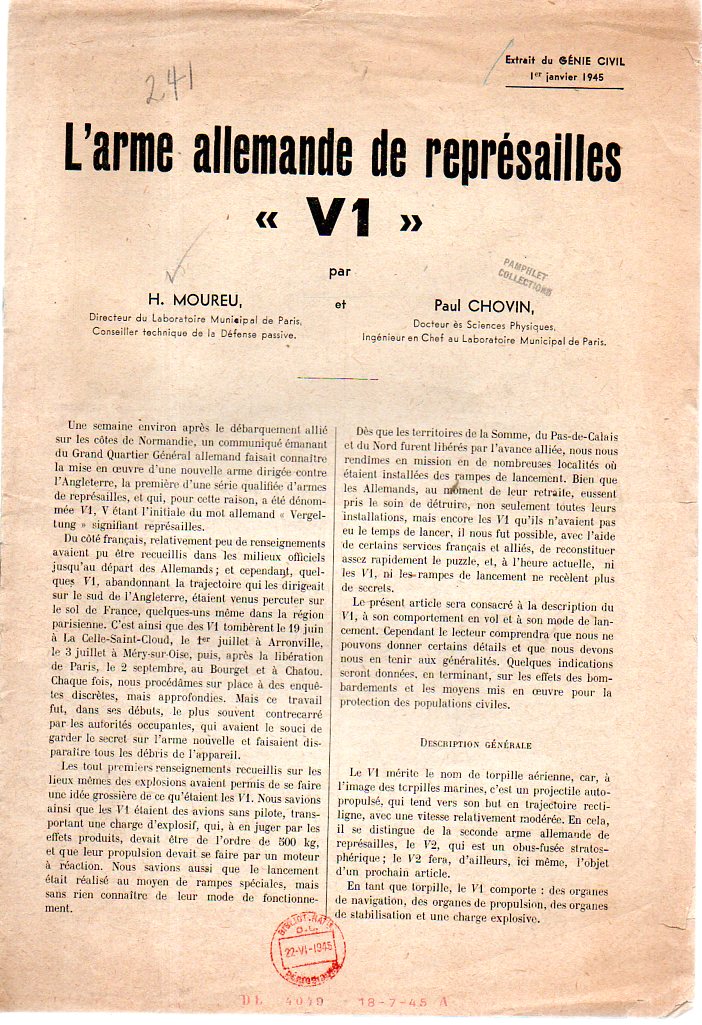
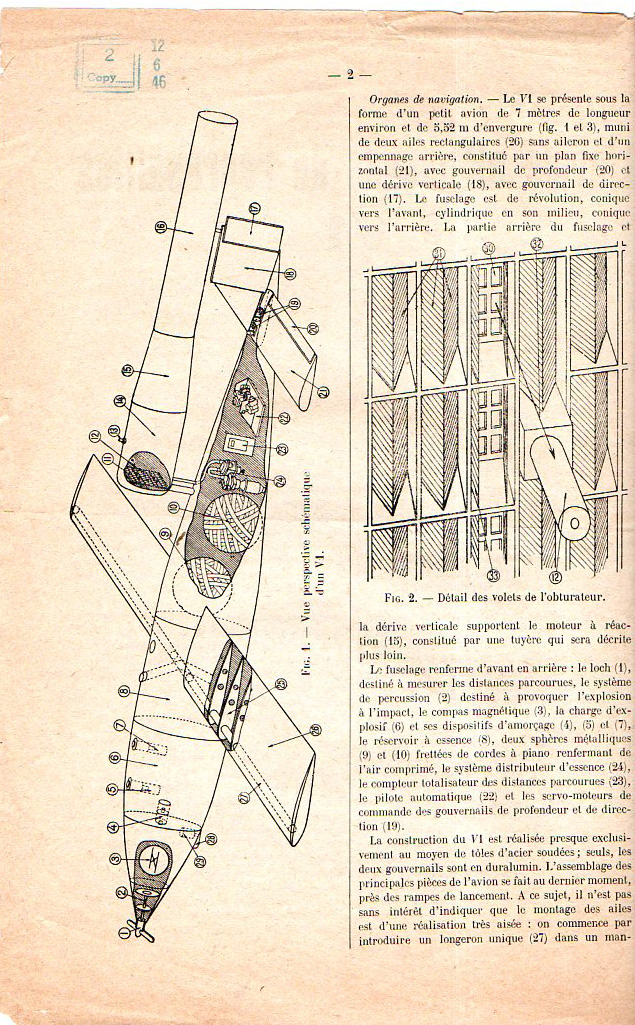
    I was  surprised to find this fairly-well documented piece on the V-1 published during the war, so I decided to reprint the report in its entirety. Some of the text runs off the side of the scanner, but that is the best I can do in scanning the pamphlet without taking it completely apart. 

    The document: Moreau, Henri (1893-1978) and Paul Chovin.  “L’arme allemande de represailles V1”, offprint from Genie Civil, 1 January 1945.  9×6 inches, 8pp, printed in Paris (newly liberated from the German army 25 August 1944) in early 1945. Very good condition, printed on a decent paper stock. It is rare as an offprint, at least, with no copies located in the WorldCat/OCLC. 


    V1519
    V1521

    ·Posted by :

    ·in:

    —

  • Moving Stationary People on a Moving Sidewalk and Not Moving People on a Stationary Sidewalk (1903)

    JF Ptak Science Books   Post 2684

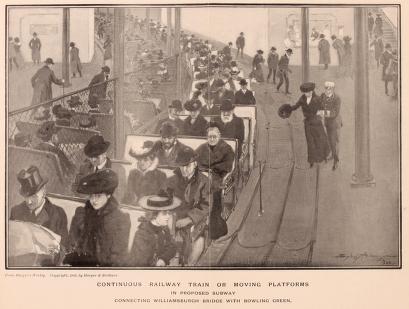
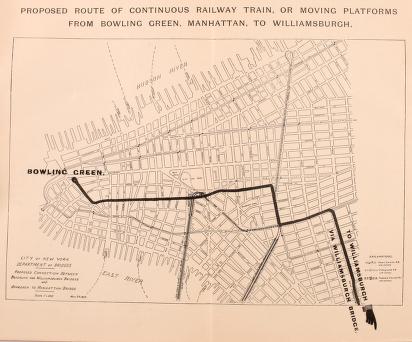
    I came upon this interesting pamphlet and thought to share it: Transportation of Passengers in Greater New York by Continuous Railway Train, or Moving Platforms.  Argument in favor of equipping the East River Bridges, and connecting subway to Bowling Green, Manhattan, with a continuous railway train or Moving Platforms. It was prepared by Schmidt & Gallatin, of New York, and printed in 1903. (Oddly it is the pamphlet that I started working on directly after working through a 1903 double-brick volume of the Journal of the American Chemical Society.) It is only 20 pages long, but decorated with four folding plates, including two maps, and two drawings of the envisioned walkways. 

    Sidewalks 3

    This seems a wonderful example of future thinking and city planning–but just not a very good idea.  It is hard to imagine a continuously moving sidewalk functioning in lower Manhattan. 

    From the pamphlet: 

    “Moving Platforms for the conveyance of passengers were recommended by Mr. Horace Greeley thirty years ago. They were successfully operated, first, at the World’s Columbian Exposition of 1893, where 2,700,000 people were transported. In 1896 they were installed at the Berlin Exposition, and again at the Paris Exposition of 1900, where they carried over eight million passengers. Few persons know what Moving Platforms are. From the face that sometimes they are called ” Moving Side- walks,” it is believed that they must be some sort of a pavement on rollers, on which it is difficult to step with safety and maintain equilibrium. The Moving Platforms are to all intents a railway, operated like other railways, propelled by electricity, with cars, seats, motors, passenger stations, ticket booths, guards, electric lights — in fact, everything belonging to a first-class railway.” 

    Sidewalks map

    “Where it differs from the ordinary railway is that the cars, or trains, are not running at intervals, but are coupled up continuously, so that there is no interruption of traffic at any time, but a large seating capacity at all times. It differs also in the construction of the cars, which are mere flat cars, provided with seats placed crosswise, and so arranged that all passengers face in the direction of motion. Each of these seats may be made wide enough to accommodate one, two or more persons. The most approved plan is to provide seats on one side of the cars only and leave the other for passengers to walk, thus giving them an opportunity to further accelerate their speed if they so desire…”


  • Delight is Where You Find It: Wagon Axle Catalog for 1905

    JF Ptak Science Books   Post 2682

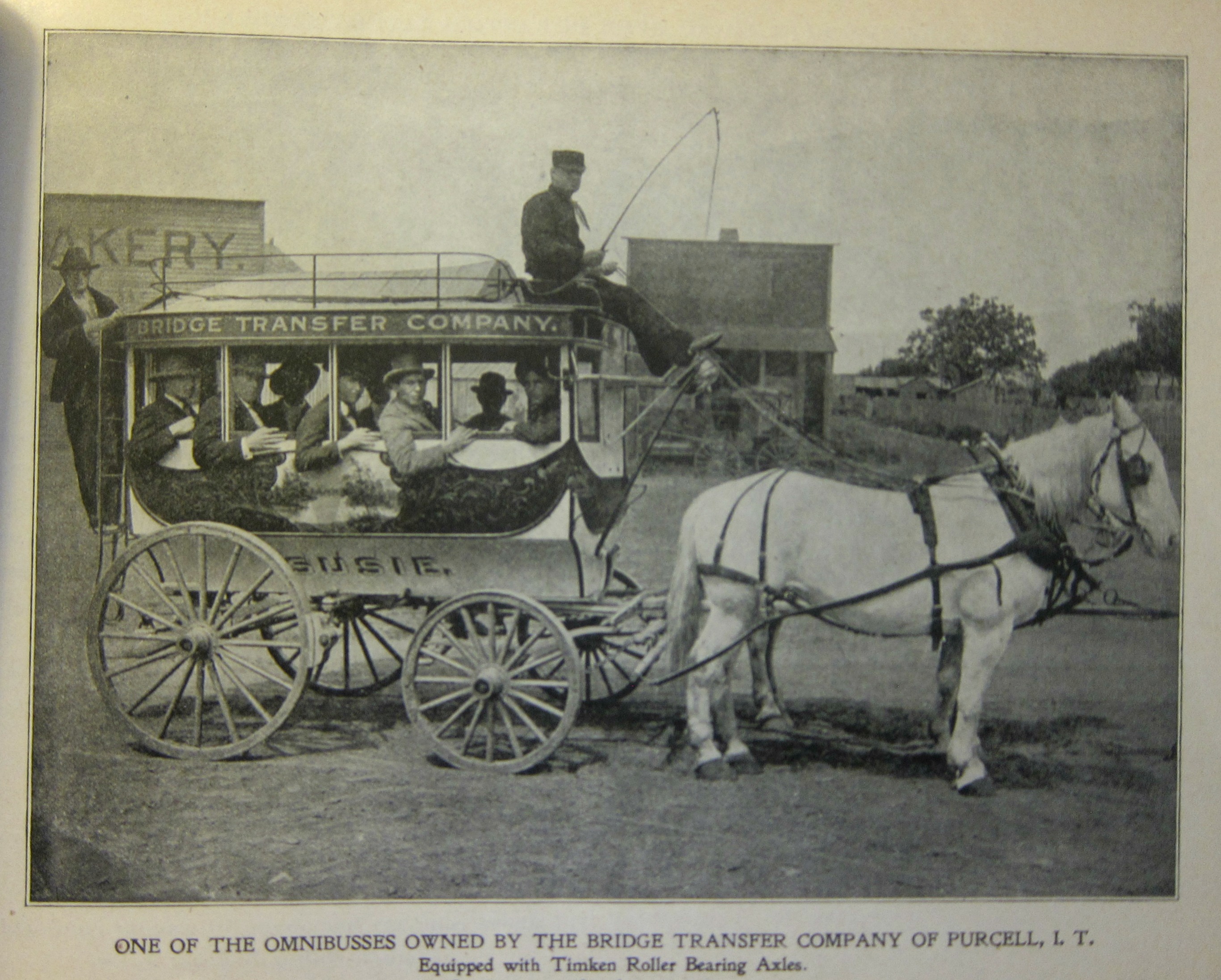
    The short story here is that less friction makes for happier conveyance and easier hauling. And evidently the founder of the Timken Roller Bearing Axle Company, Henry Timken, figured that out in the early 1890’s1, rolling his engineering insights and acumen and successful experimentation and founding his eponymous company in 1899 (and which exists as an international entity today). There’s great beauty in a fine idea, and in well-engineered parts and machinery, and no doubt the Timken axle is one of these–but what drew my attention to this catalog were the wagons and carts that benefited from the engineering. There is a superior sense of place in some of these images, an unexpected and quiet beauty found in the pages of a manufacturer’s catalog:

    Timken coaches _1_

    [Image source: Timken Roller Bearing Axle Company, Catalogue No. 5, published in Canton, Ohio, ca. 1902 (not later than January 1905).  7×9.5″,  unpaginated though 42pp long, including 9 plates of photos (some of which are above), plus 3 plates of drawings. Printed wrappers.  Provenance: Library of Congress, with their surplus stamp on the back. There are no copies of this title located in WorldCat/OCLC; there is another version, entitled “Carriage and wagon axle department, Timken Roller Bearing Axle Co., manufacturers of Timken roller bearing axles for all kinds of carriages and wagons …” ca. 1908, that is located in two locations: the Hagley Museum, and the Henry Ford Museum. I can find no other library of museum holdings.]