A Daily History of Holes, Dots, Lines, Science, History, Math, Physics, Art, the Unintentional Absurd, Architecture, Maps, Data Visualization, Blank and Missing Things, and so on. |1.6 million words, 7500 images, 4.9 million hits| Press & appearances in The Times, Le Figaro, Mensa, The Economist, The Guardian, Discovery News, Slate, Le Monde, Sci American Blogs, Le Pont, and many other places… 5000+ total posts since 2008.

Category: Technology, History of

  • Electric Biometrics (1921)


    JF Ptak Science Books   Post 2710

    The use of finger prints in identification is fairly old, used in Asia and India long before it became a popular practice in the West.  Also it seems that finger prints as forensic instruments occurs in literature before it occurred in actual police work. Mark Twain uses finger prints as essential legal elements (as well as comic relief) in his novels Life on the Mississippi (1893) and Puddn’head Wilson (1894), no doubt inspired by Francis Galton’s pioneering work on the subject (Finger Prints, published in 1892). Conan Doyle takes things a step further and describes the forging of finger prints, which I think was a brilliant idea.  All of this takes place before finger prints were more or less firmly established as an identifying tool, as the first conviction based on finger print evidence did not occur (in Great Britain) until 1902, while its weight in the conviction of murderers wasn’t felt until a first conviction was made using them in 1905 (and then 1910 in the U.S.). 
    Finger prints _1_

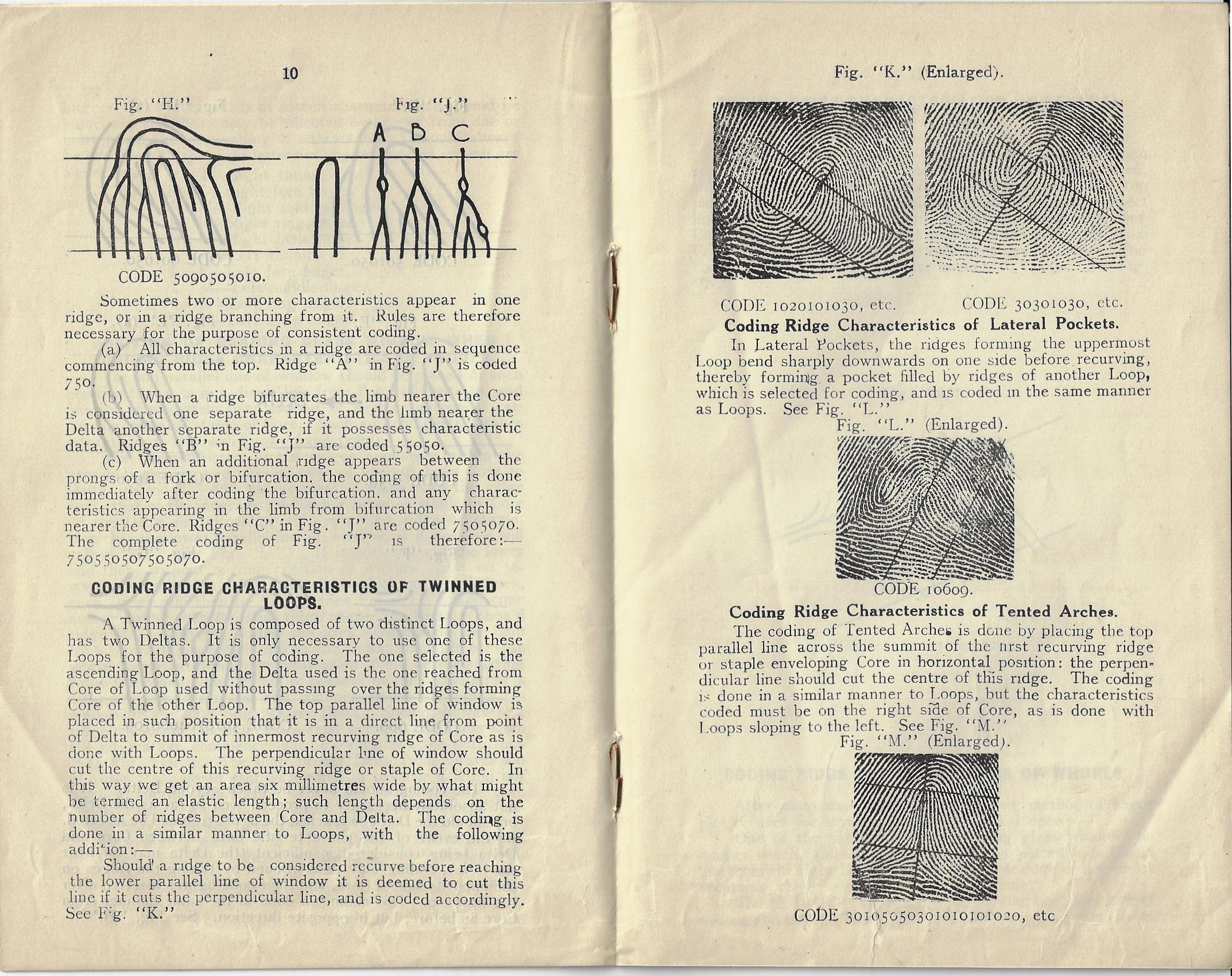
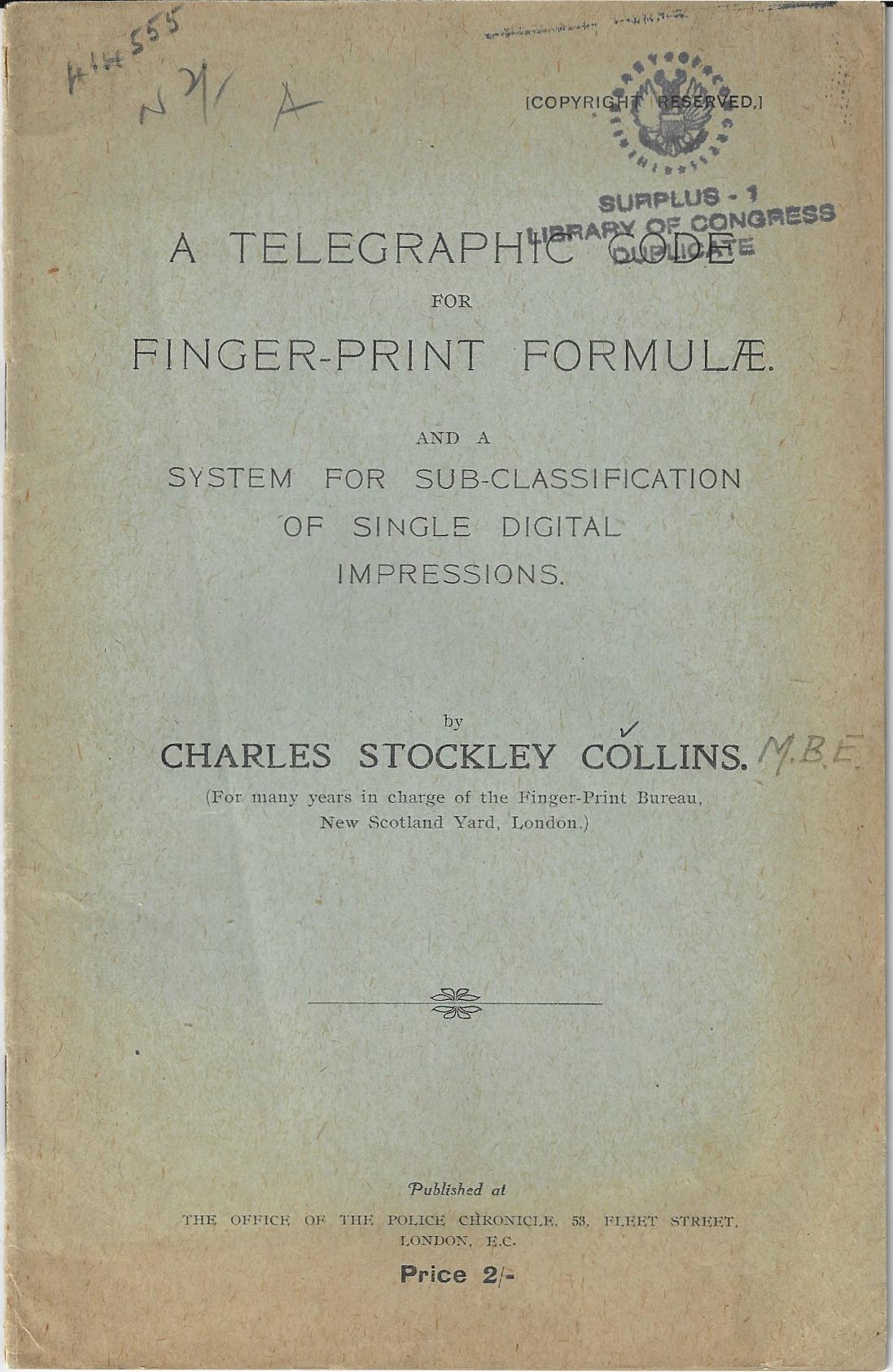
    Which brings us to these fascinating images1 of finger prints and their enumeration and transmission by wire,  which was the brainchild of the foremost finger print expert in the U.K., Detective Chief Inspector Charles Stockley Collins (M.B.E.), chief of the Finger Print Bureau at the New Scotland Yard.  I cannot determine how long in advance of this publication that he employed the idea of transmitting finger print data by telegraph, but it seems to be an excellent idea, sending important information relatively instantly over distances to help in conducting criminal investigation. It may be that this idea–far in advance of modern transmission practices, even though Arthur Korn’s first “facsimile” images were made as early as 1902–was seen at the time as both fantastic and obvious, the second impression coming almost immediately on the heals of the first, like one of those terrific ideas that seemed “obvious” once it was first stated. 

    Notes:

    1. Charles Stockley Collins. A Telegraphic Code for Finger-Print Formulae and a System for Sub-Classification of Single Digit Impressions. Published at the Office of the Police Chronicle, London, (1921).  9×6″, 17pp, with two plates and 15 illustrations/drawings in text. There are only two copies of this work located in WorldCat/OCLC (Cornell and the British Museum); for all of what Mr. Collins accomplished, this seems to be his only publication outside of journals. 
    Finger prints _2_


  • Rare and Formerly “Restricted” Info Packet on German Aircraft, 1944

    JF Ptak Science Books   Quick Post

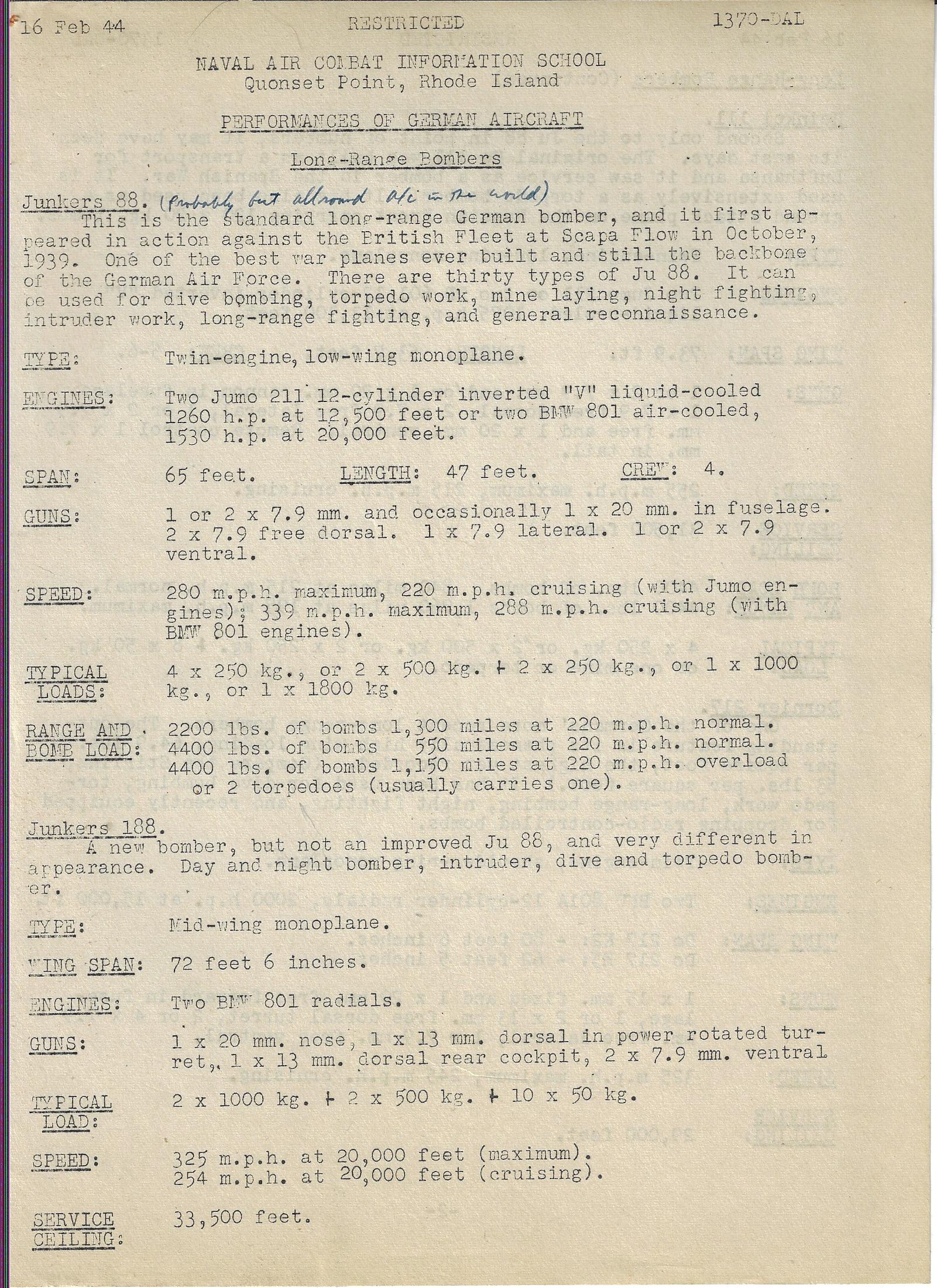
    “Performances of German Aircraft” (16 February 1944) is one of several dozen pieces that were loose-leaf bound by a naval student of the Naval Air Combat Information School at Quonset Point, Rhode Island.  The entire notebook is interesting as a whole from a pedagogical point of view, and teh components are usually very engaging (and even noteworthy) on their own.  The nine pages that comprise this Luftwaffe section of the classwork (identified as “RESTRICTED” in the offset typed original) are an outline for the classwork and no doubt augmented during lectures–but as they stand it is s statement of the base knowledge for what was being taught to intelligence officers.  

    This section is 9pp, complete, and I reproduce it below (each page is greatly expandable and easy to read):

    German planes _1_


  • The 50 Million Volt Dust Curtain of Nikola Tesla (1934)

    JF Ptak Science Books  Post 2709

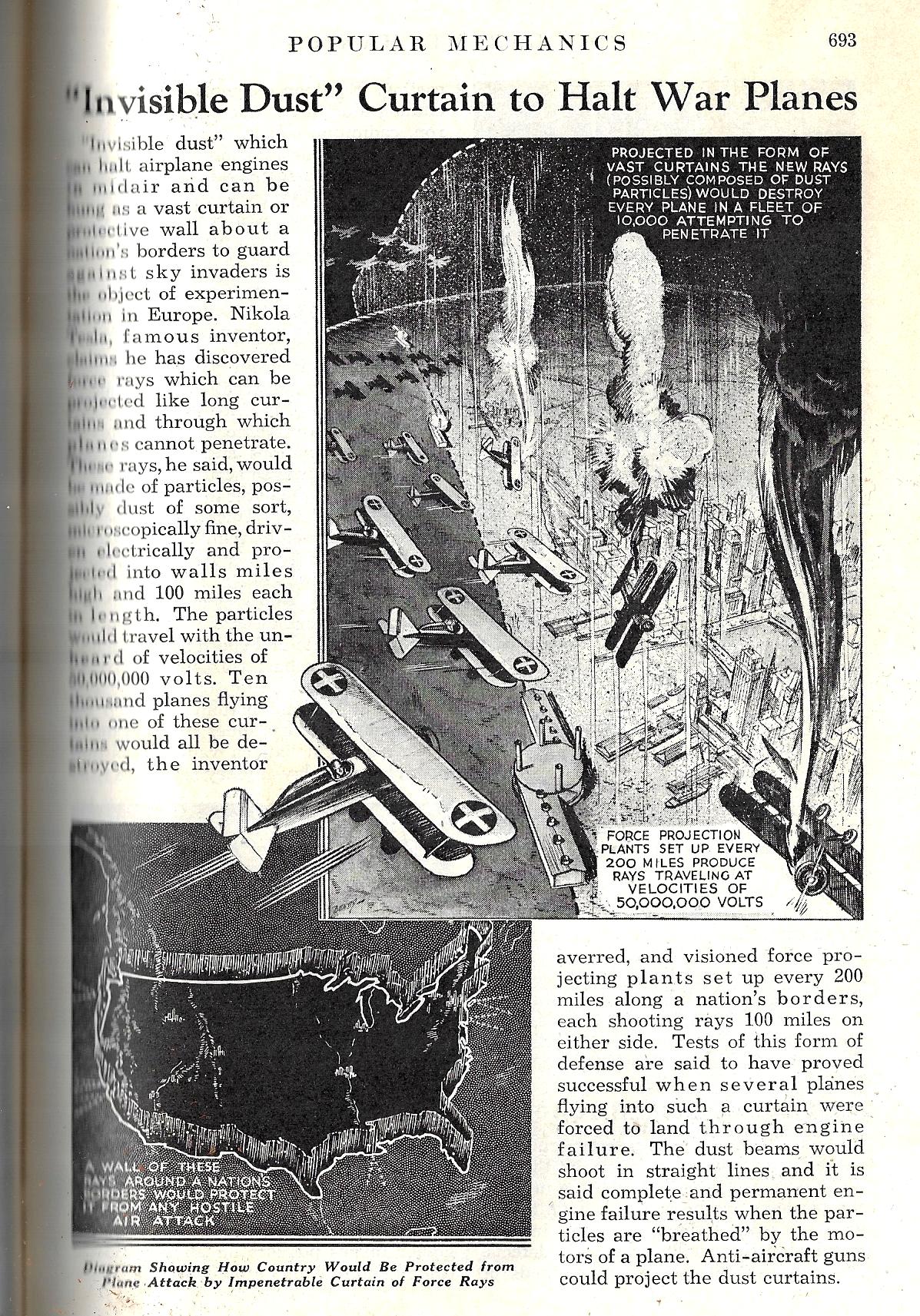
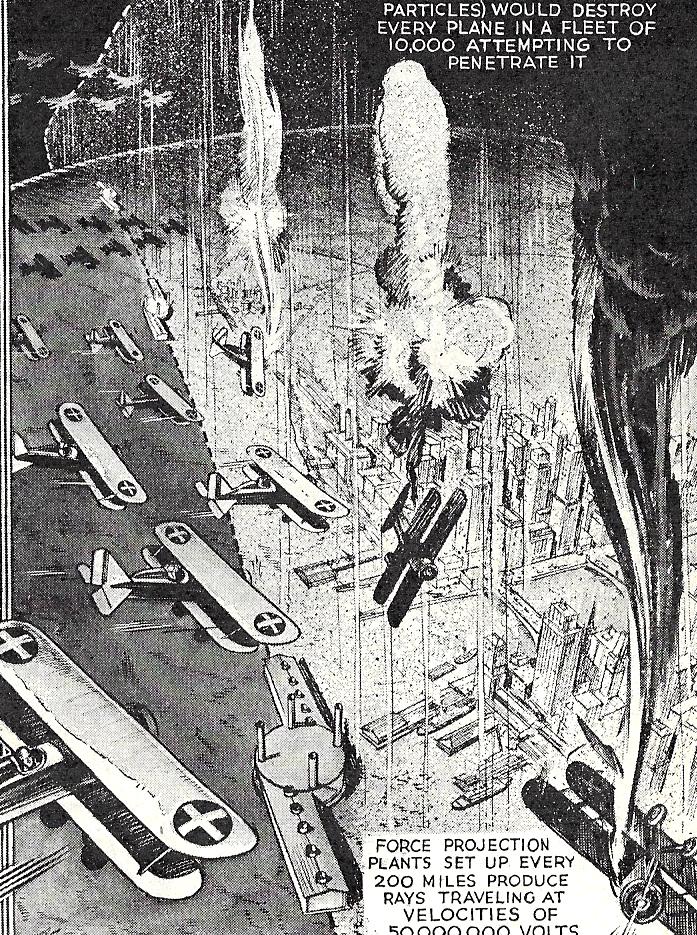
    Pop Mech 1934 TeslaThe “dust” in question here is not intended to be weaponized versions of those famous dancing bits of Brown and Einstein, but a very very high voltage-invisible-something that would obliterate any attacking air force or army. The idea is one in a long history of “death rays”, though this one belonged to Nikola Tesla (who had a much earlier outline for an idea on militarizing wireless telegraphy technology) and as such was received with considerable respect in the public and scientific spheres—or, at least in scientific areas, the low/no detail plan was given inspection and testing before it was dismissed.

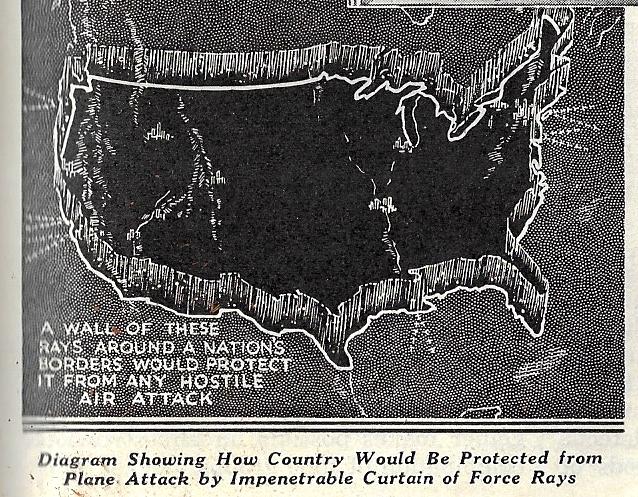
    The popular press (Chicago Tribune, New York Times, Newsweek) reported that Tesla had plans for a country-wide defensive network that would basically make the U.S. Impregnable and put an end to war. One problem was that there were nearly no details offered for the plan—at least until this article (“Invisible Dust Curtain to Halt War Planes”) appeared in Popular Mechanics in November 1934. Even though this as an extended version of the idea, there’s scant detail in this article as well. But, Tesla being Tesla, the idea was given wide circulation.

    Simply put, the article reports that Tesla “discovered force rays which can be projected like long curtains and through which planes cannot penetrate” which was composed of “microscopically-fine” “possibly dust of some sort”bits “driven electrically” at “velocities” of 50,000,000 volts and which would form invisible walls that were miles high and surrounded the country. And so thus powered the weapon could destroy an army of one million and an attacking air force of 10,000. Somehow all of this would permanently disable aircraft engines as well as destroy soldiers.

    Pop Mech 1934 Tesla _2_

    Evidently the plan for this invention was based upon four other inventions which hadn’t yet been invented, which would explain the lack of details. Nevertheless, the National Bureau of Standards did investigate and attempt to reproduce something resembling the results that Tesla was trying to bring about, but obviously failed, even though Popular Mechanics had reported some successes in experimentation.

    It seems to me that Tesla’s technology was far more powerful and advanced than many of its fictional rivals like Flash Gordon and Buck Rogers, and maybe even so of the Martian weapons from Wells’ The War of the Worlds.

    Pop Mech 1934 Tesla _3_

    Notes:

    For an interesting read in this area I was surprised to what looks like a thorough and engaging work by William J. Fanning, Jr.: Death Rays and the Popular Media, 1876–1939: A Study of Directed Energy Weapons in Fact, Fiction, and Film (McFarland, 2015) page 95

    Also, it is a curious thing that when I googled “tesla” the first reference to Nikolai was at the bottom of the 9th page, nearly 100th in line after the car/company–and that is just all sorts of wrong.


  • Another Episode in Our Bulbous Future (1931)

    JF Ptak Science Books   Quick Post    

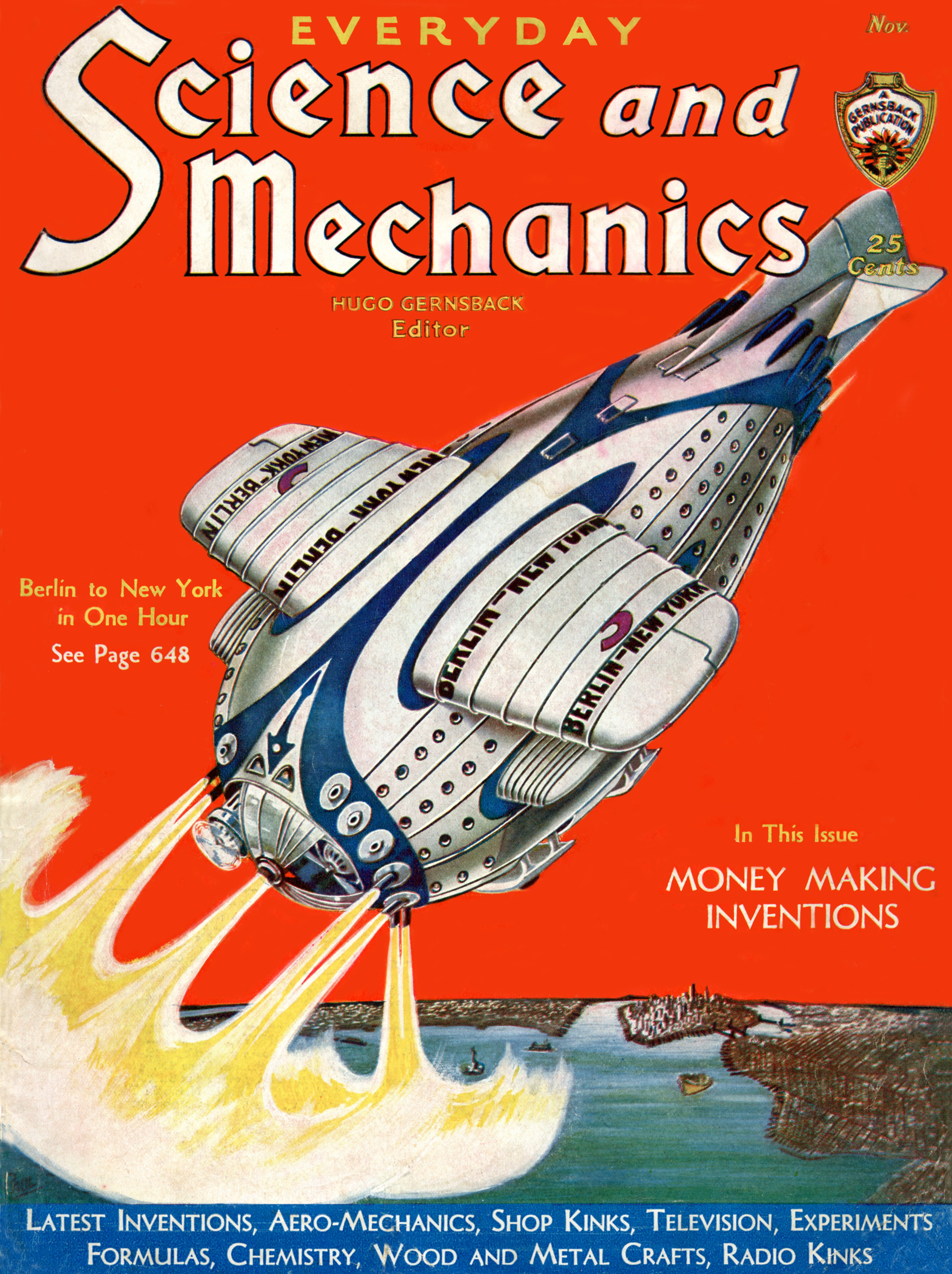
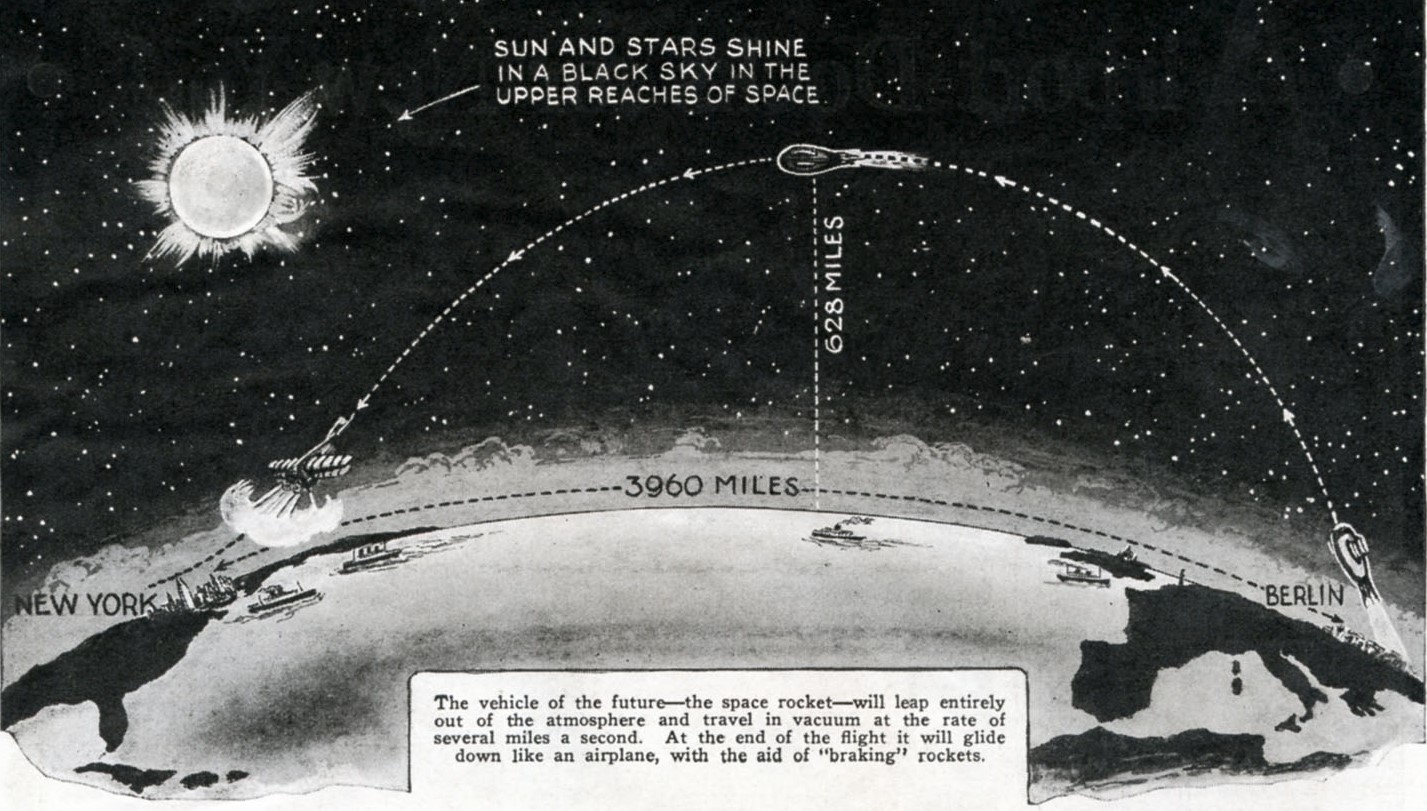
    I’ve written several posts here on the great science fiction/speculative science illustrator Frank R. Paul, and I am returning to him now with this glorious image of spaceflight commercial services. It appears in Everyday Science and Mechanics, published in November 1931 (volume 2/12), and the great Bulbosity is featured splashily on the cover. The airship was supposed to get its passengers 628 miles into space to complete a one-hour arc from Berlin to New York City, and the image shows us the end of a flight,  the craft slowing above the bay, just south of Manhattan and Brooklyn and north of Staten Island:


    Everyday Science_and_Mechanics_Nov_1931_cover bulbous

    Image source: Wiki Commons, https://commons.wikimedia.org/wiki/File:Science_and_Mechanics_Nov_1931_cover.jpg

    Text: https://commons.wikimedia.org/wiki/File:Science_and_Mechanics_Nov_1931_pg648.jpg

    And the cross section of the journey:

    Everyday Science_and_Mechanics_Nov_1931_text

    Hugo Gernsback–the author, editor, creator, publisher, and major force in the history of science fiction–wrote the article, and although many problems associated with space flight had already been at least semi-solved, there was still a big hurdle to go: fuel.  Yes, and the engines that the fuel would power.  There are no specs for the ship, but offhand –judging the portholes to accompany a seat–I’d guess that the ship was at least 200′ long and 80′, and was getting into orbit under its own power. And by the looks of things, there wasn’t much space for the engines that would do that. It seems that Mr. Gernsback was confident that the problem would be solved by 1946.  I know that the facts and figures don’t have much to do with the actual vision, because those are the things that could get in the way of visionary thinking, sometimes. Seems that here there would be no real encumbrances like that here to get in the way of this lovely idea.   


  • Earbuds, 1891

    JF Ptak Science Books,  Post 2688

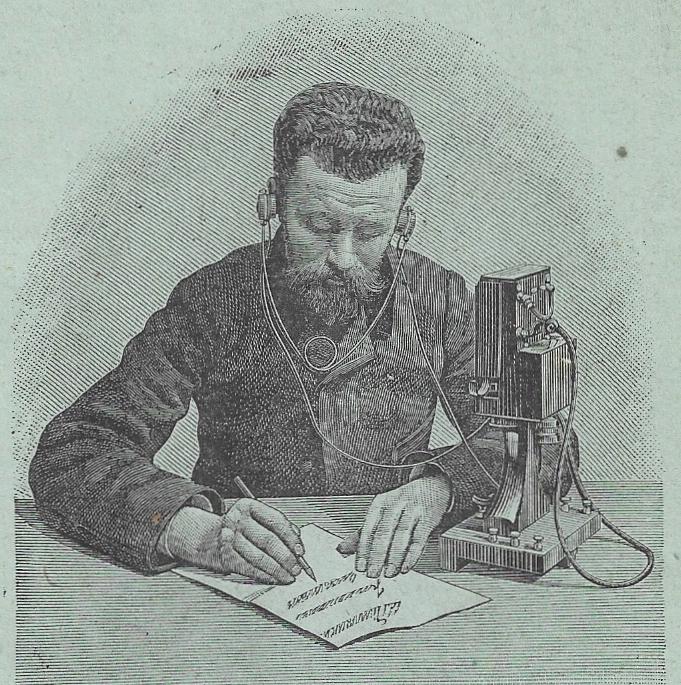
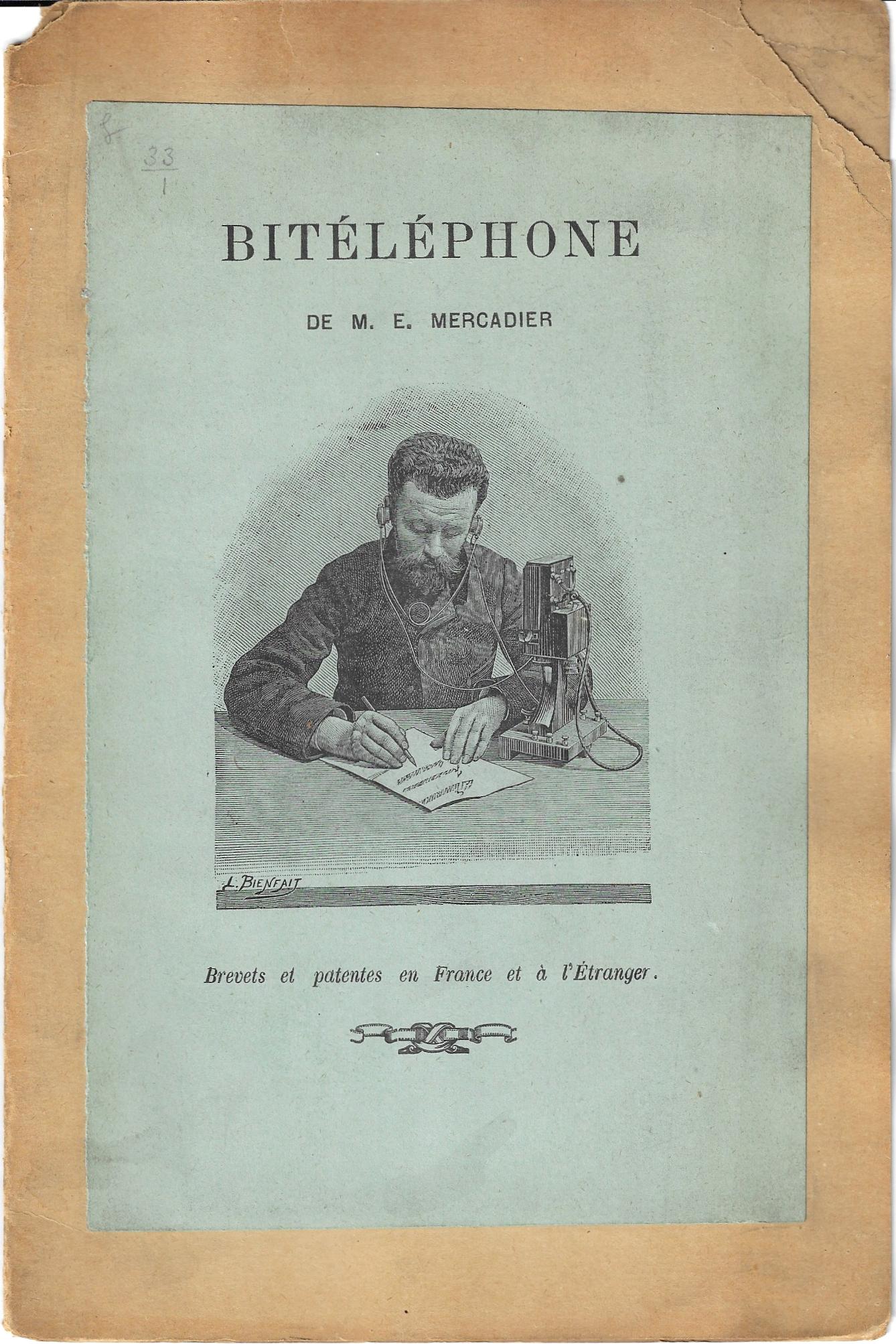
    Ernest Mercadier (1836-1911, electrical engineer and director at Ecole Polytechnique) may well have introduced the first “ear buds1” into the technical world.

    Bitelephone _2_


    Bitelephone His apparatus–small listening devices of 1.752 ounces that were padded and fit into the ear–was made for the operator of a telephone so that they could listen and speak and have free use of their hands for notes and such, as pictured on the front cover of this pamphlet. This would have been a shocking thing to see, I think, back there in 1891, only 15 years into the age of the telephone and about half of that for the time in which the still-a-luxury telephone could be accessed by relatively upper-middle-class folks. (In 1881 there were approximately 50,000 Bell telephone stations; in 1885, the year ATT was formed, there were about 150,000; in 1890, 200k and then 600k in 1900. It was in the first decade of the new century where telephone rental/ownership/accessibility really began to spread, with 2.2 million in 1905 and 5.8 million in 1910. Remember that the telephone was only one aspect of communication–all of the massive amount of infrastructure to connect thousands of telephones wasn’t yet created.) 

    Mercadier was well acquainted with the new device (having written Etudes Sur La Theorie Du Telephone five years earlier in 1886, plus other works on the telegraph and associated beginning in 1881), though what made his instrument so softly revolutionary was that it was one of the first entries into the world of communications microminiaturization–a concept we normally associate with computer development in the middle/late 1950’s. As a “headphone” this device is also extremely early though not the first3, though to my eye it is certainly the most elegant, at least that suited to its purpose. The earbud, even though it appears here in 1891, really takes another ten decades to come into its own.

    Notes:

    Ernest Jules Pierre Mercadier, Bitelephone.  Printed by Jamin in Laval, ca. 1891-3 (though no later than 1893). 21×13.5cm, 15pp, 6 text illustrations showing the device. The author announces that there are patents for his invention at home and abroad: “Brevets et patents en France et a l’Etranger”. This is the original pamphlet in wrappers, though at some very early point the pamphlet was bound into a larger manila-folder-like paper cover measuring 25x17cm; the front wrapper of the pamphlet was removed and pasted on the front cover of the new binding. The rear cover is intact. SO, that said, this is a not-perfect copy of the pamphlet, though the much-reproduced and striking cover is present. PROVENANCE: Library of Congress Smithsonian Deposit, accessed in October 1893. 

    1.  “Who Made that Earbud?”, NYT, May 16, 2014 https://www.nytimes.com/2014/05/18/magazine/who-made-that-earbud.html
    2.   From the Smithsonian Magazine on Mercadier’s invnetion:  “…improvements in telephone-receivers…which shall be light enough to be carried while in use on the head of the operator.” After extensive testing and optimization of telephone receivers, Mercadier was able to produce miniature receivers that weighed less than 1 3/4 ounces and were “adapted for insertion into the ear.” His design is an incredible feat of miniaturization and is remarkably similar to contemporary earbud headphones, down to the use of a rubber cover “to lessen the friction against the orifice of the ear… effectually close the ear to external sounds.”  : http://www.smithsonianmag.com/arts-culture/a-partial-history-of-headphones-4693742/#4c4flaaUUVCDrfVX.99  Also a nice notice in an article by The Guardian, “10 Most Influential Headphones”.  
       
    3. An interesting article in the SVG blog by Mark Schubin (http://www.sportsvideo.org/blogs/?blog=schubin-cafe&news=headphones-history-hysteria) points to the Mercadier device for being perhaps the third earliest headphone, following some others (issuing beginning in 1881) that were earlier but a lot more cumbersome. The Mercadier really were much smaller, more elegant, and a lot lighter than its 19th century companions. That said, the Mercadier device was more a candidate for the earliest earbuds more so than a straightforward headphone.  

    For a good timeline on the development of the telephone/telephone system, see: http://www.telephonetribute.com/timeline.html

    ·Posted by :

    ·in:


  • Very Early Projection of “Moving Pictures” (1883)

    JF Ptak Science Books   Quick Post

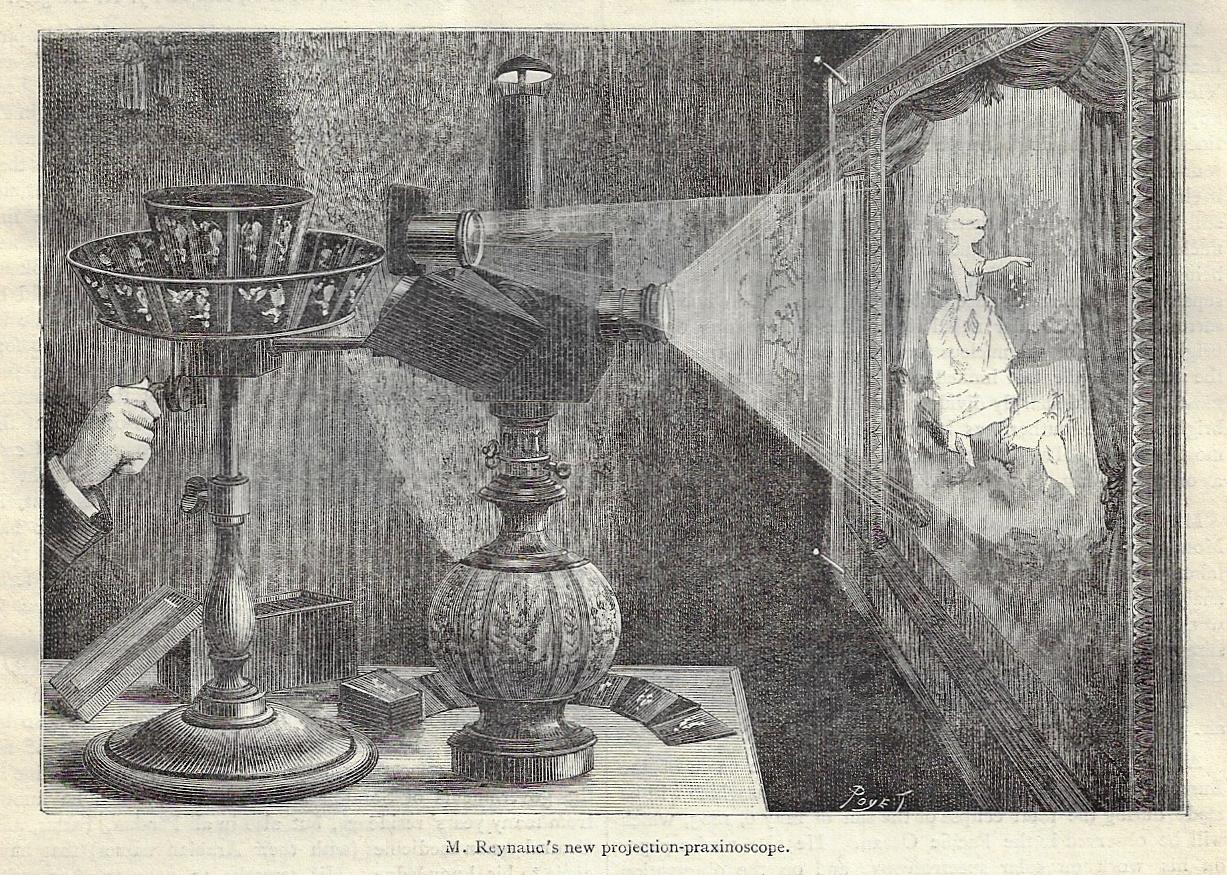
    I’ve written a number of times on this blog about the move from the static to the dynamic image and the early history of cinema. And so it came to me today by accident that I found this article in Nature reporting on the optical work of Gaston Tissandier who many people will remember more for his early aviation exploits than for his work in optics. Nature shares a post made in La Nature about his projecting praxinoscope (defined below1 from the Oxford English Dictionary)–and as it turns out, the Tissandier paper is a very early published use of “praxinoscope” with this very article referenced in the OED.  The baseline here: the demonstration image is just very neat. 

    The text of the article from Nature, (November 16, 1882), a short work on the earliest stages of cinema and “moving pictures”:

    “THE PROJECTION PRAXINOSCOPE”

    “M. GASTON TISSANDIER describes in La Nature an ingenious adaptation of the praxinoscope under the above name by means of which the images are projected on a screen and are visible to a large assembly. Our engraving will give an idea of the arrangement and the effect produced. By a modification of the lampp scope M Reynaud the inventor obtains by means of the ordinary lamp at once the projection of the scene or background by the object glass which is seen at the side of the lantern and of the subject by another object lass which is shown in front of and a little above the same lantern. For this the positions or phases which form a subject are drawn and coloured on glass and are connected in a continuous band by means of any suitable material. One of these flexible bands is placed in the wide crown of the praxinoscope which is pierced with openings corresponding to the phases of the subject.”

    Praxinoscope 1882

    “To understand the course of the luminous rays which go to form the image it is necessary to bear in mind the condensing lens which placed near the flame of the lamp is not visible in the figure then a plane mirror 45 degrees which reflects the rays and causes them to the figures filling the openings of the crown. These rays reflected once more by the facets of the prism of mirror finally enter tie object glass which transforms the vertical central image into a real image magnified on screen. In making the two parts of the apparatus converge slightly the animated subject is brought into the middle of the background where it then appears to gambol. A hand lever on the foot of the instrument allows a moderate and regular rotation to be communicated. This apparatus with an ordinary moderator lamp supplies well lighted pictures and curious effects It enables us to obtain with the greatest ease animated projections without requiring any special source of light by simply utilising the lamp in daily use.”

    Notes:

    1. From the OED:

    “Praxinoscope: A toy resembling a zoetrope, in which a series of figures representing successive positions of a moving object are arranged on the inner surface of a broad, shallow, cylindrical or polygonal drum which is open at the top and has in the middle a corresponding series of mirrors in which the figures are reflected, so that when the drum is rapidly rotated, the persistence of the successive visual images produces the impression of actual motion.

    • 1878   C. E. Reynaud Brit. Patent 4244/1877 1   An Improved Apparatus for the Production of Optical Illusions called the ‘Praxinoscope’… The object of this Invention is to produce the illusion of motion by means of Drawings representing the successive phases of an action.
    • 1882   Nature 16 Nov. 60/2   M. Gaston Tissandier describes in La Nature an ingenious adaptation of the praxinoscope,..by means of which the images are projected on a screen, and are visible to a large assembly.

    ·Posted by :

    ·in:


  • Introducing the 6 bit Core Memory UNIVAC 1004 (1962)

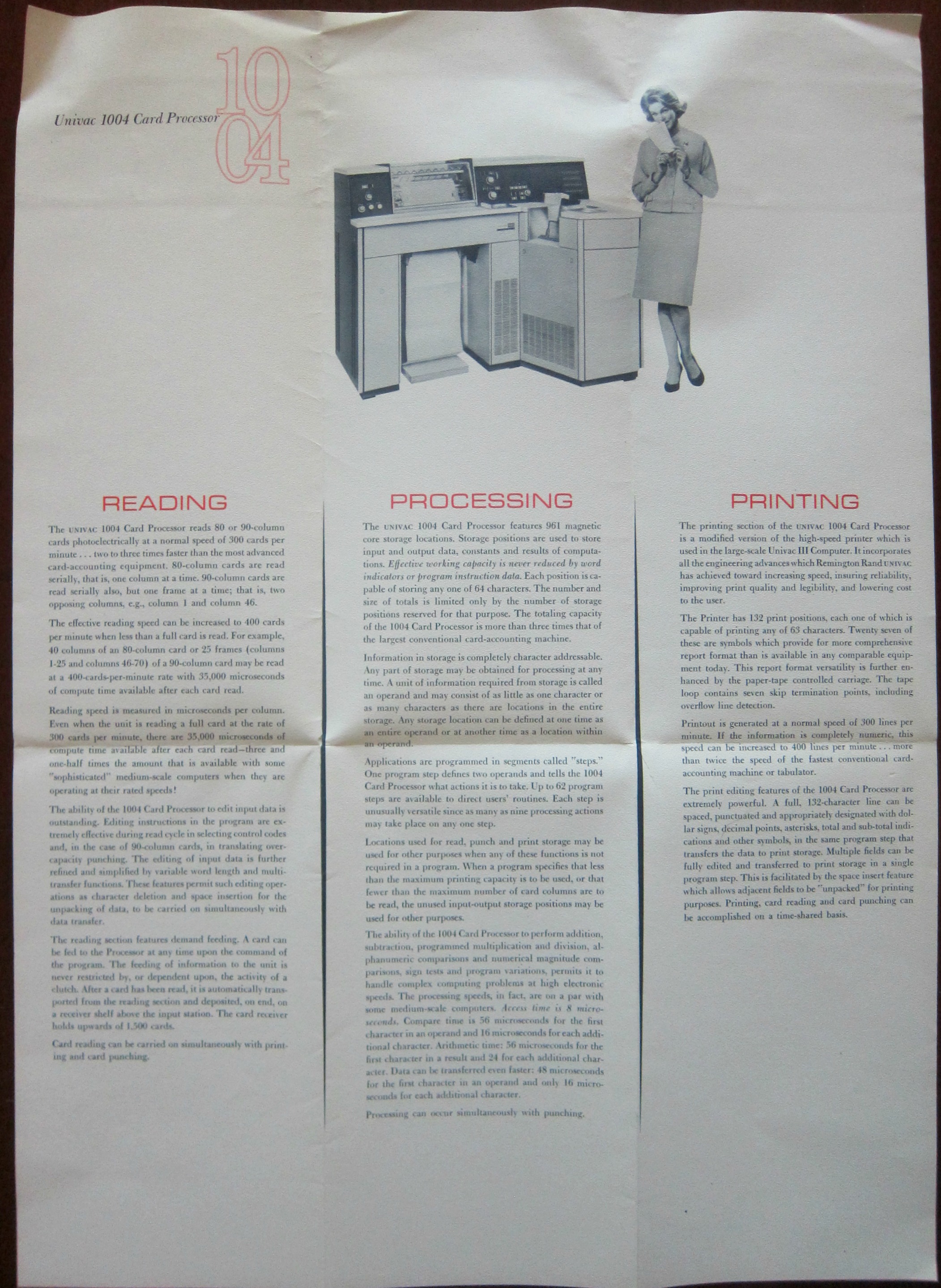
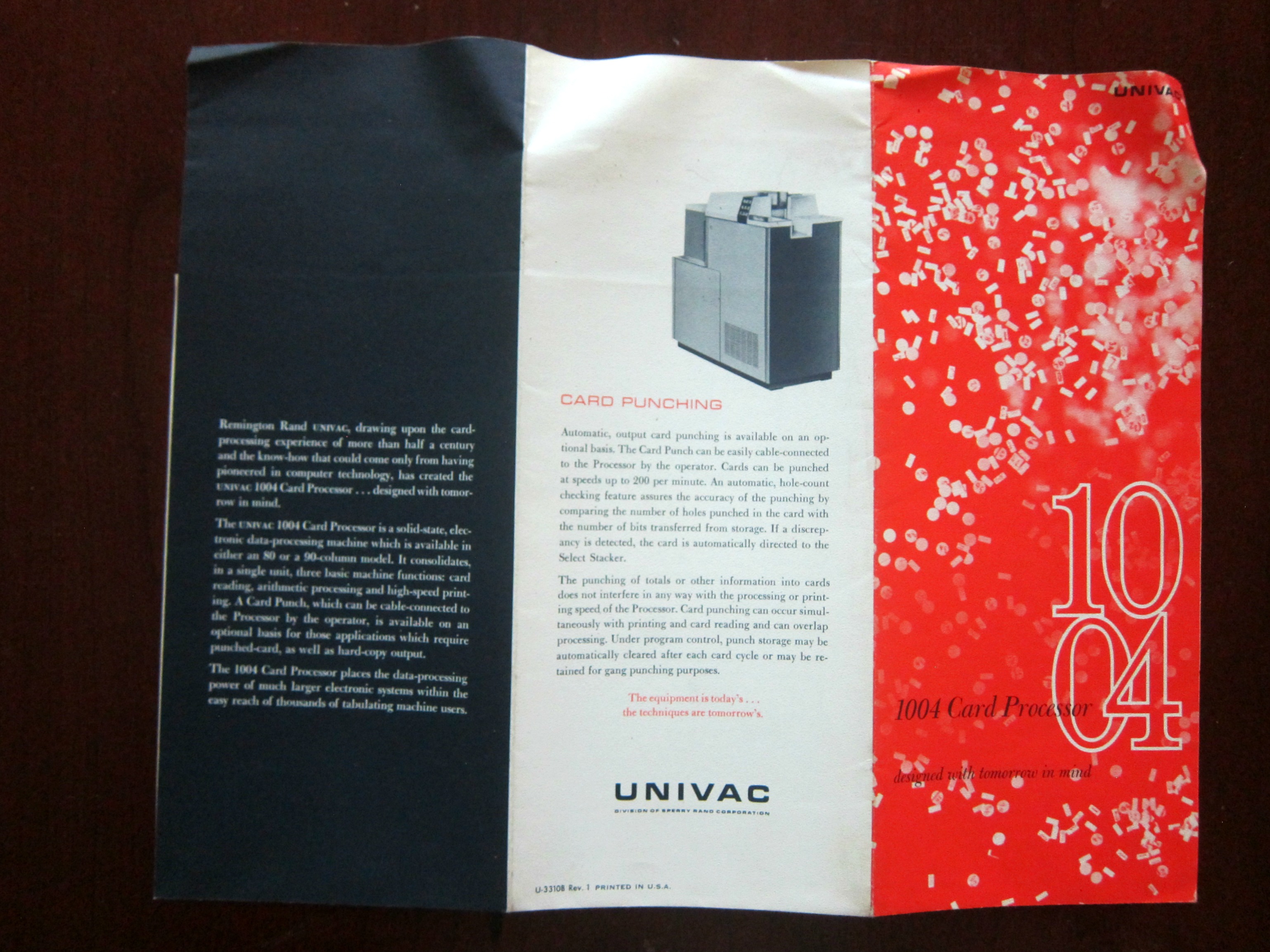
    UNIVAC 1004_2_New for 1962, the UNIVAC 1004 Card Processor 1004. The text of the ad for this tri-fold/broadside advertisment tells us that the UNIVAC machine is “faster” than its human variants, and allows for more reports to be generated at a quicker pace. This was state of the art for 1962, and no doubt companies would want one, if they could afford it.  And just for the record, this unit cost about $148,000 when new, or about $1.2 million in 2017 dollars (computed by the BLS inflation calculator).  

    (Be careful of the UNIVAC trademark, which was registered by Eckert-Mauchly Computer Corporation, Remington Rand Corporation, Sperry Rand Corporation, Sperry Corporation, and Unysis.) 

    The pamphlet-y object is an 11×4.5″ tri-fold which opens to a display of 19×14″ demonstrating the fabulous new and fast features of the machine (and improved by 1966 as the 1005). The image also shows the 1004 printer and a model coyly holding a few punch cards like a geisha fan. 

    “The UNIVAC 1004 was a plug-board programmed punched card data processing system, introduced in 1962, by UNIVAC. Total memory was 961 characters (6 bits) of core memory. Peripherals were a card reader (400 cards/minute), a card punch (200 cards/minute) using proprietary 90-column, round-hole cards or IBM-compatible, 80-column cards, a drum printer (400 lines/minute) and a Uniservo tape drive. The 1004 was also supported as a remote card reader & printer via synchronous communication services. A U.S. Navy (Weapons Station, Concord) 1004 was dedicated to printing from tape as a means of offloading the task from their Solid State 80 mainframe, which produced the tapes. A plug-board program called Emulator was widely installed to convert 1004s to stored-program operation, reading in instructions from program decks of cards which determined the processing of the following data decks.”–Wikipedia on UNIVAC

    UNIVAC 1004


  • A Fine Display of Pie Charts 1893

    JF Ptak Science Books   Quick Post

    “This apparatus works unerringly as the mills of the gods, but beats them hollow as to speed”–Electrical Engineer, November 11, 1891

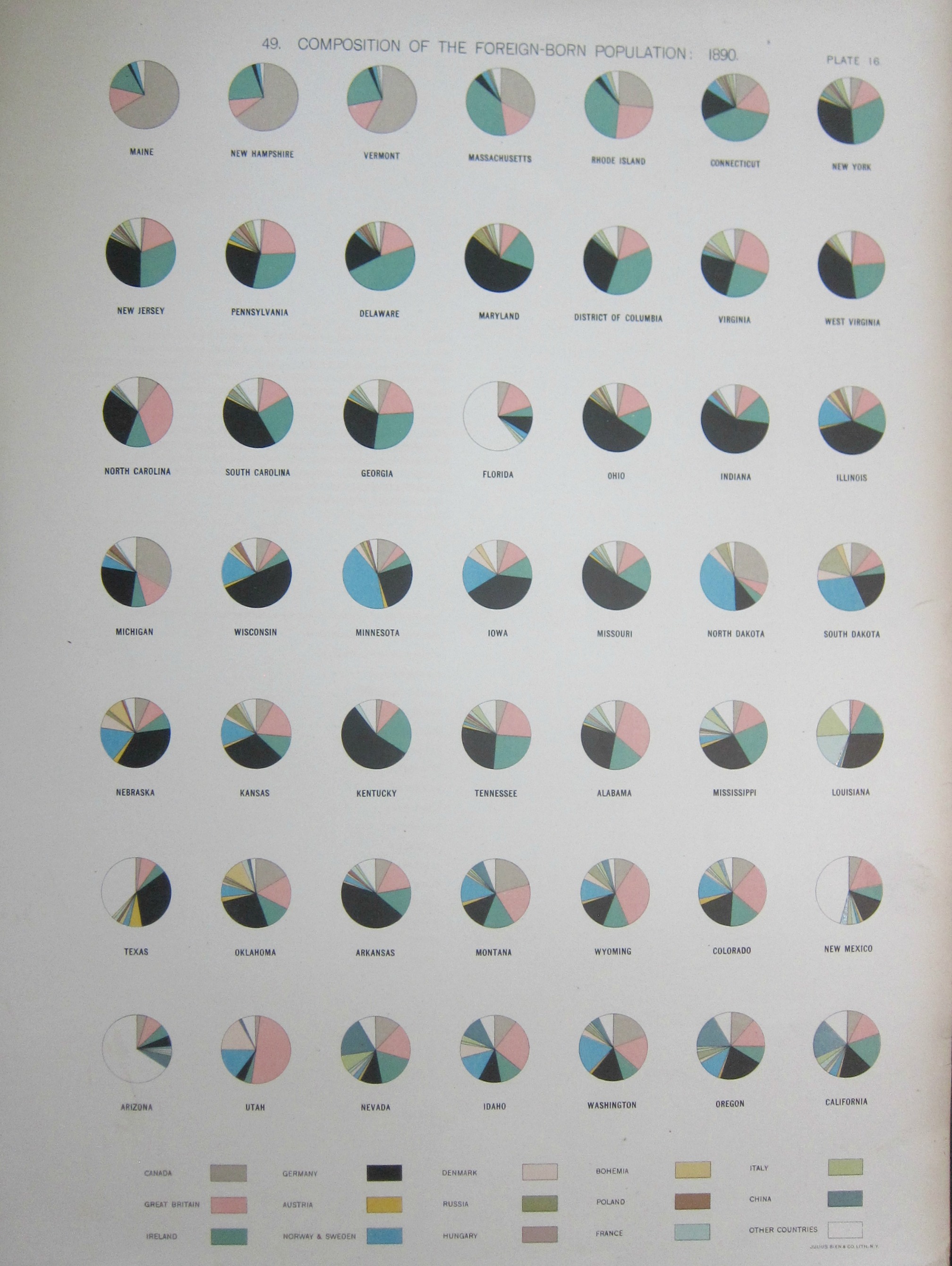
    Hollerith foreign born detail _3_

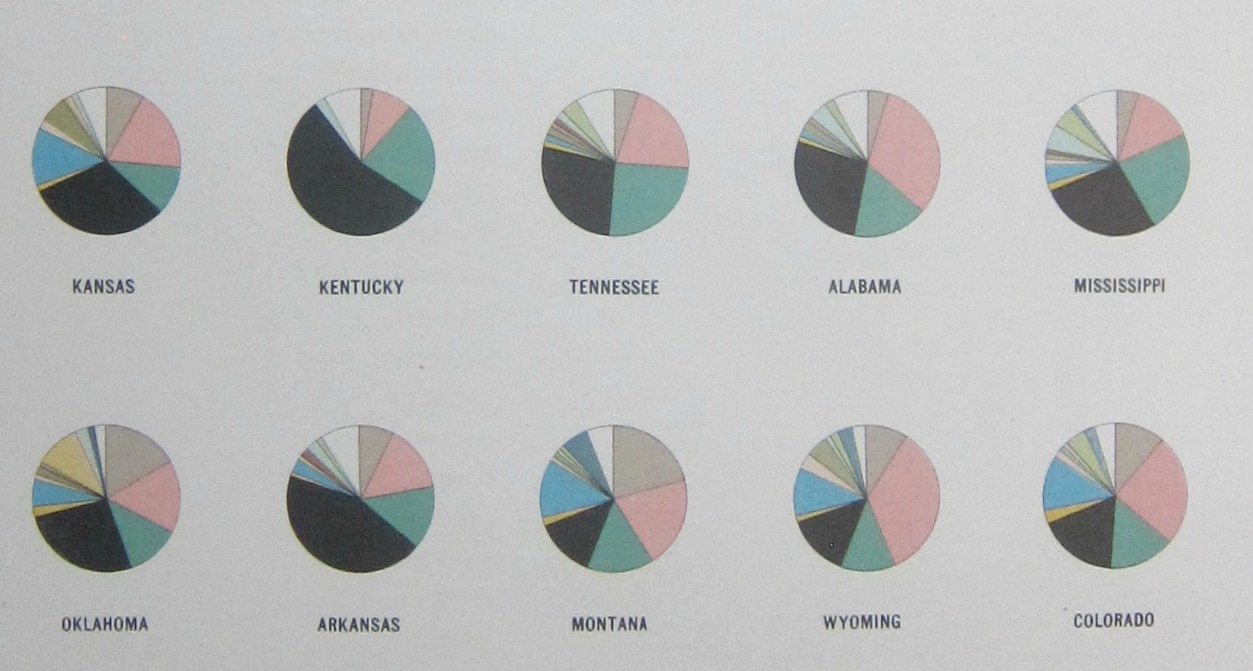
    Many splendid displays of newly-manipulable data made their appearance in the Henry Gannet atlas to accompany the great U.S. census of 1890 –this example displays the composition of foreign born inhabitants of each of the states.  Part of this was due to the use of the Herman Hollerith tabulators, which made their appearance for the census office to work their electromechanical magic to process data faster than the 8-year-long process of the 1880 census. As it stands, the Gannet atlas and the census report was published beginning just two years after the completion of the 1890 census, a job made possible by the “mills of the gods” machine and some 48,000 enumerators (who completed returns for 13,000,000 households).  With prodigious thanks to Hollerith, the census was completed quickly and with a wider variety of data collection rather than what would have been the opposite without them. 

    Hollerith foreign born pop _2_


  • Music as an Oil of the Industrial Machine (Muzak, 1941)

    JF Ptak Science Books   Quick Post 

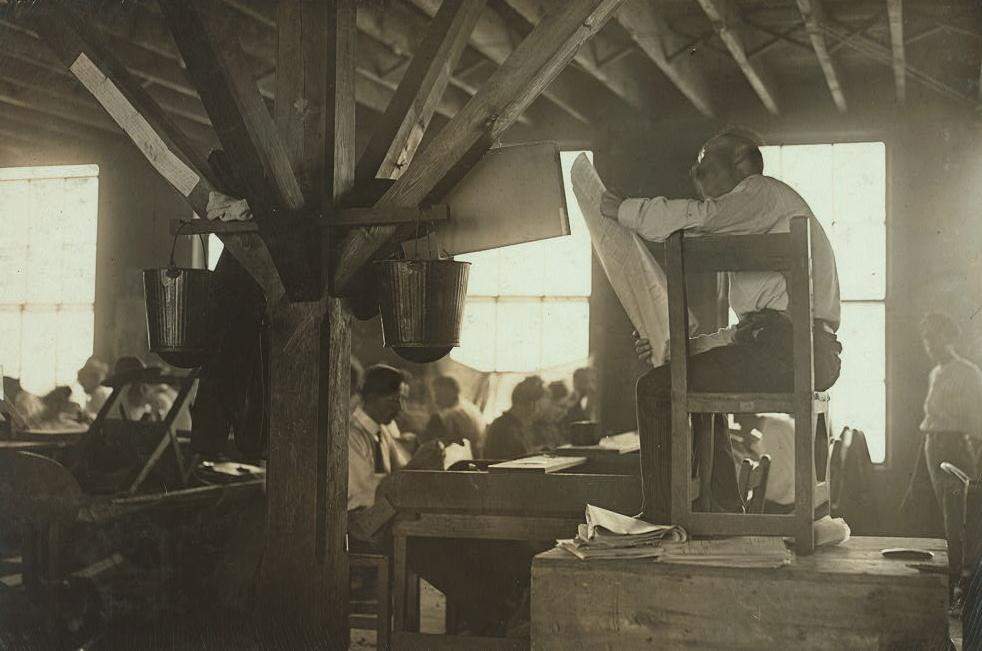
    Reading cubaEntertaining works for a happier labor force has certainly been a “thing” for quite some time–I don’t know the history very much1 but I know it extends back into the 19th c to some probably very small degree, and I do recall a Lewis Hine photo of a Lectore in Havana reading to cigar rollers (in 1909).  It makes sense to make your workers comfortable and to work to end intellectual monotony, though few employers proceeded that way. 

    And thus to Muzak, the improbable source of injecting music into the cooperation equation of industrial control of workers.  [Source: via the Library of Congress]

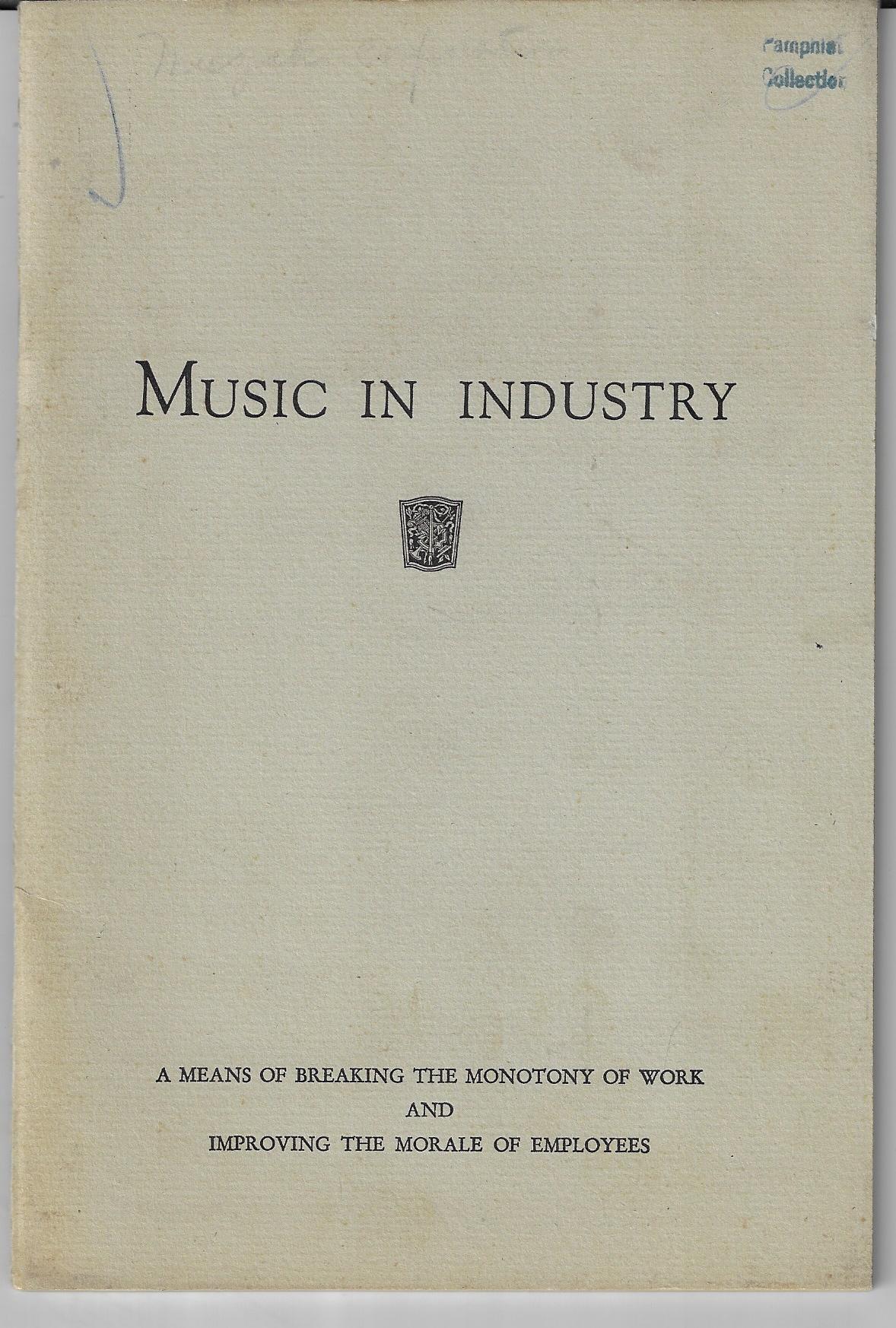
    MuzakI came to this quick realization–late to me–after finding a pamphlet in the warehouse, Music in Industry as a Means of Breaking the Monotony of Work and Improving the Morale of Workers. It was published in 1941–which is earlier than I expected for the Muzak Corporation–which adds to the surprise of the scope of the company’s long-lived impact, its history stretching back to the early 1930’s. It seems as though Muzak, which has a somewhat complex ownership and control history over its first 15 years or so, was a significant contributor to the sound landscape in the United States. It provided four  different broadcasting “networks” of selected musical patterns from the early days of wireless broadcast (at about a dollar a day per month) that provided a certain sort of architecture/design of a sound wall, though the music at this point was coming over telephone lines. In any event, Muzak started providing massive amounts of music into public and private spaces for some time, and their position was accelerated after the company’s war effort during WWII, and then becoming involved in U.S. post-war propaganda programs, and then into the Muzak that we think of today…all of which was happening a few decades before I thought it did. The fact is though that Muzak was filling silence in a controlling way in work and public places for a very long time. I imagine that one could think of this as a sort of early robotization of the human workforce–that is extreme, of course, but the thought worked its way through my head and came out here. 

    Notes:

    1. I don’t think I’ve ever mentioned this in the 4500-odd posts I’ve made to this blog in the last nine years, but the one rule I try to abide in writing one of these posts is that they take no more than an hour, start-to-finish. 
    • For an interesting read, see  Elevator Music: A Surreal History of Muzak, Easy-Listening, and Other, by Joseph Lanza.
    • There are no copies of this work found in WorldCat/OCLC, in spite of this being the second printing of the pamphlet. There are several other works by this title–generally being journal articles) and even a music in industry bibliography published in 1943, but no listings for the Muzak title. 

    ·Posted by :

    ·in:

    —

  • A Flying Aircraft Carrier, 1942

    JF Ptak Science Books   Quick Post

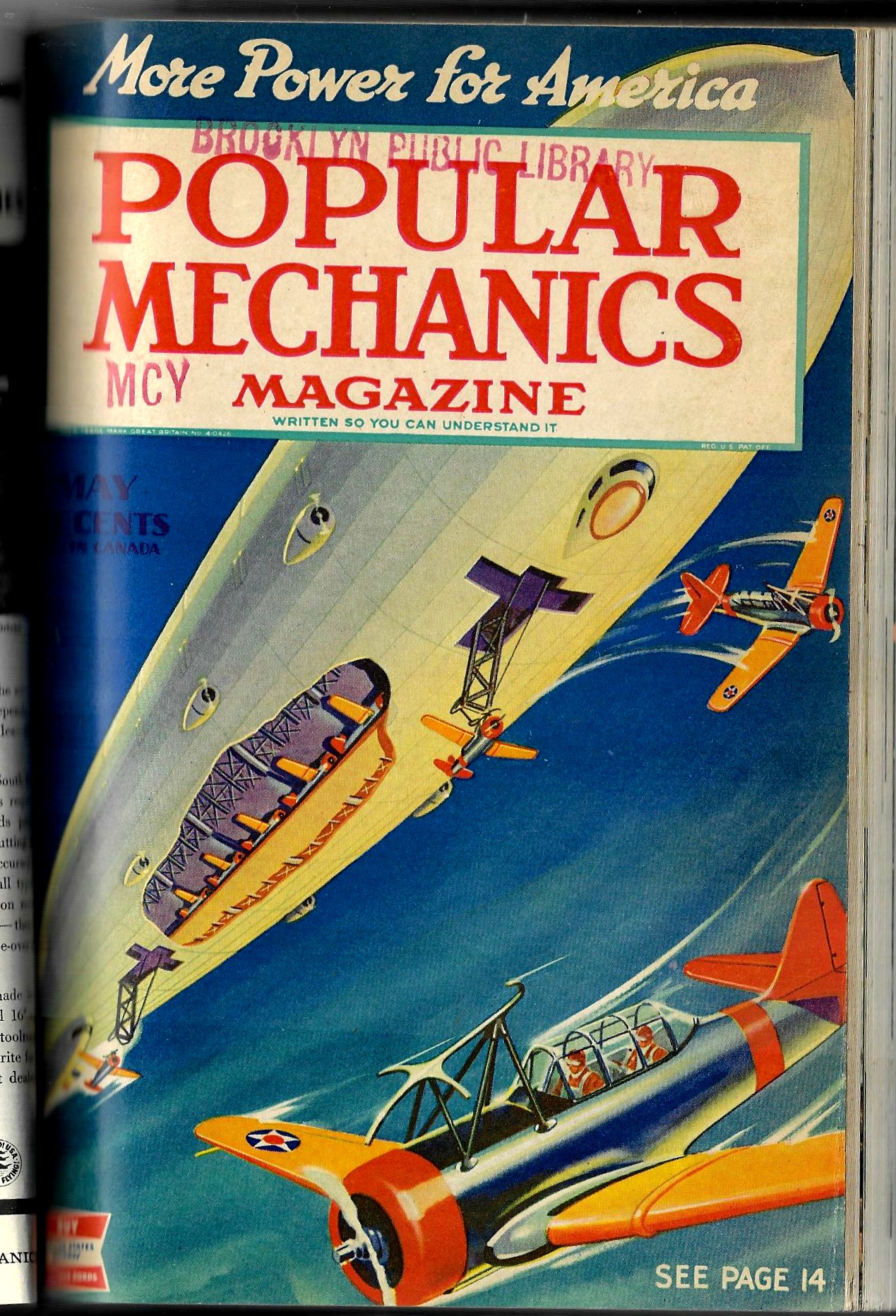
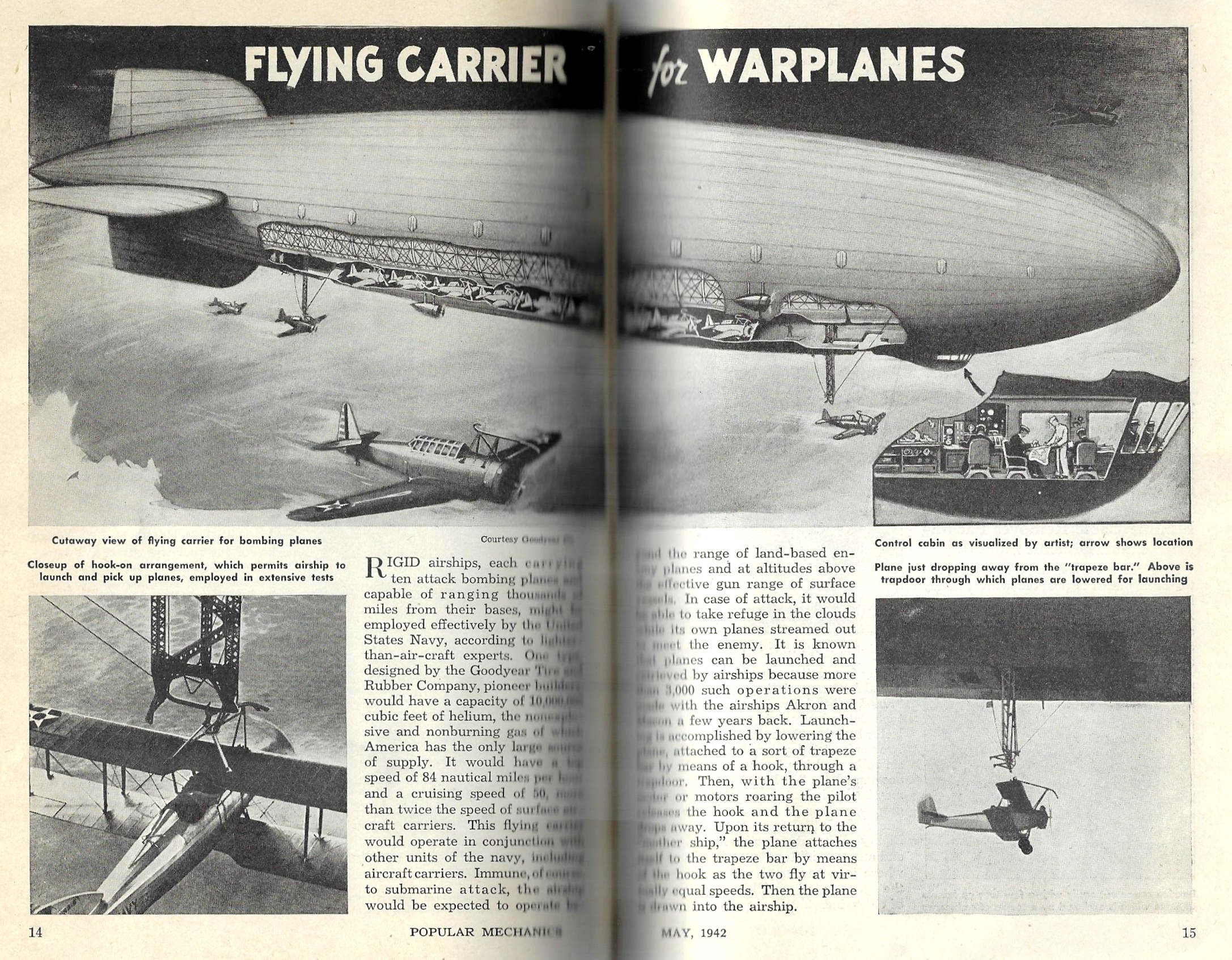
    Here’s an interesting idea: the flying, floating, helium-filled rigid-airship to serve as a flying aircraft carrier, and it appeared in the May 1942 issue of Popular Mechanics Magazine.  That places the idea in print six months after Pearl Harbor, when the U.S. was gearing up for its own direct involvement in WWII.  At the time of the attack at Pearl, the U.S. had 7 carriers; from this point out (from May 1942) to the end of the war there would be 16 more aircraft carriers constructed, plus another 33 escort carriers and light aircraft carriers, and of course those were all seaborne–and in addition to everything else that was being manufactured, that was a huge achievement.

    One thing the article points out that is an unimpeachable positive for the rigid airship carrier–they were not threatened by submarines. 

    Pop Mech 1942 May dirigible airplanes

    And the cross section giving a clearer idea of what is going on in the airship: 

    Pop Mech 1942 May diribible cross section

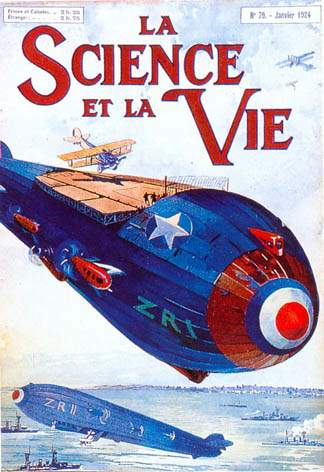
    And another, far more awkward variation, from 1924–this has little to do with the idea above though it is somewhat related:

    https://historyofideasblog.com/a/6a00d83542d51e69e2012875ea3636970c-pi