A Daily History of Holes, Dots, Lines, Science, History, Math, Physics, Art, the Unintentional Absurd, Architecture, Maps, Data Visualization, Blank and Missing Things, and so on. |1.6 million words, 7500 images, 4.9 million hits| Press & appearances in The Times, Le Figaro, Mensa, The Economist, The Guardian, Discovery News, Slate, Le Monde, Sci American Blogs, Le Pont, and many other places… 5000+ total posts since 2008.

Category: Brevity and Complexity

  • On the Sublime Mundane–Great Classics in the History of Flagpoles, Pole Painting, and Zippers

    JF Ptak Science Books   Post 1724
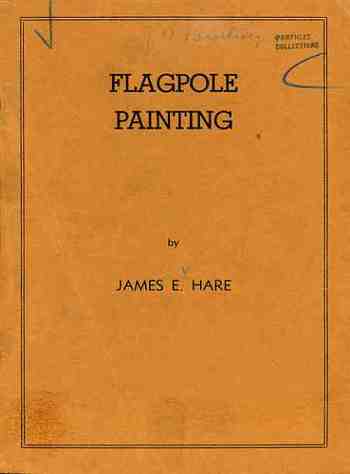
    Blogaugust_18flagpole408It is difficult not to stand in complete respect of something being Very Well Done–especially if that “something” is something very simple, a “something” that is generally  invisible because it is so much part of the visual or social or mental environment.  I’ve touched on this topic earlier in this blog, particularly here on a post on a beautiful and quick pamphlet written on the care and painting of flag poles.  It is a monumental work in its subject area of the Very Small–a very well written, concise and what seems to be complete treatment and mastery of its subject.  The subject just happens to be flagpoles–but if you ever needed something to describe what to do if faced with the task addressed by this pamphlet, then you have certainly found the Ulysses of the subject. 
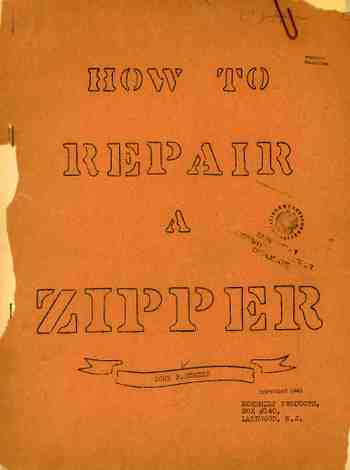
    Blogaugust_28zipper469_2

    This tall (11×8 inch) 35-page 1945 work with an impossible title has everything that you would need to know–as its title promises and delivers–to repair a zipper.  Not replace a zipper–repair it. 

    It is so beautiful as to want to make every engineer residing in the deepness of everyones’ soul just simply weep in the glory of this pamphlet.  The work  is simply but well illustrated and addresses 50-odd contingencies for zipper malfunction and failure, and speaks to a particular WWII mindset that that addresses problems in this very fashion. Repair rather than replace.  The bottom line here is that this is as good as any book of the history of fluxions or the making of the atomic bomb or cooking up a virus, given the parameters and limitations of its subject.

    These memories were brought to the surface tonight because of a pamphlet that I found that had burrowed itself deep inside a box of science pamphlets written by folks in the D-H part of the alphabet on particle physics in the 1940’s and 1950’s.  It just popped out:   Decay of Poles.
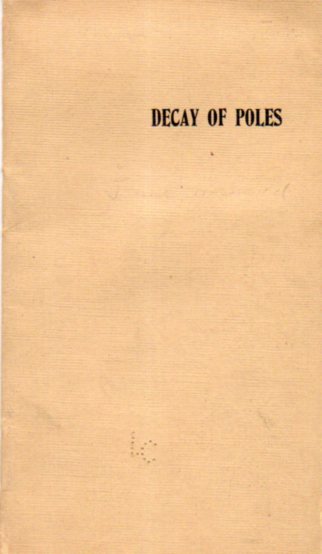
    Decay of poles230
    I really wasn’t sure what the book could be about.  Having just finished a short post on the work of Jules Verne’s Moon Gun being used to alter the axis of the Earth to make Polar exploration easier, I thought that, well, perhaps someone put something “special” together on how the Earth’s poles were decaying. Or “decayable”. 

    The title page of this sweet, small pamphlet says otherwise:  it is written by Howard Jones (“A.B., A.M., M.D.”) of the “Universal Pole and Post Preservation Company” of Circleville, Ohio. (The story of Circleville is extraordinary–we’ll deal with that tomorrow.)  Dr. Jones addresses the issue of decay and wood, particularly and of the utmost importance was the decay of the wood in poles and posts.  When you think of it just a bit, you’ll see that Decay of Poles was an essential work, as there must have been tens of millions of poles and posts slowly (or not) rotting themselves away into splinters in holes in the ground all over the United States.  As a matter of fact that are still tens or hundred of millions–billions–of wooden poles still in this country:  its how we support the very backbone of the digital infrastructure of the world economy, strung on wires in between poles made of dead trees, and stuck in holes in the ground. 

    And lastly for tonight, I’d like to address one more thing, something that took my breath away when I saw it for the first time.  It was the following article in the relatively obscure magazine, Illustrated World–a sort of more-popular Popular Mechanix–for June, 1917.  I saw the title which suggested doing something that I had never considered doing before, or thought about anyone else doing–building your own phonograph at home. 
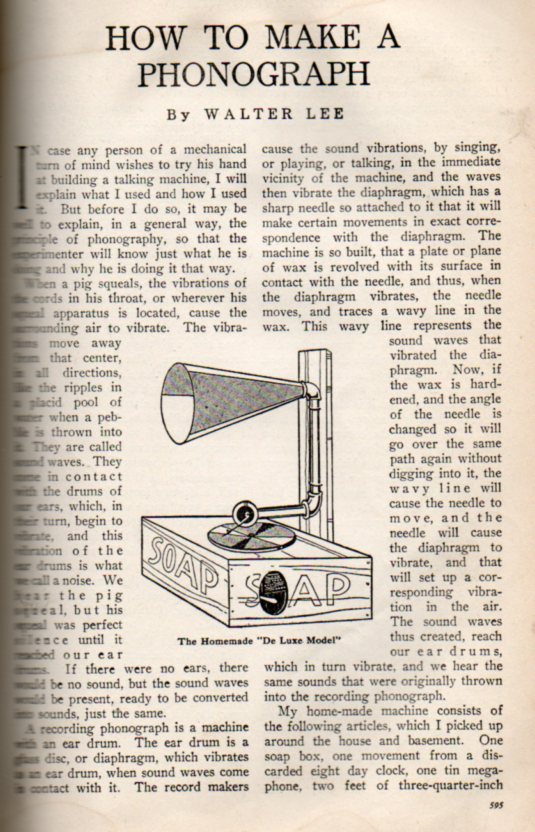
    How to phonograph228
    And of course the lovely schematic, which suggests that you could pull this thing together with bits of stuff from the kitchen junk drawer and fluff from the basement; then, Things Happen, and you have a phonograph.
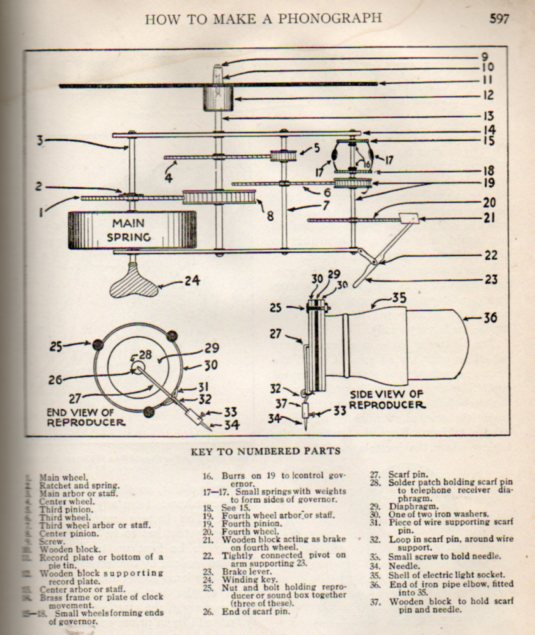
    How to phonograph229
    This just seems to me to be so perfectly right, correct.  Why not make your own phonograph?  IF you remind has heard the music before it will fill in the pops and hisses and misses that your homemade will invariably produce, so why not make something that will play your vinyl without necessarily killing it? 

    All of these items speak to an appreciation for the recognition of The Small Job Well Done.  This may be a key ingredient to what we may not be doing for ourselves, collectively, today.  This is lovely work brightly done with basically unseeable results–unless you look for them.  And then you can find the beauty. 


  • Poe’s Brilliant Literary Criticsm and the Assault on his Memory

    JF Ptak Science Books  Post 1713 [Part of a series on the History of Memory]

    Poe is not so remembered today by the general public as an essayist, and less so as his almost-forgotten career as a book reviewer and literary critic.  Creator (perhaps) of the genres of science fiction and the detective form, a master of suspense, an agent of words, poet and short story writer, editor, yes; maker of taste and keeper of logical insight in literature, well, maybe not so much.

    But the weight of it all is that Poe may have been America’s greatest literary critic of the 19th century,–perhaps more than that. And it may have led to Poe being remembered for some not very savory things, some everlasting iconic and not-necessarily true I-cannot-tell-a-lie Poeisms that are known by the social mind. For example, a bad review may have bought him this obituary as a huge helping of pay-back:

    “EDGAR ALLAN POE is dead. He died in Baltimore the day before yesterday. This announcement will startle many, but few will be grieved by it. The poet was well known, personally or by reputation, in all this country; he had readers in England, and in several of the states of Continental Europe; but he had few or no friends; and the regrets for his death will be suggested principally by the consideration that in him literary art has lost one of its most brilliant but erratic stars…”–by “Ludwig”,”Death of Edgar A. Poe, New York Daily Tribune, October 9, 1849, page 2, columns 3-4. [Full text here.]


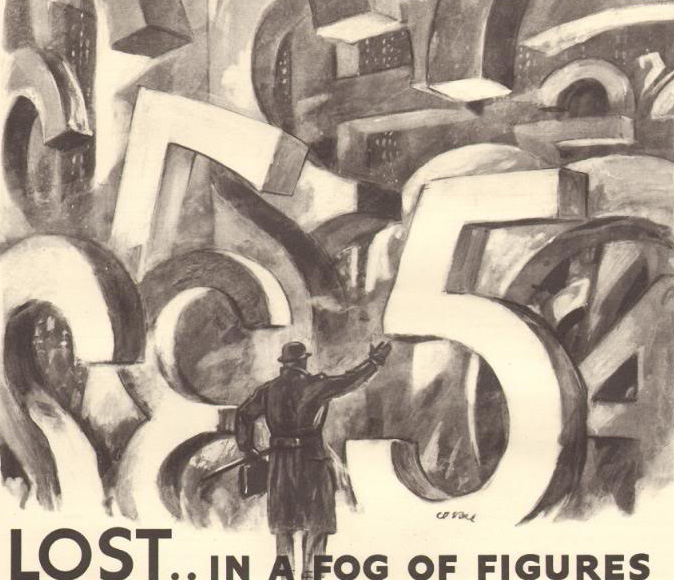
  • Drowning in Numbers–Arithmetical Harvesting by Monroe and Texas Instruments

    JF Ptak Science Books  Post 1704

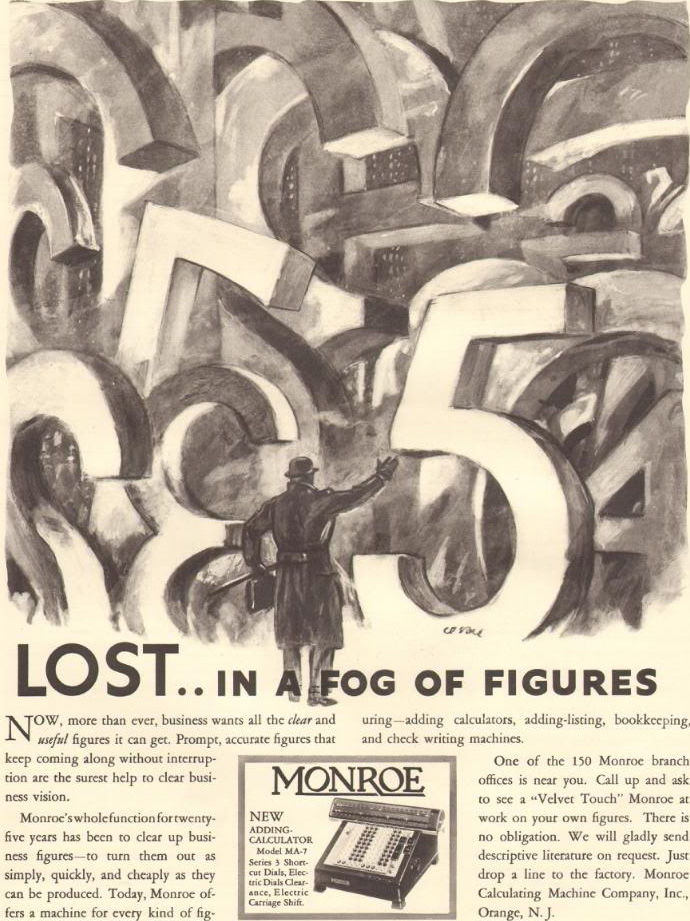
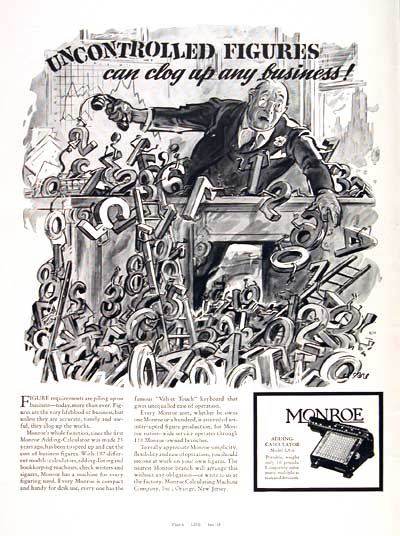
    Monroe numbers lost detail
    Monroe numbers lostThe Monroe calculator must have seemed the same sort of inspired salvation to the 1930’s generation as the hand-held Texas Instruments calculator (with paper feed!) that I saw displayed in a glass-domed pedestal at Barnes and Noble in Manhattan in 1973.  Small, compact, and with fantastic calculatign capacity–and expensive.  It was in a very real sense a glimpse into the future.  For the general, garden-variety Monroe, it certainly offered its users a much smaller, tidier machine than some of the brutes of the decade or two preceding it–make no mistake, there were some big bruising accounting Monroes that were truck busters.

    But the Monroes that appeared in these ads from LIFE magazine in the late 1930’s Monroe calculatorwere certainly populist, and easily transportable.  And they cost about as much (with some smoke/mirrors adjusting for inflation and etc) in 1937 as the $450 TI  cost in 1973. (The TI machine was produced just seven years or so after its first hand-held was introduced–I’m unsure of the 450 price tag, though I think it about correct.  The TI SR-50 without a paper trail cost about $150 in 1974.)

    Monroe is an old company (begun in 1912) company that produced hand-cranked and electromechanical calculating devices.  The Monroe salesman’s handbook that I have here from 1929 shows versions of their machine that were lightweight and versatile (at 38 pounds) to behemoths for insurance companies that were truck-haulable.  Monroe became part of Litton before reappearing again on its own, trying to compete in the hand-held market with its own electronic display calculator–a device that cost $269 in 1972.  Monroe was basically “done” by the 1960’s.

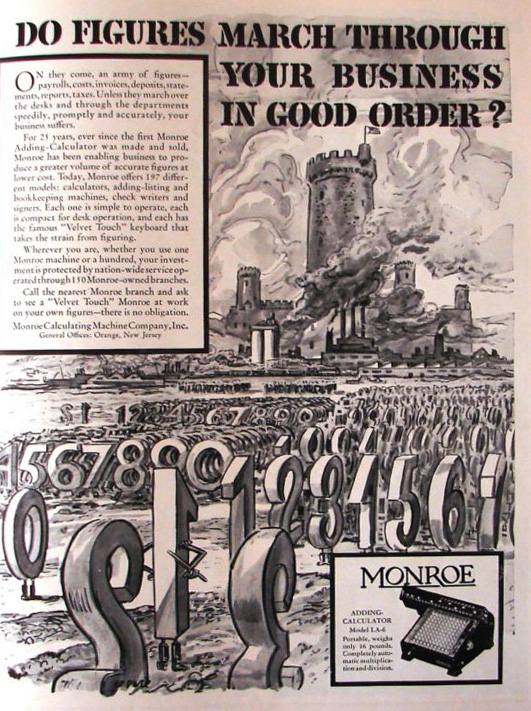
    Monroe numbers marching det
    I think that for most people Texas Instruments is produced hand-held calculating devices–it is of course a vast concern, with a long history that gets catapulted during WWII when the formerly geology-based company gets involved in military electronics.  Fast forward, TI created FLIR and MERA, laser-guided control systems for PGMs (laser-guided bombs/precision-guided munitions), launch and leave glide missiles, and so on. IT was also involved in the earliest work in microminiaturization, producing (by Gordon Teal) the first commercial silicon transistor (1954) and the first integrated circuit (by Jack Kilby) in 1958. And so on.  Its a big, old company.

    And as much as each company was offering a similar god-send to their generationally-distanced mathematician/number cruncher, TI simply didn’t have ads like Monroe.  And I’ve always iked to see numbers-on-the-move.

    Monroe numbers marching


  • A Managerial Directive on How to Present War News: PM Newspaper, 10 Dec 1941

    JF Ptak Science Books   Post 1694

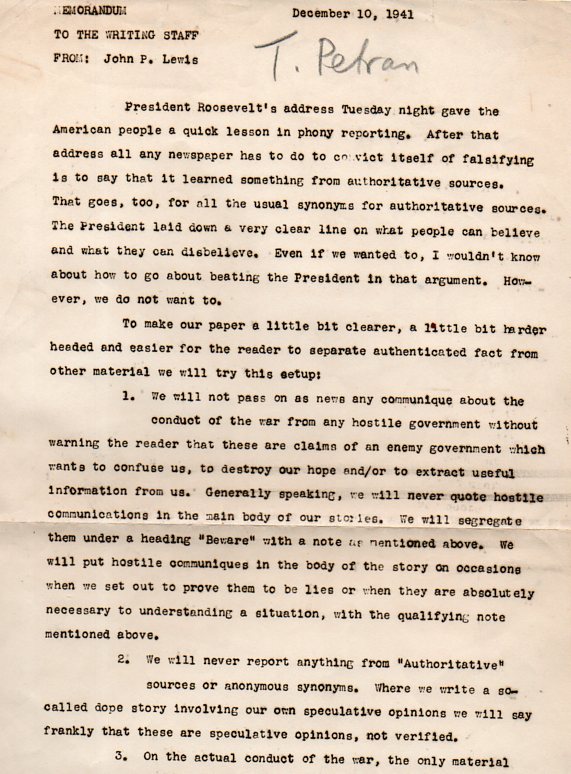
    PM (short for “Picture Magazine, evidently) newspaper1–begun 18 June 1940 and ended 1948–was a very strong, left-wing newspaper in NYC, a short-lived daily with a long pedigree of contributors2.  The “Memorandum” reproduced here, sent by the Managing Editor John P. Lewis “to the writing staff”, was a powerful and interesting directive on how to present the news, and addressed the speech of President Roosevelt of the night before. 

    Lewis felt that here, at the beginning of the American end of the fighting war, was the appropriate place to set out a war strategy for reporting and publishing regarding information received from overseas, or unverified sources, or from dispatches from the countries against which we were fighting.  He was clear and very concise–the whole of the memorandum fitting on one side of a single sheet of paper. 

    PM Newspaper136
    [This piece of ephemera may be purchased through our blog bookstore, here.]

    The Roosevelt speech of  9 December 1941 can be found  here.  Some interesting extras as follows:

    “Your Government knows that for weeks Germany has been telling  Japan that if Japan did not attack the United States, Japan  would not share in dividing the spoils with Germany when peace  came. She was promised by Germany that if she came in she would  receive the complete and perpetual control of the whole of the Pacific area…This alone if true could be a justification for war with Germany.”
    //
    “Our policy rested on the fundamental truth that the defense of any country resisting Hitler or Japan was in the long run the defense of our own country.”

    But the main thrust that Lewis was addressing was this:

    “I cite as another example a statement made on Sunday night that a Japanese carrier had been located and sunk off the Canal Zone. And when you hear statements that are attributed to what they call “an authoritative source,” you can be reasonably sure from now on that under these war circumstances the “authoritative source” is not any person in authority.”

    “Many rumors and reports which we now hear originate, of course, with enemy sources. For instance, today the Japanese are claiming that as a result of their one action against Hawaii they hare gained naval supremacy in the Pacific. This is an old trick of propaganda which has been used innumerable times by the Nazis. The purposes of such fantastic claims are, of course, to spread fear and confusion among us, and to goad us into revealing military information which our enemies are desperately anxious to obtain.”

    Lewis was quick to the point:  “President Roosevelt’s address Tuesday night gave the American people a quick lesson in phony reporting.  After that address all any newspaper has to do to convict itself of falsifying is to say that it learned something from authoritative sources.”

    He continued: “The president laid down a very clear line on what people can believe and what they can disbelieve…” and then outlined four major points for his writers to follow:

    “1. We will not pass on as news any communique about the conduct of the war from any hostile government without warning the reader that these are claims of an enemy government which wants to confuse us…

    “2. We will never report anything from “Authoritative” sources or anonymous synonyms. 

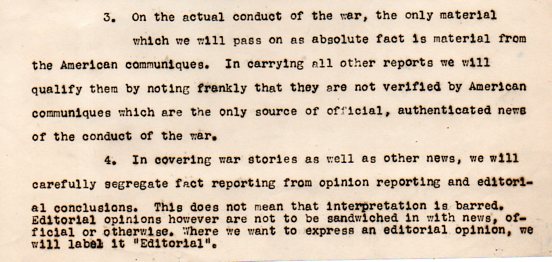
    “3. On the actual conduct of the war, the only material which we will pass on as absolute fact is material from the American communiques.”

    “4. In covering war stories as well as other news, we will carefully segregate fact reporting from opinion reporting and editorial conclusions.”

    PM Newspaper137

    Lewis was also particularly demanding in his policy regarding personal opinion in news stories: “Where we want to express an editorial opinion, we will label it “Editorial.”

    And Lewis meant it, too. Unlike almost all newspapers, PM editorials  were signed.  The newspaper also took no advertising, hoping to keep the paper running on sales and subscriptions.  And so it did, for eight years–not long by long-running standards of  newspapers, but fairly long for the times, and for the type of business plan practiced. 

    In any event I enjoyed the crispness and clarity of Lewis’ directive.

    Notes:

    1. The publisher was Ralph Ingersoll (1980-1985), who before coming to PM was the managing editor of Time-Life, and who was also the business plan designer and then managing editor of Fortune magazine; and the silent partner in the whole thing was MArshal Fields III, who pretty much bankrolled the newspaper from a distance.

    2.  It was a very considerable staf.  From Wiki:  “Journalist I. F. Stone was the paper’s Washington correspondent. His award-winning series on European Jewish refugees attempting to run the British blockade to reach the Jewish homeland in Mandatory Palestine became the book, Underground to Palestine. Staffers included theater critic Louis Kronenberger and film critic Cecelia Ager. Weegee, Margaret Bourke-White and Arthur Leipzig were the photographers. The sports writers were Tom Meany, Tom O’Reilly and George F. T. Ryall (who covered horse racing). Elizabeth Hawes wrote about fashions, and her sister Charlotte Adams covered food. Other distinguished writers who contributed articles included Erskine Caldwell, [Myril Axlerod], McGeorge Bundy, Saul K. Padover, James Wechsler (eventually the paper’s editorialist); Penn Kimball, later dean of the Columbia University School of Journalism; Heywood Hale Broun; James Thurber; Dorothy Parker; Ernest Hemingway; Eugene Lyons; Ben Stolberg; Malcolm Cowley; future Speaker of the House Tip O’Neill and Ben Hecht.


  • On the History of Blank, Missing and Empty Things: the Heart of Some Sort West

    JF Ptak Science Books  Quick Post   (Part of the series on the History of Blank, Empty and Missing Things.)

    Plains photo969

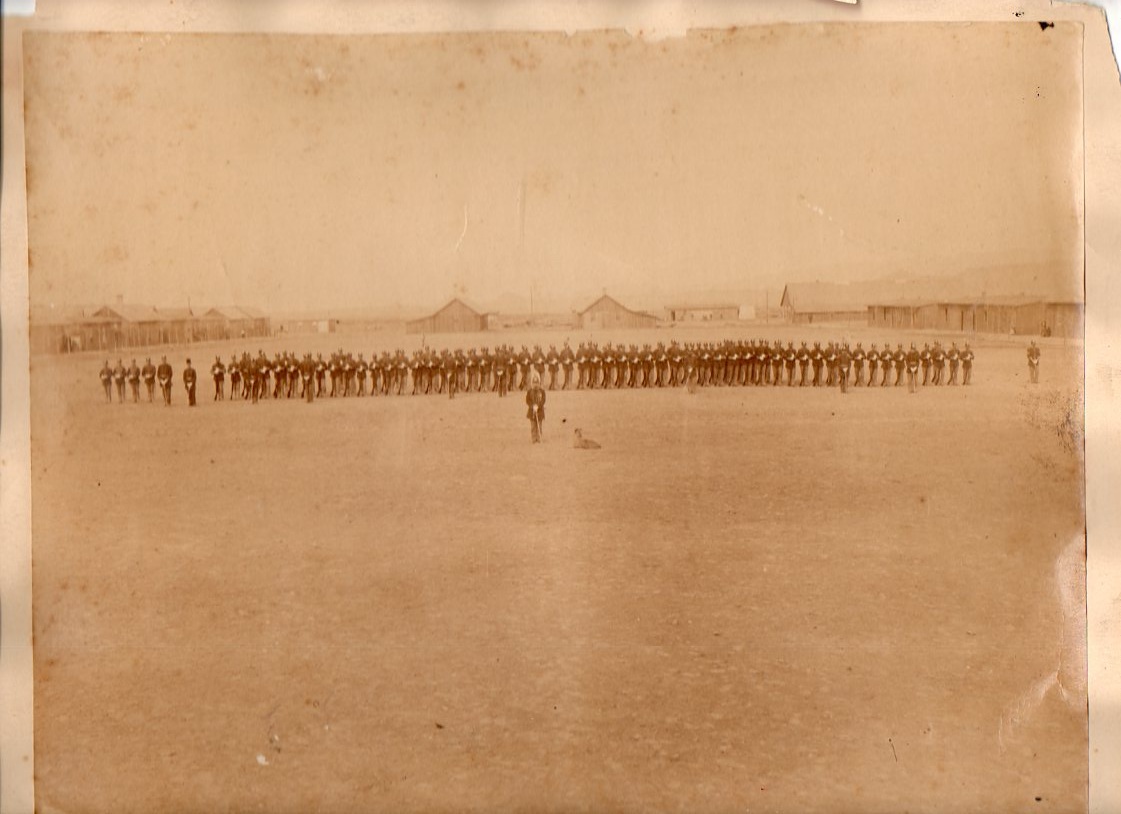
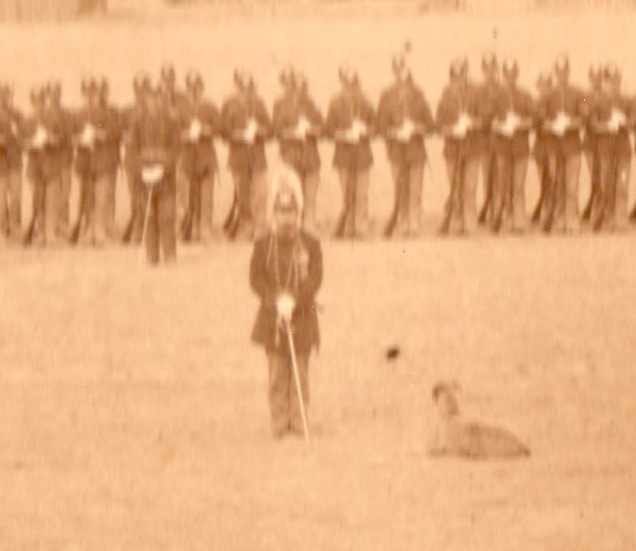
    I’ve owned this photograph for a long time.  It has been in the files for many years, waiting for something to happen to it, waiting for it to be a little understood in some slight way of identification.  I’ve still not gotten around to it.  To me, it has always seemed like a photograph of a small post out in the American Far West, 90 men in dress uniform inside their “fort”, or outpost, the commander and the camp dog addressed in front and the sergeants out on the flanks.  The enlisted men stand at ease. 

    Plains photo971

    I’m really not sure though who or where they are.  The camp is very spread out, for one thing.  And for the age (I reckon this to be made around 1885, perhaps a little earlier) I would’ve thought that boots would’ve been visible under trousers.  And their hats/helmets–they really don’t look to be made for the sun, and also seem too much of a bull’s eye/target.  That’s on first glance–nothing about their uniform seems fitted to the place:  no protection from the sun, trousers caught on low burrs and scrub, and so on.  But the uniforms–and helmets–seem to be in line with the Prussian-influenced dress of the time (or at least around 1882), including the ribbon-y materials draped around the commander’s neck.  (I really don’t know enough about U.S. Army uniforms to make a good qualified guess about who these men are.)

    But the photo as art has always intrigued me, capturing the heart of a lonely place.  I know, though, that having spent  a little time hiking in the desert that the place is hardly empty, or blank.  But it can still be lonely if you want it to be, a state which isn’t dependent on any of the conditions mentioned in the title of this post–its a created space, the loneliness.

    I’ve wondered too about who those people are,  sitting together, (huddled?) at the far end of the soldiers’ barracks, a speck visible over the shoulder of the sergeant (the last figure on the right in the top photo)? I suspect they must be Native Americans, or at least indigenous people.  They’ve faded into history too with the rest of the people in the photograph, a chance at a piece of tangible memory missed because, well, no one made any notes (that survived, at least) about the image. 

    Plains photo972
    The photograph looks hot and cold to me at the same time…

    (This image is available for purchase via our blog bookstore, here.)


  • First Printed Views of America: Columbus in Print in 1493

    JF Ptak Science Books   Quick Post

     Christopher Columbus was born in 1451, and born sometime over a three-month period that no one seems to be able to button down.  He (known as Christophorus Columbus in Latin, and Cristoforo Colombo in Italian and Cristobal Colon in Spanish)  and in an audacious dash to shortcut European rivals in trade with the East became one of the first Europeans to explore the Americas.  In his first of four voyages to what would be called “the New World”, he landed in the Bahama archipelago, and in time explored the Greater and Lesser Antilles, Central America, and the Caribbean coast of Venezula, claiming all for the Spanish Kingdom. 

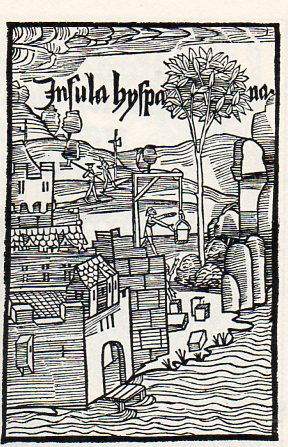
    The first images of his adventures appeared in Oceanica Classis, printed by Johann Bergmann de Olpe, in Basle, in 1493–the first, below, showing an imaginary view of the Island of Hispanola.  In the image of Insula Hyspania, below, we see Native peoples running from the approaching ship and long boat–they of course did not run far enough. (By the end of the 1620’s, something like 75% of the indigenous population in contact with Europeans (or in contact with people in contact with them) were dead, mostly from epidemics and diseases and lesser illness for which they had no immune systems.)

    Columbus933

    Four (of the other eight, two of which were repeated)  images from this fantastic work can be seen below:


  • Imago Frammeni: Boulle, the Dogon, Jouffret, the Simple and the Complex

    JF Ptak Science Books   Post 1623 

    Changing the Mind’s View of Simple and Complex Ideas via Different Image Perspectives

    Photo

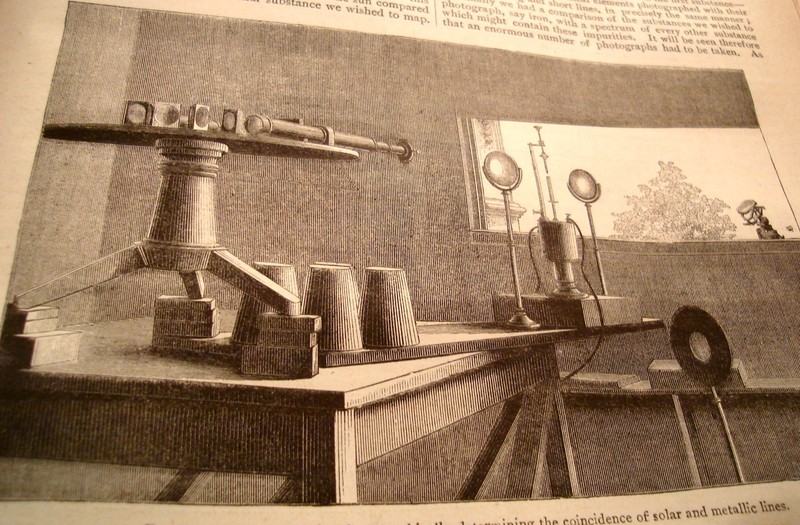
    I’m always very interested in curious things, or standard, “average” things pictured in non-standard ways, as the change in perspective can lead to entirely new observations and discovery.  Seeing this illustration in an article by J. Norman Lockyer (Nature 1881) I was shocked by its clarity and usefulness—Lockyer was simply showing the arrangement of his apparatus for his solar spectrum experiments but the angle of observation (being at such an oblique angle as is normally found) was just, so, well, “correct”.  The image I thought was perfect for the reader—not only that, it was designed artistically and with grace, and one can see exactly what Lockyer was up to.  Diagrams would’ve worked almost as well, but there is just something so extraordinary here that you could just about work from the image if there was no description. 

     
    Looking at things differently is hard work—that’s why I think it is always good to refresh the neuronal sap and look at great examples of unusual , insightful imagery.

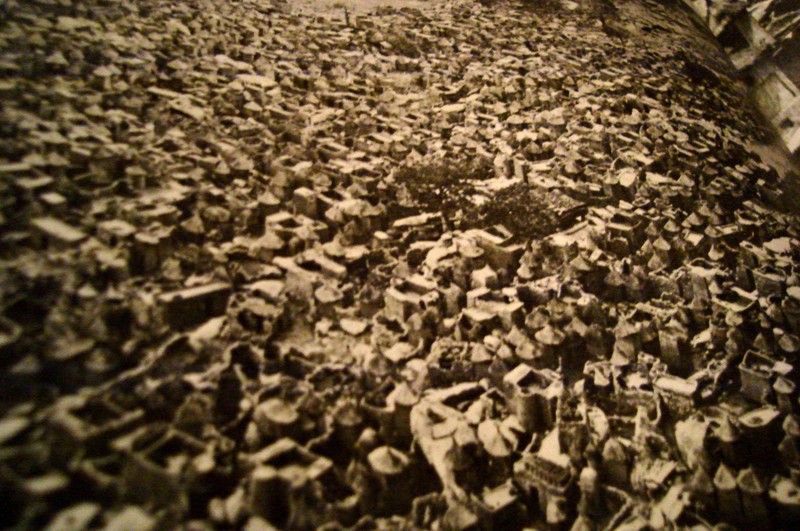
    Sometimes it works to read the description of what the image is before actually viewing it to see the differences of the image that you form in your brain before seeing the thing itself.  For example, when reading about the Dogon, a cliff-dwelling people of the plateau of Bandiagara, south of Tombouctou, and how they would make houses and then towns out of the rocks fallen from cliffs, you get what is probably a pretty benign image.  When you see photographs of these structures it seems as though the brain just simply isn’t ready for their impossible nature, though you quickly, instantly, recover (once you convince yourself the photo is real) and—voila—your mind has been expanded.  (This photo is from an expansive work by Bernard Rudofsky, Architectures without Architects, Doubleday, 1964.) 

    Photo

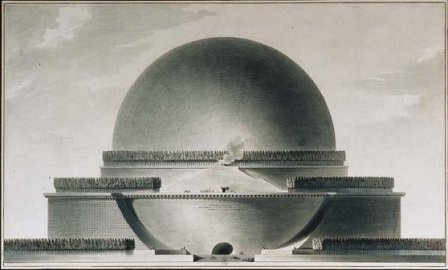
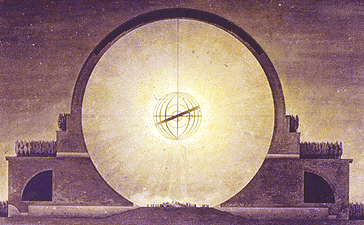
    The (internally) spectacular Etienne Boullee can greet us in the same way with some of his eye-popping architectural creations (unbuilt architecture by an architect, in this case, compared to the built architecture of the non-architects above).  Boullee’s “Plan du Cenotaphe de Newton”, a gigantic memorial to Newton  that was dancing with necessary privacy in Boullee’s brain during the French Revolution (and also during a particularly

    Photo

    un-Newtonesque time in on-your-knees-to-Cartesian-principles France)  is another superior example.  Reading the description of the structure just doesn’t quite do, and it seems whatever grand comes of that is tarnished and stripped away  by the obesely florid sentiment of none other than Ledoux’s poetic sentiments “…O Newton!  Sublime Mind!  Vast and profound genius!  I conceived the idea of surrounding thee with thy discovery…”.  Oy.   Boulle adds to this inspirational atrocity by saying of the sphere:  “…we must speak of a grace that owes its being to an outline that is as soft and flowing as it is  possible to imagine…”   And once the demand of “oh  dear god just please show me the picture” is met, we are left with a turned-around brain and another heavenly exaltation, or profanity.  The Cenotaph is just Grand-Canyon-Spectacular. 

    Photo

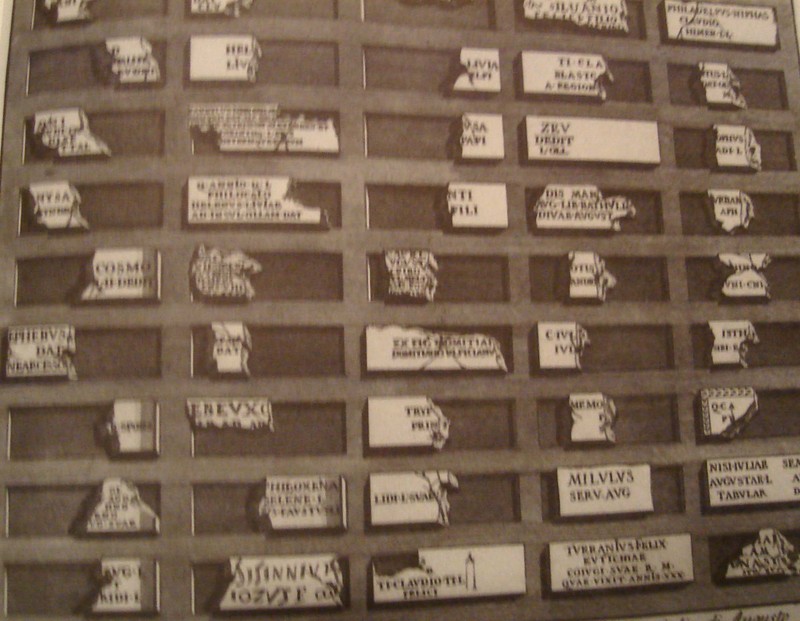
    Complex can turn on the simple in this way, where we can have those “a-ha” moments from, say, early efforts at picturing the fourth dimension or non-Euclidean geometry to a new perspective of looking at Roman ruins.  The arrival on the non-Euclidean geometries  in the 19th century posed new issues, not the least of which was representing the ideas.  Our saintly Hermann von Helmholtz believed –contrary to most elevated opinions—that the human mind could indeed intuit complex space and figures of these geometries.  (The difficulty not only from the obvious intellectual hardships in picturing the concepts but also because the geometry of Lobachevsky http://www-groups.dcs.st-and.ac.uk/~history/Mathematicians/Lobachevsky.html was called somewhat into doubt when some of its results were cast in doubt by contemporary astronomical observations.—and this even though so far as the great Gauss was concerned there was no deviation in Euclidean values.)   Helmholtz did this by employing the three-dimensional pseudosphere model of Beltrami.  (Reluctance to these ideas would end soon enough, for, as Linda Dalrymple Henderson points out with such sotto voce, “the convenience of Euclidean geometry would prove inadequate once Einstein” hit in 1905.)

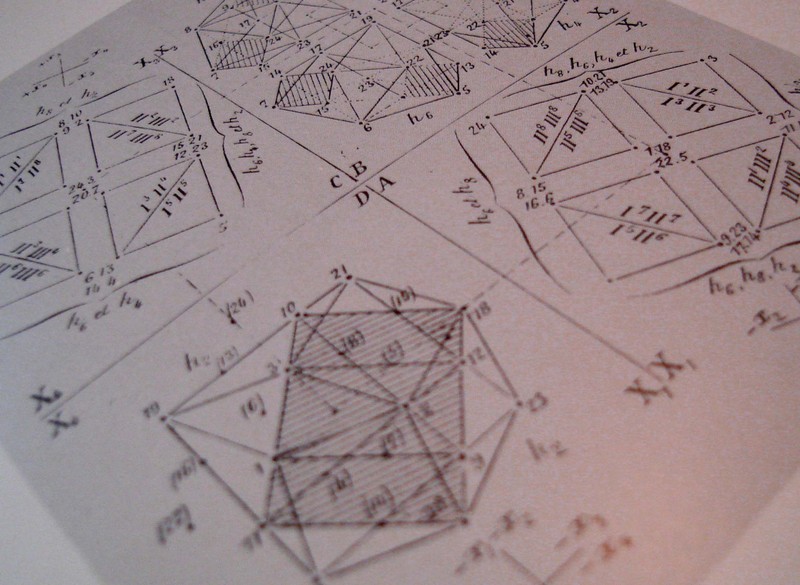
     The work of Beltrami  and H.P. Manning  (Geometry of Four Dimensions, 1914), and Jouffret  (Traite elementaire de geometrie a quarte dimensions, Paris 1903) in illustrating these complex ideas (the titles of which were in themselves daunting as with Jouffret’s “plane projections of the sixteen fundamental octahedrons of an ikosatettrhroid”) would in themselves prove to be entirely irresistible to the world of the arts. 

    Photo

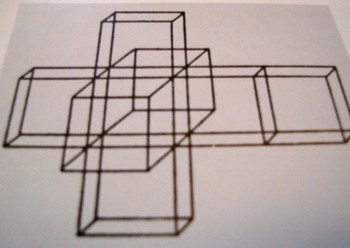
    Charles Howard and Maurice Princet I think had as much to do with  the creation of cubism and abstract art and the imaging of time than anyone, including the painter (I shudder to say his name) of Les Demoiselles (1907) or the lovely Georges Braque (Houses at Estaque, 1908) or Jean Metzinger or even the sublime comedian Duchamp’s Nude DescendingDsc04584 (1914).  The hypercube starts to show up a lot in some Bauhaus genres and even into the palette of Frank Lloyd (“Stinky”) Wright (with his St.Dsc04589 Mark’s Tower plan, NYC, 1929).  I can only imagine the shock to the brains of these creative geniuses in seeing the display of such a novel idea.  (For the ultimate treatise on this see Linda Dalrymple Henderson’s The Fourth Dimension and Non Euclidean Geometry in Modern Art, Princeton  1983).  And no the art didn’t come first. 
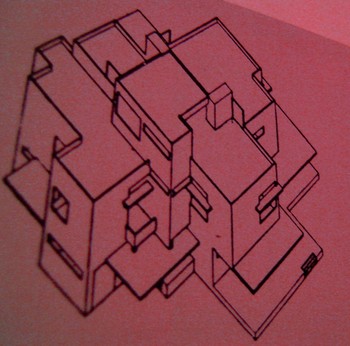
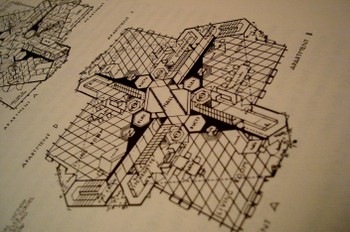
    Dsc04578
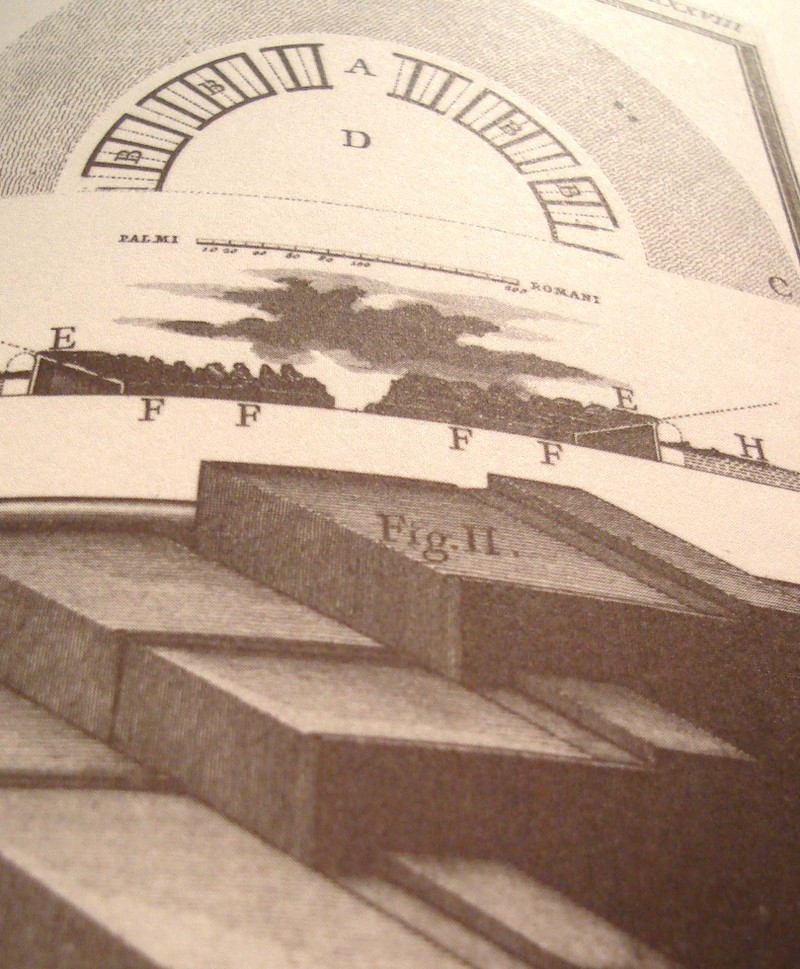
    But coming back to the simple, and in the same frame as the first example that we mentioned in Lockyer, we have the unlikely find of Giovanni Piranesi.  In my opinion his most spectacular work is found in his frammeni (the diverse bits and pieces of architectural and sculptural bric-a-brac found objects that are collected together on one stage) and in his archaeological detail.   His attention to new perspective in showing the crucial aspects of structure and building in Rome is tremendous and

    Photo

    unexpected—as an example we see here the child’s-eye-height view of three steps of the reconstruction of the theatre of Pompey.  I must say that I’ve seen a lot of architectural images in my time but nothing quite comes to me so surprisingly as this step-level view of the reconstruction of a Roman theatre,  This happens throughout the lesser-known Piranesi, with great details of tools, and cross sections of the very deep footings of bridges, and so on.  It is really refreshing, lovely, unexpected work. 

    Photo

    We’ll return to this subject from time to time as I have hundreds of interesting examples to draw from—for example, the remarkable Emily Vanderpoel’s Colour Problems which is ostensibly an undecipherable attempt to quantify color arrangement in art but through the lovely examples displaying this attempt pre-date the modern re-invention of non-representational art by at least a dozen years.  Stay tuned! Dsc04592


  • History of Headaches–Athena and Snakes

    JF Ptak Science Books  Post 1561

      Luchinus 2

    Athena–the Greek goddess of wisdom, and of civilization and of course warfare, and of strength and strategy, and of justice and craft and clever thought–was the first daughter of Zeus, whose mother was Metis, a Titan and equal of her father.  The story of her birth has been told in many different ways, but the basic element of it was that Zeus had laid with Metis, yada yada yada, and then feared that their offspring might be his equal, or greater, and so to quench his appetite for his consort, Zeus ate Metis (on the advice of Uranus and Ge), swallowing her, whole.  But as these things go, Zeus hadn’t planned that Metis was already pregnant, and that being the case, gave birth to Athena inside of Zeus.  Zeus knew nothing of this–being busy–except that after a while he developed a headache so intense that other gods came to his rescue and forced open his head to release the pain–and from his forehead came his daughter, Athena, already clad for war and armed with gifts from her mother. 

    John Milton evidently employed this (or similar) image of springing-from-the-forehead for his own incantation of sin coming from the forehead of Satan, in his Paradise Lost.  Satan (renamed from Lucifer) has been sent to Hell after his attempted terrorism in Heaven, and while there his daughter, Sin, springs from his head.  He of course falls in rapturous lust with her and they produce a baby, Death, which eventually devours Sin.  Oh Happy Days!

    There seems to be some fair amount of spring-from-the-forehead-of business in the history of story telling:  Saraswati (another goddess of wisdom) springs from Brahma’s forehead, Thoth comes from Seth’s forehead in Egyptian mythology, and a parallel Athena/Zeus story appears in Roman mythology with Palla and Jupiter. 

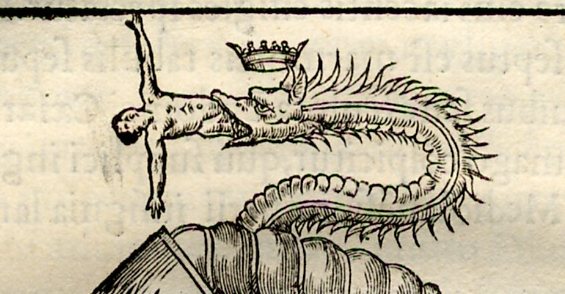
    This seems a long way to get to this headdress of Luchinus (or Luchino I Visconti, who shared in the rule of Milan from 1339 to 1349, found in Paolo Giovino’s Abbrege de l’Histoire des Vicomtes et Ducz de Milan, publihed in Paris in 1553), which was either real or not, but the image of the consumed man springing from the crowned head of the ruler was too much to pass up.  I am assuming that the man is going into the snake/dragon, rather than the other way around.

    Headaches616

    Notes:

    On Athena and Zeus–

    Hesiod, Theogony 886 ff :
    “Zeus, as king of the gods, took as his first wife Metis, and she knew more than all the gods or mortal people. But when she was about to be delivered of the goddess, gray-eyed Athene, then Zeus, deceiving her perception by treachery and by slippery speeches, put her away inside his own belly. This was by the advices of Gaia (Earth)


  • A Note on the Pledge of Allegiance: Exluding “Equality” and including “God”.

    JF Ptak Science Books  Quick Post

    The Pledge of Allegiance was written by Francis Bellamy (1855-1931) in 1892 for the 400th anniversary of the arrival of Christopher Columbus to the Western Hemisphere.  The Christian Socialist Baptist Minister Bellamy started the pledge out as a simple confirmation, and at one time considered the inclusion of the word “equality” in the message, but backed away after he saw potential difficulties with the word, what with the social and legal exclusions of women and Black people getting in the way of the concept. 


  • Tramp-Speak of Antiquarian Road Warriors: ABC’s of Tramps, Hobos and Vagabonds

    Elsewhere on this blog I’ve written a little about dictionaries and words–Sam Johnson, Ambrose Bierce, specialized dictionaries, canting dictionaries, dictionaries of vulgar and coarse language, dictionaries of first uses, dictionaries in distinct fields.

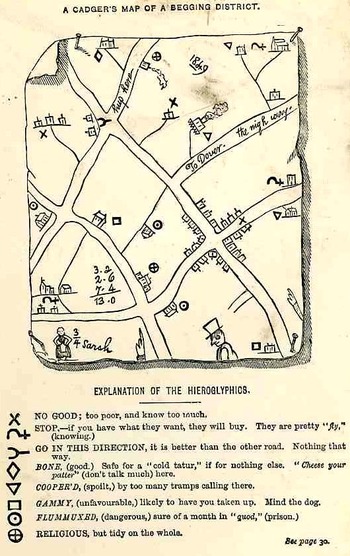
    Bloghobo_b200Hobo dictionaries, guides to hobo slang, are different from those of robbers and thieves and rogues.   They may borrow from one another, but the hobo language seems a little more dignified, and not as directed towards crime as that of, well, the criminals.  An even greater distinction is the hobo alphabet, a Morse Code if you will, a hieroglyphics, for hobos-to-hobos, written in chalk without the benefit of electricity. (I’ve written about that phenomenon here, though I’ll at least reproduce an extraordinary map of a “begging district” found as the frontispiece to the lusciously-titled The Slang Dictionary; or, the Vulgar Words, Street Phrases and Fast Expression of High and Low Society… printed in London by John  Camden Hotten, in 1870.)
    Back to words.

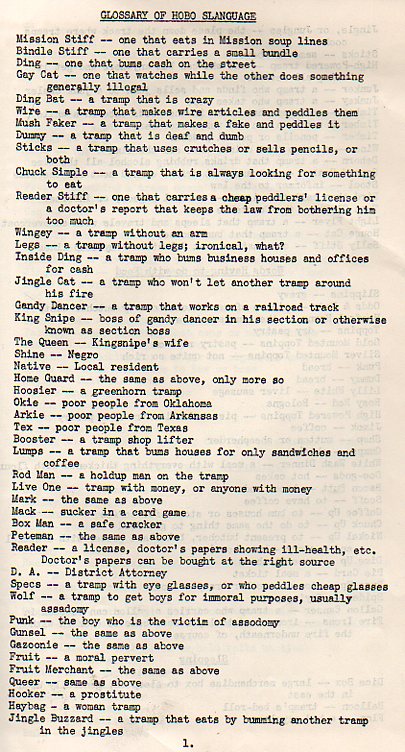
    Part I:  Hobo Slang Collected by a Common and Perhaps Hobos lingo title344 Make-Believe Hobo

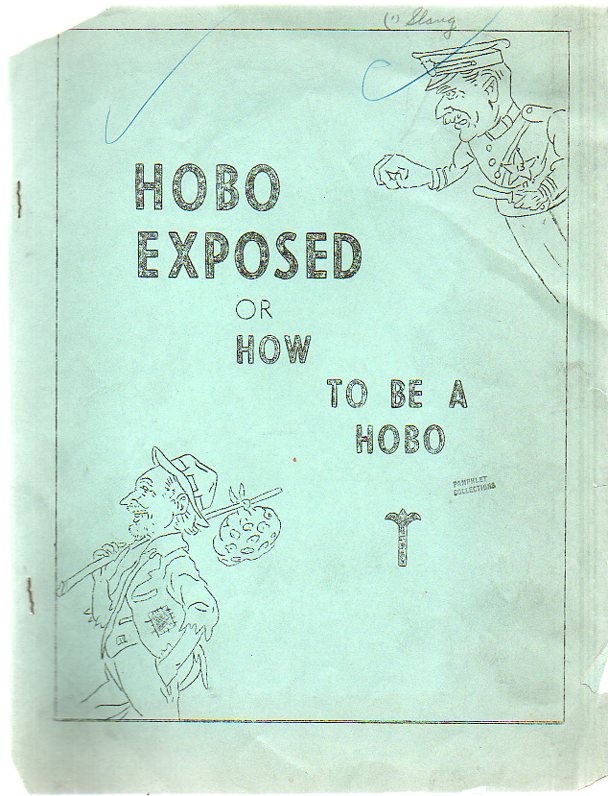
    Hobo Exposed, or How to be a Hobo, at pamphlet  with no claim for a writer but copyrighted by “Kelly’s Specialities” in 1946,  is dedicated to Sun Down Slim, Boston Blackie, Sticks Red and Commissary Blackie.  [This item is available at our blog bookstore.] It gets right to the point of my interest, the Hobo Slanguage.  The collection here is not quite as road-elegant as the collection of the Hobo King, below–not that it is less “regal”, just more common and less imaginative. 

    For example, “Wingey” is the name for a hobo without an arm; “Sticks” is a tramp who sues a crutch; “Legs”, well, you know.  On the other hand I find “grouch bag” (which was a bag of Bull Durham tobacco worn around the neck, which was either valuable enough to be worn that way to keep people out of your pockets or you just didn’t have any pockets), “hogger” (a railroad engineer), “dice box” ( a large discarded merchandise box to sleep in), “slippins” (gravy), “canned heater” (an unfortuate tramp who drinks sterno), “Jingle Buzzard” (a tramp who begs food from other tramps) and so on.

    There are many others:

    Hobos lingo a341
    [This section continued below.]

    Part II: Hobo Slang Collected by the King of Hobos

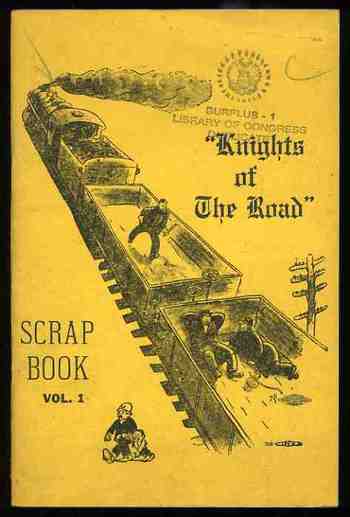
    1blog_oct_8_hobo_cvr785 There have been many Kings of the Hoboes, and Emperor of the Hobos, in the history of American Hobodom.  The most widely recognized of all this royalty is, probably, Mr. Jeff Davis, who was elected King of Hobos each year from 1908 to 1935, until in 1935 at the Pittsburgh meeting of the annual “Hobos of America” his minions gave up elected him King for Life. Of hobos, that is, the Knights of the Road; he was also a real hobo, unlike the pretenders, who in general were not. (Nels Anderson in his Men On The Move, written just as the Depression was broken, (1940) observed: “Whatever else may be said of King Jeff, his romanticizing the hobo is not without a basis in reality, and his poetic interest in the species arose from experience. But King Jeff has placed on a pedestal a man who belongs to the past. The hobo belongs with the pre-Hollywood cowboy and the lumberjacks of the Paul Bunyan legends.”)
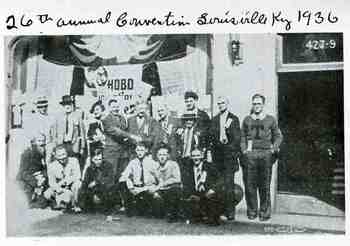
    Mr. Davis was certainly very effective in getting the message out—on freedom and responsibility to irresponsibility—and was a great organizer and popularizer. He helped to establish hobo meetings, newspapers and literature (a sample of which is at left). He also had a few movie appearances: in The Arkansas Traveler, 1938 and The Bridge of Sighs, 1915, he ably played the role of a hobo.

    1blog_oct_8_hobo_cvr786

    And what about the missing counterpart of Jeff Davis–Queen of the Hobos? There were certainly allot of women hobos during the Depression; Harry Hopkins estimated that there were something like 13,000 “sisters of the road” who were out and about in the 1930’s. I guess the most famous of them though was one who did not exist; and what parts of her that were real were mostly those of one man: Ben Reitman. Sister of the Road (1940) was supposed to be an autobiography of legendary Boxcar Bertha, but it was really an assimilation of Reitman’s own experiences sprinkled about those of women from his life. Reitman, who was described (by himself) as a “hobo, whorehouse physician, musician and tour manager/lover of Emma Goldman” (??) was probably not without enough experiences to float another character or two, had his story of Bertha wind up in the hands of exploitation movie maker Roger Corman. The good news about that though was that Corman gave the project to the very young Martin Scorcese who produced an odd and not bad film on no budget, and Boxcar got to live again.

    But what brought me here to begin with was Davis’ breakdown of some very colorful hobo slang, all of which was found int eh little yellow pamphlet (pictured above), and published as a “reference manual” in 1947.  And so:

    Gay Cat.  Someone who “beats it from town”, settles down with a job and puts together some money so that he can get on the road again.

    Gandy Dancer. “Is a hobo shovel stiff, a muck-stick artist”, a common laborer

    Pearl Diver. A hobo dishwasher and who works for his meal.

    Mush fakir. A hobo umbrella mender with a patch kit and a second-hand umbrella strapped to his back. (Evidently these guys were put out of business when larger stores began offering umbrella repair on their own.)

    Bindle stiff. A hobo who carries his stuff in a sack on a stick, including toothbrush, “but he does NOT carry blankets”.

    Kywah. An honest hobo pitchman peddling soap, perfume, jewelry, novelties, pens, knives and potatoes peelers.

    Kewah. :Makes and sells articles such as willow stands…”

    Scenery Bum. “A young tramp who bums it around the country, just for the fun of it.”

    Ring-tail. “An ignorant, harmless tramp.”

    Fuzzy tail. “A smart aleck tramp, jack of all trades, a fourflusher, big bluff, false alarm, and piker of the worst sort, who most always carries a “punk kid” or “road kid” (a runaway boy).”

    Dingbat. “An old tramp professional beggar who dings the main stem (begs on the main street).”

    Stew bum. “An elderly tramp who wastes his time continually drinking rot booze.”

    Jungle Buzzard. “A tramp who loves to eat but is too lazy to get the ingredients for a mulligan stew. He eats what is left when the gang leaves the jungle fire.” Yum.

    Road Yegg. “A vicious tramp of the petty larceny type, a cheap crook.”