A Daily History of Holes, Dots, Lines, Science, History, Math, Physics, Art, the Unintentional Absurd, Architecture, Maps, Data Visualization, Blank and Missing Things, and so on. |1.6 million words, 7500 images, 4.9 million hits| Press & appearances in The Times, Le Figaro, Mensa, The Economist, The Guardian, Discovery News, Slate, Le Monde, Sci American Blogs, Le Pont, and many other places… 5000+ total posts since 2008.

Category: Bad Ideas

  • The Car as the Dominating “Life” Form in the U.S.: Finding Places to Rest the Populating Automobile, 1930

    JF Ptak Science Books LLC  Post 481
    0 blog jan 07 car future364

    If I was an alien (of the outer-space variety) looking at the United
    States, I’d find it difficult not to assume
    that the biological units scurrying around the place were not put there to
    service the automobile.  Cars get born,
    then put on display, then selected and driven to their new home.  They get washed, and fed, and sometimes have
    their own places to sleep at night in their very own structure with their
    caretakers housed nearby.  They get taken
    out for airs in the morning and evening, resting while the humans labor all day
    to make enough money for their care and maintenance and feeding.  In the evening, they get brought back home
    and allowed to rest further.  They
    respond directly to inputs only and give no unsolicited response:  sort of like cats.  Fantastically large allowances are made for
    cars, humans going so far as to remove life- and atmospheric-sustaining biological
    units such as trees and good dirt so that the car can be taken virtually
    anywhere in the country on a path made specifically for them.  These pathways, which are padded and smooth,
    have ancillary bits attached to them so that the humans may walk beside them—houses
    and such are all connected to these paths to more easily enable the people to
    have access and maintain the car.  And,
    at the end of the day, humans breathe in the very excrement and excretia
    produced by the cars.  Placed under a
    microscope, the whole thing might resemble a biological unit, the cars being
    its very blood, everything else present to contain and move it.
     

    0 blog jan 222 car bfuture398

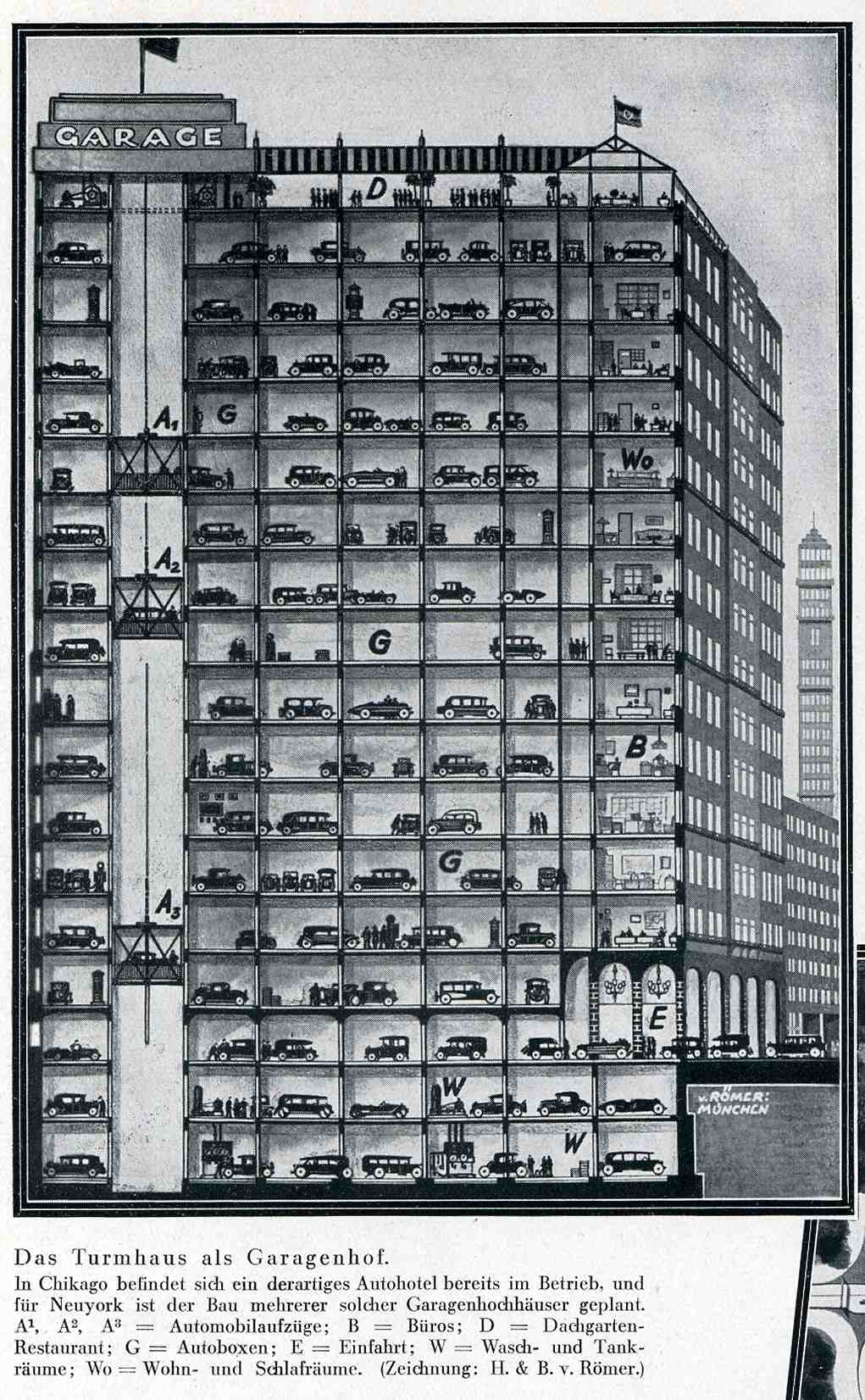
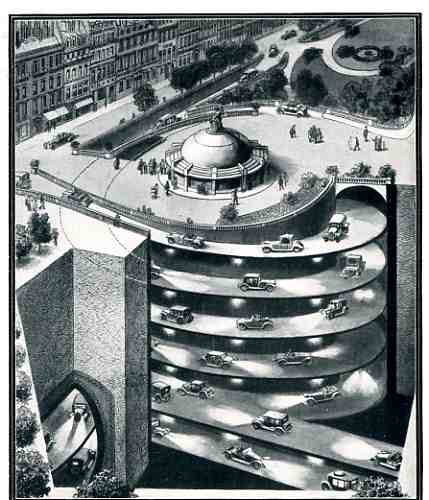
    These images from the Illustriete Zeitung (Leipzig, issue
    4484, pp 239-240) for November 1930 speak to the exact issue of how to care for
    the now ever-present automobile. 
    Entitled “Wie Bringe Ich Meinen Kraftwagen Unter?”, the short article
    (by the engineer Botho von Romer of Munchen) addresses the need of what to do
    with cars at bedtime—where do we put them? 
    One answer was this spectacular carpark (“Garagenhof”) high rise—seventeen
    floors of parking (with two more underground), serviced by a variety of
    elevators, pointing out that varieties of this structure already existed in Chicago and New York

    There was also the possibility of vast masses of sunken
    garages, their entrance way screwed into the earth leading to tunnels and
    networked warehouses where the cars could be safely deposited and removed from
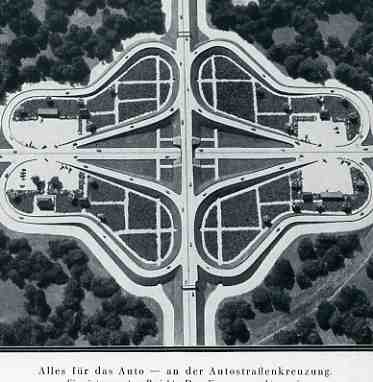
    city streets.  There were also these two
    versions of the simple above-ground garages and parking lots:  the apartment block gives over the entire
    interior area to individual parking and garages (doing away with any
    greenspace), while the massive semi-cloverleaf design is made for nothing else
    in mind than to park the cars in the four semi-centers.
     

    0 blog jan 222 car bfuture399

    By 1930 the production of the automobile had been revolutionized
    to such an extent that virtually anyone with a job and less than five kids
    could actually afford a car.  It is
    interesting to note that at the average price of say 30 cents a gallon for
    gasoline (in the U.S.A.)
    that folks 80 years ago were paying pretty more per gallon (adjusted via CPI)
    than we are paying now at $1.87/gallon (in my mountain city at the far end of
    the pipeline). 


  • Institutionalized Racism and the Sale of Toys and Music and Frivolities

    JF Ptak Science Books LLC Post 479

    0 blog jan 21 negro393

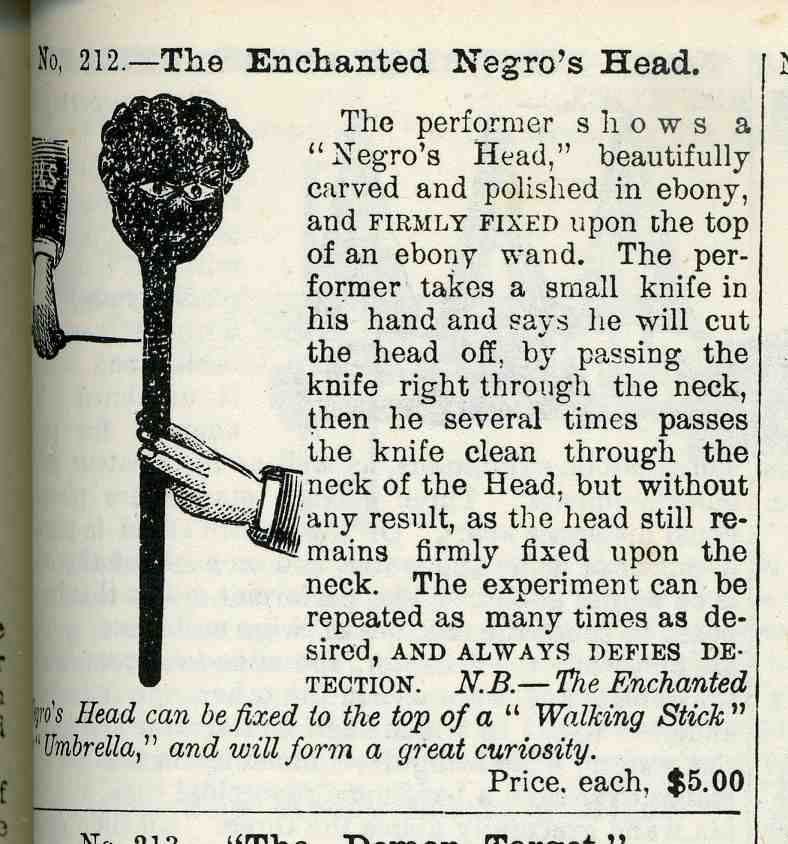
    Leafing my way through a reprint of the Peck & Snyder Out & Indoor Sports and Pastimes Catalog for 1888, looking for baseball equipment and giant bagatelles, I found this stunning advertisement.  I knew of the tragic and long history of this form of “entertainment”, as does everyone, but I must say I never considered the costume end of it.  And here it was.

    The minstrel show, or minstrelsy, appeared as an American invention in the 1830’s–much more so by the early 1840’s.  It depicted  blacks in only the worst possible ways, as shiftless, lazy, buffoonish, stupid, flawed in almost every way, an idiotic race with a musical advantage, relayed in predictable units, accompanied by a developing genre of American music.  The ad here is for the accoutrement of the performers, layers of red rouge and carbon to build on white faces one of the lowest forms of racial archetypes that this country has produced. 

    0 blog jan 21 negro394
    The astonishing thing is that it is just a simple ad in the middle of
    the page of the middle of a catalog for entertainment and sports
    bits–nothing special at all, nothing remarkable to distinguish this
    gaping hole of morality from the games and exercise equipment that
    surrounds it.  And that’s the deep horror of stuff like this, this sort
    of stereotyping that was so lethal and filled with hate, and not making
    a ripple in the awareness of anyone’s sense of correctness: the
    creation of this racial image was so complete that even its most base
    element could appear as an insignificant trifle in a sporting catalog. 

    Even more extraordinary is this ad that appears just a few dozen pages
    later.  “The Enchanted Negro’s Head” was a prop in a magic trick that
    involved drawing a knife across the neck of the black head. “The
    performer takes a small knife and says he will cut the head off”–I can
    imagine the sort of conversation between performer and audience before
    his action is undertaken, getting the audience ready to kill the “Negro
    Head”.  It would not have been pretty.  And that’s not all–once you were done with the “trick” part of cutting off the head, it “(could) be fixed to the top of a walking stick or umbrella….(to) form a great curiosity”.

    These characterizations appeared in uncountable forms in virtually every aspect of social life in this country, finding its insidious way even into something as seemingly innocent as a magic trick. It is the very vast smallness of this racism that make it so terrifically convincing and lethal. Looking at something like this makes me feel the enormous weight of the all that went into the attempted assassination of this race. 

    **My friend Joy Holland–chief of the Brooklyn Room at the Brooklyn Public Library at the Grand Army Plaza in the heart of Brooklyn USA–recently started a wonderful history blog at the library called Brooklynology.  A recent post there talks about a minstrel-related find in their ephemera collection–it is quite interesting; take a look. 


  • Great and Unbuildable Department: Floating a Missing Manhattan (1975)

    JF Ptak Science Books LLC  Post 470

    “Heard melodies are sweet, but those unheard
    Are sweeter…” John Keats,
    “Ode on a Grecian Urn”

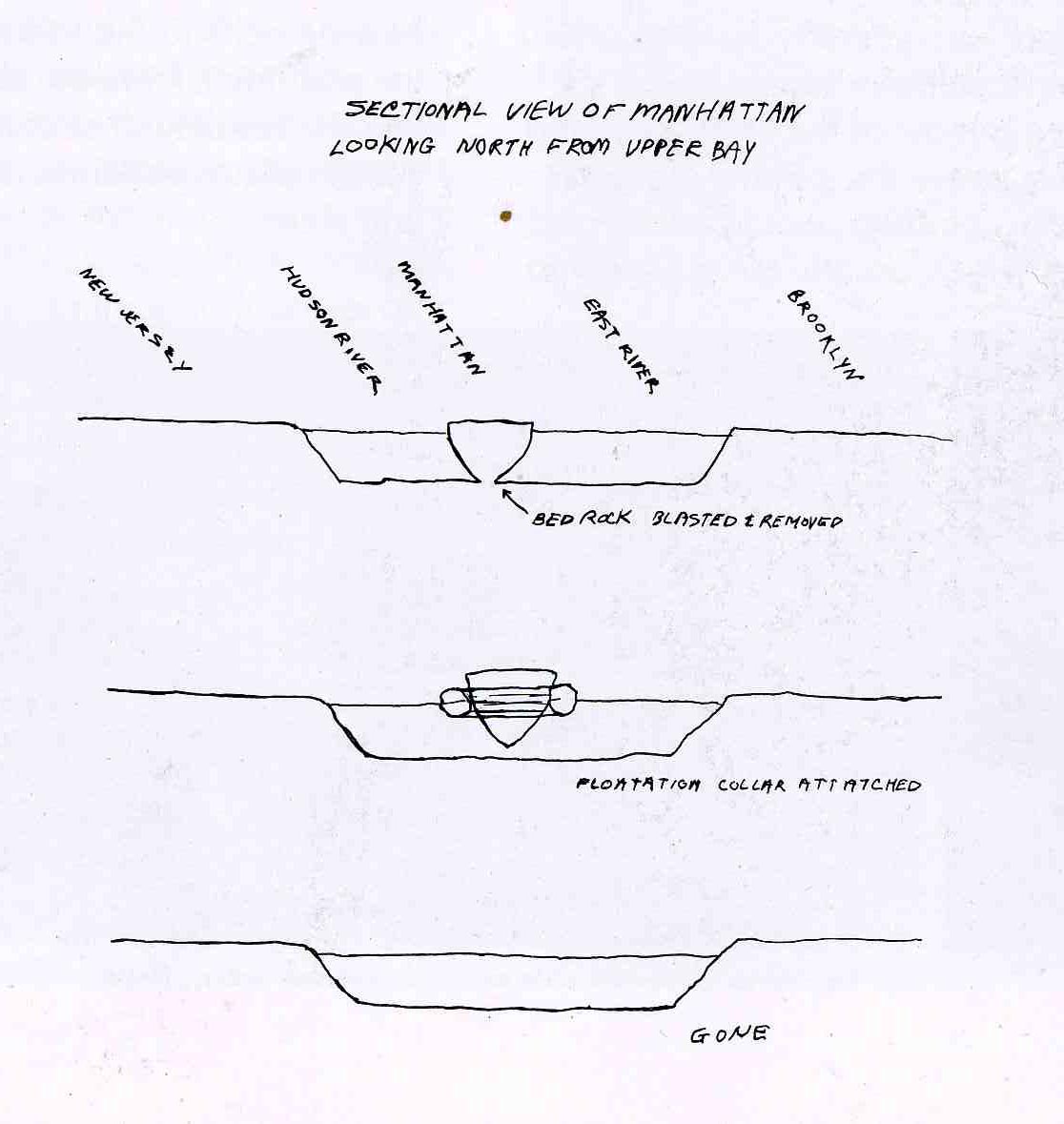
    0 blog jan 16 manhattan386 Agreeing with Mr. Keats or not, Robert Grosvenor had a delectable and memorable idea for a project in 1975:  testing the sea-worthiness of Manhattan island.  Grosvenor (b. 1937) was a well-known kinetic sculptor in Manhattan by the time of his detaching-Manhattan idea.  I found the summary of his project in Unbuilt America, by Alison Sky and Michelle Stone, of SITE, Inc. (seventh in a series called ON SITE), and published in 1976.  The book is a treasure trove of the unbuilt and the unbuildable, or the undoable, or the unnecessarily unattainable, though Grosvenor’s part in this book is clearly one of the very few who did not (really) take his/her project seriously.  I do though like the simplicity of the presentation of the project, right down to the “Step 2” of preparation, which was the umbilical snipping of the bedrock of Manhattan and the attachment of the “flotation collar”, which, I guess, would allow it to be moved around so long as flotation devices were attached. 

    I’m not sure, but I don’t think that Manhattan ever learned how to swim.  I’m also not so sure about where Manhattan would “go”,exactly; but what would it matter, since the people living in Manhattan were already where they wanted to be?

    0 blog jan 16 manhattan387


  • The Thin White Line: Concrete Ribbons as the Answer to the Air Raid Problems of London (1938)

    JF Ptak Science Books LLC   Post 469

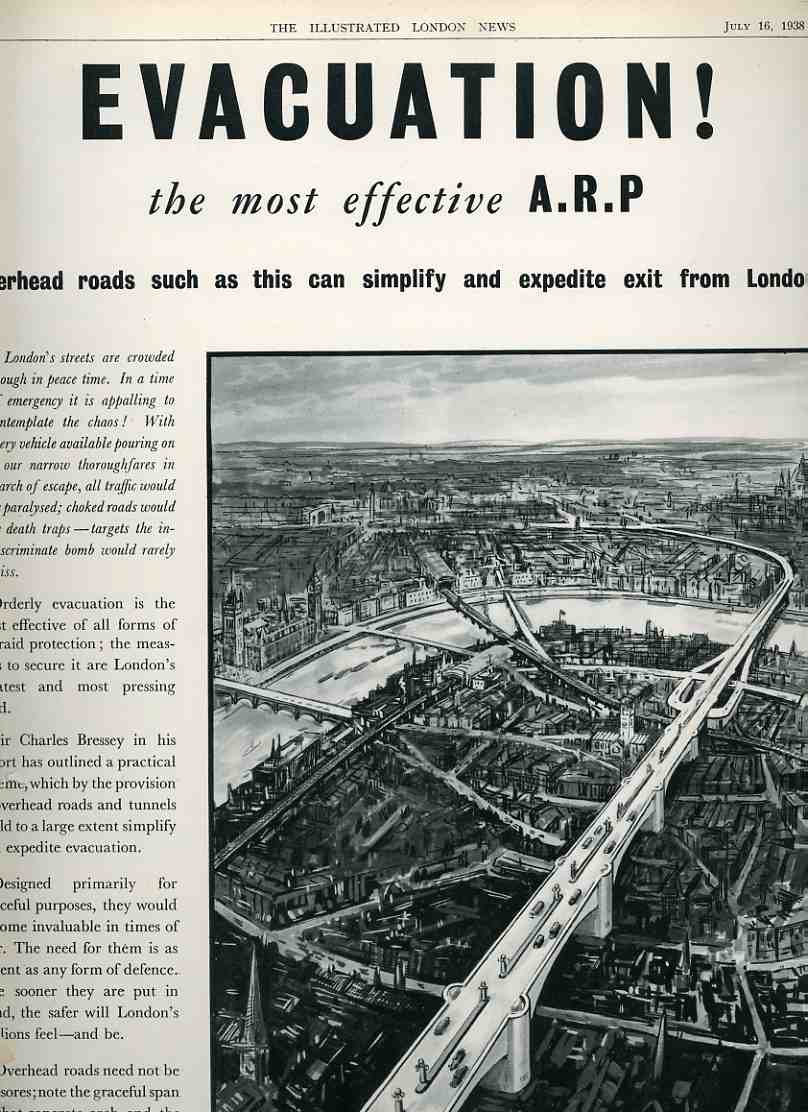
    0 blog jan 07 evacuate london365The Illustrated London News for 16 July 1938 was screaming at its readers–14 months away from the British involvement in WWII–that the MOST EFFECTIVE form of ARP (air-raid protection) was via the evacuation of London.  And of course what the “article” meant was the orderly evacuation of London, as decentralized evac during a crisis (i.e. bombing) would be an “appalling” and chaotic mess.  

    The answer was elevated highways. 

    The reader was told that “the cost of such roads will necessarily be high”, but the high ticket price wouldn’t be quite as bad as tearing down buildings and widening streets through central London.  The tearing/widening idea is so original and so shockingly bad I don’t know what to say, if there was actually anything to say at all.  But then it is second only to the idea of building elevated roadways for evacuation purposes–road that look from the picture like they were four lanes wide.  These roads would have “the additional merit that under them the traditional appearance of London can be maintained unimpaired”.  Stress that part about the appearance “underneath”.  Not only that, the heartbeat of London evacuation=, these elevated roads, were evidently immune from bombs themselves; or at the very least nothing is mentioned about these roads being targets in themselves.  One bomb, one hit, one severed artery. (Looking back through the Bad Ideas Department I see Buckminster Fuller’s tragically goofy idea for building a mile-high dome over midtown Manhattan that was “radiation proof”…he didn’t say anything about it being impervious to actually being the direct target of a nuclear weapon, though.)

    Generally when ideas are this terrificly bad there is usually a reason for it, a reason that transcends logic and honest coherent thought.  And that reason in this case was money. 

    At a time when Nazi Germany was bursting at the seams for more people to fight and for  nations to devour, when there was a true and real fear of London being a target of German bombs, this simple and weak and strategically indefensible solution was proposed by one large and interested party.

    The “article” is signed by the Cement and Concrete Association of Grosvenor Gardens, London.  And thus all is clear.


  • Things that Are Just Simply Wrong: War Gases and Babies; Protective Suits for Children and Babies, 1943

    JF Ptak Science Books LLC  Post 466

    0 blog jan 12 baby gas380

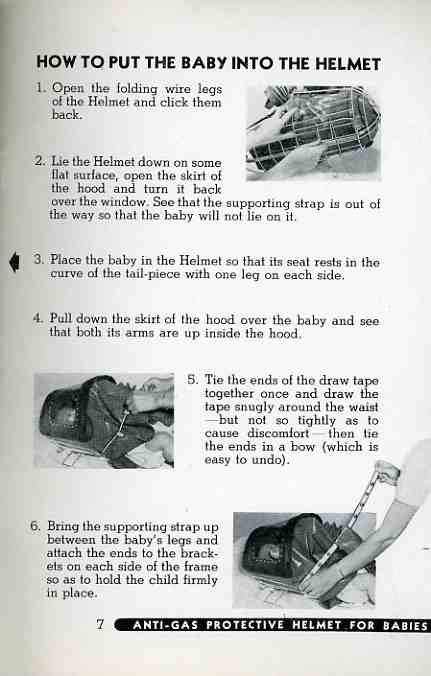
    There’s nothing that shouts “WRONG” with greater voice than images like this.  Like pornography and art, things that are just plain wrong are instantly recognizable.  And this, my dear reader, is a fine example of that thinking. Anti-Gas Protective Helmet for Babies, Manual of Instructions was prepared for the Office of the Director of Civil Air Raid Precautions of Ottawa, Canada, and published in 1943.  I’m not sure that the image of the nurse in the gas mask isn’t as disturbing, but the two of them together is just too much.  

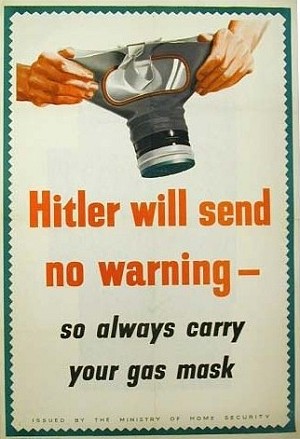
    I wasn’t aware of the gas attack preparations in Canada–the situation was entirely different in Britain, where everyone was required to own one, and by 1940 more than 38 million had been distributed to the population.  But the planning was underway in Ottawa in ’43 for the worst, as removed and distant from the war as just about any other place on earth–but the Air Raid Precautions people pulled no punches in their hearts and minds campaign, and I’m sure that it was very effective.  This little pamphlet certainly caught my attention.

    0 blog jan 12 baby gas381

    Blog gas poster

    ·Posted by :

    ·in:

    —

  • Dead Letter Department #1: LIFE Magazine Subscription from 1940

    JF Ptak Science Books LLC 

    0 blog jan 09 dead letter369
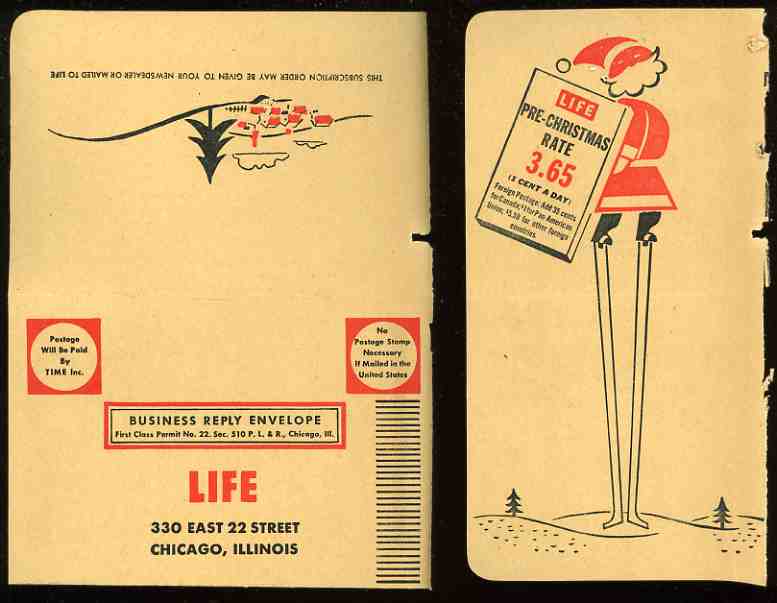
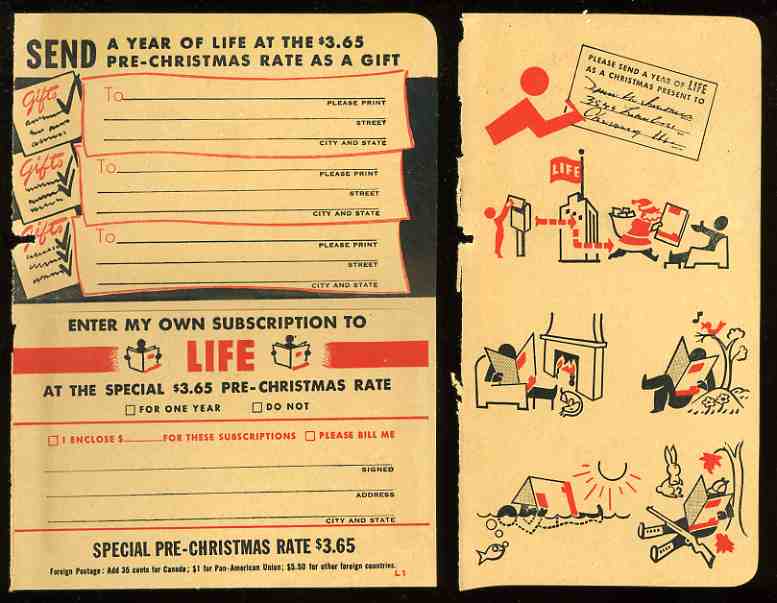
    It seems to me as though I have quite a few of these old subscription or mail-back forms from the 1930’s, ’40’s and 1950’s.  In the spirit of Don Novello (aka Father Guido Sarducci) I thought that I’d start sending some of these little buggers back out, just to see what happens with them on the other end.  I have my doubts that there are very many pieces of antique mail making their way through the labyrinth of the U.S. Postal System, so perhaps it will give some of those folks in blue a little something to talk about.  Or not.  And so I put my $3.65 in the little envelope for a year’s subscription to the fine LIFE magazine–if I could get into the Wayback machine, I’d enjoy 52 issues of LIFE in 1940 for just a few dollars.  Unfortuantely LIFE stopped being a weekly in 1972 and then sputtered along as a much-changed monthly for several decades until it completely left the track in 2007. 

    0 blog jan 09 dead letter370
    It was an interesting magazine to be sure, though not without its
    problems.  For example, I looked through every page of LIFE from 1939
    to 1945 and my impression was that there wasn’t all that much war
    reporting in the thing until everything heated up (including America, finally) in
    mid-1942. (And by “very much” I mean, well, that I just expected more in the magazine about the World War than I was seeing, space being taken up by nonsense and Liliputian interests rather than the global conflict.) Up to that point there seems to have been far more non-war
    words/images than war-related. Even in 1942 there was more adveritising
    using men-in-uniform than there were actual stories depicting fighting
    men.  Things changed quite a bit in the magazine as the war became more
    “real” for the U.S. in 1943; still, the reporting didn’t come close to
    that of the London-based Illustrated London News, where the war was
    real since 1940.  This is hardly scientific, only an impression, but
    having looked at the entire war coverage in LIFE and Illus London News I am left with a lingering impression of a remarkable difference between the two (similar) magazines.  More still for the Illustrirte
    Zeitung
    (Leipzig), but that’s another story.  Still the use of
    men-in-uniform to sell cigarettes or steel or whatever is pretty
    bothersome to me–there was a lot of that going on in LIFE, not so much
    at all in ILN, and almost none in the Illustrite Zeitung.

    ·Posted by :

    ·in:


  • The Poem-amatic Fist Microscope and the Production of Art

    JF Ptak Science Books LLC   Post 460

    “If I read a book and it makes my whole body so cold no fire can
    warm me, I know that is poetry. If I feel physically as if the top of my
    head were taken off, I know that is poetry. These are the only ways I
    know it. Is there any other way?”
    ––Emily Dickinson

    “Like a piece of ice on a hot stove, the poem must ride on its own
    melting.”
    ––Robert Frost

    I want to say right in the beginning that I mean no disrespect in any form in addressing the “found” nature of poetry in the larger landscape of the written word–a sort of Poetry Brut, awaiting discovery.   And the discovery is made rather simply, and randomly;  take your fist, clench it, and then open it to about the size of a dime so that you can see all the way across the interior of the fist,your eye placed at the “objective” made by the joined thumb and index finger. Get out a book, then press your eye against this “lens”, placing it about a foot above a printed page.  Force your eye to bring the words into focus–if you were glasses for reading you may not need them for this exercise–I don’t.  You can adjust the “focus” by making the opposite lens (formed by the pinky) a little smaller.  You’ve made a simple pinhole eyeglass with your hand.  Now bring your new optical tool to bear on a paragraph and record what you are allowed to see, recording each bit on a new line (as in a “standard” poetic format.  The results may be interesting!

    My two examples are below:  the first is from Paul Klee’s Diaries (and entry for 1916), and the second from Richard Allestreel’s The Ladies Calling (an instructional for women printed in 1673).  Of course the Klee was already clsoe enough to poetry as it was, and teh Allestreel not far behind that; but the words rearranged give them an entirely new feeling, their messages both plainer and more hidden. 

    This is a useless exercise in almost every way, though it was fun to do it, and it did help to point out some of the more-poetic aspects of these two works.  But poetry isn’t just putting prose into a new printed format, nor is prose poetry writ bigger.   But it was a little fun.    

    Example 1:
    From Paul Klee’s Diaries, Trip to Tunisia,  16 April 1916, chapter 2:

    In the evening, through the streets.  A café decorated with pictures. Beautiful watercolors.  We ransacked the place buying.  A street scene around a mouse. Finally someone killed it with a shoe. We landed at a sidewalk café.  An evening of colors s tender as they were clear…

    And then Dissected and Rearranged with the Fist Microscope:

    In the evening, through the streets
    a café decorated with pictures
    Beautiful watercolors, we ransacked
    the place buying a street scene around a mouse.
    Finally someone killed it
    with a shoe.
    We landed at a sidewalk café,
    an evening of colors
    as tender as they were clear

    Example 2
    The Ladies Calling
    attributed to Richard Allestreel Oxford: Printed at the Theater, 1673
    Part II Section III:  On Widows (opening paragraph)

    “Now those Remains are of three sorts, his body his memory, and his children. The most proper expession of her love to the first, is in giving it an honorable Enterrment; I mean not such as may vye with the Poland extravagance (of which ’tis observed that two or three neer succeeding funeralls ruin the family) but prudently proportion’d to his quality & fortune, so that her zeal to his Corps may not injure a nobler relique of him, his Children. And this decency is a much better instance of her kindness, then all those Tragical Furies wherwith som. Women seem transported towards their dead Husbands, those frantick Embraces and caresses of a Carcass, which betray a little too much the sensuality of their Love. And it is somthing observable, that those vehement Passions quickly exhaust themselvs, and by a kind of Sympathetic Efficacy as the Body (on which their affection was fixt) moulders, so does that also, nay often it attends not those lesurely degrees of dissolution, but by a more precipitate motion seems rather to vanish then consume”

    And then Dissected and Rearranged with the Fist Microscope:

    Now those Remains are his body his memory,
    his children. The most proper expession of her love to the first,
    is in giving it an honorable Enterrment;
    I mean not such as the Poland extravagance
    prudently proportion’d to his quality & fortune,
    may not injure a nobler relique of him, his Children.
     And this decency is a much better instance of her kindness,
     then all those Tragical Furies
    Women seem transported towards their dead Husbands,
    those frantick Embraces and caresses of a Carcass,
    which betray a little too much
    the sensuality of their Love.
    somthing observable, that those vehement Passions
     quickly exhaust themselvs,
    and by a kind of Sympathetic Efficacy as the Body (on which their affection was fixt) moulders, so does that also,
     nay often it attends not those lesurely degrees of dissolution,
    but by a more precipitate motion
    seems rather to vanish then consume.

    Yes I am joking.  Mostly.

    ·Posted by :

    ·in:


  • Thinking the Unthinkable Department: Moving DC to the Rocky Mountains. Or Idaho. 1952

    JF Ptak Science Books Post 457

    Blog--untinkable tp
    Sylvian Kindall’s Total Atomic Defense (published by a very severly right-wing publisher in 1952) is one of a series of books made for a deceived American population, offering the general reader both fear and hope, often from the same, exact source. But Kindall has a  somewhat diffident approach, offering his belief that the country and its population can largely  survive an all-out nuclear war–intact.  Of course the “intactness” is dependent upon massive internal change of the social and industrial fabric of the country, which would have to transform in ways as to make it largely unidentifiable from that which we would quickly recognize.  A quick look at the table of contents tells the story in miniature, with the exception of the solution to the problem, which was generally to build underground.  (The neutron bomb would soon complicate this solution.)  Suffice to say that Dr. Strangelove would approve of the publication of such a work though would hardly believe in any of it for himself. 
    Blog--unthinkable


  • American Cities at the End of the World: a List of Nuclear Targets, 1953

    JF Ptak Science Books LLC  Post 456

    0 blog jan 05 target346

    “Those who control the present control the future. Those who
    control the future control the past.” –George Orwell, Nineteen Eighty-Four

    “Political language — and with variations this is true of
    all political parties, from Conservatives to Anarchists — is designed to make
    lies sound truthful and murder respectable, and to give an appearance of
    solidity to pure wind”. –George Orwell, Nineteen Eighty-Four 

    “Logic: The art of thinking and reasoning in strict
    accordance
    with the limitations and incapacities of the human
    misunderstanding.”—Ambrose Bierce, Devil’s Dictionary

     Making the unthinkable thinkable was the de facto aim of
    this pamphlet.  It described the complete
    vulnerability of any nation in total “atomic war”, yet proceeded to advise the
    population of the United
    States
    to proceed as actors in a drama that
    could have variant endings.  And so began
    the concept of the winnable, survivable nuclear holocaust, a petulant and
    terrifically arrogant attempt to control the language in which the idea of
    nuclear war would be discussed with a government-made language. 

     This simple (1953) pamphlet was a product of the Federal
    Civil Defense Administration and was a public document, though it replaced the
    edition of 1952, which was a “restricted document”.  (We are also warned that if we have this
    earlier document that we are to burn it, even though the information contained “as
    no longer of a classified nature”.)  It
    outlined the cities and regions in the United States that would be the
    subject of an attack.  “City” is
    redefined here as a “Target Area for Civil Defense Purposes”, and then
    redefined in terms of a greater population as a “Critical Target Area for Civil
    Defense Purposes”.  There were 193 such “areas”
    defined, of which 70 were “critical targets” encompassing a population of 67
    million.  (I hate to say it, but if you
    were to map the “critical” zones it would look much like the Blue State map of 2008.)

    I am surprised to see that my own little city, Asheville
    (N.C.), makes the list for a “target area”, somehow, as one of the four cities
    mentioned for North Carolina.  I have no idea why, except that it is the
    seat of a sort-of populous county–there
    was nothing here of interest to the Soviets. 
    On the other hand there are two cities specified forNew
    Mexico, both of which are 70 miles or so east of the Los Alamos installation. 

    The unnamed author(s) warn the reader that the 100+ million
    people specified in the two major attack areas was open to a greater blanket
    attack than described, what with the number of warheads available and all—everyone
    was subject to being bombed.  Also, the
    whole issue of chemical and biological weapons was not addressed:  ‘therefore, the resources of the entire
    country outside the listed target areas, as well as within them, must be
    mobilized for civilian defense”.

    The only mobilization for defense was that against fear–there really wasn’t anything else worth talking about.


  • Fantastic and Inscrutable Titles: God and the Asylum of Ignorance. (Nazis by any other name…)

    JF Ptak Science Books LLC Post 454

    0 blog jan 02 Up341 Asa Turian, the author of this 1938 Outsider Logic pamphlet, was sort of steeped, in a light way, in gathering quotes from the moderns and the ancients–in the end, none of them seem to help. Ultimately he seems to me to create some new vocabulary to repackage the NSDAP, which even in 1938 was still gathering frothy American pro-Bund crowds at Madison Square Garden. (The scion of American Olympic sports and head of the International Olympic Committee, the  Nazi/racist Avery Brundage*, spoke to a crowd of 20,000+ American Bundists at The Garden in 1938, finding little fault with the Nazis.  He went on to a long and  distinct career– some of which in deep furtherance of his political ideologies–as did thousands of other pro-Nazis.)  The title is taken from Exodus 32:1 and is a plea, very late in the Depression, from Turian to find some sort of Moses to lead the United States out of the despairing economic situation.  He notes that although many people were talking about the depression, no one was talking  (like Mark Twain’s complaint about people discussing the weather) about what to do about it.  Which is odd because FDR had been hammering away at it for six years by the time this pamphlet was written.  No matter for Turian, who doesn’t bother mentioning Roosevelt.

    After quoting many, Turian suggests that the way out of the Depression was via a light Dictatorship (“an alternative between Democracy and Dictatorship by means of the separation of Government and Industry”) that defies simple explanation.  Half-way through this Bush-IQ-thin text the Democracy part of this partnership slips away, saying simply that “we must maintain our present form of Government and resort to Dictatorship as well”.  I think that the way this plays out is that a combination of democracy and dictatorship is just a dictatorship.  Industry is divided from government, and then  would be further divided “between Capital and Labor” and then “running it on a partnership basis” governed by the Corporate Dictatorship. He further suggests getting rid of money and putting the entire economy on a 100-billion (the unit of measurement not explained) “bartership basis”.  I have no idea how this barter would work overseas, as international trade doesn’t come up at all in Turian’s economic homage to liberation logic, though there is a lot of discussion of “state controllership” and “the status of the corporation dictatorship”.   There are some other societal revolutions that come and go, but the biggest of them all was the establishment of some sort of economico-religico tripartate God/Mammon/Something Else oracle to lead us away from all bad economic temptation.  Wow.   I’m not sure exactly what the author was getting at, but if you take away the barter bit, it sounds quite a bit like Nazism in different terminology.  I guess this just goes to show you that you can Reality-Compromised and still come up with either (a) your own version of Nazism or (b) a paint-by-numbers Nazi who changes the colors but not the numbers. 

    *I’d like to discuss Brundage more fully at some point.  For now, let’s just say that he was a man without quality.   It was Brundage who sold out Jim Thorpe in a rant against professionalism in the Olympics but who said nothing about the Olympic industry and paid Olympians in the Soviet Bloc.  It was Brundage who disqualified and exiled Tommie Smith and John Carlos in Mexico ’68 for their giving the Black Power salute but who said nothing at all about the Nazi salute in his highly cherished 1936 Berlin games.  And it was Brundage who cluster fucked the 1972 Munich Olympics–in ways too numerous to go into here–and who allowed the games to continue after a one day interruption following the murder of 11 Israeli athletes by the Black September Palestinian terrorist group.  Brundage, as President of the IOC, spoke at the ceremony the day the Olympics restarted, and unbelievably equated the massacre of the Israelis with the boycott of the racist all-white Rhodesian team: (the bold is mine, just in case):
    “The Games of the XXth Olympiad have been subject to two savage attacks. We lost the Rhodesian
    battle against naked political blackmail. I am sure that the public
    will agree that we cannot allow a handful of terrorists to destroy this
    nucleus of international cooperation and goodwill we have in the
    Olympic movement. The Games must go on….”

    Why the man wasn’t struck by lightning on the spot and turned into carbon sizzle is a sacred mystery. I am sure that a copy of the Protocols of the Elders of Zion must’ve been on his library shelf. Or half-shelf.

    The man was utterly shameful, and yet was the leading American for the Olympics for almost thirty years.

    ·Posted by :

    ·in:

    —