A Daily History of Holes, Dots, Lines, Science, History, Math, Physics, Art, the Unintentional Absurd, Architecture, Maps, Data Visualization, Blank and Missing Things, and so on. |1.6 million words, 7500 images, 4.9 million hits| Press & appearances in The Times, Le Figaro, Mensa, The Economist, The Guardian, Discovery News, Slate, Le Monde, Sci American Blogs, Le Pont, and many other places… 5000+ total posts since 2008.

Category: Bad Ideas

  • Meekness as a Quality of Woman, 1685: on Patriarchy and the Enslavement and Subjugation of Women

    JF Ptak Science Books LLC  Post 409

    “‘Love is strong as death,” and so is the obedience and reverence paid to the ashes of the dead, ruling husband”

    The Ladies Calling, in Two Parts by the Author of The Whole Duty of Man, The Causes of the Decay of Christian Piety, and The Gentlemans Calling, by Richard Allestree, printed in Oxford in its popular eight impression in 1685, was hardly a novel or unique approach to the coaching of the supplicating and correct behavior of women.

    Its eight printings in a dozen years (assuming that the print run was at least largish, this would qualify as a best-seller in today’s market) was a testament to its somewhat mirror-like expectation of the social visions of the time, also making it hardly alone in its challenges to the neo-individuality of the female sex. It was pretty much what was to be expected, a “normal” vision of the actions of women, including as ever the not-so-faint aroma of the codification of sexuality, or at least the value of women as sexual objects.  (It is true that well-married women did have a sort of power through the husband, but if the promise of children was broken or if there was something not quite right in the private life, the wife could be gotten rid of very easily, and her power by association would be gone)

    The titles of its eight chapters pretty much tell the whole story:   Of Modesty,  Of Meekness, Of Compassion, Of Affability, Of Piety, Of Virgins, Of Wives.Of Widows. The message, or, rather, the demand:  be compassionately meek, religious and observant, happy, virginal until wifely and then wifely until death, and then acting properly after the death of that  which gave you nearly purpose. Be true and faithful and genuflectorial and obedient to your god and husband, and not necessarily in that order at all times.  Ideally, the woman would obey the callings and creations of the church representing the whims of the creator; though there were some times when the husband would be needed for elucidation and guidance to even the teachings/programs of the religious authority.  The creation of patriarchy had been at least a 2000-year-old process in the 17th century, and this book was yet another in the subtle changes to the regulation of that wall. 

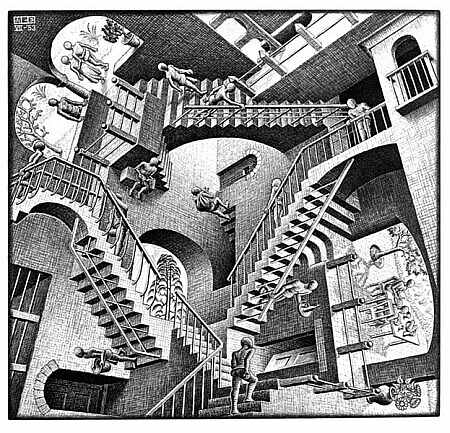
    The following two sections are pulled from the chapter on Meekness (and illustrated by an architect of Catch-22edness, M.C. Escher, on the inescapable logic of cohesive subjugation):
    Escher-mc-relativity-7400006

    “1. In the next place we may rank Meekness as a necessary feminine Vertu; this even nature seems to teach, which abhors monstrosities and disproportions, and therefore having allotted to women a more smooth and soft composition of body, infers thereby her intention, that the mind should correspond with it. For tho the adulterations of art, can represent in the same Face beauty in one position, and deformity in another, yet nature is more sincere, and never meant a serene and clear forhead, should be the frontispiece to a cloudy tempestuous heart. ‘Tis therefore to be wisht they would take the admonition, and whilst they consult their glasses, whether to applaud or improve their outward form, they would cast one look inwards, and examine what symmetry is there held with a fair outside; whether any storm of passion darken and overcast their interior beauty, and use at least an equal dilligence to rescu that; as they would to clear their face from any stain or blemish.”

    “3. And first for the Meekness of the Understanding, it consists in a
    pliableness to conviction, and is directly opposite to that sullen
    adherence observable in too many; who judg of tenets not by their
    conformity to truth and reason, but to their prepossessions and
    tenaciously retain’d opinions, only because they (or some in whom they
    confide) have once own’d them; and certainly such a temper is of all
    others the most obstructive to Wisdom.”

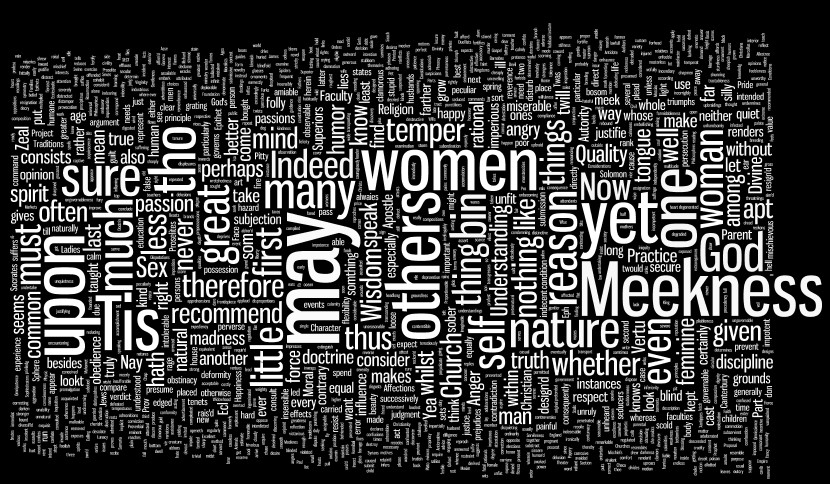
    The following is a Wordle Word Map of Meekness, featuring a vaguely three-dimensional 5,000-word
    word map of the contents, the words weighted, the most often occurring
    words appearing largest, and so on.  I’m not sure exactly what I’m learning from it, or learning more than I’d learn from reading two paragraphs of the chapter. 
    Wordle--meekness 5000

    Some further quotes from this work, including the seven remaining chapters:

    Of Modesty
    “That the Obligation to Moral & Christian Vertues is in it self universal, and not confin’d to any Sex or Person, is not to be denied: yet, as in human Constitutions there are often Precepts, which (tho not exclusive of any, do yet) more peculiarly and eminently level at som particular rank or order of Men; so in the laws of God and Nature, there appears the like distinction. That all-wise Creator, who hath put peculiar proprieties and inclinations into his Creatures, hath accordingly design’d their actuating and improving them: and altho in mankind, which differs nor in species but in gender, the variety may seem less; yet there is still enough to found som diversity, either in the kind or degree of duty”

    Of Compassion
    “But this is yet more unnatural in the female Sex, which being of softer mold, is more pliant and yielding to the impressions of pitty, and by the strength of fancy redoubles the horror of any sad object; yea so remarkable is this tenderness, that God, when he would most magnify his own compassion, illustrates it by that of women, as the highest human instance. Indeed such a propension have women to commiseration, that they are usually taxed with an excess in it; so that any imprudent lenity is Proverbially called, A womanish Pitty, and therefore it may be thought an impertinence to exhort them to that which they can scarce avoid.”

    Of Affability
    “But hitherto we consider Affability only in its ethnic dress, as it is a human ornament; ’twill appear yet more enamoring upon a second view, when we look on it as bearing the impress of the Sanctuary, as a divine Vertu. And that it is capable of being so, we have the autority of St. Paul, who inserts it in the number of those Christian Graces which he recommends to his Roman Proselites; condescend to them of low estate, Rom. 12. 16. and that we may the better discern its valu, ’tis observable that he links it with the most eminent Vertu of Humility; for it immediatly follows his Precept of be not high minded. Indeed ’tis not only joined with it as a Friend or Allie, but derived from it as its stock and Principle: and certainly a more divine extraction it cannot have, Humility being the Alpha and Omega of Vertues, that which laies the foundation, (without which the most towring Structure will but crush it self with its own weight) and that which perfects and consummates the building also, secures and crowns all other Graces; which when they are most verdant and flourishing, are like Jonas his gourd, that may afford some shadow and refreshment for a while, but are apt to breed that worm which will destroy them. When once they are smitten with Pride, they instantly fade and wither; so necessary is humility both for the acquiring and conserving, all that is good in us.”

    Of Piety
    “Piety is taken for our more immediate entercourse with God, in things purely divine, as Adorations, Praiers, Aspirations, and all pantings and breathings of the soul after him; and in this notion ’tis more particularly called Devotion. And this is comprehended it: the other, as a part in the whole; nay indeed, as an effect in its cause; for where Piety has not first formed and modelled the soul, there can be no true Devotion.”

    Of Virgins
    “Virginity is first in order of time, and if we wil take S. Pauls judgment in respect of excellence also, 1 Cor. 7. And indeed she that preserves her self in that state upon the account he mentions v. 33. that she may care for the things that are of the Lord, that she may be holy both in body and in Spirit, deserves a great deal of veneration, as making one of the nearest approaches to the Angelical State, And accordingly in the primitive time, such a Virginity was had in a singular estimation, and by the assignment of the Schoolmen, hath a particular coronet of glory belonging to it.”

    Of Wives
    “In that of a Wife her duty has several aspects, as it relates, first to his Person, secondly to his Reputation, thirdly to his Fortune.”

    Of Widowhood: 
    “THE next state which can succeed to that of Marriage is Widowhood, which tho it supersedes those duties which were terminated merely in the person of the husband, yet it endears those which may be paid to his ashes. Love is strong as death.”

    “Love is strong as death.”  So is obedience, or obedient love, or meekness rapped up in a quilt of obedient love in a field of affable, modest, pious modesty, commanded by the male even in death.

    I said earlier that the idea of patriarchy and the war on gender is a 2500-year-old process.  It is remarkable to think about the advances in equal rights for women in the last 115 years, especially in the light of the introduction of money into the equation.  Within the last 400 years or so the concept of private acummulation of property came along to the not-wealthy classes mostly (perhaps) as the standard practice of the transfer of dowry/property/children from the women to man via marriage. (I say “115” and not “100” years because, at Tahakopa, on 28 November 1893, New Zealand became the first country to grant voting rights to women on a national basis–hats off again to NZ for being first again in so many important categories.) That said, and with the extraordinary weight of money, the subjugation part was very well entrenched until relatively recent times.  As a matter of fact in the history of patriarchy this would represent only about 3% of the timeline of subjugation–1.5% if you were being honest about it. 

    So in the history of the enslavement of women,  and of all the billions of lives of women that have been lived during that time over 25 centuries, it is only within the lifetimes of living grandmothers that the true superior progress in achieving equality of rights for the sexes has been made.  If that sort of realization doesn’t illuminate the darkly myopic views of people who would want to continue ruling via exploiting differentiation, I don’t know what will.  That for 2500 years something was “normal” and acceptable; and then in the last 115 or so years, it became less so, and now in the last 50 years it is a recognized embarrassment and mistake to anyone with a brain.  Condensing backwards vision like this is an interesting practice, especially when you put it up alongside other, contemporary issues that smack of this sort of discrimination, like California’s Proposition 8.  I just hope that it won’t take a hundred years for the majority of the people living in this country to recognize that we were being stupid.  I trust that New Zealand won’t take nearly this long. 

    ·Posted by :

    ·in:

    —

  • Skinny II: Morals, Class Warfare & Letting Someone Else Pick up your Dropped Fork

    JF Ptak Science Books Post 406

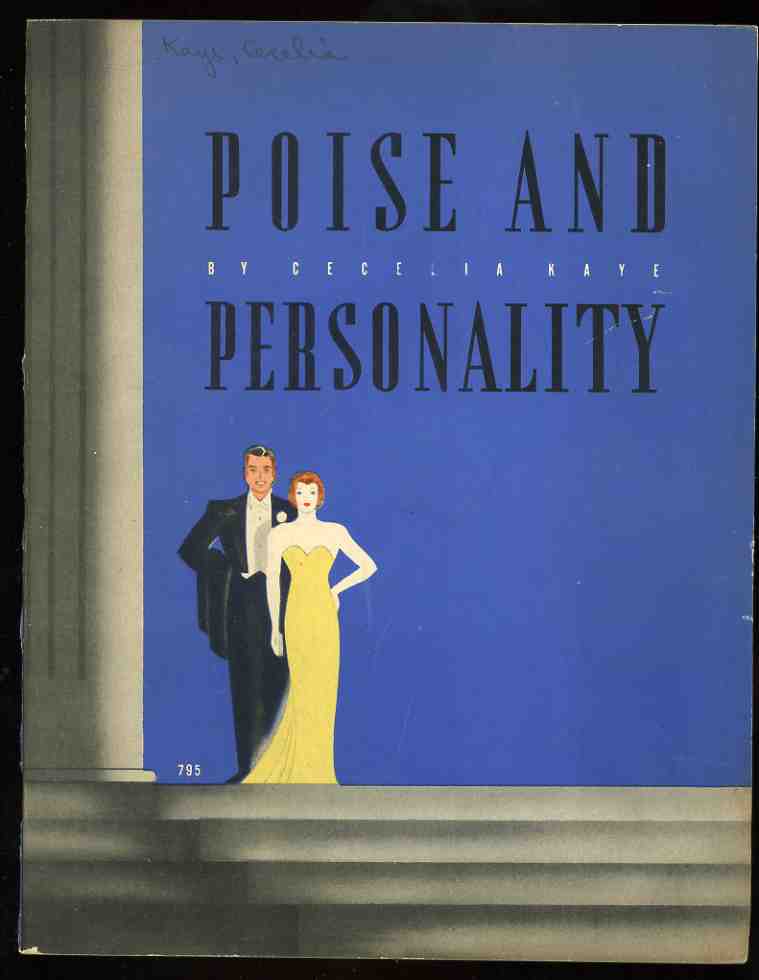
    Yes, these two pamphlets are beautifully designed, real works of production art, speaking elegantly and skinnily to their skinny, elegant times.  The World Behind the Telephone is a straightforward look at the stuff going on behind the scenes that made the telephone “go”–the woman holding the telephone is remarkably tall and angular, holding back the curtain of an even taller and skinnier doorway, beckoning the viewer into the unseen telephonic world.  Poise and Personality features more skinny people, and offers the skinny on some excruciatingly class-conscious tips on expected behavior and the division of the classes.

    0--blog---Nov 29 skinny156

    0--blog---Nov 29 skinny157

    “Social poise does not consist of a mere set of mannerisms” it reads, but beware:  “avoid careless and loose forms, which are in bad taste”.  There are all manner of pinkies-up logics and societal sniffing splayed throughout these pages, from the chapter improbably titled “Preccedence [sic] in Introductions”, to “Sensitivenesses” (“being sensitive is a luxury and the price runs high”), “Inferiority Complexes (“if you are afraid of people, talk to them with a smile…”), “Personality development” (“undoubtedly there is a native something that differs in each of us”), “Poise” (“…people are unhappy because they are nervously conscious of a lack of ability to mix with strangers….consequently they are unable to appear calm and balanced”. 

    Yes, it is a product of its time.

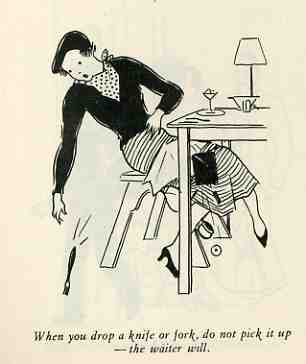
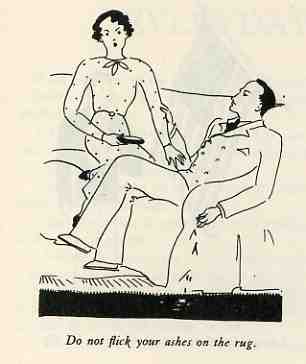
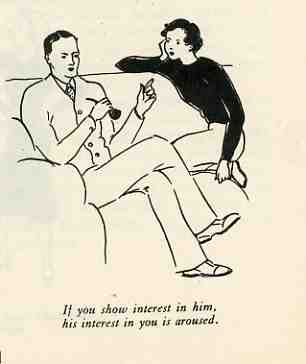
    There are some troubling and insensitive things in here as well, pamphlet being delivered of it times or not.  Letting the waiter pick up your fork is one; do not drop your ashes on the floor is another.  The more subversive ones though are on dating behavior and gender wars, the subjugation of women as it was in 1938 firmly on display.  “If you show interest in him, his interest in you is aroused.” Oh dear sweet creator, the woman is only of interest to the man if she reflects his interesting bits back to him.  Why not have the guy date a mirror?  That way nothing will be lost in all of that wasteful biological differentiation. 

    Here’s an early classic on the subject:  John S. Mill’s On the Subjugation of Women, an oldie but still a goodie. 

    0--blog---Nov 29 skinny158 0--blog---Nov 29 skinny159

    0--blog---Nov 29 skinny160

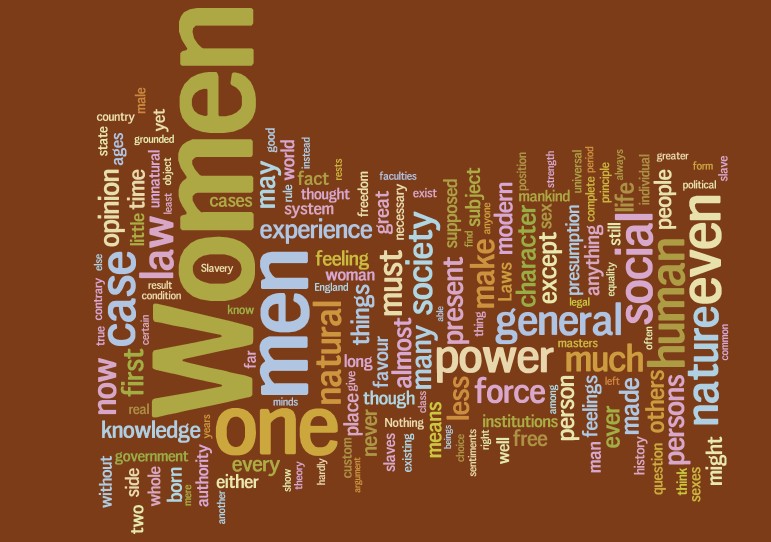
    Just for good measure, and really not related to this post, I’ll throw in a word map generated by Wordle.net of Mill’s Subjugation of Women (I like how “slavery” happened to pop up in the middle of the “O” in “women”):

    Wordle--subjugationfixed

    ·Posted by :

    ·in:

    — —

  • A War by Many Other Names: the Japanese Invasion of China, 1931-1945; How to Trivialize 20 Million Killings Without Really Trying

    JF Ptak Science Books Post 404

    I have forced myself to contradict myself in order to avoid conforming to my own taste.
    –Marcel Duchamp

    0--blog---dec 2 china168

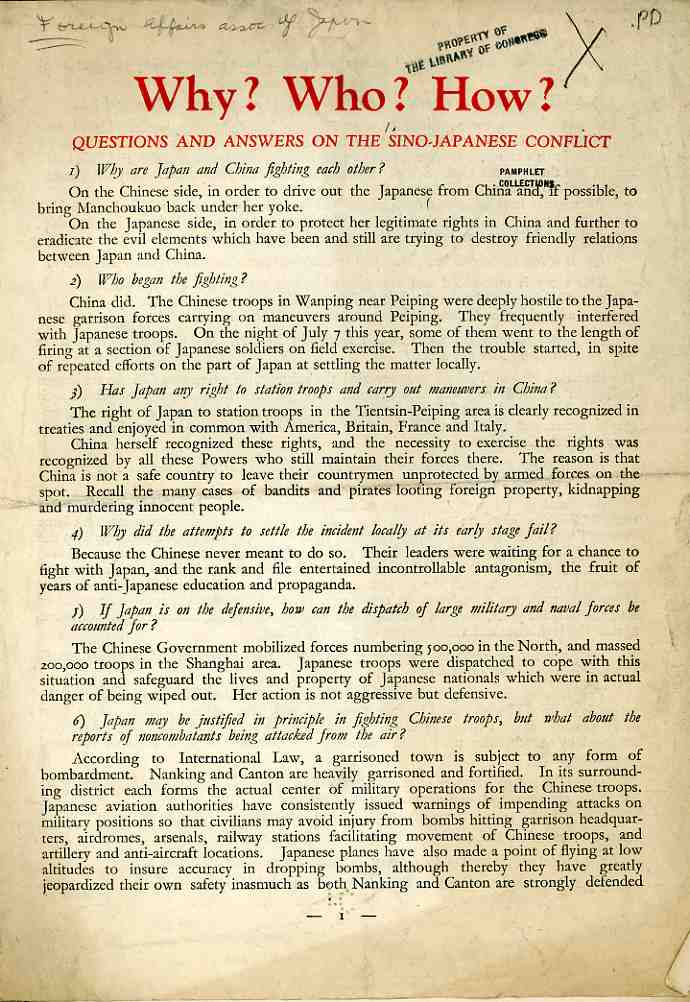
    I have a good number of English-language propaganda pieces published by such Hearts and Minds institutions as the Foreign Affairs Association of Japan describing, through the merriest and most defensive eyes, the Japanese viewpoint of exactly what it was that was going on in China between 1931 and 1945.  This leaflet, Why? Who? How? Questions and Answers on the Sino-Japanese Conflict (1937), is particularly worth noting because of how quickly and cleverish-cleanly the issue of the war and the fault of fighting was dispatched, and done with such astonishing condescending alacrity, and with such an enormous bodyguards of lies,as to be staggering.  I guess this is why the Duchamp quote came to me just now.  Old Marcel, the supremely gifted magician, certainly meant to be an enormous, itchy pain in the butt and a source of confusion, an artistic anarchist;  the thinking behind the quote served him well, and I think that it can be well-applied here.                             

    The first issue is in the subtitle:  the “Sino-Japanese Conflict” implies that the Chinese were at fault for having the Japanese invade Manchuria back in 1931; secondly,  the Chinese started a conflict and not a war. 

    Actually, the naming of the war there is quite an issue, and an issue still—and an issue at it most base level:  the word “war” is not generally used in Japan.  It wasn’t used in Japan during the war, or at least until the bombing of Pearl Harbor.  Until 1941, the millions of Chinese who were being killed by the Japanese armed forces were the result of a series of ”incidents”.  Even though there was a war raging from the beginning in 1931 to the start of total Japanese-Chinese war on 15 July 1937, the stuff that was happening from ’37 to ’42  was still an “incident” except for a period of 1940-ish to Pearl, when the idea of the Holy War (“Seisan”, eight corners of the world under one roof, etc.) was introduced by the Japanese Diet in 1940.  After that there was the occasional use of the “Great East Asian Conflict”, with the word “war” not being the part of any Japanese vocabulary.

    An interesting phrase that entered into the parlance though, if not “war”, was “Sanko Sakusen”, the “Three Alls”, as in KILL All, LOOT All, BURN All.  The Japanese wound up getting part of the Chinese All, eventually killing 20 million people or so in those 15 years.  But it wasn’t a war.

    This four-page document asks twenty questions, and answers them usually, emphatically, with simplicity, starkness, and with total complicity of innocence on the side of Japan.  For example, in discussing the “incident” in Beiging in 1937 which led to the total war between the two countries, asking the reader “why did the attempts to settle the incident locally at its early stage fail?,  we are told “Because the Chinese never meant to do so”.  Which of course is not the case.

    An incredible bit of thinking comes next, when the question “If Japan is on the defensive, how can the dispatch of large military and naval forces be accounted for?” Indeed!  Its hard to explain the invasion of another country as a purely defensive action. (We have seen this rather recently ourselves, the fictionalized account of terror-sponsorship in Iraq being about the only fuel necessary for a full-fledged defensive invasion and 2000-day long war.)  But the answer in 1937 was the Chinese defensive maneuver of massing troops for an impending invasion of China by Japan was then threatening Japanese interests in China, thus necessitating a defensive invasion of China which was mobilizing to defend itself from a Japanese offensive, which wouldn’t have come if the Chinese hadn’t adopted a defensive posture.  Basically, to paraphrase the immortal Mayor-for-Life of Washington, D.C, Marion S. Barry, “basically, the man dead”. (This was Barry’s response to reporters who were clamoring to find out what exactly had happened to a crazy man who climbed into a step van in a Buck Rogers suit and threatened to blow up the Washington Monument with a bucket of pee, an old rifle, and spray paint and then was shot about 200 times by cops of every shape and description. True story.)

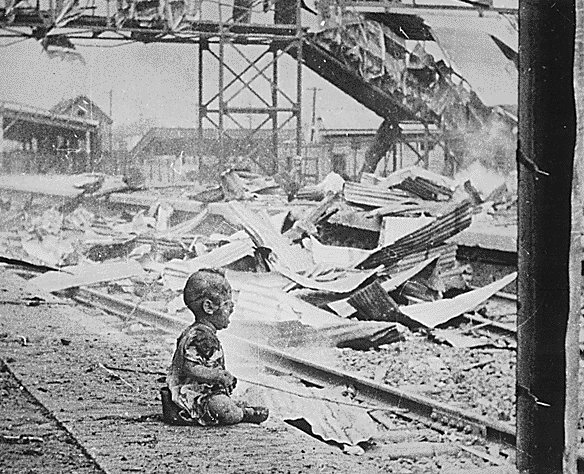
    War_shanghai-baby_Japan_bombing_shanghai_south_station_1937 (This is a picture of a baby survivor of a Japanese bombing “incident” at  South Station, Shanghai, 1937–sometimes it is better to see what something is than have someone define it for you..)

    We further find out that the attacks on the schools and hospitals in China were carried out, somehow, by Chinese troops; that a Chinese fishing fleet that was attacked and pulverized by Japanese submarines really wasn’t, and that they just disappeared; that Japan was protecting the rights of third party powers by “removing” Chinese troops occupying foreign-owned properties; that the Japanese fight against the “Sovietization” of China would “protect” foreign democracies, and so on.  The questions hardly matter, as the answers are all sort of the same.  Japan would “reach a settlement” (the word “peace” is not used anywhere here) however, if China “realized the error if her ways”. 

    Word do control mental images, and the further you get away from the situation described the more powerful the words become.  Somehow the Korean Conflict seems less so than a war because it wasn’t “legally” so; it was a “police action”.  And the Japan-China War isn’t a “war” in name in most Japanese histories of the period.  I think you can dissolve things with loose undefined language to such a point that the thing itself no longer exists; the only stuff that survives are the words used to hide it. 

    ·Posted by :

    ·in:

    — —

  • Kristallnacht: The Long post-WWII Lives and Forgotten Pasts of Criminal Nazis: Doctors

    JF Ptak Science Books LLC  Post 365

    Fischer
    How does it come to be that Nazi doctors who did human experimentation and were convicted at Nurnberg, released early, and go on to extended medical careers and long lives?  Case in point:  Dr. Fritz Fischer, pictured here, convicted of crimes against humanity for performing terrible experiments on human beings; sentenced, relseased early, and then went on to a new career with an important pharaceutical company  He may still yet be alive…

    On the 70th Anniversary of Kristallnacht—the night of the broken glass, Crystal Night, the night on 9/10 November 1938 that the Nazis became the major physical offensive against the Jewish people–I’m thinking about how the German institutionalization of anti-Semiotics came to be.  On that night 90 Jews were murdered, 200 Synagogues burned, and 25,000 other Jews rounded up for the first deportations to the concentration camps.
    It was also the horror of thousands of businesses and homes being completely ransacked, cudgeled, broken, by tens of thousands of Stormtroopers throughout the Reich; the beginning of the Great Terror.  (The map below shows the cities in which Synagogues were destroyed during Krstallnacht.)

    Kristallnacht map

     Part of the reason for this hatred was that Hitler desperately needed a common, routable foe as a rallying
    point for similarly-minded miscreants; another part was that there was considerable inferior work already being done on the behalf of racial-needs people. Mein Kampf was Hitler’s blueprint for returning Germany to power—a position that was not possible without the removal of the Jewish people, the group that had defeated the Reich in WWI and who would continue to do so as long as they were allowed to continue.  These ideas were not especially needed during the Halcyon days of the Weimar Republic, but come the hyperinflation and the Crash of 1929, the ideas started to look pretty good to the voting population.   The mortar for these puerile thoughts came via eugenics and racial studies that had been (basically) started in other countries—notably with the otherwise-fantastic  Sir Francis Galton in England, and then a little later with the popular but intellectually challenged Popenoe in the United States—and began to take hold in Germany by the early 1930’s.

    For example, human biologist and eugenicist  Dr. Otmar Freiherr von Verschuer (16 July 1896 – 8 August 1969) was concerned with “racial hygiene” and twin research.   He became the director of what would become the prestigious “Kaiser-Wilhelm-Institut für Anthropologie, menschliche Erblehre, und Eugenik” (KWIfA) (“Kaiser Wilhelm Institute of Anthropology, Human Heredity, and Eugenics”) in Berlin and the “Institut für Erbbiologie und Rassenhygiene” (“Institute for Genetic Biology and Racial Hygiene”), while he was on his way to forming the racial identity of the Nazi party.  Also along the way he became the benefactor and benefiter of the work of his pupil Josef Mengele—partners in one of the century’s most horrendous crimes against humanity.

    A not-terribly undercurrent and philosophical foundation to the anti-Semitic policies with the Nazis was the Law for the Prevention of Genetically Diseased Offspring (Gr. Gesetz zur Verhütung erbkranken Nachwuchses) or “Sterilization Law”.  This was a statute in Nazi Germany enacted on July 14, 1933, which allowed the compulsory sterilization of any citizen who in the opinion of a “Genetic Health Court” (Gr. Erbgesundheitsgericht) suffered from a list of alleged genetic disorders. The elaborate interpretive commentary on the law was written by three dominant figures in the racial hygiene movement: Ernst Rüdin, Arthur Gütt and the lawyer Falk Ruttke.

    ·Posted by :

    ·in:


  • Uncommon Races Department: Stilts vs. Runners vs. Horses (en France, bien sur)

    JF Ptak Science Books LLC Post 362

    000-ebay--Nov 8 stiltsmen016
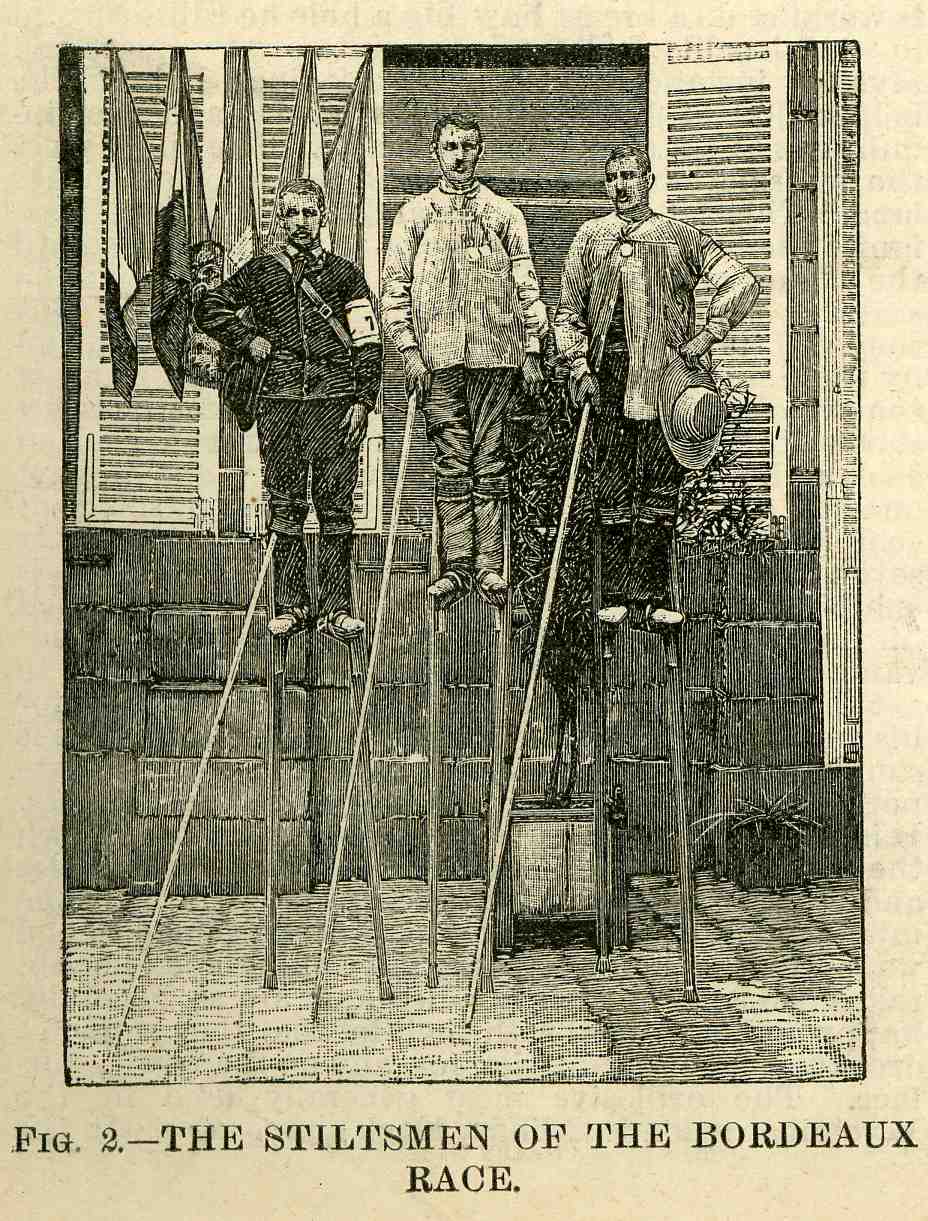
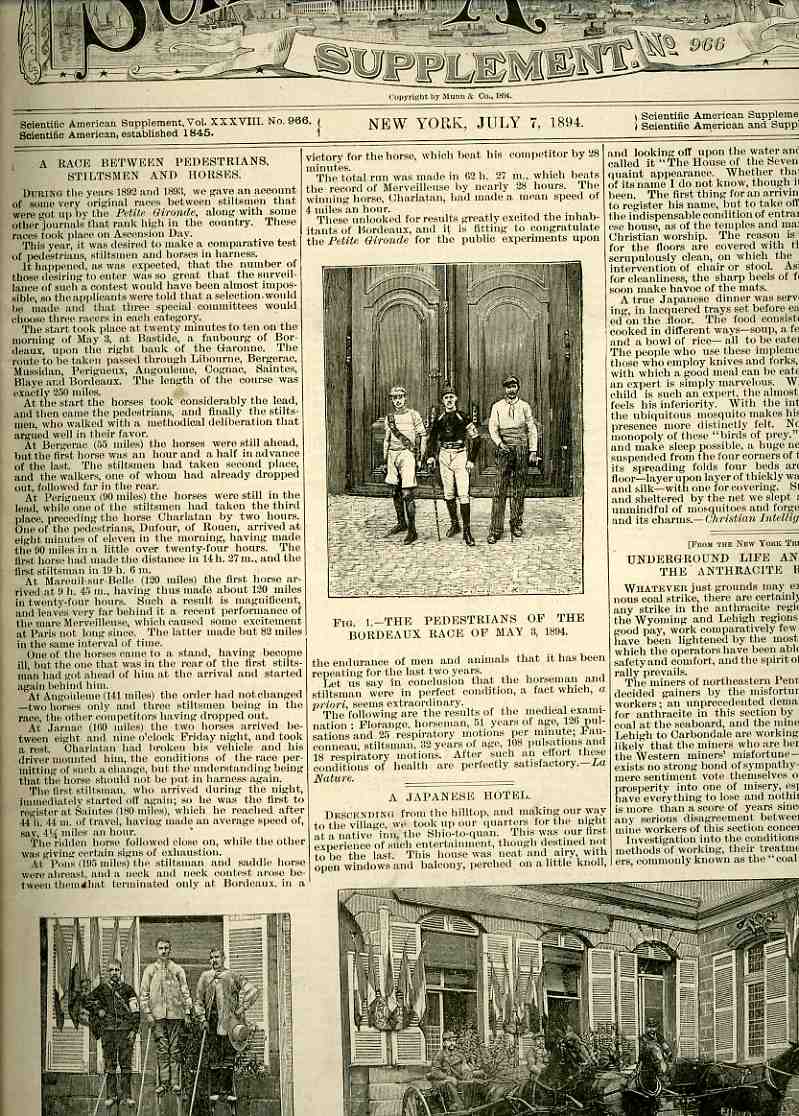
    The title for this rather unwieldy idea of a competition (from the Scientific American, Supplement for 7 July 1894) , “A Race
    Between Pedestrians, Stiltsmern and Horses” begs the question, “Why?”–or at the very least, the title of the article really should have had a
    question mark at the end, rather than being a declaration.  (This is one of those wonderful serendipitous finds–I was looking for an article deeper in this issue on the magneto for the Bell telephone; but it was this extraordinary story that wound up on the front page, under the pretty banner of the magazine.)

    As it turns out, this was an exceptionally serious race, as it was 250 miles in length–I have no idea why it should’ve been so terrifically long, but it was.  The officials were deluged with applicants; so many, in fact, that who ever was in charge decided to go with only three representative for each category.  I can imagine in my happiest state what it would have looked like trying to administer a race like this where there were hundreds of stiltsmen/runners/horse teams strung out along a 250-mile long course.

    After several preliminary reports, we read that after 141 miles that all of the pedestrian competitors had dropped away, leaving two horse teams and all of the stiltsmen.  At the 180-mile mark we learn that all were about neck-and-neck, with one of the stiltsmen completing the distance in 44 hours and 44 minutes (or about 4.5 mph). 


    000-ebay--Nov 8 stiltsmen015
    What happens next in the announcenment of the victor is that there is
    no announcenment.  In the pernicious denouement, the article states:
    “let us say in conclusion” which was hardly so, “that the horsemen and
    stiltsmen were in perfect condition, a fact which, a priori seems
    extraordinary”.  We do learn, however, about the pulse and respiration
    of the contestants (?), though we are not told if the numbers were for
    active or resting, sitting or standing etc. positions–hardly a
    satisfactory ending, especially after having to read the word
    “stiltsmen” so many times. 

    ·Posted by :

    ·in:

    —

  • A Magnficiently Bad How-to on Writing: a Card Deck of Limited and Stolen Creativity

    JF Ptak Science Books LLC  Post 351

    000-ebay--Nov 3 plotkey981
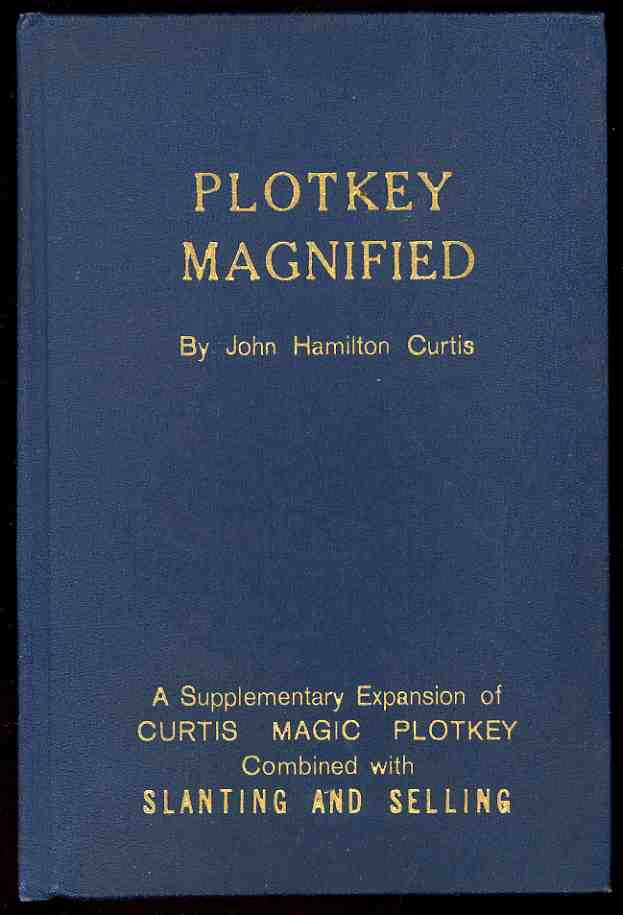
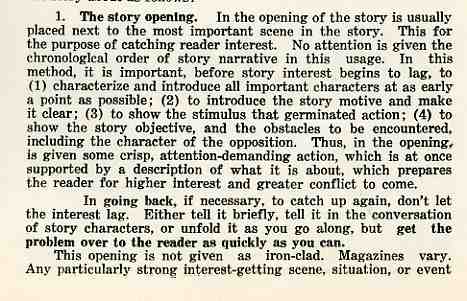
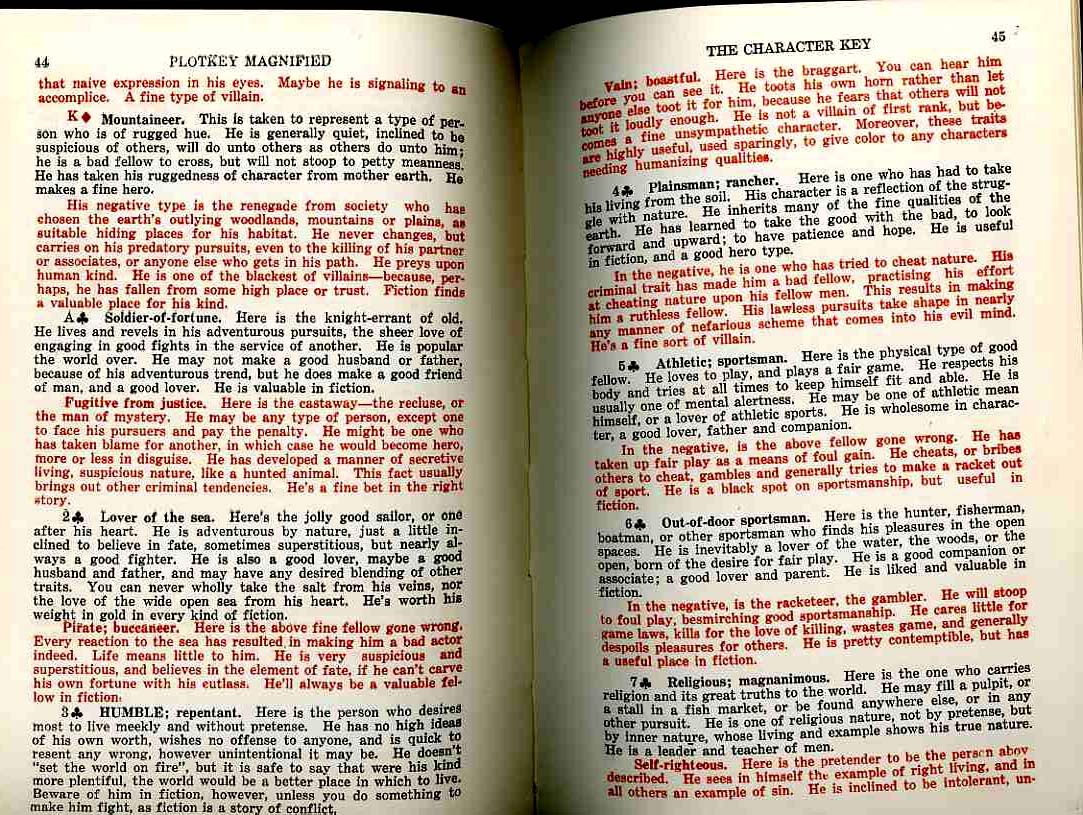
    The title to this post probably does live up to itself–this bit, The Plotkey Magnified, by John Hamilton Curtis, reads as though it were written by a long-down-the-list loser of a Hemingway-imitation contest, and thunk-up with the vigor of a five-beer bar date. (Interestingly, the work, printed but not published in 1937, was prepared by the author for himself–we learn this info on the title page, along with the author’s address, which was PO Box D, Eagle Rock, California.. It must’ve been a pretty small post office if their boxes were identified with letters.)  The subtitle to this work pretty much sums it up:  A Supplemetary Expansion of Curtis Magic Plotkey Combined with Slantng and Selling.  The one thing that the author forgot was punctuation and grammar, which somehow shook themselves loose of his book, and which I’m guessing were sold in those now-disappeared tiny paper bags that you used to get at Reiman’s Hardware store in 1966.  He also forgot how to write, as some of his efforts are just truly bad, and occasionally painful.  For example, we have the following exceptional declaration:

    000-ebay--Nov 3 plotkey984

    And so, these two paragraphs speak for themselves in their own special way.

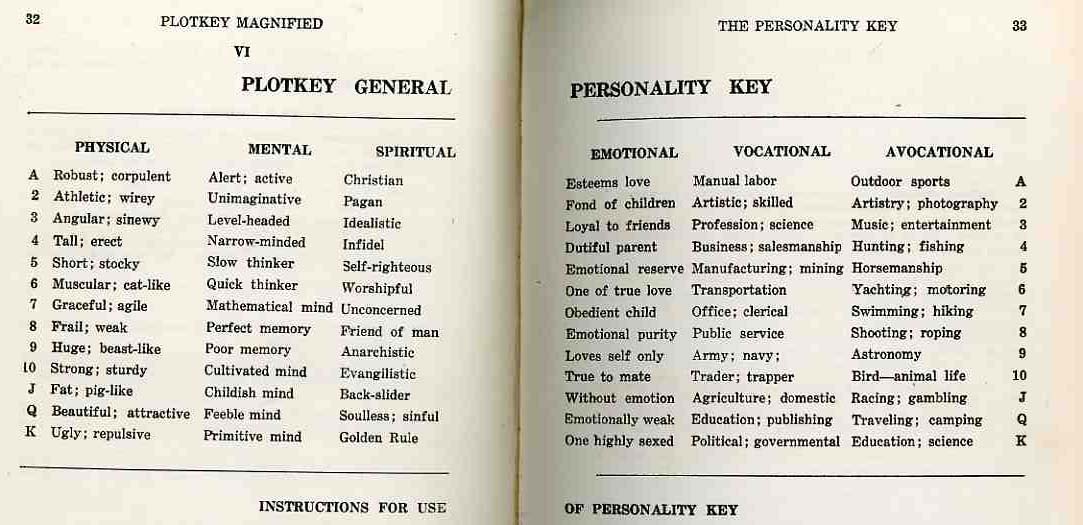
    What Mr. Curtis was trying to do here with this publication was (a) make a little money  and (b) selling a manual of some calculated “ideas” for story and character development to people writing detective fiction for detective novels.  Nothing really works here–the author shouldn’t have written it because he couldn’t write, and certainly couldn’t teach all of the stuff about writing that he couldn’t have known;and the readers shouldn’t have bought it because if they couldn’t write before reading the book they doubley-couldn’t write after using it. And I do mean “using” it rather than “reading” it.  Incredibly, the book is set up to have its ideas dismembered and set up in the fashion of a card deck, the reader dealing themselves out pieces of characters and scenes and locales, with Mr. Curtis offering more than two dozen (!)  different types of physical, mental, spiritual, emotional, vocational and avocation descriptions encompassing the totality of human nature.   Even though these descriptions of the human condition are minimal, liminal and sturdily stupid, they are funny in an outsider, disturbed vein of insight.    The ‘physical personality” aspects like  athletic/wirey; fat/pig-like(?) rub up hard against things like the removed “spiritual” personality traits, which  include “christian, pagan, idealistic, infidel, unconcerned, back-slider, soulless-sinful”.  Throw in the mental, and emotional stuff plus the interest and jobs sections and you can concoct some spectacular Frankensteinian-monster personality assignments:  for example, at random, you can develop a character for your detective story who is fat and pig like with a poor memory, a back-slider  who loves themselves only, is a trapper, and is interested in “entertainment”.  Wow.  These ingredients can get mixed and coddled into a witches brew of old tripe that would compose an unlikely and heinous small town population that should probably be buried rather than read about–remember, you’re supposed to use this cookbook as The Guide to Creativity for the short story you’re trying to sell to “Muscle Culture”. 

    I must say though that what I take away with me from this experience is an idea for turning this book into some sort of naive-surreal card/board game that is made to produce purposefully bad fiction, the sort of writing that is really hard to do; writing good bad, where the loser is the winner in a game of retro-badness. Not easy. Soldier.

    000-ebay--Nov 3 plotkey983

    000-ebay--Nov 3 plotkey982

    ·Posted by :

    ·in:


  • Extra-Earth Humano-Alien Souls From Outer Space Repopulate Earth-Hell!!(??) Blank & Missing Things XXVII

    JF Ptak Science Books  LLC Post 401


    (Extra-Earth alert! This is the third time that I have found a pamphlet illustrating a view of the earth with an extra alien-earth in the background.)

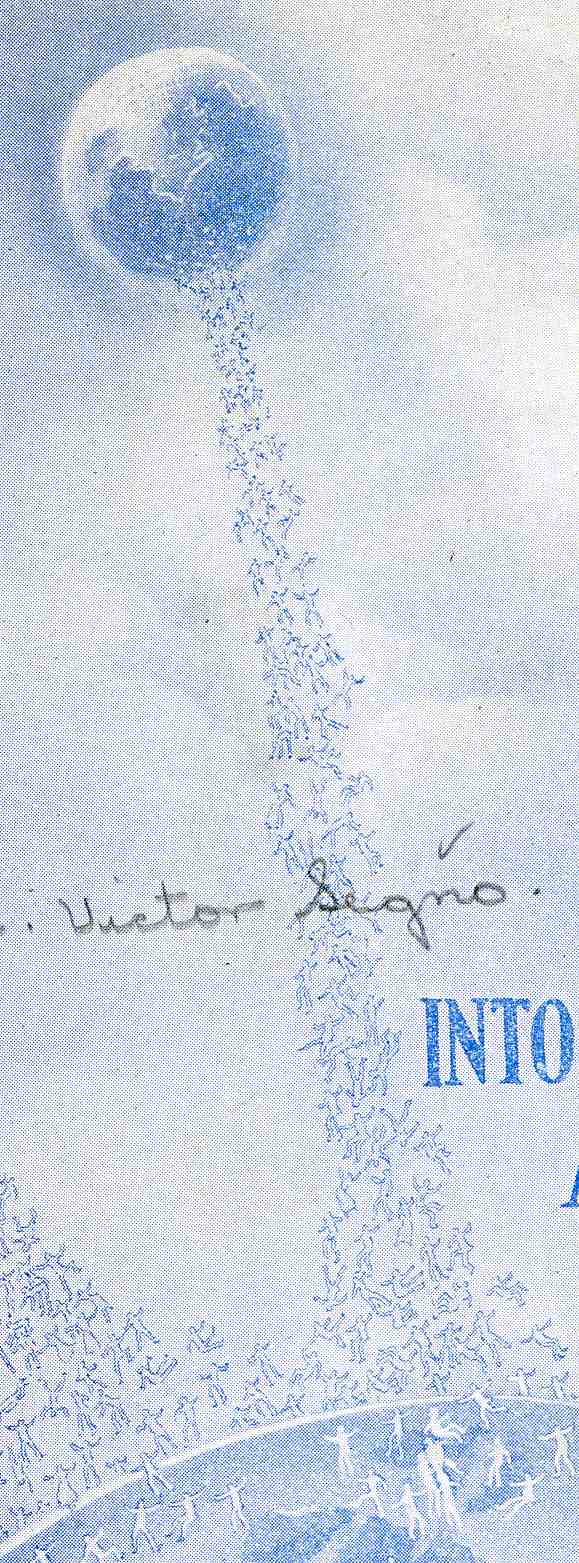
    This 1929 pamphlet by Dr. (?!) Victor Segno is the poster child for  the sub-category of Advanced Strangeness in the Naive Surreal Collection of our store. Segno is no stranger to dislocated and fractured ideas, and has a long history of preaching and extracting money from the preached-to.  Early on in his career he spawned a not-terribly original idea called “mentalism” which involved getting your “brain waves” correct and “harmonizing” your surroundings with them, which somehow also had something to do with leadership and success.  But all of that involved sending Segno a dollar for a pamphlet on brain-wave distribution.  According to Segno’s home-town paper, the LA Tribune, there were something like 12,000 people who were part of the runaway Segno train wreck–the Tribune couldn’t understand why, and didn’t much care for Segno’s quacky successes.

    0--blog---Nov 29 into this world149

    Suffice to say that quite a bit happens between 1902 and this 1929 effort, some of which involves considerable success and tiny-empire building in Echo Park.  But Segno really does break the bonds of treacly abnormalism with “Into this World and Why”, which offers a curriculum of soul/ghost extra-terrestrial astrological-astro dead/reborn beings to come and re-(!!) populate humans on earth.  (Wait a minute–that idea gets picked up by L. Ron Hubbard, yes?  Except that when L. Ron gets a hold of this idea there are 10,000 atom bombs involved and a new added process called “the clear”. But that’s another story.)  After kind of reading this pamphlet, I have come to determine that the best thing about it–bizarro ideas or not–is the cover. 

    0--blog---Nov 29 into this world151The cover, though is magnificent.  Look closely, and you’ll see that there are five other earth’s floating above the earth, all of which are contributing not bodies but souls, souls a-piling up like clustered grapes in places, souls being deposited back on earth for another go around in existence. Segno explains to the humble reader that the universe is divided into twelves sections, each populated with a planet that looks like earth, all of which are superior to the earth.  These are soul-abodes for the dead of earth whose souls leave and travel blah blah blah along the means of an undescribed process called “radiography” of the brain waves. As you can see the humanish forms falling onto earth are empty, waiting as they were to fill up a body.  Oy, vey.


    And so the thing drags on for 52 pages, a length probably determined by the paper on hand.  (But that wouldn’t stay the case, as this  pamphlet went into a self-stated 26th edition…if true, then there is no justice in publishing,)  The only reasonably entertaining and proto-sci-fi idea that comes into play here is that in all of the universe it is the earth that is Hell.  Earth is the place of punishment that souls are sent to until they get things right, at which time they leave for one of the other twelve earths.  So it goes.  

    0--blog---Nov 29 into this world150

    The other interesting bit on the cover is the representation of the giant mountains of Europe, which erupt above the earth’s horizon.  I figure that for these bumps to be so prominent that the mountains needed to be at least a hundred mile high. 


  • The Face of War: the Child-Soldier, 1918

    JF Ptak Science Books LLC  Post 361

    000-ebay--Nov 7war trench013
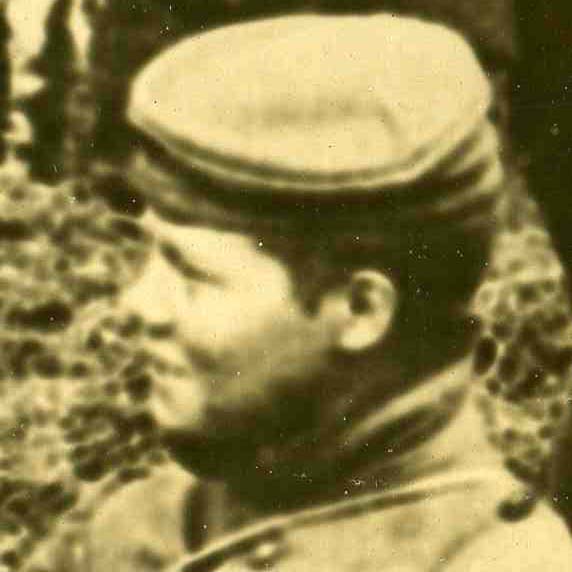
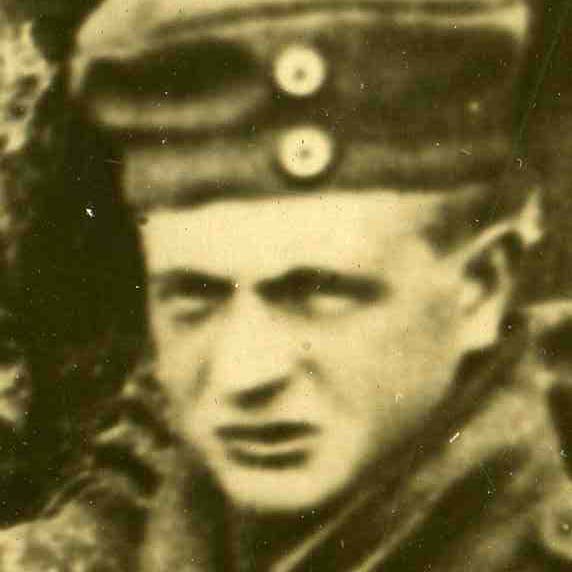
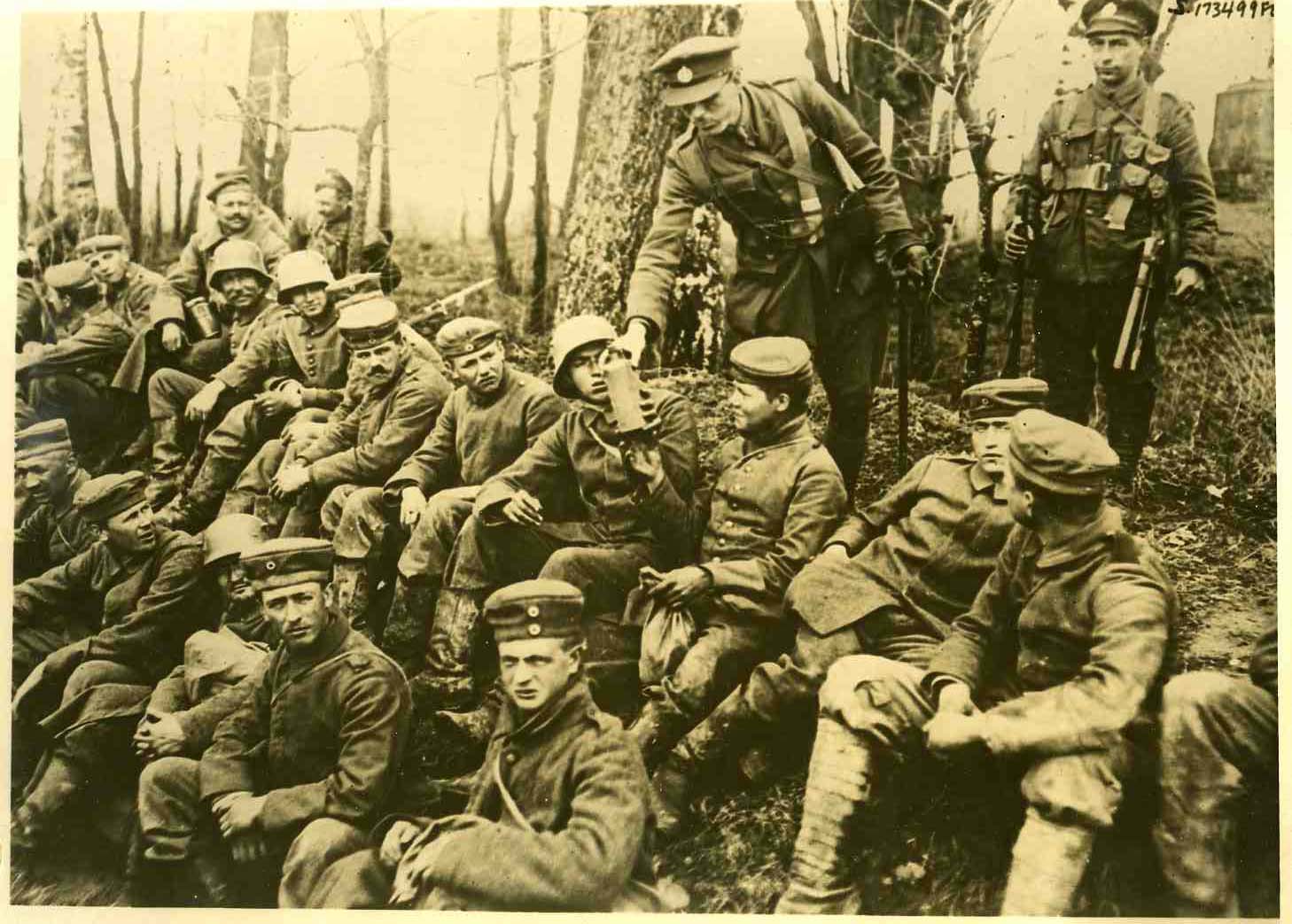
    This is a picture of a captured German soldier, somewhere in France in the middle of 1918, months away from the finale in November.  His tunic is still clean, his buttons as shiny as his baby-fat face, happy to be receiving something–a canteen?–from the British officer, an object of strict attention.  Except that the more our dour soldier to his right has his fingers around the thing and will probably take it from the boy, who looks not only young, but small.  As a matter of fact, most of these soldiers look very young, too young:  sopranos. 

    As the soon-to-be-defeated experience in every war, as the ranks of suitable, able-aged soldiers slim and shrink, the military hand grabs up whatever is available, or left.  I guess this makes sense as most folks in the industrial world didn’t debate child labor laws–with energy, anyway–until the 1920’s.  If you an work in a cotton mill at 8 or 10 or 12 years of age, why not get these workers to carry guns?  The answer is that they’re not capable, for the overwhelming majority, and would make a

    000-ebay--Nov 7war trench014
    000-ebay--Nov 7war trench012 poor soldier, possibly costing more effort and life on his own side
    than on the enemy’s.  But at the tail end of a brutal conflict like
    WWI, the grim matter is that general conscript had been gobbled up and
    fed into the grist mill that had already cost millions of lives. This
    phenomenon is not just a WWI problem, and not an old problem, either: 
    you could construct an alphabet of abusers, and apply it by century: 
    Burundi, Chad, Ivory Coats, Rwanda, Somalia, Sudan, Burma, China, Sri 
    Lanka, Columbia, the Soviet Union, the United States, all pressing
    children into the front line, or as drummer boys, powder boys, cannon
    fodder, mine-clearers, and on and on. Run out of men, and the
    13-year-old boy was next in line, the face filling out any sort of
    uniform at any point in time.


  • Manly Purity & Beauty; Soap vs. The Royal Evil, 1889

    JF Ptak Sceince Books  LLC  Post 400

    0--blog---Nov 28 crimson chin146

    This is 1889’s mini-version of a gorgeous male, a man of purity, virility, and pimple-free skin.  Also of scrofula-free skin, a condition description that seems to have faded from use after wide popularity for 500 years.  The picture of this man was used by the Cuticura Soap Company (actually the Potter Chemical and Drug Company of Boston) to promote its product, a soap with a bit of prussian blue tincture and some other stuff whose manufacturers claimed would (not could) cure all manner skin aliments, including the loss of hair.  The cure of scrofula–a form of tuberculosis affecting the lymph nodes of the neck and appearing as large welt-like dry abscesses–was no minor claim.  Aside from its quack connection, the claim was also an affront to royalty, as for hundreds of years the skin condition of scrofula (“the Royal Evil”)  was thought to be curable by a monarch’s touch; Henry IV was said to have touched thousands of people in this way.   There was also a religious connection to the sovereign touch cure, with a ceremony included in the Book of Common Prayer from the Anglican Church.  It survived in England until George I found the practice offensive and “too Catholic”. 

    An offshoot, Cuticura Resolvent, was offered to cure “every sort of blood disease”, while yet another product, Cuticura Anti-Pain Plaster, would cure rheumatism and kidney “pains and weaknesses”.  That’s quite a heap of expectation from soap, and the American Medical Association too it to task as early as 1912, calling the soap’s effectiveness as a curative “remote”; somewhat earlier, in 1908, the British Medical Association found the use of Cuticura for its stated curative capacities for syphilis to be “without basis”.  Pretty benign and reserved, I’d say, compared to what the AMA and BMA had to say about similar products. 

    The Cuticura identity is still in use–and popular–today, 143 years old, though so far as I know the modern makers make no claims for its soap to cure the Royal Evil.  Today its just soap.

    Crimson chin

    I’ll take this opportunity to reference this ideal of Manliness and Purity to a certain character from my younger daughter Tessie’s cartoon program, The Fairly Oddparents--this old man bears some resemblance to one Mr. Crimson Chin from that show.  (I just like referencing kids’ shows.)

    ·Posted by :

    ·in:

    —

  • The Queen in the Coal Pit: an Unusual Photograph of Royal-Nearness

    JF Ptak Science Books LLC  Post 360

    000-ebay--Nov 7queenonacar008
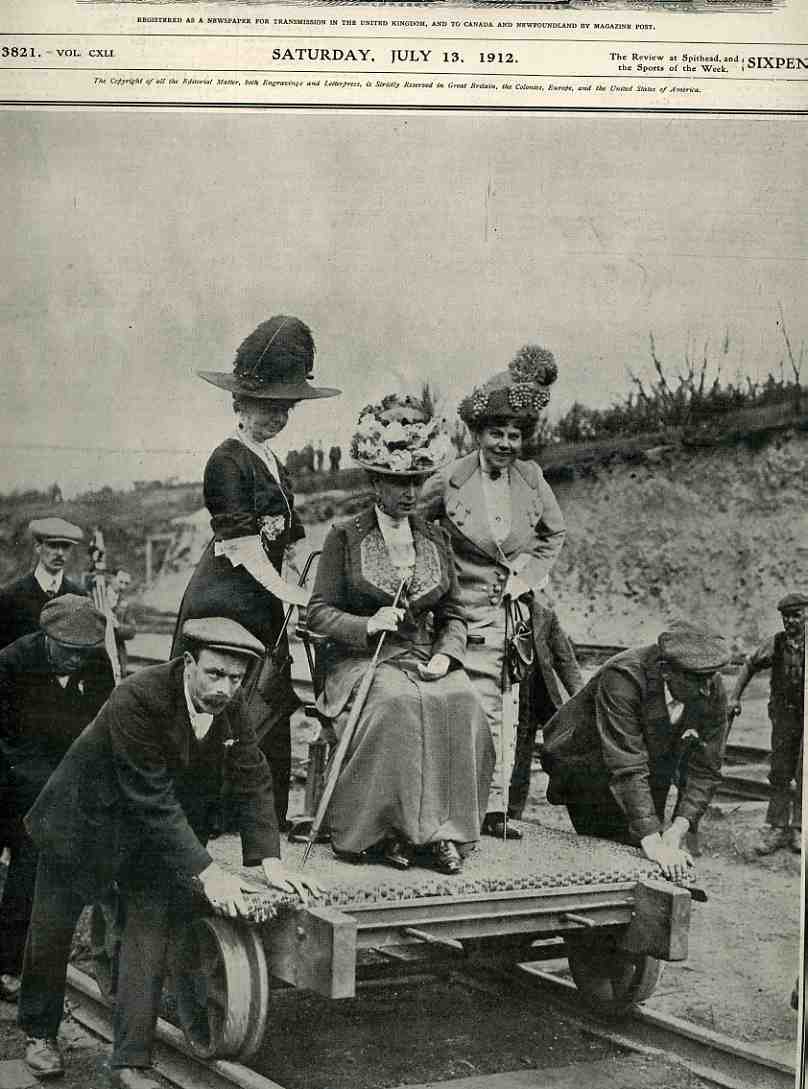
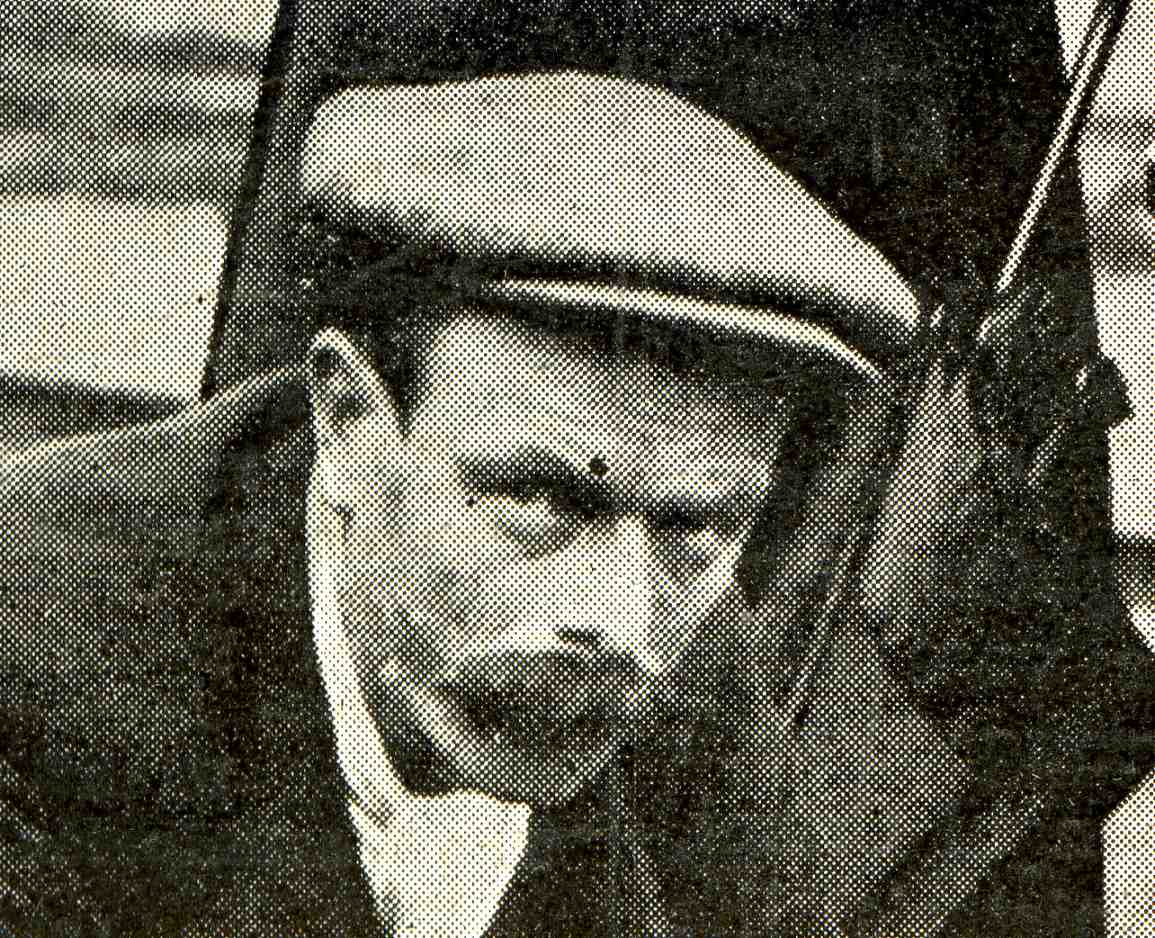
    Its not often that one sees a Queen on a side car (actually a “railway plateplayer’s trolley”)  in a coal bit, but such is the case in this photograph, showng her majesty at the Silverwood Colliery (near Rotherham), in the southern mining districts of Yorkshire.  The King and Queen attended to interests there at the coal mine “quite an hour”, before returning to finery and fuss.  Though fuss is what was made to transport the queen from point to point, her human-propelled on this car, looking not very comfortable, gripping her rapier-thin parasol with her three middle fingers.  I’m sure that the four men selected for this task (the three that we can see wearing similar boutonnieres)–their shoes spotless, their jackets pressed–were told to take it quite slow and steady, what with the queen on board.  I can’t decide what the look is, exactly, from the lead man–at the very least I don’t think that he wants to be there.  For a very busy mine there aren’t very many men in view, save for the guy on the right with the shovel; I feel pretty confident that these working fellows were kept away so as not to drift into the picture, like this guy, who would remind them of the  scrubby un-scrubbed  who made the Empire run. 000-ebay--Nov 7queenonacar009
    (Image from The Illustrated London News, 13 July, 1912)

    000-ebay--Nov 7queenonacar010