A Daily History of Holes, Dots, Lines, Science, History, Math, Physics, Art, the Unintentional Absurd, Architecture, Maps, Data Visualization, Blank and Missing Things, and so on. |1.6 million words, 7500 images, 4.9 million hits| Press & appearances in The Times, Le Figaro, Mensa, The Economist, The Guardian, Discovery News, Slate, Le Monde, Sci American Blogs, Le Pont, and many other places… 5000+ total posts since 2008.

Category: Art History

  • Numbers in Dreams

    JF Ptak Science Books   Post 1703

    Thinking big thoughts in dreams is generally not a common thing, as anyone who has read their own semi-conscious half-awake memory notes of a dream-based inspiration could attest.  But it does happen: 
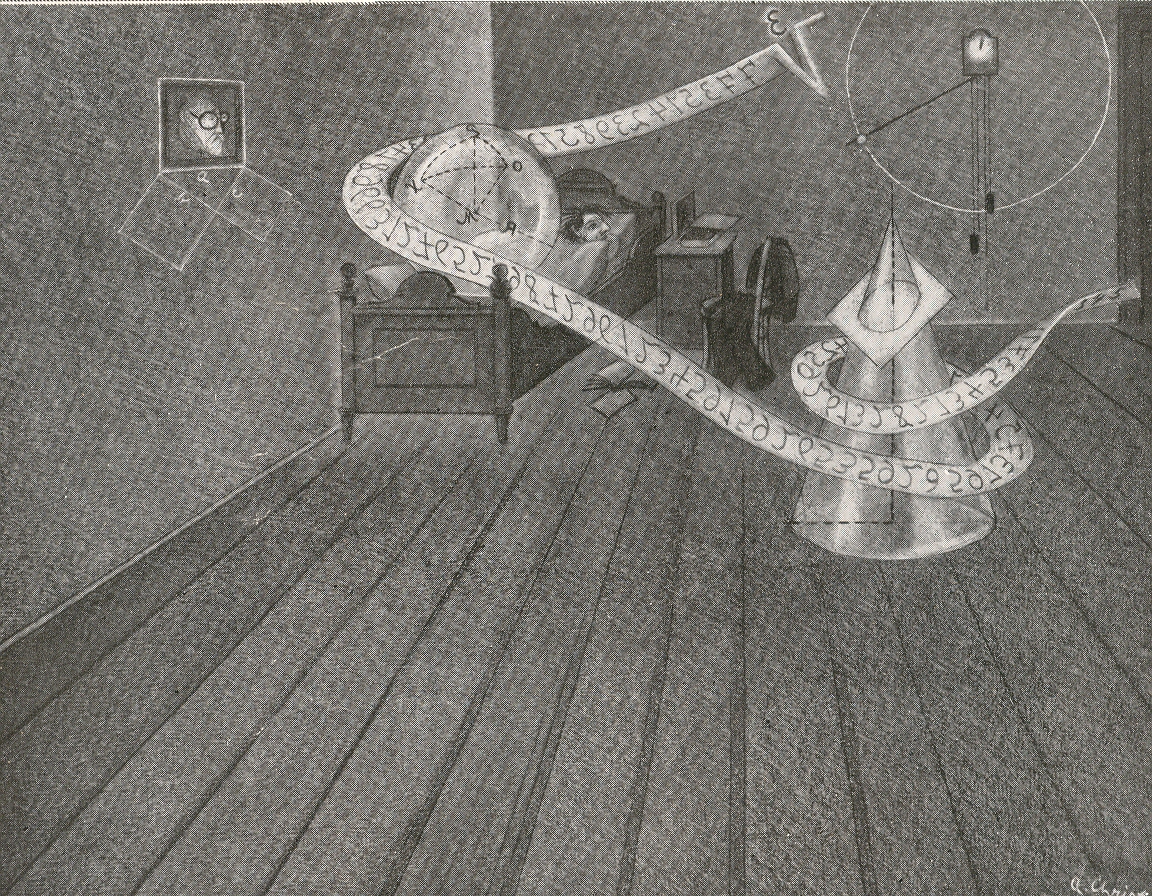
    ==Blog July 21=math dream
    Paul  McCartney1 dreamed the song Yesterday, Gandhi dreamed the source of non-violent resistance, Elias Howe  dreamed of the construction of the first sewing machine, and Mary Shelley the creation of her novel Frankenstein… For good or for ill, William Blake was evidently deeply influenced by his own dreams; on the other hand, Rene Magritte was deeply influenced by dreams but didn’t use any of his own for his paintings.  Otto Loewi turned an old problem into not one in a dream, finding a solution to the prickish problem of whether nerve impulses were chemical or electrical (and resulting in the Nobel for medicine in 1935); the fabulous discovery of the benzene ring came to August Kekule in a dream as well.  Artists have been representing people in dreams and dreamscapes for many centuries: Durer depicted a dream in a 1525 watercolor, for example, and thousands of artists have depicted famous biblical dreams (Joseph of Pharo) for long expanses of time.

    What struck me, though, in this illustration found on the other side of the page of the Illustrirte Zeitung2 (for August 1932) that I used for yesterday’s post about damming Gibraltar and Shakespeare’s memories, was the depiction of someone dreaming mathematical thoughts…or at the very least, dreaming numbers.  People have undoubtedly dreamed much in mathematics, but I can not recall seeing illustrations of these dreams.

    I’m differentiating here from something like a Poincarean inspiration, or vision, or thunderstrike–I’m talking about drop-dead asleep sleep, dreaming sleep, REM and all that. Also I’m differentiating this from imaging mathematical thought, as in the work of Francis Galton in 1880 in which the subject of mentally seeing the process of mathematics is perhaps first addressed. I wrote a short piece on that here, way back in Post 9. )

    The numerical sequence in this dream doesn’t look like anything to me:  the backwards radicand doesn’t strike anything common in my head.  The geometrical drawing under the portrait in the dreamer’s room though is the impossibly iconic Pythagorean theorem, and there is a nice picture of a conic section in the foreground; but the artist, who improbably signed the work “A. Christ”, doesn’t offer much of math in the dreamscape.  Still, it is a rare depiction of someone dreaming about math. 

    Notes
    1. “I woke up with a lovely tune in my head. I thought, ‘That’s great, I wonder what that is?’ There was an upright piano next to me, to the right of the bed by the window. I got out of bed, sat at the piano, found G, found F sharp minor 7th — and that leads you through then to B to E minor, and finally back to E. It all leads forward logically. I liked the melody a lot, but because I’d dreamed it, I couldn’t believe I’d written it. I thought, ‘No, I’ve never written anything like this before.’ But I had the tune, which was the most magic thing!” from Barry Miles (1997), Paul McCartney.
    2.  this is really a great sheet of paper, coming from issue 4492, pp 518-519.  Two pictures of dreams on one side, with three visionary images on the other (the Gibraltar dam, a sub-polar submarine, and a futuristic Indian railway/bridge.

    ·Posted by :

    ·in:

    —

  • On Recognizing Things: “Outsider” Art


    JF Ptak Science Books  Post 1684

    On an early use of the term, Outsider.

    Outsider b075

    Sometimes a word is just a word, and the elements of recognition sometimes inhibits that.  Except in this case that the word seems to be just what it is and also indicative of what it would become.

    Outsider074
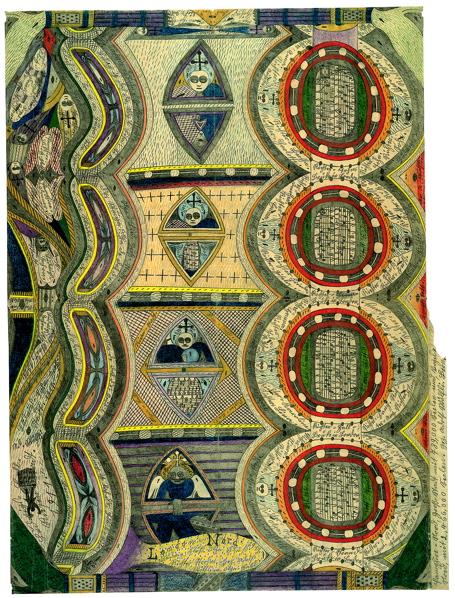
    Outsider, or outside, outside the recognition of “official” art, of critiqued-art, is the English language equivalent/translator coined in 1972 (by Roger Cardinal) to illustrate the term art brut (“raw art”) created by Jean Dubuffet.  Dubuffet created with others Compagnie de l’Art Brut in 1948, which in some respect was a reaction to a new sort of displayed art that had begun its life in the early 1920’s, mainly as the efforts of doctors treating psychiatric patients who were expressing themselves through their art.  (Two famous examples include Dr. Walter Morgenthaler’s Ein Geisteskranker als Künstler (A Psychiatric Patient as Artist), published in 1921 on the work of perhaps the most famous people in the Outsider canon, Adolf Wölfli; and another being  Bildnerei der Geisteskranken (Artistry of the mentally ill) published a year later by Dr Hans Prinzhorn.)

    [Adolph Wolfi]

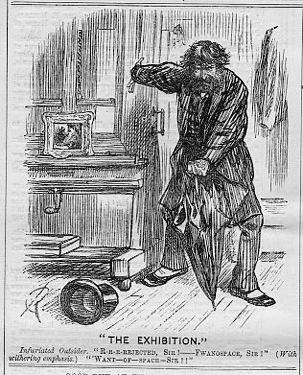
    Well, “outsider” as we  know it today in reference to the arts is definitely not what the editors of Punch magazine pursued in this cartoon for their issue of 6 May 1886.  The “infuriated outsider” was simply an artist left outside a show, whose work was not accepted for exhibition. (And from the looks of it, the small work on the huge easel, being rejected for the “want of space” might not have been the reason for the artist not making the list.)  

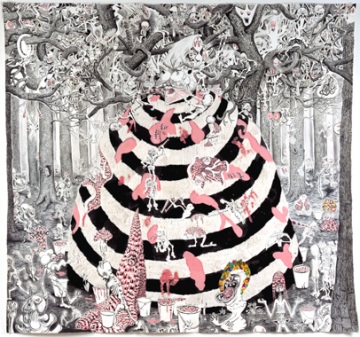
    Trenton Doyle Hancock, “AND THE BRANCHES BECAME AS STORM CLOUDS”, 2003, Mixed media on canvas. Photo courtesy James Cohan Gallery, New York and the American Folk Art Museum.

    [Henry Darger]

    This outsider was simply outside with probably-not outsider art.  Henry Darger (1892–1973), Martín Ramírez (1895–1963), Paul Gösch (1885–1940), Charles A.A. Dellschau (1830-1923), Willem Van Genk (1927–2005) and so on were Outsiders, their work being Outsider/Art Brut and also being left outside for a long time.  Far outside.  In the far-deep outsider, further and deeper outside than the more aesthete outsider varieties of “outsider” art–like Impressionist, Cubist, Dada, Constructivist, Futurist–ever got outside.  

    [Willem van Genk, detail]

    Anyway, I thought it curious to find the term stuck in the middle of a cartoon rant in an 1886 popular journal.


  • A Source of Great Blackness: Virgil in 1537.

    JF Ptak Science Books    Post 1671

    Black--virgil043
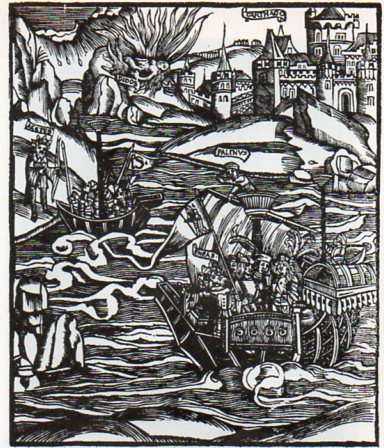
    Wood engravings and woodcuts making use of broad, deep areas of black have long been a favorite of mine.  Finding pools of deep, continuous black–especially when the dark-inked places well outweigh the untouched white spaces on a piece of paper–have been a source of intrigue, and it just doesn’t seem to happen all that often in prints made say before 1650.  And I’m not talking about darkish or heavily shaded areas, here:  I mean black.

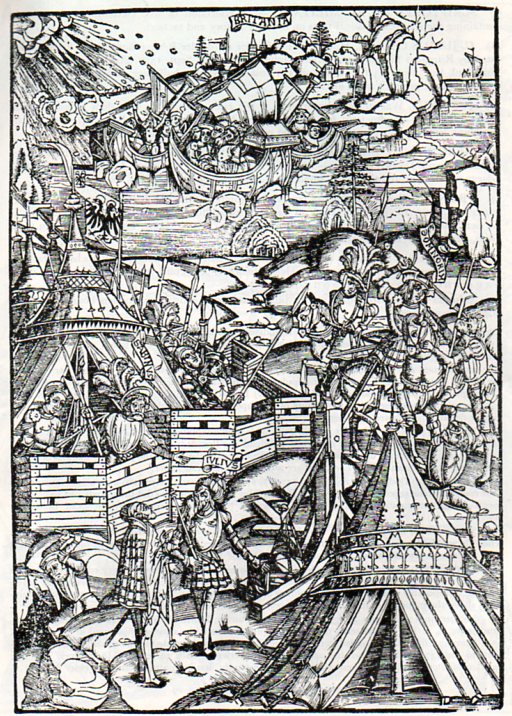
    Compare this to another, gorgeous image from about the same period, (Julius Casear) Historien vom Gallier und der Romer..., published in Mainz in 1530:

    Black--caesar 1530044

    The artist here while providing a very beautiful and complex image doesn’t really attempt the great deep blacks of the Virgil–admittedly this process doesn’t work everywhere  and for everything, not by any means, but I do like pointing out the true-black images as I find them.

    The first image–one of 104 large woodcuts–appeared in Publius Virgilis  Maro, Opera accuratissime castigata, a very large (folio) work that was published in Venice in Jnuary, 1537. This is of course Virgil, and the work contains the Eclogues (or Bucolics), the Georgics, and the Aeneid–unfortunately, I cannot find any other illustrations from this massive effort of 1537 but that pictured here.

    There are though  images from the Sebastian Brandt version of the Virgil Opera online with nearly the same images and by the same artist (“The Master of Gruninger”) but earlier (1502) and from what I can determine perhaps not with the same deep black urgency as the 1537 edition (seen above).  For example, here is an image for the Aeneis, Liber Quintus, Plate 104:

    And another fromn the Aeneis:

    Image sources (for the two images above) are from Spriti of the Ages, here

    It seems to me that day-time images like the 1537 Virgil do not get quite this black but rarely, and that the only times things seem to get blacker is with silhouettes. 


    ·Posted by :

    ·in:


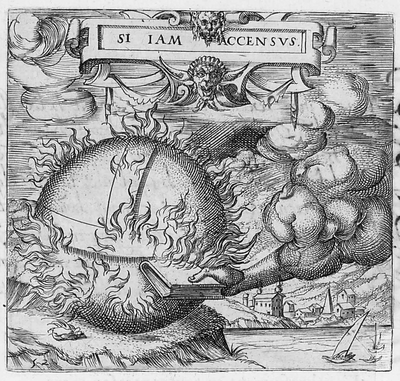
  • The Earth & Cosmos as Balls–Renaissance Emblemata and Charlie Chaplin

    JF Ptak Science Books   Quick Post

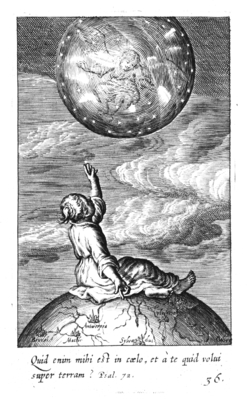
    Quid enim mihi est in caelo & a te quid volui super terram?

    (For what have I in heaven, and from thee what thou shalt do I desire upon earth?)

    Hermannus Hugo, Pia desideria (1624)hu1624036pictEvidently, there’s plenty left open to desire and want while still here on Earth–not the least of which was Heaven, or the Heavens, as we can see in this playful engraving from Hermanus Hugo’s Pia Desideria (printed in 1624).  With the Earth as a given, why not want more from the Heavens? 

    On the other end of this equation is being on Earth and wanting it–all of it. Charlie Chaplin, in his great and enormously insightful and satisfying film, The Great Dictator, styles the film’s title character after Adolf Hitler, and delivers a performance of great depth. 

    THe film was released in October,m 1940, when most of the world had been at war with Hitler and Germany for more than a year.  The United States was not, not yet (for another 14 months) though we participated in programs that meant assurance for the delivery of materiel and other materials necessary for the Allies to continue the war.  Chaplin was a savage in his attacks on Hitler, relentlessly so–and as such this was the first major American film to take such a stand against Germany in WWII. One of the great scenes of the film and perhaps of all films in the 1940’s was Chaplin’s dancing Hitler and his love affair with world domination:

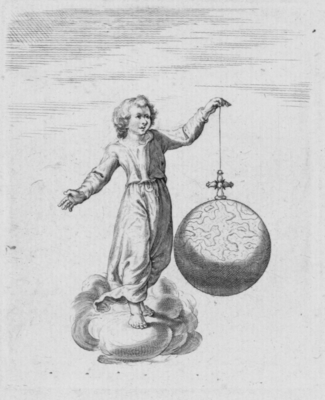
    In Jan Suderman’s De godliebede ziel (printed in 1724) we see yet another rendition of the Earth and its favor with humankind, as  as ort of balanced bit at the end of a fragile connection

    el1703001pict

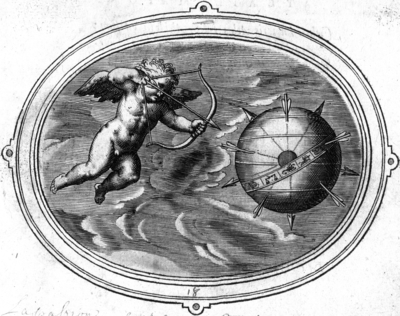
    While in Otto Vaenius’ Amorum emblemata (printed in 1608) we find a cupidesque emblem shooting the Earth with his arrows, all of which takes place under the motto “Love Keeps Everything in Essencve”, or “all Depends upon Love”, or some other variation:


    v1608018pict

    The litle God of loue transpearseth with his dartes; The heauens and eke the earth in musicall accord; For without loue it were a chaos of discord; Thats fastned now in one of well conioyned partes.

    The seemingly finished product of the love-arrowed-Earth can (possibly) be seen in Otto Vaenius’s Amorum emblemata (1608), telling us that
    Love permeates and sustains the whole, though.
    Love permeates all that breathed or not.

  • Anatol Petrizky, Costume and Stage Design, Constructivist, 1929

    JF Ptak Science Books  Quick Post

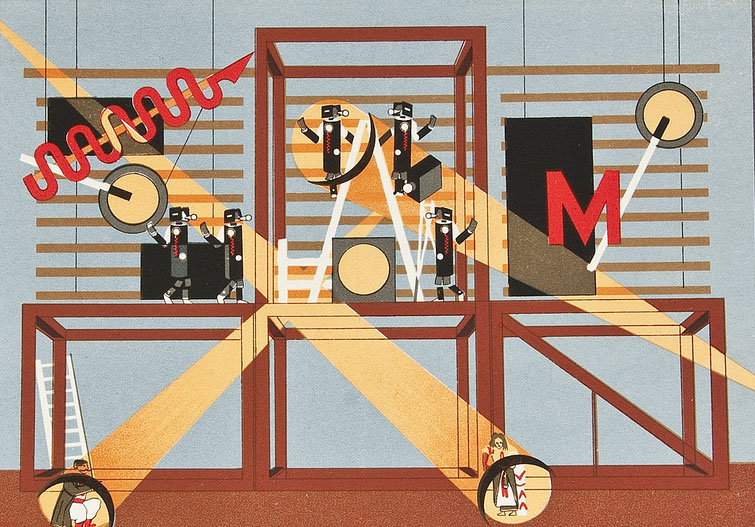
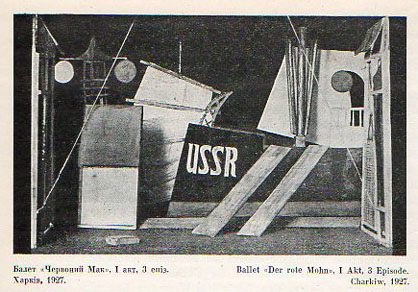
    There is nothing quite like the set and costume designs coming from the Soviet Union in the 1920’s, and this collection of work by Anatol Petrizky (described below) attests to that. My interest is more in the design of the sets than in the costumes–and so far as I can determine none of those (reproduced in black and white) have yet been on the net. (This book is also offered for sale in the blog’s bookstore.) 

    PETRIZKY 2
    [FRONTISPIECE]

    Petrizky069
    PETRIZKY, Anatol (1895-1964). [B. Chmury]  Anatol Petrizky, Theatre-Trachten.  [Anatol Petrizky Teatralni Stroi] Iintroductory essay by V. Khmury (Chmury).  [Soviet Union]: StaatsVerlag der Ukraine, 1929. One of 1500 unnumbered copies.  Design and images by Anatol Petrizky, text by B. Chmury.

     This book was published in Ukraine in 1929; although this is not the time or place (I really just wanted to post about this book as a beautiful artistic piece of work), I could not let it pass without at least mentioning what man-made disasters lie ahead for the Ukrainian SSR and for the resst of the Soviet Union.

    ·Posted by :

    ·in:


  • Echoes from the Memory Hole–a Book that Set the World on Fire

    JF Ptak Science Books   Post 1670

    Dort, wo man Bücher verbrennt, verbrennt man auch am Ende Menschen.“–Heinrich Heine, saying that if people burn books, they’ll burn people, too, which have been proven to be the case.

    av1615052pict

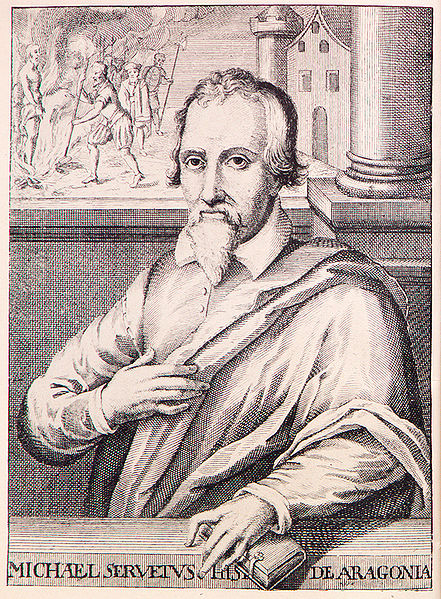
    Usually this story goes the other way around, where people of the world set books on fire–or entire libraries on fire (like the House of Wisdom, Baghdad, in the 13th century), some of them more than once (and in the case of the library at Alexandria, six times.)  Books are burned in repulsion and revulsion not only by their readers but also (and in greater numbers) by rulers who don’t want their potential readers to have any potentiality, or potential, reversing the flow of unwanted information back to the source. (The illustrious and esteemed have burned people as well as the villains–Thomas More sentenced John Tewkesbury, a London leather merchant, to the flames for “approved burning” for keeping banned books; for good measure More also had the works of Martin Luther burned, as well.)This later has a very long history, which is taken a step further when said leaders reach out to burn the books and their authors, sometimes at the same time.  This infamously happened to Michael Servetus (1511-1553, and who I wrote about here) and of course many others, entire castes of scholars burned or buried for being in the way.

    https://historyofideasblog.com/a/6a00d83542d51e69e20128779f1418970c-pi

    [Engraving of Servetus, being a good double-portrait showing him in the high life and then, in the upper left corner, being burned alive for his political activities ans for his books, which disturbed the notion of the heart-centered body and seat of all wisdom much favored by the clergy, replacing it with his notion of the heart as a muscle, as a functioning part of the body rather than its seat of wisdom.]

    The first mass, organized book burnings in the United States were instituted for self-preservation of an economic way of life–local merchants banned together to form book burning brigades for the threat to their livelihood, the Sears & Roebuck catalog, which I wrote about here.  Not quite on the scope of rejecting the lives and works of authors of what were deemed to be salacious or threatening to the core of the social structure, but in the long run perhaps they were something approaching that.

    The “Memory Hole’ is the euphemism for the dispatch and destruction of books in George Orwell’s 1984, not too far removed from the institutionalized book burning in Fahrenheit 451, though seemingly a furious leap forward from Reverend Lovejoy from The Simpsons.

    Reverend Lovejoy: “Oh hello Lisa! Can you recommend any books for my mobile?”Lisa: “Ooh absolutely! Well you know, anything by Jane Austen.”Reverend Lovejoy: “Jane Austen. Thanks Lisa, I’ll get right on it!”(Reverend Lovejoy drives away and reveals his Book Burning Mobile.)

    Reverend Lovejoy: “Oh hello Lisa! Can you recommend any books for my mobile?” Lisa: “Ooh absolutely! Well you know, anything by Jane Austen.” Reverend Lovejoy: “Jane Austen. Thanks Lisa, I’ll get right on it!” (Reverend Lovejoy drives away and reveals his Book Burning Mobile.) [Thanks to The Lisa Simpson Book CLub.]

    And for the first emblemata, above, comes the legend:

    Alta Dei flammas vox toto suscitat orbe, God’s voice on high stirs up flames in all the world,
    Dum nimis auerso mens mala corde furit. While all too strongly the evil mind rages with averted heart.
    Sed pia mens humilis paret. Sic excoquit aurum,  But the pious mind obeys in humility. So the furnace melts out gold,
    Et paleas eodem deuorat igne focus  and with the same fire devours the chaff

    And as it turns out the book to set the world on fire is the Bible, which is I guess appropriate given the number of books sought out and burnt by Mother Church, though I must say that far more books were banned than burned.  (I think so, anyway–there’s a number of iterations of the list of banned books–the Index Librorum Prohibitorum–which was kept from the mid-16th century to the mid-20th. I think that there is no massive list for books that were both banned and burned.)  Its a harsh-looking metaphor, particularly given the story of the Flood.  

    And in some cases the Bible-burning metaphor was hardly that but an actual event, and tragically ironic in the case of William Tyndale.  Tyndale was a scholar who among many other rich things brought to bear a new translation of the Bible done into English, which was a first, and which greatly displeased the ruling head of England at the time, King Henry VIII.  Henry had already burned translations of the Bible that he could not abide and thought heretical–not the least reason of which would have his multiple marriages condemned–and continued on to not only do so with Tyndale’s work, but also to Tyndale himself.  At the end of a long and complex story, Tyndale was found to be a heretic, and in 1536 was strangled to death on a platform before a large crowd, his head chopped off, and his body burned. After a few years Henry authorized multiple new translations of the Bible to be printed, all based on Tyndale’s work.  Tyndale stayed dead, though–his work had an enormous impact on other English translations of the Bible, not the least of which is the King James Version of 1611, where the overwhelming majority of the NT and OT was Tyndale’s.

    http://images.wikia.com/simpsons/images/1/1b/Book_Burning_Mobile.jpg


  • The Beautiful Lunarium: Black Walls/White Stars, 1516

    JF Ptak Science Books   Quick Post

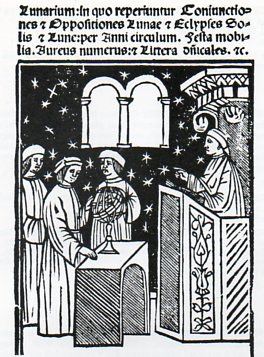
    The following are some beautiful images from a rather popular ephemerides by Bernardus de Granollachs, printed between 1484 and 1515.  The slender (16-page) work, Lunarium: In quo Coniunctiones & oppositiones Lunae… was published first in Spanish in 1484 and was then picked up and reprinted in a number of other languages over the next few decades.

    The image most interesting to me comes from the Rome edition of 1516, simply because of the magnificent black wallsemblazoned with stars (which occurs on the title page):

    Lunarium 1516052

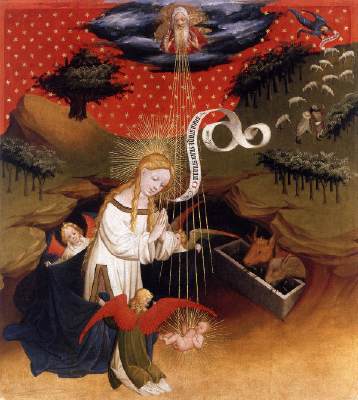
    The image did remind me very slightly of another gorgeous thing which I wrote about earlier in this blog (here):

    Red sky

    Some other variations in the Granollachs can be seen below:


    ·Posted by :

    ·in:

    —

  • Art of Labor–Ralph Fasanella

    JF Ptak Science Books    Quick Post

    Ralph Fasanella (1914-1997) was a self-taught artist who included minute details in his large canvases in which he re-created New York City, vast scenes of industry and celebration, and in general anything having a lot of people in it. He was if not in fact then at least in his head a Wobbly, a left-of-left deeply-pro-union socially-consciousness commentator, the son of a button-hole making mother and an ice-seller father. Ralph was a machinist and gas station owner, and in there somewhere in mid-life he became a painter.  I like his work quite a bit.

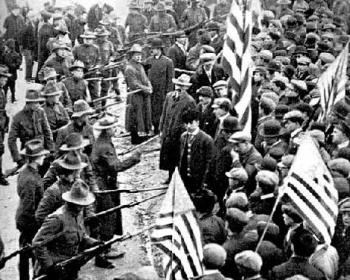
    This (above) is one of his most well-known works, and it portrays the famous IWW strike in Lawrence, Massachusetts in 1912, (see the Great Strike.), also commonly known then as now as the Bread and Roses Strike.  What differentiated this strike from others was the very large involvement of women, minorities and immigrants.  Old Ralph wore his leftie heart on his sleave.
    Here’s some photos of the real thing:

    Strikers face off with militia in Lawrence
     As usual the strike was about more humane working conditions, more light, better air, fewer hours, decent livable wages.  When the main employer in its town influences the flow of 85% of all of the town’s income, it is difficult for people to resist demands from that business which might not be reasonable.  

    Up20


    Lawrence strike meeting, New York

    [Photo shows group of men gathered outdoors, probably in New York City, to hear about the textile strike in Lawrence, MA. (Source: Flickr Commons project, 2008)]

    Guarding approach to mills, Lawrence, Mass.

    [Photo shows the Lawrence textile strike of 1912, also known as the “Bread and Roses” strike.  Source:  Library of Congress.]

    And from the introduction to the Report on Strike of Textile Workers in Lawrence, Mass., (U.S. Bureau of Labor, 1912) we read:

    "In Lawrence, Mass., fully one-half of the population 14 years of 
    age or over is employed in the woolen and worsted mills and cotton mills, and approximately 60,000 (including employees and members of their families) of the 85,892 people living in Lawrence are directly dependent upon earnings in these textile mills." "The textile strike in Lawrence and the conditions which followed were not primarily due to any condition peculiar to Lawrence. The general conditions of the industry in Lawrence are more or less typical of the textile industry in all of the large distinctly textile towns, and the strike in Lawrence and the conditions attending it might just as easily have occurred in any other of these towns."

    In short, a standard bit.
    Here are some other examples of Fasanella's work:

    ·Posted by :

    ·in:

    —

  • Buckets of Missing Smiles–an Incredibly Brief Anthropology of an Expression in the Face of the Sun

    JF Ptak Science Books Post 1666

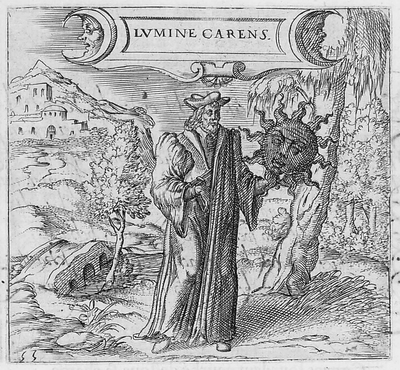
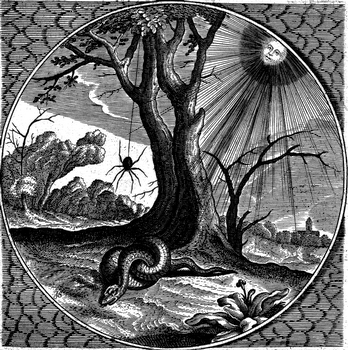
    The depiction of the anthropomorphic Sun featured with a broad toothy smile seems a commonplace fixture in modern times–at least in the very popular media–but it seems to me that the Sun was an impressively dour character in the most misty and moldy past. Its a much harder issue for me to locate a happy Sun than a phlegmatic one, as we can in the coming examples.  Here, for instance, the Sun is actually disappointed, and dark:

    av1615055pict

    [Georgette de Montenay/Anna Roemer Visscher, Cent emblemes chrestiens (c. 1615)] 

    The Sun (representative in this case of the Christian god) disavows the heavily robbed false philosopher, finding nothing but fault in the erroneous thinking and pronouncements, so much so in fact that it distances itself from the phonylogian by turning itself black and devoid of light, absenting the light that was supposed to be shone via the heretic’s teaching. 

    Feigning to be a philosopher with your long cloak
    You bring forward all false theories about the pure Sun.
    First learn to recognize what is the true light.
    The balmy day does not shine in obscure night

    Conversely, the sun would also shine to dispel the false teaching of other philosophers, as so, though this time without any face at all:

    hu1689024pict[Source: Pieter Huygen, Beginselen van Gods Koninkrijk (1689)]

    But mostly it seems the Sun appears to those who came before with a mostly blank expression:

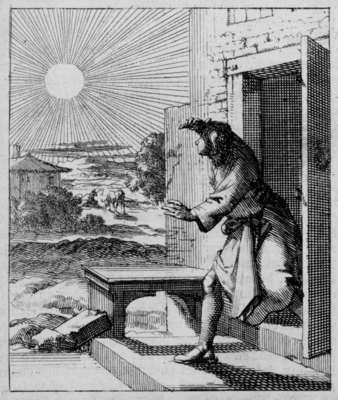
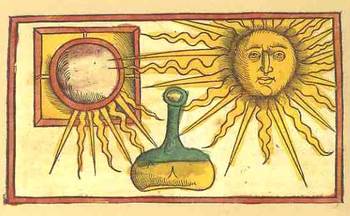
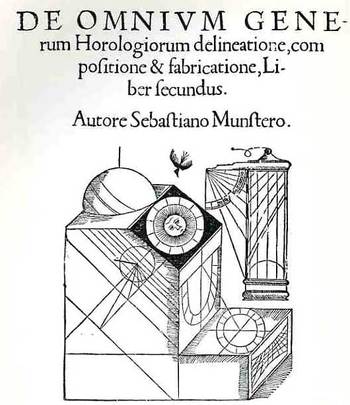
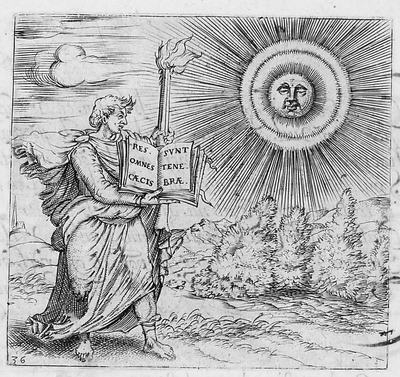
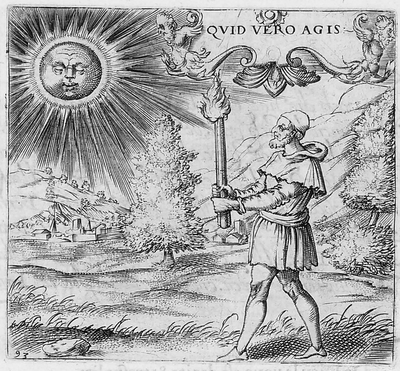
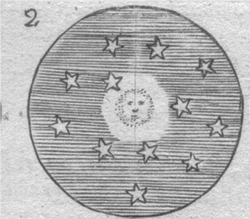
    Blogsunfacescolor Where was the smilign Sun hundreds of years ago?  Anthropomorphic images of the Sun have appeared in books in the West for several hundred years, and in almost every case where the Sun has a face, it is usually expressionless, its mouth drawn into a mid-Western farmer/Abe Lincoln horizontal, a tightly drawn nothing.  Two thin lips, firmly repulsing all emotion.  The face of the Sun was insurmountable, a tabula rasa, showing perhaps that there was nothing there at all inhabiting this iconographic image of The Creator to give the poor observer a glimpse into the depths of the future.

    Blogsunfacesdetailtwo

    This observation  seems to stand for Sun Gods and Goddesses as well, even the ones who are being tugged or pulled or charioted a cross the vaults of the heavens—the Nordic Sól, Greek  Helios , Roman Sol Invictus, Vedic Surya and of course Elijah ascending to Heaven in a Chariot of Fire, all seem pretty intractable.  But in general images that we see of Sun deities like Apollo, Greece and Rome; Freyr, Norse; Garuda, Hindu; Huitzilopochtli (Uitzilopochtli), Aztec; Inti, Inca; Liza,West African; Lugh, Celtic and Re (Ra) and Isis, and on and on, show a small, set pair of lips, if they have a mouth at all, and this going back beyond the Sumerians (Shamash). 

    Blogsunfaces2048

    When the Sun really loses its human personae in the 17th century (the scientific sun and stars beginning much earlier, as in for example Allessandro Piccolomini’s Della Sfera del Mondo, 1552, with simple star maps unadorned by icons and written in the vernacular), it is replaced with starry images which seem to somehow have more emotional authority than the sun images with faces.  Perhaps the sun was meant to have this Delphic, blank-mirroring quality, given its importance as a giver (and taker) of things,

    Blogsunfacedetailone
     
    and that it was not within human capacity to understand it as an emotive entity, especially during bad times.  But in those times of Good and Bad it wasn’t necessary to see a frown or a smile on an image of the Sun, I guess because of the complaints of redundancy.

    Blogsunfaces047

     No matter, though, as the modern astronomical text took care of the Sun and its missing buckets of smiles in due course—until more modern times, when the Sun is made to have a matching disposition, a result of kinder modern artists. 

    Blogsunfacedetailthree  

    f16914406

    This Sun seems to rule with an ennui  Daniel de la Feuille, Devises et emblemes (1691); and then again, in the following superbly engraved work by Jacob Cats, Sinne- en minnebeelden (1627):

    beeld037

    The Sun here seems to have a knowledge-worn expression, a sense of having-seen-it-all, in this beautiful work by Georgette de Montenay/Anna Roemer Visscher, in Cent emblemes chrestiens (c. 1615)

    av1615036pict

    And again from the Montenay we see a smirking Sun (definitely not a smiling one) judging the efforts of humans once again, and finding them coming up far to short:

    av1615093pict

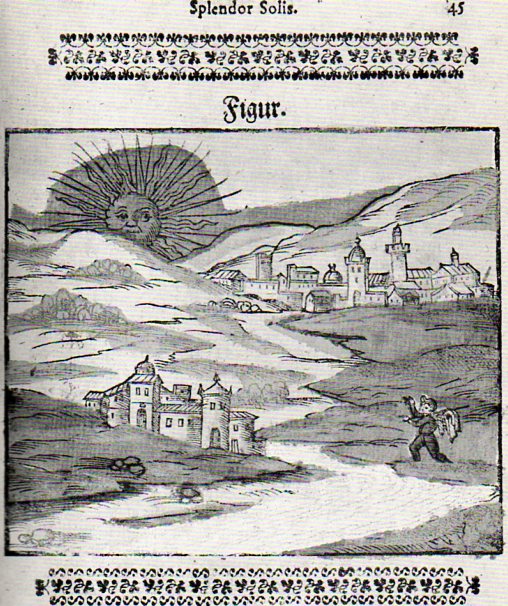
    I guess you could make a case for an “amused” Sun in the Montenay, though in a third-person sort of Royal way of being removedly amused.  Here–in a rare and very important work in the history of alchemy–we see a rising Sun in an amused state, welcoming the book’s author, on his alchemical pilgrimage. 

    Sun--splender solis029
    In another illustration from this book (by Salomon Trismosin, Auretum Velius oder Guldin Schatz und Kunsthkammer, printed by Georg Straub at Lake Constance in 1598/9, and also known as “Splendor Solis”) we find the following expected facial posture:

    [trismosin, salomon (?pseud., fl. 1473?). <i>aureum vellus, oder guldin schatz und kunstkammer.</i> rorschach: 'gedruckt in des f. gottshausz s. gallen reichshoff' leonhard straub, 1598-99.]

    And so on and on this continues, this presentation of the Sun as both removed and judging, until–in some cases–the business of representing the Sun anthropomorphically disappears altogether, even in allegorical representation, like so: 

    The Man in the Moon will just have to wait his turn, though I can’t resist the following couple of images, the first of which shows the Moon in a phase of nothingness and a nil expression:

    f16914302

    [Source:  Daniel de la Feuille, Devises et emblemes (1691)]

    And then this classic image from an iconic and early science fiction film:

    http://data.whicdn.com/images/17391911/moon,vintage,jules,verne,le,voyage,dans,la,lune-d0ec6d7f016fe54cb3a634c84919da1d_h_thumb.jpg

    And from the 1905 motion picture version of Jules Vernes From the Earth to the Moon called A Trip to the Moon–upon the approach, the Moon’s surface was blank, but quickly developed a face, which was sort of smiling–until struck in the eye by the Verne capsule. 

    Offhand, though, my memory doesn’t offer too many smiling-Moon expressions. 


  • Extra-Earths Department #4: Brueghel Dips into the Late Renaissance Allegorical Sky

    JF Ptak Science Books LLC  Post 1664

    See the other Extra-Earth posts:  Mondo Bizarro, Science Afflictions and the Dubious Mind—Bad Science, Part 1. NYC in Space (?!) here and Extra-Earth Humano-Alien Souls From Outer Space Repopulate Earth-Hell!!(??) here.

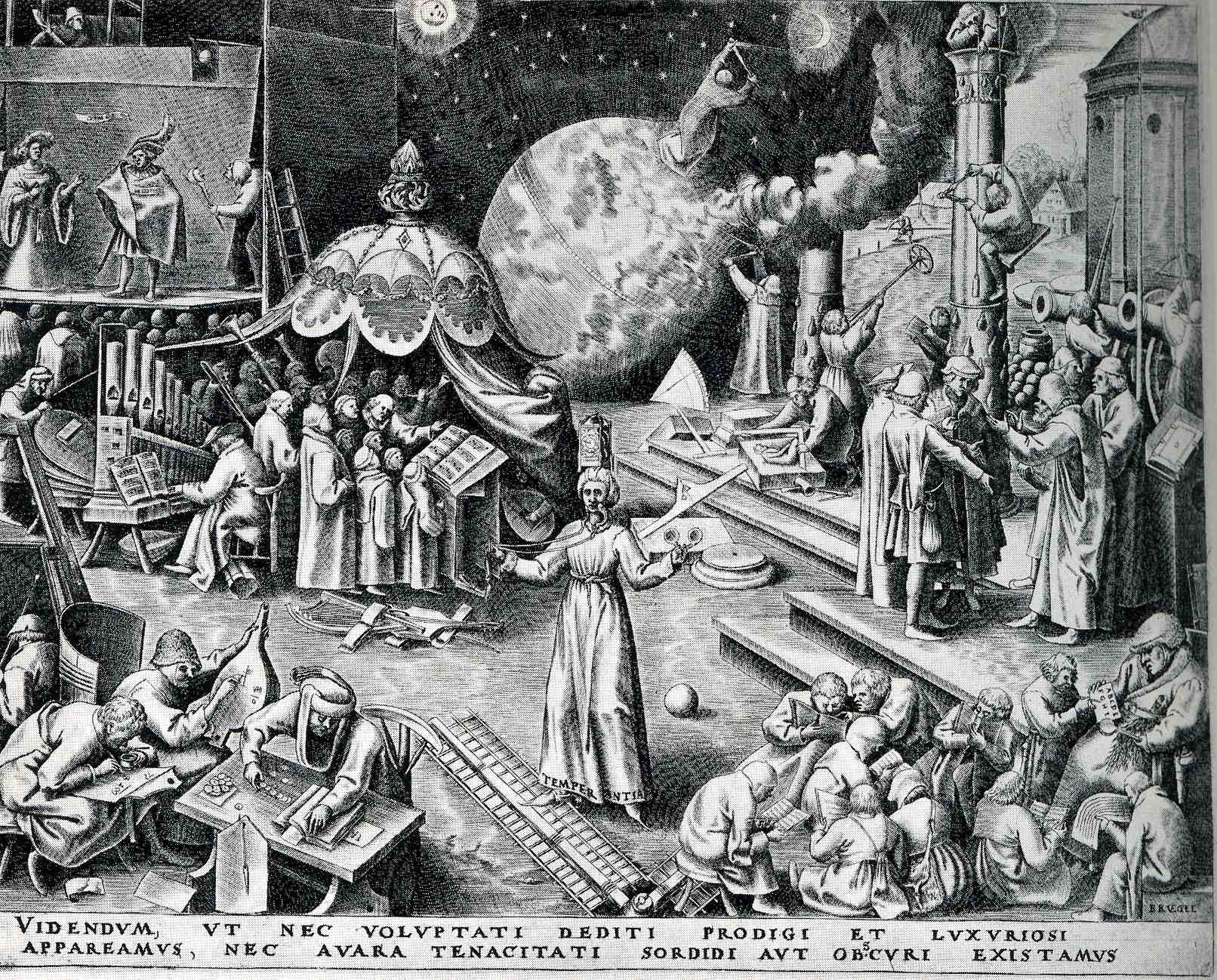
    0 blog feb 17 brug597

    Peter Brueghel (the elder, born ca. 1525 and dying in 1569), was the Dutch semi-discoverer and king of “normality” of Renaissance art–and by “normality” I mean that he depicted non-royal things that were generally off the palette for almost everyone else, finding subjects in peasants and small life (hunting, meals, working at agriculture, festivals, dances, and so on).  Brueghel was also perhaps the first painter to depict a landscape for  the sake of its own beauty, without being a backdrop for a religious study or building or historical scene. He was extraordinarily prolific in his skimpy 45 years, fully populating his scenes with suites of busy and evolving life.

    Browsing through some of his work, I came across the print called “Temerpance”, which in general I think was supposed to warn us against excessive pleasure, but which really just confused me a little.

      (TEMPERANTIA; and then, VIDENDVM, VT NEC VOLVPTATI DEDITI PRODIGI ET SVXVRIOSI//APPAREAMVS, NEC AVARA TENACITATI SORDIDI AVT OBSCVRI EXISTAMVS. “We must look to it that, in the devotion to sensual pleasures, we do not become wasteful and luxuriant, but also that we do not, because of miserly greed, live in filth and ignorance”.)  

    To me, it looks like people here are pretty industrious, mostly engaged in scientific or musical pursuits:  lots of books, musical instruments, people writing and reading.  But I guess that these were sensual pleasures, pleasures of the mind and heart, and not a pleasure devolved from the godhead.  Perhaps the complete opposite is true:  the print showing the triumph of the pursuit of the mind over sensual graft, lifting mankind above the filth and ignorance of the body.  Sheesh. 

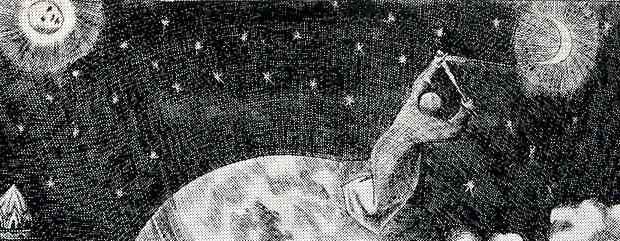
    0 blog feb 17 brug man earthBut the real grit of my interest is the action lurking in the background, the man, the astronomer, making measurements in the sky, triangulating the Moon and the Sun (perhaps).  What on earth is he standing on?  He does seem to be standing on earth in the background of the earth on which thee people in the foreground are standing–which means, with a stretch, we have the fourth entry in this blog’s short “Extra Earths” category.

    0 blog feb 17 brug man math

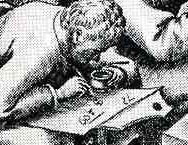
    The more I think about it, and the more closely I look at the print, this confusion must be my own–this must be Brueghel’s way of showing the possible worlds that exist outside the sensual and self indulgent. He shows children (and adults) learning their ABC’s at the feet of teh schoolmaster at bottom right, a theatre scene at upper left, a large musical ensemble (complete with choir).  An industrious man measures his fields, while builders to his right measure their progress and trueness on a column; at bottom right we see an “accountant” of the times working his tables and figures, while another to his right works on a math problem, clutching his pot of ink.  The figure in the middle (with “temperance” written in the hem of his garment), reminds us of our mortality, with a sword in one hand and a clock on his head.  All in all, it is a delightful scene of industry and invention–and it has an extra earth. 

    Of course the extra-earth is allegorical, but, still, it is an unusal thing to see.