A Daily History of Holes, Dots, Lines, Science, History, Math, Physics, Art, the Unintentional Absurd, Architecture, Maps, Data Visualization, Blank and Missing Things, and so on. |1.6 million words, 7500 images, 4.9 million hits| Press & appearances in The Times, Le Figaro, Mensa, The Economist, The Guardian, Discovery News, Slate, Le Monde, Sci American Blogs, Le Pont, and many other places… 5000+ total posts since 2008.

Author: JF Ptak

  • Alphabet Tubes (1895)

    JF Ptak Science Books  Quick Post

    I’ve written a couple of times on this blog on “tubes”, including tubular cars and ships, and of course pulp sci-fi adventures in tubular rocket ships, person intra-space tube propulsion systems, x-ray tubes, vacuum tubes, “tubes of uranium, and that sort, tubes as tubes. Plus there was the “extended tube”, like telescopes, canons, boilers, vacuum tubular whatzis of the future, plus the extended idea of the tube as an open-ended shaft and tunnel (there must be an opening on both ends otherwise you have a “hole”, which has its own category).  In these side tube researches I’ve never encountered the idea or phrase “alphabet tube”, until today. 

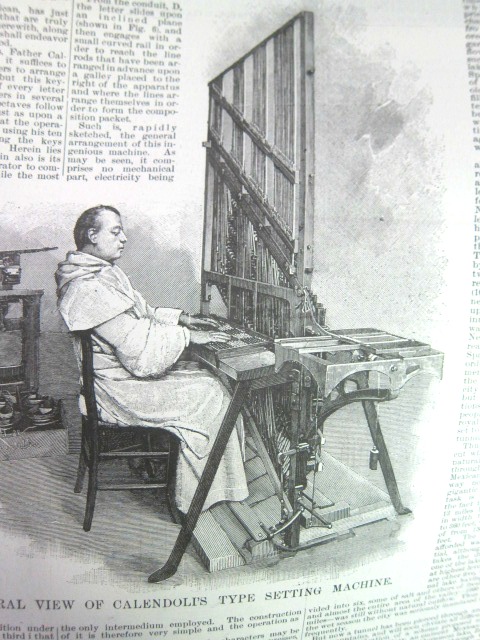
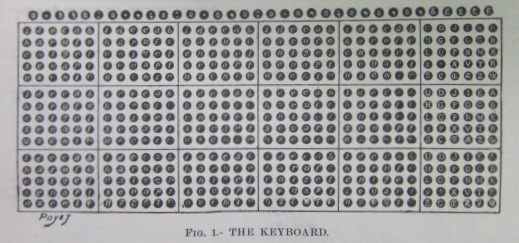
    The Domincan priest Father Vincenzo Calendoli invented (between 1893 to 1895) an unusual and seemingly-simple-but-hardly-so linotype machine that was seen by some as “the typsetting machine of the future…”(–C. Cochrane, American Printer and Lithographer, vols 21-23, 1896). The image below shows Calendoli in serene concentration seated at his machine which looks like a cross between a small Jacquard loom and an odd harpsichord (emphasis on the harp). And what Calendoli is concentrating on is this, his keyboard:


    Sci AM Mega typesetter _2_

    Sci AM Mega typesetter _3_

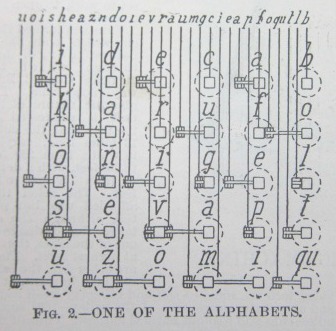
    The Scientific American Supplement  (1895, pp 16055-16057) illustration is reproduced exactly in an uncommon publication called the Rosary Magazine, (1895)–exact, with the exception of the additional caption: the writer annotates it by identifying the “checker board”, “inclined wire and galleys”, and the indescribably beautifully-named “alphabet tubes”! The explanation of what this tube is is far less interesting than its title–tubes filled with type–though the machine overall was extraordinary.


  • The Found-Poetry in Erasing Straight Lines from Maps of Mars (1909)

    JF Ptak Science Books   Post 2759

    There was good strong debate on the issues of Martian “canals” and whether or not they were there by chance or by Percival Lowell’s (and others) intelligent design. The debate dates range from about 1886 to 1909 or so, though the real method in the intelligent life argument comes in at about 1895.  The “1909” part of the endgame is embodied in the interesting paper “Observations de la planete Mars, faites a l’Observatoire de Meudon”1 by Eugene Michel Antoniadi, which is also the holder of some superior and evocative vocabulary and imagery.

    Antoniadi made a series of painstakingly-executed photos of the planet with Europe’s largest telescope (the 33″ “Grande Lunette”) at Meudon. They revealed that the canals as hard geometric forms had indeed been a sort of optical illusion, and that the new and more-definitive photographs showed them in their true and far more complex existence, more as naturally-occurring objects than something that was designed by another life form.

    • (“During the planetary opposition in 1909, Antoniadi observed Mars at the celebrated 33-inch Meudon Observatory telescope, the largest in Europe. Although he observed for only nine nights during a month-long stay in Paris, he reported seeing Mars so clearly at times that the linear appearance of the canals dissolved into an intricate mess of smaller, irregular details, and he noted that ‘the geometrical “canal” network is an optical illusion; and in its place the great refractor shows myriads of marbled and chequered objective fields, which no artist could ever think of drawing’.)–“Mapping the Mars Canal Mania: Cartographic Projection and the Creation of a Popular Icon”, Imago Mundi, 58:2, 2006.

    The Antoniadi photos came only about five years after the true “first” photograph of what were thought to be canals was made by Percival Lowell’s assistant, Carl O. Lampland. (Antoniadi by the way spent nine years as a special assistant to Camille Flammarion at his personal observatory.)  In addition to the debate of how the “canals” came to be, there was another on whether the features identified as “canals” were there at all. It was Lampland’s work that seemed to settle at least that issue, establishing photographically that there was indeed something there. Lowell seized on this work as confirmation of his theories–that if the canals were proven to be there then it followed logically that his iterations of Martian intelligence would also be true. Here Lowell probably acted too rashly, as the photos showed that the canals also weren’t like the patterned and highly-geometrical structures shown in Lowell’s maps. (That said, the British Astronomical Society adopted the position in their 1906 annual meeting that the Lampland photos served as the confirmation that Lowell had been seeking…)

    The Lowell canals as constructed objects hypothesis lost steam after 1905, and met the large part of its end on the work by Antoniadi on what was evidently a perfect night of viewing on 30 September 1909, the primum mobili aspect removed in favor of natural causes.

    In the paper Antoniadi observed 50 canals and before he described them he defined them, the definition coming from one of the original namers of the canals as “canali” (or “channels”)–Schiaparelli–and not Lowell, who interpreted the “canali” as “canals”, with the armature that they were constructed by someone or something. Antoniadi writes with certainty in this paper: “a canal is a [banrle?] or greyish line of regions called the differences of brightness of neighboring points, which constitute the details of the image…”2  which leads us far away from the material intelligence argument.

    Antoniadi then sets down an 8-point descriptive list of canal characteristics, which is beautifully written and when presented in a certain way takes on a very poetic form. His original description reads: “(a) En ombres diffuses, plus ou moins îrréijulières, dont quelques-unes paraissent doubles d’une manière fugitive;  (b) en estompages noueux;  (c) en masses grises, informes et disjointes;  (d) en estompages irréguliers, minces dans le vcuMiiage d’une haie des mers martiennes, et s’élargissnnt en une ombre vaste et confuse plus loin, comme des neuves avec leurs tributaires, vus a une très grande distance; (e) en alignements d’un très petit nombre de lacs; (f) en lacs in-éguliers, simples et bien isoler-; (g) en bords de pâles demi-tons; (h) en lignes noires très courtes, sinueuses ou courbes.”

    Here’s the description, reformatted and translated:

    “Our observations lead us to divide the channels into several categories, namely:

    In diffuse shadows, more or less irregular, some of which appear

    double in a fleeting way;

    In gnarled blobs;

    In gray masses, shapeless and disjointed;

    In irregular, thin blurring, in the construction of a hedge of

    Martian seas, and widen into a vast and confused shadow further on, like

    new with their tributaries, seen at a great distance;

    In alignments of a very small number of lakes;

    In ‘simple lakes, simple and well insulated;

    In edges of pale semitones;

    In very short black lines, sinuous or curved.


    Antoniadi concludes (translated):

    “In this nomenclature, we have not understood the fugitive straight lines, often called channels, which are visible only during a fraction of second and which can be due to an illusion.. These first observations do not confirm the existence of a network of geometric straight lines, crisscrossing in all directions. Even, by very calm images, we have recognized, not in a fleeting way but for several consecutive seconds, a structure of continental regions quite different from the previous one. These regions are shown covered with a large amount of greyish mottling, irregular, complex and gnarled, which no artist can render.

    I was very surprised to find such a significant paper rendered in such a poetic manner.

    Notes:

    1. ANTONIADI, E.-M. “Observations de la planete Mars, faites a l’Observatoire de Meudon. In: Comptes Rendus, 15 November 1909, pp 836-838 in the weekly issue, WITH a lovely full-page map of Mars.

    2. Antoniadi remarks elsewhere that the lack of geometry on the planet “was conspicuous by its complete absence”.–McKim, R. J., “The life and times of E.M. Antoniadi, 1870-1944. Part II: The Meudon years”, Journal of the British Astronomical Association, vol.103, no.5, p.219-227, 1993. There is a long report with 100 illustrations by Antoniadi in the Memoirs of the British Astronomical Association (vol XX, part II) published in the second year of the War, 1915–on the cover of that report is a very strong but still measured statement by George Ellery Hale: “The total absence of straight lines…seems to me significant”. 

    McKim goes on to note the polite correspondence between Antoniado and Lowell, including the very generous suggestion to Lowell that the later’s observations were obscured and complicated by Martian cloud cover. 
    ·Posted by :

    ·in:

    — —

  • Finding Anthropomorphism in an Electric Chair Patent (1897)

    JF Ptak Science Books  Quick Post

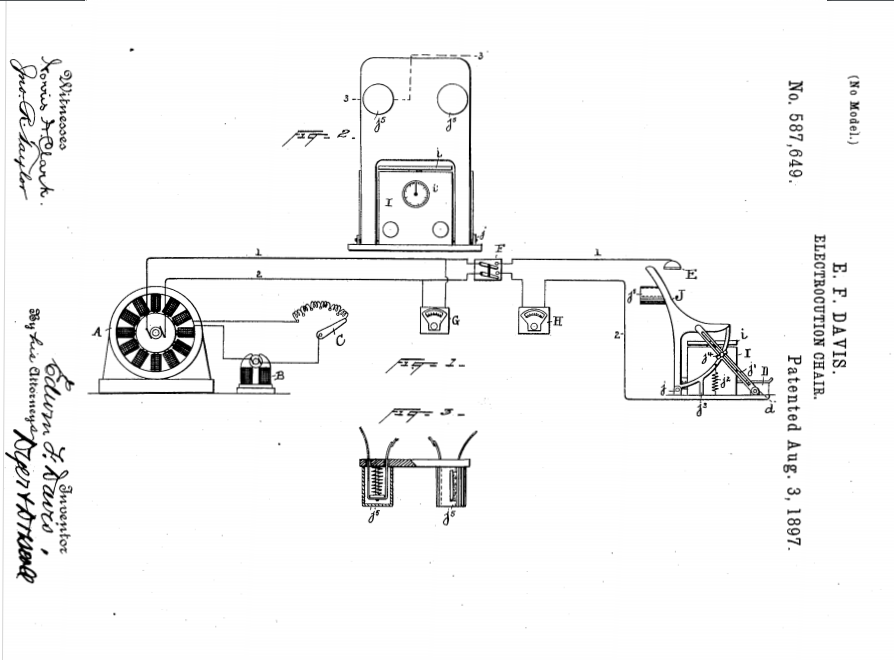
    This image of among the first electric/electrocution chairs is based on the designs of Dr. Alfred P. Southwick (1826-1898, MDS, DDS, SUNY Buffalo), who came up with the idea and started experimenting with it beginning in 1881. His was a mission of mercy, looking to find a quick if not instant salient to carry out the death penalty of a convicted murderer. NY Governor David B. Hill (1843-1910) looked to Southwick for a solution to a more humane way of executing people, establishing a distinguished panel of advisers to help him with this task. (In the small-world department, Hill succeeded Grover Cleveland as governor in 1885 following Cleveland’s election as president of the U.S.–he also acted as executioner in at least two cases while he was the Sheriff of Erie county in the mid 1870s.)

    Southwick’s design/chair was first used on the condemned criminal William Kemmler in August 1890. Most everyone who witnessed this first attempt were aghast at the spectacle; George Westinghouse is reported to have uttered that the executions “would have been better off using an axe”. Theoretically the first application of electricity kills the brain in less time than it takes the body to respond to pain. This seems not to have been the case in many instances.

    No tong afterwards Edwin F. Davis (1846-1923) conducted his own research on an effective and humane way to execute people and was awarded a patent in August 1897 for his “electrocution chair”. Davis would serve as NY state’s “electrician”/electrocutionist from 1890-1914, delivering the final blow to 240 of the condemned during that time.

    It was strange to me how anthropomorphic the design was, including the obvious head and less so for arms and feet. Overall, I think the relationship to a human form is unmistakable. 

    Electric chair patent

    Excerpt from the article illustrating the 1888 electric chair:

    “Execution by Electricity. The State of New York may pride herself in the fact that the gallows is to be banished and a more humane and scientific method of executing criminals is to be instituted. On June 4 Governor [David B.] Hill signed the bill authorizing that criminals should be put to death by an electric shock. The bill is to go into effect on January 1 1889 and new method of execution be applied in the punishment of crimes committed after date.”

    SciAm writes that “instant death” occurs with the electric chair—it doesn’t. The condemned would be lucky to have their brains damaged enough to not register pain, as it takes 45 seconds to several minutes for death to occur.

    “…the criminal is seated bound to a chair having a metal seat connected with one pole of the current. At the back of the chair there is an adjustable head rest having a metal plate on its face and a metal band which passes around the forehead of criminal. The wires may be connected with dynamo which according to the bill may be of any approved type or the current may be supplied from electric light plant or there may be a private plant arranged especially for that purpose at the place of execution. Sponges or dampened cloths should be at the points of contact with the convict to render connection more perfect. At the proper moment switch is turned by the officer and instant death ensues. The current passes along the spinal column and the brain and nerve centers. The current may be few moments to bring about complete exhaustion.”

    Scientific American, 30 June 1888, vol 58.

    ·Posted by :

    ·in:

    —

  • A Good Question on the Canals of Mars: “Are They Really There?” (1903)

    JF Ptak Science Books  Quick Post

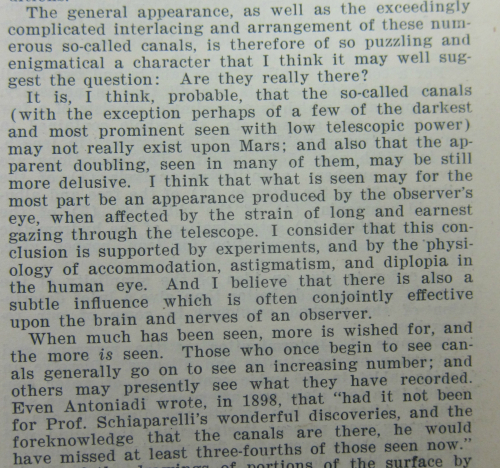
    Edmund Ledger (1841-1914, 38-year Member Royal Astronomical Society, professor of astronomy at Gresham College, 1875-1914) asks an excellent question in his short article, “The Canals of Mars”, in the Scientific American Supplement of 1903 (#1434 June 27, 1903, p 22983-4). He quickly reviews some current thinking on Schiaparelli’s canali and their reception as “canals”, made by Martians, and in his doubt asks the question: “Are they really there?”1

    Mars Ledger

    The canals had been questioned before of course, including by Ledger himself. Earlier in 1895 Ledger described one impossibility of the Seechi-named and employed-by- Schiaparelli canali as canals just in their sheer size: that in order for astronomers to observe the canals that they had to be at least 20 miles wide in addition to being thousands of miles long…a feat too great for anything to accomplish, something far beyond comprehension. (The Suez canal, completed not long before this, would have been nothing compared to the Martian works, being just about five times as long as the canali were thought to be wide. Also thinking no doubt would have been tempered in a bad way—like a poorly tempered anvil and its unpleasing response to being struck by a hammer—by the French failures in the decades that they squandered trying to build the 50-mile-long Panama Canal.)

    ·Posted by :

    ·in:

    —

  • Bubbles, Anti-Bubbles, and Reflections (and Not)

    JF Ptak Science Books   Post 2758     

    [For Jeff Donlan, Extreme Answer Lad of Answers!]

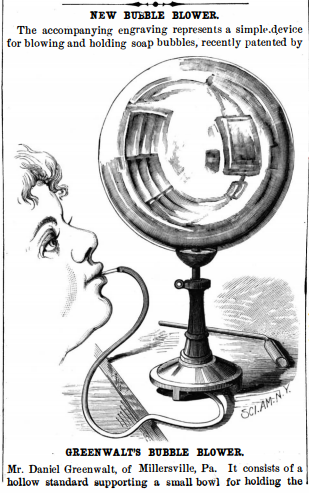
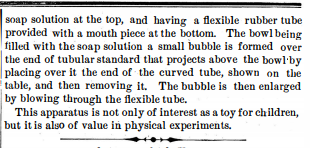
    This article was just a small 4″ or so notice  in the Scientific American on 2 August 1879, written for a new sort of apparatus to make bubble-blowing easier, or more effective, or “rounder”, or less anti-bubbly. (Actually that last would be a trick though I guess you could rig something like this up in an anti-air-breathing way, to create a bubble of liquid encapsulated by a layer of gas surrounded by a liquid. This is actually pretty easy to do standing around and would probably be a much harder thing to accomplish if you needed an apparatus for it. By the way “anti-bubble” should not be associated with the “Dirty Bubble”, which is a character from SpongeBob SquarePants.) 

    Back to the illustration: it is only about 2″ tall and a bit of a “filler”, but enough care is given it that it displays something which you never really see on bubbles in artwork: a reflection of an image! 


    Sci Am 1879 bubble blower _1_

    Sci Am 1879 bubble blower _2_

    If you go to Google and search out Renaissance/Bubble/painting or some such, you will find a number of examples of fine-looking bubbles: Gerrit Dou’s young boy blowing bubbles has life to the boy but not so much to the bubbles he’s blowing; J.E. Mallais bubble boy also has some somber fun but little exclusivity is paid to the bubble, same to for Naiveau, and de Gheyn; David Bailly’s self portrait has three happy bubbles with flair and color, and Desjardin’s allegory’s bubble maker is standing on a bubble with a fair amount of color and light to it. Even  the much-reproduced “Soap Bubbles” (ca. 1733-4) painting  by Jean Siméon Chardin (1699–1779)–which is perhaps one of the most famous antiquarian paintings involving bubbles–finds us with a bubble that is not very bubbly, without much reflection and optical interest…a too-subtle bubble. Not so in this image above, the anonymous artist collecting the 25-cent fee and giving the bubble some of the greatest bubble-life that I’ve noticed. 

    One thing those older artists do have a feel for more so than this piece above is the thinness of the wall of a bubble–here it looks pretty defined whereas with the others you get a real sense of lightness and fragility (though hardly knowing the thickness in terms of ^…as a matter of fact some of the artists mentioned were active before Newton, others before Huygens, and all before Young.) Anyway even though the business of bubbles seems to be kids’ stuff, with children playing at making bubbles in the artwork mentioned above, bubbles are worthy of some real thinking–if you understand bubbles (and anti-bubbles), you can address a fair amount more than that. 

    [I can’t really tell what the bubble-blower is seeing, what is being reflected, though one of the objects definitely seems to be a painting…]

    ·Posted by :

    ·in:


  • How Warsaw Fell (1944)

    JF Ptak Science Books  Post 2757 (expanding an earlier post) 

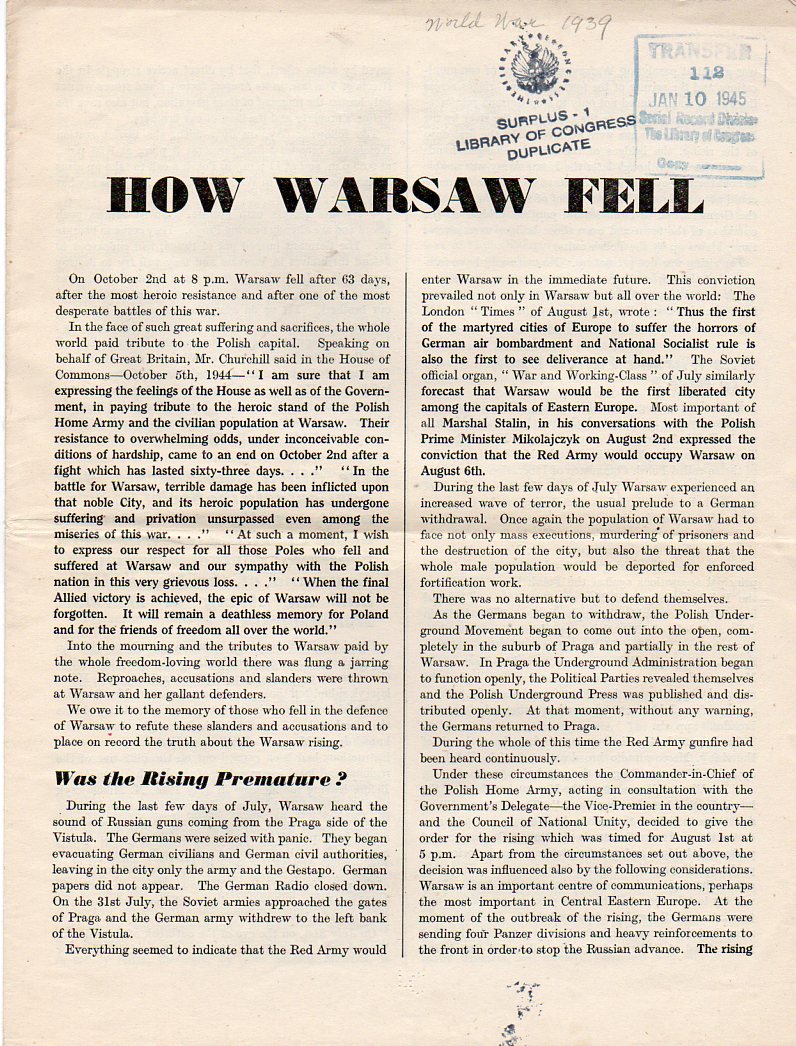
    The bottom line of the 63-day-long Second Warsaw Uprising (August/September 1944) is that the Soviet Union allowed the Polish Home Army to fail, watching from its position across the Vistula as the Nazis and Poles slugged it out, both exhausting themselves, the Nazis ultimately defeating the Poles, eliminating most of the Soviet concern for the Polish military and government, allowing the Soviet Union to take the country over more completely when the time came a few months earlier.  It was the Soviets’ choice to see two enemies annihilate themselves to have more control over Poland and immediately turn it into a vassal state when it rolled into Warsaw in January, with 85% of the city destroyed (“at the moment of its fall practically the whole city was [razed] to the ground”) and 600,000 of the city’s population  dead, along with 80% of the Home Army. 

    • Full text (though not from my copy) here, at Instytut Józefa Piłsudskiego w Londynie :http://pilsudski.org.uk/archiwa/dokument.php?nonav=&salatka=1&nrar=709&nrzesp=108&sygn=88&handle=709.238/632

      Warsaw774

    ·Posted by :

    ·in:

    —

  • Found-Abstract Art in Acoustics (with a Nod to Duchamp)

    JF Ptak Science Books  Quick Post 

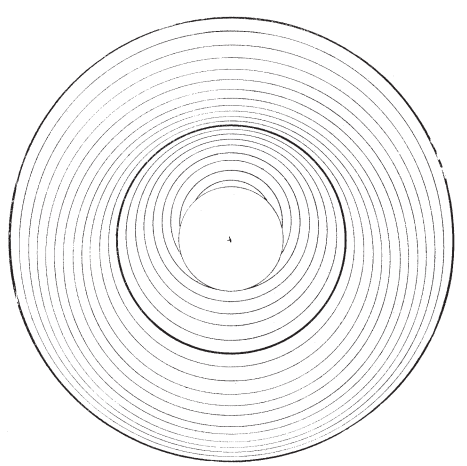
    Just yesterday I posted on Found-Abstract art  (https://historyofideasblog.com/thesciencebookstore/2018/10/found-art-in-electrical-hardware-1885.html) in a cross section of a conduit of telephone wires from 1885. Just now in research a bit on Tesla I found the following diagram for a classroom demonstration in acoustics (appearing in Nature, 11 February 1892) which could easily be added to a list of unintentional/unrecognized pre-Abstract Art art. If you varied the disks in black and white and motorized the whole thing you could imagine it another decade in the future as a work by Duchamp. As it is, it is an ingenious piece of thinking (the whole article follows):

    FOUND ABSTRACT ART 1892 nATURE CIRCLES

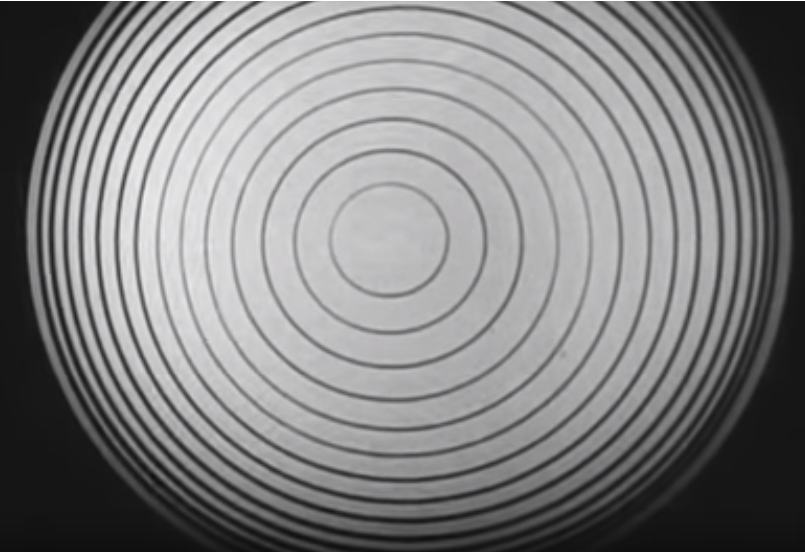
    And one still of many from Mr. Duchamp’s “Anemic Cinema”, 1926: 

    Duchamp circles

    For a video of the film: https://youtu.be/dXINTf8kXCc

    Also a nice piece on Duchamps optical experiments from Hyperallergic: https://hyperallergic.com/323582/duchamps-spinning-optical-experiments/


  • Defining the Work: Two Examples of Describing Standard Terms (1710)

    JF Ptak Science Books  Quick Post

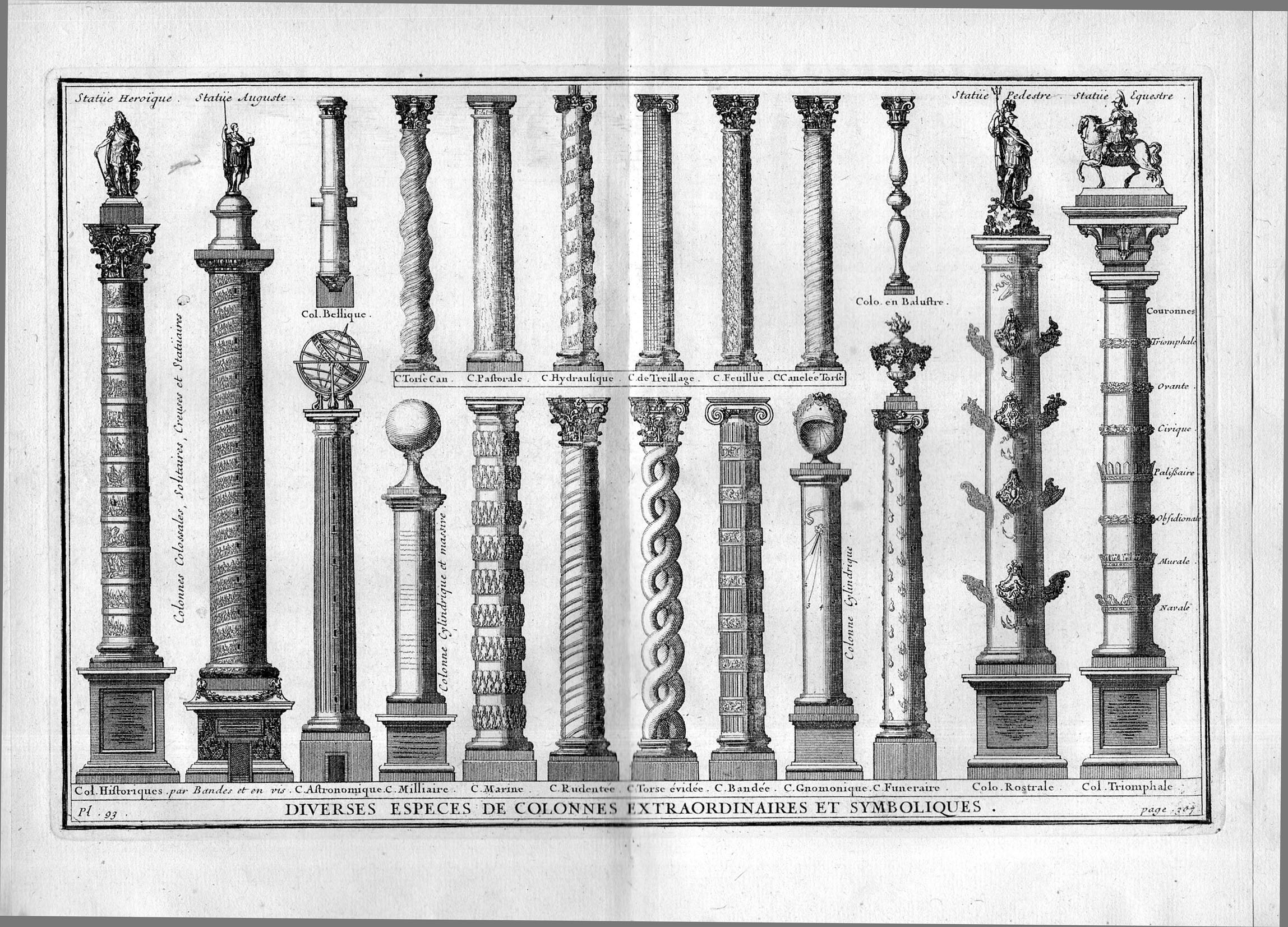
    Over the years I’ve seen many architectural prints, and I’ve come to determine that I most enjoy the comparative views.  It is uncommon to see a single-sheet engraving dedicated to different forms of columns, as we see here in plate 93 (page 307)  of volume one of A.C. Daviler’s Cours d’Architecture qui comprend les Ordres de Vignole…published in Paris in 1710. Daviler (1653-1701),was an architect and a student of  Jean-Francois Blondel (1683-1756) who worked very extensively on the architectural theory of Giacomo Barozzi or Jacopo Barozzi da Vignola (1507-1573). Here he identifies and classifies 20 different types of columns, just to make sure that everyone was on the same page, so to speak:

    Architecture--vignole--columns429

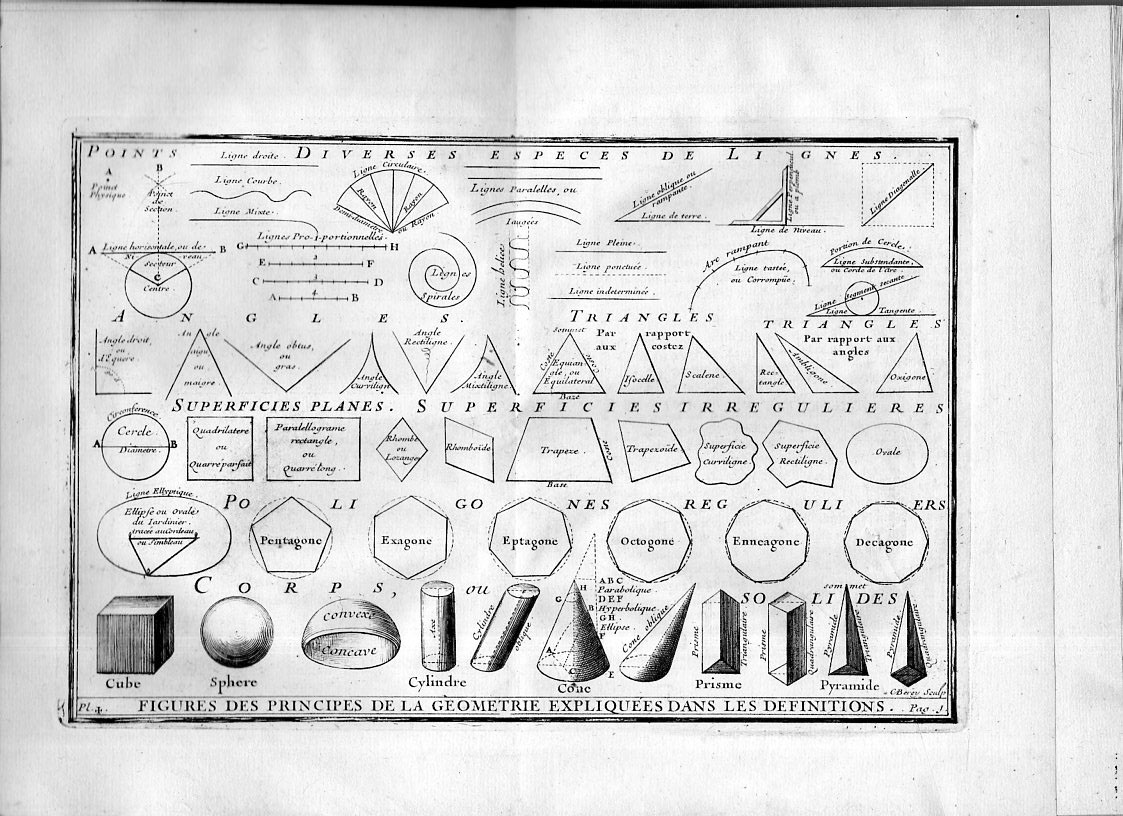
    Actually, the very first engraving in the work is dedicated to a definition of terms, establishing the basis for the forms that would be discussed over the following thousand pages.  It is an excellent way to start a book, making sure that everyone has a common identification for what standard words would mean. It is a standard and very good idea but not often illustrated: 

    Architecture--vignole-shapes430

    ·Posted by :

    ·in:


  • A Short but Good Report on a Major Paper by Tesla, 1892

    JF Ptak Science Books  Quick Post

    Tesla 5121

    In January 1892, the 34-year-old Nikola Tesla gave an interesting and significant lecture on (“alternate currents of high potential and frequency”) in London, first to the Royal Institution and second to the Institution of Electrical Engineers, which was summarized in this short paper in Nature (volume 45, #1163, 1892) reproduced below. This is a continuation it seems of his famous July 1891 lecture in which he first addressed his experiments with alternating current, and which gained him international attention. The full lecture may be seen at the Internet Archive: https://archive.org/details/ExperimentsWithAlternateCurTeslaNikola5098/page/n0

    ·Posted by :

    ·in:


  • Found-Abstract Art in Electrical Hardware (1885)

    JF Ptak Science Books  Quick Post

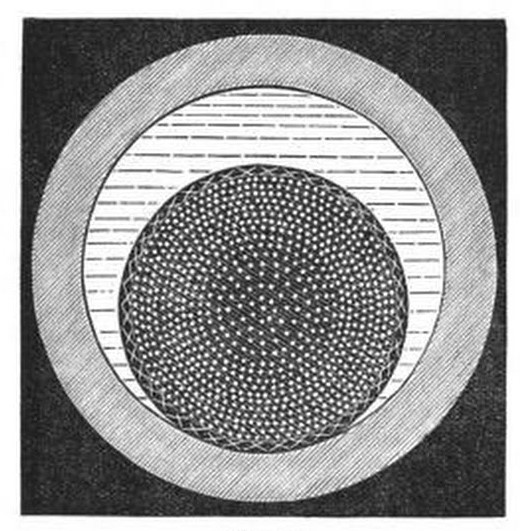
    I like this cross section as a piece of Found-Art–pre-nonrepresentational art, but it appears about 25 years too soon. It could be classified as “art” after Mr. Kandinsky makes an appearance…but we might have to look not very closely at the work of Whistler, Turner, Constable, and some others who came very close to abstract art but not quite…and we’ll also have to overlook some wide swath of Asian art (some quite ancient). 

    The actual element here is a cross section of a piece of 2.5″ pipe half-stuffed with 420 telephone lines, and belonged in 1885 to the Metropolitan Telephone Company of New York.  (“The dark shading shows the pitch filling the box around the pipe. The light ring next the pitch represents the wrought iron pipe inside of which rests the cable showing the ends of the copper wire surrounded with the insulating oil which fills the pipe full at all times.”–The Electrician, November 13, 1885)


    Electrical wires telephone electrician 1886

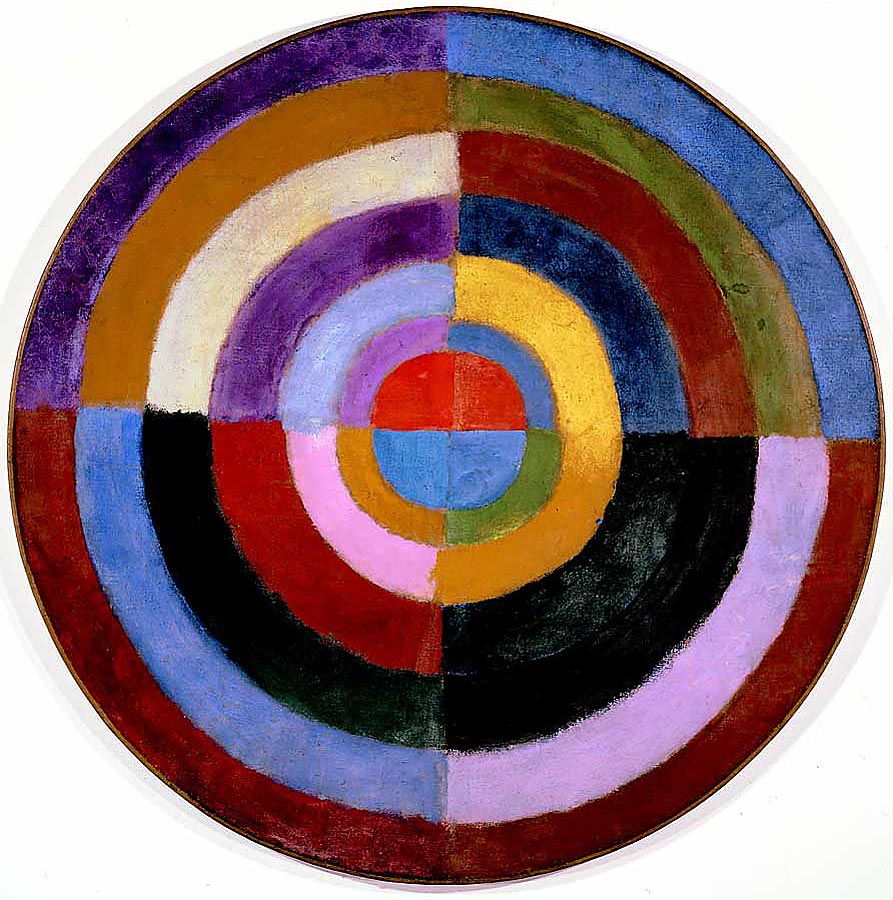
    And just conversationally I’ll include Robert Delaunay’s  1913 Premier Disque:

    Delaunay _1913 _Premier_Disque _134_cm _52.7_inches _Private_collection

    [Robert Delaunay, via Wikicommons]

    ·Posted by :

    ·in:

    —