A Daily History of Holes, Dots, Lines, Science, History, Math, Physics, Art, the Unintentional Absurd, Architecture, Maps, Data Visualization, Blank and Missing Things, and so on. |1.6 million words, 7500 images, 4.9 million hits| Press & appearances in The Times, Le Figaro, Mensa, The Economist, The Guardian, Discovery News, Slate, Le Monde, Sci American Blogs, Le Pont, and many other places… 5000+ total posts since 2008.

Author: JF Ptak

  • The Future of Future Truisms: David Byrne’s Knee Plays vs the Fat Man Nuclear Warist, Herman Kahn

    JF Ptak Science Books   Post 407

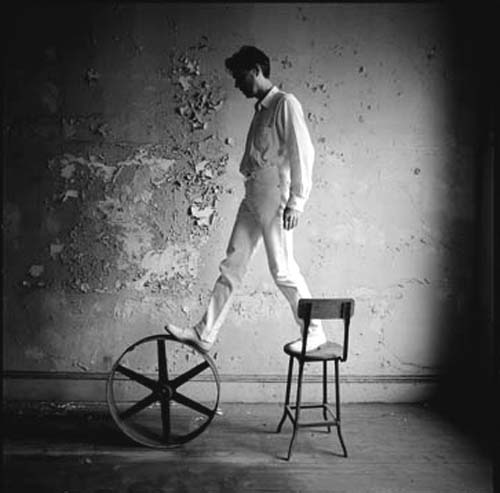
    0-blog-dec 3 byrne David Byrne, former Talking Heads member, produced a series of twelve short pieces to be used in the Philip Glass (and Robert Wilson*) Opera CIVIL warS  in 1985. (“Opera” may not be the right word for this piece, as I think it was one only in so far as the composition needed an opera house to be performed in.)   The Byrne pieces, called ”Knee Plays”, were meant to fill in the spaces, the spaces in-between,  place holders, between the sections of the day-long multimedia production..  Glass had used this idea of inter-pieces to the whole earlier in 1976 in his at-the-edge Einstein on the Beach, in which the connective elements were meant to not only join the pieces of the production together, but were also meant to stand alone, as a cohesive unit, if removed from the opera.  (Glass said they were “short connecting pieces which appear throughout the work much as prelude, interludes and post-ludes. Taken together they form a play in themselves”)
    0-blog-Dec 3 David_Byrne1991

    One of the Knee Plays, “In the Future” (Knee Play Number 12) is a slippery, stacatto brass section accompanying Byrne’s 51 sophisms about life in the future.  About thirty years earlier, “futurist” and think-tank-filler (or maybe it was “Think Tub”?) Herman Kahn (1922-1983), occupying a lot of space at the RAND and Hudson Institutes  (he was also known in many circles as the “Fat Man”), diligently recorded his myopic views of the future. He is generally regarded as a systems theory and military strategy guy, and is most remembered for (as he claims, perhaps) introducing the term “Vietnamization” which described the ultra-failed de-escalation (?) process and withdrawal for the United States from Vietnam (attention Obama administration).  Superluminarily speaking though his contribution to thought on constructing and implementing thought regarding nuclear weapons exchange (pointless to refer to this as “war”) in two books, Thinking About the Unthinkable (1962) and, On Escalation (1965), where he famously put The Bomb on the table of use possibilities.  In addition to these books—which he is busily trying to forget out there in his afterlife, somewhere, maybe in a penitential place where you are forced to think endlessly about paths-to-bad-decisions) is that 1967 peek into the future, The Year 2000.  Petroleum and oil are not issues.  Computers are of minor societal importance.  And then other things of no importance happen.

    0-blog-dec bryne kahn When you take Byrne’s Knee Play  12 and place it next to Kahn and other mis-spent prognosticators, the musician looks positively brilliant.  Some of the stuff has come to pass, some hasn’t; some will, and some won’t.  Some are open to a little interpretation, and some, a lot.  Overall, though, if you think through these little future buillets a little carefully, David Bryne looks very good.  Byrne’s lyrics/list is below.

    *Robert Wilson is a phenomenal conceptualist and theatrical designer.  On the liner notes to CIVIL warS is found the interesting note on Wilson and Byrne:  “At first, Robert Wilson asked David to compose pieces for several sections of The CIVIL warS, but on account of David’s limited time, he composed only The Knee Plays part. The CIVIL warS was supposed to be played in its complete form at the Olympic Games in Los Angeles, but if one plays every part, it takes at least eight hours. There was also a financial problem for playing every part. So only some parts of it were staged there. David himself was very interested in composing for such a play and dance and this time again he enjoyed this work very much. Last time, for The Catherine Wheel, he used recorded tape, but this time he made musicians play on the stage.”

    IN THE FUTURE (KNEE PLAY 12)

    In the future everyone will have the same haircut and the same clothes
    In the future everyone will be very fat from the starchy diet
    In the future everyone will be very thin from not having enough to eat
    In the future it will be next to impossible to tell girls from boys, even in bed
    In the future men will be ‘super-masculine’ and women will be ‘ultra-feminine’
    In the future atomic fusion will enable us to build a skyscraper with
    the energy obtained from a grain of salt
    In the future through genetic surgery there will be a race of menial
    workers, studs, ‘whores’, TV personalities and politicians
    In the future half of us will be ‘mentally ill’
    In the future there will be no religion or spiritualism of any sort
    In the future the ‘psychic arts’ will be put to practical use
    In the future we will not think that nature is beautiful
    In the future the weather will always be the same (relative to the way it is now)
    In the future no one will fight with anyone else because anyone can
    be anything he or she want to be
    In the future there will be an atomic war that will reduce the survivors to savages
    In the future water will be expensive
    In the future all material items will be free
    In the future everyone’s house will be like a little fortress
    In the future everyone will think about love all the time
    In the future TV will be so good that the printed word will function as an artform only
    In the future people with boring jobs will take pills to relieve boredom
    In the future everyone but the wealthy will be very happy
    In the future everyone but the wealthy will be very filthy
    In the future everyone but the wealthy will be very wealthy
    In the future communication/distribution systems will be so good that no
    one will live in cities
    In the future farming will be managed through a nationwide computer hookup
    In the future there will be mini-wars going on everywhere
    In the future political and other decisions will be based completely on opinion polls
    In the future only the very wealthy will be able to travel or move out their houses
    In the future individuals with soldier inclinations will go out for ‘killer’ sports
    In the future there will be machines which will produce a religious
    experience in the user
    In the future there will be a classless society, no one richer than anyone else
    In the future people will constantly be having plastic surgery, altering
    their features many times during a lifetime
    In the future there will be many mass suicides
    In the future there will be groups of wild people, living in the wilderness,
    who will rob suburbanites
    In the future there will be only paper money which will be personalized
    In the future everyone will only get to go home once a year
    In the future everyone will stay home all the time
    In the future we will not have time for leisure activities
    In the future we will only ‘work’ one day a week
    In the future our bodies will be shrivelled up but healthy and our brains will be bigger
    In the future there will be starving people everywhere
    In the future no one will be able to afford TV or newspapers, resulting in
    no one knowing what’s going on
    In the future people will live in space
    In the future only the very wealthy will have pets
    In the future the poor will be regulated by the rich
    In the future the crippled, retarded, and helpless will be killed
    In the future everyone’s house will be a total entertainment centre, with
    video, pills, dancing, sex tools, holographic movies, and game machines
    In the future everyone will have his or hers own individual style of very way-out clothes
    In the future we will all eat our favorite foods, only they will all be synthetic
    In the future we will fuck anything, anytime, anywhere
    In the future there will be so much going on that no one will be able to keep track of it

  • Skinny II: Morals, Class Warfare & Letting Someone Else Pick up your Dropped Fork

    JF Ptak Science Books Post 406

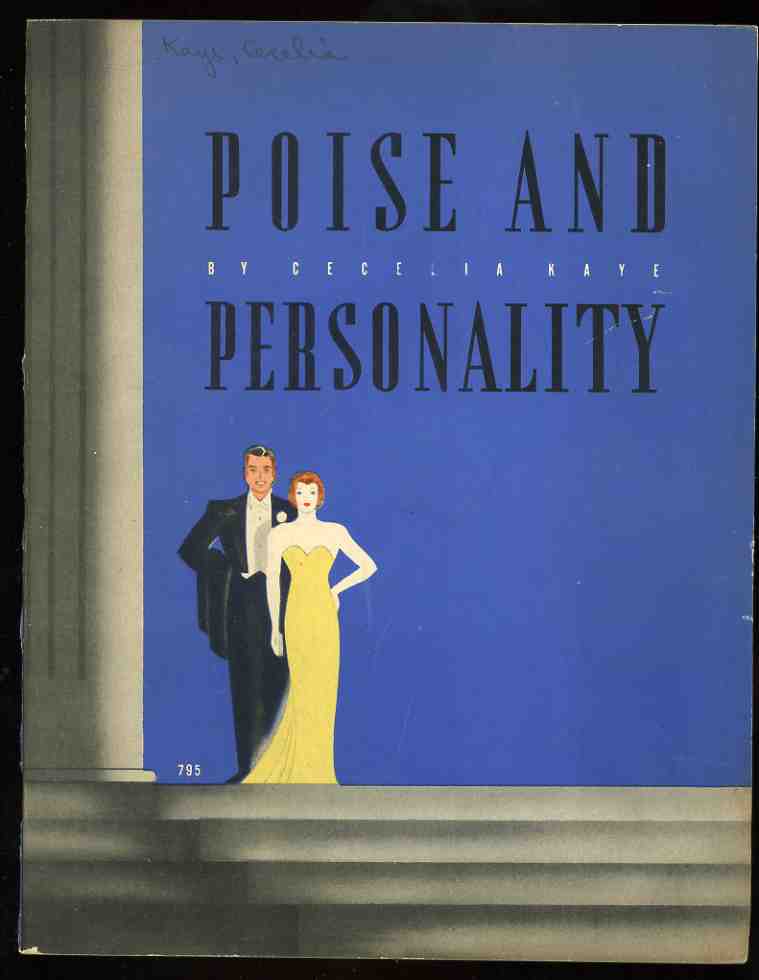
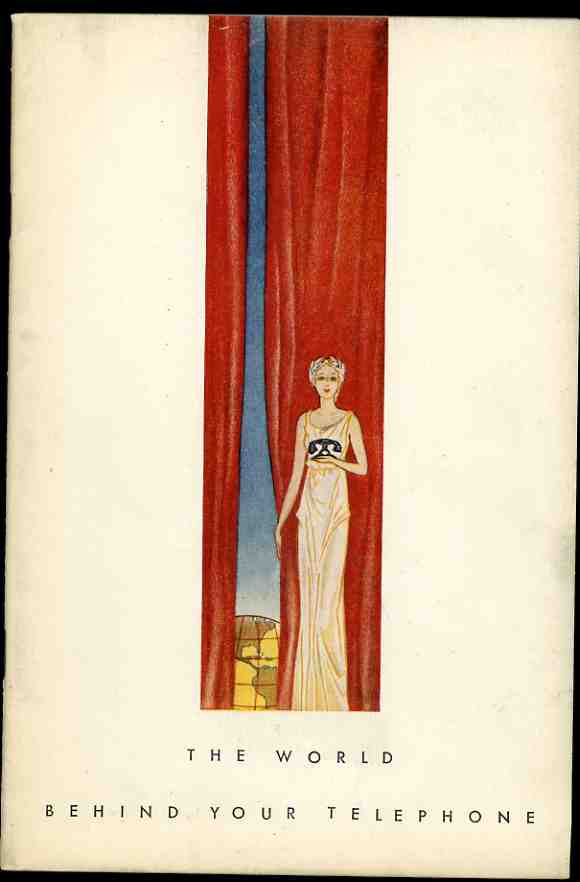
    Yes, these two pamphlets are beautifully designed, real works of production art, speaking elegantly and skinnily to their skinny, elegant times.  The World Behind the Telephone is a straightforward look at the stuff going on behind the scenes that made the telephone “go”–the woman holding the telephone is remarkably tall and angular, holding back the curtain of an even taller and skinnier doorway, beckoning the viewer into the unseen telephonic world.  Poise and Personality features more skinny people, and offers the skinny on some excruciatingly class-conscious tips on expected behavior and the division of the classes.

    0--blog---Nov 29 skinny156

    0--blog---Nov 29 skinny157

    “Social poise does not consist of a mere set of mannerisms” it reads, but beware:  “avoid careless and loose forms, which are in bad taste”.  There are all manner of pinkies-up logics and societal sniffing splayed throughout these pages, from the chapter improbably titled “Preccedence [sic] in Introductions”, to “Sensitivenesses” (“being sensitive is a luxury and the price runs high”), “Inferiority Complexes (“if you are afraid of people, talk to them with a smile…”), “Personality development” (“undoubtedly there is a native something that differs in each of us”), “Poise” (“…people are unhappy because they are nervously conscious of a lack of ability to mix with strangers….consequently they are unable to appear calm and balanced”. 

    Yes, it is a product of its time.

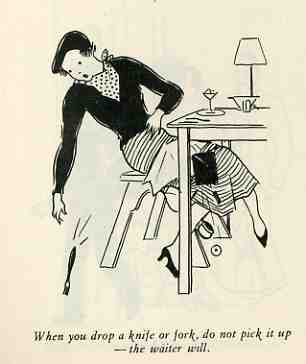
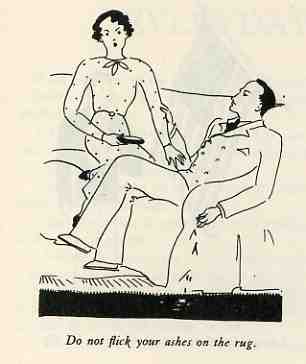
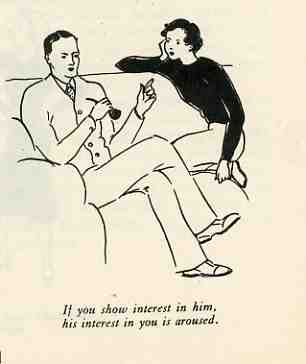
    There are some troubling and insensitive things in here as well, pamphlet being delivered of it times or not.  Letting the waiter pick up your fork is one; do not drop your ashes on the floor is another.  The more subversive ones though are on dating behavior and gender wars, the subjugation of women as it was in 1938 firmly on display.  “If you show interest in him, his interest in you is aroused.” Oh dear sweet creator, the woman is only of interest to the man if she reflects his interesting bits back to him.  Why not have the guy date a mirror?  That way nothing will be lost in all of that wasteful biological differentiation. 

    Here’s an early classic on the subject:  John S. Mill’s On the Subjugation of Women, an oldie but still a goodie. 

    0--blog---Nov 29 skinny158 0--blog---Nov 29 skinny159

    0--blog---Nov 29 skinny160

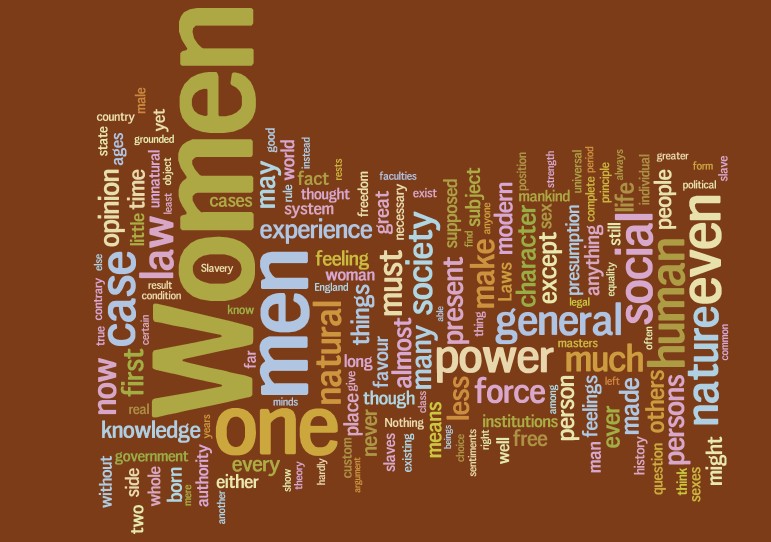
    Just for good measure, and really not related to this post, I’ll throw in a word map generated by Wordle.net of Mill’s Subjugation of Women (I like how “slavery” happened to pop up in the middle of the “O” in “women”):

    Wordle--subjugationfixed

    ·Posted by :

    ·in:

    — —

  • A Wartime Census of War Dogs: Verdun, 1916

    JF Ptak Science Books Post 405

    0--blog---dec 2 dog census172

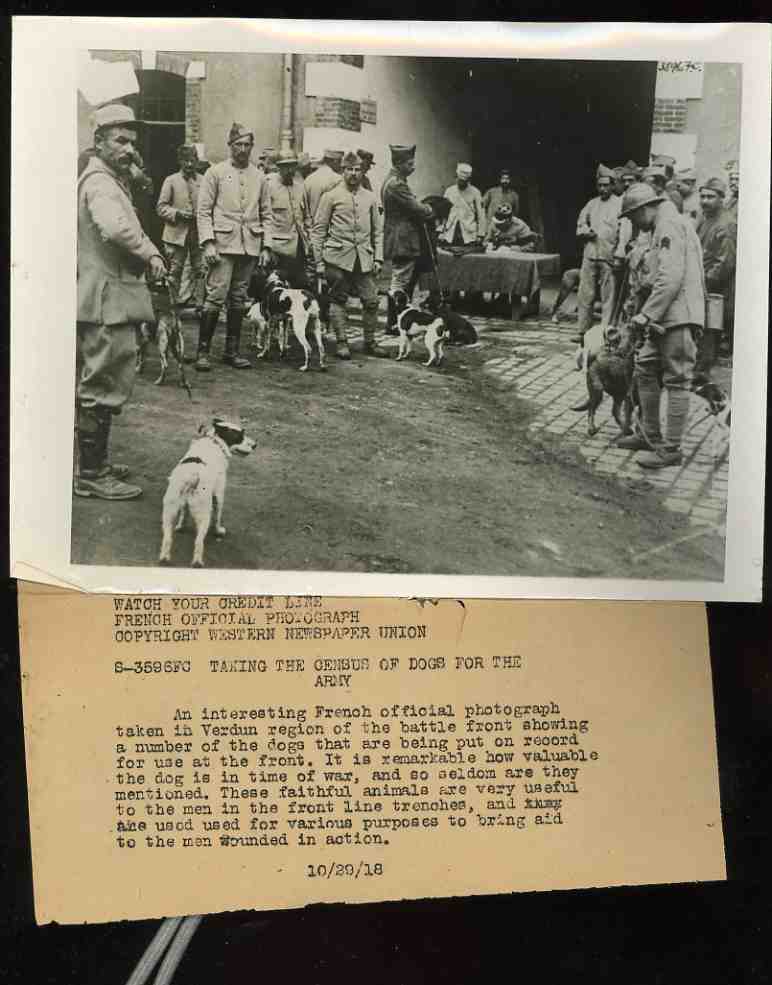
    I wonder what the French officer sitting behind the table at the center background thought about at night, after his day was done.  I wonder what it was that went through his head, his eyes fluttering, as he slipped into sleep?  As the accompanying caption of this photo states, this was a census of dogs, a census of army dogs in the French army, taken at “the battle front” of Verdun, and dated 10 October 1918.  Did he think of his duties expended throughout the day, and weeks and months?  Counting dogs as a war effort may have been a hard thing to consume.  Perhaps this officer had already seen his share of war, perhaps he had fought from 1914 and onwards, this position being relatively benign, a reward for years of impossibly difficult service in a bloody war. Or perhaps not.

    “Taking the Census of Dogs for the Army”, an official French war photograph and copyrighted and distributed by the Western Newspaper Union (a news photo service supplying photographic images for newspapers around the country), gives us a peek at what had been an largely untold story about digs in war.  As it turns out, the French started early on in the war training and using dogs to track and aid wounded soldiers on the battlefield; the Germans did so too, their dogs rescuing some 6,000 wounded soldiers by war’s end.  And this continued a story of dogs in wars that’s at least 2,000 years old.

    0--blog---dec 2 dog census173 .  The photograph, though dated 1918, was taken in 1916, during the horrific Battle of Verdun.  IT was yet another enormous battle at Verdun, which had seen more than its fair share of military action over the centuries, owing to the city’s strategic location on the Meuse River.  The men in the photo look worn, as well they should–evidently, owing to replacements and rotation, something like 70% of the entire French army fought in this battle, with 24 French divisions fighting there.  The French lost 161,000 men dead and 101,000 missing, with 216,000 wounded; the Germans lost about 142,000 dead and another 187,000 wounded.  That’s coming up close to 3/4-million men in one battle over several months in 1916, most of which were the victim of the 30 million rounds of artillery shells.


  • A War by Many Other Names: the Japanese Invasion of China, 1931-1945; How to Trivialize 20 Million Killings Without Really Trying

    JF Ptak Science Books Post 404

    I have forced myself to contradict myself in order to avoid conforming to my own taste.
    –Marcel Duchamp

    0--blog---dec 2 china168

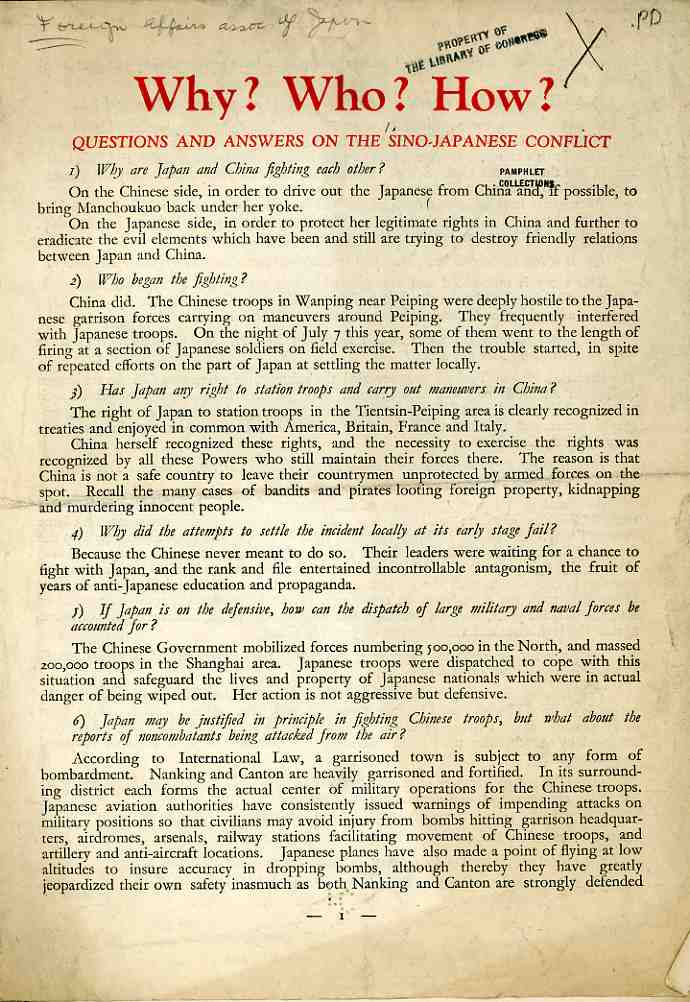
    I have a good number of English-language propaganda pieces published by such Hearts and Minds institutions as the Foreign Affairs Association of Japan describing, through the merriest and most defensive eyes, the Japanese viewpoint of exactly what it was that was going on in China between 1931 and 1945.  This leaflet, Why? Who? How? Questions and Answers on the Sino-Japanese Conflict (1937), is particularly worth noting because of how quickly and cleverish-cleanly the issue of the war and the fault of fighting was dispatched, and done with such astonishing condescending alacrity, and with such an enormous bodyguards of lies,as to be staggering.  I guess this is why the Duchamp quote came to me just now.  Old Marcel, the supremely gifted magician, certainly meant to be an enormous, itchy pain in the butt and a source of confusion, an artistic anarchist;  the thinking behind the quote served him well, and I think that it can be well-applied here.                             

    The first issue is in the subtitle:  the “Sino-Japanese Conflict” implies that the Chinese were at fault for having the Japanese invade Manchuria back in 1931; secondly,  the Chinese started a conflict and not a war. 

    Actually, the naming of the war there is quite an issue, and an issue still—and an issue at it most base level:  the word “war” is not generally used in Japan.  It wasn’t used in Japan during the war, or at least until the bombing of Pearl Harbor.  Until 1941, the millions of Chinese who were being killed by the Japanese armed forces were the result of a series of ”incidents”.  Even though there was a war raging from the beginning in 1931 to the start of total Japanese-Chinese war on 15 July 1937, the stuff that was happening from ’37 to ’42  was still an “incident” except for a period of 1940-ish to Pearl, when the idea of the Holy War (“Seisan”, eight corners of the world under one roof, etc.) was introduced by the Japanese Diet in 1940.  After that there was the occasional use of the “Great East Asian Conflict”, with the word “war” not being the part of any Japanese vocabulary.

    An interesting phrase that entered into the parlance though, if not “war”, was “Sanko Sakusen”, the “Three Alls”, as in KILL All, LOOT All, BURN All.  The Japanese wound up getting part of the Chinese All, eventually killing 20 million people or so in those 15 years.  But it wasn’t a war.

    This four-page document asks twenty questions, and answers them usually, emphatically, with simplicity, starkness, and with total complicity of innocence on the side of Japan.  For example, in discussing the “incident” in Beiging in 1937 which led to the total war between the two countries, asking the reader “why did the attempts to settle the incident locally at its early stage fail?,  we are told “Because the Chinese never meant to do so”.  Which of course is not the case.

    An incredible bit of thinking comes next, when the question “If Japan is on the defensive, how can the dispatch of large military and naval forces be accounted for?” Indeed!  Its hard to explain the invasion of another country as a purely defensive action. (We have seen this rather recently ourselves, the fictionalized account of terror-sponsorship in Iraq being about the only fuel necessary for a full-fledged defensive invasion and 2000-day long war.)  But the answer in 1937 was the Chinese defensive maneuver of massing troops for an impending invasion of China by Japan was then threatening Japanese interests in China, thus necessitating a defensive invasion of China which was mobilizing to defend itself from a Japanese offensive, which wouldn’t have come if the Chinese hadn’t adopted a defensive posture.  Basically, to paraphrase the immortal Mayor-for-Life of Washington, D.C, Marion S. Barry, “basically, the man dead”. (This was Barry’s response to reporters who were clamoring to find out what exactly had happened to a crazy man who climbed into a step van in a Buck Rogers suit and threatened to blow up the Washington Monument with a bucket of pee, an old rifle, and spray paint and then was shot about 200 times by cops of every shape and description. True story.)

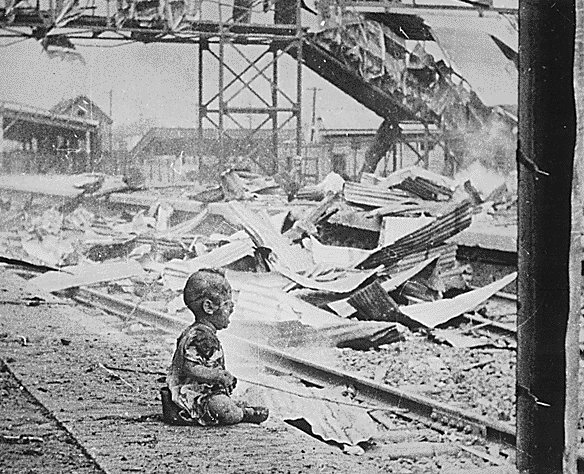
    War_shanghai-baby_Japan_bombing_shanghai_south_station_1937 (This is a picture of a baby survivor of a Japanese bombing “incident” at  South Station, Shanghai, 1937–sometimes it is better to see what something is than have someone define it for you..)

    We further find out that the attacks on the schools and hospitals in China were carried out, somehow, by Chinese troops; that a Chinese fishing fleet that was attacked and pulverized by Japanese submarines really wasn’t, and that they just disappeared; that Japan was protecting the rights of third party powers by “removing” Chinese troops occupying foreign-owned properties; that the Japanese fight against the “Sovietization” of China would “protect” foreign democracies, and so on.  The questions hardly matter, as the answers are all sort of the same.  Japan would “reach a settlement” (the word “peace” is not used anywhere here) however, if China “realized the error if her ways”. 

    Word do control mental images, and the further you get away from the situation described the more powerful the words become.  Somehow the Korean Conflict seems less so than a war because it wasn’t “legally” so; it was a “police action”.  And the Japan-China War isn’t a “war” in name in most Japanese histories of the period.  I think you can dissolve things with loose undefined language to such a point that the thing itself no longer exists; the only stuff that survives are the words used to hide it. 

    ·Posted by :

    ·in:

    — —

  • Standing on Dogs: Renaissance Knights in Armor vs. Small Dogs, #1

    JF Ptak Science Books    Post 403

    0--blog---Nov 29 dog standing154

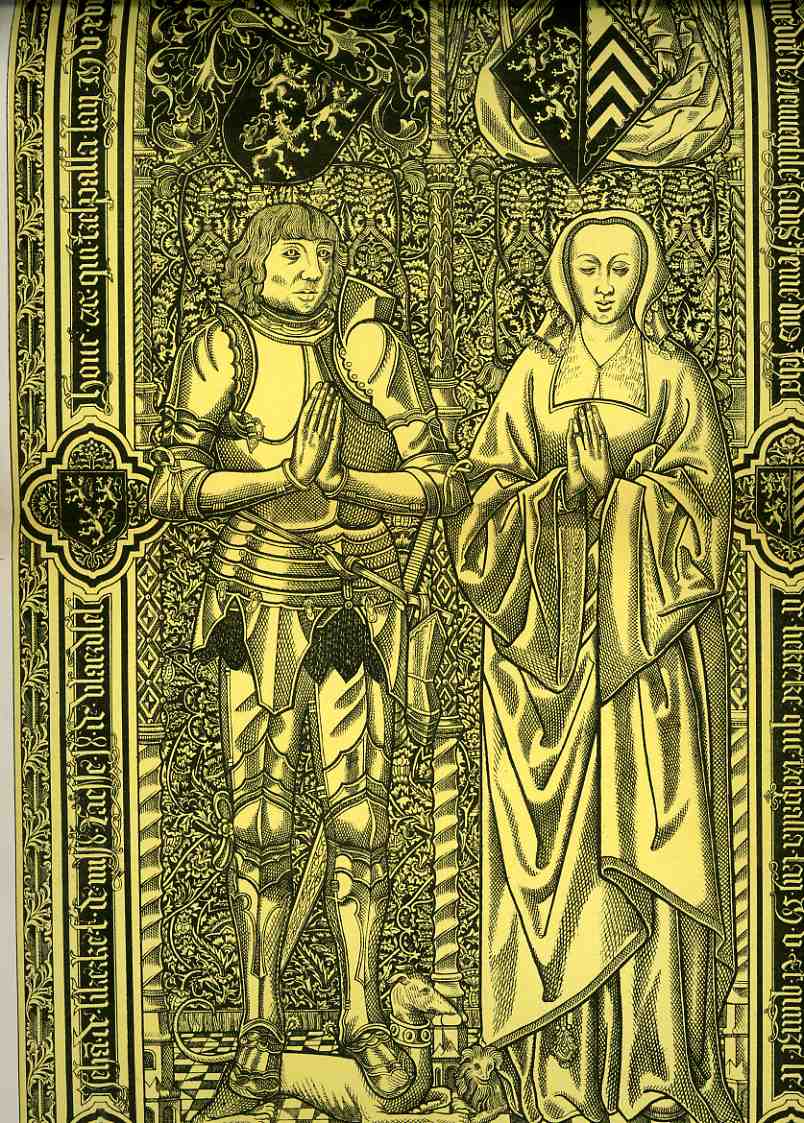
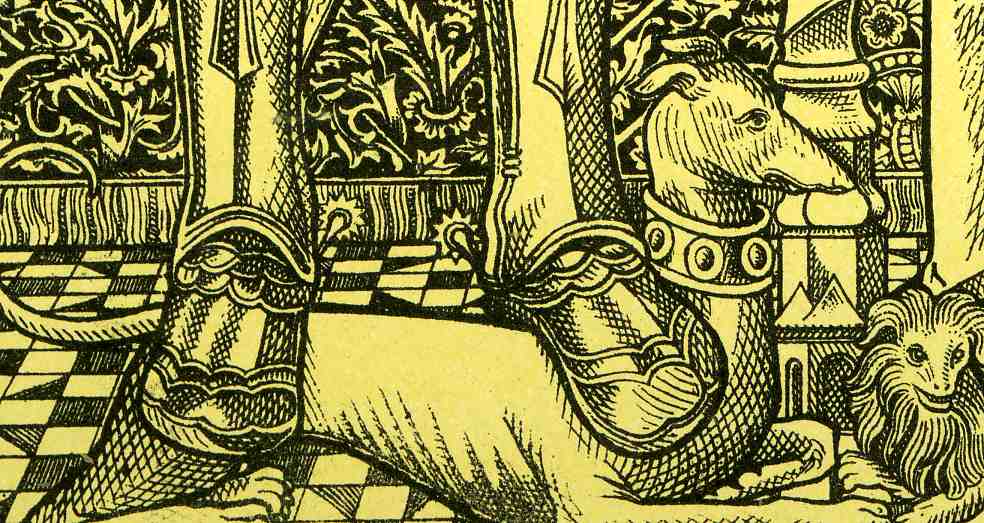
    Pictured here is Jean de Liekerke & Wife (“Jean de Liekerke et de sa Femme”), the largest element of a “dalle tumulaire”, or decorated burial slab, for the couple’s tomb, found in Brugge’s oldest church, the Cathedrale de St. Sauveur (built 12th-15th centuries).  It is a glorious chromolithograph, printed ca. 1858 or so, and is extremely detailed and complex.  I cannot unearth who the couple was, their names appearing three times in the image’s margins, twice spelled differently and partially abbreviated (“jeha de Likerke”).  Most of the print’s elements, as well as its subject, are not known to me, sorry to say:  I just stopped by to point out my completely not-understood vision of the noble Sir Jean/Jehan pictured standing on top of a greyhound.  The dog wears a large collar and also, perhaps, pants of some sort made of maille.  Generally the appearance of the dog in paintings from this era of the low renaissance signify fidelity; again, with most of the elements of this image, I do not know what the significance is of the heavily armored man standing on this small dog. 

    0--blog---Nov 29 dog standing155


  • Two Minutes to Doomsday: “Get out of Hell Free” Card, 1957. Armageddon and All That…

    JF Ptak Science Books  Post 402

    0--blog---dec 1 hell162
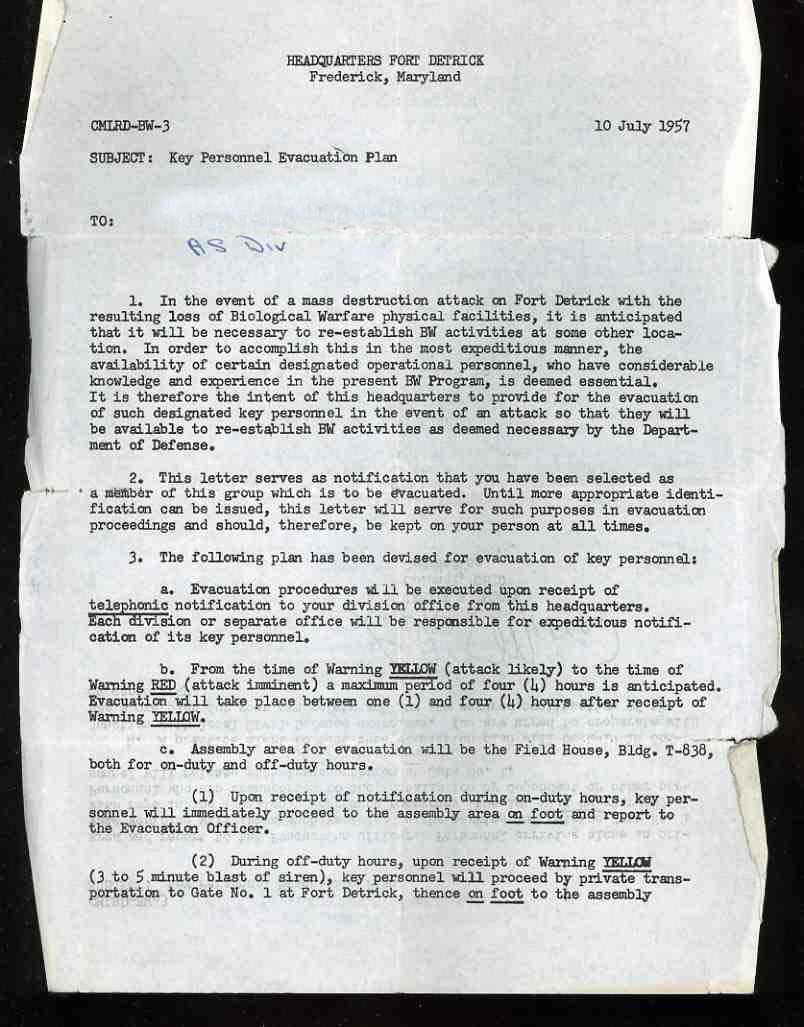
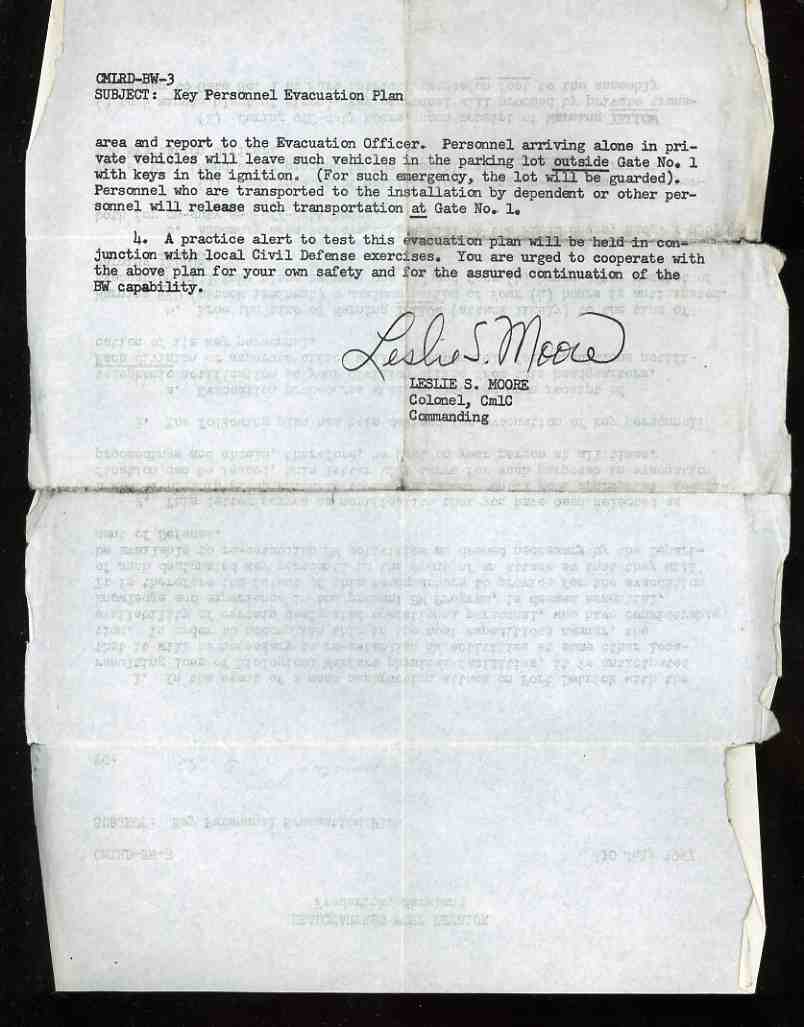
    This letter, written in 1957  by Colonel Leslie S. Moore of the U.S. Biological Weapons Program at Fort Detrick, Maryland, to a member (whose name I’ve removed) of the “A.S.”(“Atmospheric Sciences”)  division, was basically a get-out-of-hell-free card for its bearer in the case of devastating nuclear attack.

    “In the event of a mass destruction attack on Fort Detrick with the resulting loss of Biological Warfare physical facilities, it is anticipated that it will be necessary to re-establish the BW activities at some other location.”

    “In order to accomplish this in the most expeditious manner, the availability of certain designated personnel…is deemed essential.”

    The “letter serves as notification that you have been selected as a member of this group which is to be evacuated”  to get the biological weapons program up and running again.  As you can read in the clickable version of the document, there are directions about what top do and when to do it.  There is no mention of family.  My read is that this is Endgame stuff, end of civilization as we know it, and that this was the Darwinian sweep of necessary people.  Or is it Dr. Strangeloveian?  I get the two confused.

    Suffice to say that Fort Detrick, which had been established in 1943 (constructing and delivering anthrax bombs by 1944) as Camp Detrick, already had a fairly full career before it was up-named to “Fort” in 1956.  It was the recognized home/collecting node  for the American Chemical and Biological Weapons programs until Richard Nixon, of all people, disbanded that capacity at Detrick in 1969.

    0--blog---dec 1 hell163

    It is interesting to note that the person to whom this letter was addressed was actually in aerolized particle release, and at the time, in 1957, was working on Operation Large Area Concept, which simulated and studies a very large airborne attack over thousands of mile of land.  It was an obvious two-sided study about how-to and how-to react to a mass scale biological attack.

    1957 was about the height of the Cold War. According to the ticking Doomsday Clock of the venerable Bulletin of the Atomic Scientists, the minutes-to-midnight–with the stroke of midnight being the Big One, the ultimate attack, the carnal release of all nuclear power, The End–was set at about two (two minutes to midnight) from 1953 to 1960.  The clock admittedly was set very close to that mark anyway, starting out life at seven minutes to midnight in 1947, but it was probably accurate at how close we all were, our toes stuffed into  Stanley Kubrick’s Dr. Strangelove’s bitterly polished shoes, to walking (finally!) towards the explosive closing roll of the movie.

    I might have been overstating the “Get out of Hell Free” aspect of this letter.  Probably it was a “Survive Many Aspects of Hell at Not-Understandable Personal and Societal Costs” card , but it doesn’t have the snap of the former, though it is more factual.

    The letter tells the recipient to keep it on his person at all times for use in an emergency.  I don’t think you’d need to be told that twice. 


  • A Forgotten (?) Photographic Protest of the 1933 Chicago World’s Fair

    JF Ptak Science Books  Post 352

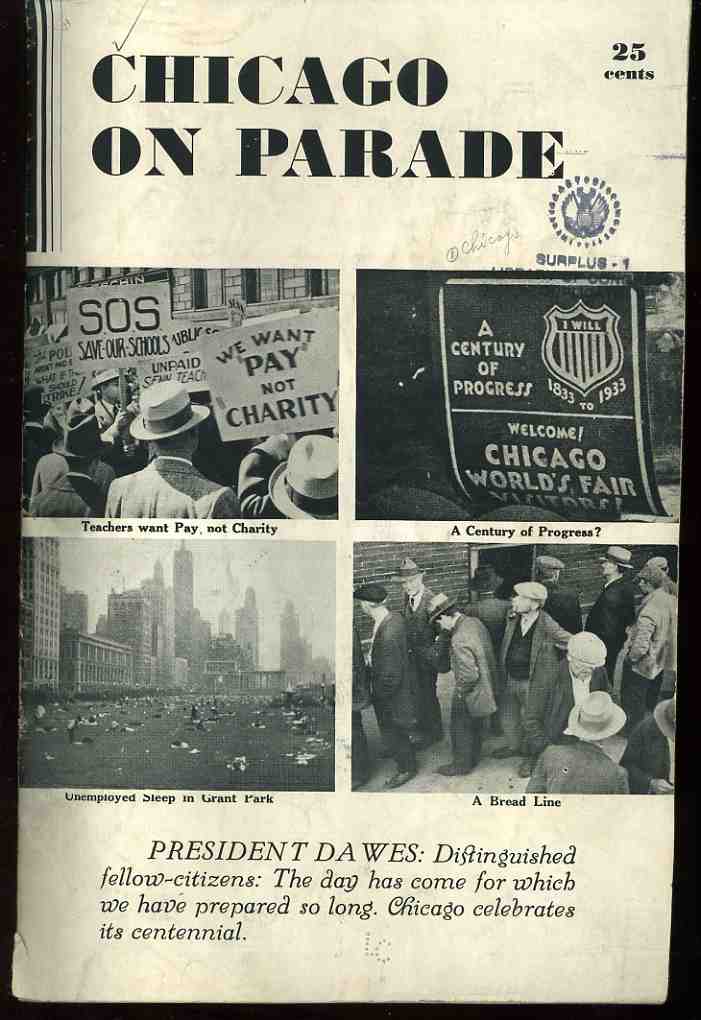
    000-ebay--Nov 4--chic 1985 This short pamphlet is a very strong tonic to those thinking about Chicago’s “Century of Progress” celebration and World’s Fair that was taking place in the middle of the Depression in 1933. (It was intended to instill hope and foster a little forgetfulness during a time in which the Depression in full swing nationwide, plus native-Chicago problems of gangsterisms, race riots, red scare, and economic distress ) As a matter of fact this pamphlet didn’t seem to find much distribution, or at the very least it didn’t get saved in spite of the fantastic documentary images that it contains.  This copy of Herman O. Duncan’s Chicago on Parade (1933), was his own, sent to the Library of Congress as a gift in 1942 before it came to me in 1999. I can find only three other copies of this pamphlet located in libraries world wide (Oxford, Duke, Chicago), and it seems very strangely underrepresented. 

    Duncan addressed the work directly to the Rufas Dawes (President of the Century of Progress Celebration), and to the mayor of  Chicago and governor of Illinois as a very blunt request to not forget the actual world of real Chicagoans living in dire straits within site of the fairgrounds.  Duncan was obviously taking issue with the many statements of wonderment and flourishes of progress that accompanied the propaganda surrounding the fair, so that the attention of the public would not be “diverted by our political and civic leaders”.  Duncan continued that these photographs, “none of which had been published previously in the United States” could “perhaps suggest a point of reference from which Chicago can measure its Second Century of Progress”. 000-ebay--Nov 4--chic 6 det991

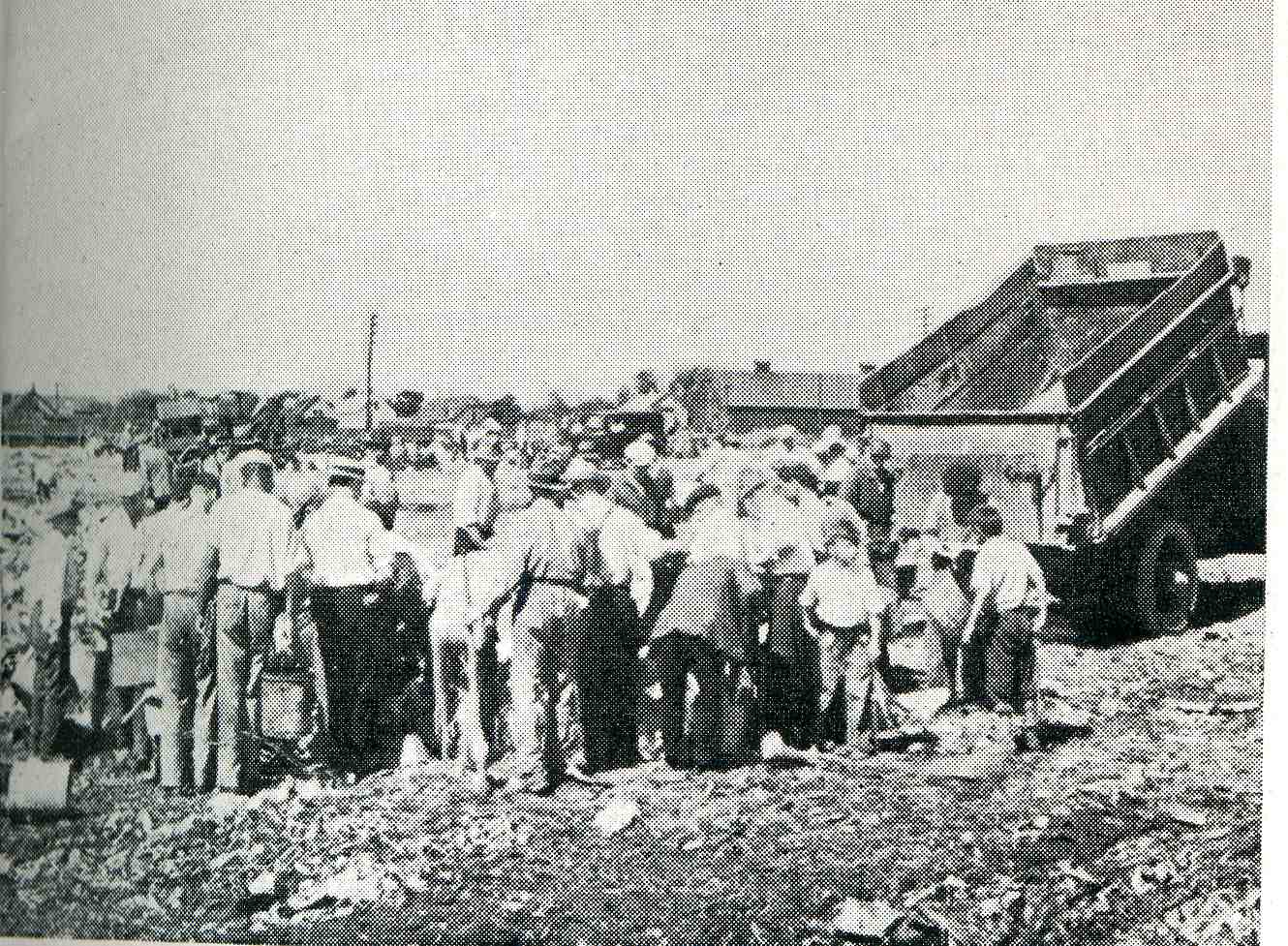
    Duncan (who unfortunately did not identify the photographer(s)) was very strong in the use of images.  He was not afraid to show long bread lines, people (including children) scavanging at the city dumps, blacks and whites marching together in protest of police brutality, (many hundreds) of people sleeping out of doors in Grant Park (Chicago’s “front yard”),because they had no where else to go, and much more.  The photographs had a real touch of journalistic acumen, and none of the images look forced or posed–they are the real stuff of social documentary, and how they have escaped wide notice is not known to me
    . 

    000-ebay--Nov 4--chic 2986
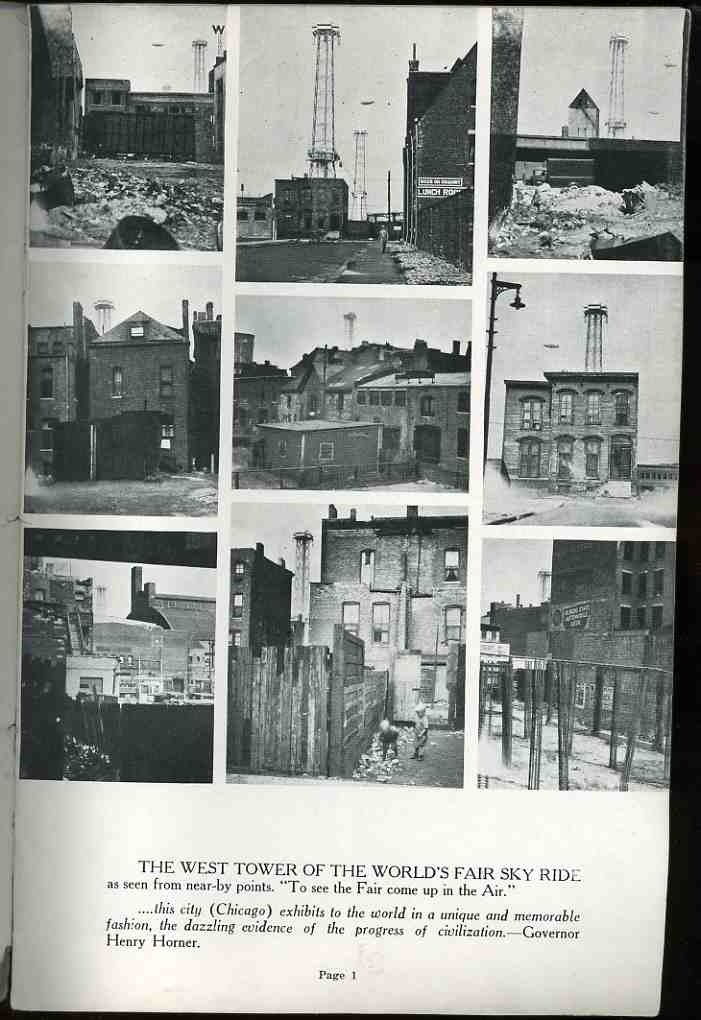
    Perhaps the strongest statement (outside of the
    photos of the children scrounging for food in dustbins and at the dump) is this series (below) showing views of the city of Chicago that were within site of the tower for the Century of Progress Sky Ride (“See the Fair / Come Up in the Air”).  The series make an elegant and strong and incontrovertible point, and that there was definitely something very wrong going on outside the walls of the celebration which had been scooped out of the city’s east side.  (The images remind me of series of photos of the US Capitol Building that appeared in the great classic of social and cultural recording of class division, Neglected Neighbors, which my friend Andy Moursund introduced me to many years ago in Georgetown.)

    The logo design for the event is terrific and I’m sure that everyone had seen it at least once in their lives, but out of the many hundreds of other pamphlets and display materials that I have here for the expo I’ve got to say that the overwhelming majority of them are luridly colored with a palette found outside nature.

    And anti-nature colors are somewhat schizoid-happy  colors, like MGM technicolor cartoons from 1949, which applies a massively ugly chromo-palette to the blight of the surrounding Depression problems.  Mr. Duncan was determined that this not happen, at least so far as he could help it, and published these arresting images to remind the rest of Chicago that the vividly colored happy face placed over the city like a stamp for the Century of Progress was not the case in fact. 

    There are another few images in the “continued reading” section.

    Note:  click on the photos for a larger, more detail view.


  • A Magnficiently Bad How-to on Writing: a Card Deck of Limited and Stolen Creativity

    JF Ptak Science Books LLC  Post 351

    000-ebay--Nov 3 plotkey981
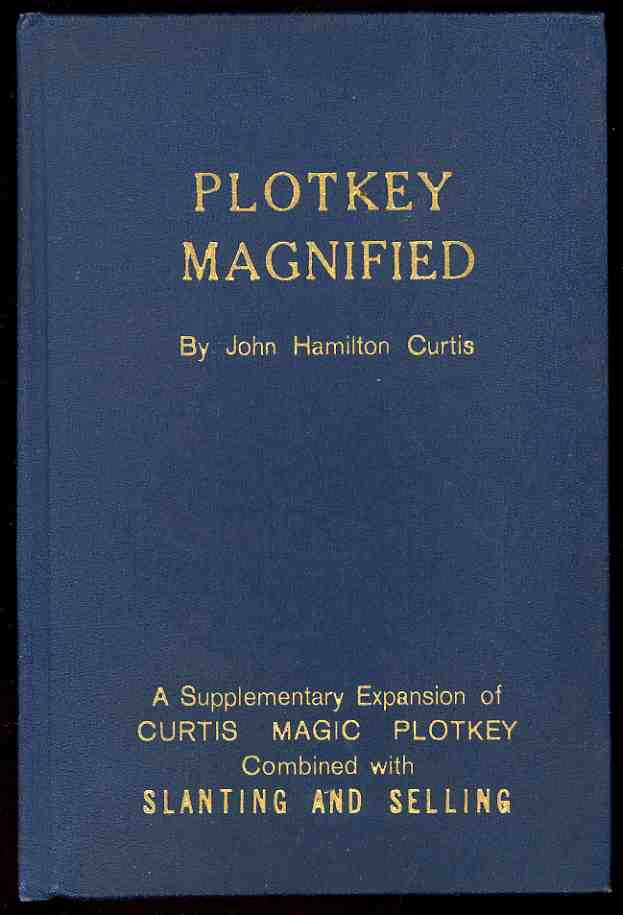
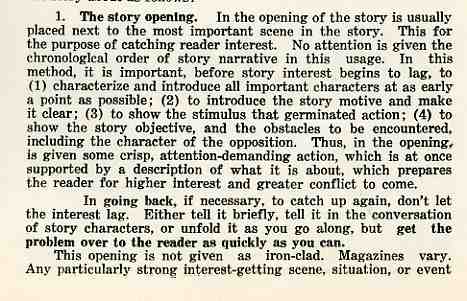
    The title to this post probably does live up to itself–this bit, The Plotkey Magnified, by John Hamilton Curtis, reads as though it were written by a long-down-the-list loser of a Hemingway-imitation contest, and thunk-up with the vigor of a five-beer bar date. (Interestingly, the work, printed but not published in 1937, was prepared by the author for himself–we learn this info on the title page, along with the author’s address, which was PO Box D, Eagle Rock, California.. It must’ve been a pretty small post office if their boxes were identified with letters.)  The subtitle to this work pretty much sums it up:  A Supplemetary Expansion of Curtis Magic Plotkey Combined with Slantng and Selling.  The one thing that the author forgot was punctuation and grammar, which somehow shook themselves loose of his book, and which I’m guessing were sold in those now-disappeared tiny paper bags that you used to get at Reiman’s Hardware store in 1966.  He also forgot how to write, as some of his efforts are just truly bad, and occasionally painful.  For example, we have the following exceptional declaration:

    000-ebay--Nov 3 plotkey984

    And so, these two paragraphs speak for themselves in their own special way.

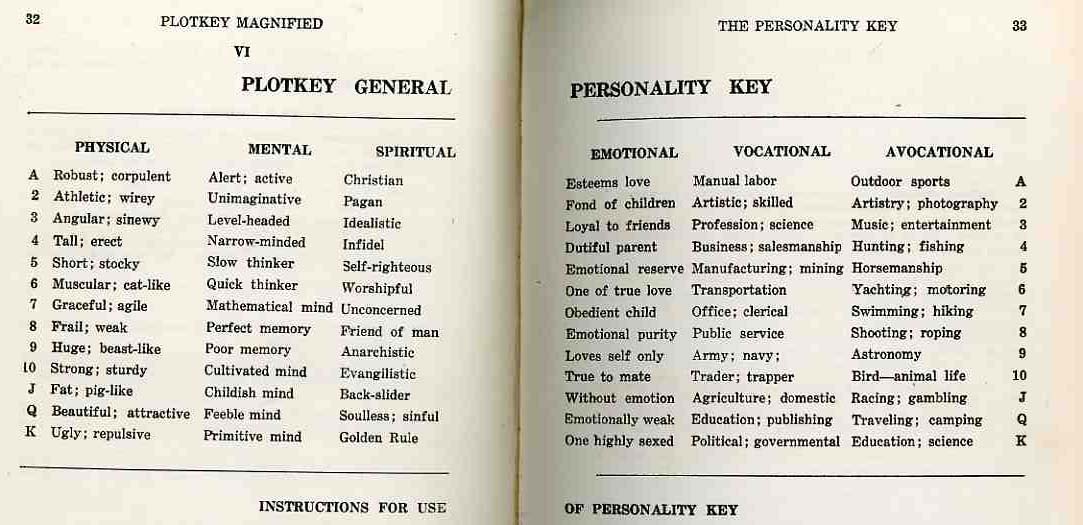
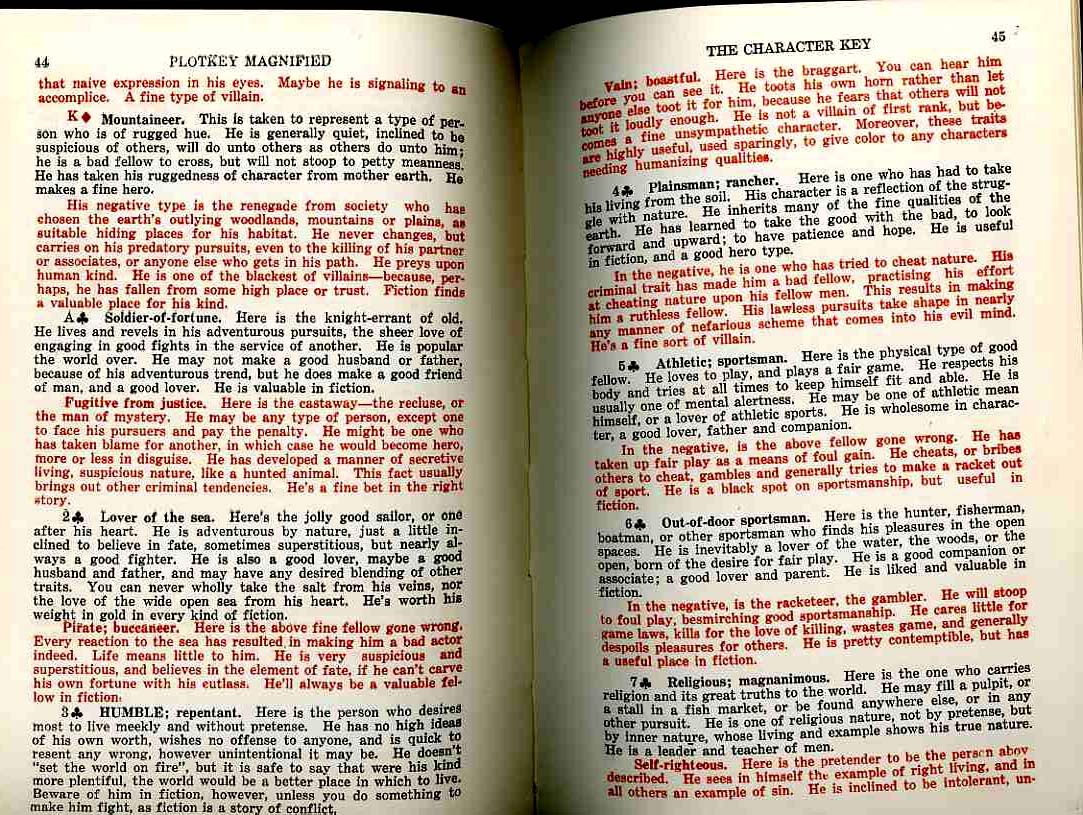
    What Mr. Curtis was trying to do here with this publication was (a) make a little money  and (b) selling a manual of some calculated “ideas” for story and character development to people writing detective fiction for detective novels.  Nothing really works here–the author shouldn’t have written it because he couldn’t write, and certainly couldn’t teach all of the stuff about writing that he couldn’t have known;and the readers shouldn’t have bought it because if they couldn’t write before reading the book they doubley-couldn’t write after using it. And I do mean “using” it rather than “reading” it.  Incredibly, the book is set up to have its ideas dismembered and set up in the fashion of a card deck, the reader dealing themselves out pieces of characters and scenes and locales, with Mr. Curtis offering more than two dozen (!)  different types of physical, mental, spiritual, emotional, vocational and avocation descriptions encompassing the totality of human nature.   Even though these descriptions of the human condition are minimal, liminal and sturdily stupid, they are funny in an outsider, disturbed vein of insight.    The ‘physical personality” aspects like  athletic/wirey; fat/pig-like(?) rub up hard against things like the removed “spiritual” personality traits, which  include “christian, pagan, idealistic, infidel, unconcerned, back-slider, soulless-sinful”.  Throw in the mental, and emotional stuff plus the interest and jobs sections and you can concoct some spectacular Frankensteinian-monster personality assignments:  for example, at random, you can develop a character for your detective story who is fat and pig like with a poor memory, a back-slider  who loves themselves only, is a trapper, and is interested in “entertainment”.  Wow.  These ingredients can get mixed and coddled into a witches brew of old tripe that would compose an unlikely and heinous small town population that should probably be buried rather than read about–remember, you’re supposed to use this cookbook as The Guide to Creativity for the short story you’re trying to sell to “Muscle Culture”. 

    I must say though that what I take away with me from this experience is an idea for turning this book into some sort of naive-surreal card/board game that is made to produce purposefully bad fiction, the sort of writing that is really hard to do; writing good bad, where the loser is the winner in a game of retro-badness. Not easy. Soldier.

    000-ebay--Nov 3 plotkey983

    000-ebay--Nov 3 plotkey982

    ·Posted by :

    ·in:


  • The Tomb of Broken Dolls–an Appeal for Respect for Outgrown and Disabled Toys

    JF Ptak Science Books  Post 349

    “No two toys are ever broken in the same way or with the same emotional results.” RobertGraves, Poetic Unreason

    000-ebay--Nov 1 doll tomb975


     I first wrote about this fabulous idea–a tomb or memorial for broken and lost toys–on this blog almost three years ago–it still seems like an utterly fantastic practice.

    000-ebay--Nov 1 doll tomb975

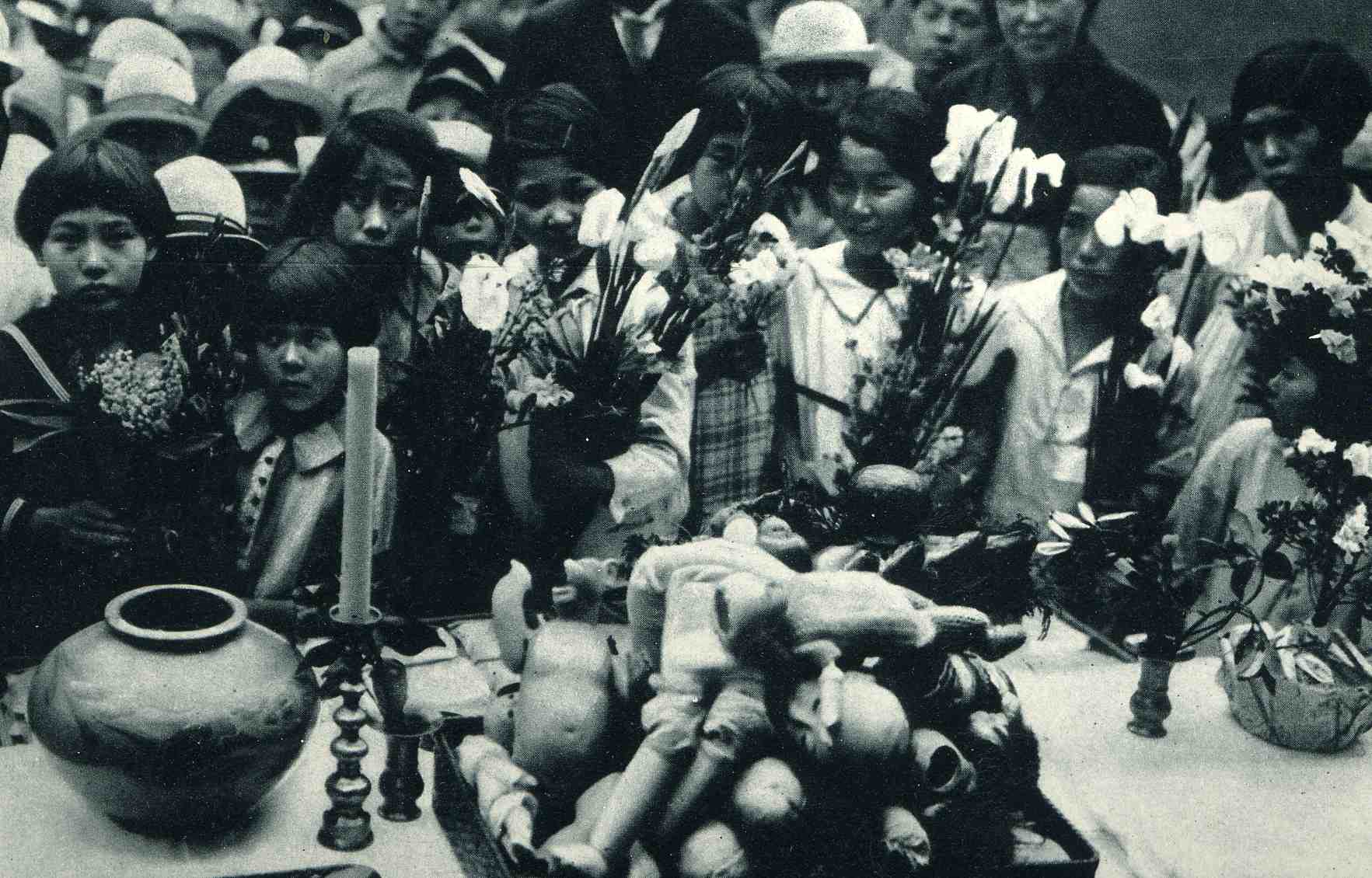
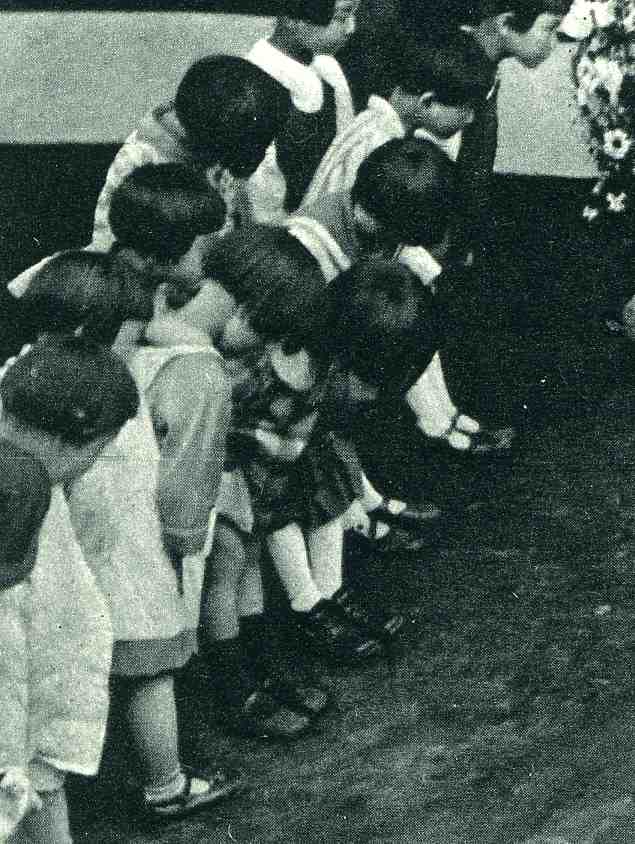
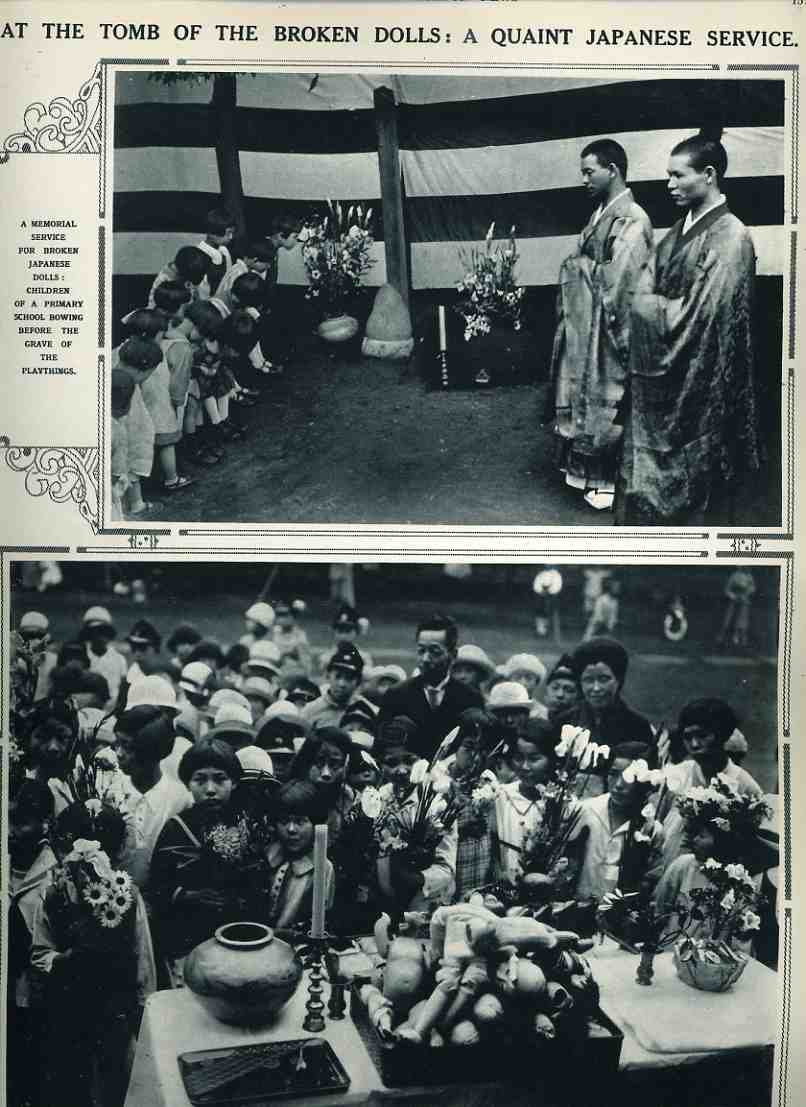
     This is an absolutely outstanding concept, and I simply have no notion as to why we don’t have such observations in the United States.  (The following two details are from the larger images, below, found  in the 27 July 1929 issue of The Illustrated London News, page 157.) The story provides these two pictures and unfortunately scant details of the ceremony which was held at the Imperial Primary School at Sugamo, Japan. 

    The first photo shows the detail of children offering flowers for the altar on which their tray of broken dolls is being venerated; and to the right is the detail of children bowing to the grave of “broken playthings”, though the markings on the (grave?) stone indicate that it is for dolls.  It also seems to be a marker for a mass of toys, not that each toy would have its own marker; I suspect it to be enough to have a place where allot of kids could come to venerate objects in which they might have invested countless hours of their time, effort, attention and affection.  That it is a shared place and experience makes the monument all the more so powerful.

    000-ebay--Nov 1 doll tomb976

    There are few better things to teach a child than to pay respects for something that has given them pleasure or helped them, or, say, for returning the love which has been showed them from their doll or toy.  It has always struck me as not-quite-right that a toy can be a beloved object one day and a dust-magnet the next, destined for the trash heap.  Certainly these are holy objects in themselves, and deserve a better and more kinder fate than being mixed with broken glass and greasy unmentionables. 

     000-ebay--Nov 1 doll tomb974


    Are there greater things to be concerned with?  Yes, of course, but only on the face of it–I think that helping kids understand the underlying dignity of inanimate objects such as their playthings could give them a greater awareness for the other seemingly invisible things that they will find throughout their lives. Further I think that a visible, constant reminder for these objects would be really more like a memory-monument for a period of time, a place in nearly everyone’s life in which held a certain purity and promise, a protected and beloved frailty of the human experience shared by all.  I can honestly think of no other monument that could reach across religious or philosophical or belief systems to arouse a feeling of common goodness than this. Everyone has had a toy that they’ve loved, and I have no doubt that if remembered these would be powerful emotions, and could be about the most common denominator we have on the planet.  I can think of no divisive element in such a monument of veneration.


  • Extra-Earth Humano-Alien Souls From Outer Space Repopulate Earth-Hell!!(??) Blank & Missing Things XXVII

    JF Ptak Science Books  LLC Post 401


    (Extra-Earth alert! This is the third time that I have found a pamphlet illustrating a view of the earth with an extra alien-earth in the background.)

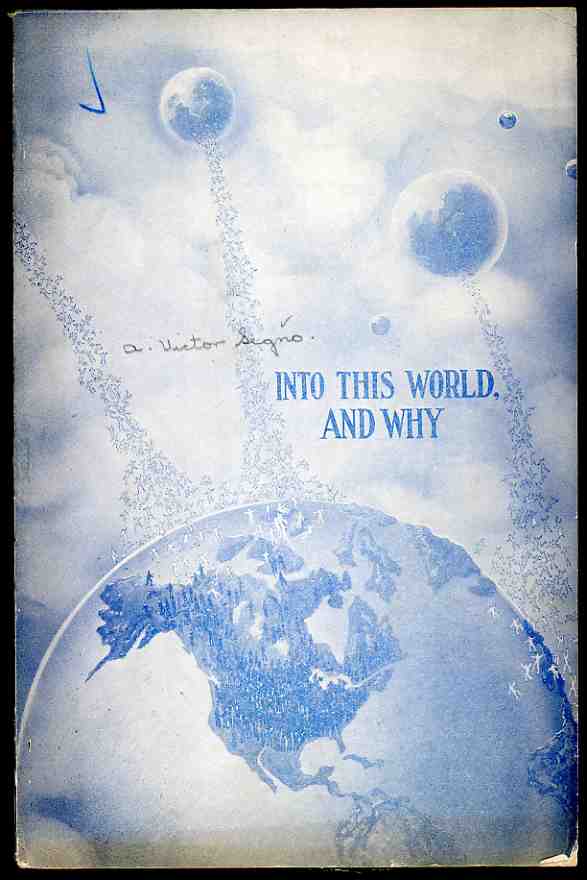
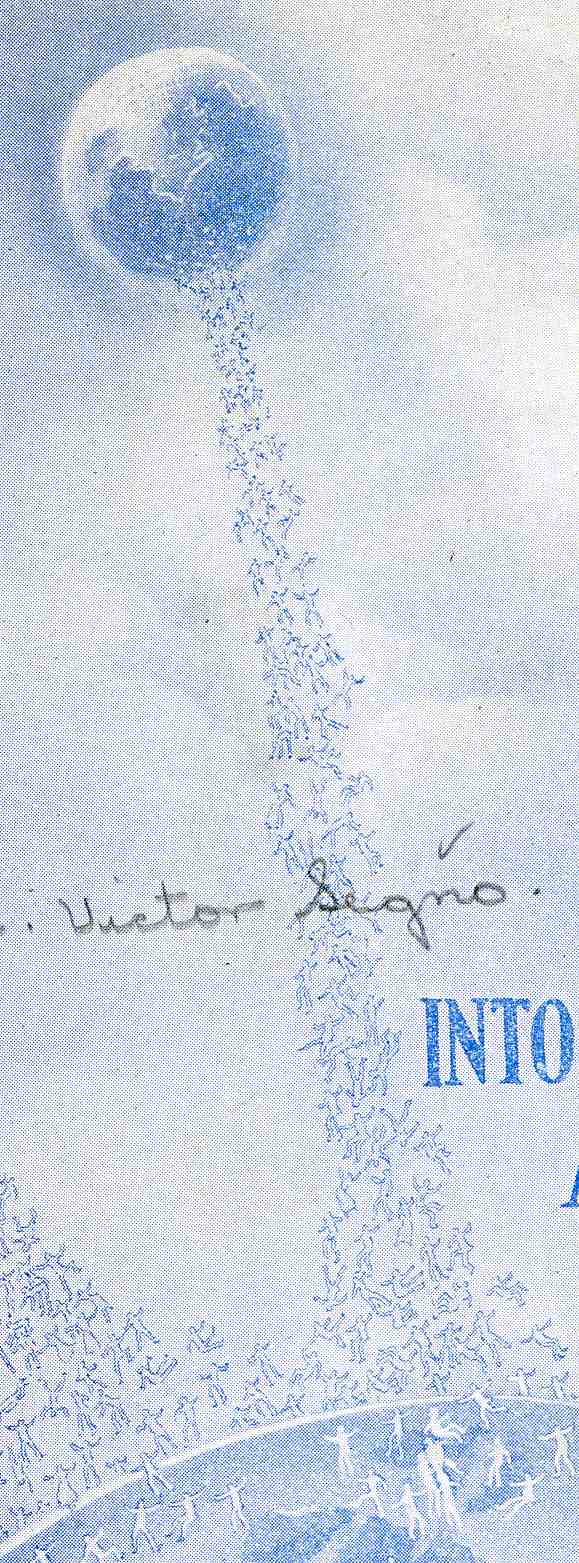
    This 1929 pamphlet by Dr. (?!) Victor Segno is the poster child for  the sub-category of Advanced Strangeness in the Naive Surreal Collection of our store. Segno is no stranger to dislocated and fractured ideas, and has a long history of preaching and extracting money from the preached-to.  Early on in his career he spawned a not-terribly original idea called “mentalism” which involved getting your “brain waves” correct and “harmonizing” your surroundings with them, which somehow also had something to do with leadership and success.  But all of that involved sending Segno a dollar for a pamphlet on brain-wave distribution.  According to Segno’s home-town paper, the LA Tribune, there were something like 12,000 people who were part of the runaway Segno train wreck–the Tribune couldn’t understand why, and didn’t much care for Segno’s quacky successes.

    0--blog---Nov 29 into this world149

    Suffice to say that quite a bit happens between 1902 and this 1929 effort, some of which involves considerable success and tiny-empire building in Echo Park.  But Segno really does break the bonds of treacly abnormalism with “Into this World and Why”, which offers a curriculum of soul/ghost extra-terrestrial astrological-astro dead/reborn beings to come and re-(!!) populate humans on earth.  (Wait a minute–that idea gets picked up by L. Ron Hubbard, yes?  Except that when L. Ron gets a hold of this idea there are 10,000 atom bombs involved and a new added process called “the clear”. But that’s another story.)  After kind of reading this pamphlet, I have come to determine that the best thing about it–bizarro ideas or not–is the cover. 

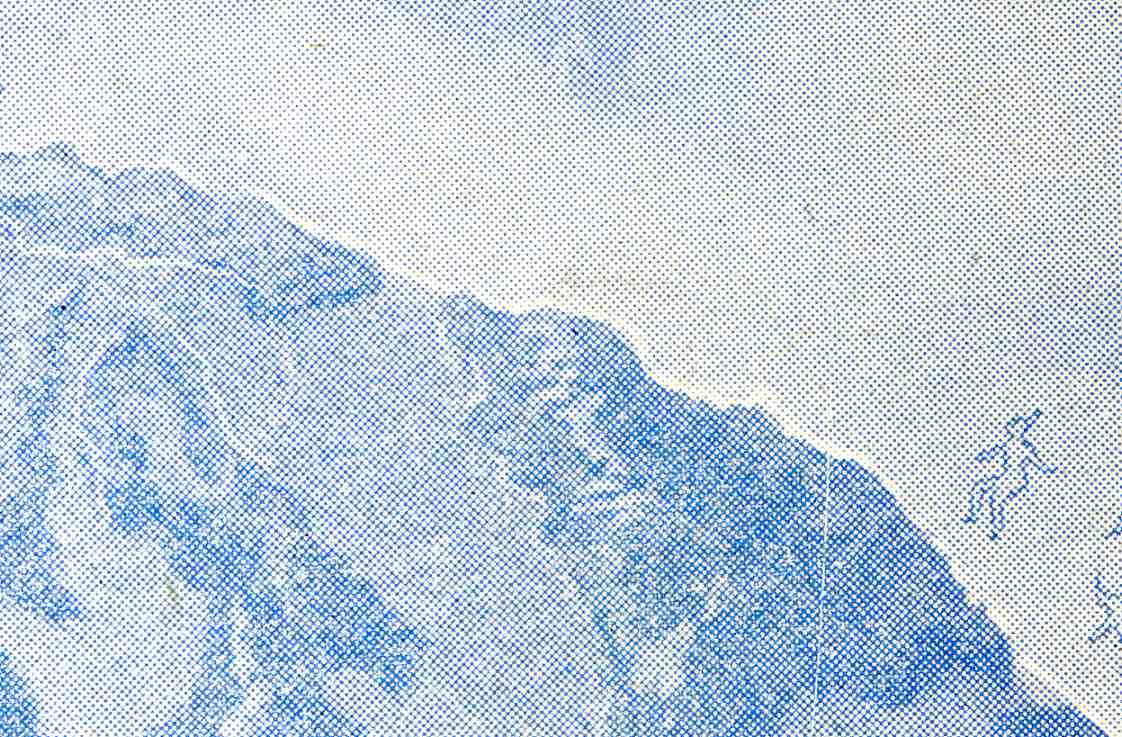
    0--blog---Nov 29 into this world151The cover, though is magnificent.  Look closely, and you’ll see that there are five other earth’s floating above the earth, all of which are contributing not bodies but souls, souls a-piling up like clustered grapes in places, souls being deposited back on earth for another go around in existence. Segno explains to the humble reader that the universe is divided into twelves sections, each populated with a planet that looks like earth, all of which are superior to the earth.  These are soul-abodes for the dead of earth whose souls leave and travel blah blah blah along the means of an undescribed process called “radiography” of the brain waves. As you can see the humanish forms falling onto earth are empty, waiting as they were to fill up a body.  Oy, vey.


    And so the thing drags on for 52 pages, a length probably determined by the paper on hand.  (But that wouldn’t stay the case, as this  pamphlet went into a self-stated 26th edition…if true, then there is no justice in publishing,)  The only reasonably entertaining and proto-sci-fi idea that comes into play here is that in all of the universe it is the earth that is Hell.  Earth is the place of punishment that souls are sent to until they get things right, at which time they leave for one of the other twelve earths.  So it goes.  

    0--blog---Nov 29 into this world150

    The other interesting bit on the cover is the representation of the giant mountains of Europe, which erupt above the earth’s horizon.  I figure that for these bumps to be so prominent that the mountains needed to be at least a hundred mile high.