A Daily History of Holes, Dots, Lines, Science, History, Math, Physics, Art, the Unintentional Absurd, Architecture, Maps, Data Visualization, Blank and Missing Things, and so on. |1.6 million words, 7500 images, 4.9 million hits| Press & appearances in The Times, Le Figaro, Mensa, The Economist, The Guardian, Discovery News, Slate, Le Monde, Sci American Blogs, Le Pont, and many other places… 5000+ total posts since 2008.

Author: JF Ptak

  • Pale Horses and the Lake of Fire: a Map to the End of the World

    JF Ptak Science Books LLC  Post 649  Blog Bookstore

    There are, in my experience, very few antiquarian images
    depicting the end of the world in which we see the entire globe exploding or in
    pieces or in flames. This sort of image gets more play in the 20th
    century, especially after 8 August 1945, but prior to that it is really very
    scarce.  I own a few images that appear
    in the 17th and 19th centuries, and another from 1929 (Das Weltbild which show a “giant ice
    ball” colliding into and completely destroying the earth). .  Then there is this new find, S.L. Lacy’s The End of the World, (necessarily) self-published
    in West Point, Virginia, in 1941.  It is a short and stocky, and bound in orange
    wrappers—its spine title (The End of the
    World
    ) begs the casual reader to pull it from the shelf. It’s a simple
    book—studying the Bible prophecies and revelations on the end of all things—and
    it annoys and is insulting but doesn’t disappoint.

    Blog--jun 13 end of the world

    I
    started to breeze through the book (back-to-front as always) and opened the
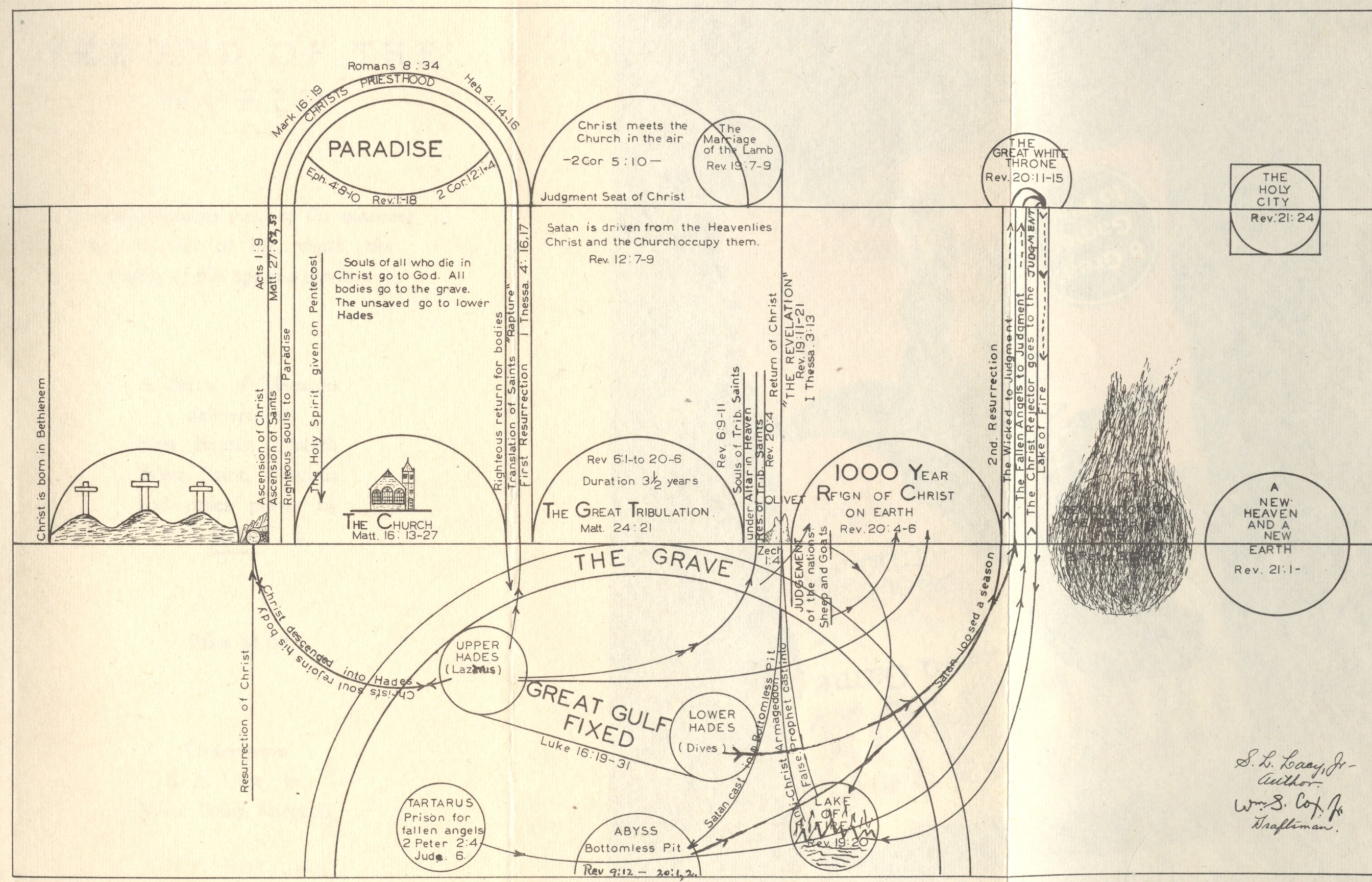
    book to Chapter XIII, finding this delicious chapter heading:  “The Chronological Order of Final Things”,
    this being a full page pre-PowerPoint summation of the time-shrinking fireball
    that is rolling inexorably towards us all. 
    To say that one is able to put a period at the end of the world’s flow
    of time, that someone is able to identify the point in the future where the
    future is no more, is “presumptive”–this in the most understated
    fashion as to offend even the highest of high-Victorians’ sense of restrained
    propriety.  Wrapped in a comfortable
    Christian chrysalis of pre- and post-apocalyptic religious certitude, Mr. Lacy
    delivers his interpretation of biblical prophecy for the coming of the end,
    hustling it to the front of the religious line of things to come.

    It seems that in 1941 the end was beginning, and Lacy saw
    all of the images implied by prophecy that were necessary to announce the
    glorious final days of broad retribution. This includes the list if the ten
    things indicating “the sign of The Times”, one of which (Number 5)
    was “The Automobile” and another (Number 7) was “Increased
    Knowledge and Travel” (announced by Nathum 2: 3,4 and old dependable
    Daniel. 12:4, respectively.  There’s
    nothing that doesn’t fit into Daniel’s visions or revelations, though Mr. Cash
    has certainly made a lovely song of them.) 
    When everything fits perfectly into a predictive model with no possibility
    of falsification (or of proof or disproof), then the model has no validity
    outside of a belief system in itself. Very tidy.

    Blog--jun 13 end of the world det

    It is an annoying, cloying minor treatise, promising little
    more than The Lake of Fire awaiting almost all of us, even the sleeping dead,
    who would be scraped from their graves to be spit into this burning
    tragedy. 

    Lacy does a lot of inspired interpretation and
    philosophizing, much of which he doesn’t seem to bother separating from
    biblical quotations—I don’t think it is intentional, just bad writing.  A random
    find in Lacy’s thinking dislodges the following  nugget:

    “Satan is in the atmosphere above the earth, with access to
    heaven and earth with a circumscribed power over the atmospheric elements and
    the earth including the inhabitants”. 

     Oh dear.

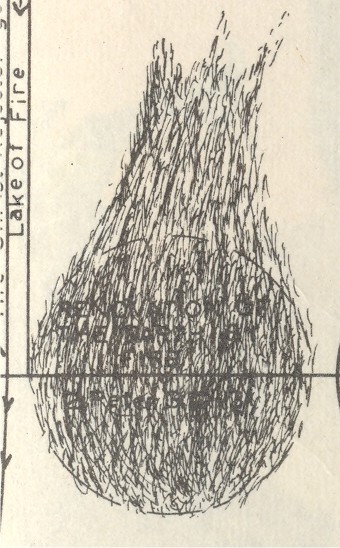
    But enough of this nonsense. What brought me to this work is
    the folding schematic map at the front of the book.  It is a slightly complex jumble of
    semi-circles and circular reasoning, and I have no interest in straightening
    out this jumbled linguine. What has my interest is the dissolving Earth part of
    the diagram, a part of the dead earth that comes between Calvary 
    and Heaven-on-Earth.  What makes this
    image different from the others though is that the Earth reappears—different from
    its former self having been vanquished and cleansed by all consuming fire, but
    the Earth nevertheless.  Or something
    like it.  Or nothing like it. 


  • The Physician Discovers the Patient: Paul Barbette 1675

    JF Ptak Science Books LLC  Post 648  Blog Bookstore

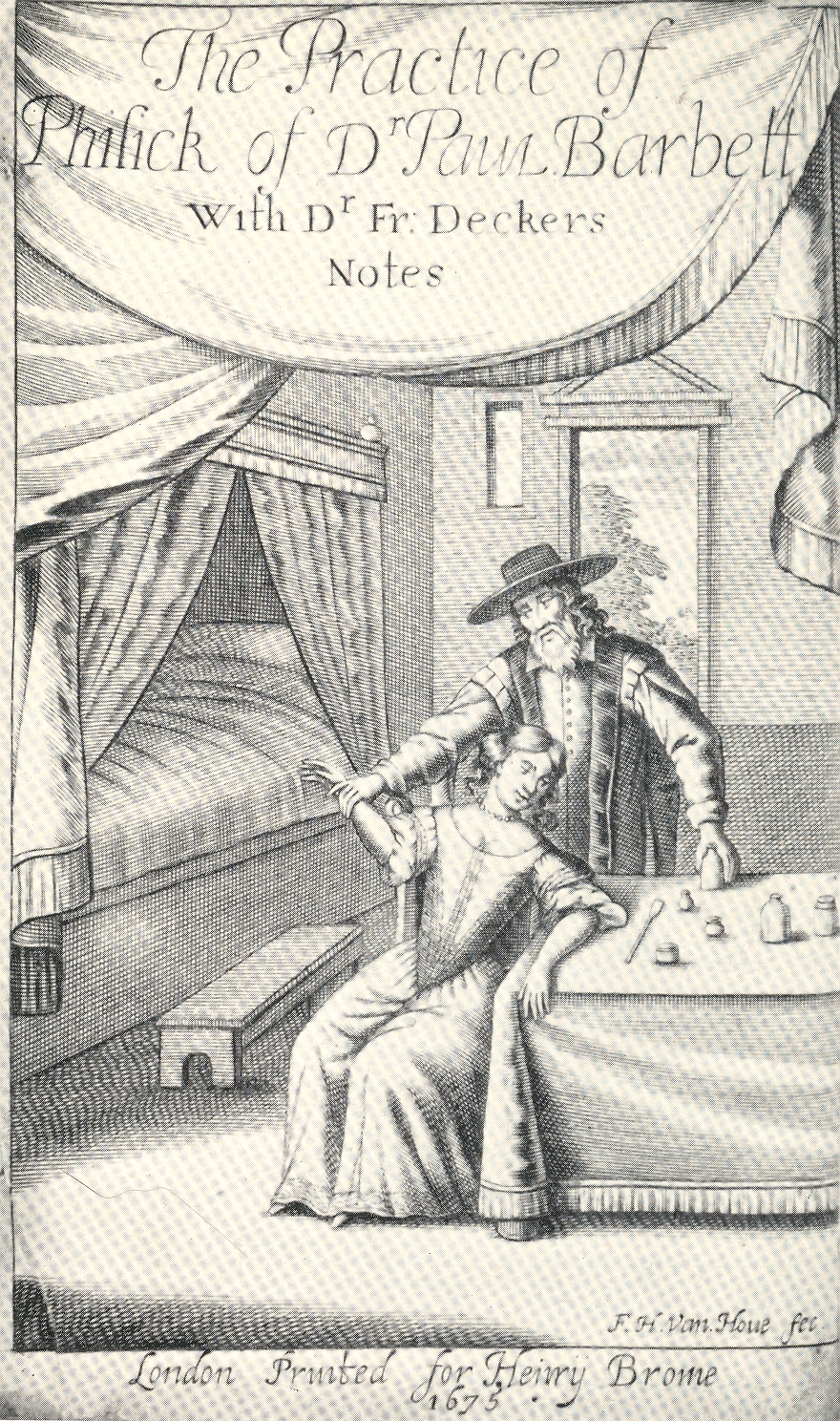
    Blog--jun 12 barbette Paul Barbette was an accomplished physician with a good touch for his patients, as we can see here in the title page illustration of his The Practice of Physik of Dr. Paul Barbette…, published in 1675.  Barbette (1620-1666 or so) was a celebrated Dutch physician whose many works were more a collaboration of experiences in his practice and classic works in medicine than they were of his own thought and creation.  The image of the physician interacting with his patient seems to me to be much more charitable than in other Doctor-patient images of these times. 

    Barbette certainly was a product of his time, writing of diseases of the upper body and treating them in the sustained manner of the mid-17th century, plus that of superstition and ancient herbals.  For example, the mugwort’s “old roots pulled from under the root of the mugewart” was a good curew for falling sickness, and must be harvested on the eve of St. John the Baptist “about twelve at t he night”.  He was also not afraid to use and apply “Crab’s eyes” and hog’s blood.  One thing he was not in favor of, however, was bleeding.  Sweating, yes, but not bleeding.  Perhaps though his most important contribution beyond accumulating a vast amount of medical information was his collection o patient histories and his interactions and interviews with them during the course of treatment.  A good idea today, not much practiced or so it seems.

    (Yes, the physician is determining the pulse of the patient in this image.  The idea of the pulse is as old as Galen but not understood until about 40 years prior to the publication of this picture with the work of William Harvey (1578 – 1657). Well it was understood about a century before that with the work of Michael Servetus, but his publication on pulmonary circulation was almost completely destroyed and its author burned at the stake for his religious temerities, so it remained for Harvey to rediscover in another century.)

    ·Posted by :

    ·in:


  • Upset in the Belly, Insanity and Murder: a Southern Interpretation, 1831

    JF Ptak Science Books LLC  Post 647  Blog Bookstore

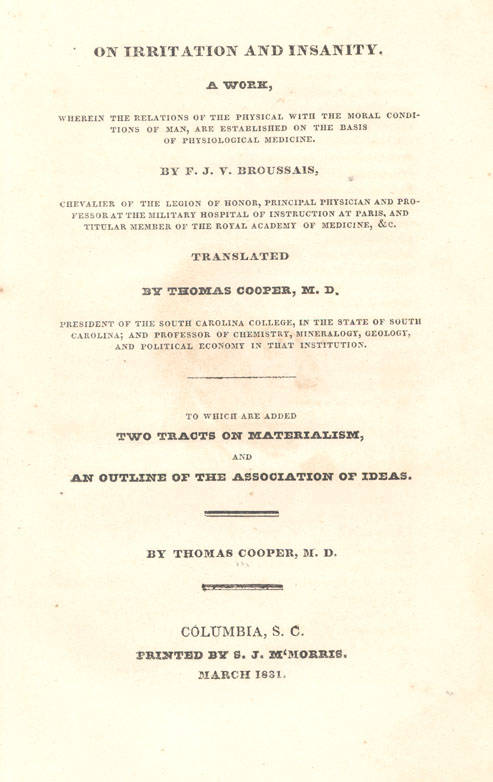
    Thomas Cooper, a merry, upper-educated intellectual called “a
    learned and talented mapcap” by none other than John Adams, wrote from his
    secure chair South Carolina College a translation of a rather individual effort
    in explaining insanity’s connection with moral outrages.  The work, published in Columbia (South Carolina) is called On
    Irritation and Insanity … to which are added Two Tracts on Materialism, and
    an outline of the Association of Ideas

    and introduced an unusual, foreign
    approach to the connection between sanity and malevolence.  Brousssais’ work may not have required such
    attention. 

    Blog--June 12--broussais

    He wrote, for example:

    “The causes of this morbid state consist always in
    irritation of the trisplanchnic apparatus, and especially in that of the
    stomach, acting on the brain.
    [Italics mine] This last viscus, may be such, by its normal
    constitution, as to give a propensity to cruelty ; but in the morbid state it
    is a sense of uneasiness perceived through the whole splanchnic apparatus,
    comprehending the brain itself, which renders ideas of murder predominant in
    spite of reason. This horrible perversion may be considered, as well as that of
    suicide, as a species of chronic anger or hatred, which impels the individual
    sometimes against himself, sometimes against other men or against inanimate
    objects. We have already considered it under a subacute form in furious mania ;
    but in the modification in which we now describe it, it is entirely
    chronic and apyretic. In fact it may be extremely obstinate, and conceal itself
    under the appearances of calm, of joy, of benevolence, until the lunatic finds
    the opportunity of executing his horrible project.”

     I can see these words being written by candle light.

     James Cowle Prittchard early on dispensed with M. Broussais,
    writing  in his A Treatise on Insanity
    and Other Disorders Affecting the Mind
    (published by Haswell, Barrington, and
    Haswell in 1837, just six years after the Cooper translation) states:


    “Such is M. Broussais’ theory of
    these phenomena. It must be allowed that various irritations, and especially
    those in the digestive organs, often give rise to irritability of temper; but
    that any such state as that .which M. Broussais has
    described is a cause, and even the principal cause, of moral insanity, and in particular of that intense excitement of
    malevolent propensity which leads to murder and suicide, is a position which,
    before it can be admitted, requires proof; and no such proof has been afforded
    by the ingenious writer who has advanced this hypothesis. It must be confessed
    that this subject is as yet enveloped in obscurity.”

    As it turns out Broussais recommended courses of bleeding, diet, soothing drinks, applications of cold and mild purgatives to treat insanity.  This went somewhat against the established regimen of treatment (but of different philosophical and theoretical approach to the idea of insanity) of Benjamin Rush, who practiced all of the above but of harsher application and with more force.  Broussais at  least advocated a more temperate approach to bleeding, that it not be “severe”, and that the strength of the insane not be completely diluted by massive exposures to dunking and the cold.  The translator Cooper, however, disagreed with the milder treatments, establishing for the record that the hotter and harsher  temperatures of the South required harsher and colder treatment. From page vi of Cooper’s [reface we read: “The Southern climate of the United States , seems to require more bold and decisive practice, than the Northern climate of Paris or London : then, to us, the therapeutics of Broussais, Begin, Coster, &c. appear feeble; but the principles, founded on the physiology and pathology of the tissues, are undeniable and universally applicable.”

    Such was the spirit of the day.  Broussais is not even a shadow, today:  he tried to establish a connection between gastrointestinal distresses and insanity, and that was seen as futile even by immediate contemporaries. Cooper survives because of his far reach into many disciplines–his treatment of Broussais, well, is memorable for his appeal to treat the insane differently in courts of law because of what he viewed as their diminished capacities. 


    ·Posted by :

    ·in:

    —

  • Maps of the Cosmos of Moles, 1671: Astrology, Pseudoscience & Furious Belief

    JF Ptak Science Books LLC  Post 646  Blog Bookstore

    “The first principle [in science] is to not fool yourself.”  R.P. Feynman

    “The Woo-woo
    is all the same, everywhere, anytime, everytime.”
    —James Randi on the
    history of   the pseudosciences .

    Self-deception and belief in Woo-woo (spurious pseudo-scientific beliefs) is some of the stuff that separates humans from animals.  And not in a good way, unless it was all chalked up to an expression of creativity and imagination.  I started this post as an entry in the History of Dots category, then in the Blank and Missing Things department, and then simply to the Bad Ideas category.  But the more I thought about mole mapping and how extraordinary it was, the less extraordinary it became, especially once the veil of age has been removed. As it turns out, mole mapping is neither more nor less extraordinary than any other system of belief.

    Here’s
    a sentence one doesn’t get to write very often: 
    Richard Saunders (1613-1692) was perhaps the foremost historian, astrologer and seer
    of human moles and their predictive forces who ever lived.  He was far from being the solitary member of
    a one-unit class:  the use of moles as
    predictive and interpretive agents stretches back dozens of
    Blog--jun 11 circ mole

    centuries, so the
    claim of Saunder’s being its most famous practitioner is not empty,
    mega-pseudo-scientific or not.  The
    mystical commentary on the Torah, the Zohar (a part of the Kabbalah), gets
    right to the point of the significance of moles (“the stars of the body”),
    transferring the structure of the cosmos and the constellations to the
    skin.  The seer and soothsayer Melampus
    from Greek mythology, in one of his necessarily pseudographic works, writes on
    the importance of moles of the face and their zodiacal relations—an idea that
    was picked up 2000 years later by the extremely significant mathematician
    Jerome Cardano.  There was a decent
    amount of argument regarding the location of zodiac symbols on the face, as it
    turned out.

    But
    the leading exponent of moles is Saunders, who was also one of the leading
    figures in a wide and very powdery period of European non-scientific
    sciences.  These wonderful images come
    from the second (!) edition of his cumbersome but accurately-titled work Saunders Physiognomie and Chiromancie,
    Metroscopie, the Symmetrical Proportions and Signal Moles of the Body, Fully
    and Accurately Explained; With Their Natural Predictive Significations Both to
    Men and Women
    (published in London, 1671, by Nathaniel Brook), in which he
    divines the psyche and the future with peoples’ moles. 

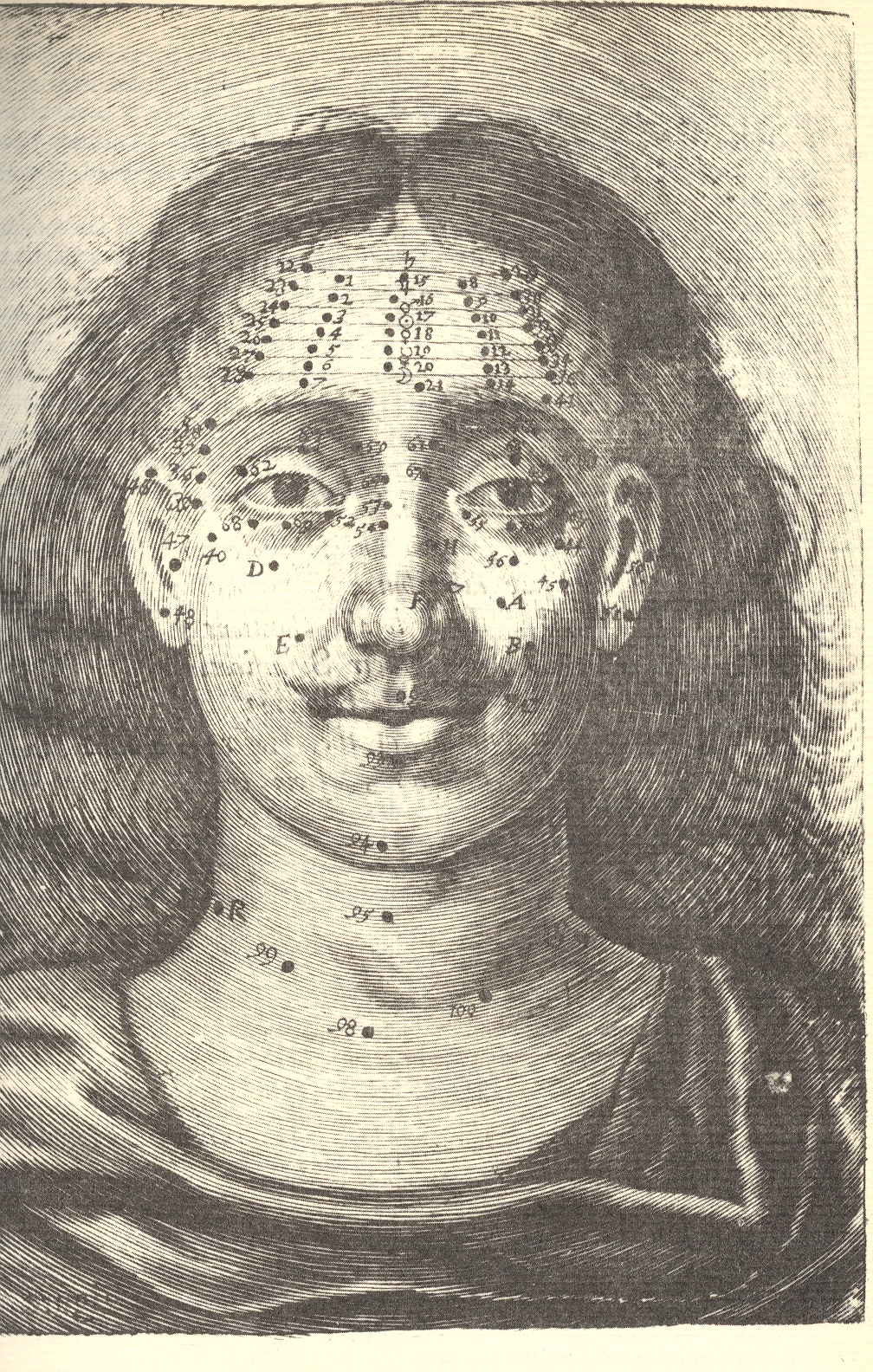
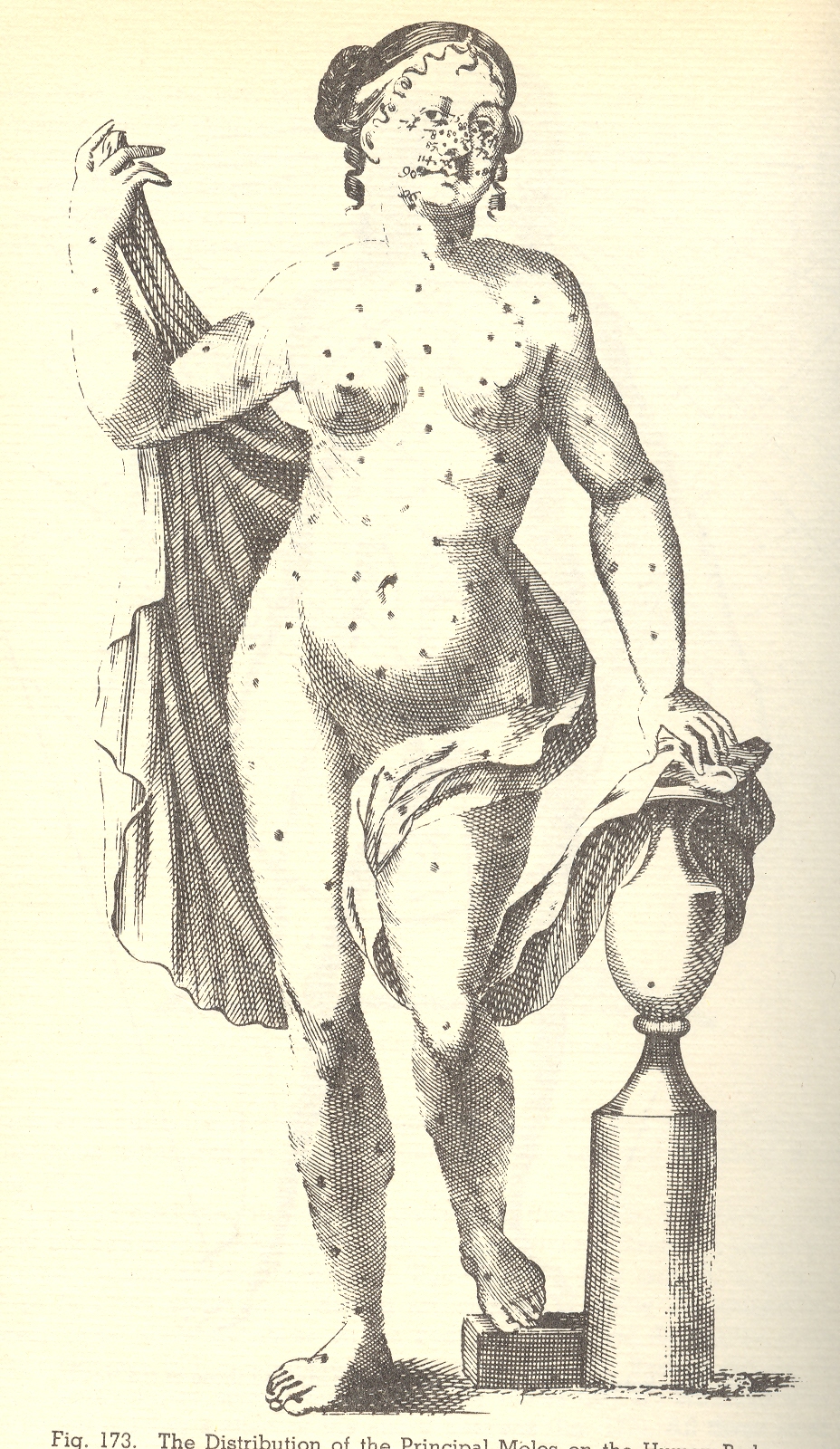
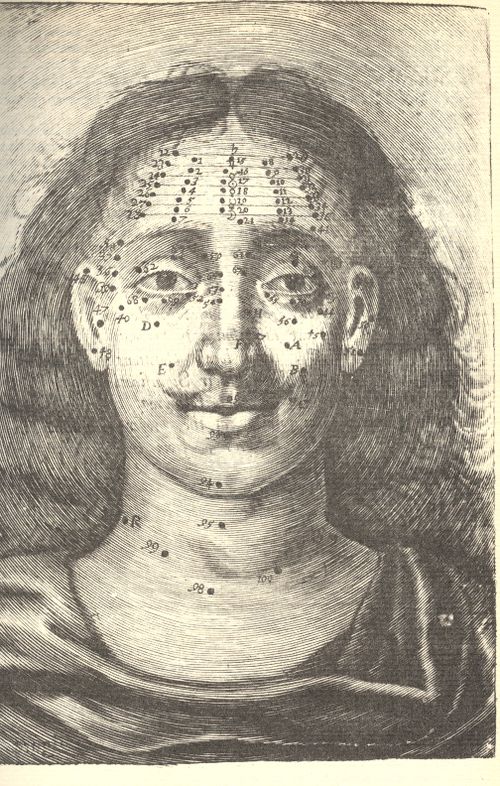
    The
    first figure, detailing the mole locations of a man’s face, is a remarkable,
    weird accomplishment, not only because of the exhaustive treatment that is
    given to every location of every mole (g_d help us), but also because of the
    manner of the engraving.  If you look
    closely, you can see that it is Fresnel lens-like—it is an engraving composed
    of (almost) concentric circles.  I cannot
    recall seeing such a thing before—needless to say the practice of engraving
    would be laborious, and not much practiced. 
    I’m not even sure what great good it causes, though it does give a
    little different idea of depth and dimensionality to the image.  The effect that it achieves here though is to
    give a solar-system-like background to the moles—something that is much more
    spectacularly achieved in the next image.
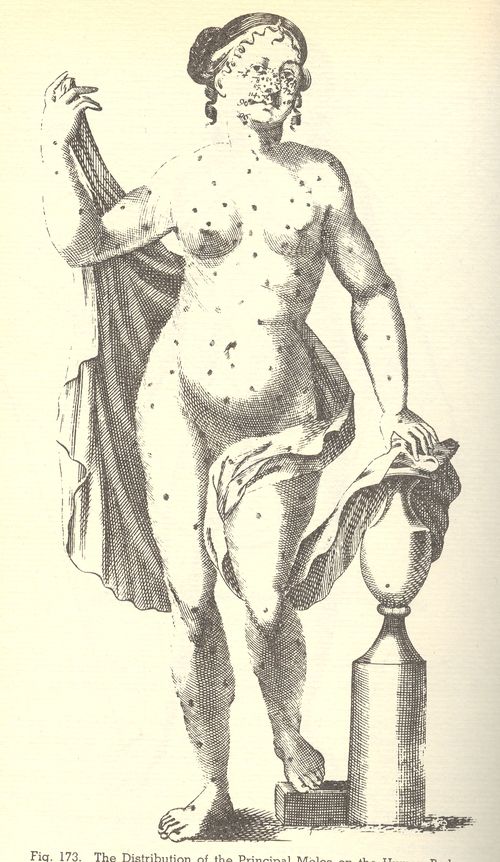
    Blog--jun 11 mole lcosmos The
    map of the moles of this woman’s body looks to me just like a constellation—and
    a constellation is just what they were for Saunders, who viewed the arrangement
    of moles on the body like an astronomer searching the night sky for a new
    comet.   But an astronomer would not be
    trying to force governing connections in the starry realms to occurrences on
    earth (or heaven, or whatever)—that would be the job of an astrologer, whose
    job would be enormously simplified since everything it conjures is
    fictional.  Had Robert Hooke been Richard
    Saunders-like when he made virtually the first microscopic investigations in
    human history, he would have been correlating the hairs and pores of the flea
    rather than making his minute and beautiful observations.

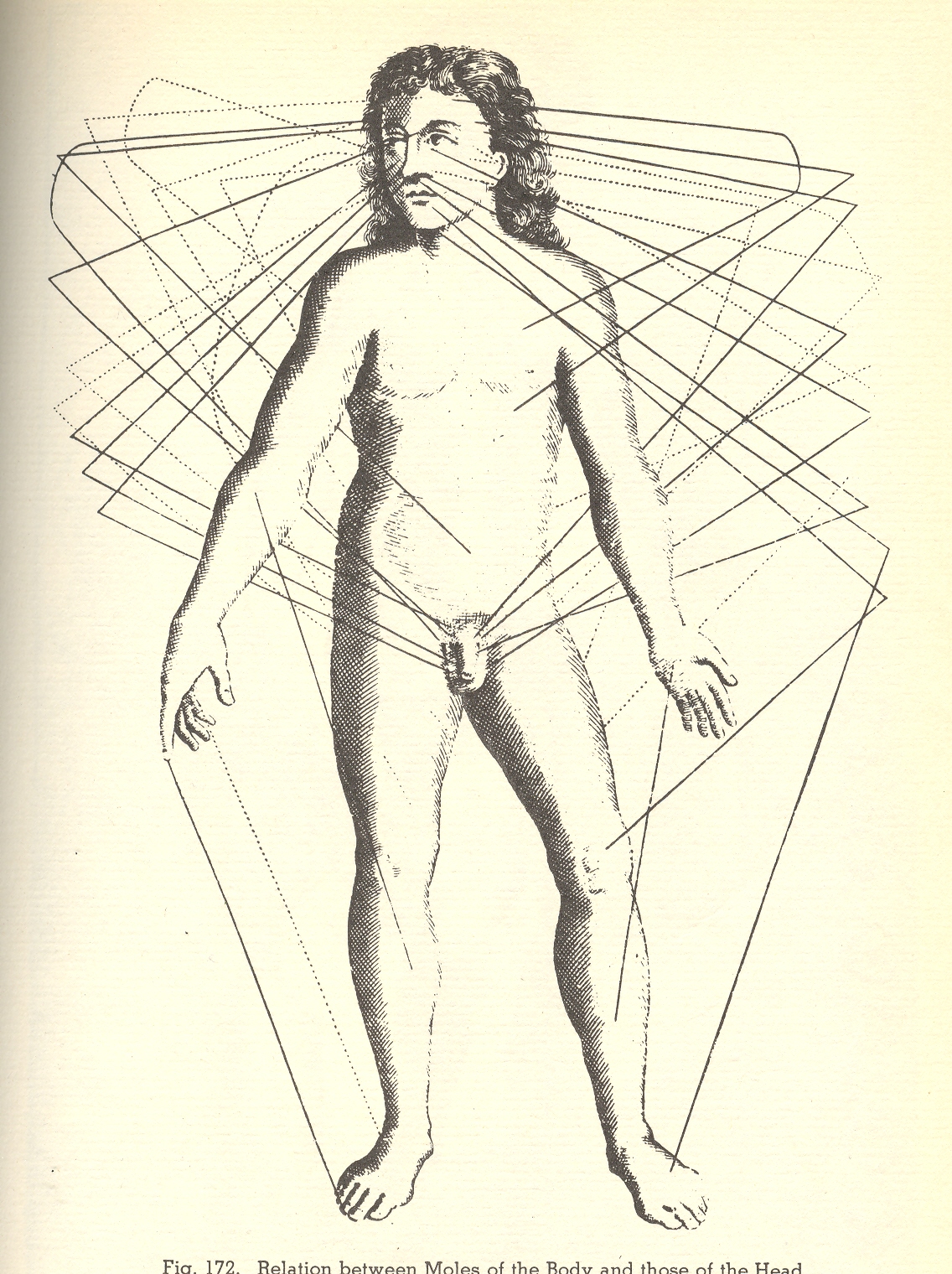
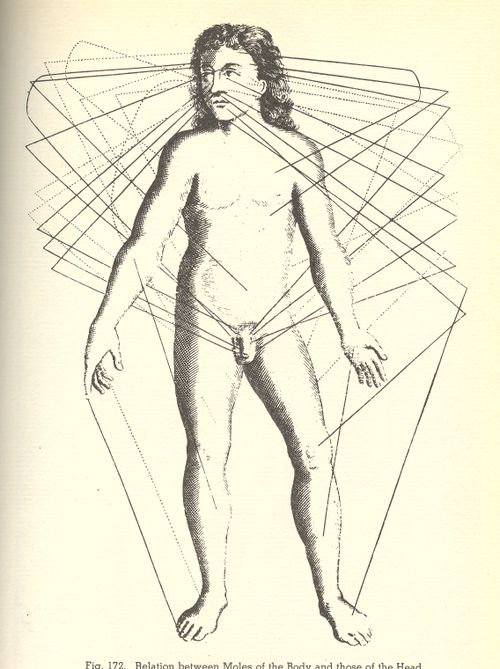
    Saunders
    sees mole connections everywhere, even developing sub-classifications to
    sub-classes: this is seen in the lovely relational map of face moles to moles
    on other parts of the body. (I like the spare curved lines most.)Blog--jun 11 mole lines
    This
    all looks perfectly phenomenal, unbelievable even,  from out here in 2009.  The fact remains though that the vast
    majority of newspapers in his country still carry horoscopes, and most Americans
    believe in UFOs, and a not-small percentage of those folks say that they’ve
    actually been abducted by Outer Space Aliens. (I calculate that from the
    “first” UFO sighting near Roswell 50 years ago that a sighting has been made about every ten seconds since
    then.  Why all of this interest?  And here’s a question among the many that I
    have about this stuff–outside the astronomical chances of actually
    encountering the other life forms in the universe that do undoubtedly
    exist:  why do these crafts, which have
    spectacular, beyond-physics capacities, have little dotty lights on them?)

    And
    so as bizarre as images like this might look, many (most?) folks in the present
    really haven’t left these ideas behind—they just get changed a little,
    upfitted, retro-ripped, and outfitted with flashing lights.

    In a
    very long career of getting people to think  in spite of themselves, James Randi (scientific
    investigator, keeper of the scientific method, head of the James Randi
    Educational Foundation
    , and formerly “The Amazing Randi” from years ago) has
    one particular mythbust-lecture that I find phenomenal, with a very large “oh
    my good god!” capacity for the students at the end of it–if they would but allow it.  Listen: 
    Mr. Randi would explore the possibilities of astrology, asking the group
    or class who there believed in it, taking a census of belief.  He would then make a very strong, convincing
    case for the application of this hope in astrology (he is a very determined and
    logical speaker), and then give astrological “readings” to each member of the
    group.  The readings would turn out to be exact and persuasive—a second tally would be taken of  believers, with
    the usual results being that (unless they knew who Mr. Randi was or was already
    a skeptic or logically un-needy thinker) the class would now consist of an
    overwhelming percentage of astrology-believers.

    Then
    Mr. Randi lets the high-wind boom swing free: 
    everyone received the same reading. (You can see a short snippet for one of these experience HERE–Mr. Randi has conducted this lecture many times for many different audiences.)  The shock of realization is palpable.

    On
    the telephone this morning Mr. Randi graciously explained this lovely lesson—he
    also explained that even after the key ingredient of the lesson was revealed,
    and even after he lectured on thought and belief and superstition and logic and
    so on, that the people who had already believed in astrology would almost in every circumstance still
    maintain that belief.  Even in the face
    of overwhelming evidence, the idea of belief was no match for fact.  Truth, fact, explanation, method, logic—none
    of these could put a chink in the armor of belief, and is no match for self-deception.

    “The
    Woo-woo is always the same, everywhere, all the time.  If its not astrology its something else, the basis for all of it is the same” (my
    paraphrase) says Mr. Randi. After approaching belief
    systems like UFOs and astrology and mentally bending spoons and mind-reading
    and on and on, Mr. Randi says that at their base, the stories have a common heritage of need.
    And they’re unbendable, and certainly unbreakable, for all of those who need
    the belief.  There’s no room for
    constructive debate and exchange in such belief systems, whether it is
    astrology or creationism (I just can’t call it by its other, cleaned-up
    name), as they cannot satisfy the basic tenets of knowledge growth and scientific inquiry which, according to RP Feynman, is the willingness to test your beliefs against falsity and to investigate all possibilities that might make them invalid.*  Mole mapping predictions and the
    fate of a life is no different from any of these other derivations in wishful/hopeful pseudosciences, either—just a different name
    for the same underlying system of beliefs, though the moles are a little long in the tooth. 

    Anyway, creationism or astrology or life-after death–they might as well all be mapping moles.

    As Feynman said:

    The first principle [in science] is that you must not fool yourself — and you are
    the easiest person to fool. So you have to be very careful about that.
    After you’ve not fooled yourself, it’s easy not to fool other
    scientists. You just have to be honest in a conventional way after that.

    * Feynman on the scientific method:  “It’s a kind of scientific integrity, a principle of scientific thought
    that corresponds to a kind of utter honesty–a kind of leaning over
    backwards. For example, if you’re doing an experiment, you should
    report everything that you think might make it invalid–not only what
    you think is right about it: other causes that could possibly explain
    your results; and things you thought of that you’ve eliminated by some
    other experiment, and how they worked–to make sure the other fellow
    can tell they have been eliminated “
    RP Feynman quoted by Ralph Leighton,  1985, p. 341
    ).

  • Naive Surreal Titles (Series #15): Antique Ideas About Womanhood

    JF Ptak Science Books LLC  Post 645  Blog Bookstore

    Blog--jun 9 odd titl ssh

    In a 
    continuing thread that I call The Naïve Surreal—common, ephemeral titles
    relating to subjects whose meaning has virtually no place outside its own era,
    creating art in their otherwise forgettable and forgetting covers and design—come
    these two examples relating to women and girls. 
    There’s really not much to say about their contents, really—so much has
    already been said.  They’re just a standard
    of their time.  Things People Won’t Talk About (1937)  is [sic] venereal diseases,
    and is an appeal for actual public discussion (“the foolish secrecy surrounding
    (the diseases) is what makes them so destructive”.

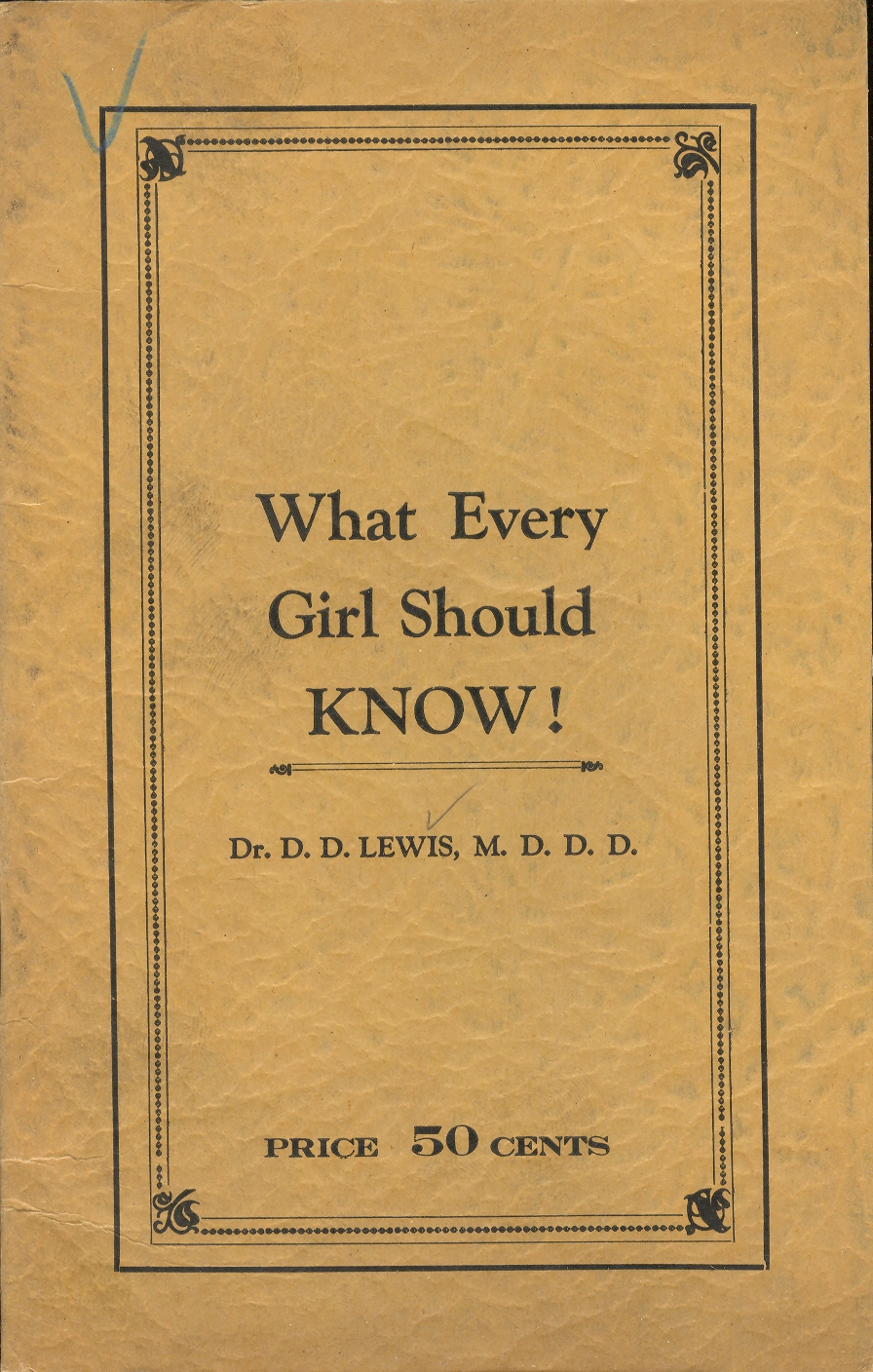
    Blog--jun 9 odd tevry grl
    What
    Every Girl Should Know

    (1928) contains nothing I think outside what everyone would expect it top say,
    except that it is rather well written, and also (in places) quite strongly
    opinionated.  The little pamphlet also
    assumes that its readers already know its complaints:  “the evils of self-abuse are so well known,
    that there is no need to elaborate further on this point”.    Its “chapter”
    headings tell a lot of the story, and probably enough of it to make their
    reading the only thing you need to read: 
    “Know Thyself”, :Know Thyself Spiritually”, “Woman’s Mission”, “The Age
    of Puberty”, “The Ovaries”, “Harmoul—its Importance”, “Rash Marriage”, “Freedom
    and More Freedom”, “Lust and Love”, “The Value of Chastity”, “Buying Popularity”,
    “Selling the Body for Clothes”, “The Tragedy of Dual Love”, Menstruation”, “Masturbation”,
    “Promiscuous Sexual Intercourse”, “Gonorrhea”, “Syphilis”, “The Dreaded Third
    Stage”.  So. There you have it.

    ·Posted by :

    ·in:

    — —

  • The History of the Evil Eye

    JF Ptak Science Books LLC  Post 644

    Fortis imagination generat cassum (“A strong imagination begets the event
    itself”)

     The Imagination of the human heart is evil
    from his youth
    (Genesis
    8.21)*


    Blog--jun 11 evil

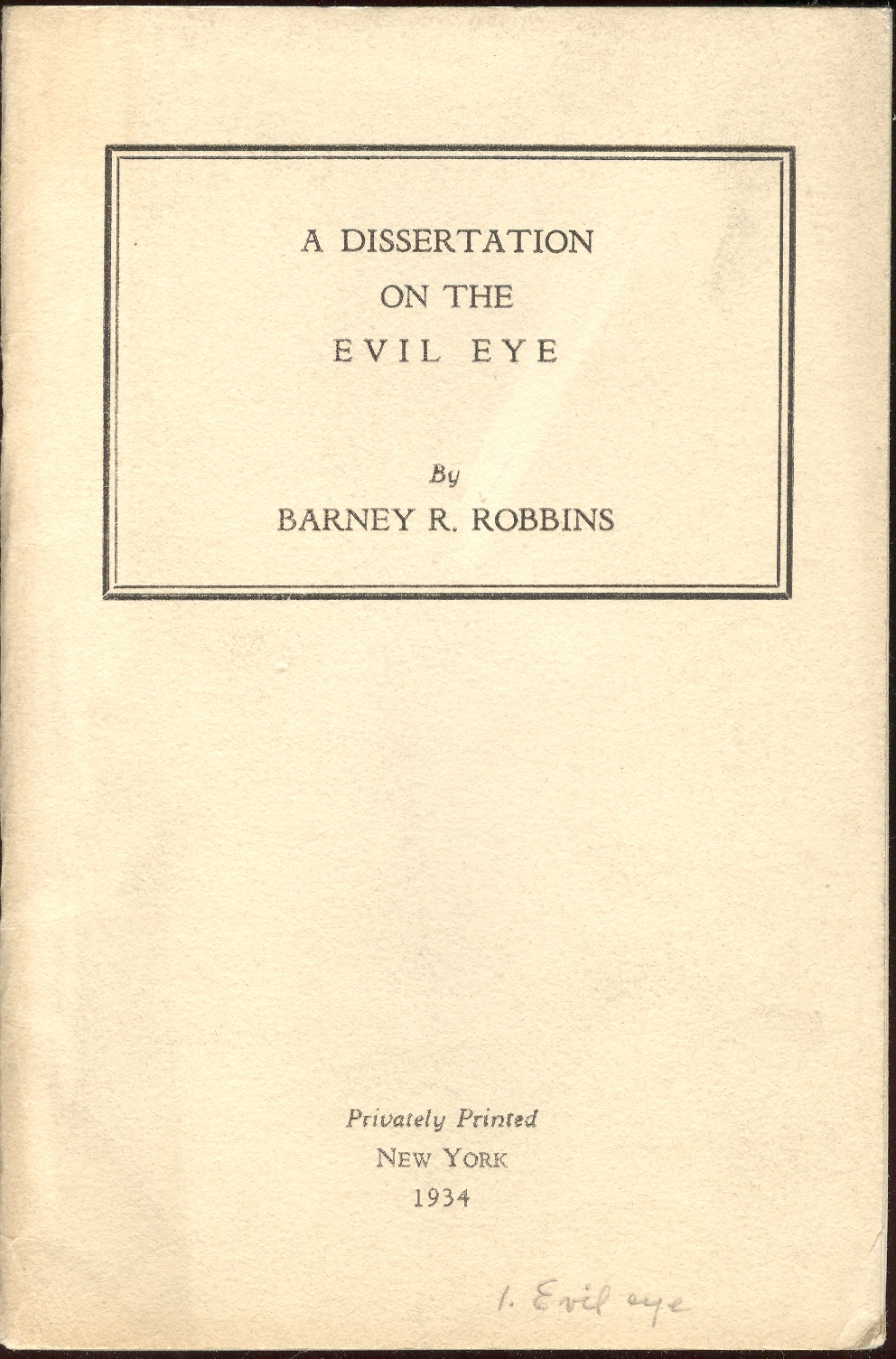
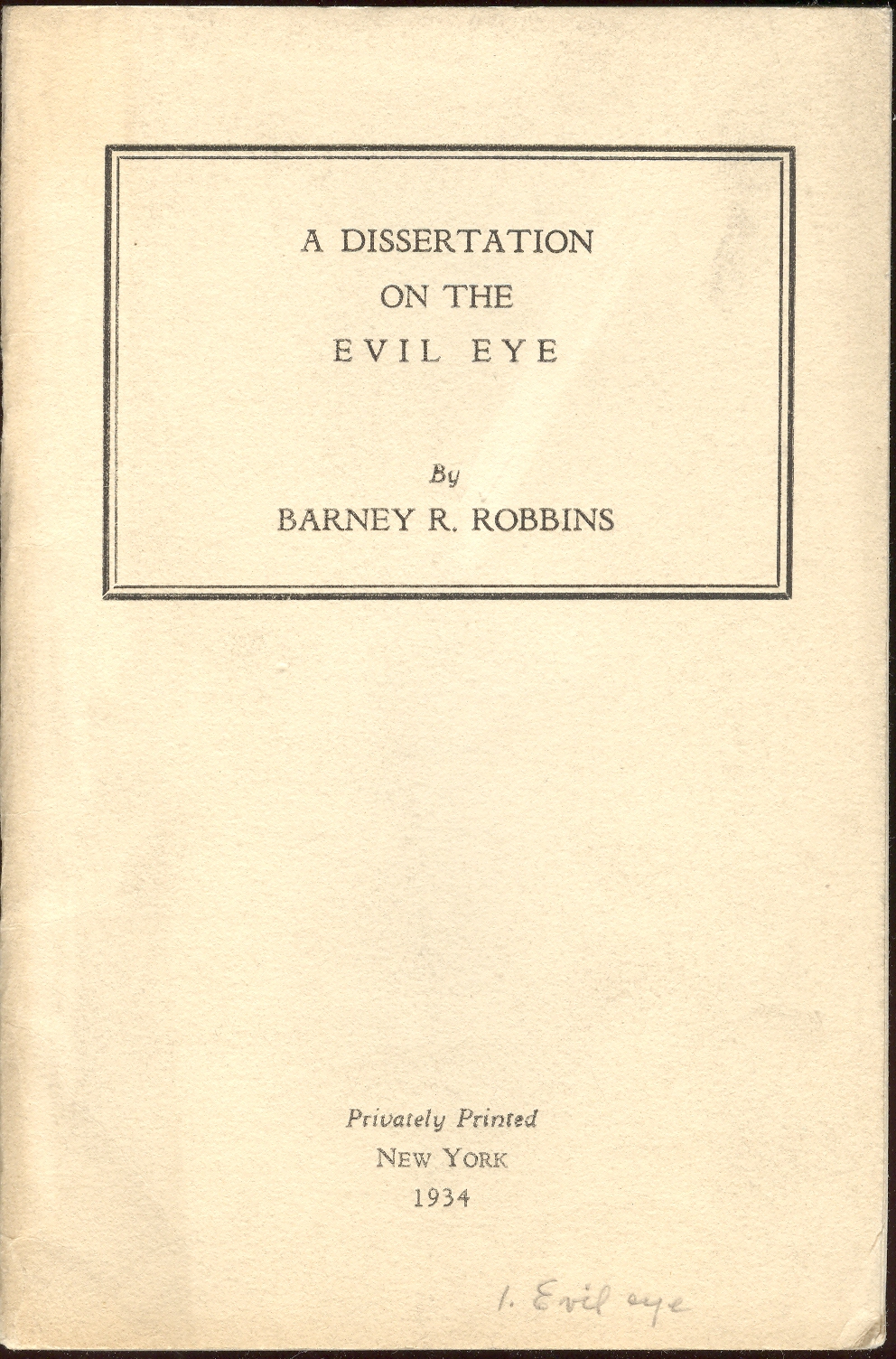
    Barney Robbin’s A Dissertation on the Evil Eye was headed to my category on Icons of Shouted & Mysterious titles—until I started to read it.  It turns out that Mr. Robbins wrote a fine, sort of brightly-written exegesis on the history of evil and its manifestation in the evil gaze—a tough thing to do in 40 pamphlet-y pages and still have lots of references to The Ancients.  He also has a pretty liberal undercurrent towards the authenticity of the Bible, the basis of human history (“our human ancestors lived in savagery during practically the entire existence of the race”), the invention of the convention of privacy in human sexual affairs (and its representation in the OT vs NT), Old Testament superstition, and other varieties of contemporary social mores and their interaction with asceticism and pagan practices. He then deftly slides into the origins of  “the preposterous belief” in and personification/transference of evil spirits, and in religious intolerance of the assumed imagination of the human mind and its role in rapturous misinterpretations of the Bible and the growth of redemptive evil.

    The last fifteen pages are spent solely on the evil eye, and is a pithy statement on how it was “given” in various cultures, and how people protected themselves from it. “They have the plague, and caught it of your eyes” writes Shakespeare in Love’s Labor Lost (V II), and this is the least of it, though Robbins points out that in various cultures you could seal yourself from this ”plague” by spitting, wearing bright colors, collecting and spewing rainwater collected on the 27th of April, cross dressing, keeping a phallic amulet on the body, keeping salt and coal in the pockets of children, blessing wine, blowing smoke into a child’s mouth, and so on.

    Robbins points to Francis Bacon, who wrote: ” It seems some have been so curious as to note that the times when the stroke or percussion of an envious eye does most hurt are particularly when the party envied is beheld in glory and triumph.” And of Robert Heron, who in his travels in Scotland in 1793 wrote : ” Cattle are subject to be injured by what is called an evil eye, for some persons are supposed to have naturally a blasting power in their eyes, with which they injure whatever offends or is hopelessly desired by them. Witches and warlocks are also much disposed to wreak their malignity on cattle. … It is common to bind into a cow’s tail a small piece of mountain-ash wood, as a charm against witchcraft.” And then to Thomas Lupton, who in his Book of Notable Things (1586) wrote : ” The eyes be not only instruments of enchantment, but also the voice and evil tongues of certain persons.”  And so it goes, on and on.  Entertainingly so.

    But there is something of Robbins that doesn’t sit well; perhaps it is his book on the New Testament, or the sniffly jaundiced Immigration and Americanization which form the background for some of the man’s thinking when he veers from liberal interpretations to right-wing political statements.  Out of nowhere comes the following gem:  “Communism is the accursed offspring of the evil eye with all its implications.  It is the collective evil eye of the masses…”

    I think what Mr. Robbins is getting to, ultimately, is the delivery of his belief that savagery has continued for thousands of years and continued to his present, “flourishing long past its day”.  Maybe so.  In any event I found his work to be unexpectedly interesting, and was impressed that he was able to weave such a complicated summation of evil in such a small place. 
    ______
    [Mr. Robbins also lobs in a  few unexpected grenades from the Old Testament, including this healthy reminder from the Book of Proverbs, which he uses in discussing a sidebar he pursues with Noah and the choice of god being evil and 58% alcohol:

    It is not for kings, O Lemuel, it is not for kings to drink wine; nor for princes strong drink; Lest they drink, and forget the law, and pervert the judgment of any of the afflicted. Give strong drink unto him that is ready to perish, and wine unto those that be of heavy hearts. Let him drink, and forget his poverty, and remember his misery no more.]

    *The imagination was also a source of sinful pride (Luke 1:51) and a source for idolatrous art (Acts 17:29), and still present in humans  in spite of the cleansing flood, and in spite of the races of man having been scattered and completely dis-united by Babel.


    It turns out that the Robbins book is rare:  only six copies have been located in OCLC/WordlCat:  Stanford, Harvard, Yale, Chicago, NYPL, Libby Congress (although not the LC any more, as this copy used to be their’s.)

    ·Posted by :

    ·in:


  • Flying Ocean Liners: Sikorsky’s Ocean-Crossing Futurama, 1941

    JF Ptak Science Books LLC  Post 643  Blog Bookstore

     Theodore
    Wright (aviation engineer, 1895-1970) wrote a lovely short piece (“Wings for
    Transportation:”)  in the Smithsonian Institution Report for 1941
    on the future of aviation and its importance in transportation.  Wright begins the article with a difficult
    paragraph on the good fortune of America‘s aviation industry to still be more concentrated on commerce than on military
    might, referring to World War II as the affair “starting with
    Munich”. 
    This is unfortunate.  But he does
    graduate from this myopic iconoclast’s future view to discuss the history of
    American aviation and its future as an essential element of the overall commercial
    transport grid.  Here he gets a lot
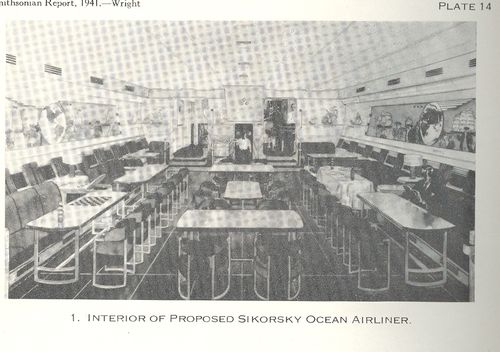
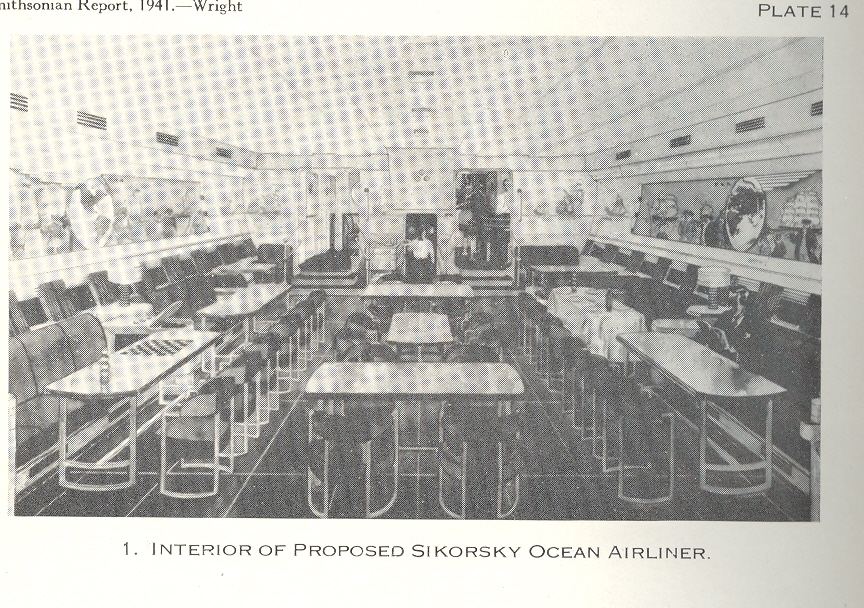
    correct. Blog--jun 9 sikorsky interior

    At
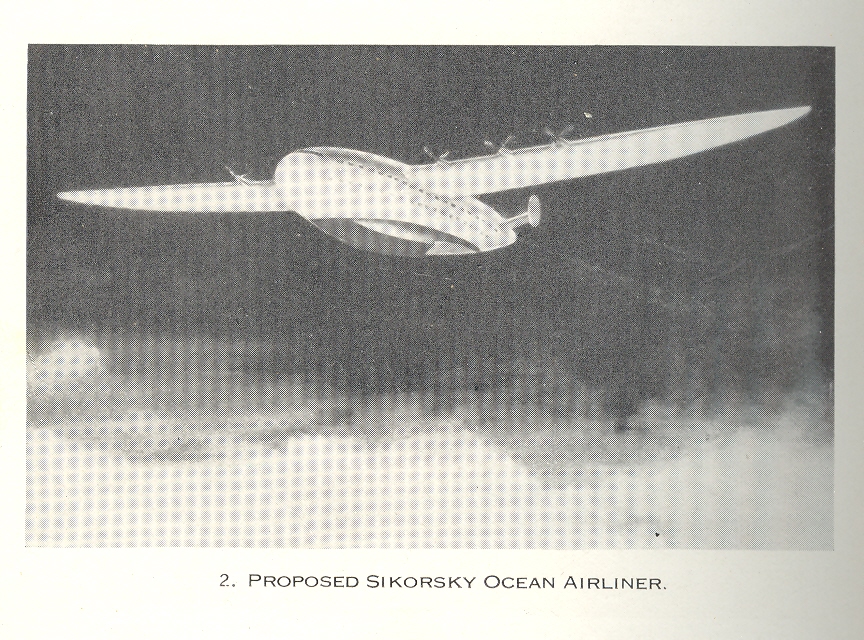
    the end of the article though comes a fantastic bit of futurology by an
    engineer and designer whose importance in aviation is unquestionable—Igor Sikorsky.  Sikorsky (1889-1972) designed the first
    multi-engine fixed wing aircraft and the great flying boats used by Pan Am to
    cross the oceans, though he is best remembered though for his enormous
    contributions in the development of the helicopter—a man of tremendous
    accomplishment.  He got an awful lot
    right.  He was also correct in the assumption
    that there would be enormous aircraft flying around the world in the near
    future—aircraft far larger than those being flown by Pan American Airways.  What he got wrong was the shape and style of
    this aircraft, which seems to be a further development of the flying boat.  Wright referred to these planes as “Ocean
    Airliners”, and that is what they certainly seemed to be:  behemoths that were ocean loners with
    wings.  They were wonderful things, and
    who wouldn’t want to be able to walk around the in-flight dining room, trying
    to pass some time on a long flight to New Zealand?  But it was not to be, of course, though
    Boeing’s superb 747 did for a while have a cocktail lounge for first
    class.  Still, these wishes die hard,
    especially when you’ve traveled with such accommodation.  (My own experiences with this is taking a
    electric tram in Helsinki
    and discovering that there was a bar in the back of the car. The open windows, the blue skies, the civility–it felt like the only way to travel: refreshed, thoughtful, and going 20 mph.)

    Blog--jun 9 sikorsky

    ·Posted by :

    ·in:


  • Bad Book Titles (and Worse Contents): Cruella DeVille and the Fur of Cats and Dogs, 1938

    JF Ptak Science Books LLC  Post 642  Blog Bookstore

    Blog--jun 8 fur title How
    could one pass up the chance to browse through such a  compelling and revolting
    title such as   Standardized Fur Tags, Their Use and Purpose, (published in NYC
    by the Fur Research Institute in 1938)? 
    Titles like this cry out in equal parts of pity, shame and pride,
    calling to their readers like fur-lined Sirens beckoning to fur-encrusted
    sailors floundering in a fury sea, hell-bent to crash upon fur-slathered
    rocks.  In a world of covering things in
    fur that once belonged to another living thing, the thinking’s all over but for
    the process, pricing and standardization, so that the furriers were less
    inclined to cheat one another and focus on the fleecing of the buying
    public.Blog--jun 8 fur title 001  

     Opening
    this oversized pamphlet reveals the explanation of the fur identified by the
    tags that would appear on the interior-neck of the garment.  There are 125 descriptions and standardization
    of furs, though I must say that what caught my attention first was the fur of
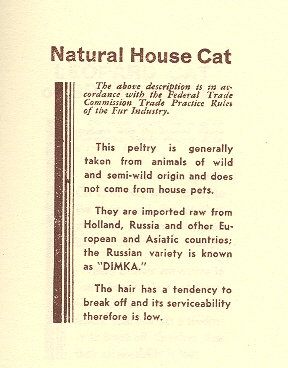
    the “natural” house cat (followed by the “dyed” house cat)—they say that this
    was not an agoraphobic cat’s pelt used to make the apparel, but from cats “wild
    and semi wild”.  Like barn cats, I guess.
    (We are told that the fur “breaks off”, and is not a very good choice for
    outerwear, though it did seem to work for the cat.)

    Blog--jun 8 fur title 002

    Then
    there’s the “dyed Chinese dog” and the “dyed Mongolian dog”—I’m not sure who
    would need pelts made of dog (or cat, or anything else for that matter), but I
    guess that they were popular enough to be included in these furrier  guidelines. 
    And so the list goes on and on: dyed skunk, pieced skunk, natural skunk,
    dyed squirrel, dyed weasel, natural wolf, dyed opossum, etc. 

    ·Posted by :

    ·in:

    — —

  • Blank & Empty Things #46: Languages of Tree Structure

    JF Ptak Science Books LLC  Post 641  Blog Bookstore

    A History of Blank & Empty Things , #46

    Messages and information, silently displayed data and the announcements of the state of all things are everywhere, all of the time:  these things only become part of the language and systematically codified once they are recognized and understood, or at least once the thrust of the message becomes distinguished from the surrounding noise. 

    Blog--jun 8 tree
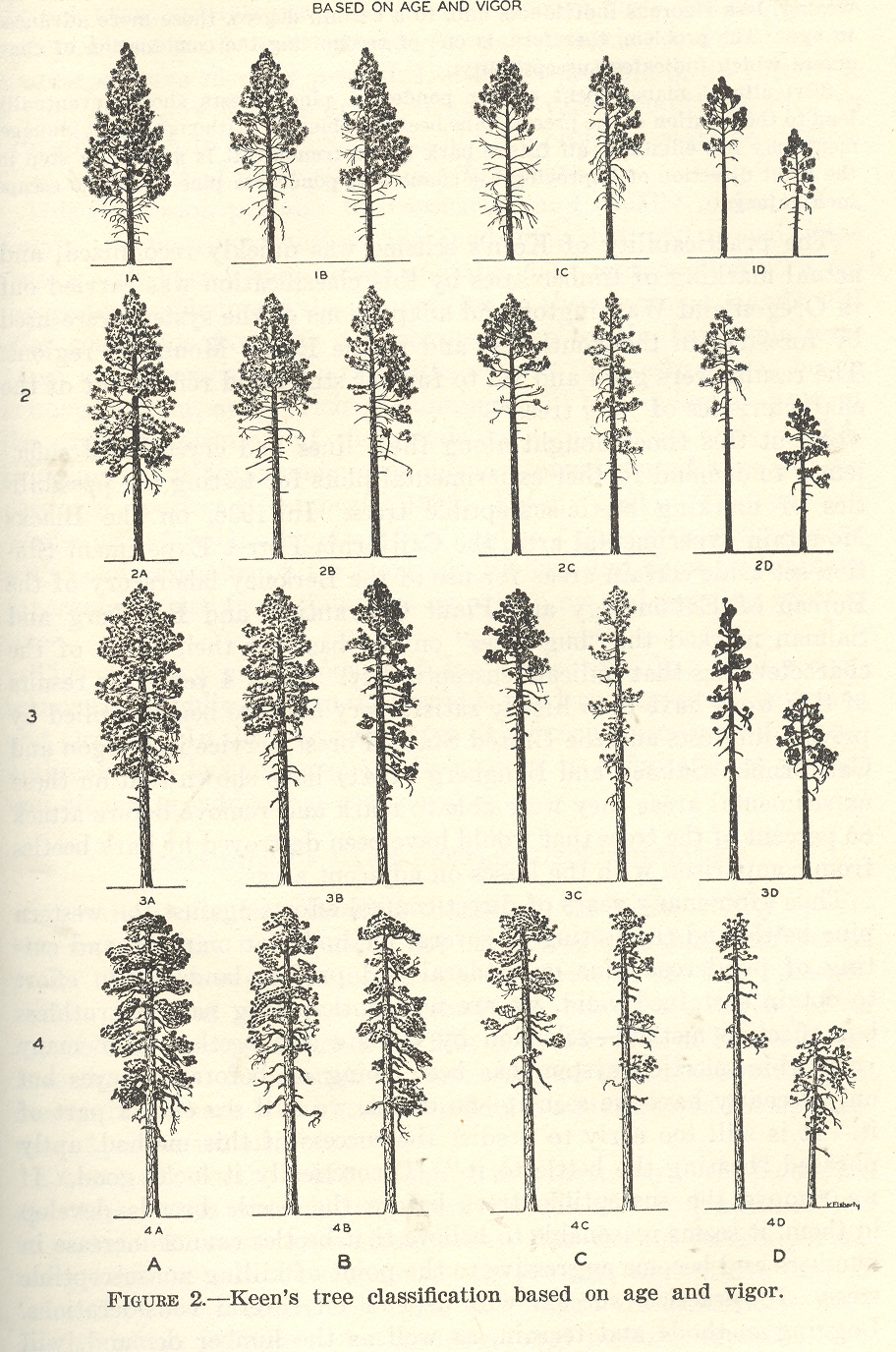
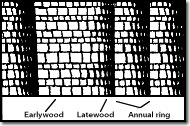
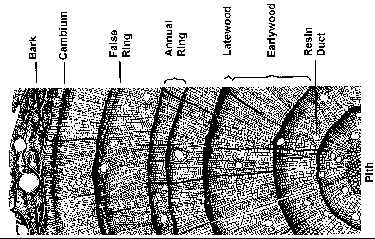
    One elegant interpretation of above-the-noise display was made by E.P. Keen in 1936 (“Relative susceptibility of ponderosa pines to bark beetle attack”, published in the Journal of Forestry)  who established a simple and practicable standardized vocabulary for the discussion and communication of tree health.  It is a relatively straightforward idea–based upon many years of keen observation and understanding–which used a pictorial schematic to establish a common baseline for the discussion of tree health/growth. Later on Keen would pioneer the use of aerial photography using various films and filters to determine the extent of damage done to stands of trees (and forests) brought about by drought, pests, diseases and other harmful stimuli–especially when the damage was done not in the visible spectrum. 

    The Blank & Empty part of tree language comes in the form of cells in the trunk of the tree which reveal–in cross section–the age of the tree and some climatic indicators of during the tree’s growth.  This comes in the form of tree rings–the rings are formed by the growth of the cells, the first of which in a new season respond with expansion, and depending upon water conditions will either grow somewhat less slowly than at first or stop growing altogether at the end of the season, and die; the new cells growing in the new season, and the demarcation being what we call a “ring”.  This was a fantastic idea, the brainchild of A.E. Douglass at the University of Arizona. 
    Blog--june 8--tree cell
    Andrew Ellicott Douglass (1867-1962)  was , ironically, an American astronomer at work at the Lowell Observatory in Flagstaff when, in 1911,  he began his experimentation with tree rings.. (I believe that he came to this end trying to ascertain terrestrial climatic conditions in his sunspot research.) The resulting effort was the clarification and near-founding of dendrochronology, with the resulting climatic understanding applicable across many different fields, and all from expanded/contracted cells.  Douglass perfected his observation and theory in a three-volume masterwork Climate Cycles and Tree Growth, which was published in 1936.
    Blog--june 8--tree 2

    For an interesting appraisal, see George E.Webb  Tree Rings and Telescopes, (the University of Arizona Press), Tucson, Arizona, 1983.


  • “Our Men Wear Shoes”: Wide Discovery in an Ephemeral Setting

    JF Ptak Science Books LLC  Post 640  Blog Bookstore

    Some Talks on Sugar
    , a nicely printed but thin pamphlet by Clarence
    R. Bitting, published in 1937, looked like a non sequitur of non-interest—until
    I flipped through the thing and found some very unexpected photographs, and then some fantastically unexpected text.  As it turns out, the interior title—Florida Sugar, Past, Present and Future…an
    Address Before the Florida Chemurgic Conference
    — provided a surprise,
    first with the Florida interest, and second with the not-seen-in-my-experience
    word “chemurgic”.  
    Blog--jun 7 sugar shoes

    It turns out that Mr. Bitting
    was the Vice President of General Motors, and was making a push to sell
    chemical fertilizers and such to other growers in the state of Florida  from the
    home-base company of United States Sugar Corporation (of which Bitting was president in 1939).  The USSC was purchased en masse by the exceptionally talented businessman and entrepreneur
    Charles Stewart Mott, who was also the major private shareholder in GM. (Mott’s
    Apple Juice came later after the company became fabulously successful—it was
    one of many other concerns created when USSC began to diversify.  From what I can tell, Mott’s today imports
    most of its apples from China—says
    so write on the bottle.)

    Now all of this had my
    attention.  Following six pages or so
    extolling the company’s successes and advances in cultivating (and draining)
    the Everglades, they got around to talking
    about the 2,500 people who worked for them. The title of that section was “Our
    Men Wear Shoes”. 

    Really?

    The Vice President of General Motors was proud of USSC’s treatment of its workers: 

    “Florida cane-field workers wear shoes; they
    own their own hats
    , and their wardrobe consists of a great deal more than a
    second-hand or third-hand pair of overalls, so that clothing production as well
    as supplying the food requirements of those directly and indirectly employed
    furnishes much additional indirect employment.”(Bold emphasis mine.)

    This really does speak to the
    times, when the manufacturer could be proud to announce that its workers own
    their own hats and shoes. Hats?  Were
    hats rented? 

    It is also remarkable that for
    all of this—the hats, the shoes, the sort of new overalls—that these “cane-field
    workers” were also carrying other incomes on their backs for the people who
    would sell them these few bits of owned clothing and food.  It seems almost impossible that these would
    be laudable traits of the employer—but they were, evidently, because the VP of
    GM saw fit to mention them.  And to me
    this must mean that other  workers, elsewhere, didn’t wear shoes and
    didn’t own their hats.  Staggering,
    really. (My wife Patti just asked what the modern equivalent of this would be. I’m not sure; perhaps the fiction of “poverty line” income, or the wispy promise of the minimum wage? Or is it the floured-up sugar delivery systems that kids get to eat for free at” breakfast” in public school?  Or the last-ditch emergency care effort that is provided for children in direneed of medical assistance, given finally only modest attention along the lines of lifetime neglect? What is it that we are proud of today that will look so stingy and mean  in the coming years? Where is the capacity to help and aid so short-sighted and so under-capacity as in the hat/shoes issue? Its a great question. [See my post on the history of the minimum wage here.])

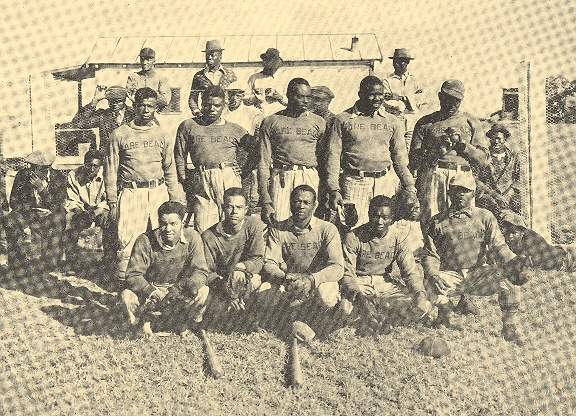
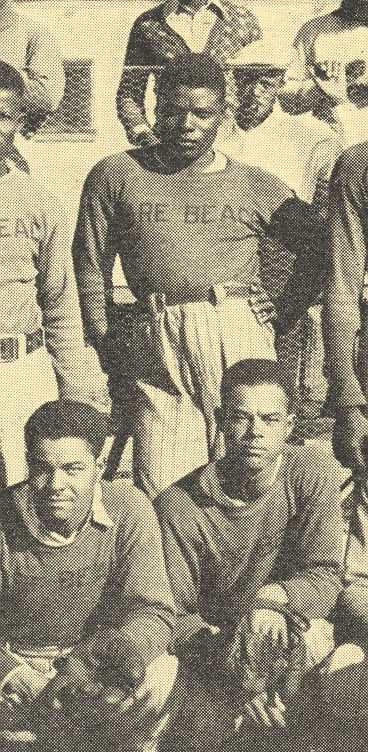
    Blog--jun 7 sugar bb And then the photos.  Pictures of Field Day festivities on acres of
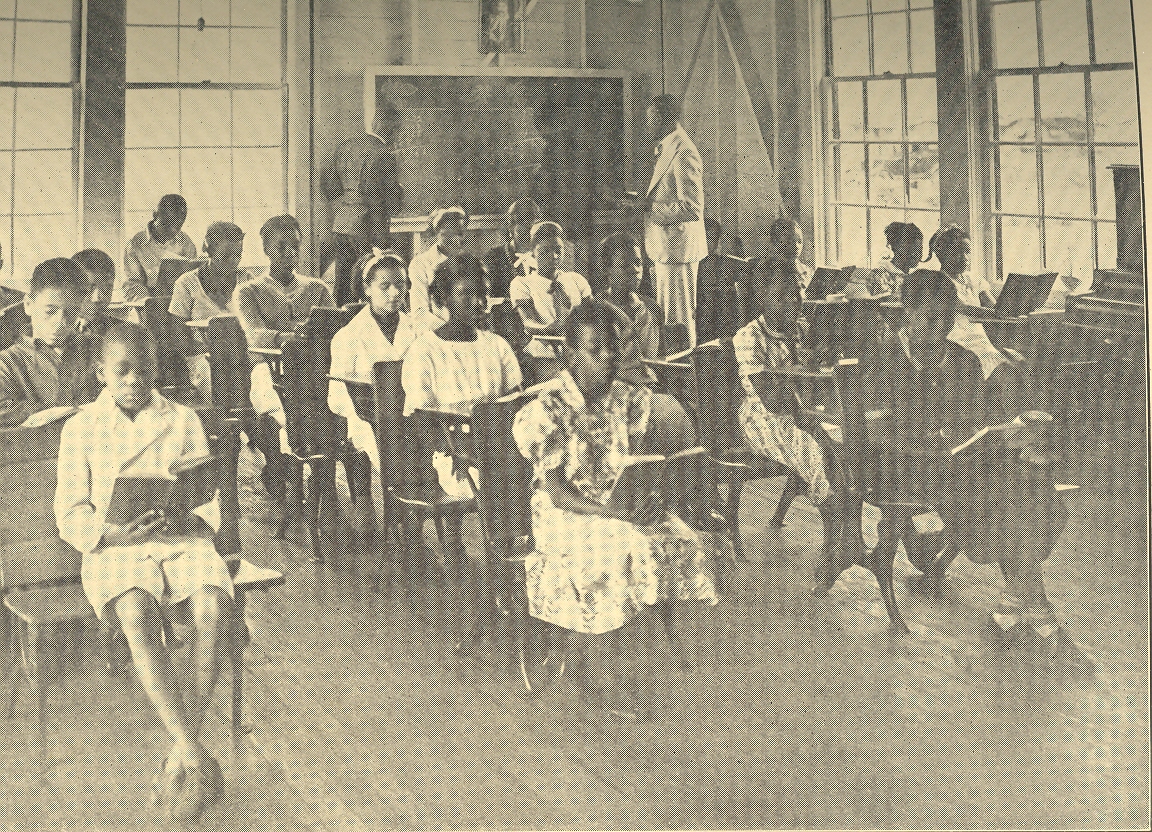
    cleared sugar cane, a tug of war, men working at a conveyor built.  Then the school room and the baseball
    team. The men in the baseball photo look proud, and ready (and formidable, especially considering how many professional players of the day were lumpy and loose, thanking god that they were wearing form-hiding loosely-fitting wool uniforms). These men were muscular, lean, hard; I bet they could play.

     Blog--jun 7 sugar school

    Blog--jun 7 sugar bb2

    The children in the airy schoolroom are decently dressed, though the poor kids in the front row have no desk.  And the walls have no interior finish.  I wonder too about the tall boys in the back of the room with their bow-tied and jacketed teacher.  What are they doing with the blackboard in the rear of the room? Was it placed there to show that the kids had a blackboard

    and it needed to be in the picture?  Or is it because this was a one-room affair, with the older children in the back, getting special attention from the teacher who was trying to give age- or capability-relative instruction under slim circumstances? My guess is that since this is 1937 and we’re talking about a company-run school in the Everglades, that the sotto voce undercurrent of thought would be that the children had a room and a teacher, and what more could they want (?)

    The photographs are unintentional monuments
    to the little bit that was given to these thousands of people–so little that
    seemed like so much to the people who had almost nothing, and also, criminally,
    it felt like so much largesse from a company that had infinitely more.

    And all of this from what would seem to be a disposable piece of ephemera–and we haven’t even gotten to the chemical hardware bits and the draining of the Everglades to get to that good cane-growing topsoil….

    *See below in extended reading for Mr. Bitting’s testimony before the Congressional Committee Investigating the Interstate Migration of Destitute Citizens. 

    ·Posted by :

    ·in: