A Daily History of Holes, Dots, Lines, Science, History, Math, Physics, Art, the Unintentional Absurd, Architecture, Maps, Data Visualization, Blank and Missing Things, and so on. |1.6 million words, 7500 images, 4.9 million hits| Press & appearances in The Times, Le Figaro, Mensa, The Economist, The Guardian, Discovery News, Slate, Le Monde, Sci American Blogs, Le Pont, and many other places… 5000+ total posts since 2008.

Author: JF Ptak

  • Stacked-Tech: Things on Top of Other Things (1926).

    JF Ptak Science Books  Quick Post

    In just three or four decades into the skyscraper era and heavier-than-air powered flight there was a certain sense of planning to join those two technological (series of) achievements. This sense of enlightenment though didn’t seem very enlightened, or practical. The idea of locating airports on the tops of tall buildings, or on structures covering rivers (like the Hudson or Thames), or on long and wide structures built over expanses of shorter inner-city buildings, seem to have had a life from the late ‘teens into the 1940s.  They were struggling ideas that struggled. 

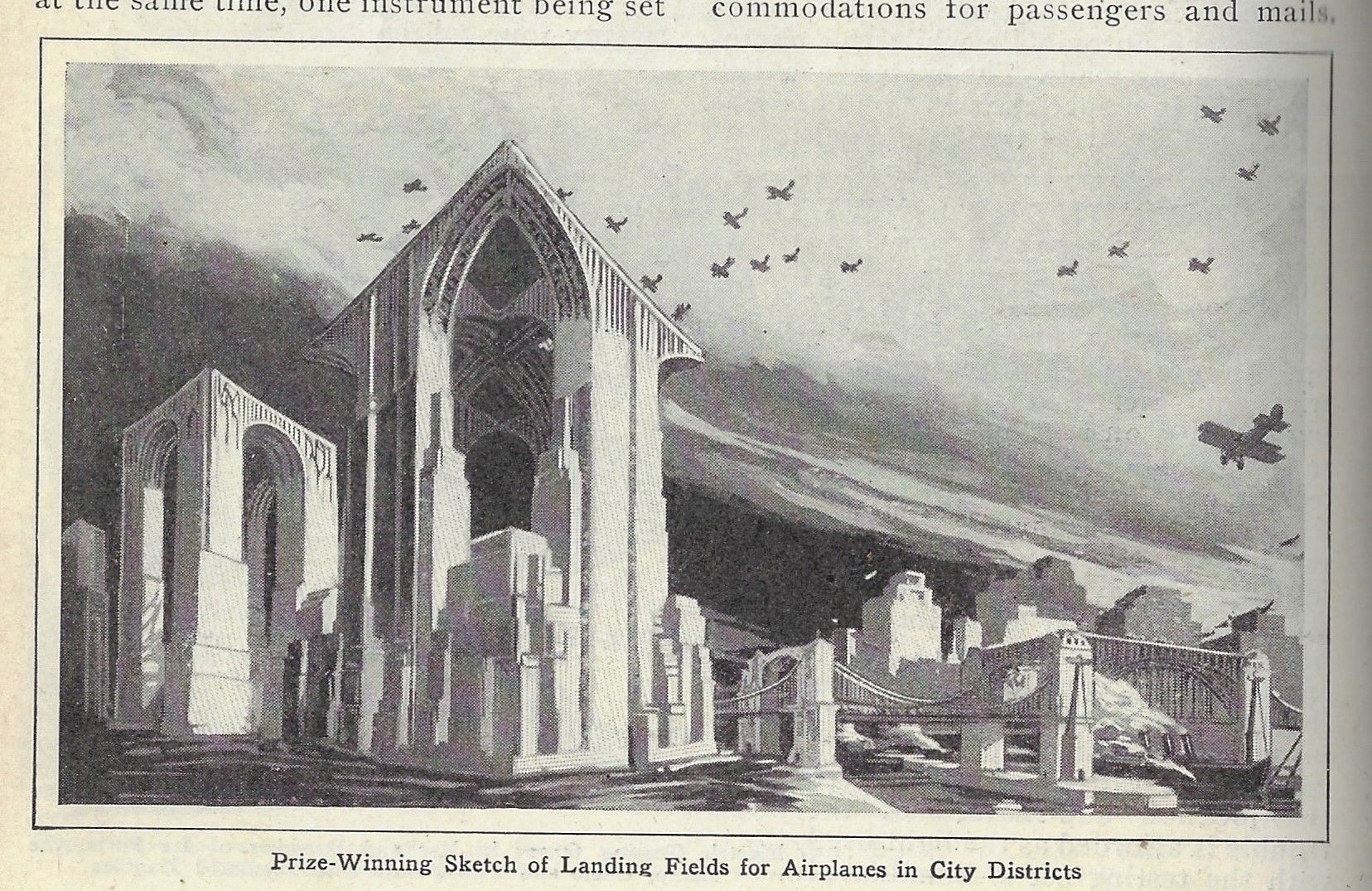
    I found two more examples of this stuff-on-top-of-other-stuff tech thinking today. The first shows a structure 950′ tall made to accommodate a strained amount of air traffic in the heart of a large metropolitan center. (There are numerous examples of this idea sprinkled throughout this blog–just pop the word “airport” into the Google search box at upper right and you should find 10 or so posts on the topic, all with great illustrations.) By the way, this was one busy dream of an airport, what with 20 planes coming and going. 

    Pop Mech 1926 tennis court resevoir

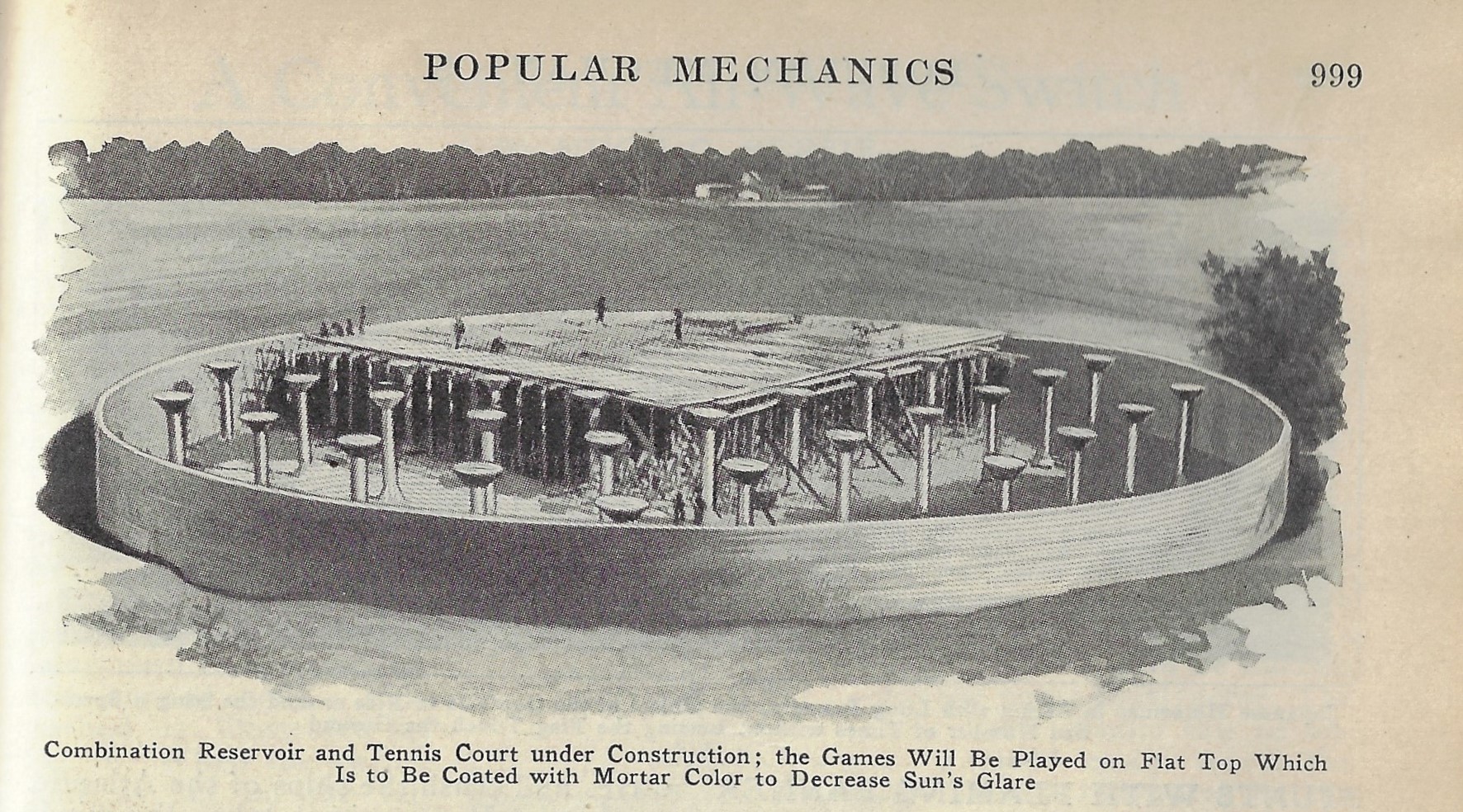
    The second image is unusual but less-techy: a tennis court built on top of a reservoir:

    Pop Mech 1926 tennis court resevoir

    I ‘m not sure how hurting people were for spaces for a tennis court in 1926, but the competition for the open land for such a thing couldn’t’ve been that severe. 


  • J.P. Joule and God

    JF Ptak Science Books  Quick Post 

    (With thanks to David Wenner for the introduction to this paper by Joule.)

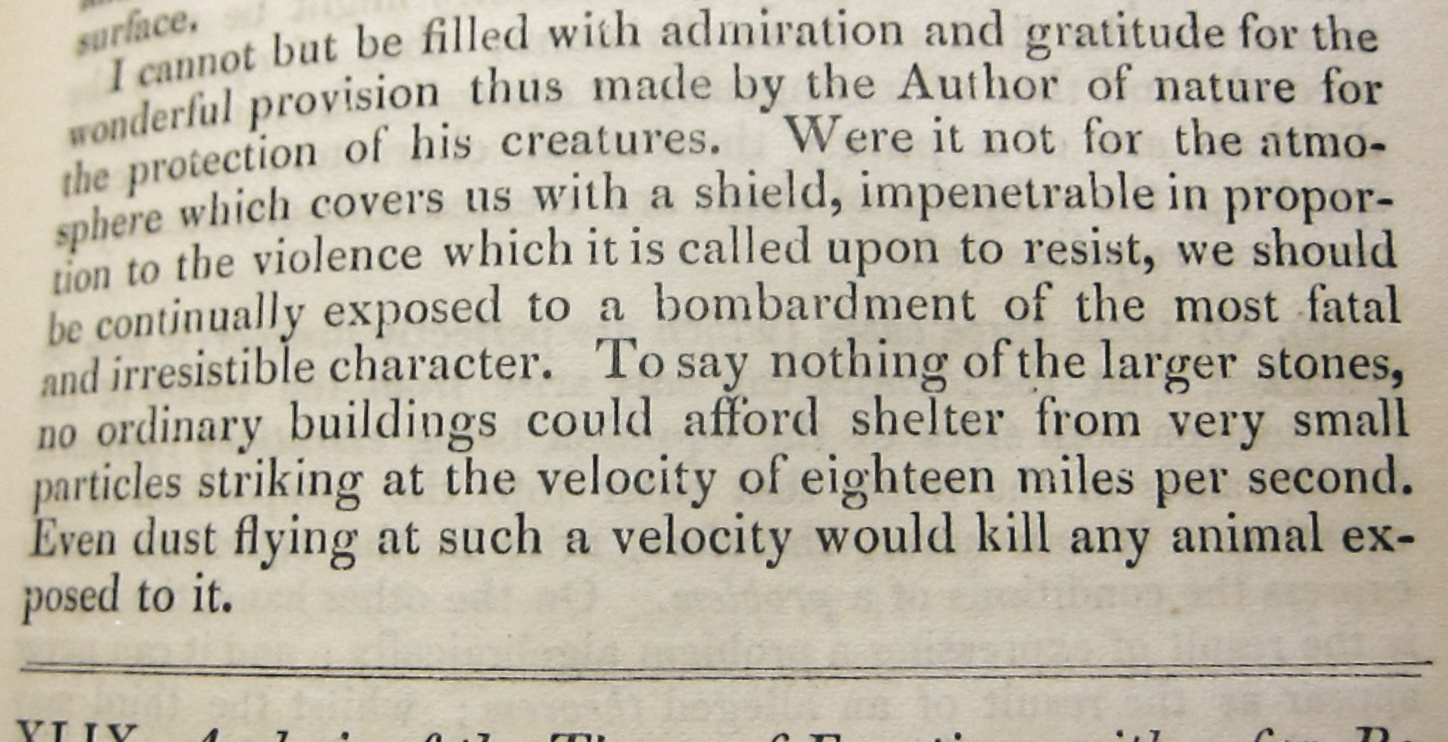
    There is a real work of unexpected beauty in the last paragraph in “On Shooting Stars” Philosophical Magazine vol 32, 1848, pp 349-351, by James Prescott Joule,  thanking the creator of the universe for including an atmosphere for the Earth.

    At the end of the day, the first law of thermodynamics is found in the law of the conservation of energy, which was found in the relationship of the nature of heat to mechanical work, which was found in the work of James Prescott Joule (“Wherever mechanical force is expended, an exact equivalent of heat is always obtained”.— J.P. Joule, 1818-1889, August, 1843.) The unit of energy called the “joule” (”used by the International Standard of Units (SI)…defined as the amount of work done on a body by a one Newton force that moves the body over a distance of one meter”–Universe Today/Astronomy ) is named for J.P. Joule.

    After addressing some issues of “shooting stars”, Joule writes his lovely closing sentiments, which to me can be easily arranged into a bit of “Found Poetry”–that is, it is the simple restructuring of the two paragraphs into a poetic format, and without changing any of the words. It is an interesting process, and I think Joule’s language easily transcends its sleepy place at the end of a mostly-forgotten work half-way through a scientific journal.

    Here it is: 

    I.

    I cannot but be filled with admiration and gratitude

    for the  wonderful provision thus made

    by the Author of nature

    for  the protection of his creatures.


    II.

    Were it not for the atmosphere which covers us with a shield,

    impenetrable in proportion to the violence

    which it is called upon to resist, we should 

    be continually exposed to a bombardment of the most fatal 

    and irresistible character [of shooting stars].

    To say nothing of the larger stones, 

    no ordinary buildings could afford shelter from very small  particles

    striking at the velocity

    of eighteen miles per second. 


    III.

    Even dust flying

    at such a velocity

    would kill any animal exposed to it.      


    This is the original bit of the poetry straightened-out, proper, and correct:

    Joule god _2_

    And the rest of the article:

    ·Posted by :

    ·in:


  • “America Asleep” (1923) and “Awake and Act” (1935)

    JF Ptak Science Books  Post 2700

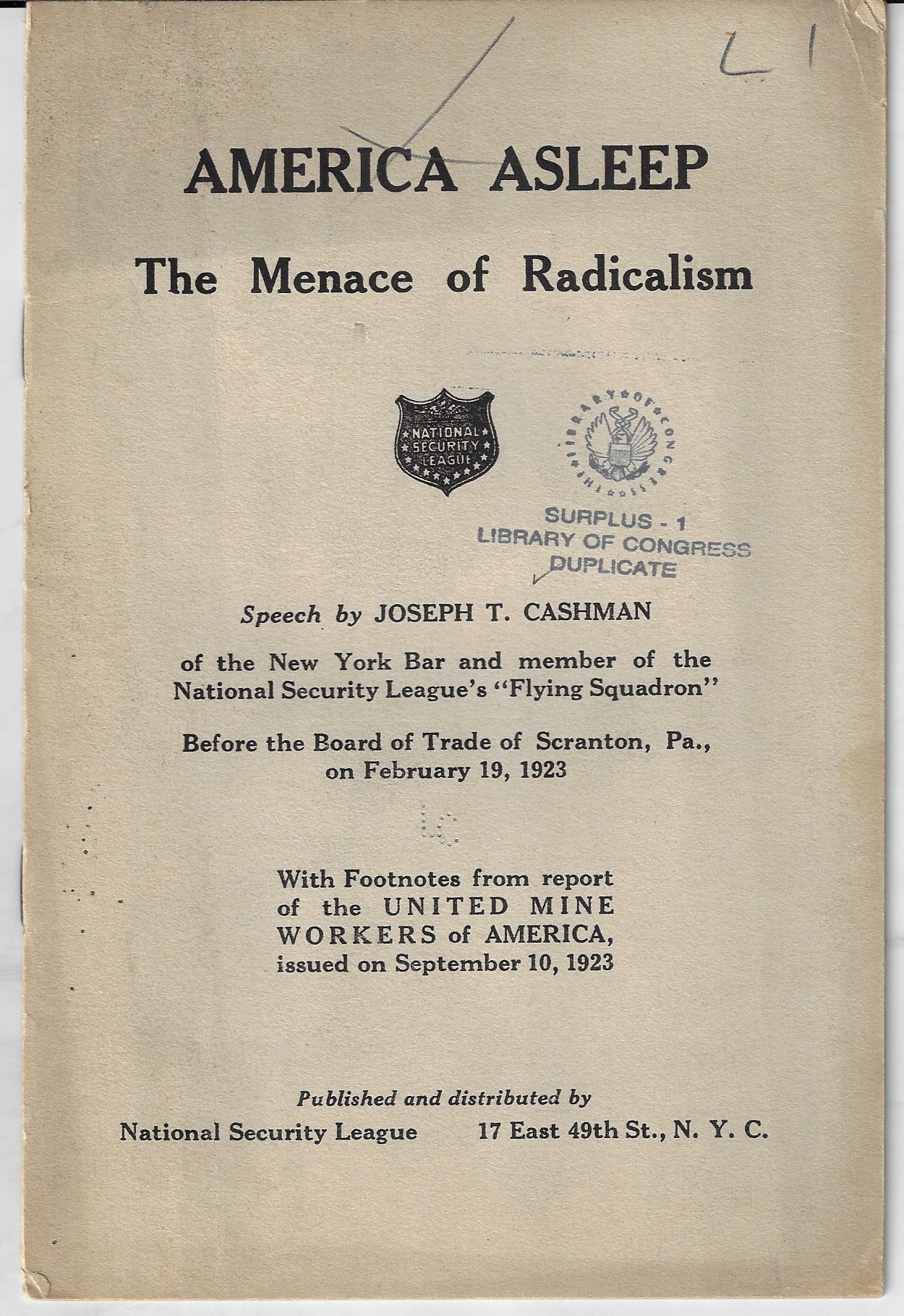
    Books covers america asleepThe “radicalism” that was a menace to America outlined in this slim pamphlet by the attorney Joseph T. Cashman (died in 1936 at 59) launched into the public consciousness in Scranton, Pa., in 1923, was Communism. Communism came in many flavors, and the author, as a member of the National Security League1, outlined some of them finding Commies in the United Mine Workers and the American Civil Liberties Union, to name two. The UMW was taking orders from the Third Internationale, which was also on its way to take over other trade unions. Then there was the larger issue of national security that was the base concern of the National Security League, which evidently went a little overboard with their issues, at one point in 1918 accusing the entire state of Wisconsin of treason.

    So, the “asleep” part is the USA not paying attention to the Communists taking over the unions newspapers, and having an influx of immigrants who were not American enough who were destined to cause trouble to our way of life, and for not recognizing that teaching foreign languages in school would lead to division, and so on. For them what was going to save the country was uniformity, obedience, pledges of all sorts (like the Lusk Law in New York where teachers had to swear to their piety, patriotism, an wholesomeness), mandatory military service, and a vast increase in military funding to secure our borders. Welcome to 1923.

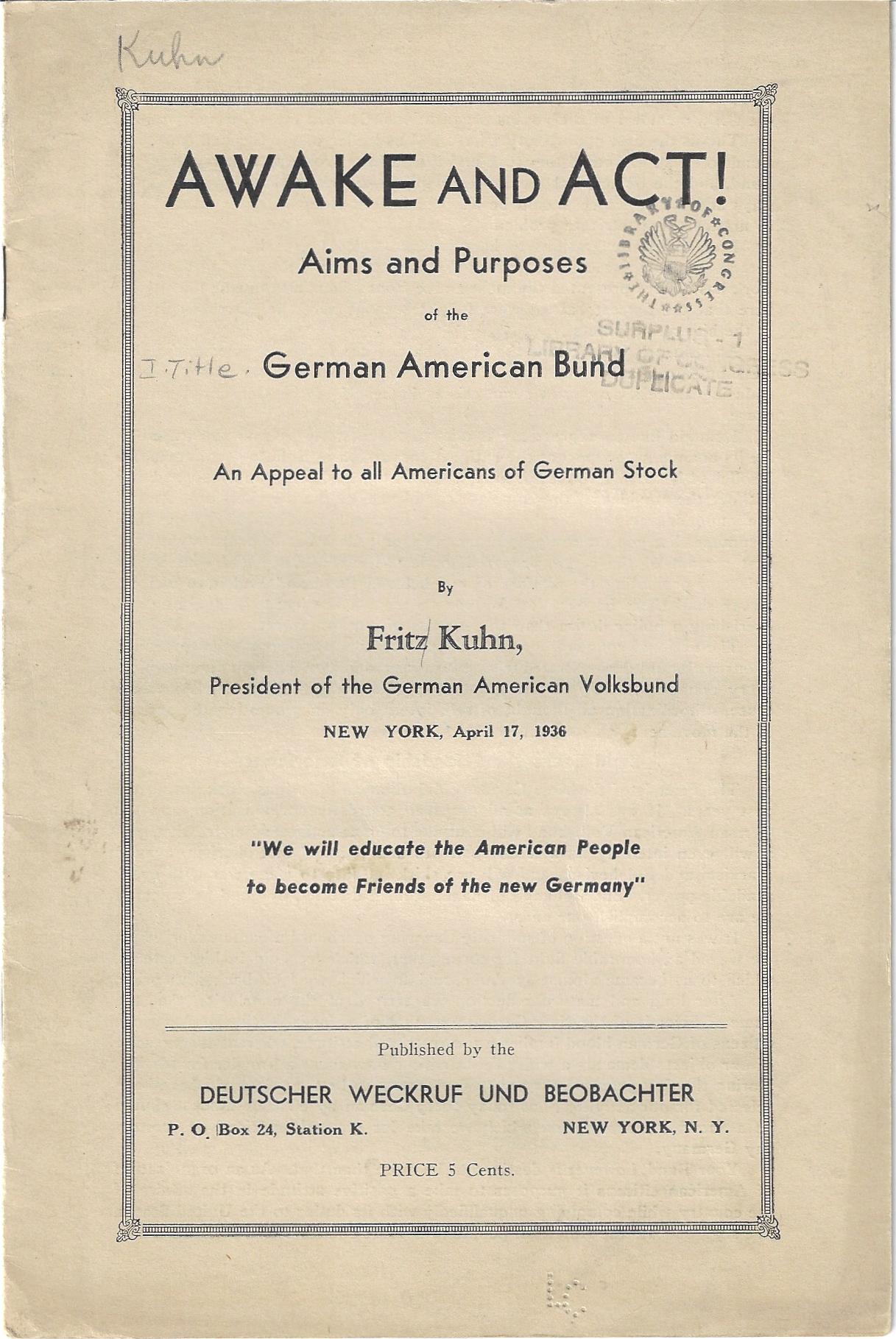
    Books covers awakw and actIn other news, there’s this pamphlet from 1936, a miserable message from a miserable man, telling the U,S, to wake up…and become National Socialists. 

    Fritz Julius Kuhn was president of the German American Volksbund and a nasty, hateful character who worked in service of National Socialism in the United States. He wound up in trouble and in jail for mishandling funds, and once the U.S. got into the war, he found himself arrested as an enemy alien and sent to spend time in the interment camp on Ellis Island. He was kicked out of the country, and then arrested again by U.S. Occupation Forces and sent to Dachau in 1947 as part of the Denazification effort of Gen. Lucius D. Clay. Of course Dachau wasn’t the Dachau of Kuhn’s idol, so he unfortunately did not experience the camp of his intentions. He died in 1951, and that was that. Provenance: the Library of Congress, the pamphlet being a gift from the Bund.

    In 1936 Kuhn wasn’t yet interested in taming the U.S. for the Nazis, though he was interested in protecting it from the greatest evil of mankind–Communism.. Actually, it turns out to be Bolshevism, but the controlling power to this is”the war battalions of the Jewish capitalists of the stock exchange” which was “the international (J)ewish attack of world Marxism”, which he said is what was attacking Germany, presently. There’s a lot more of this rhetoric in the pamphlet…actually, that is all there is in it, this sort of language, written by a non-native speaking chemist walking in Hitlerian glory and not all that smart. He was smart enough though in his rants, and tirades, and his anger was such that he was able to get 20,000 people to attend a rally at Madison Square Garden in 1939 where amidst his adjectival malignancies he ranted against “Franklin Delano Rosenfeld” and his “Jew Deal”, much like the language used in someone else’s beloved Ezra Pound’s traitorous broadcasts from Italy during the war. This was the straw that broke the stinking fascist’s back, though, terminally pissing off Mayor Laguardia who went after Kuhn’s taxes and found fraud and embezzlement. And so off he went.  But not before ruining the memories of those people who witnessed their friends become engorged by his wrath and hatred, a ruined man with ruinous ideas who ruined people. 

    Notes:

    1. “The National Security League (NSL) was an American patriotic, nationalistic, nonprofit, nonpartisan organization that supported a greatly-expanded military based upon universal service, the naturalization and Americanization of immigrants, Americanism, meritocracy, and government regulation of the economy to enhance national preparedness. Many of the programs advocated by the NSL, such as a unified national defense agency, an interstate highway system, universal conscription, English as the official language, and a unified national budget, were highly influential. Although the organization had declined before it finally folded in 1942, many of its ideas would become national policy in the United States.”–Wikipedia


  • Scarce Collection of Portraits of Physicists, 1908

    JF Ptak Science Books  Quick Post

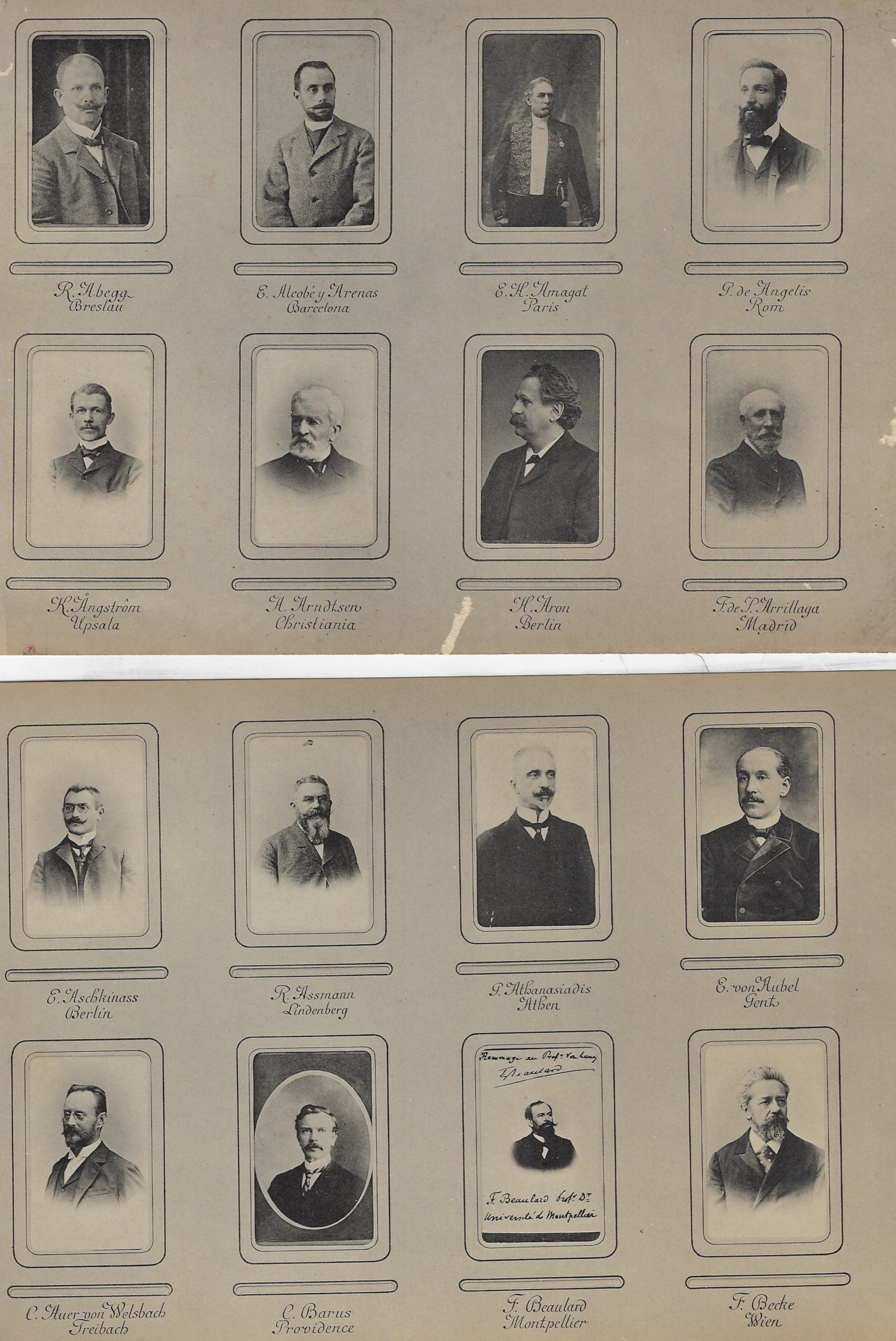
    This scarce publication–Bildnisse zeitgennossischer Physiker–is a collection of about 320 portraits of leading physicists, collected together as an homage to Viktor von Lang on the occasion of his 70th birthday.  The book was made to look like a family portrait album, resembling stiff cardboard pages that would have open places in the pages for a collection of cartes des visites to be slid into place via at slot at the bottom of the window. The physicist are from Germany, France, the UK, Spain, the U.S., Russia, Czechoslovakia, Poland, Italy, Hungary, Japan, and a few other countries.  Interesting to note here are the three portraits of women physicists: Margaret Maltby (Barnard, and first woman to receive a doctorate from a German university); A. Serdobinskaja (St. Petersburg); and O. Steindler (Vienna).

    Lang (1838-1921, one of the founders of crystal physics and from 1865 to 1909 (!) the director of the Physikalisches Kabinett in Vienna) is listed in some references as the author though I’m pretty certain that the work was edited by someone else and presented to Lang as an appreciation for his long contribution to science. There is also no mention of a place of publication.

    There are only four copies of this book found in WorldCat, and I only found a handful of the published photos online, so I thought to reproduce the book in its entirety Each section is expandable; the images were scanned at 200dpi so I think they will stand up nicely for individual reproduction. 

    Physics portraits _1_

    ·Posted by :

    ·in:


  • Questionable Quidity: “A very unexpected feature of war-time has been the decline of insanity” (1918)

    JF Ptak Science Books  Quick Post

    Among the many unexpected sentences that Prof. J.A. Lindsay1 (1856-1931) writes in his article “The Eugenic and Social Influence of the War” (in The Eugenics Review, volume X, No. 3, October 1918) are the following:

    “A very unexpected feature of war-time has been the decline of insanity.”

    And

    “… that war, fruitful though it is in shock cases and neurasthenia, does not increase, but may even tend to diminish, insanity.”

    I’ve included the two long paragraphs in which they occur, below, and also provide a link for the full article.

    Of course this makes no sense as it stands, but there it is.

    Dr. Lindsay’s article is followed straight away by Charles Darwin’s son, Major Leonard Darwin, who wonders about the eugenic survivability of the war in his “The Need for Widespread Eugenic Reform During Reconstruction”. 

    Eugenics as a way of life was in its heyday at this point, though its demise was approaching, and its ideas (for far as establishing it as a field of intellectual study) discredited in the next decade or so, even though the journal The Eugenics Review would survive into 1962. 

    Here are the quotes (bold mine):

    ·Posted by :

    ·in:


  • Very Heavy Journalism, Old School–a Gift from H.L. Mencken

    JF Ptak Science Books   Quick Post

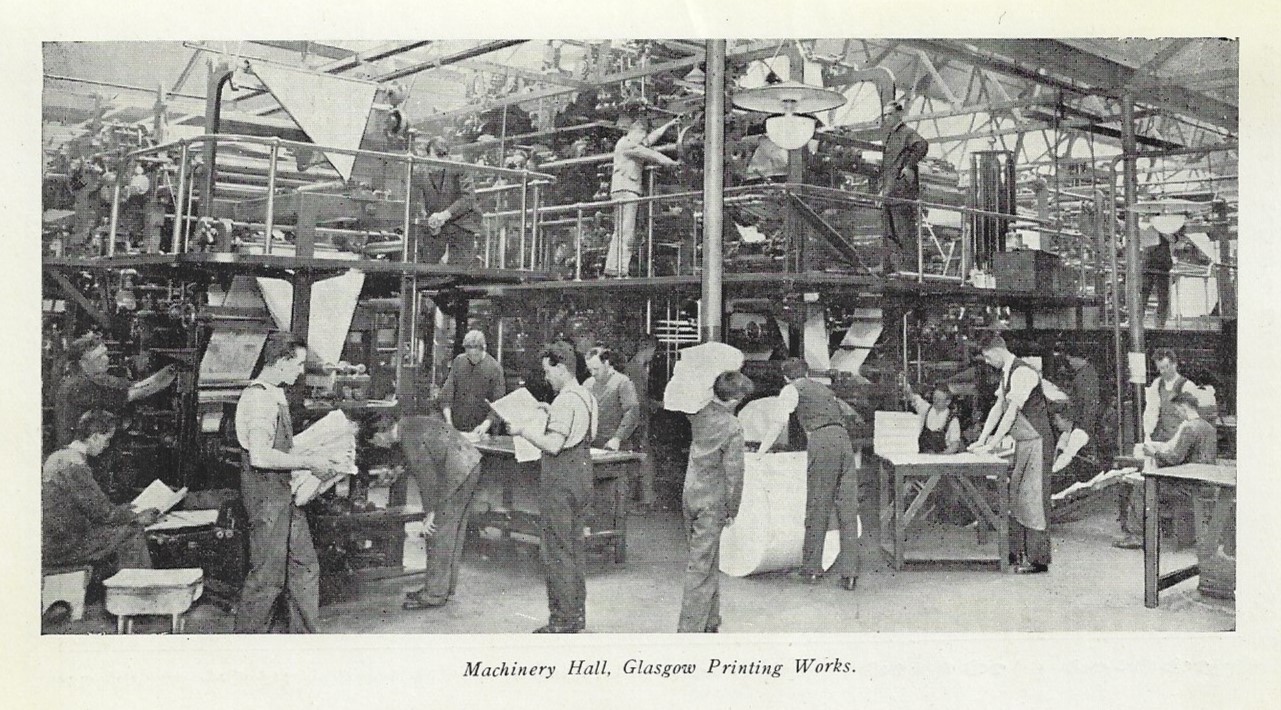
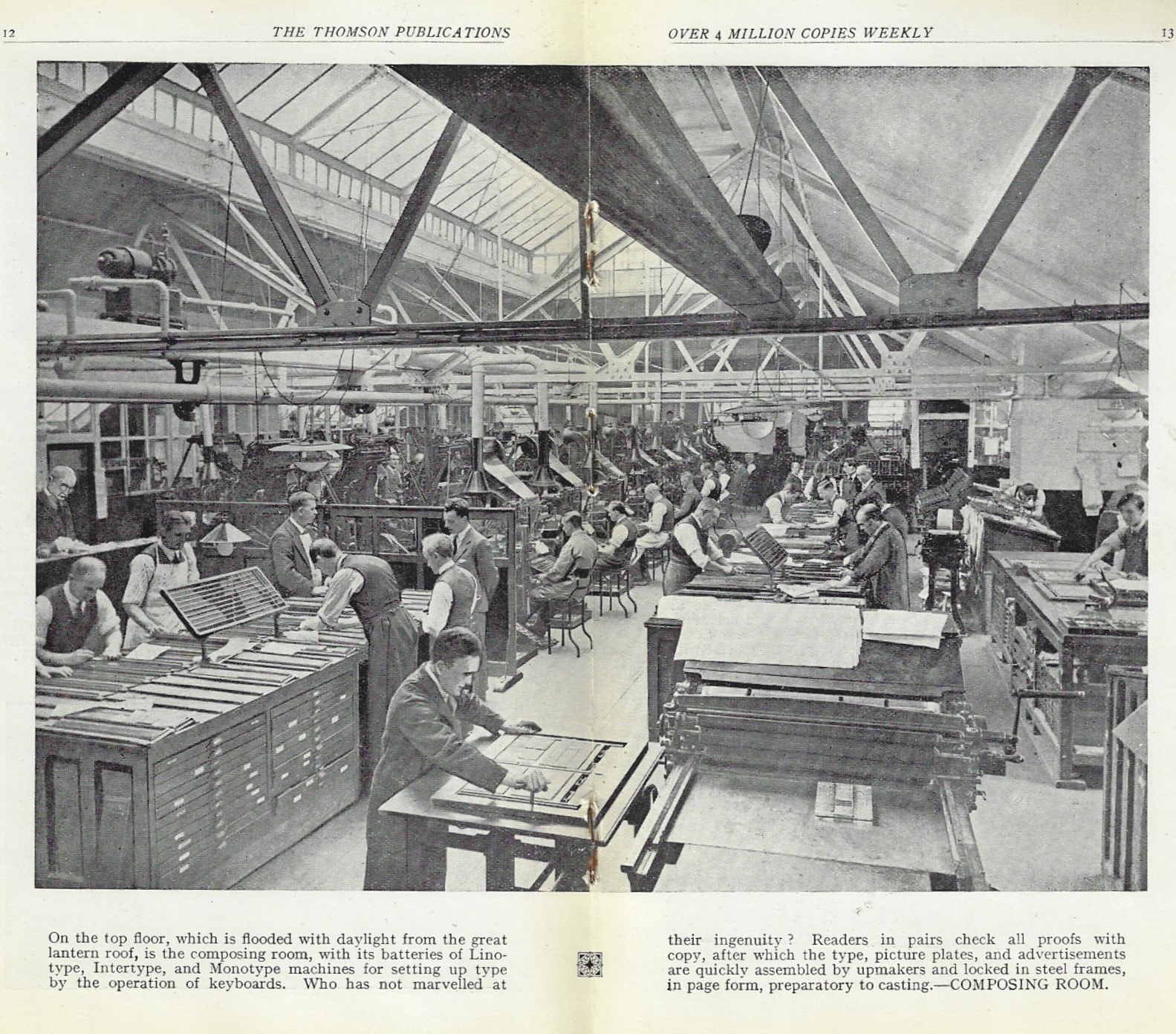
    Here’s another lesson in the continuing and forever-expanding series on not judging by appearances: the following terrific images were found in a very tall and slender, stiff and demure 1920’s publication celebrating the Thomson Printing Works of London (and Glasgow, Dundee, and Manchester). The calf-bound book has the feel of an antique wallet, and even though the binding is sumptuous the cover is imprinted “A memento of a visit to the Thomson Printing Works, Dundee, Glasgow, Manchester”, which made it a rather expensive give-away–if that is so it was probably given only to the special few and not to the great unwashed. (My copy belonged to H.L. Mencken, who kept it until 1935 when he gave it away). Anyway Thomson was a busy printing house/publisher, sending out millions of pieces, and the illustrations in the publication gives the reader an idea of the heavy hardware that went into the process. It is all very impressive. Also the photos of the human aspect of the firm–the crowded work and editorial and etc. rooms–well, it gives you an idea of the closeness and noise of the place as it might have been on a late summer afternoon in 1928.  [And by the way, I just checked WorldCat for this title and there’s only one copy listed–National Library of Scotland–which means the thing is pretty rare, and which also means that these terrific photos have probably not been shared very much at all…]

    The heavy hardware:
    Thomsons publications _8_ end product

    I wonder how much just the type weighed in the composing room?

    Thomsons publications _8_ end product

    ·Posted by :

    ·in:


  • On the Future of the Telephone as an Instrument for Listening to Music Remotely (Summer, 1876)

    JF Ptak Science Books  Quick Post

    Here’s an interesting piece on the future of the telephone, written just a few months after Bell’s patent was granted him (at the age of 29) on March 7, 1876. “Telephones and other Applications of Electricity”, appearing August 24, 1876 in Nature (volume 14, pp 353-355), written anonymously though probably by the editor (and founder of the journal) J. Norman Lockyer, discusses advancements in telegraphy and then switches to the telephone. It was not Bell’s telephone that the writer was discussing, but (mostly) that of Elisha Gray and “Reuss” (actually meaning Philip Reis).—and as a matter of fact there is no mention whatsoever of Mr. Bell.
    The article turns its interest to the future and to the telephone, and how it may come to be that you could basically dial up any sort of music you’d like to hear, and thus do away with live musical entertainment. Curiously there isn’t an implication for the using the telephone for communication–maybe the absence of Bell is less surprising in a way because Reis’ instrument was actually pretty good at transmitting musical sounds and not-so with voice. Still this is a little odd, given that Bell made his famous demonstrations of the instrument’s efficacy just weeks after his patent was granted.

    The text:

    • “We do not, however, believe that in its [the telephone’s] present state, the invention is so complete that we can, at a distance, repeat on one or more pianos the air played by a similar instrument at the point of departure. There is a possibility here, we must admit, of a curious use of electricity. When we are going to have a dancing-party, there will be no need to provide a musician. By paying a subscription to some enterprising individual, who will, no doubt come forward to work this vein, we can have from him, a waltz, a quadrille, or a galop, just as we may desire. Simply turn a bell-handle, as we do the cock of a water or gas-pipe, and we shall be supplied with what we want. Perhaps our children may find the thing simple enough.”


  • Found Art: Found Documentary Photos in an Obscure Publication (1931)

    JF Ptak Science Books   Quick Post

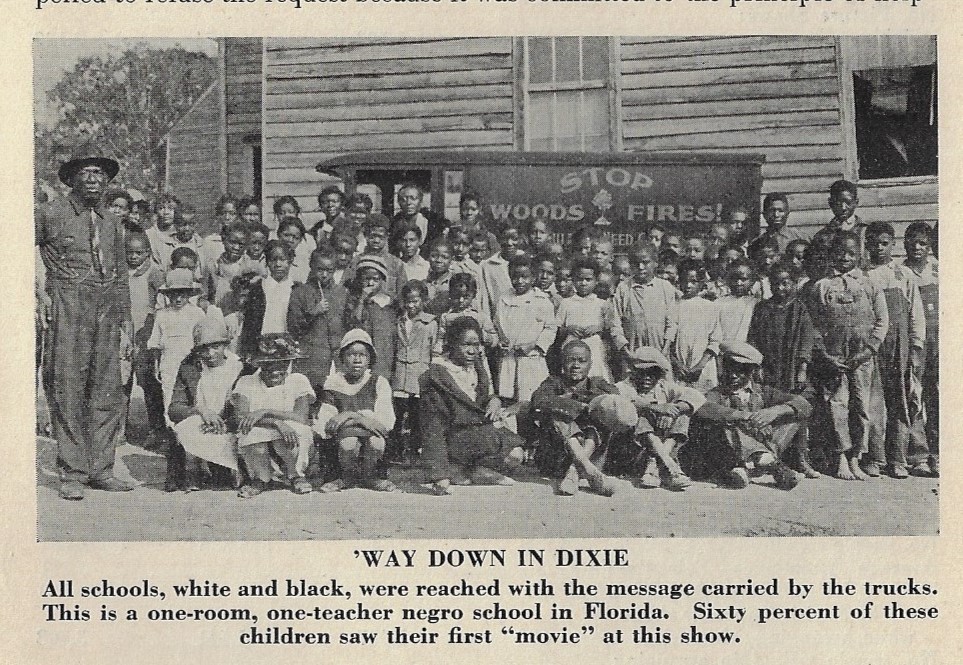
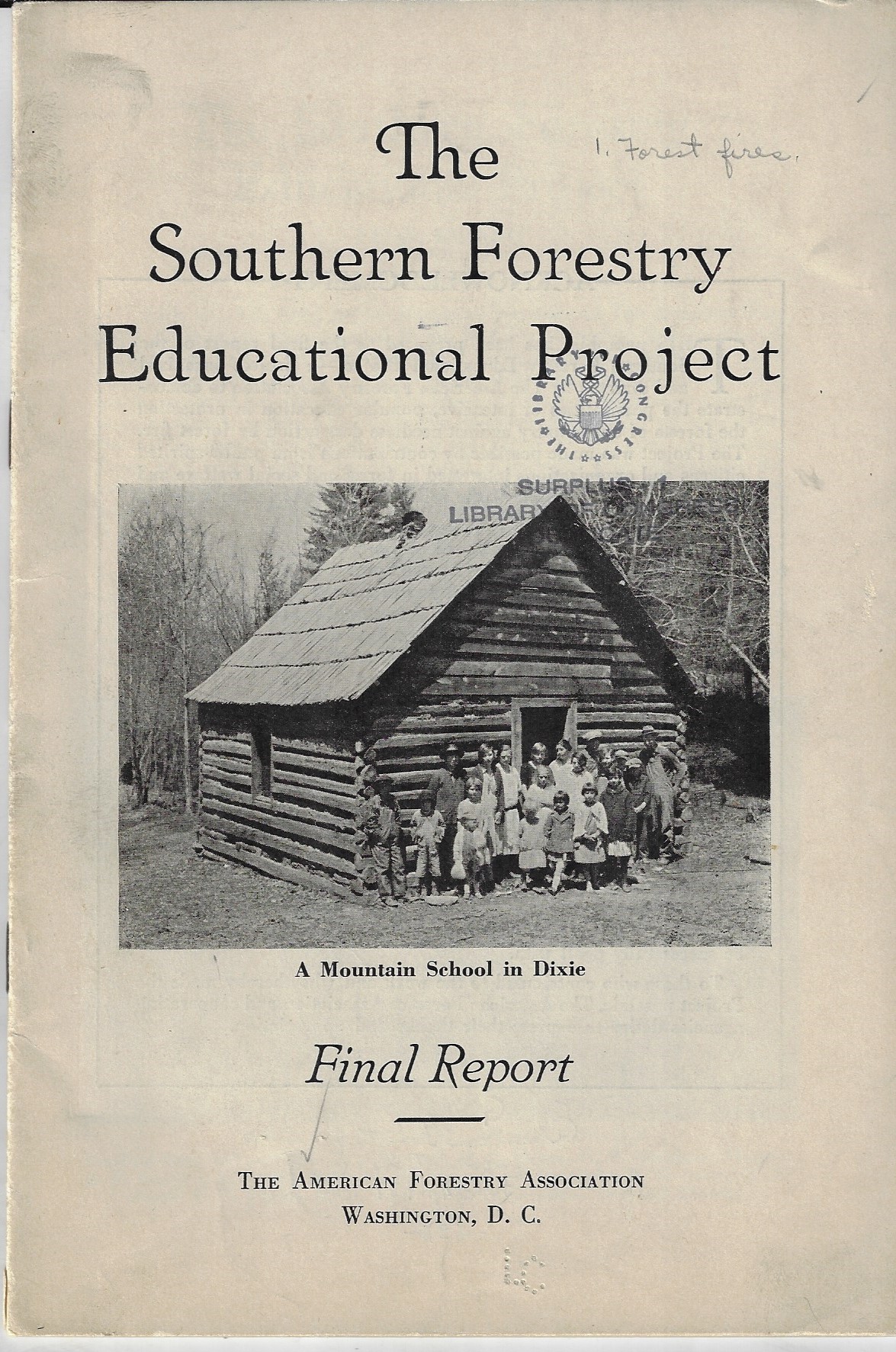
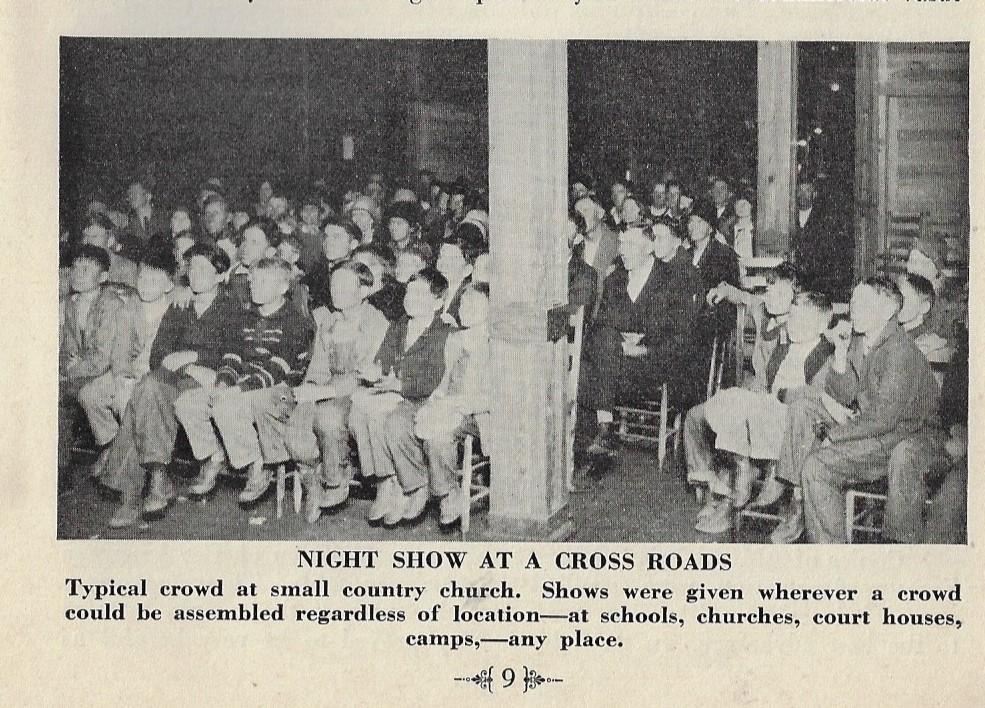
    The catalog description for the slim 1931 pamphlet,  The Southern Forestry Educational Project Final Report (American Forestry Association of D.C.) 1937, doesn’t exactly make the generally-curious reader generally curious. As it turns out it packs a lot of data and info into its thirty-two very tight and crisply-written pages–better yet are the photo illustrations, which were a real surprise, and have for the most part nearly every measure of what documentary photography would become in just a few years under the Farm Security Administration. American Forestry sent trucks out into the deep parts of Mississippi, South Carolina, and Georgia to host community meetings in which there were lectures and movies on forest use, maintenance, and fire prevention–for many first movie experience. All tolled from 1928 through 1931 there were 7,370 lectures and “picture shows” given to some 1.1 million attendees, which sound like pretty big numbers to me.  

    [The analysis shows that of the 4,606 picture shows only 504 were given at “Negro schools”; of the 2,764 lectures 1,200 were given to audiences at schools for African Americans.]


    Forest Service Dixie _3_
    Forest Service Dixie _3_

    Forest Service Dixie _3_


  • The “Beneficial Exercise” of Walking the Trail of Tears (1838)

    JF Ptak Science Books   Post 1387 (from 2011, extended)

    • I’m revisiting this post again as I’m going to send off the book that provided its source, and before it goes, I wanted to make sure of the damning quote found below. For some reason when you google the quote there are just 10 hits: my earlier post, a 1910 history of Oklahoma, Helen Hunt Jackson’s A Century of Dishonor: A Sketch of the United States Government’s Dealings from 1880, and then seven U.S. government doc/serial sites with the full text of the volume. Why this quote is not more widely known is a mystery to me. 

    The “Beneficial Exercise” of Walking the Trail of Tears (1838)

    “…strong men, women, boys and girls, not only capable of marching twelve or fifteen miles a day, but to whom the exercise would be beneficial.”  —General Winfield Scott, military leader in charge of the removal of the Cherokee nation, 1838, on the benefits of enforced marching of men, women and children over an 800-mile course.

    Most people are familiar with the story of the Trail of Tears, the epic tragedy of the “removal” of a class of people—the Cherokee Indians in this case—from their homes in the east to a new land appropriated for them in Indian Territory (present-day Oklahoma). (In the Cherokee language, the event is called Nu na da ul tsun yi (the place where they cried), another term is Tlo va sa (our removal).) The Cherokees were given the ultimatum to leave their homes in Georgia, Texas, Tennessee, Alabama and North Carolina, doing so in the period from 1836 to 1839—the first part of the exodus was prompted by the U.S. Government but not necessarily enforced. The later part, however, in the spring of 1838, was absolutely enforced, with General Winfield Scott arriving on the scene with 7,000 U.S. Troops to round up the last of the remaining Cherokees and take them—by force if necessary—to Indian Territory.
    Cherokee Scott 1838

    There were approximately 12,0001 Cherokees left in the east by the time of Scott’s arrival—by the time their enforced march to the west was completed, around 4,000 Cherokees would be dead.

    The ease with which this re-settlement was partially removed from the broader moral and ethical implications of marching 12,000 men, women and children an 800 miles west in the fall and winter of 1838/9 was accomplished with abstract language in the government reports describing the affair.

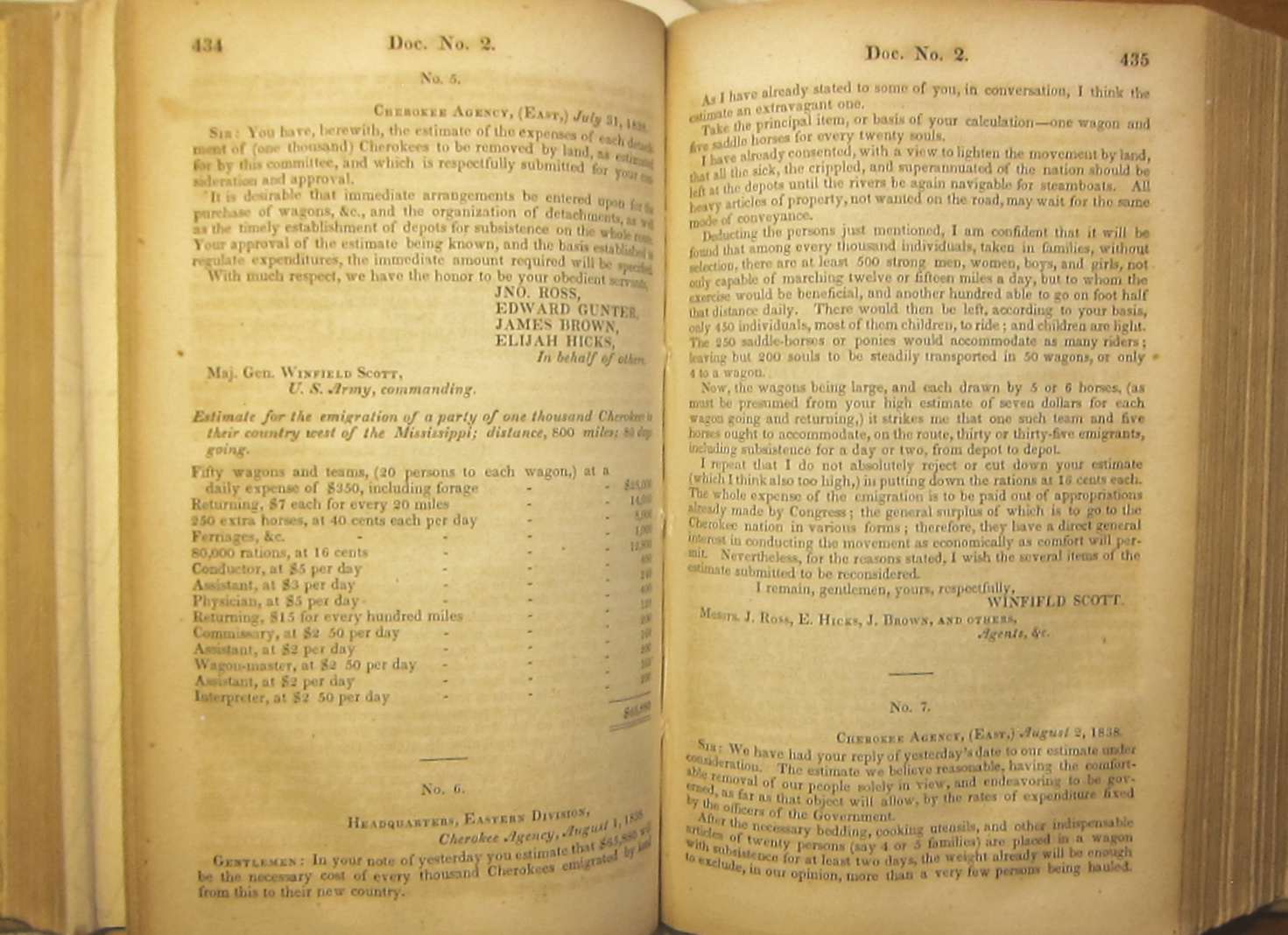
    For example, smothered in the thousand pages of the executive documents printed by Thomas Allen for the U.S. government of the 25th Congress, 3rd session, 1838 of  nine documents printed in volume one is document #2, “Message of the President of the United States to the Two Houses of Congress….”, and in there resides a 94-page section called “Report of the Commissioner of Indian Affairs” (occupying pp 410-506), and in that section is the compelling sub-document, “Emigration of Indians”. It is there that we find the clinical appraisals of the government efforts to scoop the Cherokees up and deposit them far west. For example, we are told that “(an) aggregate of 18,000 Cherokees…have ceased to live east of the Mississippi during the Spring, Summer and Autumn”, this after General Winfield Scott had “collected them”. Removing an entire Indian tribe had been a simple matter of that tribe no longer living there anymore, having been “collected” by the Army and “emigrated” to points west.

    The “collection” part is told elsewhere and often and more brilliantly than I can relate here—it is the material of a deep national tragedy. Suffice to say presently that 16,000+ people were herded together at bayonet and gunpoint, given scant opportunity to collect themselves, and then brought together in concentration camps to await the arrival of the last of their tribe. After that, most were marched in stages to Oklahoma, through bad weather of all descriptions—from drought to rain to high heat and bitter cold—sometimes encamped in stockades to wait for river levels to rise and fall, allowing dysentery and other diseases to come into the population and take hold. 4,000 people would die along the way–each mile would wind up killing five  people, one death per every 1,000 feet.

    The section on the emigration of the Indians is alternately heart-breaking and infuriating. There is a series of correspondence between John Ross, representing the leadership of the Cherokees, and General Winfield Scott, regarding the mechanics and monetization of removal. The Cherokees at this point make every attempt to accommodate their pending future with dignity and humility, acquiescing on almost all government points in what I think were the hopes of gaining a few extra necessities for the people making the trip. Generally, the requests were rejected. Coffee and sugar were at one point presented to Scott as a necessary—Scott refused, saying that the disbursements for the removal had already been made, even though all of the monies were coming from government funds allocated to the Cherokees for the lands they were having stolen on the heals of their exit.

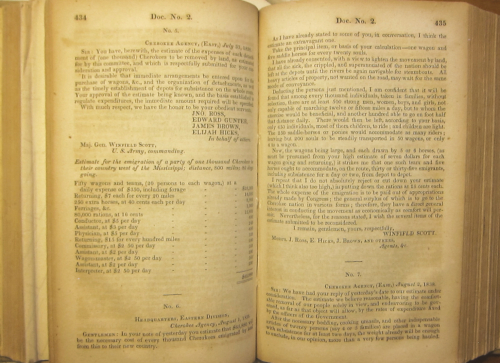
    Another particularly infuriating example of misogynistic governmental neutral-speak—a towering example, really, an incredible, unspeakably-wrong statement—occurs on page 435 in a letter from Scott to John Ross et alia. In response to a request from Scott for extra wagons to help transport the young and the old and possessions and food, Scott refuses. He refutes the estimated expense of $65,000 per every 1000 Cherokees for the entire trip of 800 miles (over 80 days), regarding the estimation of this need as “extravagant”:

    “As I have already stated to some of you in conversation I think the estimate an extravagant one. Take the principal item or basis of your calculation one wagon and five saddle horses for every twenty souls. I have already consented with a view to lighten the movement by land that all the sick the crippled and superannuated of the nation should be Heft at the depots until the rivers be again navigable for steamboats. All heavy articles of property not wanted on the road may wait for the same mode of conveyance.”

    He continues to his incredible statement quoted above:

    “Deducting the persons just mentioned I am confident that it will be found that among every thousand individuals taken in families without selection there are at least [of the 1000-person figure quoted above] 500 strong men women boys and girls not only capable of marching twelve or fifteen miles a day but to whom the exercise would be beneficial and another hundred able to go on foot half that distance daily. There would then be left according to your basis only 450 individuals most of them children to ride and children are light. The 250 saddle horses or ponies would accommodate as many riders leaving but 200 souls to be steadily transported in 50 wagons or only 4 to a wagon.”3

     And just to set the record straight on this, we are talking about 800 miles of marching, in weather good and bad, over a period of many months (and sometimes extending to a year).

    There were allocated 50 wagons and teams for the journey for all of those thousands of people, the teams costing $28,000 in rent for the entire journey, ironically paid for by the Cherokees. The sugar and coffee which had not been provided for in the original rations list and which were excluded, would’ve raised the cost of the average daily ration allowance a few cents too many, exceeding the 16 cents per day/person for the journey.

    This of course was not the only Indian “removal”, not even the only removal for this year—it was the stage of affairs for many dozens of tribes over the course of two centuries, revisited and replayed and reprise d over and over again, with different actors, different agents, different tribes and different places—all with the similar result. (For example, even among just the Five Civilized Tribes, the Choctaw were the first to be removed in 1831, then the Seminoles in 1832, the Creeks in 1834, the Chickisaw in 1837, and then the Cherokees in 1838.)

    As awful as Scott’s correspondence reads to me I am reminded that among the general staff it was Scott who was seen as sympathetic to the Indians’ plight, that it was Scott who was ostracized for being too accommodating. This may have actually been the very best that the U.S. Government could offer, which is utterly tragic. 

    Notes:

    1. In the fall of 1835, a census was taken by civilian officials of the U.S. War Department to enumerate Cherokees residing in Alabama, Georgia, North Carolina, and Tennessee, with a count of 16,542 Cherokees, 201 inter-married whites, and 1592 slaves (total: 18,335 people).  The total number of deaths  for the Removal is much studied and debated–estimates range from 2,000 to 6,000 people. 

    2.  Message From the President of the United States to the Two Houses of Congress, at the Commencement of the Third Session of the Twenty-Fifth Congress, page 434 for both quoted phrases.

    3.  Ibid, Page 435.
    ·Posted by :

    ·in:


  • Found-Semi-Documentary Photography (Georgia, 1898)

    JF Ptak Science Books   Post 2795

    Sometimes “surprises” are quick to come to recognition, and sometimes they are slow, and sometimes they do a fast-creep into existence. The following surprise is a combination of the three—it may not have developed into the “something” I thought it nearly was, or is, but given the initial shock in seeing them, there probably is a “there”, there.

    I’m speaking of the illustrations for what is mostly a benign work, Georgia, its Resources, Condition and Opportunities, Preliminary Pamphlet, which on the face of it has very high potential for boredom and nothingness. It was published though in Atlanta in 1898, which gives it some hope—it also had in a sub-sub-heading that it was sponsored by the “Georgia Immigration and Investment Bureau”, which breathes some life into the thing.

    On opening the pamphlet immediately gave up its prize—photographs. And this was the first photo I saw:

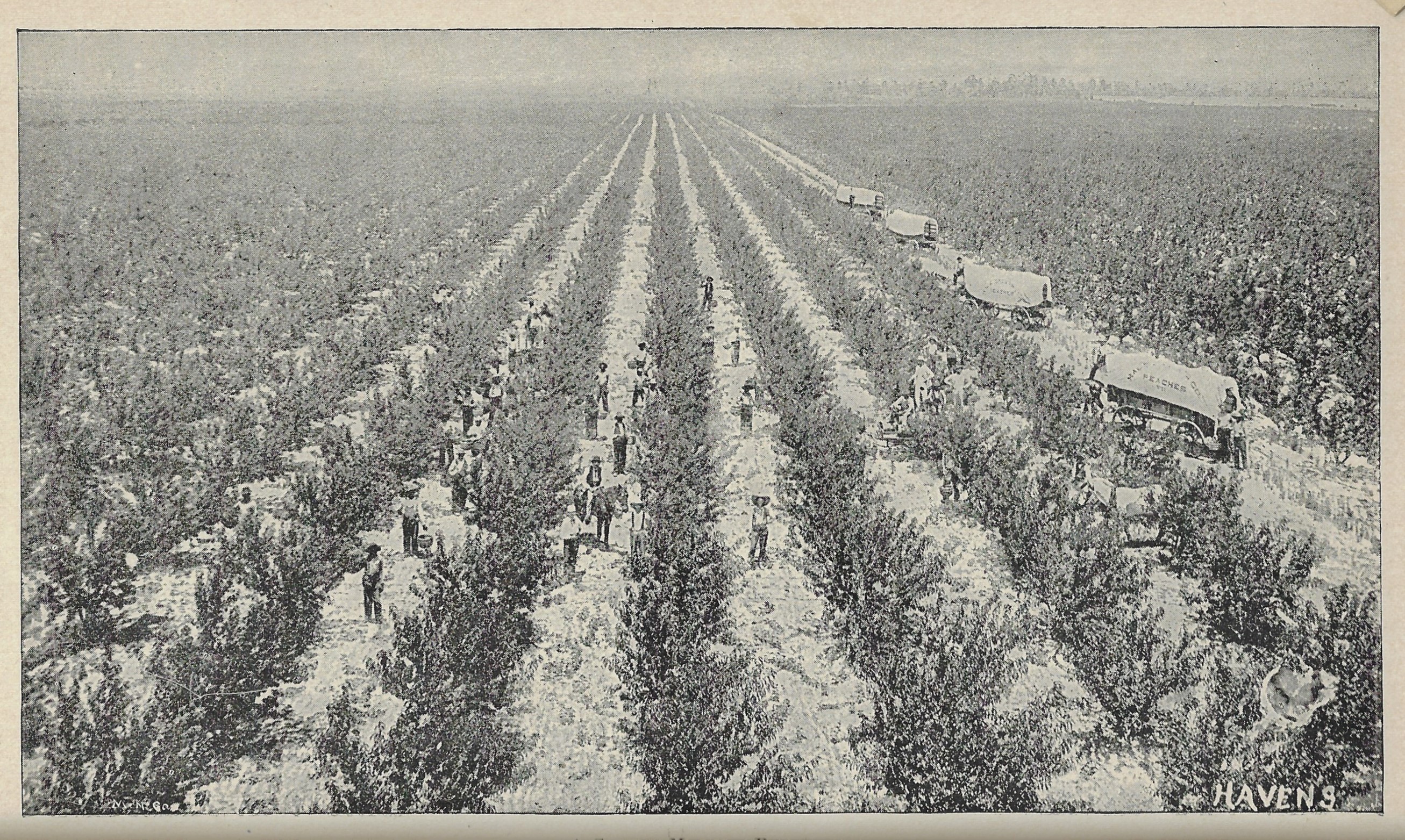
    Georgia resources _3_

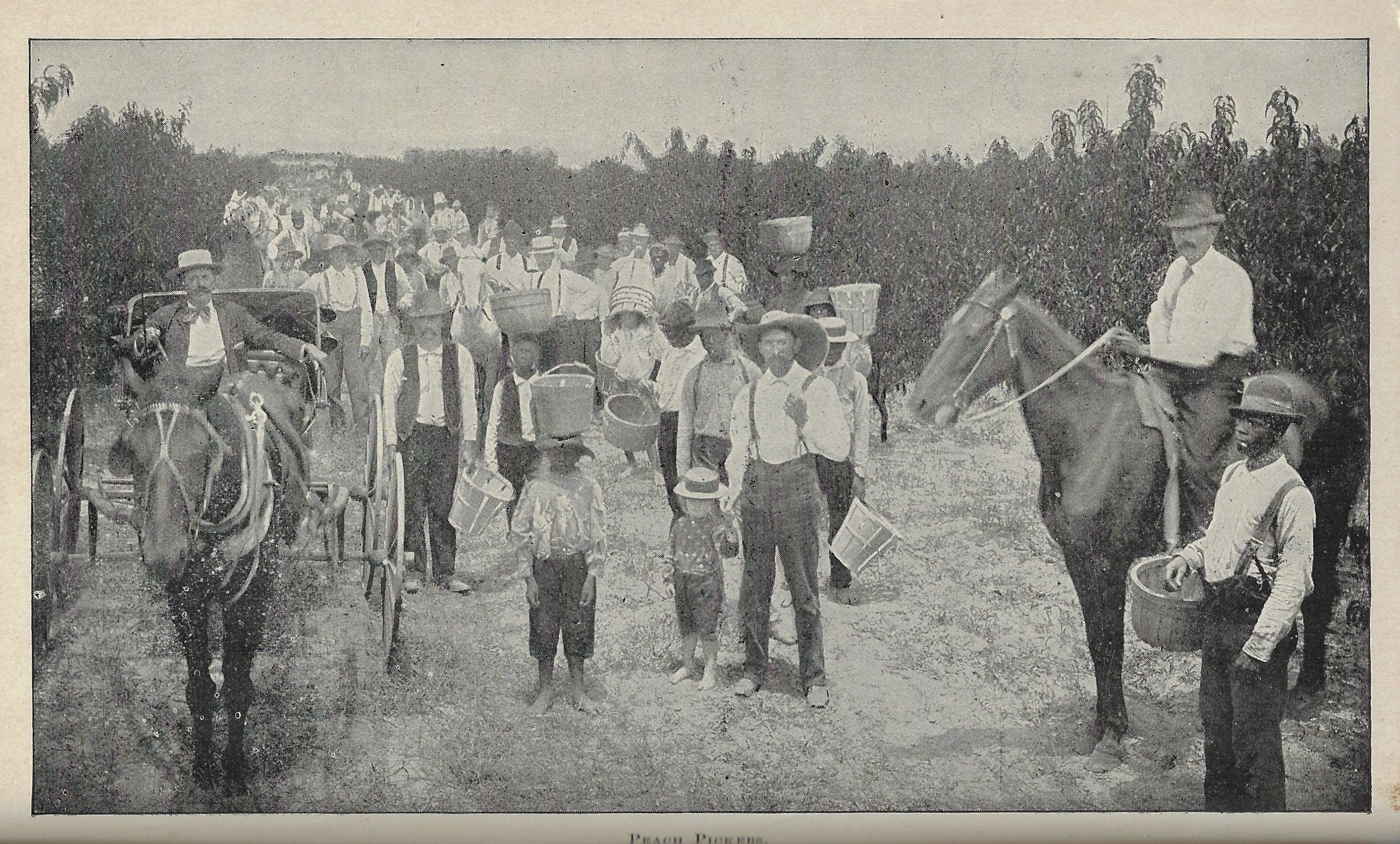
    Now I know this is supposed to be a propaganda piece for the state to attract money and people to come to Georgia, showing the abundances and state of agriculture as they were in 1898, which should have put a bright coat of shining sheen over whatever was to be pictured–but a photo like this had a very photo documentary effect, far more so than the photographer or editor ever intended it to be. It was a pride photo back in 1898, not an unblinking-photo-eye.

    But the mystery is also the insight, something for us to consider 121 years into the future of these scenes which displayed what was supposed to be the Happy Normal. So the “Square Mile of Peaches” photo showing abundance seems to have the feel of an abundant silent crisis receding in its own mist, sinking into the short horizon.

    And this:


    Georgia resources _2_

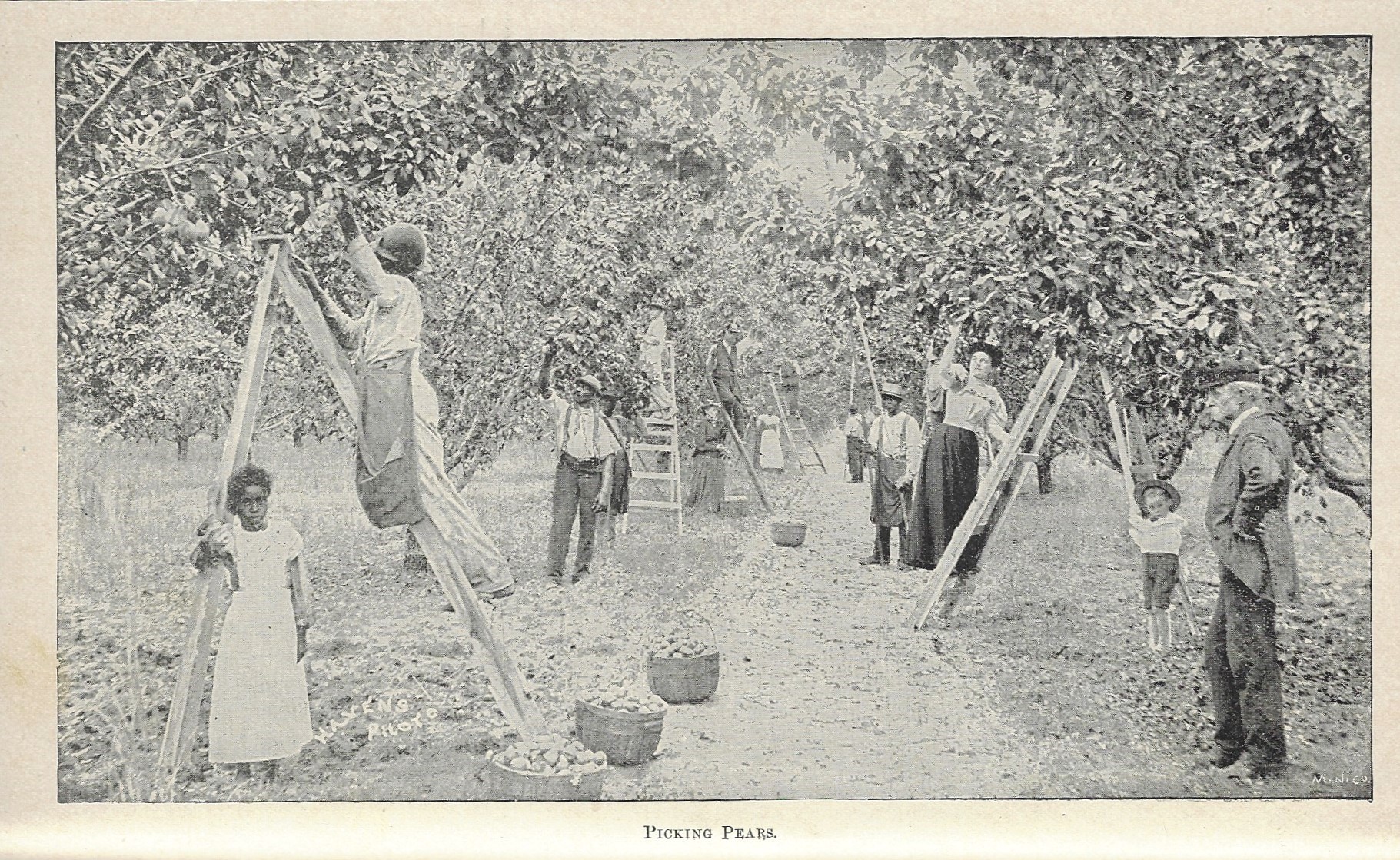
    What I wonder was the message in showing the formal but informal arrangement of the white and black people working together picking pears? “Integrated” is certainly not the word to use here—no doubt it was more like an agreement to perform some sort of work where the races were in close proximity with all race rules observed and maintained.

    There were many photos lie this in the pamphlet—of the thirty or so in the pamphlet only these three emerge to tell a story differentiated from the work they illustrated.

    They are Found-Semi-Social-Documentary images, sort of…I’m not sure, really what they are. They were certainly very different from what I expected, and in memory remind me a little of Annan, Mayhew, Hines, Riis, Parks, and Lange, but only by accident. They reveal something that is beyond the quickly posed environment.

    They are a little mysterious in interpretation—and they were certainly a surprise.


    Georgia resources _2_