A Daily History of Holes, Dots, Lines, Science, History, Math, Physics, Art, the Unintentional Absurd, Architecture, Maps, Data Visualization, Blank and Missing Things, and so on. |1.6 million words, 7500 images, 4.9 million hits| Press & appearances in The Times, Le Figaro, Mensa, The Economist, The Guardian, Discovery News, Slate, Le Monde, Sci American Blogs, Le Pont, and many other places… 5000+ total posts since 2008.

Author: JF Ptak

  • Illustrations from Two Rare Computer Pamphlets (1945 and 1948)

    JF Ptak Science Books   Quick Post

    This is a repost from my books-for-sale pages, basically catalog entries (minus the sales stuff) for two very seldom seen works on early (and famous) IBM machines, the ASSC (1945) and the SSEC 

    With a Giant Fold-out Photo Illustration of the Mark I (the ASSC) Computer, 1945

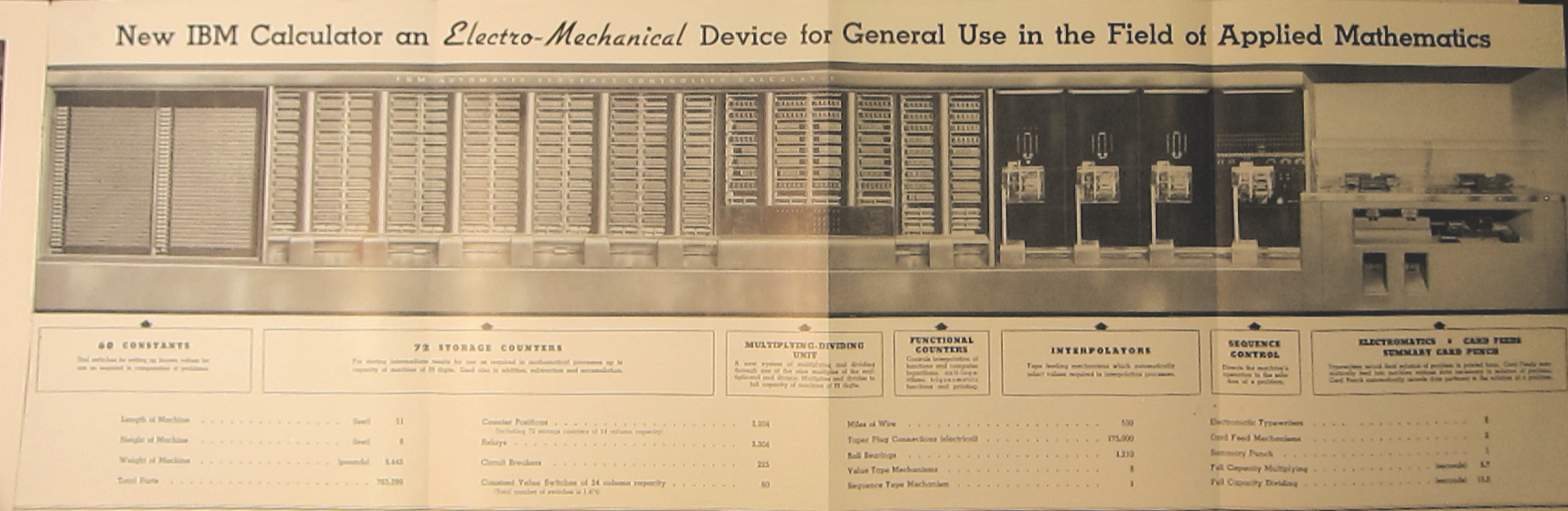
    IBM Automatic Sequence Controlled Calculator. Published by International Business Machines Corporation, 1945. 11”x 8.5”, 6pp. Illustrated with a massive (30” x 11”) folding photographic plate of the computer which seems to be the first image of the full length of the machine. (An earlier but less inclusive report appears in Popular Mechanics in 1944 (in an unusually-titled article, “Robot Solves Problems”) and though it does have a photo of the computer only shows a small piece of it. This photo is just fantastic, and it would seem to be the first full frontal image of the great computer. It is also one of the most impressive computer photos I’ve ever seen of any of the early machines. 
    AI 4 ASEC _long pic pt 2_

    This pamphlet tells the story of the ASCC starting with the establishment of the Columbia University Statistics Bureau in 1928 (for adapting IBM machines for Columbia’s computing requirements. Proceeding from there the outline develops around the 1934 establishment of a separate lab in the astronomy dept at Columbia, and then up to the efforts of H.A. Aiken, Harlow Shapley, T.H. Brown, and W.J. Eckert. Following this I s n extended review of Aiken’s speech at the dedication of the calculator in 1944, including 10 of the significant inventions “of the many basic units of the calculator, invented or developed by IBM”. Here appears on pp 5-6a general description of the calculator. Appearing at the end of the pamphlet is the magnificent folding photo showing the entire face of the 51′-long computer, while in the photo legend are a number of nuts-and-bolts facts about the composition of the machine (including “530 miles of wire”).
    ·Posted by :

    ·in:


  • A Note on the History of Backwards (1878)

    JF Ptak Science Books  Quick Post

    This is a tiny note on the idea of seeing/listening/thinking backwards–I’m not even sure what that means, except for teh obvious cases, especially when you throw technology into the mix to spice up the possibilities of investigation of a backwards form. First of all, the words “backward” and “backwards” go all the way back in the history of English, as we can see in these two pretty examples from the OED:

    • 1398   J. Trevisa tr. Bartholomew de Glanville De Proprietatibus Rerum (1495) xiii. xxvi. 456   “By vyolente puttynge of ayre bakward the body of the byrde meuyth forwarde.”

    •  1697  Dryden tr. Virgil Georgics iii, in tr. Virgil Wks. 101   “Clouds of Sand arise; Spurn’d, and cast backward on the Follower’s Eyes”

    • 1953 “When I go backwards I’m generally backing up”–Not Yogi Berra

    With technology I’m referring to the more subtle ways of exhibiting something/someone in backwards motion rather than the reserve of raising an obelisk–it would be more like seeing a fire burn a house in reverse or rain falling up or a locomotive recovering itself from a head-on collision with a tree via motion picture recordings, things can can’t be reproduced backwards simply by reversing the motion. 

    As long as I’m at it, I think this sense of “backwards” is differentiated from a reverse chronology.  Citizen Kane starts at the end and works it long and angled-dark ways from the beginning to the opening shot; the movies Momento and Eternal Sunshine… are fuller in their reverse chronology, as is the occasional episode of Seinfeld and the book (and movie) Benjamin Button, to name a few examples. 

    What brought me to this place was an article  by Fleeming Jenkin and J.A. Ewing on the new invention, “The Phonograph” in Nature (1878), where their entire interest in the short note was the use of the machine in playing recorded speech backwards. This would be among the first uses of the new technology in a way that displayed info in a new way from all other previous human experience. This leads me to think about the next step in the development of the motion picture, where people could “unwatch” a developed motion of something and have it reconstitute itself right before their eyes. No doubt that was an extraordinary experience. So far as the motion picture goes, it would be almost another twenty years before a motion picture would be exhibited popularly that showed an action in reverse–and that honor goes yet again to Louis Lumiere and his “Demolition of a Wall” in 1896, still in the first decade-ish of the invention of what we would think of as a motion picture film.  

    In any event, these are just some loose thoughts on the subject of “Backwards”. 

    Here’s the short article by Jenkin and  Ewing: 


  • History of Lines Department: Supply and Demand (1870)

    JF Ptak Science Books   Quick Post

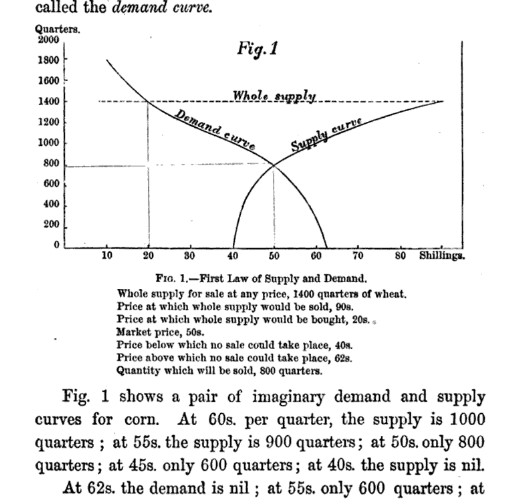
    The idea/phrase “supply and demand” goes back a very long way, and gets treated in a more-modern aspect by Locke (1767) and Adam Smith (1776) and David Ricardo (1813) and Thomas Malthus (1803)–however, the  first time that the idea was presented graphically came with (the beautifully-named) Fleeming Jenkin in 1870. The famous graph appeared in  “Graphic Representation of the Laws of Supply and Demand, their Application to Labour, Part I”, published in Recess Studies, edited by Sir Alexander Grant and published in Edinburgh.  And here it is, in brilliant simplicity:

    Supply and demand

    He writes in this paper by way of introduction:

    “Supply at a price denotes the quantity which at a given price holders would be then and there willing to sell. Supply at a price is also mensurable Demand at a price denotes the quantity which then and there buyers would purchase at that price. The supply at a price and the demand at a price in any given market will probably vary with the price they may be said to be functions of the price.”

    “Let a curve be drawn the abscissae of which represent prices and the ordinates the supplies at each price. This curve will be called the supply curve. A similar curve constructed with the demand at each price as ordinates will be called the demand curve.”

    A few notes in support of the Jenkin diagram:


  • The Early Use of a Telescope in Crime Detection (1900)

    JF Ptak Science Books  Quick Post

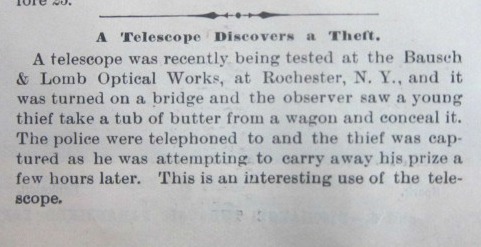
    Just a quick notice here of an interesting note found in Scientific American (vol 83, no. 4, pg 54) for 28 July 1900:

    Telescope discovers a theft

    I wonder if this observation violated the expected zone of privacy of an individual, meaning a violation of the fourth amendment? Now this activity described above in Rochester took place on a bridge, so perhaps there was no expectation of privacy on a public street , especially if you are out-and-about and committing a crime. A quick look at the history of the fourth amendment gets immediately complex to me, and so I’ll leave it alone–except to say that it is not a clear-cut issue as to whether the above use of a telescope would’ve been a search-and-seizure issue. On the other hand, when this issue is discussed the idea of what would be “normally” observable to the unaided eye comes up–but what sort of unaided eye are we talking about? If the eye needed correction, would using eyeglasses constitute a challenge to the fourth amendment?  I don’t know, as I’m not a law guy–but the question about the telescope and the fourth amendment seems mildly interesting. 

    ·Posted by :

    ·in:


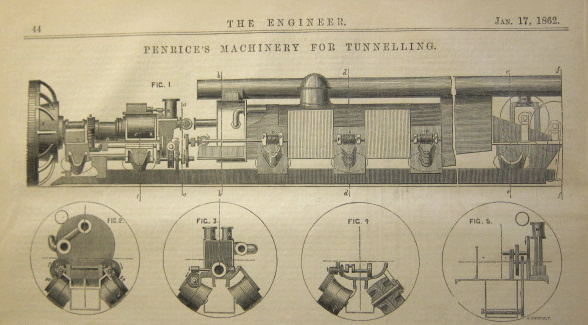
  • A Giant Metal Kraken Worm, Beast Among Beasts: a Tunneling Machine, 1862

    JF Ptak Science Books  Post 2790

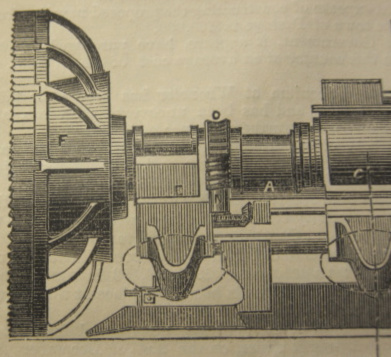
    This enormous  piece of machinery was designed and patented by Hubert Newton Penrice (of Norwich1) in 1862 for “tunneling and driving through rock and other strata”. The section labeled “F” is obviously the grinding business-end of the beast, meant to turn with a “variable” speed–what we see here is the outermost set of teeth which surrounded an unspecified number of smaller concentric cutting plates.  I imagine that if you looked at this machine straight-on from the front you’d see a number of concentric rings of hundreds of steel teeth, which immediately makes me think “Kraken!”, though this one is underground, boring its way through rock. No specifics are given for dimensions, though my guess would be that the cutting face had to be at least 8′ (?), meaning that the entire machine was on the order of about 50′. 

    Originally the steam-driven machine was powered “at a distance” though in this version the boiler and engine are right there behind the cutting face and a  car powered to inch froward as the tunneling is done.  The boiler would supply several engines–one to drive the cutting wheels, another to feed the machine that “swept” up the cut stone and directed them towards the back of the outfit another to power the forward motion of the whole thing to put pressure on the cutting face, and I think several more.  That long shaft along the top of the unit is for “waste steam” that would direct (some!) of the smoke and heat towards the rear and eventually out of the tunnel, somehow. 

    I don’t know how many workers it took to operate this thing and make it all work, and I find it difficult to imagine working in a cramped, hot, loud, dangerous and uncertain situation as this, and have it all underground and powered by steam. 

    The only thing worse that I can think of–outside of pure disaster–is failure: what happened if the thing got “stuck”?  

    • “On each axle is a screw or worm wheel and there are two parallel shafts one on each side of the boiler with worms or screws thereon there being one worm for each of the wheels by this means a slow motion may be given to the wheels and the machinery may thus be moved towards the face of the work. The speed at which the screw shafts are driven is capable of being readily varied in order to suit the varying strata and in order to be able readily to adjust the progress of the machine to the quantity of work which the cutters are enabled …”–from the article.

    Engineer 1862 tunnel cutter detail

    [Source: The Engineer, volume 13, January 17, 1862, p 44.]

    Engineer 1862 tunnel cutter full copy


    And by the way, the article identifies Mr. Penrice as being “of Wilton House, Norwich”, and so I looked that up:

    Wilton house

    Source: http://wiltontown.com/feature/wilton-house/


  • Found Poetry of Fallacies (1864)

    JF Ptak Science Books  Quick Post

    “Proposed Dictionary of Mechanical Fallacies”

    “While Ignorant of Follies How Can We Become Wise?”

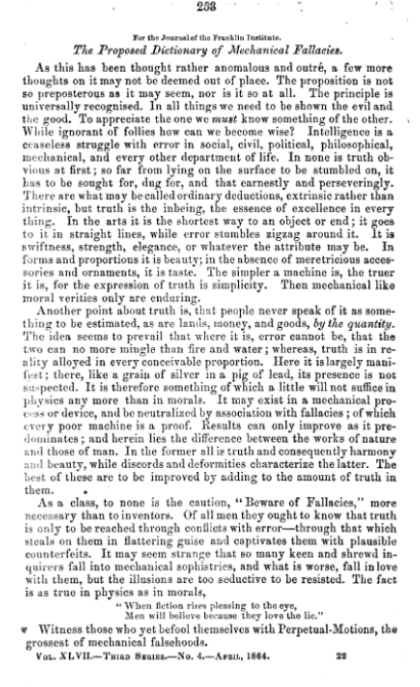
    The author (“E”) writes to the readers of 1864 in The Journal of the Franklin Institute1 an odd and open letter on truth, beauty, and the importance of recognizing fallacy.  “E” has a bit of a hard time of it, writing more in the style of an early 19th-century figure than someone at mid-century, but sooner or letter he gets to his point, and along the way there are some pretty interesting observations. He also takes things a bit too far in places, but if you concentrate on his successes, the article is worth a read. It isn’t a suggestion of De Morgan’s A Budget of Paradoxes, but “E” provides enough in three pages to make it a good read.  

    In the spirit of poetic adventure I offer some of the “E” article below in situ as “Found Poetry of Fallacies”:

    As a class to none is the caution, “Beware of Fallacies” more necessary than to inventors.

    Of all men they ought to know that truth is only to be reached

    through conflicts with error through that which steals on them in flattering guise and captivates them with plausible counterfeits.

    It may seem strange that so many keen and shrewd inquires fall into mechanical sophistries

    and what is worse fall in love with them but the illusions are too seductive to be resisted.

    The fact is as true in physics as in morals:

     “When fiction rises pleasing to the eye. Men will believe because they love the lie”  (Witness those who yet befool themselves with Perpetual Motions the grossest of mechanical falsehoods.”


    As this has been thought rather anomalous and outré a few more thoughts on it may not be deemed out of place.

    The proposition is not so preposterous as it may seem nor is it so at all. The principle is universally recognized.

    In all things we need to be shown the evil and the good.

    To appreciate the one we must know something of the other.

    While ignorant of follies how can we become wise.

    Intelligence is a ceaseless struggle with error in social civil political philosophical mechanical and every other department of life…

    The full article, via Google Books:

    ·Posted by :

    ·in:


  • The Geometric Art of the Antique Bicycle (1885)

    JF Ptak Science Books  Quick Post

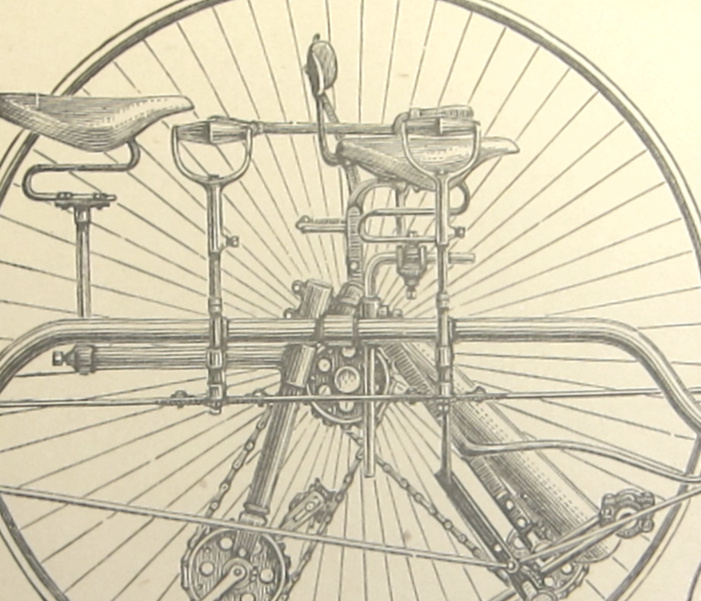
    Robert E. Phillips’ “On the Construction of Modern Cycles” was a beautiful short paper that appeared in Institution of Mechanical Engineers, Proceedings, and which was published in  October 1885. This paper appears in the issue of pp 461-552, occupying pp 467-521, fantastically well-illustrated with 39 engraved plates (numbered 62-100). The illustrations are beautifully detailed and feature all manner of technical aspects of bicycles. (Two years hence, in 1887, Phillips would published a lovely book, The Pleasures, Objects, and Advantages of Cycling, in London, by Simpkins).

    Bicycles _6 detail_

    ·Posted by :

    ·in:


  • The Human Trust Fund (1929)

    JF Ptak Science Books  Quick Post

    No, not the work of George Costanza, but of someone else, a Chicago native who had an idea for saving the country, for saving humanity. I haven’t read but the first and last pages, and I think that that was about enough–I’m not at all sure what the author’s play was here, but whatever it was, he tried.  In any event, this pamphlet (13″ x 8″ and 24 leaves) was printed in 1929–there’s no mention of The Depression that I could see (the epithet “Great” wouldn’t be applicable for another 15 months or so)–and once belonged to the great but problematic H.L. Mencken, who didn’t own it for long. This pamphlet is part of my Outsider Logic Collection, in the Department of Gallant Tries. 

    Books covers human trust

    ·Posted by :

    ·in:


  • Stacked-Tech: Things on Top of Other Things (1926).

    JF Ptak Science Books  Quick Post

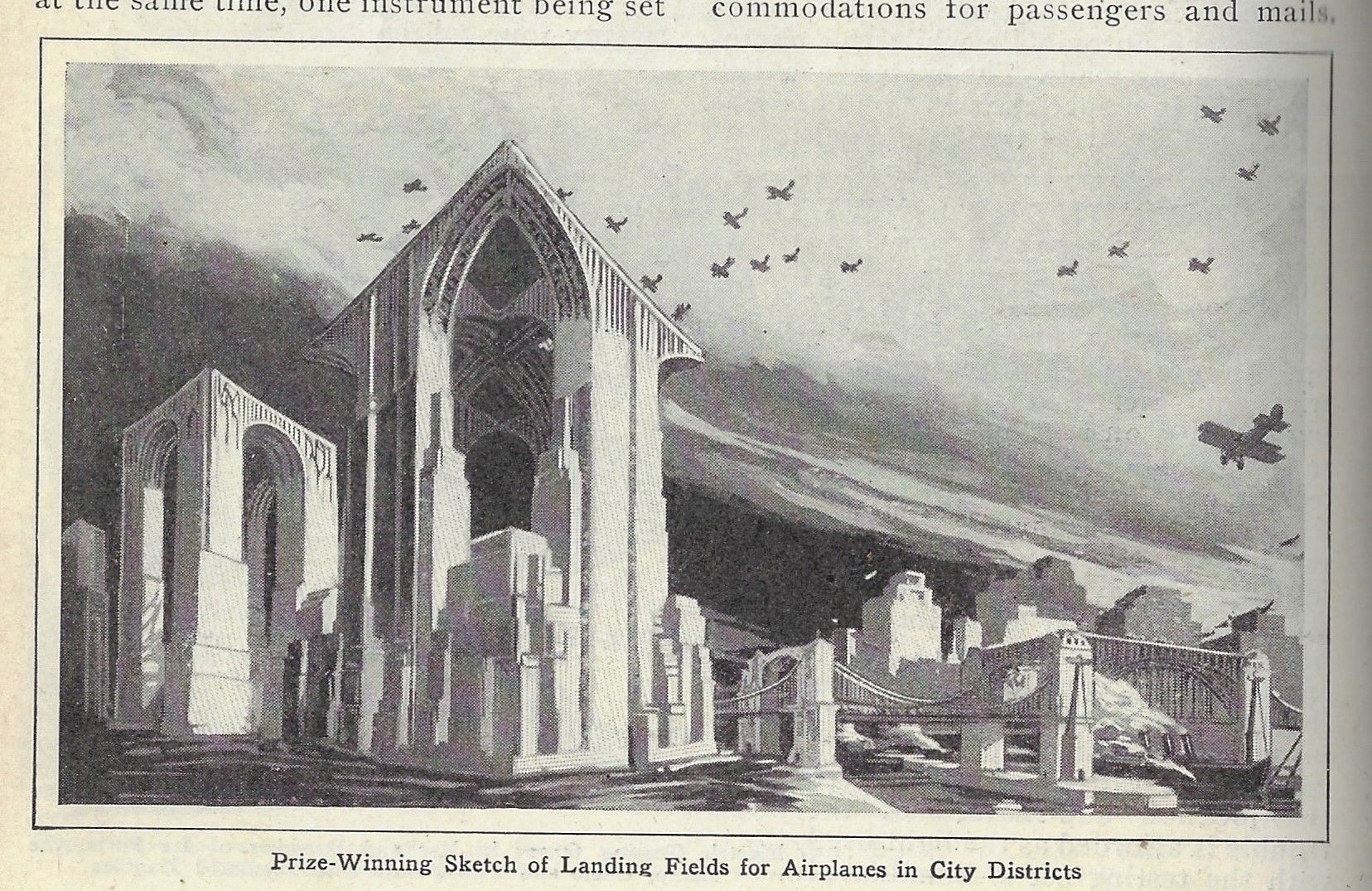
    In just three or four decades into the skyscraper era and heavier-than-air powered flight there was a certain sense of planning to join those two technological (series of) achievements. This sense of enlightenment though didn’t seem very enlightened, or practical. The idea of locating airports on the tops of tall buildings, or on structures covering rivers (like the Hudson or Thames), or on long and wide structures built over expanses of shorter inner-city buildings, seem to have had a life from the late ‘teens into the 1940s.  They were struggling ideas that struggled. 

    I found two more examples of this stuff-on-top-of-other-stuff tech thinking today. The first shows a structure 950′ tall made to accommodate a strained amount of air traffic in the heart of a large metropolitan center. (There are numerous examples of this idea sprinkled throughout this blog–just pop the word “airport” into the Google search box at upper right and you should find 10 or so posts on the topic, all with great illustrations.) By the way, this was one busy dream of an airport, what with 20 planes coming and going. 

    Pop Mech 1926 tennis court resevoir

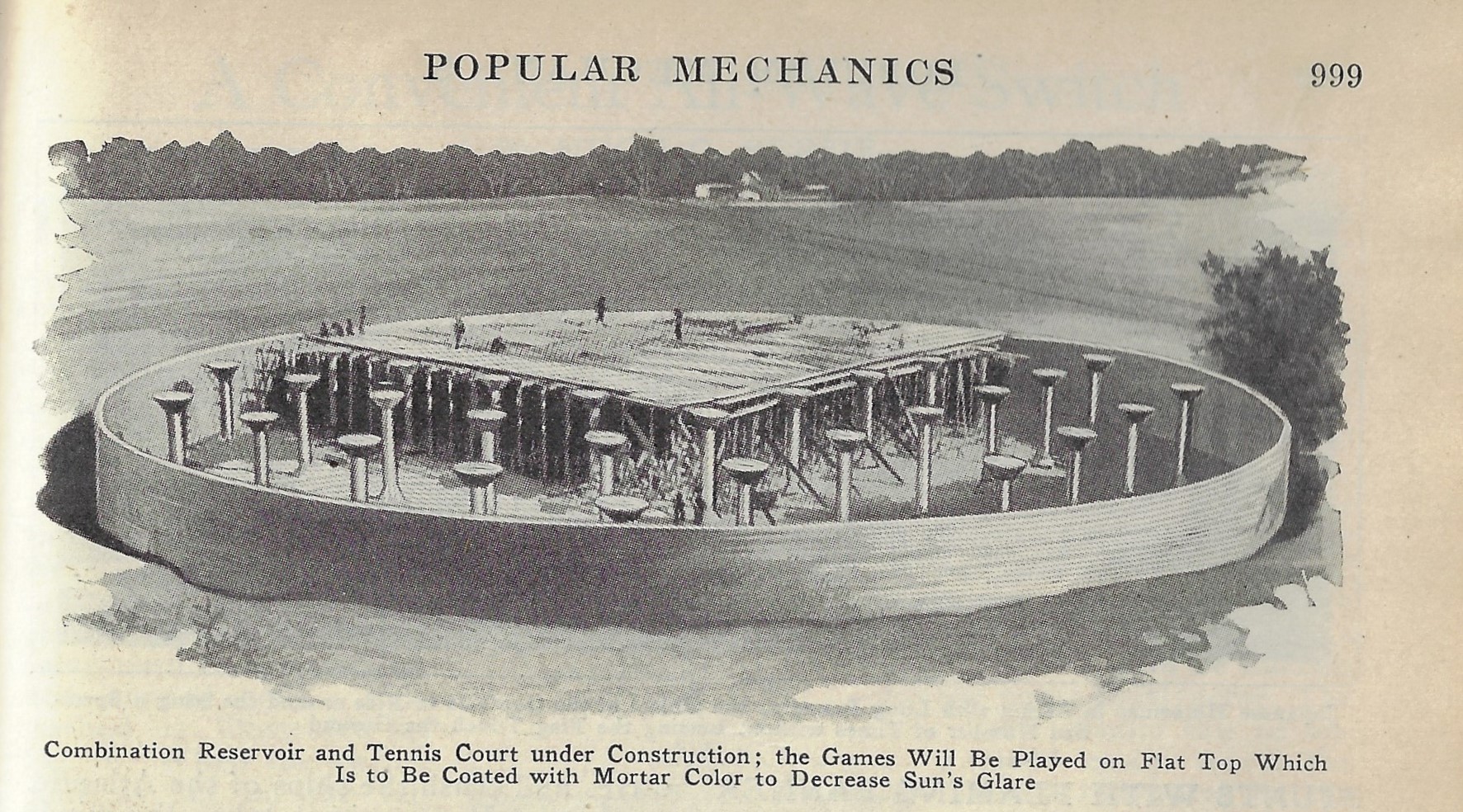
    The second image is unusual but less-techy: a tennis court built on top of a reservoir:

    Pop Mech 1926 tennis court resevoir

    I ‘m not sure how hurting people were for spaces for a tennis court in 1926, but the competition for the open land for such a thing couldn’t’ve been that severe. 


  • J.P. Joule and God

    JF Ptak Science Books  Quick Post 

    (With thanks to David Wenner for the introduction to this paper by Joule.)

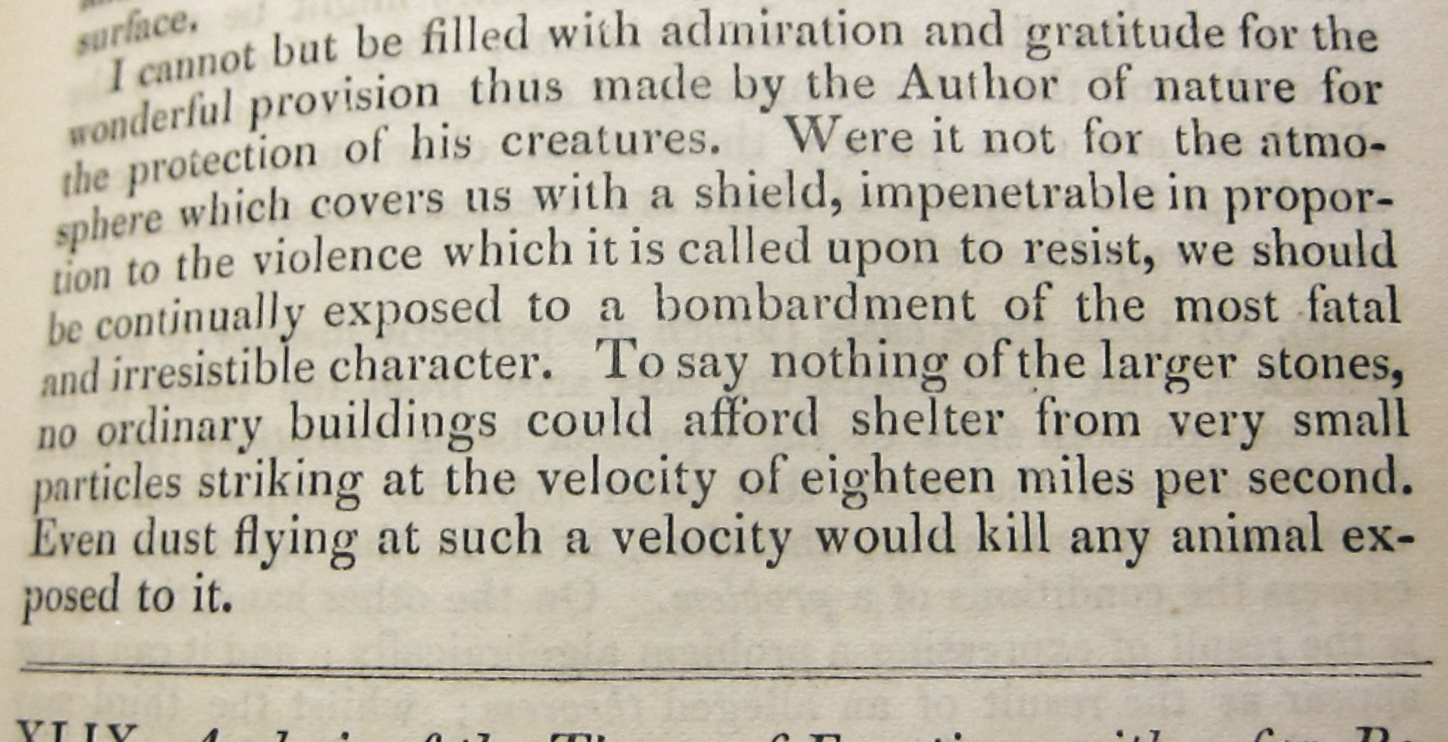
    There is a real work of unexpected beauty in the last paragraph in “On Shooting Stars” Philosophical Magazine vol 32, 1848, pp 349-351, by James Prescott Joule,  thanking the creator of the universe for including an atmosphere for the Earth.

    At the end of the day, the first law of thermodynamics is found in the law of the conservation of energy, which was found in the relationship of the nature of heat to mechanical work, which was found in the work of James Prescott Joule (“Wherever mechanical force is expended, an exact equivalent of heat is always obtained”.— J.P. Joule, 1818-1889, August, 1843.) The unit of energy called the “joule” (”used by the International Standard of Units (SI)…defined as the amount of work done on a body by a one Newton force that moves the body over a distance of one meter”–Universe Today/Astronomy ) is named for J.P. Joule.

    After addressing some issues of “shooting stars”, Joule writes his lovely closing sentiments, which to me can be easily arranged into a bit of “Found Poetry”–that is, it is the simple restructuring of the two paragraphs into a poetic format, and without changing any of the words. It is an interesting process, and I think Joule’s language easily transcends its sleepy place at the end of a mostly-forgotten work half-way through a scientific journal.

    Here it is: 

    I.

    I cannot but be filled with admiration and gratitude

    for the  wonderful provision thus made

    by the Author of nature

    for  the protection of his creatures.


    II.

    Were it not for the atmosphere which covers us with a shield,

    impenetrable in proportion to the violence

    which it is called upon to resist, we should 

    be continually exposed to a bombardment of the most fatal 

    and irresistible character [of shooting stars].

    To say nothing of the larger stones, 

    no ordinary buildings could afford shelter from very small  particles

    striking at the velocity

    of eighteen miles per second. 


    III.

    Even dust flying

    at such a velocity

    would kill any animal exposed to it.      


    This is the original bit of the poetry straightened-out, proper, and correct:

    Joule god _2_

    And the rest of the article:

    ·Posted by :

    ·in: