A Daily History of Holes, Dots, Lines, Science, History, Math, Physics, Art, the Unintentional Absurd, Architecture, Maps, Data Visualization, Blank and Missing Things, and so on. |1.6 million words, 7500 images, 4.9 million hits| Press & appearances in The Times, Le Figaro, Mensa, The Economist, The Guardian, Discovery News, Slate, Le Monde, Sci American Blogs, Le Pont, and many other places… 5000+ total posts since 2008.

Author: JF Ptak

  • The First Mention of a Photograph of a Face? (1840)

    JF Ptak Science Books  Post 2800

    “An Account of some Experiments made in the South of Virginia on the Light of the Sun…”, published in the Philosophical Magazine (London) in 1840, is a very early photographic  effort by John Draper on the effects of solar light on different material and media, including silver solutions. This is the first appearance of the work in Great Britain and Europe, having appeared in a much longer (32pp) version in the Journal of the Franklin Institute from 1837. Draper remarks that his works in photography were not much read in England, having been published in the U.S., and thought to bring this paper in particular to the attention of the Philosophical Magazine: He writes in the paper that “Most of these have been published in the Journal of the Franklin Institute of Philadelphia; but as they do not appear to have been noticed in England, I will ask the favour of a page or two of your excellent Magazine, to give my testimony on a subject, which now appears to excite so much interest.”

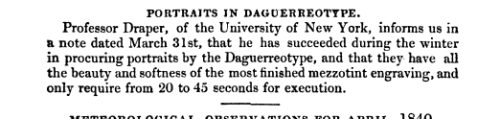
    Of perhaps greater interest here is the announcement in the June 1840 issue in this same volume of Draper’s success in producing human portraits by the Daguerre process. It is a short notice (only five lines, appearing on page 535) and even though it is stated that the Draper paper was received on March 31st it still somehow did not make it into the May issue of the journal–this in spite of this being the first official announcement of a human portrait being made in photography. This is slightly complex because even though Draper’s portrait of his sister, Dorothy, was long recognized as being the first photographic portrait, it seems as though he was beaten to the punch by Alexander Wolcott (and/or Robert Cornelius?), though it was Draper who made the announcement  of a successful portrait (in general) and thus the first overseas notice of the success. (Draper did make the first photograph of the Moon later in 1840…) 

    Photography face draper

    ·Posted by :

    ·in:

    —

  • A Very Early (First?) Description of a Panoramic Daguerreotype (1845)

    JF Ptak Science Books  Quick Post

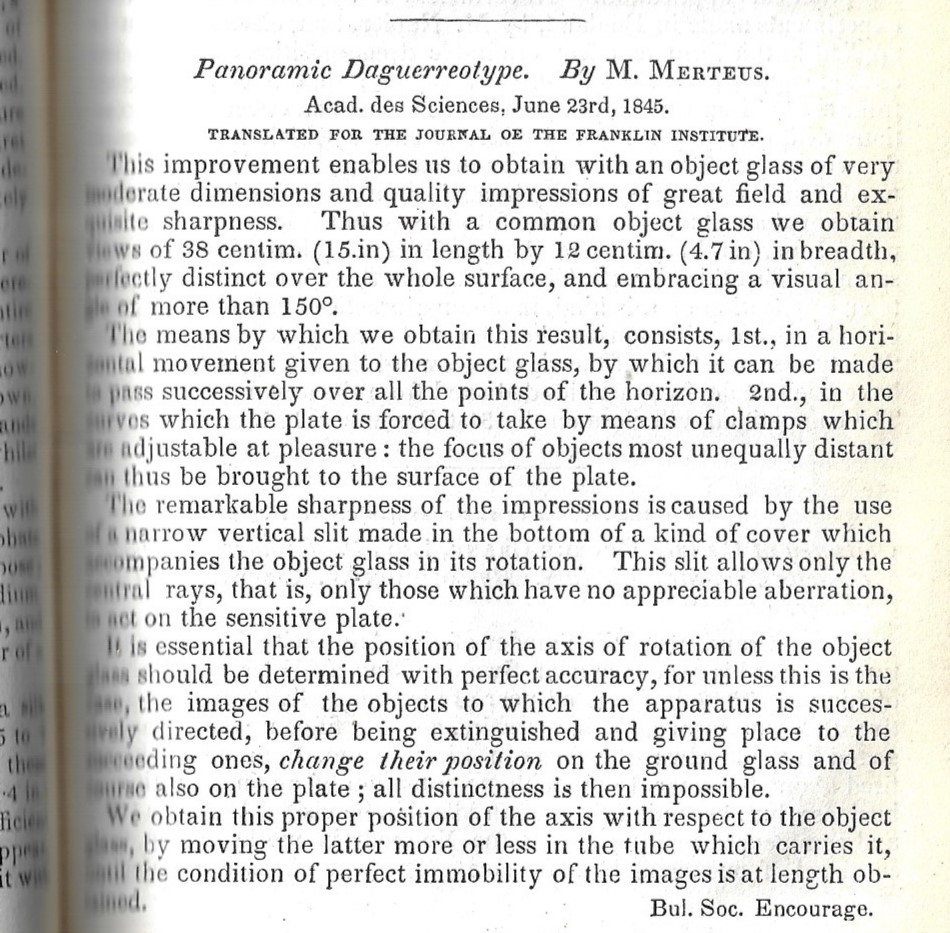
    Just five years after the announcement of Daguerre’s invention of photography, and just four years after the beginning of the early photo craze, there appeared in the Comptes Rendus in mid-1845 a paper by Friedrich von Martens (1809-1875) on an expansive use of the new media: the panorama.  It was certainly the first paper to appear in this journal on the subject; when I checked a likely U.S. source on the subject (Journal of the Franklin Institute, 1846) I found only one mention prior to 1865: a translation of the Martens paper (recorded though as “Merteus”). This seems a little obscure but not unimportant, as Martens may have been either the second (and possibly first) to perfect a panoramic camera, patenting his “Megaskop Kamera” in 1844.

    • I’ve decided to share the Martens paper in both the original and the American translation: 

    JFI 1846 panorama

    • Here’s the text version of the original article, from the Comptes rendus de l’Academie des Sciences..., Paris, June 23, 1845:

  • Leonardoesque Robot Brains, the Harvard Mark I, and a Peek into the Future of Computing (1944)

    JF Ptak Science Books   (Expanding an earlier post from 2008)

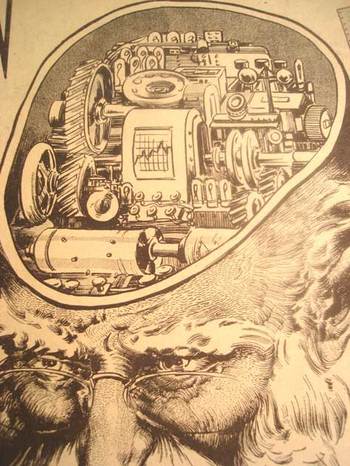
    Blogharvardbrain This may well be the first popularly-written and popularly-published report on the Harvard Automatic Sequence Controlled Calculator (ASCC) (appearing in the American Weekly, 15 October 1944), which was the first automatic, general-purpose, digital calculator.  Known as the MARK I, it was the brainchild of Howard Aiken (1900-1973), a graduate student at Harvard, who started it all in 1937 by proposing a series of coordinated Monroe calculators to function as a unified whole  that would cross the threshold of the physically-impossible calculation (though theoretically possible) to the eminently doable.  The project was immeasurably aided by the input of Harvard astronomer Harlow Shapley (who had earlier dealt with the enormously problematic aspects of the scale of the universe) who put Aiken in the hands of IBM at Endicott (NY).  From there the building of the computer came under the supervision of Clair D. Lake, with the engineering and theoretical team of Francis Hamilton, Ben Durfee and Howard Aiken. 
    Blogharvardbraindetail
    The machine was basically completed in 1943 and tested in Endicott for the better part of the year before it was shipped of to Harvard in February 1944, where it was put almost instantly to work on ballistic calculations (like its cousin ENIAC at the Moore School at U Penn), as well as naval engineering and design issues. 

    The author of this article, Gordind Bhari Lal (“noted science analyst”), actually does a pretty decent job describing the machine and its (1940’s) possibilities, noting at the end that “it may even unleash for Man’s Use the long-dreamed-of energy of the atom”.  This part did come true, especially post-war, when the machine was put to fair use by the US Atomic Energy Commission. 

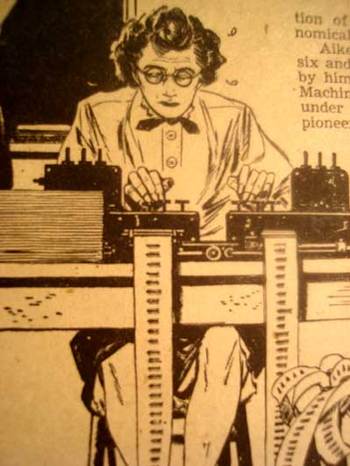
    The part I really don’t understand in this article is comparing the speed and function of the ASCC to two women working on calculators and Albert Einstein, working with a pencil, paper and pipe, none of whom look comfortable or happy.   Lal does make a decent comparative point (of uncertain veracity) about four generations of humans (the three above-mentioned calculators?) doing calculations that the ASCC could do in seconds.  Right or wrong, it gave the crowds in 1944 a real something to think about.
    Blogharvardbraingirl


  • On the Annihilation of the Mind (1877)

    JF Ptak Science Books   Quick Post

    I found an article with a captivating title and didn’t know where it would take me, except that at the end we got to the point of life-and-death being somewhat in league with the conservation of energy. Anyway, the title is as you see it in the title of this quick post, “On the Annihilation of the Mind”, written by the considerable John Trowbridge, who was a professor of physics at Harvard, an E&M guy, and the major force in establishing the Jefferson Lab at Harvard. I recall that he was very prolific in addition to his teaching duties, and right about this time published several articles on the Bell telephone, which made it first appearances less than a year before this article, which published in the Popular Science Monthly in April 1877.

    The last three sentence sum the article up, though I’m not exactly sure of how the author arrived at his conclusions—it bears repeating in spite of the result, if for no other reason than to share the pretty remarkable structure of the close of the article.

    And so:

    “The doctrine of the existence of the spirit after physical death seems to me not to be foreign to the scientific ideas of the conservation of force, which have now obtained such complete supremacy in the science of physics; or to the doctrines of Darwin, which are accepted by so large a body of eminent naturalists. Without the sun there would be an annihilation of force. When energy is dissipated, we find the sun exalting it again by processes which we cannot completely follow. The idea of a great source of life and mind, the prototype of our physical sun, which sets in motion a vast scheme for the survival of the fittest, and the exaltation of energy in vast cycles, is not inconsistent with the doctrine of the New Testament, and seems to be required in a philosophical theory which shall endeavor to account for the differences in that great spiritual world which are continually suggested to the human mind by the various types of mental growth.”

    ·Posted by :

    ·in:


  • A 19th-Century 3-D Printer (1864)

    JF Ptak Science Books  Post 2799

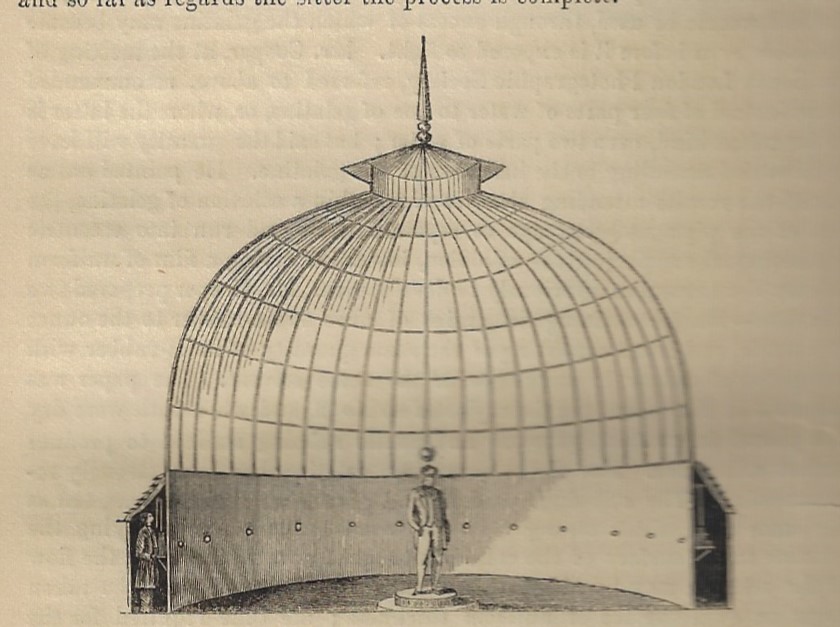
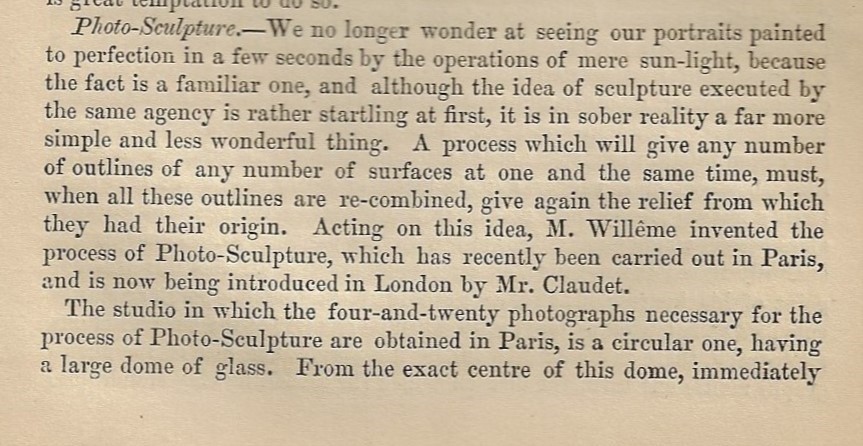
    Well, the title to this post is not quite right as we would think of it in modern terms: this one is a human-based photo-aided clay fabricator of 2-D images into 3-D, which is something. What we have here is a dedicated apparatus for making a continuous photographic 360-degree view of a subject, set in order on a revolving disc on a magic lantern and projected onto a screen with a sculptor viewing the progression and making cuts and changes to his lump of clay in response to the change of perspective. The photographs of the subject were made in a circular hall, the walls of which hosted 24 regularly-spaced cameras working in unison to make a complete photographic record of the subject. The images were then taken and arranged in order on a large disc and portrayed slowly on a screen behind which the sculptor worked his magic.

    Pop Sci Rev 1864 Photo sculpt _3_

    The author tells us the process came from Paris via Francois Willeme (1830-1905), who seems to have created the process in 1859 and patented it in 1860 (1864 in the U.S.), and who started a veritable “craze” for the process.

    The article I’m referencing and reproducing here is from the Popular Science Review of 1864, though an earlier paper was published on the process in the Journal of the Franklin Institute in 1861. Offhandedly I’ve spotted several articles in the Scientific American in 1867 (including a piece of micro-photo-sculpture), plus many other papers published before 1880, so the processes wasn’t obscure by any means.

    In any event I found this interesting—having never seen this application before—and thought to pass it along. Plus the woodcut of the imaging room (or 3-D “scanner”) is very appealing in itself.

    Pop Sci Rev 1864 Photo sculpt _3_

    ·Posted by :

    ·in:


  • Mouldy Elegance (1864)

    JF Ptak Science Books  Quick Post

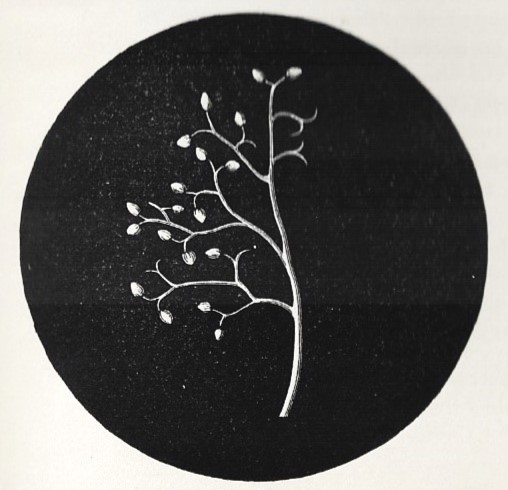
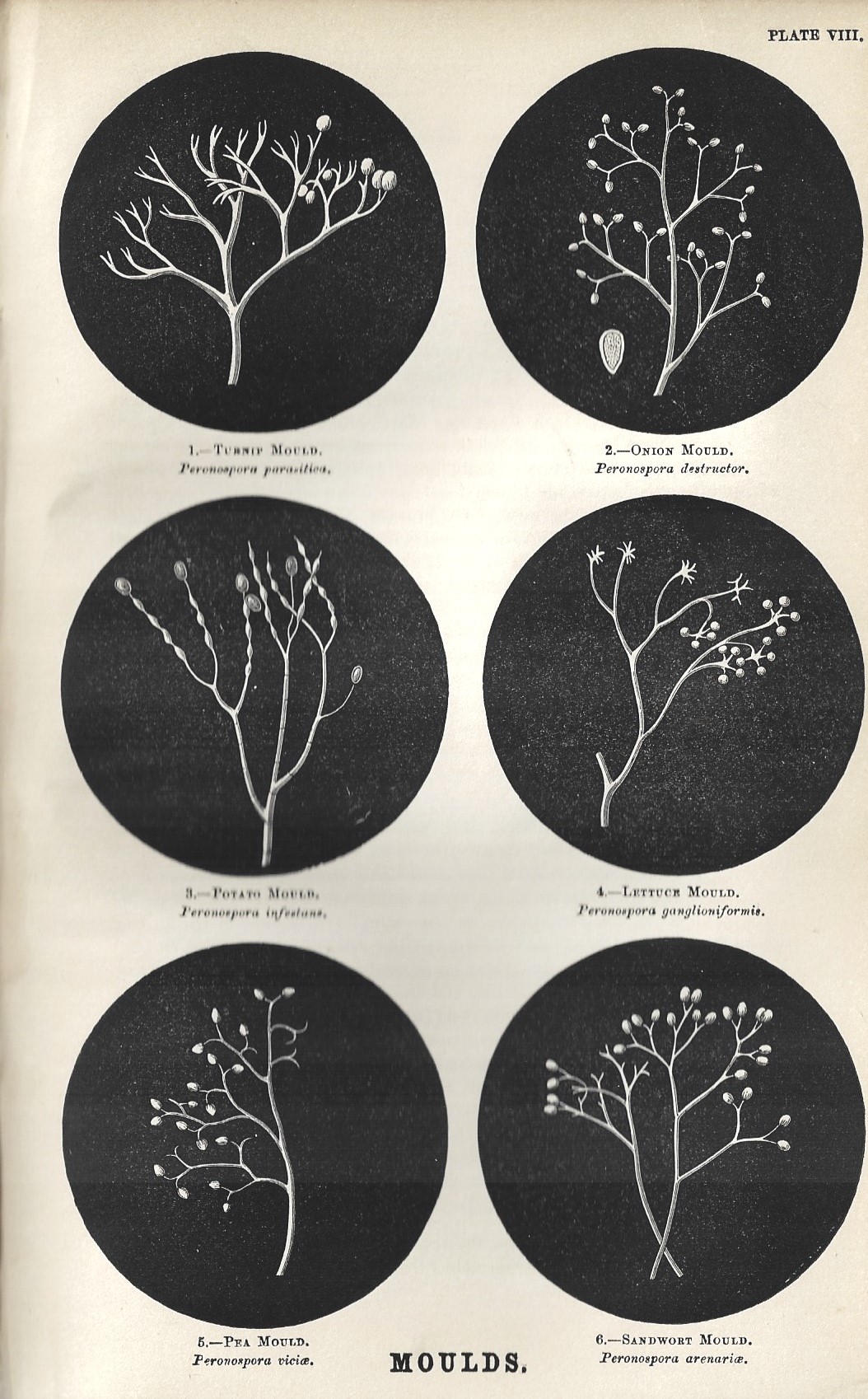
    I started to call this mini-post “Beautiful Mould” but thought better of it, since moulds can cut both ways (so to speak)–“elegant” is a good descriptor and fairly correct.  In any event this image is used for the article “Moulds” and it appeared in the journal Popular Science Review, and published in 1864. Just about everything about the illustration is lovely, including the design in the display of the six samples.

    Here’s a detail of one of the six:

    Pop Sci Rev 1864 Mould full

    And the full plate:

    Pop Sci Rev 1864 Mould full

    ·Posted by :

    ·in:


  • From the Department of Hopes and Dreams: the Red Cross, St. John, and POWs (WWII)

    JF Ptak Science Books   Post 2798

    I assembled a little collection of WWII Red Cross and St. John charity pamphlets–what they all share is a sense unity, duty, perseverance, and hope. They are all published between 1942 and 1944, the majority coming in the summer of 1943–a wicked bad time for the Allies, perhaps the worst time since the Nazi onslaught of Europe. Five of these pamphlets directly addressed trying to help the prisoners of war held by Nazi Germany, and portrayed some healthy and sustaining images of the possibilities of POW life, as well as what would seem to be a high chance of delivery all manner of goods to the prisoners to make their time behind barbed wire somewhat more bearable. (Several of these short pamphlets are reproduced below, while the covers of four of them follow):

    Red Cross POW _1_ (1)


  • Using Darwin to Sell Stuff–an Early Appearance of Marketing Darwin (1877)

    JF Ptak Science Books  Quick Post

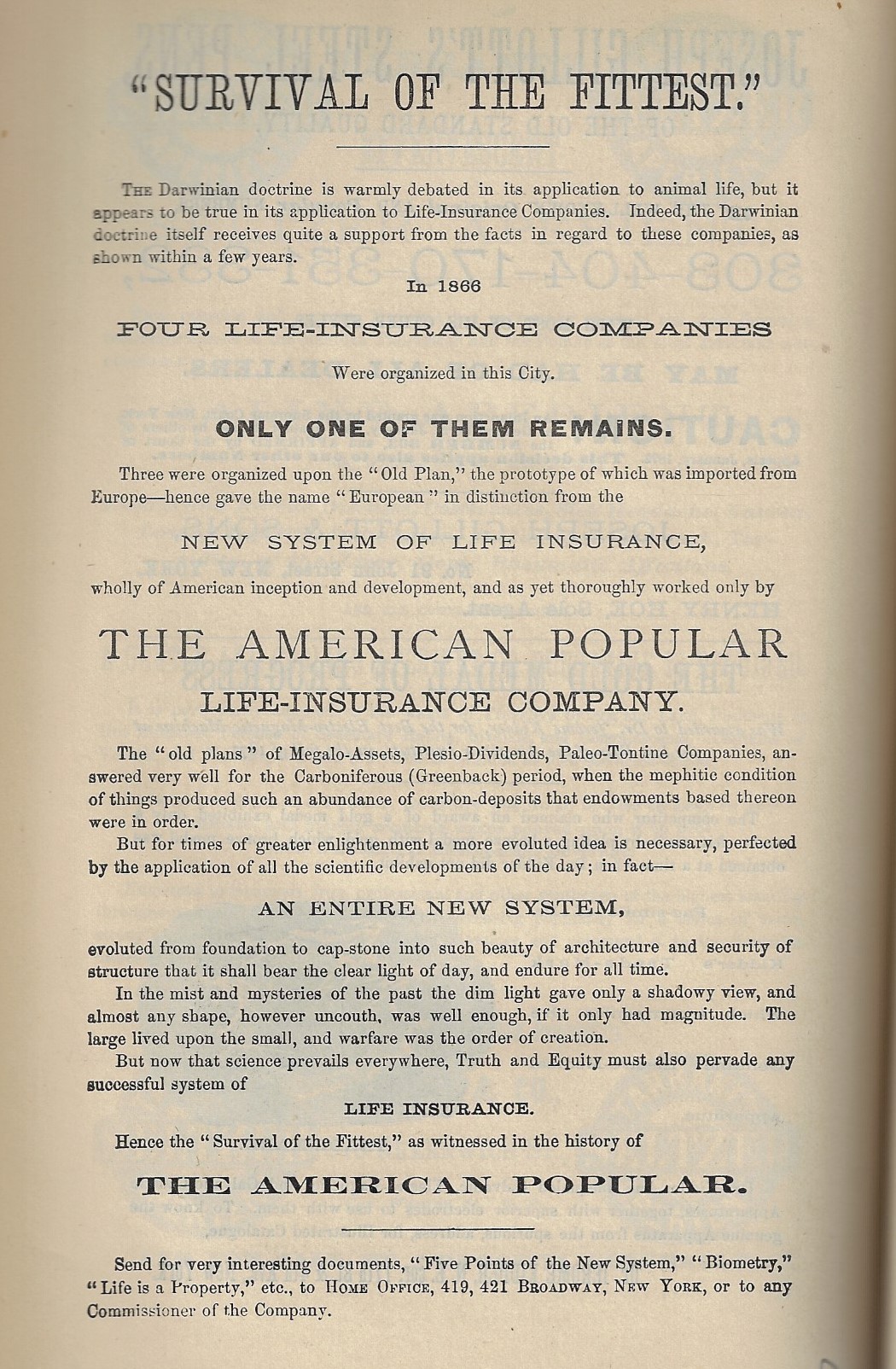
    I can’t be sure of where this stands overall, but it certainly seemed to my reading over the last x-yearsx that using a quote or idea from our Mr. Darwin to sell something in the first decade or two after the publication of On the Origin of Species…. is a rare thing. So seeing this ad in the back of the volume of Popular Science Monthly (1877) was really surprising, as it was taking the phrase we find in Darwin to sell the long-lasting qualities of a life insurance firm.  (Well, the phrase actually starts out with Herbert Spencer as he was influence by OTOOS, writing it to express an idea in economics in his Principles of Biology in 1864; Darwin himself adopts it in Variations of Animals and Plants under Domestication in 1868 and then in the fifth edition of OTOOS in 1869. I’ve included a lengthy quote from the Spencer, where the phrase turns out on page 444.)  I do have a recollection of a drawing in Punch of a crying Mr. Darwin in a quarter illustration promoting kindness to animals or some such…but offhand there’s no memory of using the man/ideas as a sales vehicle before this. Again, that’s not my field so I may be missing a lot–if you know of other ads like this please let me know.  

    Pop Sci Mo 1877 survival fittest full


  • The Voltaic Armadillo, Electric Earth, and Invisible Reverse Double Dandruff: Quack Medical Ads, 1877.

    JF Ptak Science Books  Quick Post  (An entry in the category of Questionable Quidity)

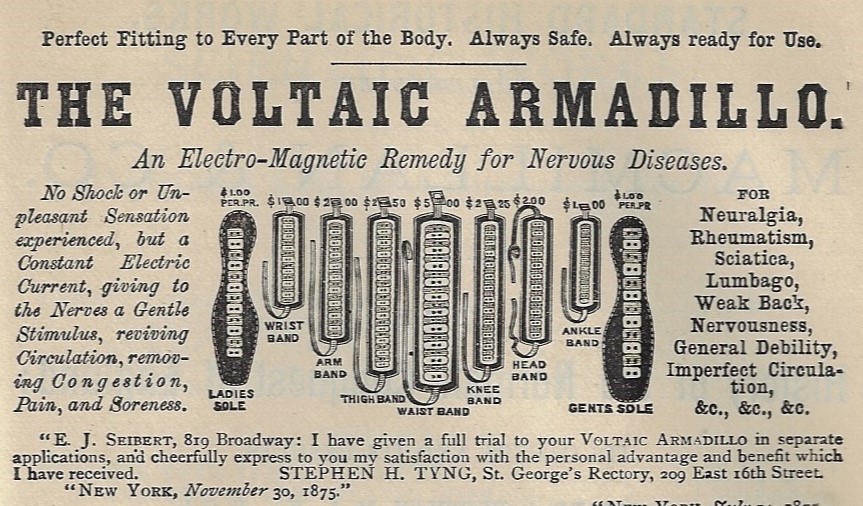
    The Popular Science Monthly (today known as Popular Science) was founded in 1872 and treated all manner of scientific/tech subjects for the general reader–most of the time very successfully, though sometimes not-so-much.  The issue at had for August 1877 had a number of interesting articles, but my attention was stolen away by a pair of ads in the back of the journal. Remember that there were few (if any) regulatory agencies for advertisements on scientific and medical subjects, which means that people were left to their own devices and internal customary ethics, which were sometimes abided and sometimes not.  What I found were two half-page ads for electrical cure-alls, battery-driven devices that were supposed to be a cure and a dependent for just about all things, from dandruff to neuralgia, or the twists or tremors, triple-reverse invisible exuda, marble mouth, inverted feet, and so on. These devices could fix anything because they fixed nothing.  The ads were striking, as you can see:

    Pop Sci Mo 1867 voltaic armadillo detail

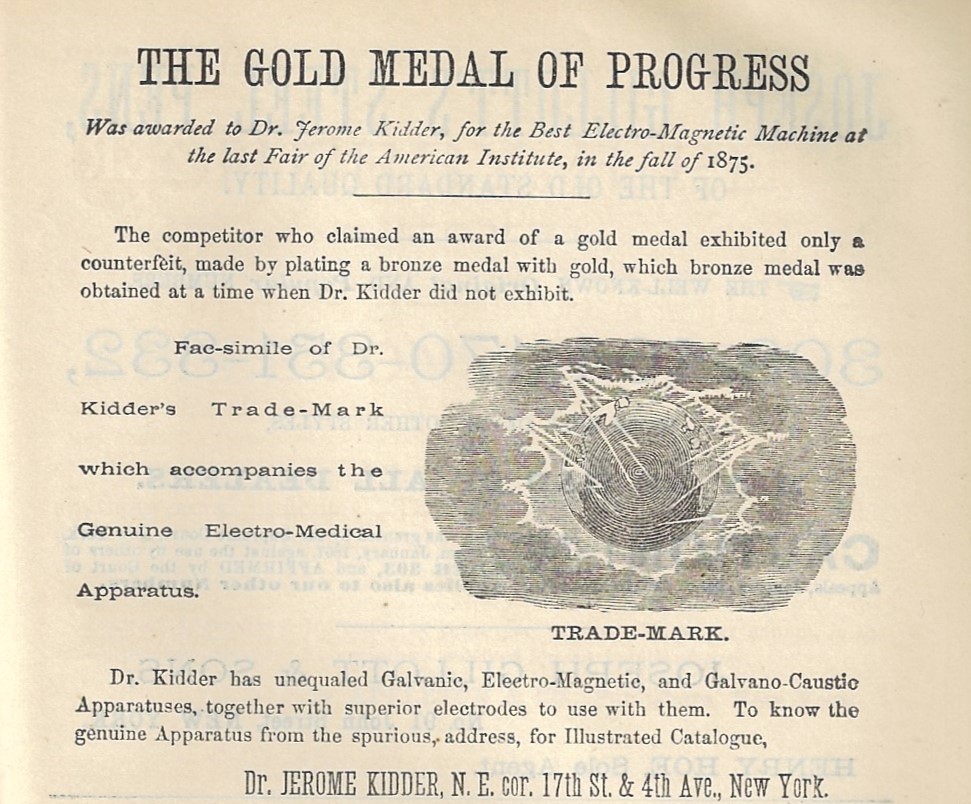
    A few pages away the “galvano-caustic” entry by Dr. Jerome Kidder, who both tried to sell his stuff and protect himself from impostures in the same ad. It was the Kidder trademark of the electrical earth surrounded and beset by a field of electrical-something bits and bobs that attracted my attention:

    Pop Sci Mo 1877 Kidder

    There were other ads in the 1877 volume, though these were the only two of real Charlatanesque sub-virtues.  

    ·Posted by :

    ·in:


  • Charles Babbage, Poet: on Chess and Miracles.

    JF Ptak Science Books  Post 2797 (extended)

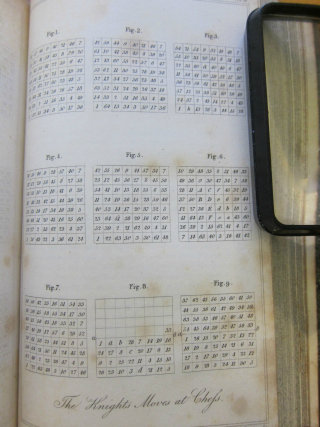
    When reading through a volume of the Royal Society’s quarterly publication on the stuff of science (for the year 1817) I came across an article on the Knight’s Tour puzzle: “An Account of Euler’s Method of Solving a Problem, relative to the Move of the Knight at the Game of Chess, from a  Correspondent”, and which was published in Babbage chess The Quarterly Journal of Science, Literature, and the Arts, edited at the Royal Institution of Great Britain, published by John Murray for the Royal Institution, London, 1817-1818. After a little digging to find the authorship, I found that the “Correspondent” here is Mr. Charles Babbage himself, with the authorship established at least by the time of his Passages from the Life of a Philosopher if not before. The Knight’s Tour puzzle–in which a  knight is moved around a chessboard (8×8 grid, though smaller and much larger have been used) so that every square is touched only once–is ancient, with the host of the famous 18th century mathematical revelers3 positioning the problem in the dim past, with Lucas in 1882 and then Kraitchik in 19272 fixing it more resolutely in India over 2000 years ago.
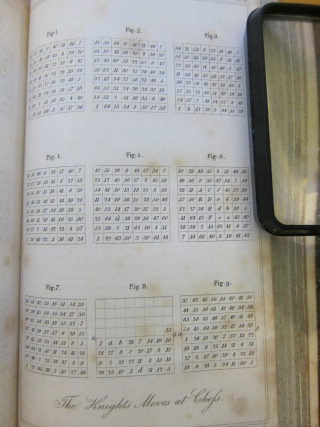
    Babbage identifies the paper as his own in the section of his own “contributions to human knowledge” in his retrospective, Passages in the Life of a Philosopher, published in 1864. I’ve never read this book though I’ve used bits and pieces for research, and last night and today I’ve read in it quite a bit. Apart from the sheer enjoyment of the power of this guy’s mind, I’m finding the book to be unexpectedly amusing. The man is actually funny, plus witty, and an entertaining writer–why this is so surprising, I don’t know; perhaps it is because he is associated in a personal sense in my mind with General Winfield Scott, as they resemble one another, both looking Very Highly Contentious and gassy. In any event, I can safely say that this is a Good Read. 

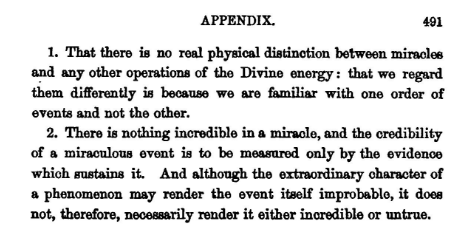
    Now to the Found Poetry part in this bit, the text of which is found in the appendix of the article, in the section called “On Miracles”. The text is as found, though the spacing/structure has been “poematized”to exhibit the great and hidden logical poetry of Mr. Babbage:

    On Miracles

    "1. That there is no real physical distinction between miracles 
    and any other operations of the Divine energy: 
    that we regard them differently 
    is because we are familiar 
    with one order of events 
    and not the other. 
    
    2. There is nothing incredible in a miracle, 
    and the credibility 
    of a miraculous event 
    is to be measured only by the evidence 
    which sustains it. 
    
    And although the extraordinary character 
    of a phenomenon may render the event itself improbable, 
    it does  not, therefore, necessarily 
    render it either 
    incredible or untrue."

    And the original:
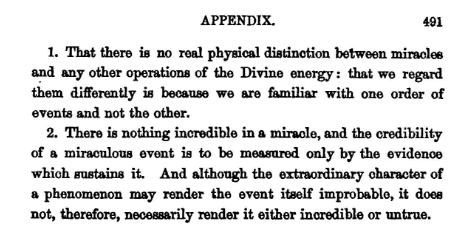
    Babbage miracles

    There’s a few pages of reasoning before we get to his enumerated “prepositions”, but this should do nicely.  The guy was a very very good thinker. 

    Full text of the article is found here: https://archive.org/stream/passagesfromlif01babbgoog#page/n510/mode/2up

    Notes

    1. See the “collected works” section in Babbage’s Passages from the Life of a Philosopher (1864) where he outs himself as the author.  https://archive.org/stream/passagesfromlif01babbgoog/passagesfromlif01babbgoog_djvu.txt

    2. “Chronology of Knight’s Tours”, compiled by George Jelliss, http://www.mayhematics.com/t/1g.htm

    3. Just as a sample the folks working on this puzzle in the 18th c included d’Alembert and Diderot in theEncyclopedie; Jacques Ozanam  in Recreations Mathematiques et Physiques; d’Ortous de Mairan, Abraham de Moivre, Pierre Rémond de Montmort; Jean Etienne Montucla,, Leonhard Euler, and many others.

    The “Euler” in the title refers to Leonhard Euler “Solution d’une Question Curieuse qui ne Paroit Soumise a Aucune Analyse”, Mémoires de l’Academie Royale des Sciences et Belles Lettres, Année 1759, volume 15, pp.310-337, which was the first mathematical paper on knight’s tours.
     

    ·Posted by :

    ·in: