JF Ptak Science Books Quick Post
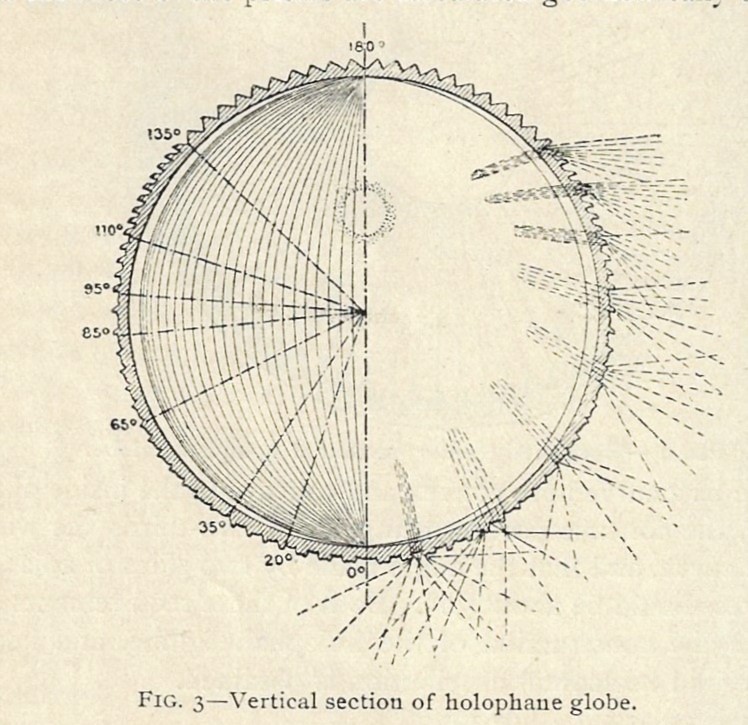
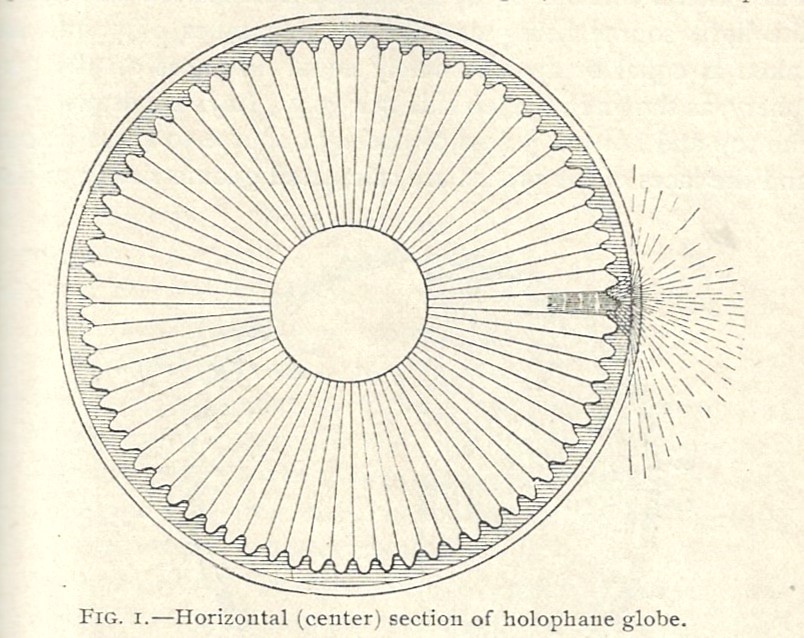
I happened upon these lovely technical drawings –in plan and cross section–of the newly-patented Holophane Globe. The inventors and coiners of the Holophane were French scientist Andre Bondel and the Turkish Spiridion Psaroudak who patented their illuminating globe in the U.S. in 1896 (and five other countries between 1893-1895). It was designed with inverted and excised cuts in the glass dome to refract and reflect the interior lighting source, and successfully illuminated more area with “less light waste” than most other globes. Not only was the design effective, but the effects were also pretty, as were the schematics of the globe. (The profile and paln remind me of some early engravings and woodcut of the interior of the Earth showing the sources of volcanic action…or in the case of our not-recently-mentioned friend Athanasius Kircher, the source of water.)
- Source: “The Holophane Glass Globes for Effecting the Better Diffusion and Distribution of Artificial Light”, Journal of the Franklin Institute, vol 145, April 1898. The article is a technical review of the glass globe and wound up being highly favorable, awarding the inventors the John Scott Legacy Medal for their invention, “…for [the invention] of a globe that secures much better diffusion and more satisfactory distribution than any other globe…”
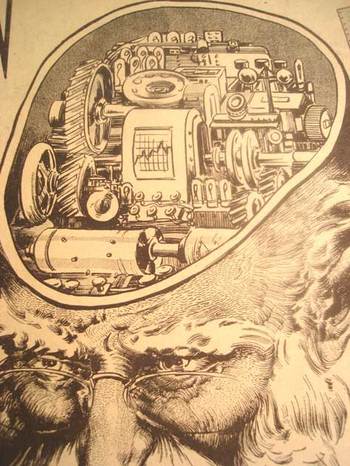
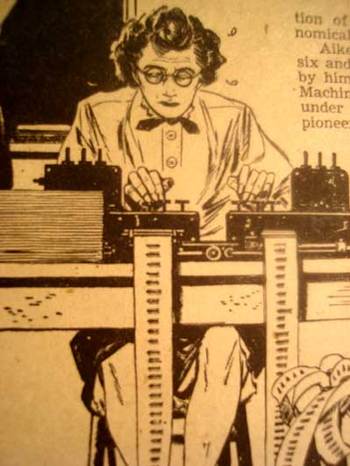
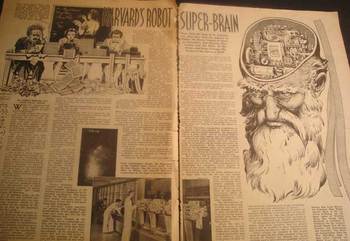 This may well be the first popularly-written and popularly-published report on the Harvard Automatic Sequence Controlled Calculator (ASCC) (appearing in the American Weekly, 15 October 1944), which was the first automatic, general-purpose, digital calculator. Known as the MARK I, it was the brainchild of Howard Aiken (1900-1973), a graduate student at Harvard, who started it all in 1937 by proposing a series of coordinated Monroe calculators to function as a unified whole that would cross the threshold of the physically-impossible calculation (though theoretically possible) to the eminently doable. The project was immeasurably aided by the input of Harvard astronomer Harlow Shapley (who had earlier dealt with the enormously problematic aspects of the scale of the universe) who put Aiken in the hands of IBM at Endicott (NY). From there the building of the computer came under the supervision of Clair D. Lake, with the engineering and theoretical team of Francis Hamilton, Ben Durfee and Howard Aiken.