A Daily History of Holes, Dots, Lines, Science, History, Math, Physics, Art, the Unintentional Absurd, Architecture, Maps, Data Visualization, Blank and Missing Things, and so on. |1.6 million words, 7500 images, 4.9 million hits| Press & appearances in The Times, Le Figaro, Mensa, The Economist, The Guardian, Discovery News, Slate, Le Monde, Sci American Blogs, Le Pont, and many other places… 5000+ total posts since 2008.

Author: JF Ptak

  • On Dr. Frankenstein and a Female Creation

    JF Ptak Science Books    Post 2705 

    Why did Dr. Frankenstein create a male and not a female being? I guess it would be easy to slip into a rolling piece of guesswork as to why the good doctor took on what he referred to as feminine Nature to substitute himself for the job and bring forth yet another male.

    It is perhaps a little odd that Mary Shelley took this route, given her proto-feminist-founding mother and anarchist father, but then again her novel was published in 1818 when she was all of 21, which means she probably wrote it in her ‘teens, which means there was only so much time at that point to have given much long thought to the rights of women ideas. Or not—this is purely speculative. In any event, I liked the idea of the question.

    Victor Frankenstein did indeed nearly create a female being, and was half-way or so there. He wasn’t a fan of this thinking earlier on in the novel, as we hear him addressing his Monster:

    • “Abhorred monster fiend that thou art the tortures of hell are too mild a vengeance for thy crimes. Wretched devil you reproach me with your creation come on then that I may extinguish the spark which I so negligently bestowed…” (By the way, “sparks” is what brought the Frankenstein’s creation to life, this being an early heyday of electricity, though “spark” is mentioned only three other times in the book.)

    His creation pleaded with him for companionship, but old Dr. Vic thought better of the idea and destroyed “her”, ripping the new creation literally limb from limb. It is an unpretty story, though the case made to the doctor from his “monster” is excellent, and I include a good selection of the dialog below.


  • Edgar Allan Poe and Science: the Power of Words and Words as Energy (1845)

    JF Ptak Science Books  Quick Post

    This is a follow-up to a post from yesterday about the transcendental/mystical science found in Edgar Allan Poe’s last work, Eureka.  Today I was looking at one of his great “Marginalia” pieces that appeared in the Democratic Review for June, 1845, called “The Power of Words”. And it seems quite literally so–that the force of (I assume) spoken words is an actual physical thing, atoms at play with others from one point to the next, ad infinitum. Poe writes: It is indeed demonstrable that every such impulse given the air, must, in the end, impress every individual thing that exists within the universe…”

    Full text of the 1845 piece here:  https://babel.hathitrust.org/cgi/pt?id=msu.31293013987718&view=1up&seq=526

    • “ You are well aware that, as no thought can perish, so no act is without infinite result. We moved our hands, for example, when we were dwellers on the earth, and, in so doing, we gave vibration to the atmosphere which engirdled it. This vibration was indefinitely extended, till it gave impulse to every particle of the earth’s air, which thenceforward, and for ever, was actuated by the one movement of the hand. This fact the mathematicians of our globe well knew. They made the special effects, indeed, wrought in the fluid by special impulses, the subject of exact calculation — so that it became easy to determine in what precise period an impulse of given extent would engirdle the orb, and impress (for ever) every atom of the atmosphere circumambient.”

    ·Posted by :

    ·in:


  • A Famous Book and its 170-Word Title (1828)

    JF Ptak Science Books  Quick Post

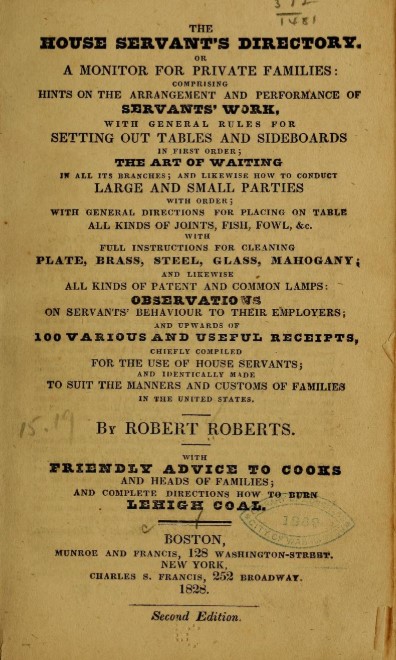
    Books covers robert roberts Before I recognized the importance of this book I was attracted to its endless title, which always seems to be truncated when looking for a version to cut-and paste: The House Servant’s Directory, or a Monitor for Private Families: Comprising Hints on the Arrangement and Performance of Servants’ Work, with General Rules for Setting Out Tables and Sideboards in First Order; the Art of Waiting in all Its Branches; and Likewise how to Conduct Large and Small Parties with Order; with General Directions for Placing in Table all Kinds of Joints, Fish, Fowl, &c.. With Full Instructions for Cleaning Plate, Brass, Steel, Glass, Mahogany; and Likewise all Kinds of Patent and Common Lamps: Observation on Servants’ Behaviour to their Employers, and Upwards of 100 Various and Useful Recipes Chiefly Compiled for the use of House Servants; and Identically Made to Suit the Manners and Customs of Families in the United States…with Friendly Advice to Cooks and Heads of Families, and Complete Instructions on How to Burn Leigh Coal. 

    I enjoy the stab of a three-word-long book title–but if the title can’t be short, then just let it all go, I say.

    Mr. Roberts is recognized to be the first African-American author of a book intended for commercial enterprise, and it evidently did quite well–when he died 32 years after the appearance of this second edition, he left an estate of $7,000, which was a considerable sum in 1860. (A skilled carpenter in 1860 might make $500/600 or so for a filled-up year of 52 60-hour weeks; a free African-American would have made far less–here I’d guess that they would make a fraction of a white unskilled laborer’s wages, if there were jobs like that to be had, and make $100 or so a year. So Mr. Roberts was able to live his 80-year life and support a family of 12 and still was able to save a lot of money.)

     There’s a lot of wide interest in this book, not the least of which is “The Art of Waiting all its Branches”.

    See the full text here, via the Library of Congress:

    https://archive.org/details/houseservantsdir00robe/page/n7


  • Cracks in the Road and What They Mean–a Short Diversion in the History of Lines (1943)

    JF Ptak Science Books  Quick Post   (Part of the History of Lines series) 

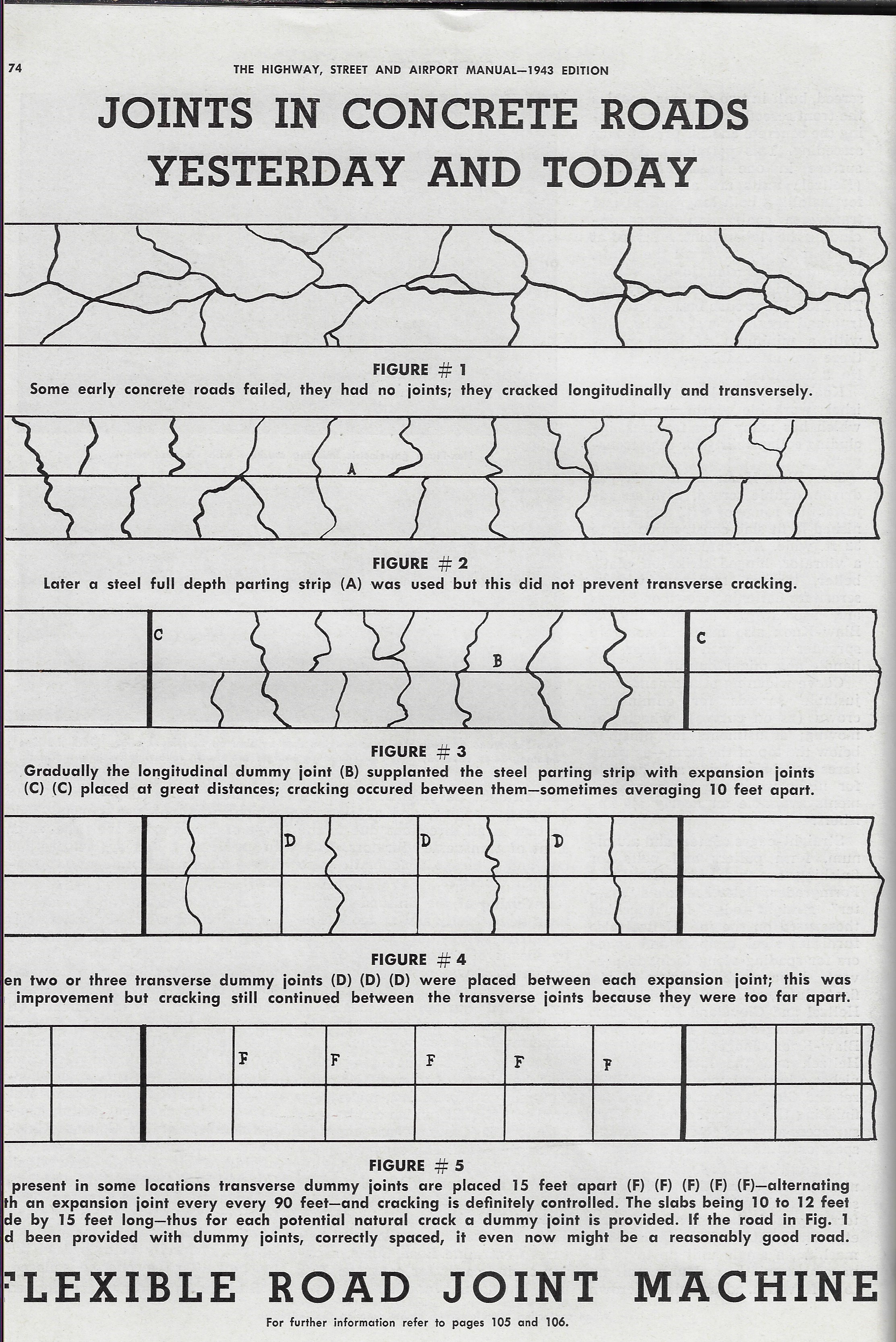
    This part of tonight’s entertainment comes from the unlikely source: The Highway, Street and Airport Manual, Equipment, Methods, Materials (1943), published by Public Works Magazine, and shares an ad that displays the results of various types of concrete road paving failure with the placement of joints. (And, yes, I’m sorry to say that I’m equating “lines” with “cracks”.) It is pretty interesting stuff in a similar vein of the history of painted road lines (longer and more complicated than expected), alpha-numeric utility pole designations, the design of manhole covers, the placement of cable and electrical lines on utility poles, and the like–very obvious and present things in the daily social life of organized public conveniences, but probably mostly overlooked for their constant presence.

    And so, cracks in the street:

    Road concrete failure _1_

    The full two pages of text:


  • Edgar Allan Poe and Science: on the Infinite and Being It *and* the Big Bang Found in “Eureka”?

    JF Ptak Science Books    Post 2803

    I heard about Edgar Allan Poe’s “prose poem”,  Eureka, an Essay on the Material and Spiritual Universe (1848) , and its mystical relationships to scientific bits and bobs, but not much more than that. Looking at it it must’ve looked high-inspired Outsidery back in the day, the language and created references being somewhat impenetrable, and sometimes insufferable, except that it is was a piece of highly creative writing. The book was not well-received at all when published–the public reception was terrible, and it must’ve been a blow to Poe as hr thought that this was the best work he had ever done, and ever could do.  The pity is that he would be dead at age 40 only months later. The book is terrifically mysterious and probing, theologico-sci-fi-osohpy enthrallingly not-science science, and almost the entire audience he wrote for mostly hadn’t yet been born.

    • Link to the text of Eureka: http://www.gutenberg.org/files/32037/32037-h/32037-h.htm

    There’s an endless amount here that is interesting, if not obscure and obscured—much of what I find interesting is also heavily endowed with double-inscrutable jargon, though I think I can make out the meaning but for the words. [Caveat: that said, I’m no Poe guy whatsoever, though I do like his work, particularly the “Marginalia” series–which puts me in mind of Walter Benjamin’s The Arcade Project–but in general I’m just a general reader of the man with no expertise whatsoever.]

    To start this walkaround in the science in Poe I did a very simple word search: I looked for “Newton” (25 hits), followed by“Newtonian” (19 hits). Then came “God” (42), “particle” (23), “word” (71), “gravity (35), “love” (3), “mass” (38 ), and “soul” (20), and some others, none giving me the skeleton key I was looking for. (I haven’t read the whole book and didn’t have the time for it given that I only spend about an hour on each one of these blog posts.) I found my prize with “atom” (147 hits!) and read the appropriate sections, and that got me to where I wanted to go, or at least close to it.

    It begins with a rough entry:

    • “What I wish to impress upon the reader is the certainty of there arising, at once, (on withdrawal of the diffusive force, or Divine Volition,) out of the condition of the atoms as described, at innumerable points throughout the Universal sphere, innumerable agglomerations, characterized by innumerable specific differences of form, size, essential nature, and distance each from each. The development of Repulsion (Electricity) must have commenced, of course, with the very earliest particular efforts at Unity, and must have proceeded constantly in the ratio of Coalescence—that is to say, in that of Condensation, or, again, of Heterogeneity”
    • “Thus the two Principles Proper, Attraction and Repulsion—the Material and the Spiritual—accompany each other, in the strictest fellowship, forever. Thus The Body and The Soul walk hand in hand.”–pg 80

    Poe then goes on to describe the formation of the Solar System (which he estimates to the limits of the revolutions of newly-discovered Neptune to be “6 thousand million miles” which is very close to being correct) as the result of the meeting of two not-diametrically-opposed atoms, which nearly join together, and start spinning around each other, joined by other atoms, and so on, until an enormous uncohesive mass is form after which a collapsing takes place to form the planets as we know them. 

    •  “For ages, this mass of matter has been undergoing condensation, until at length it has become reduced into the bulk we imagine; having proceeded gradually, of course, from its atomic and imperceptible state, into what we understand of visible, palpable, or otherwise appreciable nebulosity….”–pg 85

    This is all some pretty interesting thinking for a man with no science background, sitting in a room.

    We did get to “Ultimately individual consciousnesses will collapse back into a similar single mass, a “final ingathering” where the “myriads of individual Intelligences become blended”, (pg 132) which does have a sort of Black Hole appeal to it.

    And then backtracking a bit I came upon this, 

    • “Let us now endeavor to conceive what Matter must be, when, or if, in its absolute extreme of Simplicity. Here the Reason flies at once to Imparticularity—to a particle—to one particle—a particle of one kind—of one character—of one nature—of one size—of one form—a particle, therefore, “without form and void”—a particle positively a particle at all points—a particle absolutely unique, individual, undivided, and not indivisible only because He who created it, by dint of his Will, can by an infinitely less energetic exercise of the same Will, as a matter of course, divide it. “–page 30

    I then came to what I think I was looking for, to a sort of Big Bang, or a cosmology that at least entertains some Big Bang bits:

    • “The assumption of absolute Unity in the primordial Particle includes that of infinite divisibility. Let us conceive the Particle, then, to be only not totally exhausted by diffusion into Space. From the one Particle, as a centre, let us suppose to be irradiated spherically—in all directions—to immeasurable but still to definite distances in the previously vacant space—a certain inexpressibly great yet limited number of unimaginably yet not infinitely minute atoms.”(pg 31)

    Lemaitre is still far off in the distance at this point, as are Gamow/Alpher/Herman–none would be born for another 50-60 years or so. But here we have some very probing thinking in an area that has something to it,  that can call on the prequel to the Big Bang, all rolled up in an enormous cosmotheology by a poet/writer/editor back in the year of revolutions, 1848.

    Poe knows that he is way out on a limb here, I imagine, and perhaps he was even being heretical: “I design to speak of the Physical, Metaphysical and Mathematical—of the Material and Spiritual Universe:—of its Essence, its Origin, its Creation, its Present Condition and its Destiny. I shall be so rash, moreover, as to challenge the conclusions, and thus, in effect, to question the sagacity, of many of the greatest and most justly reverenced of men.”

    Here’s where the “heresy” part might come into play, with endless god-beings in infinite space, even before existence existed

    • “…a still-existent Being existed—one of an absolutely infinite number of similar Beings that people the absolutely infinite domains of the absolutely infinite space”) who wades through eternity absolutely compacted and expanded, I guess ( “…a Divine Being, who thus passes his Eternity in perpetual variation of Concentrated Self and almost Infinite Self-Diffusion” ). And it is in that compacted part that all beings are created in their consciousnesses, and that eventually all of that will be molded into one big ball of being (“Think that the sense of individual identity will be gradually merged in the general consciousness—that Man, for example, ceasing imperceptibly to feel himself Man, will at length attain that awfully triumphant epoch when he shall recognize his existence as that of Jehovah.”)

    And now off to the finishing bits, the closing paragraphs on p 143:

    • “for pleasure and for pain:—but the general sum of the sensations is precisely that amount of Happiness which appertains by right to the Divine Being when concentrated within Himself. These creatures are all, too, more or less conscious Intelligences; conscious, first, of a proper identity; conscious, secondly and by faint indeterminate glimpses, of an identity with the Divine Being of whom we speak—of an identity with God. Of the two classes of consciousness, fancy that the former will grow weaker, the latter stronger, during the long succession of ages which must elapse before these myriads of individual Intelligences become blended—when the bright stars become blended—into One. Think that the sense of individual identity will be gradually merged in the general consciousness—that Man, for example, ceasing imperceptibly to feel himself Man, will at length attain that awfully triumphant epoch when he shall recognize his existence as that of Jehovah. In the meantime bear in mind that all is Life—Life—Life within Life—the less within the greater, and all within the Spirit Divine.”

    I hope I haven’t done a disservice here to Mr. Poe, or that I’ve gotten things terribly wrong–this is how it reads to me. Poe’s writing is dense and light at the same time, even transcendental–and so to try and nail a piece of writing like this to the floor it hovers above may be the entirely wrong thing to do.


  • Found-Art in a Beautiful Book about Pipes

    JF Ptak Science Books  Quick Post

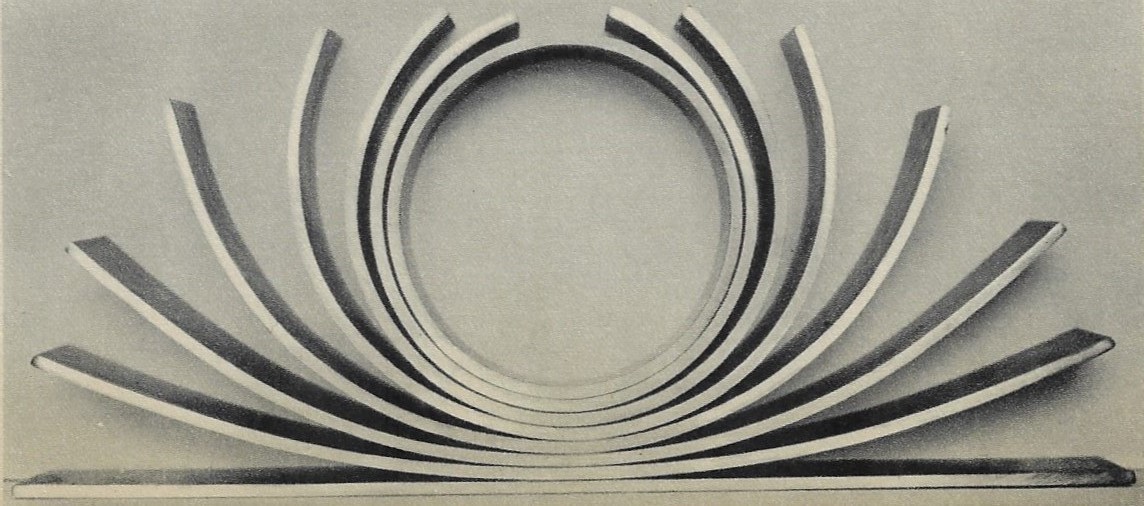
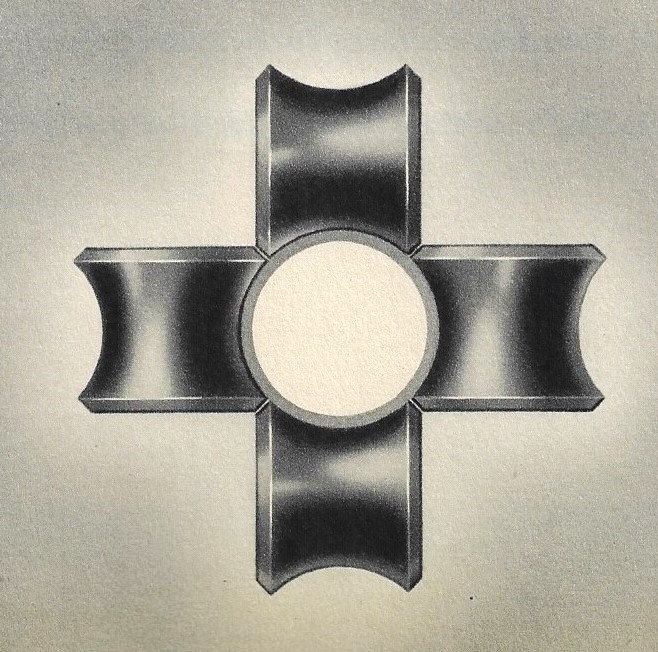
    In the long-developing series on Found Art (categorized here under “Absurdist, Unintentional”, a header that certainly needs changing) is today’s entry: two designs in the unintentional abstract, like a sort of colorless color school Barnett Newman…or perhaps not, maybe they’re more like Duchamp readymades, though heavier. In  any  event,  The  Pipe  of  Progress,  published  by  the  advertising  department  of  Republic Steel in  1940,  is unexpectedly  quite  lovely,  which  a number  of  Bernice-Abbott-like photos  plus  the  already-mentioned  Found  Art.  For  example,  here’s  a cross  section  of  pipe  in  the stages  of  pre-wielded  shaping:                

    Books covers pipes _2_

    And another image showing a cross section of  pipe as it is cold-shaped to its final diameter by one of the series of rollers

    Books covers pipe detail roller

    And the cover of the work:


  • A Vision of the Future: 1911 Takes a Look at 1950.

    JF Ptak Science Books  Post 2802

    While pacing through a volume of Technical World for December 1911 I found an interesting paper on what the world of the future–in 1950–held for the average person in 1911.  

    Introduction

    “Wait! Every ten years in America sees a revolution. Industrial phases assume new proportions, commerce enlarges its borders to rush over strange seas, politics become a tangled web during its evolutionary processes, economic problems broaden their scope. Were the possibilities of the great labor divisions of the world gauged by the strides made during the last fifty years, one would stand in wholesome awe of the vision. The last word in the reconstruction of America is far from being said, though tireless workers of science are constantly forming the new America out of natural forces already largely under their control.”

    Air travel and airplanes

    –“Charles K. Hamilton recently stated that the form of aeroplane now in use can be indefinitely increased in size, and that the speed and carrying power can be proportionately augmented. He believes the limited size of aeroplanes, thus far, to be merely a question of cost,…This will come today or tomorrow, and after that will come the Mauretanias of the air. In 1950 we may have air-ships a thousand feet long, flying at a rate of speed so high as to bring New York and London as near together as New York and Chicago now are.

    –Thomas Edison: “…the most serious difficulty to be overcome in aerial navigation—the difficulty of carrying fuel. “I do not know how to do it,” says the inventor of the phonograph, “but a method will be discovered of wirelessly transmitting electrical energy from the earth to the motor of a machine in mid air. There is no reason to believe it cannot be done.”


  • History of the Past and History of the Future: Communications and Electronics in the Year 2012 (from 1962)

    JF Ptak Science Books    Post 2803 (Reference Tools Post) 

    Now HERE’S a wonderful and referenced and deep look at the history and future of electronics, and one that I believe is very overlooked. The article has the slightly opaque title of “Proceedings of the IRE Fiftieth Anniversary, 1912-1962” , which is the entire May issue for the journal, a double-brick of a book, weighing in at 6 pounds and running over 900 pages. It is a vast and compelling survey of the history and present state and future of electronics in general, boasting an authorship of leading lights across many different fields and encompassing 250 articles. (Some of the big names include: Terman, H.A. Wheeler, H. Olson, Gordon Teal, Presper Eckert, Zworykin, Simon Ramo, JR Pierce, Watson-Watt, Jerome Wiesner, Leo Beranek, Belevitch, Colin Cherry, Lee Lusted, Ronald “THE Antenna”) King, and many others. There’s fantastic reporting on the present-day state of things, as well as dozens of provocative and very prescient overview of what the future may/will bring…and take.

    I obviously can’t reproduce the volume, and no one seems to have the whole thing online, but I can provide a mostly-cleaned-up OCR (please pardon some of the typos) of the three very packed pages of the table of contents of the issue—many of those individual articles can be found online. (If anyone wants the original of this work, I have it for sale in my bookstore.) Perhaps now that you know such articles exist and hadn’t before, you may be able to put this list to some use.

    Some interesting articles include: There Will Be No Electronics Industry in 2012 A.D., J. M. Bridges; Communications Throughout the Solar System, W. H. Pickering; The Information Science anti Industry Fifty Years Hence, Robert M. Bowie; Machines with Imagination, G. A. Morton; The Integration of Man and Machine, J. Presper Eckert, Jr; Man-Machine Coupling-2012 A.D., R. M. Page…well, you get the idea.  

    COMMUNICATIONS AND ELECTRONICS-2012 A.D

    World Travel and Space Communication-2012 A.D., A Realistic Fantasy, Ernst Weber

    • Space-2012, Lloyd V. Berknei
    • Space Exploration, J. H. Dellinger
    • Education in 2012 for Communication and Electronics, Frederick E. Terman
    • Engineering Education-Circa 2012 A.D., W. L. Everitt
    • A Day in the Life of a Student in the Year 2012 A.D., Maurice J. Ponte
    • Fifty Years of Teaching Machines, Harold A. Zahl
    • The Tools of the Engineer 2012 A.D., R. Bennett
    • The Automatic Handbook, Nathaniel Rochester
    • There Will Be No Electronics Industry in 2012 A.D., J. M. Bridges
    • Radio Communication in 2012-An Obsolete Art, Dorman D. Israel
    • Electromagnetics and Communications, Harold A. Wheeler
    • Communication Spectra by the Wholesale-2012 A.D., Estill I. Green
    • A Short History of Electromagnetic Communications, John W. Coltman
    • The Spectrum Problem-Looking Back From 2012 A.D., E. A. Sack
    • The Full Use of Wide-Band Communications, Sir Noel Ashbridge
    • Wide-Band Communication into the Home, W. D. Lewis
    • Communication and Navigation, Henri Busignies
    • Communications and Electronics-2012 A.D., Peter C. Goldmark.
    • Communications Throughout the Solar System, W. H. Pickering.
    • Human Factors in Communications, Albert G. Hill
    • Multilingual Communication, Yasujiro Niwa
    • Language, Words and Symbols, Harold A. Wheeler
    • Processing of Sound, Harry F. Olson

  • Scientific Appraisals of Curving a Baseball, 1877

    JF Ptak Science Books   Quick Post

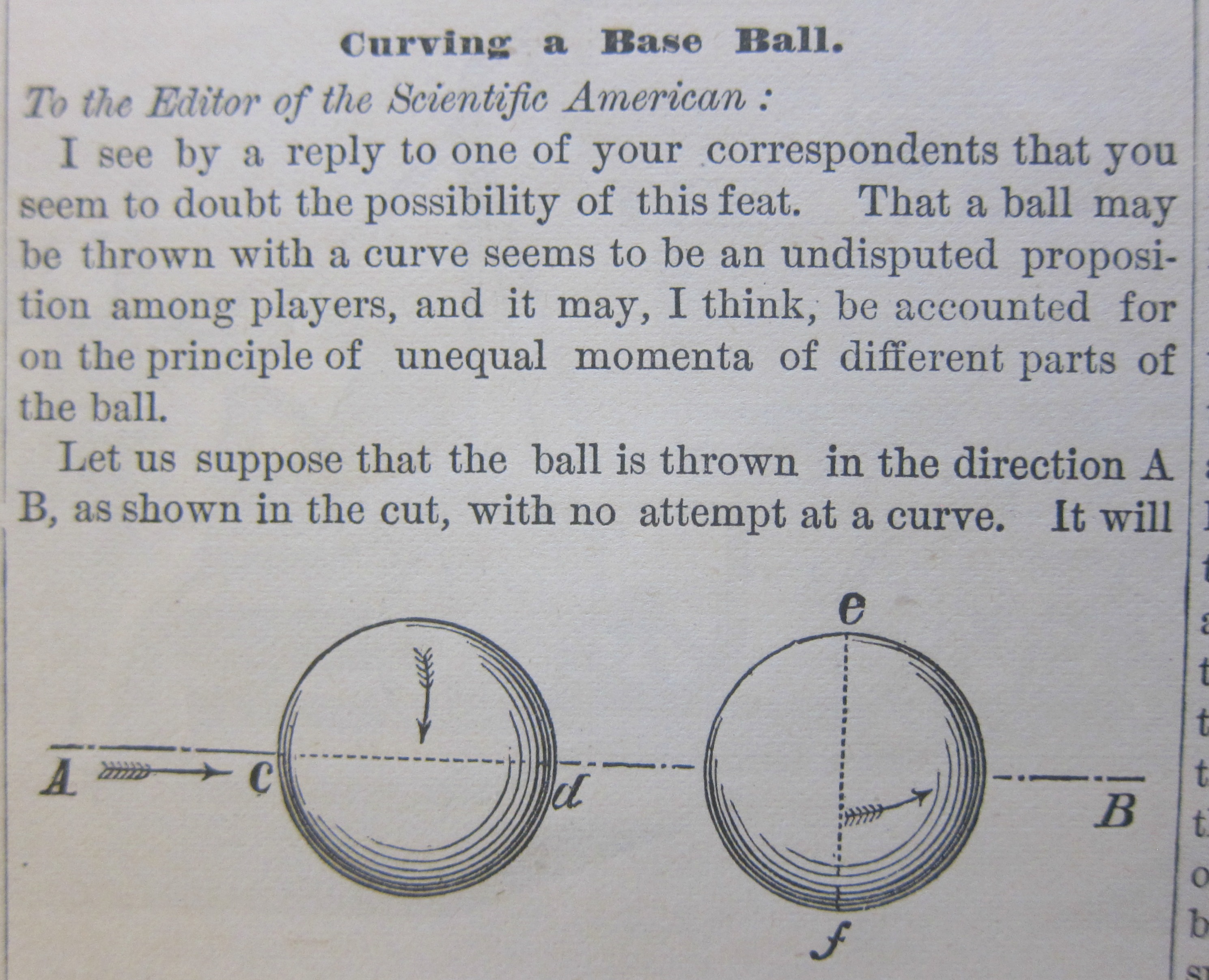
    Ah, the mechanics of curving a baseball as found in the summery summertime pages of  Scientific American, August 18, 1877, page 100. The author, an “H.C.”, admits that they might not be correct, but they’re going with it anyway, at least at this time. 

    Also I should point out that “curveball” appears in print for the first time only two years earlier, at least that is so by the Oxford ENglish Dictionary: 

    • “Curveball. Baseball. A delivery in which the pitcher causes the ball to deviate from a straight path by imparting spin.”
    • “1875   Providence (Rhode Island) Evening Press 4 Oct.   Both sides batted heavily and by the close score made an exciting game. Macullar played worthy of a professional, and the tricky Bancker sent in his curve balls with telling effect.”

    And as long as we’re at it, the chronology of first appearance publications of baseball-related things, according again to the OED, include the following: baseball, 1845; baseball player, 1856; baseball game, 1857; baseball bat, 1858; shirt, 1860; cap, 1865; team, 1869; diamond, 1871; glove, 1884; and baseball fan, 1885. Odd, no, that “baseball fan” appears 40 years after “baseball”? 

    Sci Am Curve Ball BAseball

    ·Posted by :

    ·in:


  • Glass Globes, Light, and Volcanoes (1898)

    JF Ptak Science Books Quick Post 

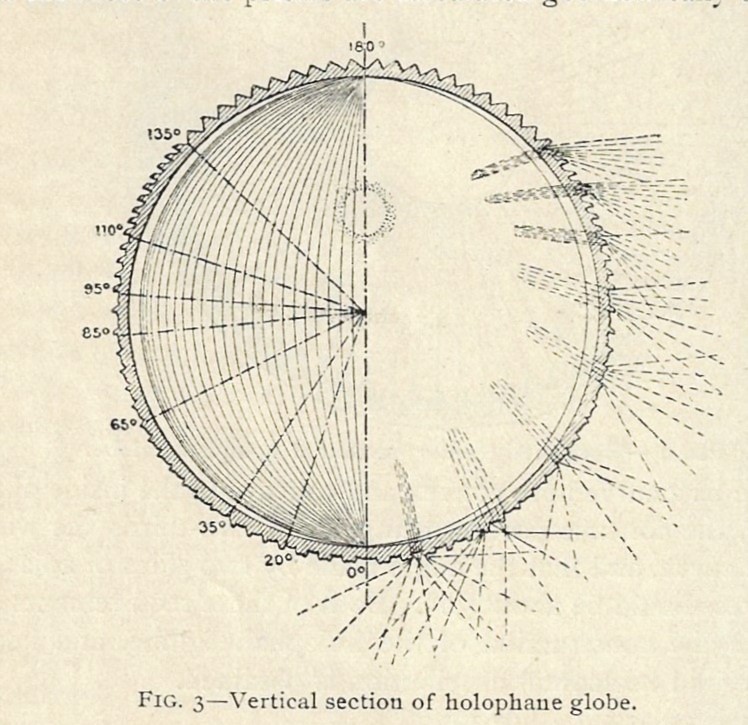
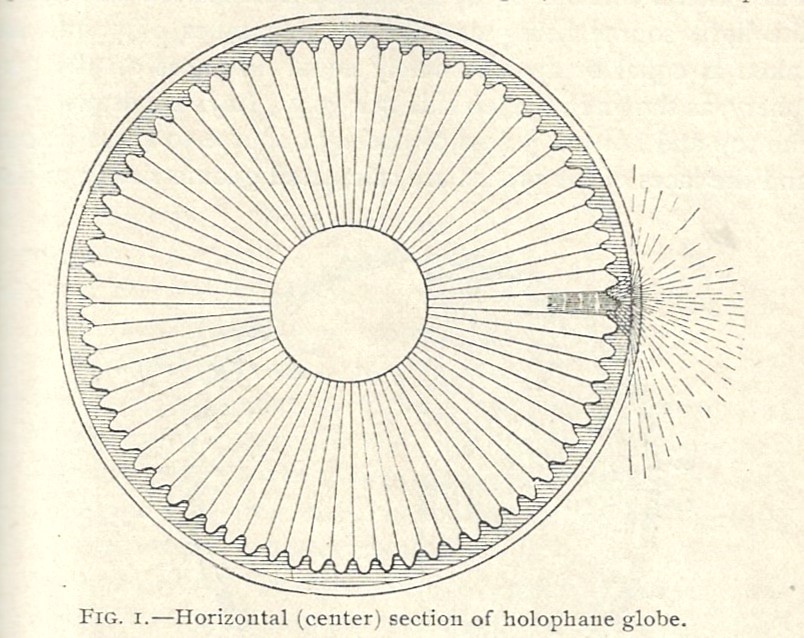
    I happened upon these lovely technical drawings –in plan and cross section–of the newly-patented Holophane Globe. The inventors and coiners of the Holophane were French scientist Andre Bondel and the Turkish Spiridion Psaroudak who patented their illuminating globe in the U.S. in 1896 (and five other countries between 1893-1895). It was designed with inverted and excised cuts in the glass dome to refract and reflect the interior lighting source, and successfully illuminated more area with “less light waste” than most other globes. Not only was the design effective, but the effects were also pretty, as were the schematics of the globe.  (The profile and paln remind me of some early engravings and woodcut of the interior of the Earth showing the sources of volcanic action…or in the case of our not-recently-mentioned friend Athanasius Kircher, the source of water.)

    • Source: “The Holophane Glass Globes for Effecting the Better Diffusion and Distribution of Artificial Light”, Journal of the Franklin Institute, vol 145, April 1898. The article is a technical review of the glass globe and wound up being highly favorable, awarding the inventors the John Scott Legacy Medal for their invention, “…for [the invention] of a globe that secures much better diffusion and more satisfactory distribution than any other globe…” 


    JFI 1897 Holophane _1_ JFI 1897 holophane _2_

    ·Posted by :

    ·in: