A Daily History of Holes, Dots, Lines, Science, History, Math, Physics, Art, the Unintentional Absurd, Architecture, Maps, Data Visualization, Blank and Missing Things, and so on. |1.6 million words, 7500 images, 4.9 million hits| Press & appearances in The Times, Le Figaro, Mensa, The Economist, The Guardian, Discovery News, Slate, Le Monde, Sci American Blogs, Le Pont, and many other places… 5000+ total posts since 2008.

Author: JF Ptak

  • A Review of a WWII German History of Rocket Development Film (1950)

    JF Ptak Science Books  Quick Post

    The gem in the title to this short post bubbled into view while looking through an issue of the Journal of the British Interplanetary Society (March 1950) for a biography of Wernher von Braun. The two-page biographical notice was perfunctory and the war years were sanitized (stating that after interrogation there “was no room for doubt” that von Braun’s real interests were only in interplanetary travel and high altitude research).  

    Rocket development history of -2_ DETAIL

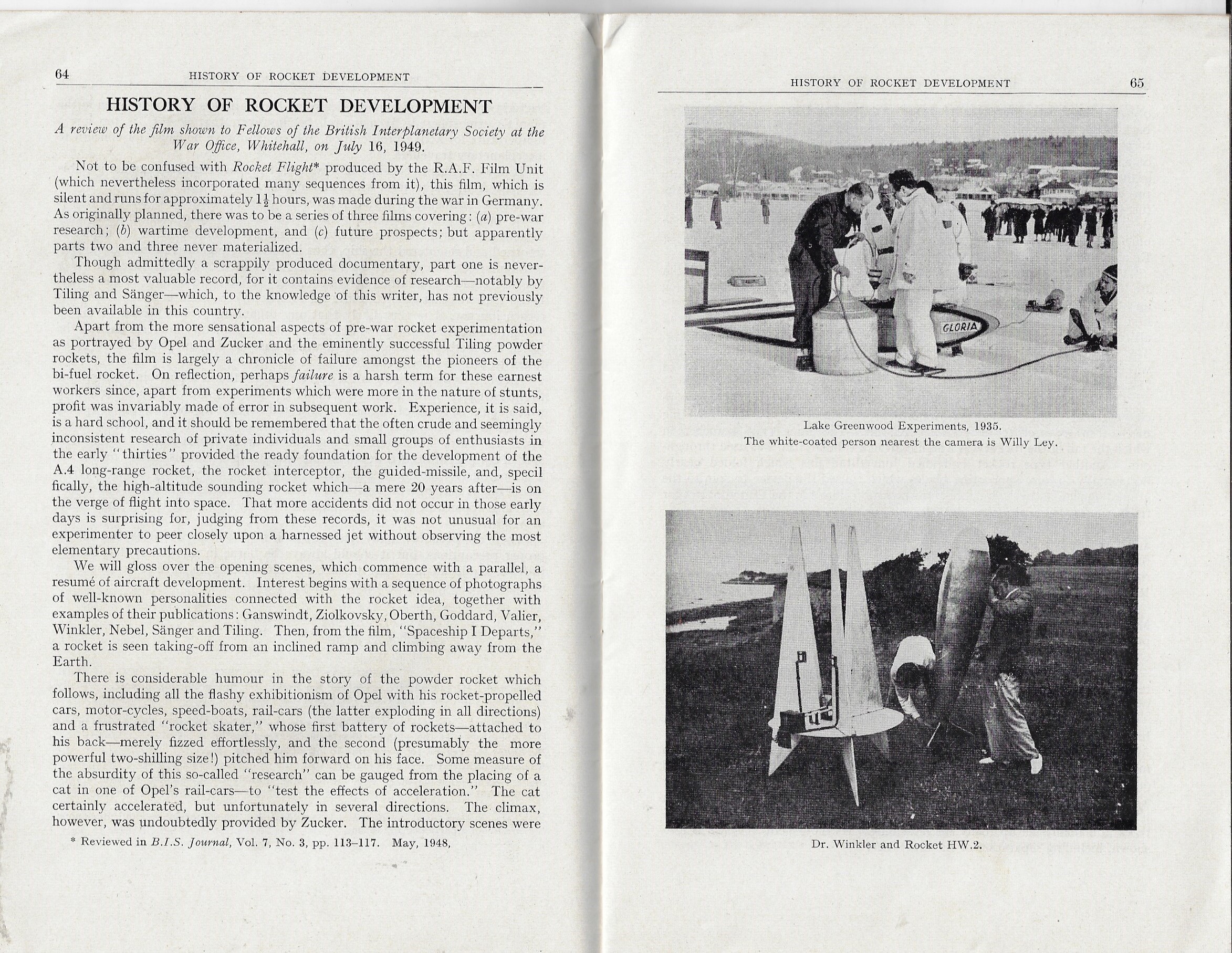
    The review of the German film on rocket development is another story–I’ve reproduced the eight-page tightly packed review below, as it is very useful and in the face of not having the viewable film it serves as a good outline.

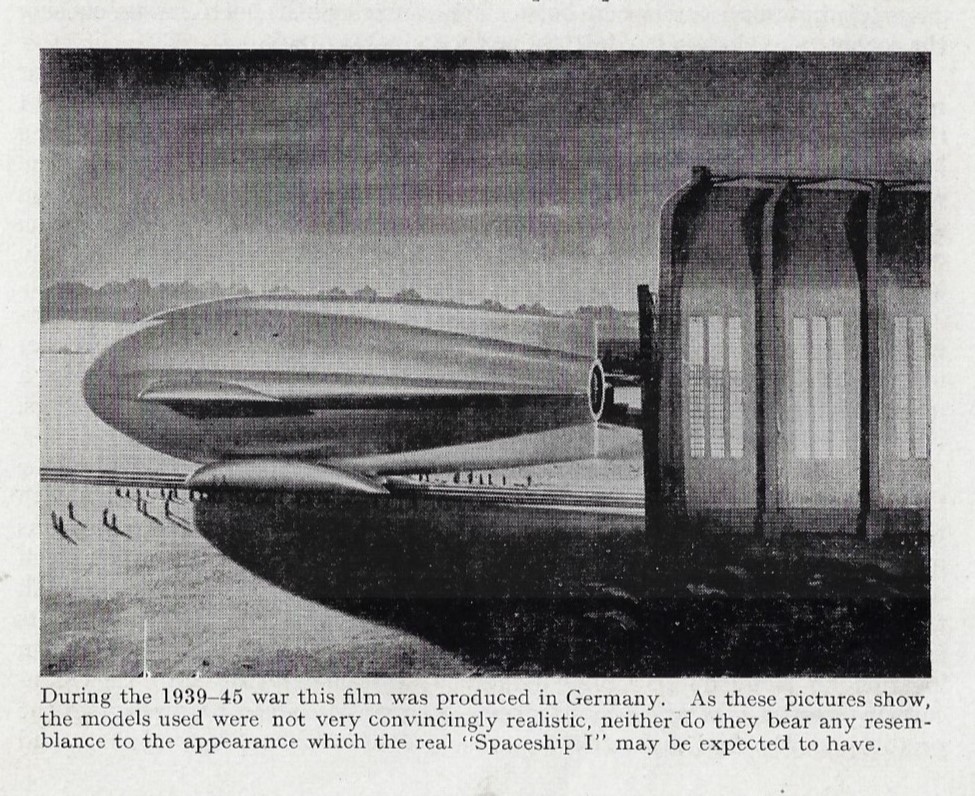
    I found the references to “Spaceship I” (pictured above) to be very intriguing, though outside of two images of models for the proposed dirigible-like behemoth almost no other information is presented. 

    Rocket development history of -1_

    ·Posted by :

    ·in:


  • “Flying Saucers” (1952)

    JF Ptak Science Books  Quick Post

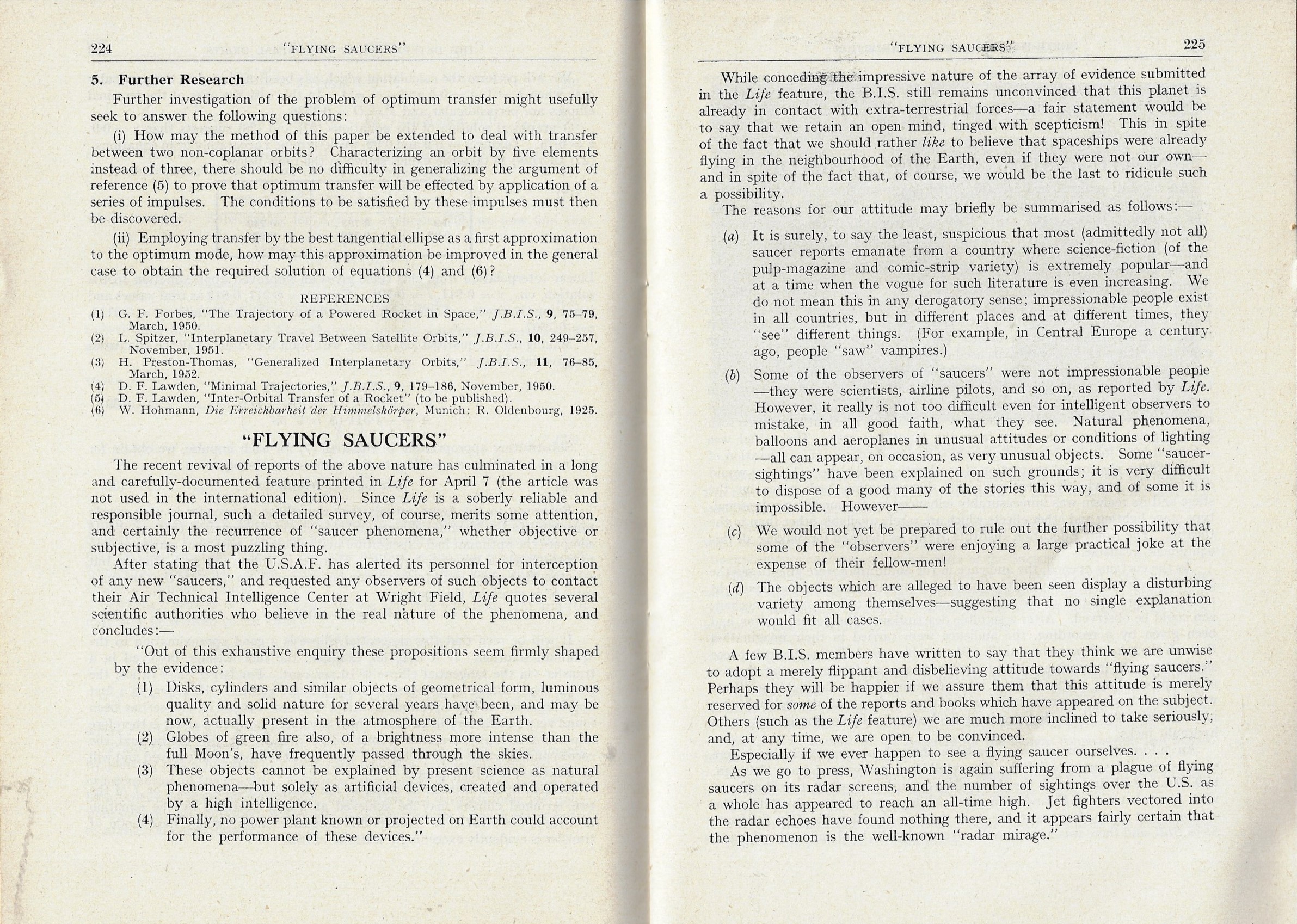
    I want to spend only a few minutes on this subject as I have just now come upon a nicely-written and logical response to the “flying saucer” issue in the pages of the Journal of the British Interplanetary Society1 for 1952.  Rather than discuss it I’m just going to reproduce the two pages of the piece below.  I did bend to curiosity a bit here and checked out “flying saucer” and “U.F.O.” in the Oxford English Dictionary, just to get a sense of how quickly they came into being following the hysteria of 1946.  Turns out that the BIS is no stranger to the term, the OED listing it second in usage back in 1948, back when the word still had its new-car-smell, though as you can see it hardly registered so with the members of the Society.

    “Flying saucer” n.: the fanciful name given to various unidentified disc- or saucer-shaped objects reported as appearing in the sky.

    • 1947   Times 8 July 4/4   During the past fortnight reports that dish-like objects, nicknamed ‘flying saucers’, have been seen travelling through the air at great speed..have come from the United States and Canada.
    • 1948   Jrnl. Brit. Interplanetary Soc. 7 199   I haven’t examined the details carefully, but the ‘flying saucers’ bear all the hall-marks of mass-suggestion.
    • 1953   D. Leslie & G. Adamski Flying Saucers have Landed i. i. 13   Ever since the cliché ‘flying saucer’ was coined, the greatest and most exciting mystery of our age has been automatically reduced to the level of a music hall joke.

    “U.F.O.”, n.: An unidentified flying object; a ‘flying saucer’.

    • 1953   D. E. Keyhoe in Air Line Pilot Oct. 9/3   The UFO was estimated to be between 12,000 and 20,000 feet above the jets.
    • 1956   E. J. Ruppelt Rep. Unidentified Flying Objects 13   UFO is the official term that I created to replace the words ‘flying saucers’.

    [Click for a cleaner and larger image]

    Flying saucers BIS 1952


  • General Groves on The Possibility of Blowing Up the World and What Comes Next (1945)

    JF Ptak Science Books   Quick Post

    Yesterday I wrote a post about Robert Oppenheimer’s 1945 Congressional testimony on the economics of using atomic bombs over conventional bombs. In an earlier section of the same volume1 publishing the Oppenheimer statements there are also testimonies of some other Los Alamos and atomic bomb figures, including Harold Urey, Irving Langmuir, and Vannevar Bush. And Leslie Groves. General Groves of course was the military chief of the Manhattan Project and ran it with some interpersonal difficulties but with great success with Robert Oppenheimer, who was in charge of the scientific cadre.  They were an odd pair but worked well enough together to push through an enormous project of absolutely fantastic complexities and depths. In questions from six Senators Groves addressed a number of wide-ranging issues about the bomb, though what particularly appealed to me today was his observations on the possibilities of the U.S. precipitating some sort of event with atomic weapons that would bring an end to the world. The question came from  Senator Richard Russell (Ga.) who (with some difficulty) asked after this possibility. Groves responded with brusqueness and a sort of common authority, which I reprint below. 

    “Senator Russell: General, the papers tell us that some of the scientists are of the opinion that if a large number of these [atomic bombs] were exploded over the world that it would reach out into the elements in the atmosphere and instead of being a world we would just be a new star, and all life on the planet would be extinguished almost automatically. Do you have any theory on that to give us?

    General Groves: My only theory is that I don’t worry about it because if it happens it will be all over and we won’t have that to worry about. We won’t have to explain that one but the theory is not concerned with getting a number of these bombs but with getting one that is big enough to do that. No one knows what that size is. It is all highly theoretical…It is more or less the kind of thing that they [physicists] will discuss as a possibility when they are just sitting around talking theoretically they may be able to prove that such a thing is possible but the best advice I have and I certainly don t hold any personal views or knowledge on the subject but the best advisers tell me that they are not a bit worried, and I personally am not worried. I feel it will be beyond my lifetime and then I will let the next generation worry as to whether they are going to blow themselves up or not.”

    And there you have it. 

    Notes:

    1. HEARINGS BEFORE THE SPECIAL COMMITTEE ON ATOMIC ENERGY UNITED STATES SENATE SEVENTY NINTH CONGRESS FIRST SESSION PURSUANT TO S Res 179 4.  A RESOLUTION CREATING A SPECIAL COMMITTEE TO INVESTIGATE PROBLEMS RELATING TO THE DEVELOPMENT USE AND CONTROL OF ATOMIC ENERGY.  USGPO, 1945.

    ·Posted by :

    ·in:


  • J. Robert Oppenheimer on the Economics of Atomic Bombing (1945)

    JF Ptak Science Books  Post 2811

    On the heels of the sale of a letter [https://historyofideasblog.com/thesciencebookstore/2013/03/william-shockley-on-the-economics-of-atomic-bombing-1945.html] written by transistor pioneer and then mega problem child William Shockley on the economics of atomic bomb a friend told me about a potentially similar account by J. Robert Oppenheimer. Leaving the modern racist Shockley behind in this post for time consideration, the Nobelist (sharing the 1956 award with co-workers Walter Brattain and John Bardeen), the man wrote an appraisal on the monetary aspect of conventional vs. atomic attack for one of the Vannevar Bush groups in 1944/5. It may seem pretty harsh—especially when he came out with the unsurprising finding that the economics of the situations were firmly positive for the use of nuclear weapons—but it was a job that someone had to do, somewhere, and Shockley turned out to be that person, probably to the surprise of very few.

    Oppenheimer is a different story. Philosophically conflicted and occasionally torn, the man who announced himself as the “destroyer of worlds” while still bathed in the light of the successful atomic test shot in the Jornada del Muerto also contributed some thought to this issue. The original reference to this was told to me to be in Scientific Information Transmitted to the United Nations Atomic Energy Commission…June 14, 1946, a set of seven slender volumes prepared under the direction of the always-present Bernard Baruch. The reference came in the first volume (which also has a short and simple and brilliant 18-page history by Richard Feynman and Robert Bacher of atomic energy and the building of the atomic bomb) in a paper by Philip Morrison in which he records a one-line quote of Oppenheimer’s overall assessment of the dollars and cents of atomic bombing. The Oppenheimer quote was referenced to its source in a Congressional special report on atomic energy published a few months earlier in 1946, and there he speaks for about one page on these explosive economics.

    As I said it is far easier finding this thinking in Shockley—but for Oppenheimer as disagreeable as this thinking might’ve been, it was still a pertinent question and one that needed to be researched and answered, and I believe Oppenheimer did just that, with no extra-emotional attachments to the issue. It was an issue/problem/question, and the scientist answered it.

    So for the general interest I’m reprinting Oppenheimer’s testimony on this one aspect of the use of the atomic bomb, which you will find below.

    • The source: Hearings before the Special Committee on Atomic Energy, United States Senate, 79th Congress, first session, pursuant to S. Res. 179, A resolution Creating a Special Committee to Investigate Problems Relating to the Development, Use, and Control of Atomic Energy. Part 2: December 5,6,10 and 12, 1945. USGPO 1946.

    “Senator Hart [Thomas C. Hart of Connecticut]. Doctor I think perhaps you may be misunderstood at one point on account of brevity.

    You said that atomic weapons can be cheap instruments of devastation and then explained it briefly.

    I think it would be better for purposes of the record if you expanded that.

    Dr Oppenheimer. Well I have seen a figure I don t know whether it is a reliable figure but it is surely not a crazy one that it has cost us in this war $10 a pound to deliver explosive on the enemy. I am unable to give an accurate cost figure on atomic weapons partly because I don t know and partly because if I did know it I would be prevented by that knowledge from saying it but I think that I can say that even taking account of the in some ways diminished effectiveness of concentrated bombing it is somewhere between 10 and 100 times cheaper to deliver atomic weapons which is simply in terms of the area destroyed it is 10 or 100 times cheaper.

    I don t know if it is 10 times or 30 times and this will depend on policy but it is an enormous factor. It is not a trivial change.

    Senator Hart. Cheaper for instance than TNT?

    Dr Oppenheimer. That is right and I am using a figure which may well be criticized but which is I believe the figure used by Army Ordnance for over all cost of delivering a pound. You can see what that means if you take a round figure of 10,000 tons as a possible effective equivalent for an atomic bomb. That is 20,000,000 pounds which is $200,000,000. Now without revealing any secrets I can say that an atomic bomb and the equipment for delivering it is not going to cost that by an enormous factor.

    Senator Hart. But those large TNT bombs which are the usual comparative figure though the destruction in any one point any one small area is by no means as great it is sufficient and is spread over a wider area is it not?

    Dr Oppenheimer. I used a somewhat conservative figure of the 10,000 tons rather than the actual equivalent in part to take this into account. The actual atomic bomb releases more energy than this.

    Senator Hart. But it is true that the comparison as is usually made is a little faulty because of the respective areas involved?

    Dr Oppenheimer. What I would say is this and I will be somewhat sharper about it if you wish. For the equivalent tonnage the factor of cost will be more than 100. For equivalent area it will be somewhere between 10 and 100 and that is to try to take account of this effect which you mentioned. Of course if you want to knock out three houses somewhere you will not use an atomic bomb.

    Senator Byrd [Harry Flood Byrd, Virginia]. Doctor, when you spoke of destroying the stock pile of bombs would that mean too destroying the organization and the factories that made the bomb?

    Dr Oppenheimer. In the first place I did not speak of destroying it. I was asked about it.

    Senator Byrd I understood you to say that if you had faith in other nations you would then favor the destruction of the bombs we accumulate during this period before we can ascertain what other nations are going to do.

    Dr Oppenheimer I would say this country should do for the problem of atomic armament what we expect other nations to do If we expect them and are convinced that they wish not to arm atomically then I think that we should not arm atomically and if we want to keep the plant some place. I think we should have that plant completely open and should allow the representatives of the powers with whom we are dealing to know as much about what we are doing as we would want to know about their plants…”
    ·Posted by :

    ·in:


  • A Massive Triple Tandem Triplane (1921)

    JF Ptak Science Books  Quick Post

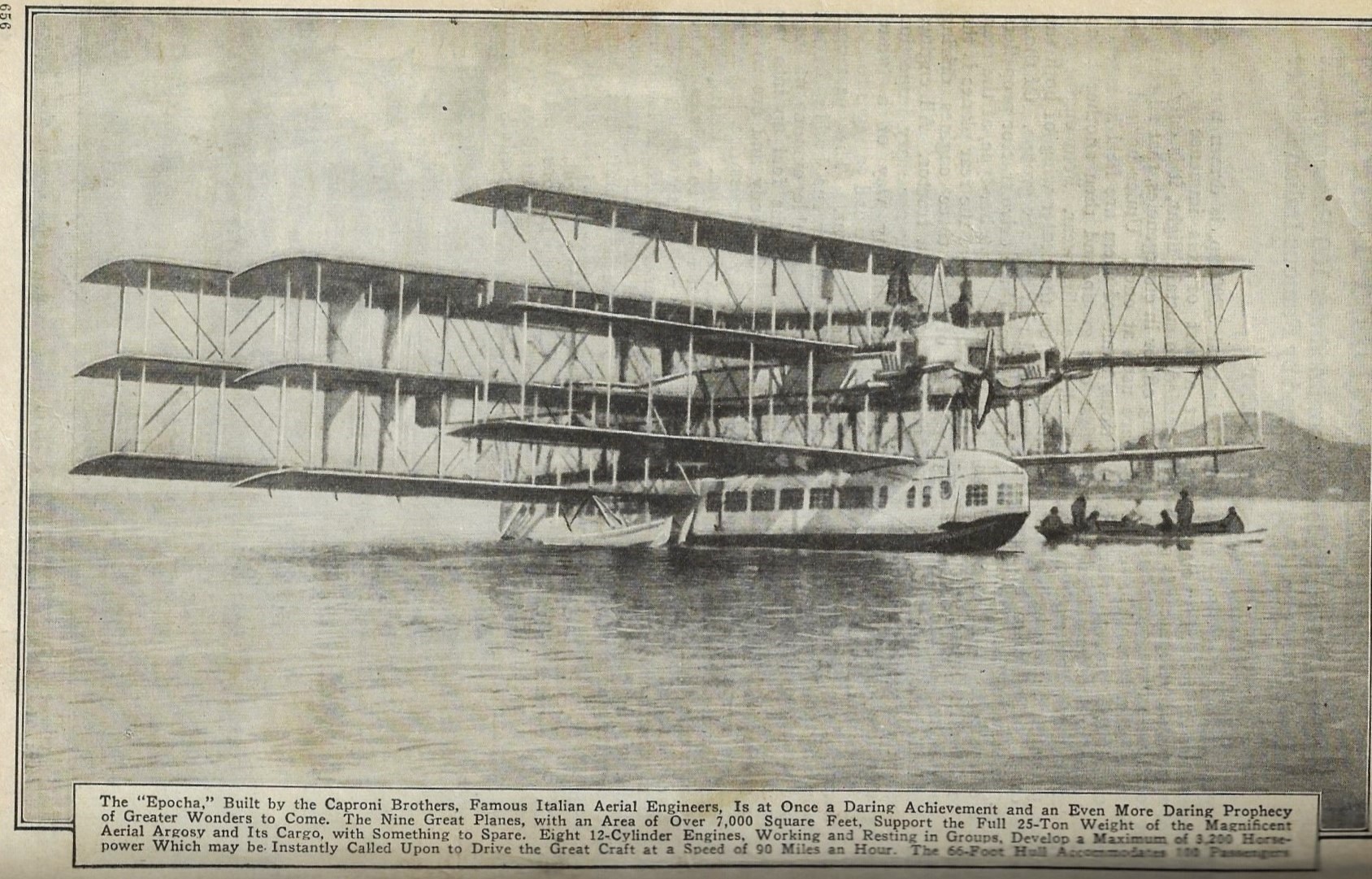
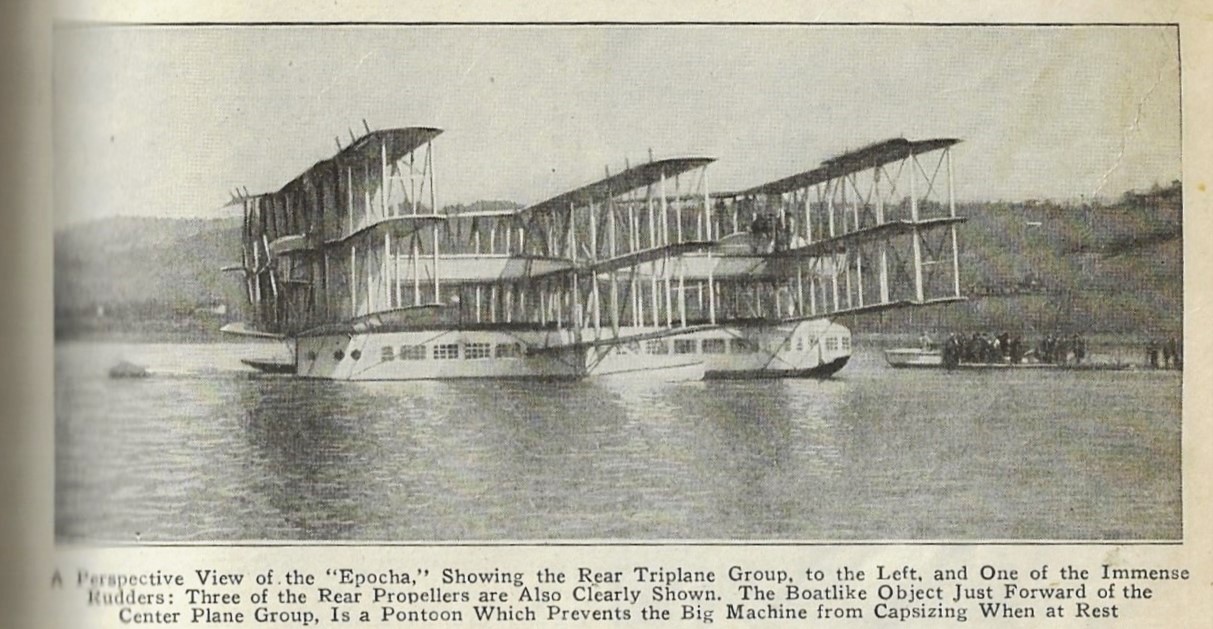
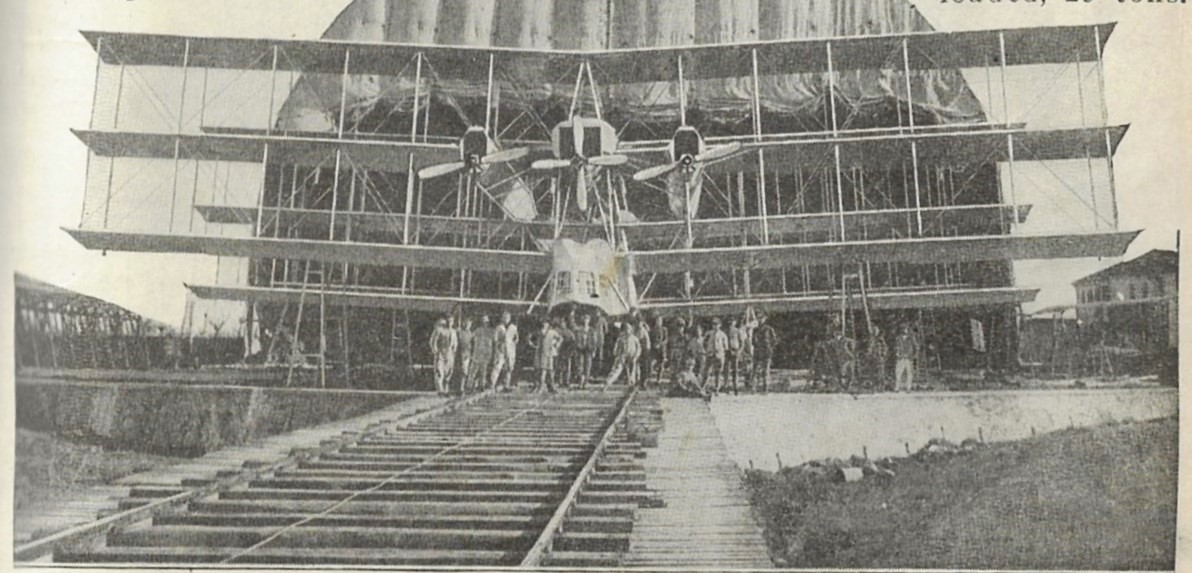
    What we see here, below, is a rather extraordinary flying machine, a mammoth beast with 8,000 square feet of wings (more than 40% greater than that of a 747). It was a triple tandem triplane, which is a glorious-sounding and possibly epic description of the aircraft—a plane with three independent triplanes fixed to one fuselage. The article appears in Popular Mechanics for May 1921, and describes this aeronautical attempt as the work of Giovanni (Gianni) Caproni (1886-1957), which was to be a transport for 300-mile round trip excursions at about 80mph cruising speed. It was powered by 8 12 cylinder 400 hp Liberty engines operating on push/pull arrangements on different wings, carrying a crew of eight and 100 passengers. Unfortunately the flying boat crashed on its second test flight, and then the remains were towed badly toward shore, and that was the end of the plane.

    Pop Mech 1921 massive flying boat caproni _2_


    Pop Mech 1921 massive flying boat caproni _3_
    Pop Mech 1921 massive flying boat caproni _3_

    ·Posted by :

    ·in:


  • When the Opposite of an Idea is the Better Idea (1922)

    JF Ptak Science Books  Quick Post

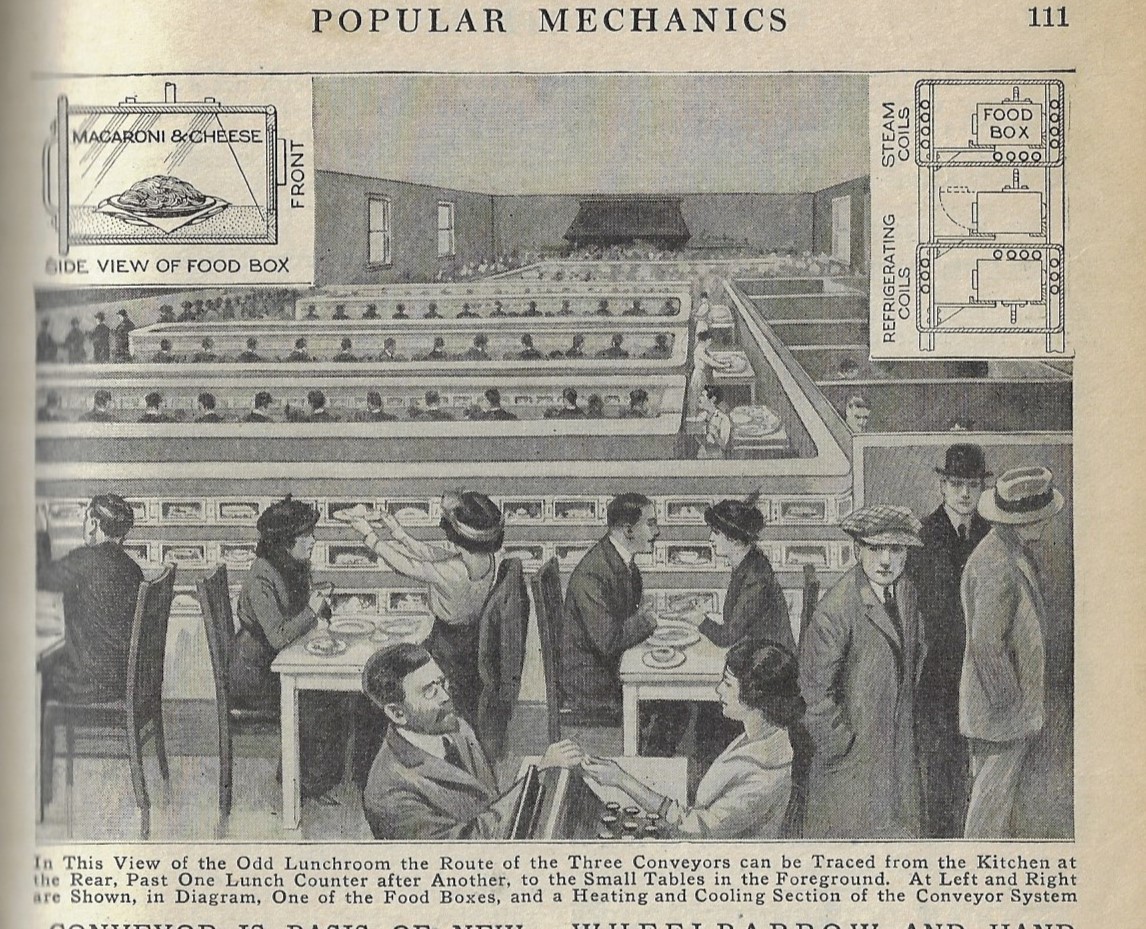
    Here’s a suggestion for a new category for this blog: Ideas That May Be Better Backwards. The idea is presented in this wonderful image from Popular Mechanics in 1922 and features an endless trolley/conveyor of food that moves past stationary diners at a restaurant. You’d sit down, and gobs of food would be presented on an endless conveyor, moving along at probably 1 mph. This idea makes sort of very quick 3-beer sense, until you think of the probable waste and the cost of machinery and energy that it took to trundle the food along, and then replacing all of it that went cold, and so on. It seems to me the opposite might be the better if not still-bad idea: putting the patron seating area on a revolving stage and have a central location for the food where they’d take what they wanted. The conveyor-of-food idea withers next to the great Automat, where people would simply walk up to a long bank of small windowed receptacles with different foods inside, drop a few coins into the slot opening the lovely little (but thick) door, after which you’d simply find a place to sit and eat. (This automat was a German 19th c idea, and it became popular in the U.S. in the 1930s’-1960’s, with Horn & Hardart leading the way with 30 or so locations in NYC. The H&H variety closed up by the early 1990’s, their locations converted into Burger King meat/fat/carb slingshops.) Here it is:

    Pop Mech 1920 luncheon

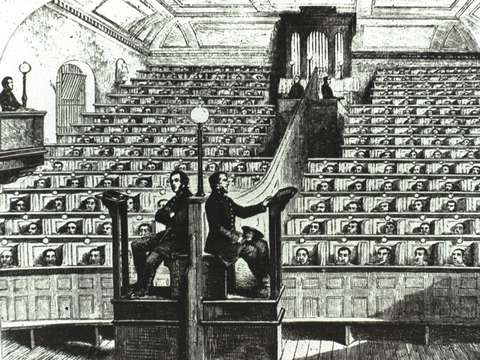
     The image reminded me of one I saw for the very restrictive penitent/observer prisoner in chapel at Pentonville Prison in 1855–I know it is hardly similar whatsoever to the food-on-a-belt, but the two did come together somehow in my head:

    Prison chapel Pentonville

    [Source: lost! Apologies.]

    ·Posted by :

    ·in:


  • The Jevons Logic Machine (1870)

    JF Ptak Science Books  (This is a null post, carried over from the bookstore section of this blog–I’m sharing it in the bookseller format to simply share the info on this fascinating machine.)

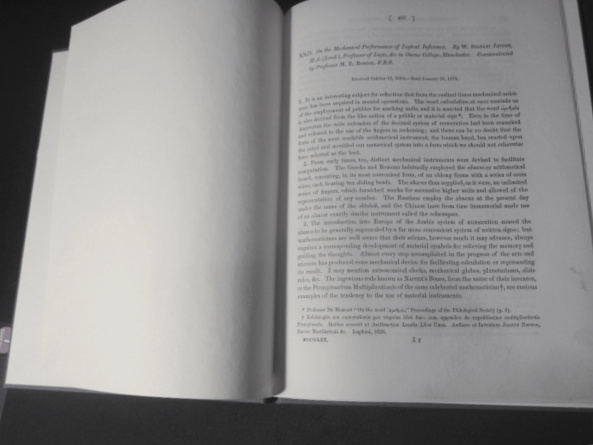
    Jevons logical _4_W. Stanley Jevons, On the Mechanical Performance of Logical Inference, in Philosophical Transactions of the Royal Society, 1870, pp 497–518. This is an extract from the volume, containing the entire article, plus its three engraved plates showing the works and interior of the machine. This is very tastefully bound in paper covered boards with a paper spine label. This is the first description of the one the preeminent. 

    Jevons was a polymath and one of my favorite thinkers of the 19th century. He worked across many fields but seems to be remembered today mostly and unfortunately for his theory of the relationship between sunspots and economics cycles. He is not so well known as the inventor of one of the earliest pre-modern computers and particularly for it being the fastest machine of its kind ever invented.

    “In 1870 a British scholar, W.S. Jevons, built the first computer designed to solve logical problems. Inspired by Boole and Babbage, Jevons built a mechanical device implementing automated deduction…”–Paul Amblard, “A Finite State Description of the Earliest Logical Computer: The Jevons’ Machine”, in the Springer International Series in Engineering and Computer Science book series (SECS, volume 434)

    “The creation of analog computing devices is both relevant and significant to the development of modern computers, but was there no early pure mechanical digital apparatus, given the advent of Boolean logic and Venn diagrams in the 19th century? One individual in particular began a small, but significant movement that transformed digital theory into mechanical devices that, while lacking the sophistication and power of later electronic digital computers, did, nevertheless, function in a digital mode. The person responsible was the Englishman W. Stanley Jevons (1836–1882).”–George Buck and Stephen Hunka, “W. Stanley Jevons, Allan Marquand, and the Origins of Digital Computing” in IEEE Annals of the History of Computing, Vol. 21, No. 4, 1999.


  • The First Microscopical Images of Captured-and-Reproducible Sound? (1878)

    JF Ptak Science Books   Quick Post

    Only months into the invention of the phonograph by Thomas Edison (at Menlo Park in December of 1877 and patented in January 1878) Alexander J. Ellis reviewed a version of it constructed in London by Mr. Stroh, and found it, well, wanting.  Ellis (1814-1890) was a product of Eton, Cambridge, Trinity, and was a gifted mathematician, philologist, and a groundbreaking ethnomusicologist, and did see some limited utility of the machine to restricted areas of his research. In the short note he wrote for Nature in their April 18, 1878 issue1, he mostly found that the phonograph was generally flawed in its reproductive capacity, and did not venture far from this interpretation so far as the possible applications of the machine was concerned, which seems iconically short-sighted from my perch here in the future. Even though Ellis recognized that “the effects produced are sometimes startling (as in cries, coughs, laughter, music), the philosophy of the process (making a permanent impression of a very complex compound vibration, and using it as a mould to reproduce that vibration is exceedingly attractive, but at present the instrument–at least the one that I saw…” he concludes that the status of the invention “…has not risen beyond a lecture illustration or a philosophical toy”.  

    Nature 1878 Perifser Frazer

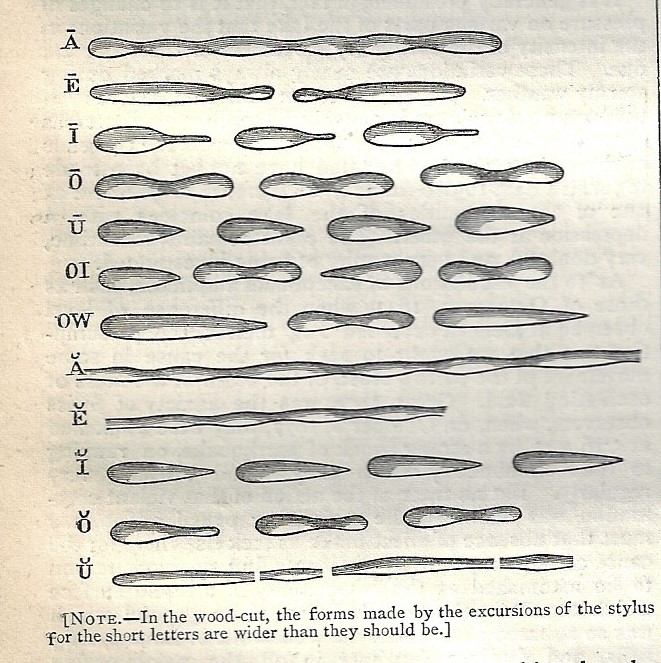
    Five weeks after this article and about four months following the patenting a visually-arresting article appeared in Nature which contains what I am assuming to be the first microscopic images of recorded and reproducible sound. I know that is a pretty deep qualification, but I think that’s its accurate. The article appeared as “Examination of the Phonograph Record under the Microscope” by Persifor Frazer2, who investigated what the impression of the stylus looked like as known sounds are recorded on tin foil. And so this remarkable image, showing what vowel and some dipthongs “look like”.  

    Notes:

    1. Persifer Frazer,   “Examination of the Phonograph record under the Microscope”,  an abstract of a paper presented at the Franklin Institute April 17, 1878, by Persifor Frazer, Nature, May 23, 1878, p. 102, in the weekly issue. 
    2. Persifor Frazer was of the Philadelphia Frazers, of long and interesting lineage. A Gettysburg vet, he was in professional life mainly a geologist; he did become expert in handwriting and the detection of forgeries using photographic means.  

  • An Improbable Advertisement in “Astrophysical Journal”, 1903.

    JF Ptak Science Books   Quick Post

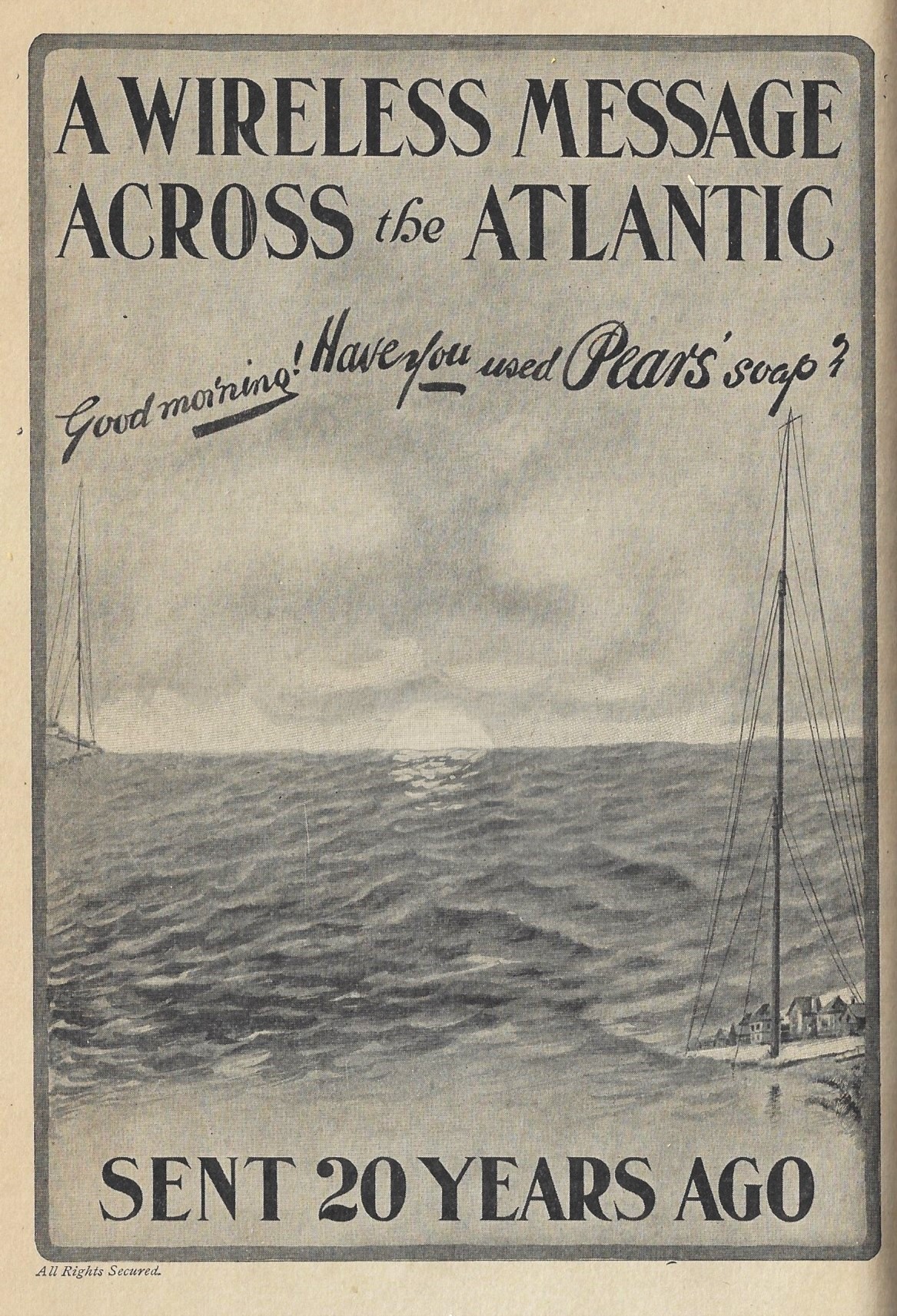
    Pears soapHere’s a scamperingly light post: an ad for Pears’ soap making a very curious and probably intentional incorrect claim. Of course it is just an ad, and it is just soap, but it is displayed proudly full-page on the inside cover of the prestigious Astrophysical Journal for 19031, and it seems to make an odd statement about transoceanic radio communication, inferring that a message was sent across the Atlantic via wireless “20 years ago”.

    Here’s the deal: I don’t understand why this ad is so purposefully wrong. The first message sent across the Atlantic didn’t occur “20 years ago” or 1883 as is coddled in the ad–that honor belongs to Marconi (1874-1934) who expanded on his first experiments in 1894 to send and receive radio signals across the Atlantic on 12 December 1903. (The signals originated in Poldhu, Cornwall, England, and was received at Signal Hill, St. Johns, Newfoundland—the message was a simple Morse code for the letter “s”.) Those twenty years notwithstanding, Marconi and Ferdinand Braun shared the Nobel in 1909 for their work in radio.

    Now, the ad says “sent 20 years ago” and not sent and received, or received at all for that matter. I know the “twenty years” doesn’t correspond to when Pears began operation, because that occurred in 1807. So I’m not sure what it is that they’re talking about here, though it is a pretty ad. If anyone has the answer to this little issue, I’d like to hear about it.

    (The antennas depicted here are very unlike the ones that Marconi constructed for his famous feat: “The spark-gap transmitter fed a mammoth antenna array — four hundred wires suspended from 20 masts, each 200 feet tall, placed in a circle. A similar station was set up on the American side of the Atlantic at South Wellfleet, Cape Cod.”–IEEE Milestones, “Milestones:Reception of Transatlantic Radio Signals, 1901.”)

    Notes:

    1. Oddly enough, Pears’ was about the only advertiser in the 1903 volume of the journal. I don’t know what the attraction was between soap and astronomy, though perhaps the elite at Pears’ just wanted to sponsor the relatively new journal.  


  • “Smoking and Longevity Statistically Associated with Impairment of Life Duration” (1938)

    JF Ptak Science Books  Post 2706

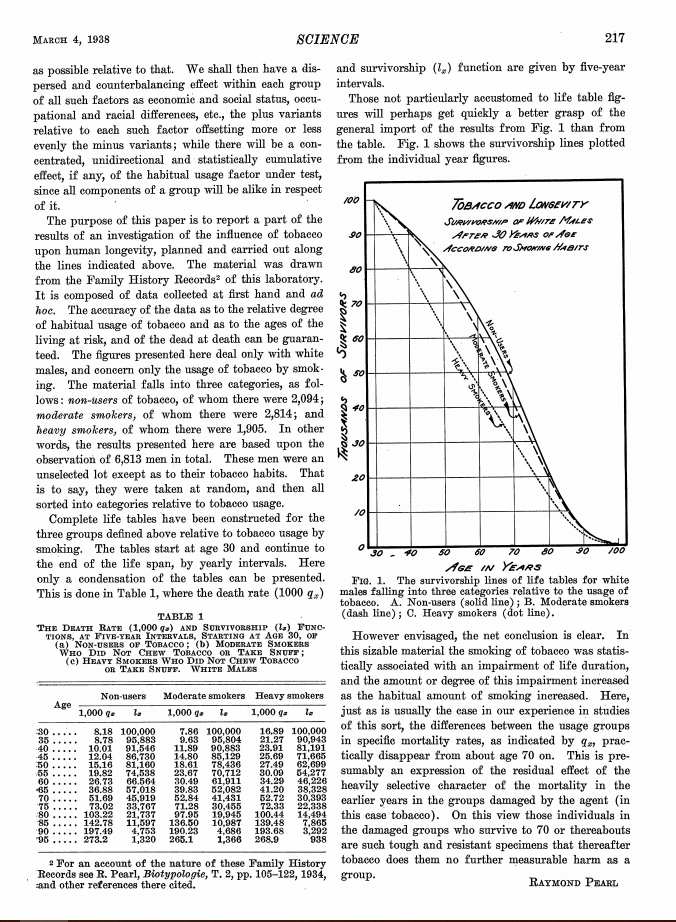
    Raymond Pearl brought to the readers of Science in 1938 what seems to be the first scientific study1 on the effects of smoking tobacco on longevity, announcing that “smoking of tobacco was statistically associated with an impairment of life duration” The work has been described as a classic in epidemiology:

    • “Despite his often provocative pronouncements, the proof that Pearl provided that smokers are prematurely killed by the effects of tobacco must be recognized as one of his most important achievements in epidemiology. In fact, Pearl’s 1938 article in Science describing the premature death of smokers was the first significant piece of data on the link between tobacco and longevity.”–Goldman, I L, “Raymond Pearl, smoking and longevity”, in Genetics, 11/2002, Volume 162, Issue 3 https://www.genetics.org/content/162/3/997

    Pearl certainly had a way with turning a long and tumbling and turgid phrase—you can almost see him crafty his long wide-tired sentences and chuckling through them, gravity of the subject or not.

    He starts the paper off with a rather longish statement about the vast majority of human beings consuming things that they really don’t need to consume, and that some of these controllable non-essentials may cause them some harm:

    “In the customary way of life man has long been habituated to the routine usage of various substance and materials not psychologically necessary to continued existence: he writes. “Tea, coffee, tobacco, opium and the betel nut are statistically among the more conspicuous of such materials…all of them contain substances of considerable pharmacologic potency if exhibited in appropriate dosage”. Pearl states that even with heavier usage of these products that the long-term negative effects of usage does not outweigh the benefits of use “in the opinion of vast number of human beings”.

    • “Purely hedonistic elements in behavior, which are present in lower animals as well as in man, have a real importance…there are undoubtedly great numbers of human beings who would continue the habitual use of a particular material they liked, even though it were absolutely and beyond any question or argument proved to be somewhat deleterious to them”.

    Pearl smokingHe doesn’t say anything about people being addicted to any of these things.

    In the next page or so he describes the study and the numbers (though we don’t learn in this paper what the difference is between his “heavy” and “moderate” smoker categories), establishing with a strongly accusatory graph that there is a bulbous result in shortened lifespan for heavy smokers aged 30-70-ish.

    He concludes in this short two-page paper that after the subjects in his study turned 70 that “individuals in the damaged groups…are such tough and resistant specimens that thereafter tobacco does them no further measurable harm as a group”. There’s nothing here about the “why” or “how” of death, just that it occurs.

    So there it is, the first measure of tobacco use and shortened lifespan. This was the first step in the long climb to the very public introduction of the killing nature of the tobacco habit, which entered its modern phase in 1964 after considerable battles with those in the business of producing the deathsticks.

    1964 was 55 years ago and fortunately great strides in research and education have been made. The tobacco menace has been extinguished now that we’ve learned beyond all question the great horrors it brings, everyone worldwide knowing that smoking tobacco will kill you, and in very nasty ways. Humans have learned something, and this is one extremely preventable mode of death that we’ve managed to eliminate.

    Oh, wait a minute…

    Notes:

    1. Raymond Pearl, “Tobacco Smoking and Longevity”,  Science, vol 87, no. 2253, March 4, 1938, pp 216-217.

    ·Posted by :

    ·in: