A Daily History of Holes, Dots, Lines, Science, History, Math, Physics, Art, the Unintentional Absurd, Architecture, Maps, Data Visualization, Blank and Missing Things, and so on. |1.6 million words, 7500 images, 4.9 million hits| Press & appearances in The Times, Le Figaro, Mensa, The Economist, The Guardian, Discovery News, Slate, Le Monde, Sci American Blogs, Le Pont, and many other places… 5000+ total posts since 2008.

Author: JF Ptak

  • Welcome to October: Make Your Own Baseball Paper Computer (1961)

    JF Ptak Science Books Quick Post

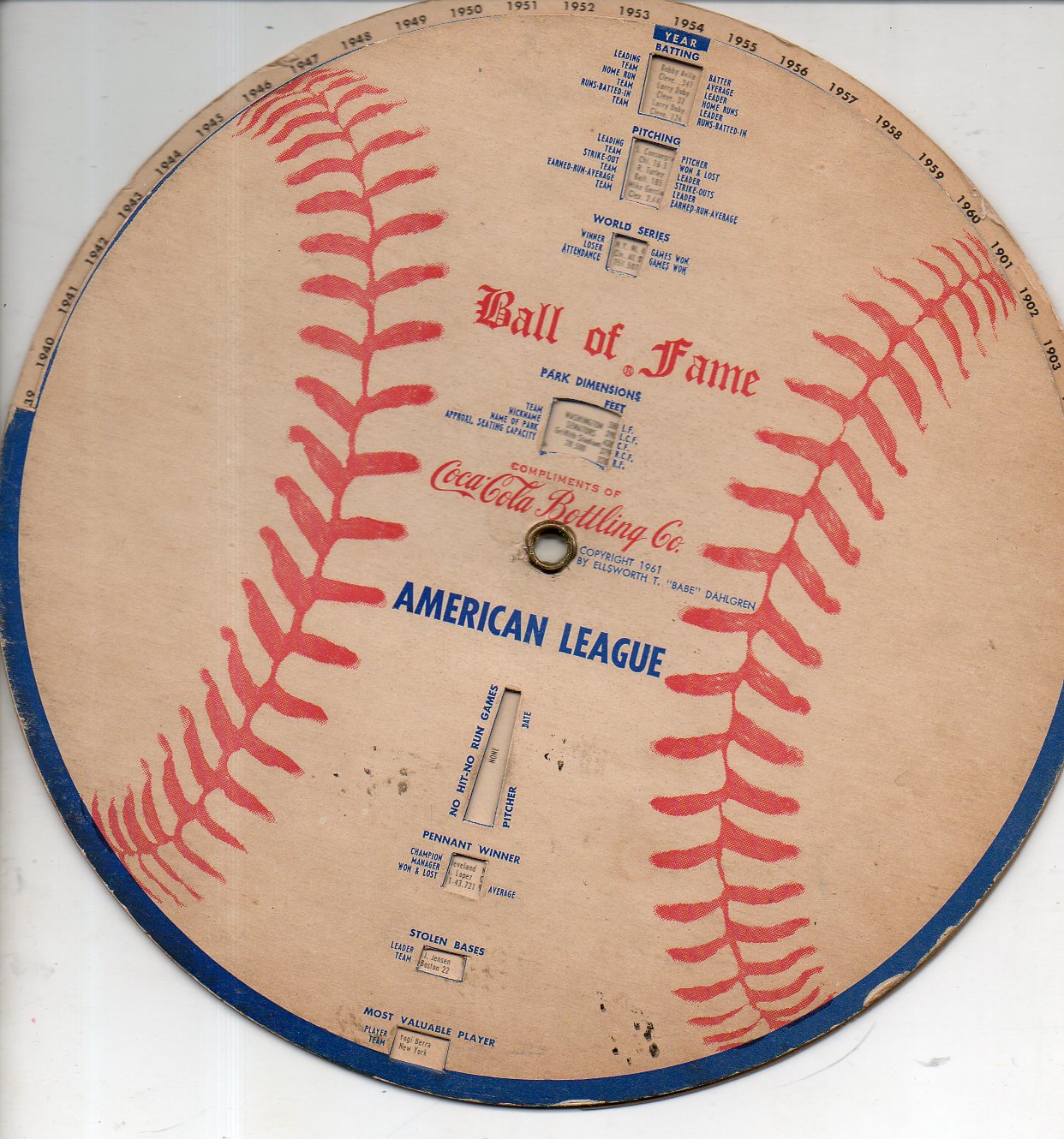
    I’ve accumulated 50 or so paper computer/calculators of various shapes and sizes and descriptions, ranging from calculating the mileage for a 1959 Rambler, the ground speed for a B-25, radiation dosimetry, one-handed bridge, nuclear weapon yields, political history quizzes, and many others–including this “Ball of Fame” baseball historical paper volvelle. 
    Ball of fame719
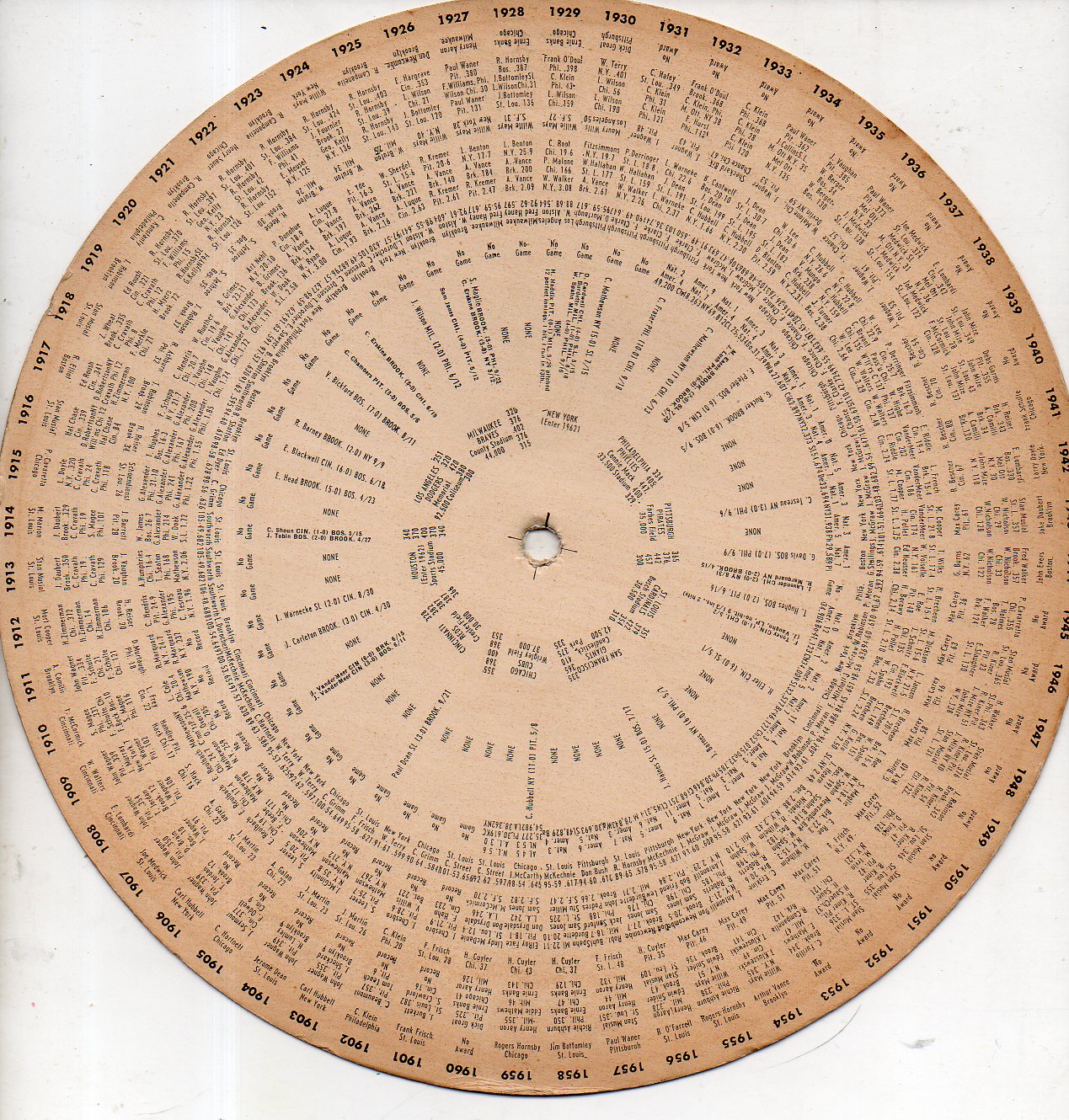
    I’ve seen this online a bit, but I’ve not seen the guts/data of the thing, so I decided to take mine apart and scan it so that the baseball folks among the readers of this blog can make their own. I’ve scanned at 200 dpi so there’s plenty of detail–just print out the four sections, grab your exacto knife, and you’re in business. 
    Ball of fame721

    The computer has an awful lot of detail, the most interesting to me being located at top-center, for “Park Dimensions”–in that quarter-inch square window we see info for the team, nickname, name of park, seating capacity, and the distances to the five points of the fences. Terrific!  The rest of the info, fpr the years 1901-1960:

    • Batting (showing leading batter, team, average, home run leader, leading team for home runs, rbi leader and rbi team leader).
    • Pitching (showing leading pitcher, w/l record, team, KO leader, team strike outs, ERA pitching and team leaders.
    • Pennant winner: (showing the winning team, manager, W-L, and winning percentages.
    • Stolen bases: leader and team leader.
    • And, lastly, MVP. 

    There are bits and pieces that wouldn’t fit the scanner, but they’re replaceable. 

    Have fun!

  • A Skelton Key of Blank Physicists, 1946

    JF Ptak Science Books   Quick Post

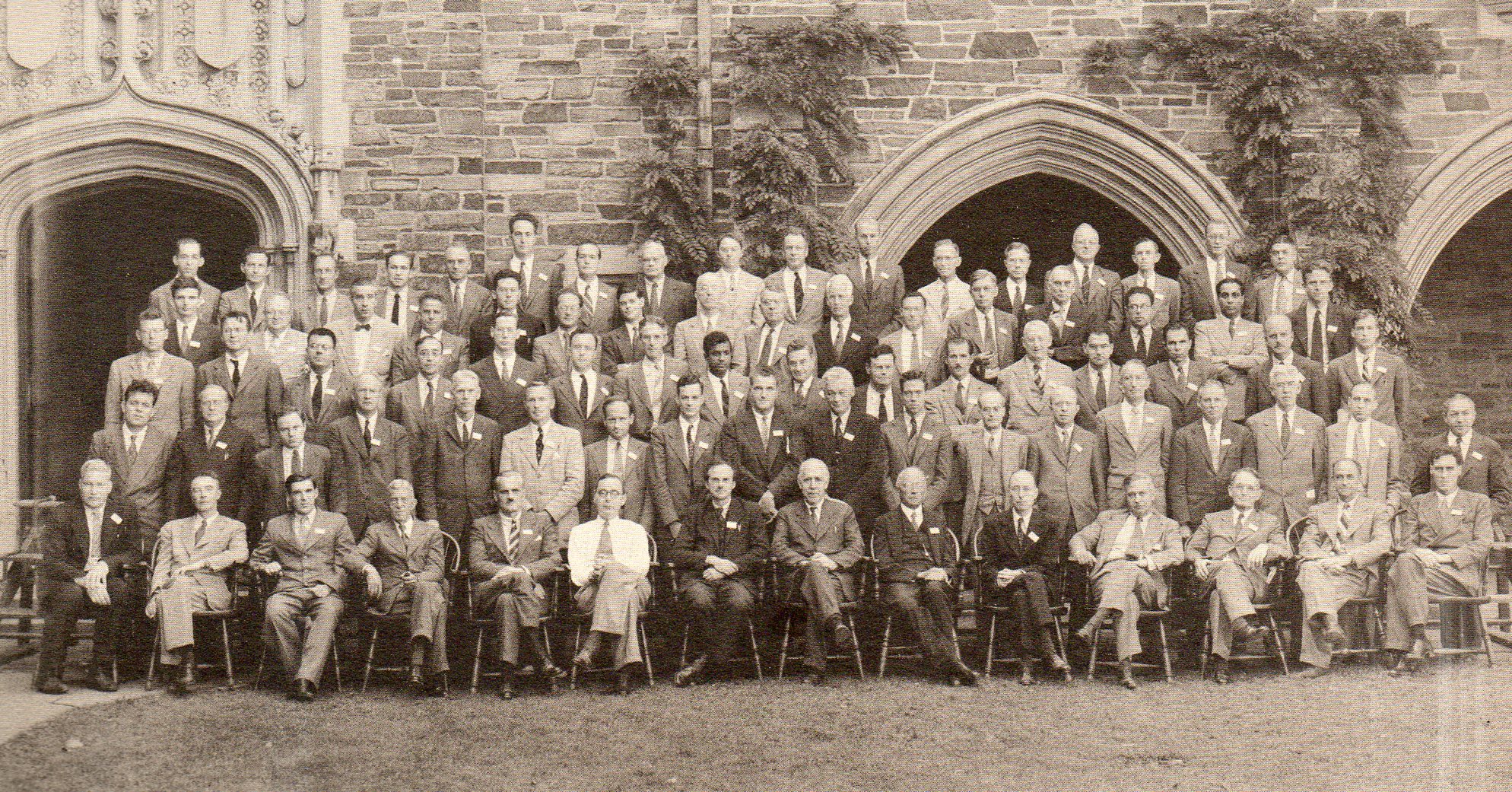
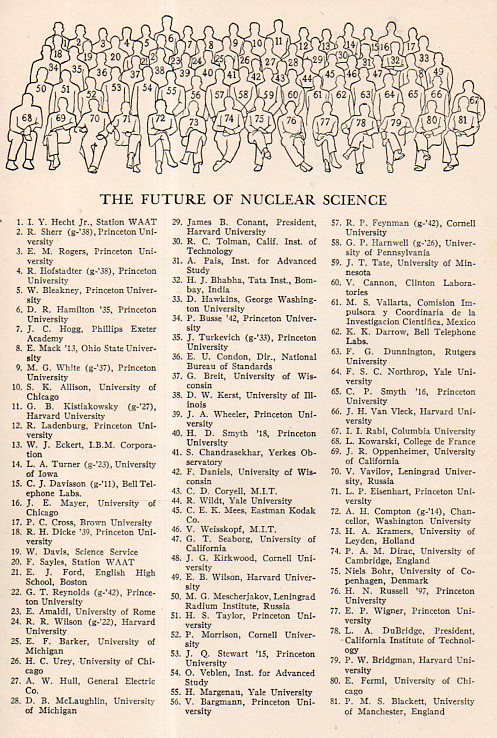
    The Future of Nuclear Science, Princeton University Bicentennial Series, Series I Conference I (1946), with a forward by the director of the conference, E.P Wigner, is mostly just a short (36-page) introduction to the conference, though it does contain a very nice and not commonly seen photograph of the conference’s participants. Of particular interest is the accompanying ghost/outline guide to identifying the group, which seems to take on its own life when viewed out-of-context.

    Skeleton 716
    It is a considerably heavyweight group of physicists–among them are Hofstadter, S.K. Alison, Kistiakowsky, Ladenburg, W.J. Eckert, L.A. Turner, R.H. Dicke, E. Amaldi, Urey, Conant, Tolman, Pais, Turkevich, Condon, Wheeler, Smyth, Chandrasekhar, Weisskopf, Seaborg, Wilson, Morrison, Veblen, Bargmann, Feynman, Van Vleck, Rabi, Eisenhart, Compton, Kramers, Dirac, DuBridge, Bridgman, Fermi, Blackett, and others.  It is a wonderful photograph:

    Skeleton det718
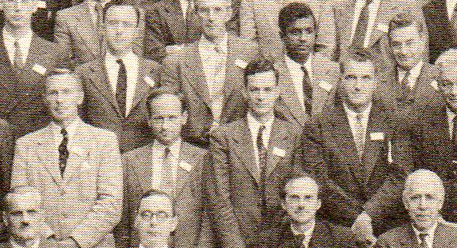
    Here’s a relatively-random detail featuring (bottom left -to-right) Compton, Kramers, Dirac, Bohr, plus (middle left-to-right) Margenau, Bargmann, Feynman, Harnwell, Tate, and (third row) Wheeler, Smyth, and Chandrasekhar.  This was an extraordinary group. 

    Skeleton det a718

    Full text via Hathi Trust via Cornell University.


  • Finding the One Percent of 1916.

    JF Ptak Science Books  Quick Post

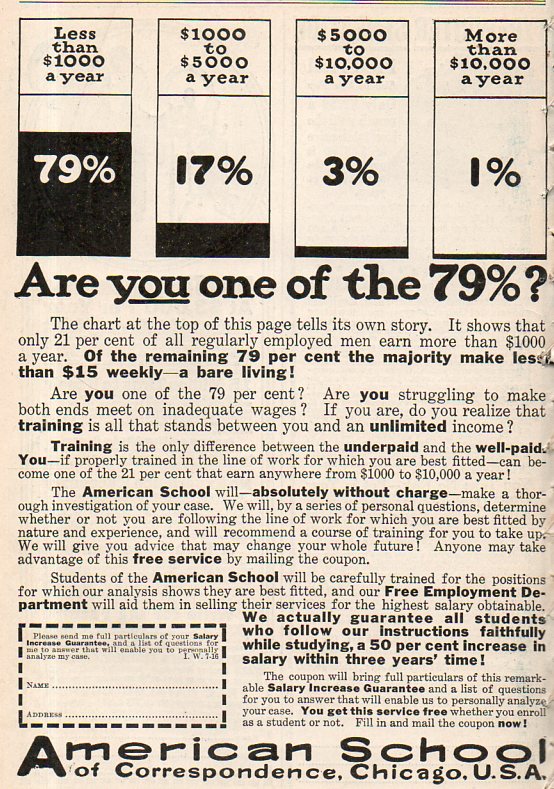
    Where was the One Percent of 1916? Luckily, I found it at the end of this simple bar graph for The American Correspondence School advertisement in Illustrated World for January 1916, right at the end of the other 99% WWI was about at the half-way point, America still wasn’t in the war, and there was little attention paid in the magazine to that fantastically bad Thing happening overseas.  In any event, the ad tried to attract the 79% of the population making $1000/year or less through not-described correspondence school means, and at the same time flagging the top one-percent earners in the U.S. as though making $10,000+ per year. 

    1 percent715
    This doesn’t seem much like a high figure, except that the average person was making about $650/year, and the average house cost about ten times that amount.  Today’s 1% income/year folks take in about $400,000 (or about 25 times the average yearly salary of the  99%, and three times the cost of the average house).  And according to the Bureau of Labor Statistics, that $10k/year is equal in buying power to about $212,000 yearly in 2013, so that odd-looking ten grand figure might be about right, even if it was probably all quickly made up in some composing room in Chicago 97 years ago. 

    If you were to look at this figure through comparative baseball eyes, it is particularly astonishing, given that in this decade or so there have been 65 players with $100,000,000 contracts, which makes for many dozens of players with 10 million/year salaries.  But these are different times, and the baseball players of 1916 (the year of the first super market opening) were paid hardly anything at all relative to the income of the team owners, though baseball as a business at this point represented almost nothing of what it would become. 

    I don’t mean to pick on baseball–it’s just that it is the beginning of the World Series and the game is on my mind.  And it doesn’t work so well to pick out the one percenters in, say, physics, where Albert Einstein–who had a terrific year in 1916–was probably being paid in the 3% club region in spite of his rather exalted fractional 1% status. 

    In any even I was surprised to see “1%” appear in this graphic.


  • James Clerk Maxwell, on Himself (“a profession was not necessary to a useful life”)

    JF Ptak Science Books  Quick Post

    Around 1870 James Clerk Maxwell–one of the great minds in the history of modern physics–responded to a request by Francis Galton to fill out  a questionnaire for Galton’s work on the characteristics of people-of-genius, and published as English Men of Science, their Nature and Nurture (1874).

    This is a set of Maxwell’s responses about himself, as well as his mother and father: 

    ·Posted by :

    ·in:


  • The Society for the Friendless, 1921

    JF Ptak Science Books

     The Charities Bureau of Kansas City published this handbook in 1921 for the annual fund raising season: The Hand Book for the Campaign
    is a concise account of the principal helping-hand organizations, many
    of which have (from our seat here in the future) quite extraordinary
    names.  

    0-blog---Nov 21 social agencies090

    We find “The Rest Cottage” (“maintained as a refuge and
    rehabilitation sot for homeless and unfortunate women and girls and
    their destitute children”), the “Receiving Home for Children”, “The
    Home for Infants”, “The Orphan Home for Girls”, “The Child Welfare
    Club”, “The Children’s Hotel”, “The Whatsoever Circle”, “The Home for
    Aged Women and the Destitute”, “The Presbyterian Home and School for Crippled Children”, “The Helping Hand Association for the Blind”, “The Girls Hotel”, “the Childrens Bureau”, “The Finding Society”, “The Home for Aged Women of the Mexican Christian Institute”, “The Hopkins receiving Home”  and of course “The Society for the Friendless” (providing aid to the “man who comes from prison”, from Lansing, Leavenworth and St. Joesph.  Actually the members of this society would receive the newly released convict as well as visit them in prison; the society reached over 13,000 men (and “girls in Industrial Schools”) between 1919 and 1921. 

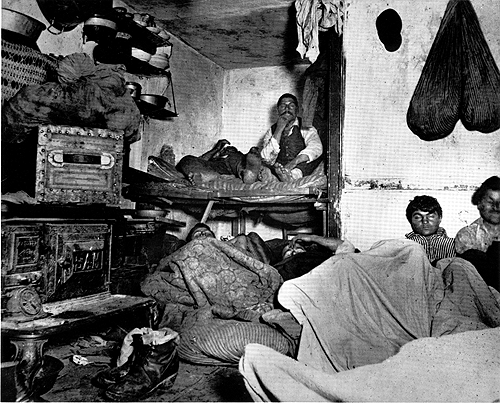
    Riis4

    There were dozens of these agencies that were providing help and relief to the needy in the Kansas City area in the pre-Federal-help days.  It is very interesting to see these charities divided along lines of need, rather than have them gathered together under a giant umbrella like, oh, the Department of Health and Human Services or some such agency.  Or just the Department of “Human Service”(?) on the state level of many states.  It seems more appropriate to actually specify the nature of relief rather than hide it away under a giant Orwellian blanketing cover of general services–it would be okay to be reminded that there are needs for abandoned children and destitute girls.  Perhaps it would make us all a little more aware of who needs what in this rich and capable society. It just seems to me that codifying the extreme of social need into more amorphous units like we have done in the last 50 years or so smooths the edges that people like Thomas Nast and Jacob Riis* and Charles Dickens and Virginia Woodhull and Dorothea Lange and Dorthy Day** managed to sharpen.  Sharp edges are good.
    Dorothy day

    * Jacob Riis was perhaps the first documentary photographer of the American “underclass”, putting an indisputable photographic face on the living and working conditions of the laboring poor.  A photograph of these conditions was irreproachable–it was something you could absolutely trust, mree so than an “artist’s representation”; like seeing a photograph from the surface of the Moon.
    ** Dorothy Day, (above), perhaps the least-known of these names, was a tremendous figure in the civil and workers rights movement and the founder of the Catholic Worker. 


  • Tiny Electoral Art, 1920

    JF Ptak Science Books   Quick Post

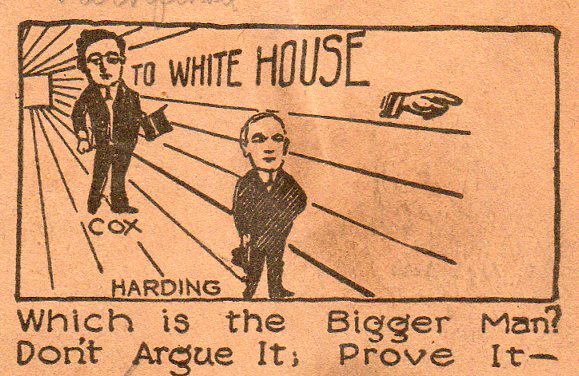
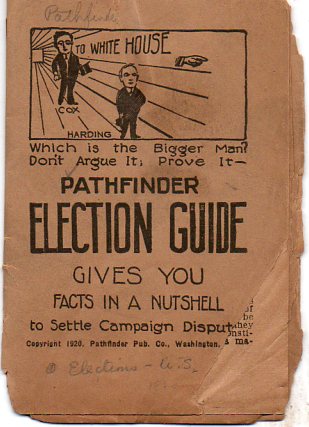
    I admit to a weakness for early 20th century American political found art in barely-existent pamphlets.  And so this fine example:

    Harding714

    This is the top quarter of a tiny (3″) pamphlet on the presidential election of 1920, a small bit of political ephemera found in exactly one library worldwide.  It provides a little coverage for the James Cox (a Democrat from Ohio whose running mate was FDR and who found the still-very-existent Cox Communications) and Warren Harding (another Ohioan newspaper magnate but a Republican).  Harding was the compromise candidate in a field showing La Follette, Hoover, Coolidge, and Leonard Wood (among others) who became the party’s choice on the eight ballot.  Cox was the Democrat favorite, but it didn’t help much, as Harding went on to a tremendous victory with 60% of the vote (and a 404-127 electoral college landslide).  Harding had a number of problems in his presidency, including his 1923 death, an administration pockmarked by scandal, but punctuated by some forward-paced and interesting movements in finance and social issues.  My feeling is that he doesn’t deserve the 40’s that he pulls in POTUS rankings, but Teapot Dome (and etc) are remembered still for him more than anything else.

    None of this helped Cox, who managed to lose the solid south, causing Tennessee to be the first of the eleven original Confederate states since Reconstruction to vote Republican. 

    Harding713


  • Bubbles of Cubist and Steampunk Dada Futures from 1812

    JF Ptak Science Books   Post 2105

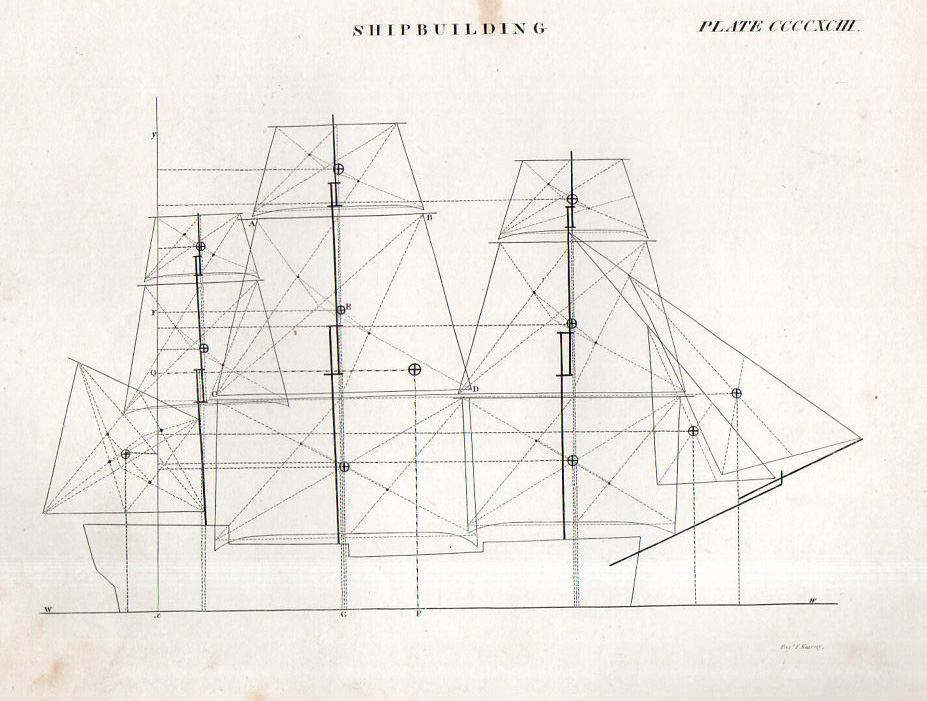
    I think that a pre-proto-neo-antiquarian or whatever Cubist representational form is very clear in the 1812 engraving, which was a relatively simple formulaic presentation of ship/sail construction found in Rhees’ Encyclopedia.  “Clear” of course to someone here in the print’s future, seeing what that form could actually become apart from showing the naval necessaries.  But it always puzzles me how an image like this could appear and someone didn’t take the next step and turn the thing into “art” of some sort.  That would all happen soon enough, the loosening of form and its representation via impressionistic and geometrical ways–Mr. Turner was already 37 years old when this print was published, and on his way (at least intellectually) to his magnificent Romantic career. 

    Cubist653

    Why wasn’t this art in 1812, aside from people not being quite ready for it?  Maybe there is no other “thing” apart from that.  It would take nearly another hundred years before the representational form of say a ship was lessened and stripped away, softened , modified, rubbed, erased, into something that is the object but really isn’t.

    Perhaps what we have here is a peep (like with Durer’s geometric man) into the future at modern art, a dissonance between abstraction and realism.  There is a regeneration of form taking place in this image, but it is only something on its way to creating a more idiomatic engineering representation of naval needs, and not a new art form–that would have to wait for Braque and Gris and Leger and Delauny and Villon and Picabia and Duchamp and the rest.  So this pre-non-Cubist engraving is not a key to a new vocabulary of vision–it is just a drawing of ship’s sails. 

    Here’s another example of pre-modern art peeping out from the pages of this same encyclopedia, this one being a Prehistoric Rayograph, or a proto-non-photographic example of Man Ray, but from 1810 (and which I wrote about here):

    Cubist-Dadaist655

    Which is a detail from:

    Cubist-Dadaist654

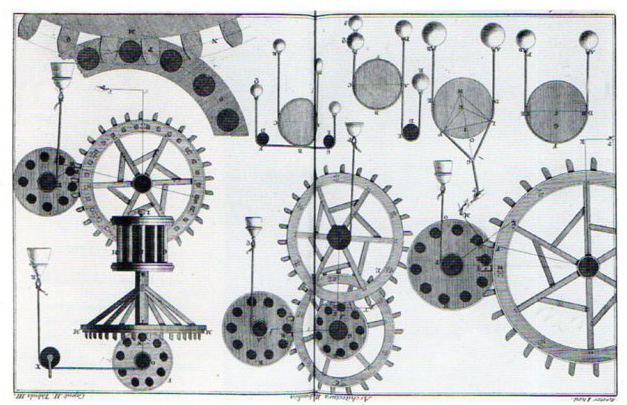
    The engraving below is another fine example of futuristic bubbles, this one a possible example of Steampunk Dada, and appears innocently (and beautifully, and importantly) in Architectura Hydraulica (1740),
    and titled “Demonstration of Friction”.  I’ve simply inverted it and
    removed some of the numerical notation–and then, suddenly, it becomes a
    sort of Steampunk Balloon Machine–a lovely collection of small
    balloons lifting large wheels and cogs, assembling some sort of
    something in mid-air, demonstrating very little friction, of lightness
    and airiness.

    Belidor upside down

    Seems to me that if you look hard enough that these examples are, well, kind of everywhere.  They just aren’t yet what they could’ve been.

    Notes:

    Here’s another example:  Geology of Images: Finding Pre-biotic, Neo-Dadaist Images in Antique Astronomy Prints (here)


  • Engineering with the A-Bomb, “To Conquer Forever the Dust Bogey”, 1945

    JF Ptak Science Books   Post 2104

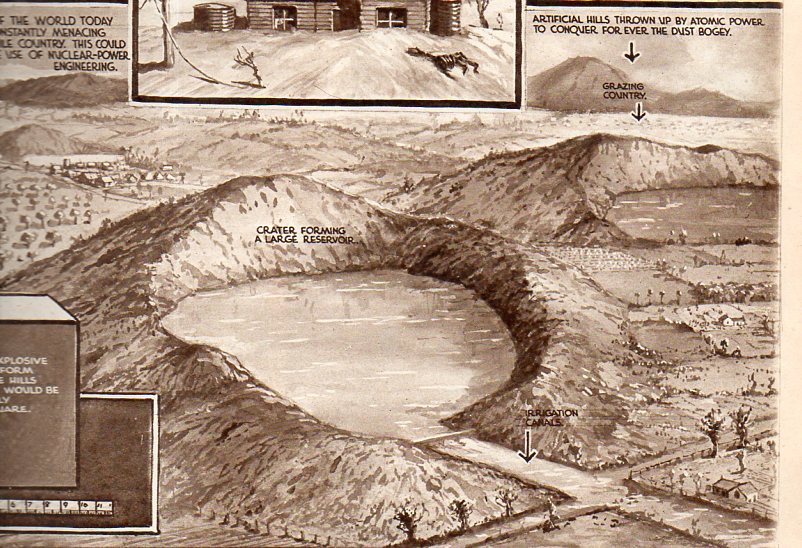
    Atomic resevoir708
    1945, Autumn:  the question is, now that “we” have the atomic bomb, what can be done with it?

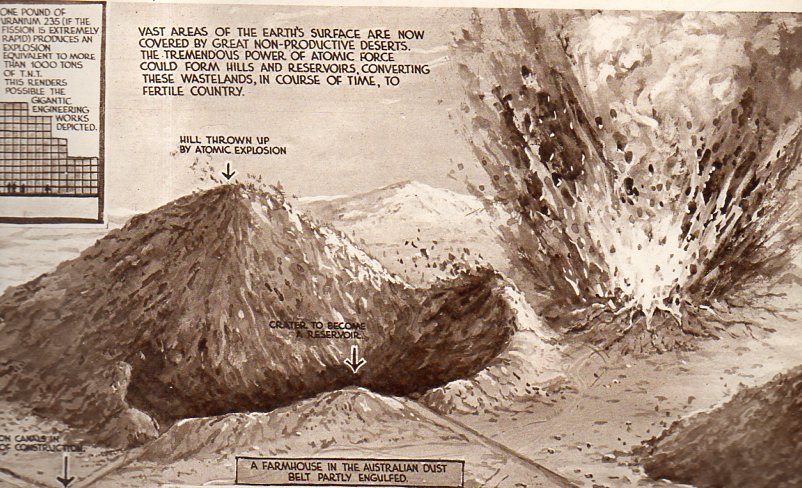
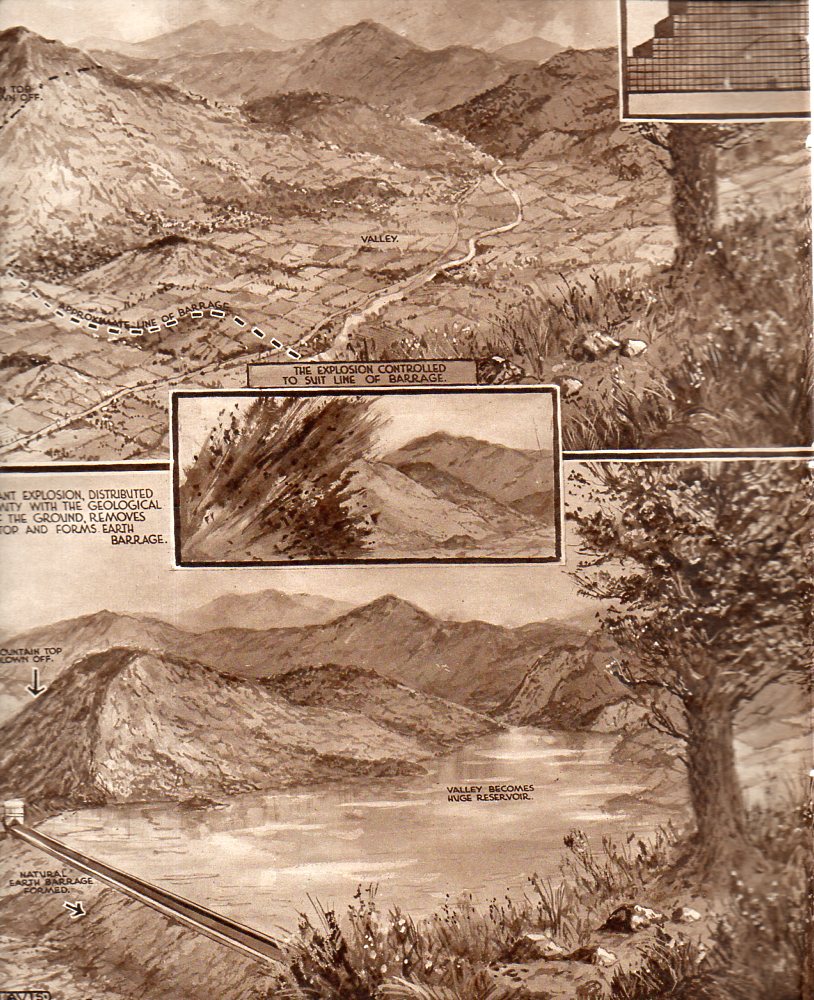
    One thing is for certain–it could be used not only to make big holes out of little ones, but also make big mounds of dirt where there were none. This stands to reason, of course, because if you are producing massive holes in the Earth then the dirt and other hole-filling stuff must go somewhere (as Beakman says in his often-repeated admonition and perhaps the most important thing that is said on this kid-based science show, “everything goes somewhere”). Unfortunately the mountain of hole-dirt doesn’t get made quite like the way it was envisioned in this article in the Illustrated London News for 17 November 1945, but they were trying, and it was still a very young and tender period in the history of public discussion on the atomic bomb/bombing. 

    Atomic resevoir709
    Still, “The Force Which Can Move Mountains:  Harnessing the Atom to Vast Projects for the Benefit of Mankind” imagined an atomic-bomb-fueled set of public works projects that were of Pyramidally-historic proportions, and was among the first fissionally-inspired public portrayals of the peaceful uses of atomic bombs. (The “Peaceful Uses of Atomic Energy” UN-based conferences and etc. would come later.)  Engineering with atomic bombs does have some considerable issues, like radioactivity, but some of those issues were worked out somewhat–but that came later on. 

    Atomic resevoir711
    Back in 1945 the bomb was being discussed as a hole-maker for reservoirs and for making mountains in the deserts of the world to cut down on the sandstorms and related problems (the “dust bogey” from the fantastic quote in the heading of this post).  More thought would be given to this issue on the peaceful applications of nuclear weapons in such platforms as Operation Plowshare1, an American undertaking begun in 1961, which entertained half-fantastical thoughts of widening the Panama Canal and creating–through a series of five hydrogen bomb detonations–a new harbor at Cape Thompson, Alaska.  Some of the dirtiest of all nuclear detonations were associated with Plowshare–like the Sedan shot of 1962 which displaced 12 million tons of dirt and made a really big hole but which also contributed something on the order of 7% of all fallout contamination of the total
    amount of radiation which fell on the U.S. population during all of the
    nuclear tests at Nuclear Test Site.  It is still the largest man-made hole in the U.S. and for what it is worth it is listed on the National Register of Historic Places.  Over the years such testing for Plowshare (alone) cost the U.S. about 700 million dollars, which seems like a wildly undervalued estimate of costs.

    In any event, I liked this story form the ILN and for the hope that it represented, coming at the earliest public history of the use of atomic weapons. 

    Atomic resevoir710

    Notes.

    1.  Perhaps people felt a little kinder towards monster ideas like this if the name of the proceedings found its origins in the Old Testament, like this one: Isaiah 2:3–5, “And he shall judge among the nations, and shall rebuke many people: and they shall beat their swords into plowshares, and their spears into pruning hooks: nation shall not lift up sword against nation, neither shall they learn war any more”. 


  • A Good 37

    JF Ptak Science Books   Quick Post

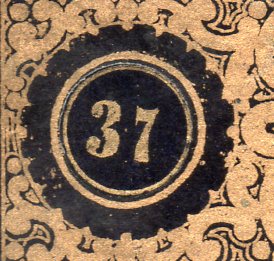
    37704
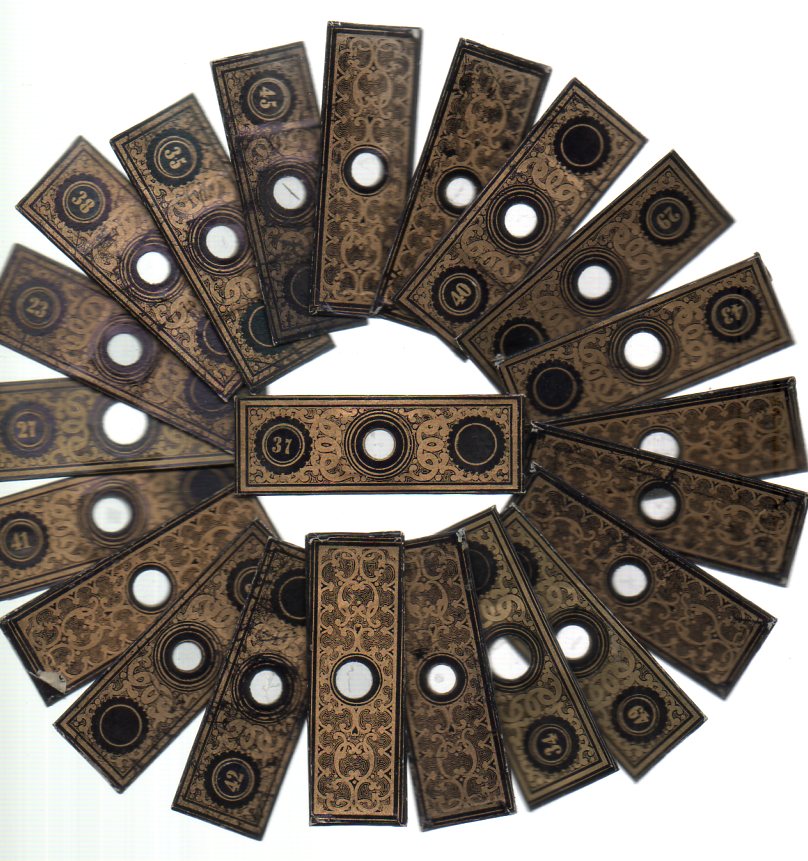
    My wife, Patti Digh, has a big thing going with the number 37.  It forms the kernal of her eight-year-old social memoir and applied memory blog, 37days.com, which has led to her seven books (with only thirty more to go). As a result, we see 37s where we can, which when you’re looking for them is not that hard to do.  I found a rather nice one tonight on one in a set of 19th century microscope slides.  In general, slides and other preparations from this period can be incredibly beautiful things.  These are quite nice, and have the printed number on them, which is not common to my experience.  Anyway, this is for Patti: 

    37703

    ·Posted by :

    ·in:


  • Batman’s Possible Influence on Shakespeare

    JF Ptak Science Books  Post 2102

    Crock702
    Well, it’s not really the Batman as culture currently knows the name, but Stephen Batman (d. 1584) whose published work heavily incorporating a Medieval natural history text was probably one read/consulted by Shakespeare.  The earlier work was the beautifully-named book by Bartholomaeus Anglicus, All the Properytees of Thyings, which was published in Westminster in 1495 (and also known as De proprietatibus rerum, also translated as On the nature of things, or On the properties of things), which was originally written around 1225.  The book was a
    bestiary, a marvelous encyclopedia, a collection of all things as known
    in the 13th century–it would be interesting to represent all that is
    know today and compact it into a workable, logical, usable (printed !)
    book of a thousand pages.  The question of organization of knowledge
    would be the key, of course, and how to make one flow to another
    complimentarily as practicable…it would be an interesting project (for
    someone else) to try and arrange the basis of human knowledge in a
    finite space like that.

    Batman produced his own version of the book incorporating the 400-year-old information with some of his own, and found the book a printer in 1572–Batman uppon Bartholome, His Booke De Proprietatibus Rerum; newly
    corrected, enlarged, & amended, with such Additions as are
    requisite, unto every severall Booke. Taken foorth of the most approved
    Authors, the like heretofore not translated in English. Profitable for
    all Estates, as well for the benefite of the Mind as the Bodie
    was a storehouse of knowledge, right and wrong.  

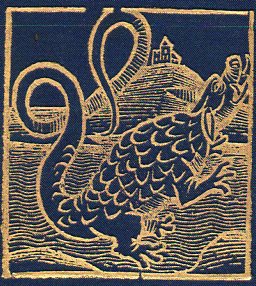
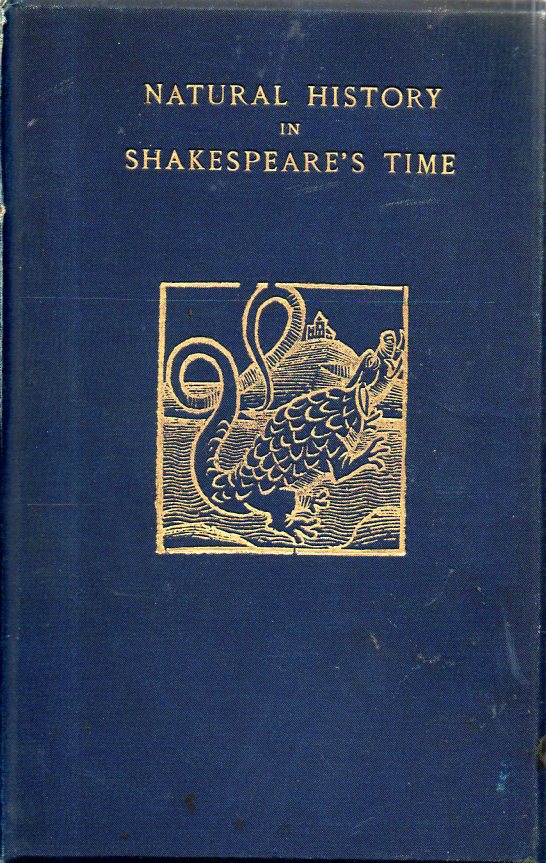
    I came upon the book today because one of its images is on the front cover of a book that I just unpacked.  H.W. Seager, author of Natural History in Shakespeare’s Time, being Extracts illustrative of he Subject as he knew it…. (“printed for Elliot Stock” of London in 1896) must’ve found the image compelling enough to reproduce it in gold leaf.  Batman’s image was of a crocodile, which now being told what it is probably looks more like itself than a dragon–Batman himself took issue with the current London practice of buying the skins, which he found to be a laughable thing (“we know not how to bestow our money”), establishing that people had too much money and not enough sense on what to do with it.  In any event, I like the image. 

    Crock701

    ·Posted by :

    ·in: