JF Ptak Science Books Quick Post
Author: JF Ptak
-
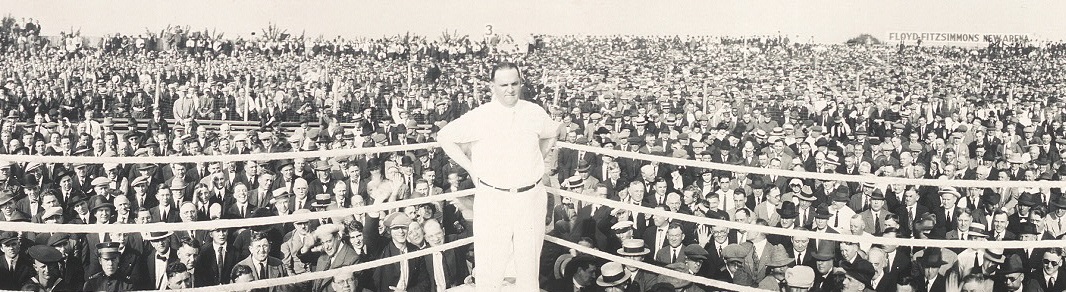
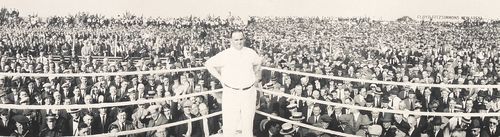
Panorama–Boxing Day, 1920
JF Ptak Science Books Quick Post
I saved this image for the real Boxing Day, and then of course promptly forgot it–I’ve missed the day, though perhaps it really doesn’t matter, because even though it isn’t ‘boxing”, it is “boxing”.
 [Source: Library of Congress, here.]
[Click to enlarge image].
-
Claude Shannon as the Father of (1) Info Theory or (2) Information Age or (3) Both?
JF Ptak Science Books Quick Post
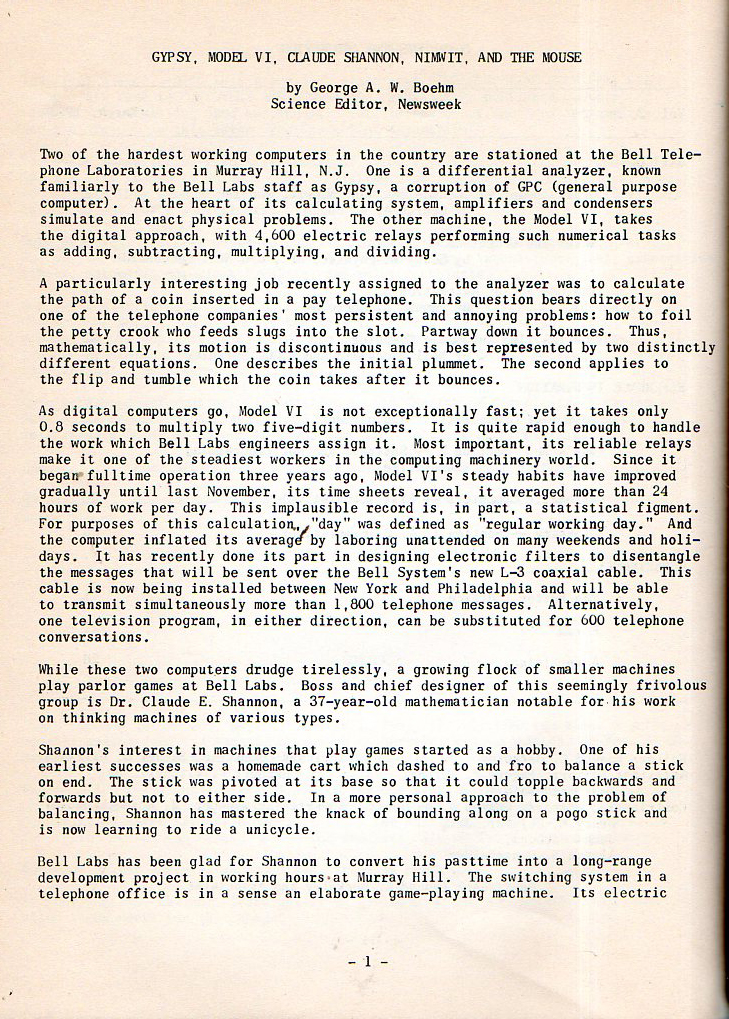
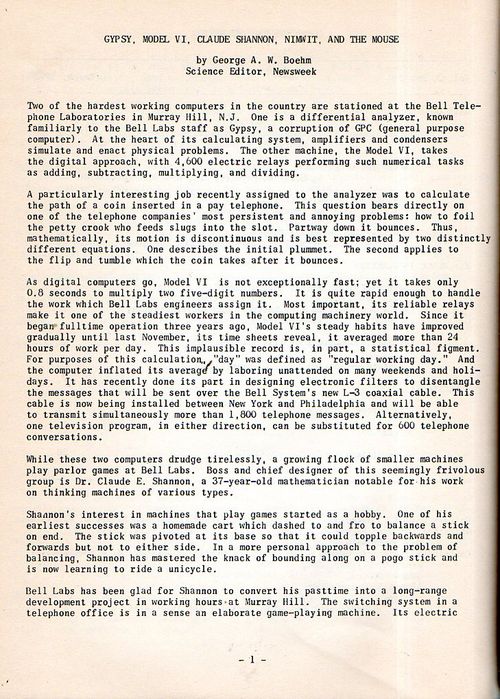
George Boehm wrote a fine, semi-offhanded paper on Claude Shannon’s inventiveness: “Gypsy, Model VI, Claude Shannon, Nimwit, and the Mouse”, in Computers and Automation, volume 2, number 2, March 1953. (The article is found on pp 1-4 in the issue of 37pp.)
Shannon (1916-2001) is widely seen as being the “father of information theory” though it might be more accurate to refer to him as the “father of the information age”–either title will do just fine.
Shannon basically established the foundation of the digital circuits in his 1937 A Symbolic Analysis of Relay and Switching Circuits, which was also one of those great dreams-come-true parts of graduate school, when your masters’ thesis is actually something that means something, and with Shannon’s paper that “something” was exponential. It is the stuff of dreams but Shannon actually did it and did so with this paper at the age of 21. In the midst of a brilliant young career he also produced (in 1948, 11 years later) another great landmark effort, A Mathematical Theory of Communication, which is the pioneering paper on information theory and which was so brilliantly composed that its framework is still in place after 67 years. A year later came Communication Theory of Secrecy Systems, a work which established cryptography as a science more than a system. And on and on.
I like that Shannon was born in Petosky, Michigan, up there on the choppy Little Traverse, and all of those big-pebble Petosky fossil/stones.
This is a very insider-y semi-offhand but solid review of some of the gadgetry and robotic work of Claude Shannon:
-
History of Lines–Straightening out the Thames
JF Ptak Science Books Quick Post
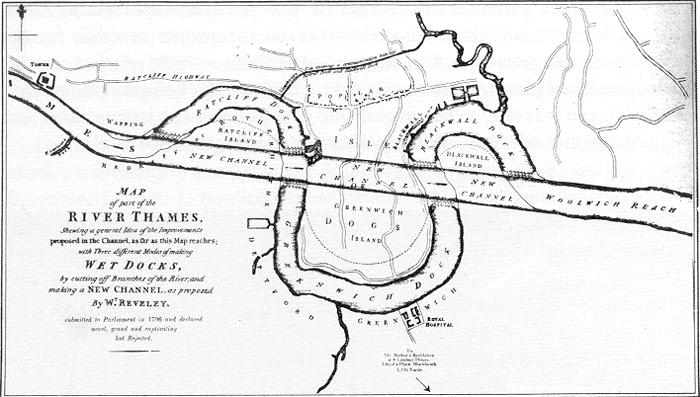
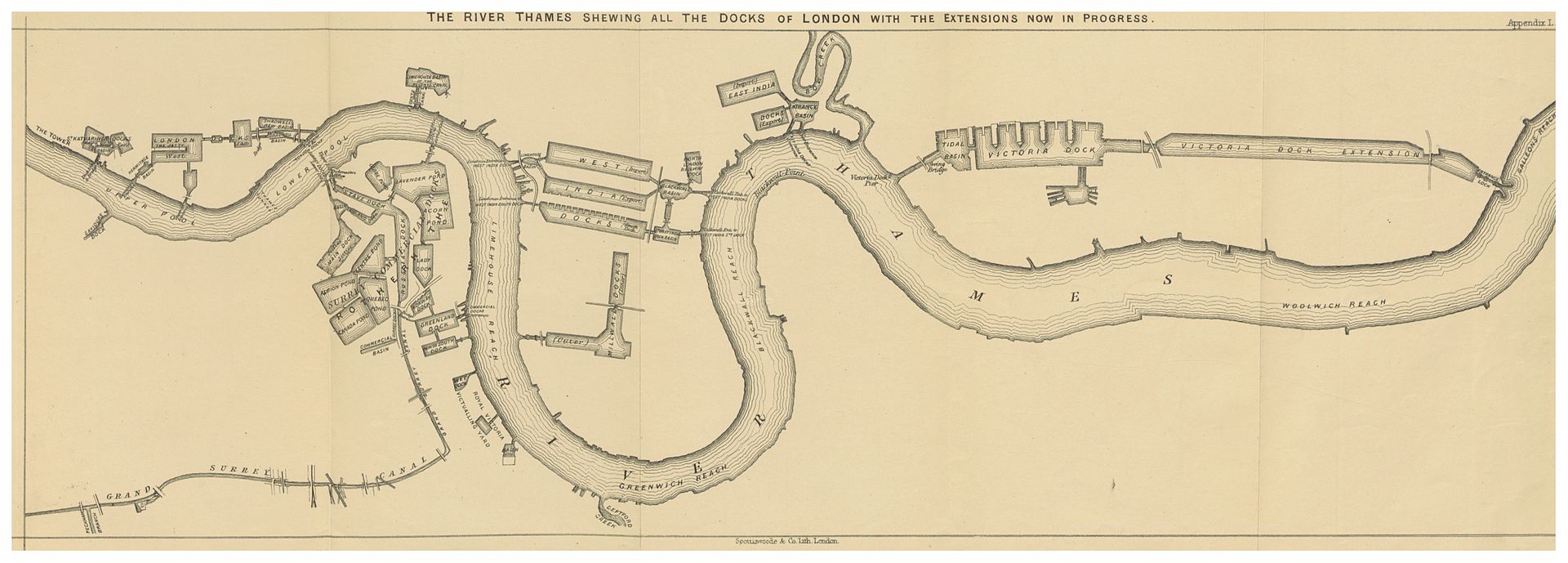
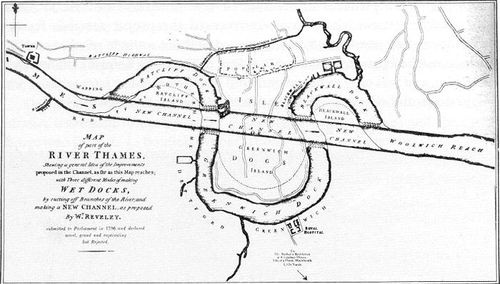
The architect Willey Reveley straightened out curves and curved out straight lines.
Source: Wikimedia.
As we can see here he had the idea of constructing a straightaway through the three famous bends of the River Thames in East London. The straight part would be used for commerce while the bends would become docks and yards.
Another vision by Reveley is seen below, from page 113 of Alexander Forrow’s The Thames and its Docks, a Lecture (London), 1877 (the full text available at the Internet Archive):
 Source: Wikicommons
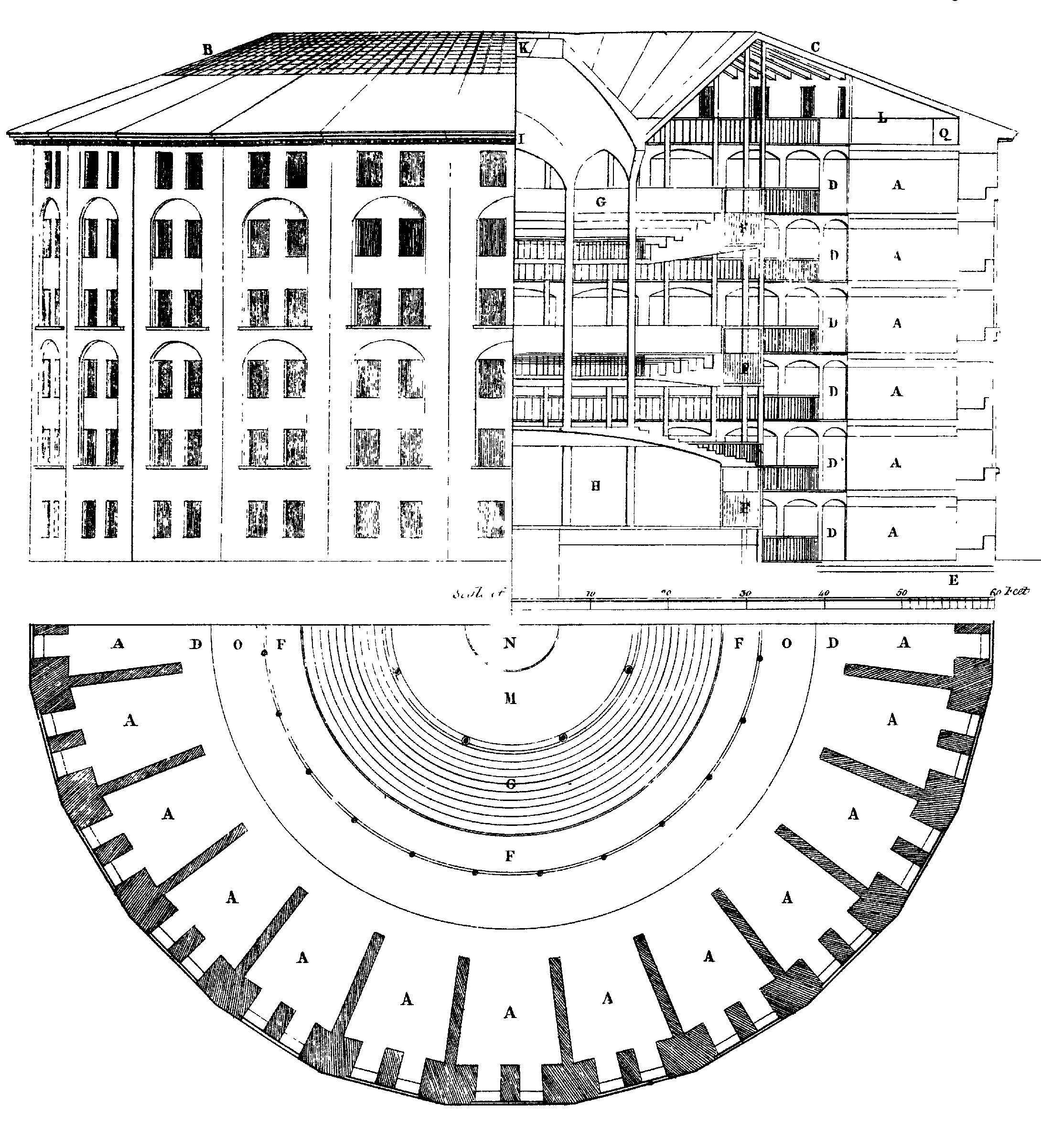
 With all of this straightening-out of the river thinking going on in Reveley it is interesting to see that when he applied his brain to the the world of very straight lines as they exist in prisons that he went the other way–following the idea and commission by Jeremy Bentham, Reveley created plans for a circular prison. Bentham’s Panopticon was an idea that wouldn’t leave Bentham and occupied at least one small part of his brain throughout the 1790’s–I’m not sure where in Reveley’s head the idea lived, but it didn’t live there for long, as the architect died at a very young 39 in 1799. Bentham (born in 1748) lived until 1832, and never did see his Panopticon constructed. (Then again, he may come to see it if someone showed it to him, as his head has been preserved as an on- and off-again display at University College…)
Source: http://upload.wikimedia.org/wikipedia/commons/1/11/Panopticon.jpg
·Posted by :
·in:
-
Nazi Propaganda Map for a European Hearts and Minds Campaign
JF Ptak Science Books (Post 193 from 2008) Expanded and with better images.
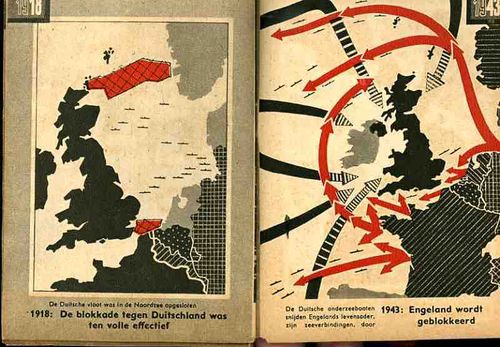
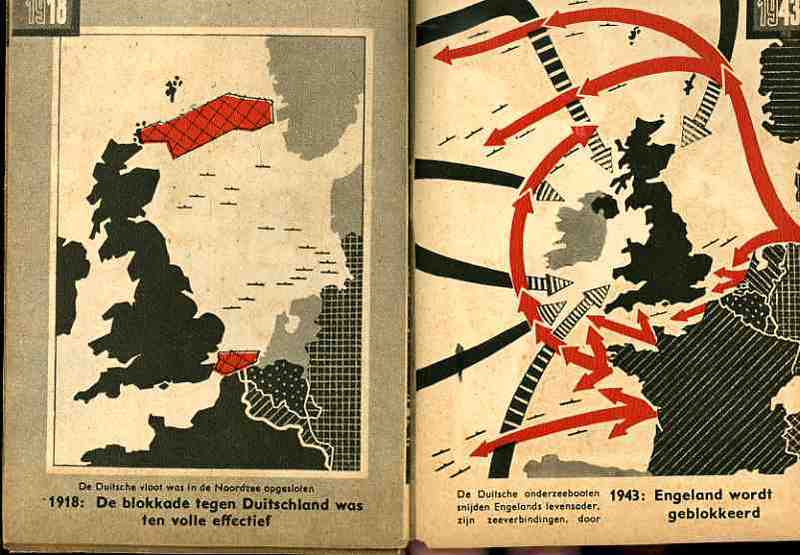
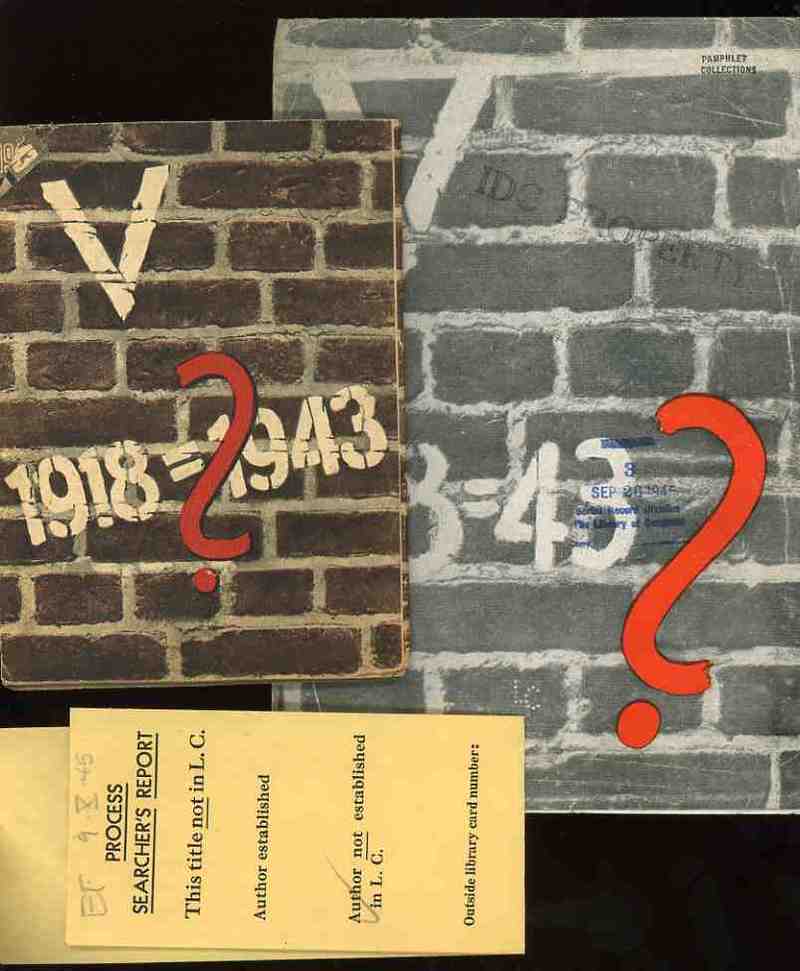
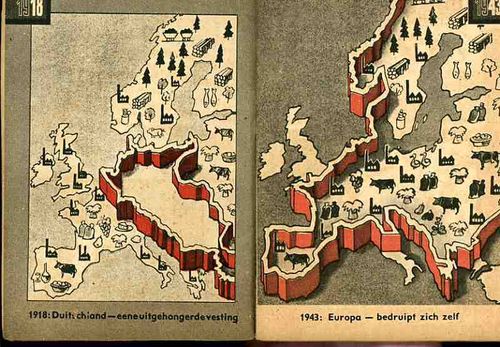
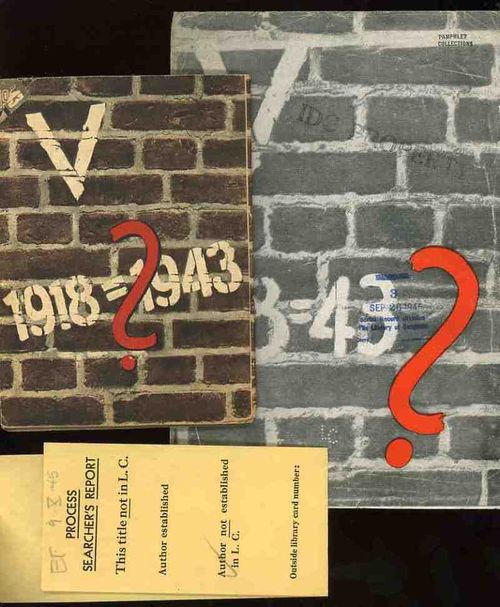
These two, related, pamphlets were the products of the Nazi Propaganda engine and sought to affect the moral and intellectual stamina of the people in the occupied countries of the Netherlands and France in 1943. Each stressed the enormous differences in the German state that took place in the 25 years between the end of World War I and the third year of the Nazi European part of World War II. I’ve no idea whatsoever about the grander symbology (if any) of these numbers associated with these two pamphlets (the Roman numeral for “5” and the 25 years of the difference and the “13” points (of the French propaganda) aside from the obvious mathematical implications.
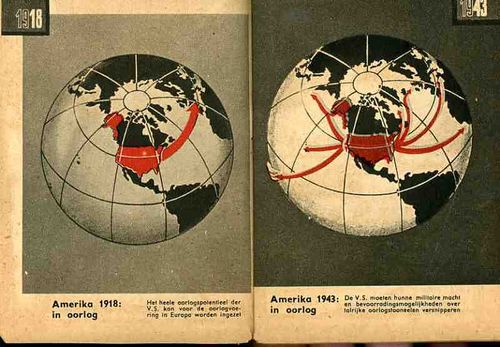
(The only interesting bit that I can find in the “18=43” from the French pamphlet is Luke 18:43 “Immediately the man could see again and began to follow Jesus, glorifying God. All the people saw this and gave praise to God.”. ) I find it curious that identical symbolism (?) was used for the two countries, and that the French version was simple comparative text (summarizing the differences in the two periods of time) while the Dutch version was mainly a picture book.
I would reprint the French version if it wasn’t so bloodily hateful. (Suffice to say that this is so by looking at one example: in the last of the second issue of 13 points Goebbels et alia wrapped themselves in the insulating fabric of the German “people” in the “resistance” against “Jewish saboteurs”—not the German political machine, and not the German military, but the German people, insinuating that the Nazi annihilation of the Jewish people was de facto sanctioned by the will of the German nation. This is of course part and parcel of the fictitious and loathsome Protocols of the Elders of Zion (of which Henry Ford was a happy reader), a French work that was completely stolen and plagiarized by Imperial Russia in the early 1880’s and which, later, Hitler used to both build his hate against the Jewish people and use (and acknowledge ) as the template for his early actions in the Nazi Party.)
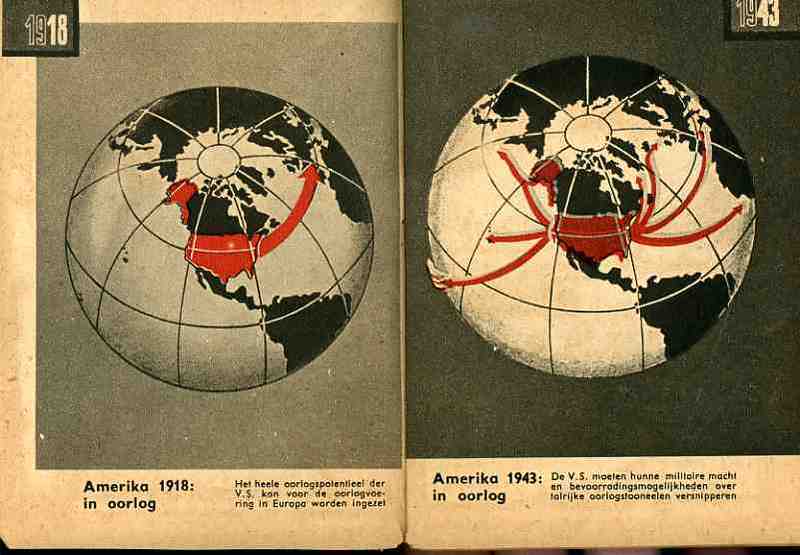
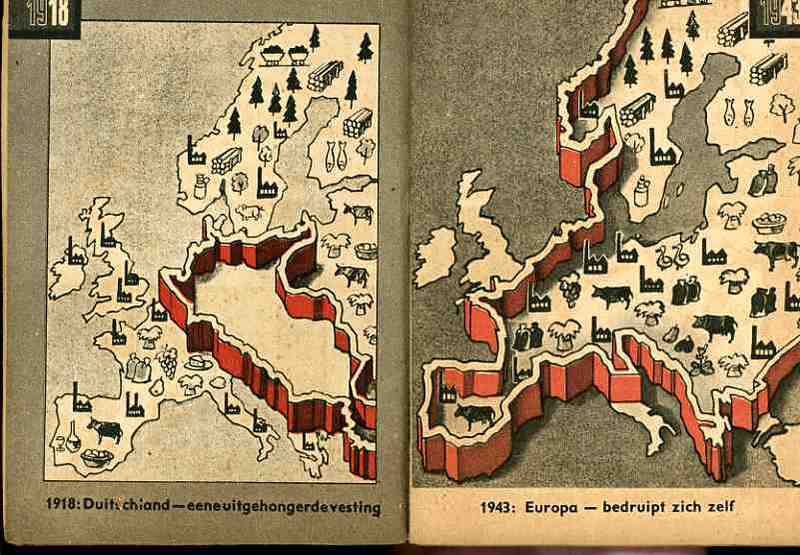
The maps used in the Dutch publication are fairly general and issue a stark warning about the growth of Germany–and how Germany continues to grow through war. The first that we reprint, above, tries to get the point across to the occupied people that England has more problems to deal with than would concern their attention with the Netherlands. The second part of the first map crazily shows the attack upon England and the effectively exhausting attention it has to pay to many points of invasion. Ditto for the second map, showing the spread of American concerns–the U.S. in 1943 would have far more to deal with in many points in a two-ocean war than to concern itself with or have the ability to think about the liberation of Europe and the Netherlands. The last map shows the supposedly extraordinary growth in Germany’s industrial and agricultural capacity.
In short, the maps tell its readers to just keep quiet, the German nation is mighty, and just wait for the end of the victorious German war. The maps also addressed non-readers–of course the Dutch literacy rate was extremely high, but you didn’t have to be able to read the description of the map to understand its blunt message. (This makes me wonder if the maps really weren’t intended for scare tactics against children.) As Boss Tweed once infamously reported–that he had no fear of editorials because his constituency couldn’t read–he hadn’t counted on the political cartoons of Thomas Nast–which could be understood by a non-reader–and which wound up being one of the direct causes of his exposure and downfall.
·Posted by :
·in:
-
Surrender Propaganda Map of Heavily Bombed Germany, One Week in 1945
JF Ptak Science Books Quick Post
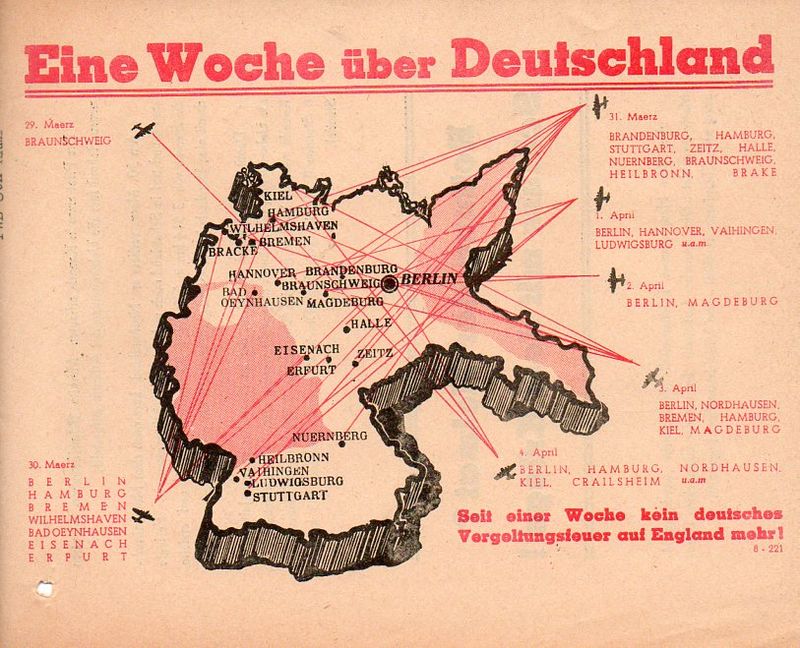
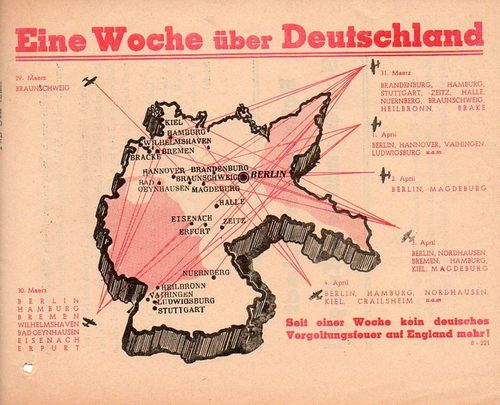
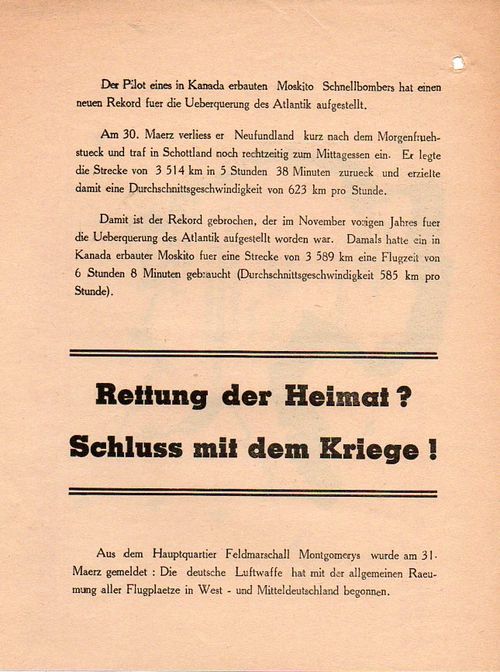
This is a map of The End: “One Week over Germany”…”a week of retaliatory fire” (‘vergeltungsfeuer”). It is a piece of propaganda dropped on Germany along with high explosives, a small convincing element to entice soldiers to surrender and save Allied lives in the final push to Berlin.It is a map that shows much more than just the beginning of the end–it is the ending of the end, two-moves-to-mate. No more failed stalemate, no more breakouts, no more attacks, no more nothing.
I’d find it hard to believe that any Germany soldier would disbelieve what this map represented.
 [Private collection]
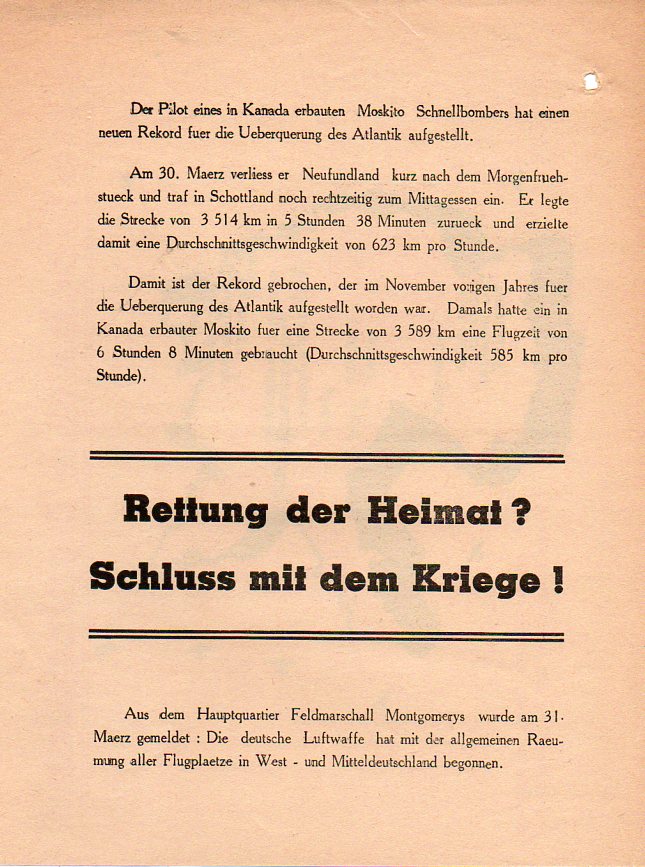
And the reverse:
-
The Weight of Humanity on Book Covers
JF Ptak Science Books Post 2427
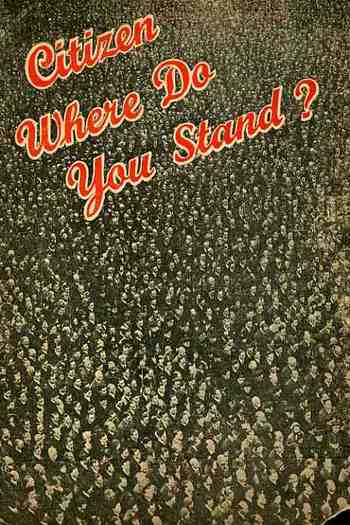
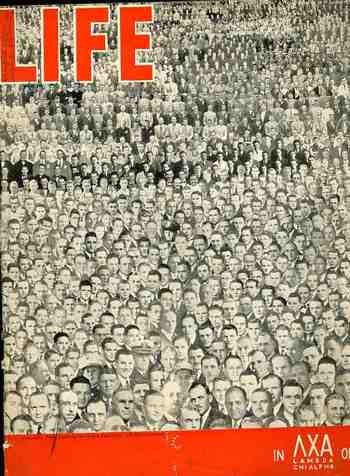
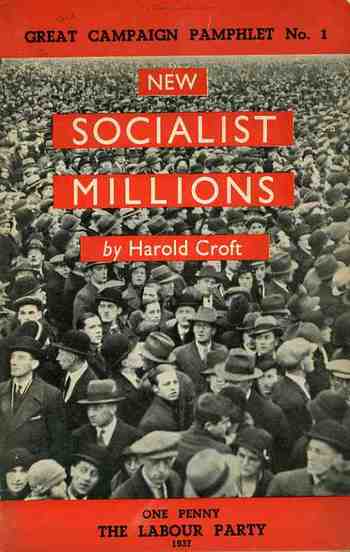
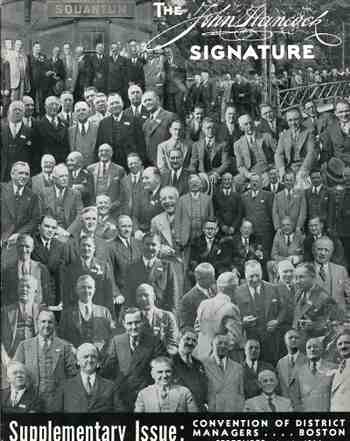
I don’t often see covers of pamphlets or magazines featuring hundreds–or thousands–of people as a part of the design. In my continuing role as finder and re-finder of things found I have re-surfaced four of these designs, and I feel I should post them before they’re captured in the un-finding process. Again. Back to the design: these are very striking, persuasive images, unavoidable in many ways, completely intriguing, beguiling. People just have to look at these things. Look: I made a little experiment today placing ten very interestingly-designed pamphlets on display, all with compelling and distinct merits, and including one with a big spread of humanity on the cover (the “Life” pamphlet). The very unscientific results is that people were generally first drawn to the complex people image, and stayed longer looking at it–by far–than any other image. Perhaps its the same sort of reaction going on when you watch people walking in front of a mirror or reflective surface, with the vast majority of folks checking themselves out in it. Maybe its just people looking for something familiar. Maybe the faces are simply, strictly more interesting than just points o the page. I’m not sure.
The first image is Life, the story of the fraternity lamda chi alpha, published around 1935; second, a one penny Labour Party publication coming from the National Executive Committee of the Labour Party, published in London in 1937; third, a program for the Liberal Party, published in London in c. 1938; lastly, fourth, a program for some course of semi-statistical study with the John Hancock life insurance company. These beautiful designs were much more interesting than the very casual contents they covered.
-
Unexpected Graph of Nazi Elections, 1919-1933, and the Beginning of the End
JF Ptak Science Books Post 2427
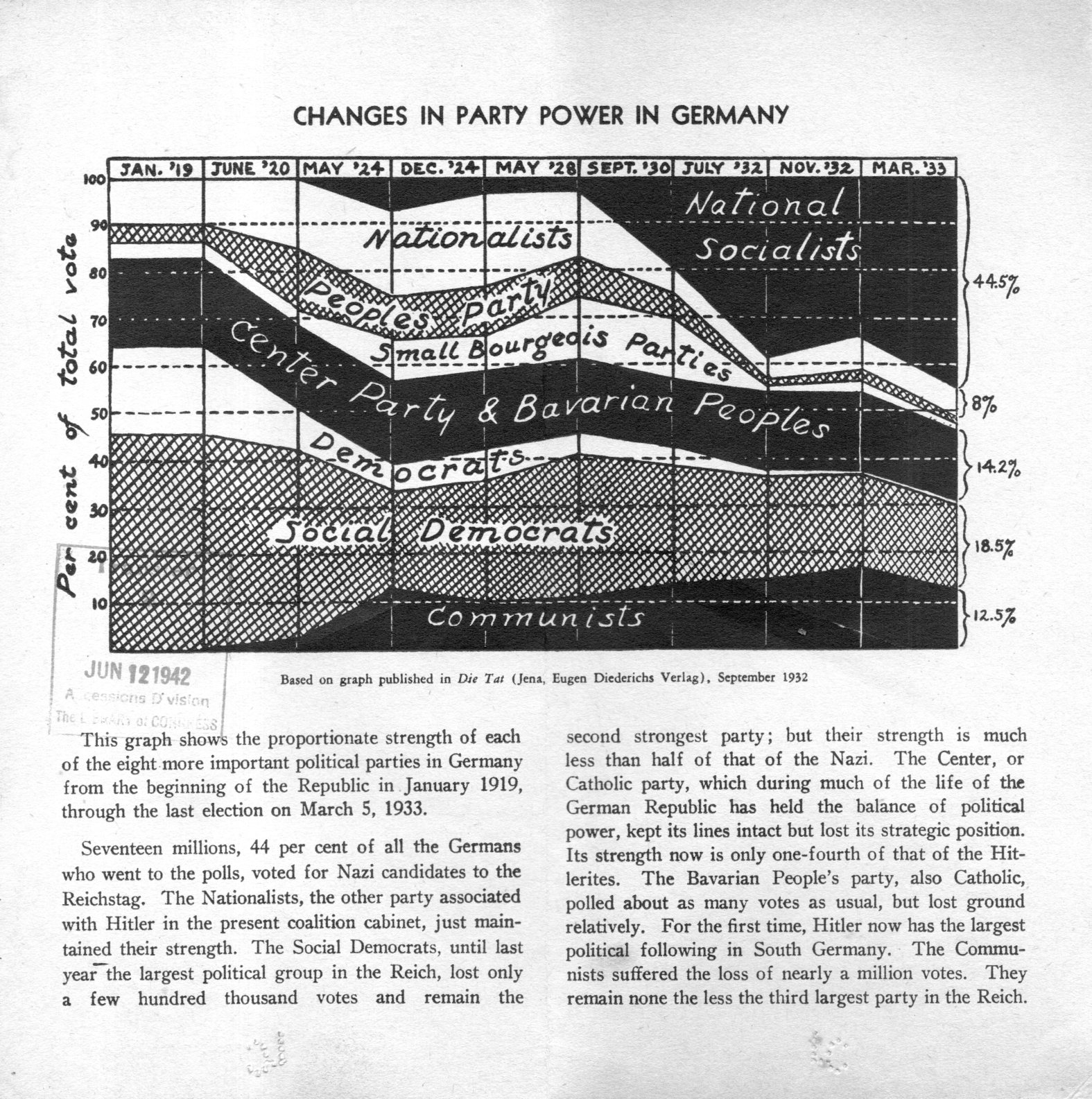
This graph shows the growing shadow of The End, the falling curtain, creeping across the the vertical and the horizontal. This was published to show the results of the fatal 1933 election–this was the one right after Hindenburg appointed Hitler Chancellor who immediately dissolved the Reichstag and so necessitated a new election. That election followed months later, and in spite of massive Brown Shirt presence, plus NSDAP intimidation, violence, coercion and son on, Hitler’s party did very well, but perhaps surprisingly not as successful given all of those other factors. He didn’t have control of the government as a result of the election that gave the Nazis 43% of the seats in the Reichstag. It would come to develop that Hitler and the party found enough support to implement the Enabling Act, which would give Hitler the power to enact laws without the support of the Reichstag. Four months later, with the political and power struggle over, there were no other parties in Germany besides the Nazi Party, and that would become Hitler’s ultimate power, and the true beginning of the rotting of Germany and the coming of the deaths of dozens of millions of people.
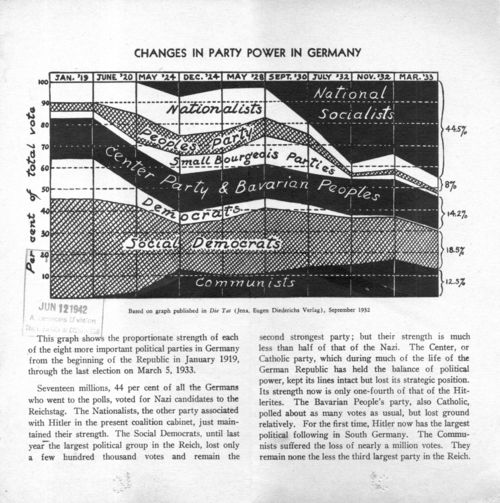
[Source: private, via the Library of Congress from the OSS library.]
-
Avaition Cross-Section, 1940
JF Ptak Science Books Quick Post

This is a not-frequently-seen schematic of the Royal Air Force’s Sunderland, a flying boat, and the largest airplane in British service, pictured and slightly dissected in Popular Mechanics in 1940. (Apologies for the blurry definition on the left side–the book is huge, and not very friendly to the scanner.)
·Posted by :
·in:
-
Nazis in the Soup; Found-Swastikas, 1935
JF Ptak Science Books Quick Post
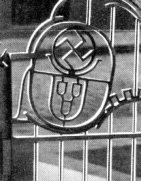
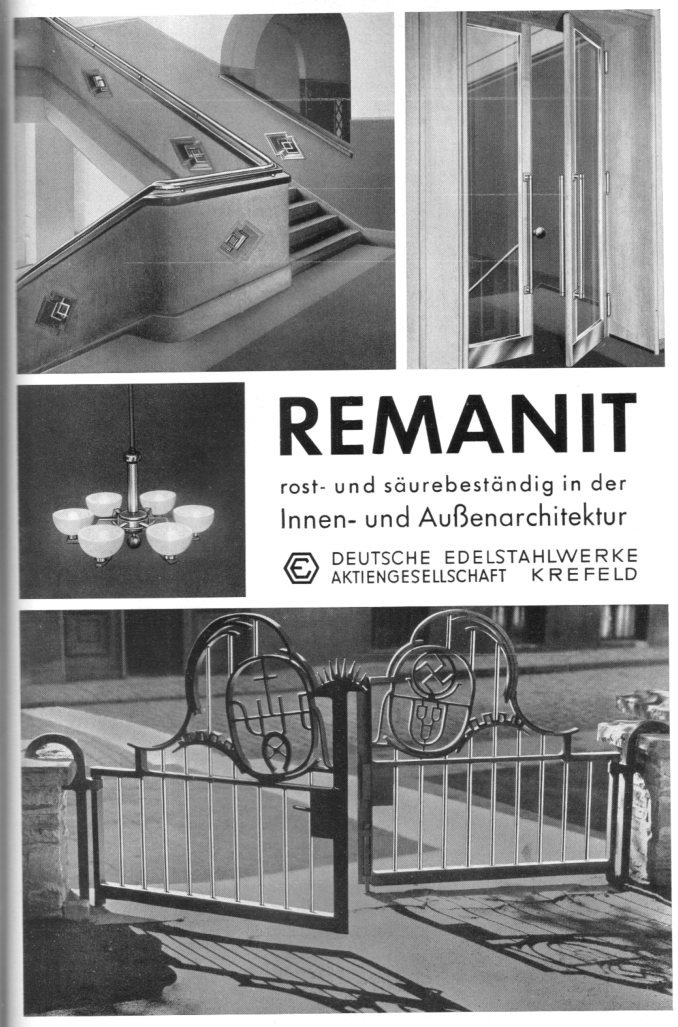
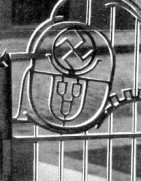
I know this shouldn’t be so semi-surprising and yet so not-unexpected, but it is–finding NSDAP/Nazi symbolism in Germany in the ’30’s embedded in and “edifying” common items and ordinary locations. The thing would just appear, like a little stamp of approval, in advertisements for toothpaste, cars, pins, engines, oil–multiple alphabets of everyday bits made to associate with NSDAP emblems. In this instance the found-swastika caught my eye in a design detail for a gate. The company, Remanit (in Krefeld, northwest of Dusseldorf), specialized in indoor and outdoor stainless steel fixtures–handrails, lighting elements, doors, gates, so on. The gate in the ad–appearing in an oversized magazine on art and taste, Die Kunst, Monatschefte fuer Freie und Angewandte Kunst, volume 74, 1934/5—contained a decoration of a family crest-like design, incorporating a cross; on the other gate, another crest, and almost lost in the shadow was a large swastika. Party members and sympathizers and other passives used the symbol (in its many iterations) quite a bit,adorning their possessions and products with it– and evidently also in one’s stainless steel impervious-to-rusting-but-not bombing gate crest, a stamp of approval for the eclipse of a culture and nearly unprecedented destruction.
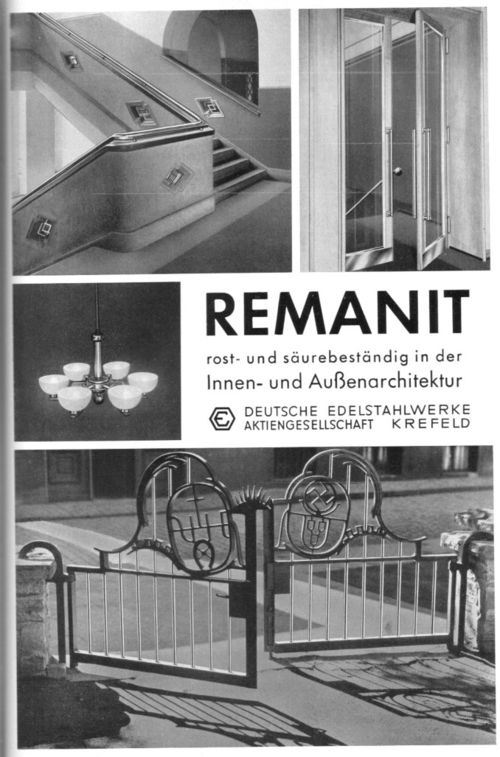
And the detail: