A Daily History of Holes, Dots, Lines, Science, History, Math, Physics, Art, the Unintentional Absurd, Architecture, Maps, Data Visualization, Blank and Missing Things, and so on. |1.6 million words, 7500 images, 4.9 million hits| Press & appearances in The Times, Le Figaro, Mensa, The Economist, The Guardian, Discovery News, Slate, Le Monde, Sci American Blogs, Le Pont, and many other places… 5000+ total posts since 2008.

Author: JF Ptak

  • Reporting the Hiroshima Bomb the Day After, 7 August 1945. AND The First Map of NYC A-Bombed

    JF Ptak Science Books   Blog Bookstore  Part of the Atomic and Nuclear Weapons Series 

    [In which me meet exceptional coverage of a mammoth day-old event and what must be the first map of NYC under atomic attack.]
    ==Blog July 26=PM cvr bomb

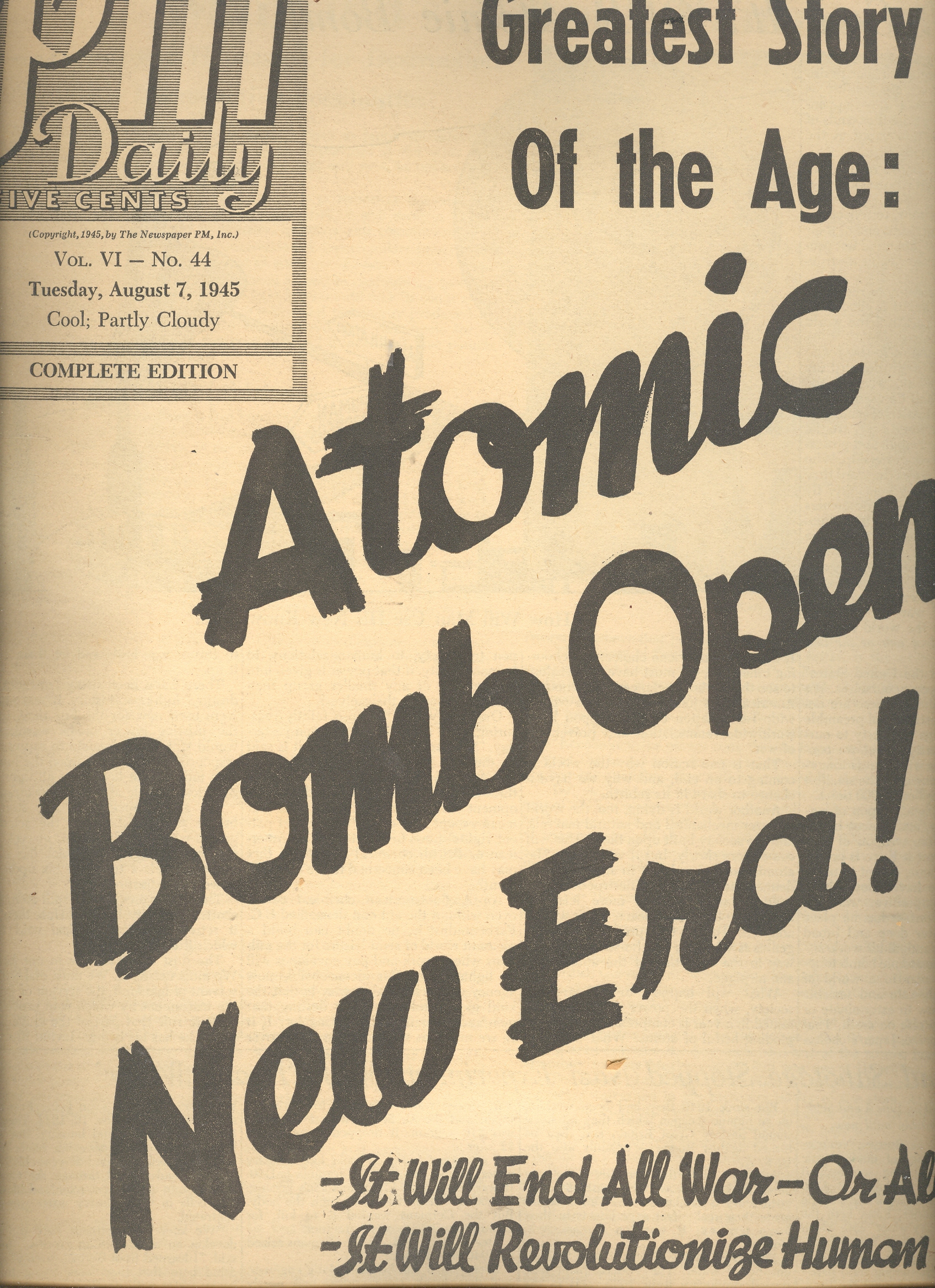
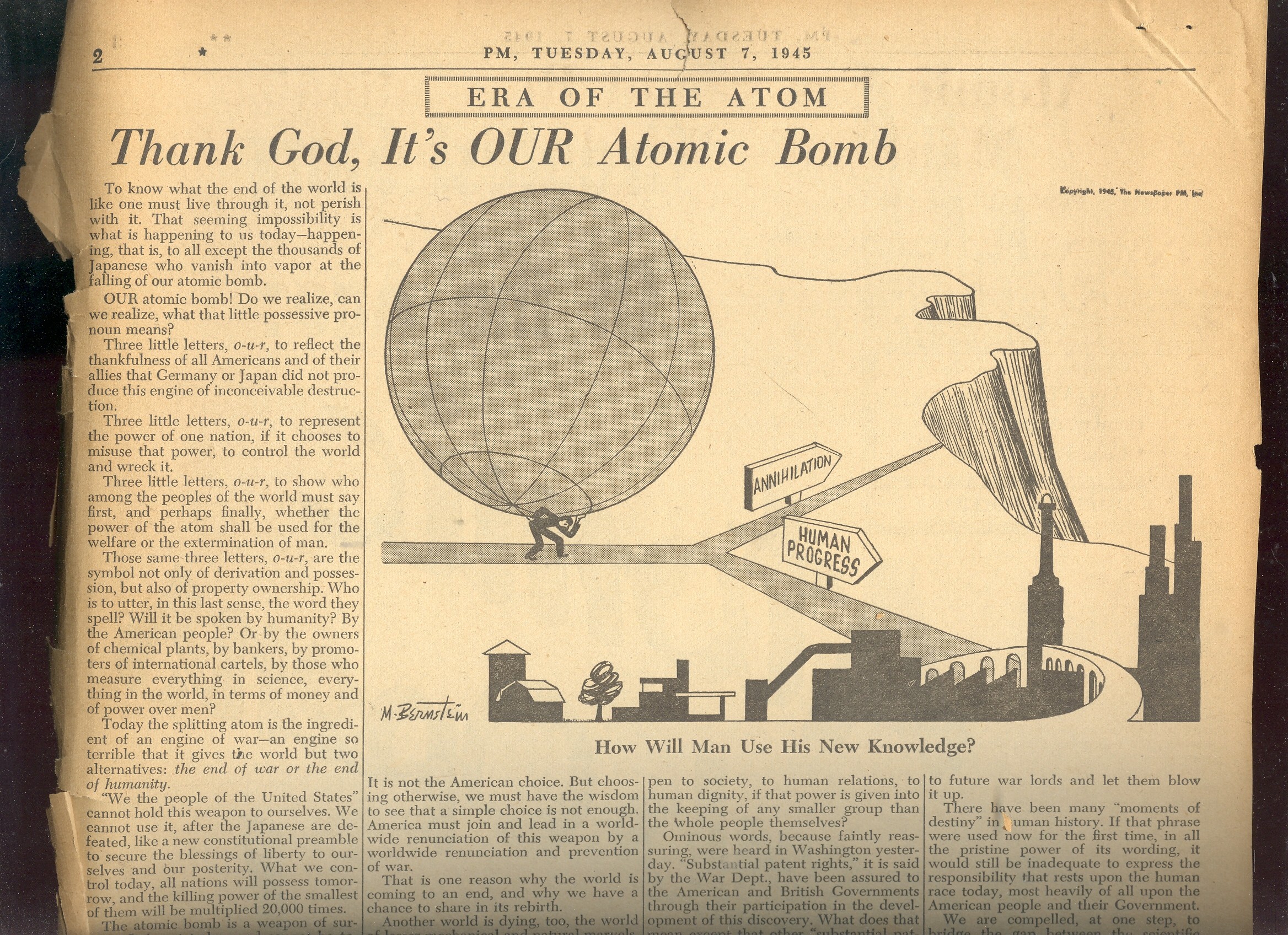
    The news coverage of the 6 August 1945 bombing of Hiroshima was covered in spectacular (all things and time considered) detail in the 7 August issue of the daily newspaper, PM.1  The entire issue of 12 pages (with no advertisement2) was dedicated to the event—I have no idea, really, how they were able to put together this amount of good tough data so very quickly, nimbly and intelligently, as the bomb was detonated at Hiroshima only the day before.

    • This item is available for purchase via the blog’s bookstore, here.  

    It is odd how well the case is covered, and it is positively issued on the day after –it isn’t the case that it was issued for the week of 7 August and released on 13 August, which I thought was a possibility of explaining the deep coverage.  But there’s no mention of Nagasaki (which would come in two days), so I am certain that the coverage was all accomplished within 24 hours of the use of the weapon. The newspaper distinguishes itself by not screaming something about the “Jap city” being wiped out (as so many other newspapers did), with its front page summarizing beyond the bomb.  (“It Will End all War—Or all Men” and “It Will Revolutionize Human Life” as sub-heads; the first being accurate, while the second being nearly so.) 

    The editorial, “Thank God its OUR Bomb”, by Irving Brant, is a lovely piece of thoughtful interpretation in the opening moments of the nuclear age. He writes: “America must join and lead in a worldwide renunciation of this worldwide renunciation and prevention of war”,and “What will happen to industry, to society, when the power of all the coal mined in a year is compressed into an exploding fistful of atoms?” And further:“There is no escape.  The split atom may shatter humanity, but not before then will it retreat into the physical void from which it came.  The dust of creation is in our hands.  We must master it.” Not bad stuff for having a few hours or so to think this  through. 
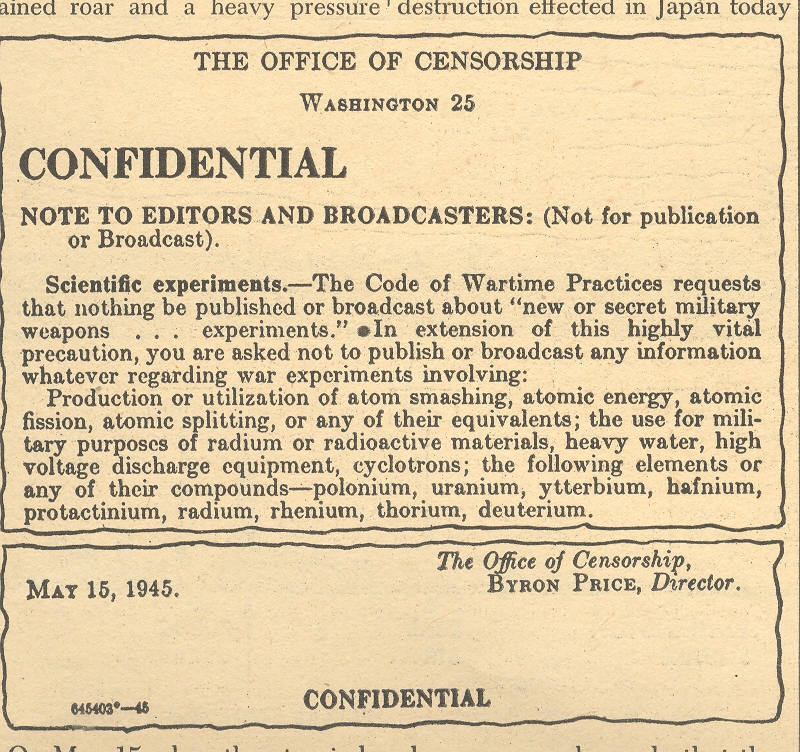
     ==Blog July 26=PM cvr bomb censor


    The other articles included “Bombs and Sabotage Stopped Nazi Experiment with Heavy Water”, “New Atomic Era Could Revolutionize Mankind’s Whole Manner of Life/Power Harnessed for Destruction Has Limitless Constructive Possibilities”, big two-page story “Stimson Reveals How Work on Bomb Was Organized”, “Bomb’s Death Range Believed to be 4 Miles”, “Four Scientists who Will Plan Postwar Uses of Atomic Energy”, “Harnessing of Atomic Power research Strengthens US Research”, “If a Piece of the Sun Were Placed on Earth”, “End Not Yet Truman Tells the Japanese”, and another 12 articles.


    There’s another baffling article “Steel Tower Vaporized in First Test”, discussing the shot at Alamagordo—it must have been the case that there was an enormous amount of material divulged by the government in the hours after the explosion at Hiroshima .  The work at Columbia is also chronicled, as is the personal life of the man in control, General Leslie Grove (and how completely in the dark his wife was, and so on). 
    ==Blog July 26=PM cvr bomb artoon

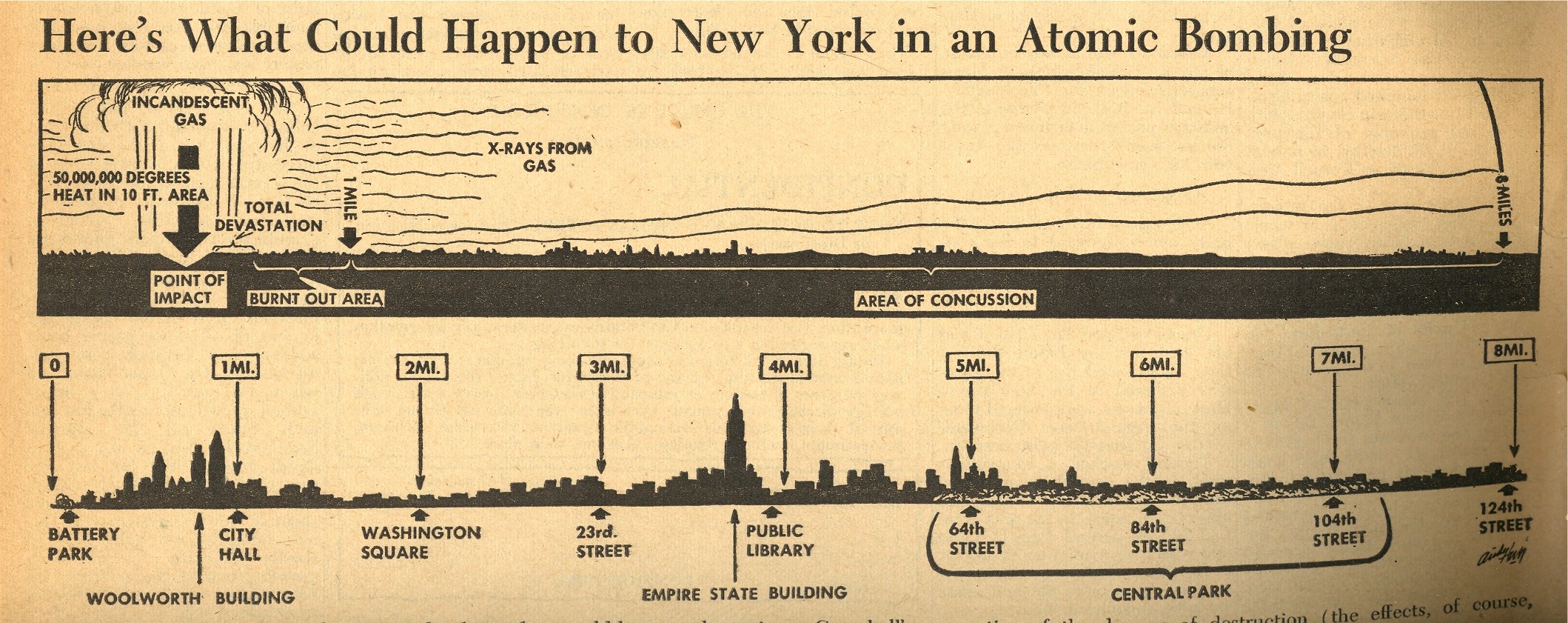
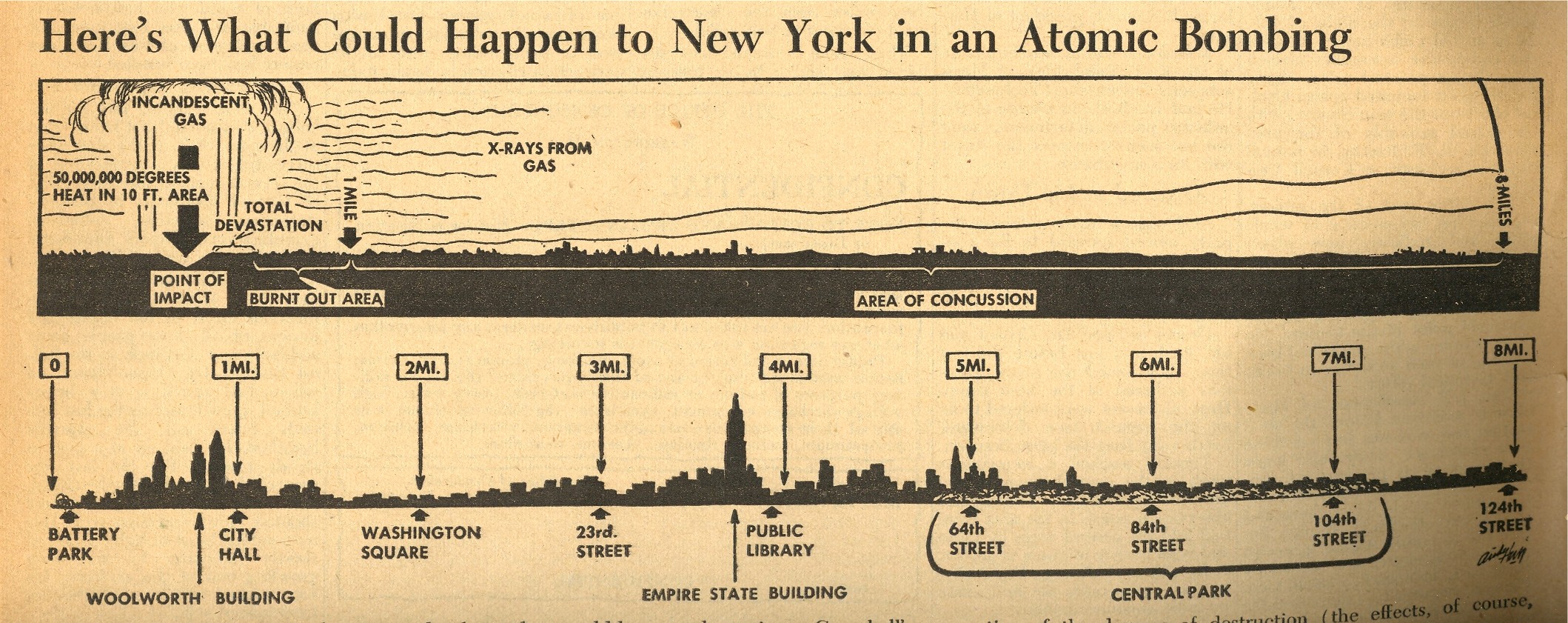
    One of the most interesting objects to me though is the small graphic on page 7 which shows what effect the Hiroshima atomic bomb would have if dropped on New York City—it was no doubt gigantically sobering to anyone who looked at it, and brought the power of the bomb and its destruction to a common, understandable point.  I’m not an historian of the first newspaper coverage of the bomb, but it strikes me that this may well be the first graphic to depict the effects of an atomic bomb exploded over NYC.
    ==Blog July 26=PM cvr bomb map

     
    In any event, the overall coverage of the event was stunning given the short amount of time to do the research, writing, and publication.  Truly a great effort. 

    Notes:

    1. PM (1940-1948) was a left-wing newspaper funded by Marshall Field III, and was home to excellent reporting.  See here for more details. Among the staff writers was I.F.Stone and staff photographers Margaret Bourke-White.  Other contributors included Heywood Hale Broun; James Thurber; (the great) Dorothy Parker; Ernest Hemingway; Eugene Lyons; Ben Stolberg; Malcolm Cowley; Tip O’Neill;and Ben Hecht.

    2. Actually, NO issue of PM had advertisements–it was entirely ad-free. (And even so it still came close to making money after 8 years.)

    PM‘s stated mission:

    PM is against people who push other people around.   PM accepts no advertising. PM belongs to no political party. PM is absolutely free and uncensored. PM’s sole source of income is its readers–to whom it alone is responsible.PM us one newspaper that can and dares to tell the truth.

    Theodore Geisel (Dr. Seuss) was a cartoonist for PM (see here for his War cartoons) as was the great Crockett Johnson.
    ·Posted by :

    ·in:


  • What Happens To Essential Personnel in a Nuclear Attack? (1956)

    JF Ptak Science Books   Post 2452

    Perhaps nothing is obvious unless it is established or labeled so; perhaps the obviousness must be stated at least once before it can be officially, recognizably, the case.  And perhaps the greater the obviousness is, the more the need to make it officially so.  Perhaps nothing is so incredibly obvious that it can be studied and dissected and established.

    This seems to be more the case in more recent history than in time more further removed: that millions of dollars can be spent “proving” that children do not like to be separated from their mothers, or that cars will go faster downhill than up, or that people will respond to proper medication better than not, and so on, so on into the night, just seem not to need a vastly-funded proof.

    And so the case with nuclear warfare, people, and cities.

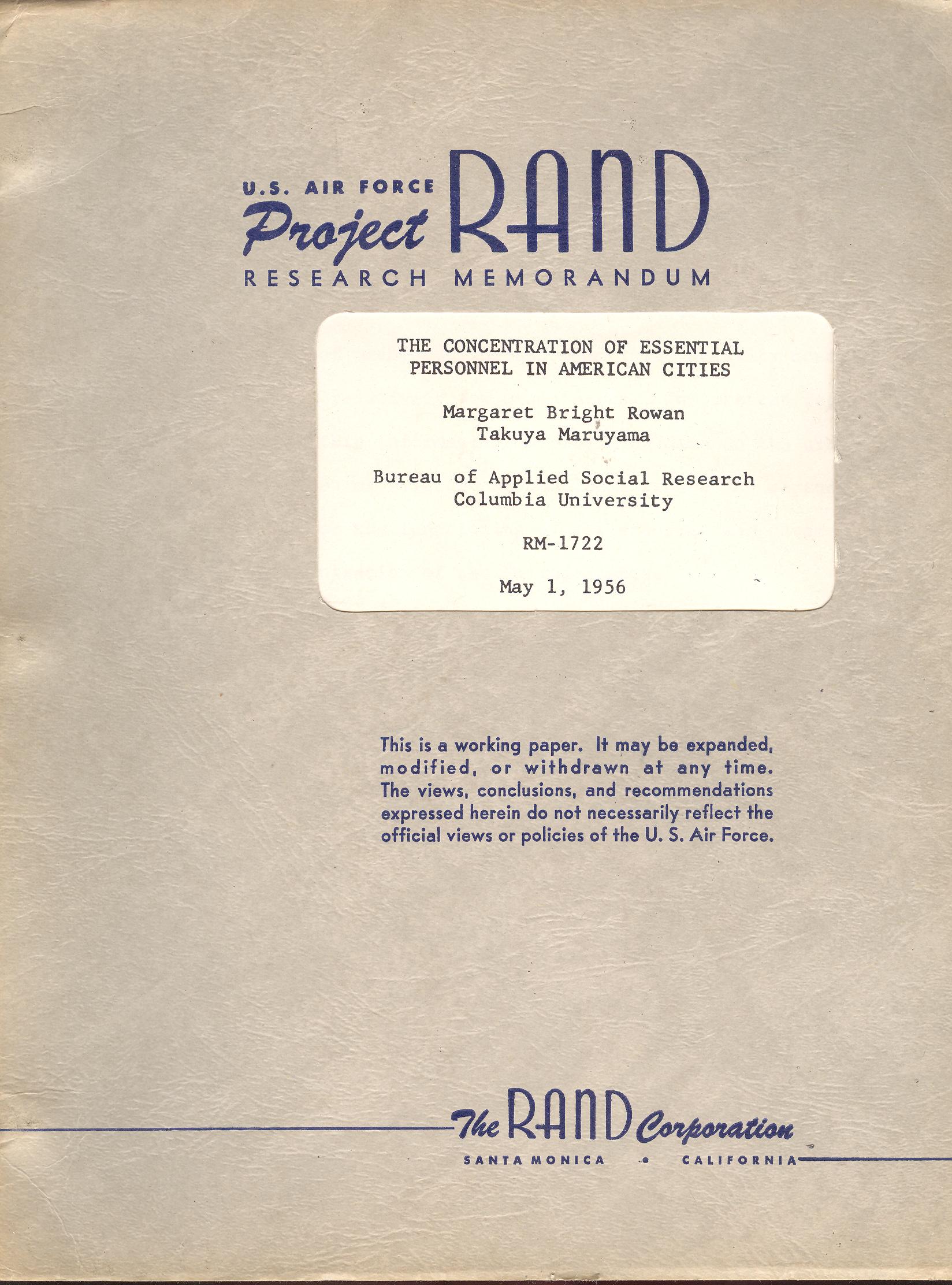
    In this RAND report from 19561, the great issue seems to be laid to rest, once and for all: the problem with nuclear weapons being exploded in/over cities is that since cities are filled with people, people will be killed.  And if those people in the cities are there because of professions that depend on city-settings, then more of those people will be killed than not.  

    Rand report


    • This work is available at our blog bookstore, here. 

    But what this report was really about was the unfortunate aspect of the impact if nuclear warfare on leadership and working positions in significant and strategic industrial/business/government professions.  And what the report finds is this: since the vast majority of these positions are located in cities (defined as 100,000 population and above), and since cities will be the major targets in a nuclear “exchange”, the overwhelming majority of these people will be killed, thus leading to strategic human resource vacancies post-war. 

    It seems that 95% of aeronautical engineers in the U.S. would be killed in a nuclear war, which I guess would mean that it would be difficult to design new aircraft and such in the post apocalypse world.  Of course these people would be killed because it was their industrial base that was being targeted and they were collateral damage, so there wouldn’t be any industrial base to produce the components necessary to build, say, a B-52.  That part of the equation is not addressed here, though.  Nor is there any sort of recommendation presented to fix the problem.

    The RAND document just painfully points out the obvious, once and for all; no one really knew what to do with the information now that it was there, in black and white. Certain people could be evacuated, saved from the maelstrom; but saved for what?  There were other evacuation plans that were completely doomed from the beginning, sheltering plans, Dr. Strangelove arrangements, but all of that would come into their pitiful being later on.

    First, though, the bitter reality of what everyone already knew–one of the greatest of all obviousnesses–had to be make its appearance in print.  And so it did.

    Notes

    1.  The Concentration of Essential Personnel in American Cities. Margaret Bright Rowan.  The RAND Corporation, May 1956.  72pp.  11×8 inches.  RARE. No copies located in WorldCat/OCLC 

    ATOMIC BOMB.  The Concentration of Essential Personnel in American Cities. Margaret Bright Rowan.  The RAND Corporation, May 1956.  72pp.  11×8 inches.  RARE. No copies located in WorldCat/OCLC $350.00

    ·Posted by :

    ·in:


  • German Anti-U.S. Caricatured Propaganda, 1918

    JF Ptak Science Books  Quick Post


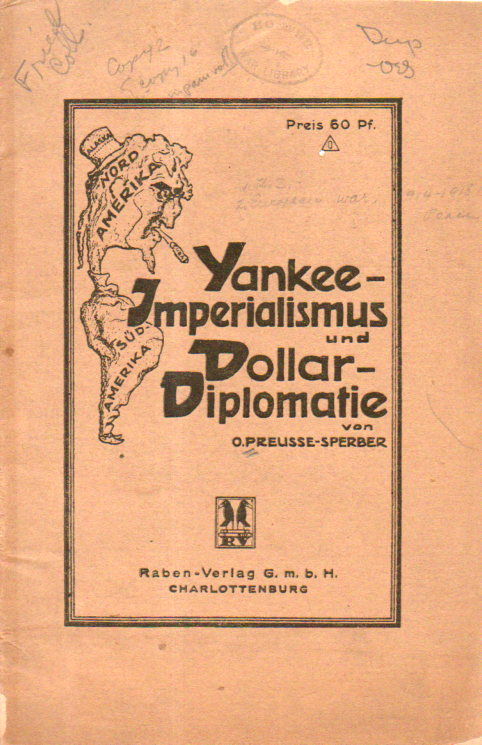
    Yankee Imperialismus und Dollar Diplomatie by O. LinkPreusse-Sperber is a rant against the United States–not so surprising as it was published in 1918, the last year of WWI.  I’ve selected this to share because of the cover art more so than the content. This is an interesting copy of a scarce little work (only four  copies are located in the OCLC including Smith College, the British Library, Bibliotheque Nationale, and BM Lyon, while Harvard and the NYPL have copies but not originals) and has a nice provenance of its own, coming to me from the Library of Congress Pamphlet Collection via the Hoover War Library at Stanford.

    WWI anti-US propaganda955

    • The original is available for purchase at our blog bookstore, here.  

    WWI anti-US propaganda954

    ·Posted by :

    ·in:

    —

  • A Nearly-Blank Outline Map of the World

    JF Ptak Science Books   Quick Post

    Part of the series of The History of Blank, Empty, and Missing Things

    “Other maps are such shapes, with their islands and capes!
    But we’ve got our brave Captain to thank”
    (So the crew would protest) “that he’s bought us the best-
    A perfect and absolute blank!”

    So goes the fourth fit of the Bellman’s tale in The Hunting of the Snark, featuring a map that I wrote about here, wondering about its absolute beauty of near total blankness.  

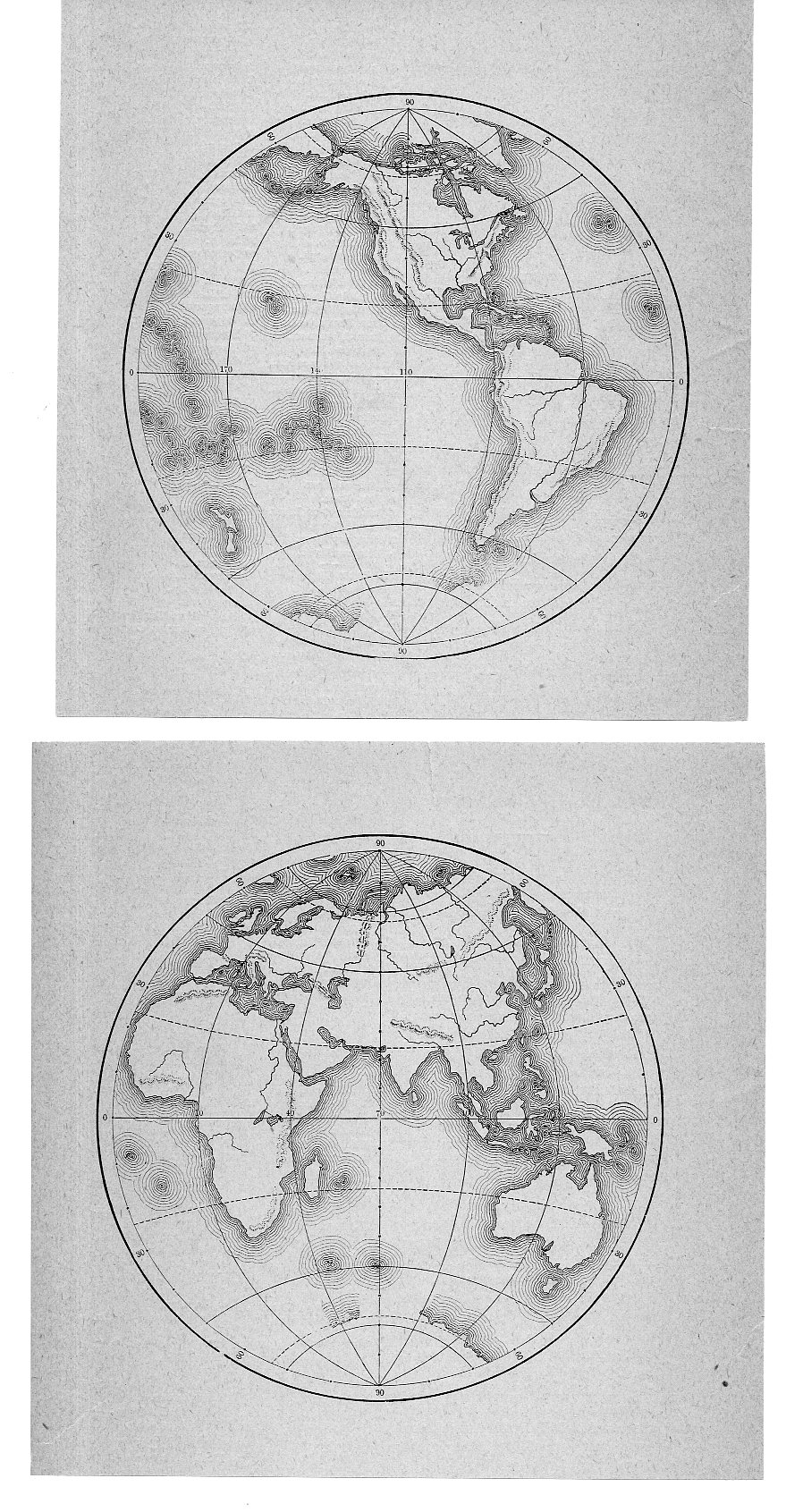
    No doubt this pair of hemispheric maps of the world–printed probably in the 1880’s–were intended as instructionals, or primers, or to be used as outline maps to be filled-in and elaborated by students. Still, standing there out of context as Blank Maps, the have a certain appeal.  They don’t have the vigour and the energetic nothingness of the Lewis Carroll Bellman map, but they will have to do for now.  

    Map Worldf blank953


  • World Map of the The Geography of Homer

    JF Ptak Science Books  Quick Post

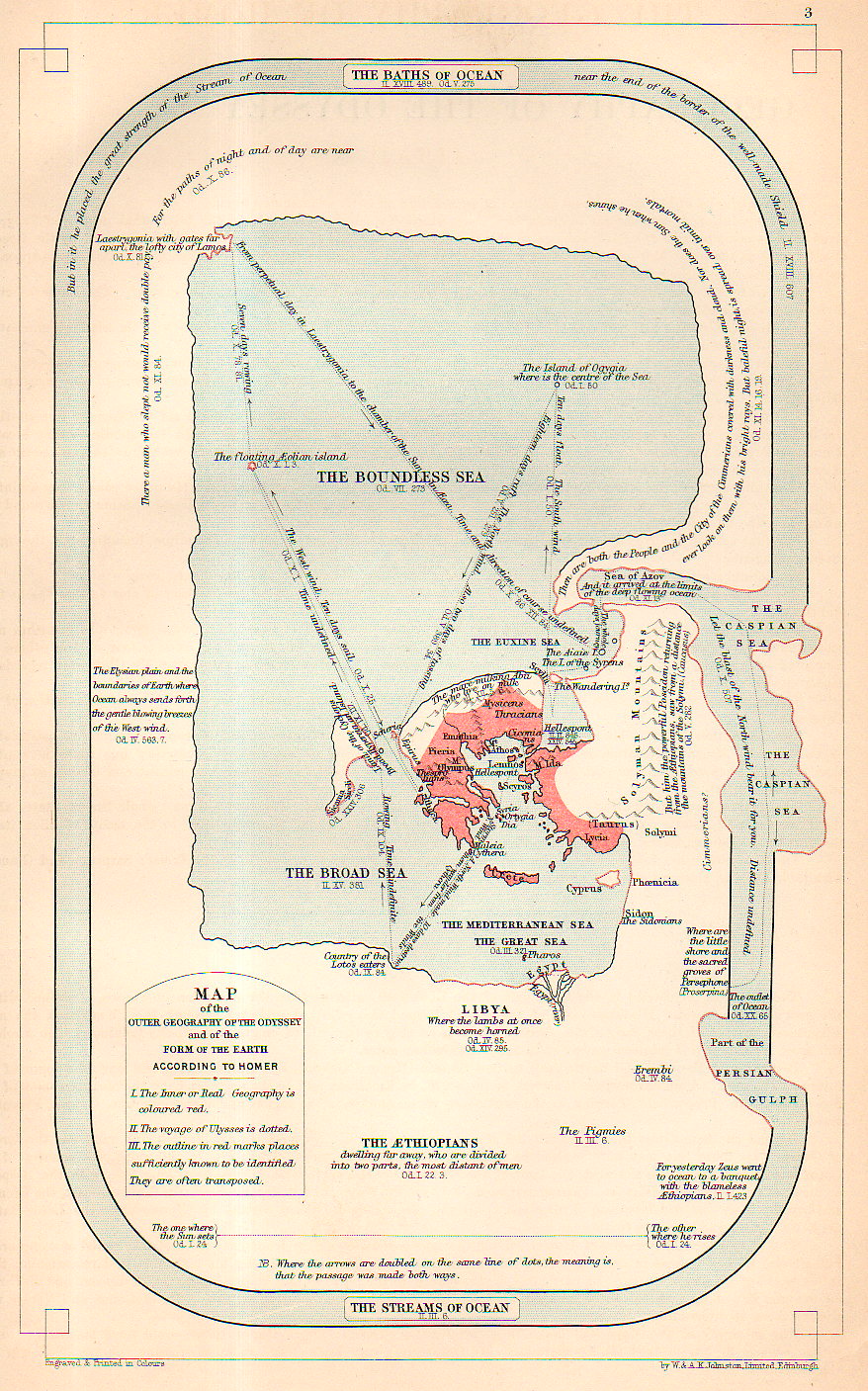
    • “For the paths of night and of day are near”–Odyssey, X 86.

    Map of the Outer Geography of the Odyssey and the Form of the Earth According to Homer is a wonderful map of the creation of Homer (ca. before 900 BCE), across the Soundless Sea to the outer bounds of the paths of the oceans.

    Map Geography of Homer951

    Source:


    • This map is available for purchase at our blog’s bookstore, here.  

    A fine collection of ten other Homeric World maps can be found (with a lengthy essay) at Cartographic Images, here.  


  • Atomic Bomb Dreams of Safety and Annihilation: 1950’s Public Service Films.

    JF Ptak Science Books  Quick Post

    Part of a long series on  Atomic and Nuclear Weapons

    I’ve collected a sextet of films I found and posted on twitter at one point or another, collected here and placed on one soft pillow.  They all seem to be made in 1950-1952, at the beginning of the Great Red Scare of the 1950’s. There was a certain amount of fear and loathing about the USSR and the bomb beginning soon after the U.S. use of it in August 1945, though the Soviets didn’t successfully test their first weapon until August 29, 1949 (called “Joe 1” in the United States). There was a slow march to the first air drop (1951) to the development of the first Soviet hydrogen bomb in 1954.  There was a constant bombardment of popular culture by atomic threat beginning shortly after 1945, with atomic attacks, atomic super heroes, atomic villains, atomic mutants, atomic super races, and so on, and that all accelerated with Soviet nuclear weapons progress through the early/mid-50’s. The films and public announcements below represent an early rush of film media to deal with the possibility of ….Atomic Attack.  

    Atomic Alert, (“elementary version”),  1951–a Bomb awareness film.

    Atomic alert 1951

    Source:  Internet Archive http://ow.ly/Mqa0q 


    ·Posted by :

    ·in:


  • Portraits Within Portraits Within Portraits: France, German Prisoners, 1918

    JF Ptak Science Books   Quick Post

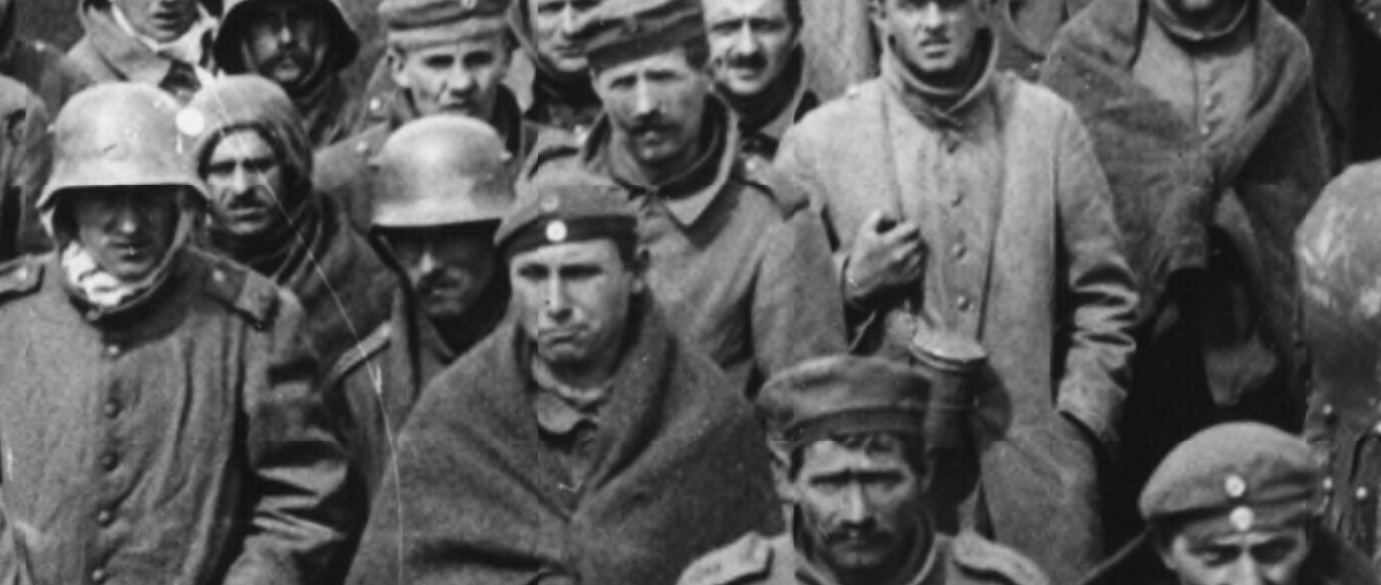
    April, 1918, Givenchy Road, France–this is an official war photograph of captured German soldiers.  There are hundreds of smaller photographs composing the larger full photo of this mass scene of fear, relief, exhaustion, and boredom.  Everywhere a portrait, and each portrait with a different story to tell.  

    • See this blog’s continuing series on WWI photographs, here. 

    WWI--Photos--German Prionser NLS  greater detail

    Also see an earlier post on this site, a similar photograph, the original of which is offered for sale on the blog’s bookstore, here. 

    ·Posted by :

    ·in:


  • Outsider Cosmology and a Theory of a Firey Universe (1781)

    JF Ptak Science Books   Post 2451

    Rabinqueau was a sort of intellectual performance artist provocateur, who made a living on his brain, writing scientific and pseudo-scientifically on a number of subjects as well as being a paid-for scientific performer. he would demonstrate to paying audiences various experiments in optics and light and electricity and magnetism, though he would sometime veer far away from the safely trodden fields of science into new scientific theories, many of which would put a considerable distance between himself and recognition from the Academie Royale des Sciences.  

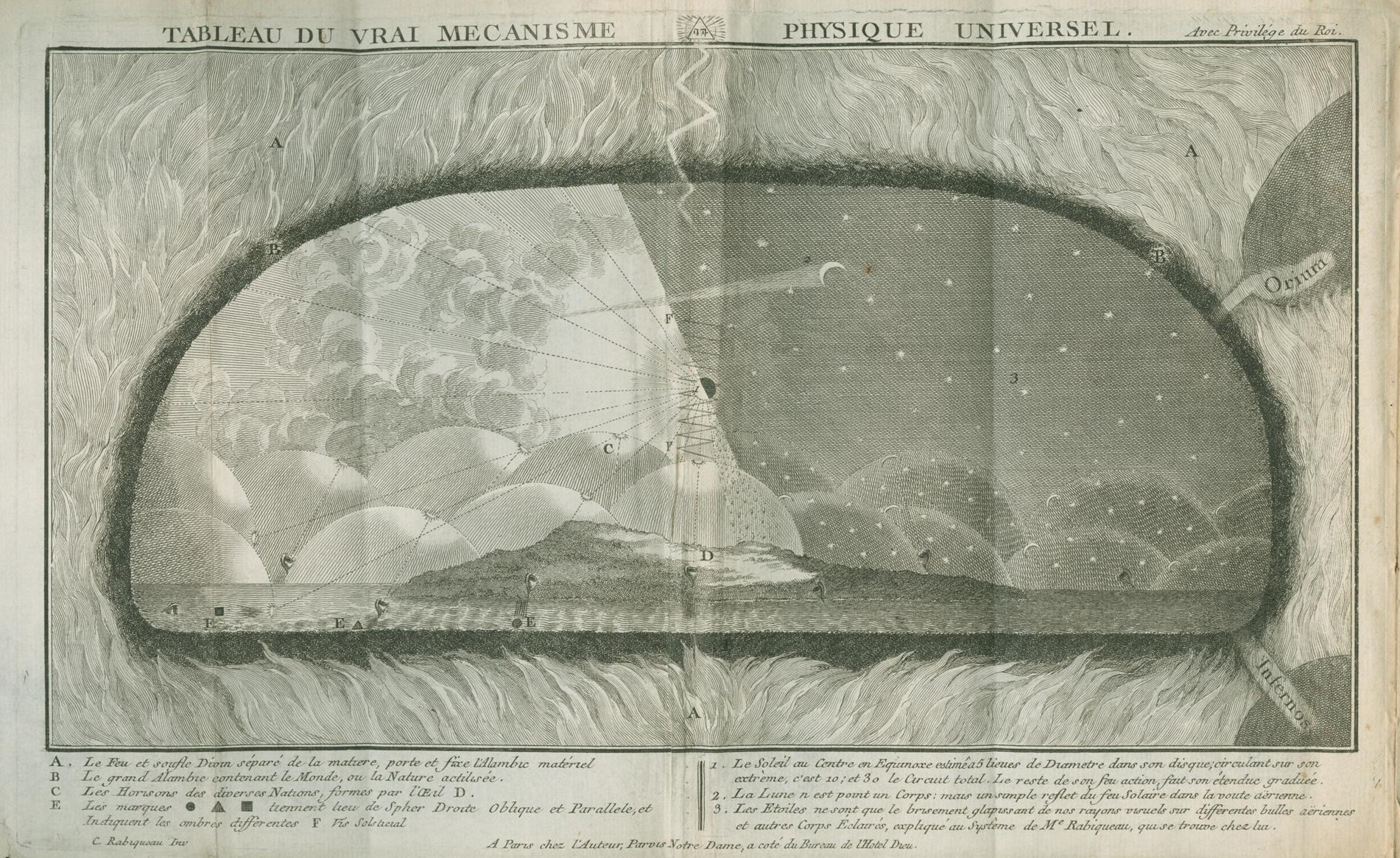
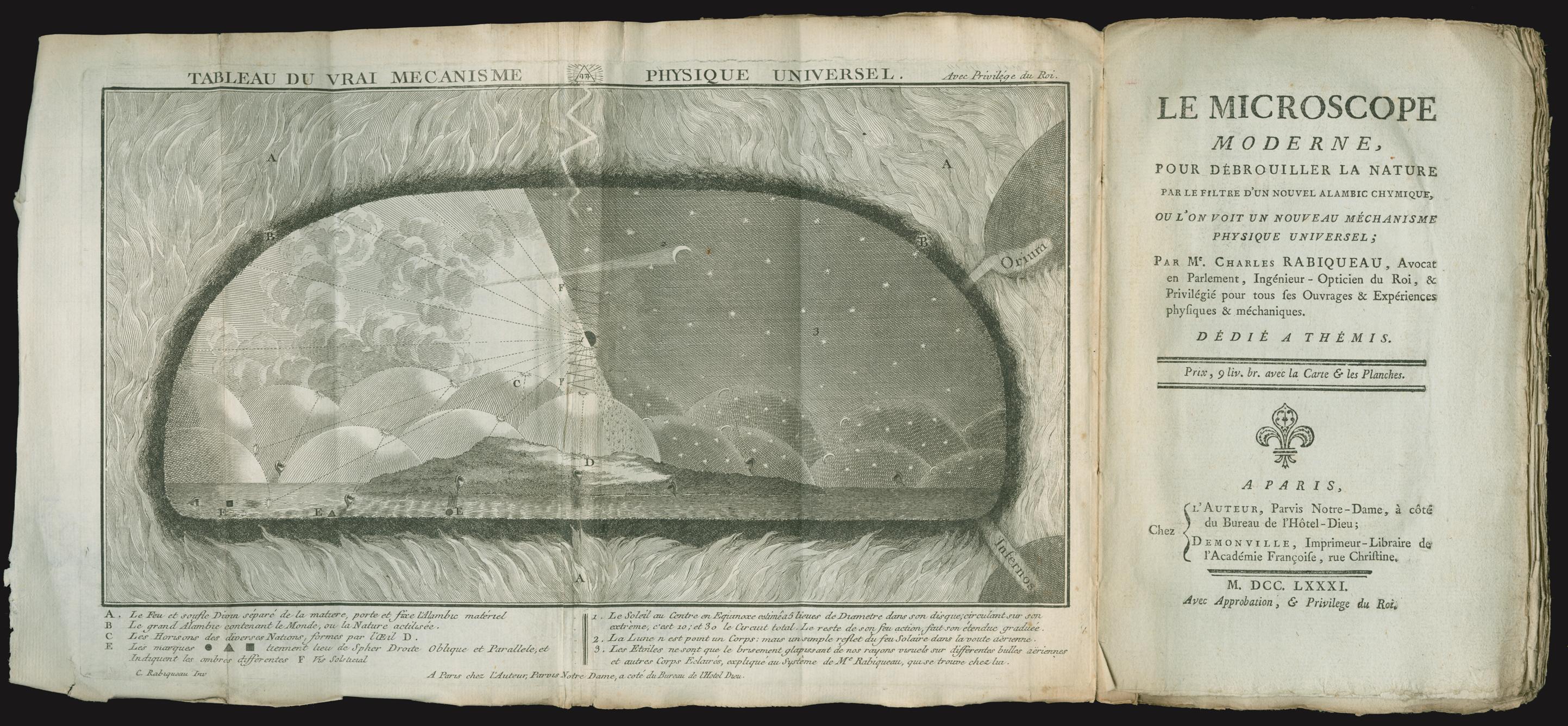
    For example, he developed a number of pseudo-magical physical ideas and astrological bits, as well as a fire-based theory of electricity in which the very substance of the universe is occupied by fire.  (See Popular Science and Public Opinion in Eighteenth-Century France, by Michael R. Lynn, p 51.)  Even though his ideas and results were far from the known science of such topics, he held a special affinity for the superiority of his own ideas, and stuck by them.  His universal fire theory at the very least resulted in an insistence for Outsidery consideration of cosmological questioning and display, as see in this beautiful engraving:

    Rabinqueau plate

    Rabinqueau


    The image appeared as the frontispiece to his Le Microscope moderne. [Treatise on cosmography], which appeared in 1781, and which seems to me to be sort of late in the game for these theories to be making an appearance. Source: Newberry Digital Library. (The image also makes an appearance with a different interpretation in Barbara Maria Stafford’s Good Looking, Essays on the Virtue of Images, p. 93.)

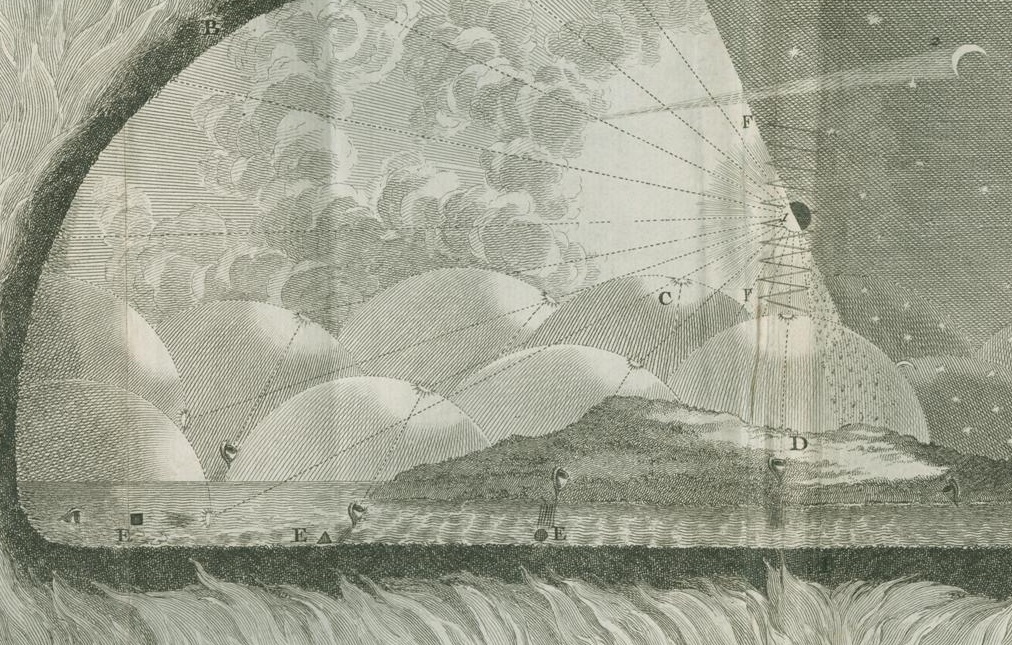
    And a detail:

    Rabinqueau plate detail

    Rabinqueau also developed an electrical, friction-based theory of the sexes, involving much rubbing and electrified ovaries, but this idea didn’t go very far. (See: The Psychoanalysis of Fire, by Gaston Bachelard, page 26.)


  • Dirt in the Sky–a Floating Sepulcher

    JF Ptak Science Books  Quick Post   

    I have not made an entry to the Strange Things in the Sky department in a while, though I’m happy to have made my way to this one this morning. While many entries in this category truly are strange and actually in the sky, many are not–they are strange and unexpected, though appearing ‘in” the sky by virtue of placement in an image, which is what we have here.

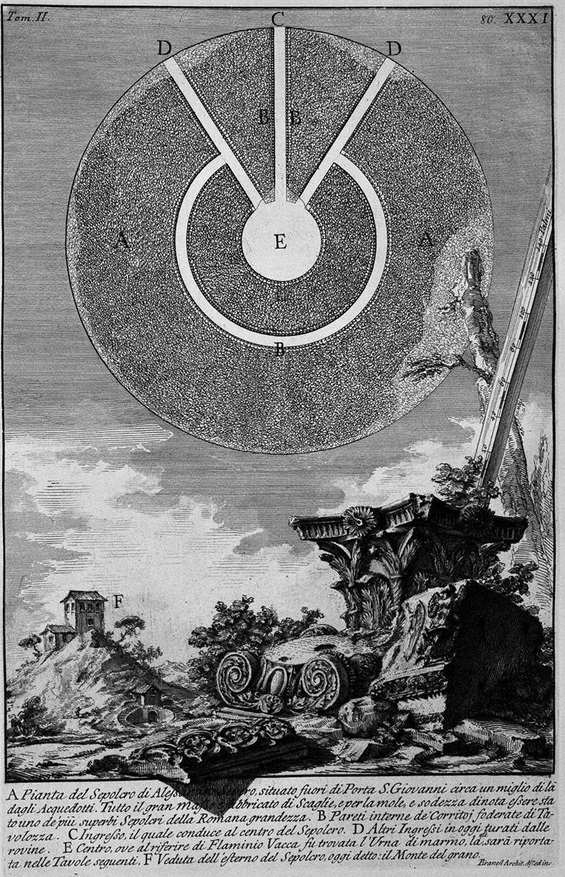
    Giovanni Piranesi’s collected works on the antiquities of the Roman empire are astonishing in form and function, and scope and breadth, and sometimes all of the above plus the placement of the represented objects on a piece of paper.  In this case we have the plan of the sepulcher of the last Roman Emperor of the Severi dynasty, Alessandro Severo, who reigned at age 13 from 222-235 in a bitter part of 3rd century Roman history.  The bumpy plan appears to float in the sky above unindexed ruined bits, while in the far background (lettered “F”) is the building/construction itself, occupying perhaps only 5% of the image space.  

    Piranesi fragment alessandro severo[Source: http://www.wikiart.org/de/giovanni-battista-piranesi/the-roman-antiquities-t-2-plate-xxxi-fragment-of-stucco-gouged-by-the-time-of-nicchioni-is-one-1756#supersized-artistPaintings-262292]

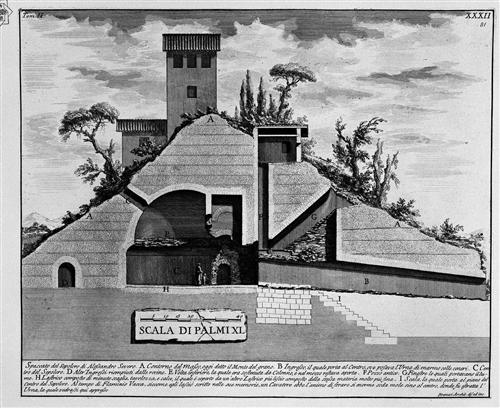
    And the next etched plate in Piranesi’s book gives a fuller appreciation of the tomb: 

    Piranesi alessandro severo tomb

    [Source: http://www.wikiart.org/de/giovanni-battista-piranesi/the-roman-antiquities-t-2-plate-xxxi-fragment-of-stucco-gouged-by-the-time-of-nicchioni-is-one-1756#supersized-artistPaintings-262291 The Roman antiquities, volume 2, Plate XXXII. “Plan and external view of the tomb of Alexander Severus located outside Porta S. John about a mile from the aqueducts”, 1756.]

    Piranesi is filled with treasures of all shapes and descriptions, but what I find to be among the most sensational in the gigantic work are the arrangements of the found bits and the unexpectedly-placed objects. 


  • Paper Dissections of the Brain I, ca. 1876

    JF Ptak Science Books  

    These images are brought to us by the Irish-born Quain brothers:  Jones Quain (1796-1865) who was  an anatomist and professor of Anatomy and Physiology at the University of London; and Richard Quain (1800-1887), a professor of anatomy from 1832-on at the University of London, then surgeon at North London Hospital, and president of the Royal College of Surgeons. The illustrations are from a later (ca. 1850’s) and smaller printing of their beautiful 1844 work The Anatomy of the Arteries of the Human Body, with its Applications to Pathology and Operative Surgery, in Lithographic Drawings with Practical Commentaries.

    • The original lithographs of these images can be purchased at the blog’s bookstore. 

    Brain521