A Daily History of Holes, Dots, Lines, Science, History, Math, Physics, Art, the Unintentional Absurd, Architecture, Maps, Data Visualization, Blank and Missing Things, and so on. |1.6 million words, 7500 images, 4.9 million hits| Press & appearances in The Times, Le Figaro, Mensa, The Economist, The Guardian, Discovery News, Slate, Le Monde, Sci American Blogs, Le Pont, and many other places… 5000+ total posts since 2008.

Author: JF Ptak

  • Phases of Saturn, Big and Small (1851)

    JF Ptak Science Books   Quick Post   Part of the Zoomology series

    Saturn BIG multiples_sun saturn

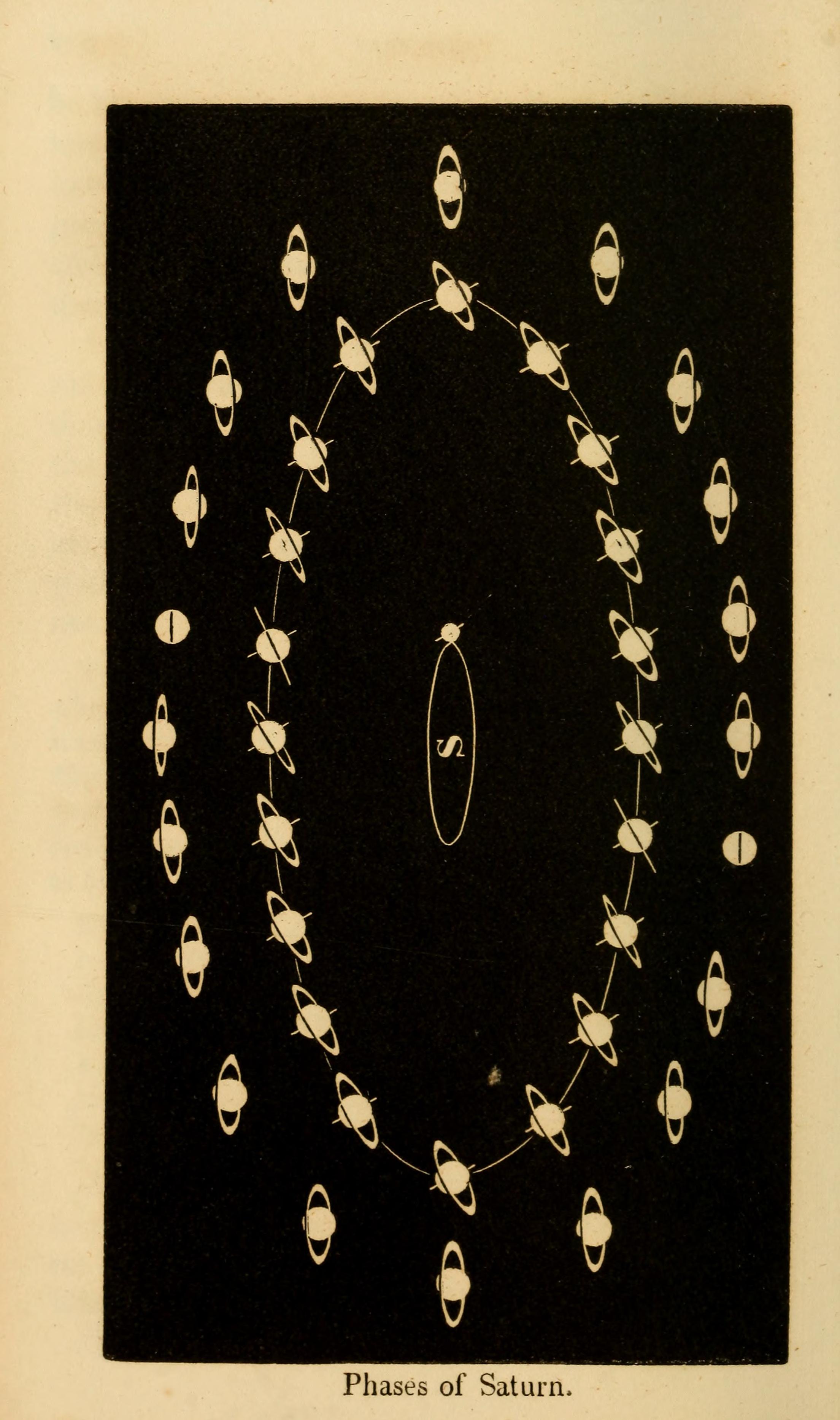
    I’ve had a bit of fun with my “paper microscope” on this beautiful engraving of the phases of Saturn.  It is enormously captivating in it full glory, but there’s so much more in it, a huge variety of single and multiple images of captivating energy–almost everywhere within the image is another image, and so on, turtles all the way down.  

    The full image:

    Saturn BIG multiples

    The engraving is from E.O. Kendall Uranography, published in 1850, and an excellent high-def deeply zoomable copy is located at the Internet Archive, here. 

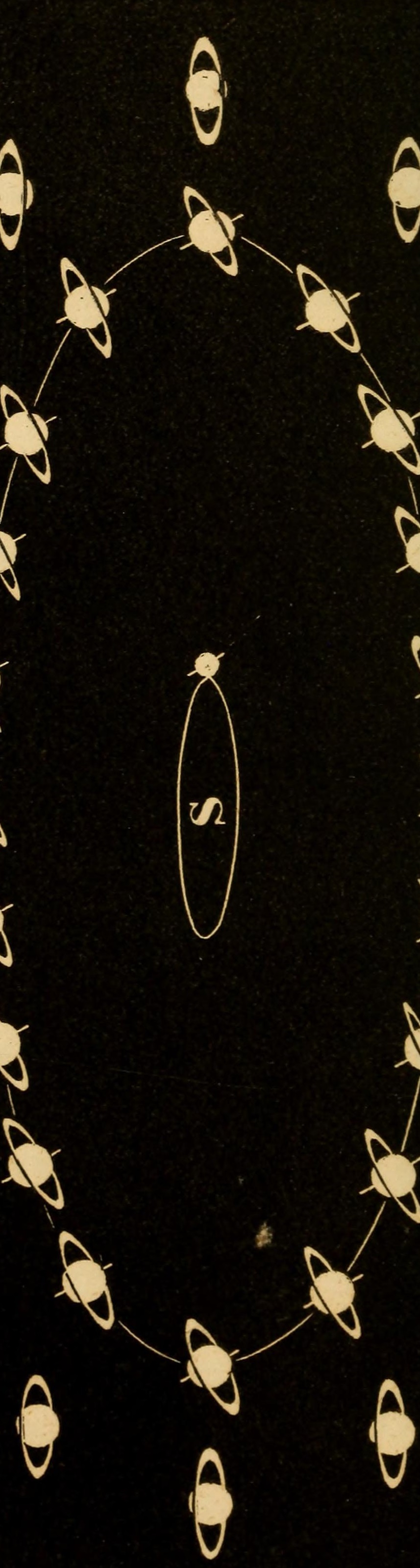
    And another selection:

    Saturn BIG multiples_long vert

    There’s much that can be done with this piece of art–in this example we just have a close-up of the original image which is only a few millimeters wide…

    Saturn BIG multiples_tiny Saturn


  • The U.S. and Not Wanting to Go to War, 1939 & 1940

    JF Ptak Science Books   Post 2450

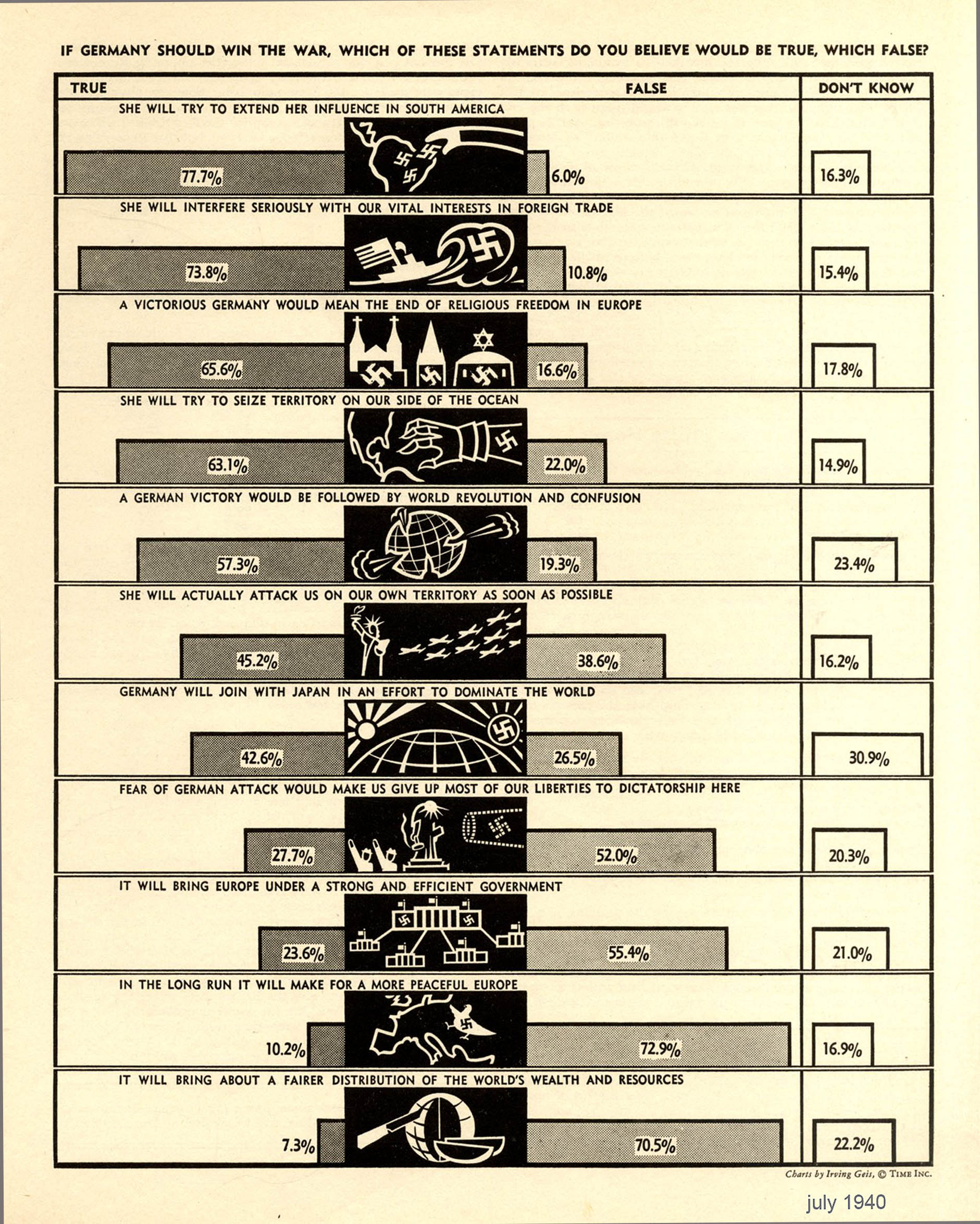
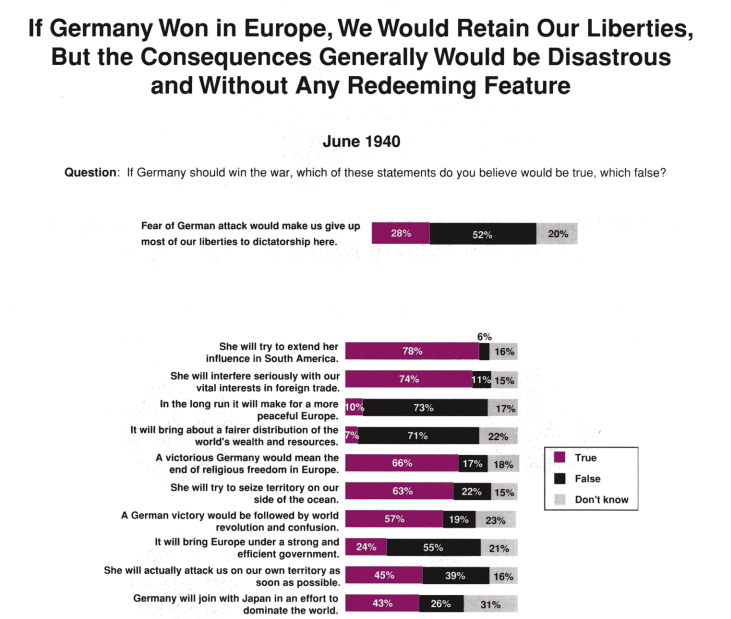
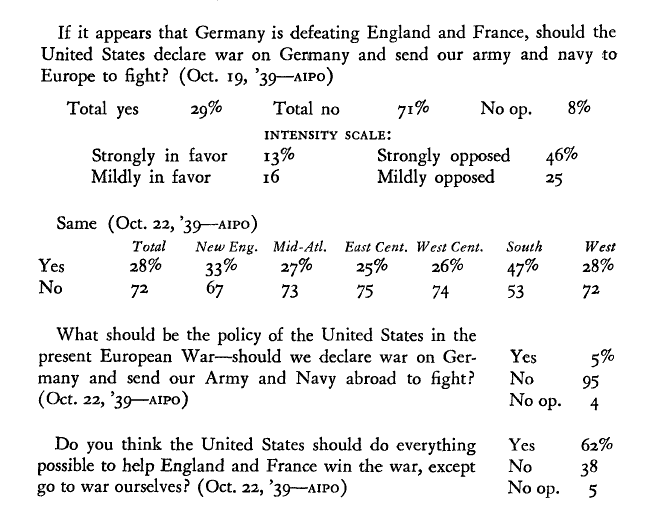
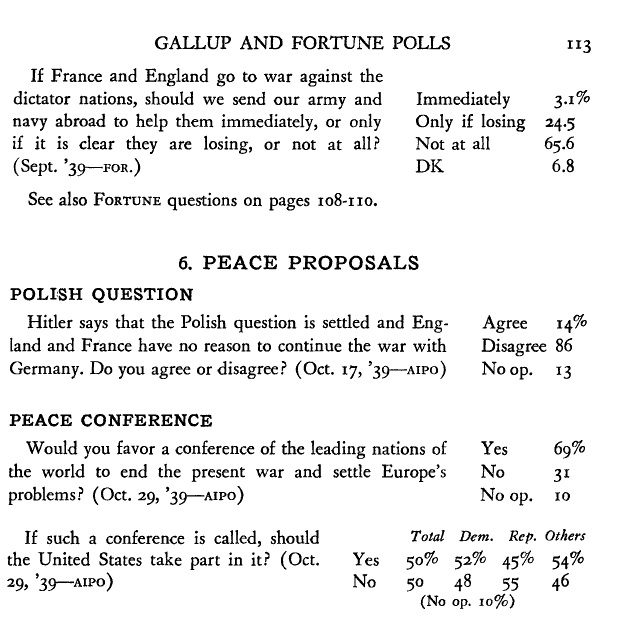
    I found this interesting display of data on opinions of people in the United States regarding the war in Europe in 1939.  The information is fascinating–and combined with further samples from opinion polls included below, contribute to showing the deep opinion that the United States stay out of the war, even to extremes. Everyone probably knows that the U.S. wanted to avoid the war, and to have the European War stay in Europe, and that there were many odd right-wing groups with famous/infamous leaders leading the way to isolation and self-interest, and that the general implications for the U.S.of an overseas war was more economic concern than anything else, but looking at the numbers in representations like those below it is still surprising to see how wide and deep those feelings were.  It can certainly give a greater insight into the problems that Roosevelt faced even with trying to supply war goods to Great Britain.  

    First, the original chart:

    Poll if germany shoul dwin war

    The source for this graphic is the excellent site,Visual Loop (http://visualoop.com/blog/17696/vintage-infodesign-56), who has provided an extended reference for more of  Irving Geis’ (1908-1997) highly stylized and interesting work (via Visual Loop at http://www.fulltable.com/VTS/f/fortune/diag/b.htm). Geis might be recognizable to some as a long-time illustrator for Scientific American among many other journals, and also for the semi-famous How to Lie with Statistics, which was published in 1954.

    A similar source of data is found at the Roper Center UConn, with a ton of interesting bits in it, though it does not describe the source of the data. (This article was published in Public Perspective, Dec/January 1998.) One lead led me to this article (below) on the Gallup Fortune Public Opinion Poll in the Public Opinion Quarterly for December 1940, and it may have provided some of the data for the infographic, but I haven’t yet read in closely.

    Here is an interesting sample from Roper:

    Poll if germany won 1940
     In any event the Public Opinion Quarterly (“Gallup and Fortune Polls” Vol. 4, No. 1, March 1940 pp. 83-115) piece is interesting on its own, and I’ll no doubt return to it, though tonight I’m just interested in a few bits.

    Data should u.s. fight

    [Gallup and Fortune Polls The Public Opinion Quarterly Vol. 4, No. 1 (Mar., 1940), pp. 83-115]

    Data war and peace

    I’ll come back to this in a bit–for now I would just like to post the links.  


  • Comparative Lengths of Rivers, in Black & White (1875)

    JF Ptak Science Books Quick Post

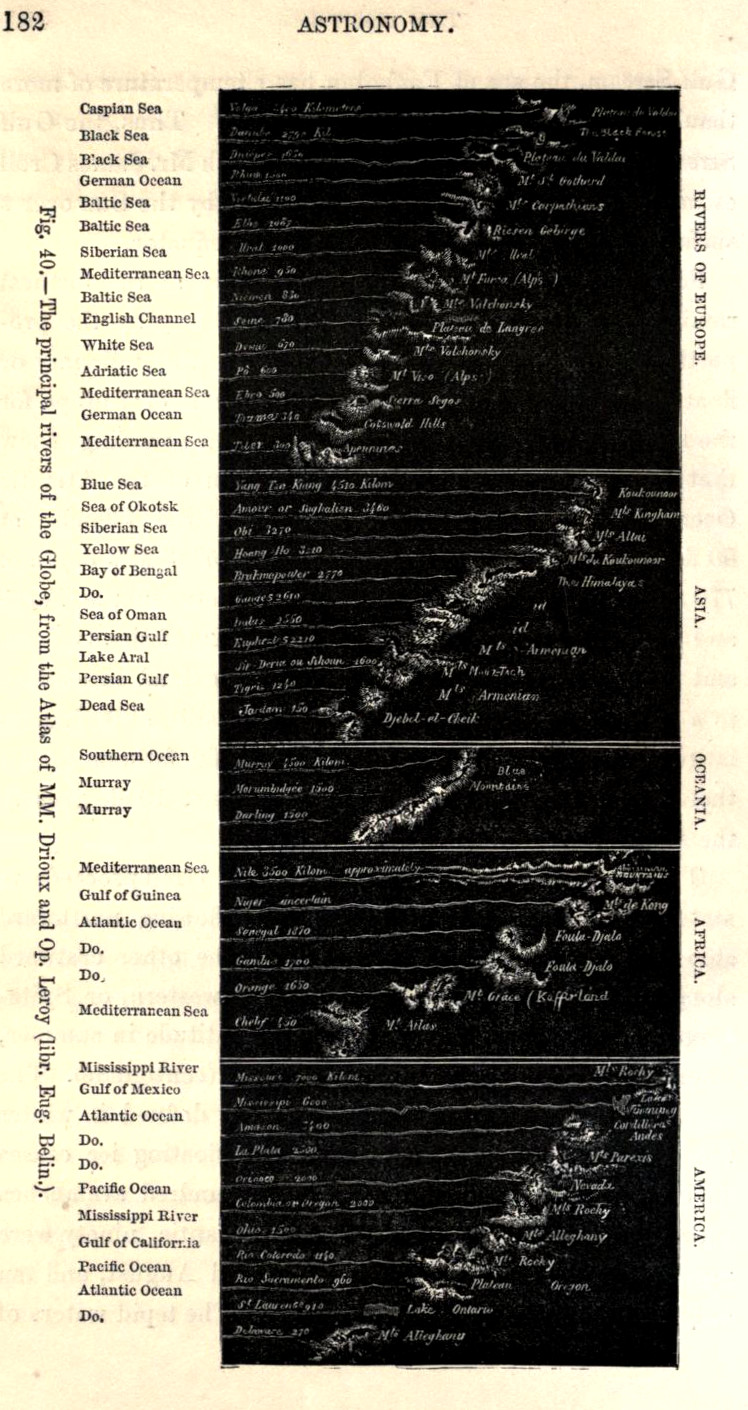
    There have been a number of posts on this blog concerning 19th century comparative tables of river lengths, mountain heights, lake sizes, and so on.  The example below is an odd one, found deep in Jean Pierre Ranbosson’s Astronomy, published in London in 1875,–a funny little chart on the comparative lengths of rivers, very unusual in that it is printed white-on-black. 

    River length


  • Annotated Found-Poetry of Clouds (1726)

     JF Ptak Science Books  Quick Post

    Poetry has a place and a time for itself, though I’ve never really understood it. Most of the poetry that speaks to me is probably required to have qualifier punctuation marks, like “poetry”–it is the poetry in found and established situations, unintentional poetry, free-range poetry that fits a peculiar geometry.  Not that this is poetry to many other people, and I certainly don’t mean disrespect in volunteering volunteer word strings as poetical devices, but sometimes it just works–like explaining a Joseph Cornell assembly, some arrangements just work well together because they do.  

    Here’s an example of what I’m talking about–it appeared on this blog last November but without explanation (for reasons unknown) and may have proved  a little baffling to some readers.  In any event I’ve recovered it with this tiny introduction and present the “findedness” of its poetical assembly below.

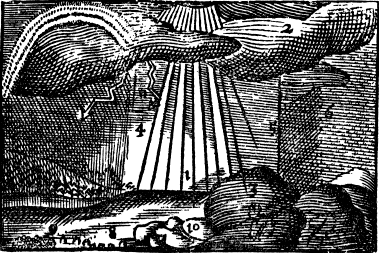
    A Vapour Ascendeth from Water  

    (1726)

    Clouds cromenius

    [Image from John Comenius,  Orbis Senfualium Piélus: Omnium Principalium in Mundo Rerun/ Vita Аllопит,  translated as Pictura et Nomenclatur, the Visible World, or A Nomenclature, and Pictures of all Chief Things that are int he World, translated into English by Charles Hoof…1726.  See an earlier post here for more on Comenius. Image Source:  PROJECT GUTENBERG.]


    Clouds

    A Vapour, (1). ascendeth
    from the Water.

    From it a Cloud, (2).
    is made, and a white Mist, (3).
    near the Earth.

    Rain, (4).
    and a small Shower
    distilleth out of a Cloud,
    drop by drop.

    Which being frozen, is Hail, (5).
    half frozen is Snow, (6).
    being warm is Mel-dew.

    In a rainy Cloud,
    set over against the Sun
    the Rainbow, (7). appeareth.

    A drop falling into the water
    maketh a Bubble, (8).
    many Bubbles make
    froth, (9).

    Frozen Water
    is called Ice, (10).
    Dew congealed,
    (13) is called a white Frost

    Thunder is made of
    a brimstone-like vapour,
    which breaking out of a Cloud,
    with Lightning, (11).
    thundereth and
    striketh with lightning

    This is simply the text from the annotation on this section on clouds from Comenius’ popular work presenting the state of human knowledge–the text has simply been re-spaced.  The reallocation of space in the few lines of text have (to my mind) given it a more artistic and eloquent quality. But maybe I’m looking too hard at it….

    ·Posted by :

    ·in:


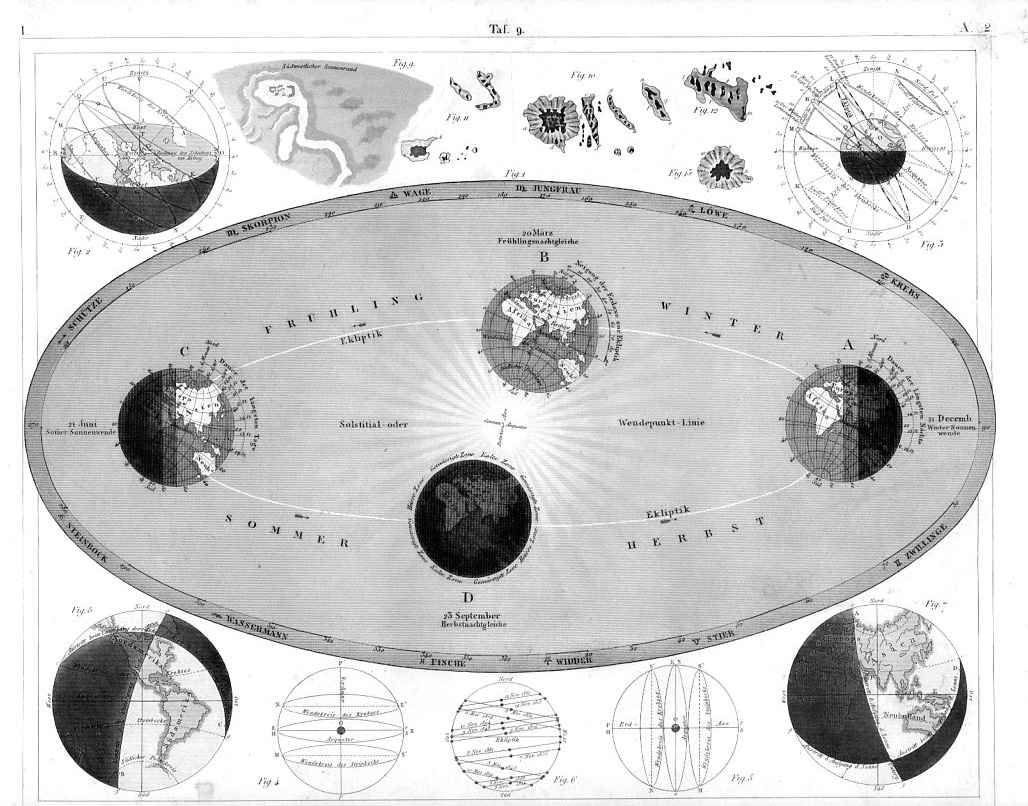
  • The Four Seasons in Beautiful Astronomical Detail, 1851

    JF Ptak Science Books  Post 2449  

    • The original print is available from the blog’s bookstore, here.

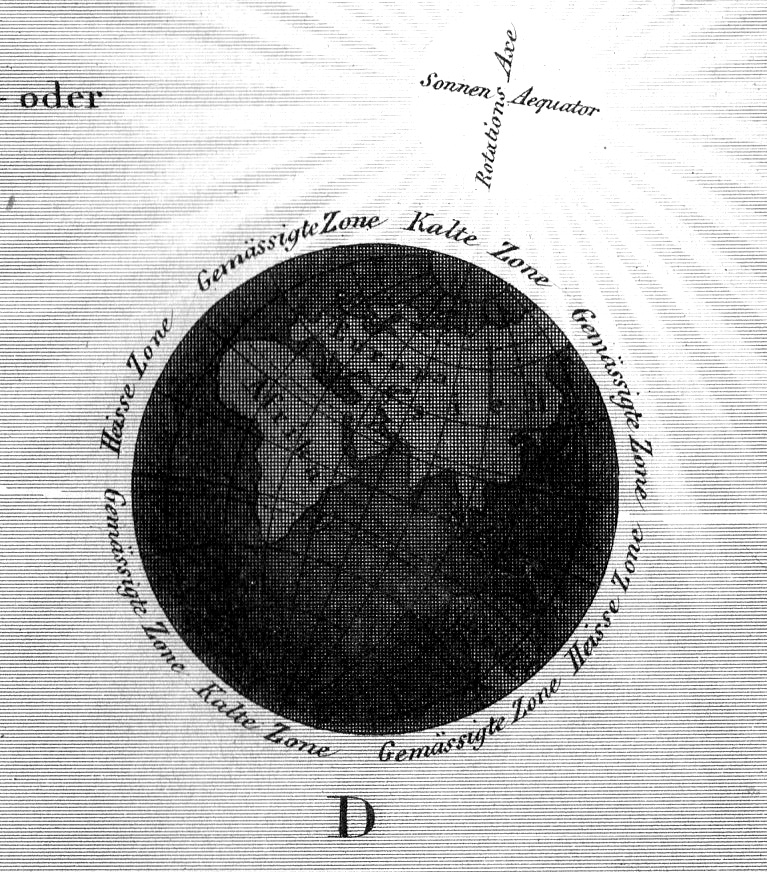
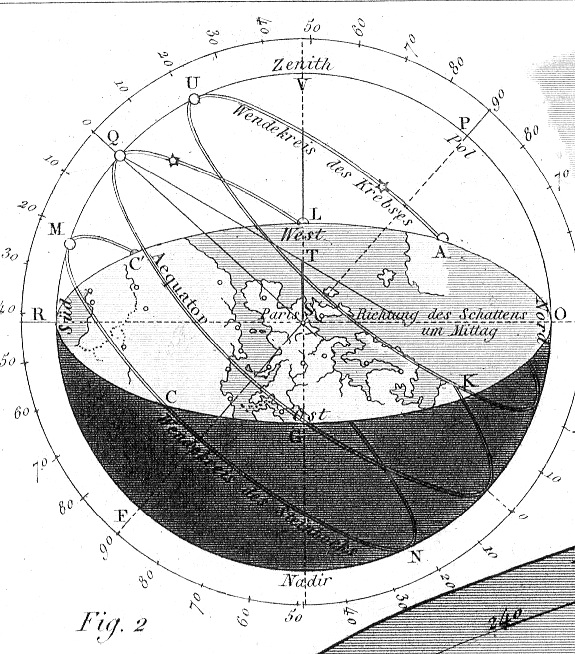
    J.G. Heck wrote and compiled a fascinating and complex work entitled The Iconographic Encyclopedia of Science, Literature and Art, which was published in the United States for the first time in 1851 following Spencer Baird’s translation from its original German. The artwork is detailed, and deep, fantastically controlled, and very instructive

    Eclipses heck941

    The key to his work is the amount of data displayed on each of the 500 engraved plates illustrating this work and the way in which it is arranged.  The design and layout of the 30,000 items on these 500 plates was a work of genius, and for my money it is easily the best-presented complex means of the display of data and objects that was published in the 19th century.  

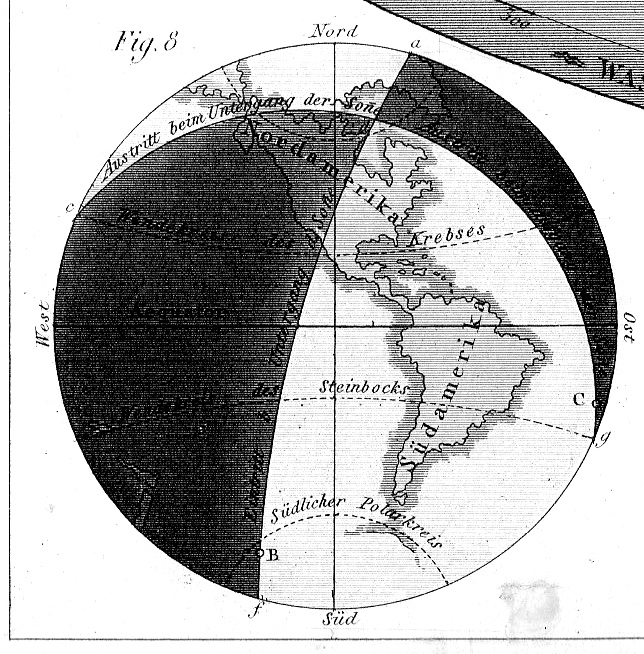
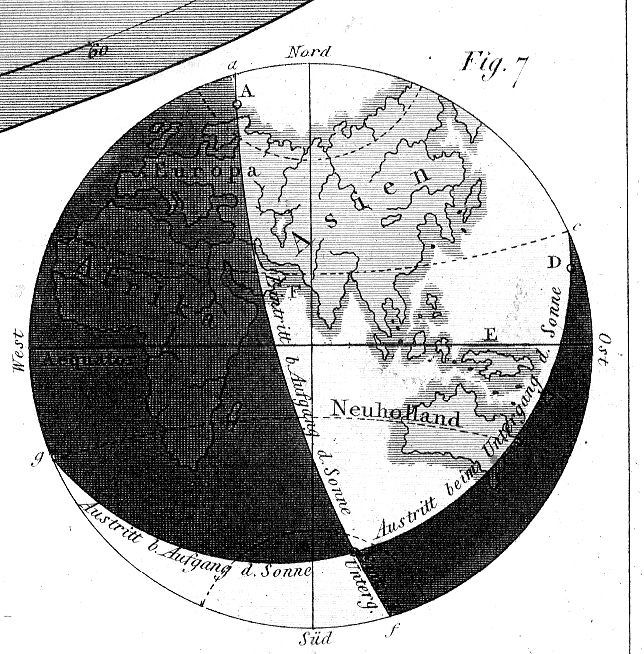
    For example, in the plate above is displayed the progression of the seasons. It is a beautiful work–the original measuring about 12×9″–with great detail in the inset globes, which measure in the original only about 1.5:” in diameter.  It is an excellent work of exactness and shading.  

    The details:


    Eclipses heck942

    Eclipses heck943

    Eclipses heck944

    Eclipses heck945


  • Dr. Lise Meitner, Fission, and Comic Books (1946)

    JF Ptak Science Books   Post 2448

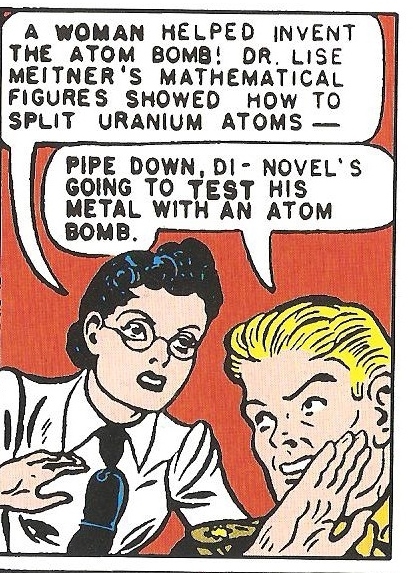
    I don’t often venture into the comic book world unless I’m looking for something, and in a hunt for atomic bomb references in comics <1955 I stumbled upon a reference to Dr. Lise Meitner. (A good short bio and summary of her work can be found here at the American Nuclear Society.) Seeing great physicists in comic books is evidently not common, as  subsequent series of searches seem to indicate.  The Meitner (1878-1968) mention in Wonder Woman, though, was pretty interesting.  Meitner did get a lot of press coverage when she made her tour of the USA in 1946, which I guess led to the panel.  She would have been more famous if she had been properly treated by the Nobel committee when they awarded the Nobel Prize in Chemistry of 1944 to Otto Hahn for work (“for his discovery of the fission of heavy nuclei”)  that she and Hahn had carried out jointly for years.  But it didn’t happen, for various reasons, and she really didn’t get an official prize/award of recognition for her work until 1966 when she was given the Enrico Fermi award.  She did receive an ultimate honor in 1997 when the chemical element with the atomic number of 109 was named (discovered in 1982) was named “Meitnerium” in her honor–the only non-mythological woman’s name to be used in designating a chemical element. And she is featured on a few stamps, but outside the general physics community she sort of languished in obscurity for decades–odd since she was about the most significant woman in the history of 20th century physics.  
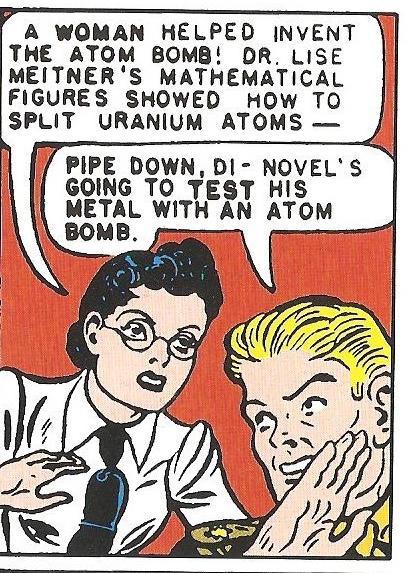
    Scientists in comics meitner

    [Source: found in the blog Shakeville, here.Wonder Woman, 1946.]

    “Disintegration of Uranium by Neutrons: A New Type of Nuclear Reaction”, by Lise Meitner and Otto R. Frisch; Nature, 143, 239-240, (Feb. 11, 1939). Full text here via Atomic Archive.

    See below for the Meitner/Frisch paper from Nature 1939, and also the footnotes for papers cited (a number of which may be purchased via the blog bookstore id you were so inclined to own documents like this).  

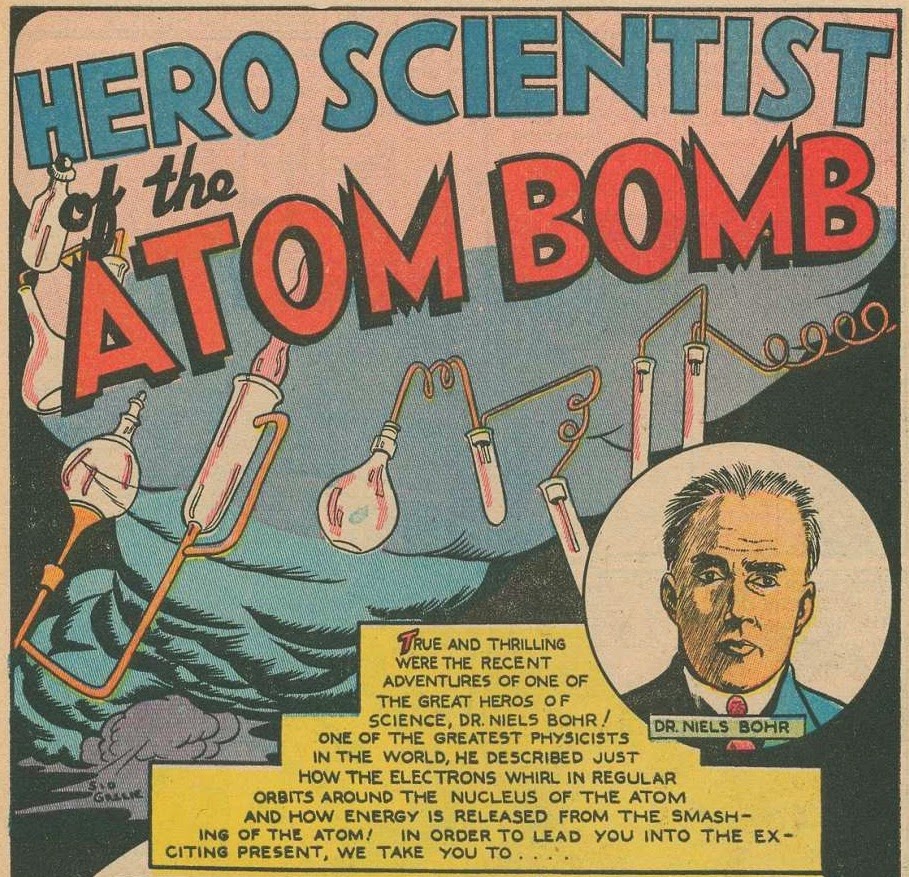
    And here’s a surprise appearance of Niels Bohr!
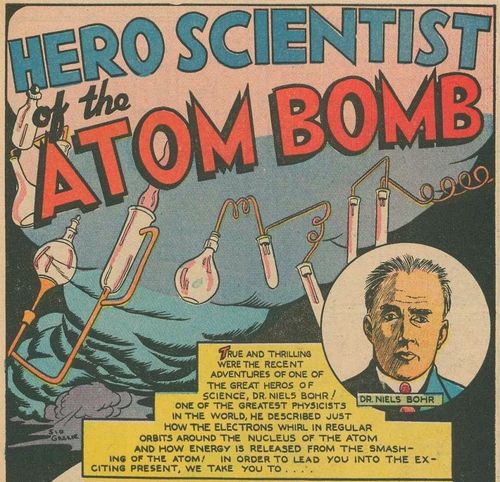
    Scientisits in comics Bohr

    http://physicsbuzz.physicscentral.com/2014/06/7-public-domain-physics-comics-worth.html


    Papers cited in Meitner/Frisch Nature 1939:

    1. Fermi, E., Amaldi, F., d’Agostino, O., Rasetti, F., and Segré, E. Proc. Roy. Soc., A, 146, 483 (1934).
    2. See Meitner, L., Hahn, O., and Strassmann, F., Z. Phys., 106, 249 (1937).
    3. Curie, I., and Savitch, P., C.R., 208, 906, 1643 (1938).
    4. Hahn, O., and Strassmann, F., Naturwiss., 26, 756 (1938).
    5. Hahn, O., and Strassmann, F., Naturwiss., 27, 11 (1939).
    6. Bohr, N., NATURE, 137, 344, 351 (1936).
    7. Bohr, N., and Kalckar, F., Kgl. Danske Vis. Selskab, Math. Phys. Medd. 14, Nr. 10 (1937).
    8. See Meithner, L., Strassmann, F., and Hahn, O., Z. Phys. 109, 538 (1938).
    9. Bethe, A. H., and Placzec, G., Phys. Rev., 51, 405 (1937).

  • Outsider Hoover Logic: Were J.Edgar and Herbert Super Commies?

    JF Ptak Science Books   Quick Post

    Hoover insanity940

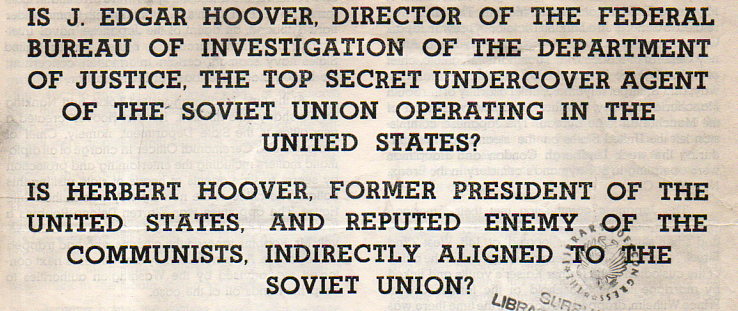
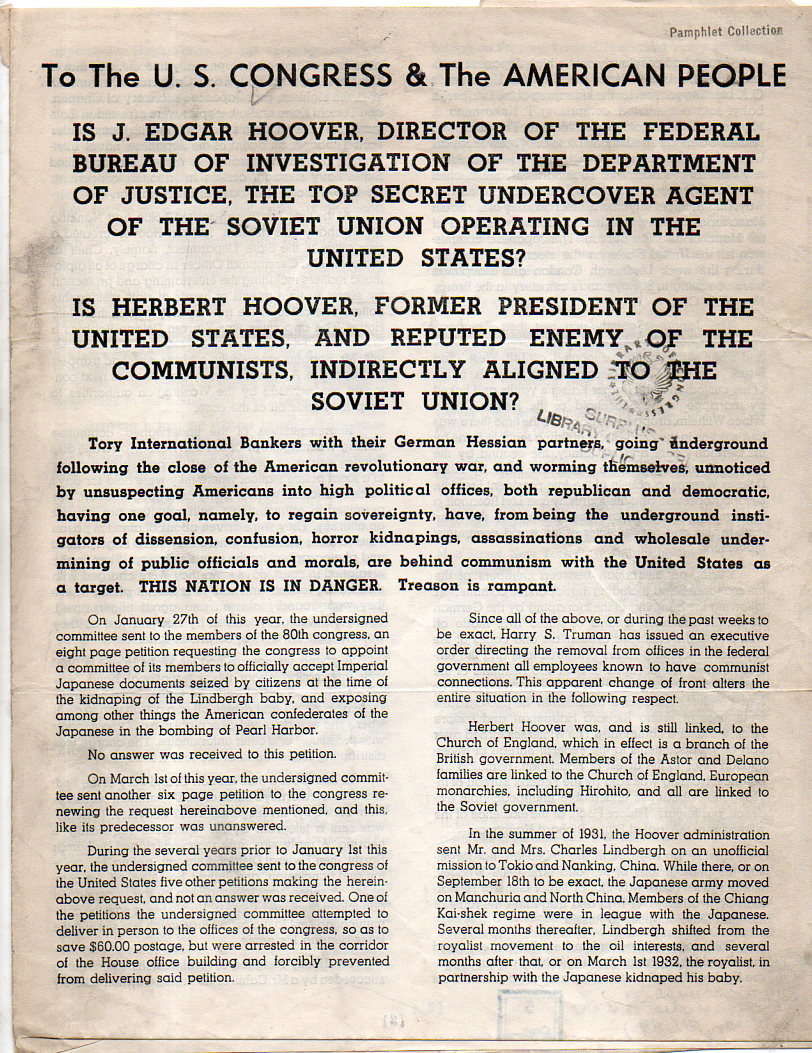
    There are so very many names and addresses and number and connections and plans and schemes and possibilities and roundabouts and subversions and plots and twists and turns in this document, so many possibilities and impossibilities that the sheer weight of them is enough to make this eight-page work weigh about 20 pounds.  It is an incredible piece of outsider-y thinking with so many moving and mis-directed/re-directed parts that it gives one a headache to think about unraveling its massive mess.  But the opening salvo, the questions about the dueling-but-partnered-Hoovers being special Communist agents is quite enough to get the point across about what the document is or isn’t about–in the end the secret and not-so-secret connections makes the thing about everything and so nothing.    

    The end.

    And the full first page (which is also the cover):

    Hoover insanity939


  • “Adopt Modern Methods” (1903)

    JF Ptak Science Books  Quick Post

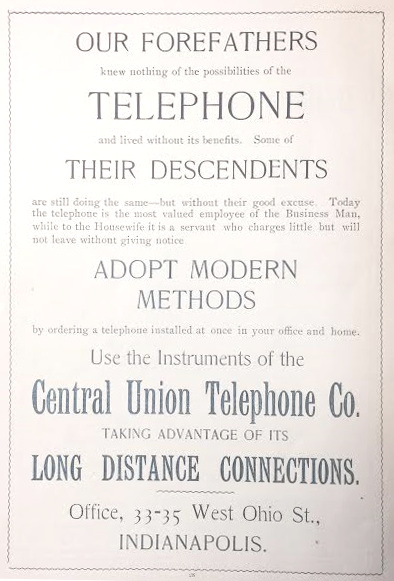
    “Adopt Modern Methods” is pretty much always something to consider, and it is said very forcefully in this ad that appears in History of Our Flags, published in Indianapolis in 1903:  

    Telephone for the future

    ·Posted by :

    ·in:


  • Vicious Anti-Roosevelt Pamphlet, 1940 (“The New Deal Has Worn Out”)

    JF Ptak Science Books   Quick Post

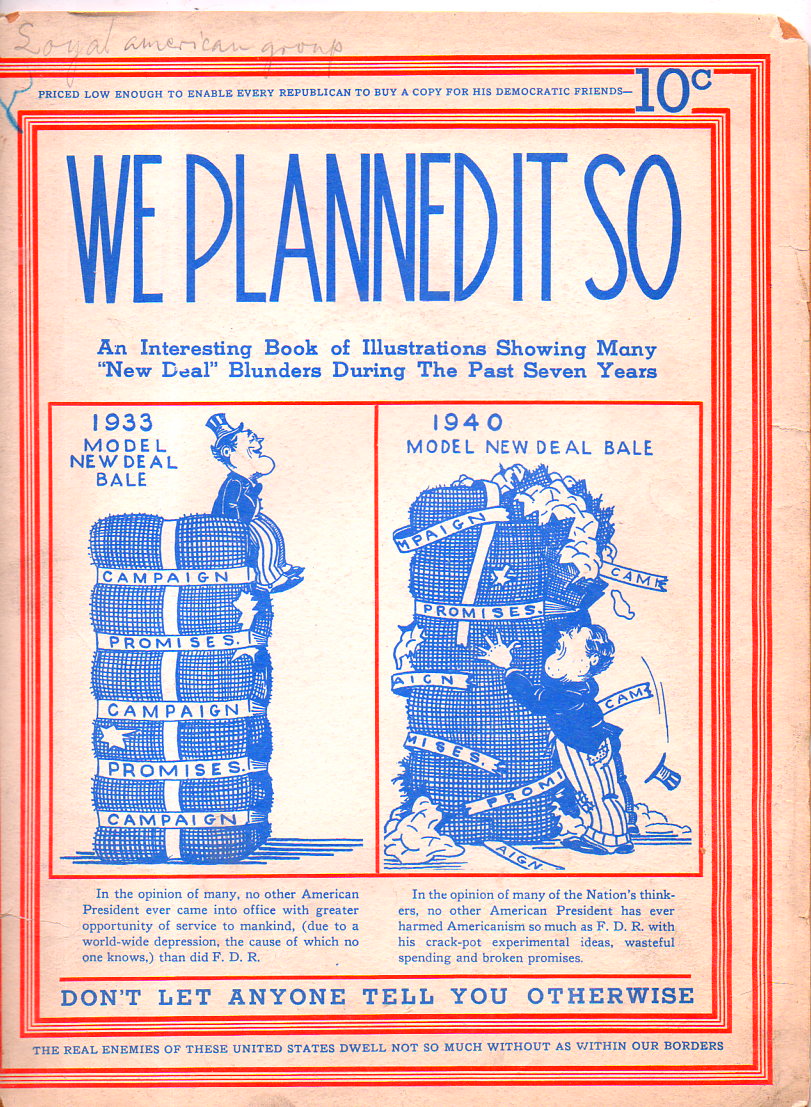
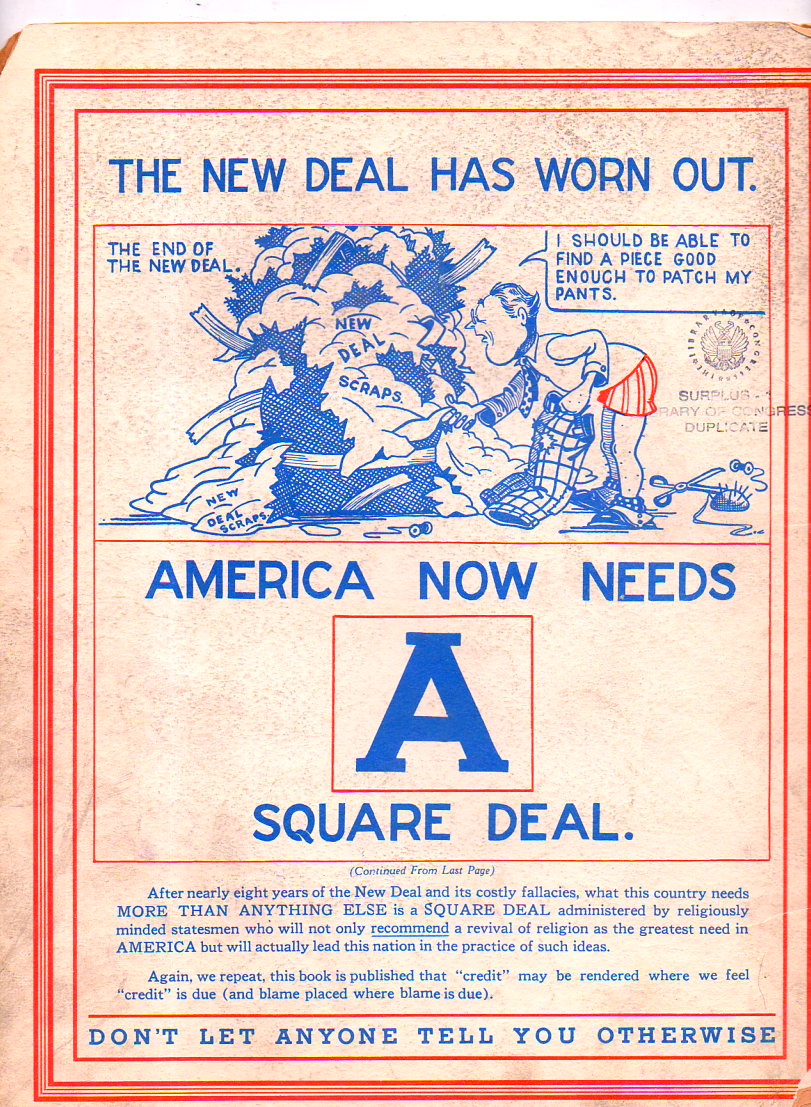
    This 42-page oversized pamphlet renders its vicious criticism mostly by cartoon, a cartoon on every page, and mostly a lie (or a group of them) to go along with it.  The work is ostensibly that of a republican (the pamphlet “priced low enough to enable every Republican to buy a copy for his Democratic friends” but it is really far beyond that.  It is tremendously anti-Communist, and anti-Socialist, and so much so that it swings far to the right of right-winger Conservatives who are beyond the reach of right-wing Republicans, all the way over to fascism.

    • The original pamphlet is available for purchase via the blog’s bookstore, here. 

    FDR propaganda936
     The work was publish by the Loyal American group, an organization under the direction of W.Henry MacFarland jr, whose organization “promptly identified as a fascist organization by the U.S. Attorney General”, and hung around long enough to be added to a list of fascist/hate groups in the Preliminary Report on Neo-fascist and Hate Groups by the Committee on Un-American Activities (December 17, 1954).  I’d reproduce more of the artwork, but the pamphlet is brittle and won’t go onto the scanner without breaking. The remarkable front and back pages should serve the purpose of the publication….

    FDR propaganda937

    ·Posted by :

    ·in:


  • Images of Manhattan Destroyed–Additions, 1951 and 1953

    JF Ptak Science Books   Quick Post 
    Follow Me on Pinterest
     

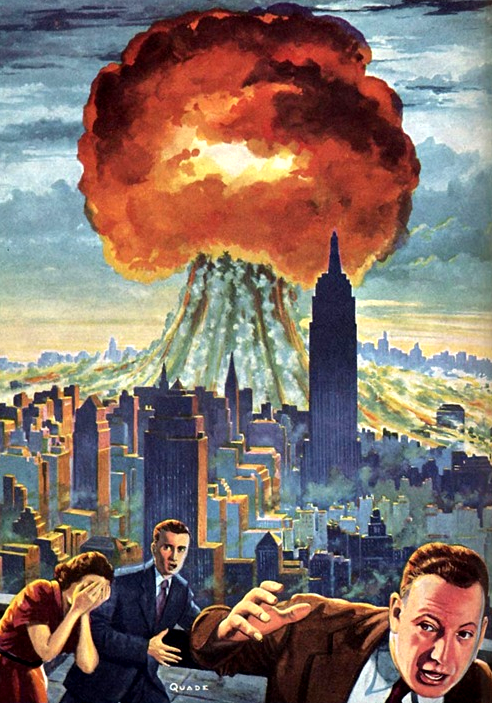
    There’s a sotto voce sub-series on the destruction of Manhattan in this blog’s longer series on atomic/nuclear weapons. (There are a number of them–if you’re interested search those terms in the Google search box at left.)  I’ve found three more from 1951/2 that I’ve included below.  At some point I’ll gather all of the Destroyed Cities and makes a larger post of them. 

    Manhattan destroyed R McQuade

    [Source: ‘We have now entered the Atomic Age’, artwork by Lester Quade, in 1952.]

    ·Posted by :

    ·in: