A Daily History of Holes, Dots, Lines, Science, History, Math, Physics, Art, the Unintentional Absurd, Architecture, Maps, Data Visualization, Blank and Missing Things, and so on. |1.6 million words, 7500 images, 4.9 million hits| Press & appearances in The Times, Le Figaro, Mensa, The Economist, The Guardian, Discovery News, Slate, Le Monde, Sci American Blogs, Le Pont, and many other places… 5000+ total posts since 2008.

Category: Title Page Art, Beautiful

  • Women Meat Pioneers, 1943

    JF Ptak Science Books LLC  Post 570

    (Science Book Blog)

    4-1 prop meat
    This simply irresistible, charmingly uncomfortable, and semi-surreal title is an excellent example of what I’ve come to know (and forget) in my  career of doing whatever it is I’m doing.  Generally though the thousand or so titles in my Naive Surreal collection belong to pamphlets and the occasional book, but the occasional advertisement makes its way into the fray.  (None really come quite close to the work of the immortal Otto Fleiss, who produced America’s greatest work on making art with fat,  White Art in the Meat Food Business.  A Practical Handbook for
    Butcher, Pork Stores, Restaurants, Hotels and Delicatessens on How to
    Make Lasting and Transferable White Art Decorations out of Bacon Fat
    Back for Window Displays, Ornaments on Meat Food Cold Buffets and for
    Exhibits and Advertising Purposes.  Enrich yourself with Personal
    Knowledge.
    It is a toweringly fantabulous work, and is one of this blog’s most-viewed posts.)

    This ad is innocent enough:  appearing in the 1 November 1943 issue of LIFE magazine, it was simply encouraging the modern housewife to go adventuring into cuts of meat that had been deemed unacceptable before rationing and the war, which brought about a meat drought.  (The Brits had a far worse time–this issue of LIFE also contained a photo of a leggy London showgirl posing with a “real lemon” which was being raffled off to raise hundreds of pounds for the general welfare.) 
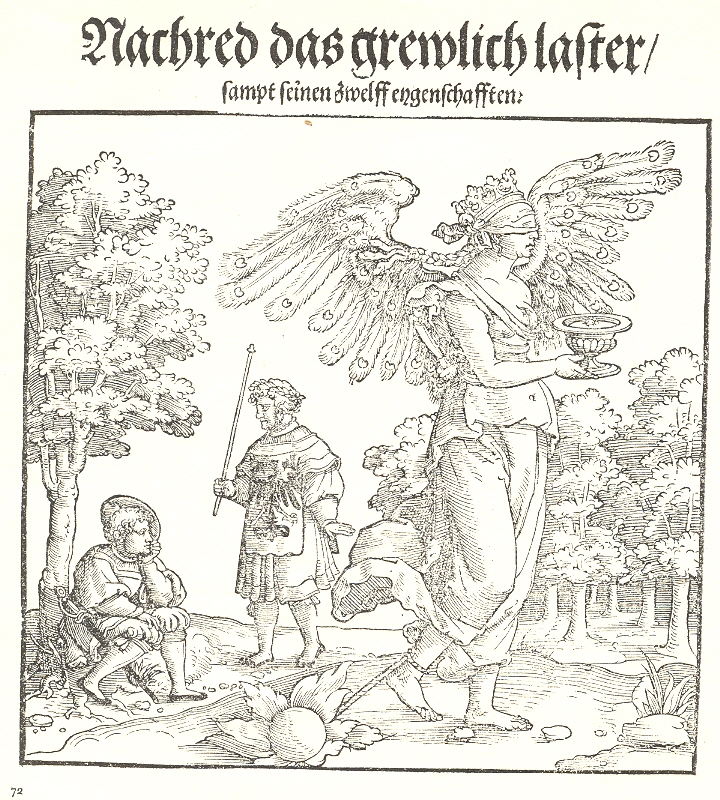
    4-1 renaissance pandora
    I’m sorry to say that this image reminded me of an older, finer, more whimsical but far more damning and stern woodcut.  The two aren’t terribly-well related, I know, but as I shocked myself in being able to locate it I’m bound to use it now before it slips back into my misty print purgatory. 

    This image is probably the work of Georg Pencz and appeared in Hans Sachs’ Nachred das grewlihc laster...published in Nuremberg in 1535 The booklet was a work directed against the evils of libel and lying and spreading rumor.  Pencz’ woodcut personified all of this wrapped up in the form of a vice-charmed woman.

    The libel-charged rumor-mongre woman (watched from under a tree by a poet who is protected from her by a fellow with an imperial seal and stanchion) is outfitted with very feathery wings and a crowned seat on a collection of snakes.  She carries a lidded pot, an offering of some sort, while she hides a knife behind her back with her other hand.  She advances with a breast barred and another breast vut and bleeding, while she tugs along in her wake a ball and chain, which sets her traveled path on fire.  All-in-all, Pencz paints a dismal picture of womanhood. 

    As I said, it has little to do with the original image of a Pioneer Meat Woman, but they sort of looked similar in my memory. 

  • Blank and Missing Things 33: (Disembodied) Hands of Creativity

    JF Ptak Science Books LLC  Post 532

    0 abay feb 23scheiner623

    [Last year’s post for this day: The Wrong Stuff, Righted–the Attack on Darwin’s Descent, 1871]

    I wish that I had kept track of all of the images of “holy/phenomenal” disembodied body parts sprouting from nothingness or from pure creator-of-the-universe light that I have seen populating antique prints over the years.  Much more popular in displaying the indisputable are the images of the Primum Mobile,  the Hebrew word for Y_w_h, the smiling countenance of the creator itself, or doves arising from a shining star or sun–far less seen are the images featuring seemingly floating disembodied body parts.  Had I kept track of all of these magnificent things in the sky or air I’d really be able to compare them; but I haven’t, so I just need to rely on a generalized memory of what seems to me to be uncommonly seen images, and then wax away like a groaning and saggy Moon. 

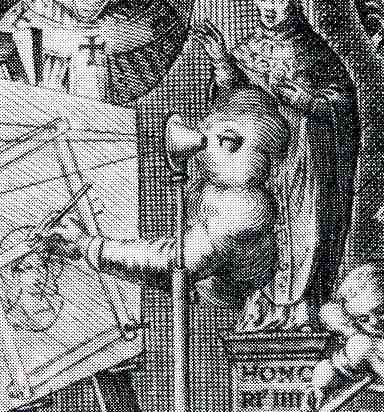
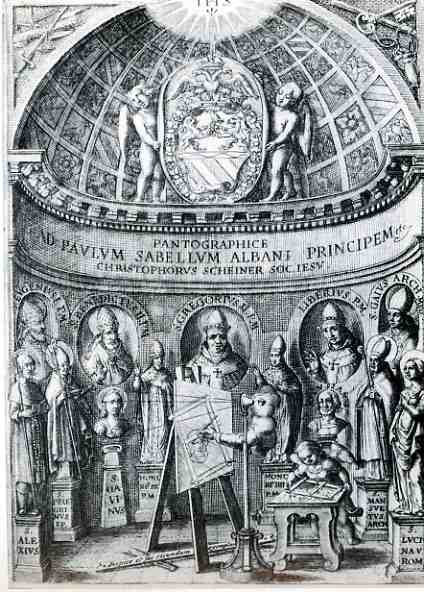
    The image to the left is the decorated title page of the great Christoph Scheiner’s (1573-1650) Pantographice sev ars Delineandi  res Quasilbet per Parallelogrammum Lineare..., published in Rome in 1630.  The book was about one of the most-employed inventions

    0 abay feb 23scheiner624

    of the 17th century,  Scheiner’s very own pantograph, which was/is a very versatile tool used to project an object from one scale to a greater one, and used by grateful sculptors and architects and mapmakers and astronomers and engineers for hundreds of years. What we see in detail in the engraving (right) is the disembodied squinty-eyed-cloud-arm of creativity, using the pantograph, and copying a painting (in a chapel?)  But is this the soul of creativity, really, since the arm-eye is using a device to copy something?  I’m not saying that there is no art involved in this practice, because if that was the case then I could use this device with positive results–but I can’t, and so there must be artistic merit involved.  Perhaps this curious image celebrates the art in the copied elements and not the use of the pantograph.  

    0 blog march 3 kircher635

    Another interesting example of disembodied genius occurs in the
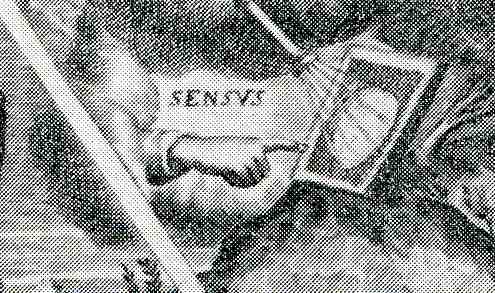
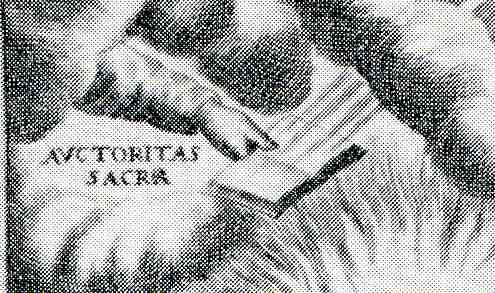
    title page (at left) of the transubstantiated and sometimes-impossible Athanasius Kircher’s encyclopedic Ars magna lucis et unbrae in decem libros digesta, published in Rome in 1646.  Of his very many works, this is perhaps one of the most important, and includes the first descriptions of (his discovery/invention?) of the magic lantern, of luminesence, and of the camera obscura.  (Among much else are Kircher’s drawings of his microscopic investigations, which were very major contributions, and which predate the works  of Hooke and Leeuwenhoeck.)  This complex and iconographically-layered title page engraving contains (almost offhandedly) three disembodied hands, the first of which displays camera obscura image.  Given everything else that is going on in the image, the holy hands are the those demanding the least amount of interpretative skill. 

    0 blog march 3 kircher detail636


    0 blog march 3 kircher detail637


  • A History of Smallness, Part 3: Dew and Space (Charles William Wells, 1814)

    JF Ptak Science Books LLC  Post 515

    0 blog feb 13 dew581

    Little things comfort us because little things distress us. Blaise Pascal

    Science is simply common sense at its best. ~Thomas Huxley

    Physics is imagination in a straight jacket. ~John Moffat

    Science does not know its debt to imagination. ~Ralph Waldo Emerson

    Moderation, which consists in an indifference about little things, and in a prudent and well-proportioned zeal about things of importance, can proceed from nothing but true knowledge, which has its foundation in self-acquaintance. Plato

    William Charles Wells (1757-1817), a Charleston-born Londoner who was the physician to St. Thomas’s Hospital from 1800-1817, did one of those great, little experiments (sort of but not really like Charles Darwin crawling around on his imaginarily-sick tummy at Downs watching worms) from which big things were born. The experimentation, lovely and penetrating and elegant, took place over several years from 1812 to 1814, were published in this semi-slender, 146 page tract, which the great Thomas Huxley called “a model of wise inquiry and lucid exposition”. (Actually, 146pp on dew might seem like a lot until you consider what dew is all about.) What Wells so ably exposed about dew was its great terrestrial demeanor–that the movement of dew, its accumulation and dissipation, was due to nothing less than radiation from space, regulated (or interrupted) by the action of the Sun and clouds, ‘introducing a clear view of what is now called the radiation balance of the atmosphere”. (W. Middleton, A History of the Theories of Rain, pp 188-191).  So this is a bit of smallness, something small and seemingly insignificant, leading from its own bit of nothingness into a theory of radiation from space and a theory of the atmosphere, a result almost completely unanticipated.  It is too in its own way somewhat like Robert Hooke re-introducing the often seen and little liked flea–showing people what the flea actually was, under magnification for the first time, showing what sort of world was going on in front of us that was simply just too small to see. 


  • Van Helmont’s Lovely Title Page and his Sorry Slip into Curative Magnetism

    JF Ptak Science Books LLC  Post 514

    0 ebay feb 10 helmont553

    Joan Baptiste van Helmont’s
    A ternary of paradoxes : the magnetick cure of wounds, nativity of tartar in wine, image of God in man.
    (printed in London  by James Flesher for William Lee, 1650), offers its own unintended paradoxes (and joined the field of relatively few books with the word “paradox” in their title).  Purportedly a work of science, van Helmont offers the reader his views on the curative powers of the loadstone.  Of particular interest is Helmont’s (1579-1644) discussion of the weapon salve, a cure for injuries caused by knives and swords. The unique feature of this ointment was that it was not applied to the wound but to the weapon which caused the wound, though in the midst of other very problematic scientific observations, this wasn’t so bad.  For example, Helmont presented a recipe for making scorpions, which involved bricks, sunlight and basil, from which a scorpion would come. 

    And what exactly is Helmont’s place in the history of science?  Difficult to say:  he did make several important physical discoveries, and did present what some have called the modern approach to experimentation (firm insistence on relateable objects in empirical observation and so on); however, he was a reaching alchemist misty mystic who rejected syllogistic thought, mathematics*, human reasoning.  These are hard bits to let go.

    All this said, what with scorpions and magnetic treatment of wounds, he comes close to the generation of infection in wounds:  “Upon the solution of Unity in any part the ambient air…repleted with various

    0 ebay feb 10 helmont555

    evaporations or aporrhoeas of mixt bodies, especially such as are then
    suffering the act of putrefaction, violently invadeth the part and
    thereupon impresseth an exotic miasm or noxious diathesis, which
    disposeth the blood successively arriving at the wound, to
    putrefaction, by the intervention of fermentation. ” With his magnetic
    sympathy, Van Helmont expressed clearly the doctrine of immunity and
    the cure of disease by immune sera: “For he who has once recovered from
    that disease hath not only obtained a pure balsaamical blood, whereby
    for the future he is rendered free from any recidivation of the same
    evil, but also infallibly cures the same affection in his
    neighbour…and by the mysterious power of Magnetism transplants that
    balsaam and conserving quality into the blood of…’
    Problematic greatness just needs to be understood in greater detail
    than simply disregarding everything because someone disdains logic…

    Note:

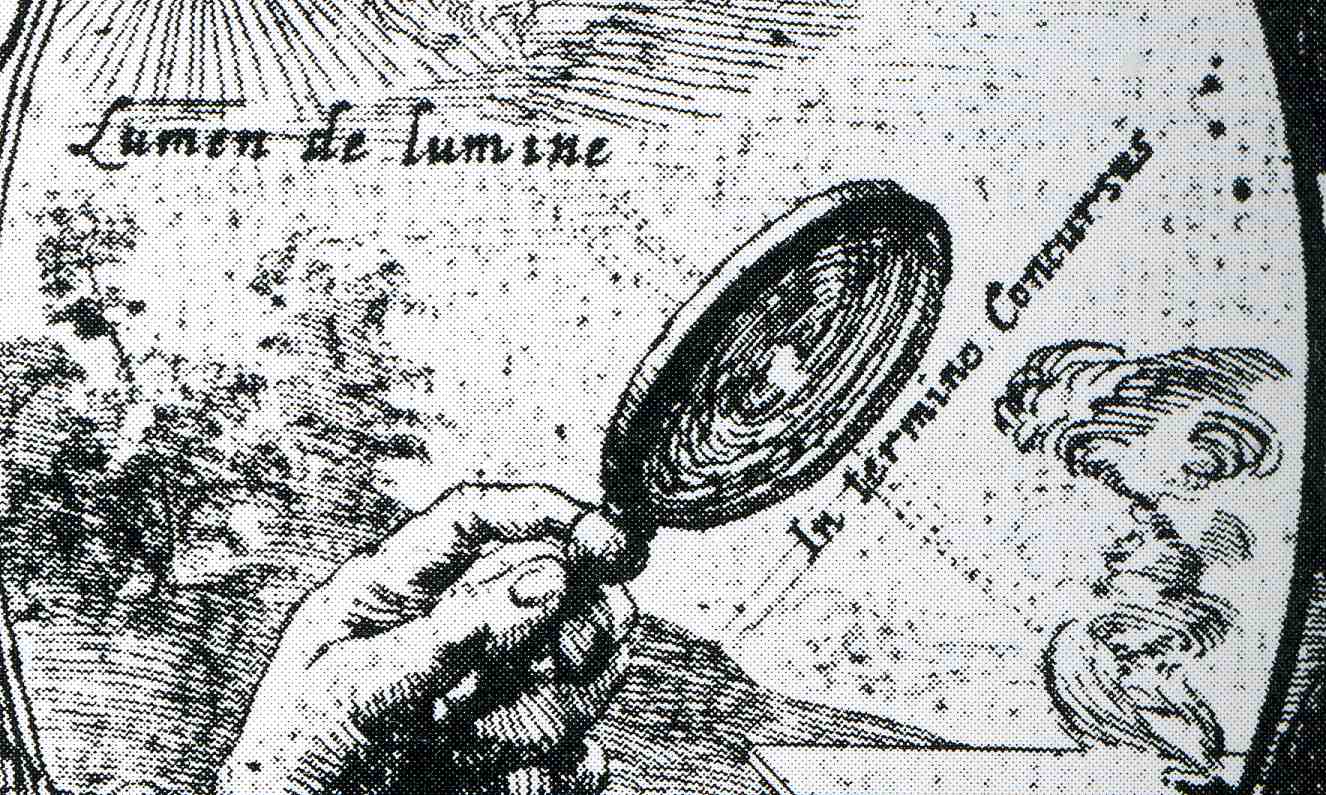
    The interesting image in the middle of the title page is more religious symbolism than what seems to be a straightforward physics reference, and the bulk of it lies in the “lumen de lumine” inference, which in the Nicene-Constantinopolitan Creed confesses faith in Jesus Christ as Lumen de Lumine (Light from Light).  Once you replace the optics with the divine, the rest of the image and its relationship to the contetns of the obok becomes more clear.

    *

    Helmont thought about the restrictiveness of mathematics, and that the quantitative aspects of things that math addressed missed their interior qualities, thus making mathematics not able to see what things are.  Oopsie.


  • Odd Things in the Sky Department: Der Herr Gott in a Cape, and Bombs Away

    JF Ptak Science Books LLC Post 510

    Blog--brunswig
    What upsets people is not things themselves, but their theories about things.
      —Epictetus, quoted in the epigraph to Laurence Sterne, The Life and Opinions of Tristram Shandy, Gentleman (1759)

    Continuing a minor thread on “Odd Things in the Sky”, which also joins up nicely with another odd thread, “Things Out of Place”,  come these two interesting, just-remembered images, showing a stiff-armed god and a big old bomb coming out of the sky.  The first, left, is the title page of the Strassburg-born army surgeon  Hieronymus Brunschwig’s Apoteck fuer den Gmeine man der die Ertzet.  Published posthumously in 1530, the good dead doctor offers wide and varied instructions and ruminations on medicine (per se) and health care to the average person–meaning, basically, the person with enough money to buy a book but who could not afford a doctor (probably a slim margin).  the book was filled with reasoned and reasonable approaches to taking care of health and illness, with cures and recipes for everything from itchyness to syphilis.  Presumably the Der Herr Gott of Einstein is doing a little more than throwing dice, taking a very prescribed interest in the hoeing man and gathering woman.  It is interesting to see that the man emerging from the cloud, somehow needs a cape. Blog--blondel_title

    Coming from the sky next is a bomb, the creation of  Francois Blondel, (1618-1686) in his L’art de jetter les bombes…, published 1699.  Blondel was as good in building as he was in un-building, being in charge of the public works of Paris (and appointed so by Louis XIV, being perhaps one of the
    most important architectural/engineering positions that could be
    imagined by the French mind), as well as being an expert in the
    construction of forts and fortifications.  His work on bombs and
    artillery was ready to be published 15 years or so before 1699, but the
    King saw that even though there was a lot of interest and use to his
    military in seeing the treatise published, the same was also true of
    his enemies.

    But of interest to me here is the title page and the bomb not only falling from the sky, but  falling from the bannered heavens.  There’s nothing soft or spooky about the book itself, which is all business, of course, as important to the military man of 1700 as, say, Robert Coles’ book on underwater explosions was in 1965 or Urbanski’s Chemistry of Explosives a decade earlier.  And even though Blondel certainly built on Galileo’s work on the parabolic flight of such weapons, the bomb on the front cover is falling straight down. 


  • Very Literal (and Persuasive) Images–Christ in a Winepress

    JF Ptak Science Books LLC  Post 490

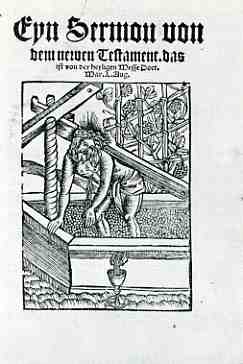
    0 blog jan 24 christ wine420Seldom are images less equivocal than this fantastic woodcut dominating the title page of Martin Luther’s Eyn Sermou von dem newen Testament das ist von der heyligen Messe…, a tallish, 14-page pamphlet printed in Leipzig in 1520.  We see the Christ of Luther (1483-1546) being pressed, crushed under the weight of the crucifix which is also a part of the wine press in which Christ stands–the screw to the press passes through the cross which applies the weight, spilling Christ’s blood which collects in a sacramental chalice.  For Luther, the covenant of Christ’s blood is everlasting, connecting his redemption to man without the need of priests.  And by 1520, Luther certainly had no need of priests.  He was filled with a reforming rage against the papal machine, becoming especially annoyed (in 1517) with the putrifing effects of the funding of the building of St. Peter’s Basilica, which bowed under the flatulent weight of Pope Leo X, who was very busy selling indulgences* from sin to those who could afford to.  So between 1517 and the publication of this pamphlet in 1520, there was the Papal indulgence issue, whose appalling nature led to Luther’s 95 theses on the door at Wittemberg; then came the Diet of Augsberg in October 1518, and then the excommunication of Luther in 1520.  A very busy three years.  

    * (from the Wiki biography on Luther)  “A Dominican monk named John Tetzel was assigned to the sale of
    indulgences in Saxony. A talented and unscrupulous salesman, Tetzel was
    willing to make any claim that improved sales. He thus promised not
    only a reduction in punishment for sin, but complete forgiveness of all
    sin and a return to the state of perfection enjoyed just after baptism.

    “He added that if one would generously purchase indulgences to speed
    the release of a deceased loved one from Purgatory, no actual
    repentance on the part of the giver was even necessary. Marketing
    genius that he was, Tetzel employed a memorable jingle to make his
    offer clear and simple:  “As soon as the coin in the coffer rings, a soul from Purgatory springs.”


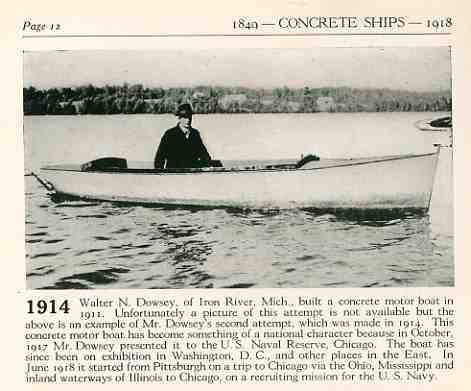
  • Celebrating a Good Idea that Sounds Silly: Concrete Ships

    0 blog jan 06 concrete ship361
    JF Ptak Science Books LLC  Post 459

    0 blog jan 06 concrete ship362

    This 1919 pamphlet’s title certainly sound more odd than the concept it describes:  concrete boats have been around for a long time, (160 years at least), and they make a lot more sense than a quick-think would give them (lumbering, unstoppable, heavy prep trucks come to mind).  For boats over 25 feet long, it is probably the easiest and cheapest material to employ, and it doesn’t need weatherproofing.  And, as an interesting website dedicated to concrete boats (ferro-boats) observes, a 30-foot 8-ton displacement ship made of either wood or concrete will weigh the same, which means that the very first image that comes into our heads when you say “concrete ship” is just wrong. 

    It looks like the French were the first to come up with the idea in about 1848, patenting the most winning methods of construction in 1855.  Since then there have been 12,000 or so of these 25-ft+ ships built, including a 130′ yacht and a 120′ British sub.  This method of construction certainly saw its time, especially during wartime, when steel production was in high demand.

    Please note:  posts over the next seven days or so will be somewhat truncated; I’m moving my store so time is a little scarce. Thanks for bearing with me.


  • An Early and Vicious anti-Austrian-Nazi Graphic Political Pamphlet, 1934

    0 ebay 15 nazi275

    JF Ptak Science Books LLC  Post 432

    This  rare pamphlet–located in only two collections worldwide–was published in Vienna in 1934 and takes accurate and vicious aim at Austrian Nazis.  The Austrian Nazis were busy fighting amongst themselves, the factions breaking down into pro-Italian fascists and pro-German Nazis.  Or at least that is what this seems to me to be for a one-line summary of a complex four-year struggle, The Nazi party existed in Austria well before the Anschluss of 1938 (when the Nazis swept into the country and took geo-political-military control), and attempted to seize power in the country from the very their  outset.  The pamphlet  also seems to have been printed after the 1934 attempted coup (July Putsch) and successful assassination (by a group of eight German Nazi agents) of the Austrian leader turned dictator Engelbert Dollfuss, who was replaced by another fascist dictator, Kurt Schuschnigg.  (The OCLC lists 1934 as the year of publication; there does seem to be a caricature of Schushnigg being pummeled by an Austrian Nazi on page three, making this pamphlet a product of the second half of 1934.)  Schuschnigg was another  dictator replacing a dictator and the leader of the Austrofascist party, who in turn was thrown away in the Anschluss and sent to Dachau and Sachsenhausen.  He survived and wound up teaching polysci at Saint Louis U from 1948 to 1967.

    The pamphlet was a real display of courage at a very difficult time.  I hope that this frivolous treatment of a complex story wasn’t too far off the mark. 

    0 ebay 15 nazi276


  • The $6,000 Ham Sandwich and the Ills of Labor Unions–the Republican Failure of 1936

    JF Ptak Science Books LLC  Post 393

    0--blog---Nov 26 little weird136 

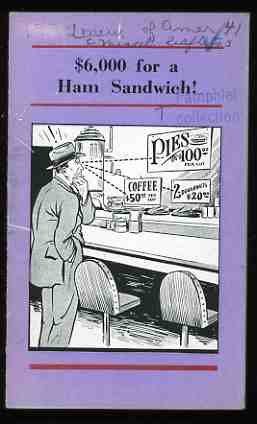
    These little (3 by 1.5 inches) pamphlets, all published in 1936 by a group called “Men of America, Inc” of Chicago,
    took a weird and dislocated aim at government (read “F.D.R.”) policies,
    supporting an anyone-but-him position for the election of 1936.  Or so
    it seems.  Its actually a little hard to discern the political needs
    and  desires of the group beyond defacing the New Deal programs and the
    vast increases in federal spending on public programs; there’s nothing
    positive that they can seem to say about advancing another platform. The little pamphlets attack the newly created broad social net of social security, and questions the efficacy of labor unions.  Allot of this sounds surprisingly like the campaign rhetoric of Alf Landon, (1897-1987) the Kansas governor (1932 and 1934), oilman, millionaire and Republican who ran against Roosevelt in the spectacularly lopsided election of 1936.  After that November Landon even lost his own shadow; Roosevelt completely and utterly defeated the republicans by an electoral landslide of 523 to 8, Landon sweeping like a cold chill wind in his victories in Maine and Vermont.  Actually to be fair Landon scored 38% or so of the popular vote, but the country wound up being almost entirely blue in the electoral map.

    I’ve included these pamphlets because of their quaint/stubby/rounded political imagery, a style once extremely popular with newspaper cartoon journalists (and baseball writers) in the 1920’s and 1930’s, and then almost completely gone (except for Gasoline Alley) by the start of the American World War II. 

    0--blog---Nov 26 little weird135


  • The Poetics of STDs and the Mountain of Truth; a Rollicking Good Time in 1545

    JF Ptak Science Books  Post 348

    Mountain of truth

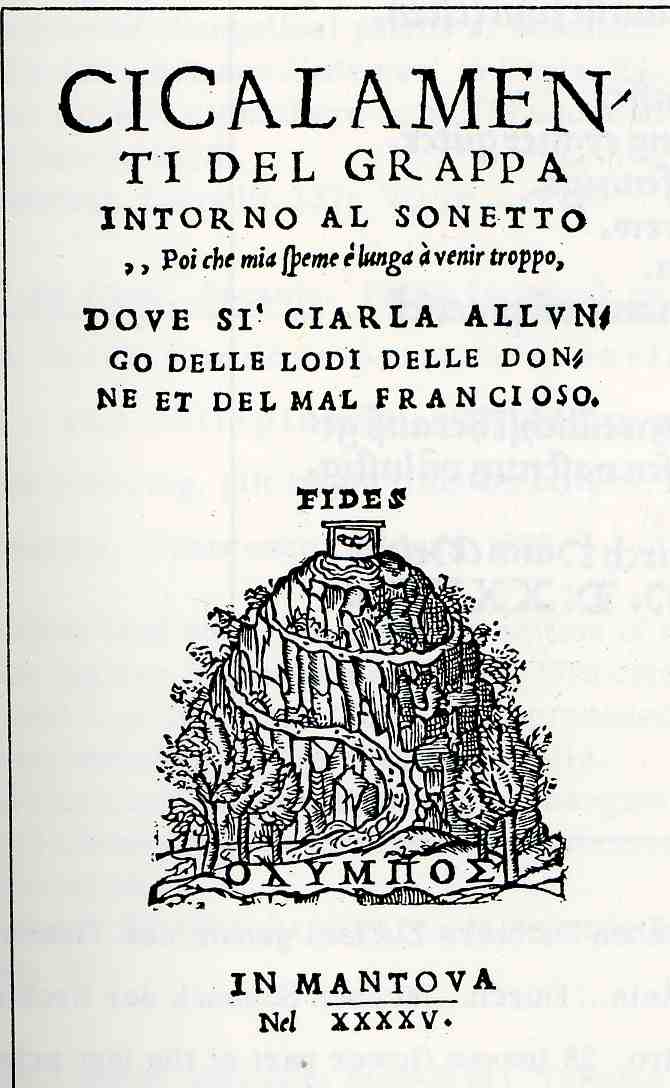
    The progress of man/humankind has, in our dim antiquarian past, been represented in art in stages of ascending a mountain.  The fine arts and sciences have been shown, in their various intellectual pedigrees, at various points on the mountain of the mind, usually with Philosophia sitting supremely at the top (with Astronomia and Mathematica generally not far underneath). This is mind, I came across another sort of progression to the Olympian heights, though it has no people in it, just the mountain, and a curious idea, ascending to faith, or truth. 

    The image is on the title page of a curious, little, early work by the pseudonymous  “Grappa” (well-named for the drink), Cicalamenti de Grapps intorno  al Sonetto…though its real nature is revealed in the subtitle,“dove si’ Cliarala allungo delle lodi delle donne et del mal francioso”, or “where one chats at length about women with The French [venereal] Disease”.  It is also dedicated to a non-existent courtesan who was heralded as being lovely, generous, and deep in the seat of this same disease.  Indeedy! This ribald, blustery, frank, coarse innuendo-laced tract (28 leaves long) was not terribly unusual when it was printed in 1545, celebrating as it does the low- and high-cultural private life of Renaissance Italy.  Doctors, poets, gluttons, cheats and of course lots of beautiful women romp around ostensibly in an attempt to prove the usefulness of their sinful vices, relating it all somehow to the disease-improved poetic capacities of the STD-bestowed Petrarch, master of forlorn and unrequited love poetry and the father of Humanism  (It relates in a way that I can’t explain to Petrarch’s Canzoniere, sonnet #88, mostly written, I think, about a  girl/woman that he fell in love with in church, which is why we can see he needed to invent Humanism. He seems to say that the needs of love are strong, stronger than he could stand, evidently, and that one should flee, renounce it; he seems to for himself, the girl across the pew or across the great open space in the cathedral never weakening to him a bit.  He pines over her, and announces his own amoroso intoppo, or “amorous fumblings”, and would take flight from himself as well. Evidently the people in this work by Grappa do not take his warnings to heart, though they do seem to renounce the “love” part but not the “sex” part. I could be really wrong on this god knows; all I wanted to do was look at the pretty picture on the cover!)

    Stumbling into things like this  makes you remember that the Renaissance wasn’t all stuffy and main-springy; perspective-this and techno-that; they had their fun, too, even in 1545, and put it into print.

    Back to the woodcut on the title page: it features a small, winding route up a mountain, the top of which is sanctified “fide”.  Now considering what these folks were doing in this work I wouldn’t necessarily christen the end of the adventure with this word, particularly if it meant (as it does) the name of the World Chess Federation (FIDE).  Seriously though fide means “faith”, as in bona fide (on good faith, by good authority), as opposed to mal fide (bad faith).  I cannot determine what in the world the structure is on the top of the mountain, or what is in it.