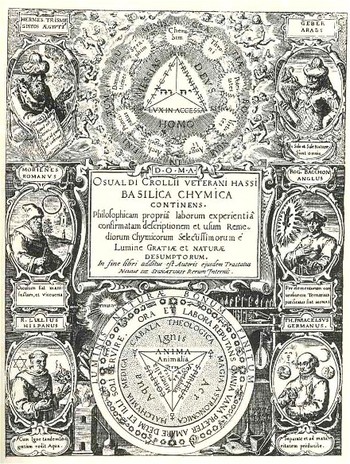
JF Ptak Science Books LLC
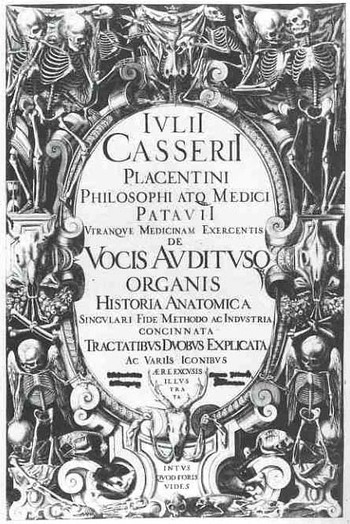
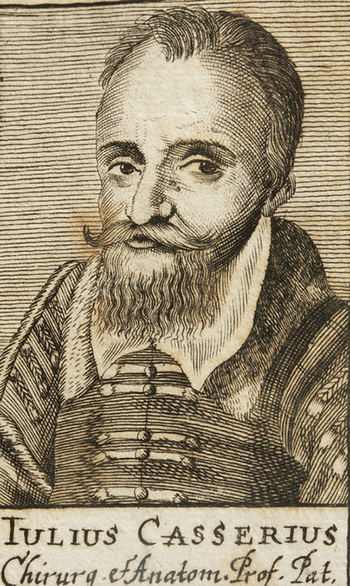
The first title page here belongs to Guillio Casserio (c.1552-1616), De Vocis Auditusque Organis historia anatomica singulari fide methodo…, 1600-1601, an absolutely gorgeous illustrated monograph on the vocal organs and organs of hearing in man and animals. Casserio, a superb anatomist (and who was also signatory to William Harvey’s doctoral diploma from Padua in 1602), set the standard for accuracy and beauty in copperplate anatomical illustration just as Vesalius had set the standard for woodcut illustration.
I cannot recall a title page illustrated with so many skeletons, especially so beautifully arranged, and posed in common, breathing, living situations. Their placement is excellent, along with the other skull and bones—it seems to me as though they could not be re-arranged into a better assortment more pleasing to the eye, much like rearranging Joseph Cornell construction…it just cannot be done.
Another fine example of title page design is Filippo Buonanni’s Museum Kircherianum sive Museaeum A.P. Athanasio Kirchero…printed in Rome in 1709, and it belongs to the first published effort to catalog the scientific and miscellaneous 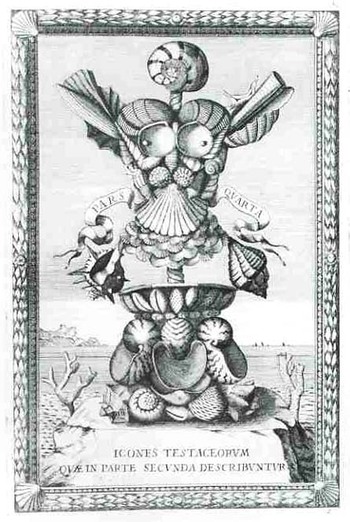
collection of the vast 17th century polymath, Athanasius Kircher; the collection assembled in the Jesuit Collegio Roman, and assembled by Alfonso Donnimo. Buonanni was a student of and successor to Kircher at the Collegio and catalogued the specimens of natural history, scientific instruments, geological items, Egyptian antiquities, and other items brought back to the school via networks of Jesuit missionaries. His particular strength in study was conchology, and he displayed his knowledge in this intricate arrangement of shells from the collection in the title page.
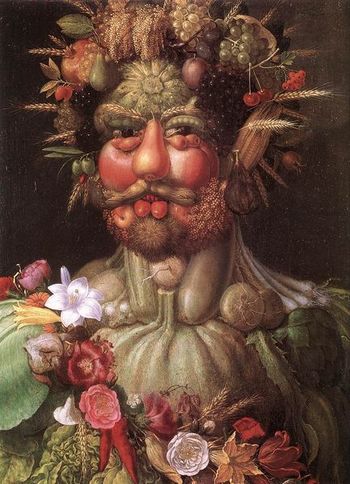 I cannot help but think that his artistic vision may have been influenced by the extraordinary Giuseppe Arcimboldo (also spelled Arcimboldi; 1527-1593), who, one hundred or so years earlier, painted (in his non-conventional works) fantastic portraits and images using fruits, vegetables and other natural objects as the sole source of representation. On the other hand his influence may not have been so very well known, as many of his works were stolen during war time in the mid-17th century, and he fell rather deeply into obscurity until being revived and resurrected by the Surrealists in the 20th century. His work was so extraordinary–and this is true at any time in history but especially so during the time that he lived–that it would be impossible not to mention this unique talent in connection with Buonanni.