A Daily History of Holes, Dots, Lines, Science, History, Math, Physics, Art, the Unintentional Absurd, Architecture, Maps, Data Visualization, Blank and Missing Things, and so on. |1.6 million words, 7500 images, 4.9 million hits| Press & appearances in The Times, Le Figaro, Mensa, The Economist, The Guardian, Discovery News, Slate, Le Monde, Sci American Blogs, Le Pont, and many other places… 5000+ total posts since 2008.

Category: Militaria

  • The Belgian Collector of Life, 1918

    JF Ptak Science Books  Quick Post                

    Part of the World War I  Photography series
    WWI Sniper198

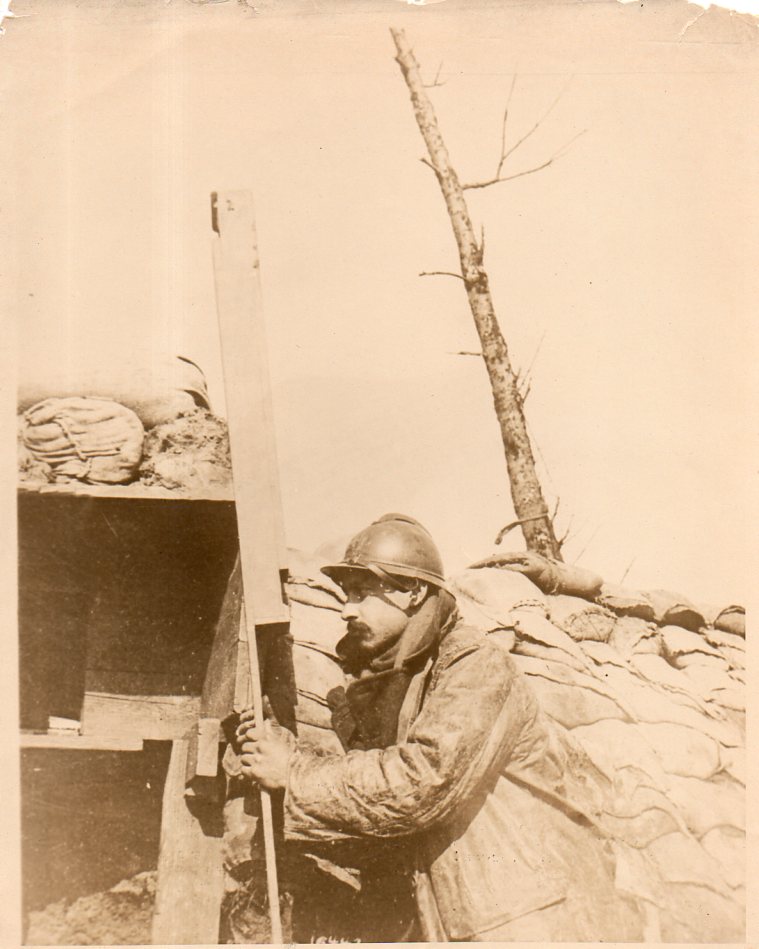
    This is an excellent example of appreciating images in context.  The photograph seemed line an ordinary image of a soldier peering through a periscope on action ahead of his trench, in some miserable battlefield, somewhere in Europe, 1918.  The image is the product of a photographic pool, the photographers working in semi-unison to produce acceptable images to be used in publications illustrating the war.  The images could not be too terribly graphic, and must not relate any useful military intelligence–they would pass through the hands of very active censors whose job it was to slightly inform the reading public and to also keep morale high, a difficult balancing act.

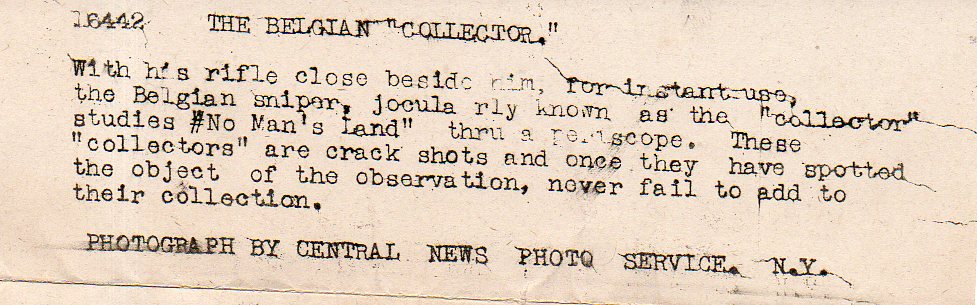
    And so I thought my thoughts. Until I turned the image over–it was stamped “Photo by Central News Photo Service”. It was also accompanied by a typed caption, the bit of text that was to be the standardized caption for this photograph when and if it was used by a magazine or newspaper.

    The title is “The Belgian Collector”. 

    The Belgian collector was a sharpshooter. He would scan the field looking for any unfortunate who might have left themselves exposed.  Then he would shoot at them. Collect them.

    In a  sense, “collect” like “John Fowles The Collector, only killing them with a rifle.

    But that was his job. And it was war. And if he was on your side, then you’d want him there.  

    I found “the collector” name to be poetical, and chilling.  
    WWI Sniper det199

    So, combining the context with the image in this case was a truly sensational thing.  

    The original photo may be purchased from this blog’s bookstore, here.
    ·Posted by :

    ·in:

    — —

  • Superb Cover Design–WWII Underground Warfare, 1943

    JF Ptak Science Books   Post 2280

    “There are no news-cameras clicking where the underground war wages. It is a war of iron nerves against an iron machine, of indomitable men and women defying the Nazi monster, of sudden swift strokes out of the dark, of blows that fall where least expected, hampering, slowing, wrecking the Nazi war machine…” 

    WWII  Underground War196

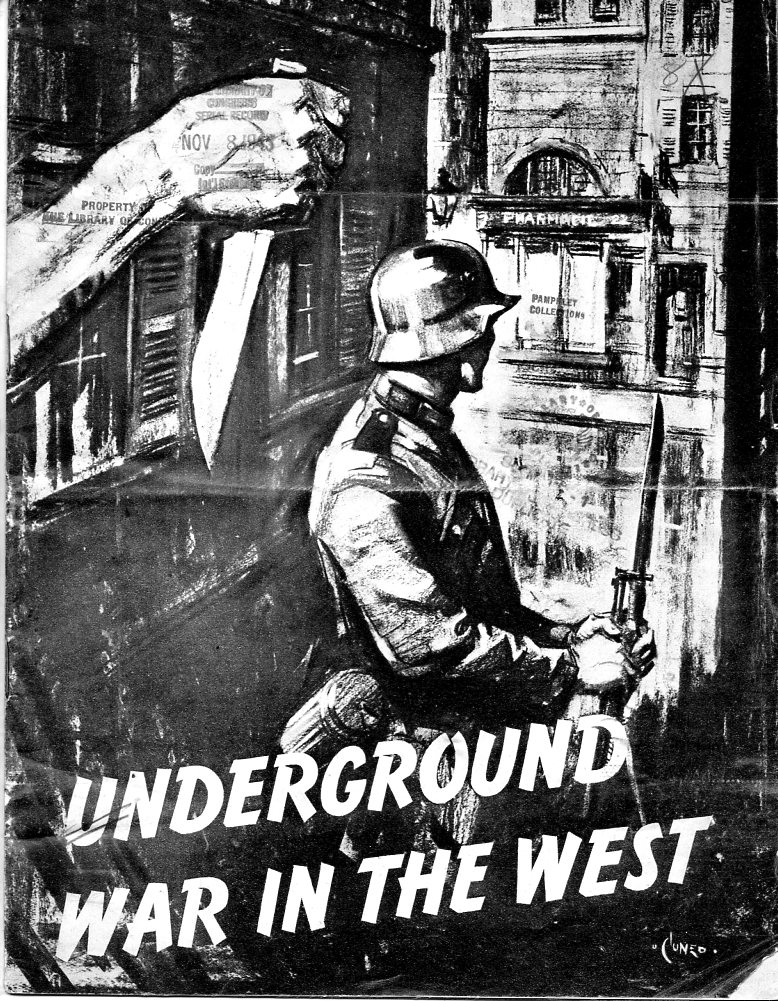
    Underground War in the West has one of he most dyunamic covers I’ve seen in quite some time–not to say that there are absolute “best” designs, but it is certainly a top-tier design, a fine effort, grabbing the attention of even a casual browser, and suggesting action, even without a read. 

    This pamphlet really seemed like a tiger in a cage—looking through some of the collection here relating to WWII literature on activities in occupied countries, the startling cover graphic of Underground War in the West (printed at some time in 1943, and not before or after) really rattled its cage.  Its contents were non-too tame, either—while being reasonably polite (as was the fashion) it still invoked some very difficult ideas and images.  

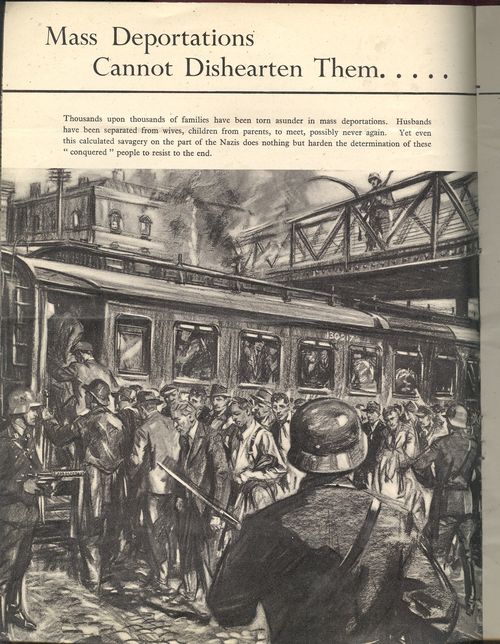
    This was a terrific, mass appeal pamphlet on the underground actions of occupied Europe illustrated with pencil and charcoal drawings by Cuneo, with each page depicting a  resistance activity—including the underground press, medical aid, sabotage, and general murderous nuisance-making and in general pamphlet praises and celebrates the heroism in occupied countries such as Czechoslovakia (with a drawing showing the assassination of Heydrich), Holland (showing the Dutch caring for a wounded RAF pilot), Belgium, France, Greece. Norway, Poland, Yugoslavia and Luxembourg.

    Blog jan 7 undergrd deport

    There are full-page drawings relating to the strength of occupied people in the face of “Mass Deportation (cannot dishearten them, thousands and thousands of families have been torn asunder in mass deportations…”) and “Firing Squads…thin the patriot ranks yet ever more step into their places” . The section on “Facts from the Occupied Countries” list activities in 9 occupied countries;  under “Poland”, we read that “Germany has drawn a veil of silence around Poland…it is estimated that 2,500,000 Poles have died in concentration camps or by execution up to December 31, 1942. There are 54 concentration camps in Poland…and the average life span in the camps is nine months…”  Nowhere in the pamphlet however is there any singular mention of deportation or murder of the Jewish people—there were hundreds of articles printed in American newspapers up  until this time on the beginning of the (yet named) Holocaust, though acknowledgment of a fact doesn’t necessarily make it widely known in spite of its incredible and massive significance.  This pamphlet, while extraordinary in mentioning the millions of deaths in the concentration camps and “deportations”, was rather ordinary in its coverage of who it was that was being murdered in the camps.  

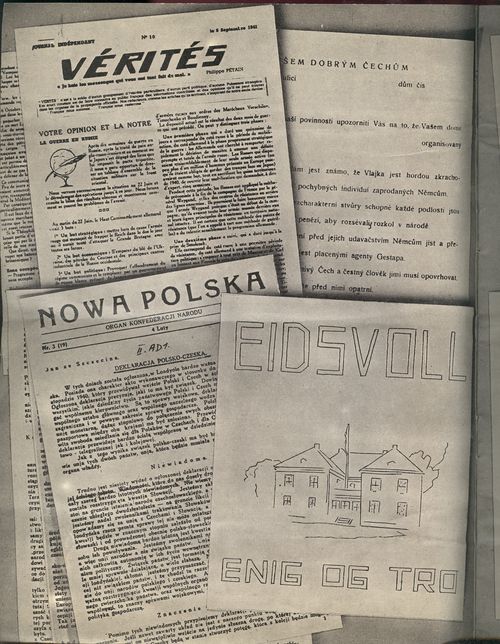
    There is also a two-page spread exhibiting examples of underground newspapers:

     
    Blog jan 7 undergrd newspars 001

    Only six copies are located in libraries around the world, and those are pretty high-calibre institutions:  Hoover Institute on War, Holocaust Library, Harvard University Law Library, London Metropolitan, National Library of Scotland, Oxford University.  


  • German Resistance, Great Britain, 1944

    JF Ptak Science Books  Quick Post

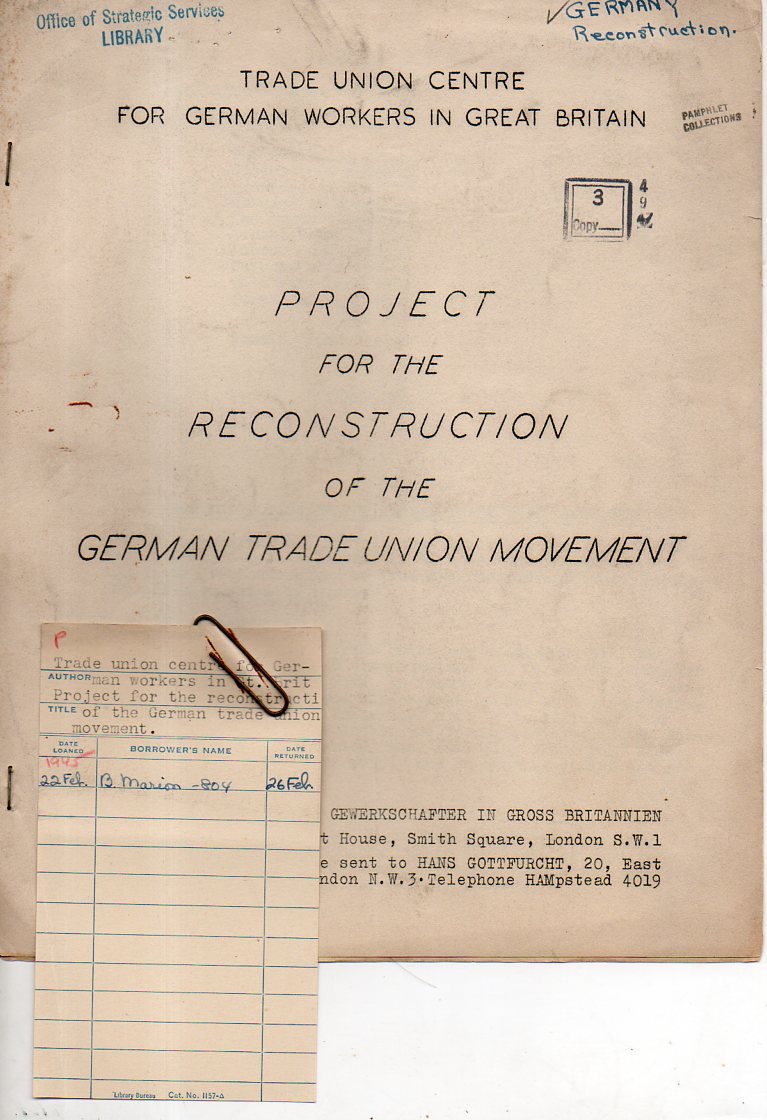
    German trade union187The Project for the Reconstruction of the German Trade Union Movement was the brainchild of the wonderfully-named Hans Gottfurcht (God Fear, Fear of God, God Fright, etc), the docuiment printed in 1944 a year after the author began the organization in London.  Gottfurcht was a major domo in the union movement in Germany and headed one of the principal national committees from 1919-1933–that is, until the Jewish Gottfurcht found himself to be at odds with the NSDAP. And also when the NSDAP outlawed trade unions.  Gottfurcht survived in Germany as an insurance agent until finally getting out in 1938.  He worked his way to England, where at the begining of teh war found himselkf interned as an enemy alien–one of those ironic cases in which anti-Nazi Germans were rounded up with thousands of other fellow Germans.  Out of detention Gottfurcht founded the Socialist Trade Union for German Wrkers in Great Britain, advocating union positions and getting ready for the state of the economy in Germany in post-Nazi Germany.  

    The pamphlet below is from my purchase of the Library of Congress “Pamphlet Collection”, and came to the LC via the library of the Office of Strategic Services (the OSS), the precursor to the CIA.  This was in the library for some time, and borrowed only once.  

    It is interesting to see how strong post-war planning was for Germany–I haven’t studied this at all but in general reading I have come across many instances like this where plans were being made on how some segment of the German nation could proceed once the war was ended and the NSDAP extinguished.  

    ·Posted by :

    ·in:


  • New Orleans at the Top of the U.S., 1861

    JF Ptak Science Books  Quick Post

    Mississipi River

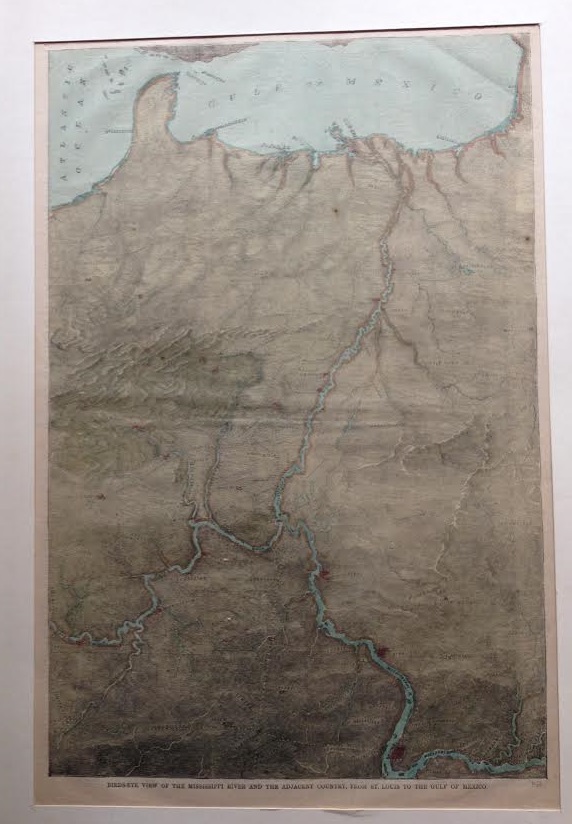
    Maps with unusual perspectives have long been interesting to me, and this map of the Mississippi River certainly fits this category.  Printed in Harper’s Weekly on July 6, 1861, and entitled “Bird’s-eye View of the Mississippi River and the adjacent Country, from St. Louis to the Gulf of Mexico” it displays the river from north-to-south, landing New Orleans at the top of the United States.  I’m not altogether certain why this perspective was used –perhaps it was just to acquaint readers with possible “western” battlefields for the brand-new Civil War, showing the terrain from a different position for the sake of running old geographic info through a news interpretative lens.  

    It displays this middle-ish section of  the country from just east of Knoxville (and almost to the mountains in which I am sitting) and then south to Charleston, and north along that same line to Vincennes and the Wabash River;  then on west to St. Louis and Rolla and south to Galveston. We can easily see the entire Florida peninsula–truncated, owing to the bird’s-eye view part. There are probably dozens of cities shown, all of which are on one railway or another. The terrain is very interestingly cut and also very useful.  And again, New Orleans sits on top of it all, perhaps to emphasize its importance in the future fight for the river and the middle of the country in the three-month-old Civil War.  

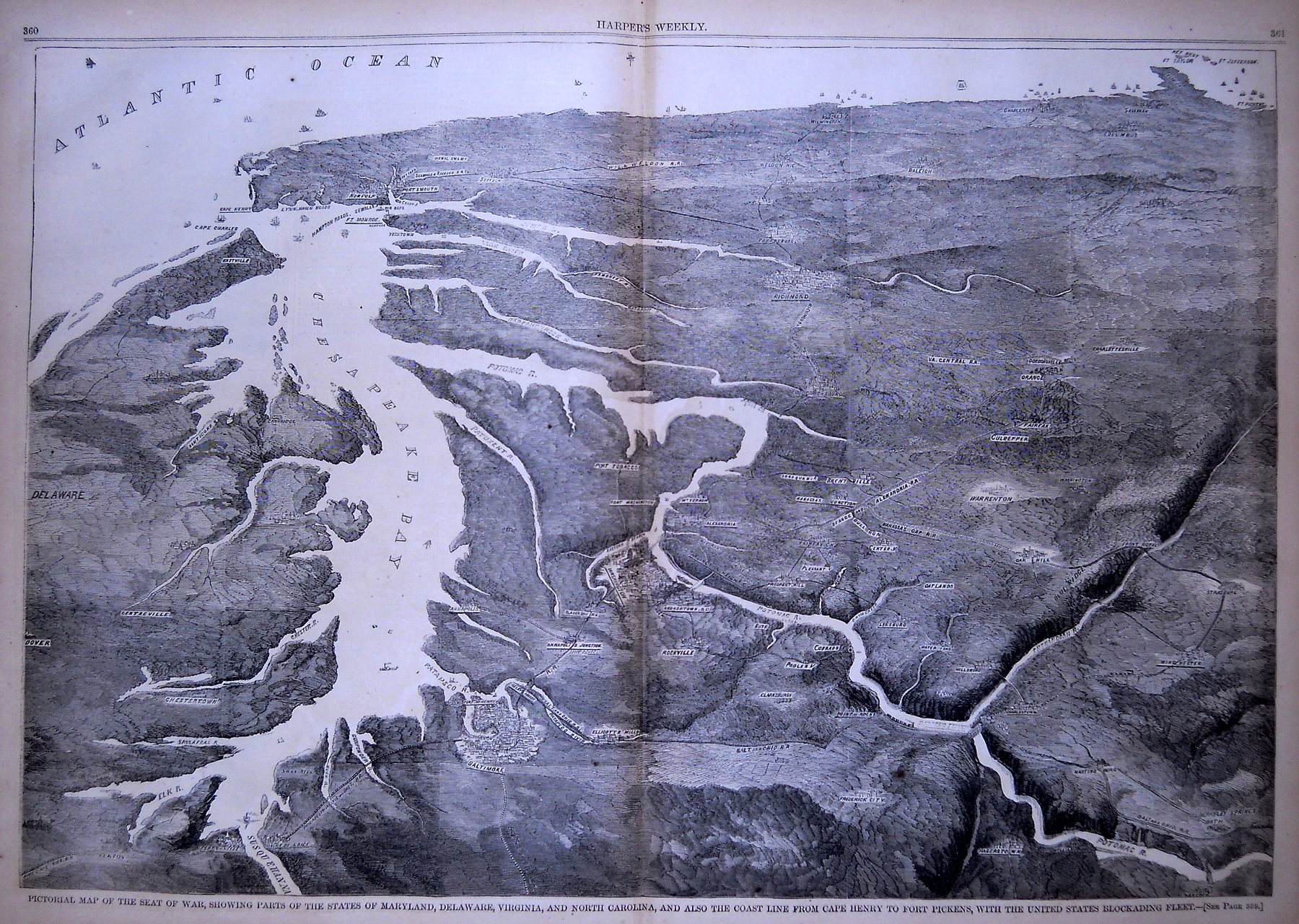
    Harper’s Weekly published several perspectives like this–for example, here’s another very creative and imaginative view of the theater of war looking southeast from high above Baltimore, and surveying the country that leads south and encompassing the entire coastline to just beyond Savannah.  It is a very interesting portrayal of the terrain, especially for the Blue Ridge, and for giving a good idea of what was on the road between Washington and Richmond.  

    Chesapeake[Image source: the Philadelphia Print Shop]


  • German Propaganda in Sweden, 1943

    JF Ptak Science Books   Post 2239

    “Sveriges folk vet inte mycket om alt detta”/Swedish people do not know much about this…” 

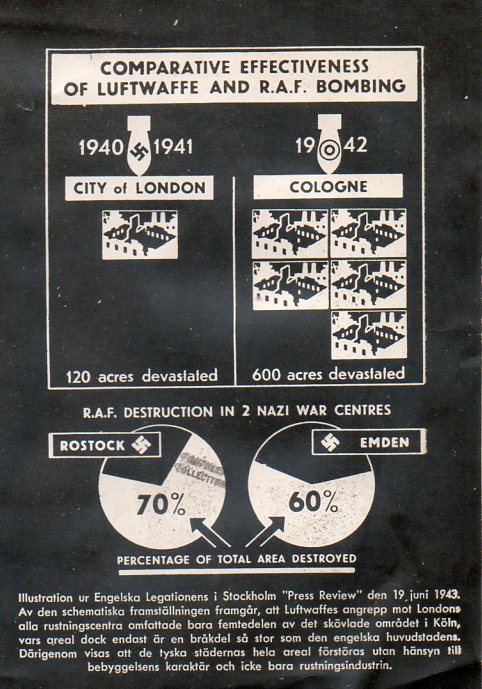
    This is an unusual graphic–or at least a graphic display of information found in an unusual location, a publication in Swedish quoting sources from the Free Press from Stockholm (19 June 1943) on the effectiveness of Luftwaffe vs R.A.F. bombing.

    It is supposed to be a graphic proof for the ferociousness of the Allies, published in a pamphlet called Konst i  spillror (roughly, Art and Rubble, or Art in Rubble, something like this) which I believe was a German attempt to win Swedish hearts and minds by displaying the destructive force of teh other side of the war. The subtitle of the pamphlet is on the destruction of European cultural treasures in Antwerp, Nuremberg, Koln, Lubeck, Karlsruhe, Munich…plus bombed cemeteries, schools, hospitals, and so on. The locations are in Germany, mostly, or German-held areas, and decry the barbarity of the war in the hands of the British, Canadians, and Americans.  

    WWII graphic077

    I do not have proof of this as propaganda, but it certainly feels like it.  Sweden was a neutral country during WWII, managing to maintain its neutrality for the entire conflict. There were evidently soem concessions made to both sides–for Germany the major bit seems to have been allowing the German 163rd rail transport across Sweden in the attack on the Soviet Union (which I imagine was an enemy of my enemy move). On the other hand the Swedes accepted Jewish refugees from Norway and accepted all of the Danish Jews who were supposed to be sent to concentration camps.  I can understand the Nazis wanting to try to make inroads into the national psyche, but I have a hard time imagining that this campaign succeeded on any level. 

    My copy is a photographic negative of the original, made during the war, and was once part of the Library of Congress Pamphlet Collection.  As I said, I could be wrong in this interpretation, but I feel fairly confident that it is so.


  • Anti-Nazi Cover Art, 1931

    JF Ptak Science Books   Post 2226

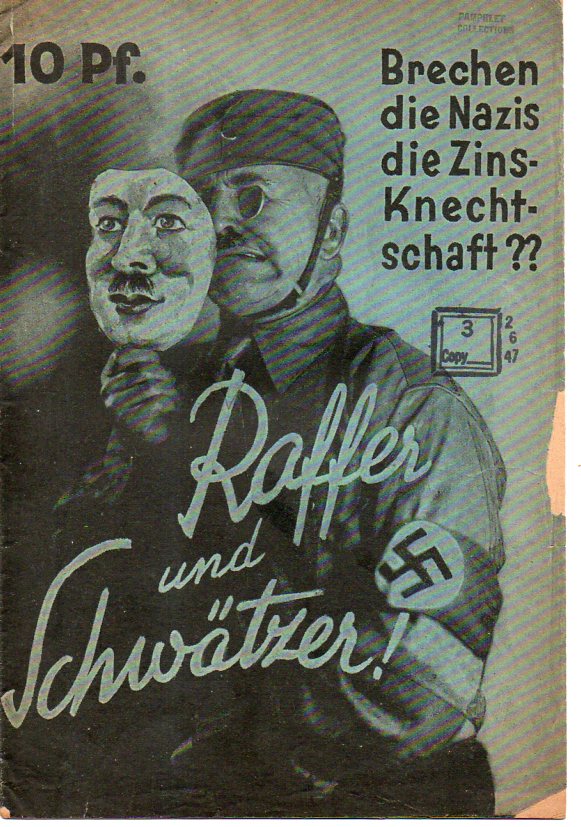
    German cover art044

    In a similar intellectual capacity (though not so much in the same genre) as the great John Heartfield, this cover illustration depicted what many were thinking about the Nazi Party in 1931. It appears as the illustration for Brechen die Nazis die Zinknechschaft?? Raffer und Schwatzer!, printed by the SPD (Sozialdemokratisch Partie Deutschland in 1931.  It also seems as though it was a response to the recent NSDAP victories in elections for the Reichstag on 14 September 1930.  That election was a major show of the Nazis and a semi-modern meet-and-greet campaign for Hitler, a political blitzkreig (in its way), a showing that had been unseen before in German politics, a production of short and repetitive phrasing, long promises and short details.  The result was an incredible win for the Nazis, going from fringe element with a comical leading figure to the second-most powerful party in the country, receiving more than 6 million votes and 107 seats in the Reichstag.  

    The SDP had a lot to worry about. In the last election the SDP had 153 seats with the Nazis 12; in September 1930 the SDP lost ten seats while the Nazis took 95, outpacing their new rival by over about 2 million popular votes.  In the March 1933 election the NSDAP took control of the Reichstag, ending with 288 seats, with the Social Democrats becoming the new second party with 120.  This was the beginning of the end–by the third week in March the Enabling Act was pushed through the NSDAP-Reichstag giving Hitler plenary powers with the ability to make laws without the input of the Reichstag.  The Act passed following the strong-handed rule-bending, with only the SDP members voting against it.  A new election was called in November 1933, with the Nazi Party being the only part to vote for–it received 92%  of the vote, consolidating Hitler’s control.  

    The pamphlet above was a slim 10-pfennig work, a diatribe against the Nazis.  The cover art warns the casual browser that once the Nazi mold/Facade (? of a relatively decent-looking Hitler-like face) was broken there was nothing underneath it but a snarling, puffy, monocled Brown Shirt.  (Unfortunately the cover art is unsigned. The pamphlet is pretty rare, with only one copy (NYPL) showing in the massive catalog of worldwide library holdings, the OCLC/WorldCat.)


  • Full Metal Jacket, 1918

    JF Ptak Science Books   Quick Post

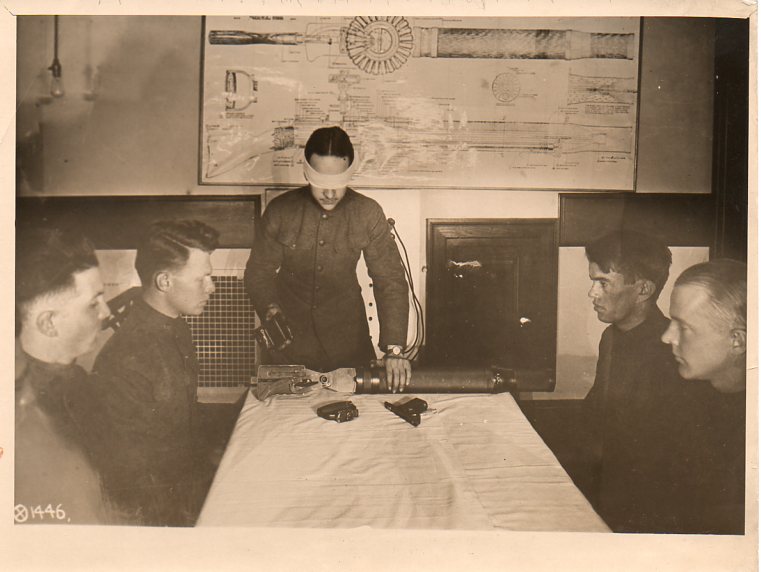
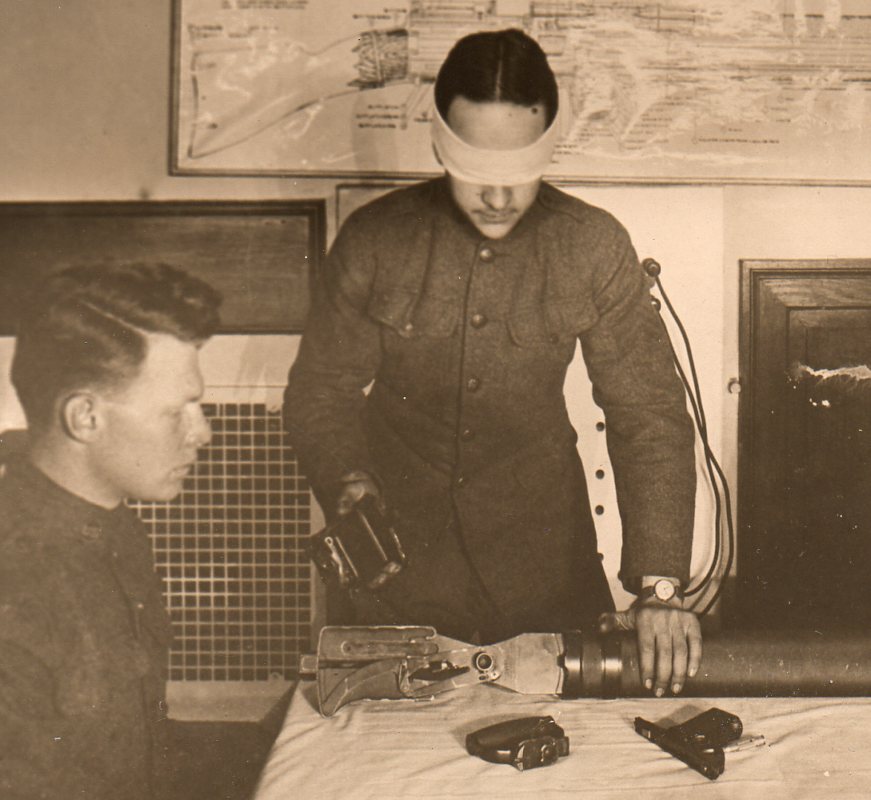
    WWI Photos Blindfold077

    WWI Photos Blindfold078

    I do believe that this is a Lewis Machine Gun, one of the most popularly-used automatic weapons by the BEF (and of American design). It was a gas-operated weapon firing a .30-06 Springfield at 500/600 rpm withan effective range of about a half-mile.  The drum magazine (not present here so far as I can see) held 47 and 97 rounds.  These soldiers were all business. (Source: this is one of perhaps 400 WWI news service photos down in the warehouse…)

    ·Posted by :

    ·in:

    — —

  • America Attacked, 1937–and the Unusual Architectural Response to Poison Gas and the Homeless Unemployed

    JF Ptak Science Books  

    [An earlier post on this blog, Mapping the Invasion of America, 1942, addressed another vision of the invasion of the United  States–it is also the most viewed post that I’ve written, having been read more than 400,000 times–Part II of this post may be seen here; and while you’re at it  consider a  related post on the Nazi sub-orbital Amerika Bomber.]

    America attacked poison962
    Philip Diamond discovered an interesting concept in “blurryness” in the pursuit of building with a purpose.  In his pamphlet Should it Happen Here, self-published (and printed by the Brighton Press of Brooklyn, U.S.A.) in 1937, Diamond established a need for creating (1) inexpensive housing for the unemployed and (2) poison-gas-proof housing for Americans in general, and came up with (1.5) inexpensive poison-gas-proof housing.  In blurring the lines between the two needs I’m not sure that he satisfied anyone’s needs, spreading his engineering/architectural gifts jut a little (or a lot) of bit too thin.

    One thing Diamond was sure of was that the next war would be governed by “one man flying in an aircraft and releasing vapors of poisonous gas for destruction” and assured his readers that in this new war “there would be no front lines”.  “The future war will not be carried to the front line; it will be carried to the front door.”  That of course was true for hundreds of millions of people in Europe and the Soviet Union and South Asia, but not so in the same sense for anyone in America–unless those Americans happened to live on a remote chain of Alaskan islands.  Diamond was sure that war was coming directly to the U.S., and although he doesn’t name the country/countries that would be responsible for attacking America with poison gas, he did name one of the aircraft that would come here to do that–the HE112. (The HE 112 was a prototype fighter aircraft that wasn’t adopted, with fewer than 100 produced. How this would get across Europe and then across the Atlantic and then across the U.S. I’m not sure.)

    America attacked poison963
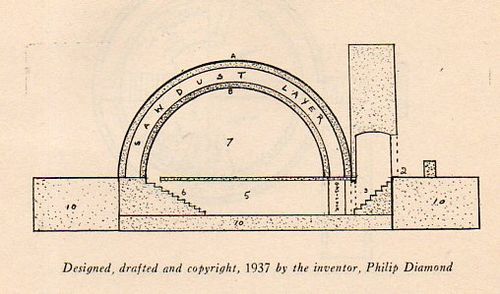
    Once Diamond gets to the design of his house things get a little fuzzy–and heavy./  Very heavy.  HE proposed a domed structure with a foot-thick “exterior roof” and a foot-thick “interior roof” of concrete, between which would be sandwiched three feet of sawdust.  The sawdust was supposed to act as both a filter to noise and soot and dust from the outside world, as well as a filter for poisonous gases. 

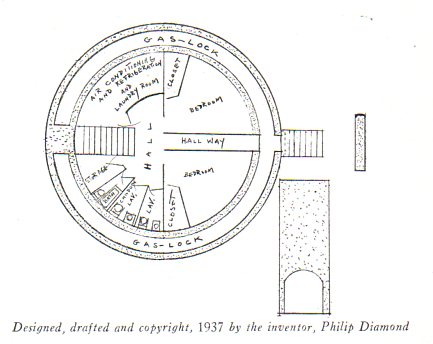
    The 5-foot thick structure would be embedded on a 10-foot thick concrete bed (for earthquake protection) and surrounded on its sides by another 10-foot concrete structure of something that I can’t figure out.  Not surprisingly, the author announced with a section headings that there would be “No WIndows”.  There would be a double entry equipped with an “air condition” that would wash folks entering the house and decontaminate the gases that might’ve impregnated their clothing or bodies (though Diamond says nothing about outerwear). 

    America attacked poison964
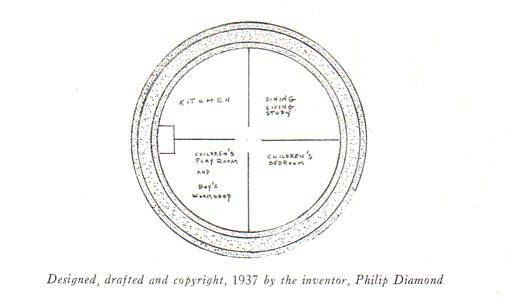
    Once inside (charmingly referred to as “the vault”) the occupants would find two bedrooms, a kitchen/dining room, and two lavatories (one “miniature” for the children, not so much for “hygiene”, but to “protect the delicate moal grace amongst the children”. That was the best line in the pamphlet, and about the only thing that really made any sense.)

    6 million of these houses could be constructed for the unemployed, costing $3,000/each, meaning that this part of the project could be funded with 18 billion dollars.  This was at a time when the New Deal was having a heart attack, unemployment was spiking again, and the entire GDP of the U.S. was $91 billion, which means that Mr. Diamond was seeking a 20% cut of the GDP pie.  In current terms, that 20% would mean $3 trillion. 

    So far as I can determine Mr. Diamond’s plan was not taken seriously. 

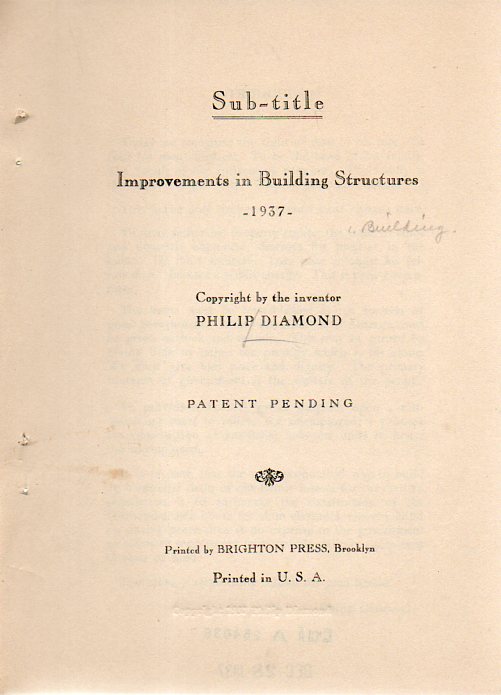
    Also, this I think is my only encounter with  a title pages that starts out with the words “Sub-title”.

    America attacked poison965


  • Being in Regret–Verdun, 1916-1918

    JF Ptak Science Books  Post 2215

    IMG_6842

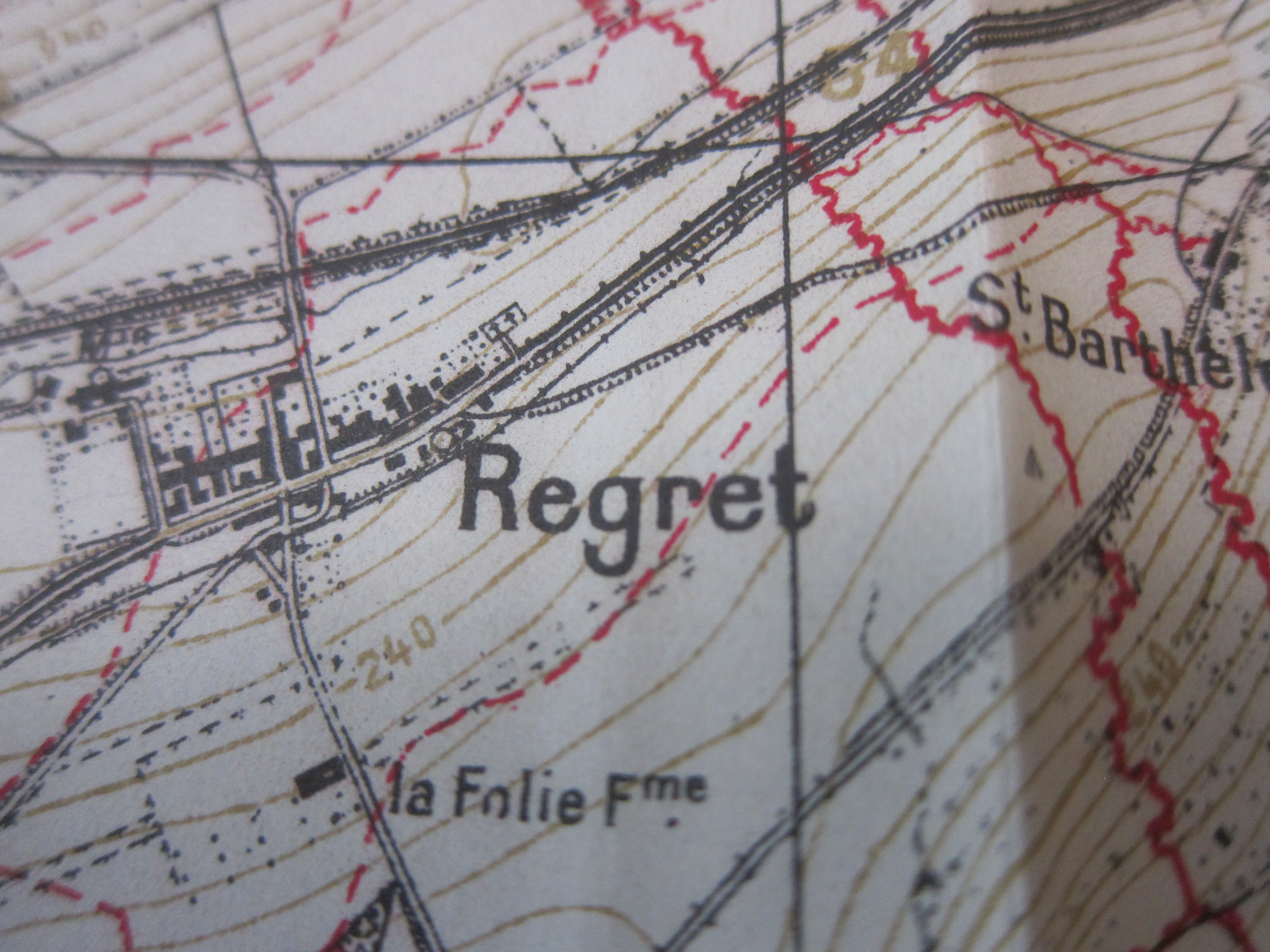
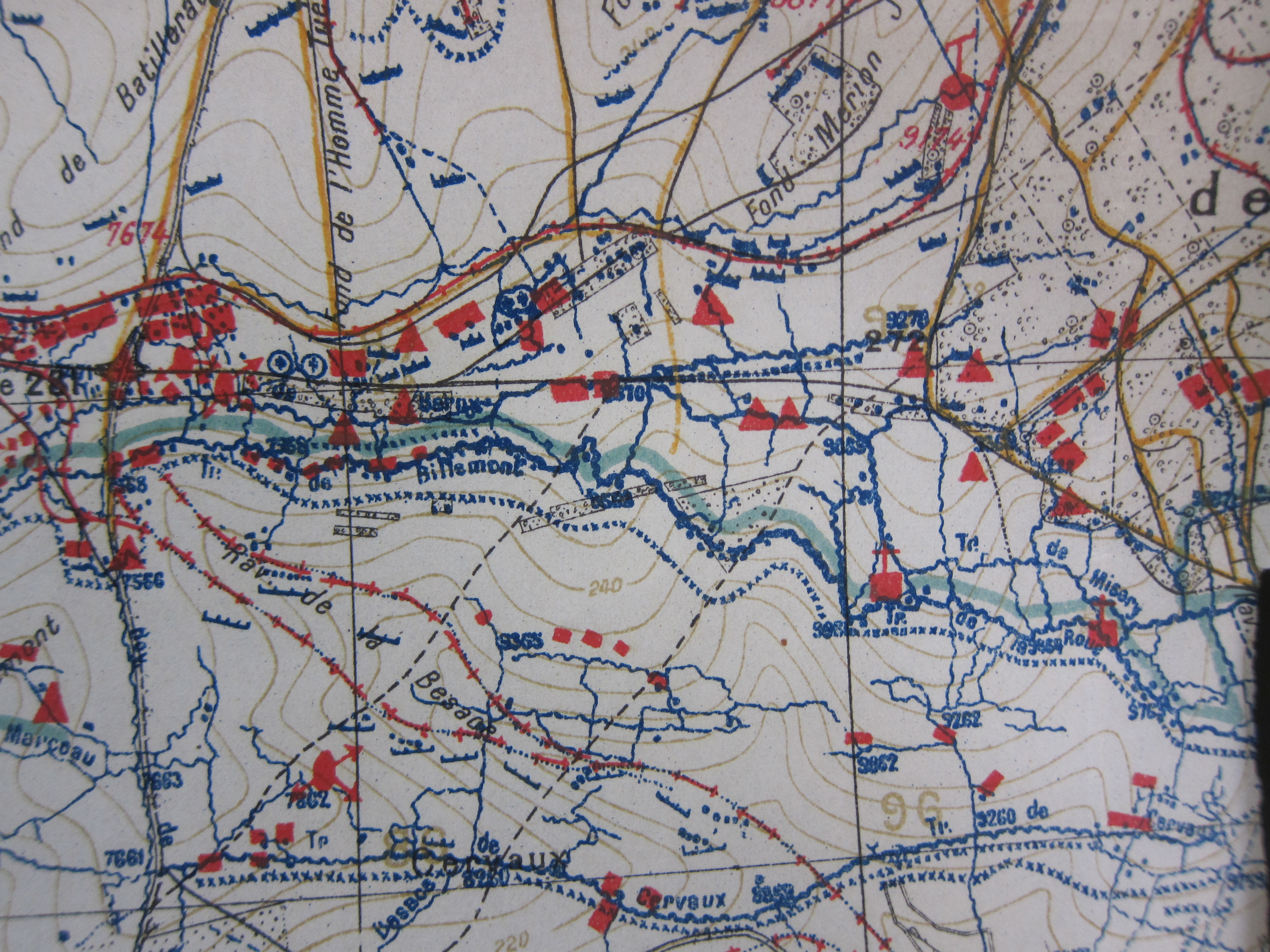
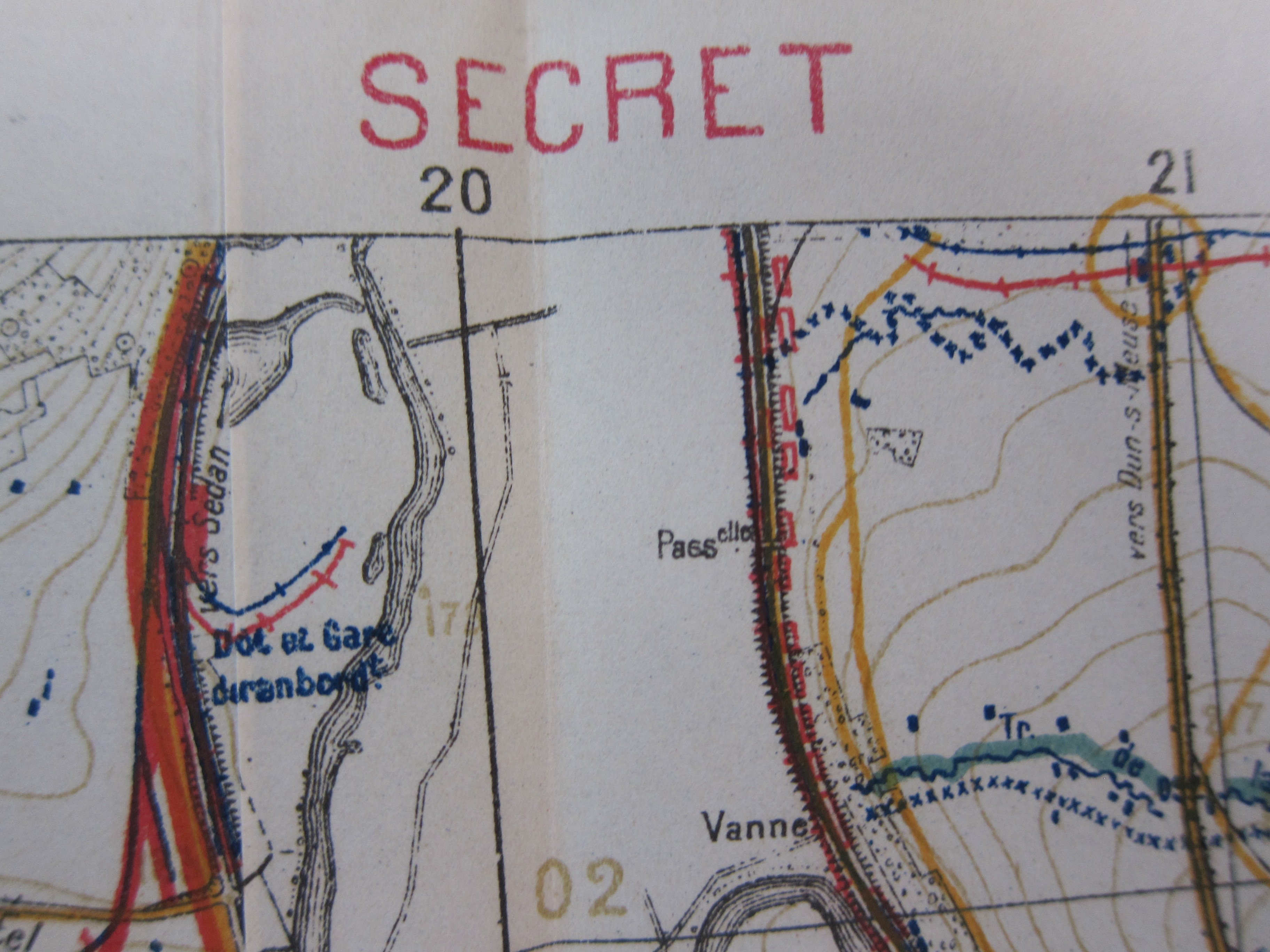
    I was looking through a very heavy volume from 1924 of Military Engineer and came upon a very large folding map1.  It was vanilla on the outside and stayed so, opening only the back of the map through one, two, three, four (!)  unfoldings,  not yet revealing itself, until it was at it full width, and then unfolded once down, which opened to the middle of the map, which was a mass of lines and shading of brown and gray.  Another unfold up, and then another down, and more of the same, so much detail that the context still was hidden. I unfolded the bottom half of the map three more times and at the bottom was the town “Regret”.  My right hand obscured the name of the much larger and antique-fortified town, which turned out to be the military-sacred city of Verdun.  When I unfolded the top of the map–making it about four feet long–I saw that it was for development of the battle and lines of communication and placement of troops and so on for part of the Autumn of 1918. And trenches.  

    (This was actually “Verdun B”, the mate of “Verdun A”, which together form a huge and wildly complex 4×4′ map. )

    IMG_6843

    This was a reprint six years later of the 34th edition of this particular map–that is a lot of editions.  But this was a lot of place, Verdun.  A fluid place of ordered killing chaos that was as dynamic as it was occasionally static, starting in a very contained space of massive fighting that took place from 21 February to 18 December, 1916. The map is of a place that was about the longest, costliest, and deadliest battles that humans have come to, so far.   Casualties were about the same on each side (370,000 French and 340,000 German) and totaled about 710,000 people, though scholars argue the point, some coming to a figure much higher, approaching a million.  That makes 70,000-100,000 per month for the battle, which was like a war in itself. 

    There were probably two million soldiers in motion here, at Verdun, in a relatively tiny area, with front lines extending about five miles or so, the battlefield being fairly narrow from point to point, perhaps totaling 20 square miles of heavily bombarded/shelled ground.  It was a terrifying place to be, and I’m certain that it must have scarred forever hundreds of thousands who survived the ordeal.  

    IMG_6844

    Unfortunately Verdun 1916 was only about the half-way point of the war, with these maps generated to show artillery targets for the American entry in the war for action that would take place just before the end of the war on the 11th hour of the 11th day of the 11th month of 1918. This was the French Fourth Army and the American First Army which attacked on a front from Moronvillers to the Meuse on 26 September 1918 through the end of September, and from which the German army began its gradual withdrawal from the area, continuing right up to Armistice Day.  

    Ultimately whenever I think of this war things usually boil down to Dalton Trumbo’s Johnny Got his Gun, which was required reading in my freshman year of high school in 1970.

     Verdun


    Notes:

    1.  Journal of the Society of Military Engineers, volume 16, 1924; the map titles are “Tranchee Francaise schematique a la date de 1er Sept 1918″ and “Carte Generale des Objectifs d’Artillery”.  


  • Mending Socks on the Western Front, 1918

    JF Ptak Science Books    Post 2213

    World War I photos--sewing in field297

    World War I photos--sewing in field298
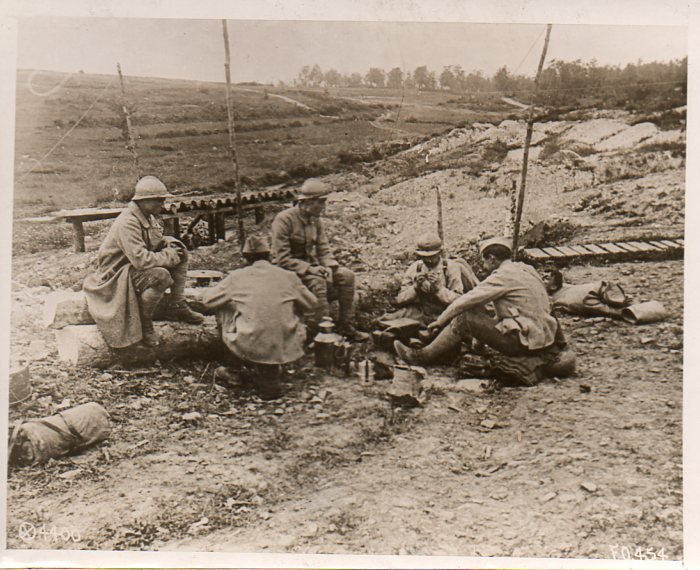
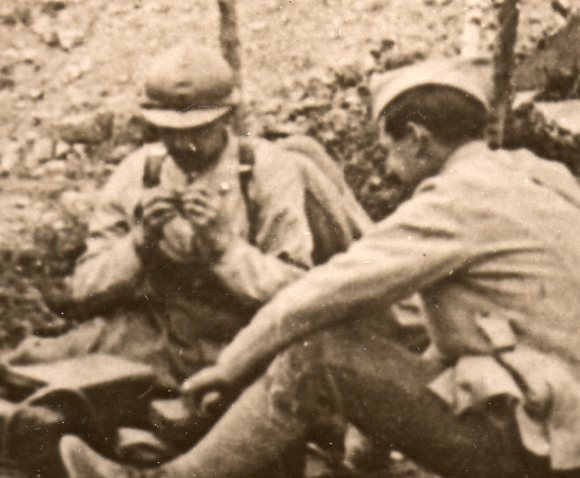
    This fantastic photograph calls to mind the importance of the little things of battle–dry socks, headgear, water, food, scissors.  And of course a good coat in the winter–a good coat that can be kept closed to allow the body to stay warm, or dry.  I mentioned in an earlier post here that it was a small thing that may have led to the demise of Napoleon’s army in Russia in 1812–the buttons on the overcoats of the soldiers were made of tin, and as tin becomes brittle in severe cold, it is conceivable that the buttons failed and therefore allowed the jackets to blow open much more easily than normal.  Little change that has an enormous impact.  

    World War I photos--sewing in field299

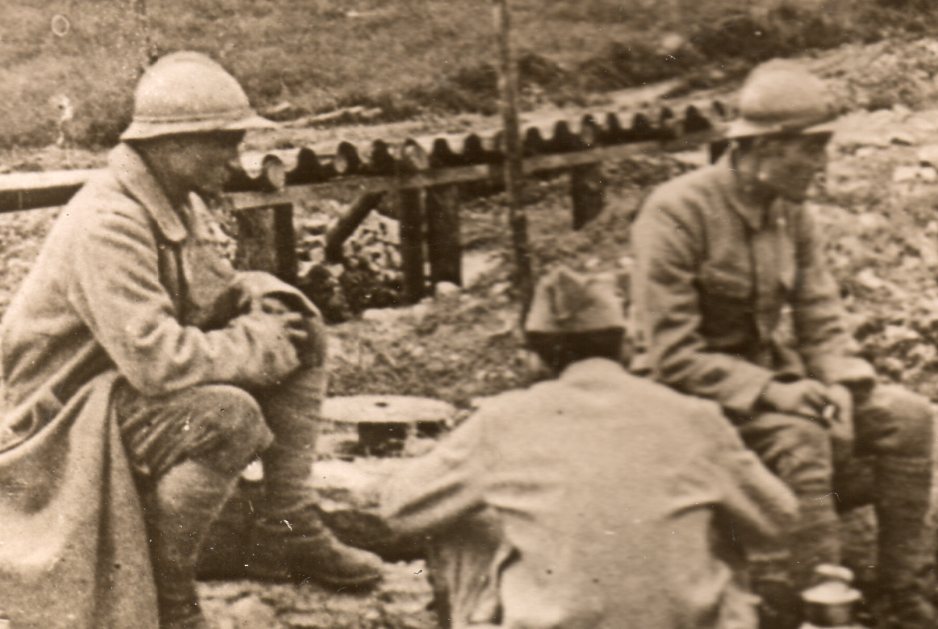
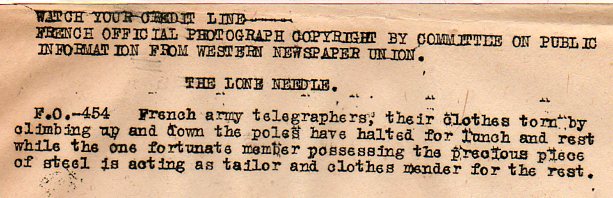
    This photograph–an official French photo published by the Western Newspaper Union in November 1918–shows a group of French telegraphic soldiers, taking a break, and mending their clothes.  The original text for the photograph (below) points out that their uniforms were torn and made shabby by continuously running themselves up and down telegraph poles.  It is important to keep yourself fit and fed and your uniform in good order, so they calmly awaited the repair of their uniforms y the one man with a needle and thread. 

    World War I photos--sewing in field txt300


    ·Posted by :

    ·in:

    — —