A Daily History of Holes, Dots, Lines, Science, History, Math, Physics, Art, the Unintentional Absurd, Architecture, Maps, Data Visualization, Blank and Missing Things, and so on. |1.6 million words, 7500 images, 4.9 million hits| Press & appearances in The Times, Le Figaro, Mensa, The Economist, The Guardian, Discovery News, Slate, Le Monde, Sci American Blogs, Le Pont, and many other places… 5000+ total posts since 2008.
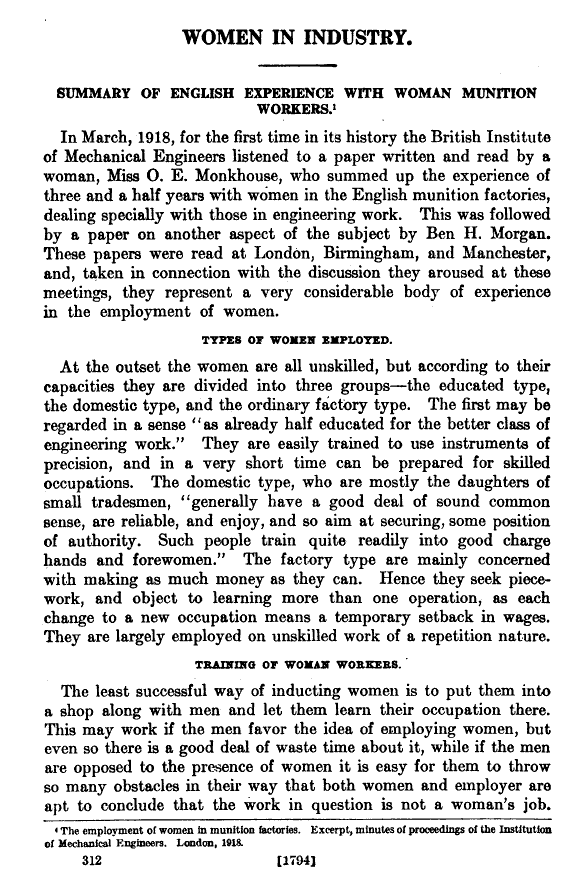
I came across an interesting little story in Nature (March 28, 1918) about women munitions workers. It is a note based on a report written by Miss O.E. Monkhouse–and as it was noted in the Monkhouse piece that it was the first paper read by a woman before the British Institute of Mechanical Engineers–and summarizes the work of a million women workers in wartime bomb factories. It is probably a valuable report for its telling of the number and nuts and bolts, and of course for the history of the introduction of women into a work environment where they had never been before, and in great numbers, but it still must suffer through the painful prejudices and opinions of the times. Ms. Monkhouse though is an elegant spokesperson and proponent for equality, and makes several arguments for the abilities of women being equal to that of men, which makes this short article well worth the read.
About two months after the Germans used the first poison gas in WWI (on April 22, 1915 against French Colonial troops at he Second Battle of Ypres in Belgium) the Scientific American published (on June 12, 1915) an account of some very early responses to the new lethal threat. This was a more caustic and dangerous form of a warfare that existed for at least 2200 years, going back to the Peloponnesian wars, with pitch- and sulphur-saturated wood that was set alight and buried under siege walls, the noxious smoke incapacity the soldiers within the walls. As the SA article also points out, bellows were used to propel the nasty and noxious smoke produced in a cauldron of burning charcoal, pitch and sulphur, blown hopefully over the walls and lines of the enemy–this at about the same time as the Athenians and Spartans were having it out.
There’s also indications that plague/disease-ridden animal carcasses were catapulted across enemy lines, armies going at one another using rockets of diseased meat. And so on.
But the 150 tons of chlorine gas that the Germans sent over the French lines on that day was something entirely different–and far more lethal than any other gas previously used. (There was an earlier attempt to use gas in battle, employing an even nastier gas–xylyl bromide. It was dispatched January 15, 1915 against the Russians on the Eastern Front, but due to extreme cold most of the gas froze–it still however was potent enough to kill a thousand soldiers.)
The early response to protection from gas warfare was inadequate, with masks being sometimes little more than string and cotton gauze. This response was better than no response, because in the end it at least gave some millions of soldiers comfort to know that they were being taken care of, that something was being done to address the gas problem. Of course this would last only so long as they didn’t have to actually employ the mask.
As the war progressed, the gas mask response improved, though so did the lethal varities of gases that were employed. Even the best of the masks were incapable of defending much against phosgene and diphosgene–and then there was no protection at all from mustard gas, which was another beast entirely.
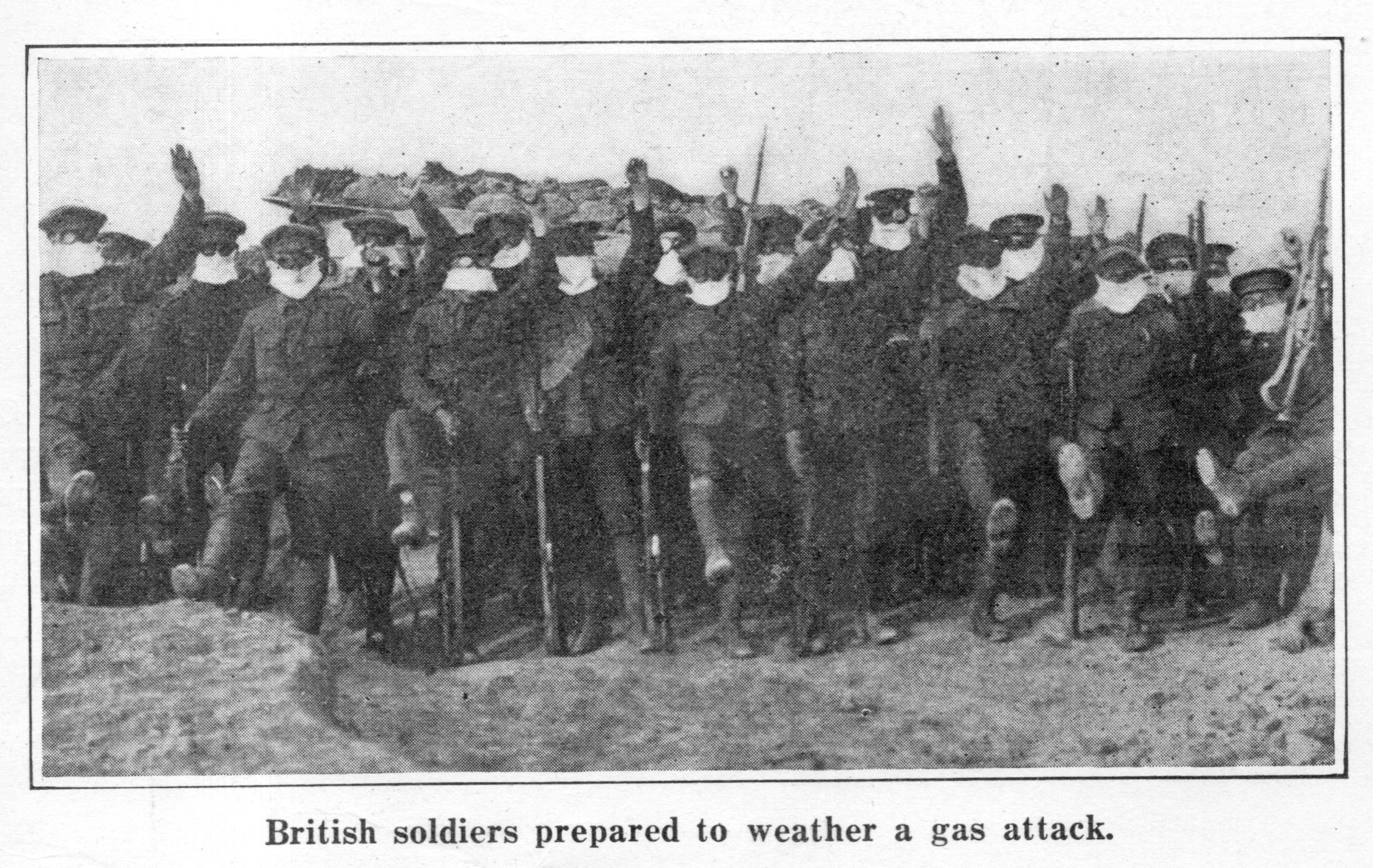
It was the illustrations that stopped me in the Scientific American article–first for the flannel muzzle mask (above), which made my heart half-break; and then, just beneath that picture, a portrait of a group of British soldiers wearing cloth masks, who were “prepared to weather a gas attack”. They were told that adding a little water to the mask would help stop the gas, a lot of which was hopeful expectation and wishful thinking.
An earlier post appears here, “Gas Masks and Poison Gas, World War I, 1915”, on early (November/December 1915) masks.
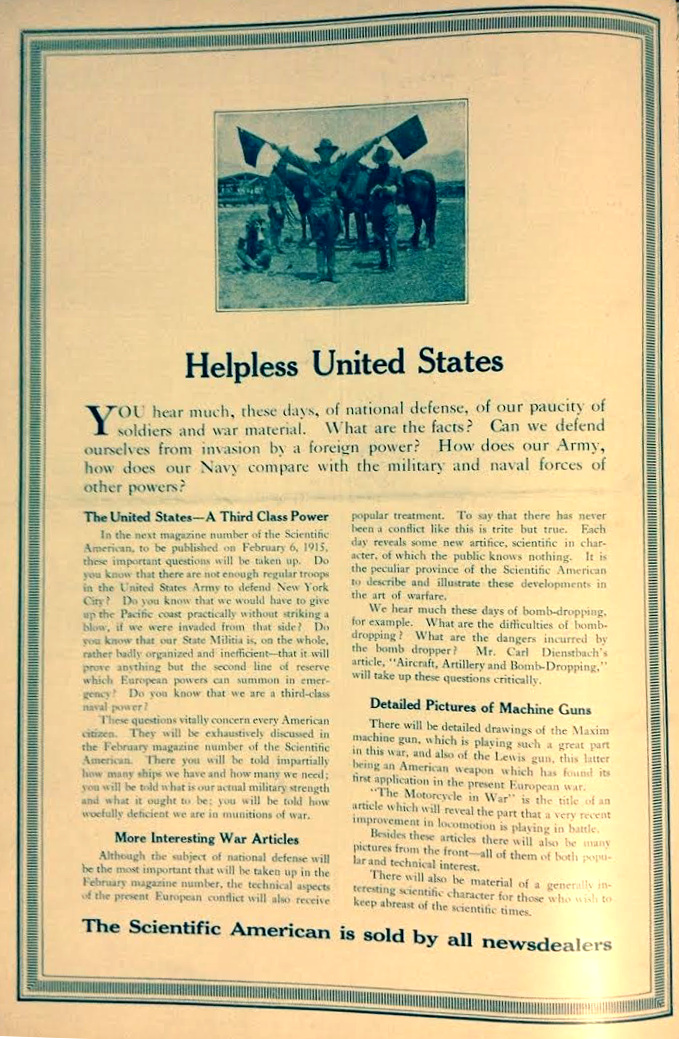
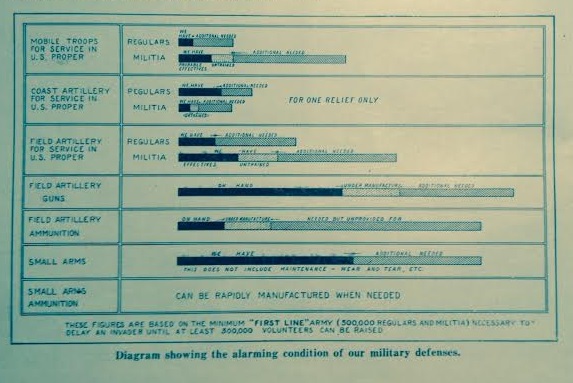
In January, 1915, in the pre-Luistania/post beginning of WWI (by six months) days, Scientific American declared an interest in the state of the United States military and found it lacking. It posted this very strong statement to advertise a coming special issue investigating the status of the armed services.
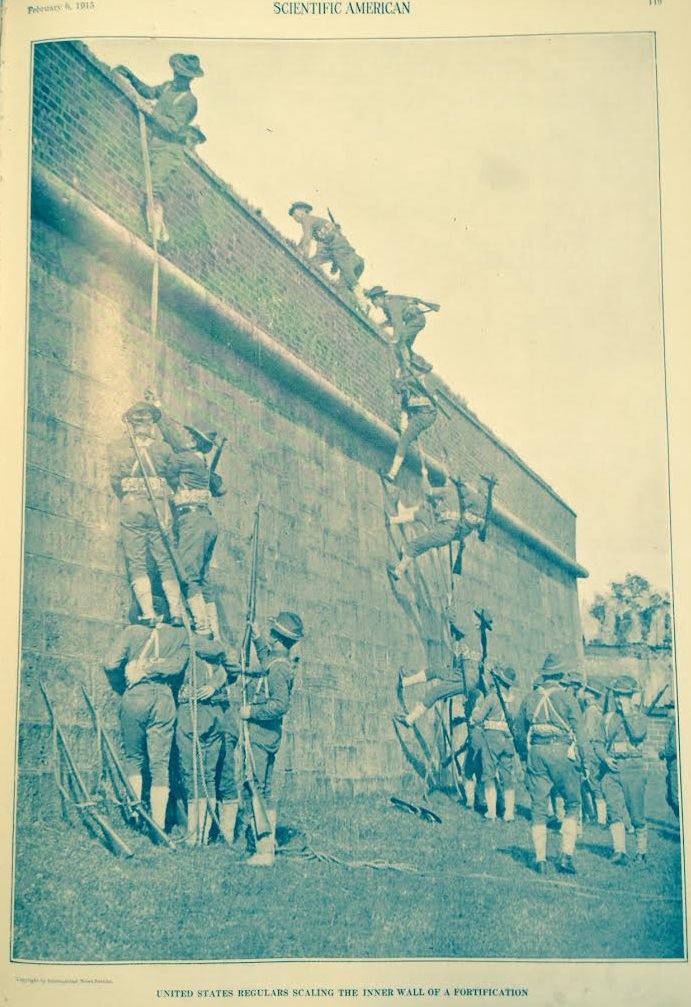
Perhaps the most telling image in that special issue (of 5 February 1915) was an image of soldiers scaling a fortress wall–that’s pretty much the polar opposite of what training should have been happening, what with trench warfare and all. There is also a photograph of practicing cavalry–and not a hint of a tank. There was little or no attention being paid to the developments in aerial/gas/tank/trench warfare, the armaments and munitions of war were ancient-esque, and the standing army numbered around 100,000 (plus 120k in National Guard), which was hardly anything at all compared to the fact the French Army on a single day (August 22, 1914) in the Alsace-Lorraine region lost 27,000 dead and 40,000 wounded, and that there were already 3 million dead/wounded in the European theater. There would be readiness factions and peace factions at work for the heart and mind of the U.S., but that wouldn’t really start for another month or two. In the meantime, though, Scientific American took stock of the military situation, and found that the U.S. was militarily-prepared for almost nothing, so far as global war was concerned.
England was last invaded in 1688 by the Dutch republic, following twelve other attempts from 1066, but Adolf Hitler was half-determined to do so (and several of his leading generals who were not-at-all determined, anti-determined to do so) himself, trying to follow in the lost footsteps of Napoleon with Operation Sea Lion (Unternehmen Seelöwe). Napoleon failed of course, as did his predecessors: three French, two Spanish, and an Austrian attempt since 1707. And so would Hitler, although he would never come close to implementing much outside of his terror attacks on cities in the U.K. and the war waged on the RAF (and particularly Fight Command)–control of the air being integral to any sort of invasion that he might try to mount.
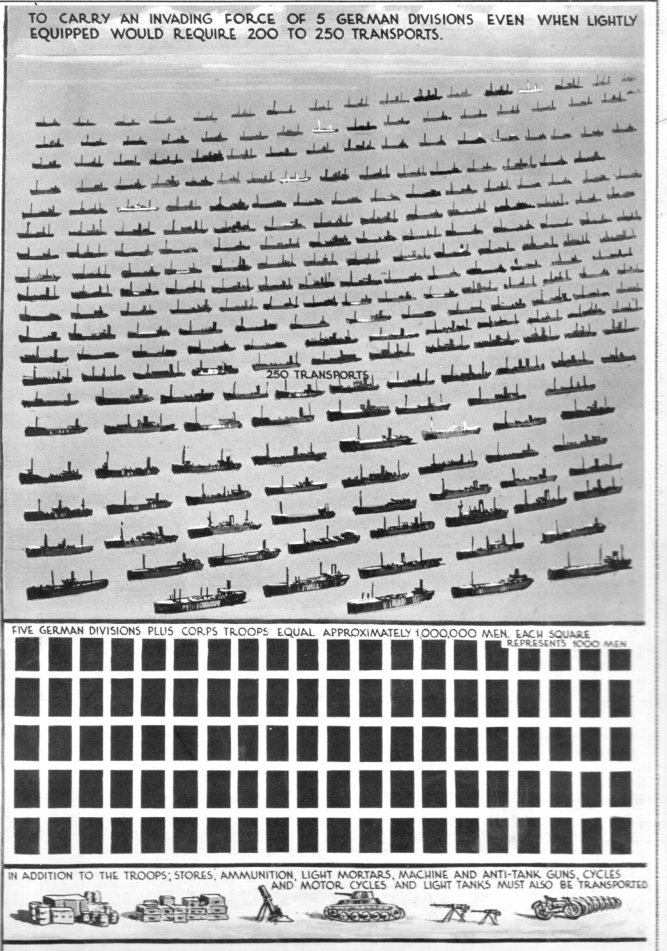
It was at the beginning of this air attempt–the Battle of Britain–that the following interesting small graphic appeared in the Illustrated London News (June 29, 1940), a featurette on what it would require for the Germans to mount a successful invasion of England. Interestingly the Brits had just mobilized their own floatilla for the evacuation of Dunkirk just weeks (26 May-4 June 1940).
The German armada pales in comparison….
Some part of it doesn’t make sense to me, (sitting here quietly in the future, not having Nazis flying overhead trying to kill my country)–like a convoy of troop carrier set at 250 to carry a million soldiers into the U.K. Plus there were all of the stuff of invasion–food, supplies, support, materiel of all shapes and sizes and description, and on and on. The D-Day invasion force used 6,939 vessels, 1,213 naval combat ships, 4,126 landing ships, 864 merchant vessels, and 736 other ships, not to mention the 3000+ aircraft and gliders, all in use toland 156k soldiers along a 50 mile front in Normandy. An utterly understated spectacular undertaking–and no doubt the Germans would have had to do something along similar lines, a lot of something that they just didn’t have. But no one knew this yet, not really.
This small series of graphics probably served two purposes: one was to alert English readers that such an invasion was theoretically possible, and secondly, that, well, it was in some ways impossible, given the enormity of the task. So, beware, but do not fear, is what I think the message was here.
And by the way here are two bits of films about a successful Nazi invasion of England:
A few days ago I was having a look at a Large & Impossible Tank, and today I came across this fabulous beauty from the Electrical Experimenter for February, 1915.
This 45′ monster would be somehow powered by electricity though there is no discernible power source or power train, and it would be steered by a gyroscope. (The use of the gyroscope is interesting–the idea of it acting as a control mechanism had been successfully introduced in the Whitehead torpedo in 1905, and used as stabilizing agents in airplanes and ships by 1910, and found in the first gyroscopic repeater compass by 1911, so the magazine and writer pretty much had their finger on the national gyroscopic pulse of the time.) Being hit by defensive cannon fire was said to have been not too much of a problem because the shells would mostly pass through the lattice work of the structure. The armament in the suspended armored buckets would be “the same as British tanks”–the buckets also came equipped with a bomb chute (if you look closely you’ll see one in action here, the destroyer dropping a bomb on itself) for, well, bombing.
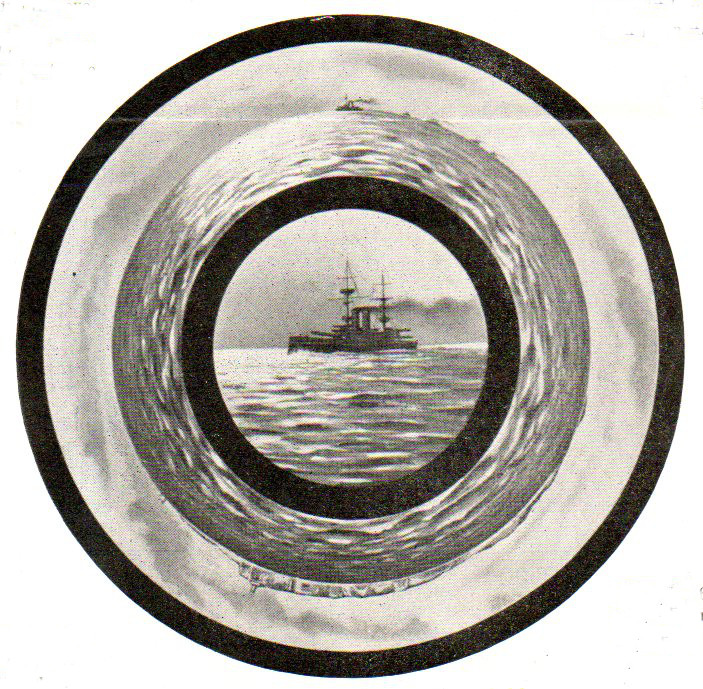
This interesting and arresting images appears in Scientific American Supplement, October 23, 1915 (page 269). It is an excellent view of topside from 30′ or so below. The article describes simple, compound, tele-objective, direct-reflected, panoramic, and periscopes with annular fields–sort of simple, but not really. In any event the panoramic periscope gave a view of a directed point-of-view as well as a slender (but versatile) 360o.
These spectacular images of monumental monumentality appeared in the December 1916 issue of Popular Science Monthly. The author Frank Shuman (1862-1918) had some major inventing chops, not the least of which was some very forward-thinking work (in theory and practice) on solar power (one of which was a solar powered steam engine and another a liquid O2 propulsion system for submarines), so these suggestions for gigantic land battleships came with a fair amount of gravitas. This is some grand thinking, and as Shuman tells us, the beast below would weigh about 5,000 tons (the weight of several hundred Sherman tanks1) and would roll along on 200′ diameter wheels. Unfortunately, outside of seeing some sort of (steam) power plant, there is no mention of how those wheels would be turned–I’d’ve liked to read about that. There is a mention of shock absorbers, but only so, jsut a bare hint.
[Image source is Google Books–I have this volume in a 40 year run of this periodical down in the warehouse, but the book was really too thick to lay flat ont he scanner, and so the Google Books scan was used..]
And for whatever reason there is no heavy artillery on this thing. The damage to the enemy would be done via the three wheels, and also by the enormous chains that hang from the front of the enormity, like a flailing slow-moving monster from a 1950’s B-movie.
My guess is that this wouldn’t do so well in the rain.
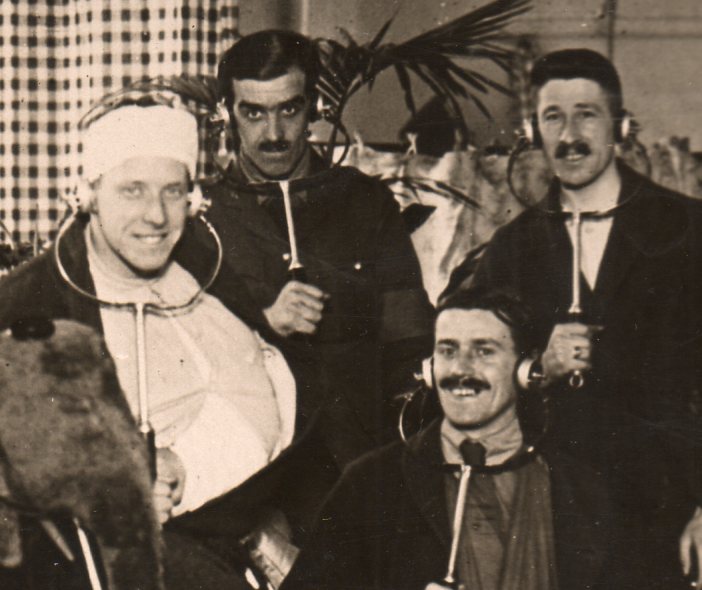
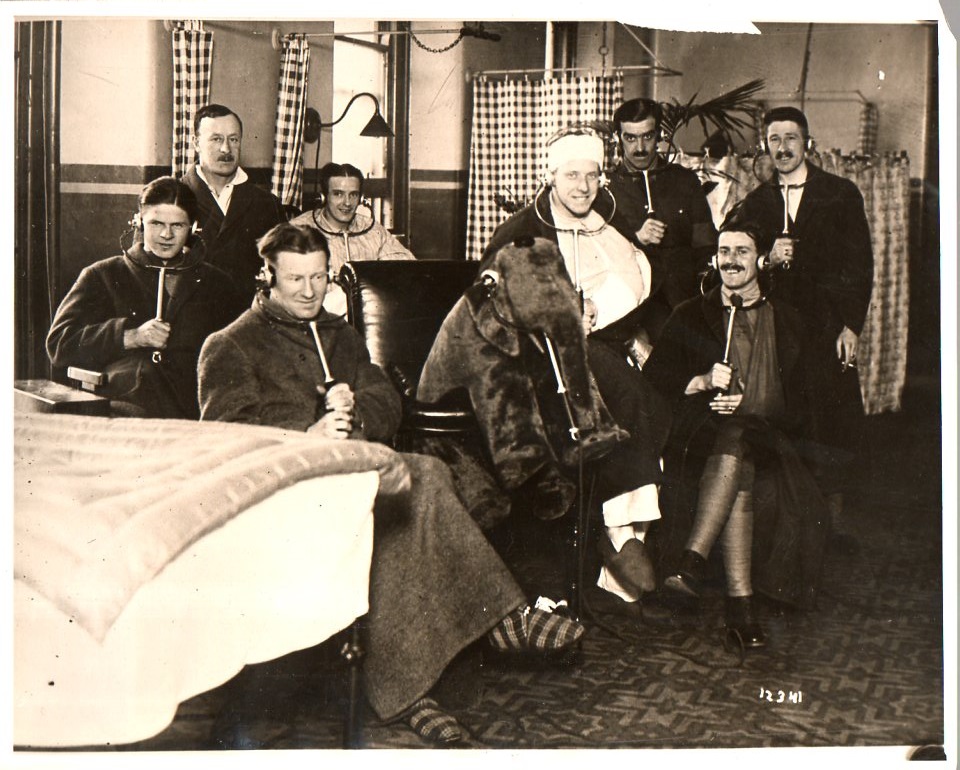
Overall, these soldiers look to be in pretty good spirits, even if they were perhaps told to be so, they still looked fairly genuine. And who wouldn’t be, at least to some degree, being survivors? They were a few of the millions of soldiers who were wounded in WWI, which means at least that they were among the millions of the dead.
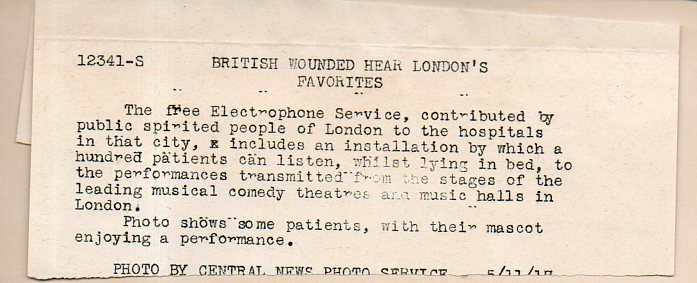
The caption that accompanies these News Photo Service image (made by the Central News Photo Service and dated May 11, 1917, says that they were enjoying the donated headsets–Electrophones–and represented a few of the hundreds that received them. This device was basically a telephone receiver, and years after Bell and Edison dreamed of social integration and advancement and wide-ranging culture, of delivery literature and music to people flung near and far, these soldiers were enjoying the benefit of limited concerts and other entertainments via telephone lines.
[This lovely photograph is available at the blog’s bookstore, here.]
Here’s a very good quote ont he electrophone from the highly interesting The Cat’s Meat Shop, written by Lee Jackson, author of Dirty Old London, the Victorian Campaign Against Filth. (It is an interesting topic–filth and its control–because you really can’t have an Industrial Revolution without lots of workers living close to their jobs, which means that lots of people live close together, and you can’t have that unless you somehow control for good sanitary conditions, which means you’ve got to take care of filth.)
The story of the (very) long-range bombardment of Paris from points unknown is filled with questions in this article that appeared in the Scientific American on April 6, 1918. The writer hadn’t an idea of the type of gun being used, the weight of the shell (yet), and just about all other details. The author did wonder about the reasons for such a gun–that the idea of a long-range indescrimient bombing from a great distance just seemed to be beyond the wanting capacity of the countries fighting Germany.
The big gun was The Big Gun, later identified as the Paris Gun–a mysterious entity during the war, and after the war as well. It turns out that when the Germany army retreated beginning in August that they also destroyed the weapon and just about anything connected to it.
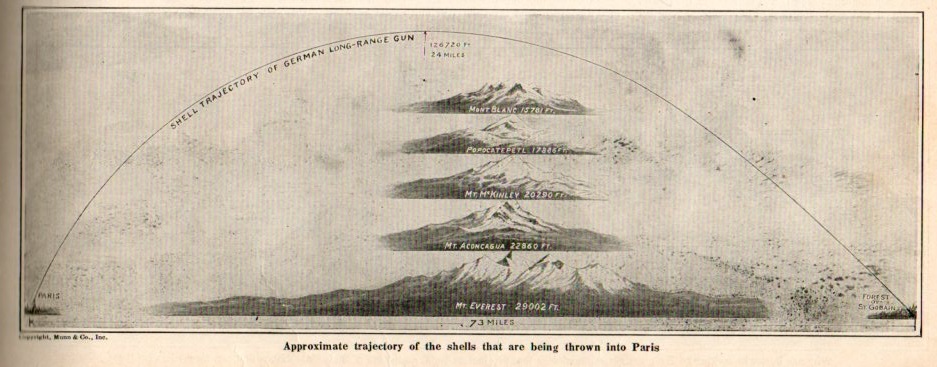
The gun was extremely powerful. At 256 tons it launched a 236-pound shell to a height never before achieved by humans launching/propelling stuff into the air–it left the barrel of the gun at about 1 mile/second, traveled 75 overland miles, reached a height of 26 miles…and then came down, exploding, killing.
One very effective way of explaining the incredible height that the shell reached was measuring the zenith of its trajectory in terms of mountains:
Which is a detail from:
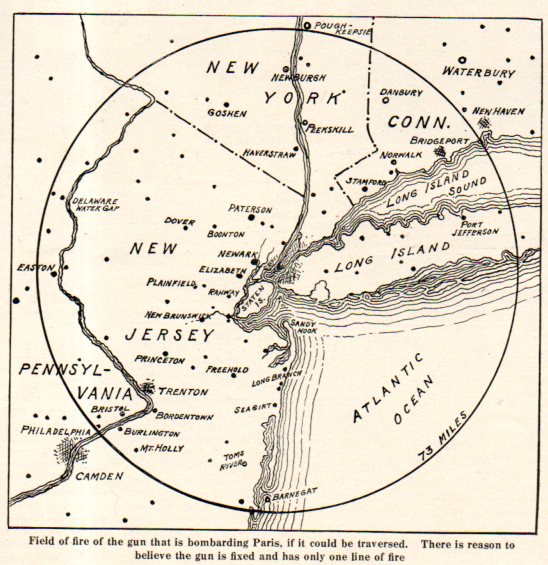
And to give a more local understanding of the range of the gun:
No doubt this map gave a true flavor and sense of dread to American readers on exactly what it meant to have to deal with a cannon whose reach was 75+ miles.
[Source: University of Missouri – Kansas City.http://library.umkc.edu/spec-col/ww2/1939/jive.htm#jive] I made a post just now on German propaganda warning and harrowing the Brits to come to the peace table because Germany was surrounded by non-threatening neutral countries which in effect were surrounding Great Britain. Of course when I posted it I immediately bumped into this piece of music, “Blitzkrieg Baby (You Can’t Bomb Me)”, by F. and D. Fisher. The ong is much like its title, a kind of a neutral song so far as where it stood on neutrality and Blitzkrieg, though it does imply that if the Germans did attack that whoever it was would not be neutral, though that woul dbe stating the obvious. Anyway, it is an interesting find to me, and the performance is first class: greats Lester Young on sax and Una Mae Carlisle singing make this high, um, calibre.