A Daily History of Holes, Dots, Lines, Science, History, Math, Physics, Art, the Unintentional Absurd, Architecture, Maps, Data Visualization, Blank and Missing Things, and so on. |1.6 million words, 7500 images, 4.9 million hits| Press & appearances in The Times, Le Figaro, Mensa, The Economist, The Guardian, Discovery News, Slate, Le Monde, Sci American Blogs, Le Pont, and many other places… 5000+ total posts since 2008.

Category: Information, Quantitative Display of

  • The X-Ray of the Imagination: Internal Dialog, Demons, Humors, and Picturing the Stuff of Thought–On the outer shapes of the inner container

    JF Ptak Science Books   Post 1094

    In an earlier post I wrote about what I thought was the first graphic representation of  the process of forming and imaging a complex thought (found in Francis Galton’s Visualizing Numeracy).
    It is interesting how people tried—over a long period of time—to get at
    exactly that, the inner process, via some sort of external means, which
    is almost entirely left in the not-so-exclusive world of the
    science-like.Blogxrayfludd
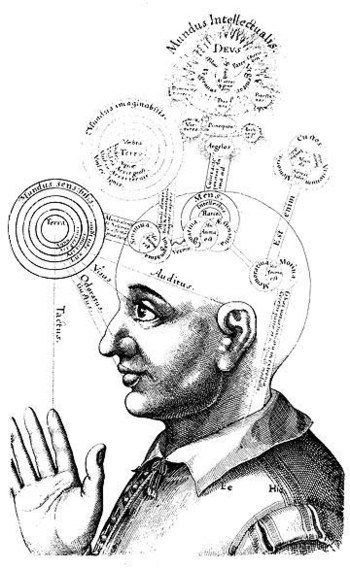
    Perhaps the greatest early effort (and certainly the most beautiful yet) to ascribe physical locations and attributes to the mind was the work and drawings of Robert Fludd.  That would be Dr. Robert Fludd (1574-1637), occultist/philosopher, randy logician and hermticist astrologer pseudo-scientist; and maybe the best of his work is found in his fabulously titled work Utriusque Cosmi, Maioris scilicet et Minoris, metaphysica, physica, atque technica Historia (The metaphysical, physical, and technical history of the two worlds, namely the greater and the lesser…), published in Germany between 1617 and 1621.  Things get very deep and complex and confusing, even in the illustrations; so as far as being a key to human knowledge, Fludd probably relaxed the confusion boundaries more than he strengthened insight—but maybe that was supposed to be his job, what with supposedly being a Grandmaster of the Priory of Sion

    Another great effort in the attempt to physically determine what might be going on inside someone’s brain and mind were the physiognomists. Physiognomy (does it really matter how it is spelled?  I should think that if I was to try and determine how I should spell the word using the very methods its practioners employed that the spelling might change daily…) from the Greek, basically meaning “nature” and “interpret”, claimed an ability to judge the scope of a brain by the shape of its container—the skull.  If a skull was sunken or distended or high or pretty or what have you then this shape in some way related to the development of that area of the brain.  So a high forehead could mean great insight or knowledge or intellectual ability; a low, sloping forehead meant, well, not, and to steer clear of such people with yourBloglavater
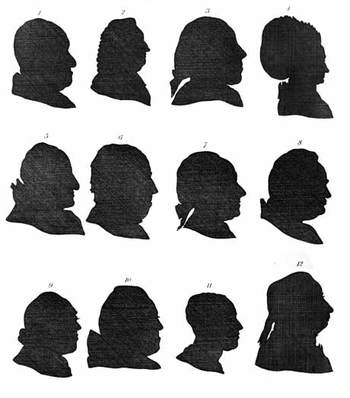
    hand firmly on your purse.  An early practioner was the very formidable Thomas Browne (1605-1682) (in the Religio Medici), but the powerhouse thinker (as it were) was Lavater (1741-1801), who caused and challenged all manner of mischief. The democratic nicety of this pseudo-science is that you didn’t really need to be associated with any extended scientific thought to engage in its application—a nice silhouette-maker would do, along with a series of interpretive and a decent personality was about all you needed.  A nice clear forehead would help.

    Nipping at the heels of Johann Caspar Lavater and company was Franz Gall (1758-1828) and the Phrenologists (from the Greek again, “mind knowledge”), who made a slight step beyond simple head shape by “reading” the bumps and indentations of the skull.  Their educated fingers were in this way were supposed to have the capacity to feel the special elements of that part of the brain manifesting itself via cranial nodules or something.
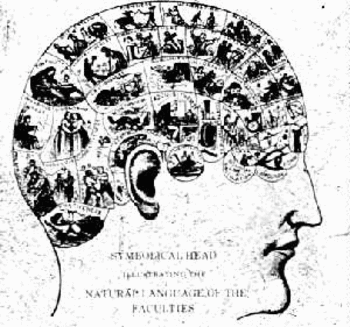
    Blogphren
    Pathognomy was yet another step in the stairs to the flooded basement, where passions and emotions resident in the voice, or gesture, or facial expression, would somehow reveal the structure of the mind.  I found this one pretty curious because it concentrated on the motions of the physical ramifications of the brain, which somehow seemed very elegant in a ghost-like, narcotized way.

    But this is just the attempts to ascertain thought—actually picturing it, literally, was not all that common.  Dreams,Blogxraycruikshank
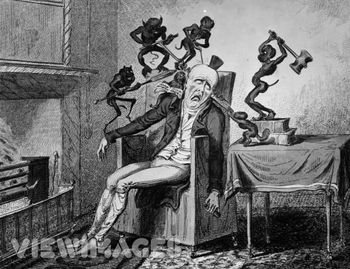
    fears, thoughts, pain, interpretative inner dialog—seems to have occupied artists far less than love or creed or ambition or devotion.  Being able to “see” someone’s pain, or nightmares, was really quite special.

    Thomas Cruikshank made this a sub-specialty for himself, depicting people suffering extreme anguish as a result of gout, or delirium tremens, or fear, and anthropomorphizing them, giving these concerns/fears/pains a human-like quality.  So instead of seeing  a badly inflamed gouty ankle and imaging its pain, we see anti-cherubs, demons, spikey creatures at work on the ankle, pricking it, setting it on fire.

    Bosch of course performed miracles in setting out the fear of the Lake of Fire in very explicit, basic, understandable ways.  In my opinion though the Chinese Hell Screens (as a genre) have Mr. Bosch beat by a long mile, as they were terminally specific in elucidating even what might seem to be trivial transgression for the casual viewer.  (For example, a person who wasted paper would, according to one scroll, spend eternity in a lake of flaming feces, bobbing to the surface occasionally to be stuck in the face by a flaming spear.  Now THAT’S Hell!)

    We have certainly seen people in the throes of nightmare in art, but the relative subtlety of the visions of HenryFuseli
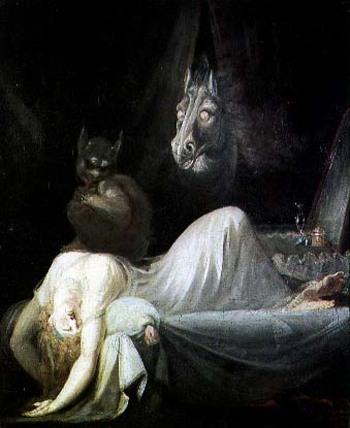
    Fueli (The Nightmare, 1782) and William Blake (“Jeruslaem”, 1820, for example) and of course Fransico de Goya’s “The Sleep of Reason Produces Monsters” (from Los Caprichos) really do wane in comparison to some of the highly explicit horrors of Cruikshank and James Gillray and Thomas Rowlandson.  Perhaps this is so because the later group seems to address the masses and making the nightmare more universal, visiting the ample-butted poor as it would the couch-bound Faintress of the Upper Classes. (I guess I should really remove Goya from the former class, as he really did intend to reach the working poor as much as anyone else.)

    I’ve wondered about the artist Arcimbaldo—the genius portrait painter whose artistic palette was fruits and vegetables—and whether his use of various types and shapes of foods were supposed to correspond to any internal dialogs in the person sitting for him but, well, I think not.  Nice thought, though.

    Most effective though in graphically revealing the inner workings of someone’s mind is, yes, the word balloon, which takes a second seat to its younger sibling, the glorious thought balloon.

    What a fantastic creation!

    The word balloon, or the idea for it, exists for quite some time in Mesoamerica, incised in sculptures from 1000 yearsBlogxrayyellow_kid
    ago.  (See Hull, Kerry Michael (2003). “Verbal Art and Performance in Ch’orti’ and Maya Hieroglyphic Writing”).    Something that we begin to recognize in a more modern form comes up in the 12 th century with word scrolls—elegant, flowing, appealing bits of fabric upon which the words of the person in the painting are written.

    Word balloons really come into their own in political art in the 18th century (and do have a very curious, artistic affect in their longish, elongated appearance with tiny 3-point type inside).  Sometimes the word balloons look like smoke with words in it—these might be my favorite, as they give the clear impression of the immediate and dissipating nature of most speech.

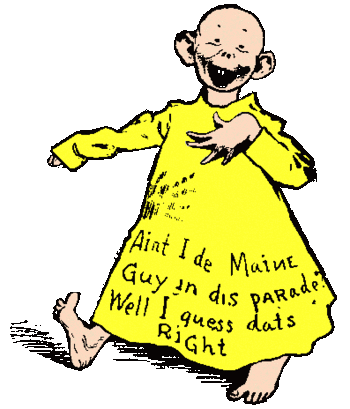
    The Yellow Kid, generally acknowledged as the first “cartoon character”, at first had his speech written directly on his flanged shirt.  It was around 1896 (I think!) that the words moved from his apparel and into a balloon over his head.

    The most beautiful innovation though came a little later (exactly when I’m not sure, I’m sorry to say) with the invention of the thought balloon.   What a magnificent idea!  Why hadn’t this concept been employed earlier, anyway?  How come it took until that unparalled period of time—1895-1915, when virtually everthing became “modern”, when just about everything (save politics, unless you include the creation of the concentration camp) experienced a paradigm shift—and not earlier?  Certainly it is common and debased, and runs amok with the very idea of art and its attempt to show the viewer the inner machinations/beauty of its subject; but wouldn’t it be interesting to have the thought balloon for Lisa Gheradini (the wife of Francesco del Giocondo, “Mona”)?

    Well, probably not.

    But the thought balloon–bubbly, cloud-like apparitions above its thinker’s head—certainly has it place, and isBlogthought_bubble
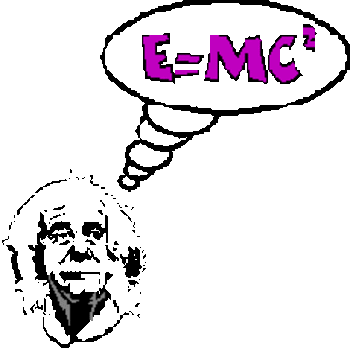
    absolutely a more elegant invention discerning thought than Lavater or even the lovely Mr. Fludd could ever dream.
  • A Few More Trees in the Display of Information

    JF Ptak Science Books   Quick Post


    Tree_of_life_by_Haeckel det
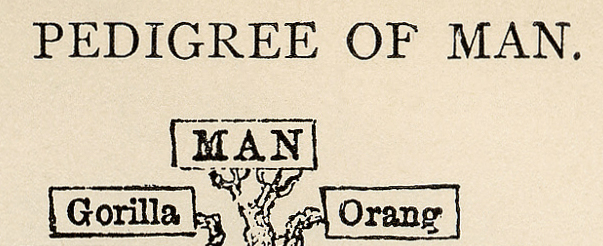
    I’d like to add the few images below to a developing thread on the use of trees in diagrammatic displays of information as seen earlier on this blog in the following posts:

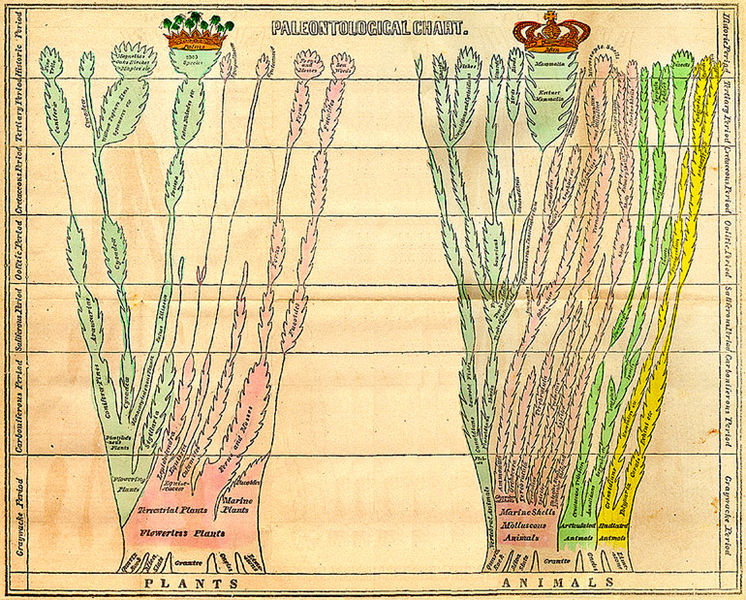
    This is a distinctive utilization, featuring a king and queen versions of the tree/plant display, this by Edward Hitchcock (1763-1864) in his Elementary Geology, published in 1840, and showing paleontological chart of trees andplants:

    Tree--edward Hitchcock
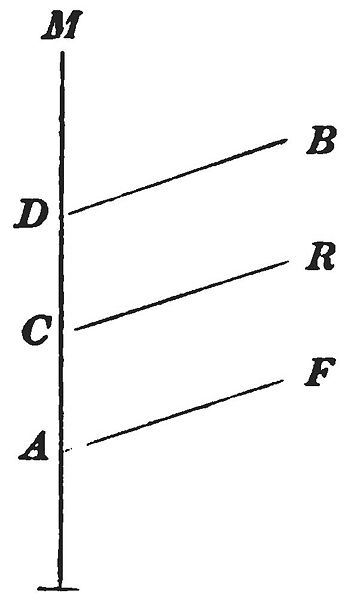
    At about the same time came this outline for a tree diagram, (of embryonic development), from Robert Chambers, Vestiges of the Natural History of Creation, printed in 1844, and which shows a model of development where fish (F),
    reptiles (R), and birds (B) represent branches from a path leading to
    mammals (M):

    Vestiges_dev_diag
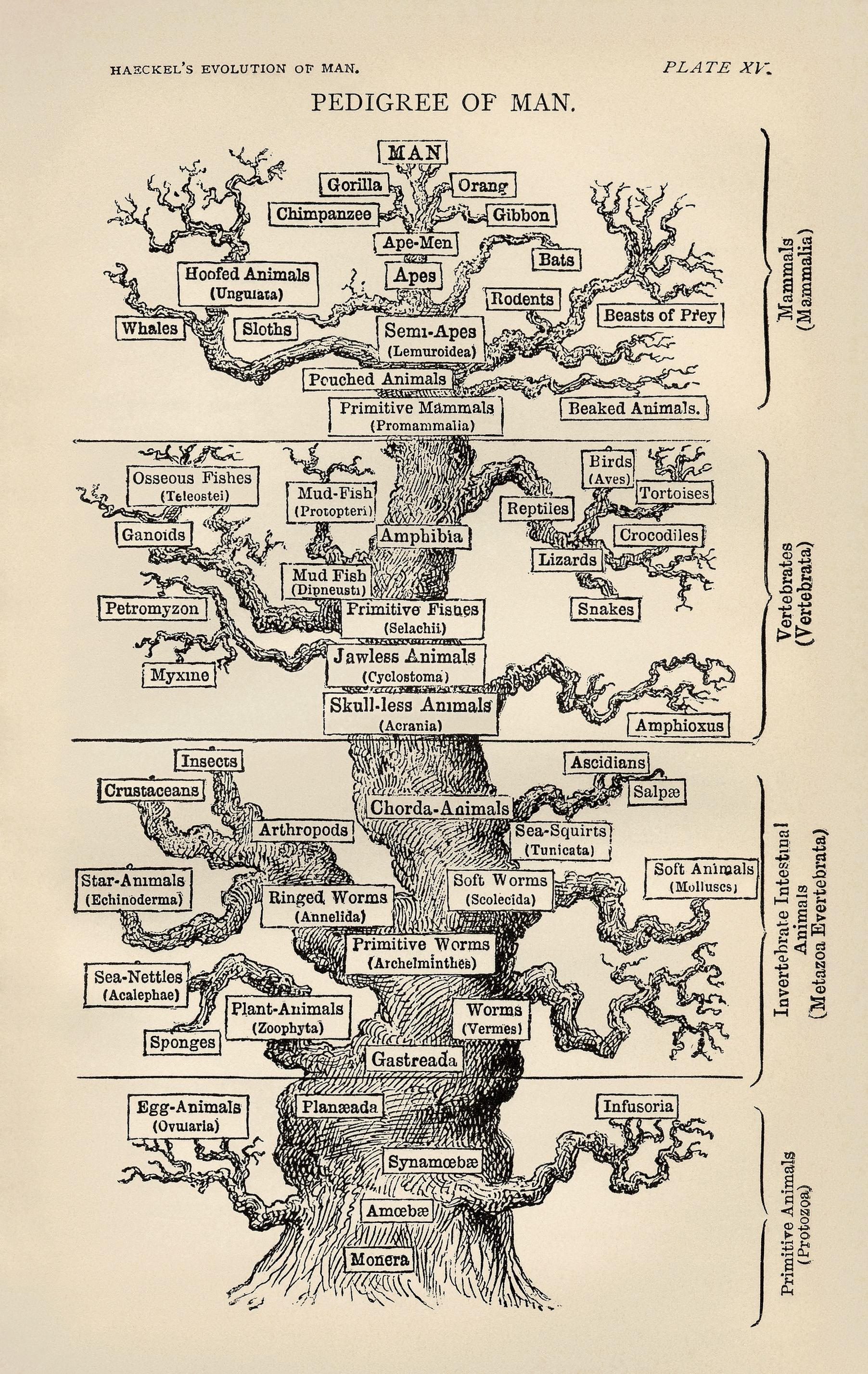
    And somehow in the different representations of the tree of life by Ernst Haeckel I failed to include these three very famous renderings, the first made for an English-language edition of his Evolution of Man, which appeared in 1879:

    Tree_of_life_by_Haeckel
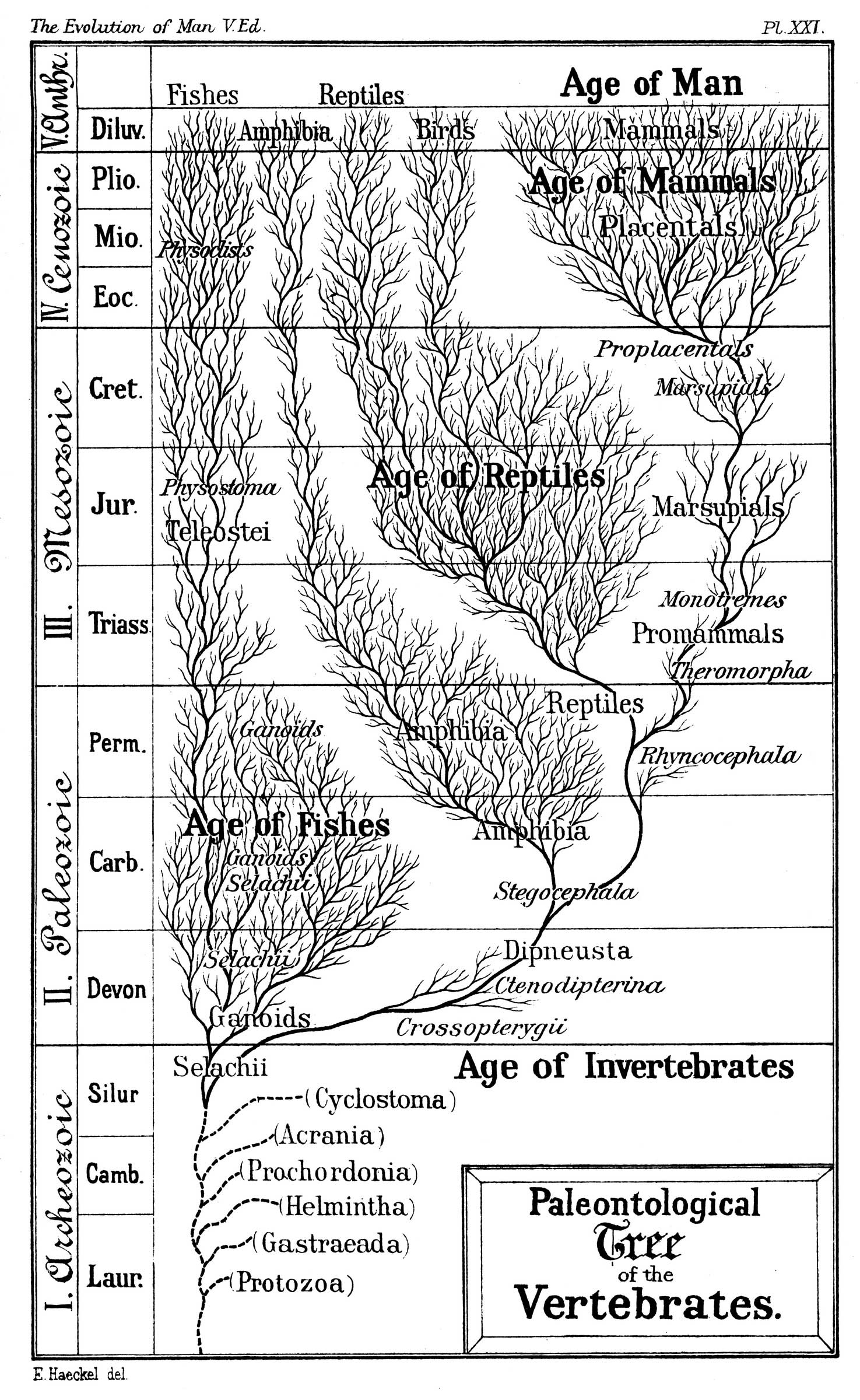
    And this version, which appeared in the fifth edition of his Evolution of Man, printed in London in 1910:

    Age-of-Man-wiki

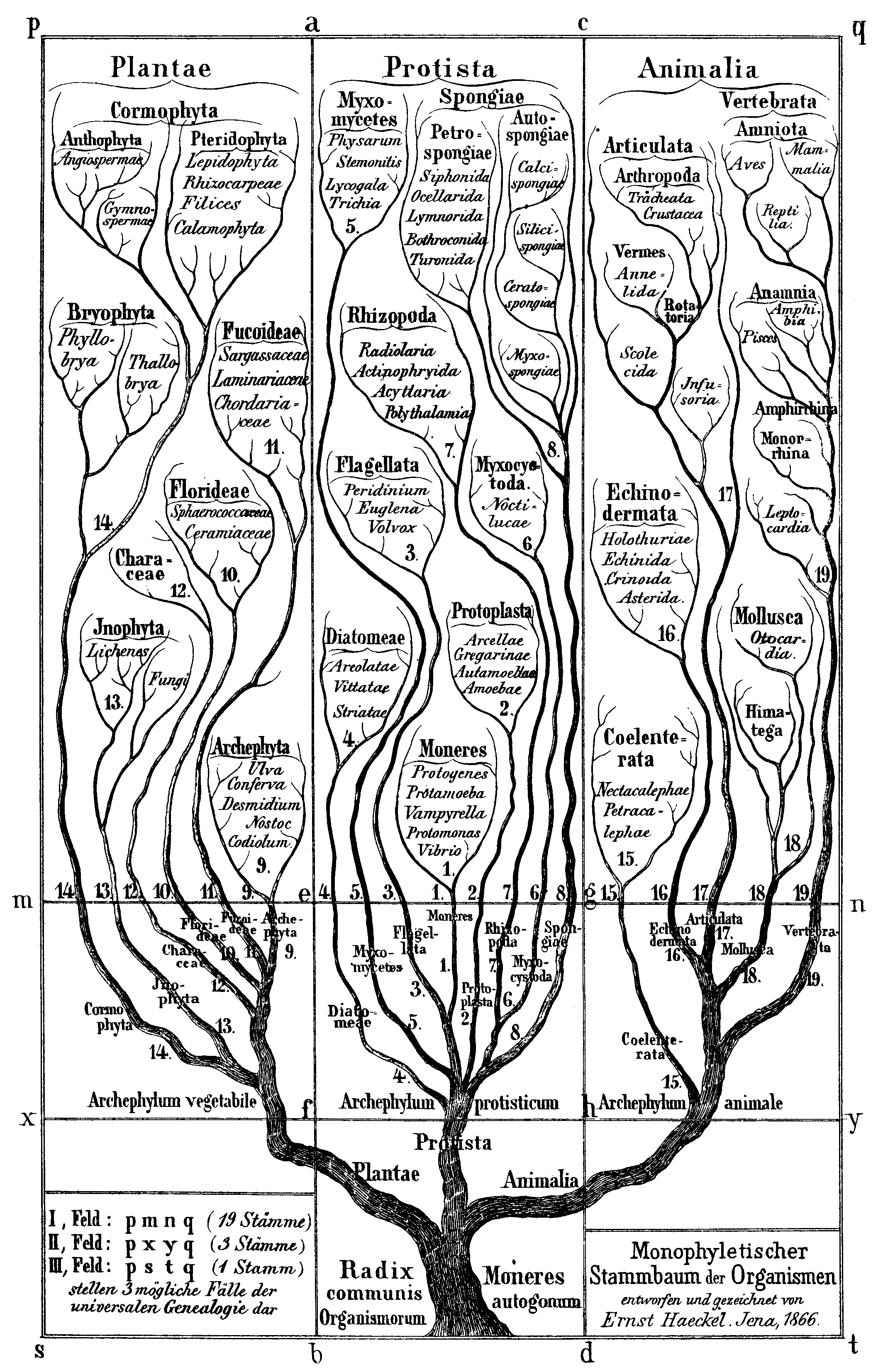
    And yet another, this one much earlier, in 1866:

    Haeckel_arbol_bn


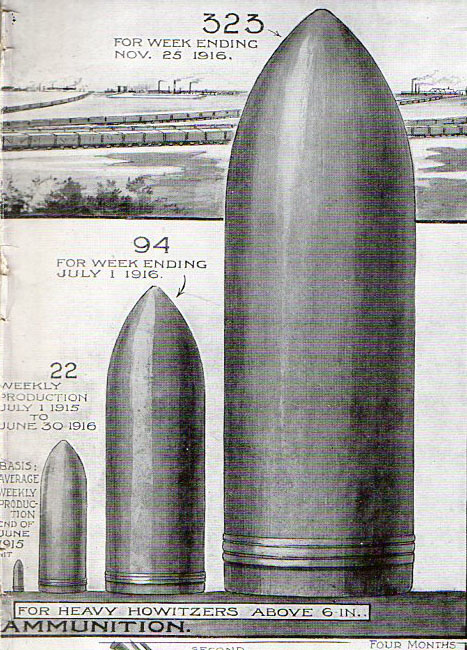
  • Big Time Big Bombs–Great Infographic, 1917

    JF Ptak Science Books   Quick Post 
     
    Follow Me on Pinterest

    I don’t often see graphical displays of quantitative data utilizing quite so many images of shells, even when the image is comparing ammunition production.  This striking example is found in The Illustrated London News for July 15, 1917. 


    Bombs994


  • Statistical Atlases and the Artful Display of Massive Data

    JF Ptak Science Books   Quick Post   

    Follow Me on Pinterest


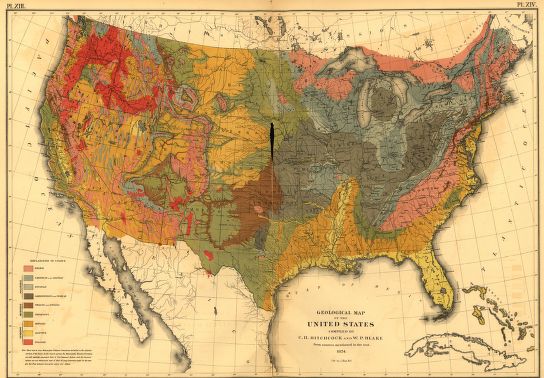
    Statistical Atlas 1870 geo map[Geological map of the U.S. from the 1870 U.S. Statistical Atlas, here.]

    Even though I have used (and owned) these atlases over a long time I’ve never collected them together in any of the 2600+ entries (2036 longer posts and 500+ Quick Posts)  that I have made to this blog.  So today I include links for the atlases in their entirety, as found on the sumptuous site of the Library of Congress. The books are interesting, fascinating, captivating, and beautiful.


  • Engraving Slow Motion–a Paper Filmstrip from 1844

    JF Ptak Science Books  Post 2036 

    Follow Me on Pinterest


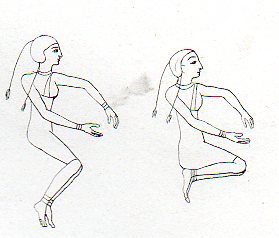
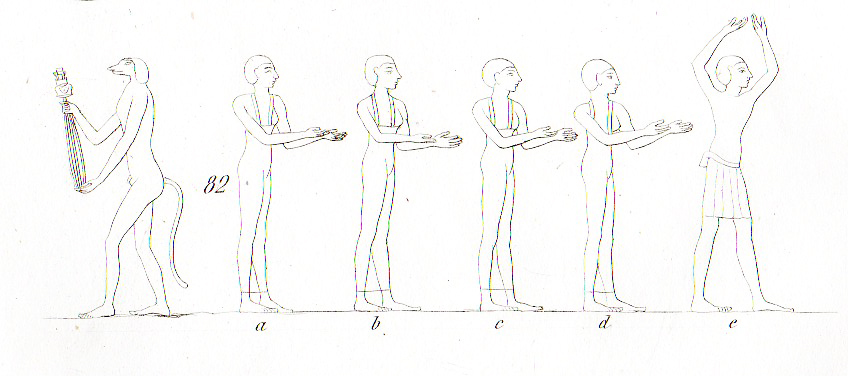
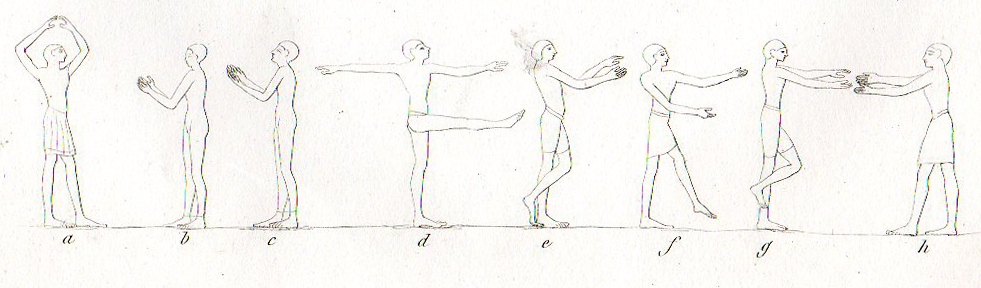
    It was a curious thing to find, these engraved images of Egyptian dance and movement, seeming for all the world like motion shorthand, a sort of antiquarian Labanotation or kinetography.  They appear in the stray atlas volume here by Juste Adrien Lenoir de La Fage (1801-1862), Histoire Generale de la Musique et de la Danse, which was published in Paris in 1844. I imagine that this is a surprise mostly to me–the Egyptians certainly knew that tey danced, and from the looks of it, they danced with athleticism. 

    Egyptian d347[Text can be found at the Haiti trust.]

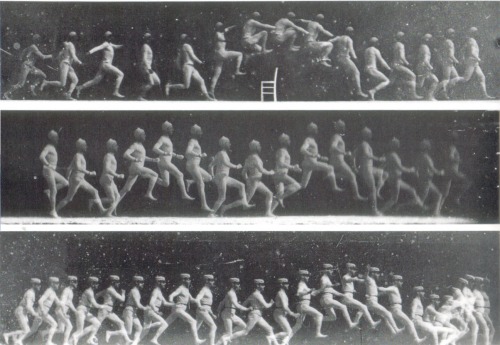
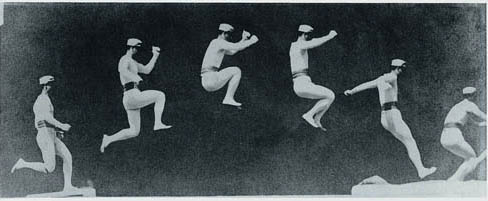
    Most of the surprise part of this–the opening the book and having a sense of the “aha!” and deja vue— were these images’ association in my head with the work of the motion picture pioneer and all-around smart guy, Etienne Marey, who in the 1870’s created what was essentially the
    world’s first “slow motion” device. One iteration of Marey’s apparatus
    was basically a long series of ganged cameras recording a motion for a Marey12
    simple task at a given time frame and presented on a continuous strip
    of photographic paper, sort of like a motion picture with the camera
    speed set at three frames per second. The resulting images were
    phenomenal and showed people for the first time the exactness of all
    manners of simple motions–motions that no longer looked so “simple”
    once all of its aspects could be studied from captured photographic
    evidence.  Even the act of hopping over a small stool or bending to pick
    up a bucket of water were enormously revealing in a way like Robert
    Hooke’s Micrographia displayed the great detail and complexity
    of the seemingly simple fly.  Perhaps the most famous of Marey’s series
    of images was that of a galloping horse, which also for the first time
    revealed what exactly the horse’s legs were doing and proving that
    almost every painter in the history of art represented the galloping
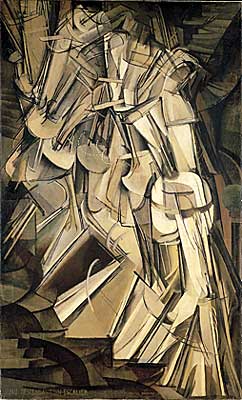
    horse incorrectly.  His series of photographs (as in the samples above and below)
    show a fairly close fit to the work of the futurists (like for example
    Duchamp) who would come into being after another four decades.

    Egyptian a343But the la Fage comes earlier still–granted, they are engravings, and they don’t necessarily all show a progression of movement, though some of them do–but it makes them very interesting in a capturing-the-moment way like few people had done before.

    Marey sequence
    La Fage, 1844:

    Egyptian b344

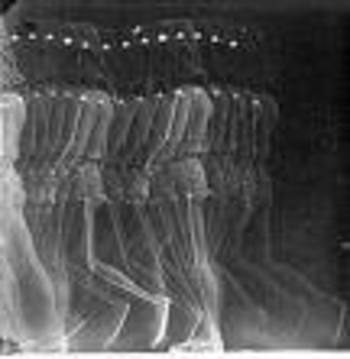
    Etienne Marey, ca. 1875:

    . 

    Marey 

    And Marcel Duchamp’s Nude Descending (1912):

    Duchamp


  • A Shining Singularity of 1896–the Glory of Lost Hardware Stores

    JF Ptak Science Books   Post 2032  

    Follow Me on Pinterest


    When I was a kid I liked to go to Reiman’s hardware store on Victory Blvd., Staten Island, New York, where there was everything and everything was in its place, though not every place was in its place.  There was a certain untidiness to the store that made it seem as though everything was a jumble, except it wasn’t.  The order was controlled by a collection of hardware men who seemed to know everything and absolutely knew where everything was.  I would walk in, go to the back, hold up the widget that I needed to the Old Man, and then he’d go to a half-wall filled with tiny boxes filled with tiny things, and find what I needed–or something better. The store was biggish, but very quiet, given all of the surface area of all of those thousands of tiny cardboard boxes.  It was all enveloped with the hardware store equivalent of the old bookstore aroma. 

    These were the thoughts that sprang to mind when I saw a post at the SecretPlans.org site displaying that robot-like figure riding the hardware bike. It is found in what must be the bible of 19th century books on the keeping of a hardware store, appropriately titled The American Hardware Store, written by R.R. Williams in 1896. It is remarkable for its organization and for its lovely presentation.  And of course for its very prominent  display of memory of what was necessary in building and maintenance from a hundred years ago.  There are instructions to the store owner on what and how to exhibit, with images of displays of axe heads, hurricane lamp glass,scythes, plumbs, hatchets, horseshoes, scale beams, belts, pumps, oil cloths, and much more of the stuff that is mostly gone.

    Thanks to this manual I think that when you go back in time and into that hardware store of 1896 you’ll be ready.


  • Symbols in Francis Bacon’s Beautiful “Instauratio Magna”, 1620

    JF Ptak Science Books  Post 2029  Follow Me on Pinterest

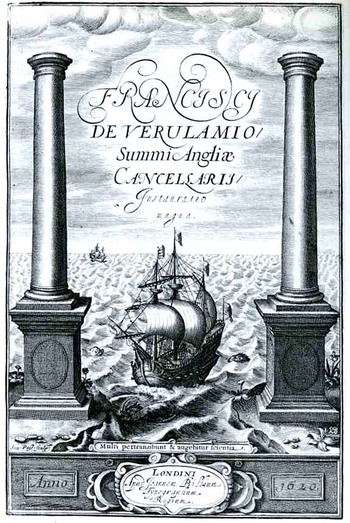
    Blogbacon038

    This sweepingly metaphorical title page belongs to Francis Bacon’s (1561-1626) superb Instauratio Magna, printed in 1620.  Bacon, the privileged and brilliant son of Nicolas Bacon, the Lord Keeper of the Seal of Elisabeth, entered Cambridge at the age of 12 and never looked back, becoming one of the leading thinkers of the English Renaissance. 

    The Instauratio contains his Novum Organum  (The New Oganon [New Instrument], or true Directions Concerning the Interpretation of Nature) a monumental pronouncement and a new way of looking at scientific thought, looking to break away from the established Aristotlean methods that had been in place in England and Europe for centuries. The “new instrument” part directly relates to Aristotle’s own work called Organon, which in short was a work of inquiry and a treatise on logic and syllogism—Bacon would present his own new instrument of logic base upon a simpler process of reduction. (Bacon famously begins this work “Those who have taken upon them to lay down the law of nature as a thing already searched out and understood, whether they have spoken in simple assurance or professional affectation, have therein done philosophy and the sciences great injury. For as they have been successful in inducing belief, so they have been effective in quenching and stopping inquiry; and have done more harm by spoiling and putting an end to other men’s efforts than good by their own.”  He continues in this vein, getting to the real crux of the biscuit, and broadly states in the second paragraph “Now my method, though hard to practice, is easy to explain; and it is this. I propose to establish progressive stages of certainty. The evidence of the sense, helped and guarded by a certain process of correction, I retain. But the mental operation which follows the act of sense I for the most part reject; and instead of it I open and lay out a new and certain path for the mind to proceed in, starting directly from the simple sensuous perception…”  And how!) This new approach to knowledge was foremost in the mind of the designer and artist who produced this title page, which is deeply indebted to the analogy between the (very deeply ingrained and mature) age of exploration and that of intellectual discovery.
    Blogbacon_bits

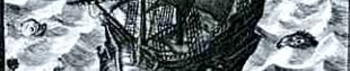
    The ship in this scene is passing through the Pillars of Hercules, exiting the relatively safe waters of the western Mediterranean and heading out to sea—-to accent this point we see two sea monsters at either side of the ship right at the beginning of this new-world trip, just feet beyond the established safe perimeter.  The pillars had long since been recognized as the western end of the world, as recognized by Dante in the Inferno, observing the voyage of Ulysses past the pillars, endangering the lives of his sailors in the justifiable

    Blogbaconplus_ultra
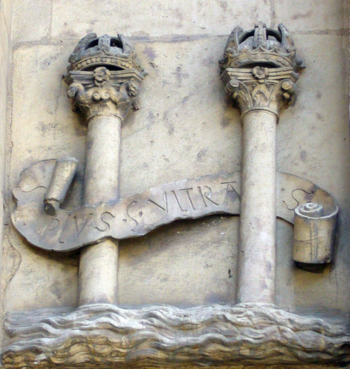
    search for knowledge of the unknown.  The Pillars appear in the coat of arms of Spain, originating with Charles V (the Holy Roman Emperor and also the King of Spain), with motto plus ultra (“further, beyond”) The plus
    ultra part fits nicely with the Bacon, even though the words are not there in the image, they really should be, emblazoned across the stern of the ship of Bacon’s imagination and intellectual enterprise.(The great voyage of discovery analogy and the  great new discovery in thought is probably painfully clear already.)

    Blogbacon_bits_latinThe image is captioned and summarized with the Latin phrase “Multi pertransibunt et augebitur scientia”, wrenched from the triumphantly problematic and slightly insane Book of Daniel (chapter 12, verse 4).  It is translated loosely as “many shall run to and fro, and knowledge shall be increased” or more elegantly “many will pass through and knowledge will be increased”—either way, whether by direct adventure and exploration or frenetic activity, the act of a new effort will be rewarded with a new knowledge.
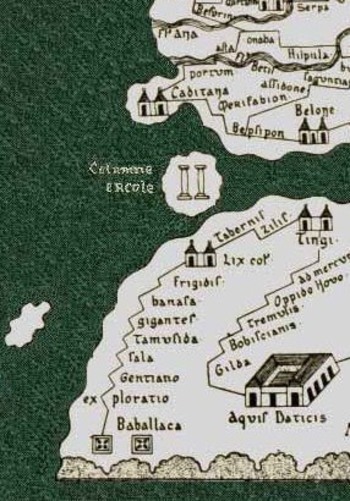
    The image below is from the Tabula Peutinger–basically a roman-era road map of the extent of Empire–and shows the location of the pillars.  They were mountainous metaphors existing at Gibraltar and Morocco, but folks were only too happy to relieve them in marble.

    Blogbaconpillars_2


  • War Gas Paper Calculator, 1942

    JF Ptak Science Books   Quick Post

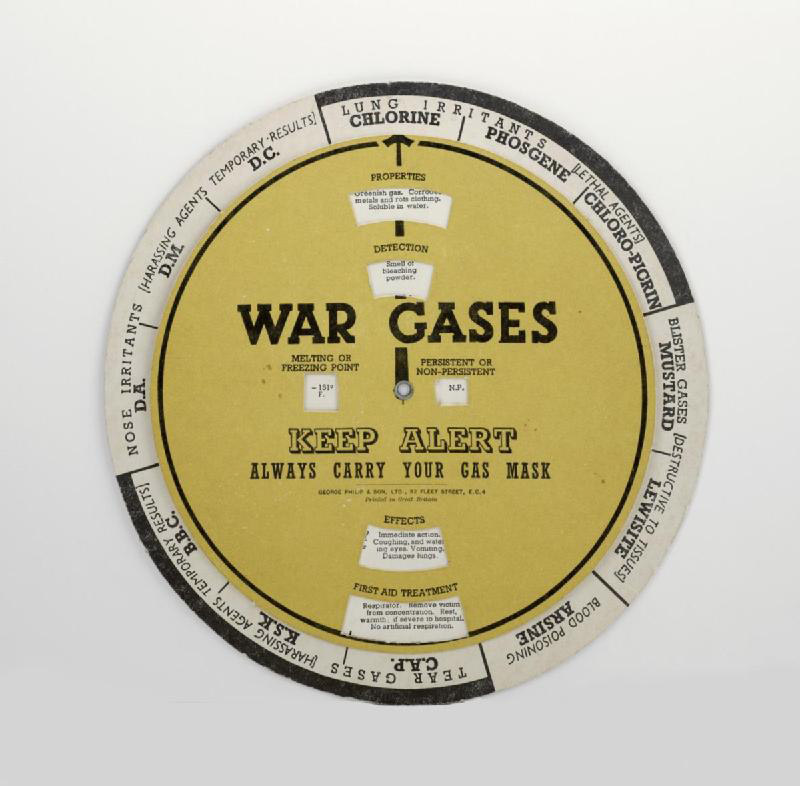
    I found this very interesting paper calculating device (ca. 1940) on the Imperial War Museum site (here):

    War Gases
    I came to the IWM site via the St. Marylebone WWII site and the section on Air Raid Protection because of unearthing this elegant sticker in one of my pamhlets:

    Marylebone285


  • Propaganda Maps: the Big Lie and the Surrounding Threat to Germany, 1927

    JF Ptak Science Books  

    Bloggermany_surrounded328

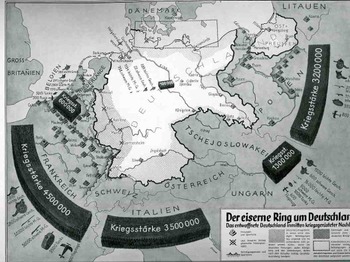
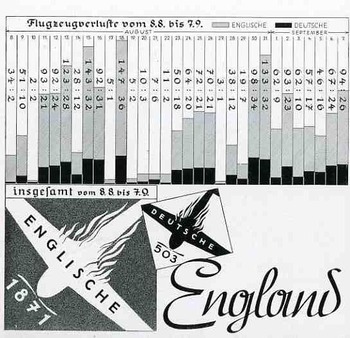
    These two displays come at different ends of the beginning of WWII and, in a way, couldn’t be further away from themselves in the stories they were trying to tell(some truth, some fiction), and were separated in time by  11 years or so.   The first “Der eiserne Ring um Deutschland” (“The Iron Ring and Germany”) shows Germany surrounded by imaginarily aggressive (and aggressively-portrayed) neighbors nine years after the end of WWI.  They both display subsets of the Big Lie superset described by Hitler in 1925 in Mein Kampf (actually, sort of better described by the German term Lügenfabrik, or “lie factory”, used by Goebbels in his descriptions of the British.  The “Big Lie” was basically a lie so big and so preposterous, so outrageous, so impossible, that no one would possibly utter something so insane and dubious, and so therefore the massive untruth is taken as true.) 

    This representation depicts the threat posed to Germany-making an iron ring-by the potentially hostile French, Italians, Belgians, Czechs and  Poles.  It shows the ring composed of a combined army of 13.1 million men versus the standing army of Germany, which in 1928 was given as 100,000, and listing virtually no heavy weapons and no air force whatsoever.. (The interesting bit here is that neither the Soviet Union nor Great Britain is included in these aggressive forces, the Soviets less-so than the English.)   The designer goes so far as to shade in areas of Germany that were under immediate threat, extending from the Donau to the Rhine, to a 50-mile-wide area all around the country, with East Prussia almost entirely consumed.  (Certainly the Treaty of Versailles was a very troubling document closing the end of the war and, it cam be argued, opening the door for the next one.  It took six months to sign the peace treaty following the cessation of hostilities in November 1918, and the troubled negotiations produced a troubled treaty, ripping Germany up and saddling it with unrealistic retributions that began to wither in only four years, with the treaty virtually dissolved by 1935.)

    Blognazi_brit_aircraft325

    It is no wonder when looking at propaganda such as this that Germany was immured with fear of national collapse at the hands of land-hungry neighbors, and that there was a huge need to re-instate the army and a system of “self protection”.    (By 1936, only 8 years later, it was beyond question about what Germany was up to-I can say that after having at least breezed through every page of the Illustrirte Zeitung (Leipzig)  from 1930-1940, that even a very casual reader could’ve tracked, graphically, the interest in military reporting and militarism in the page’s of what would’ve been the German equivalent of LIFE magazine.  By 1935 there was so much glorification of weapons and the Nazi manifesto that it should’ve been a surprise to no one when the Germans moved into their neighboring countries.)  This was by no means the earliest depiction of this rampant sale of fear or fear mongering (a design which has existed for thousands of years and not at all a creation of the present republican administration), but it is a very big and bald one, a somewhat staggering one, a bright shining lie.  (A Bright Shining Lie by John Paul Vann is by the way a great book on American involvement in Vietnam.) 

    The second image, a graph showing the successes of and very limited damage to the German Luftwaffe at the beginning stages of WWII, in August 1940.  This was a bad time for the Allies, this part of the war coined by Winston Churchill in 18 June 1940 in the House of Commons:  “The Battle of France is over. I expect the Battle of Britain is about to begin”. 

    Hitler’s Luftschlacht um England would start by air, where the Brits were far less the equal in military capacity, rather than by a land/sea assault, which would’ve tested the British at their strengths.  This second part of the assault on England was Unternehmen Seelöwe, or “Operation Sea Lion”, which would’ve begun the land assault following the victorious air campaign. 
    The graph shows aircraft losses from 9 July to 8 August, 1940, the German losses in black, and the British in gray.  As you can see, it was a pretty lopsided affair, made even more dramatic by the fictitious number of English planes being destroyed.

    This would all change, of course, with the Germans losing this battle, in a big way, with a resulting decisive victory for the Brits. (Who would of course muscle their way through the war another seven months before the U.S. was attacked and entered the war.) . It would coming to a screeching and collapsing reverse for the Germans by May 1941.  The results of the battle, in terms of aircraft and humans, were,  for England: 1,023 fighters: 376 bombers, 148 coastal command aircraft  for a total of 1,547 aircraft and  544 pilots and aircrew killed.  There were also 27,450 civilians killed and 32,138 wounded.  The Germans lost 873 fighters and 1,014
    bombers for a total of 1,887 aircraft and  2,500 pilots

    I could find no graph of course showing the results of the endgame in the Zeitung.


  • Some Ancient Forms of Numbers

    JF Ptak Science Books  Post 2030

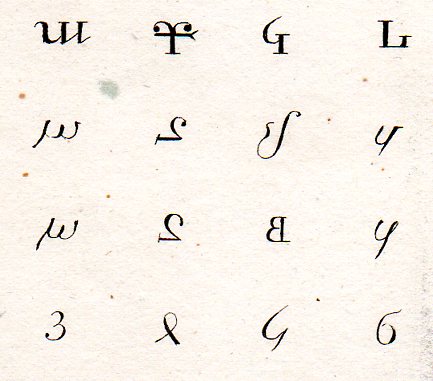
    With “all” of the recent talk about prime numbers I thought to post this elegant and small summary of the different ways of writing numbers.

    Number history316Above is a lovely detail of a collection of “ancient arithmetical characters”, including notations for the numbers 1 through 9 by “Boethius, Plenudes, al Sephadi, Sacro Bosco, Indian, Roger Bacon, and AL Sephadi”.