A Daily History of Holes, Dots, Lines, Science, History, Math, Physics, Art, the Unintentional Absurd, Architecture, Maps, Data Visualization, Blank and Missing Things, and so on. |1.6 million words, 7500 images, 4.9 million hits| Press & appearances in The Times, Le Figaro, Mensa, The Economist, The Guardian, Discovery News, Slate, Le Monde, Sci American Blogs, Le Pont, and many other places… 5000+ total posts since 2008.

Category: Future, History of the

  • A Really Big Idea: the 5,000 Ton Tank (1916)

    JF Ptak Science Books   Post 2389

    These spectacular images of monumental monumentality appeared in the December 1916 issue of Popular Science Monthly.  The author Frank Shuman (1862-1918) had some major inventing chops, not the least of which was some very forward-thinking work (in theory and practice) on solar power (one of which was a solar powered steam engine and another a liquid O2 propulsion system for submarines), so these suggestions for gigantic land battleships came with a fair amount of gravitas. This is some grand thinking, and as Shuman tells us, the beast below would weigh about 5,000 tons (the weight of several hundred Sherman tanks1) and would roll along on 200′ diameter wheels.  Unfortunately, outside of  seeing some sort of (steam) power plant, there is no mention of how those wheels would be turned–I’d’ve liked to read about that.  There is a mention of shock absorbers, but only so, jsut a bare hint.  

    [Image source is Google Books–I have this volume in a 40 year run of this periodical down in the warehouse, but the book was really too thick to lay flat ont he scanner, and so the Google Books scan was used..]

     And for whatever reason there is no heavy artillery on this thing. The damage to the enemy would be done via the three wheels, and also by the enormous chains that hang from the front of the enormity, like a flailing slow-moving monster from a 1950’s B-movie. 

    My guess is that this wouldn’t do so well in the rain.  


  • The Coming of Broadcast Television (1929)

    JF Ptak Science Books   Post 2388

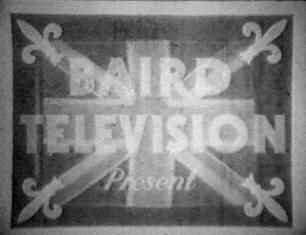
    I found a news item in the April 6, 1929 issue of Nature that gives a real sense of the coming of the future, of the future-at-hand–and they seemed to have a sense of what was coming, though probably not as big as that future would be. In this case, it was the beginning of the passive visual assumption of the collective culture–the very quick and potentially immediate assimilation of pop culture, this by the invention of television and popular broadcasting.  

    Baird_tv_caption

    The unidentified author was reporting on the recent activities of the Baird Television Development Company, which the author was interested in, and although it was “not presently practicable ” it did “represent(s) a noteworthy scientific achievement”, which I am sure was the writer’s way of downplaying a very significant event.


  • Millions of Miles of Hole-Filled Paper–Dystopia, Entertainment, Vonnegut and Prison

    JF Ptak Science Books 

    {Part of this blog’s History of Holes and History of the Future series.]

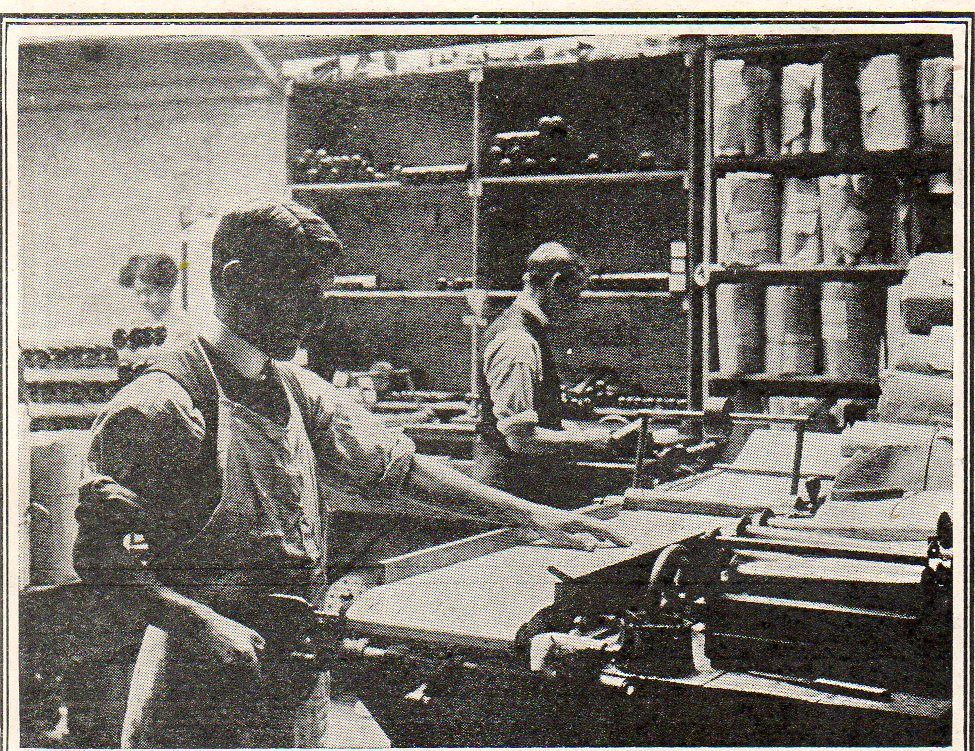
      Music role making--1871 There is a certain layered, geological dystopic quality to the  images of these men laboring at producing piano rolls for player pianos (and found in The Illustrated London News for 18 December 1909). This is true especially for the details, the small boxes in the background to where the rolls are being “processed”–music pounded out with metal points on a hard surface, as though produced by whatever it was that was in those little labeled wooden containers, far removed from the artistry of melody. These are images of a culture being made into hundreds of thousands of miles of hole-filled paper.

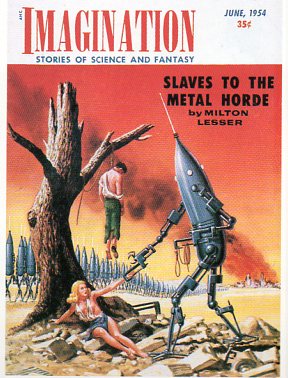
    The piano roles remind me of automatons replacing humans in entertainment, and then replacing the humans making the piano roles; of machines taking over the jobs of people writ large.  There’s a long and rich literary history of this idea, not the least (or first) of which is the appropriately-named Player Piano, Kurt Vonnegut’s first novel, written in 1952.  Like a tiny idea-machine, Vonnegut manufactured part of his tale from Brave New World, with Huxley having taken his bit from an earlier novel, We, written by Yevgeny Zamyatin in 1921–they’re all bleak images of a future dominated by machines, the humans acquiring numbers for names, like the replaceable and expendable units they became. 
    (Artwork by Malcolm Smith for Imagination, June 1954.)

    Robots in ocntrol--hanging human879

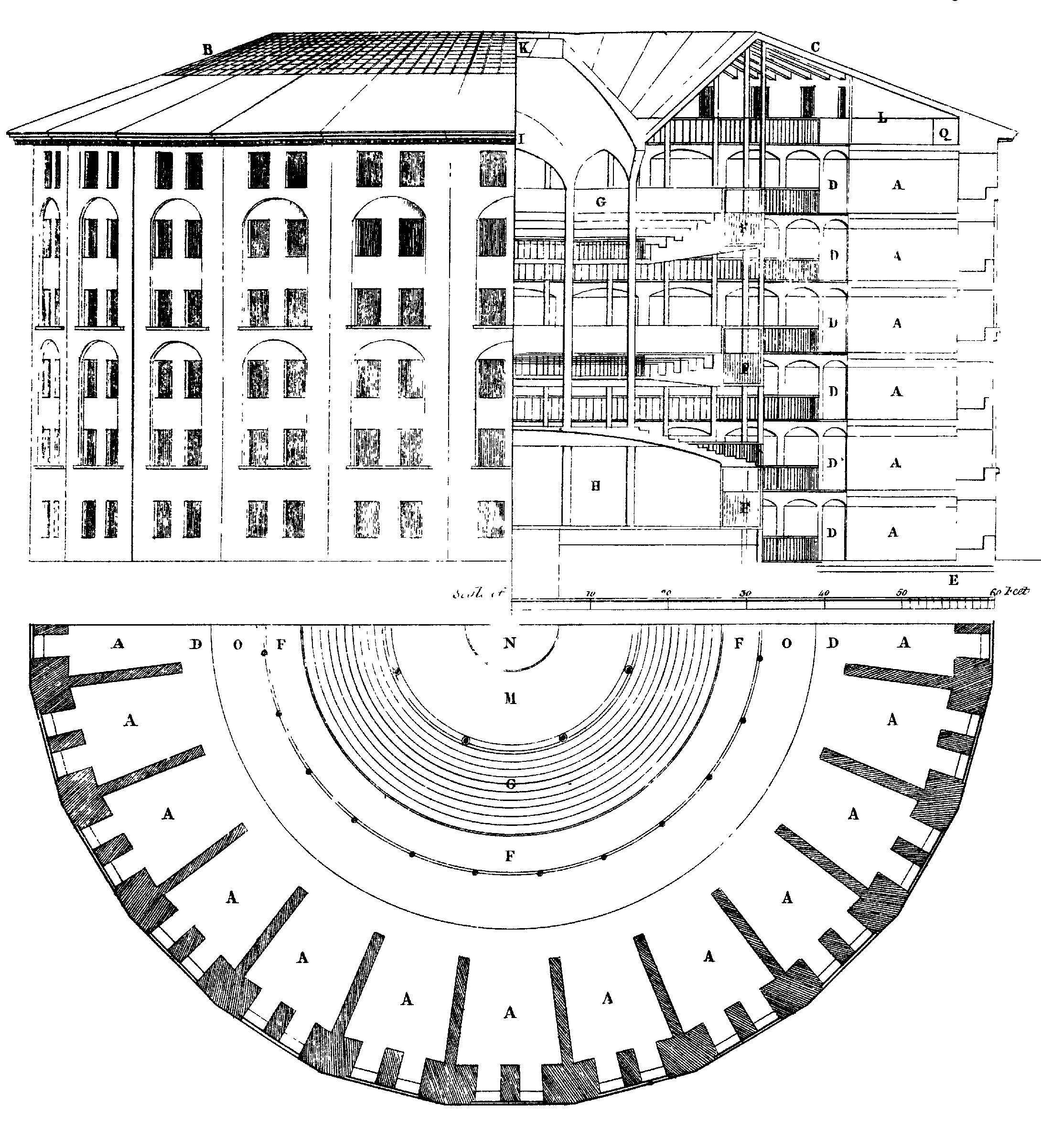
    The devices for producing the roles remind me of Jeremy Bentham’s panopticon, a functional prison designed so that all of the prisoners could be viewed from one central point.  The profile of the place reminds me of the geared punch machine for the piano roles; I’m not at all sure about what the function of the prison reminds me of.  But in the history of holes, I guess all it foes it fill u its empty holes with people, keeping them there for months or years or decades, and then replacing them with other people, part of a long and continuing series.

    File:Panopticon.jpg

    Here’s the panopticonal prison at Presidio Modelo, Isla De la Juventud, Cuba–with the walls laid flat, and some cells filled-up, and reduced, you may be able to make a certain music with it, like reading the scores made by pigeons roosting on a five-wire-strung staff of utility poles. My daughter Emma just suggested that there could be a Morse Code crossover as well!)

    File:Presidio-modelo2.JPG

    The plan and elevation of these prisons relate to the player paino paper, like the early dots and dashes of communication, like the punched cards that Vonnegut had in mind when he was writing his early classic. 

    Now, the rest of the Illustrated London News story:


  • Some Good Thinking, 1945

    JF Ptak Science Books   Post 2360

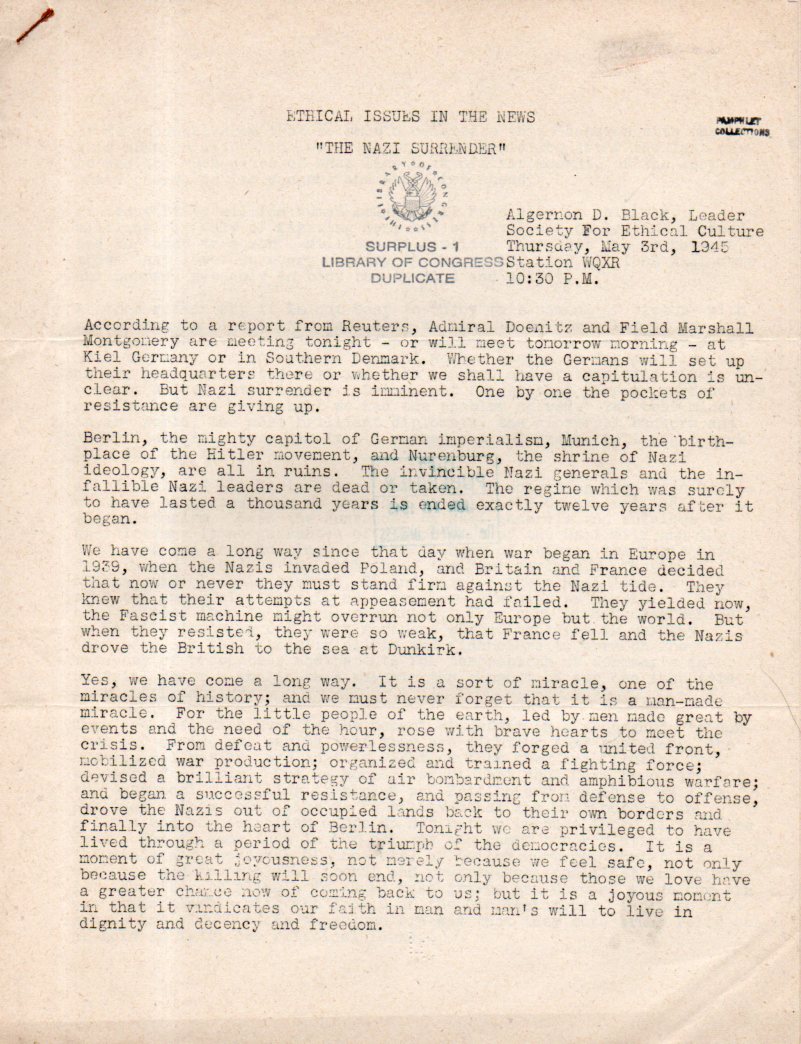
    Algernon D. Black, the leader of the Society for Ethical Culture, wrote a pretty good appeal to America in his radio broadcast of May 3, 1945 on WQXR (NYC). His topic on his “Ethical Issues in the News” series was The Nazi Surrender.  WWII in Europe was nearly over, Hitler had been dead for four days, nearly every major German city was in ruins, and surrender was in the air– and on the ground, and in the rivers, German troops surrendering in the tens of thousands in the west, and more so in the east, with many also being killed at the hands of the Soviets. Surrender was everywhere but on paper.

    May 7 would be the official day, four days in Mr. Black’s future. 

    Black, Algernon459And what Mr. Black warned against in the coming of surrender was this–that even though Germany was defeated, we must make sure that Nazism is defeated too.  He warned that the Nazis claimed to be fighting a common enemy in the Soviets, and at the end tried to align themselves with the West against the rising East. “Even the surrender of Nazi generals and suicides by Nazi leaders in no guarantee if a surrender of the Nazi will and the defeat of the Nazi ideology.

    He went on:  “In the moment of defeat, the Nazis have done things to assure the rebirth of the Nazi movement” pointing out hidden money, transfer of major funds to neutral countries, setting the stage for retrieving patents and industries, and so on. 

    Black points out that the Nazis started a war that killed at least 50 million people, and who in their quest to defeat “Russian bolseheviks” killed hundreds of thousands of British, French, and American soldiers, and civilians, caused the deaths of millions more, imprisoned millions and ran concentration camps. 

    “When we have accepted the Nazi surrender, our real difficulties will begin” Black writes, telling his audience that the Nazis must be separated from the non-Nazis, and that Germans who were “victim of false indoctrination will have to be subjected to intensive re-education”, and that “those who are anti-Nazis must be encouraged to take leadership and to aid in the rebuilding of German life and of German democracy…”

    Black was advocating a sensible, thoughtful approach to a longer-termed peace in discussing the termination not of the German state, but of the Nazi ideology.  

    ·Posted by :

    ·in:


  • The CowBot, 1888

    JF Ptak Science Books  Quick Post

    Robot Cow


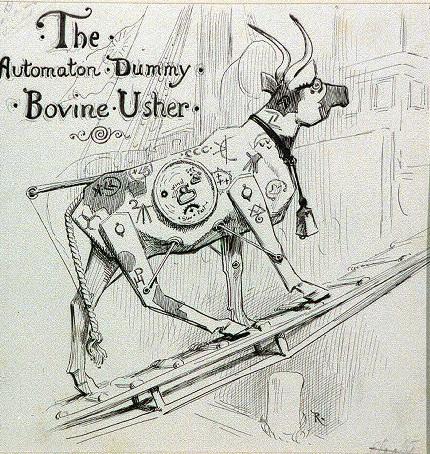
    I’ve been collecting images of 19th century robots and automatons and came across another–a very uncommon cowbot. “The Automaton Dummy : Bovine Usher” was drawn for Wallace Peck, created by William Allen Rogers (1854-1931)  and published in volume 8 of Life (July 8, 1886) and also in Peck’s The Golden Age of Patents (Frederick Stokes, 1888). [Image source: the Library of Congress, here, and for the Peck book, here.)  This is the only robot featured in the book, though there are many other fine illustrations of future techno whatzit bits.  The automaton beef was supposed to lead the other cows aboard a ship for shipment, the philosophy being that if one led the way that the others would follow.) The cowbot is also covered with brands, including a H.A.Rey-like Curious George techno bit in the midsection, the knobs and so forth forming an anthropologic face.  


  • Social-Techno Anthropomorphy

    JF Ptak Science Books  Post update

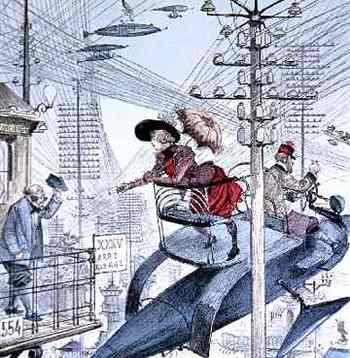
    Robida

    My friend Jeff Donlan sent along a suggestion for reading Michael Graziano’s Consciousness and the Social Brain—I don’t know anything about the book, but the title has done its job in provoking the imagination.  What the title asks me (apart from whatever the book might be about) is this: how long have people thought about some aspect of a “social brain” and what has that looked like over the decades (or centuries)?  “Social” and “brain”, like society, or Earth, or some definition or classification of people, have made for themselves something much larger than the ordinary collective.  It is a very useful tool, this simple metaphor–in it are a wellspring of ideas.

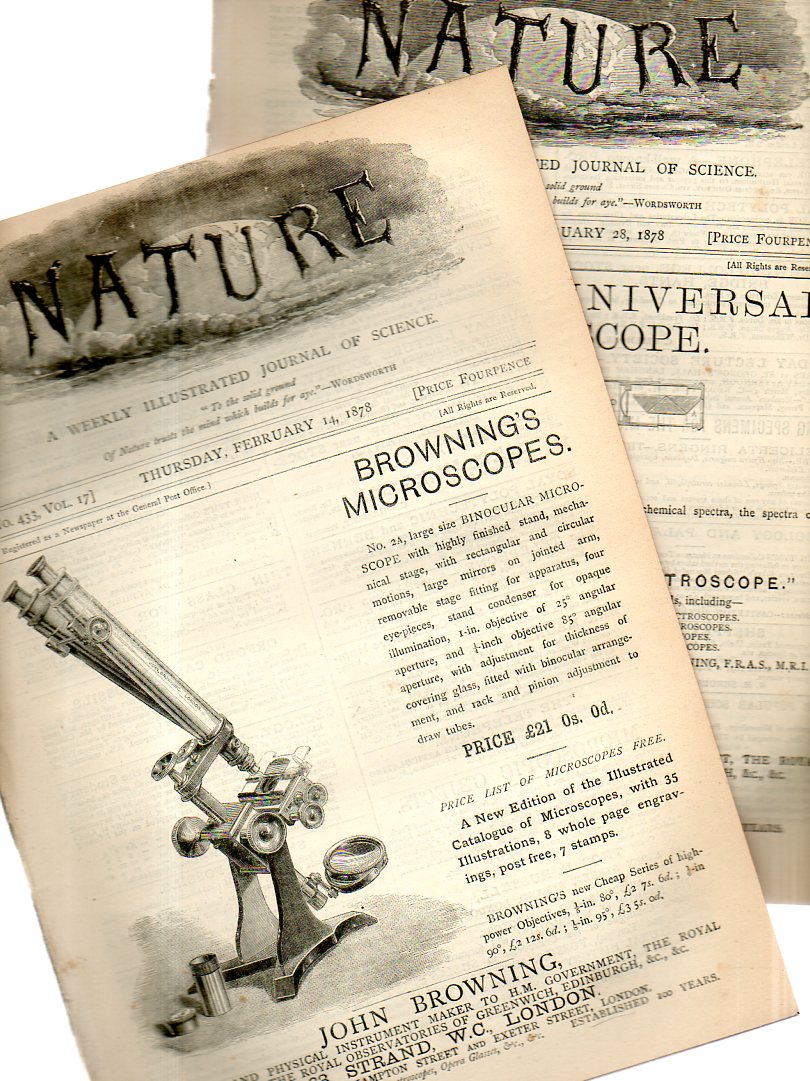
    I’m also interested in what anyone might know about the early use of metaphors (and analogies) relating large-scale societal techno advances and biological functions?  I have no doubt that they go back to modern-ancient times (say to William Gilbert (1544-1603)  and his vis electrica) and that some old mechanical/anthropomorphic examples are still in everyday use (“horsepower”)—but I’m stopped today by seeing this paper by J. Norman Lockyer called “Social Electrical Nerves” (in two issues of  Nature for 14 and 28 February 1878).  In this paper the great astronomer (and the editor of the journal) looks at elements of the “grid” as it was and seeing how the new networks of police and fire communications via telegraph  interacts with the existing electrical systems.  It seems to me an early use of  nervous system/electrical analogy, in spite of the fact the first “electrical highways” (as Lockyer puts it 120 years before our own “information superhighway”) appeared in England 32 years earlier though apparently without these biological metaphors. 

    Robidatelephone_lines
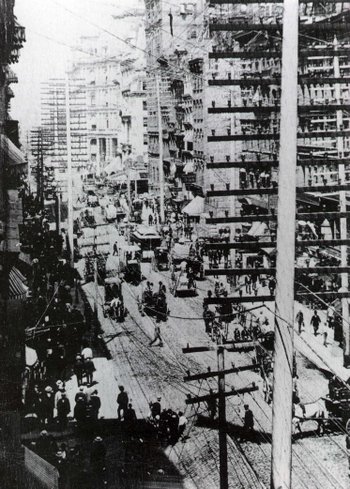
    The work pictured above is the electrically-draped world of the future, at least according to the vision of the wonderful Albert Robida, who was actually at work on these visions just at the time of the publication of the Lockyear paper . (Robida produced at least a trio of interesting and lovely and occasionally prescient works:  Le Vingtième Siècle (1883);  La Guerre au vingtième siècle (1887); and Le Vingtième siècle– La vie électrique (1890)).   Many of Robida’s visions of electrical connectivity seem to me to move beyond the nervous system metaphor and become a kind of societal “skin”—which is not terribly far from the truth, especially when looking at images of congested metropolitan centers ca. 1910, when utility poles fairly well sagged under 20 (!) horizontal crossbars carrying a dozen lines apiece.   At the very least, you knew that something or other was happening (fast forward to the massive ductworks of Terry Gilliam’s masterpiece, Brazil.) 

    Social electric616

    And now that the wireless age is starting to get ridges in its fingernails (the “wireless” age being at least 115 years old, beautifully borne by Heinrich Hertz and Marconi), where are our bio-electrical  metaphors going?

    Philosopher of science Rom Harre is one among very many who have written on the use of metaphor in science–he finds the practice an “indispensible element…to scientific creativity and imagination”.1 And he is certainly correct–the recognition of the Lockyer metaphor is instantaneous today, and must’ve been quite a shocking thing to see in 1878.  

    I know that this is just a nibble around the edge of a vast amount of thinking on this subject, and perhaps I don’t want ot do this so “out loud” in the public forum, but I am interested in a dialog on this, if anyone is interested in participating.

    Notes: 

    1. Harre’s reasoning is nicely summed up here in “The Function of Scientific Metaphors: An Example of the Creative Power of Metaphors in Biological Theories”,  by Xavier de Donato 
    Rodríguez and Alfonso Arroyo-Santos:
     
    “(1) New scientific theories try to provide a better understanding of reality.(2) In order to do that, these theories must be intelligible.(3) That intelligibility must ultimately derive from the intelligibility of the novel entities and forms conceived in the creative scientific imagination.(4) The novel entities and forms introduced by the theory become intelligible only if we interpret them in terms of the old entities and forms already available.(5) But, the only way to do this is by means of metaphors or analogies taking the entities and forms already available as a basis.(6) So, analogies and metaphors are indispensable for scientific theories.”

    ·Posted by :

    ·in:


  • Steampunk Air Travel, 1843

    JF Ptak Science Books   Quick Post

    “Let no man seek / Henceforth to be foretold what shall befall / Him or his children.Milton,” Paradise Lost XI, 770-72

    George Cruikshank–the gifted English cartoonist/satirist/caricaturist and social commentator–was readying his viewers to some hyperspeculative dreams on the possibilities of near-in-time powered flight.  Steampunk air travel is so commonplace in the near future that there are departure stations on building-tops   

    The etching in question, illustrating “Air-um Scare-um Travelling” appeared in the Comic Almanack (1843), and outlines a clear and hopeful image of future travel.  The ads show that there are frequent flights to far-away places, including Mont Blanc and Beijing.  

    It is interesting that the future is tempered somewhat by including an exploding airship at bottom left–so the future may be wondrous and exciting, though not without its dangers.  


  • Anti-Gravity Anti-Gravitas

    JF Ptak Science Books   Post 2319

    “Similitude of Substance will cause Attraction, where the Body is wholly freed from the Motion of Grauity.”– Bacon, Sylua Syluarum, 1626 

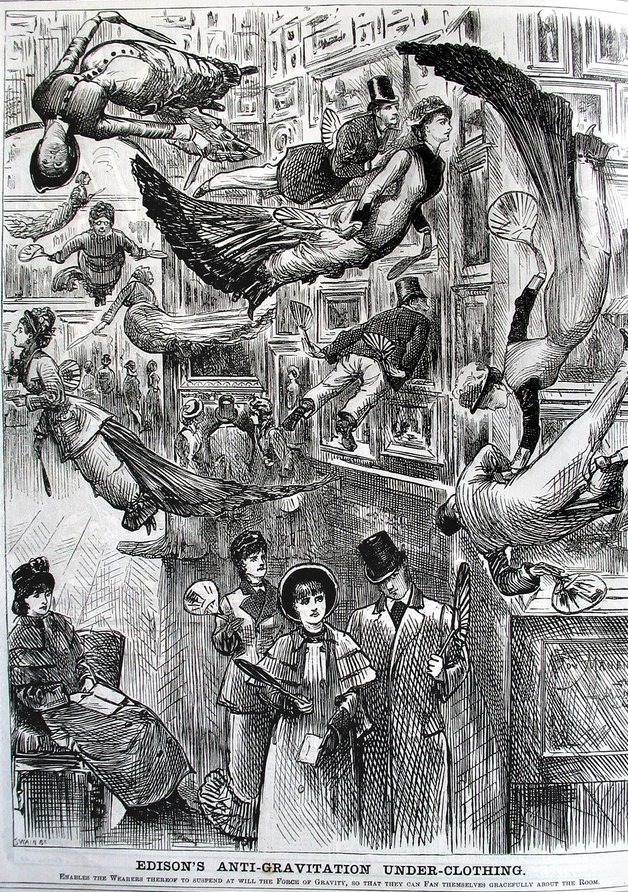
    It seems that in variations of the future that I have read that the concept of anti-gravity-something wasn’t taken so much seriously as it was a half-prank.  For example earlier in this blog I wrote about one of Edison’s least-known and most-nonexistent inventions, antigravity underpants. There was a time in the late 19th century when it was seen that Thomas Edison could do just about anything–so much so that the Brits in The London Punch gave him tongue-in-cheek credit for inventing (flying, so to speak), anti-gravity underwear.  The funny thing about this though is that the best thing that people could do with this new invention would be to go to a super-sized art gallery to look at paintings close to the ceiling. 

    Edison anti gravity b

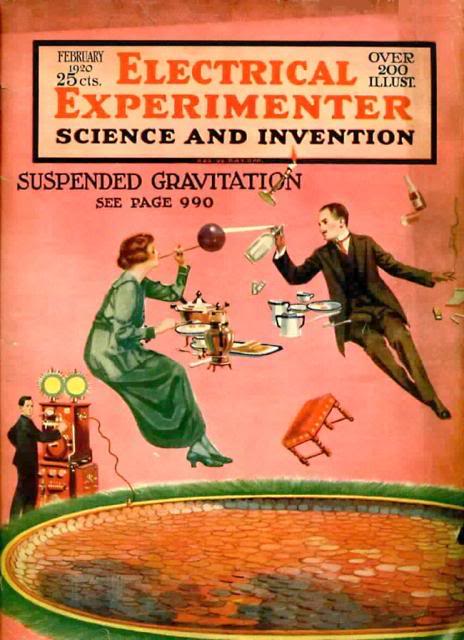
    Another example of gravity taken not-so-heavily is the scientific publication, Electrical Experimenter, where a seated couple is no longer so in the clutches of “suspended gravitation”, and again what the floating people engage in is play, the oman blowing a balloon and the man spraying selzter at it.  

    Anti-Gravity

    [Image source:  My Ear Trumpet, here.]

    The odd bit here is that “gravity” is found early on in the Oxford English Dictionary back to 1622 with G. de Malynes and N. Carpenter in 1625, and then of course with Roger Bacon a year later), though “anti-gravity” does not occur in use until 1945; and clearly the concept is on display in these three quick examples, though the phrase is not. “Anti-gravitation” however is used, though for some reason it is not included in the OED.  

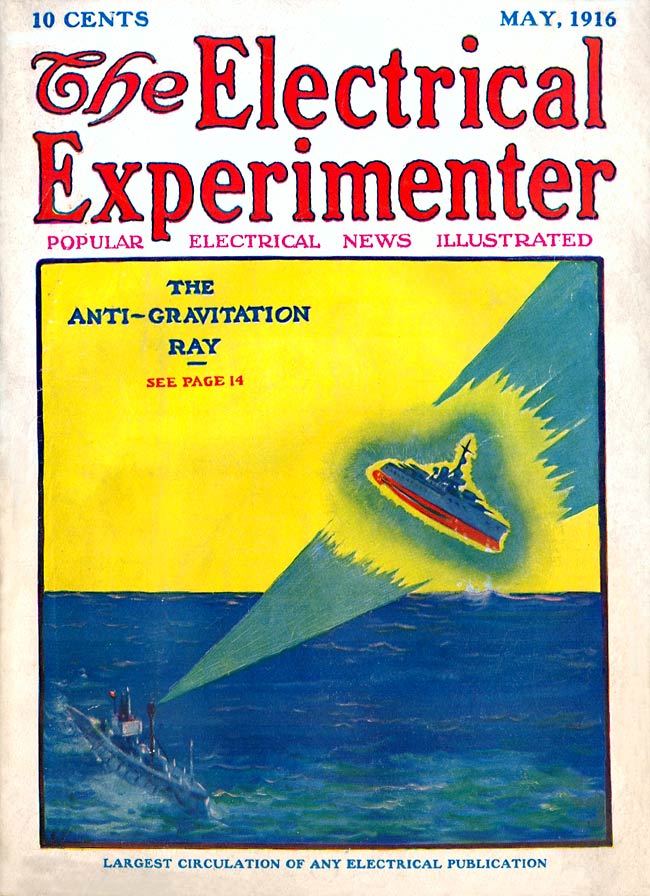
    The article, “Overoming Gravitation” by George Piggott, really did take the matter seriously, in spite of the cover illustration, as a quick read will verify.  More serious than that, though was an earlier and perhaps war-infested thinking mode was the militarily enhanceable anti-gravity ray (May, 1916).  

    Electricalexperimenter anti-gravity

     [Image source: Airminded, in a post about future weapons of the past, here.]

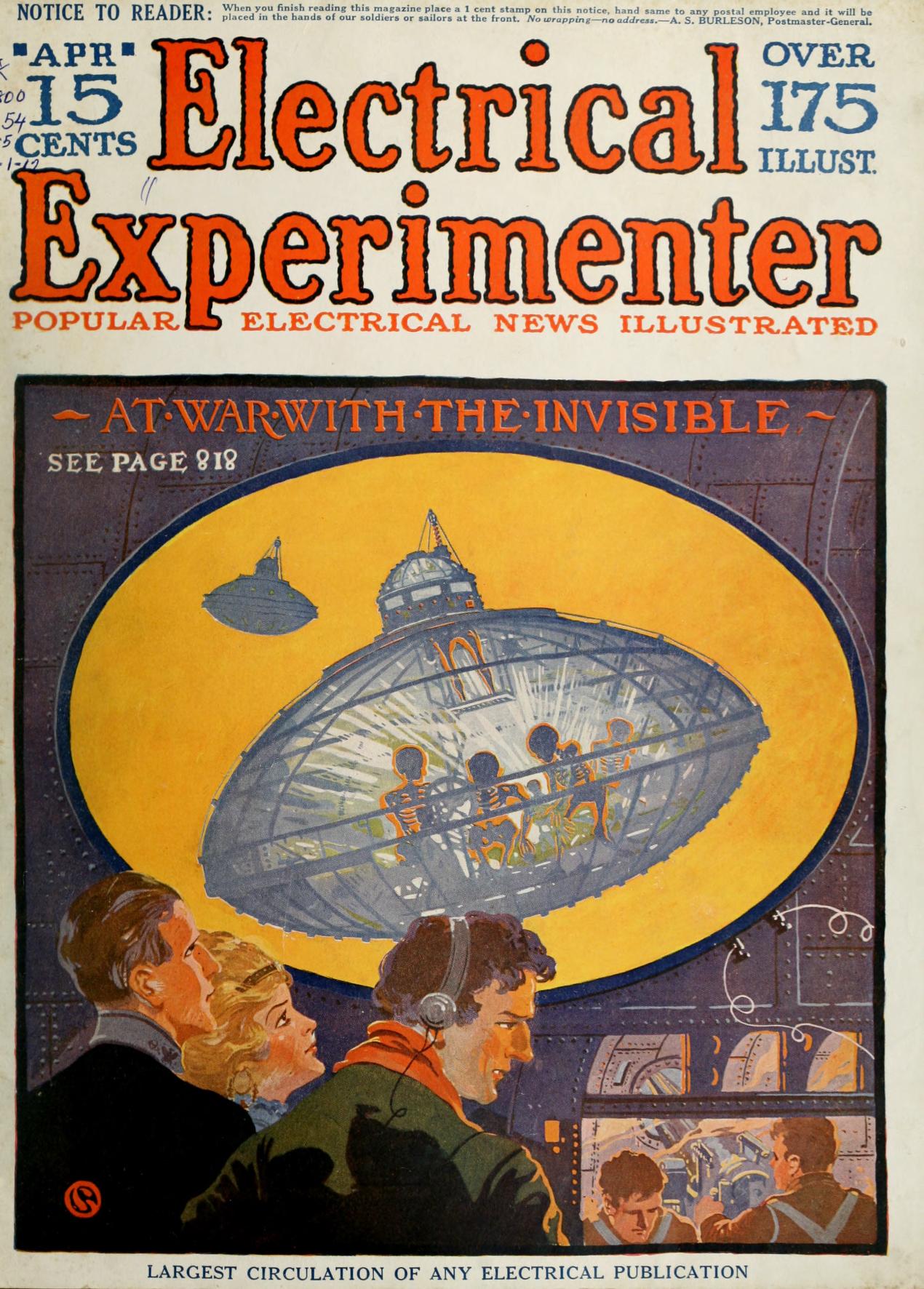
    Better yet (?) is this appearance in 1918 of an anti-gravity craft with invisibility options: 

    Antigravity and invisible

    [Image source: Inernet Archive, here.]

    And then of course there are examples like this, found in another early post on this blog, “Anti-gravity Atomic-powered Sun-fed Underground Woman of the Year 5000!”, here.

    In any event, these are a few example of the anti-gravity idea in the 1880-1920 period. No doubt there is a rich and full literature on this very thing–mainly what I wanted to do here was captued Airmnded‘s image to use for another day.  


  • Moving Manhattan and Brooklyn Together at the Speed of…Slow (1903)

    JF Ptak Science Books   Post 2299

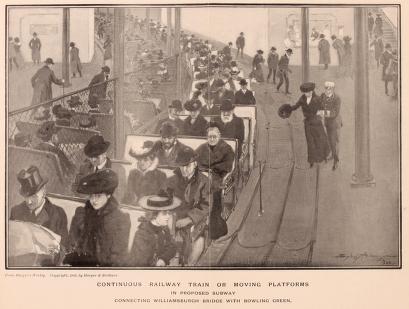
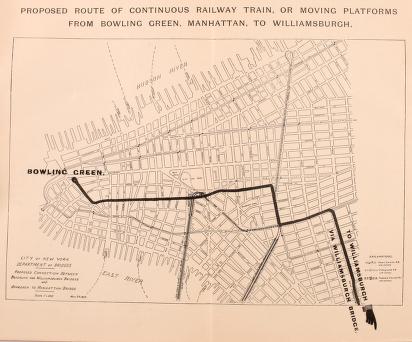
    If New York City was populated by nothing but people wearing hats, carried mink muffs, used gold-handled walking sticks, and really didn’t have to be anywhere at a particular time, then I think this invention might have been useful.  But seeing that off the engineer’s table that Manhattan was not god’s waiting room and far more Darwinian  than a high-Victorian imaginary noblese-chaste class of slow and deliberate people waiting to be waited on, then this idea wouldn’t have worked very well at all.  The seed of it all is found in Transportation of Passengers in Greater New York by Continuous Railway Train, or Moving Platforms.  Argument in favor of equipping the East River Bridges, and connecting subway to Bowling Green, Manhattan, with a continuous railway train or Moving Platforms, which was  prepared by Schmidt & Gallatin of New York in 1903.  It was only 20 pages, but it had  four folding plates, including two maps, and two drawings of the envisioned walkways, and that is the stuff upon which dreams are laid, made, and stayed.

    Sidewalks 3


    “Moving Platforms for the conveyance of passengers were recommended by Mr. Horace Greeley thirty years ago. They were successfully operated, first, at the World’s Columbian Exposition of 1893, where 2,700,000 people were transported. In 1896 they were installed at the Berlin Exposition, and again at the Paris Exposition of 1900, where they carried over eight million passengers. Few persons know what Moving Platforms are. From the face that sometimes they are called ” Moving Side- walks,” it is believed that they must be some sort of a pavement on rollers, on which it is difficult to step with safety and maintain equilibrium. The Moving Platforms are to all intents a railway, operated like other railways, propelled by electricity, with cars, seats, motors, passenger stations, ticket booths, guards, electric lights — in fact, everything belonging to a first-class railway.” 


    Sidewalks map


    “Where it differs from the ordinary railway is that the cars, or trains, are not running at intervals, but are coupled up continuously, so that there is no interruption of traffic at any time, but a large seating capacity at all times. It differs also in the construction of the cars, which are mere flat cars, provided with seats placed crosswise, and so ar- ranged that all rmssengers face in the direction of motion. Each of these seats may be made wide enough to accommodate one, two or more persons. The most approved plan is to provide seats on one side of the cars only and leave the other for passengers to walk, thus giving them an opportunity to further accelerate their speed if they so desire…”


  • “Spirit Writing”: Electric, Script-Writing Telegraph, 1879 (!!)

    JF Ptak Science Books   Post 2295

    Telegraph script

    Telegraph script
    This fine bit of welcome-to-the-future technology appeared in the notice “A Real  Telegraph”, in Nature, 6 February 1879.  It is a quick report on the invention, occupying one scant paragraph of text but was accompanied by a full-page illustration of a sample of the telegraphic writing, which must have seemed in 1879 like a touch of the future–the telegraph was forty years old, but the recording telegraph was relatively new, and the idea that you could read a series of spaces and dots and dashes as though it were handwriting must have seemed like seeing color photographs in 1935.

    The “real” part of the title of the note meant in this case that rather than have a key operator tap out the message in Morse Code, the sender would be writing out the message in long hand, and the receiver would gather up the message so that it appeared in recognizable letters and words rather than dots and dashes.  The inventor’s name was E.A. Cowper, and he brought to the telegraphic art something as “startlingly” as the “marvels” of the telephone, which had been invented just three years earlier.

    The author describes the appearance of the script on the receiving end seeming as though to have been guide by a “spirit hand”, such as the highly unexpected result even to the trained scientific reporter. 

    A somewhat longer article appeared in the New York Times a few weeks later, the full text of which is here.


    According to William Maver jr. American telegraphy and encyclopedia of the telegraph: systems, apparatus … By William Maver (jr.) this was the first successful attempt at producing susch a machine.