A Daily History of Holes, Dots, Lines, Science, History, Math, Physics, Art, the Unintentional Absurd, Architecture, Maps, Data Visualization, Blank and Missing Things, and so on. |1.6 million words, 7500 images, 4.9 million hits| Press & appearances in The Times, Le Figaro, Mensa, The Economist, The Guardian, Discovery News, Slate, Le Monde, Sci American Blogs, Le Pont, and many other places… 5000+ total posts since 2008.

Category: Future, History of the

  • Future Sky Cop, 2000 (from 1882)

    JF Ptak Science Books    Quick Post

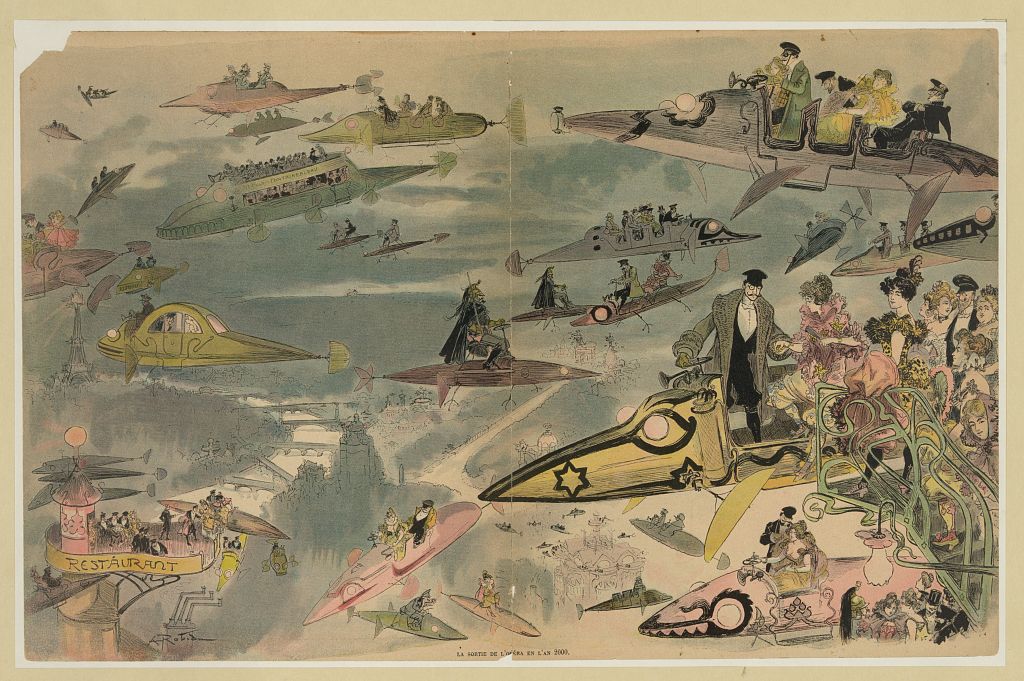
    Robida paris opera[Image source: Library of Congress, here.]

    Albert Robida (1848-1926) imagined many things in his long and illustrative career, seeing deep into the futures that would/didn’t come to be. Perhaps this one is nearly coming true but in a different format–his imagination 1882 inspiration of what the future of air traffic would be like attending the Paris Opera  (“Le Sortie de l’opéra en l’an 2000”) might seem more prescient of the view was in 2030 and the taxi cabs and other air chariots were drones instead.  In this version of the future there are restaurants and limos and buses and private air vehicles galore, all anthropomorphically cluttering the environment 1500′ above the city-center of it all though is a blue centurion, riding a futuristic Electra Glide, a helmeted cop on a small and sleek vehicle, right in the center of the sheet. 


  • The “Robot” of the Year Zero

    JF Ptak Science Books   Post 2390

    “HIEROGLYPHICS: Language of the ancient Egyptians, invented by the priests to conceal their shameful secrets. To think that there are people who understand them! But perhaps the whole thing is just a hoax?”—Gustave Flaubert, Dictionary of Received Ideas1

    Kircher robot599


    [Reproduced from the Hachette reprint]

    I’ve written a number of posts about pre-robot robots, robots before they were named, mechanical entities of some human qualities that performed tasks or played games, inanimate objects that engaged in articulated motion, with most of the early creations being in the early 19th century.  I never have done the back-fill, the earliest days in which (if you squinted very mightily) robots may have appeared.  

    This came to mind today while writing about the great Athanasius Kircher (1601-1680), a man considered to “know everything” and who if he didn’t know it made the knowledge come out of something else so help him god; he was a man of intense energy, extremely formidable learning, high creativity, and who seemingly possessed the talent to forget nothing.  Today’s episode (with the frequently-appearing Kircher in this blog) is just a small addition to the cosmology thread and the history of dots series. 

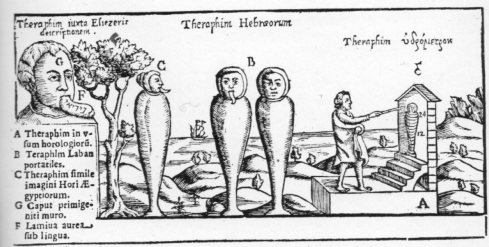
    The image that drew me in is found in Kircher’s magnum opus, his Oedipous Aegyptiacus, printed in three volumes from 1652-1654–it is a half-miracle sort of work–it is astonishing, universal,  fabulous, and in many cases, far-reaching….too far-reaching, especially in the case of his deciphering Egyptian hieroglyphics, where he pretty much gets it all wrong.  In volume one (page 262), however there is  an image of theraphim (“Theraphim Hebraeorum”), which are small-to-largish statuettes/statues which to save sp[ace and time here are seen by many as being something along the order of a household idol. (It is a much more complex story than this, but I think that for at least one aspect in defining these objects that this is basically correct.)
     
    The illustration makes it seem as though the small statues have etched speech on extended tongues–in some versions of the theraphim story the statues do speak in their way. That makes them speaking statues.  And speaking statues are–in a very antiquarian way–robots, or at least they are worthy of that consideration in my book. Or blog. 
     
    And this reminds me of another “speaking” statue:  Memnom, of the the two Colossi at Thebes.This monument was said to be a “miracle” (by Colistatus, in the 3rd century CE) and that the only difference between it and a human was a body. Memnon was said to react to eh morning Sun, emitting  a sound or song or speech; and again, at sunset, a more lamenting sound would issue from the statue, which would sometimes be accompanied by tears.  The songs/cries were said to be returned by Echo, who responded with, well, an echo, which is what all of this might be in regards to the modern sense of the robot, and to the created artificial life of the future.  
     
    Notes:
    1. This fine quote was found in an interesting article  “Egyptian Oedipus: Athanasius Kircher and the Secrets of Antiquity (2013) – Introduction” by Daniel Stolzenber, here.


  • A Really Big Idea: the 5,000 Ton Tank (1916)

    JF Ptak Science Books   Post 2389

    These spectacular images of monumental monumentality appeared in the December 1916 issue of Popular Science Monthly.  The author Frank Shuman (1862-1918) had some major inventing chops, not the least of which was some very forward-thinking work (in theory and practice) on solar power (one of which was a solar powered steam engine and another a liquid O2 propulsion system for submarines), so these suggestions for gigantic land battleships came with a fair amount of gravitas. This is some grand thinking, and as Shuman tells us, the beast below would weigh about 5,000 tons (the weight of several hundred Sherman tanks1) and would roll along on 200′ diameter wheels.  Unfortunately, outside of  seeing some sort of (steam) power plant, there is no mention of how those wheels would be turned–I’d’ve liked to read about that.  There is a mention of shock absorbers, but only so, jsut a bare hint.  

    [Image source is Google Books–I have this volume in a 40 year run of this periodical down in the warehouse, but the book was really too thick to lay flat ont he scanner, and so the Google Books scan was used..]

     And for whatever reason there is no heavy artillery on this thing. The damage to the enemy would be done via the three wheels, and also by the enormous chains that hang from the front of the enormity, like a flailing slow-moving monster from a 1950’s B-movie. 

    My guess is that this wouldn’t do so well in the rain.  


  • The Coming of Broadcast Television (1929)

    JF Ptak Science Books   Post 2388

    I found a news item in the April 6, 1929 issue of Nature that gives a real sense of the coming of the future, of the future-at-hand–and they seemed to have a sense of what was coming, though probably not as big as that future would be. In this case, it was the beginning of the passive visual assumption of the collective culture–the very quick and potentially immediate assimilation of pop culture, this by the invention of television and popular broadcasting.  

    Baird_tv_caption

    The unidentified author was reporting on the recent activities of the Baird Television Development Company, which the author was interested in, and although it was “not presently practicable ” it did “represent(s) a noteworthy scientific achievement”, which I am sure was the writer’s way of downplaying a very significant event.


  • Millions of Miles of Hole-Filled Paper–Dystopia, Entertainment, Vonnegut and Prison

    JF Ptak Science Books 

    {Part of this blog’s History of Holes and History of the Future series.]

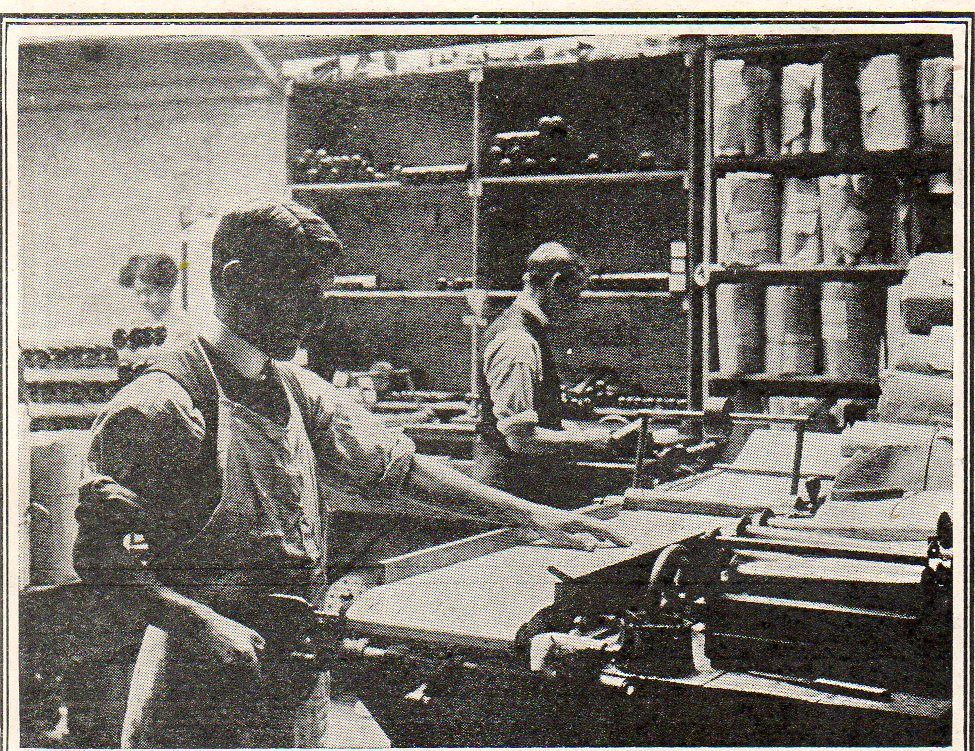
      Music role making--1871 There is a certain layered, geological dystopic quality to the  images of these men laboring at producing piano rolls for player pianos (and found in The Illustrated London News for 18 December 1909). This is true especially for the details, the small boxes in the background to where the rolls are being “processed”–music pounded out with metal points on a hard surface, as though produced by whatever it was that was in those little labeled wooden containers, far removed from the artistry of melody. These are images of a culture being made into hundreds of thousands of miles of hole-filled paper.

    The piano roles remind me of automatons replacing humans in entertainment, and then replacing the humans making the piano roles; of machines taking over the jobs of people writ large.  There’s a long and rich literary history of this idea, not the least (or first) of which is the appropriately-named Player Piano, Kurt Vonnegut’s first novel, written in 1952.  Like a tiny idea-machine, Vonnegut manufactured part of his tale from Brave New World, with Huxley having taken his bit from an earlier novel, We, written by Yevgeny Zamyatin in 1921–they’re all bleak images of a future dominated by machines, the humans acquiring numbers for names, like the replaceable and expendable units they became. 
    (Artwork by Malcolm Smith for Imagination, June 1954.)

    Robots in ocntrol--hanging human879

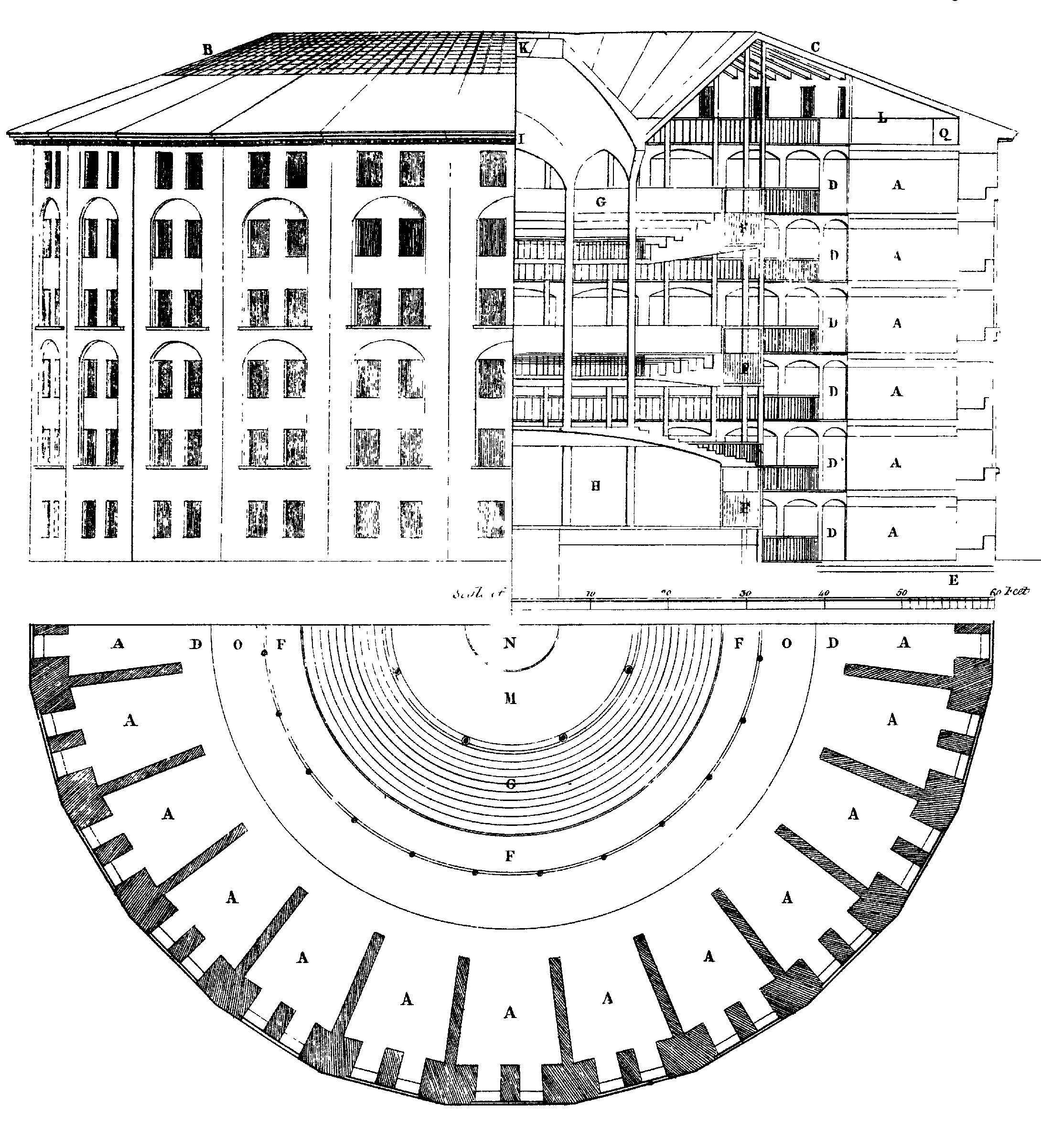
    The devices for producing the roles remind me of Jeremy Bentham’s panopticon, a functional prison designed so that all of the prisoners could be viewed from one central point.  The profile of the place reminds me of the geared punch machine for the piano roles; I’m not at all sure about what the function of the prison reminds me of.  But in the history of holes, I guess all it foes it fill u its empty holes with people, keeping them there for months or years or decades, and then replacing them with other people, part of a long and continuing series.

    File:Panopticon.jpg

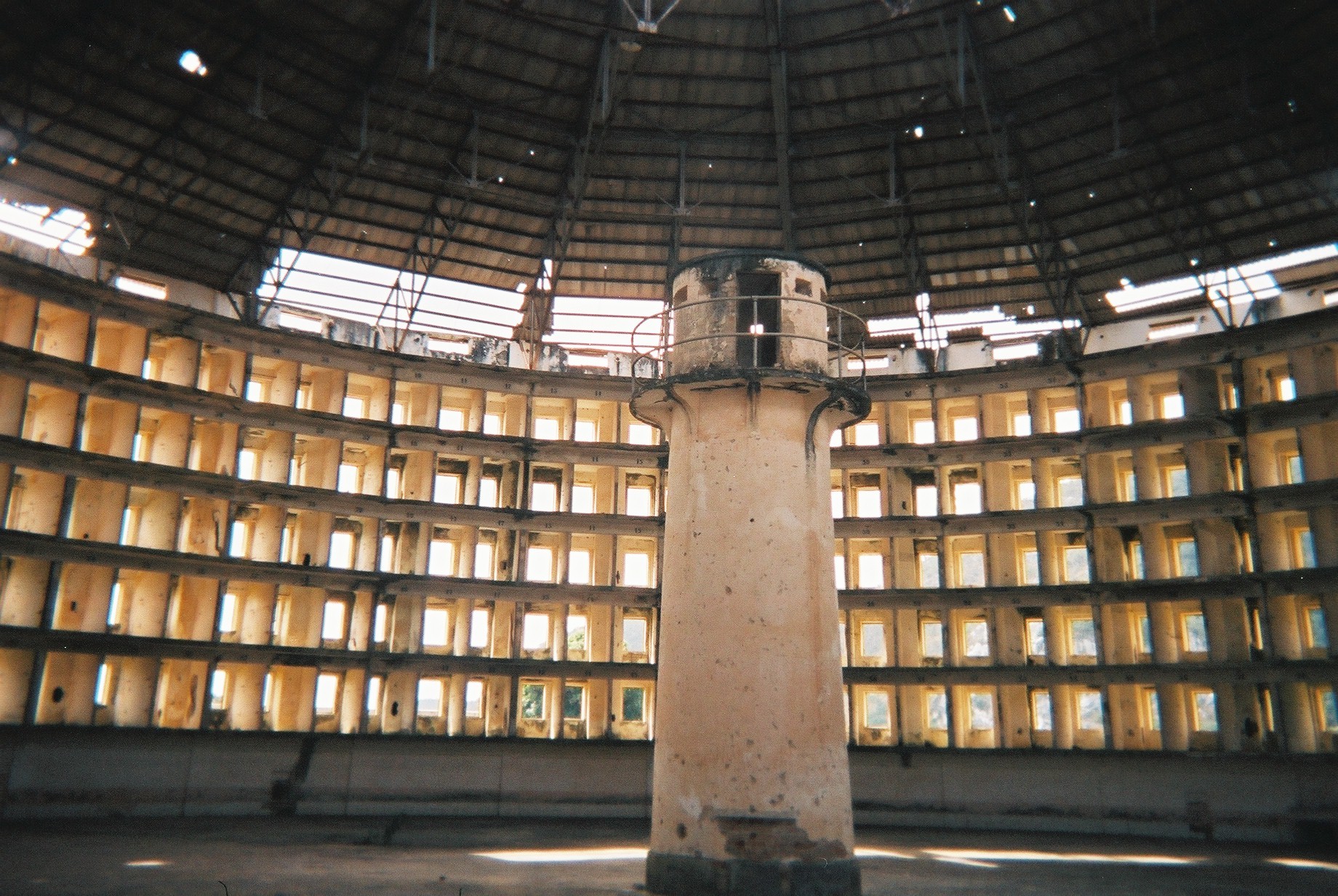
    Here’s the panopticonal prison at Presidio Modelo, Isla De la Juventud, Cuba–with the walls laid flat, and some cells filled-up, and reduced, you may be able to make a certain music with it, like reading the scores made by pigeons roosting on a five-wire-strung staff of utility poles. My daughter Emma just suggested that there could be a Morse Code crossover as well!)

    File:Presidio-modelo2.JPG

    The plan and elevation of these prisons relate to the player paino paper, like the early dots and dashes of communication, like the punched cards that Vonnegut had in mind when he was writing his early classic. 

    Now, the rest of the Illustrated London News story:


  • The Past and the Future Bridge, 1928

    JF Ptak Science Books  Quick Post

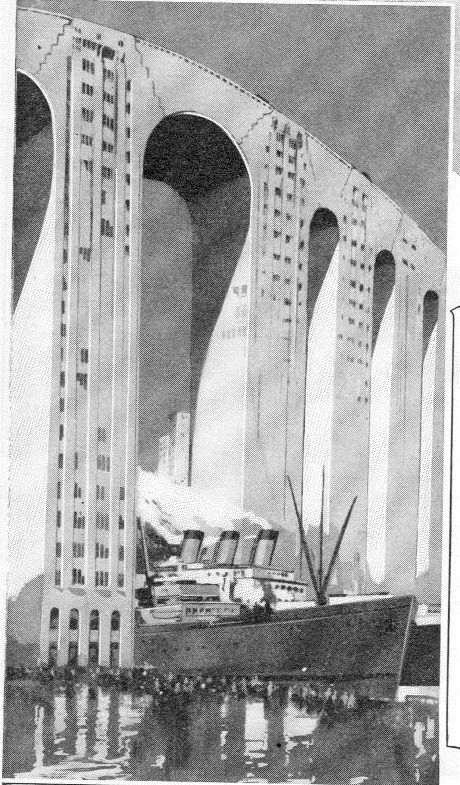
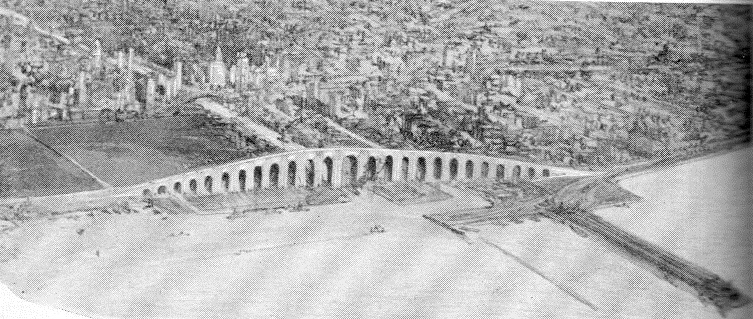
    This view of a future “skyscraper bridge” appeared in the May 1928 volume of Popular Mechanics (volume 48). It is an interesting idea , though very much on the high side, what with the structures being hundreds of feet high, towering over the shipping lanes. It is an old idea, the new bridge, and it reminds me of a lovely example in the Ponte Vecchio (literally, the “Old Bridge”) of Florence, the recognizable image of it rebuilt in the 14th century. (It was probably designed by the great Taddeo Gaddi (remembered so well in narrative by Vasari and in portraiture by Paolo Uccello.)  There was no Gaddi at work on this bridge, which was set to unite Chicago.  

    Future bridge558

    And the bird’s-eye view of the enormous structure:

    Future bridge559


  • Massiveopolis: Filling in the North Sea (1930)

    JF Ptak Science Books   Post 2378

    This is part of a series of Mega-Massive Invisible Engineering, the Filling-it-In Section. Other examples from this series not necessarily filling-stuff-up include:

    The title of this post is a bit of a tweeker–the project is not to fill in the entire the North Sea, just the southern North Sea.  This actually makes a pretty big difference bathymetrically, because the sea floor gets mighty deep up along the coast of Norway. Still, though, as impossibly ambitious projects go, this is still a massively unstable consideration, the entire North Sea or not.  
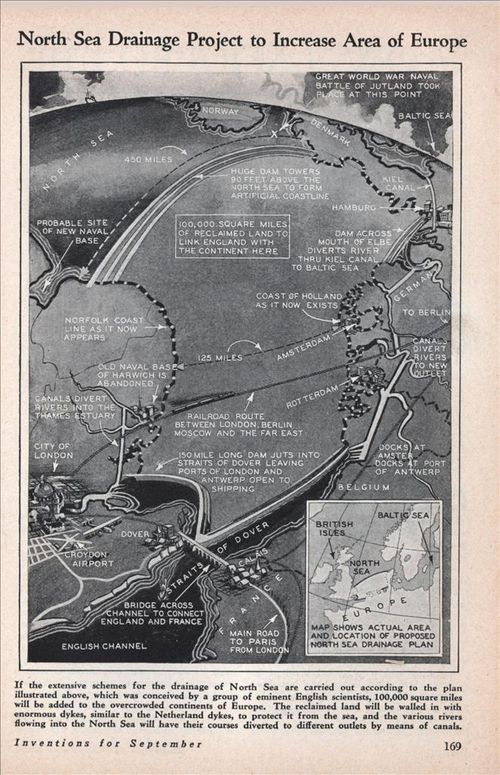
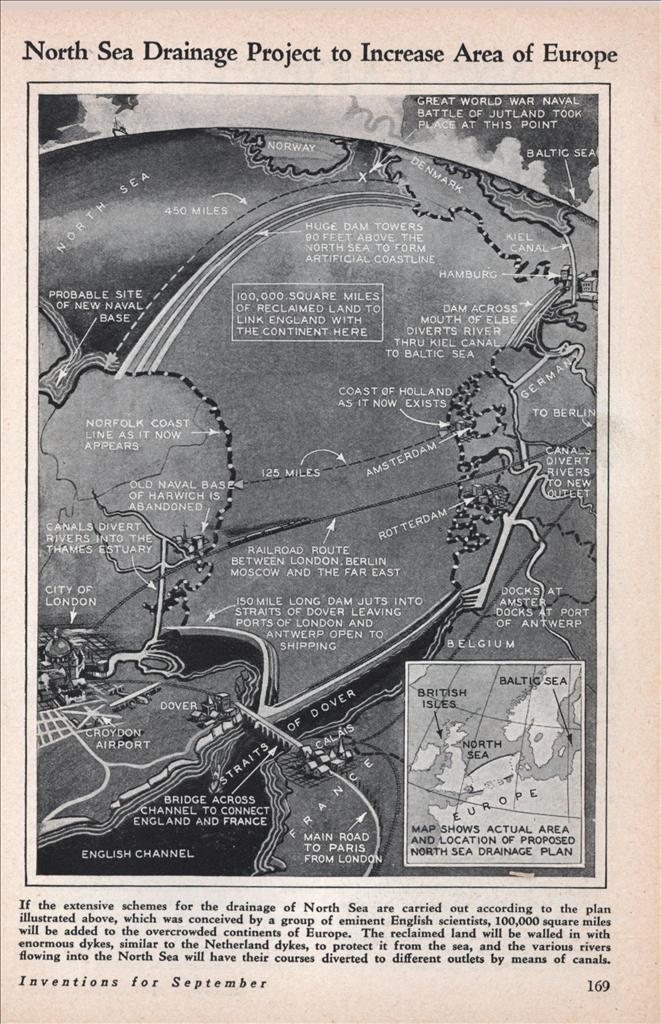
    North sea[I owe the fun I had thinking about this project to two great sites: Modern Mechanix and Imaginary Cities–Modern Mechanix for posting it to begin with and Imaginary Cities for tweeting it.  These are two great sites well worth subscribing to.]

    A sort-of Atlantis was drowned some 8500 years ago, a large piece of land that connected what is today Great Britain and Europe. Rising water did away with this territory leaving behind the great island nation and much else. The plan referred to above in the title is the extraordinary thinking for “raising” that lost Atlantis-esque land, and was floated in the September 1930 of Modern Mechanics. 

    The author maintains some sort of possibility for recovering some 100,000 square miles of submerged land that would connect south-eastern England with France, Belgium, the Netherlands, and Denmark. It would be accomplished by erecting some 700+ miles of dykes and dams and then, somehow, emptying all of that surrounded and captured water into the sea that it once belonged to.  

    100,000 square surface miles is an area twice the size of England, three times the size of Lake Superior, nearly the size of the Caspian, and equal to the size of Colorado. 

    The English Channel and the straits of Dover would become a divided thoroughfare; the Thames would be part of a canal system that would extend along the old Norfolk coast to The Wash; a bay from the Straits would extend inland to Belgium, where it would be met by a canal system that would extend to the Baltic.  All of this would be held in place by a 150-mile long dam of unusual  shape. And just for good measure, bisecting these two would be a monster bridge from Dover to Calais. 

    This is of course extraordinary, but when we look north we see a breathtaking proposal for a  450-mile long, 90′-high dyke extending from the English coast to Denmark. The artwork claims that this is 90′ above the water for the rest of the North Sea, which means that the structure would have to be at least 110′-150′ high, plus the foundation. Luckily for the designer the southern North Sea is a relatively shallow water sea, 20-40′ deep, though there is a stretch of 100′ miles where the depth is considerably deeper.  I haven’t considered yet how wide this dyke would be, except that it would be, well, big.

    There is also a drawing for a London-Berlin and points east train. The  Elbe is dammed, and it looks as though the Netherlands is no longer the Lowlands, everything there being “filled in”, with the sea being moved some 200 miles to the west. 

    This is just a short spec piece that appeared in a popular science magazine 84 years ago, but there is no mention of what these changes might mean to the currents of the south North Sea, or Jutland coastal waters, or the Continental Coastal waters; or the changes it might dictate to salinity, or nutrients to the rest of the North Sea, to say nothing of the sea floor inhabitants and fish, and so on.  There would no doubt be some natural consequences to this (literal!) undertaking.  

    I suppose someone at some point would have to think about how all that new land would be divided, but I guess that would all take care of itself.  

    • Another related article from Modern Mechanix posting a Modern Mechanics May 1931 addresses the issue of water removal albeit at as much lesser scale, here.
  • Rare Block Diagrams for the UNIVAC (1950)

    JF Ptak Science Books  Quick Post 

    The UNIVAC (Universal Automatic Computer) was the first commercially-available electronic computer, and the first computer to handle both numeric and alphabetic information, produced by Remington Rand, and  came into working service at the Bureau of the Census in 1951.  It was designed by John Mauchly and Pres Eckert Jr, who also worked together in the design and construction of the first digital computer, the Electronic Numerical Integrator and Computer (the famous ENIAC). The UNIVAC was a Big Boy: 25×50′, with 5,600 tubes, and 18,000 crystal diodes–given its workhorse nature and general success, by 1957 there were 46 UNIVACs in operation. 

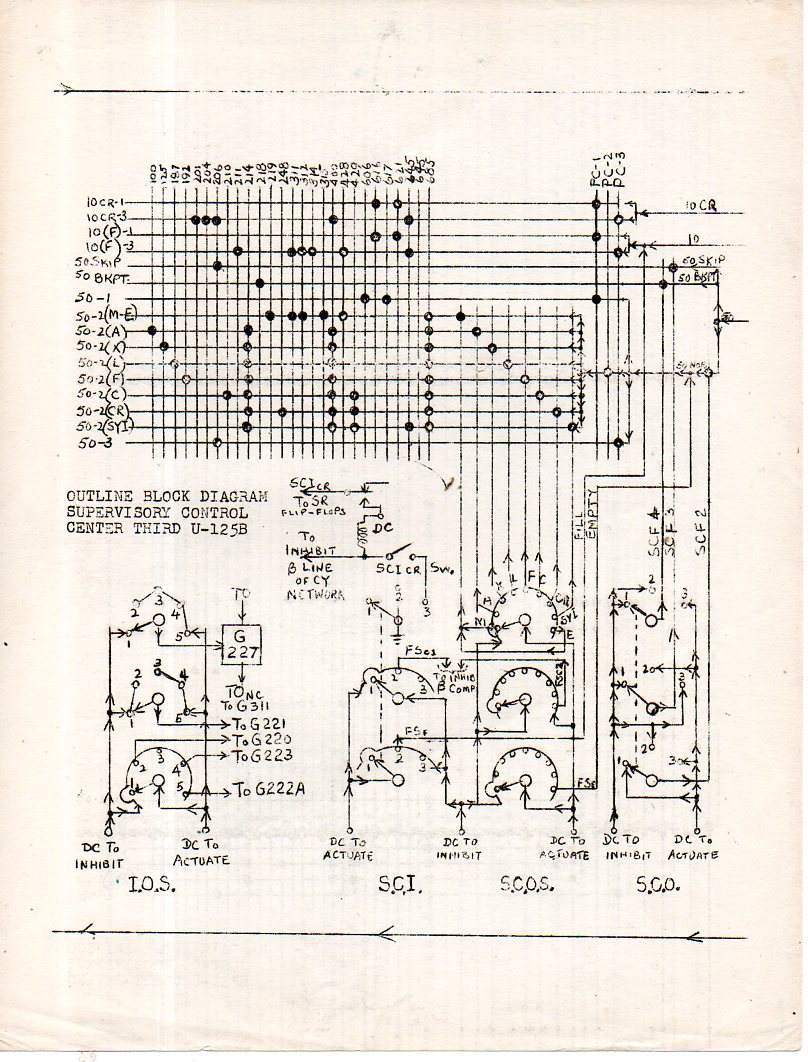
    The following are working block diagrams of sections of the UNIVAC, produced by some sort of early offset process in 1950, slightly before the computer came to its working life.  I have a number of sections of the computer represented in this way, but not the entire machine–but what is here may be of interest to historians of computer science.

    MullendoreBlock diagrams497[Supervisory Contro Panel]

    Present in the collection:

    • 1.  The Supervisory Control Panel (2 sheets of 3, including center and left third, both undated but assumed to be 1950 like all of the others. [Shown above]
    • 2.  Input-Output controls.  3 sheets of 3. (left, middle and right thirds), dated 8/10/50 and 8/7/50.

  • The Future of Oil in 1921

    JF Ptak Science Books   Quick Post

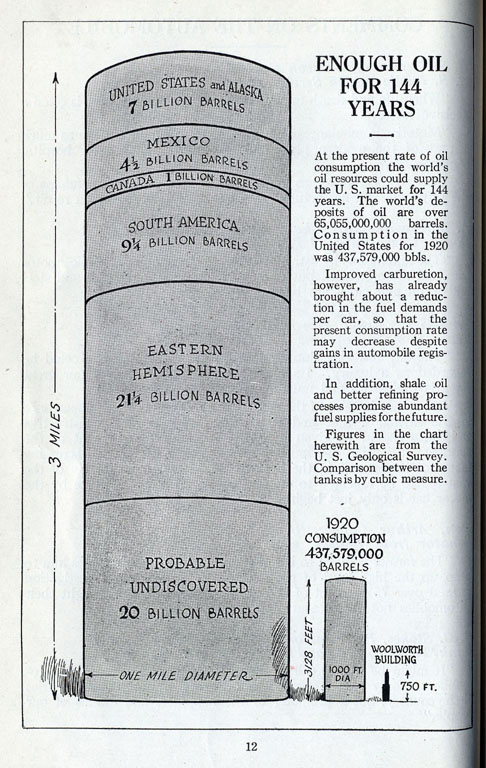
    Oil production

    [Image source:http://www.railsandtrails.com/AutoFacts/1921p12-100-8.jpg]

    There wasn’t that much of a comparative draw on what was supposed to be the world’s total supply of oil, assumed to fill a barrel about 3×1 miles, or 65 billion barrels.  (Also I assume that they are talking about oil oil, total oil, not some derivative of crude/natural/refined petroleum products and so on.) That was supposed to be enough for 140 years at the  level of consumption, about 65 billion barrels, which sounds like a lot when you drinking up 500 million/year. And it should be noted that this was for U.S. consumption only–I don’t know what happened to the rest of the world on this one; probably it was a failure of gathering statistics rather than a myopic America-only viewpoint.

    But that was 1921, and there is no mention of the Middle East (which wouldn’t become a player for a few decades) and other oil-rich regions, and other factors too numerous to mention in this quick post, so it was very much a prediction of the moment more so than of the future. The other very problematic issue with the graph is assuming the “current rate of consumption”, which would absolutely and totally miss the explosion of oil-consuming vehicles and the production of pretroleum-inclusive products.  The bottom line is that in 2013 the total world production of all aspects of oil was about 32 billion barrels1, or half of what was thought to be the total world reserves of oil in 1921.    

    Footnotes

    1. U.S. Energy Information Administration, http://www.eia.gov/cfapps/ipdbproject/IEDIndex3.cfm?tid=5&pid=53&aid=1


  • Robots: Swivels, Speed, and Stumps (1928)

    JF Ptak Science Books  Quick Post

    Sometimes the future of the past looks a little, well, dodgy, or at least it looks a little too quickly assembled. 

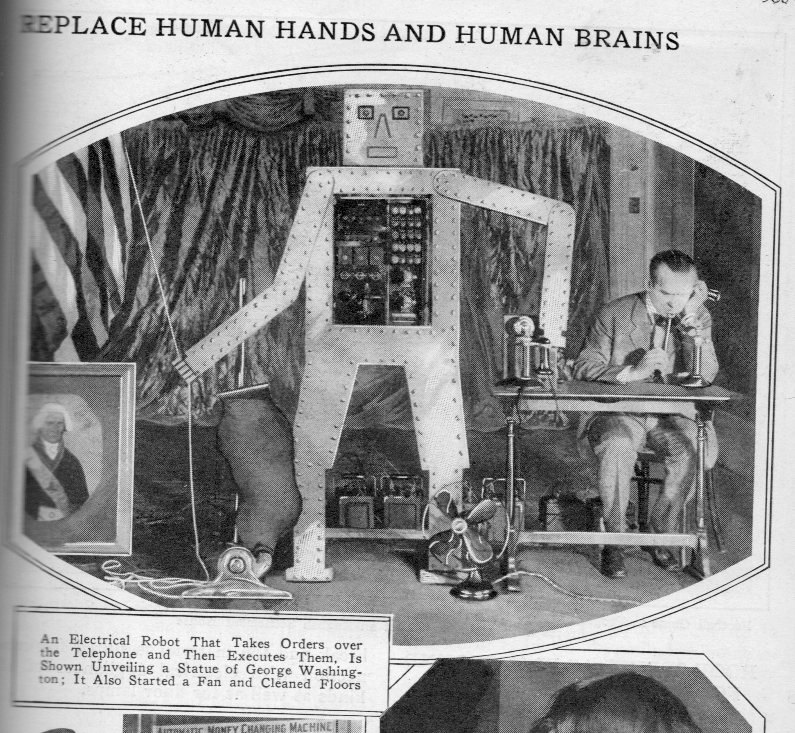
    I have a few robots to add to this blog’s collection of robots–both are from the same volume of Popular Mechanics for 1928.  The first features a large manikin-like robotic cut-out, with a few swivel joints, and performs a couple of tasks. More than likely this was all that it could do.

    Robot 1928560